
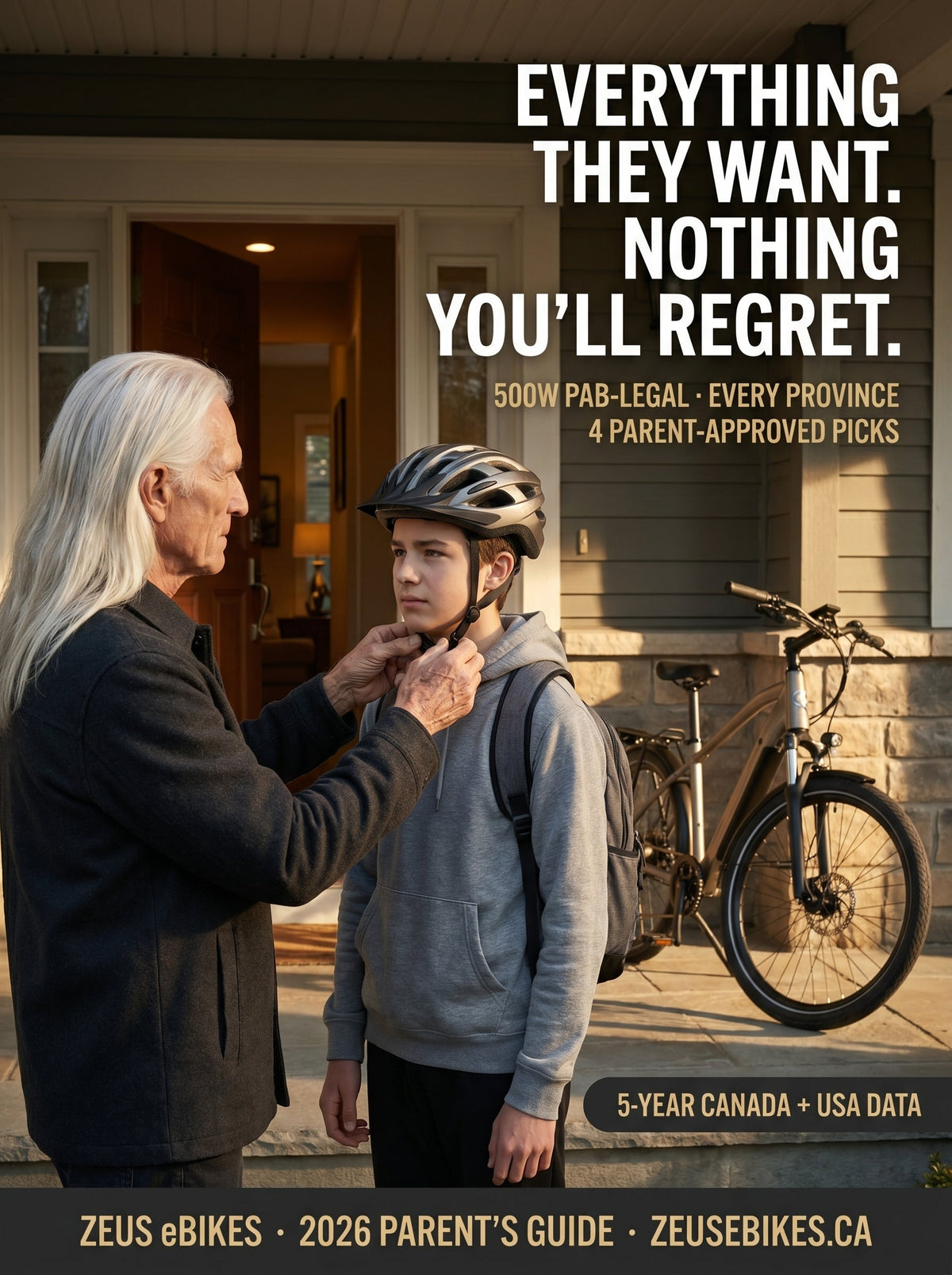
The True Cost of Power: A Canadian Parent's Guide to Buying an Electric Bike for Your Kid or Teen

📸 All photography by Playcut.ai — personalized AI actor technology
The decision is not "should my kid or teen ride an electric bike." The decision is "which class of machine is in my driveway." A legal Canadian Power-Assisted Bicycle (PAB) — 500W nominal motor, 32 km/h motor cutoff, functional pedals, helmet on every ride — sits in the safety neighbourhood of a regular bicycle, materially safer per kilometre than a teen behind a steering wheel. A 1,500W-8,000W "eBike" with pedals bolted on for compliance is a motorcycle, and that is the class causing the fatalities and the parent prosecutions filling the headlines. For a kid or teen, five parent decisions matter, in this order: (1) ≤500W nominal, (2) provincial age met, (3) helmet on every ride, (4) zero modifications, (5) insurance verified in writing. Zeus picks in this guide span a true kids' bike to a premium trail machine: Eunorau eKids 24 (age 8+, $1,299) · Eunorau Meta Foldable ($2,295) · Eunorau Defender ($2,450) · Taubik Tour S ($2,899), plus 24-inch, fat-tire, 29-inch and full-suspension options below. Every pick is 500W nominal or less with a listed road speed of 32 km/h or less; the cards flag the ones whose maker pages also describe a faster or unlockable setting, and whether a bike with an unlockable cap qualifies is not settled.
The Canadian Paediatric Society's handout for parents, "Electric scooters and bikes: Not safe for kids" (last updated October 2025), says: "Children under 16 years should not use e-scooters or e-bikes or ride on them as passengers." It names no exception for children's models. That is medical guidance, not a law, and provincial age rules differ; this guide sets out both so you can weigh them together.
Should you buy your kid or teen an electric bike? The honest answer needs two facts you may not have heard.
Fact 1. Not all "e-bikes" are the same. A legal Canadian e-bike has a 500-watt motor or smaller, stops giving power at 32 km/h, and has working pedals. With a helmet, this kind of bike is about as safe as a regular bicycle.
Fact 2. Some bikes sold as "e-bikes" are actually electric motorcycles. They have 1,500 to 18,000 watts of power, go 50 to 100 km/h, and the pedals (if they have them) are for show. These are the bikes behind almost every news story you have read about kids getting hurt or killed, and the parents being charged with crimes.
So the question is not "should my kid ride an electric bike." It is "which kind of electric bike is in my driveway."
Five things to check, in order:
- Is the motor 500 watts or less?
- Does my province let my kid ride it at their age? (12 in Alberta. 14 to 16 in most provinces. Quebec needs a special licence for 14- to 17-year-olds.)
- Will my kid wear a helmet every single ride? (Without a helmet, your kid is about twice as likely to get a head injury.)
- Will the bike be left alone — no aftermarket battery, no faster controller, no removed speed limit?
- Does my home insurance cover the bike? (Get the answer in writing.)
If all five answers are yes, the data says the bike is safer per kilometre than letting your teen drive a car. It is also five to ten times cheaper. If any answer is no, fix that first before the bike goes anywhere.
Scope: 5-year window. 2021 through 2026. Canada and USA data side by side. Primary sources only. Explicit no-cherry-picking discipline — counter-data is presented in equal weight to risk data. If e-bikes substitute car trips, that data is in here. If the per-trip cycling fatality rate is in the same range as driving, that's in here. If catastrophic injuries cluster around a specific product class (e-motorcycles disguised as e-bikes) rather than the PAB-legal category, that distinction is in here.
Statistical rigour note: Confidence intervals (CIs) and p-values are reported in this guide where the original source publication provides them. The JAMA Surgery 2024 helmet odds ratio (1.9× higher head-injury odds for non-helmeted riders, p=0.005) is the cleanest statistical claim in the cited literature. Aggregate percentage changes from press releases (e.g., SickKids 220% YoY surge, St. Michael's 240% over 5 years, Toronto Fire ~1,200% over 5 years, AAOS 2026 ~300% pediatric e-bike accident rise) are reproduced as published — these are descriptive aggregate changes and the source publications did not include CIs or significance testing in the public-facing press materials. A formal regulatory document would require access to the underlying clinical or incident-level data to compute CIs; this editorial does not.
Primary medical sources audited: Canadian Paediatric Society "E-scooter and e-bike warning" (Aug 15, 2024 — Rosenfield & Beno, Injury Prevention Committee); SickKids press release (Aug 9, 2024); Unity Health Toronto / St. Michael's Hospital (Oct 2025 — Ontario Ministry of Transportation Road Safety Research Partnership); CHIRPP retrospective in Paediatrics & Child Health; JAMA Surgery 2024 (Fernandez, Li, Patel, Allen, Ghaffar, Hakam, Breyer — UCSF); Surgery Open Science 2023 (Goodman et al., PMID 37519328); AAOS 2026 Annual Meeting (Thompson et al. — Rady Children's Hospital / UC San Diego, abstract ID 005354); CPSC Micromobility Products-Related Deaths, Injuries, and Hazard Patterns 2017-2023; KFF Health News.
Primary regulatory and legal sources audited: the former Canadian federal Power-Assisted Bicycle definition (repealed by SOR/2020-22, registered Feb 4, 2020, repeal in force Feb 4, 2021) and the provincial e-bike rules; Health Canada Notice of Intent on Lithium-Ion Batteries (Dec 2, 2025 – Feb 14, 2026 consultation); Quebec Arrêté ministériel n° 2024-15 (dated July 26, 2024; Gazette officielle du Québec, July 30, 2024, in force that day) and Arrêté n° 2024-24 (Gazette officielle du Québec, January 26, 2025, which made the prohibition permanent); California Senate Bill 1271 (Oct 2024, effective Jan 1, 2026); New York City Local Law 39 of 2023 (effective Sept 16, 2023); California Attorney General Rob Bonta "Too Fast, Too Furious" alert (April 14, 2026); Toronto Fire Services published incident data (Chief Jim Jessop); FDNY 2024 lithium-ion fire data; Vancouver Fire Rescue Service; Montreal SIM. Desrochers v. McGinnis, 2024 ONCA 63 (Ontario HTA s. 192(2) owner vicarious liability for negligent entrustment); Edmondson v. Edmondson, 2022 NBCA 4 (New Brunswick parental negligence); Quebec Civil Code arts. 1457 and 1459; Floyd et al. v. Bowers et al., 1978 CanLII 1465 (ON SC), aff'd 1979 (Ont. C.A.) (negligent entrustment); Dominion v. Hannam / Pender v. Squires, 2013 NLCA 37 (NL homeowner-policy duty to defend); Criminal Code ss. 215, 218, 219–221.
Operational evidence: Zeus eBikes Canada product page verification (URLs, prices, specs, stock status, collection assignment) live as of May 21, 2026. Direct commercial verification by the editorial team of every product link and product specification cited.
This guide is published by Zeus eBikes Canada, a Canadian electric bike retailer (zeusebikes.ca). Zeus carries the nine Zeus picks featured in the product section below and benefits commercially if a reader purchases any of them. The editorial positions taken in this article — that the "kid and teen eBike crisis" is, in honest data, overwhelmingly an e-motorcycle and aftermarket-battery crisis affecting riders under 18; that ≤500W PAB pedal-assist eBikes with helmets and supervised early riding sit in the safety neighbourhood of regular bicycles; that modification is the dominant single-variable safety risk under parental control — are presented as the author's editorial views, supported by the primary-source citations linked throughout, and offered as fair comment on a matter of public interest under Canadian law.
This article is not legal advice and is not a substitute for individual consultation with a lawyer or insurance broker about your specific situation. Provincial laws, insurance contracts, and individual circumstances vary. Verify the current rules for your province and the specific terms of your policy before acting on any of the material below.
In This Guide
- The Two Categories — The Data Trick That Hides the Real Problem
- The Verified Canadian Record — 5 Years
- The Verified US Record — 5 Years
- The Named Cases — What They Actually Tell Us
- The Canadian PAB Framework — What's Actually Legal
- The Modification Trap — Where the Real Risk Lives
- The Battery Fire Reality — Aftermarket Cause, Standards Gap
- The Insurance and Liability Reality
- The Honest Cost Math
- Counter-Data — What Most Articles Bury
- The E-Scooter Question — Neutral Data Presentation
- The Parent Decision Framework
- Zeus's Picks — Kids, Teens & Taller Riders
- Sizing the Bike for a Growing Kid
- Teaching the First Rides — A Supervised Progression
- The Parent–Rider Agreement (Printable)
- Buyer's Guide Handoff — Where to Go Next
- Limitations of This Guide (Honest Disclosure)
- References & Primary Sources
- Frequently Asked Questions
The Two Categories — The Data Trick That Hides the Real Problem
The article that follows applies whether your rider is a 12-year-old, a 14-year-old, or a 17-year-old — the Canadian framework, the data, and the parental control levers are the same across the kid-to-teen age range. Before any honest parent decision can be made, one editorial trick has to be exposed.
The "teen e-bike injury crisis" headline that has driven the past two years of Canadian and US news coverage is collapsing two completely different product categories under one phrase. When the categories are separated, the safety picture changes radically — and the parent's decision becomes simple in a way it cannot be when the categories are blurred.

The two categories:
The 3-Second Test: Is It a Bicycle or a Motorcycle?
Run all three checks against the manufacturer's spec sheet — not the marketing copy. All three must pass for the machine to be a legal Canadian e-bike (PAB).
Category A — Legal PAB E-Bikes
What they are: ≤500W nominal motor (Canada) or ≤750W (US), motor cutoff at 32 km/h (Canada) or 20-28 mph (US), functional pedals required.
What the data shows: Injuries rising because adoption is rising. The European shared e-bike injury rate per million trips fell 18.4% year-over-year in the 2025 reporting period while trip volume grew 72.3% (Micro-Mobility for Europe 2025). Mode-for-mode, a Canadian PAB pedal-assist with a helmet sits in the safety neighbourhood of a regular bicycle.
Named teen fatalities in this category, North America 2021-2026: Molly Steinsapir, 12, RadRunner, January 2021 (riding as a passenger on a friend's bike; the brake-defect lawsuit against Rad Power Bikes was voluntarily dismissed in April 2023 following a $1.5M settlement between the Steinsapir family and the operator's parents, which Rad Power opposed — the defect claim was never adjudicated on the merits). Brodee Champlain-Kingman, 15, e-bike, struck by van at intersection while changing lanes, June 2023 — the same mode-share risk any cyclist faces. No Canadian named teen e-bike fatality positively identified through tier-1 search as of May 21, 2026.
Category B — E-Motos Disguised as E-Bikes
What they are: 1,000W to 18,000W motors, 30-65+ mph top speeds, often with pedals "bolted on for compliance theatre," typically sold with an "off-road unlock" that bypasses the 20 mph / 32 km/h legal cap.
Examples: Sur-Ron Light Bee, Hyper Bee, Storm Bee, Ultra Bee (4-8 kW peak). Talaria. Onyx RCR (18,000W, 65+ mph). Ridstar Q20 (1,500W single-motor, ~28+ mph) and Q20 Pro (2,000W dual-motor, manufacturer-claimed ~34 mph) — both subject to a CPSC unilateral fire warning March 19, 2026. FENGQS F7 Pro (high-power off-road e-bike with 52V/21.5Ah battery, subject to a CPSC unilateral warning June 18, 2025 after 9 fire reports).
Named teen fatalities and parent prosecutions in this category, North America 2021-2026: Saul Cookson, 15, Sur-Ron Light Bee, June 2023 (UK, referenced as the closest international comparator). Benson Nguyen, 13, non-street-legal electric motorcycle, Garden Grove CA, May 7, 2026 (Garden Grove Police explicitly stated "not an e-bike — no pedals"). Ed Ashman, 81, killed as a pedestrian by a 14-year-old on a Sur-Ron Ultra Bee, Lake Forest CA, April 16, 2026 (mother Tommi Jo Mejer charged with involuntary manslaughter and 5 other counts).
Yorba Linda, July 2025: 12-year-old severely injured on a modified 60 mph "e-bike" (father Richard John Eyssallenne charged with felony child endangerment). Walnut Creek, Sept 2025: 17-year-old severely injured on a Sur-Ron Light Bee, ridden, per the DA, "in an unsafe manner and at unsafe speeds" (parents Crews/Gabellini charged with misdemeanour child abuse). All charges are allegations; none of these cases has been adjudicated as of publication.
Read the lists side by side. Every named parent criminal prosecution in 2025 and 2026 is in Category B. Every named teen fatality where the bike is positively identified and where it killed the rider (not where the rider was struck as a cyclist) is in Category B. The one Category A lawsuit — Steinsapir against Rad Power Bikes for alleged defective brakes — settled between the two families involved and was voluntarily dismissed; the defect claim against the manufacturer was never decided on the merits.
This is not a defence of every e-bike on the market. It is a refusal to collapse the legal PAB pedal-assist category into the catastrophic risk pattern of a different product class. Both classes need editorial honesty applied to them. Both classes deserve to be discussed by their actual risk profile, not by the headline-aggregated phrase "teen e-bikes."
PeopleForBikes, the US bicycle industry's policy organisation, published this exact framing in September 2025 in a piece titled "The E-Bike Problem Is an E-Moto Problem." The organisation is drafting US bill language to ban the "crossover" products — motorcycles with pedals bolted on — from being sold as e-bikes.
Velo / Outside ran the same disaggregation in December 2025 with the headline "E-Bike Injuries Are Up 1,800%, But It's Not Actually E-Bikes: It's Electric Motorcycles." The Canadian regulatory analogue is Quebec's Arrêté ministériel n° 2024-15 (in force July 30, 2024; made permanent by Arrêté n° 2024-24 from January 26, 2025), which bars from public roads, bike lanes included, two- and three-wheeled motor vehicles that look like a motorcycle or moped and carry no compliance label or national safety mark when they also have footrests, motorcycle-style wheels, a body over the frame without an adjustable saddle, or a motor that exceeds 32 km/h or 500 W.
Almost every named teen fatality and every parent criminal prosecution clusters in one category. The other category — pedal-assist ≤500W PAB e-bikes with helmets — sits in the safety neighbourhood of regular bicycles. The headline collapses the two. The honest parent decision separates them.
The Verified Canadian Record — 5 Years
Canadian medical, fire, and regulatory data through May 2026. The numbers are real, the sources are primary, and the editorial frame here is honest: this is what the Canadian record actually shows when read in full, not just the parts that drive a particular narrative.
Canadian Hospital Data
SickKids (Hospital for Sick Children, Toronto) published a press release on August 9, 2024 documenting a 220% year-over-year surge in e-scooter injuries at the institution — 16 cases (June-July 2024) versus 5 cases (June-July 2023). Note the precise wording: this is e-scooter data, not e-bike data. The press release is often paraphrased into "e-bike" headlines, but the underlying figure attaches to e-scooters specifically. E-scooters account for 85% of all battery-powered device injuries at SickKids 2021-2024.
56% of e-scooter injury cases involved a rider without a helmet. Dr. Suzanne Beno, Medical Co-Director of the SickKids Trauma Program, and Dr. Daniel Rosenfield, SickKids pediatric ED physician, are the named clinicians in the release; Dr. Rosenfield confirmed publicly that a 13-year-old died from an e-scooter crash in 2023 with "catastrophic" injuries.
St. Michael's Hospital (Unity Health Toronto), Level 1 Trauma Centre, reported in October 2025 that e-bike trauma cases rose from 15 (2020) to 51 (2024) — a 240% increase over 5 years. E-scooter trauma cases at the same institution rose from 4 (2020) to 28 (2024), a 600% increase. Patients across both categories present with head, facial, and extremity injuries ranging from "minor scrapes to open fractures and traumatic brain and spinal cord injuries." St. Michael's is leading a new study funded by the Ontario Ministry of Transportation's Road Safety Research Partnership Program.
CHIRPP (Canadian Hospitals Injury Reporting and Prevention Program) retrospective data published in Paediatrics & Child Health documented ED visits for e-scooters at one Ontario site rising from 1 (2020) to 46 (2024). Mean patient age 12.0 ± 3.4 years, 75% male. Among reported helmet status, 78.5% were not wearing helmets. Head and facial injuries accounted for 36.6% of all injuries; fractures 33.7%.
The Canadian Paediatric Society "E-scooter and e-bike warning" (August 15, 2024) is the strongest Canadian medical authority on this topic and the source most cited by Canadian pediatricians when parents ask. The CPS guidance covers helmet use, age limits, supervised early riding, and the importance of distinguishing legal e-bikes from over-limit electric motorcycles. The full warning is available at the CPS website (cps.ca).
The Society's handout for parents, last updated October 2025, is plainer still: "Children under 16 years should not use e-scooters or e-bikes or ride on them as passengers." Its reason: "Children under 16 do not typically have the strength, coordination, or experience needed to safely operate them." (Caring for Kids)
Canadian Fire Service Data
Toronto Fire Services published a year-over-year lithium-ion fire breakdown showing total Toronto lithium-ion fires rising from 29 (2022) to 55 (2023) to 76 (2024) to 90 (2025) — a 210% increase from 2022 to 2025. E-bike and e-scooter-specific lithium-ion fires rose from 3 (2020) to 25 (2024) to 39 (2025, partial year) — what TorontoToday called a 1,200% increase from 2020 to 2025. Toronto Fire Chief Jim Jessop has publicly stated that e-bike batteries are "the largest growing fire safety risk in the city" and has formally requested federal-government action on standardisation and certification.
Toronto Fire's root-cause analysis is editorially critical: the agency attributes most of the increase to "cheaper aftermarket batteries and chargers that aren't manufacturer-approved" and "DIY modifications — charging faster, more power." This is not a story about original-equipment manufacturer (OEM) batteries on PAB-compliant e-bikes catching fire. It is a story about aftermarket and modified equipment, mostly attached to over-limit bikes, causing fires.
Montreal SIM (Service de sécurité incendie de Montréal) documented lithium-ion fires rising from 24 (2022) to 43 (2023) to 71 (2024) — a 195% increase over two years. SIM attributes most of the increase to micromobility devices.
Vancouver and BC. Vancouver Fire Rescue Service's 2024 annual report flagged lithium-ion battery risks as an emerging challenge, particularly in Single-Room Occupancy buildings. BC's Office of the Fire Commissioner recorded 70 rechargeable battery fires province-wide in 2023, $3.4M in damage, 4 injuries, 0 deaths. Surrey 2025 data: of 8 battery-caused fires that year, 5 involved e-scooters or e-bikes — and the typical cause was a modified charger, an aftermarket charger, or batteries placed in serial-versus-parallel to extract more power.
Health Canada Aggregate
Between 2013 and 2023, Health Canada's Consumer Product Safety Program received 924 reports of lithium-ion battery incidents, 266 (28.8%) involving injuries. Health Canada's December 2025 – February 2026 pre-consultation on proposed new lithium-ion battery requirements explicitly excludes e-bikes from the proposed regulation because they fall under the Motor Vehicle Safety Act vehicle definition. This is the structural Canadian regulatory gap that Toronto Fire Chief Jessop has formally asked Ottawa to close.
The Canadian Fatality Gap
The most editorially honest disclosure in this section: no verified named Canadian teen fatality on an e-bike (as opposed to a pedal bike or an e-motorcycle) has surfaced in tier-1 search through May 21, 2026. Two Manitoba dirt-bike fatalities of 15-year-old boys were reported by CBC and CTV in 2025 — neither outlet specified make or model, and we do not classify those as e-bike incidents.
AJ Edhi, 13, was killed in Edmonton in May 2024 in a hit-and-run; coverage describes the victim as on "a bike," not specifically an e-bike. An Etobicoke 15-year-old was seriously injured in a 2025 e-bike collision; not fatal, no public identification. The absence of named Canadian teen e-bike fatalities does not mean Canada is safe — it most likely reflects (a) more recent Canadian market penetration than the US, and (b) Canadian police agencies describing crashes as "dirt bike" or "e-bike" without naming the make. But the absence is real and is worth recording honestly.
The Verified US Record — 5 Years
US data is more complete than Canadian data because the CPSC, NEISS, and US trauma centres publish at a higher cadence. The US record is also where the headline injury surges most often quoted in the Canadian press originated. Here is the full picture, with the no-cherry-pick discipline applied.
The Headline Numbers
JAMA Surgery 2024 (Fernandez et al., UCSF) — the single most-cited dataset. Published February 21, 2024 in JAMA Surg. 159(5):586–588. NEISS-derived data, 2017-2022.
- 45,586 estimated e-bike injuries 2017-2022 (95% CI 17,079–74,094)
- 30-fold rise in injuries; 43-fold rise in hospitalizations (over 108% annually)
- Head trauma went from ~163 cases (2017) to ~7,922 (2022) — a 49× increase. By 2022, head injuries represented 34% of all e-bike injuries.
- Age-cohort shift: children (<18) went from 0% (2017) to 13% (2022) of e-bike injuries. Young adults (18-34) decreased from 63% to 30%.
- Helmet use declined 5.6% per year (p=0.01). Non-helmeted riders had 1.9× higher odds of head injury.
Goodman et al., Surgery Open Science 2023 (PMID 37519328) — pediatric-specific, NEISS 2011-2020, ages 2-18.
- 3,945 pediatric e-bike injuries across the 10-year window
- Average age: 12 years. Ages 10-13 represented 44.3% of injuries. 82.5% male.
- Hospitalization rate: e-bikes 11.5% vs. pedal bikes 4.8% (p<0.0001) — e-bikes ~2.4× higher risk of severe injury vs pedal bicycles
- 97.3% of injured pediatric e-bike riders were not wearing a helmet, compared to 82.1% of injured pedal cyclists — the injured e-bike cohort was substantially less likely to have any documented helmet use
- Most prevalent injury types: lacerations 18.1%, fractures 21.4%
AAOS 2026 / Rady Children's Hospital San Diego (Thompson et al., abstract ID 005354 — "E-Bike Orthopaedic Injuries Amongst Pediatric and Adolescent Patients at a Level 1 Trauma Center") — presented at the American Academy of Orthopaedic Surgeons 2026 Annual Meeting (March 2-6). Senior researcher: Dr. Rachel Mednick Thompson, FAAOS (Rady Children's / UC San Diego).
- E-bike share of pediatric micromobility trauma activations: 2% (2017) → 64% (2023)
- 2019-2023: pediatric e-bike accidents in San Diego rose >300%
- Patients in e-bike accidents were more likely to sustain extremity injuries (OR = 4.2, p<0.001) and sustained more fractures (0.6 vs 0.2 per patient, p<0.001) than pedal-bike accidents
Marin County, California — Dr. John Maa, MarinHealth Medical Center, the county's only Level 1 trauma facility:
- 10-15 year olds in Marin County: 5× the e-bike crash rate of all other age groups (Marin 911 data)
- Death rate from e-bike trauma at MarinHealth: 37× higher than from conventional pedal-bike trauma
- 110% increase in 911 calls for bicycle accidents among youth 10-19 from 2019 to 2022
- Drove the Marin County Special Committee on Youth E-Bike Safety and an under-16 throttle-bike ban
CPSC Aggregate
The CPSC's "Micromobility Products-Related Deaths, Injuries, and Hazard Patterns 2017-2023" report (published 2024) is the most comprehensive US aggregate.
- 448,600 micromobility injuries treated in US EDs 2017-2023
- ED visits rose from 34,000 (2017) to 87,800 (2023) — statistically significant (p<0.01)
- E-bike share: ~87,400 injuries = 19% of all micromobility
- E-bike injuries grew 10× between 2017 and 2023 (34,200 cases in 2023 alone)
- 193 e-bike-attributed fatalities 2017-2023 (52% of 373 total micromobility fatalities)
- Motor vehicle collisions caused 113 of those fatalities (59%) — that is, the e-bike rider was struck by a car
- 14 e-bike fatalities were from lithium-ion battery fire, across 8 separate incidents
FDNY (New York City) — The Counter-Example
FDNY 2024 lithium-ion fire data is the single best evidence that regulatory action on battery certification works. After New York City Local Law 39 of 2023 took effect (September 16, 2023), requiring UL 2849 certification for e-bikes, UL 2272 for e-scooters, and UL 2271 for batteries, FDNY's e-bike fire numbers and deaths both dropped:
- 2023: 18 deaths from lithium-ion batteries (all device types)
- 2024: 277 lithium-ion fires (vs 268 in 2023), 264 specifically e-bike, 95 injuries, 6 deaths from all lithium-ion fires. FDNY does not publish e-bike-specific death counts; the NYC Public Advocate's December 2024 partial-year report ("Stopping the Blaze") cited 5 lithium-ion-related deaths in 2024 at that point, in an e-bike-focused report.
- 67% drop in lithium-ion-related deaths 2023→2024 attributed by FDNY to a combination of Local Law 39 enforcement, Local Laws 49 and 50 of 2024, the city's e-bike trade-in program, a $1M targeted ad campaign, education and outreach, and 585 e-bike shop inspections in 2024 (+25% YoY)
- Enforcement: 426 FDNY summonses, 138 violation orders, 32 criminal summonses, 7 vacate orders in 2024
The FDNY data is also the cleanest evidence available that the problem is the bottom-quartile uncertified product category, not the e-bike category broadly. Certify and enforce, and the deaths drop two-thirds in one year.
The Named Cases — What They Actually Tell Us
Aggregate statistics tell parents about the volume of risk. Named cases tell parents about the shape of risk — what type of bike, what kind of riding, what factors clustered together to produce the fatal or catastrophic outcome. Below are the named cases on the public record where the bike, the age, and the circumstances are documented to a tier-1 standard. Read them by category, not chronologically.
Named Fatalities on Legal PAB E-Bikes (Category A)
Molly Steinsapir, 12, Pacific Palisades, California — January 31, 2021. Riding as a passenger on a friend's Rad Power RadRunner (a US Class 2 throttle pedal-assist consistent with the federal e-bike definition) down a hill. The bike went into a wobble on the descent and Molly was thrown to the concrete. Her helmet was on, but the traumatic brain injury was severe. After multiple brain surgeries she died 15 days later, on February 15, 2021.
Her parents sued Rad Power Bikes alleging defective brakes. The case was voluntarily dismissed with prejudice in April 2023 following a $1.5 million settlement between the Steinsapir family and the parents of the operator — the surviving 11-year-old friend — a settlement Rad Power opposed. The brake-defect claim against Rad Power was never adjudicated on the merits.
This is the closest North American example of a teen fatality on a legal e-bike since 2021, and the honest reading is plain: a downhill loss-of-control crash on a bike that sat squarely inside the legal e-bike definition. The risk pattern is closer to a high-speed bicycle descent than to an out-of-class motor vehicle.
Brodee Champlain-Kingman, 15, Encinitas, California — June 22, 2023. San Dieguito Academy student. Struck by a van while changing lanes on S El Camino Real near Santa Fe Drive. Helmet on. Organ donor — his mother stated publicly that his heart helped preserve another life. State Senator Catherine Blakespear subsequently secured a $3.09 million Santa Fe Drive Corridor Improvements project for the area; Brodee's mother spoke at the September 2023 presentation.
The bike was described in family and news coverage as an e-bike; the Sheriff's Department did not publicly classify it as a specific US Class 1, 2, or 3. This is a cyclist-struck-by-vehicle fatality. The same risk pattern would apply to a teen on any bicycle at the same intersection.
Named Fatalities and Catastrophic Injuries on E-Motos (Category B)
Editorial note: the parent prosecutions described below are charges, not convictions. The named individuals are entitled to the presumption of innocence under both US and Canadian law. The information that follows is reproduced from primary District Attorney press releases and court filings as of publication and may change as the cases proceed.
Saul Aiden Cookson, 15, Salford, United Kingdom — June 8, 2023; inquest closed January 9, 2025. Riding a Sur-Ron Light Bee. Followed (not "pursued" per Greater Manchester Police policy) by a police BMW X5; collided with an ambulance on Langworthy Road. Multiple traumatic injuries. The IOPC found GMP officers acted "appropriately"; coroner Michael Pemberton concluded the cause was the road traffic collision. Referenced here as the closest published comparator on a Sur-Ron Light Bee fatality in the English-speaking world.
Benson Nguyen, 13, Garden Grove, California — May 7, 2026. Riding a non-street-legal electric motorcycle at approximately 35 mph on Magnolia Avenue near Larson Street. He struck the centre median and was ejected. He was wearing a bicycle helmet, not a motorcycle helmet. Garden Grove Police publicly stated the vehicle "was not an e-bike" and "did not have pedals," and described it as more comparable to an off-road dirt bike than to a bicycle.
Ed Ashman, 81, Lake Forest, California — struck April 16, 2026, died April 30, 2026. Pedestrian. Vietnam veteran. Substitute teacher at El Toro High School. Struck at the intersection of Toledo Way and Ridge Route Drive by a 14-year-old riding a 2025 Sur-Ron Ultra Bee — a 4-8 kW peak electric motorcycle the Orange County District Attorney has publicly described as "16 times more powerful than an e-bike." The teen was doing wheelies.
The 14-year-old's mother, Tommi Jo Mejer, 51, was charged April 30, 2026 with involuntary manslaughter, child endangerment, accessory after the fact, contributing to the delinquency of a minor, providing false information, and permitting an unlicensed minor to drive. Maximum sentence approximately 7 years 8 months.
Yorba Linda, California — July 20, 2025. A 12-year-old, riding an e-bike that the rider's father (Richard John Eyssallenne, 39) had helped modify to 60 mph (pedals replaced with motorcycle pegs, governor removed, rewired), ran a red light and struck a Honda Civic. The child suffered concussion, intracranial bleed, skull fracture, broken wrist, fractured femur. The father was charged with felony child endangerment, child abuse, and contributing to the delinquency of a minor — maximum 6 years. The father had attended a community e-bike safety presentation on January 15, 2025, weeks after his son's previous citation. The Orange County DA's press release is the primary source.
Walnut Creek, California — September 18, 2025. A 17-year-old was severely injured colliding with a minivan while riding a Sur-Ron Light Bee. The Contra Costa County District Attorney described the riding as "in an unsafe manner and at unsafe speeds." The teen's parents, Steven Leroy Crews and Jeanna Marie Gabellini (Benicia residents), were charged with misdemeanour child abuse for allowing their son to ride from ages 14 through 17 despite repeated citations and warnings.
The Pattern, Read Honestly
Place the cases beside each other and the pattern is editorially unambiguous. Category A holds two North American teen fatalities since 2021 — Steinsapir, a lost-control downhill whose lawsuit settled between the two families and was never decided against the manufacturer, and Champlain-Kingman, a cyclist struck by a vehicle at an intersection. Category B holds at least three named teen fatalities or catastrophic injuries (Cookson, Nguyen, Yorba Linda 12-year-old) and three sets of parents criminally charged in 2025-2026 (Mejer, Crews/Gabellini, Eyssallenne). None of the parent prosecutions involved a legal PAB pedal-assist e-bike. Every one involved an over-limit or modified vehicle.
This does not make any of these cases less tragic. Each child and each victim deserves to be named and remembered. But the editorial conclusion the data forces — and that every honest parent reading should sit with — is that the catastrophic-injury and criminal-liability risk is heavily concentrated in one product category, not the other.
A parent who buys a 500W PAB pedal-assist bike, enforces helmet use, and refuses modification is operating in the same risk profile as a parent whose teen rides a regular bicycle. A parent who lets a teen ride a Sur-Ron Ultra Bee on a public road is operating in a profile that has produced, in 2026 alone, multiple felony-charge filings.
Two named North American teen fatalities on legal e-bikes in 5 years. Three named parent criminal prosecutions in a single 12-month window on over-limit or modified bikes. The product category is the single biggest variable.
The Canadian PAB Framework — What's Actually Legal
Canada does not use the US Class 1/2/3 e-bike system. Canadian e-bike law is provincial: the provincial definitions (Newfoundland and Labrador's Act has none) converge on three criteria for a vehicle to qualify as an e-bike rather than a motor vehicle, the same three the former federal Power-Assisted Bicycle (PAB) definition used until its repeal on February 4, 2021.
Some retailers and even some Canadian publications conflate Canadian PAB with US Class 1/2/3 — that conflation is wrong on the law and creates real legal exposure for parents and teens.
The Three PAB Criteria
- Motor output ≤500W nominal. Not peak. Not "advertised maximum." Nominal. A motor labelled as 500W nominal with a higher peak rating is permitted; a motor labelled as 750W or 1,000W or 1,500W is not.
- Motor cutoff at 32 km/h. The motor must stop providing assistance at 32 km/h (20 mph) under its own power. The rider can pedal faster — the motor simply cannot continue to contribute. A bike capable of motor-assisted speeds above 32 km/h is not a PAB.
- Functional pedals required. The bike must have pedals capable of propelling it. Pedals "bolted on for compliance theatre" — non-functional, decorative, or designed to be removed — do not count. The pedals must work.
Historical note: the former federal PAB definition sat in the Motor Vehicle Safety Regulations until February 4, 2021, when its repeal took effect. Transport Canada made SOR/2020-22 on February 4, 2020, and its s. 35(2) deferred the repeal of the definition to the first anniversary of registration.
The 500W / 32 km/h / functional-pedals criteria live on in provincial law, with differences: Nova Scotia’s 30 km/h ended on 19 October 2026, and British Columbia has had two classes since April 5, 2024 (Light: 250W, 25 km/h, no throttle, age 14 and up; Standard: 500W, 32 km/h, age 16 and up). The practical effect for a parent: there is no current federal definition, so the rule that applies is your own province’s.
Provincial Age and Helmet Snapshot (2026)
| Province | Minimum Age | Helmet Required | Notable Province-Specific Rule |
|---|---|---|---|
| Ontario | 16+ | All riders, all ages | HTA s. 192(2) owner vicarious liability (per Desrochers v. McGinnis, 2024 ONCA 63 — applies to negligent entrustment by vehicle owners) |
| British Columbia | 14+ for Light E-Bike (≤250W, no throttle, introduced April 5, 2024); 16+ for standard 500W PAB | All riders, all ages | Two-tier light/standard PAB system (B.C. Reg. 64/2024) |
| Alberta | 12+ | All riders, all ages | Lowest minimum age of the provinces that set one; under 18 needs a parent's consent form (AR 320/2002 s. 9) |
| Saskatchewan | 14+ (per SGI Motorcycle Handbook — Power-Assisted Bicycles) | All riders, all ages | SGI requires an approved bicycle or motorcycle helmet for every operator |
| Manitoba | 14+ (HTA s. 183) | All riders, all ages (for power-assisted bicycles specifically) | — |
| Quebec | 18+ default; 14–17 only if holding a Class 6D (moped/scooter) licence | All riders, all ages (helmet with rigid shell, padded interior, chin strap; $60–$100 fine) | Arrêtés n° 2024-15 and 2024-24 bar motorcycle-looking vehicles with no compliance label, such as stock Sur-Rons, from public roads, bike lanes included |
| New Brunswick | No statutory minimum age in the NB Motor Vehicle Act | All riders, all ages on a highway: Service New Brunswick treats a compliant e-bike as a bicycle (Motor Vehicle Act s. 177(3)) | Edmondson v. Edmondson, 2022 NBCA 4 (parental negligence for child passenger on single-occupancy motorcycle) |
| Nova Scotia | 14+ from 19 Oct 2026 (none in the old Act) | All riders, all ages under the old Act; wear one under the new Act too | — |
| Prince Edward Island | 16+ (a power-assisted bicycle is deemed not to be a motor vehicle: no registration or licence) | All riders, all ages | — |
| Newfoundland & Labrador | No minimum age in the Highway Traffic Act (not settled: as written the Act can treat an e-bike as a motor vehicle, which needs a licensed driver; ask Service NL) | All riders, all ages (RCMP NL: "regardless of age") | — |
This snapshot is editorial; specific clauses, exceptions, and recent amendments live in each province's Highway Traffic Act / Motor Vehicle Act. Zeus's province-by-province blog series (Ontario, BC, Quebec, Alberta, Saskatchewan / Manitoba) and the master Electric Bike Laws Canada guide cover the full statutory detail.
Find your province — tap to expand
Ontario
Minimum age: 16+
Helmet: Required — all riders, all ages
Licence (legal ≤500W PAB): Not required
E-scooter: Legal only in participating pilot municipalities; Toronto restricts e-scooters to private property — verify your city
British Columbia
Minimum age: 14+ for the Light E-Bike class (≤250W, no throttle); 16+ for the standard 500W class
Helmet: Required — all riders, all ages
Licence (legal ≤500W PAB): Not required
E-scooter: Legal only in specific pilot communities (Vancouver, Kelowna, North Vancouver, Vernon and others) — verify your municipality
Alberta
Minimum age: 12+ (under 18 needs a parent's consent form)
Helmet: Required for every rider, all ages (AR 122/2009 s. 107(2))
Licence (legal ≤500W PAB): Not required
E-scooter: Legal in participating municipalities (Calgary, Edmonton pilots) — verify locally
Saskatchewan
Minimum age: 14+
Helmet: Required — all riders, all ages (approved bicycle or motorcycle helmet, per SGI)
Licence (legal ≤500W PAB): Not required
E-scooter: Restricted / pilot — verify locally
Manitoba
Minimum age: 14+
Helmet: Required — all riders, all ages (for power-assisted bicycles)
Licence (legal ≤500W PAB): Not required
E-scooter: Restricted / pilot — verify locally
Quebec
Minimum age: 18+ default — riders 14–17 are authorized only if they hold a Class 6D (moped/scooter) licence
Helmet: Required — all riders, all ages
Licence (legal ≤500W PAB): Class 6D required for ages 14–17; none for 18+
E-scooter: Banned from public roads since 2023 (private property only)
New Brunswick
Minimum age: No statutory minimum in the Motor Vehicle Act
Helmet: Required on a highway — all riders, all ages: Service New Brunswick treats a compliant e-bike as a bicycle, so the bicycle helmet rule applies (Motor Vehicle Act s. 177(3))
Licence (legal ≤500W PAB): Not required
E-scooter: Largely restricted — verify your municipality
Nova Scotia
Minimum age: 14+ from 19 October 2026 (N.S. Reg. 230/2026, s. 128); the old Motor Vehicle Act set none
Helmet: Required — all riders, all ages under the Motor Vehicle Act until 19 October 2026; the new Act's helmet section does not name the power-assisted bicycle, though its fine schedule prices a missing helmet: wear one
Licence (legal ≤500W PAB): Not required
E-scooter: Restricted — verify your municipality
Prince Edward Island
Minimum age: 16+ (Power-Assisted Bicycles Regulations, s. 13(2)); PEI deems a power-assisted bicycle not to be a motor vehicle (s. 1(2)), so it needs no registration or licence
Helmet: Required — all riders, all ages
Licence (legal ≤500W PAB): Not required
E-scooter: Restricted — verify your municipality
Newfoundland & Labrador
Minimum age: No minimum age in the Highway Traffic Act; the province expects to amend the Act this fall, and no bill had been tabled as of 18 October 2026
Helmet: Required — all riders, all ages
Licence (legal ≤500W PAB): Not settled: as written the Highway Traffic Act can treat an e-bike as a motor vehicle needing registration, insurance and a driver's licence (ss. 2(oo), 10(1), 43(1), 75(1)); the province applies its cyclist rules. Ask Service NL before a child rides on a road.
E-scooter: Restricted — verify your municipality
Always confirm the current rule with your provincial Highway Traffic Act / Motor Vehicle Act before your kid or teen rides — Zeus's Electric Bike Laws Canada guide carries the full statutory detail by province.
Quebec's Arrêtés n° 2024-15 and 2024-24 — The Strongest Canadian Enforcement
Arrêté ministériel n° 2024-15 is dated July 26, 2024; it was published in the Gazette officielle du Québec and took effect on July 30, 2024, and Arrêté n° 2024-24 made the prohibition permanent from January 26, 2025. It bars from public roads, bike lanes included, any two- or three-wheeled motor vehicle, with or without pedals, that looks like a motorcycle or moped, carries no Transport Canada compliance label or national safety mark, and has at least one of four traits: footrests or a foot platform, motorcycle- or moped-style wheels and tires, a body over the frame with no height-adjustable saddle, or a motor that can exceed 32 km/h or is rated above 500 W.
The ban captures these vehicles by criteria rather than by brand name, and all current Sur-Ron variants (Light Bee, Hyper Bee, Storm Bee, Ultra Bee) fall within scope: they look like motorcycles, carry no national safety mark, and exceed both the speed and wattage thresholds. Fines: $300 to $600. As of CBC reporting in November 2024, SPVM (Service de police de la Ville de Montréal) had issued 244 tickets since the ban took effect; the figure is likely higher today. This is the strongest published Canadian provincial enforcement action against the e-moto category to date.
The PAB Framework Is the Decision Anchor
For a Canadian parent reading this guide, the PAB framework is not a technicality. It is the line between "the bike is a bicycle for legal, insurance, and policing purposes" and "the bike is a motor vehicle requiring registration, plates, motor-vehicle insurance, and a CMVSS National Safety Mark — none of which is typically available to a non-OEM or grey-market unit." Every Zeus pick in this guide is 500W or less and sold at a 32 km/h on-road setting; several have a cap their maker lists as unlockable, and the cards say which.
Several over-limit alternatives sold on Amazon, marketplace listings, and grey-market resellers are not — and the legal status of those is unambiguous regardless of how they are marketed.
The Modification Trap — Where the Real Risk Lives
If the previous sections established the product-category split, this one is where the parental control variable lives. Modification — speed-limiter bypass, aftermarket battery, aftermarket charger, controller swap, motor swap, throttle replacement, rewiring — is the single biggest variable a parent can directly influence. It is also the variable that converts a Category A bike into a Category B bike in a single afternoon with a $0 toolkit and a YouTube tutorial.
What "Modification" Actually Looks Like
The modification culture on teen e-bikes is real, well-documented, and aggressively normalised across YouTube, TikTok, Reddit, and dedicated tuning websites. The most common modifications, in approximate order of frequency:
- Speed-limiter bypass ("delimiting"). Three common methods: (a) magnet relocation — moving the wheel-mounted magnet to a pedal bracket so the controller reads a lower-frequency signal and unlocks higher speed; (b) wire removal — physically stripping the limiting wire from the controller harness; (c) controller setting change — many controllers expose a single Bluetooth or LCD setting that switches between PAB-legal and off-road-unlocked modes. YouTube tutorials demonstrating each of these number in the tens of thousands of views. Quoting Amy Thompson, Boulder Valley School District Safe Routes coordinator (cited in KFF Health News): "It's super easy for kids to go on YouTube and find a video that will coach you how to override or disable the governor."
- Aftermarket battery. Replacing the original OEM battery with a non-manufacturer pack — usually for more capacity, sometimes for more power, sometimes simply because the original failed and the cheapest replacement was a third-party listing on Amazon or AliExpress. Toronto Fire Services has identified aftermarket batteries as a leading cause of e-bike battery fires across Toronto's 1,200% fire increase 2020-2025.
- Aftermarket charger. Using a non-OEM charger — typically a higher-amperage charger to charge faster, or a generic charger because the original was lost or broken. Chargers are not interchangeable across battery chemistries, voltage configurations, or BMS profiles. A mismatched charger can cause thermal runaway in cells that would otherwise be safe.
- Controller swap. Replacing the OEM controller with a higher-output unit to extract more peak power from the same battery and motor. Changes the entire electrical characteristic of the drivetrain and can cause the battery to deliver current outside its design specification.
- Throttle modification. Replacing a Canadian-PAB-legal throttle with a US-style unrestricted throttle, or adding a thumb throttle to a pedal-assist-only bike.
- Motor swap. Wholesale replacement of the motor with a higher-output unit. Less common because more involved, but well-documented in forum and YouTube content.
- Wiring modifications. Splicing, rewiring, or bypassing protective fuses, switches, or BMS components. The most direct fire-risk modification possible.
- Firmware modifications, aftermarket displays, software-unlocks. Common on the higher-end mid-drive systems (Bafang, Bosch, Shimano EP-series). Some firmware modifications void warranties but do not change peak power; others do.
What Happens When a Teen Modifies Their Bike
Three things happen simultaneously, every time. None of them is optional or hypothetical.
Every Zeus-carried manufacturer voids the warranty on a modified unit. Zeus cannot file a warranty claim against any manufacturer for a unit that has been modified — the modification breaks the chain of original-equipment responsibility. This is industry-standard and is not specific to any one brand.
Canadian home and tenant insurance policies typically cover legal ≤500W PAB pedal-assist e-bikes as bicycles, with third-party liability extending under the homeowner's general liability limit. Most policies contain a motorized-vehicle exclusion clause that activates when (a) the bike exceeds 500W nominal, (b) the bike is modified to exceed 32 km/h on motor assist, (c) pedals are removed or made non-functional, or (d) the bike is otherwise altered from its original-equipment specification. When the exclusion activates, an insurer can deny the claim entirely — leaving the rider's parents personally liable for any judgment.
A modified e-bike that exceeds 500W nominal or exceeds 32 km/h on motor assist or has had its pedals removed is no longer a Power-Assisted Bicycle in any Canadian province. It is a motor vehicle. To operate a motor vehicle on a public road in Canada the rider needs a valid driver's licence, the vehicle needs a registration and plate, the vehicle needs valid motor-vehicle insurance, and the vehicle needs a Canadian Motor Vehicle Safety Standard (CMVSS) National Safety Mark to be registrable in the first place. Most over-limit and modified bikes do not carry this mark and cannot be registered. The teen is then operating an unregistered, unlicensed, uninsured motor vehicle on a public road. In a cited Val-Morin Quebec case (May 2024), a single fleeing-on-modified-e-bike incident produced $1,878 in stacked fines plus six demerits.
The Marketing Reality Parents Should Understand
The Sur-Ron Hyper Bee — 8 kW peak, 40 mph (~65 km/h) per Sur-Ron USA spec listings — is marketed by Sur-Ron's authorised distribution network as a youth-oriented model. Its 8 kW peak is far above the 500W line the provinces converge on, and 40 mph is twice the 32 km/h line.
DIAN Motors Inc. (Ottawa), the exclusive authorised Canadian Sur-Ron distributor, explicitly states in its FAQ: "Units sold by unauthorized resellers (i.e. Alibaba, AliExpress, Amazon) cannot be serviced by dealers within our network." Canadian grey-market Sur-Ron units sold through those marketplace channels therefore arrive with no warranty pathway. The legal reality on a Canadian road or pathway: motor vehicle, no plate possible, no insurance possible, criminal exposure if a fatality occurs.
Zeus has covered this category in depth at Sur-Ron in Canada: The Honest Review — Why It's Not Street-Legal in Any Province. The Canadian parent who is being asked by a teen for "an e-bike like my friends have" is, in many cases, being asked for a vehicle in this Category B class. The first parental task is to find out which.
Zeus's Amazon eBikes Canada audit, Ridstar Amazon scam pattern article, and How to Spot a Legit eBike Store in Canada guide collectively map the channels through which over-limit and grey-market bikes typically enter Canadian households.
Modification is the single variable that converts a Category A bike into a Category B bike. The toolkit costs $0. The legal, financial, and safety consequences are catastrophic. This is the variable parents actually control.
The Battery Fire Reality — Aftermarket Cause, Standards Gap
Battery fires are the second variable parents directly control. The data, when read across Toronto Fire, FDNY, Vancouver Fire, Montreal SIM, and CPSC, points to a consistent root cause: aftermarket batteries, aftermarket chargers, and post-purchase modifications. Original-equipment, UL-certified, OEM-charger-only setups are not where the fires are coming from. The regulatory gap in Canada — Health Canada's December 2025 consultation explicitly excluded e-bikes — leaves the certification standard non-mandatory federally. Parents must do the standards work the regulator has not yet done.
Where the Fires Come From
Toronto Fire Chief Jim Jessop's published root-cause framing is the most direct in Canada: e-bike battery fires are "often caused by people buying cheaper batteries and chargers that aren't manufacturer-approved" or "modifying batteries — charging faster, more power." The Vancouver SRO fire on East Hastings in February 2024 was investigator-attributed to "the modified charging system caused the battery to explosively fail." The Surrey 2025 data showed 5 of 8 battery-caused fires that year involved e-scooters or e-bikes with modified chargers or aftermarket chargers, or batteries placed in serial-versus-parallel for more output.
FDNY's 2024 numbers are the cleanest evidence available that the problem is the bottom-quartile uncertified product category and not the e-bike category broadly. After NYC Local Law 39 took effect September 16, 2023 (mandating UL 2849 certification for e-bikes, UL 2272 for e-scooters, UL 2271 for batteries), FDNY's lithium-ion-fire deaths (all device types) dropped from 18 (2023) to 6 (2024) — a 67% reduction in one year.
The fire counts barely moved (268 to 277); the deaths dropped two-thirds. The drop is attributed by FDNY to a combination of Local Law 39, additional 2024 enforcement laws, the city's $1M ad campaign, the e-bike trade-in program, and 585 shop inspections. Certify the batteries, enforce the certification, and the fires stop killing people.
Certification — Where Canada Stands
The standard is published. The mandate is not.
- UL 2849 — Standard for Electrical Systems for eBikes. Published jointly as ANSI/CAN/UL 2849: an American National Standard and a National Standard of Canada via the Standards Council of Canada. Recognised in Canada, but not federally mandated.
- UL 2271 — Batteries for Use in Light Electric Vehicle (LEV) Applications. Same recognition status.
- EN 15194 — European e-bike standard, accepted in some US jurisdictions as a UL 2849 alternative.
- California Senate Bill 1271 — effective January 1, 2026 — bans the sale, lease, or rental of e-bikes in California unless the battery is certified to UL 2849, UL 2271, or EN 15194.
- NYC Local Law 39 of 2023 — effective September 16, 2023 — mandates UL 2849 for e-bike systems, UL 2272 for e-scooters, and UL 2271 for batteries.
- Health Canada — Notice of Intent on Lithium-Ion Battery Requirements, pre-consultation December 2, 2025 to February 14, 2026. The proposed Canadian regulation excludes e-bikes and e-scooters because they fall under the federal Motor Vehicle Safety Act vehicle definition. This is the structural gap that Toronto Fire Chief Jessop has formally asked Ottawa to close.
The practical Canadian-parent implication: until the federal government closes the gap, certification is a buyer-side discipline. Look for UL 2849 or ANSI/CAN/UL 2849 marking on the bike, UL 2271 marking on the battery, and OEM-only chargers. Of the Taubik picks in this guide, Taubik's pages (read 9 October 2026) state UL 2849 certification for the Westridge 4T; a Samsung battery "Certified in accordance with UL 2271" and no system-level UL 2849 for the Tour S and the Blackburn 275T; and a Samsung battery listed as "UL Certified", with no standard named, for the Westridge 29T. Certification status for the other picks is verified individually at the product page.
Recent CPSC Warnings — The Names to Know
The CPSC has issued three unilateral public warnings on e-bike products in the past 12 months — the agency's strongest available tool when a Chinese manufacturer refuses to negotiate a voluntary recall. Every one of these warnings involves a product sold to Canadian consumers via Amazon, Walmart, or direct-to-consumer channels.
- FENGQS F7 Pro — CPSC unilateral warning June 18, 2025. 9 fire reports, $12,000 property damage. Manufacturer refused recall initially; ultimately agreed to a CPSC-supervised recall July 24, 2025. High-power off-road e-bike with 52V/21.5Ah battery pack. Sold on Amazon at $700-$1,200, approximately 180 units in the affected production run. Shenzhen Fengqisi Car Industry Co., Ltd.
- Rad Power Bikes batteries — CPSC unilateral warning November 24, 2025. Issued during Rad Power's Chapter 11 bankruptcy proceedings; the manufacturer refused recall negotiation. Canadian warranties voided as part of the bankruptcy. Vancouver retail store closed.
- Ridstar Q20 / Q20 Pro — CPSC unilateral warning March 19, 2026. 11 fire reports, 1 burn injury, 5 smoke inhalation reports, $40,000+ in property damage. Per Ridstar.net product listings: Q20 is a 1,500W single-motor model rated to ~28+ mph; Q20 Pro is a dual-motor (2× 1,000W = 2,000W combined) model manufacturer-claimed to ~34 mph. Both well over the US Class 3 federal cap and the Canadian PAB cap. Sold on Amazon, Ridstar.net, Walmart. Manufacturer Huizhou Xingqishi Sporting Goods Co. refused recall. As of publication (May 2026), Health Canada has issued no parallel Canadian action — a search of recalls-rappels.canada.ca for "Ridstar" returns no results.
Zeus's coverage of the Ridstar situation, the Amazon Canada distribution channel for these products, and the Canadian regulatory gap is at Ridstar eBike on Amazon Canada and Amazon eBikes Canada (2026): What $399 to $1,200 Actually Gets You.
The Insurance and Liability Reality
The most under-discussed variable in Canadian teen e-bike decisions is insurance and parental liability. Both are governed by provincial law and individual policy language — meaning the answer depends on where you live, which insurer you have, and whether the bike falls within or outside the legal PAB definition. Below is the published framework. None of this is legal advice; verify your specific situation with your insurer and, if a serious question arises, with counsel.
Home Insurance Coverage — Legal PAB E-Bikes
Published guidance from major Canadian insurers (TD Insurance, Acera Insurance, Waypoint/Navacord) takes a conditional position: a legal ≤500W PAB pedal-assist e-bike, unmodified, may fall under home/tenant personal-property coverage, but coverage is not guaranteed, varies by carrier, and home policies frequently contain a motorised-vehicle exclusion that can apply to e-bikes. The bike itself is sometimes covered under contents up to a sub-limit (often $1,000-$5,000 without scheduling; scheduling raises the limit).
The bigger coverage question for a parent is the policy's third-party liability — the portion that pays out if your child injures someone else — which may extend to bicycle use up to the general liability limit (commonly $1M to $2M). None of the three insurers publishes a categorical "PAB = bicycle" rule; coverage is contractual, not statutory.
The catch. This is contractual, not statutory. Every policy is different. Some insurers have begun to issue policy amendments explicitly addressing e-bikes; some have not. The single most important paragraph a parent can put in writing to their insurer is: "Does my home/tenant policy cover my teen on a 500W PAB pedal-assist e-bike with no modifications — including third-party liability for any injury caused while riding?" Get the answer in writing and keep it on file.
Hello — my teen rides a [your teen's bike make and model] e-bike with a 500W nominal motor, a 32 km/h motor cutoff, functional pedals, and no modifications. Please confirm in writing whether my home/tenant policy covers: (1) the bike against theft and damage; (2) third-party liability if my teen injures another person while riding; and (3) my teen's own medical or rehabilitation costs if they are injured. If any of the three is not covered, please tell me which rider or standalone policy would cover it. Thank you.
Home Insurance — The Modified or Over-Limit Bike
The exclusion clause that matters: motorized-vehicle exclusion. Standard wording across Canadian home policies excludes coverage for any vehicle that, due to its motorised assistance, is required to be registered. A modified bike that exceeds 500W nominal, or that has had its speed limiter bypassed, or that has had pedals removed, falls into this exclusion. The insurer can then deny:
- Damage or theft of the bike itself
- Third-party liability if the teen injures another person
- Medical or rehabilitation costs if the teen is injured
The exposure becomes personal. There is no insurance-policy cap; the parent's personal assets are what backs the judgment if the case goes to trial. Canadian catastrophic-injury awards in this range routinely run from $200,000 (provincial uninsured-motorist fund cap in most provinces) to over $5 million. Campisi LLP reported a $2.95 million settlement for a 17-year-old soft-tissue bicycle injury case as one published example.
Provincial Parental Liability Framework
In every Canadian province, parents can be held civilly liable for injuries caused by their children — but the doctrine and the standard of proof varies. The clearest published authorities:
- Ontario: Owner vicarious liability under Highway Traffic Act s. 192(2) — the owner of a vehicle is liable for negligence in the operation of the vehicle "on a highway" by any authorised user. Desrochers v. McGinnis, 2024 ONCA 63, extended this to ATV negligent-entrustment scenarios on unpaved public roads. (Note: in Desrochers, the trial finding that the parents had not breached the parental standard of care was upheld; the case is owner-liability authority, not parental-liability authority.) Ontario's Parental Responsibility Act, 2000, s. 2(1) covers property loss/damage and economic loss flowing from property loss caused by a child; it does not extend to general personal-injury negligence. Personal-injury parental exposure proceeds at common law (negligent supervision/entrustment).
- Quebec: Civil Code arts. 1457 (general fault) and 1459 (parental presumption) establish a rebuttable presumption of parental fault for injuries caused by minor children. The parent must affirmatively rebut the presumption (typically by demonstrating reasonable custody, supervision, and education).
- Ontario / common law: Common-law negligent entrustment doctrine, drawing on Floyd et al. v. Bowers et al., 1978 CanLII 1465 (ON SC), aff'd (1979), 106 D.L.R. (3d) 702 (Ont. C.A.) — parents liable for leaving an unlocked pellet gun and ammunition accessible to a 13-year-old. The reasonable-parent standard governs whether the entrustment was negligent in the circumstances. BC and other provinces apply analogous common-law principles.
- New Brunswick: Edmondson v. Edmondson, 2022 NBCA 4, established as binding authority that violating a provincial motor-vehicle safety statute when transporting a child can constitute prima facie evidence of parental negligence — supporting summary judgment on liability. The doctrine is particularly applicable to teen riding of vehicles outside the PAB framework.
- Newfoundland & Labrador: Dominion of Canada General Insurance Co. v. Hannam (also reported as Pender v. Squires), 2013 NLCA 37, confirms that homeowner policies can extend a duty to defend non-owner family members in off-road vehicle claims — the insurer's duty to defend reached the non-owner mother and son under the policy's non-owned off-road vehicle clause, though it did not extend to the ATV-owner father under the owned-vehicle exclusion.
None of these doctrines applies a hard cap to parental liability. A judgment for a serious bodily-injury claim can — and in cited cases has — substantially exceed the third-party liability cap on a homeowner's policy. The provincial uninsured-motorist fund pays the first ~$200,000 in most provinces, then subrogates against the parent personally for the balance.
Optional Liability Protection — What's Available
For parents who want additional protection beyond home insurance third-party liability, several Canadian-available options exist:
- Cycling Canada / Cycling BC / Ontario Cycling Association — provincial cycling federation memberships include up to $10M commercial general liability coverage for members through BFL Canada. Annual cost $50-$120 depending on province and category. Important scope limit: the federation third-party liability cover applies to sanctioned events and documented club rides on file with the federation, not everyday recreational riding. The Sport Accident component (everyday riding) is first-party accidental death and dismemberment / medical bills, not third-party liability. Read the policy carefully if a teen plans to ride outside sanctioned events.
- Standalone bicycle/e-bike policies for Canadian residents — providers include Pedal Power Insurance (underwritten by Oasis Insurance; national except Quebec) and BCAA (BC/AB/SK/MB/ON). Pedal Power's published example: ~$163/year for fire-and-theft only on a $2,500 e-bike for a 21+ rider with no claims; liability-inclusive coverage on a $2,500-class bike typically runs ~$250–$500+/year for adults, higher for teen riders. Note: Velosurance covers bicycles ridden in Canada but its policies are only available to USA residents — Canadian buyers should use Pedal Power or BCAA. Confirm pricing for your specific situation with the insurer.
- Personal umbrella policies — extend the underlying home liability limit by $1M-$5M. Typically cost $200-$500/year. Available through most major Canadian insurers.
Criminal Exposure — The US Pattern
The three California parent prosecutions in 2025-2026 (Mejer for Ashman's death; Crews/Gabellini for their 17-year-old's catastrophic injury; Eyssallenne for helping modify his 12-year-old's 60 mph "e-bike") establish a clear US prosecutorial pattern under existing child-endangerment, criminal-negligence, contributing-to-the-delinquency-of-a-minor, and accessory statutes. Maximum sentences in the cited cases: 6 to 7 years 8 months.
The Canadian analogue statutes — Criminal Code s. 215 (failure to provide necessaries of life), s. 218 (abandonment of children under 10), s. 219 (definition of criminal negligence), s. 220 (criminal negligence causing death), s. 221 (criminal negligence causing bodily harm — the more likely charge in non-fatal teen e-bike collisions), and provincial child-welfare statutes — are not identical to the California statutes used in the named prosecutions, but they cover the same conceptual ground.
As of May 2026, no Canadian criminal prosecution of a parent for permitting teen over-limit or modified e-bike use has surfaced on tier-1 search. The Canadian regulatory and prosecutorial frame is currently civil, not criminal, on this question. That position may evolve.
The Honest Cost Math
The "true cost of power" frame in this article's title is not only safety cost. It is also financial cost. The financial comparison most parents have not yet sat down with — because the assumption "teen needs a car when they turn 16" is so culturally embedded — is the four-year cost of supporting a teen driver versus the four-year cost of supporting a teen on a legal PAB e-bike. The numbers, in Canadian dollars at 2026 retail, are not close.

The Teen-Driver Cost (Four-Year Window, 16-19)
| Line Item | Range (CAD) | Source |
|---|---|---|
| Insurance, age 16, Ontario, own policy | $4,430/yr | ThinkInsure published averages |
| Insurance, ages 16-19, Ontario, own policy | $3,550/yr average across cohort | ThinkInsure |
| Insurance, young new male, Toronto (20-year-old, recent Honda Civic, no training, no claims) | up to $13,418/yr | CTV News Toronto, November 18, 2025 (Rates.ca data) |
| Incremental cost on parent's policy (occasional teen driver with training) | $496-$1,035/yr (with training); $3,180+/yr if teen is primary driver | Mitch Insurance, Ontario scenarios |
| Vehicle (used, basic, financed) | $8,000-$15,000 + interest | Industry retail data |
| Total annual cost of vehicle ownership (compact car) | ~$9,500/yr all-in (fuel, maintenance, insurance, depreciation, financing) | CAA "Real Picture of Annual Driving Costs" |
| Four-year total range, own-policy | $28,200 to $80,000+ | — |
| Four-year total range, on-parent-policy | $18,000 to $35,000 | — |
The PAB E-Bike Cost (Four-Year Window)
| Line Item | Range (CAD) | Source |
|---|---|---|
| Bike purchase, this guide's picks | $1,299 – $5,700 one-time (most picks $2,295–$3,099) | Zeus product pages (Eunorau prices re-checked October 10, 2026; Taubik 9 October 2026) |
| OEM battery replacement (year 4-5 if needed) | $700-$1,250 one-time | Canadian retail data, 2025-2026 |
| Helmet, lights, locks, basic accessories | $150-$400 one-time | — |
| Optional standalone liability insurance (Canadian-resident) | $0-$500+/yr | Pedal Power Insurance / BCAA (Velosurance is US-only) |
| Optional Cycling Canada / Cycling BC / Ontario membership | $50-$120/yr (incl. $5M-$10M liability) | Federation websites |
| Maintenance (tires, brake pads, chain, tune-ups) | $100-$300/yr | Industry averages |
| Four-year total range | $2,694 to $5,329 | — |
The cost gap, parent-side, is approximately 5× to 10× cheaper to give a Canadian teen four years of mobility on a PAB pedal-assist e-bike than to give them four years of mobility behind a steering wheel. The gap is not a marketing claim — it is a reading of the published Canadian insurance, retail, and CAA cost-of-driving data.
The downside risk if a teen rides a modified or over-limit bike, on the other hand, is asymmetric. A catastrophic-injury judgment in the $200,000 to $5,000,000 range — which Canadian appellate-court cases have produced in serious bodily-injury claims — exceeds the entire four-year car-driving budget by orders of magnitude. The parent who saves $20,000-$50,000 by choosing the e-bike route, only to face a $1,000,000 judgment because the teen modified the bike or chose an over-limit unit, is in worse net financial position than the teen-driver path.
The way to capture the cost saving without the asymmetric risk: legal PAB pedal-assist, OEM only, no modifications, helmet enforced, insurance verified. The framework holds.
For parents who want to defer the up-front bike purchase across instalments, Zeus's guide to financing a Canadian e-bike covers seven ways to pay, from Klarna Pay-in-4 and Shop Pay Installments to PayPlan by RBC. A typical $2,295–$3,099 pick at standard Klarna terms breaks down to roughly $192–$259 per month over 12 months (a kids' bike is less; a premium full-suspension model is more) — and that is a single year of payments, after which the bike is owned outright, versus a teen auto-insurance premium that recurs every year for the entire teen-driver window.
Counter-Data — What Most Articles Bury
The no-cherry-pick discipline this article opened with requires this section. Most teen e-bike articles cite the JAMA Surgery 30× injury increase, the SickKids 220% YoY surge, the AAOS 2026 300% pediatric e-bike accident increase — and then end there. The numbers are real, but they are also part of a larger picture that most coverage omits because the larger picture complicates the editorial frame. Here is the counter-data, in equal weight.
The 1,800% Figure Is Not What It Looks Like
Velo / Outside (December 2025), Streetsblog USA, Planetizen, and The Overhead Wire have all reported the same disaggregation: the headline "e-bike injuries up 1,800%" is materially driven by electric motorcycles being sold as "e-bikes" — products with 1,000W to 18,000W motors, 30-65+ mph top speeds, and pedals added for compliance theatre.
PeopleForBikes, the US bicycle industry's policy voice, framed it in its September 18, 2025 piece "The E-Bike Problem is an E-Moto Problem": "If it's too fast or too powerful in any mode, then it's not an electric bicycle, period." (Republished in Streetsblog USA, November 3, 2025, under a Matt Moore byline.) Velo / Outside ran the headline "E-Bike Injuries Are Up 1,800%, But It's Not Actually E-Bikes: It's Electric Motorcycles." The product-class disaggregation is the editorial spine of this guide.
Mode-for-Mode, Driving Is Far More Dangerous for Teens
- US teen drivers (ages 16-19): 4.8 fatal crashes per 100M miles driven for the cohort overall. Males 16-19: 6.4 per 100M miles — the highest demographic in NHTSA data. The 16-19 rate is approximately 3× the rate of drivers aged 20+ (IIHS Fatality Facts: Teenagers).
- 2024 US teen driver deaths: 2,565 (5.4% drop from 2,714 in 2023). National Safety Council Injury Facts.
- Car crashes remain the #1 cause of death for American teens (CDC, cited in Electrek summary).
- Canada per 100M trips (BC, UBC Cycling in Cities): 14 cycling fatalities vs 10 driving fatalities — equivalent to ≈1 cyclist death per 7.25 million person-trips vs ≈1 driver/passenger death per 10.4 million person-trips. The trip-basis comparison often matters more for parents thinking about a teen's daily mobility than headline statistics suggest.
- European shared e-bike injury rate per million trips fell 18.4% year-over-year in the 2025 reporting period even as trip volume grew 72.3% (Micro-Mobility for Europe 2025 report; LEVA-EU coverage). The reduction tracks the broader European shared-fleet five-year downward injury-risk trend.
Car Replacement and Mental Health Wins
- 62% of e-bike trips replaced car trips, with the average displaced car trip running 9.3 miles (MacArthur et al. 2018, "A North American Survey of Electric Bicycle Owners," PSU TREC / NITC, n=1,759).
- Acquiring an e-bike substitutes 20-86% of private car journeys depending on baseline car-dependence (Bourne et al. 2020, "The impact of e-cycling on travel behaviour: A scoping review," Journal of Transport & Health).
- US Surgeon General "loneliness epidemic" designation for American teens (Murthy Advisory, 2023 — "Our Epidemic of Loneliness and Isolation"). Mirrored in Canadian pediatric and adolescent mental-health literature.
- 50.4% of US teens (12-17) have 4 or more hours of daily screen time (CDC NCHS Data Brief No. 513, October 2024). ~22% of US adolescents (12-19) are classified as obese (CDC). The mental-health and physical-activity context matters for the parent decision.
- E-bikes documented in published research as encouraging face-to-face peer interaction — "side-by-side, rolling down the street" — at a higher rate than other adolescent transportation modes (Electrek "Electric bikes might just be the healthiest thing to ever happen to teenagers," August 5, 2025).
Helmet Use Is the Biggest Single Lever
Both JAMA Surgery 2024 and the Goodman 2023 pediatric paper confirmed it. JAMA: non-helmeted riders had 1.9× higher odds of head injury (p=0.005); among injured riders, only 44% wore helmets; helmet use was declining 5.6% per year through 2022. Goodman 2023 pediatric: only 2.65% of pediatric e-bike injury cases had helmet use documented, versus 17.9% of pedal cyclists. The public-health intervention with the largest measured effect on teen e-bike outcomes is not banning e-bikes, restricting age, or limiting power further — it is helmet enforcement. Helmet enforcement is a parental task, not a regulatory one. The parent reading this guide controls this lever directly.
The PAB-vs-E-Moto Injury Split Is Real
When you re-sort the trauma data by product class, the picture changes from "all e-bikes are dangerous" to "almost all the catastrophic teen fatalities and parent prosecutions are e-motorcycles." Reorganised:
| Vehicle Class | Power | Speed | Named teen fatalities 2023-2026 | Parents prosecuted? |
|---|---|---|---|---|
| Sur-Ron / Talaria / electric motorcycle | 6-8 kW peak | 50-100 km/h | Cookson, Nguyen, Ashman (victim) | Yes — Mejer |
| Modified e-bike (limiter removed, 60 mph) | Rewired 1,500W+ | ~60 mph | Yorba Linda 12-year-old (severe injuries) | Yes — Eyssallenne |
| Sur-Ron Light Bee | Beyond 4 kW peak | "Unsafe speeds" (per DA) | Walnut Creek 17-year-old (severe injuries) | Yes — Crews/Gabellini |
| Legal Class 1/2 PAB e-bike (≤500W Canada, ≤750W US) | ≤500-750W | ≤32 km/h Canada | Steinsapir (case settled 2023 between rider families; defect claim against manufacturer never adjudicated), Champlain-Kingman (struck by van) | No |
The fatalities in the legal-PAB row exist but represent the mode-share risk every cyclist faces — losing control on a downhill, being struck by a motor vehicle while cycling. The fatalities and parent prosecutions in the e-moto and modified rows are, almost entirely, product-class issues — not legal-e-bike issues.
Your Kid or Teen Is Asking for an E-Scooter Instead — Here's the Data, Honestly
Many of the parents who email Zeus with the "should I buy my kid an electric bike" question come back two days later with the follow-up most parents send: "actually, my kid wants an electric scooter instead." The follow-up is fair. The data on it is different.
Zeus does not sell electric scooters. This section exists not to recommend a product but to put the Canadian data parents need into one place — the same Canadian hospital data, the same Canadian fire data, the same Canadian provincial law data — applied to the e-scooter question. Whether your kid or teen ends up on an e-bike, an e-scooter, or neither is your decision. The data below is what you need to make it honestly.
An e-scooter and an e-bike are not the same product under Canadian medical data, Canadian fire data, or Canadian law. The hospital data shows e-scooter pediatric injuries growing faster than e-bike pediatric injuries at every Canadian trauma centre that publishes the comparison. Provincial law is generally more restrictive on e-scooters than on e-bikes — most provinces run e-scooter pilot programs limited to specific municipalities, and Quebec banned e-scooters from public roads in 2023. The Canadian Paediatric Society's August 2024 warning treats both products as one category for child safety, contrasts both against bicycles on rider-uncontrollable speed and inexperience, and specifically notes that e-scooters are illegal in many Canadian jurisdictions. Zeus does not sell e-scooters and does not tell you whether to buy one. We tell you what the data shows. You decide.
What's Actually Different (in Plain Words)
The two products look similar in marketing photos. They are different in five measurable ways that matter for safety, for legality, and for parental risk decisions:
| Difference | E-Bike (PAB-legal) | E-Scooter |
|---|---|---|
| Pedals | Functional, load-bearing | None (rider stands) |
| Posture | Seated, three-point contact (saddle + bars + pedals) | Standing, two-point contact (bars + platform) |
| Wheel size | 20"–29" (most kid/teen models 20"–26") | 8"–10" (most consumer models) |
| Top motor-assist speed (Canada) | 32 km/h motor cutoff (provincial rules) | 24–32 km/h depending on provincial pilot rule |
| Centre of gravity under emergency braking | Lower (seated), wider base of support | Higher (standing), narrow base of support |
The standing posture and the smaller wheel diameter are the two physical differences most often cited by Canadian pediatric trauma clinicians when asked why e-scooter injury rates run higher than e-bike injury rates per ride. Smaller wheels respond more sharply to bumps, cracks, and surface debris; standing posture means a higher centre of gravity and a narrower base of stabilising contact when a rider has to react.
The Canadian Hospital Data — E-Bike vs E-Scooter at the Same Toronto Centres
This is the cleanest Canadian comparison available — same hospitals, same period, both products tracked separately:
| Source | Period | E-Bike Trauma Growth | E-Scooter Trauma Growth |
|---|---|---|---|
| St. Michael's Hospital, Toronto (Level 1 Trauma; Ontario Ministry of Transportation Road Safety Research Partnership funded) | 2020–2024 (5 years) | +240% (15 → 51 cases) | +600% (4 → 28 cases) |
| SickKids Hospital, Toronto (Pediatric; Dr. Suzanne Beno, Dr. Daniel Rosenfield) | June–July 2023 vs June–July 2024 | Combined with scooter data | +220% YoY (5 → 16 cases) |
| CHIRPP (one Ontario site) retrospective in Paediatrics & Child Health | 2020 → 2024 | n/a | 1 → 46 ED visits |
Read across the row. At St. Michael's — the cleanest direct comparison because the same trauma centre tracked both product categories over the same five-year window — e-scooter trauma grew 2.5× faster than e-bike trauma. SickKids' August 9, 2024 press release reported that e-scooters account for 85% of all battery-powered device injuries at the institution from 2021–2024. The CHIRPP retrospective on the e-scooter cohort: mean patient age 12.0 ± 3.4 years, 75% male, 78.5% no helmet at time of injury, head and facial injuries accounting for 36.6% of all injuries, fractures 33.7%.
This is not an editorial conclusion. It is the published Canadian hospital data, drawn from the same primary sources cited throughout this guide.
What the Canadian Paediatric Society Said
The CPS warning of August 15, 2024 (Rosenfield & Beno, Injury Prevention Committee) is the strongest Canadian pediatric authority on this topic. The warning is titled "E-scooter and e-bike warning" — the CPS treats them as one category for child-safety guidance, contrasts both against bicycles primarily on rider-uncontrollable speed and inexperience (not on vehicle design), and specifically notes that e-scooters are illegal in many Canadian jurisdictions. The recommended parental controls apply to both:
- Helmet on every ride (the highest-leverage parental control on both products)
- Age-appropriate riding — supervised early riding, no riding alongside motor-vehicle traffic for younger riders
- Vehicle-class awareness — knowing the legal classification of the vehicle in your specific province
- No modifications — same parental rule applies to both products
The CPS does not tell parents to choose one product over the other. The CPS tells parents to apply the same controls to whichever product their child rides. The full warning is available at cps.ca.
Provincial Law — E-Scooters Are More Restricted Than E-Bikes in Most Provinces
This is the single most under-appreciated distinction in Canadian parent decisions. An e-scooter is generally not legal on a Canadian public road unless the rider is in a specific municipality participating in a provincial e-scooter pilot program. An e-bike inside the provincial limits is generally allowed on public roads, subject to each province's age and helmet rules.
| Province | PAB E-Bike (≤500W) | E-Scooter (Public Road) |
|---|---|---|
| Ontario | Legal on roads and bike lanes (16+; helmet all ages) | Legal only in participating municipalities under the Ontario e-scooter pilot — verify your specific city. Toronto's pilot allows e-scooters only on private property as of recent updates. |
| British Columbia | Legal on roads and bike lanes (14+ Light / 16+ standard) | Legal in specific pilot communities (Vancouver, Kelowna, North Vancouver, Vernon, others — verify locally) |
| Quebec | Legal on roads (14+; Class 6D moped licence for 14-17) | Banned from public roads since 2023 (electric kickboard restriction) |
| Alberta | Legal on roads (12+; helmet at all ages) | Legal in participating municipalities (Calgary, Edmonton pilots — verify locally) |
| Saskatchewan | Legal on roads (14+; helmet at every age) | Restricted/pilot — verify locally |
| Manitoba | Legal on roads (14+; helmet at every age) | Restricted/pilot — verify locally |
| Atlantic provinces (NB, NS, PEI, NL) | Legal on roads (PEI 16+; NS 14+ from 19 Oct 2026; NB and NL set no minimum in their Acts, though in NL whether an e-bike needs a licence is not settled; helmet at every age, though Nova Scotia's new Act leaves the e-bike case unsettled: wear one) | Largely restricted; specific municipality verification required |
Practical implication for a parent: if you live outside an e-scooter pilot municipality, an e-scooter is a private-property vehicle for your kid or teen. It is not a transportation tool that can legally get them to school, to a friend's house, or to a part-time job. An e-bike that meets your province's rules can.
Fire Risk — Same Category, Same Aftermarket Cause
Toronto Fire Services reports e-bike and e-scooter battery fires as a combined category — the agency does not distinguish between the two product types in its published incident statistics. Toronto's combined e-bike-and-e-scooter battery fires rose from 3 (2020) to 39 (2025, partial year) — approximately a 1,200% increase over five years. Toronto Fire Chief Jim Jessop has publicly identified the root cause as "cheaper aftermarket batteries and chargers that aren't manufacturer-approved" and DIY modifications — the same parental control variable as e-bikes.
The fire-safety conclusion: the modification rule that applies to e-bikes applies identically to e-scooters. Use only the OEM charger. Do not replace the battery with a non-OEM pack. Do not modify the controller, throttle, or wiring. Charge in a fire-safe area, not on a couch or near combustibles. Look for UL 2272 (e-scooter battery) or UL 2849 (e-bike system) certification.
Cost Range Comparison (2026 Canadian Retail)
| Product | Price range (CAD) | Reputable Canadian-available brands | Insurance treatment |
|---|---|---|---|
| PAB-legal E-Bike (kid/teen) | $899 – $3,000 entry-to-mid | Taubik, Eunorau, Samebike, Himiway, Velotric (Canada-shipping) | Typically covered under home insurance as personal property; third-party liability extends if PAB-compliant and unmodified |
| E-Scooter (consumer) | $500 – $3,500 | Segway, Apollo (Canadian-headquartered), Inokim, NIU, others | Typically covered under home insurance as personal property; same modification-voids-coverage exclusion |
The two product categories overlap heavily in cost. Insurance treatment is similar — both may be treated as personal property by Canadian home policies (varies by carrier), both lose coverage on modification, and both benefit from optional standalone third-party liability via Pedal Power Insurance, BCAA, or cycling federation memberships (federation cover applies to sanctioned events only).
Six Parent Questions About E-Scooters — Answered
The six questions Zeus receives most often about e-scooters, answered in short-form for clarity and AI-Overview extraction:
Q: Are electric scooters safe for kids in Canada?
The Canadian hospital data shows e-scooter pediatric ED visits growing faster than e-bike pediatric ED visits at every Canadian trauma centre with published comparison data — St. Michael's recorded +600% e-scooter trauma vs +240% e-bike trauma over 2020-2024. SickKids' August 2024 press release reported e-scooters at 85% of all battery-powered device injuries 2021-2024. CHIRPP recorded 78.5% no-helmet use among injured pediatric e-scooter riders at one Ontario site. Whether that risk profile is acceptable for your specific kid is a parental judgment, not a Zeus position.
Q: What's the minimum age to ride an electric scooter in Canada?
Varies by province and by municipal pilot program. Most Canadian e-scooter pilots set 16+ as the minimum age for public road or pilot-zone use. Quebec's 2023 prohibition removes the question from public roads entirely (private property only). Verify the specific minimum age in your municipality before purchase.
Q: Is an e-scooter or an e-bike better for my teen?
The data does not produce a universal answer. On hospital ED visit growth rates, e-scooters have grown faster than e-bikes at every Canadian trauma centre with published comparison data. On provincial legal access, e-bikes inside the 500 W / 32 km/h line are regulated province by province, while e-scooters are restricted to pilot municipalities in most provinces. On cost, the two product categories overlap heavily. On insurance, both are treated similarly.
The decision depends on your province's specific pilot rules, your kid or teen's terrain, your local cycling infrastructure, and your parental assessment of standing-vs-seated stability for your specific rider. Zeus does not take a position. We present the data; you decide.
Q: Are electric scooters legal in Canada?
Federally, no specific prohibition. Provincially, most provinces operate e-scooter pilot programs that restrict legal public-road use to specific participating municipalities. Quebec banned e-scooters from public roads in 2023. Outside the pilot municipalities and outside private property, e-scooters are generally not legal on Canadian public roads in most provinces. Verify your specific municipality before purchase.
Q: What wattage e-scooter is legal in Canada?
There is no federal e-scooter wattage standard in Canada (the provincial e-bike rules apply to bicycles with pedals, not to e-scooters). Provincial pilot programs typically cap e-scooters at 500W to 750W with a 24-32 km/h motor cutoff; specific caps and minimum-age rules vary by pilot. Ontario's pilot historically caps e-scooters at 500W and 24 km/h. Verify your municipality's specific pilot rule before purchase.
Q: Do I need insurance for my kid's e-scooter?
Same answer as e-bikes. Canadian home insurance carriers may extend coverage to legal e-scooters as personal property with third-party liability — varies by carrier; confirm in writing. Modification typically activates the standard motorized-vehicle exclusion clause. Optional standalone bicycle/PMD liability for Canadian residents is available through Pedal Power Insurance (national except Quebec) or BCAA in select provinces; liability-inclusive coverage on a typical $1,500 e-scooter runs roughly $200–$400+/yr for adults. Cycling federation memberships cover sanctioned events only, not daily commuting. Velosurance is US-residents only.
The Parent Decision Framework
Everything in the preceding sections converges into a five-question framework. If a parent answers all five clearly, the decision is no longer a fog of conflicting headlines — it becomes a simple yes-or-no. Run the framework in order. If any question fails, fix that issue before proceeding.

A Canadian-legal e-bike is 500W nominal motor or less, 32 km/h motor cutoff, functional pedals. Above any of those three thresholds the vehicle is a motor vehicle, not a PAB. Verify by reading the manufacturer's spec sheet — not the marketing copy. Look for explicit "500W nominal" or equivalent language, an explicit 32 km/h on-road cutoff, and a confirmation that pedals are functional and load-bearing. If the spec sheet hedges, the bike is not a Canadian PAB.
Provincial age limits range from 12 (Alberta) and 14 (Manitoba, BC Light E-Bike, Saskatchewan, and Nova Scotia from 19 October 2026) to 16 (Ontario, PEI). Quebec sets the default at 18 — riders 14–17 are authorized only if they hold a Class 6D moped licence. British Columbia uses a two-tier system: 14+ for Light E-Bike (≤250W, no throttle, introduced April 5, 2024 under B.C. Reg. 64/2024) and 16+ for the standard 500W class. New Brunswick and Newfoundland and Labrador write no minimum age into their Acts, and Nova Scotia's old Motor Vehicle Act set none. Confirm your specific province's rule via the provincial-laws guides linked above before purchase.
Provincial helmet rules: Ontario, BC, Saskatchewan, Manitoba (for power-assisted bicycles), Quebec, PEI, and Newfoundland and Labrador require helmets for all riders, all ages. Alberta also requires a helmet at every age (AR 122/2009 s. 107(2)), and so does New Brunswick on a highway (Motor Vehicle Act s. 177(3)), where Service New Brunswick treats a compliant e-bike as a bicycle. Nova Scotia's Motor Vehicle Act required one at every age until 19 October 2026; its new Traffic Safety Act names the bicycle but not the power-assisted bicycle in its helmet section, though its fine schedule still prices a missing helmet on any non-vehicle conveyance, so keep the helmet on. Regardless of legal requirement, the data is clear: non-helmeted e-bike riders have 1.9× higher odds of head injury (JAMA Surgery 2024). 97.3% of injured pediatric e-bike riders were not wearing a helmet (Goodman 2023). This is the highest-leverage parental intervention available. Helmet on every ride, no exceptions. Standard MIPS-equipped bicycle helmets meet the relevant safety standard; full-face downhill helmets are warranted for trail / off-road riding.
Aftermarket battery, aftermarket charger, controller swap, speed-limiter bypass, throttle replacement, motor swap, wiring change. Each one voids warranty, voids insurance, and converts the bike into a motor vehicle the teen cannot legally operate on a Canadian public road. Aftermarket batteries and chargers are the leading cause of Canadian e-bike battery fires per Toronto Fire Services. The parental rule: OEM only. If your teen modifies the bike, return it to OEM specification before the next ride, before any warranty or insurance claim, and before any further public-road or pathway use.
Email your home or tenant insurer this exact paragraph: "My teen rides a [model] e-bike. The bike has a 500W nominal motor, a 32 km/h motor cutoff, functional pedals, and is unmodified. Does my policy cover (a) the bike itself, (b) third-party liability if my teen injures another person while riding, and (c) my teen's own medical or rehabilitation costs in the event of injury? Please confirm in writing." File the response. If the answer is no or unclear on any of the three coverage areas, add standalone bicycle/e-bike liability for Canadian residents through Pedal Power Insurance or BCAA (liability-inclusive coverage typically ~$250–$500+/yr for adults, higher for teen riders) or a Cycling Canada / Cycling BC / Ontario Cycling membership (up to $10M general liability through BFL Canada — note this covers sanctioned events and documented club rides, not everyday recreational riding).
Five questions. All yes, your teen rides. Any no, fix the no before the next ride. This is the parental decision the data supports.
Want the full provincial-law detail before you proceed?
Zeus's Canadian eBike Legal Access Atlas maps 9 bike types × 10 terrain types × 13 jurisdictions in a single decision matrix. The province-by-province law guides (Ontario, BC, Quebec, Alberta, Saskatchewan / Manitoba) cover the statutory detail by jurisdiction.
Read the Legal Access AtlasZeus's Picks — Kids, Teens & Taller Riders
Nine picks, spanning a true kids' bike through a premium full-suspension trail machine — covering riders from about age 8 (3'5" / 104 cm) to adult. Every pick is 500W nominal or less, sold at a 32 km/h on-road setting, with functional pedals — at the 500 W / 32 km/h line the provincial rules converge on — and listed in an active Zeus collection.
Read this before the picks: the Canadian Paediatric Society says "Children under 16 years should not use e-scooters or e-bikes or ride on them as passengers" (Caring for Kids, last updated October 2025), and it names no exception for children's models. The bikes below include models their makers size for younger riders. Whether one belongs in your family is your decision, and that line belongs in it.
Each card gives the verified spec, the parent rationale, and the honest caveats, including the four Eunorau picks whose caps Eunorau lists as unlockable (Meta 24 and Meta Foldable: “Unlockable”; Defender and Urus 2.0: a 45 km/h off-road unlock), which parents must keep at the on-road setting for any public-road or pathway use, though whether a bike with an unlockable cap qualifies is not settled; the Taubik Tour S lists 32 km/h only, and Taubik's Westridge 4T page mentions a 41 km/h off-road top speed beside its 32 km/h spec (see its card).
Prices are CAD (Eunorau prices re-checked October 10, 2026, Taubik prices 9 October 2026); confirm the live product page before purchase, as Zeus runs periodic sales and stock changes.
For Younger Kids (about 8–12)
Parent rationale: The only true kids' bike in this guide, and the answer to the "my child is too small for the others" problem. A 250W rear hub, a 24V / 240 Wh battery, and — the feature that matters most for a young rider — a parent-set speed cap with three levels (12 / 18 / 25 km/h), so you decide how fast an 8- or 10-year-old can go. The machine sits comfortably inside the provincial numbers (250W, 25 km/h, functional pedals), but a rider under the province’s minimum age (for example 12 in Alberta; 14 in Saskatchewan, Manitoba and British Columbia’s Light class) cannot ride it on public roads, so below that age treat it as an off-street, supervised bike. Light at ~20 kg, with dual mechanical disc brakes and motor cutoff at the levers. Fits riders 3'5"–5'5" (104–165 cm); manufacturer age guideline 8 and up.
Honest caveat: It's single-speed and capped at 25 km/h — that's the point for a young child, but a taller or older teen will outgrow it quickly. Once a rider passes ~5'5" or wants to keep up on longer commutes, step up to the 24-inch Eunorau Meta or a 500W pick below. Listed in Zeus's Teen Electric Bikes collection — confirm live stock on the product page before purchase.
For Smaller Teens (24-Inch)
Parent rationale: The Eunorau Meta platform on a smaller 24" wheel — the right pick for a teen ready for a full-power 500W bike but too short for a 26"/27.5" frame. Samsung-cell 720 Wh battery (with an optional second battery taking range toward 160 km), 55 Nm, hydraulic disc brakes (180 mm), Shimano 7-speed, and sold set to 32 km/h, though Eunorau’s spec badges it “Unlockable”: keep it at the factory setting, and note that whether a bike with an unlockable cap qualifies is not settled. Fits from 5'3" on the 24" wheel; a 26" option is there for when they grow.
Honest caveat: This is the rigid 24"/26" Meta — not the folding model. If you need a bike that folds for an apartment or transit, choose the Eunorau Meta Foldable below instead. The Meta 24 is its own listing, available to order when we checked our system on October 20, 2026.
Entry & All-Round Picks (riders ~5'1"+)
Parent rationale: Folding 20" × 3.0" plus-size tires, 500W rear hub, Samsung-cell 720 Wh battery, sold at 32 km/h, though Eunorau’s spec badges it “Unlockable”: keep it at the factory setting (whether a bike with an unlockable cap qualifies is not settled). Shimano 7-speed, hydraulic disc brakes, optional secondary battery (14Ah or 17Ah) for riders who want extended range. The folding frame is the practical edge: a teen in a Toronto, Vancouver, or Montreal apartment building, on transit, or storing in a parent's car trunk has the simplest possible logistics with this bike. The Meta Foldable was in stock when we checked our system on October 20, 2026.
Honest caveat: 20" wheels are not the right choice for daily 15+ km commutes on rough rural roads — the smaller wheel diameter trades comfort and rolling efficiency for portability. If your teen's primary ride is suburban or rural and folding is not a constraint, look at the Taubik Tour instead.
Parent rationale: The pick for a teen whose riding includes trails, gravel, rough rural roads, or genuine off-road exploration. Full suspension — 100 mm front fork plus 165 mm rear shock — absorbs roots, potholes, and Canadian frost heaves. 27.5" × 3.0" plus-size tires sit between standard mountain-bike tires and fat tires, giving a teen the float for sand and snow without the weight penalty of full-fat. The Defender is also among the lightest picks in this tier (~30 kg), which matters when a teen has to lift the bike onto a car rack or up an apartment stairwell. Mid-step / step-over MTB frame style, hydraulic disc brakes, Shimano 7-speed.
Honest caveat (read this carefully): The Defender ships with an off-road unlock to 45 km/h (28 mph). The on-road factory default is 32 km/h; whether a bike with an unlockable cap qualifies is not settled. For any public-road or pathway use, the on-road 32 km/h lock must be kept engaged. If your teen unlocks the off-road mode and rides on a Canadian public road, the bike falls outside the PAB framework and into the motor-vehicle category — with all the warranty, insurance, and legal consequences detailed in the sections above. Second honest caveat: Eunorau does not publish whether the Defender’s pedal assist runs off a torque or a cadence sensor, so pedal response is the one thing you cannot check on paper before you ride it. The 60 Nm hub motor is modest for steep technical climbs.
Parent rationale: From Canadian-owned Taubik. The bike Zeus ships is Taubik's Tour S; its page (read 7 October 2026) states a 48V 15Ah Samsung battery "Certified in accordance with UL 2271", the battery-level standard, and no system-level UL 2849. 80 Nm torque from a 500W Bafang rear hub, 720 Wh Samsung battery, hydraulic disc brakes (Zoom 180 mm dual-piston front and rear), Shimano Acera 8-speed drivetrain — the only 8-speed of the three — and a dual torque/cadence sensor. Taubik rates range up to 100 km; our listing gives no seasonal figures, so plan on less in winter.
Honest caveat: Taubik's Tour S page lists 32 km/h and no other speed, and our listing prints the same, so there is no off-road setting to keep disengaged; the manual Taubik links from its page shows a thumb throttle, which trails that admit pedal-assist only will not accept. The listing price is $2,899 as of 8 October 2026. Bike weight is 77 lb (34.9 kg) on Taubik's page and 35.5 kg in its manual, which matters if a teen has to lift it onto a car rack or up apartment stairs.
For Trail, Mountain & Taller Teens
Parent rationale: Canadian-owned Taubik's fat-tire trail bike, built for trail, gravel, sand and snow. 80 Nm from a 500W Bafang hub, 26"×4" Kenda Juggernaut Pro tires for float and grip, a Samsung 21700 battery Taubik lists as UL Certified, Zoom dual-piston hydraulic brakes and a Shimano Acera 8-speed. Taubik's page says the Westridge 4T carries UL 2849 certification, the system-level standard. On speed it says two things: 32 km/h in its spec table and manual, while a feature paragraph says the motor "can reach a peak power of 1000W" and "achieves top speeds of 41km/h, ideal for off-road adventures". Ask us how the bike ships before a teen rides it on a public road or pathway.
Honest caveat: At 35.2 kg (Taubik's page and manual), factor in the weight if a teen has to lift it onto a car rack or up stairs. Fat tires add rolling resistance on pavement. Taubik publishes no rider-height range; its dimension chart gives a 31" (788 mm) lowest seat height and a 26.9" (684 mm) stand-over height, so measure your teen's inseam against those before you buy. Confirm live stock on the product page before purchase.
Parent rationale: A step-thru commuter built around a dual sensor (torque + cadence), which gives smoother, more intuitive power delivery than the cadence-only bikes in this guide — easier and more predictable for a newer rider. The step-thru frame makes mounting and dismounting easier than a step-over frame, though Taubik publishes no rider-height range or seat heights for it, so check the fit in person (see the sizing section). UL 2271-certified Samsung 21700 battery, Zoom dual-piston hydraulic brakes, Shimano Altus 7-speed. Taubik's page and manual list 32 km/h and no other speed.
Honest caveat: The 27.5"×2.35" hybrid tires are tuned for road and path, not serious trail — if your teen wants real off-road, the Westridge 4T or Eunorau Defender are the better fit. Full-system UL 2849 is not stated (battery is UL 2271). Confirm live stock on the product page before purchase.
Parent rationale: The pick for a tall teen. Taubik's dimension chart gives a 34.6" (879 mm) lowest seat height, a 40.4" (1,028 mm) highest and a 27.7" (705 mm) stand-over height on 29" wheels. Taubik publishes no rider-height range; the general frame guide in the French section of its manual pairs a 43 cm (about 17") mountain frame with legs of about 66–76 cm, and this frame is 17". The 500W rear hub makes 65 Nm on Taubik's page, it is lighter than the fat-tire 4T (28.8–29.7 kg across Taubik's documents, against 35.2 kg), its Samsung battery is listed as UL Certified, it runs a Shimano Acera 8-speed, and Taubik's page and manual list 32 km/h and no other speed.
Honest caveat: The 34.6" (879 mm) lowest seat height is the number to check against a shorter teen's inseam before you buy. For a shorter teen, compare the Westridge 4T, whose lowest seat Taubik's chart puts at 31" (788 mm), or a 24" pick. Full-system UL 2849 is not stated on Taubik's 29T page (its battery is listed as UL Certified). Confirm live stock before purchase.
Parent rationale: The premium, serious-trail option for a dedicated older teen who will genuinely ride technical terrain. The Bafang M600 mid-drive with a torque sensor is a real quality step up from the hub motors elsewhere in this guide — power that responds to how hard the rider pedals, centred low for balance. Full suspension, 4-piston Tektro hydraulic brakes (203 mm front), SRAM NX 11-speed, an 840 Wh Samsung battery, and two frame sizes covering 5'3"–6'4". At 500W nominal it ships set to 32 km/h; whether an adjustable cap qualifies is not settled.
Honest caveat (read both points): First, price — at $5,700 it costs about double most picks in this guide; this is a serious-rider investment, not an entry teen bike. Second, it ships with a 45 km/h (Class 3) off-road unlock; the 32 km/h on-road limit must stay engaged for any public-road or pathway use, or the bike leaves the PAB category and becomes a motor vehicle — with the warranty, insurance, and legal consequences detailed earlier in this guide.
Younger kid (about 8–12, under 5'5") → Eunorau eKids 24. A true kids' bike: 250W, parent-set 12 / 18 / 25 km/h cap, 24" wheels, light.
Shorter teen who wants a full-size ride → Eunorau Meta (24"). 500W, Samsung battery, set to 32 km/h (Eunorau badges the cap unlockable), fits from 5'3".
Apartment / transit / car trunk → Eunorau Meta Foldable. Folding frame, set to 32 km/h; Eunorau badges the cap unlockable, so keep it at the factory setting.
Easy-mount commuter, dual sensor → Taubik Blackburn 275T. Step-thru, smooth torque + cadence response, UL 2271 battery.
Fat-tire trail, Canadian-owned brand → Taubik Westridge 4T. 80 Nm, 26"×4", UL 2849 stated on Taubik's page; 35.2 kg, so factor in lifting.
Trail / gravel / rural active rider → Eunorau Defender. Full suspension, plus-size tires — keep the 32 km/h on-road lock engaged.
Best all-round → Taubik Tour S (UL 2271 battery). 80 Nm hub, 8-speed, dual torque/cadence sensor.
Taller teen → Taubik Westridge 29T. 29" wheels, 65 Nm, 8-speed; lowest seat 34.6" (879 mm) on Taubik's chart, so check the inseam first.
Serious trail, premium → Eunorau Urus 2.0. Mid-drive torque sensor, full suspension, 11-speed — $5,700, with a 45 km/h off-road unlock to keep disengaged on-road.
Sizing the Bike for a Growing Kid — The Standover Test
The most common fit mistake parents make is buying "big to grow into." On a pedal bike that costs a child a scraped shin; on a 30 kg e-bike that does 32 km/h, an oversized frame the rider can't stand over or stop confidently is a real crash factor. Size to the rider you have today, not the one you'll have in two years. Here is the two-minute fit check before any kid or teen rides.
The four checks, in order
- Standover clearance. Have your kid straddle the top tube, flat-footed, in the shoes they'll ride in. There should be at least 2–5 cm of clearance between the top tube and their body. If the frame is touching, it's too big — they can't get a foot down fast in an emergency. (Step-thru and low stand-over frames sidestep this, which is part of why the picks below include both.)
- Flat-foot confidence (new riders). Set the saddle low enough that a new or younger rider can put the balls of both feet on the ground while seated. It isn't the most efficient pedalling height, but ground contact is what builds confidence and prevents tip-overs in the first weeks. Raise it gradually as skill grows — toward a near-straight (slightly bent) leg at the bottom of the pedal stroke.
- Reach and brakes. Seated with hands on the grips, your kid should reach the bars without stretching and squeeze both brake levers fully with their fingers. Most quality e-bikes have reach-adjust dials on the levers — wind them in for smaller hands so a hard stop is actually possible.
- Lift and hold. Can your kid hold the bike up at a stop, walk it backwards, and lift the front wheel over a curb? A 30–35 kg e-bike that overwhelms the rider at walking pace will overwhelm them at speed.
Where the manufacturer publishes a rider-height range, use it as the starting filter, then run the four checks in person. Taubik publishes none for the Taubik bikes in this guide, so start from the frame and seat figures on its dimension charts, which the Taubik cards above give. The standover and flat-foot checks are what confirm the fit for your specific child.
| Pick | Manufacturer rider fit | Frame style (mounting ease) |
|---|---|---|
| Eunorau Meta Foldable | ~5'1"–6'1" (155–185 cm); max rider 130 kg | Folding, low stand-over |
| Eunorau Defender | ~5'1" upward; max rider 136 kg | Mid-step / step-over MTB |
| Taubik Tour | No rider-height range from Taubik; frame 17.5" (spec table) or 17.4" (chart); max load 120 kg (manual) or 286 lb (page) | Step-thru (Taubik: "makes getting on and off easy") |
Teaching the First Rides — A Supervised Progression
The safety data in this guide repeats one phrase — "supervised early riding" — without ever saying what it looks like. Here is a concrete ten-ride progression that turns a nervous first-timer into a competent commuter before they ever ride alone in traffic. An e-bike is faster than the pedal bike your kid learned on; the muscle memory for braking and speed has to be rebuilt at the new speed.
Stage 1 — Rides 1–3: The empty parking lot
Lowest assist level (PAS 1); throttle off or disabled if the bike has one. Empty lot, a school yard on a weekend, or a quiet cul-de-sac. Goals: starting smoothly, holding a straight line, looking ahead (not down), and the single most important skill — stopping on command. Have them ride to you and stop at a marked line, over and over, until it's automatic.
Stage 2 — Rides 4–6: Braking and control
Still off-road or in the empty lot. Drill both brakes together, progressively — most new riders grab only the rear and skid, or only the front and pitch forward. Practise an emergency stop from PAS 2. Add slow-speed control (a slalom between water bottles), one-handed riding for signalling, and the shoulder-check without swerving.
Stage 3 — Rides 7–8: Quiet streets, with you alongside
Move to quiet residential streets, you riding or walking alongside. Goals: real intersections, shoulder-checking before every turn, signalling, reading parked-car doors and driveways, and predicting what drivers will do. Talk each hazard through out loud the first time.
Stage 4 — Rides 9–10: The actual route
Ride the exact route they'll use — to school, to a friend's, to work — together, at the time of day they'll actually ride it. Find the one tricky intersection or blind driveway on that route and rehearse it. Agree where they lock up and how they cross the worst point.
Only after Stage 4 does the rider go solo — and solo riding starts with the Parent–Rider Agreement below, signed and on the fridge.
The Parent–Rider Agreement (Print This)
The decision framework only holds if the rules are explicit and agreed before the first solo ride — not improvised after the first problem. Fill this in together, both sign it, and put it somewhere visible. It converts the five-question framework into a standing agreement your kid has actually consented to.
Our E-Bike Agreement
Between [parent / guardian] and [rider], for the [bike make & model]. Date: ____________________
- I wear a properly-fitted helmet on every ride, every time — no exceptions, no "just down the street."
- I never modify the bike: no speed-limiter bypass, no aftermarket battery or charger, no controller, throttle, or wiring changes. OEM parts only.
- I keep the bike at its 32 km/h on-road setting at all times on public roads and pathways.
- I charge only with the original charger, in an open area, never unattended overnight, and never where it blocks an exit.
- I don't carry passengers the bike isn't built for.
- I ride only where bicycles are allowed — bike lanes and roads, never on sidewalks.
- I use front and rear lights after dusk and ride predictably: signal, shoulder-check, obey every light and sign.
- I tell a parent where I'm going and when I'll be back.
- If anything feels wrong — brakes, a hot battery, a wobble, a strange noise — I stop riding and tell a parent before the next ride.
- If I break this agreement, the bike is parked until we talk it through together.
To print: use your browser's print option (or screenshot the box above) — the agreement is sized to fit on one page.
Buyer's Guide Handoff — Where to Go Next
If the decision is yes — your teen is going to ride a legal PAB pedal-assist e-bike, with a helmet, with insurance verified, with zero modifications — the next stop is the product-specific buyer's analysis. This article is the parent decision framework; the model-by-model purchase analysis lives in Zeus's existing teen buyer's guide and the related provincial and category guides below.

Teen Buyer's Guide (the next step)
- Electric Bikes for Teens Canada (2026): 10 Picks, Real Safety Data & the Parent Checklist — the model-by-model purchase analysis to read after this decision framework
- First-Time eBike Buyer Checklist Canada — the 17-mistake list of common first-time-buyer errors
- How to Finance an Electric Bike in Canada — Klarna, instalments, dealer financing options
What to AVOID — Honest Reviews
- Sur-Ron in Canada: The Honest Review — why the Sur-Ron is not street-legal in any Canadian province
- Amazon eBikes Canada (2026): What $399 to $1,200 Actually Gets You — the Amazon channel audit
- Ridstar on Amazon Canada — the buyer-protection guide
- How to Spot a Legit eBike Store in Canada — the 12-point retailer checklist
Canadian Provincial Law
- Canadian eBike Legal Access Atlas (2026) — 9 bike types × 10 terrain types × 13 jurisdictions
- Electric Bike Laws Canada (2026) — every province in one place
- Ontario eBike Laws 2026
- BC eBike Laws 2026
- Québec eBike Laws 2026
Have a specific question about your teen, your province, or your insurer's response?
Email Zeus's customer-service team — the same team that handles Zeus's Canadian parent enquiries. The answer comes from people who have read the same data set this article was built on, and who can speak to the specific Zeus inventory matched to a specific buyer profile.
Email milad@zeusebikes.ca Browse Urban / Commuter eBikesLimitations of This Guide (Honest Disclosure)
A tier-one public-health publication would carry a formal limitations section. This is a Canadian retailer's editorial guide, not a Health Canada or Canadian Paediatric Society document — but the same discipline applies, and the eight limitations below are worth naming directly so the reader can weigh the analysis on its own terms.
- Single-author, single-session editorial. This guide was researched and written by one author (Milad Ghobadibeygvand, Co-Founder, Zeus eBikes Canada, BScN Western 2014, former Registered Nurse 2015–2020 — CNO licence is lapsed and "former RN" is used as past-tense title only) over a single editorial session in May 2026. It has not been independently peer-reviewed by a Canadian pediatric trauma specialist, a transport-law specialist, or an insurance industry specialist. A reader seeking peer-reviewed guidance should consult the Canadian Paediatric Society's e-scooter / e-bike warning (August 15, 2024) and the relevant primary-source studies cited throughout this guide.
- Commercial interest is disclosed up-front. The publisher (Zeus eBikes Canada) sells the four products featured in the picks section and benefits commercially if a reader purchases any of them. The editorial positions taken — particularly the Category A vs Category B framing — are presented as the author's views, supported by the cited primary sources. A neutral regulatory position would weigh both categorical framings with equal editorial weight; this guide does not.
- The Canadian fatality data gap is real and unresolved. No verified named Canadian teen e-bike fatality on a legal PAB pedal-assist bike has surfaced in tier-1 search through May 21, 2026. This may reflect (a) more recent Canadian market penetration than the US, (b) Canadian police agencies describing crashes as "dirt bike" or generic "e-bike" without naming the make, (c) genuinely lower incidence, or (d) reporting lag. The absence is real but the interpretation is not.
- US data is substituted where Canadian data is unavailable. Where Canadian data is unavailable (JAMA Surgery 2024 NEISS-derived sample, Goodman 2023 pediatric sample, AAOS 2026 San Diego trauma centre data, CPSC 2017-2023 aggregate), US data is used as the closest available comparator. US and Canadian markets differ in product mix, regulatory framework (US Class 1/2/3 versus Canadian PAB), helmet-law enforcement, and infrastructure. Findings may not transfer one-to-one to a Canadian population.
- News-source quantitative claims are not equivalent to primary regulatory or peer-reviewed claims. Several quantitative claims in this guide (SPVM Montreal's 244 tickets issued under Arrêté n° 2024-15, Toronto Fire's ~1,200% e-bike/e-scooter fire increase 2020-2025, FDNY's 67% year-over-year drop in lithium-ion deaths after Local Law 39) are sourced from secondary news coverage (CBC News, La Presse, TorontoToday, Gothamist, NFPA Journal) rather than primary regulatory or hospital publications. While the news sources are reputable, they are not the original primary documents and the underlying methodology is not always public.
- Confidence intervals and statistical significance are not consistently provided. The cleanest claim in this guide is the JAMA Surgery 2024 helmet odds ratio (non-helmeted riders 1.9× higher head-injury odds, p=0.005). Other quantitative claims are aggregate percentage changes published in press releases and the source materials did not include CIs or significance testing in their public-facing summaries. A formal Health Canada or PHAC document would require access to incident-level data to compute these.
- The provincial law table is editorial and may have lag. The provincial age and helmet table is sourced from Zeus's existing province-by-province blog series and a third-party Canadian e-bike retailer's published age-limit reference. Recent provincial amendments may have changed specific clauses, exemptions, or enforcement guidance after the date of publication. Verify the current rule for your specific province via the federal and provincial statutes and your provincial Highway Traffic Act / Motor Vehicle Act before acting on this material.
- This is not legal, medical, or insurance advice. The article addresses general public-interest questions about a category of consumer product. It does not substitute for individual consultation with a Canadian lawyer (for liability questions), a registered insurance broker (for coverage verification), a pediatric medical professional (for specific clinical questions about a child's readiness to ride), or a peace officer / transport ministry official (for specific local enforcement guidance). Every parent's situation is different.
Within these limits, the guide is offered as a structured, primary-source-anchored editorial framework. If a future Health Canada / PHAC / Canadian Paediatric Society publication addresses this question with the formal methodology that a regulatory document warrants, that publication will supersede this guide on every point of conflict. Until that publication exists, this is the best synthesis the author was able to produce inside one editorial session and the cited primary sources.
References & Primary Sources
Every load-bearing statistic and legal claim in this guide traces to a primary source. Where a stable public link was verified live as of May 24, 2026, it is linked below; the remaining sources are cited in full so you can locate them by identifier (PMID, DOI, neutral citation). This guide is editorial fair comment built on these sources — not a substitute for them.
Medical & Injury Data
- Canadian Paediatric Society. E-scooter and e-bike warning. Rosenfield D, Beno S; Injury Prevention Committee, August 15, 2024. cps.ca
- Goodman et al. Pediatric e-bike injuries, NEISS 2011–2020. Surgery Open Science, 2023. PMID 37519328. PubMed
- Fernandez, Li, Patel, Allen, Ghaffar, Hakam, Breyer (UCSF). Electric Bicycle Injuries, NEISS 2017–2022. JAMA Surgery. 2024;159(5):586–588.
- Thompson RM et al. E-Bike Orthopaedic Injuries Amongst Pediatric and Adolescent Patients at a Level 1 Trauma Center. AAOS 2026 Annual Meeting, abstract ID 005354 (Rady Children's Hospital / UC San Diego).
- SickKids (The Hospital for Sick Children, Toronto). E-scooter injury surge — press release, August 9, 2024 (Dr. Suzanne Beno, Dr. Daniel Rosenfield).
- Unity Health Toronto / St. Michael's Hospital. Micromobility trauma data, October 2025 (Ontario Ministry of Transportation Road Safety Research Partnership Program).
- CHIRPP (Canadian Hospitals Injury Reporting and Prevention Program) pediatric e-scooter retrospective. Paediatrics & Child Health.
- Canadian Paediatric Society, Caring for Kids. Electric scooters and bikes: Not safe for kids. Last updated October 2025. caringforkids.cps.ca
Fire & Battery Safety
- Toronto Fire Services. Lithium-ion and e-bike/e-scooter fire incident data, 2020–2025 (Chief Jim Jessop).
- U.S. Consumer Product Safety Commission. Micromobility Products-Related Deaths, Injuries, and Hazard Patterns 2017–2023 (2024); CPSC unilateral warnings — FENGQS F7 Pro (June 18, 2025), Rad Power batteries (November 24, 2025), Ridstar Q20 / Q20 Pro (March 19, 2026).
- Health Canada. Consumer Product Safety Program; Notice of Intent on Lithium-Ion Battery Requirements (consultation Dec 2, 2025 – Feb 14, 2026). canada.ca
- ANSI/CAN/UL 2849 (e-bike electrical systems) and UL 2271 (LEV batteries), Standards Council of Canada / UL Standards.
- New York City Fire Department (FDNY). 2024 lithium-ion fire data; New York City Local Law 39 of 2023.
Regulatory & Legal
- Government of Canada. Federal and provincial statutes — Justice Laws. laws-lois.justice.gc.ca. Historic federal PAB definition repealed via SOR/2020-22 — registered Feb 4, 2020, repeal in force Feb 4, 2021.
- Quebec. Arrêté ministériel n° 2024-15 (dated July 26, 2024), Gazette officielle du Québec, Partie 2, July 30, 2024 (in force that day), and Arrêté n° 2024-24, Gazette officielle du Québec, Partie 2, January 26, 2025 (makes the prohibition permanent). Highway Safety Code, art. 4: a "chemin public" includes the bike lanes built on it, LégisQuébec, C-24.2.
- California Senate Bill 1271 (2024; battery-certification requirement effective Jan 1, 2026). leginfo.legislature.ca.gov
- Desrochers v. McGinnis, 2024 ONCA 63 (Ontario HTA s. 192(2) owner liability).
- Edmondson v. Edmondson, 2022 NBCA 4 (New Brunswick parental negligence).
- Floyd et al. v. Bowers et al., 1978 CanLII 1465 (ON SC), aff'd 1979 (Ont. C.A.) (negligent entrustment).
- Dominion v. Hannam / Pender v. Squires, 2013 NLCA 37 (NL homeowner-policy duty to defend); Quebec Civil Code arts. 1457, 1459; Criminal Code ss. 215, 218–221.
Transportation, Cost & Counter-Data
- Insurance Institute for Highway Safety (IIHS). Fatality Facts: Teenagers. iihs.org
- National Safety Council. Injury Facts — teen driver fatalities, 2024.
- MacArthur J et al. A North American Survey of Electric Bicycle Owners (PSU TREC / NITC, 2018; n=1,759).
- Bourne JE et al. The impact of e-cycling on travel behaviour: a scoping review. Journal of Transport & Health, 2020.
- Micro-Mobility for Europe (MMfE) 2025 shared-fleet safety report; UBC Cycling in Cities (per-trip fatality comparison); CAA "The Real Picture of Annual Driving Costs"; ThinkInsure / Rates.ca teen-insurance figures (CTV News Toronto, Nov 18, 2025); PeopleForBikes, "The E-Bike Problem Is an E-Moto Problem" (Sept 18, 2025).
Update History
This guide is a living document, reviewed quarterly and after any material change to Canadian federal or provincial e-bike law.
- 22 October 2026: Provincial-rule wording corrected (the provincial e-bike definitions are written province by province, and Newfoundland and Labrador's Act has none), long paragraphs split for easier reading, title and description shortened.
- 24 May 2026: Added the bicycle-vs-motorcycle test card, the interactive province picker, the copy-paste insurance-email box, the bike-sizing guide, the first-rides progression, the printable Parent–Rider Agreement, and this references section; added five editorial photographs. Expanded the picks from four to ten — adding the Eunorau eKids 24 (age 8+), the 24-inch Eunorau Meta, the Taubik Westridge 4T, Taubik Blackburn 275T and Taubik Westridge 29T, and the premium Eunorau Urus 2.0.
- 22 May 2026: Tier-1 writing and editorial pass.
- 21 May 2026: Tier-1 legal and fact-check pass against primary sources.
- 19 May 2026: Published; e-scooter section and Plain Language Summary added the same day.
Frequently Asked Questions
At what age can my teen legally ride an e-bike in Canada?
The minimum age varies by province. Alberta sets it at 12. Manitoba, BC (Light E-Bike class), and Saskatchewan set it at 14, and so does Nova Scotia from 19 October 2026 (its old Motor Vehicle Act set none). Ontario and Prince Edward Island set it at 16. Quebec sets the default at 18 — riders aged 14 to 17 are authorized only if they hold a Class 6D (moped/scooter) licence. New Brunswick and Newfoundland and Labrador write no minimum age into their Acts. British Columbia adds a tier: 14+ for the Light E-Bike class (≤250W, no throttle, introduced April 5, 2024 under B.C. Reg. 64/2024) and 16+ for the standard 500W class. Helmet requirements: Ontario, BC, Saskatchewan, Manitoba (for power-assisted bicycles), Quebec, PEI, and Newfoundland and Labrador require helmets for all riders, all ages. Alberta (AR 122/2009 s. 107(2)) and New Brunswick (Motor Vehicle Act s. 177(3)) also require a helmet at every age. Nova Scotia's Motor Vehicle Act required one at every age until 19 October 2026; its new Traffic Safety Act names the bicycle but not the power-assisted bicycle in its helmet section, though its fine schedule still prices a missing helmet on any non-vehicle conveyance, so keep the helmet on. Verify the current rule for your province before your teen rides.
Are e-bikes safe for teenagers?
The honest answer requires separating two product categories that get collapsed in news headlines. A legal Canadian PAB pedal-assist e-bike — 500W nominal motor, 32 km/h motor cutoff, functional pedals — with a helmet and supervised early riding sits in the safety neighbourhood of a regular bicycle, which is to say: real risk that is materially lower than driving a car or being a teen passenger in one. JAMA Surgery 2024 (Fernandez et al., UCSF) confirmed non-helmeted e-bike riders have 1.9× higher head-injury odds than helmeted riders. Goodman et al., Surgery Open Science 2023 found that 97.3% of injured pediatric e-bike riders were not wearing a helmet. The catastrophic-injury data and the named parent prosecutions cluster almost entirely around a different product category: electric motorcycles disguised as e-bikes (Sur-Ron Light/Hyper/Ultra Bee, Talaria, Ridstar Q20, Onyx RCR), and modified e-bikes with the speed limiter removed. The headline injury surges most often cited in the press are, on the disaggregated data, primarily a teen e-motorcycle and aftermarket-battery surge — not a teen PAB e-bike surge.
What wattage e-bike is safe for my teenager in Canada?
500W nominal or less, period. The provincial e-bike rules, which converge on 500W / 32 km/h, cap a legal e-bike at 500W nominal motor output, a 32 km/h motor cutoff speed and functional pedals. Anything above 500W nominal or above 32 km/h or without pedals is not a legal e-bike in Canada — it is a motor vehicle requiring registration, plates, and insurance. There is no 750W tier for Canada (that's the US federal cap, not the Canadian one). There is no Class 1/2/3 tier for Canada (those are US state classifications, not Canadian law). A 750W or 1,000W or 1,500W bike, regardless of how it is marketed, is not a Canadian PAB e-bike. Buy 500W or under, keep it at its factory speed setting, and check your province’s minimum age and helmet rule and your city’s pathway bylaws before the first ride.
Will my home insurance cover my teen if they injure someone on their e-bike?
For a legal ≤500W PAB e-bike with no modifications, some Canadian home insurance carriers indicate the bike may fall under personal-property coverage with third-party liability extending under the home/tenant policy's general liability limit (commonly $1M to $2M) — but coverage is not guaranteed, varies by carrier, and home policies frequently exclude motorised vehicles. Every policy is different. Confirm yours with your insurer in writing. If your teen modifies the bike (replaces the battery with a higher-output pack, swaps the controller, removes the speed limiter, replaces the throttle) or rides an over-limit unit (anything over 500W nominal or capable of exceeding 32 km/h on motor assist), your policy's motorized-vehicle exclusion typically activates and the insurer can deny the claim entirely. The exposure is then yours, personally, with no limit. For added protection, Canadian residents can look at standalone bicycle/e-bike policies from Pedal Power Insurance (national except Quebec; example pricing ~$163/yr fire-and-theft only on a $2,500 e-bike; liability-inclusive typically ~$250–$500+/yr for adults, higher for teen riders) or BCAA in BC/AB/SK/MB/ON. Provincial cycling federation memberships (Cycling Canada / Cycling BC / Ontario Cycling Association) include up to $10M general liability via BFL Canada — but that cover applies to sanctioned events and documented club rides on file, not everyday recreational riding. Note: Velosurance is US-residents only; Canadians should use Pedal Power or BCAA.
Am I legally liable if my teenager crashes their e-bike into someone in Canada?
In every Canadian province, yes — to varying degrees, and depending on the facts. The clearest published authorities: New Brunswick (Edmondson v. Edmondson, 2022 NBCA 4, establishing that violating a provincial motor-vehicle safety statute when transporting a child can constitute prima facie evidence of parental negligence and support summary judgment on liability); Ontario / common law (Floyd et al. v. Bowers et al., 1978 CanLII 1465 (ON SC), aff'd 1979 (Ont. C.A.) — negligent entrustment doctrine); Quebec (Civil Code arts. 1457 and 1459, which establish a rebuttable presumption of parental fault for injuries caused by minor children); Ontario (HTA s. 192(2) imposes owner vicarious liability on vehicle owners for negligence in the operation of the vehicle on a highway — this is owner liability, not parental liability per se; see Desrochers v. McGinnis, 2024 ONCA 63); Newfoundland and Labrador (Dominion v. Hannam, also reported as Pender v. Squires, 2013 NLCA 37, on homeowner-policy duty to defend non-owner family members in off-road vehicle claims). In a legal PAB on-road incident the parent's exposure is typically handled through the third-party-liability portion of the parent's home or tenant policy. In a high-power or modified incident the exposure escalates rapidly because (a) the insurer typically denies coverage under the motorized-vehicle exclusion, (b) the bike often falls outside any standard insurance category, and (c) catastrophic-injury Canadian judgments in this range routinely run from $200,000 to over $5 million. This is not legal advice; consult counsel for your specific situation.
What's the difference between a real e-bike and an electric moped or motorcycle being marketed as one?
The provincial e-bike definitions, which converge on the same three criteria, are what matter in Canada: 500W nominal motor or less, 32 km/h motor cutoff, functional pedals required. PeopleForBikes, the US industry's policy voice, calls the over-limit category "e-motos" — 1,000W to 18,000W motors, 30 to 65+ mph top speeds, sometimes with pedals "bolted on for compliance theatre." Brand-name examples in this category include the Sur-Ron Light Bee, Hyper Bee, Storm Bee, and Ultra Bee (4 to 8 kW peak), the Talaria, the Onyx RCR (18,000W, 65+ mph), the Ridstar Q20 (1,500W single-motor, ~28+ mph) and Q20 Pro (2,000W dual-motor, ~34 mph) — subject to a CPSC March 2026 fire warning, and the FENGQS F7 Pro (subject of a CPSC unilateral warning June 18, 2025 after 9 fire reports). On a Canadian road or pathway, every product in that category is a motor vehicle requiring registration, plates, and insurance — none of which is achievable for a bike without a Canadian National Safety Mark. Quebec's Arrêté ministériel n° 2024-15 (dated July 26, 2024; published in the Gazette officielle and in force July 30, 2024; made permanent by Arrêté n° 2024-24 from January 26, 2025) bars from public roads, bike lanes included, any two- or three-wheeled motor vehicle that looks like a motorcycle or moped, carries no compliance label or national safety mark, and has footrests, motorcycle-style wheels, a body over the frame without an adjustable saddle, or a motor that exceeds 32 km/h or 500 W, with $300–$600 fines; as of CBC reporting in November 2024, SPVM Montreal had issued 244 such tickets.
Should my teen have a Class 1, Class 2, or Class 3 e-bike?
Canada does not use the Class 1/2/3 e-bike system. Class 1, 2, and 3 are US state-level classifications (Class 1: pedal-assist, 20 mph cutoff; Class 2: throttle-or-pedal-assist, 20 mph; Class 3: pedal-assist only, 28 mph). Canada’s e-bike rules are provincial (the federal Power-Assisted Bicycle definition was repealed effective February 4, 2021), and they converge on a 500W nominal motor, a 32 km/h motor cutoff (Nova Scotia’s 30 km/h ended on 19 October 2026) and functional pedals. Some manufacturers label their bikes with US Class numbers because the manufacturer ships the same bike north — but the question that matters in Canada is whether the bike meets your province’s rule. If a Canadian retailer mentions Class 1/2/3, the relevant question is whether the actual specs (motor wattage, cutoff speed, functional pedals) meet your province’s rule. A US Class 3 e-bike, at 28 mph (45 km/h) and 750W, does not. A US Class 1 or 2 bike capped at 32 km/h and 500W meets the numbers as shipped; if its maker lists a higher or unlockable cap, whether a bike with an unlockable cap qualifies is not settled.
Does my teen need a licence to ride a legal PAB e-bike in Canada?
For a ≤500W PAB pedal-assist e-bike with the 32 km/h motor cutoff intact and functional pedals: no, in most provinces. The exception is Quebec, where riders aged 14 to 17 require a Class 6D moped licence to operate any e-bike including legal PAB-compliant pedal-assist units (SAAQ Class 6D, theory test only). Riders 18 and over in Quebec do not require a licence. For an over-limit bike (>500W or >32 km/h or no pedals), the vehicle is no longer an e-bike: in provinces such as Ontario and Alberta it falls under motor-vehicle rules (licensing, registration, plates and insurance), and in Québec the SAAQ says a bicycle with a motor above 500 W is not authorized on public roads, bike paths included — and the bike must carry a Canadian Motor Vehicle Safety Standard (CMVSS) National Safety Mark to be registrable. Most over-limit "e-bikes" sold online or on marketplaces do not carry this mark and are therefore impossible to register in Canada at all.
Is a helmet required for teens on e-bikes in Ontario, BC, Quebec, or Alberta?
Yes, in every province, at every age. Ontario, British Columbia, Saskatchewan, Manitoba (for power-assisted bicycles), Quebec, Prince Edward Island, and Newfoundland and Labrador require helmets for all riders, all ages. Alberta also requires a helmet at every age (AR 122/2009 s. 107(2)), and so does New Brunswick on a highway (Motor Vehicle Act s. 177(3)), where Service New Brunswick treats a compliant e-bike as a bicycle. Nova Scotia's Motor Vehicle Act required one at every age until 19 October 2026; its new Traffic Safety Act names the bicycle but not the power-assisted bicycle in its helmet section, though its fine schedule still prices a missing helmet on any non-vehicle conveyance, so keep the helmet on. Regardless of whether it is legally required, the public-health data is unambiguous: JAMA Surgery 2024 (Fernandez et al., UCSF) confirmed that non-helmeted e-bike riders sustain head injuries at 1.9× the rate of helmeted riders. The pediatric data (Goodman et al., Surgery Open Science, 2023) found that 97.3% of injured pediatric e-bike riders were not wearing a helmet. Helmet enforcement is the highest-leverage parental safety intervention available — higher than power, higher than legality.
What's the real cost of a teen e-bike over four years, compared to letting them drive a car?
A four-year cost-of-ownership comparison, Canadian retail, mid-range: a Canadian teen on their own car insurance policy averages $4,430/year at age 16 in Ontario, $3,550/year across ages 16-19 (some markets), and $13,000+/year for young male Toronto drivers per CTV reporting. That's $14,200 to over $52,000 in insurance alone over a four-year teen-driver window, before gas, parking, depreciation, and the car itself. A Zeus PAB pedal-assist e-bike in this guide runs from $1,299 to $5,700 one-time (most picks $2,295–$3,099), plus a single $700-$1,250 battery replacement around year 4-5 if needed, plus an optional $100-$200/year third-party liability policy if the parent wants additional protection beyond home insurance. The four-year total for the e-bike route is typically $2,500 to $4,500 all-in, with the bike itself retaining material resale value. The cost gap is not 10% or 20% — it is approximately 5× to 10× cheaper to give a Canadian teen mobility on a legal PAB e-bike than to give them mobility behind a steering wheel.
How fast can a legal teen e-bike go in Canada?
A Canadian PAB-compliant e-bike's motor cuts assist at 32 km/h (20 mph). Above 32 km/h the rider can still pedal — the motor simply stops contributing assist. Canada has had no federal e-bike definition since the federal power-assisted-bicycle definition was repealed effective February 4, 2021. E-bike rules are provincial, and they converge on a 500W motor and 32 km/h of assisted speed (Nova Scotia's 30 km/h ended on 19 October 2026). The motor will not continue to drive the bike past 32 km/h on assist. If a "legal" bike is going 45 or 50 km/h under power alone, the limiter has been bypassed (rider modification) or the bike was never PAB-compliant to begin with. Many over-limit bikes sold to Canadian consumers ship with an off-road unlock (examples include 41 km/h and 45 km/h unlock modes). On a Canadian public road or pathway the off-road unlock is illegal to engage; if engaged the bike falls outside PAB and into the motor-vehicle category. For Zeus's picks in this guide, the Eunorau Meta 24 and Meta Foldable are sold at 32 km/h, but Eunorau's spec badges them “Unlockable”, and the Eunorau Defender and Eunorau Urus 2.0 have off-road unlock modes documented on their product pages; whether a bike with an unlockable cap qualifies is not settled; the on-road default must be kept engaged for any public-road or pathway riding. The Taubik Tour S is sold at 32 km/h with no unlock mode on Taubik's page or ours. Taubik's Westridge 4T page lists 32 km/h in its spec table, but a feature paragraph on the same page mentions top speeds of 41 km/h for off-road use; ask us how it ships.
Can my teen ride their e-bike on the sidewalk, in bike lanes, on the road?
Road and bike-lane access for e-bikes inside your province’s rules generally follows bicycle access, but not everywhere a bicycle can go: some paths, trails and parks restrict e-bikes. Sidewalk riding is generally prohibited in every Canadian municipality of size (Toronto, Vancouver, Montreal, Calgary, Edmonton, Ottawa, Winnipeg, Halifax — all have municipal bylaws prohibiting bicycle riding on sidewalks except for very young children). Provincial trail networks (Trans Canada Trail, NCC pathways in Ottawa, Stanley Park Seawall in Vancouver) typically allow legal PAB e-bikes. Toronto's Martin Goodman Trail is stricter: the City bars e-bikes “weighing more than 40kg or which do not require muscular power” from its multi-use paths. Specific multi-use paths, mountain-bike trails, and conservation-authority lands may have additional restrictions (pedal-assist only, no throttles, no over-500W). Verify the specific path or trail before your teen rides. Zeus's Canadian eBike Legal Access Atlas maps these access rules by jurisdiction and bike type.
What happens if my teen modifies their e-bike to go faster?
Three things happen simultaneously, every time. (1) The manufacturer's warranty becomes void — Zeus cannot file a warranty claim against any manufacturer for a modified unit, because the modification breaks the chain of original-equipment responsibility. (2) Your home or tenant insurance's motorized-vehicle exclusion typically activates — meaning if the teen causes injury or damage on a modified bike, your insurer can deny the third-party-liability claim and the exposure falls on you personally. (3) The vehicle's legal classification shifts — a modified e-bike that exceeds 500W nominal or 32 km/h on motor assist or that has had its pedals removed is no longer a PAB in any Canadian province. It is a motor vehicle. If the bike does not carry a CMVSS National Safety Mark (most aftermarket-modified or original-equipment-over-limit bikes do not), it cannot be registered as a motor vehicle either — meaning your teen is operating an unregistered motor vehicle on a public road. In a cited Val-Morin Quebec case (May 2024), a fleeing-on-modified-e-bike incident produced $1,878 in stacked fines plus six demerits in a single event. The escalation pattern in California — three sets of parents criminally charged in 2025 and 2026 (Mejer, Crews/Gabellini, Eyssallenne) for permitting modified or over-limit teen e-bike use — has not yet produced Canadian criminal prosecutions, but the underlying child-endangerment, criminal-negligence, and dangerous-operation statutes are mirrored in Canadian law. Do not modify.
Is buying my teen an e-bike safer than letting them drive a car or ride an electric scooter?
Mode-for-mode, the data favours the legal PAB e-bike route over both alternatives. Per-100-million-trips cycling fatality rate in BC (UBC Cycling in Cities): 14 per 100M cycling trips vs 10 per 100M driving trips (≈1 cyclist death per 7.25M trips vs 1 driver/passenger death per 10.4M trips). US teen driver (ages 16-19) fatal-crash rate: 4.8 per 100M miles for the cohort overall, 6.4 per 100M miles for male teens (IIHS, 2016-17 data). 2024 US teen driver fatalities: 2,565 (down 5.4% from 2,714) (NSC). European shared e-bike injury rate per million trips fell 18.4% year-over-year in the 2025 reporting period while trip volume grew 72.3% (Micro-Mobility for Europe 2025). Acquiring an e-bike has been documented to substitute 20-86% of private car journeys (Bourne et al. 2020 scoping review, Journal of Transport & Health). The car-fatality risk for the average teen is well-documented as the leading cause of teen death in North America. The e-bike risk, when restricted to PAB-legal bikes with helmets and supervised early riding, sits materially below. The e-scooter risk runs higher than the e-bike risk in SickKids data. The honest answer: yes, the legal PAB e-bike route is, on the data, safer per trip and dramatically cheaper than the alternative of teen driving — provided the bike is legal, the helmet is on, and the bike is not modified.
Is an e-scooter or an e-bike safer for my kid in Canada?
Zeus does not sell e-scooters and does not take an editorial position on this question. The Canadian hospital data is: at St. Michael's Hospital Toronto (Level 1 trauma centre tracking both product types over 2020–2024), e-scooter trauma cases grew +600% (4 → 28) while e-bike trauma cases grew +240% (15 → 51) — meaning e-scooter trauma grew approximately 2.5× faster than e-bike trauma at the same hospital over the same period. SickKids' August 9, 2024 press release reported e-scooters accounted for 85% of all battery-powered device injuries 2021–2024 at the institution. The CHIRPP retrospective on the e-scooter cohort recorded mean patient age 12.0 ± 3.4 years, 75% male, 78.5% no helmet at time of injury, and head/facial injuries accounting for 36.6% of all injuries. The Canadian Paediatric Society's August 15, 2024 warning is titled "E-scooter and e-bike warning" — the CPS treats them as one category for child safety, contrasts both against bicycles on rider-uncontrollable speed and inexperience, and specifically notes that e-scooters are illegal in many Canadian jurisdictions. The parental control variables (helmet, no modifications, OEM-only batteries and chargers, age-appropriate supervised riding) apply identically to both products. Whether the data is acceptable for your specific kid or teen is your parental judgment.
Are electric scooters legal in my province in Canada?
Provincial e-scooter law is materially different from e-bike law in most Canadian provinces. There is no federal e-scooter prohibition, but most provinces operate e-scooter pilot programs that restrict legal public-road use to specific participating municipalities. Ontario: legal only in participating municipalities under the Ontario e-scooter pilot — Toronto's pilot rules have changed multiple times, verify locally. British Columbia: legal in specific pilot communities (Vancouver, Kelowna, North Vancouver, Vernon, others — verify your specific municipality). Quebec: banned from public roads since 2023 (private property only). Alberta: legal in participating municipalities (Calgary, Edmonton pilots). Saskatchewan, Manitoba, Atlantic provinces: largely restricted/pilot — verify locally. By contrast, an e-bike inside the provincial limits (500W or less, a 32 km/h motor cutoff, functional pedals; Nova Scotia's 30 km/h ended on 19 October 2026) is allowed on public roads subject to each province's age and helmet rules (Newfoundland and Labrador's Act reads two ways on this). Practical implication: if you live outside an e-scooter pilot municipality, an e-scooter is a private-property vehicle. An e-bike that meets your province's rules can transport your kid to school, to a friend's house, or to a job.
Does Zeus sell electric scooters?
No. Zeus eBikes Canada sells electric bicycles. We do not carry electric scooters and do not have an e-scooter product to recommend. The e-scooter section of this guide exists because many of the parents who email Zeus with the "should I buy my kid an electric bike" question follow up with "actually my kid wants an electric scooter instead" — and the same Canadian hospital data, fire data, and provincial law data that informs the e-bike decision should be available in one place when applied to the e-scooter question. We present the data; we do not tell you whether to buy an e-scooter; the decision is yours. If you decide an e-scooter is the right product for your kid or teen, reputable Canadian-available brands include Segway, Apollo (Canadian-headquartered), Inokim, and NIU — Zeus has no commercial relationship with any of them and is not making a recommendation.
Where should I start if I've decided to buy?
Three steps. (1) Read Zeus's existing 11-pick teen buyer's guide at Electric Bikes for Teens Canada (2026) for the model-by-model purchase analysis. (2) Verify your provincial age, helmet, and any local trail-access rules — Zeus's Canadian eBike Legal Access Atlas maps these by province and bike type. (3) Confirm your insurance position with a one-paragraph written request to your insurer ("does my home/tenant policy cover my teen on a 500W PAB pedal-assist e-bike with no modifications") and keep the response on file. The picks Zeus features in this guide span the full range — from the Eunorau eKids 24 (age 8+) and the 24-inch Eunorau Meta for smaller teens, through the Eunorau Meta Foldable, Eunorau Defender and Taubik Tour, to the Taubik Westridge fat-tire and 29-inch trail bikes and the premium full-suspension Eunorau Urus 2.0, each detailed with full specs and parent-rationale in the picks section above.
The honest data does not show that electric bikes are dangerous for kids or teens. It shows that the wrong machine, sold as an e-bike, is. Buy 500W. Helmet on. No modifications. Insurance verified. Your teen rides.
This guide is the parent-decision framework. The model-by-model buyer's analysis, the provincial-law detail, the safety and insurance deep-dives, and the honest reviews of what NOT to buy all live in the linked guides below.
Teen + Family
What NOT to Buy
Provincial Law
📸 All photography by Playcut.ai — personalized AI actor technology
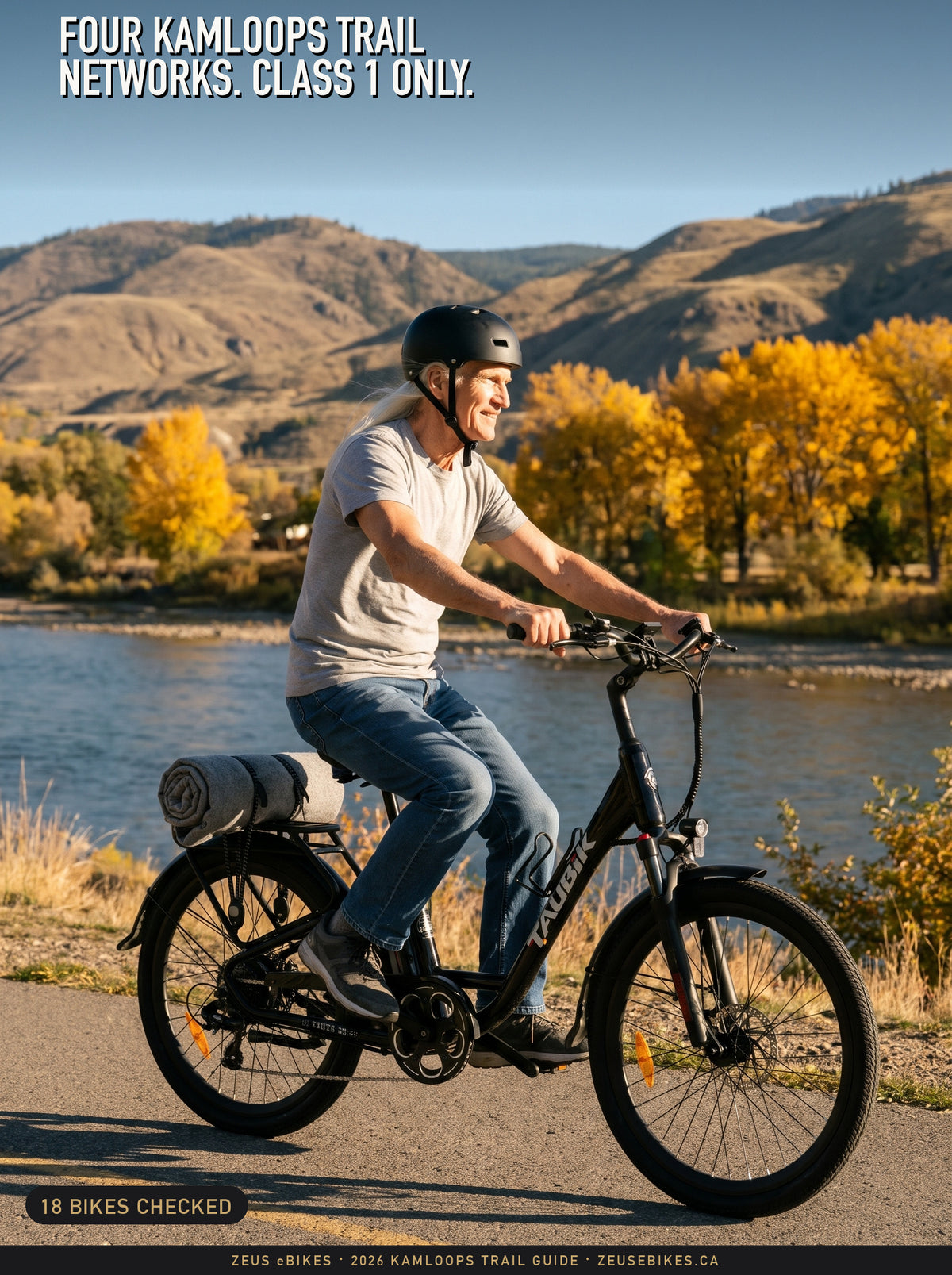
Share:
Your Teen Wants an eBike. Here's What the Hospital Data Actually Says
Abbotsford eBike Trail Map 2026: 181 km, Trail by Trail