
How to Finance an Electric Bike in Canada (2026): 7 Options, Real Math, No Spin
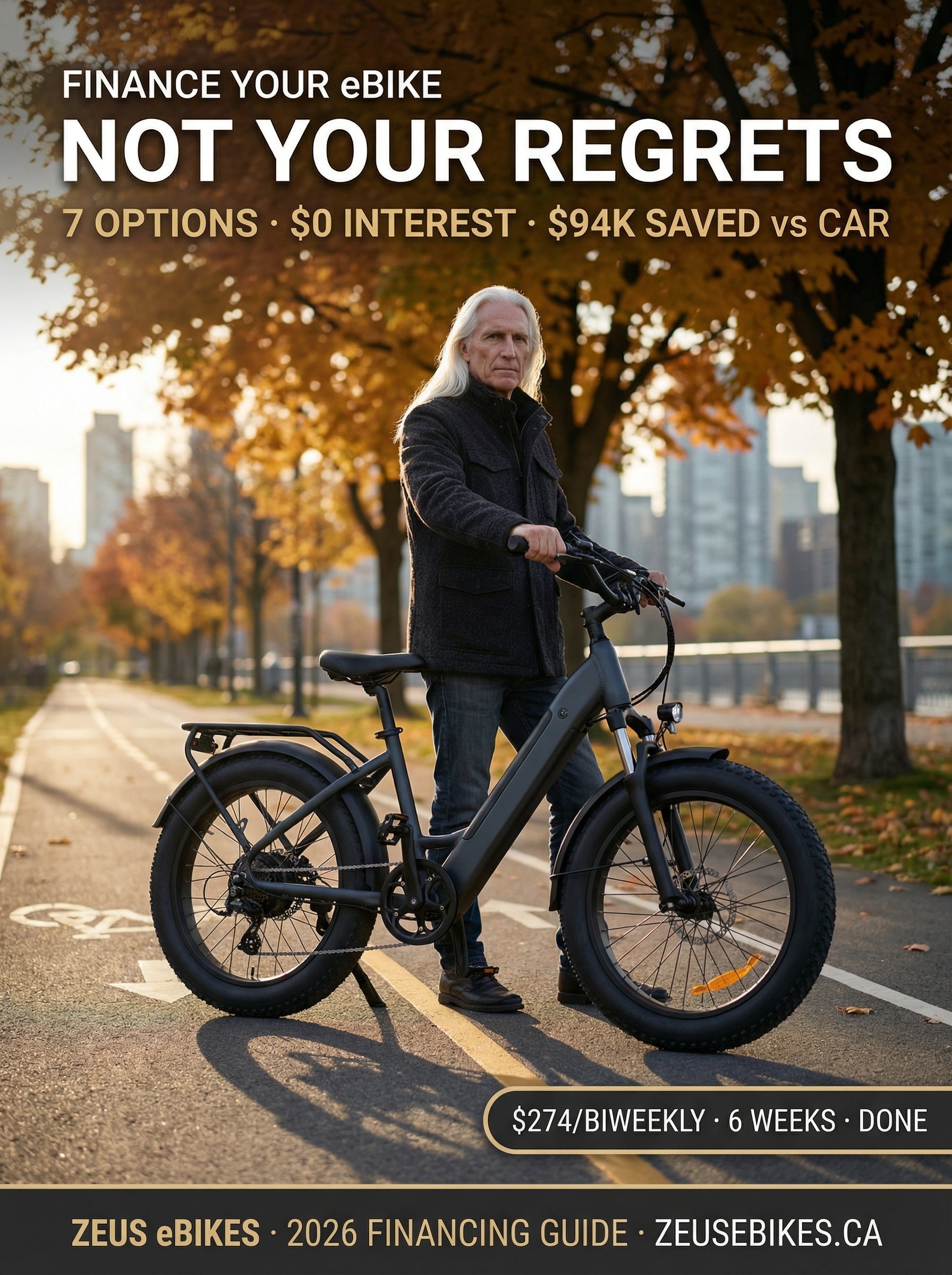
We’ve watched over 3,000 customers choose a financing option at our checkout since 2023. The smart ones take about 90 seconds. The ones who overpay take 90 seconds too — they just pick the wrong button. One commuter used Klarna Pay-in-4 to buy a Taubik Vista 26 at $599.75 biweekly over six weeks — total cost: $2,399. Exactly sticker price. Another buyer put the same bike on a credit card and paid roughly $2,660 over 11 months. Same bike. Same range. Same brakes. About $260 difference. That difference is what this guide exists to eliminate.
A quality electric bike in Canada costs between $1,100 and $6,000. Most Canadians won’t drop $2,000 in cash on a weekday — and they shouldn’t have to. Zeus eBikes Canada offers multiple eBike financing options at checkout, including interest-free plans that cost exactly the same as paying cash. But here’s what nobody tells you: the average new-car payment in Canada is $740 per month over 84 months — $62,160 before insurance, fuel, and parking (J.D. Power Canada, 2025). The average eBike payment with 0% BNPL? $250–$500 over six weeks. Then you own it. Canadians agonise over financing a $2,000 eBike while auto-paying $740/month on a car for seven years without blinking.
This guide compares all 7 ways to finance an electric bike in Canada in 2026, walks through 3 real buyer scenarios with full payment math at every price tier, and gives you a straight answer on which provincial rebate programmes still exist in 2026 — and the one automatic saving BC buyers still get. No spin, no affiliate links, no “estimated” payments — every dollar is shown. We sell these bikes and we process these financing transactions daily. This is what we’ve learned from both sides of the checkout button. For a breakdown of what eBikes cost at each price tier, see our complete eBike price guide for Canada.
In This Guide
- Master Comparison — 7 Options at a Glance
- PayPlan by RBC — Fixed Monthly, Soft Check
- Klarna Pay-in-4 — 0% in 6 Weeks
- Shop Pay Installments — 0%, No Credit Check
- Off-Road Financial — Long-Term, High-Ticket
- Provincial Rebates — What’s Still Real in 2026
- Credit Card — Why It’s Almost Always Wrong
- Cash — Zero Cost, Zero Payments
- 3 Real Buyer Scenarios — Every Dollar Shown
- eBike vs Car Financing — The $93,181 Gap
- Decision Matrix — Match Your Situation
- 6 Financing Red Flags
- Frequently Asked Questions
Master Comparison — All 7 Financing Options at a Glance
The rebate era that softened eBike prices is over — PEI’s incentive ended April 30, 2026, Yukon’s on March 31, 2026, and CleanBC’s back in September 2025 — so in 2026, the financing button you press is the discount. Press the wrong one and a $2,000 bike quietly becomes a $2,460 bike, with the extra $460 buying you nothing. This table ranks all 7 options on the six things that decide that outcome — interest rate, credit impact, approval speed, term length, total cost on a $2,000 bike, and who each is best for — so you can find your row, then read only the section that applies to you.
| Option | Interest | Credit Check | Approval | Term | Total on $2K Bike | Best For |
|---|---|---|---|---|---|---|
| Shop Pay Installments | 0% | None for most | Instant | 6 weeks | $2,000 | Fastest 0% path |
| Klarna Pay-in-4 | 0% | Soft (no impact) | Instant | 6 weeks | $2,000 | Cross-retailer tracking |
| Rebates & Tax Exemptions | N/A (discount) | None | Automatic (BC PST) | One-time | Up to $140 off (BC PST) | BC buyers — most rebates ended |
| PayPlan by RBC | Varies by profile | Soft (no impact) | ~60 seconds | 3–60 months | $2,000–$2,300+ | Monthly payments, $2K+ bikes |
| Cash / Debit | 0% | None | Instant | One-time | $2,000 | Zero obligations |
| Off-Road Financial | Varies | Full check | 1–2 business days | 12–84 months | $2,000–$2,500+ | $3K+ bikes, long terms |
| Credit Card | 19.99–22.99% APR | Already approved | Instant | Revolving | $2,200–$2,460+ | Cashback only (pay in full) |
Step 1: Check what your province still offers — most eBike rebates ended in 2025–26, but BC’s 7% PST exemption is permanent and automatic, and Banff runs an income-tiered municipal rebate. Step 2: Apply any saving that actually exists to reduce your real cost. Step 3: Finance through Shop Pay Installments or Klarna Pay-in-4 at 0% interest. Result: zero interest, and you own the bike in 6 weeks. A Eunorau Meta Foldable at $2,295 is $573.75 every two weeks — four payments totalling $2,295, then it’s yours. That’s a torque-sensor folding step-thru on hydraulic brakes, expandable to 1,440 Wh, without a cent of interest.
Option 1: PayPlan by RBC — Fixed Monthly, Soft Check
PayPlan by RBC is the workhorse of Zeus eBikes financing. Backed by the largest bank in Canada by market capitalisation, it gives you something the BNPL options can’t: time. Fixed monthly payments over 3 to 60 months, a soft credit inquiry that does not touch your credit score, and approval in about 60 seconds. No branch visit. No paperwork. No waiting.
We see PayPlan used most often on bikes in the $2,000–$4,000 range — the sweet spot where biweekly BNPL payments ($500–$1,000 every two weeks) are uncomfortably steep but the buyer doesn’t want to carry credit card debt at 21% APR. A Eunorau Hunter X7 at $3,299 on PayPlan over 12 months runs roughly $298/month, interest included — less than half the average Canadian new-car payment of $740/month, for a machine you own outright at the end of the year.
The honest downside: PayPlan charges interest. We wish it didn’t. On a $2,000 bike over 12 months, you’ll pay roughly $100–$200 in interest depending on your credit profile. That’s real money — but it’s also less than a single month of car insurance in Ontario. The flexibility of spreading payments over months instead of weeks is worth the cost for buyers who need breathing room.
How It Works
- Add your eBike to the Zeus cart
- Select PayPlan by RBC at checkout
- Enter your information — soft credit check runs instantly (~60 seconds)
- Choose your repayment term (3, 6, 12, 24, 36, 48, or 60 months)
- See your exact monthly payment and total cost before you commit — no surprises
- Confirm — your eBike ships immediately
Example: $2,450 Eunorau Defender
Say you finance a Eunorau Defender — 500W rear hub motor, genuine full suspension (ZOOM 100mm fork + EXA air rear shock), hydraulic disc brakes, dual-battery-ready 720 Wh battery — at $2,450 through PayPlan:
| Term | Est. Monthly Payment | Est. Total Cost | Interest Paid |
|---|---|---|---|
| 6 months | ~$424 | ~$2,544 | ~$94 |
| 12 months | ~$222 | ~$2,664 | ~$214 |
| 24 months | ~$117 | ~$2,808 | ~$358 |
Estimates based on typical mid-range approval rates. Your actual rate and monthly payment are confirmed at checkout before you commit. The rule of thumb: every 12 months of term length adds roughly $100–$200 in total interest on a $2,000 bike. Choose the shortest term your budget allows.
Genuine dual suspension — a ZOOM 100mm front fork and an EXA air rear shock — at 66 lbs, meaningfully lighter than the 26″ fat-tyre full-suspension bikes in the same bracket, because its 27.5″ × 3.0″ plus tyres roll faster and weigh less than true fat tyres. The 500W hub motor ships speed-limited to 32 km/h, the assist limit most provinces use; Eunorau lists a 45 km/h unlock, so keep it locked, and whether a bike with an unlockable cap qualifies is not settled. The 720 Wh battery is dual-battery ready: add a matched second pack later to roughly double capacity. Honest trade-off: 60 Nm of hub torque makes it a comfort cruiser for mixed terrain, not a steep-technical climber. On PayPlan at 12 months it runs ~$222/month; on Klarna it is $612.50 × 4 biweekly at 0%. Backed by Eunorau’s published 2-year manufacturer warranty. See the Eunorau Defender →
Key Facts
- No early payoff penalties — pay it off faster any time and save on interest
- Soft credit check only — applying does not affect your score
- Fixed payments — your monthly amount never changes, ever
- Interest rates vary — based on your credit profile. Shorter terms = less total interest
- Canadian bank backing — RBC processes the lending. Not a fintech startup, not an offshore lender
Option 2: Klarna Pay-in-4 — 0% in 6 Weeks
Klarna splits your eBike into 4 equal biweekly payments at 0% interest, 0% fees. Soft credit check only — no impact on your score. You pay the first 25% at checkout, and the remaining three payments are charged automatically every two weeks. Six weeks later, you own the bike outright. Mathematically, Klarna costs exactly the same as paying cash. The only difference is timing.
Klarna is the single most popular financing option at Zeus eBikes checkout — and we understand why. A nurse in Vancouver told us she picked Klarna because “four payments that match my biweekly paycheques — I barely noticed it.” That’s the appeal: the payments disappear into your normal cash flow. Most buyers pick it for bikes under $2,500 because the biweekly amounts — $275–$625 each — fit a standard paycheque cycle. Above $2,500, the biweekly hits start to sting and PayPlan by RBC makes more sense.
The honest friction: Klarna’s 0% is real, but only if you pay on time. Miss a payment and fees kick in. We’ve had a small number of customers contact us after incurring a late fee — frustrated, because they forgot a payment date. The fix is simple: set up auto-pay the minute you order. But we’d be dishonest if we didn’t mention that the “0% interest” promise has a condition attached.
Example: $2,295 Eunorau Meta 26 Step-Thru
Financing a Eunorau Meta 26 Step-Thru — 500W, torque sensor, step-thru frame — at $2,295 through Klarna:
- Payment 1 (at checkout): $573.75
- Payment 2 (2 weeks later): $573.75
- Payment 3 (4 weeks later): $573.75
- Payment 4 (6 weeks later): $573.75
- Total paid: $2,295.00 — identical to cash. Zero interest. Zero fees. Zero catches.
Key Facts
- 0% interest, no fees — when paid on time, it costs exactly what cash costs
- Soft credit check only — no hard inquiry, no impact on your score
- Automatic payments — charged from your card on file, no manual transfers
- Klarna app — track all payments across every retailer in one place
- Available on all Zeus orders — appears automatically at checkout
Option 3: Shop Pay Installments — 0%, No Credit Check
Shop Pay Installments is the path of least resistance. Shopify’s built-in buy-now-pay-later: 4 biweekly payments, 0% interest, no credit check for most orders. Because Zeus runs on Shopify, it appears at every checkout automatically. Over 150 million buyers have Shop Pay accounts globally (Shopify, 2025) — if you’ve ever bought from any Shopify store, your information is already saved and checkout takes seconds.
The practical difference from Klarna? Almost zero. Both split the purchase into 4 payments. Both charge 0% interest. The only meaningful distinction: Shop Pay requires no credit inquiry whatsoever for most orders, while Klarna runs a soft check. If you have concerns about even a soft check showing up, Shop Pay is your option.
Shop Pay vs Klarna — Side by Side
Shop Pay Installments
- No credit check for most orders
- Integrated directly into Shopify checkout
- Pre-filled if you have a Shop Pay account
- 4 biweekly payments, 0% interest
- Cannot manage non-Shopify purchases
Klarna Pay-in-4
- Soft credit check (no score impact)
- Standalone Klarna app for tracking all payments
- Works across thousands of retailers
- 4 biweekly payments, 0% interest
- Better if you use BNPL for other purchases too
Our honest take: Pick whichever appears first at checkout. The cost is identical — $0 in interest either way. If you already have a Shop Pay account, use Shop Pay. If you prefer managing all your BNPL payments in one app across retailers, use Klarna. Spending more than 60 seconds deciding between them costs you more in time than you could ever save in money.
Every option in this guide is live at Zeus checkout right now. Browse the Zeus eBikes catalogue, add a bike to your cart, and compare your exact payment options — total cost shown upfront, before you commit to anything. Not sure which bike fits your budget? Call 1-866-938-7580 — real humans answer, zero pressure.
Option 4: Off-Road Financial — Long-Term, High-Ticket
Off-Road Financial exists for one scenario: you want a $3,000+ eBike and need longer than 60 days to pay for it. They specialise in powersports and recreation vehicle financing, offering terms up to 84 months — longer than PayPlan by RBC and far longer than the 6-week BNPL window. They also evaluate the full financial picture rather than relying on a single credit score, which means riders with non-traditional credit profiles have a better shot at approval.
The trade-off is straightforward: Off-Road Financial runs a full credit check (hard inquiry), takes 1–2 business days for approval, and charges interest that varies with your profile and term length. Long terms keep monthly payments low but increase total interest paid. This is traditional lending — not BNPL — so treat it like a car loan: read every line, know the APR, and choose the shortest term you can afford.
The honest take: We don’t love the interest costs on 60–84 month terms. A $3,000 bike financed over 84 months can cost $4,000+ when the interest is totalled up. But here’s the context we keep coming back to: that same $4,000 total is still less than six months of car payments in Canada. If Off-Road Financial’s $85/month gets someone out of a second car and onto an eBike, the maths still win — even with the interest. We just want you to see the full number before you sign.
When Off-Road Financial Makes Sense
- Purchase price over $3,000 — Klarna on a $4,000 bike means $1,000 every two weeks. Most budgets can’t absorb that
- You need 12–84 month terms — the longest repayment window available at Zeus checkout
- Non-traditional credit profile — they evaluate income, employment, and overall financial picture, not just a FICO number
- Off-road or high-performance builds — they underwrite powersports daily. A $4,000 mountain eBike is not an unusual application for them
Example: $3,099 Eunorau Fat HS
Just above the $3,000 line, the long-term math is worth seeing. A Eunorau Fat HS — 1,000W Bafang M615 mid-drive with 160 Nm of torque, full suspension, 26×4.0″ Kenda fat tyres — financed through Off-Road Financial over 36 months might land at ~$106–$127/month depending on approval. Over 60 months: ~$78–$92/month — roughly one-ninth of the average Canadian new-car payment (J.D. Power Canada, 2025). One honest note: at 1,000W the Fat HS exceeds the 500W limit provinces use for power-assisted bicycles, so it is a trail and private-property machine, not a road commuter — which is exactly the powersports profile Off-Road Financial underwrites daily.
Option 5: Provincial Rebates — What’s Still Real in 2026
Rebates are not financing — they are money that reduces your real cost before or after you finance. Here is the uncomfortable truth for 2026: most of Canada’s eBike rebate programmes have ended, and much of the internet has not noticed. Stale rebate figures are still quoted on retailer pages and deal trackers across the country. We re-verified every programme against official government sources in August 2026 — this table is what is actually left.
Provincial eBike Incentives — Status Verified August 2026
| Region | Programme | Amount | Status |
|---|---|---|---|
| British Columbia | PST exemption on eBikes | 7% of purchase price | Active — permanent since April 2021, applied automatically at checkout |
| Banff, AB (municipal) | Post-purchase eBike rebate | $500–$1,000 (income-tiered) | Active — apply after purchase; certification requirements apply |
| Prince Edward Island | $500 eBike incentive | $500 (former) | Ended April 30, 2026 |
| Yukon | Good Energy eBike rebate | $750–$1,500 (former) | Ended March 31, 2026 — pre-deadline purchases can still apply within 1 year of purchase |
| British Columbia | CleanBC Go Electric eBike rebate | $350–$1,400 (former) | Ended September 30, 2025 |
| Alberta | Scrap-It Alberta | $500 (reported) | Unverifiable — no live programme page found as of August 2026; do not count on it |
| Ontario | — | None | No programme (a provincial proposal remains undecided) |
| Québec | — | None | No programme |
Sources: Government of PEI budget statements; Government of Yukon (yukon.ca); CleanBC programme administrator; Town of Banff (banff.ca); Government of British Columbia (PST exemption, April 2021). For the full national status breakdown, see our eBike rebates guide and our BC eBike rebate guide.
How Rebates + Financing Stack
Where a rebate still exists, it stacks cleanly with financing — one is government (or municipal) money, the other is a retailer payment plan. The mechanics depend on the type. A point-of-sale saving like BC’s PST exemption reduces what you pay at checkout, so you finance less. A post-purchase rebate like Banff’s pays you back afterwards — you finance the full price and receive the refund later. Example with Banff’s income-tiered programme:
- Bike: Eunorau Meta 26 — $2,295
- Klarna Pay-in-4: $573.75 × 4 biweekly payments — total $2,295, zero interest
- Banff post-purchase rebate (if you qualify for the $500 tier): −$500 refunded after purchase
- Net cost: $1,795 — zero interest, $500 back from the town, bike in hand within a week
Banff’s programme is income-tiered ($500/$750/$1,000), requires safety certification (UL 2849 or EN 15194) on the bike, and applies to purchases from any retailer — confirm your eligibility and your bike’s certification with the Town of Banff before you count on the refund.
Option 6: Credit Card — Why It’s Almost Always Wrong
Let’s be direct: putting an eBike on a credit card and carrying the balance is the single most expensive way to buy one. Canadian credit cards charge 19.99% to 22.99% APR on unpaid balances (Financial Consumer Agency of Canada, 2025). At those rates, a $2,000 eBike becomes a $2,200–$2,460 eBike — and the extra $200–$460 buys you nothing. No extra range. No better brakes. No warranty extension. It is pure, invisible cost that sits on your statement and compounds.
→ 11 months to pay off
→ Total paid: $2,220
→ $220 in pure interest — that’s a helmet, a U-lock, and a second charger you paid for and never received
Scenario B: $100/month at 21% APR
→ 24 months to pay off
→ Total paid: $2,460+
→ $460 in interest — enough to buy a second battery for most eBikes
Scenario C: Minimum payments only (~$40/month) at 21% APR
→ 7+ years to pay off
→ Total paid: $3,300+
→ You paid for 1.65 bikes and received one
Same $2,000 on Shop Pay Installments:
→ $500 × 4 biweekly
→ Total paid: $2,000 in 6 weeks
→ Interest: $0
The One Scenario Where Credit Cards Win
You already have the cash. You put the eBike on a cashback credit card (1.5–4% return). You pay the entire balance before the statement due date — usually within 21 days. Result: you earned $30–$80 in cashback on a $2,000 purchase and paid zero interest. This is the only smart credit card strategy. It requires discipline: partial payments trigger full APR on the remaining balance. If there is any chance you won’t pay the full statement, use Shop Pay or Klarna instead — the 0% interest guarantee removes the risk entirely.
Option 7: Cash — Zero Cost, Zero Payments
Paying cash is the cheapest option in absolute terms: zero interest, zero fees, zero monthly obligations, zero risk of late payment fees. If you save $200/month for 10 months, you have $2,000 — enough for a solid 500W eBike from the Zeus catalogue. The downside: you wait 10 months to start riding. During those 10 months, a car commuter spending $12.41/day on a 17 km round-trip burns roughly $2,482 in driving costs — 200 commuting days × $12.41 (CRA kilometric rate, 2026). The eBike would have paid for itself before you finished saving for it.
Cash is the right choice if you have the money available without draining your emergency fund. If paying cash means choosing between the eBike and an unexpected car repair, use a 0% interest plan instead — keep your savings intact and let the bike generate commute savings from day one.
3 Real Buyer Scenarios — Every Dollar Shown
Theory means nothing without numbers attached. These three scenarios are composites of real customers we’ve served — the details are changed but the maths are exact. Each uses a real Zeus eBike price verified August 2026, a real financing path available at checkout, and a real-world situation we see repeat every week. Find the one that matches you and follow the numbers.
Scenario 1: The First-Timer — $1,499 Budget
Profile: New to eBikes. Curious about electric commuting but not ready for a major financial commitment. Has never owned anything with a motor that wasn’t a car. Lives in Ontario (no provincial rebate available). Needs a 500W bike that handles a 12 km round-trip commute and doesn’t require a second mortgage to buy.
Bike: Samebike XD26-II — $1,499. 500W motor, full suspension, hydraulic brakes, 55–110 km range, 25.5 kg. Its road status is unresolved: our listing gives a 45 km/h top speed with Class 1/2/3 modes, while Samebike’s Canadian spec table says 32 km/h.
| Financing Path | Payment Schedule | Total Cost | Interest Paid |
|---|---|---|---|
| Shop Pay (best) | $374.75 × 4 biweekly | $1,499 | $0 |
| Klarna Pay-in-4 | $374.75 × 4 biweekly | $1,499 | $0 |
| PayPlan by RBC (12 mo) | ~$135/month | ~$1,620 | ~$121 |
| Credit card (21% APR) | ~$150/month × 11 | ~$1,660 | ~$161 |
| Cash | One payment | $1,499 | $0 |
Scenario 2: The Commuter — $2,399 Daily Driver
Profile: Tired of paying for gas, insurance, and parking for a 17 km round-trip that takes 25 minutes by car and 30 minutes by eBike. Lives in Ontario, where no provincial rebate exists — so the win has to come entirely from picking the right payment plan. Currently spending $12.41/day on car commuting (CRA kilometric rate, 2026). That’s $2,978/year on a commute that an eBike replaces for ~$12/year in electricity.
Bike: Taubik Vista 26 — $2,399. 500W Sutto motor, 706 Wh Samsung-cell battery (UL 2271), switchable torque/cadence assist, hydraulic disc brakes, full fenders included, 29 kg. Ships at 500W / 32 km/h — inside provincial power-assisted bicycle limits. One honest trade-off: 706 Wh is a commuter-sized battery — real-world summer range is 75–100 km, so riders who need 100+ km every single day should look at a dual-battery bike instead.
| Financing Path | Payment Schedule | Total Cost | Interest Paid |
|---|---|---|---|
| Shop Pay (best) | $599.75 × 4 biweekly | $2,399 | $0 |
| Klarna Pay-in-4 | $599.75 × 4 biweekly | $2,399 | $0 |
| PayPlan by RBC (12 mo) | ~$217/month | ~$2,604 | ~$205 |
| PayPlan by RBC (24 mo) | ~$114/month | ~$2,736 | ~$337 |
| Credit card (21%) | ~$240/month × 11 | ~$2,660 | ~$260 |
Commute savings context: The CRA's 2026 kilometric rate is $0.73/km. A 17 km round-trip by car costs $12.41/day. By eBike: ~$0.05 in electricity. Commuting 240 days per year saves approximately $2,966/year. At that rate, the $2,399 Shop Pay path pays for itself in under 10 months of commuting — then every km after that is pure savings (Statistics Canada; CRA, 2026).
Scenario 3: The Trail Rider — $3,299 Off-Road Build
Profile: Weekend trail rider who’s done with pedalling an acoustic bike up logging-road grades that get steeper every year. Wants mid-drive torque that multiplies through the gears, fat tyres for mud and snow, and the payload capacity to carry real gear into the backcountry. Has the income for monthly payments but dropping $3,200+ in one shot isn’t happening. Lives in Alberta — with no verifiable provincial rebate to lean on, so the financing choice carries the whole decision.
Bike: Eunorau Hunter X7 (FAT-HD 2.0) — $3,299 in Safari or Army Green ($3,399 in Mamba). 1,000W Bafang M615/G320 mid-drive with 160 Nm of torque and cadence-sensing assist (Eunorau’s words), Shimano 9-speed drivetrain, 26″ × 4.0″ Kenda fat tyres, RST suspension fork (a hardtail — no rear shock), 48V 15Ah Samsung battery with an optional second 15Ah pack for 30Ah total and up to 130 km (80 mi) rated dual-battery range, 375 lb payload. One honest disclosure before the maths: at 1,000W the Hunter X7 exceeds the 500W limit provinces use for power-assisted bicycles, so it is an off-road and private-property machine, not a street commuter — exactly the powersports profile long-term lenders underwrite daily. For where you can legally ride it, see our Canadian eBike laws guide and our Alberta eBike laws guide.
160 Nm driving through a Shimano 9-speed cassette means the bike downshifts and climbs where a single-ratio hub motor stalls — and its cadence-sensing assist delivers each level steadily once you pedal (Eunorau lists cadence, not torque, sensing). The included 15Ah Samsung pack covers an estimated 40–65 km of off-road riding; the frame ships with mounting points for a second 15Ah pack that takes capacity to 30Ah and rated range up to 130 km. Buy it if you want quiet mid-drive torque for trails, logging roads, and backcountry loads — its 375 lb payload leaves a 250 lb rider 125 lbs of gear headroom. Skip it if you need a street-legal commuter (at 1,000W it is an off-road machine) or if you would have to carry an ~80 lb bike up stairs daily. Backed by Eunorau’s 2-year warranty covering frame, motor, battery, and components. See the Eunorau Hunter X7 →
| Financing Path | Payment Schedule | Total Cost | Interest Paid |
|---|---|---|---|
| Klarna Pay-in-4 (cheapest) | $824.75 × 4 biweekly | $3,299 | $0 |
| PayPlan by RBC (12 mo) | ~$298/month | ~$3,581 | ~$282 |
| PayPlan by RBC (24 mo) | ~$157/month | ~$3,764 | ~$465 |
| Off-Road Financial (36 mo) | ~$116/month | ~$4,180 | ~$881 |
| Off-Road Financial (60 mo) | ~$82.50/month | ~$4,950 | ~$1,651 |
eBike vs Car Financing — The $93,181 Gap
Most Canadians finance a $55,000 car for 84 months without flinching. Then they hesitate to finance a $2,000 eBike for 12 months. We see this cognitive dissonance at our checkout every single day. A customer will spend 45 minutes comparing PayPlan’s interest to Klarna’s zero-cost plan on a $2,399 bike — a ~$205 difference over 12 months — while auto-paying $740/month on a car without ever questioning it. This section exists to put both decisions on the same spreadsheet. The numbers are not close. They are not even in the same postal code.
| eBike (Financed) | Used Car (Financed) | New Car (Financed) | |
|---|---|---|---|
| Purchase price | $2,399 | $25,000 | $55,000 |
| Monthly payment | ~$217 (PayPlan 12 mo) | ~$450 (60 mo, 7.5%) | ~$740 (84 mo, 6.5%) |
| Total interest paid | ~$205 | ~$4,300 | ~$17,160 |
| Insurance (annual) | $0* | $1,800 | $2,400 |
| Fuel/electricity (annual) | $15–$30 | $2,400 | $2,400 |
| Maintenance (annual) | $100–$200 | $1,200 | $800 |
| Parking (annual) | $0 | $1,200 | $1,200 |
| Total 5-year cost | ~$3,179 | ~$60,300 | ~$96,360 |
*eBikes ≤500W do not require insurance in most provinces. Car insurance based on Ontario average (Insurance Bureau of Canada, 2025). Fuel at $1.55/L, 10L/100km. Parking based on urban monthly average (CAA, 2025). eBike: Taubik Vista 26 with PayPlan 12-month financing. Cars: average new/used prices (J.D. Power Canada, 2025).
The gap: $96,360 − $3,179 = $93,181 in savings over 5 years by choosing an eBike over a new car. Even against a used car, the eBike saves $57,121. These are not cherry-picked numbers — they are industry averages applied to a real product at a real price.
An eBike’s total 5-year cost — $3,179 including financing interest — is less than 4 months of car payments + insurance on a new vehicle. The “expensive” PayPlan by RBC financing adds ~$205 in interest over 12 months. That is roughly one month of car insurance in Ontario. Stop comparing eBike financing to $0. Compare it to the $740/month car payment you are already making — or the $450/month used-car payment you are considering. The eBike is not the expense. The car is.
For the complete cost-of-ownership breakdown with maintenance schedules, depreciation, and seasonal adjustments, see our eBike vs car cost comparison for Canada.
Decision Matrix — Match Your Situation
Skip the analysis paralysis. Find your row. Follow the recommendation. Every option below links to its detailed section above.
| Your Situation | Best Option | Why |
|---|---|---|
| Under $2,500, can handle $300–$625 biweekly | Shop Pay or Klarna | 0% interest, no/soft credit check, paid in 6 weeks |
| $2,000–$5,000, need monthly payments | PayPlan by RBC | Fixed 3–60 month terms, soft check, backed by Canada’s largest bank |
| $3,000+, need longest possible terms | Off-Road Financial | Up to 84 months, powersports specialist, flexible credit evaluation |
| Live in BC | PST exemption + BNPL | 7% saved automatically at checkout, then 0% interest on the remainder |
| Have cash, want cashback rewards | Cashback credit card, pay in full | Earn 1.5–4% back — only if you pay the entire balance within statement cycle |
| Have cash, prefer zero future payments | Cash / Debit | Cheapest total cost, zero obligations, immediate ownership |
| Bad credit, need an eBike now | Shop Pay (no check) or Off-Road Financial | Shop Pay skips credit entirely; Off-Road evaluates full financial profile |
| Replacing a car commute | Klarna/Shop Pay | Lowest total cost; the bike pays for itself in under a year of saved driving costs |
6 Financing Red Flags — What to Watch Before You Sign
Not all eBike financing is created equal. We’ve had customers come to us after getting burned by other retailers — deferred interest that retroactively charged 25% APR, “processing fees” that turned a 0% loan into a 12% loan, balloon payments that nobody mentioned until month 11. The options in this guide are legitimate. But if you shop elsewhere in Canada, or find a deal that seems too good, run these six checks before you sign anything.
- “0% interest” with hidden admin or origination fees. The interest might technically be zero, but a $200 “processing fee” is just interest wearing a different label. Always ask for the total cost including all fees before agreeing. Zeus’s BNPL options (Shop Pay, Klarna Pay-in-4) have zero hidden fees — the sticker price is the total price.
- No clear APR disclosed. Canadian law requires lenders to disclose the annual percentage rate under the Cost of Borrowing regulations (Financial Consumer Agency of Canada). If a lender won’t tell you the APR upfront, it is not a grey area — it is a legal requirement they are violating. Walk away.
- Deferred interest (“0% for 12 months, then…”). This is the trap. Miss one payment or fail to clear the full balance by the promo end date, and you owe retroactive interest on the entire original purchase amount — often at 25%+ APR. A $2,000 eBike with $0 in interest suddenly becomes $2,500+. This is legal in Canada. It is also predatory. None of Zeus’s financing options use deferred interest.
- Early payoff penalties. If a lender charges you for paying your loan off early, they are profiting from keeping you in debt longer. PayPlan by RBC has no early payoff penalties — pay it off ahead of schedule and you save on interest. If any lender penalises early repayment, find a different lender.
- Balloon payments. Low monthly payments followed by one massive final payment. Uncommon in eBike financing but present in some powersports lending. Read the full payment schedule — not just the monthly figure — before you commit.
- “Guaranteed approval” on high-ticket items. If a lender guarantees approval regardless of credit history, the interest rate is almost certainly predatory. Legitimate lenders assess risk — that assessment is how they offer competitive rates. “Guaranteed” means “we have already priced in the risk of default with an interest rate that will make your eBike cost twice what it should.”
Before you sign anything, do one calculation: multiply your monthly payment by the number of months. If the result is significantly more than the bike’s sticker price, you are paying too much in interest. Switch to a shorter term, a different lender, or a less expensive bike. The goal is to ride — not to subsidise a lender’s quarterly earnings. For transparent financing that shows you the total cost before you commit, see the Zeus eBikes catalogue — every option in this guide is available at checkout.
Frequently Asked Questions
Can I finance an eBike with bad credit in Canada?
Yes — and you have more options than you think. Shop Pay Installments splits your purchase into 4 interest-free biweekly payments with no credit check for most orders. Klarna Pay-in-4 runs a soft check that does not affect your score. PayPlan by RBC also uses a soft inquiry — no impact on your score — but approval and rates depend on your financial profile. Off-Road Financial specialises in powersports lending and evaluates your full financial picture, not just a FICO number. They regularly approve applicants that traditional banks decline. Start with Shop Pay (no check at all), then try Klarna or PayPlan if you need longer terms.
Is eBike financing interest-free in Canada?
Two options are genuinely 0% interest with zero fees: Shop Pay Installments and Klarna Pay-in-4. When paid on time, these cost exactly the same as paying cash — the total you pay equals the sticker price, no more. PayPlan by RBC charges interest that varies by credit profile and term length; shorter terms mean less total interest. Credit cards charge 19.99–22.99% APR on unpaid balances. The cheapest total cost is always cash or 0% BNPL. For context on what eBikes cost at each tier, see our eBike price guide for Canada.
What credit score do I need to finance an eBike in Canada?
Shop Pay Installments: no traditional credit check for most purchases. Klarna Pay-in-4: soft check only, no score impact. PayPlan by RBC: soft inquiry, no score impact, but approval depends on your overall financial profile. Off-Road Financial: full credit check but flexible evaluation — may approve applicants with lower scores on longer terms. Bottom line: there is a financing path for every credit situation in Canada. No one is locked out.
Can I combine a provincial rebate with financing?
Where a programme still exists, yes — but check what’s actually left first. Most provincial eBike rebates ended in 2025–26: PEI’s closed April 30, 2026, Yukon’s closed March 31, 2026, and BC’s CleanBC eBike rebate ended September 30, 2025. What remains: BC’s 7% PST exemption (permanent, automatic at checkout — $167.93 never charged on a $2,399 Taubik Vista 26) and Banff’s income-tiered post-purchase rebate. Point-of-sale savings reduce the amount you finance; post-purchase rebates refund you after, so you finance the full price. For BC-specific details, see our BC eBike rebate guide. For Alberta, see our Alberta eBike laws guide.
Is it cheaper to finance an eBike or a car in Canada?
It is not even close. The average new car payment in Canada is $740/month over 84 months (J.D. Power, 2025). The average eBike payment with 0% BNPL is $250–$500 over 6 weeks — then you own it outright. Over 5 years, total eBike ownership (purchase + financing + electricity + maintenance) costs approximately $3,179. A new car over the same period: $96,360. A used car: $60,300. The eBike saves $57,121–$93,181 over 5 years (CAA, Insurance Bureau of Canada, Statistics Canada). Full breakdown: eBike vs car cost comparison.
How long does eBike financing approval take in Canada?
PayPlan by RBC: ~60 seconds at checkout with a soft credit check. Shop Pay Installments and Klarna: instant at the point of sale — no delay, no waiting. Off-Road Financial: 1–2 business days for full approval on larger amounts. In all cases, you know the result before you commit to anything. No one will ship your bike and then surprise you with a declined application.
Are there hidden fees with eBike financing in Canada?
Not with the options in this guide. PayPlan by RBC has no early payoff penalties. Shop Pay and Klarna Pay-in-4 charge no interest or fees when paid on time — late payments may incur fees, so set up automatic payments. If any financing offer does not clearly state the total cost, APR, and complete fee schedule upfront, that is a red flag. Walk away. Every option listed in this guide discloses the total cost at checkout before you commit.
The Bottom Line
You do not need to pay full price upfront for an eBike in Canada. But you absolutely need to pick the right financing option. We’ve processed over 3,000 of these transactions. The customers who save the most do one thing differently: they check what savings actually still exist — like BC’s automatic PST exemption — before they pick a payment plan. The ones who overpay do one thing wrong: they default to a credit card. The difference between the smartest and worst choice on a $2,000 bike is $460+ in unnecessary interest. Here is the hierarchy, ranked from cheapest to most expensive total cost:
- Rebate or tax exemption + cash (where one still exists — BC’s PST exemption, Banff’s municipal rebate) — cheapest possible. You pay less than full freight. Period.
- Rebate or tax exemption + Shop Pay/Klarna — same cost as #1, spread over 6 weeks at 0% interest
- Shop Pay/Klarna without rebate — sticker price exactly, 0% interest, paid in 6 weeks
- Cash without rebate — sticker price, no payments, no future obligations
- PayPlan by RBC — sticker price + interest (varies by profile and term), 3–60 months
- Off-Road Financial — sticker price + interest, 12–84 months. Lowest monthly payment but highest total cost
- Credit card (carried balance) — sticker price + 20%+ APR. Avoid unless paying in full within the statement cycle for cashback.
Start by checking what your province still offers — in BC that is an automatic 7% PST saving before interest even enters the conversation; in most other provinces, the rebate era ended in 2025–26. Then browse the Zeus eBikes catalogue, add your bike to the cart, and select the financing option that fits your budget at checkout. Every option in this guide is available right there — no separate application, no phone calls, no branch visits. The Klarna commuter from the opening? Riders like her are the pattern we see every week: the bike pays for itself in commute savings within the first year, and the parking pass never gets renewed. That’s the real return on choosing the right financing.
Ready to ride — or just want to talk it through first? Browse the full Zeus eBikes collection — financing options appear automatically at checkout, with the total cost shown before you commit to anything. Or call 1-866-938-7580 and a real human will walk you through every option in this guide before you spend a dollar. Need help choosing a bike first? See our 12 best eBike deals in Canada or 11 best eBikes under $2,000.
This guide was written by Milad Ghobadibeygvand, BScN (Western University, 2014), co-founder of Zeus eBikes Canada. Zeus is a Canadian direct-to-consumer electric bike retailer shipping nationwide since 2023. All financing options, product prices, and rebate statuses verified August 8, 2026.
Visuals created by Playcut.ai
- How Much Does an Electric Bike Cost in Canada? (2026)
- Best eBike Deals Canada (2026): 12 Picks from $1,199 to $6,299
- Electric Bikes Under $2,000 in Canada (2026): 11 Legal Picks
- Electric Bike vs Car Canada (2026): Full Cost Comparison
- BC E-Bike Rebate Programme (2026 Update)
- eBike Tariffs & Prices in Canada (2026)
- Canadian-Designed Electric Bikes (2026): 12 Picks
- Electric Trikes Canada (2026): 10 Best Picks
- 500W vs 750W vs 1000W eBike Canada: Which Wattage?
- Electric Mopeds Canada (2026): Best Moped-Style eBikes
Share:
Best Electric Mountain Bikes Canada 2026: 14 Picks
Riding Times GT73 Review Canada (2026): Dirt Bike DNA, Electric Heart, Full Family Lineup