
eBike Theft Protection Canada (2026): The 3-Layer System That Actually Works

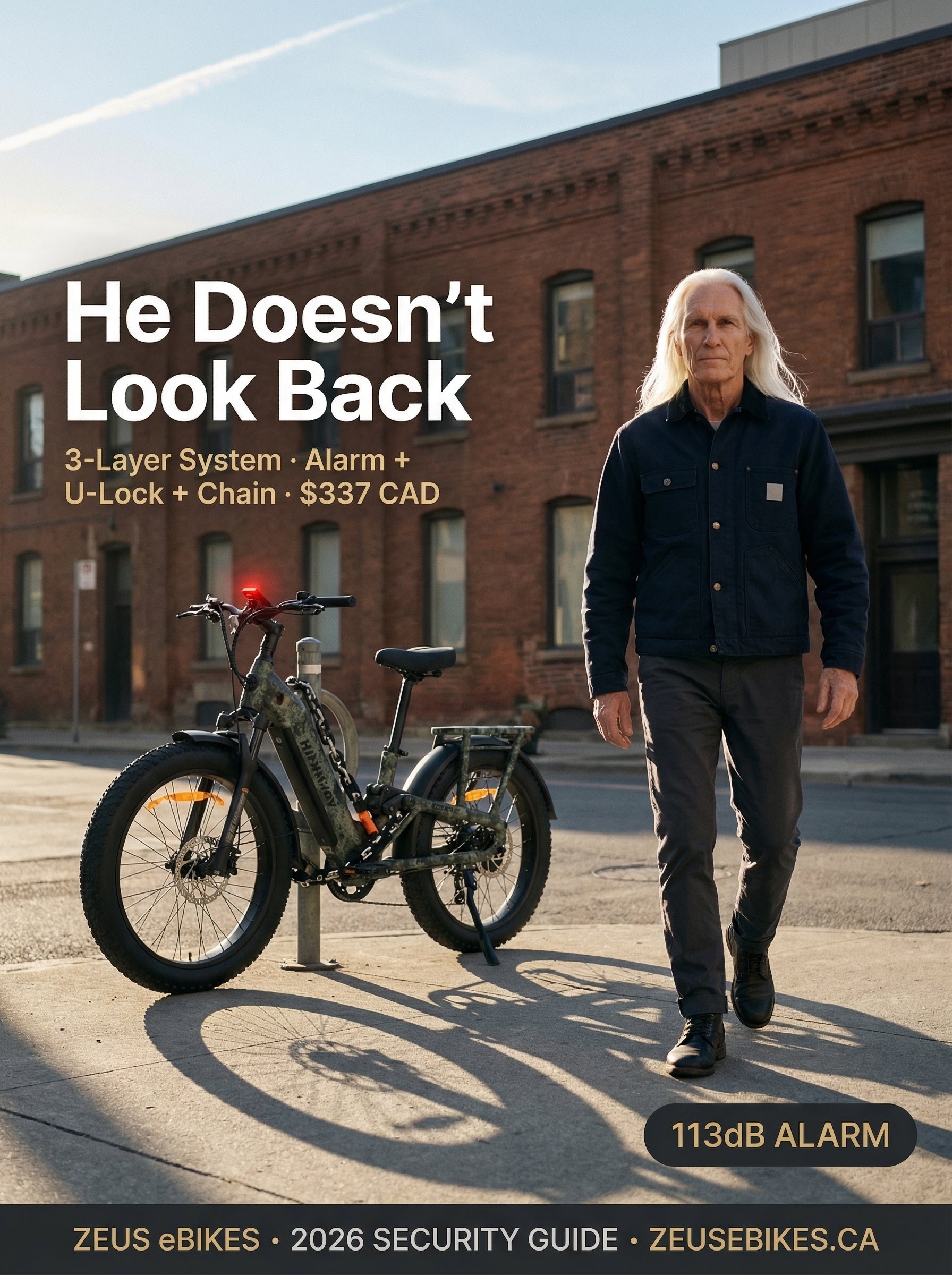
The most effective eBike theft protection in Canada is three layers used together, every time: (1) a 113dB motion-sensing alarm ($59) to deprive the thief of time, (2) a two-way hardened U-lock ($79) through the frame and rear wheel, and (3) a 1.2m heavy chain lock ($199) through both wheels and a fixed anchor. The complete system costs $337 CAD. GPS trackers can help locate a stolen bike but do not guarantee recovery — only 16% of reported stolen bikes are reunited with their owners in Canada (Square One Insurance data). Physical prevention is the only reliable strategy. Browse the full Zeus security accessories collection to build your system.
Zeus has been sourcing, testing, and importing eBike security products for over 2 years — evaluating hundreds of manufacturers from China, Germany, and the US. We tested alarm sensitivity and decibel output in-house, verified lock construction by requesting material certifications from suppliers, and compared shackle locking mechanisms across 40+ U-lock designs. The 88% non-recovery and 16% reunited-with-owner statistics are sourced from Square One Insurance Canada's published research. GPS recovery rates reflect the 16% figure corroborated across multiple Canadian insurance sources. We cite only what we can verify — and omit what we cannot.
In This Guide
- The Canadian eBike Theft Reality
- Time Is Everything — Why the Alarm Goes First
- Layer 1: The Two-Way U-Lock
- Layer 2: The 4.28 kg Chain
- The Complete System ($337)
- Built-In Security: What Your eBike Already Has
- GPS Tracking — The Honest Canadian Truth
- NFC vs Physical Key
- Where and How to Lock
- Home and Storage Security
- If Your Bike Is Stolen: What Actually Works
- Security Tier Comparison Table
- Verdict
- FAQ — 8 Questions Answered
The Canadian eBike Theft Reality (The Numbers That Should Change How You Think About This)
Here is the number that matters most: 88% of stolen bikes in Canada are never recovered (Square One Insurance). Not 20%. Not 40%. Eighty-eight per cent. Once your eBike is gone, the statistical likelihood is that you will never see it again. If you are counting on filing a police report and getting your bike back, you are betting against overwhelming odds — only 16% of stolen bikes reported to police are reunited with their owners (Square One Insurance).
Bike theft in Canadian cities has grown sharply alongside eBike adoption. Toronto, Vancouver, Montreal, and Calgary all rank among North America's most active environments for bicycle and eBike theft. Theft concentrates during warmer months when outdoor parking is most frequent, and in locations where bikes sit unattended for extended periods — apartment building communal storage, parking lots, and busy commercial streets are consistently the most targeted environments.
The financial exposure is significant. A stolen eBike worth $2,000–$4,000 is gone with near-certainty. Professional thieves in Canadian cities now carry portable angle grinders — documented across police reports and news coverage in Toronto, Vancouver, and Montreal. A poorly secured lock can be defeated in seconds with the right tools. The entire theft prevention strategy comes down to one principle: make defeating your security take longer than any thief is willing to risk in public.
Professional thieves in Canadian cities now carry portable angle grinders — documented across police reports and news coverage in Toronto, Vancouver, and Montreal. A cable lock disappears in seconds with basic wire cutters. A basic U-lock falls quickly to a grinder. Even quality hardened locks are not impenetrable — the goal is not to make theft impossible, but to make it take long enough in a public space that the risk outweighs the reward. Speed is the thief's primary resource. Removing it is your entire defence strategy.
Time Is Everything — Why the Alarm Is Your First Line of Defence
Professional thieves do not choose targets by how expensive the bike looks. They choose targets by how much time they have. An isolated parking spot with no foot traffic and no cameras gives a thief five minutes. A busy coffee shop patio with people walking by gives them thirty seconds — if that. The alarm's entire job is to collapse the available time to zero.
A 113dB alarm going off next to a bike is not a gentle deterrent. It is comparable to a chainsaw at close range. It causes immediate panic in anyone nearby — not just the thief. Bystanders stop and look. Nearby shop owners come out. Witnesses appear instantly. The risk calculation for the thief flips: continuing the theft is no longer worth it. The window of undetected opportunity is gone. Most professional thieves abort and move on within seconds of an alarm triggering. That is the only outcome you need.
Zeus has personally tested dozens of alarms from manufacturers across China, Europe, and North America over the past two years. The criterion was simple: it had to be the loudest and most sensitive alarm we could find, with battery life long enough to be practical. What we found: the difference between a $10 alarm and a properly engineered one is enormous, primarily in sensitivity. A poorly calibrated alarm requires significant force to trigger — meaning a thief can probe and test your bike quietly before it trips. A properly calibrated alarm responds to the slightest touch or vibration.
Loud Anti-Theft eBike Alarm
The loudest and most sensitive alarm Zeus found after testing many manufacturers. At 113dB, this is not a gentle chirp — it is a shock-level sound that causes immediate panic and draws attention from anyone within range. Waterproof construction handles Canadian rain and winter conditions. The 6–10 month standby battery life on three AAA batteries means you set it and forget it for an entire riding season.
Zeus personal note: For a quick stop — coffee shop, grocery run, 10 minutes locked outside — Zeus personally uses only the alarm (no lock). Not because a lock is unnecessary, but because the alarm's speed of deployment makes it practical for moments when you are nearby and attentive. For any extended absence, use the alarm plus at least the U-lock. For overnight or multi-hour parking, use all three layers. The alarm is always the baseline — it is never optional.

Layer 1 — The U-Lock: Two-Way Locking vs One-Way
Most people assume a U-lock is a U-lock. The shackle goes through the wheel and frame, the crossbar closes, and the bike is secure. This is wrong, and the difference between a secure U-lock and a vulnerable one is invisible from the outside but critical to a thief.
A standard cheap U-lock locks only one end of the shackle into the crossbar. The other end is free, held in place only by the closed shape of the U. This creates a pivot point. With the right leverage tool — a car jack, a pry bar inserted into the frame of the U — the shackle can be forced open without cutting it at all. The lock cylinder remains intact. The bike is gone.
A two-way U-lock locks both ends of the shackle into the crossbar simultaneously. There is no pivot point. To defeat it, both sides must be cut simultaneously — which requires two angle grinder discs, two cut points, and significantly more time. This is why two-way locking is the meaningful specification to check on any U-lock you consider purchasing.
Heavy Duty U-Lock
High-strength alloy steel shackle with a zinc alloy lock cylinder and silica gel coating that prevents frame scratching — a detail that matters when you are locking through a premium eBike frame. The two-way locking mechanism engages both ends of the shackle into the crossbar, eliminating the pry-point vulnerability that makes cheap U-locks defeatable without cutting. The 2.0–2.5cm shackle diameter is the threshold where angle grinder time becomes genuinely prohibitive for a thief working in public.
Use this through the rear wheel and frame triangle, always locked to a fixed anchor. The U-lock alone is not sufficient for overnight parking — pair it with the chain for the rear wheel and front wheel combination. But for daytime stops of 30 minutes to two hours in a visible location, the alarm plus this U-lock is a strong deterrent.
One more detail worth understanding: the lock cylinder matters as much as the shackle. Low-grade cylinders can be bumped or picked in seconds using techniques freely available online. The zinc alloy cylinder in the Zeus U-lock is meaningfully harder to bypass than the cheap brass cylinders found in discount locks. It is not pick-proof — no lock is — but it is pick-resistant enough to add time, and time is what you are buying.
Layer 2 — The Chain: Why 4.28 kg of Steel Matters
The U-lock secures your frame. The chain solves a different problem: it secures your wheels, your connection to a fixed anchor, and — critically for dual-motor eBike owners — your front hub motor.
This last point is something most riders do not think about until it is too late. If you own a dual-motor eBike with hub motors in both wheels, the front motor is an independent, high-value component worth $200–$400. A thief who cannot quickly steal the whole bike will often take the front wheel instead — especially if the front wheel is not secured. With only a rear U-lock in place, the front wheel is completely free. The chain goes through both wheels and the frame to the anchor. No wheel is free. No motor is accessible.
Zeus tested hundreds of chain lock products from Chinese manufacturers over two years. This is the toughest chain we found. The 4,282g total weight is not a flaw — it is the specification. That is 4.28 kilograms of alloy steel that must be cut through. A portable angle grinder working in public, against this chain, takes long enough to make it impractical for an opportunistic thief. The polypropylene sleeve protects your frame from metal-on-metal contact across the chain's 1.2m length.
The 2-in-1 design means the chain integrates with a lock mechanism at one end — you do not need a separate padlock. Two keys included. Thread the chain through both wheels, through the frame triangle, and around a fixed anchor object. The route matters: use the full 1.2m and keep the chain off the ground (ground contact gives a thief a stable cutting surface). Leave no slack.
A note on weight: 4.28 kg is heavy. If you are commuting across town and locking up daily, carrying this chain every ride is a commitment. The practical approach for most commuters: keep the chain at your destination (office, home, regular parking spot) as a permanent fixture. Carry the alarm and U-lock with you. The chain is the anchor that lives where the bike lives. The alarm and U-lock travel with you.

The Complete System: All Three Together ($337 CAD)
Each layer serves a distinct purpose. Remove any one and you introduce a gap a professional thief will exploit.
| Layer | Product | Price | What It Defeats | Alone, Can Be Bypassed By |
|---|---|---|---|---|
| Alarm | Loud Anti-Theft eBike Alarm | $59 | Time. Removes opportunity window. Causes panic. | A thief willing to work fast with a grinder despite the noise |
| U-Lock | Heavy Duty Two-Way U-Lock | $79 | Quick frame grabs, pry attacks, single-cut shortcuts | Sustained angle grinder work at both shackle ends |
| Chain | WEST BIKING 2-in-1 Chain | $199 | Wheel theft, front motor theft, pry leverage points | Sustained grinding through 4.28 kg of alloy steel |
| All Three Together | Complete System | $337 | Every realistic attack vector in a Canadian urban environment | — |
The system works because each layer compensates for the weaknesses of the others. The alarm makes sustained grinding untenable in public — the noise draws attention before the grinder gets through the steel. The U-lock makes frame grabs impossible. The chain makes wheel theft impossible. A thief who can defeat one layer still faces two more, each requiring time they do not have once the alarm is sounding.
For Dual-Motor eBike Owners: The Chain Is Not Optional
If you own a dual-motor eBike — any bike with hub motors in both wheels — the chain is mandatory, not optional. Here is why: the front hub motor is a valuable standalone component. Theft rings know this. A thief who cannot steal your whole bike will often settle for removing the front wheel instead — it is lighter, faster to remove, and easy to sell or part out. If the front wheel is not chained, it is vulnerable regardless of what secures the rear.
The chain routes through both wheels, through the frame triangle, and around a fixed anchor — securing every component in a single pass. If you are riding a fat-tire or AWD eBike and want to understand how that wheel geometry affects security positioning, our fat tire vs regular tire eBike guide covers the physical differences relevant to lock placement.
Alarm + U-Lock + Chain — all three available now at Zeus. Every product Zeus-tested. Every product in stock.
Shop Security Accessories Alarm — $59Built-In Security: What Your eBike Already Has
If you are buying a new eBike and theft protection is a priority, certain models ship with integrated security features that meaningfully change your baseline. These are not marketing add-ons — they are real hardware differences that make theft harder before you attach a single external lock.
Velotric Summit 1
The Summit 1 has Apple Find My built directly into the frame — visible in the iPhone Find My network even when the bike is powered off, without a monthly subscription. This is passive location tracking: if your bike is stolen and ends up somewhere within range of any Apple device (which in Canadian cities is essentially anywhere), its location appears in your Find My app. This is useful for police investigations and insurance claims. It is not a recovery guarantee — see the GPS section below for the honest truth about what tracking actually delivers in Canadian policing realities. Used alongside the 3-layer physical system, it adds a meaningful investigative tool.
Velotric Nomad 2X
The Nomad 2X carries the same Apple Find My integration as the Summit 1, adding it to a dual-motor platform. Note that dual-motor bikes require the full chain lock to protect both hub motors independently — the Find My tracking helps if the bike is stolen, but the chain prevents the front motor from being removed. See the chain section above for the dual-motor theft risk breakdown. If you are building a security system for a premium dual-motor bike, budget for the complete $337 system plus the Nomad 2X's Find My as a final investigative layer.
Velotric Fold 1 Plus
The Fold 1 Plus has three integrated security features: Apple Find My, GPS tracking via the Velotric app, and a key-locked removable battery. But its most important security feature is the one that is invisible in the specs: it folds. A folding eBike that lives under your desk, in your apartment, or in your office is not getting stolen from the street. The best theft prevention is not leaving your bike outside at all. For riders who commute via transit, work in an office, or live in apartments where indoor storage is possible, a folding bike eliminates outdoor parking risk entirely. Use it as a daily commuter with indoor storage — no lock required most of the time.
Smartravel Raptor ST202 Pro
The remote disable is the most powerful integrated security feature available on any eBike Zeus carries. If this bike is stolen, you open the app and disable it. The motor stops responding. The bike becomes a heavy, unpowered object — not a rideable vehicle. This does not prevent a thief from picking it up and carrying it, but it removes its primary value and makes it significantly harder to fence or use. GPS tracking shows you where it is while the bike is disabled.
The honest trade-off: a monthly subscription is required for the GPS and remote disable functionality. Factor this into your total cost of ownership. The subscription unlocks the most capable anti-theft feature we have seen on a production eBike — but it is a recurring cost, not a one-time purchase. If you want to understand whether this level of integrated security fits your rider profile, our best eBike for every rider type guide covers how security needs vary across different use cases and environments.

From Apple Find My on the Velotric line to the Raptor's remote disable, different bikes offer different built-in protection. Browse the full Zeus lineup or read the rider-type guide to match the right model to your situation.
Find Your Ideal eBike Shop All Security GearGPS Tracking — The Honest Canadian Truth
Every eBike security article should say this clearly, and most do not: GPS tracking is useful, but it is not a recovery guarantee in Canada. Here is what the data actually shows and why.
GPS trackers can locate your bike. After a theft, you open your app and you can see a pin on a map. This is valuable information — it gives you something concrete to bring to police, an insurance adjuster, or a bylaw officer. It can confirm the bike has not left the city. It can narrow down a building or a block.
But here is the Canadian policing reality: if your bike's GPS signal is showing inside a private residence, the police need a warrant to enter. A GPS pin is not sufficient probable cause in Canadian law for immediate entry. In many Canadian jurisdictions, bike theft is low-priority for warrant applications — officers are stretched across more serious crimes, and the paperwork-to-outcome ratio makes warrant applications for individual bikes a difficult ask. Bikes are also often sold or parted out within days, before any warrant process can move. The 16% recovery rate for reported thefts — which includes bikes that had trackers — reflects this reality precisely.
The Apple Find My network, used by the Velotric Summit 1, Nomad 2X, and Fold 1 Plus, is a different architecture than active GPS. It is passive crowdsourced tracking — your bike's Bluetooth signal is picked up by any nearby Apple device and reported to Apple's network anonymously. This is useful because it works without a subscription and without the bike being powered on. It is less useful in areas with low iPhone density (rural areas, industrial zones) and it cannot refresh location in real time the way a cellular GPS module can. Each technology has its context.
NFC vs Physical Key — Your Lock Cylinder Matters
Most eBike riders never think about the access control system for their own bike's integrated lock — the mechanism that controls the display, the battery compartment, or any factory-fitted immobiliser. This is a security detail worth understanding.
Physical keys can be bumped, picked, or duplicated. Key bumping is a technique where a specially cut key is inserted and struck — the impact momentarily sets all the pin tumblers simultaneously, allowing the lock to turn. It is a 30-second job for someone with the right bump key. Physical key duplication is even simpler: a locksmith or a hardware store with a key-cutting machine can copy a common key in minutes. If a thief gets hold of your key long enough to photograph or trace it, a duplicate exists.
NFC electronic locks work on a fundamentally different principle. Instead of a physical tumbler that responds to a shaped key, an NFC lock responds only to a specific digital signal from a paired device — your phone or an NFC card. Without the paired device, the lock does not open. There is no mechanical tumbler to bump, no key profile to duplicate. The only attack vector is the paired device itself.
Brands that use NFC-based access control for their display, battery, or integrated lock mechanism are meaningfully more resistant to casual bypassing. When comparing eBike models, particularly at the $2,500+ tier where integrated security features appear, NFC access control is a genuine security upgrade over physical key equivalents — ask about it specifically when evaluating a model, as it is rarely highlighted in spec sheets.
Where and How to Lock: Parking Strategy
The best lock in the world is compromised by poor parking choices. Professional thieves are scanning environments constantly — they identify locations where they can work unobserved, where no one will notice a noise, where there is no camera coverage. Your locking location is as important as your locking hardware.
The Fixed Anchor Rule
Always lock to a fixed, immovable object. A dedicated bike rack bolted to a concrete pad is ideal. A thick steel post set in concrete is strong. What is not a valid anchor: chain-link fence (the fence panels can be lifted), wooden posts (cuttable faster than most chains), decorative thin poles, or anything that can be disassembled from above (signposts with removable tops). If your lock is stronger than your anchor, the thief defeats the anchor, not the lock.
Location Selection
Parking lots and apartment bike storage rooms are high-risk because they have low foot traffic, limited sightlines, and often no reliable camera coverage. A busy street rack in front of a coffee shop — with foot traffic and multiple windows overlooking it — is a better parking choice than a quiet parking lot, even if the parking lot rack looks more secure. Thieves select targets that give them time and privacy; your job is to remove both.
- Lock in high-traffic, well-lit, camera-visible areas whenever possible
- Avoid isolated corners of parking structures, even in nominally secure buildings
- Position the lock body high and off the ground — angle grinders are harder to use on locks that are not resting on a stable surface
- Fill the U-lock as tightly as possible — internal slack gives a thief room to insert pry tools
- Point the keyhole downward on both the U-lock and chain lock — this reduces tool access to the cylinder
- Remove the battery if your bike has a removable battery and you will be away for more than an hour

The Battery Question
The battery is often the single most valuable component on your eBike — $300 to $600 to replace, and a direct target for thieves who know they can sell it independently of the bike. If your battery is removable with a key, remove it for any extended outdoor parking. Carry it into your destination. A locked bike without its battery is significantly less attractive than a complete, operational eBike. This is also a valid cold-weather practice — Canadian winters discharge lithium batteries faster when they sit in -20°C temperatures, and bringing the battery indoors maintains its charge capacity and lifespan. Our winter eBike guide covers battery management in Canadian cold weather in detail.
Home and Storage Security
Communal bike storage rooms — accessed by multiple residents with a shared key or fob — are a documented risk. A thief who lives in or has access to the building can work on your bike in relative privacy, overnight, without the time pressure of a public street. Controlled-access entry does not mean your bike is safe inside; it means the thief has a quieter, longer window to work.
If you live in an apartment and have communal bike storage, the three-layer system applies in the storage room exactly as it does on the street. Do not assume the building's controlled access protects your bike — the statistics say it does not reliably. An alarm in a storage room is even more effective than on the street: the enclosed space amplifies the sound, making it impossible to ignore.
The best apartment storage strategy is also the simplest: bring the bike inside your unit. A folding eBike — particularly the Velotric Fold 1 Plus — is designed specifically for this. It folds flat enough to stand in a hallway, fit in a closet, or live under a desk. An eBike that is inside your apartment is not getting stolen from communal storage.
For riders with garage access or house storage: treat the garage like a public space, not a safe space. Ground anchors bolted into the concrete floor are the strongest possible anchor and cost far less than replacing a stolen bike. The three-layer system applies in the garage exactly as it does outside. Many residential eBike thefts happen from garages — either through opportunistic entry or when the garage door is left open while the owner is home.
If Your Bike Is Stolen: What Actually Works in Canada
Despite every precaution, theft happens. Knowing what to do in the first 24 hours materially affects the small but real chance of recovery.
Immediate Steps (Within the Hour)
- File a police report immediately. Even if you believe recovery is unlikely — and statistically it is — the report is required for any insurance claim and gives police a record to work from if your bike is found or seen. Include your serial number (found on the bottom bracket or chainstay). Photograph the serial number when you buy the bike and store it somewhere other than your phone.
- Post on local Facebook groups and Kijiji. Secondary market monitoring is one of the most effective recovery methods in Canada. Post your bike's photos, serial number, and description to local "stolen bike" groups and marketplace groups immediately. Check Kijiji, Marketplace, and Craigslist listings daily for the first two weeks.
- Contact your eBike insurance provider. If you purchased eBike-specific insurance — check our eBike insurance Canada guide for what policies cover and how they handle theft claims — initiate the claim process immediately. Most policies have time limits on reporting.
- Check your GPS tracking app. If your bike has integrated tracking — the Smartravel Raptor ST202 Pro has real-time GPS and remote disable, Velotric models use Apple Find My — check the location immediately. Share the location data with police alongside your report number. If you have the Raptor, activate the remote disable now — the motor stops responding, making the bike non-rideable and harder to fence. Do not attempt to physically recover the bike yourself based on GPS data.
- Register the theft on Bike Index Canada (bikeindex.org). This is a free national registry that police and shops check when recovered bikes turn up. A listing here increases the chance that a recovered bike gets connected back to you.
The Recovery Reality
Be clear-eyed: 88% of stolen bikes in Canada are never recovered (Square One Insurance). The actions above maximise the 12% chance. They do not change the odds structurally. The structural change is the three-layer system before the theft. Prevention is the only strategy with reliable results.
If you are buying a new eBike after a theft and wondering whether to trust an eBike retailer for a significant purchase, our guide to how to spot a legit eBike store in Canada walks through what to look for before you commit. And if you are thinking about financing the replacement, the financing guide covers every available option in Canada with real math.
Security Tier Comparison by Setup
| Setup | Cost | Time to Defeat | Best For | Weakness |
|---|---|---|---|---|
| No security | $0 | Immediate | — | Everything |
| Cable lock only | $15–30 | Seconds (wire cutters) | Visible deterrence only | Wire cutters — no real resistance |
| Basic U-lock (one-way) | $30–60 | Seconds to minutes | Low-risk areas, short stops | Pry attacks, angle grinder |
| Alarm only | $59 | Variable | Quick monitored stops | Determined thief with grinder ignores it |
| Alarm + quality U-lock (two-way) | $138 | Minutes (in public) | Daytime stops, moderate-risk areas | Front wheel unprotected; hub motors vulnerable |
| Complete 3-Layer System | $337 | Many minutes (alarm sounding) | All conditions, all bike types | No system is impenetrable — minimises risk to near-zero in practice |
| 3-Layer + GPS/Find My | $337–$550+ | Many minutes (alarm sounding) | High-value bikes, urban commuters | GPS recovery still subject to policing capacity |
Verdict
88% of stolen eBikes in Canada are never recovered. That number does not change with hope, with police reports, or with GPS tracking alone. It changes with physical prevention — and physical prevention means three layers working together.
The alarm is your first line of defence because it attacks the thief's most critical resource: time. The two-way U-lock is your frame anchor, eliminating pry attacks and quick cuts. The heavy chain secures your wheels and your connection to the ground, making it physically prohibitive to defeat all three layers simultaneously in a public environment.
At $337 total, the complete system costs less than 15% of even a budget eBike. The math of not buying it is simply: you are self-insuring a $1,500–$5,000 asset against an 88% unrecoverable loss rate, for no reason. Build the system. Use it every time. The alarm is always on. The locks are always through the frame and wheels. Every time.
If you are also buying a new eBike, the Smartravel Raptor ST202 Pro adds a remote disable capability that renders a stolen bike non-functional. And the Velotric Fold 1 Plus solves the problem most completely of all: it folds into your apartment, and a bike inside your home is not getting stolen from a street rack.
Browse the full Zeus security accessories collection to build your system today.
Frequently Asked Questions
What is the best way to protect an eBike from theft in Canada?
The most effective system is three layers used together: a 113dB motion-sensing alarm ($59), a two-way hardened steel U-lock ($79), and a 1.2m heavy chain lock ($199) — all from the Zeus accessories collection. The alarm removes the thief's most important resource: time. The U-lock and chain make the physical attack take long enough in a public space that the risk outweighs the reward. Use all three for maximum protection.
Will GPS tracking help recover a stolen eBike in Canada?
GPS can help locate your bike, but it does not guarantee recovery. Canadian police often cannot act on GPS data alone — if your bike is taken to a private residence, a warrant is required, and bikes are often sold or parted out before police can act. Only 16% of reported stolen bikes are reunited with their owners in Canada (Square One Insurance data). GPS is a useful final layer but should never replace physical security. Never rely on tracking alone.
Do I need all three — alarm, U-lock, and chain — or will one be enough?
For maximum security, especially with a high-value or dual-motor eBike, use all three. Each layer serves a different purpose: the alarm panics the thief and removes their time advantage; the U-lock secures the frame; the chain secures both wheels and the frame to a fixed object. For dual-motor bikes, the chain is especially critical — the front hub motor can be stolen independently if only the rear is secured. All three items total $337 CAD at Zeus.
How loud should an eBike alarm be?
Loud enough to cause immediate panic and draw attention from anyone within range. The Zeus-tested alarm reaches 113dB — comparable to a chainsaw at close range. This is not a gentle chirp. It is designed to startle the thief, draw attention from bystanders, and make the risk of continuing the theft greater than abandoning it. Sensitivity matters equally: the alarm should trigger at the slightest touch or movement, not require significant force before tripping.
What is a two-way U-lock and why does it matter?
A two-way U-lock locks both ends of the shackle into the crossbar simultaneously. Cheap U-locks lock only one end, which creates a pivot point — the shackle can be pried open with leverage without cutting it. A two-way lock eliminates that pivot point. Both sides must be defeated simultaneously, which is significantly harder for a thief working with physical tools in public.
What is the safest place to lock an eBike in Canada?
Lock to a fixed, immovable object — a dedicated bike rack bolted to concrete, a thick steel post, or a ground anchor. Never lock to chain-link fence, wooden posts, or anything that can be cut or disassembled faster than your lock. Place your lock so it is off the ground (harder to angle grind against a cramped surface). Lock in high-traffic, well-lit, camera-visible areas. Avoid isolated parking lots and quiet corners of parking structures. Time is the thief's resource — busy, visible locations reduce available time.
Should I bring my eBike battery indoors when locking outside?
Yes, always remove and bring the battery indoors when leaving your bike locked outside for extended periods. The battery is the single most valuable component — often $300–$600 to replace. Most eBike batteries are removable with a key. If yours is removable, take it with you. This also prevents cold-weather discharge in Canadian winters. A battery-less eBike is significantly less attractive to opportunistic thieves who want a complete, rideable bike. To understand what your battery is worth — and how to choose one that’s safe to charge at home — see our eBike battery guide for Canada.
Is NFC or physical key better for eBike security?
NFC is meaningfully harder to bypass. Physical key locks can be bumped, picked, or have the key duplicated — standard techniques a practiced thief can execute in under 30 seconds. NFC electronic locks require a valid digital signal to open. Without the paired device, the lock does not open — there is no physical tumbler to manipulate. If your eBike offers NFC-based access control for the display, battery compartment, or integrated lock, that is a meaningful security advantage over physical key equivalents.
- eBike insurance Canada guide — what policies cover, real costs, and whether you need it
- Winter eBike guide — battery performance, tyre selection, and cold-weather riding across Canada
- Fat tire vs regular tire eBike guide — which platform handles Canadian conditions best
- Best eBike for every rider type — 14 picks across 10 categories, $1,499–$6,499
- How to spot a legit eBike store — what to check before buying online in Canada
- eBike financing guide — 7 options with real math and no-spin comparisons
📸 All photography by Playcut.ai — personalized AI actor technology
Share:
Fat Tire vs Regular Tire eBike Canada (2026): 11 Picks, Real Data & an Honest Verdict
Best 1000W Electric Bikes in Canada (2026): 9 Verified Picks, $1,999–$4,099