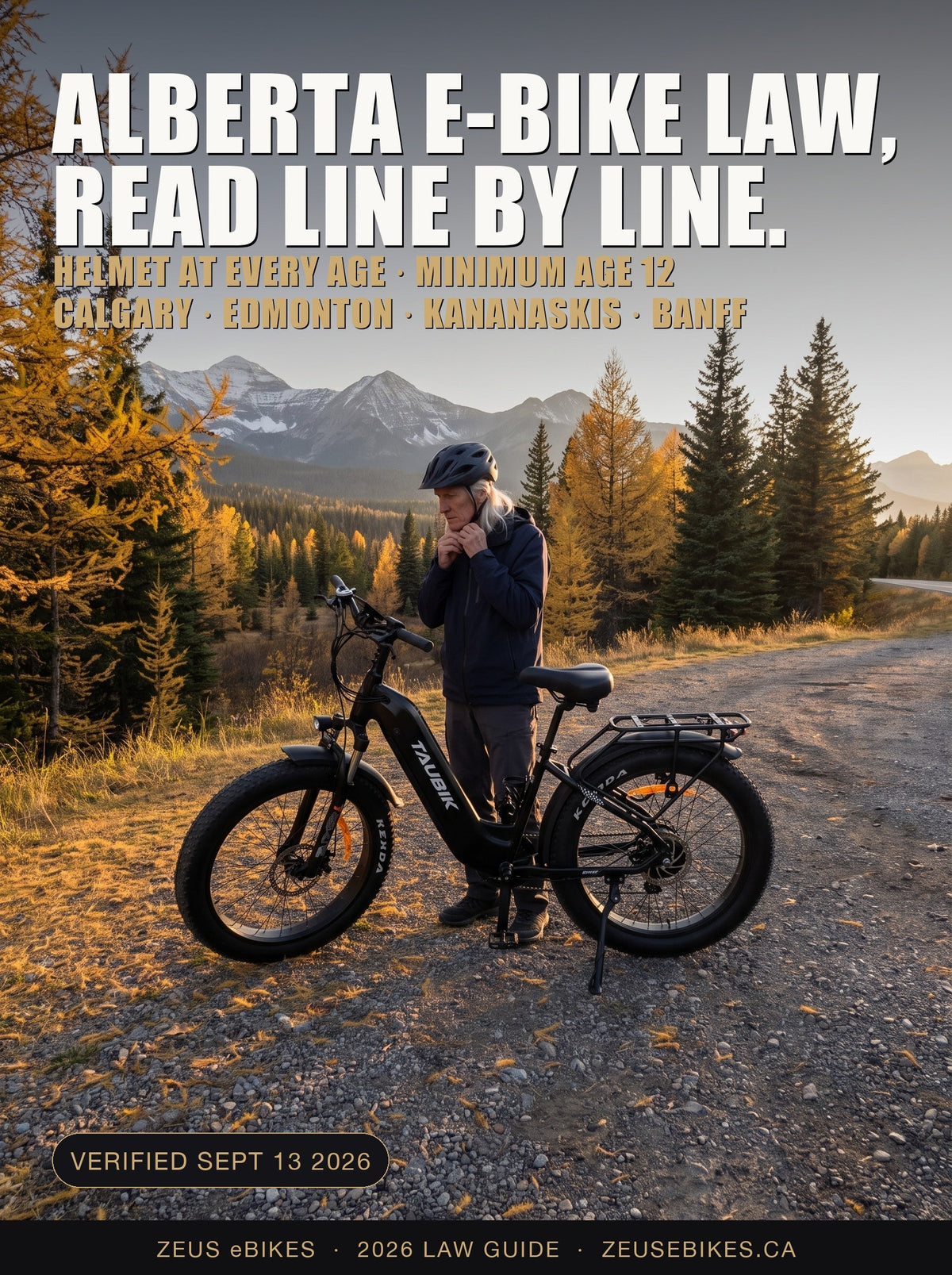
Alberta E-Bike Laws (2026): Rules, Fines & Where You Can Ride

Yes, e-bikes are legal in Alberta. The law calls them power bicycles, and a compliant one needs no licence, no registration and no insurance. The details are where Albertans get caught: a helmet is required at every age, the equipment rules include a left-side mirror, Calgary pathways allow pedal assist only, Edmonton fines sidewalk riding $250, and a throttle keeps you off park trails.
This guide was rebuilt on 13 September 2026 from the text of the law itself: Alberta's Traffic Safety Act and four of its regulations, the specified-penalty schedule, Calgary and Edmonton bylaws, Alberta Parks and Parks Canada orders, the Criminal Code, and both transit systems' own rules. Every rule below links to where it is written.
We read the current King's Printer consolidations rather than summaries: the Traffic Safety Act (current as of July 2, 2026), the Use of Highway and Rules of the Road Regulation (AR 304/2002, current as of August 8, 2025), the Vehicle Equipment Regulation (AR 122/2009, current as of June 11, 2025) and its June 2025 amendment, the Operator Licensing and Vehicle Control Regulation (AR 320/2002, current as of September 1, 2026) and the Procedures Regulation fine schedule (AR 63/2017, current as of March 13, 2026). City rules come from Calgary Bylaw 11M2019 and its penalty schedule and from Edmonton Bylaw 20700 as consolidated May 19, 2026.
Where a government page no longer exists, we retrieved the archived original and say so. Bike specifications come from each manufacturer's Canadian spec sheet, and every price was checked against the live Zeus listing on 13 September 2026.
E-bikes are legal in Alberta as power bicycles. The criteria the province publishes are 500W or less, motor assistance that stops at 32 km/h, and working pedals, although the regulation’s own definition points to a federal one repealed in 2021. No licence, registration or insurance. Riders must be 12 or older (under 18 needs a parent's consent or a licence) and wear a helmet at every age. Required equipment includes a headlamp, tail lamp, reflectors, brakes on both wheels, a bell and a left-side mirror.
Calgary pathways: pedal assist only, 20 km/h. Edmonton sidewalks: banned from age 17, $250. Bikes with a throttle stay off provincial and national park trails. A motor over 500W falls outside those criteria, and Alberta’s guide treats such a machine as a motor vehicle. For a 500W bike that ships set to 32 km/h, start with the Eunorau Meta 26 (Eunorau lists its cap as unlockable, and whether that qualifies is not settled) or browse Zeus's legal e-bike collection.
In This Guide
- What Changed in 2025–2026
- What Alberta Law Actually Says
- The Rules at a Glance
- Helmets, Mirrors & Required Equipment
- Where You Can Ride
- Calgary Rules
- Edmonton Rules
- Kananaskis & Provincial Parks
- Banff, Jasper & Waterton
- Impaired Riding
- E-Scooters, E-Dirt Bikes & Mopeds
- E-Bikes on CTrain, LRT & Buses
- Fines & Penalties
- Insurance
- 7 Zeus Picks Set Up for Alberta Roads
- Frequently Asked Questions
- The Bottom Line
- References
🇨🇦 Looking for Canada-wide rules? This guide covers Alberta. For every province's motor limits, helmet ages, licensing rules and fines in one comparison table, see eBike Laws Canada (2026): every province, one table.
What Changed in 2025–2026
Three rule changes have reached Alberta riders since March 2025: a new Banff e-bike order, Edmonton's Public Spaces Bylaw, and new helmet standards in the Vehicle Equipment Regulation. An older guide can put you on the wrong trail, the wrong sidewalk or under the wrong helmet. The table lists each change with its source.
| Date | What changed | What it means for you | Source |
|---|---|---|---|
| March 28, 2025 | Parks Canada issued the current Banff e-bike order, in effect "until further notice" | E-bikes are banned in Banff except on paved roads, highways and 12 listed trails, and only pedal-assist bikes may use those trails | Banff restricted activity order |
| May 12, 2025 | Edmonton Public Spaces Bylaw 20700 came into force and repealed the old Parkland Bylaw 2202 | $250 for riding a bicycle, e-bike or e-scooter on a sidewalk from age 17, and $250 for each riding-conduct offence | Bylaw 20700, ss. 78–82, 95, 97 |
| June 2025 | AR 129/2025 amended the Vehicle Equipment Regulation | The approved helmet list now runs DOT 218, Snell M2005 to M2025, and ECE 22.05 or 22.06; the older CSA, BSI and Snell M2000 standards were removed | Ministerial Order 22/25 |
One change is still pending rather than done. Alberta Municipalities has asked the province to allow privately owned e-scooters, and as of August 2026 it reports the request as "Intent Partially Met" and says it anticipates legislation in fall 2026 (Alberta Municipalities). Until that happens, the current e-scooter rules in this section apply.
If your information predates spring 2025, re-check three things: which Banff trails are open to your bike, Edmonton's sidewalk age cut-off, and whether your helmet carries an approved label.
What Alberta Law Actually Says
A power bicycle in Alberta is a cycle, not a motor vehicle. The Traffic Safety Act's definition of "motor vehicle" expressly "does not include a bicycle, a power bicycle", so licence, registration and insurance rules do not apply (TSA s. 1(1)(x), ss. 51, 52, 54). On the road, you have a driver's rights and duties (AR 304/2002 s. 75).
The technical definition has an unusual history. Alberta's rules of the road define a power bicycle as "a vehicle that is a power-assisted bicycle under the Motor Vehicle Safety Regulations (Canada)" (AR 304/2002 s. 1(1)(o)). Ottawa repealed that federal definition effective February 4, 2021 (C.R.C., c. 1038, s. 2: "[Repealed, SOR/2020-22, s. 3]"), and the Alberta consolidation we read, current as of August 8, 2025, still points to it. The province's own small-vehicle guide reprints the criteria that definition contained (Alberta Transportation, updated November 2018):
- Steering handlebars and pedals, and capable of being propelled by muscular power
- No more than three wheels in contact with the ground
- Electric motors with a total continuous output of 500 W or less, "singly or in combination", so two 500W motors count as 1,000W
- Assistance that stops when you stop pedalling, or when you brake if a throttle is engaged
- No further assistance above 32 km/h on level ground
- A manufacturer's label, and either an on/off switch separate from the throttle or a mechanism that stops the motor engaging below 3 km/h
Alberta's Interpretation Act says a reference in an Alberta regulation to a federal regulation is a reference to that regulation "as amended" (s. 31). Ottawa amended it by repealing the definition, and the Act's redirect rule applies only when a repealed federal provision has "other provisions" substituted for it (s. 36(2)), which did not happen. Read plainly, the definition of power bicycle now points to text that no longer exists. In our searches we did not find an Alberta court decision or an amending regulation that settles it.
The other reading deserves a hearing. Section 36(1)(f) of the same Act says a repealed enactment with no replacement provisions is "construed as being unrepealed insofar as is necessary" to give effect to the enactment that refers to it, which is an argument that the old criteria still stand in Alberta. That subsection opens by describing an enactment repealed and "a new enactment ... substituted for it", and s. 36(2) is the subsection written for the laws of Canada and other provinces. Which reading a court would take is the open question here.
The same 2021 amendment also rewrote the federal definition of "motorcycle", which until then excluded power-assisted bicycles. A limited-speed motorcycle is now any motorcycle with handlebars that steer one wheel, a top speed of 70 km/h or less and a driver's seat at least 650 mm off the ground when unladen (C.R.C., c. 1038, s. 2), a description many adult e-bikes meet on paper. That is why a bike outside the published criteria is more likely to be read as a moped in Alberta than as a motorcycle.
What Alberta still publishes is the old standard: its 2018 small-vehicle guide reprints the criteria above, and Alberta Parks defines a permitted e-bike as up to 500 W with assistance stopping at 32 km/h. Those are the criteria to buy and ride to. How a court would treat the gap is a legal question this guide cannot answer; if it matters to you, ask Alberta Transportation or a lawyer.
What counts as a power bicycle, minimum age, helmets, lights and equipment, and the $68 to $203 specified penalties.
Sidewalks, pathway speed limits, pedal-assist-only pathways and conduct rules. Calgary and Edmonton write these differently.
Banff, Jasper and Waterton set their own trail rules with fines up to $25,000, and impaired-operation law is criminal law that applies everywhere.
A motor rated over 500W, pedals that cannot move the bike, or assistance past 32 km/h puts a machine outside the published criteria. Alberta’s guide then treats it as a motor vehicle, which needs a licence, registration and insurance. It is a moped (Class 7 licence, age 14) only if it also meets the limited-speed motorcycle standard of 70 km/h or less; otherwise it is a motorcycle (Class 6, age 16), per Alberta's small-vehicle guide. For what each motor size means in practice, see our 500W vs 750W vs 1000W guide.
The Rules at a Glance
Every Alberta power bicycle rule in one table, each with the section it comes from. The short version: stay at 500W and 32 km/h, be 12 or older, wear a helmet, carry the listed equipment, and follow your city's pathway and sidewalk bylaws. Licence, plate and insurance rules do not apply to a compliant bike.
| Requirement | Alberta rule | Where it is written |
|---|---|---|
| Motor | 500 W or less continuous, all motors combined | AR 304/2002 s. 1(1)(o), by reference to the repealed federal definition |
| Assisted speed | No assistance above 32 km/h on level ground | Same |
| Pedals | Must be able to propel the bike by muscular power | Same |
| Minimum age | 12. Under 18 must carry a parent's or guardian's consent in the Registrar's approved form, or hold an operator's licence | AR 320/2002 s. 9 |
| Passengers | Riders under 16 may not carry passengers | AR 304/2002 s. 76 |
| Helmet | Required for rider and passenger at every age. Which helmet is explained below | AR 122/2009 ss. 107–108 |
| Lights | Headlamp, tail lamp and brake lamp; required lamps must be on whenever you ride on a highway | AR 122/2009 ss. 10, 13, 18; AR 304/2002 s. 55(2) |
| Reflectors | Amber at the front sides, red at the rear sides, red at the rear, amber on each pedal | AR 122/2009 s. 50 |
| Brakes | A brake on each wheel, able to stop within 12 m from 30 km/h | AR 122/2009 ss. 54–55 |
| Bell | Horn or bell | AR 122/2009 s. 60 |
| Mirror | Left-side mirror | AR 122/2009 s. 110 |
| Licence, registration, insurance | Not required | TSA ss. 1(1)(x), 51, 52, 54 |
| Throttle | Allowed by provincial law; not on Calgary pathways or park trails | City and park rules below |
| Road position | As far right as practicable, on a paved shoulder where there is one, single file | AR 304/2002 ss. 77–78 |
Want a bike that meets these rules out of the box? Every pick in this guide meets the 500W and 32 km/h criteria as set up for Alberta roads, and Zeus's PAB-legal collection has more to compare. Not sure about a specific model? Call 1-866-938-7580. Real humans answer.
Eunorau Meta 24 · Meta 26 · Meta 275 2.0
$2,295 CAD
This is the pick for the rider who wants to stop thinking about the law and just ride. All three sizes share a 500W hub motor, a 32 km/h listed top speed and working pedals, which meets the 500W, 32 km/h and pedal criteria as shipped. The torque sensor matters in Calgary, where pathways are pedal-assist only: assistance follows how hard you push, so pathway riding feels like a strong bike rather than a restricted one. Front and rear LED lights, fenders and a 7-speed Shimano drivetrain come standard.
Choose by height, per Eunorau's spec sheets: Meta 24 (5′3″–6′2″, 61.7 lb), Meta 26 (5′4″–6′3″, 68.4 lb) or Meta 275 2.0 (5′6″–6′1″, 68.4 lb, 27.5 × 2.6″ tires). All three fit under Calgary Transit's 75 lb bus-rack limit and exceed Edmonton's 55 lb limit. Two things to plan for: they have a thumb throttle, so park trails are off the table, and Eunorau's spec sheets list no mirror, so budget for a rear-view mirror.
Helmets, Mirrors & Required Equipment
Alberta requires every power bicycle rider and passenger to wear a helmet, at any age, and the regulation lists motorcycle helmet standards. The province's public cycling page says power bicycle riders may wear a bicycle helmet instead. The 2018 exemption that allowed that expired at the end of 2022, and we could not find a renewal. Wear a helmet every ride: the ticket is $135.
Which helmet
The Vehicle Equipment Regulation says no person may operate or ride as a passenger on a cycle other than a pedal bicycle "unless that person is properly wearing a safety helmet" (AR 122/2009 s. 107(2)). Section 108 adopts motorcycle standards only: DOT FMVSS 218, Snell M2005, M2010, M2015, M2020 and M2025, and ECE 22.05 or 22.06, updated by AR 129/2025 in June 2025.
Alberta's cycling safety page says "riders of power bicycles can choose to wear a bicycle helmet instead of a motorcycle helmet" (Alberta.ca). That permission came from a Registrar's exemption dated November 20, 2018, which the government no longer hosts. The archived original allows "an approved bicycle helmet" and states: "This exemption expires on December 31, 2022" (Registrar's Exemption, archived).
"This exemption expires on December 31, 2022." The last line of the 2018 Registrar's exemption that let Alberta power bicycle riders wear bicycle helmets.
We looked for a renewal on Alberta.ca, through searches of Alberta's open-government portal, and at the exemption's original government address, and did not find one. So the province's current public advice supports a bicycle helmet, and the regulation's text supports a motorcycle-certified helmet. If you want no room for argument at a roadside stop, a helmet carrying one of the section 108 labels settles it. Either way, never ride without one.
The mirror and brake-lamp rules
The same 2018 package also exempted power bicycles from the brake-lamp rule (s. 18(2)) and the left-side mirror rule (s. 110), and it carried the same December 31, 2022 expiry (archived exemption). Alberta's 2018 small-vehicle guide still tells riders that power bicycles "no longer require a brake lamp or a side mirror". On the regulation's text, both requirements apply. A rear-view mirror costs less than the $135 ticket, and two of the picks below, the Taubik Tour S and the ONE-TRIKE 2.0, already carry a brake light.
| Equipment | Rule | Specified penalty |
|---|---|---|
| Helmet (rider and passenger, all ages) | AR 122/2009 s. 107(2) | $135 |
| Helmet meets an approved standard | s. 108 | $135 |
| Left-side mirror | s. 110 | $135 |
| Reflectors (sides, rear, pedals) | s. 50 | $135 |
| Headlamp | s. 10(1) | $68 |
| Tail lamp | s. 13 | $68 |
| Brake lamp | s. 18 | $68 |
| Horn or bell | s. 60 | $68 |
| Brakes on each wheel | s. 54 | $203 |
Penalty amounts: Procedures Regulation, AR 63/2017, Schedule Part 42, current as of March 13, 2026.
Helmet on (rider and passenger) · headlamp and tail lamp switched on · brake light · reflectors on both sides, the rear and the pedals · brakes on both wheels · bell · left-side mirror. Add a rear-view mirror if your bike did not come with one.
Where You Can Ride in Alberta
A power bicycle can use public roads and bike lanes anywhere in Alberta, riding as far right as practicable and single file. Pathways, sidewalks and trails are set by whoever manages them: cities write pathway and sidewalk rules, Alberta Parks and Parks Canada write trail rules, and the biggest dividing line on trails is whether your bike has a throttle.
| Place | E-bike with a throttle | Pedal-assist only e-bike | Source |
|---|---|---|---|
| Public roads and bike lanes | ✔ Allowed | ✔ Allowed | AR 304/2002 ss. 75–78 |
| Calgary pathways | ✔ In pedal-assist mode, 20 km/h | ✔ 20 km/h | City of Calgary |
| Edmonton shared pathways | ✔ Reasonable speed | ✔ Reasonable speed | Bylaw 20700 ss. 78(2), 82 |
| Calgary sidewalks | ✘ Age 14 and up (City bicycle rule) | ✘ Age 14 and up (City bicycle rule) | City of Calgary |
| Edmonton sidewalks | ✘ Age 17 and up | ✘ Age 17 and up | Bylaw 20700 s. 78 |
| Deerfoot Trail, Calgary | ✘ | ✘ | City of Calgary |
| Alberta provincial park trails | ✘ Not on trails | ✔ Where cycling is permitted | Alberta Parks |
| Banff trails | ✘ Paved roads only | ✔ 12 listed trails | Parks Canada order |
| Jasper and Waterton trails | ✘ Not on trails | ✔ Trails open to bikes | Parks Canada |
If you plan to ride park trails, the throttle decides it before the motor does. A bike without one opens every trail where cycling is allowed; a bike with one keeps you off them. Walking your bike on a sidewalk is always fine.
Calgary Rules: Pathways, Sidewalks & Fines
In Calgary, e-bikes can use roads, bike lanes and the pathway network, but pathways allow pedal assist only: the City says "power-on-demand electric or gas bicycles are not allowed on pathways." Pathway speed is capped at 20 km/h unless posted, riders 14 and older must stay off sidewalks, and Deerfoot Trail is closed to anyone cycling.
Pathways
- Pedal assist only. "Pedal assist electric bicycles are allowed on pathways, except where bicycles are prohibited" (City of Calgary park user guide). If your bike has both a throttle and pedal assist, use pedal assist on pathways.
- 20 km/h "unless otherwise posted", and never faster than is reasonable for weather, traffic or pathway conditions (Bylaw 11M2019 s. 17).
- Signal before passing and keep right except when overtaking (s. 19).
- Between sunset and sunrise, a white front light and a red rear reflector, which you may wear on your body if they will not fit the bike (s. 20).
Everywhere else
- Sidewalks: "Children younger than 14-years-old may ride bicycles on the sidewalk" (City of Calgary). Everyone else rides the road or cycling lanes.
- Helmets: the City's cycling page states that for e-bikes, helmets "must be worn by all riders and passengers, regardless of age", matching the provincial rule (City of Calgary).
- Deerfoot Trail is closed to people cycling (same page).
| Calgary pathway offence | Minimum | Specified |
|---|---|---|
| Speeding, up to 10 km/h over | $100 | $150 |
| Speeding, more than 10 km/h over | $250 | $400 |
| Unsafe speed for conditions | $250 | $400 |
| Unauthorized vehicle or device on a pathway | $150 | $250 |
| Unsafe activity on a pathway | $200 | $400 |
| No required lighting on a pathway | $150 | $250 |
Source: City of Calgary, Parks and Pathways Bylaw 11M2019 penalties. For bikes suited to the city itself, see our Calgary e-bike guide and the Calgary e-bike shop directory.
Velotric Discover M
$3,899 CAD
Calgary asks you to ride pathways on pedal assist, and a mid-drive is the best way to make that feel effortless on a climb. The Discover M's 500W motor sits at the cranks and works through a Shimano CUES 9-speed, so its 100 Nm is multiplied by your gears instead of fighting a single hub ratio. Velotric's SensorSwap lets you switch between torque and cadence sensing, an 80 mm air fork softens broken pavement, and the bike is certified to UL 2849 and UL 2271 (Velotric Canada).
Two things to know. Velotric ships it at a 32 km/h default but lists an adjustable range up to 45 km/h: keep it at 32 anywhere public, because above that it falls outside the published criteria. It also has a throttle, so park trails are off-limits. At about 27.2 kg on 27.5 × 2.4″ tires it is within Calgary Transit's bus-rack weight and tire limits and over ETS's 25 kg limit.
Edmonton Rules: Sidewalks, Pathways & the $250 Bylaw
Edmonton's Public Spaces Bylaw 20700, in force since May 12, 2025, sets a flat $250 fine for riding a bicycle, e-bike or e-scooter on a sidewalk if you are 17 or older, and the same amount for riding in transit stations, riding indoors, failing to yield, passing without an audible signal, unsafe passing and unsafe speed. Shared pathways are open to e-bikes, with no numeric speed limit.
What Bylaw 20700 says
- Sidewalks: "A person must not ride a bicycle, e-bicycle, e-scooter, on a sidewalk." The rule "does not apply to a shared pathway or persons aged 16 years and under" (s. 78).
- Transit stations and indoor public spaces: no riding (ss. 79–80).
- On pathways and anywhere you ride: yield to pedestrians and slower users, give "an audible signal and reasonable time before overtaking", overtake with care, keep "a reasonable rate of speed", and do not ride where it damages the surface (s. 82).
- Old rules are gone: the bylaw repealed Parkland Bylaw 2202 (s. 97), so the bell and grass fines older guides quote from that bylaw no longer exist in that form. The provincial requirement for a horn or bell still applies ($68).
We read Bylaw 20700 in full, as consolidated on May 19, 2026, and found no rule that treats throttle e-bikes differently from pedal-assist e-bikes on Edmonton pathways. For bikes suited to Edmonton's winters and river valley, see our Edmonton e-bike guide, and for local service, the Edmonton e-bike shop directory.
| Edmonton offence (Bylaw 20700) | Section | Fine |
|---|---|---|
| Riding on a sidewalk (age 17 and up) | 78(1) | $250 |
| Riding in a transit space | 79 | $250 |
| Riding in an indoor public space | 80 | $250 |
| Failure to yield right of way | 82(a) | $250 |
| Failure to alert before overtaking | 82(b) | $250 |
| Unsafe overtaking | 82(c) | $250 |
| Unsafe operation | 82(d) | $250 |
Eunorau Defender
$2,450 CAD
Alberta riding is rarely smooth asphalt for long. Frost-heaved paths, gravel range roads and packed river-valley trails are where a full-suspension bike earns its place, and the Defender does it within the core power bicycle criteria: a 48V 500W rear hub, a 20 mph (32 km/h) listed top speed and working pedals, per Eunorau Canada's spec sheet. Suspension front and rear plus 27.5 × 3.0″ CHAOYANG tires give it a wide, planted footprint on loose surfaces, and the brake levers cut motor power as you squeeze.
Where it does not fit: 60 Nm is comfort torque rather than climbing torque, so for steep daily hills the Discover M is the better answer. It has a thumb throttle, so park trails are off-limits. At 66 lb it fits Calgary Transit's 75 lb rack limit and not ETS's 55 lb limit. Eunorau does not publish its sensor type on that page, so call us before ordering if that decides it for you. It ships with a headlight and taillight; add a mirror.
Riding Calgary or Edmonton every day? Tell us your route and your city's pathway rules and we will match you to a bike that fits both. 1-866-938-7580, free Canada-wide shipping, and financing options if you would rather pay monthly.
Kananaskis & Alberta Provincial Parks
Pedal-assist e-bikes are allowed on every designated pathway and trail where cycling is permitted in Alberta's provincial parks, provincial recreation areas and wildland provincial parks, including Kananaskis Country. Alberta Parks defines a permitted e-bike as non-throttled, up to 500 W continuous output, with assistance that stops when you stop pedalling or reach 32 km/h.
The rule grew out of a two-year pilot in Kananaskis Country from 2019 to 2021, which drew 1,213 survey responses and concluded that pedal-assist e-bikes present "low risk to visitor safety and park features" (Alberta Parks, updated March 20, 2025). Alberta Parks spells out what does not qualify (Alberta Parks activities page):
- Throttle or power-on-demand bicycles
- More than 500 watts of maximum output
- Power provided above 32 km/h
- E-scooters, electric skateboards and other electric devices
Kananaskis also requires a Kananaskis Conservation Pass to park your vehicle there, so buy it before you unload the bikes.
Taubik Tour S
$2,899 CAD
If trails are why you are buying, start here. Taubik, a Canadian-owned brand, lists the Tour S with a 500W Bafang motor, a 32 km/h top speed and dual torque/cadence pedal assist, and no throttle on its spec sheet (Taubik); the manual Taubik links from that page shows a thumb throttle, so ask before a park trail that admits pedal-assist only. Alberta Parks' definition of a permitted e-bike excludes throttles, so that is the spec that matters. Parks Canada adds its own test, a mechanism that stops the motor engaging below 3 km/h, so confirm that with us before you ride Banff's listed trails.
The rest suits Alberta shoulder seasons: 26 × 4.0″ Kenda Juggernaut fat tires, a 75 mm RST fork, Shimano 8-speed gearing, full fenders, a low step-through frame and a rear rack with an integrated brake light, which covers one of the equipment rules above. The trade-off is weight. At 77 lb it is over Calgary Transit's 75 lb bus-rack limit, so plan to drive it to the trailhead.
Banff, Jasper & Waterton: National Park Rules
Inside Banff, Jasper and Waterton Lakes, Parks Canada's rules apply. Only pedal-assist e-bikes may use trails, and a bike with a throttle is limited to roads. Banff allows pedal-assist e-bikes on 12 listed trails, Jasper and Waterton on trails open to bicycles, and breaking a Banff order carries a maximum penalty of $25,000.
Parks Canada's e-bike test
To ride Banff's listed trails, an e-bike must have handlebars and pedals, no more than three wheels on the ground, be capable of muscular power only, have motors totalling 500 W or less that "immediately cease power assistance when the muscular power ceases" and stop assisting at 32 km/h, and have a mechanism that prevents the motor engaging below 3 km/h (Banff order, March 28, 2025).
Banff
"The use of electric bicycles (e-bikes) is prohibited in Banff National Park except on paved roads and highways," with pedal-assist e-bikes permitted on these trails: Banff Legacy Trail, Brewster Creek Trail, Cascade Ponds–Bankhead Trail, Fenland Loop, Healy Creek Trail (between listed junctions), Redearth Creek and Shadow Lake Trail, Sundance Trail, Tunnel Mountain Bench Area, Bow River Trail, Tramline Trail, Louise Creek Trail, and the Great Divide (Old 1A Highway) Trail. The order is issued under s. 7(1) of the National Parks General Regulations, maximum penalty $25,000.
Plan spring rides around one more order: from March 1 to June 25, travel is not permitted between 8 p.m. and 8 a.m. on a 17-km section of the Bow Valley Parkway, from the Fireside picnic area to Johnston Canyon Campground (Parks Canada).
Jasper
Under a pilot program, "pedal assist e-bikes are permitted on all trails and areas that bicycles are permitted in Jasper National Park," and "a bike that has an accelerator (a throttle) is not a pedal assist e-bike; it may only be ridden on roads, not on trails." Parks Canada says tree assessment and dangerous-tree removal are complete only on designated trails and areas marked open, so check trail conditions first (Parks Canada, updated May 27, 2026).
Waterton Lakes
"E-bikes (pedal assist electric bicycles) are permitted on all cycling trails," and e-bikes with a throttle "can only be ridden on roads" (Parks Canada, updated October 23, 2025).
Check your trail against the current list, check seasonal closures, and look at your handlebars. If there is a throttle, the bike rides park roads only, whatever its wattage.
Impaired Riding: Provincial and Criminal Law
Alberta's roadside impaired-driving sanctions do not apply to a power bicycle, but that is only half the answer. The Criminal Code defines a motor vehicle as anything propelled "by any means other than muscular power", police in Canada have laid impaired-operation charges against e-bike riders, and a conviction carries a $1,000 minimum fine and a driving prohibition.
The provincial layer
Alberta's 24-hour and immediate roadside sanctions are written for motor vehicles, and the Traffic Safety Act excludes power bicycles from that definition. The Act adds a specific carve-out for those sanctions: "motor vehicle" does not include an electric scooter or electric bicycle "operated by one person and carrying only that person" and "not exceeding 30 kilometres per hour at the time of operation" (TSA s. 87.1(2)(a)).
The criminal layer
The Criminal Code's definition of "motor vehicle" is "a vehicle that is drawn, propelled or driven by any means other than muscular power" (s. 2). In R. v. Pizzacalla, 2014 ONCA 706, Ontario's Court of Appeal upheld a conviction for driving while disqualified on a device whose pedals could not propel it, holding it was a motor vehicle rather than a power-assisted bicycle (Court of Appeal for Ontario). That case involved non-working pedals and a disqualification charge.
We did not find a published appellate ruling on impaired operation of a fully compliant pedal-assist e-bike. Police treat the risk as real: in September 2026, Vernon North Okanagan RCMP told Vernon city council they had laid Motor Vehicle Act and Criminal Code charges against two people for operating e-bikes while impaired by alcohol (Castanet, September 12, 2026). Those are charges in British Columbia, not convictions, but the Criminal Code is the same in Alberta.
| If convicted of impaired operation | Consequence | Source |
|---|---|---|
| First offence, minimum | $1,000 fine | Criminal Code s. 320.19 |
| Second offence, minimum | 30 days' imprisonment | s. 320.19 |
| Prohibition order, first offence | 1 to 3 years from operating "the type of conveyance in question" | s. 320.24 |
| Alberta driving disqualification | 1 year from a motor vehicle in Alberta, on a finding of guilt under s. 320.14 | TSA s. 83(1) |
| Alberta roadside sanctions | Do not apply to a power bicycle | TSA ss. 1(1)(x), 87.1(2)(a) |
A driver's licence can be lost over a ride on a bike that needs no licence. If you have been drinking, lock the bike and take a ride home.
E-Scooters, E-Dirt Bikes & Mopeds: Not Power Bicycles
Privately owned e-scooters, electric dirt bikes and anything over 500W fall outside Alberta's power bicycle rules. Alberta Transportation lists electric scooters among prohibited miniature vehicles that may only be operated on private property; an off-road electric motorbike is an off-highway vehicle needing registration and insurance; and a moped or motorcycle needs a licence.
E-scooters
Alberta Transportation lists "personal transporter, pocket bikes, go carts, electric scooters and golf carts" as prohibited miniature vehicles that "may only be operated on private property" (Owning and Operating a Small Vehicle in Alberta, March 2013), and its 2018 guide repeats that operating them on roadways or sidewalks is prohibited (small-vehicle guide). The shared scooters in Calgary and Edmonton run under city programs, and Alberta Municipalities' request to allow personal e-scooters remains open, with legislation anticipated in fall 2026 (Alberta Municipalities). If you want a legal personal ride today, a compliant e-bike is it.
Electric dirt bikes
An electric motorbike built for off-road travel is an off-highway vehicle under the Traffic Safety Act, which covers "motorcycles and related 2-wheel vehicles" and "any other means of transportation that is propelled by any power other than muscular power" when designed for cross-country travel (TSA s. 117). It must be registered and insured to ride on public land or anywhere else it is permitted (s. 119), the rider needs a helmet (s. 128.1), and it may not be driven on any portion of a highway unless the province or a municipality authorizes it (s. 120(2)(b), (4)). The Act also includes a seizure provision for off-highway vehicles (s. 127).
Riding one on streets, pathways or sidewalks as if it were an e-bike is not legal. See our Sur-Ron legality guide and electric dirt bikes guide.
Mopeds and electric motorcycles
| Power bicycle | Moped | Motorcycle | |
|---|---|---|---|
| Definition | 500 W or less, 32 km/h, pedals (the criteria Alberta publishes) | Electric motor or ≤50 cc engine, and a limited-speed motorcycle (70 km/h or less) | Motor vehicle on 2 or 3 wheels other than a moped |
| Licence | None | Class 7 | Class 6 |
| Minimum age | 12 | 14 | 16 |
| Registration and insurance | No | Yes | Yes |
| Helmet | Yes, see above | Motorcycle helmet | Motorcycle helmet |
Sources: AR 304/2002 s. 1(1)(i); TSA s. 1(1)(w); AR 320/2002; Alberta small-vehicle guide.
E-Bikes on CTrain, Edmonton LRT & Buses
Both cities allow bikes on their trains at all times. Bus racks are where e-bikes get turned away: Calgary Transit's racks take e-bikes up to 75 lb (34 kg), while Edmonton Transit's take bikes under 25 kg (55 lb) with tires no wider than 2.35 inches, which rules out most e-bikes.
| Rule | Calgary Transit | Edmonton Transit (ETS) |
|---|---|---|
| Bikes on trains | CTrain, at all times; folding bikes folded and in a bag or case | LRT, at all times |
| Bus rack weight | 75 lb / 34 kg | Under 25 kg / 55 lb |
| Tire width | 3.2″ standard racks; 5.5″ fat-tire racks | 2.35″ |
| Wheelbase | 48″ standard; 51″ fat-tire racks | 44″ |
| Wheel diameter | 16–29″ standard; 24–29″ fat-tire racks | 20–29″ |
| Folding bikes inside buses | Allowed if folded and not obstructing | Not allowed |
| E-bike batteries | No battery rule listed | Remove the battery and carry it on if possible |
Sources: Calgary Transit, Bikes on Transit; ETS, Bikes and E-scooters on ETS (read from the Internet Archive copy of September 12, 2026, because the city's server refused our retrieval tools). ETS's battery-type rule (sealed gel, lithium-ion or NiCad only) applies to its Century Park bike storage room, not to buses. Riding inside a transit station in Edmonton is a $250 offence under Bylaw 20700 s. 79.
Eunorau Meta Foldable (20″)
$2,295 CAD
For the rider who mixes the bike with the bus, this is the pick built around Calgary Transit's rack limits: 63.4 lb against a 75 lb limit, 3.0″ tires against 3.2″, and 20″ wheels inside the 16–29″ range. Measure the wheelbase against the 48″ limit before you rely on it. It keeps the Meta formula of a 500W hub, torque sensor, 720 Wh Samsung battery, 7-speed Shimano gears and 180 mm hydraulic brakes with motor cut-off, and at 5′1″ it fits the shortest riders of any bike here (Eunorau Canada).
Where it falls short: ETS's 55 lb and 2.35″ limits rule it out of Edmonton bus racks, so Edmonton riders should use the LRT. Eunorau's current spec sheet for this 20-inch Meta lists an adjustable stem rather than a folding frame, so if folding matters to you, call before ordering. It has a thumb throttle, so park trails are off-limits.
Fines & Penalties: What Each Rule Costs
Alberta e-bike fines come from three levels of government. Provincial equipment tickets run $68 to $203, Calgary pathway fines $100 to $400, Edmonton's riding offences $250 each, a Banff order breach up to $25,000, and an impaired-operation conviction a $1,000 minimum plus a driving prohibition.
| Offence | Level | Amount |
|---|---|---|
| No helmet, rider or passenger | Provincial | $135 |
| No left-side mirror | Provincial | $135 |
| Missing reflectors | Provincial | $135 |
| No headlamp, tail lamp or brake lamp | Provincial | $68 |
| No horn or bell | Provincial | $68 |
| Inadequate brakes | Provincial | $203 |
| Pathway speeding, up to 10 km/h over | Calgary | $100 minimum, $150 specified |
| Pathway speeding, more than 10 km/h over | Calgary | $250 minimum, $400 specified |
| Riding on a sidewalk, age 17+ | Edmonton | $250 |
| Passing without an audible signal | Edmonton | $250 |
| Breaching the Banff e-bike order | Federal (Parks Canada) | Up to $25,000 |
| Impaired operation, first conviction | Criminal Code | $1,000 minimum plus prohibition |
Sources: AR 63/2017 Schedule Part 42; Calgary Bylaw 11M2019 penalties; Edmonton Bylaw 20700 Schedule; Banff restricted activity order; Criminal Code ss. 320.19, 320.24. All linked in References.
Do You Need Insurance for an E-Bike in Alberta?
No. Insurance is required only for motor vehicles under the Traffic Safety Act, and a power bicycle is not one. Two checks still take ten minutes: whether your home or tenant policy's liability section excludes "self-propelled land vehicles", and whether standalone e-bike cover makes sense for a bike worth more than your policy's limits.
Per our e-bike insurance guide, re-verified in August 2026, Sundays Insurance writes e-bike cover in Alberta from $14 a month on a $2,000 bike, and Pedal Power Insurance covers every province except Quebec and includes liability. The same guide notes that Alberta's care-first auto insurance model under Bill 47 takes effect January 1, 2027, so check what it changes for you before then.
Call your home or tenant insurer and ask one question: "Does my personal liability cover me while riding an electric bicycle?" Get the answer in writing.
7 Zeus eBikes Set Up for Alberta Roads (September 2026)
Each pick has a motor rated 500W or less, working pedals and a 32 km/h assist cut-off as set up for Alberta roads, confirmed against the manufacturer's Canadian spec sheet on 13 September 2026. Two of them, the Velotric Discover M and the Eunorau Urus 2.0, ship capped at 32 km/h but can be set faster through the app or display.
The definition Alberta publishes asks for a bike that is "incapable of providing further assistance" above 32 km/h, and we found no Alberta guidance on whether a rider-adjustable cap meets that wording. Ride them capped, and treat that point as unsettled rather than proven.
| Model | Price | Motor · torque | Throttle | Weight | Calgary bus rack | ETS bus rack | Park trails |
|---|---|---|---|---|---|---|---|
| Eunorau Meta 24 · 26 · 275 2.0 | $2,295 | 500W hub · 55 Nm | Thumb | 61.7–68.4 lb | ✔ Weight and tires fit | ✘ Over limits | ✘ Not on trails |
| Eunorau Meta Foldable (20″) | $2,295 | 500W hub · 55 Nm | Thumb | 63.4 lb | ✔ Weight and tires fit | ✘ Over limits | ✘ Not on trails |
| Eunorau Defender | $2,450 | 500W hub · 60 Nm | Thumb | 66 lb | ✔ Weight and tires fit | ✘ Over limits | ✘ Not on trails |
| Eunorau ONE-TRIKE 2.0 | $2,499 | 500W hub · 80 Nm | Half-twist | 86 lb | ✘ Three wheels | ✘ Three wheels | ✘ Not on trails |
| Taubik Tour S | $2,899 | 500W Bafang · 80 Nm | None on the page, manual shows a thumb throttle | 77 lb | ✘ Over 75 lb | ✘ Over limits | ✔ None on the page, manual shows one (confirm first) |
| Velotric Discover M | $3,899 | 500W mid · 100 Nm | Yes | ≈27.2 kg | ✔ Weight and tires fit | ✘ Over limits | ✘ Not on trails |
| Eunorau Urus 2.0 | $5,700 | 500W mid · 120 Nm | Thumb | ≈61.7 lb | ✔ Weight and tires fit | ✘ Over limits | ✘ Not on trails |
Specifications from each manufacturer's Canadian spec sheet; transit fit measured against the rack limits in the transit section. Wheelbase is not listed on the spec sheets we used, so measure yours against the 44″ (ETS) and 48″ (Calgary) limits.
Eunorau ONE-TRIKE 2.0
$2,499 CAD
Alberta's definition allows up to three wheels on the ground, and so does Parks Canada's, so a trike can qualify as a power bicycle. The ONE-TRIKE 2.0 pairs a 48V 500W rear-drive motor with 80 Nm and a 20 mph (32 km/h) speed-limited setting, per Eunorau Canada. The saddle has a backrest, the payload rating is 440 lb, the stem folds for storage, and it carries an integrated brake taillight, one of the equipment rules above already handled.
What to plan for: it is single-speed, so hills are the motor's job; at 85.98 lb it will not go on a bus rack in either city; and its half-twist throttle keeps it off park trails. Stability at a stop, without putting a foot down, is the reason to choose it. Compare every three-wheel option in our electric trikes guide.
Eunorau Urus 2.0
$5,700 CAD
The Urus is the most capable bike on this list: a 500W Bafang M600 mid-drive with 120 Nm, 150 mm RockShox suspension at both ends, Tektro hydraulic brakes on a 203 mm front rotor, a remote dropper post and an 840 Wh Samsung battery (Eunorau Canada). If you ride steep gravel climbs out of the foothills or long rolling roads, the motor and gearing have margin to spare. Eunorau now lists the weight at about 61.7 lb (28 kg), which clears Calgary Transit's 75 lb rack limit on 2.8″ tires and not ETS's 25 kg limit.
Before you buy: Eunorau labels it "Class 3, speed limited, unlockable". Its Canadian page lists 32 km/h as the shipped maximum in one place and 45 km/h in its spec table (read 19 September 2026), and the bike ships with assistance capped at 32 km/h. The definition Alberta publishes asks for a bike "incapable" of assisting above 32 km/h, and Alberta's guidance does not say whether a cap the rider can change meets that, so ride it capped and know the point is unsettled.
It also has a thumb throttle, which means Alberta Parks and national park trails are off-limits whatever the speed setting. Ridden as set up for Alberta roads, it is a road and pathway bike with mountain-bike hardware.
Seven bikes, one set of Alberta rules. Free Canada-wide shipping, financing at checkout, and a real person at 1-866-938-7580 who will check your city, your trails and your bus route against the bike before you buy.
Frequently Asked Questions
Are e-bikes legal in Alberta?
Yes. Alberta treats a compliant e-bike as a power bicycle, and the criteria it publishes are a motor of 500 W or less, assistance that stops at 32 km/h, and pedals that can move the bike. It needs no licence, registration or insurance. Riders must be at least 12, wear a helmet, and carry the required lights, reflectors, brakes, bell and mirror. City bylaws and park orders add rules on pathways, sidewalks and trails. One caveat: Alberta's regulation still defines a power bicycle by pointing to a federal definition repealed in 2021.
Do you need a licence for an electric bike in Alberta?
No. The Traffic Safety Act's definition of "motor vehicle" excludes power bicycles, so the operator's licence, registration and insurance requirements do not apply. That changes if the motor is over 500 W, the pedals cannot propel the bike, or it assists past 32 km/h: it is then a motor vehicle, typically a moped (Class 7) or motorcycle (Class 6).
How old do you have to be to ride an electric bike in Alberta?
Twelve. The Operator Licensing and Vehicle Control Regulation says a person under 12 may not drive a power bicycle on a highway, and a rider under 18 must carry a parent's or guardian's consent in the Registrar's approved form, or hold an operator's licence (AR 320/2002 s. 9). Riders under 16 may not carry passengers.
Is it illegal to ride an e-bike without a helmet in Alberta?
Yes, at every age, for riders and passengers. The Vehicle Equipment Regulation requires a helmet on every cycle other than a pedal bicycle, and the specified penalty is $135. The regulation lists motorcycle helmet standards; Alberta.ca says power bicycle riders may wear a bicycle helmet, but the 2018 exemption behind that expired December 31, 2022, and we found no renewal.
What is the speed limit for e-bikes in Alberta?
The motor must stop assisting at 32 km/h on level ground. You can go faster under your own power or downhill, but a bike that assists above 32 km/h falls outside the published criteria. Pathways set lower limits: Calgary's is 20 km/h unless posted, and Edmonton requires a reasonable rate of speed for the conditions.
Is throttle legal on e-bikes in Alberta?
On roads and bike lanes, yes, as long as the bike stays within 500 W and 32 km/h. On Calgary pathways, no: use pedal assist. On trails in Alberta's provincial parks and in Banff, Jasper and Waterton, a throttle-equipped bike is not allowed on trails, and Parks Canada limits it to roads. Edmonton's Bylaw 20700 does not treat throttle e-bikes differently.
Are 750W e-bikes legal in Alberta?
Not as power bicycles. The definition Alberta uses caps continuous motor output at 500 W, counting all motors together, so two 500 W motors are 1,000 W. A 750 W e-bike sits outside those criteria, and Alberta’s guide treats such a machine as a motor vehicle, which brings licence, registration and insurance rules before it can be ridden on a road.
Can you ride an e-bike on the sidewalk in Calgary or Edmonton?
Not if you are an adult. In Calgary, only children younger than 14 may ride bicycles on sidewalks. In Edmonton, Bylaw 20700 bans riding a bicycle, e-bike or e-scooter on a sidewalk for anyone 17 or older, with a $250 fine, and allows it on shared pathways. Walking your bike on the sidewalk is always allowed.
Can you get a DUI on an e-bike in Alberta?
Alberta's roadside impaired-driving sanctions do not apply to power bicycles, but the Criminal Code defines a motor vehicle as one propelled by any means other than muscular power, and police in Canada have laid impaired-operation charges against e-bike riders. A conviction carries a $1,000 minimum fine, a prohibition order, and a one-year Alberta driving disqualification.
Can you get a DUI on an electric scooter in Alberta?
Alberta's roadside sanctions exclude an electric scooter carrying one person at 30 km/h or less (Traffic Safety Act s. 87.1(2)(a)). The Criminal Code is separate: its motor vehicle definition covers anything propelled by other than muscular power, so an impaired-operation charge remains a risk. Privately owned e-scooters are also prohibited on Alberta roadways and sidewalks.
Are electric scooters legal in Alberta?
Privately owned e-scooters are not legal on Alberta roadways or sidewalks. Alberta Transportation lists electric scooters among prohibited miniature vehicles that may only be operated on private property. Shared rental scooters operate under city programs in Calgary and Edmonton. Alberta Municipalities reports its request to legalize personal e-scooters as partially met and anticipates legislation in fall 2026.
Are electric dirt bikes street legal in Alberta?
No. An electric dirt bike without working pedals, or over 500 W, is not a power bicycle. If it is built for off-road travel, the Traffic Safety Act treats it as an off-highway vehicle, requiring registration, insurance and a helmet, and the Act includes a seizure provision for off-highway vehicles (s. 127). It cannot be ridden on streets, pathways or sidewalks as if it were an e-bike.
Do you need a licence for an electric motorcycle in Alberta?
Yes. An electric motorcycle is a motor vehicle, so it needs a Class 6 operator's licence (minimum age 16), registration, insurance and a motorcycle helmet. A smaller electric vehicle that meets the limited-speed motorcycle standard (70 km/h or less) is a moped, which needs at least a Class 7 licence at age 14, registration and insurance.
Do I need insurance for an e-bike in Alberta?
No. Alberta requires insurance for motor vehicles, and a power bicycle is not one. Still check whether your home or tenant policy's liability coverage excludes "self-propelled land vehicles". Standalone e-bike insurance is available in Alberta; our e-bike insurance guide compares current providers and prices.
Can I ride an e-bike in Kananaskis or Banff?
Yes, with a pedal-assist e-bike. In Kananaskis and other Alberta provincial parks, non-throttled e-bikes up to 500 W are allowed wherever cycling is permitted. In Banff, pedal-assist e-bikes may use 12 listed trails, including the Legacy Trail and Sundance Trail, and must meet Parks Canada's 3 km/h engagement rule. A bike with a throttle is not allowed on those trails.
Can I take my e-bike on the bus in Calgary or Edmonton?
In Calgary, e-bikes can go on bus racks if they weigh 75 lb (34 kg) or less and fit the rack's tire and wheelbase limits, and bikes are allowed on the CTrain at all times. Edmonton Transit's racks take bikes under 25 kg with tires up to 2.35 inches, which excludes most e-bikes, but bikes may ride the LRT at all times.
Does Alberta use the Class 1, 2, 3 e-bike system?
Not in law. Class 1, 2 and 3 are American industry labels. Alberta's rules use one category, the power bicycle: 500 W, 32 km/h and working pedals. Alberta Parks mentions that its pedal-assist standard "is sometimes referred to as a class 1 e-bike", but the legal test is its written definition. For how the two countries compare, see our Canada vs USA e-bike laws guide.
The Bottom Line
Alberta's e-bike rules are simple at the core and detailed at the edges. Stay at 500W and 32 km/h and you need no licence, plate or insurance. Wear a helmet, carry the lights, reflectors, bell and a left-side mirror, and learn your city's pathway rules: pedal assist at 20 km/h in Calgary, no sidewalks from age 17 in Edmonton. Choose a bike without a throttle if park trails are the point.
If you are unsure whether a bike fits your city, your trail or your bus route, you do not have to decide alone. Call 1-866-938-7580 and a real person will walk through your riding before you spend a dollar. Every order ships free across Canada, financing is available, and more 500W options are in Zeus's PAB-legal collection. Riding outside Alberta too? Compare the British Columbia rules and the Saskatchewan and Manitoba rules.
By Milad Ghobadibeygvand, BScN (Western University, 2014), Co-founder, Zeus eBikes Canada. Laws, fines and park orders verified against primary sources, and prices and specifications checked, on 13 September 2026. Last updated: 8 October 2026 (the Tour S throttle line now carries both Taubik documents; every linked source was fetched again on 7 October 2026 and compared with the September copy; Kananaskis and West Bragg Creek trail reports changed only their closure dates). Park, transit, city and manufacturer sources re-read 19 September 2026. Rules change: confirm current rules with your municipality, Alberta Parks and Parks Canada before riding.
Visuals created by Playcut.ai
References
- Traffic Safety Act, RSA 2000, c. T-6, consolidation current as of July 2, 2026: ss. 1(1)(i), (w), (x); 51; 52; 54; 83; 87.1(2)(a); 117; 127; 128.1. Alberta King's Printer (PDF)
- Use of Highway and Rules of the Road Regulation, AR 304/2002, current as of August 8, 2025: ss. 1(1)(c), (i), (o); 55(2); 75–78. Alberta King's Printer (PDF)
- Vehicle Equipment Regulation, AR 122/2009, current as of June 11, 2025: ss. 10, 13, 18, 50, 54–55, 60, 107–108, 110, 114. Alberta King's Printer (PDF)
- Interpretation Act, RSA 2000, c. I-8, current as of September 1, 2025: ss. 31, 36. Alberta King's Printer (PDF)
- Vehicle Equipment Amendment Regulation, AR 129/2025 (Ministerial Order 22/25, June 2025). Alberta King's Printer (PDF)
- Operator Licensing and Vehicle Control Regulation, AR 320/2002, current as of September 1, 2026: s. 9. Alberta King's Printer (PDF)
- Procedures Regulation, AR 63/2017, Schedule Part 42 (Vehicle Equipment Regulation specified penalties), current as of March 13, 2026. Alberta King's Printer (PDF)
- Alberta Transportation, Registrar's Exemption: Power Bicycle Helmet Requirements, dated November 20, 2018, expiry December 31, 2022. Internet Archive copy
- Alberta Transportation, Registrar's Exemption: Power Bicycle Brake Lamp and Side Mirror, dated November 20, 2018, expiry December 31, 2022. Internet Archive copy
- Alberta Transportation, Rules & Regulations Applying to Small Vehicles, updated November 2018: power bicycles, mopeds, motorcycles, prohibited miniature vehicles. Open Government (PDF)
- Alberta Transportation, Owning and Operating a Small Vehicle in Alberta fact sheet, March 2013: prohibited miniature vehicles list. Alberta Transportation (PDF)
- Government of Alberta, Cycling safety equipment. Alberta.ca
- Motor Vehicle Safety Regulations, C.R.C., c. 1038, s. 2: "power-assisted bicycle" [Repealed, SOR/2020-22, s. 3], current to July 21, 2026. Justice Laws
- Criminal Code, R.S.C. 1985, c. C-46: s. 2 (motor vehicle); s. 320.19 (minimum punishments); s. 320.24 (prohibition orders).
- R. v. Pizzacalla, 2014 ONCA 706 (October 17, 2014). Court of Appeal for Ontario
- Bowen Assman, "Youth crash and impaired driving arrests prompt renewed e-bike warnings from Vernon RCMP", Castanet, September 12, 2026 (RCMP report to Vernon council, September 8, 2026). Castanet
- City of Calgary, Parks and Pathways Bylaw 11M2019: bylaw text (PDF), ss. 17, 19, 20; penalty schedule; park user guide (e-bikes on pathways).
- City of Calgary, Cycling bylaws and safety tips and Bylaws related to street use.
- City of Edmonton, Public Spaces Bylaw 20700, consolidated May 19, 2026: ss. 78–82, 95, 97 and Schedule. City of Edmonton (PDF)
- Calgary Transit, Bikes on Transit. Calgary Transit
- Edmonton Transit Service, Bikes and E-scooters on ETS. City of Edmonton (read via the Internet Archive capture of September 12, 2026)
- Alberta Parks, Activities: Cycling/E-bikes and Kananaskis Region E-bike Pilot Project (updated March 20, 2025).
- Parks Canada, Banff National Park: Restricted activity order, e-bikes (March 28, 2025); Bow Valley Parkway travel restriction.
- Parks Canada, Jasper National Park biking (updated May 27, 2026) and Waterton Lakes National Park cycling (updated October 23, 2025).
- Alberta Municipalities, E-Scooters and Modernizing the Alberta Traffic Safety Act for Personal Use (status as of August 2026). Alberta Municipalities
- Manufacturer specifications, retrieved September 13, 2026: Eunorau Canada META24, META26, META275 2.0, META20, Defender, ONE-TRIKE 2.0, Urus 2.0; Taubik Tour S; Velotric Discover M.
Milad Ghobadibeygvand, BScN (Western University, 2014), is the co-founder of Zeus eBikes Canada. He re-verifies every Zeus law guide against the primary statute, regulation and bylaw before publishing.
Share:
CitiTri E-310 Trike Review Canada: 2 Years, Zero Warranty Calls
Velotric Summit 1 Review Canada (2026): 90Nm of Real Mountain Torque