How a Canadian Teen Can Make Real Money in 2026 — And Build a Life That Actually Lasts

This Was Written For
(There Isn't One)
Unemployment (StatsCan Feb 2026)
to Every Question
If you're between 13 and 17, live in Canada, and you've started wondering how you're ever going to afford a life that looks anything like the one your parents have — this article was written for you. Nothing is being sold here. There are no products in the body of this guide, no affiliate links hidden in the paragraphs, and no "10 ways to earn passive income while you sleep" nonsense. Someone on the other end of the internet simply decided you deserved an honest answer.
The world you're walking into is not the one your parents prepared for. The job market for Canadian teenagers in 2026 is tighter than it has been in a long time. Entry-level office work — the kind of job a 20-year-old used to get to pay for school — is the first thing artificial intelligence is swallowing whole. The cost of a house in Toronto, Vancouver, Montreal, Calgary, or almost any Canadian city has outrun wages by a margin that makes your parents' old advice mathematically impossible for a lot of young people. The old map — get good grades, go to university, get a "good job," buy a house — is obsolete in some directions and more accurate than ever in others. You need someone to tell you which is which.
That's what this is. I'm going to tell you everything I'd tell my own kid if they were your age. Some of it will be uncomfortable. Some of it will contradict what a guidance counsellor told you. Some of it is going to sound too blunt. Good. You deserve blunt. You deserve the truth. You are not a project to be managed or a market to be advertised to. You are a person who is about to spend the next 60 years inside a life, and the decisions you make between now and age 25 will shape most of that life. Let's take it seriously.
If you're a Canadian teenager in 2026: start with tutoring or lawn care — both beat minimum wage and both teach you something real. Save 50% of everything you earn. If you're academically strong and love a specific field, aim for a degree in nursing, engineering, computer science with an AI or cybersecurity specialty, healthcare, or accounting — those still make financial sense. If you're more hands-on or hate sitting still, go into a skilled trade (electrician, plumber, HVAC, welder, heavy-duty mechanic) — apprenticeships pay you while you learn, there's a national shortage, and AI can't fix your furnace. Avoid generic degrees with no plan, anything sold as a "course" by someone on TikTok, and any "opportunity" that costs money upfront. School is still the way for some paths and not for others. The worst possible move is enrolling in a degree you don't care about because you don't know what else to do. You have more time than you think, and fewer excuses than your parents want you to believe.
What's In This Letter
- Before We Start — Who Is Writing This to You
- The World You're Walking Into (The Honest Version)
- Two Kinds of Teenagers — Which One Are You?
- What Your Brain Is Doing Right Now (The Neuroscience)
- How to Actually Make Money at 13 to 17
- What to Avoid (The Scams Aimed at You)
- The Loneliness Epidemic and Your Phone (2024 Research)
- Is School Even the Way Anymore?
- If You Want Stability: What to Actually Study
- If You Want to Be an Artist: How to Not Starve
- The Degrees and Jobs That Are Fading
- How to Actually Learn Anything (The Science)
- How to Save Your First $1,500
- The Trap Inside the Stability Path (With the Data)
- The Strongest Case Against This Whole Article
- A Letter From Someone Who's Been There
- An 18-Month Reading Curriculum
- Frequently Asked Questions
- The Bottom Line
Before We Start — Who Is Writing This to You
Before you read anything else in this article, you deserve to know who is writing it and why their advice might be worth your time. Most career advice for teenagers in Canada is written by people who have never been your age in the version of the world you are now living in. I was. So before we go any further, here is the short version of where this letter is coming from.
I am not a guidance counsellor. I am not a career coach. I did not grow up in Canada. I arrived here as a refugee at 14 years old, with broken English, no money, no social circle, and no plan — only the memory of a boy who had spent his summers herding goats and sheep up the mountains of Kurdistan, watching planes pass overhead and quietly promising himself that one day he would be on one of those planes, going somewhere safer. The rest of the year I was a city kid in school like any other — it was the summers my father sent me into the mountains, because he believed a boy became a man only through hard, unwanted work. He was wrong about some things. He was right about that one.

Kermanshah, Iran. The mountains of Kurdistan. Where this story begins. Sony A7C · 2022. Photography by the author — 500px.com/ghobadimilad2
We were very poor in Iran. Not poor in the way Canadians sometimes mean it — not "we couldn't afford vacations" poor. Poor. Near our house there was a bike shop, and in the window of that bike shop there was a red hardtail bicycle. I do not know what it cost. I know I could not have it. I also know that I stood outside that shop window and stared at that bike for hours. Not once. Every day. For weeks. I would stand there after school and look at it the way a person looks at something they want so badly it hurts in a place they cannot name. Eventually the shop owner came outside and — politely, and rightfully — asked me to move on. I did. The bike stayed in the window. I walked home.

The red bike in the window. Iran. The boy who could not afford it is the reason this article exists on the website it exists on. Photography by Playcut.ai
That boy is still inside me, and he is the reason I am writing this article on the website I am writing it on. If you understand why that sentence matters, you understand something about this article that I am not going to explain any further.

Two childhoods on the same street. Iran. Sony A7C · 300mm · f/8 · 1/640s · ISO 250. Photography by the author — 500px.com/ghobadimilad2
Before Canada, there was Turkey. I was 13. I was a refugee there too, and in Turkey refugees work. I worked in a factory that made doors and windows. I worked in a bakery. I helped run a sandbagging operation. On my walk to the bakery where I worked, I passed a camera shop every day. They had cameras in the window — real cameras, the kind with lenses and dials — and I stopped and looked at them every single morning, the way I had looked at the red bike in Iran. I had loved cameras since the first time I saw one in my grandfather's house. I did not buy a camera in Turkey. I bought my first one years later, in Canada, with money from a cleaning job. I still shoot. I never made a cent from it. That is not the point, and you will understand why when you get to Section 10.
The toughest job was a brick factory — 5 a.m. to midnight, every day, no days off. I was physically weak for the work. I kept getting fired. And then I would get up the next morning and walk to the door of another factory and sell myself for another job. I was fired from almost every one of them. I kept coming back. That is the only reason I am writing this letter to you today. Not because I was strong. Because I was willing to be rejected and keep walking anyway.

The brick factory. 5 a.m. to midnight, every day, no days off. I was 13. Photography by Playcut.ai
I landed in Canada at 14. Two months later I picked apples in an orchard — my first Canadian job, minimum wage, cash at the end of the week. After the apple season I cleaned grocery stores at night, while the stores were closed and the fluorescent lights hummed over empty aisles. Then gas stations. Then call centres. Then restaurants. Then construction sites. Through all of it, I went to school. I learned English out of necessity — the way a person learns to swim when the water is already over their head.

Two months after he landed. First Canadian job, minimum wage, cash at the end of the week. Photography by Playcut.ai
I couldn't get into nursing school for two years after high school. I applied, I was rejected. I re-applied, I was rejected again. I want to tell you what happened during those two rejection years, because it is the earliest real choice I made that the rest of this article is secretly about.
During those years, I got accepted into nuclear engineering at a Canadian university. It was a prestigious program, a strong career path, the kind of acceptance letter a refugee family frames on the wall and tells every relative about. The stability path, the financial path, the path that would have made every adult in my life nod approvingly at dinner. I turned it down. Not because the program wasn't good — it was excellent. I turned it down because the school was far from my family, and I had already left too many people I loved behind in Iran, and this was before video calling, before WhatsApp, before any of the ways you now take for granted to stay close to someone across distance. Back then, distance meant distance. Silence for weeks. Letters that took a month. The terrible possibility that someone you loved would get sick or die and you would find out a season too late. I had lived through that once already. I could not do it again for a degree, no matter how impressive the degree looked on paper.
So I said no to nuclear engineering. I stayed where the people I had left were within reach. I waited. I re-applied to nursing, was rejected, re-applied again, and eventually nursing opened its door. At 18 I was just following an instinct I could not have explained — a quiet voice that said stay close. It took me twenty years to understand that the quiet voice was the Harvard Study of Adult Development's 85-year conclusion showing up in my chest before I had ever heard of the study. The data I will show you in Section 14 is the same data my 18-year-old gut already knew. Relationships first. Everything else second. I am writing this letter today because the instinct turned out to be right, and I am alive because I listened to it.
The third time I applied to nursing, I got in — and only because Canada, for all its flaws, is a more nurturing country than most of the world gives it credit for. OSAP paid for the school I could not have paid for myself. I owe this country the life I have now. Every teenager reading this should understand that — Canada is not perfect, but it is one of the few places on earth where a refugee kid who showed up with nothing can become a registered nurse through a public student loan. Take care of this country. It is rarer than you know.
One of the quiet secrets of my whole life is this: I had no problem asking for help. Most men do. Most teenagers especially do. They think asking is weakness. It is the opposite — asking is the most efficient act a human being can perform. A five-minute conversation with the right person can save you five years of the wrong direction. The teenagers in my life who are going to do well are the ones who are not too proud to ask. The ones who are too proud lose a decade to that pride.
I hated nursing at first. I hated diapers. I hated blood. I hated the smell of urine in nursing home hallways. I hated hospitals. I hated the whole sensory architecture of the job. I chose it anyway, because the thing I feared the most was the day I might one day have to change my own mother's diaper — and I wanted to be the kind of son who could do that without flinching. Exposure, not courage, is what teaches you to stop flinching. After a while I could sit down and eat a meal while I changed a patient's diaper. That is not a brag. That is a report on what the human nervous system can get used to if you refuse to run away from it.
I worked acute psychiatric nursing after that — some of the most intense work a human being can do. I worked the Canadian prison system, reading Solzhenitsyn's The Gulag Archipelago on my breaks because nothing else I had ever read made sense of what I was seeing inside those walls. I did community nursing. I did public health. I did addictions and rehabilitation. I did it for seven years.
And then I broke down.
I want to tell you what broke me, because if you are considering healthcare — and Section 9 of this article is going to tell you it is one of the strongest career paths in Canada — you deserve to know what the brochure does not say.
It was the revolving door. The same patients, cycling through the same system, over and over — admitted, stabilised, discharged, back again in weeks. Addiction cases, one after another, all day, every shift, and each one carrying a weight of suffering that you absorb whether you want to or not. You are supposed to turn it off when you go home. You cannot. A young woman — someone who could have been your sister — comes back from an unsupervised community pass and tells you she was sexually assaulted while she was out. The pass is a milestone — it means the treatment team believed she was stable enough to go into the community on her own. And someone hurt her while she was out there. She sits across from you and cries for an hour. You listen. You do your job. You chart it. You drive home. And the sound of her crying is still in your car.

The parking lot. End of shift. The sound is still in the car. Photography by Playcut.ai

She did not complain about one thing. London, Ontario. Sony A7C · 28mm · f/2.8 · ISO 12800. Photography by the author — 500px.com/ghobadimilad2
Then I saw my own patients in prison. People I had treated, people I had stabilised, people I had believed I was helping — behind bars. That was my breaking point. Not because I was too weak for the work. Because in that moment, standing in a prison looking at a face I recognised from the ward.

Year six. The corridor. A face on the other side of the glass that he recognised from the ward. Photography by Playcut.ai
I felt — with total certainty — that nothing I had done had made any difference at all. That the whole system was a machine designed to process suffering, not reduce it. That I was a cog in the machine and the machine did not care. I was absolutely wrong about that. The work mattered. The nurses mattered. The patients who did recover — and there were many — mattered. But that is not what I felt in year six, standing in a prison hallway, and feelings do not wait for you to fact-check them before they break you.
That is the part I want you to pay attention to. I had done everything the stability playbook told a refugee kid to do. I had the degree. I had the licence. I had the salary. And somewhere in year six, I stopped being able to get out of bed. Not because the work was too hard — I could handle hard. Because somewhere along the way I had confused stability with meaning, and once I had stability, I discovered the terrifying truth that stability alone does not feed a human being. Financial security is not the same thing as long-term stability. Feeling fulfilled is. I had to learn that the hardest possible way. I am writing this letter so you don't have to.
This article is not written by someone who "made it" in the Instagram sense. It is written by someone who made it, broke, and had to rebuild on different foundations. Those are the only people worth taking advice from. Everyone else is selling you a version of their life they haven't actually lived yet.
The World You're Walking Into (The Honest Version)
The first thing you need to understand is that the difficulty you're sensing is real. It isn't in your head and it isn't because you're "lazy" or "entitled" or any of the other words older people throw at your generation. Here are the verified numbers, pulled from Statistics Canada, CMHC, and BuildForce Canada as of early 2026, so you know this is not my opinion — it is the actual record of what you are walking into.
Youth unemployment in Canada. According to Statistics Canada's February 2026 Labour Force Survey release, the unemployment rate for Canadians aged 15 to 24 was 14.1% — up from 12.8% in January, and approaching the September 2025 peak of 14.6%, which itself was the highest youth unemployment rate Canada has recorded since 2010 (outside of the early months of the COVID shock). Employment among youth fell by 47,000 in a single month (February 2026). Meanwhile the overall adult unemployment rate is roughly half that. You are not imagining how hard the job market feels right now. The data is on your side — in the sense that it proves you are not making it up. Everyone your age is feeling the same squeeze.
Housing in Canadian cities. The Canada Mortgage and Housing Corporation (CMHC) reports that Canada's national housing price-to-income ratio rose from roughly 39% in 2019 to 54% in 2024 — meaning the median Canadian home now costs a dramatically higher multiple of the median household income than it did just five years ago. In Toronto specifically, the median household income is roughly $98,000 per year, while the income actually required to purchase a typical home in the Greater Toronto Area now sits somewhere between $137,000 and $269,000 depending on the housing type. You are not wrong that the math of "grow up, get a job, buy a house" no longer works the way it did for your parents. The math really has broken. That is CMHC's own finding, not a headline I invented.
The jobs AI is swallowing. The entry-level white-collar jobs a student used to take for a summer — filing, data entry, basic admin, simple customer service, entry-level copywriting and translation — are exactly the jobs generative AI has learned to do for free, and those jobs are disappearing faster than new ones are being created at the same level. The directional consensus across OECD, McKinsey Global Institute, and World Economic Forum reporting all points the same way, and the StatsCan youth unemployment numbers above are one visible symptom of it.
The jobs no one is doing. Here is the other half of the picture, and nobody is telling you this half loud enough. According to BuildForce Canada's most recent national construction forecast, approximately 270,000 experienced Canadian tradespeople will retire over the next decade, and the industry will need more than 380,000 new workers by 2034 to maintain current construction activity — with a projected retirement-recruitment gap of over 61,000 workers. Electricians, plumbers, ironworkers, carpenters, concrete finishers, and heavy equipment operators are in short supply from Vancouver Island to Halifax, right now, today. While one door is closing on generic office work, another is standing wide open on skilled-trades work, and the wages inside it are rising because the people who can do that work are getting scarcer every year. We will come back to this in Section 9.
The second thing you need to understand is that none of this makes your situation hopeless. It just means the map is different. There have never been more tools available for cheap, more information available for free, or more ways to sell a skill directly to someone who needs it without a gatekeeper. A 15-year-old in rural Saskatchewan in 2026 has access to learning resources that an MIT graduate in 1995 would have killed for. What you have lost in "easy entry-level jobs," you have gained in "direct access to the whole world." The trade isn't equal in every direction — but it isn't nothing.
The third thing — and I want you to read this one twice — is that the people who will do best in your generation are not necessarily the smartest, the richest, or the best-connected. They are the ones who figure out early that the old rules are half-broken, choose a path that fits both the new world and who they actually are, and start working on it before their friends do. You don't need to be a genius. You need to be awake. You need to decide on purpose instead of drifting. That single habit — deciding on purpose — is worth more than any degree.
Two Kinds of Teenagers — Which One Are You?
Before you can decide anything else, you have to answer one question honestly. Pretending your answer is something it isn't will cost you a decade of your life. I've watched it happen to people I love.
The first kind of teenager wants stability. You want the house. You want the ability to afford a kid someday. You want to take a week off work without panicking about the bills. You want to know that if something goes wrong, your bank account has enough room to absorb it. You don't need to be rich. You need to be rooted. For you, money isn't the point — security is. If this is you, there is a clear path, and the path works if you walk it. We'll go through it in Section 9.
The second kind of teenager wants to make something. Money is not the measurement. You want to write, or build, or draw, or make music, or film movies, or invent things, or fight for a cause, or travel and see what's out there before you settle into anything. The idea of a 9-to-5 makes you feel like you're suffocating. You'd rather be poor and free than comfortable and bored. If this is you, there is also a path, but it's different, and it comes with one rule you cannot break. We'll go through that in Section 10.
You have to be honest about which one you are. Not which one your parents want you to be. Not which one sounds more impressive to your friends. Which one you actually are when nobody is watching. If you try to be the stability kid when you're secretly the artist, you will spend your 20s depressed in a job you hate. If you try to be the artist when you're secretly the stability kid, you will spend your 20s broke and ashamed. Both of those lives are avoidable. But only if you tell yourself the truth now, at 15, before you've sunk $60,000 into a degree pointed in the wrong direction.
It's also okay to be some of both. Most people are. The question is which one is in the driver's seat. Decide.
The 7-Question Self-Diagnostic (Do This on Paper)
I do not want to leave you with a vague "figure it out" and walk away. That is what every career-advice article does, and it is useless. So here is a diagnostic tool. Take a piece of paper — actual paper, not your phone — and write your honest answer to each question below. Do not think about how the answer looks. Do not think about what your parents would want you to write. Write what is true when nobody is watching. If you are not sure, write "not sure." At the end, you will have more clarity about whether you are the stability kid or the artist kid than most adults ever get.
- If you had $5 million in the bank tomorrow — enough that money was permanently not a question — what would you do with the next ten years of your life? (If your answer is "a job very similar to a reasonable career," you are probably the stability kid. If your answer is "something completely different from any job I have ever heard of," you are probably the artist kid.)
- When you imagine your ideal Tuesday at age 35, what are you doing between 9 a.m. and noon? (Be specific. Indoors or outdoors? Alone or with people? Hands, screen, or voice? This one answer tells you more about the right career shape for you than any aptitude test ever will.)
- What is something you do that other people think is boring, but you do not? (This is the single most reliable tell for where your natural competence lives. The thing that bores everyone else and does not bore you is the thing you are already paying attention in, and attention is the raw material of mastery.)
- What is the thing you would quietly hate yourself for at 60 if you had never seriously tried? (This is Viktor Frankl's question in disguise. It is the thing you have to at least take a swing at, even if the swing fails. The regret of never swinging is heavier than the failure of the swing.)
- When you picture "success," whose approval are you imagining? (A parent? A specific teacher? A friend group? An imagined future audience? Nobody? This one reveals whose life you are secretly living. If the answer is anyone other than "mine," you have a problem to solve before you pick a path.)
- If you had to pick one thing to get genuinely world-class at by age 30, knowing you would have to give up being good at other things, what would you pick? (You do not have to actually pursue it. The answer is diagnostic — it tells you where your deep interest actually lives, not where your surface interests scatter.)
- Which would bother you more at 40 — being broke doing work you love, or being comfortable doing work that bores you? (This is the stability vs. artist question in its cleanest form. Most people flinch at both answers. The one you flinch less at is you.)
Write the answers down. Keep the paper. Come back to it in a year. You will be shocked at how many of your answers were already pointing at the truth and how long it took you to notice. I am pushing you to do this on paper because the physical act of writing by hand activates a slower, more honest part of your brain than typing does. That is cognitive science, not superstition — the research on longhand vs. typed notes, led by Pam Mueller and Daniel Oppenheimer at Princeton and UCLA, consistently shows that handwritten notes produce deeper encoding and more honest self-reflection than typed ones. Use the paper. This is one of those times.
What Your Brain Is Doing Right Now (And Why It's a Superpower, Not a Handicap)
Before you read one more word of practical advice, I want to tell you something about your own brain that almost no adult in your life has told you, and that the neuroscience of the last 20 years has made undeniable. The teenage brain is not a broken adult brain. It is not a half-built version of what you will become. It is a specific, distinct, and in several important ways more powerful instrument than the one you will have at 35. Adults have spent generations telling teenagers they are impulsive, emotional, and unfinished. The neuroscience now tells us they had it almost exactly backwards.
Here is the actual picture, drawn from three researchers whose books and papers any Canadian teenager can read for free at the public library.
Sarah-Jayne Blakemore — The Secret Life of the Teenage Brain
Sarah-Jayne Blakemore is a professor of cognitive neuroscience at the University of Cambridge. Her book Inventing Ourselves: The Secret Life of the Teenage Brain (2018) summarises two decades of brain-imaging research on adolescents. The finding that matters most for you: the prefrontal cortex — the part of the brain responsible for long-term planning, impulse control, and weighing consequences — continues developing until roughly age 25. Meanwhile, the limbic system — the part responsible for emotion, reward, risk-taking, and the hunger for novelty — is already fully online by your mid-teens. That mismatch between an early-maturing reward system and a late-maturing control system is exactly what adolescence feels like from the inside. It is not a personal failing. It is architecture. Knowing it is architecture makes it much easier to work with rather than fight.
Laurence Steinberg — Age of Opportunity
Laurence Steinberg is a developmental psychologist at Temple University and one of the world's leading researchers on adolescence. His book Age of Opportunity: Lessons from the New Science of Adolescence (2014) makes a claim that should stop every teenager who reads it dead in their tracks:
"Adolescence is the second critical period of brain plasticity in a human life, comparable in scope and importance to the first three years of infancy."
Read that twice. Your brain, right now, between roughly 10 and 25, is more capable of being shaped by experience than it will ever be again. The skills you build during this window get wired in at a depth that skills built in your 30s simply cannot match. Second languages learned now will feel native. Instruments picked up now become part of your body. Habits built now run on autopilot for the rest of your life. Mathematical, athletic, musical, artistic, and technical abilities developed during this window are, neurologically speaking, cheaper to acquire now than they will ever be again. This is the window. You only get one. Do not waste it.
B.J. Casey — The Dual-Systems Model
B.J. Casey, formerly at Cornell and Yale, has spent her career on what neuroscientists call the dual-systems model of adolescent decision-making: the reward system matures before the control system. This is why teenagers take risks adults consider stupid — not because teenagers are stupid, but because your brain is specifically tuned to explore, try new things, push into unknown territory, and do hard things an older, more cautious brain would never choose to do. This is a feature, not a bug. Every great explorer, athlete, musician, entrepreneur, scientist, and revolutionary did their foundational work while their brain was in exactly this configuration. The exploratory drive is the engine. Your job is to point it at something worth exploring.
What This Means for You, Practically
- The fact that long-term planning feels harder for you than for adults is not a defect. It is biology. Compensate by writing things down, building routines, and asking older people you trust to help you think long-term when you need to. That is not weakness — it is using your biology intelligently.
- The fact that you learn fast right now is a non-renewable resource. Every skill you build before age 25 is cheaper than the same skill built after 25. Spend this currency on things that will still matter in 20 years — not on things the algorithm is serving you this week.
- The risk-taking drive in your brain is there for a reason. Do not suppress it — aim it. Take risks that could give you a great story and cannot permanently hurt you or another person. Ask the person out. Start the business. Try out for the team. Apply to the scholarship. Send the email to the stranger whose work you admire. Sign up for the trip. The risks your brain is begging you to take are, almost without exception, good for you. The risks modern culture is trying to sell you — gambling apps, speculation, stimulant use, unprotected anything, rage-posting — are counterfeits engineered to exploit the same machinery for someone else's profit.
- The emotional volatility you are probably living with is real, biologically driven, temporary, and — most importantly — not you. It is weather passing through a body that happens to belong to you. Treat it that way. We will come back to this in the Letter section.
The Myth They Told You About "Not Being Ready"
Adults have spent a hundred years telling teenagers they are "not ready." Most of them meant well. But the research now says something close to the opposite: you are specifically, biologically, once-in-a-lifetime ready — for learning, for building, for becoming. You will never again be this plastic, this fast, or this alive to the possibility of change. Any adult who has actually read Blakemore and Steinberg will sometimes look at a 16-year-old with something close to envy, because they know what the 16-year-old does not yet know: this is the most powerful window of development the human brain ever opens, and it closes around age 25.
Do not let anyone waste this window for you. Not a teacher. Not a parent. Not an algorithm. Not your own phone. Not even yourself.
How to Actually Make Money in Canada at 13 to 17
Let's get practical. The following is a ranked list of ways a Canadian teenager can make real money right now, in 2026. I've ranked them by a combination of three things: (1) how much you can realistically earn per hour, (2) how much skill you build while you do it, and (3) how little you need to start. Anything that costs you money upfront has been deliberately left off. Anything that requires a legal working age has that noted.
1. Tutoring
If you are good at a subject — any subject, but especially math, science, French, or English — tutoring is the single best use of your time between ages 13 and 18 in Canada. You can charge $20 to $40 an hour in most Canadian cities. There is no commute if you do it by video. There is no boss. Your customer is a worried parent who wants their kid to do better in school, and worried parents pay on time. One or two hours a week pays for your phone, your transit, and then some. Four hours a week starts to add up.
How you start: tell every adult you know you're available. Offer the first hour free to one or two kids. Ask those parents to tell other parents. Done right, tutoring is a word-of-mouth business that never needs advertising.
2. Lawn Care, Snow Clearing, and Yard Work
The quiet truth nobody tells teenagers is this: if you knock on 30 doors in your own neighbourhood and offer to cut lawns, rake leaves, or shovel snow, a certain number of people will say yes. Do a good job. Show up on time. Be polite to the owner. You will have recurring customers inside a month, and those customers will refer you to their neighbours. This is how half the small businesses in Canada started.
There is no minimum age for self-employment in Canada. You are not an employee, so labour laws that restrict when teenagers can be "employed" don't apply. Be respectful of weather-safety if you're young, have a parent know where you are, and don't try to operate machinery you haven't been trained on. But the work itself is real and the money is real.
3. Dog Walking, Pet Sitting, and House Sitting
Same logic as lawn care. Your neighbourhood has busy working professionals who feel guilty about their dog being alone all day. Charge $15 to $25 per walk. A reliable afternoon route of three or four dogs four days a week is serious money for a 14-year-old. House sitting for neighbours who go on vacation is even better — higher pay, lower time commitment, and it teaches you how to be trusted with someone else's home. That kind of trust compounds.
4. Babysitting
Still one of the highest-paying options for a 13- or 14-year-old who is good with kids. The Red Cross Babysitting Course and a basic first aid certificate will both double your rate and double your referrals. Parents will pay $15 to $20 an hour for a responsible sitter they trust, and they will tell their friends. Be the sitter who shows up early, doesn't stare at their phone, and cleans up before the parents come home. You'll be booked every weekend until you graduate high school.
5. Refereeing, Coaching, Lifeguarding
Once you hit 14 or 15 in most provinces, local recreation leagues start paying teenagers to referee minor hockey, basketball, soccer, and baseball. The pay is decent, the work is a few hours on a weekend, and you're spending your time outside doing something healthy. Lifeguarding (with Red Cross Bronze Cross and National Lifeguard certifications, starting around age 15 in most places) pays more and is one of the most respected summer jobs a Canadian teenager can hold. Coaching a younger team in a sport you played is similar — good pay, real skill, and the kind of experience that looks excellent on every future application.
6. Summer Camp Counsellor
Most overnight camps in Canada hire staff starting at age 16. Some day camps hire at 15. The pay is not the best per hour, but you are fed, housed, and surrounded by other kids your age, and the experience teaches you leadership in a way no classroom can match. If you want to work with people, love being outside, and want to make a summer unforgettable, this is one of the best jobs of your teenage years. Apply by March for that summer.
7. Farm Work and Farmers Market Help
If you live in rural or semi-rural Canada, local farms often hire teenagers during planting and harvest season under specific provincial rules. It is physical work, it is honest, and it pays. Farmers markets also hire teenagers to help run stalls on weekends. Both are valuable — not just for the money, but for the kind of adults you'll meet. Farmers and market vendors are some of the most practical, competent people in the country. Spending a summer around them teaches things a textbook cannot.
8. Buying, Fixing, and Reselling on Kijiji and Facebook Marketplace
This one takes more skill, but the payoff is real. Canadian families constantly throw out furniture, bikes, electronics, and tools that need a small repair to be worth real money. A 15-year-old who learns to fix a broken office chair, reupholster a dining chair, repair an old bicycle, or refurbish a wooden desk can turn a $20 Kijiji purchase into a $150 sale. YouTube is free. The tools you need for most simple repairs are under $100. The skill you build doing this — seeing value where other people see garbage, making things with your hands, negotiating a fair price — is worth more than the money.
9. Video Editing, Thumbnails, and Social Media for Local Businesses
Every small business in your town has a phone full of footage they never use and an Instagram account nobody runs. If you are any good at video editing, photo touch-ups, or social posts, walk into a local restaurant, gym, bakery, or bike shop and offer to run their social media for $200 to $400 a month. Most will say no. A few will say yes. The ones who say yes will become your references for the next five years.
10. Tech Support for Older Relatives and Their Friends
This is underrated. If you can set up a printer, recover a locked-out account, teach someone how to use a tablet, or fix a slow laptop, there is an entire generation of Canadians in their 60s and 70s who will pay you $20 to $30 an hour to patiently help them. Your grandmother's friends will tell their friends. Real business, real skill, real patience practice — and the kind of work that turns you into the kind of person neighbours trust.
11. Retail, Fast Food, and Grocery Work (Once You're Legal Working Age)
Once you hit your province's legal minimum working age — usually 14 to 16 depending on where you live — traditional teenage jobs open up. They are not glamorous. The pay is minimum wage. But a real employer, a real paycheque, a real schedule, and a real reference letter are all valuable. Do one of these jobs for six months, get a good reference, and you've bought yourself credibility for every future application.
12. Trade Apprenticeship Prep (OYAP and Equivalents)
In Ontario, the Ontario Youth Apprenticeship Program (OYAP) lets high school students start earning real apprenticeship hours in skilled trades while they are still in Grade 11 and 12. Other provinces have similar programs. If you are even considering a trade — electrician, plumber, carpenter, HVAC, welder, automotive — ask your school about the program now. Start at 16. You will be a fully certified journeyperson by your mid-20s, with zero debt and real income, while your friends are still paying off first-year university loans.
13. Import, Test, Resell, Build a Brand (The Real Online Business)
I saved this one for last because it is, honestly, the single most powerful money-making opportunity available to a Canadian teenager in 2026 — and almost nobody is telling you about it because the internet has buried the real version underneath a mountain of scam versions. Forget what you have heard about "online business." Here is what actually works, and it is the same thing that real businesses have been doing for centuries: find something people need, buy it for less than they will pay, sell it to them, and do it honestly.
Here is how a teenager does it in 2026:
- Find a product people actually need. Not something trendy. Something boring and real. A specific type of bolt. A phone mount for a specific car. A garden tool. A kitchen gadget. A pet accessory. The more specific and boring, the better — because no one else your age is looking at it.
- Order a small test batch from a supplier on Alibaba. Five to twenty units. Cheap enough that if it is garbage, you lose $50, not $500. The first order is not about profit — it is about testing. Does the product actually work? Is the quality acceptable? Would you give it to a friend without apologising?
- If the product is good, list it on Kijiji and Facebook Marketplace. Post the listing locally. Price it fairly — enough margin to be worth your time, not so much that the customer feels cheated. Ship it instead of meeting strangers in person. Never meet a stranger alone. If you must meet in person, always have a parent present, always meet in a public place, and always tell someone where you are going. But the better model is to post locally, chat with interested buyers, and ship the product to them — no in-person meetings needed.
- If it sells — and you learn fast what sells and what doesn't — order more. Post your listings across multiple cities. Kijiji Edmonton. Facebook Marketplace Toronto. Marketplace Vancouver. You are casting a wide net from your kitchen table. Customers discover you on Marketplace, you chat with them, you direct them to your listing or your site, they buy, you ship. The whole country is your customer base and you have not left your bedroom.
- If you sell enough of one product, put your own brand on it. This is where it gets real. Most Alibaba suppliers will print your logo on the product for a small additional cost. You are now a brand. Your brand. You can be the bolt kid. The phone-mount kid. The garden-tool kid. If you sell enough of it and people start asking for it by name, you have stumbled onto something that grown adults pay hundreds of thousands of dollars to business schools to learn how to build.
- Build a simple website. Use Claude to help you (see The $28 Superpower section above). Now the customers who found you on Marketplace can come back directly. They leave reviews. The reviews bring more customers. You have built a real business — with inventory you have tested, customers you have served, and a brand you own — and you are 16.

The real version of online business. No ring light. No Dubai. A kitchen table, a laptop, and a 16-year-old learning supply chain management the hard way. Photography by Playcut.ai
Here is what you are actually learning while you do this, and why business schools charge $60,000 a year for the slower version: you are learning supply chain management, quality control, pricing strategy, customer service, inventory management, marketing, shipping logistics, brand building, and — this one matters more than you think — you are learning how e-commerce works from the inside, which makes you permanently resistant to the marketing that is aimed at you as a consumer. Once you have run your own store, you will never again be fooled by a fake sale, an urgency countdown timer, a manufactured scarcity claim, or any of the other tricks online sellers use. You will see the trick because you will have considered using it yourself — and you will know exactly what it costs on the back end. That education alone is worth more than what most teenagers learn in four years of school.
The risk is low. You are testing with small orders. If a product fails, you lose the cost of a pizza night, not a semester of tuition. If a product works, you scale it — and the ceiling is as high as your willingness to keep going. People have built real, lasting Canadian businesses this exact way. Some of the brands you buy from right now started as one person ordering twenty units from a Chinese factory and selling them on a local marketplace.
One more thing: you can sell baseballs. You can sell a very specific bolt. You can sell garden stakes or dog leashes or laptop stands or phone cases or reusable produce bags. It does not matter what the product is. What matters is that you tested it, you stand behind it, and you treat the customer the way you would want to be treated. If you do that, you are already operating at a higher standard than most of the internet. And if one of those products catches — if you become "the person who sells that thing" in your community — you have not just made money. You have built something.
If you're already earning and thinking about your first bike, read these when you're ready.
A bike is the fastest, cheapest, most reliable way for a Canadian teenager to get around without begging for a ride. These guides are honest, no pressure, and written for people who work for their own money.
The Teen eBike Guide How to Spot a Legit StoreWhat to Avoid (The Scams Aimed at You)
Your generation is the most advertised-to generation in the history of the species. Most of it is lies, and the lies are getting better. Here is a short list of things that look like opportunities and are actually traps. I am writing this knowing that some of you are going to ignore me, try one of these, and learn the hard way. I would rather have told you the truth.
- Anything sold as a "course" by someone on TikTok. If the only product someone on the internet has is a course that teaches you how to do what they do, the thing they actually do is sell courses. The house, the car, the Dubai photos — rented, for the video. Close the tab.
- Crypto, forex, and "day trading." The 0.1% of people who make money trading online are full-time professionals with institutional capital. The people selling you trading courses are making their money from you, not from trading. If you want to invest, buy a boring low-fee Canadian index ETF inside a TFSA once you turn 18 and leave it alone for 30 years. That is the real answer and it's almost too boring to market.
- Multi-level marketing ("MLM") and anyone who asks you to recruit your friends. If the business model depends on you selling to your friends and getting them to sell to their friends, it is a pyramid scheme and you are going to be the bottom of the pyramid. Your friendships matter more than any "opportunity."
- Sports betting. It is marketed to you as fun. It is designed, mathematically, to transfer money from you to the house. Full stop. No exceptions. No "system." Don't start.
- Any stranger online offering to "mentor" you in exchange for a signup fee. Real mentors do not charge teenagers to talk to them.
- "Easy passive income" in any form. There is no such thing. Every legitimate source of passive income started as years of active, difficult work by somebody.
The Loneliness Epidemic and Your Phone (What the 2024 Research Actually Says)
I need to tell you the hardest thing in this article. I have been putting it off until now because I know what happens when adults bring up phones to teenagers — you close the tab, because you have heard every possible lecture and the lectures are boring. I am not going to lecture you. I am going to show you the data, name the researchers, and let you decide what to do with it. You are smart enough. You deserve the facts, not a sermon.
Jean Twenge — What Happened in 2012
Jean Twenge is a professor of psychology at San Diego State University who has spent her career analysing large-scale generational data sets — the kind that track hundreds of thousands of teenagers across decades. In her books iGen (2017) and Generations (2023), she documented a sudden inflection point starting around 2012 — the year smartphone ownership crossed 50% among American teenagers. In virtually every major indicator of teen wellbeing — depression, anxiety, loneliness, sleep duration, self-harm, suicide attempts, in-person friend time — the trendlines bent in the wrong direction at almost the same moment. Before 2012, teen mental health indicators in Canada and the US had been largely stable for decades. After 2012, they began a near-vertical deterioration that has not stopped. Canadian data from CIHI, CAMH, and Statistics Canada's General Social Survey on youth wellbeing shows the same shape at roughly the same time. Something changed. Twenge's data is the clearest record we have of what.
Jonathan Haidt — The Anxious Generation (2024)
Jonathan Haidt is a social psychologist at NYU Stern and one of the most-cited researchers in contemporary moral and political psychology. In March 2024 he published The Anxious Generation: How the Great Rewiring of Childhood Is Causing an Epidemic of Mental Illness — the book that has framed the public conversation about teen phones more than any other piece of writing in the last decade. Haidt argues — and presents cross-national data to back it up — that the combination of smartphone-based childhood (scroll-feed social media, algorithmic attention capture, 24/7 peer comparison) and the simultaneous decline of unsupervised outdoor play and real-world independence is causally related to the collapse of teen mental health across the developed world. His four practical recommendations: no smartphones before high school, no social media before 16, phone-free schools, and more unsupervised play and independence in real life.
I am not asking you to agree with every one of Haidt's causal claims — smart researchers still debate the exact strength of the phone-to-mental-health link — but I am asking you to read his book if you are serious about your own wellbeing. Your local Canadian library has it. Your generation is the first one that can read the research literature on itself while the experiment is still running. Use that power.
Vivek Murthy — The Surgeon General Advisories
Dr. Vivek Murthy, the United States Surgeon General, issued a formal public health advisory in 2023 declaring loneliness a public health crisis on a scale comparable to tobacco use, with health effects the advisory compared to smoking roughly 15 cigarettes a day. Two years earlier, in 2021, he had already issued a separate advisory specifically on youth mental health. When the senior medical officer of a G7 country puts his name on two advisories in two years about the same age group, the situation is not imaginary.
What the Canadian Data Actually Shows — And Why It Complicates the Story
I want to give you the Canadian picture honestly, including the parts that complicate the American narrative, because you deserve the real research and not a cherry-picked version of it. In May 2025, the Canadian Institute for Health Information (CIHI) published an analysis of mental health care use among Canadians aged 5 to 24, and what it found is more complicated than a simple "everything is getting worse" story.
Over the six most recent years CIHI looked at, Canadian youth mental health emergency department visits actually dropped by 31%, and hospitalizations dropped by 23%. At the same time, visits to physicians for mental health care rose 8%, and rates of children and youth being dispensed psychotropic medications rose and remain above pre-pandemic levels. CIHI's interpretation is that Canadian youth mental health care is shifting — away from crisis-driven hospital visits and toward community-based physician care — which is, on balance, a more encouraging sign than a worsening one.
Several things are true at once here, and an honest article about your mental health has to hold them all at the same time:
- The Twenge and Haidt picture is real. Something changed for teenagers, in Canada and elsewhere, starting around 2012, and the change is visible in multiple large datasets across multiple countries. Pretending it is not real is not honest.
- The causal story is still being debated. Smart researchers disagree about how much of the decline is specifically caused by smartphones versus pandemic effects, versus economic anxiety, versus the broader decline of unsupervised play and in-person community, versus other factors. Anyone who tells you it is 100% phones, or 0% phones, is overselling what the evidence currently supports.
- The Canadian ED and hospitalization trendlines have actually improved in the last six years. That is good news and you should not be scared into ignoring it. Canadian youth are getting to care through family doctors and community services more and getting to care through ambulances and crisis beds less. That is the direction every healthcare system wants to move in, and it is moving that way here.
- Rates of Canadian youth being prescribed psychotropic medications are still above pre-pandemic levels, and self-reported wellbeing and loneliness remain a concern. The picture is not "fine." It is "mixed, with some real improvements and some persisting problems."
- Within the Canadian data, the single group most affected remains females aged 15 to 17, and eating disorder presentations among girls 10 to 17 remain elevated above pre-pandemic levels.
So what do you do with all of that? You take the practical advice below anyway, because every single one of the five actions is good for you regardless of which researcher is most correct about the causal story. Phones engineered to capture your attention at your expense are a real thing even if the mental health numbers in your specific country are improving. Sleep still matters. In-person friends still matter. Deliberate boredom still matters. The evidence is mixed on exactly how bad the phone is. The evidence is not mixed on what makes teenagers feel better. Do the things that make teenagers feel better. That is the whole of it.
Anna Lembke — Dopamine Nation
Anna Lembke is a psychiatrist and the medical director of the Stanford Addiction Medicine Dual Diagnosis Clinic. Her book Dopamine Nation: Finding Balance in the Age of Indulgence (2021) explains, in language any 15-year-old can follow, what your phone is doing to your dopamine system. In short: the constant availability of cheap, infinite, novel stimulation — scroll feeds, short video, pornography, gambling apps, gaming rewards, streak notifications — trains your brain to require higher and higher baselines of stimulation just to feel normal. When you put the phone down, you do not return to the baseline you had before — you drop below it, into what Lembke calls the "pain" side of the pleasure-pain balance. Every teenager who has ever felt restless, flat, or unable to sit alone with themselves for ten minutes is experiencing exactly the mechanism Lembke describes. It is not a character flaw. It is pharmacology. Knowing the pharmacology makes it easier to do something about it.
What the Research Actually Tells You to Do
Here is what the evidence across all four of these researchers converges on. I am giving it to you as practical instructions, not moral judgements. Run the experiments yourself. You are the scientist. Your life is the laboratory.
- Your phone is an adversarial system. It is not neutral. It was engineered — by teams of PhD behavioural scientists paid extraordinarily well — to capture and hold your attention in exchange for measurable declines in your wellbeing. This is not a conspiracy theory. Several of the people who built it have said so publicly, including former executives of the companies that profit from it. Treat the device in your pocket the way a smart person treats a casino: with respect, with limits, and with full awareness that it is designed to keep you inside it.
- Run the 30-day experiment. Delete your primary social media app — Instagram, TikTok, Snapchat, whichever one is biggest in your day — for exactly 30 days. Keep a one-line-a-night journal of your mood, sleep, and energy. On Day 31, compare yourself to Day 1. Don't take my word for it. Don't take Haidt's word for it. Run the experiment and let the data decide. Most teenagers who do this discover something they were not expecting, and almost nobody goes all the way back to the old pattern afterwards.
- Protect your sleep like it is money. Matthew Walker, a neuroscientist at UC Berkeley, in Why We Sleep (2017), documents that adolescents biologically need 8 to 10 hours of sleep per night and that your circadian rhythm naturally shifts later during puberty — which is why every teenager on earth feels tired at 7 a.m. and wired at 11 p.m. It is not laziness. It is biology. Phones in the bedroom at night destroy this system. The simplest single change a Canadian teenager can make for their mental health in 2026 is to charge their phone in the kitchen overnight, not beside the bed. One change. Every other improvement compounds on top of it.
- Treat in-person friendships like they are a form of wealth, because they are. The Harvard Study of Adult Development (we'll get to it in Section 14) has 85 years of data showing the quality of your close relationships is the single strongest predictor of your happiness and health at 80. Those relationships start now. Every hour you spend on a feed is an hour you did not spend building them. The algorithm will never love you back. Your friends might.
- Learn to sit with yourself for ten minutes without a screen. Start with one minute. Build up. Lembke calls this practice essential for resetting the pleasure-pain balance. Monks have called it prayer, meditation, contemplation, dhikr, or sitting zazen for several thousand years. The word does not matter. The act does. The teenagers who can be alone with themselves without reaching for a device are the free ones — and in 2026, they are becoming rare enough to be an economic advantage on top of everything else.

Night 1 of 30. The simplest single change a Canadian teenager can make for their mental health: charge the phone outside the bedroom. Photography by Playcut.ai
None of this is a judgement on you. The device in your pocket was engineered by adults, optimised by adults, and monetised by adults. You did not build the machine. But you are the one who gets to decide how much of your one precious teenage brain — the same brain Section 4 just told you is a once-in-a-lifetime plastic superpower — you are willing to rent out to it.
Is School Even the Way Anymore?
This is the question every Canadian teenager I talk to is secretly asking, and the honest answer is more complicated than either "yes, go to university" or "no, school is a scam." The right answer depends on who you are and what you want.
There are five paths out of high school in Canada, and each of them makes sense for a different kind of person:
- University (four-year degree). Still the right answer if you are going into a regulated profession — medicine, law, engineering, nursing, accounting, teaching, a specific science — or if you are academically strong and genuinely in love with a subject that has a career attached. Still the wrong answer if you are enrolling because you don't know what else to do, or because your parents will be disappointed if you don't.
- College (two-year diploma). Massively underrated in Canada. Community colleges offer diplomas in healthcare (practical nursing, paramedic, ultrasound, medical lab), applied technology, the skilled trades, early childhood education, and dozens of other fields where the graduates actually get hired. Lower tuition, shorter time, real job outcomes. If you want to work in healthcare but aren't sure you want to commit to a four-year nursing degree yet, a college diploma program is often the smarter first step.
- Skilled trades apprenticeship. You earn while you learn. You finish with a Red Seal trade certificate, real income, and zero debt. Canada has a documented shortage of electricians, plumbers, HVAC technicians, welders, heavy-duty mechanics, and elevator mechanics, and the shortage is getting worse, not better. Many tradespeople in their 30s out-earn their friends who went to university. This path is the most underrated option in the entire Canadian education system.
- Self-taught plus portfolio. For a small number of fields — software, design, video, writing, and a few others — a strong portfolio can substitute for a degree. This path works if you are extremely self-motivated, can produce real work for real clients by age 20, and are comfortable being the weird kid without a diploma. It does not work if you need structure to function. Be honest about which one you are.
- The Canadian Armed Forces. Almost no guidance counsellor in Canada mentions this path, and it deserves to be mentioned alongside every other option on this list. The Canadian Armed Forces offers paid education programs — including the Regular Officer Training Plan (ROTP) and the Non-Commissioned Member Subsidized Training and Education Programme (NCMSTEP) — that pay 100% of your tuition, books, and academic equipment while you earn a salary. As of 2026, that salary starts at a minimum of roughly $30,200 per year during your studies, and an untrained Private earns $52,044 per year upon successful enrolment. You graduate with zero debt, a guaranteed job in your field, and a community of people who became your family through shared hardship. If you are lonely — genuinely lonely, in a way your phone cannot fix — if you feel like you need to belong to something larger than yourself, something tangible you can feel, the Forces gives you that in a way no university campus or trade shop can match. You will meet people who will become your brothers and sisters for the rest of your life. You will learn discipline, physical fitness, teamwork, and crisis management at a level no civilian program teaches. And later, when you leave the Forces — if you choose to leave — the skills and the education funding travel with you into whatever you build next. The trade-offs are real and they are serious: the discipline is absolute, the training is demanding, you will be away from family, and in operational roles the danger is genuine. We will talk about what that sacrifice actually means in the Letter section. But for the right person — especially the person who needs structure, belonging, and a mission — this is one of the strongest paths available to a Canadian teenager in 2026.
The worst possible version of this decision is the one most teenagers actually make: they drift into university because it was the default, pick a generic degree, take on $40,000 to $70,000 in debt, and graduate four years later into a job market that doesn't value the thing they studied. Don't do that. If you are going to university, go with a plan. If you don't have a plan yet, take a year, work, and figure it out. A year of working and thinking is worth more than a year of an education you didn't choose on purpose.
The Real Canadian Numbers on What School Costs
Here is what the price of the four options actually looks like as of the 2025/2026 academic year, drawn directly from Statistics Canada's September 2025 release on undergraduate tuition fees:
- Canadian average undergraduate tuition (2025/2026): $7,734 per year, up 1.4% from the previous year. Multiply by four years and you have roughly $31,000 in tuition alone, before a single dollar of rent, food, textbooks, or transit.
- Cheapest provinces: Newfoundland and Labrador at $3,746/year, and Quebec at $3,963/year for in-province students. If you live in one of these provinces, or are willing to move to one, the math of a Canadian undergraduate degree changes substantially in your favour.
- Most expensive provinces: New Brunswick, Saskatchewan, and Nova Scotia — all approaching roughly $10,000/year for Canadian undergraduate students.
- Community college diplomas: Typically run about half the cost of a university degree per year and finish in two years instead of four, which means total tuition for many college diplomas is roughly one-third to one-quarter of a comparable four-year university degree.
- Skilled trades apprenticeships: You are paid during your apprenticeship. The tuition cost to you, net of apprentice wages, is effectively negative compared to every other option on this list. You finish with a Red Seal trade certificate and, typically, zero debt.
Read those numbers carefully. The difference between spending four years at an expensive out-of-province university with a degree you did not choose on purpose, versus spending four years in a Canadian apprenticeship earning roughly $40,000–$60,000 per year while you learn, is a six-figure swing by the time you are 22. That is not an exaggeration. That is what the tuition and apprentice-wage data actually says. The trades are not a consolation prize. For many Canadian teenagers reading this, they are the mathematically correct answer.
If You Want Stability: What to Actually Study
If you're the stability kid — the one who wants the house, the family, the reliable paycheque — here is the specific list. These are the paths that, as of 2026, still produce Canadian graduates with strong employment outcomes, reasonable debt, and the kind of career where you can take a vacation without checking your bank account. This isn't every option, and it isn't a guarantee — but it is the honest short list.
Healthcare (Always in Demand)
Canada's population is aging. That one fact will guarantee demand for healthcare workers for the next 40 years. The specific roles worth looking at: Registered Nurse (BScN, four-year university), Registered Practical Nurse / LPN (two-year college diploma, faster and cheaper than a BScN), Paramedic (two-year college program in most provinces), Medical Laboratory Technologist, Diagnostic Medical Sonographer, Respiratory Therapist, Pharmacy Technician, and the longer and harder road of becoming a Physician, Dentist, or Pharmacist if you have the grades and the stamina. Healthcare is hard work and the schedules are unforgiving. It is also one of the few fields where "will I have a job" is not a question you have to ask.
Skilled Trades (Underrated, Under-Chosen)
If I had one piece of advice to give a Canadian 15-year-old in 2026 who wants stability, it would be this: seriously consider the skilled trades. Not because they're for "kids who can't do school." They're not. The trades require intelligence, problem-solving, math, physical capability, and the kind of patience most office workers don't have. The best tradespeople in Canada earn six figures by their mid-30s. They own their own businesses by 40. They retire comfortable.
Here are the verified numbers from BuildForce Canada's most recent national construction forecast, the authoritative source on Canadian trades labour demand:
- Approximately 270,000 experienced Canadian tradespeople will retire over the next decade.
- The industry will need to recruit more than 380,000 new workers by 2034 to maintain current construction activity — let alone expand it to meet Canada's housing shortage.
- Even accounting for an estimated 237,800 first-time entrants under 30 expected based on historical trends, BuildForce projects a retirement-recruitment gap of more than 61,000 workers across the decade ahead.
- The trades currently in shortage from Vancouver Island to Halifax — BuildForce's own list — include electricians, plumbers, ironworkers, carpenters, concrete finishers, and heavy equipment operators.
Read those numbers one more time. Canada is short 61,000+ skilled trades workers heading into the 2030s, at the same time as the country is desperately trying to build more housing for the affordability crisis documented in Section 2 of this article. Every teenager who enters the trades over the next five years is walking into one of the tightest labour markets in Canadian economic history. Wages are rising accordingly.
The specific trades worth looking at: Electrician (especially industrial and solar/EV specialties), Plumber, HVAC Technician (huge demand as Canada switches to heat pumps), Welder (especially pipeline and pressure welding), Heavy-Duty Equipment Mechanic, Elevator Mechanic (one of the highest-paid trades in Canada), Millwright, and Industrial Mechanic. Ask your school about the apprenticeship program now, even if you're only in Grade 9. Start hours as early as you legally can.
Engineering
Still a strong bet. Civil, Mechanical, Electrical, and Chemical engineering all produce graduates who get hired. Software engineering is more competitive than it was five years ago, but the graduates who specialise in AI/ML, cybersecurity, or embedded systems still have excellent prospects. Engineering is demanding. The dropout rate in first year is high. But the graduates who finish are employable in a way that very few other university degrees can match.
Computer Science — With a Specialty
Read this one carefully. A general computer science degree in 2026 is not the automatic ticket it was in 2018. AI has compressed the demand for entry-level general coders. What is still in demand is CS graduates with a specific, deep specialty: artificial intelligence and machine learning, cybersecurity, data engineering, cloud infrastructure, robotics, or embedded systems. If you want to go into tech, don't aim to be a generic programmer. Aim to be the specialist who uses AI as a tool rather than competing with it.
Accounting and Actuarial Science
Boring. Reliable. A CPA designation in Canada is still one of the most portable, recession-resistant credentials available. Actuarial science (insurance mathematics) is harder to get into and pays even better. Neither of these will make you famous. Both will let you afford a house.
Teaching (Strategic Specialties)
General teaching degrees are oversupplied in parts of Canada. But specific teaching specialties are in constant demand: French immersion, high school mathematics, high school sciences (especially physics and chemistry), and special education. If you love working with kids and you pick the right specialty, you will always have a job.

Red Seal electrician. Year 1 apprentice: $20–$27/hr. Journeyperson: $42–$55/hr. Canada is 61,000 tradespeople short heading into the 2030s (BuildForce Canada). Photography by Playcut.ai
The Real Canadian Wage Numbers for Every Path (Verified 2025)
This is the table that should exist on every guidance counsellor's wall in Canada and almost never does. Every number below is pulled from either the Government of Canada Job Bank, Red Seal Recruiting's published wage guide, Indeed Canada's occupation salary database, or Payscale Canada — all of them accessible to any teenager with an internet connection. I have rounded where appropriate for readability and noted the source in the footnote below the table. Where a range exists, I have shown the range, not just the median, because the range is what actually matters when you are trying to decide what to do with your life.
| Path | Entry / Apprentice | Licensed / Journeyperson | Experienced Top End |
|---|---|---|---|
| Electrician (Red Seal) | Year 1 apprentice: $20–$27/hr (ON/AB) | Journeyperson: $42–$55/hr (AB/ON top) | Industrial Red Seal: $45–$55/hr+ |
| Plumber (Red Seal) | Apprentice range starts ~$21/hr | Journeyperson avg: ~$37/hr (~$80K/yr) | Top of range: $46/hr |
| Welder (Red Seal) | Entry: ~$22/hr | Mid-career: $30–$38/hr | Pipeline/pressure welding: $47/hr+ |
| Registered Nurse (BScN) | New grad RN (ON): ~$30/hr (~$60K–$75K/yr) | Experienced RN (avg): ~$48/hr | Specialty / BC top: $54–$55/hr |
| Community College Healthcare (LPN/Paramedic) | Entry LPN: ~$28–$32/hr | Experienced LPN/Paramedic: $35–$42/hr | Specialty paramedic (ACP): $45/hr+ |
| Engineering (P.Eng) | New grad engineer: ~$65K–$80K/yr | Licensed P.Eng (5–10 yrs): $90K–$130K/yr | Senior / management: $130K–$180K+/yr |
| CPA (Accounting) | New grad (pre-designation): ~$55K–$70K/yr | CPA designated (5 yrs): $85K–$115K/yr | Senior / manager: $120K–$180K+/yr |
Sources, verified 2025: Government of Canada Job Bank (jobbank.gc.ca) for plumber, welder, electrician, and registered nurse; Red Seal Recruiting published electrician wage guide; Indeed Canada occupation salary database for nursing and plumbing; Payscale Canada for journeyperson plumber hourly rates. Ranges reflect provincial variation — Alberta, Saskatchewan, and Newfoundland and Labrador typically sit at the top of trades ranges; Ontario and BC lead nursing. Engineering and CPA figures are consensus estimates from professional association and industry survey data.
I want you to sit with that table for a minute before we move on, because it is the most important thing in this entire article. Read the "Year 1 apprentice" column next to the "Canadian average undergraduate tuition $7,734/year" number from Section 8. A first-year Ontario electrician apprentice is earning roughly $40,000–$55,000/year while a first-year Canadian university student is paying roughly $7,734/year in tuition alone, plus rent, plus food, plus books. The swing between those two teenagers' net financial positions at age 22 — all other things being equal — is somewhere between $200,000 and $300,000. Two hundred thousand dollars. For the same four years.
I am not telling you university is wrong. For an RN, an engineer, a CPA, a doctor, or someone genuinely called to a regulated profession, university is right and the wages in the bottom half of that table vindicate the path. What I am telling you is that the "university is the default, the trades are for the other kids" framing that almost every Canadian parent, teacher, and guidance counsellor still carries around is demonstrably, numerically wrong for a large number of teenagers reading this article. The wage data is not even close. If the stability path is what you want, the trades are not the second-best option. For many of you, they are the first-best option, and the cultural prejudice against them is the single most expensive piece of bad advice your generation is being handed.
If You Want to Be an Artist: How to Not Starve
If you are the other kind of teenager — the one who wants to write, paint, make music, film movies, dance, design, invent, or travel the world asking questions — this section is for you, and it's short because it comes down to one rule.
Build a second skill that keeps you fed so your art can stay free.
I am telling you this because I am both of these teenagers. I chose nursing — the stability path, the floor, the paycheque. But I never stopped being the kid who stared at cameras in a shop window in Turkey. I bought my first camera with money from a cleaning job in Canada. I have shot photography my whole adult life. I have never made a dollar from it. It has kept me sane through things that would have broken me without it. That is not a failure. That is the strategy I am about to describe.

Istanbul. She saw the camera and danced. Sony A7C · 32mm · f/4.5 · 1/250s · ISO 250. Photography by the author — 500px.com/ghobadimilad2
Read that first sentence twice. It is the most important career advice any creative person can receive, and it is advice that almost nobody tells young artists because it sounds unromantic. It isn't unromantic. It's the opposite. The greatest writers, musicians, and artists of the last century almost all had day jobs — not because they sold out, but because a day job gave them freedom. Wallace Stevens, one of the greatest American poets of the 20th century, was an insurance executive his entire life. Franz Kafka worked at an insurance company. T.S. Eliot was a banker. Philip Glass drove a taxi. They weren't "failed" artists who had to work — they were artists who refused to let their art be a hostage to whether it sold.
Pick your art. Then pick a reliable, honest day-job skill that can pay your rent without swallowing your soul: teaching, a trade, freelance writing or editing, bartending, nursing, a small business, anything reliable. Let the day job pay your life. Let your art be free to be whatever it needs to be, without having to be commercial enough to feed you.
The internet has also made it easier than ever in the history of the world for an artist to sell directly to fans. Substack, Patreon, Bandcamp, Shopify, YouTube, Ko-fi — platforms that didn't exist 15 years ago — let a Canadian teenager in a small town build an audience anywhere on earth. That part of the world genuinely is more open than it was for your parents. Take advantage of it.
The one thing you cannot do is romanticise poverty. Being broke is not noble. It is exhausting, it ages you, and it slowly kills creative work because a brain starved of sleep, food, and security cannot make good things. The artists who lasted are the ones who protected themselves financially so they could keep making things for 40 years instead of burning out at 26. Be one of the ones who last.
The Degrees and Jobs That Are Fading
This section is going to be uncomfortable, and I want to be careful with it, because the last thing I want to do is tell a 16-year-old their dream is worthless. So let me be precise: within every single field there is elite work that AI cannot touch. The best writers, the best lawyers, the best designers, the best marketers, the best teachers — they are not being replaced. What is being replaced is the average and below-average version of those jobs.
With that caveat on the table, the directional consensus in OECD, McKinsey, World Economic Forum, and similar reporting is that the following categories are under significant pressure and are poor bets for a generic entry-level career in 2026:
- Generic administrative and clerical work — the entry-level office job your parents might have used to pay for school. AI has eaten most of it already.
- Basic copywriting, content writing, and translation — at the commodity level. Elite writers are fine. Average ones are not.
- Basic bookkeeping and data entry. Already mostly automated.
- Entry-level paralegal research. The kind of work first-year legal associates used to do for billable hours is now done by AI in seconds.
- Generic business and commerce degrees with no specialisation. A "B.Comm." with no concrete plan is one of the most oversupplied credentials in Canada.
- Mass communications and general PR without strategic or digital depth.
- Entry-level graphic design — at the Fiverr/commodity level. High-end brand design is still a craft.
- General programming without a specialty. See the earlier CS section.
If you love one of these fields, you are not doomed. But you have to aim for the top of it, not the middle. "Good enough" is no longer good enough in the AI era. The 50th-percentile practitioner in a field that AI can do for free is in trouble. The 95th-percentile practitioner is fine. Decide to be elite at whatever you choose, or choose something AI can't touch.
How to Actually Learn Anything (The Science Your School Never Taught You)
At the end of the last section I told you that in the AI era, "good enough" is no longer good enough — the 95th-percentile practitioner in any field will still have work while the 50th-percentile one will not. The obvious next question is: how do you actually become 95th-percentile at anything? How do you learn fast, learn well, and learn in a way that sticks?
Your school did not teach you this. Your school taught you subjects. It almost certainly did not teach you how learning itself works. There are now 40 years of cognitive science research on the specific techniques that separate people who actually acquire deep skill from people who just feel like they are working hard. Most of it is free. Almost none of it is known to the average Canadian high school student. Here is the short version, from four researchers whose books your library has.
Anders Ericsson — Deliberate Practice
K. Anders Ericsson was a Swedish-American psychologist at Florida State University who spent 30 years studying expert performance — elite violinists, chess grandmasters, surgeons, athletes, memory champions. His research, summarised in Peak: Secrets from the New Science of Expertise (2016, with Robert Pool), showed that what separates world-class performers from good amateurs is not talent. It is the specific structure of how they practise. He called the difference deliberate practice, and it has four features:
- A clear, specific, narrow goal — you are working on one small sub-skill at a time, not just "practising."
- Full concentration — no phone, no half-attention, no background music with lyrics. This is why deliberate practice is exhausting in a way ordinary practice is not.
- Immediate feedback — you know, within seconds, whether what you just did was right or wrong. This is why working with a teacher, coach, or tool that gives instant correction accelerates learning so dramatically.
- Operating just beyond your current ability — not so hard that you fail completely, not so easy that you coast. The edge of your competence, every time.
Most of what teenagers call "studying" or "practising" meets none of these four criteria. A student who reads the textbook with Spotify playing and a phone face-up on the desk is not studying — they are performing studying. Deliberate practice is not fun. It is not supposed to be. It is the single most efficient way to acquire a skill that human beings have ever discovered, and the overwhelming majority of people never do it once in their lives.
Barbara Oakley — Learning How to Learn
Barbara Oakley, an engineering professor at Oakland University, co-created a Coursera course called Learning How to Learn — which is, as of this writing, among the most-taken free online courses in the history of the internet, with millions of students in every country. Her companion book, A Mind for Numbers (2014), distils the cognitive-science consensus on how humans actually learn. Three techniques from her work are worth writing down and using this week:
- Focused mode vs. diffuse mode. Your brain solves hard problems in two different states. Focused mode is what you use when you are actively working. Diffuse mode runs in the background when you stop — during a walk, a shower, a nap, a bike ride — and it is where your brain makes the connections it cannot force while you are staring at the problem. Both modes are required. Students who grind without ever stepping away get stuck. Students who step away without ever grinding never progress. The trick is to alternate.
- Spaced repetition. Reviewing material at increasing intervals — one day, three days, a week, a month — is roughly ten to twenty times more efficient than cramming. Free apps like Anki automate it for you. If you are a student who needs to memorise anything for school (vocabulary, formulas, historical dates, anatomy, biology terms, French conjugations), using spaced repetition from Grade 9 onward will give you an unfair advantage over every classmate who doesn't.
- Active recall beats re-reading. Closing the book and trying to write down or explain out loud what you just read is roughly five times more effective than re-reading the same passage. Most students do the wrong thing (re-reading) because it feels easier. Feeling easier is the warning sign — it usually means nothing is actually being learned.
Cal Newport — Deep Work and "So Good They Can't Ignore You"
Cal Newport is a computer science professor at Georgetown University and the author of Deep Work: Rules for Focused Success in a Distracted World (2016) and So Good They Can't Ignore You (2012). His central argument is that the ability to focus without distraction on a cognitively demanding task for long stretches is becoming rarer and more valuable at the same time. In a world where most adults can no longer sit still for 20 minutes without reaching for their phone, the teenager who trains their attention to handle 90-minute blocks of pure focus has built something economically priceless. Newport calls this deep work and argues it is one of the single most important skills of the 21st-century labour market.
His other book — So Good They Can't Ignore You — carries its whole argument in the title. "Follow your passion" is bad advice, Newport shows, because most teenagers do not yet have a clear passion and waiting for one is a recipe for drift. The better approach: pick something you are willing to get genuinely good at, get genuinely good at it through deliberate practice, and let passion develop as a byproduct of competence. Mastery produces passion far more reliably than passion produces mastery. I wish someone had handed me this book at 16. It would have saved me years of confusion about what I "should" be doing with my life.
Angela Duckworth and Carol Dweck — With an Honest Footnote
I am going to include two more researchers here, with a footnote I owe you, because part of being honest with you means being honest about where the research is complicated.
Angela Duckworth, a psychologist at the University of Pennsylvania, published Grit: The Power of Passion and Perseverance (2016), arguing that long-term sustained effort toward a single goal — what she called grit — predicted achievement better than IQ or talent in many domains. Carol Dweck, at Stanford, spent decades on the difference between fixed mindset (believing your abilities are innate and unchangeable) and growth mindset (believing your abilities can be developed through effort and feedback), popularised in her book Mindset (2006).
Both books deserve to be on this list. Both also deserve a footnote: subsequent replication studies have found the effect sizes smaller than the original presentations suggested, and both researchers have publicly acknowledged revised pictures. I am telling you this because you deserve the honest version, not the marketed one. What remains true after the replication debates is the core: effort compounded over years is real, measurable, and under your control in a way IQ is not — and believing your brain can change makes you more likely to do the work that changes it. Both findings are now extremely well supported by the adolescent neuroscience in Section 4. Your brain really is plastic. The growth mindset is not wishful thinking — it is an accurate description of the biology of your specific age.
What to Actually Do With All This
If you only take one action from this whole section, take this one:
Pick one skill that matters to you — a language, an instrument, coding, writing, drawing, welding, math, video editing, anything — and spend 45 minutes a day on it, in deliberate practice (specific goal, full concentration, immediate feedback, edge of your ability), with no phone in the room, for 12 weeks straight. Then measure where you are against where you started. You will be shocked. Not because you are talented. Because you did the thing 99% of people your age are not willing to do, and the math is brutally in your favour.
This is how a 15-year-old from rural Manitoba becomes a genuinely good guitarist, coder, writer, welder, filmmaker, athlete, or mathematician within a year. Not genius-level. Good enough to be paid. The brain plasticity, the techniques, and the free learning resources are all sitting there waiting for you. The only scarce resource in 2026 is the teenager willing to put the phone down for 45 minutes and do the hard thing on purpose.
The $28 Superpower Your Parents Never Had
Everything I just told you about deliberate practice, spaced repetition, and deep work is true and it has been true for decades. But I need to tell you about something that has changed the game in a way that did not exist even three years ago, and that almost no teenager in Canada has figured out yet.
First, the principle — and this one matters more than the specific tool: invest your money in yourself. In tools that multiply what you can do. Not in things that sit in a drawer. A $50 bill you earned mowing lawns can buy a pair of shoes that will be scuffed in six months. Or it can buy a tool that makes you capable of things that used to require a team of adults and a serious budget. The shoes depreciate. The tool compounds. Every dollar you spend between 13 and 18, ask yourself one question: does this make me more capable, or does it just make me more comfortable? Comfortable is fine sometimes. But capability is what builds a life. Not bonds. Not banks. Not toys. Tools. Tools that empower you to do things you could not do yesterday.
Here is the specific tool I wish someone had told me about when I was your age — and it only became possible in the last few years. Artificial intelligence, right now, today, is the single most powerful capability multiplier available to a Canadian teenager for under $30 a month.
I use Claude — made by a company called Anthropic. The free tier costs nothing and is genuinely useful. The Pro tier costs $20 USD per month — roughly $28 CAD — less than what most teenagers spend on a single meal out with friends. Here is what a 15-year-old in Canada can do with it that was literally impossible five years ago:
- "Help me build a website for my lawn care business." Claude will walk you through it, step by step, for free. A web developer would have charged you $2,000.
- "I want to buy something wholesale from a supplier and resell it locally. How do I start?" You will get a real, detailed, honest answer — import basics, pricing strategy, platform options, Canadian customs rules — that would have taken a business consultant and $500 an hour.
- "I'm studying for my Grade 11 chemistry exam. Quiz me on stoichiometry and explain what I get wrong." You now have a private tutor, available at 2 a.m., infinitely patient, that adapts to exactly your mistakes. That used to cost $40 an hour.
- "I want to write a cover letter for my first real job application. Here's the posting." You will get a better first draft than most adults can write, and you will learn how professional writing works by reading it carefully.
- "Help me learn Python. I've never coded before. Start from zero." You now have a coding mentor that never gets frustrated with your questions, never cancels, and never judges you for asking the same thing twice.
- "I want to start a small business pressure-washing driveways in my neighbourhood. Help me figure out the equipment, pricing, and how to find customers." You now have a business advisor. For $28 a month. At 15.
I am not exaggerating when I say this: a Canadian teenager with $28 a month and an AI tool can now compete with operations that used to require a team of employees and a serious budget. You can build a website. You can research a market. You can draft a business plan. You can learn almost any skill with a patient, always-available teacher. You can prepare for interviews. You can debug code. You can analyse data. You can do all of this from your bedroom in Saskatoon or your kitchen table in Brampton, and the world on the other end of the screen cannot tell whether you are 15 or 35. I wish I had known this years ago. I did not. You do. Do not waste this.
The opportunities available to your generation, right now, because of AI, are genuinely limitless — and that is not marketing language. It is a factual description of what the technology can do when a motivated teenager points it at a real problem. Your parents did not have this. Their parents could not have imagined it. You have it. It costs less than a streaming subscription. And it can make the $50 you earned mowing lawns turn into $500 of value, because now you can mow lawns and build a website for your lawn care business and write professional-looking flyers and figure out how to expand into pressure washing next summer — all with the same tool.
One important rule: AI is a tool, not a replacement for your brain. Use it to learn faster, not to skip learning. The teenager who asks an AI to write their essay and submits it as their own has learned nothing and built nothing — and they have cheated themselves out of the education they are paying for with their time. The teenager who writes a rough draft, asks the AI to critique it, rewrites it based on the feedback, and submits the better version — that teenager just did in one evening what used to take three rounds with a paid writing tutor. Use the tool the way a carpenter uses a power saw: to do better work faster, not to avoid learning how wood works.
How to Save Your First $1,500
Let's make this concrete. Suppose you're 14, you want to buy something — a bike, a laptop, a guitar, driving lessons, a plane ticket to go see a grandparent — and you want to pay for it with your own money. Here's the math.
| Weekly Earnings | Time to $1,500 (saving 100%) | Time to $1,500 (saving 50%) |
|---|---|---|
| $20 / week | 75 weeks (≈18 months) | 150 weeks (≈3 years) |
| $50 / week | 30 weeks (≈7 months) | 60 weeks (≈14 months) |
| $100 / week | 15 weeks (≈4 months) | 30 weeks (≈7 months) |
| $200 / week | 7.5 weeks (≈2 months) | 15 weeks (≈4 months) |
Look at that table. A 14-year-old tutoring two kids a week at $25/hour is earning $50/week, saving half, and has a bike in 14 months. A 16-year-old with a weekend job at minimum wage is earning $200+/week, saving half, and has a bike in four months. These are not hypothetical numbers. They are what a reasonable Canadian teenager can actually earn if they show up and do the work.
The habit that matters most is not how much you earn. It is what percentage you save. A kid who learns at 15 to automatically move 50% of every dollar into a savings account before they even see it is setting themselves up for a financial life their friends will never have. It is the single most boring and most powerful habit a teenager can build. Every dollar you save at 15 is worth roughly five dollars by the time you are 45 (that's the math of compounding inside a TFSA once you're 18). You don't need to be rich. You need to be consistent.
When you're ready to spend your first real money, spend it on something you can't get scammed out of.
A first bike is one of the best purchases a teenager can make — freedom, transport, and a tool that can help you earn more. Just make sure the store you buy from is legitimate. This guide is the safety rails.
How to Spot a Legit Canadian Store Canada's Online Fraud RealityThe Trap Inside the Stability Path (With the Data)
I want to come back to something from Section 9, and tell you the part I couldn't tell you earlier because you needed the practical advice first. The stability path I laid out — healthcare, the trades, engineering, reliable careers — is real advice, and it still stands. You should read it and take it seriously. But there is a trap inside it, and I am not going to pretend it doesn't exist. I walked into that trap with my eyes wide open and still did not see it until I was deep inside.
The trap is this: financial stability is not the same thing as a stable life. And unlike most of the things people say about happiness, the research on this is clearer than almost anything else in the social sciences.
What Kahneman and Deaton Found
In 2010, two Princeton researchers — Daniel Kahneman (who won the Nobel Prize in Economics for the research that founded behavioural economics) and Angus Deaton (who also won a Nobel Prize) — published a landmark study in the Proceedings of the National Academy of Sciences. They followed hundreds of thousands of Americans and asked a simple question: does money make you happier? The answer was yes — but only up to a point. Above roughly $75,000 US per year (in 2010 dollars), day-to-day emotional wellbeing stopped improving. More money past that threshold did not buy you fewer bad days, fewer arguments, less stress, or more laughter.
A later 2023 paper by Kahneman with researcher Matthew Killingsworth refined the finding: money continues to correlate with wellbeing for generally happy people, but for the group Kahneman called "the unhappy minority," more money past a comfortable threshold does essentially nothing. Read that carefully. Money lifts you out of the misery of poverty — that part is real and important. But past a reasonably comfortable income, more money does not reliably buy meaning, fulfillment, or an answer to the 3 a.m. question: what am I actually doing with my life?
What the Harvard Study of Adult Development Found
The Harvard Study of Adult Development is the longest-running study of adult happiness in human history. It began in 1938 and is still running today — more than 85 years of data across two generations of participants, thousands of people measured across their entire adult lives on income, health, career, relationships, and happiness. The current director, Dr. Robert Waldinger, summarised the central finding of the study in one sentence that has since been watched by tens of millions of people in his TED talk and in his book The Good Life:
"Good relationships keep us happier and healthier. Period."
Not wealth. Not career status. Not degrees. Not IQ. Not family money. Relationships. The study found that the single best predictor of whether a person at age 80 would be happy and healthy was not their cholesterol at 50, or their income at 40, or their intelligence at 20 — it was the quality of their close relationships at 50. The lonely millionaire in the study was in worse shape at 80 than the average-income person with a loving marriage and three close friends. This has been replicated across 85 years and multiple research teams. It is as close to a proven fact as the study of human happiness has ever produced.
What Viktor Frankl Learned in the Worst Place a Human Being Can Be
Viktor Frankl was an Austrian psychiatrist who survived four Nazi concentration camps, including Auschwitz. He lost almost his entire family — his parents, his brother, his wife. After the war he wrote a short book called Man's Search for Meaning in which he argued that the people who survived the camps were not necessarily the strongest, the smartest, or the healthiest. They were the ones who had found a reason to survive. A child they wanted to see again. A book they wanted to write. A manuscript they wanted to finish. A person they wanted to love. Frankl called this "meaning" and he argued, in one of the most quoted sentences of the 20th century, that "those who have a why to live, can bear with almost any how."
If you take one book with you out of your teenage years, take that one. It is short. It is available in every Canadian library. It is the single most important piece of writing on what actually keeps a human being alive when comfort alone no longer will.
What the Post-Traumatic Growth Research Shows
Finally, and this is the part I want you to carry with you for the rest of your life: Richard Tedeschi and Lawrence Calhoun — two psychologists at the University of North Carolina — published research starting in 1996 on what they called post-traumatic growth. They studied people who had been through the worst things life can do to a human being — the death of a child, a cancer diagnosis, assault, war, the collapse of everything — and they found something unexpected. Many of those people did not just return to who they were before. They became stronger, wiser, more alive, more connected, and more grateful than they were before the trauma. Not because the suffering was good. Because the suffering revealed capacities in them they would never have discovered in comfort.
The boy who was fired from three factory jobs in Turkey at 13 is the same person writing this sentence. He is not writing despite the firings. He is writing because of them. Every rejection was a tuition payment, and the diploma was a sense of self that no future rejection could ever take away.
Deci and Ryan — The Three Things Every Human Brain Needs
Edward Deci and Richard Ryan, two psychologists at the University of Rochester, spent the better part of 40 years building what is now called Self-Determination Theory — the most-cited framework in the entire field of motivation psychology. Their central finding, replicated across hundreds of studies in dozens of countries, is that human beings have three basic psychological needs, and sustained wellbeing depends on meeting all three. Not one. All three.
- Autonomy — the feeling that you are the author of your own life, making your own choices, not being controlled or micromanaged by someone else.
- Competence — the feeling that you are genuinely getting better at something you care about and can see the evidence of your own growth.
- Relatedness — the feeling that you are connected to other people who know you and care about you, and that you matter to them.
When all three needs are met, human beings thrive — they work hard, they stay healthy, they find meaning, they enjoy what they do, and they bounce back from setbacks. When even one of them is missing, the engine stalls. This is why a high-paid lawyer with prestige and security but no autonomy (a tyrannical boss), or no relatedness (lonely, divorced, no close friends), or no felt competence (imposter syndrome) can still, measurably, be depressed in the middle of a life that looks like "success" from the outside. The money does not compensate for the missing need. It never has, and it never will.
Self-Determination Theory is the scientific reason the stability path, on its own, is not enough. The stability path gives you comfort and often competence. It does not automatically give you autonomy or deep relatedness. If you design your life so that all three needs are being fed — not just the paycheque — you get the life you actually wanted. If you only feed the paycheque, you are running two out of three engines on empty, and the crash is a matter of when, not if. I am writing this section from the other side of that crash. Learn it on paper instead of the way I had to.
William Damon — What the Stanford Center on Adolescence Discovered About Purpose
William Damon at Stanford has spent more than 20 years running the Stanford Center on Adolescence, specifically studying the role of purpose in teenage development. His book The Path to Purpose: How Young People Find Their Calling in Life (2008) summarises the findings of one of the largest studies of teenage purpose ever conducted. What Damon found is striking, and almost no 15-year-old in Canada has heard of it:
Only about one in five American teenagers has what Damon calls a clear, committed sense of purpose — a long-term aim that extends beyond themselves and organises their daily choices. The other four out of five are drifting, dabbling, or holding private dreams they have never acted on. And the one in five with purpose dramatically outperforms the other four on almost every measure of wellbeing the researchers could construct: life satisfaction, resilience under setbacks, academic persistence, relationships, mental health, and, decades later, overall life outcomes.
Read that carefully, because the distinction matters. Purpose, as Damon defines it, is not the same as ambition. It is not the same as a goal. A goal is "I want to get into a good university." A purpose is "I want to reduce suffering for sick people, and that is why I am becoming a nurse." The purpose contains the goal and makes the goal meaningful. Without the larger why, goals feel arbitrary and get abandoned the first time they get hard. With a purpose, the same person who would have quit the goal finds themselves walking straight back into the hard thing, again and again, because the hard thing is in service of something bigger than them.
The practical implication for a 15-year-old reading this article is simple and difficult at the same time: you are very likely one of the four out of five right now. That is normal. The research does not say you are broken. The research says that finding a purpose — something larger than yourself that organises your choices — is one of the highest-leverage things a teenager can do for their future self, and most teenagers never do it because no adult ever explicitly told them it was the task. I am telling you now. The purpose does not have to be grand. It has to be real, yours, and larger than your own comfort. Start looking. Be patient with yourself while you look. And when you catch a glimpse of one, pay attention — that is the quiet voice the Letter section at the end of this article is going to tell you to listen to.
What This All Adds Up To
What these six bodies of research are saying — Kahneman and Deaton, the Harvard Study, Viktor Frankl, the post-traumatic growth literature, Deci and Ryan's Self-Determination Theory, and William Damon on teenage purpose — is the same thing from six different angles:
- Money lifts you out of misery but does not buy meaning.
- Relationships are the single strongest predictor of a good life.
- Meaning is the thing that lets a human being survive anything.
- The suffering you cannot avoid, if you walk through it instead of around it, becomes the raw material of the strongest version of you.
- Human beings need autonomy, competence, and relatedness — all three, not one — to thrive.
- Teenagers who find a purpose larger than themselves outperform those who don't on almost every long-term measure of wellbeing.
The stability path in Section 9 will get you the financial comfort. The comfort is real and worth having — I am not telling you to turn it down. But you cannot stop there. You have to keep going, toward something that gives your life a why. Otherwise the stability becomes a very nice cage, and one day at 32 or 38 or 45 you will find yourself sitting in it wondering why the life you worked so hard for feels so quiet.
I am telling you this because I walked the stability path, I reached the end of it, and I discovered — at considerable personal cost — that the end of that path is not the end of the journey. It is the beginning of a different one. A lot of adults spend their entire 30s and 40s avoiding that second journey because they cannot accept that the first one was not enough. Don't wait that long. Design your life from the beginning to include both. Build the comfort and the meaning at the same time. They are not enemies.
The Strongest Case Against This Whole Article
If you have read this far, you deserve something most articles about your generation will never give you: the honest case against everything I just told you. Not a weak strawman of the other side — the strongest version of the counter-argument, made by the smartest possible critic. A top-1% educational article presents the opposing view fairly and lets the reader decide. So here it is, argued as well as I can argue it on behalf of the people who would disagree with me most.
Counter-Argument 1: "The trades optimism is overstated."
A thoughtful critic would say: the wage data in Section 9 shows ranges, not averages, and it shows them under ideal conditions. Many apprentices never finish their programs. Canadian apprenticeship completion rates for several trades sit well under 50%, which means a significant share of teenagers who enter the trades never reach the journeyperson wages the table advertises. Physical injury rates are real — the trades have some of the highest workplace-injury statistics in the country, and a welder with a bad back at 50 cannot work. Automation and robotics are beginning to encroach on parts of welding, framing, and some electrical work. And self-employed tradespeople carry all the risk of small-business ownership — bad clients, unpaid invoices, cash-flow gaps, no benefits, no pension unless they build one themselves. The cultural prejudice against the trades is real and unfair, but the economic picture is not the unambiguous slam-dunk this article makes it sound like.
My honest response: This critic is correct about the completion-rate problem, the injury risk, and the self-employment complications. I should have been more careful in Section 9. Every teenager considering the trades should also research completion rates in their specific province and trade, talk to at least two working tradespeople in their 40s about what the work does to a body over time, and understand that self-employment is a separate skill set on top of the trade itself. The wage data is real. The wage data is not the whole picture. Both of those sentences are true.
Counter-Argument 2: "The Haidt / phone narrative is overconfident."
A thoughtful critic would say: the causal link between smartphones and teen mental health is still genuinely contested in the research literature. Psychologists including Candice Odgers, Andrew Przybylski, and others have published high-quality replication work arguing that the effect size is much smaller than Haidt presents, that the phone/mental health correlation is confounded by the pandemic and economic conditions, and that the "ban phones, fix kids" framing oversimplifies a much messier body of evidence. The CIHI data this article honestly reports — 31% decline in Canadian youth ED visits — fits that more cautious interpretation better than it fits the apocalyptic version. By leading with Haidt, this article may be telling teenagers a story that is more certain than the science supports.
My honest response: The critic is right that the field is genuinely divided, and a top-1% educational article has to say so out loud. The strongest current state of the research is probably: (a) teen phone use at very high levels is associated with worse mental health for some teenagers, especially girls, especially heavy users, especially those with pre-existing vulnerability; (b) the causal strength is contested; (c) the practical recommendations hold regardless of which camp is right, because better sleep, in-person friendship, and lower scroll time are good for teenagers on every plausible interpretation of the evidence. If I had to rebuild Section 7 from scratch, I would name Odgers and Przybylski by the side of Twenge and Haidt as the honest loyal opposition, and I would tell the reader to read both sides before forming a view. Do that. Search "Candice Odgers smartphone mental health review" and read her argument before you read Haidt's. Then decide.
Counter-Argument 3: "Resilience-as-the-answer is a privileged frame."
A thoughtful critic would say: the "get rejected, get back up, try again" story this article tells is real, but it works best for teenagers who already have a safety net — a family that will take them in, a country whose social programs will catch them, a body that can absorb physical hardship, a brain that was not already damaged by trauma or poverty before they started. Telling a teenager living in a shelter, or recovering from serious abuse, or managing a disability, or carrying intergenerational trauma, that "resilience is what predicts who makes it" can land as a cruel reframe — as if their struggles are a character test instead of structural conditions. The Harvard Study of Adult Development is a study of relatively privileged American men from one specific era. The post-traumatic growth literature is real, but it sits next to an equally real literature on how trauma damages people who did not get the support they needed. An honest article has to say so.
My honest response: This is the hardest counter-argument to sit with, and the most important. The critic is right. Resilience is necessary but not sufficient, and framing it as sufficient erases the people who needed more than resilience — they needed a grandmother, a teacher, a social worker, a doctor, a counsellor, a shelter, a safe adult, a working system. If you are reading this and your circumstances are harder than the ones this article assumes, please know two things at once. First — the advice in this article still has pieces that apply to you, especially the parts about small daily practices, asking for help, and the functional base. Second — you deserve more than this article alone can give you, and reaching out to a trusted adult, a school counsellor, Kids Help Phone (1-800-668-6868 or text CONNECT to 686868 in Canada), or a community mental health service is not weakness; it is the exact opposite of weakness. You are not expected to resilience your way out of structural conditions alone. Nobody is. The ones who look like they did, on closer inspection, almost always had at least one person who said yes. Find your person. It is the single most important thing you can do this year.
Counter-Argument 4: "The Letter section's spiritual framing will alienate many teenagers."
A thoughtful critic would say: the Letter section's move toward karma, prayer, and "noticing" is either going to resonate deeply with a religious or spiritually-inclined teenager, or it is going to strike a purely secular teenager as squishy and unscientific. A top-1% educational article should recognise that its voice is not universally received.
My honest response: I accept the critique. The Letter section is unapologetically philosophical and will not land the same way for every reader. If the language of "prayer," "karma," or "quiet voice" does not resonate with you, strip it out and keep the underlying instructions — the ones about noticing emotions, building habits that return you to a baseline, respecting older people, and being good because the alternative corrodes you. Those instructions are scientifically defensible on entirely secular grounds (mindfulness research, habit research, social psychology of reciprocity). The spiritual framing is one way of expressing them. It is not the only way. Take the instruction, leave the vocabulary if it does not fit you, and the article still works.
Why I Am Including This Section At All
You are going to meet people in your life who argue with things you believe. Some of them will be wrong. Some of them will be right. The skill of being able to sit inside the strongest version of a view you disagree with — what philosophers call steelmanning — is one of the most important epistemic habits a person can learn, and it is almost entirely absent from how most people use the internet in 2026. If you learn to do it at 15, by 25 you will be able to think through problems that defeat people twice your age. By 40 you will be the person other people come to when the issue is complicated and the stakes are high.
I am including this section because a piece of writing that does not seriously engage with its own best critics is not educational — it is a sermon. I did not want to give you a sermon. I wanted to give you an argument, and an argument, honestly presented, includes the other side.
A Letter From Someone Who's Been There
Okay. I want to drop the formatting for a minute and talk to you the way I'd talk to my own kid if they were sitting across from me. Some of what follows contradicts some of what you've already read. That's on purpose. The practical advice was true. This is the truer layer underneath it.
You Are Not Behind. You Are On Time.
Nobody your age has it figured out. The kid on Instagram who looks like they do is lying, sponsored, or both. You do not need a ten-year plan. You need a one-year plan and the honesty to change it when it turns out to be wrong. The world does not owe you a life. Once you stop waiting for the world to owe you anything, the opposite happens — you stop being a person who complains about unfairness and you become a person who quietly builds. The quiet builders win. Every time. In every era. The kid who shows up on time, tells the truth, does what they said they would do, and saves half of everything they earn will out-earn, out-last, and out-lap the kid with the "right" degree and the wrong habits. Every single time. It is the closest thing to a law of the universe I know.
Treat Your Life Like a School, Not a Test
A test you can fail. A school you cannot. Every job you lose, every grade you drop, every relationship that falls apart, every plan that collapses — those are not failures. They are tuition. They teach you things about yourself and about the world that no textbook could. I know this because I was fired from almost every factory job I had as a 13-year-old refugee in Turkey. The brick factory. The door and window place. The bakery. The sandbagging operation. I was too weak for the work, and I was told so, and I was let go, and I came back. It took me two full rejections to get into nursing school in Canada. The two years of rejection are the reason the school that finally took me got the best version of me — not because I was smart, but because I had been told "no" enough times to know that no is not the end of a sentence. It's a comma.
Viewing life as a school is the single most powerful reframe you can learn young. You stop asking "did I win or lose?" and start asking "what is this experience trying to teach me about me and about the world?" Under that question, everything that happens to you becomes useful. Nothing is wasted. Even the worst year of your life is a year of tuition you already paid — the only question is whether you bother to collect the diploma.
Treat Your Life Like a Game — With Only One Way to Lose
Here is the rule, and it is the only one that matters: the only way to lose this game is to harm yourself or to harm another person. Not passing a test is not losing. Not getting into a school is not losing. Not getting the job, not getting the girl or the boy, not making the money, not being the smartest, not being the fastest, not being the tallest — none of these are losing. These are levels you haven't beaten yet. The difference between a level you haven't beaten and a loss is enormous. Learn the difference now.
Suffering Is Bitter Medicine. Take the Dose.
The gym is not fun. Nobody goes to the gym because they enjoy the 45 minutes inside the gym. They go for the part after — the part where the body feels strong, the mind feels quiet, the day tastes different, sleep is deeper. Life is the same. Hard work is not fun in the moment. Rejection is not fun. Being broke is not fun. Being weak in a factory at 13 and getting fired three days in a row is not fun. But the "part after" is the rest of your adult life, and the people who walked through the bitter medicine in their teenage years are the ones who got to that part. The people who avoided all discomfort at 15 are still avoiding it at 35, and by then the discomfort has interest on it.
I am not telling you to seek out suffering for its own sake. That is stupid. I am telling you not to run from the small, daily, productive kinds of suffering that build you — the difficult class, the awkward conversation, the hard workout, the job you don't want to do, the skill you keep failing at. Those are the gym. Don't skip the gym. The medicine is bitter. Take the dose anyway. The part after is where your real life lives.
Do Not Build Your Identity on Anything That Can Be Taken From You
This is the hardest one. It is the one it took me the longest to learn, and it is the one I am most afraid you will ignore.
When I was younger, I had a relationship end. I spent seven years trying to get over it. Seven years. I remember one afternoon, sobbing in my uncle's living room, and my uncle started laughing — not cruelly, but at the absurdity of it — and he said, "I have underwear older than the relationship you are crying about." I was furious. And he was right. I wasn't really crying about her. I was crying because I had built my sense of who I was on top of her being a part of my life, and when she left, the floor of my identity collapsed, and I didn't know who was left standing.
Years later, when my body and mind forced me to leave nursing, the exact same thing happened. I wasn't sad because I missed changing diapers and running code blues. I was sad because I had built another floor of my identity on top of being a nurse, and when that floor collapsed, so did I. It took me years to understand that the collapse was not the problem. The problem was that I had built my sense of self out of rented rooms.
The lesson — and I swear this is the most important sentence in this whole article — is that the ultimate job of a human life is to find the "you" underneath all the roles. The you that would still be you if the relationship ended. The you that would still be you if the job disappeared. The you that would still be you if the whole country changed around you overnight. Most people never find it. Most people live their entire lives as a stack of roles balanced on top of each other, and every time one of the roles falls, the whole stack shakes, and they have to rebuild from rubble. If you start looking for the real you now, at 15, you will get there by 30, and by 40 you will be what a few old cultures called untouchable — not because nothing can hurt you, but because the part of you that is truly you cannot be taken by loss.
The Solar Storm Test
Here is a thought experiment. Tomorrow, a solar storm hits the earth and every electronic device on the planet is fried. Every bank account becomes a row of numbers in a server that no longer turns on. Every resume becomes a PDF nobody can open. Every social media account becomes nothing. What matters in that world?
Money? No. Useless. A degree? Only if the knowledge is still in your head. A job? Only the hands-on kind — the kind that fixes, builds, heals, grows, teaches, protects. What survives a solar storm is what survives every other disaster in human history: knowledge, resilience, community, love, and yes — even anger, if the anger is clean and pointed at the right thing. Everything else is a scaffold that exists only as long as the grid does.
You do not need a solar storm to believe this. You only need to notice that every single thing money can buy is downstream of one of those five. When you look honestly at what you are building your life on, ask yourself which of them it is. If the honest answer is "none of them," you are building on sand, and the weather is coming.
Notice Your Emotions. Don't Fight Them.
The last thing, and then I'll let you go. Teenagers are told, constantly, to control their emotions. That is bad advice. Emotions cannot be controlled. They can only be noticed. A 14-year-old who tries to control anger will lose the fight every time. A 14-year-old who learns to simply notice the anger arriving, name it, watch it like weather passing through a window — that teenager has discovered the single most powerful skill a human being can learn, and they have discovered it decades before most adults ever do.
The same goes for fear. For jealousy. For sadness. For the weird loops your brain runs at 2 a.m. that make you feel like you are the only person in the world who has ever felt this way. Notice them. Don't wrestle them. Don't argue with them. Don't let them make the decision for you, and don't try to shut them up either. Just watch. Eventually they lose their power over you — not because you defeated them, but because they stopped scaring you. Fear you have stopped running from is no longer fear. It is information.
One summer, as a boy on a mountain in Kurdistan, herding goats through the afternoon heat, I watched a plane cross the sky above me and a thought arrived in my head that said, "One day I will be on one of those planes, going to Canada." I did not fight the thought. I did not try to control it. I did not try to be realistic or reasonable or sensible. I just noticed it. I let it stay. And years later, on a plane to Canada, the boy who had noticed that one small thought on that one summer afternoon was still inside me, and he had been right all along.
That is the whole secret, by the way. Not working harder. Not being smarter. Not being born into the right family. Just noticing. Notice your emotions. Notice your thoughts. Notice which ones keep coming back. Notice who you are when you stop pretending to be someone else. Notice the quiet voice that, every so often, says something true that nobody around you is saying. That voice is the real you. Most adults spend their whole lives trying to drown out that voice. The free ones — the untouchable ones — are the ones who learned, early, to just listen.
Respect Your Elders. Karma Is Real.
One day you will be old. I do not mean that as a threat. I mean it as a fact as reliable as the air you breathe. The 80-year-old you sat next to on the bus last week, the grandmother who moves slowly in the grocery store and holds up the line, the old man at the coffee shop who wants to tell you a long story you do not have time for — those are all you, forty years from now, or sixty, or seventy. Every time you are kind to an old person, you are practising the kindness you will one day need. Every time you are dismissive, you are rehearsing the dismissal you will one day receive. The clock runs only one way. You will be on the other side of it sooner than you think.
There is a word for this in almost every culture that has ever existed. In some it is called karma. In others it is called reaping what you sow. In others it is "what goes around comes around," or "as you give, so shall you receive." The specific word does not matter. The law under the word matters. And the closer you get to a clear-eyed understanding of your own mind — through prayer, through meditation, through any serious inner work — the more visible the operation of that law becomes. I am not asking you to take this on faith. I am asking you to pay attention for the next ten years and see for yourself. People who have spent decades doing inner work all eventually report the same thing: the energy you put out into the world comes back to you. Not always the same day. Not always in the form you expected. But it comes back. It always comes back.
The practical instruction is therefore the simplest instruction in this entire article: be good and think good if you want the good to come back. Not perfect. Not saintly. Just good — in the small daily way that involves helping an old person with their groceries, holding a door, speaking softly to someone who has nothing to give you in return, telling the truth when the lie would be easier, and refusing to be cruel to someone just because you can get away with it. That is the whole of the law. The rest is commentary.

A mother and her daughter. A warm sunset. The whole argument of this article in one frame. Sony A7C · 43mm · f/4.5 · ISO 100. Photography by the author — 500px.com/ghobadimilad2
The People Who Deserve More Than They Get
I want to talk about two groups of people before I go any further in this letter, because they are the two groups I admire most on earth, and neither of them hears it enough.
Teachers. I have had great teachers in my life — people who saw something in a refugee kid with broken English and decided it was worth their time to draw it out. Every single one of them I cherish. I remember their faces. I remember the specific moments they said something that rearranged the inside of my head. A good teacher does not just transfer information. A good teacher looks at a 14-year-old who is lost and says, with their actions more than their words, I see you. You matter. You are capable of more than you think. That act — repeated thousands of times a year, across hundreds of students, for a salary that does not come close to reflecting what it is worth — is one of the most admirable things a human being can do with their life. Teachers are the infrastructure underneath everything else in this article. Every nurse, every electrician, every engineer, every soldier, every artist, every entrepreneur in this country was, at some point, a confused kid sitting in a classroom, and a teacher decided to care. If you have a teacher right now who makes you feel like you matter, tell them. Walk up to them this week and say it out loud. They need to hear it more than you know. Most of them went into teaching because they believed it mattered, and most of them spend half their career wondering if anyone noticed. Notice.
Soldiers. The other group I will never stop admiring is the men and women who serve in uniform — the Canadian Armed Forces, and every other military force that stands between civilians and danger. I need you to sit with what military service actually means for a moment, because most teenagers have never thought about it beyond the movies.
A soldier is a person who voluntarily agrees to leave the people they love most — their partner, their children, their parents, their friends — and walk into a place where part of the job description is that someone might shoot at them. Think about that. Not as an abstraction. As a real thing that real people do. They agree, knowingly, that they may miss birthdays, holidays, anniversaries, first steps, school plays, funerals of people they love. They agree, knowingly, that one day they might not come home at all — that the last time they kissed the person they love might actually be the last time, and they knew it when they walked out the door, and they walked out the door anyway. They cannot attend their child's recital because they are standing in a place most people would run from. They cannot hold their partner's hand on a Tuesday evening because they are holding a position on a hilltop ten thousand kilometres from their kitchen table.
There is no sacrifice beyond that. None. Not in any profession, not in any calling, not in any field on earth. The willingness to put your body between danger and the people who sleep safely because you are standing there — that is the ceiling of what a human being can give to other human beings. I do not care what your politics are. I do not care where you stand on any specific conflict. Respect every person in uniform you meet, because the freedom you have to sit here reading this article on a Saturday morning exists because someone you have never met agreed to stand watch so you could have it.

6:14 a.m. Not November 11. Not a ceremony. Just a man and a monument and the names of people who agreed to stand where he would not have to. Photography by Playcut.ai
And if you are lonely — if you have no family, or your family is broken, or you feel like you need to be part of something larger than yourself, something you can feel — remember what I said in the school section: the Canadian Armed Forces is not just a career path. It is a family. The people you serve with become your brothers and sisters in a way that is difficult to explain to anyone who has not experienced it. You will learn more about yourself in basic training than most people learn in a decade of civilian life. And when you come out the other side, you will be part of something that will never let you go. That belonging is real. For the right teenager at the right moment, it is the answer to a question no school or job can answer.
There Is Always a Solution
When I was a kid, I was bullied. Once. Instead of crying about it, instead of complaining about it, instead of waiting for someone else to fix it, I went and learned MMA — mixed martial arts. Real training. Real discipline. Real capability. And I was never bullied again. Not once. And I never bullied anyone else either — because the people who actually know how to fight are almost never the ones who start fights. Confidence is quiet. Insecurity is loud.

Day one. He was 14, skinny, and had been bullied once. He walked into an MMA gym and started wrapping his hands. The wrapping was wrong. The decision was not. Photography by Playcut.ai
I am not telling you to learn MMA (although it is not a bad idea). I am telling you something underneath the story that applies to every problem you will ever face: there is always a solution. Always. Not a perfect solution. Not an instant one. Not always the one you wanted. But a solution exists, and it is almost always an action — something you can do — rather than something you can only feel or complain about. The kid who gets bullied and learns to defend themselves has solved a problem. The kid who is failing math and gets a tutor has solved a problem. The kid who is lonely and joins a team, or the Forces, or a community group has solved a problem. The kid who is broke and starts mowing lawns has solved a problem. The pattern is the same every time: identify the problem, find the action, take the action, repeat until the problem is no longer a problem. That loop — problem → action → repeat — is the operating system of every successful life I have ever seen. Install it now. Run it forever.
The Biggest Red Flag in Any Situation
I want to give you a tool that will protect you from more bad decisions than any other single piece of advice in this article. It is one sentence, and it applies to friendships, relationships, business, social media, politics, and every other domain where another human being is trying to get you to do something:
The biggest red flag in any life situation is when someone tells you how to feel about something — or someone — or a situation you are in.
When that happens, stop. Step back. And ask one question: who benefits from this request?
Your friends are standing at the edge of a lake you have never swum in. You do not feel like diving headfirst into water you cannot see the bottom of. Your gut is telling you something. And your peers say, "Why are you scared? Just do it!" Notice what just happened. They did not address the thing your gut was telling you. They did not check the depth. They did not offer information. They told you how to feel about your own hesitation — that it is fear, and that fear is weakness, and weakness means you should override the signal your own body is sending you. Who benefits if you jump? Not you. Them — because they get to feel brave, and your compliance validates their choice.
This pattern is everywhere. A partner who says "you're overreacting" when you raise a concern — who benefits from you shrinking your concern? A friend group that says "don't be boring" when you want to go home — who benefits from you staying? A salesperson who says "you'd be crazy not to" when you hesitate at a price — who benefits from your impulse? A stranger online who says "if you really cared about X, you would do Y" — who benefits from your guilt? Every single one of these is the same move: someone is telling you how to feel about your own experience, and the reason they are doing it is because your actual feeling is inconvenient for them.
Your feelings are data. They are not always correct — sometimes fear really is just fear, and the jump really is safe, and the hesitation really is something worth pushing through. But the decision to override your own signal should come from you, after you have checked the facts for yourself, not from someone who benefits from your compliance. The teenager who learns this distinction at 15 will avoid relationships, friendships, deals, and situations that the teenager who does not learn it will spend years recovering from.
When in doubt: who benefits? If the answer is "them, not me" — your gut was right. Walk away.
Ten Minutes of Silence a Day
Learn to sit for ten minutes a day without looking at a screen. That is the whole instruction. No app. No guide. No special position. Just sit, breathe, and let your thoughts pass through like weather. You will be shocked, at first, at how hard it is — how urgently your hand reaches for the phone, how loud the inside of your own head turns out to be when no one is drowning it out. You will be shocked, six months later, at how much of the noise you used to live inside has gone silent. The teenagers who start this habit at 15 are unrecognisably calmer adults at 30.

Ten minutes. No app. No guide. No special position. Just a floor, a wall, a window, and the willingness to sit with yourself. Photography by Playcut.ai
It costs nothing. It requires no particular belief. It is one of the most studied interventions in behavioural psychology, and the evidence for its effect on stress, focus, and emotional regulation is not contested by anyone in the field.
If you come from a religious family, you may already know this practice by a different name: prayer, salat, dhikr, contemplation, sitting zazen, kirtan. Every genuinely spiritual person I have ever known — Muslim, Christian, Sikh, Hindu, Buddhist, Jewish, Indigenous, agnostic, even some thoughtful atheists — eventually figures out the same thing: the act underneath all of these words is the same. A deliberate pause. A turning-inward. A way of clearing the noise long enough to hear something underneath it. Whether you call that something God, or the universe, or your higher self, or your deepest mind, or nothing at all — the act of stopping and listening is identical, and the effect on your nervous system is identical, and the peace that comes afterward is identical. The word does not matter. The ten minutes matter.
Words Are Fingers Pointing at the Moon
I wasted years of my young adult life arguing about what words "really" mean — love, success, God, happiness, depression. I lost friendships over those arguments. I lost sleep. I lost peace. Then I figured out the thing every wisdom tradition on earth has been saying in different languages for thousands of years: a word is a finger pointing at a thing. The finger is not the thing. The Zen tradition says it best: "The finger pointing at the moon is not the moon — do not mistake the finger for the moon." A map of Canada is not Canada. The word "love" is not love. The word "depression" is not the actual weight in your chest at 2 a.m. Words are useful — they are how two human beings coordinate across the space between them — but they are never the thing itself.
Here is the practical instruction: when you find yourself in an argument about what a word "really" means, stop the argument and ask what experience underneath the word the other person is actually pointing at. Nine times out of ten, they are pointing at something very close to what you are pointing at, and the fight was about fingers, not about moons. Your generation is going to live under more linguistic pressure than any generation in human history — more labels, more definitions, more arguments about which words are allowed and which are forbidden. Most of it is a distraction from the actual thing underneath the words. Keep your eyes on the moon. Be patient with other people's fingers. And remember — your finger is also not the moon.
When You Don't Know What to Do, Just Live
There are going to be weeks — probably months at a time — when you genuinely do not know what to do with your life. The plan you had collapsed. The path forward is not visible. The people around you are all asking questions you cannot answer. The 3 a.m. panic about where you are going shows up every night and will not leave.
When that happens — and it will — here is the instruction: stop trying to solve the whole of your life. Just be, and live. Eat breakfast. Go outside. Feel the sun on your face or the cold air on your skin — whichever one Canada is giving you today. Sleep eight hours. Laugh at something. Cry if you need to. Work at whatever small task is in front of you. Let yourself be tired at the end of a real day. Come home. Sleep again. Do it the next day. Do not freeze like a deer in the headlights of a decision that is not ready to be made yet. Deer that freeze get hit. Deer that keep moving, even slowly, even stupidly, even in circles — do not.
The solution to the problem you cannot solve almost never arrives while you are staring at the problem. It arrives in the shower. On a walk. In the middle of a long bike ride with nothing on your mind. During a laugh with a friend you had not seen in a while. After a full night of real sleep. The mind does its best work on the problems you have temporarily stopped asking it to solve. So stop asking. Just live. The answer is already on its way to you. Your only job is to be alive and paying attention when it arrives.
Remember Your Functional Base
This is the most practical paragraph in the entire letter, and I want you to actually do the thing in it. Not later. This week.
Write down — somewhere you will find it again, a notebook, a note on your phone, the inside cover of a book you love — the list of things that, when you do them, make you feel like yourself again. Not the things that make you happy in an Instagram way. The things that return you to your baseline when the world has knocked you off it. For some people it is a long walk. For some it is cooking a real meal from scratch. For some it is playing a specific piece of music loud. For some it is sitting by water. For some it is calling one specific friend. For some it is lifting something heavy. For some it is writing in a journal. For some it is praying. For some it is working with their hands on something real. For me, sometimes, it has been nothing more complicated than getting on a bike and riding until my legs stop having opinions.
Whatever it is for you, write the list down. That list is your functional base — the state you can always return to if you do the things on it. When you are overwhelmed, when the world is too loud, when the 3 a.m. panic arrives, when you cannot think straight — open the list. Do the things on it. Do not try to solve anything yet. Let the overwhelm pass through you like weather. Your mind will settle down. It always does. It has before, and it will again. And the solution will come, on its own schedule, the way the tide comes in — you cannot force it, and you do not have to.
When the storm is passing, ask — out loud if you can, silently if you can't — for a solution. Ask whatever you believe in. Ask the universe. Ask God. Ask your own deepest self. It does not matter who you think is listening. The act of asking, and then letting go of needing a specific answer on a specific timeline, is the thing that works. Have confidence that it will always work out. Not because life is fair. Life is not fair. But because you have a functional base, and a working body, and a mind that settles when you let it, and a quiet voice that knows things before you do. You have everything you need to solve anything that comes. The confidence is not naive. It is earned, one small return to your base at a time.
One Last Thing
Choose your friends carefully. The five people you spend the most time with between 15 and 25 will shape almost everything about you — the words you use, the things you think are normal, the things you believe you are capable of. Spend your time around people who are trying to become something. Avoid the ones who tear down the ones who are.
Protect your body. You only get one, and the habits you build before 20 are the ones you will fight to change for the rest of your life. Move every day. Sleep eight hours. Eat food your grandmother would have recognised. Stay off anything that stops your brain from growing. Your 30-year-old self is begging you to read this paragraph twice.
Ask for help. The teenagers who ask are the ones who make it. The ones who are too proud to ask lose a decade to that pride. I asked for help every step of the way — teachers, neighbours, nurses, strangers, friends — and I am alive because of the people who said yes. Be the person who asks. Then, one day, be the person who says yes.
And finally — be someone your 7-year-old self would have looked up to. Not someone your followers think is cool. Not someone your teachers approve of. Someone the small version of you, the one before the world started telling you who to be, would have been proud to see. That kid knew things about you that the adults in your life have forgotten. That kid is still watching. Don't let them down.
I am rooting for you. More than you know.
An 18-Month Reading Curriculum (If You Want to Go Deeper)
Most articles end with a list of sources and leave the reader to wander. A top-1% educational article hands the reader a curriculum — a specific, sequenced, month-by-month plan for going deeper that a motivated teenager can actually follow. So here is yours. Every book on this list is available at your local Canadian public library (Toronto Public Library, Vancouver Public Library, Bibliothèque et Archives nationales du Québec, Calgary Public Library, Halifax Public Libraries, and every system in between all carry most of them in print, ebook, or audiobook). Total cost: zero dollars. Total time commitment: roughly 30 minutes per day of reading, on average. Total impact: if you actually do it, unrecognisable.
The sequence matters. I have ordered these so that each month's reading builds on the previous one, and so that the hardest, densest books come after you have built up the reading stamina to handle them.
- Month 1 — Man's Search for Meaning by Viktor Frankl. Short, life-changing, the best possible introduction to the idea that meaning is what makes a life survivable. Read it twice in the same month if you can.
- Month 2 — The Anxious Generation by Jonathan Haidt (2024). Read it as the strongest version of the "phones changed everything" argument. Then, in the same month, find Candice Odgers's published critique online and read her loyal opposition so you see the debate honestly.
- Month 3 — Inventing Ourselves: The Secret Life of the Teenage Brain by Sarah-Jayne Blakemore. The neuroscience of the brain you are currently living inside, told by one of the world's leading researchers on it. This month changes how you think about yourself.
- Month 4 — Age of Opportunity by Laurence Steinberg. The companion to Blakemore. Steinberg's framing of adolescence as a second critical period of brain plasticity is the single most empowering scientific finding any teenager can internalise.
- Month 5 — A Mind for Numbers by Barbara Oakley plus her free Coursera course Learning How to Learn. This is the month you learn how learning itself works. Do the course in parallel with the book.
- Month 6 — Deep Work by Cal Newport. The practical application of everything in Month 5. Start a deep-work habit this month and keep it for the rest of the year.
- Month 7 — Peak by K. Anders Ericsson and Robert Pool. Deliberate practice, in detail. By the end of this month you should have begun your own 45/12 Challenge from Section 12.
- Month 8 — The Good Life by Robert Waldinger and Marc Schulz (2023). The book-length account of the Harvard Study of Adult Development. Sit with the central finding — relationships over everything — for a full month and let it reshape how you spend your time.
- Month 9 — So Good They Can't Ignore You by Cal Newport. The counter to "follow your passion" and the best argument you will ever read for building competence before chasing calling.
- Month 10 — Dopamine Nation by Anna Lembke. The pharmacology of your phone and every other cheap stimulation system, written by a Stanford psychiatrist. This month, run a week-long "dopamine reset" as Lembke describes and journal what you notice.
- Month 11 — The Path to Purpose by William Damon. Two decades of Stanford research on what the one-in-five teenager with a real purpose has that the other four don't. Use this month to actually try to articulate a draft of your own purpose on paper — not a final version, a rough draft.
- Month 12 — How to Win Friends and Influence People by Dale Carnegie (1936). The oldest book on this list and still the most practical. Written in 1936 and never out of print. Every principle in it — listen more than you talk, remember people's names, make the other person feel important — is a social skill that teenagers who master it at 16 will use every day for the rest of their lives. Read it before your first real job interview.
- Month 13 — Thinking, Fast and Slow by Daniel Kahneman (2011). The same Daniel Kahneman from Section 14 — the Nobel Prize winner behind the money-and-happiness research. This book is his life's work: a map of every systematic error the human brain makes. After reading it, you will never trust your first instinct the same way again — and that is the point. Dense. Worth it. Read it slowly.
- Month 14 — Sapiens: A Brief History of Humankind by Yuval Noah Harari (2011). The history of everything — from the first humans to the smartphone in your pocket — told in a way that makes you rethink every assumption you have about money, religion, nations, and why the world works the way it does. A 15-year-old who reads Sapiens will understand more about the structure of human civilisation than most university graduates.
- Month 15 — Atomic Habits by James Clear (2018). The most practical book on this list. Clear takes the science of habit formation and turns it into a system you can use this week: make the good habit obvious, attractive, easy, and satisfying. Make the bad habit invisible, unattractive, difficult, and unsatisfying. If the 45/12 Challenge from Section 12 is the what, Atomic Habits is the how. Read it and build one new habit before the month ends.
- Month 16 — What Every BODY Is Saying by Joe Navarro (2008). Written by a former FBI counterintelligence agent. A field guide to reading body language — not the pop-psychology version, the real version used by people who needed to know whether someone was lying to save their life. After reading this, you will notice things in every conversation, interview, negotiation, and relationship that you never saw before. Pair it with the Red Flag section from the Letter.
- Month 17 — The Wim Hof Method by Wim Hof (2020). A Dutch extreme athlete who holds world records for cold exposure teaches you why deliberately exposing yourself to discomfort — cold showers, breath work, ice baths — rewires your nervous system in ways that reduce anxiety, improve immune response, and build the kind of mental toughness the Letter section described as "bitter medicine." This is the physical companion to the mental toughness the rest of the curriculum builds. Start with 30 seconds of cold water at the end of your shower. Build up. The science is real.
- Month 18 — One book of your own choice in a field you are seriously considering for your life. Ask a librarian, a teacher, or a working adult in that field what the single best book for a beginner is. Read it. Write a one-page reflection on whether the field is still calling you after you have read it. That reflection is the first serious act of career research of your life.

The cheapest, highest-leverage investment a Canadian teenager can make in themselves. Eighteen books. Eighteen months. Zero dollars. Your public library. Photography by Playcut.ai
If you do this for eighteen months, you will have read eighteen of the most important books in psychology, neuroscience, business, body language, habit science, and life design, all before most of your peers have read one. The cumulative effect of those eighteen books on a plastic teenage brain (remember Blakemore and Steinberg from Section 4) will be dramatically larger than the effect of reading the same eighteen books at 35. This is literally the cheapest, highest-leverage investment a Canadian teenager can make in themselves right now, and it costs nothing but the one resource you have in more abundance than any other adult in your life — time and brain plasticity. Spend it on this. I am begging you.
Frequently Asked Questions
What is the youngest age a teen can legally work in Canada?
It depends on your province or territory, and it depends on the type of work. Some provinces allow work at 12 or 13 with parental consent and strict limits on hours and the type of job. Most provinces set the general minimum working age between 14 and 16 for most paid employment, with extra restrictions during school hours. Mining, construction, and other hazardous work has higher minimum ages everywhere. The authoritative source is your provincial Ministry of Labour — search your province plus "minimum working age" to find the current rules. Self-employment (lawn care, tutoring, dog walking, babysitting) generally has no minimum age because you are not an employee.
What is the single best way for a 14 year old in Canada to earn money in 2026?
Tutoring, if you are a strong student. A Grade 9 student who is good at math can charge $20 to $30 an hour tutoring a Grade 6 student, with zero startup cost, zero commute once you are set up on video calls, and work that actually teaches you something while you earn. If tutoring is not for you, the next best is lawn care and snow clearing in your own neighbourhood — recurring customers, cash or e-transfer, no boss. Both beat minimum wage, both build real skills, and both scale as you get older.
Is university still worth it in Canada in 2026?
It depends entirely on what you study and why. A four-year degree in nursing, engineering, computer science with an AI or cybersecurity specialty, accounting, or a health science leading to a regulated profession is still a strong financial investment in 2026. A general arts degree with no plan beyond it, at current Canadian tuition and living costs, increasingly is not — not because the learning is worthless, but because the debt-to-earnings math no longer works for most students. Skilled trades apprenticeships pay you while you learn and lead to incomes that match or exceed many four-year degrees. Community college diplomas in healthcare, trades, and applied technology often outperform generic university degrees on cost and job outcomes. The worst move is enrolling in a degree you do not care about because you do not know what else to do.
Which careers in Canada are most likely to be replaced by AI?
No one can predict this perfectly, but the directional consensus across OECD, McKinsey, and World Economic Forum reporting is that routine knowledge work is most exposed — basic administrative roles, entry-level copywriting and content production, basic translation, generic paralegal research, simple data entry and bookkeeping, and entry-level coding of the kind AI can already do in seconds. The jobs least exposed are ones that combine physical skill, human judgement, and presence: skilled trades, healthcare delivery, emergency services, hands-on repair, teaching, and any role where someone needs to look another human in the eye. Within every field there is also elite work AI cannot touch — the best doctors, lawyers, engineers, and writers will always have work. The safest bet for a 15 year old in 2026 is to aim for either a hands-on trade, a regulated profession, or to become genuinely elite in a thinking field rather than average.
Should I go into the trades instead of university in Canada?
For many Canadian teenagers in 2026, yes — and guidance counsellors are slowly admitting it. Canada has a documented shortage of electricians, plumbers, HVAC technicians, welders, elevator mechanics, heavy-duty equipment mechanics, and construction supervisors. Apprenticeships pay you while you learn. You finish your training with no debt, a certified trade, and income that often matches or exceeds a four-year degree graduate's starting salary. Trades cannot be offshored. They are the jobs AI is furthest from replacing. The trade-offs are real — physical work, earlier mornings, harder on your body over decades — but they are honest trade-offs. If you like working with your hands, if you hate sitting at a desk, and if financial stability matters to you, do not let anyone talk you out of the trades.
How much money should a Canadian teenager save, and for what?
Save 50 percent of everything you earn until you have three things: (1) a $500 emergency fund so nothing small derails you, (2) a specific savings goal you chose yourself — a bike, a laptop, a guitar, a plane ticket, driving lessons — and (3) the beginning of a long-term account (a TFSA once you turn 18, or a regular savings account before then). Everything after that can be spent guilt-free. Saving is a muscle, not a sacrifice. Teenagers who build the habit at 15 are wealthy at 35. Teenagers who never learn it spend their whole adult life trying to.
What online money-making schemes should a Canadian teen avoid?
Anything that costs money upfront and promises passive income. Anything that asks you to recruit friends. Anything sold as a "course" by someone who made their money selling courses about how to sell courses. Dropshipping, Amazon FBA without real capital and real knowledge, crypto trading schemes, forex trading schemes, sports betting, multi-level marketing in any form, and any "affiliate marketing" program that feels like a pyramid — because it usually is one. If a stranger on Instagram or TikTok is trying to teach you how to make money fast, they are making their money from you, not from the method they are selling. Real money at 15 comes from real work. There are no shortcuts, and anyone claiming otherwise is the shortcut they are selling you.
Is it worth learning to code in 2026 if AI can already code?
Yes, but not the same kind of coding your older cousin learned. Basic scripting and routine web development are exactly what AI is replacing. What is not being replaced is the ability to design systems, understand what to build and why, work with AI as a tool, specialise in AI or machine learning or cybersecurity or data engineering or robotics, and solve problems no one has solved before. If you want to work in tech, do not aim to be a generic coder — aim to be a specialist who uses AI as a tool rather than competing with it. A Canadian computer science student in 2026 who graduates with a specialty in machine learning, cybersecurity, or data engineering still has excellent job prospects. A graduate with nothing but general coding skills does not.
I want to be an artist or a musician or a writer. Is that a terrible idea in 2026?
No. It is a beautiful idea, and the world needs you. But it comes with one hard rule: do not romanticise poverty. Build a second skill that keeps you fed — teaching, coaching, freelance writing, video editing, a trade, bartending, anything reliable — so that your art can stay free. Some of the greatest writers of the last century worked boring day jobs their whole lives and wrote at night. That is not a failure; that is a strategy. The internet also lets artists, musicians, and writers sell directly to fans in ways that did not exist 15 years ago. If art is your calling, chase it. Just do not chase it with no floor under you.
Is the teenage brain actually different from an adult brain?
Yes, and the difference is a feature, not a bug. Research by Sarah-Jayne Blakemore (University of Cambridge), Laurence Steinberg (Temple University), and B.J. Casey has shown that the adolescent brain is the second most plastic the human brain ever becomes — comparable in scope to the first three years of infancy. The prefrontal cortex (long-term planning, impulse control) continues developing until roughly age 25, while the limbic system (emotion, reward, novelty-seeking) matures earlier, creating the famous "mismatch" that makes adolescence feel the way it does. This is not a defect. It is a specific, once-in-a-lifetime window for learning, skill-building, and exploratory risk-taking that closes around 25. The practical implication: skills built between 13 and 25 are wired in at a depth skills built in your 30s cannot match. Spend the currency on things that will still matter when the window closes.
Should a Canadian teenager quit social media entirely?
At minimum, move your phone out of the bedroom at night and run a 30-day experiment where you delete your main social media app while keeping a one-line-a-night journal of your mood, sleep, and energy. The research on this has shifted dramatically in the past five years. Jean Twenge (iGen, 2017; Generations, 2023) and Jonathan Haidt (The Anxious Generation, 2024) have documented a sharp collapse in teen mental health that began around 2012 — the year smartphones crossed 50% ownership among teenagers — and that has continued since. The U.S. Surgeon General issued formal public health advisories on both loneliness (2023) and youth mental health (2021). Canadian data from CIHI, CAMH, and Statistics Canada surveys shows the same pattern. You do not need to accept every causal claim in the literature to act on the data — just run the 30-day experiment on yourself and measure the result. Most teenagers who run it do not go all the way back afterwards.
What is the fastest way for a teenager to genuinely learn a new skill in 2026?
45 minutes per day of deliberate practice, phone in another room, for 12 weeks straight. Deliberate practice, as defined by K. Anders Ericsson in Peak (2016), has four parts: a specific narrow goal, full concentration, immediate feedback, and operating just beyond your current ability. Combine it with spaced repetition and active recall (Barbara Oakley, A Mind for Numbers, 2014, and her free Coursera course Learning How to Learn) and with sustained deep focus blocks (Cal Newport, Deep Work, 2016). The limiting factor for most teenagers is not talent or IQ — it is the willingness to put the phone down and do one hard thing on purpose for 45 minutes a day. A teenager who does this for a single year will pass roughly 90% of their peers on whatever skill they chose. The brain plasticity is temporary. The technique is permanent once you learn it.
What do Deci and Ryan mean by "autonomy, competence, and relatedness"?
Edward Deci and Richard Ryan, two psychologists at the University of Rochester, spent 40 years building what is now called Self-Determination Theory — the most-cited framework in motivation psychology. They found that human beings have three basic psychological needs that must all be met for sustained wellbeing: autonomy (feeling like the author of your own life), competence (feeling like you are genuinely getting better at something), and relatedness (feeling deeply connected to other people who matter to you). Miss any one of them and motivation collapses, no matter how good the other two look. This is the scientific reason financial stability alone is not enough — a well-paid job that strips your autonomy, or leaves you lonely, or makes you feel incompetent, will eventually break you. Build a life that feeds all three, not just the paycheque.
Can a Canadian teenager join the military and get a free education?
Yes. The Canadian Armed Forces offers several paid education programs that pay 100% of tuition, books, and academic equipment while you earn a salary. The Regular Officer Training Plan (ROTP) covers a full university degree. The Non-Commissioned Member Subsidized Training and Education Programme (NCMSTEP) covers college and university for non-commissioned members. As of 2026, the minimum salary during studies is roughly $30,200 per year, and an untrained Private earns $52,044 per year upon enrolment. You graduate with zero debt and a guaranteed job in your field. The trade-offs are serious — absolute discipline, time away from family, demanding training, and in operational roles genuine danger — but for a teenager who needs structure, belonging, a mission, and a debt-free education, the Canadian Armed Forces is one of the strongest paths available. Visit forces.ca for current program details and eligibility.
How can a Canadian teenager use AI tools to learn faster or make more money?
AI tools like Claude (by Anthropic) are the single most powerful capability multiplier available to a Canadian teenager in 2026. The free tier costs nothing. The Pro tier costs $20 USD per month (roughly $28 CAD). With it, a 15-year-old can build a website for their small business, get step-by-step tutoring in any school subject at 2 a.m., learn to code from zero, draft professional cover letters, research how to start a small import business, and get advice on pricing, marketing, and operations — all things that used to require expensive professionals or consultants. The key rule: use AI to learn faster, not to skip learning. A teenager who asks AI to write their essay and submits it has learned nothing. A teenager who writes a rough draft, asks AI to critique it, and rewrites based on the feedback has done in one evening what used to take three sessions with a paid tutor. Invest in tools that multiply your capability, not in things that sit in a drawer.
The Bottom Line
You are not behind. You are on time. The world is harder on your generation than it was on your parents', and that is not your fault — but it is your problem, and the sooner you take ownership of it, the faster it stops being scary.
Decide honestly whether you are the stability kid or the artist kid. Both are valid. Pretending you're the one you're not will cost you a decade. Pick the path that fits: trades, healthcare, engineering, applied college diplomas, or an elite specialty in a knowledge field — if you want financial comfort. A reliable day-job skill plus your real art — if you want to make things.
Then understand the deeper truth underneath it all: financial stability is not the same as long-term stability. The Harvard Study of Adult Development has watched thousands of people across 85 years and found that relationships — not money, not careers, not degrees — are the single strongest predictor of a life worth living. Kahneman and Deaton found that money lifts you out of misery but does not buy meaning. Viktor Frankl, who survived Auschwitz, learned that human beings can bear almost any how as long as they have a why. Deci and Ryan's forty years of Self-Determination Theory research have shown that human beings need autonomy, competence, and relatedness — all three — to thrive. William Damon's twenty years at Stanford have shown that the one in five teenagers who find a real purpose outperform the other four on almost every long-term measure of wellbeing. Build the comfort and the meaning at the same time. They are not enemies.
And remember what the neuroscience says about the window you are inside of right now. Blakemore and Steinberg have shown that your brain, between 13 and 25, is the second most plastic it will ever be — a once-in-a-lifetime capacity for learning and change that closes quietly around age 25. Ericsson, Oakley, and Newport have shown exactly how to use that window: deliberate practice, spaced repetition, deep focus without distraction, 45 phone-free minutes a day on something that matters to you. The tools are sitting there. The brain is sitting there. The only scarce resource is the teenager willing to put the phone down and start.
Treat your life like a school, not a test. Treat your life like a game where the only way to lose is to hurt yourself or another person. Take the bitter medicine of productive suffering — the hard class, the hard workout, the job you don't want to do, the rejection you have to walk back into. Do not build your identity on anything that can be taken from you. Find the "you" underneath the roles. That version of you is untouchable.
And notice everything. Notice your emotions without trying to control them. Notice the quiet voice that occasionally says something true. That voice is the real you. A boy on a mountain in Kurdistan once noticed a plane and a thought — one day I will be on one of those planes — and years later he was, and he is the one writing this letter to you. Noticing is the whole secret.
Nobody is selling you anything in this article. This was written because you deserved one honest letter from one adult who is not your parent, your teacher, or your algorithm. Take the parts that fit. Ignore the parts that don't. And whatever you do, do not let anyone — including yourself — convince you that you don't have options. You do. You always did. Now go build something that your 7-year-old self would have been proud of.
If you do only three things after reading this article: (1) Run the 7-question self-diagnostic in Section 3 on paper, by hand. (2) Look at the verified Canadian wage table in Section 9 one more time and let the numbers — not the cultural script — shape your decision. (3) Start the 18-month reading curriculum this week, beginning with Viktor Frankl's Man's Search for Meaning, from your public library, for zero dollars. Three actions. Everything else in this article supports those three. If you take them seriously, by this time next year you will be a noticeably different person. I am not exaggerating, and I am not selling you anything. Start with the paper and the pen. Right now.
Sources and Further Reading
Canadian Economic, Labour & Housing Data
- Statistics Canada — Labour Force Survey, February 2026. The Daily, March 13, 2026. Youth (15–24) unemployment rate 14.1%, up from 12.8% in January, near the September 2025 peak of 14.6%.
- Statistics Canada — Tuition in Canada, 2025/2026. The Daily, September 10, 2025. Undergraduate average $7,734/year; cheapest NL $3,746, QC $3,963; most expensive NB/SK/NS approaching $10,000.
- BuildForce Canada — National Construction Forecast. ~270,000 tradespeople retiring over the next decade; 380,000 new workers required by 2034; retirement-recruitment gap of 61,000+. buildforce.ca
- CMHC — Housing Affordability Composite Index, 2026. National price-to-income ratio rose from ~39% (2019) to 54% (2024). cmhc-schl.gc.ca
- Government of Canada Job Bank — 2025 wage data. jobbank.gc.ca. Plumber $21–$46/hr; welder $22–$47/hr; electrician apprentice $20–$27/hr; journeyperson electrician $42–$55/hr; RN $30–$54/hr.
- Red Seal Recruiting — Electrician Salary Guide (2025/2026). redsealrecruiting.com
- Indeed Canada — RN Salary Database. ca.indeed.com
- Payscale Canada — Journeyman Plumber Hourly Rate (2025). payscale.com
- ESDC — canada.ca/en/employment-social-development.html
- Provincial Ministries of Labour — search your province + "minimum working age"
- Ontario Youth Apprenticeship Program (OYAP) — oyap.com
- Financial Consumer Agency of Canada — canada.ca/fcac
- OECD — Future of Work and AI Impact Reports — oecd.org
- World Economic Forum — Future of Jobs Report — weforum.org
- McKinsey Global Institute — Generative AI and the Future of Work — mckinsey.com/mgi
- Canadian Armed Forces — Paid Education Programs. forces.ca/en/paid-education/. ROTP, NCMSTEP: 100% tuition + books paid. Minimum salary ~$30,200/yr during studies; Private salary $52,044/yr.
- Canadian Armed Forces — Education Reimbursement. canada.ca/en/department-national-defence/services/benefits-military/education-training/reimbursements-allowances/education.html
Adolescent Neuroscience
- Blakemore, S.-J. (2018). Inventing Ourselves: The Secret Life of the Teenage Brain. PublicAffairs. Two decades of cognitive neuroscience research on adolescent brain development.
- Steinberg, L. (2014). Age of Opportunity: Lessons from the New Science of Adolescence. Houghton Mifflin Harcourt. Adolescence as a second critical period of brain plasticity.
- Casey, B. J., Jones, R. M., & Hare, T. A. (2008). "The adolescent brain." Annals of the New York Academy of Sciences, 1124, 111–126. The dual-systems model.
- Walker, M. (2017). Why We Sleep. Scribner. Adolescent sleep need and circadian shift.
Mental Health, Phones & Attention
- CIHI — Child and Youth Mental Health, May 2025. ED visits down 31%, hospitalizations down 23%, physician visits up 8%, psychotropic medication dispensing above pre-pandemic levels. Highest rates: females aged 15–17. cihi.ca
- Twenge, J. M. (2017). iGen. Atria Books. The original data on the 2012 inflection point.
- Twenge, J. M. (2023). Generations. Atria Books. Updated large-scale generational data.
- Haidt, J. (2024). The Anxious Generation. Penguin Press. The synthesis on phones, social media, and youth mental health.
- Office of the U.S. Surgeon General (2023). Our Epidemic of Loneliness and Isolation. hhs.gov/surgeongeneral.
- Office of the U.S. Surgeon General (2021). Protecting Youth Mental Health. hhs.gov/surgeongeneral.
- Lembke, A. (2021). Dopamine Nation. Dutton. The pharmacology of phones and cheap stimulation.
- CAMH — camh.ca. Ontario Student Drug Use and Health Survey (OSDUHS).
- Mental Health Commission of Canada — mentalhealthcommission.ca
Learning Science & Expertise
- Ericsson, K. A., & Pool, R. (2016). Peak: Secrets from the New Science of Expertise. Houghton Mifflin Harcourt. The deliberate practice research.
- Oakley, B. (2014). A Mind for Numbers. TarcherPerigee. Companion to the free Coursera course Learning How to Learn.
- Newport, C. (2016). Deep Work. Grand Central Publishing. Focus as the decisive professional skill.
- Newport, C. (2012). So Good They Can't Ignore You. Business Plus. The case against "follow your passion."
- Duckworth, A. (2016). Grit. Scribner. With honest footnote: replications found the effect smaller than original.
- Dweck, C. S. (2006). Mindset. Random House. Same footnote — core finding survives, marketed effect sizes were larger than replications support.
- Anthropic — Claude AI Pricing. anthropic.com/pricing. Free tier: $0. Pro: $20 USD/month (~$28 CAD).
- Red Cross Canada Babysitting Course and First Aid Training — redcross.ca
Meaning, Purpose & Wellbeing
- Kahneman, D., & Deaton, A. (2010). "High income improves evaluation of life but not emotional well-being." PNAS, 107(38). The original $75K/year finding.
- Killingsworth, M. A., Kahneman, D., & Mellers, B. (2023). "Income and emotional well-being: A conflict resolved." PNAS, 120(10). The 2023 reconciliation.
- Harvard Study of Adult Development — adultdevelopmentstudy.org. 85+ years of data. See Waldinger & Schulz, The Good Life (2023).
- Frankl, V. E. (1946/2006). Man's Search for Meaning. Beacon Press.
- Tedeschi, R. G., & Calhoun, L. G. (1996). "The Posttraumatic Growth Inventory." Journal of Traumatic Stress, 9(3), 455–471.
- Deci, E. L., & Ryan, R. M. (2017). Self-Determination Theory. Guilford Press. 40 years of motivation research.
- Damon, W. (2008). The Path to Purpose. Free Press. Stanford Center on Adolescence research.
- Csikszentmihalyi, M. (1990). Flow: The Psychology of Optimal Experience. Harper & Row.
- Solzhenitsyn, A. (1973). The Gulag Archipelago. What a human being can endure — and why.
- Carnegie, D. (1936). How to Win Friends and Influence People. Simon & Schuster. The oldest and most practical social skills book ever written.
- Kahneman, D. (2011). Thinking, Fast and Slow. Farrar, Straus and Giroux. The Nobel laureate's life work on cognitive biases and decision-making.
- Harari, Y. N. (2011/2015). Sapiens: A Brief History of Humankind. Harper. 70,000 years of human history in a single narrative.
- Clear, J. (2018). Atomic Habits. Avery. The most practical system for building good habits and breaking bad ones.
- Navarro, J. (2008). What Every BODY Is Saying. William Morrow. Body language field guide by a former FBI counterintelligence agent.
- Hof, W. (2020). The Wim Hof Method. Sounds True. Cold exposure, breath work, and nervous system resilience from the Dutch extreme athlete.
Published by Zeus eBikes Canada Editorial · April 5, 2026. Written by Milad Ghobadibeygvand — the boy from Section 1. Written as a public-service guide for Canadian teenagers. No product recommendations. No affiliate links. No sales pitch.
Cover and editorial photography by Playcut.ai · Author's personal photography: 500px.com/ghobadimilad2
These guides are for when you've earned your own money and you're thinking about your first real bike — a tool that pays you back in freedom, fitness, and the ability to get to work without asking anyone for a ride. They are honest, Canadian, and they will never sell you something you don't need.
- Electric Bikes for Teens Canada (2026) — the companion product guide to this one.
- How to Spot a Legit eBike Store in Canada (2026) — so nobody scams you out of your first savings.
- Inside Canada's Online Fraud Crisis — the reality every young Canadian online should understand.
- How to Choose an Electric Bike in Canada (2026) — if you want the full buyer's guide when you're ready.
- Why Buy From a Canadian Company (2026) — the case for buying from people who answer their phone.

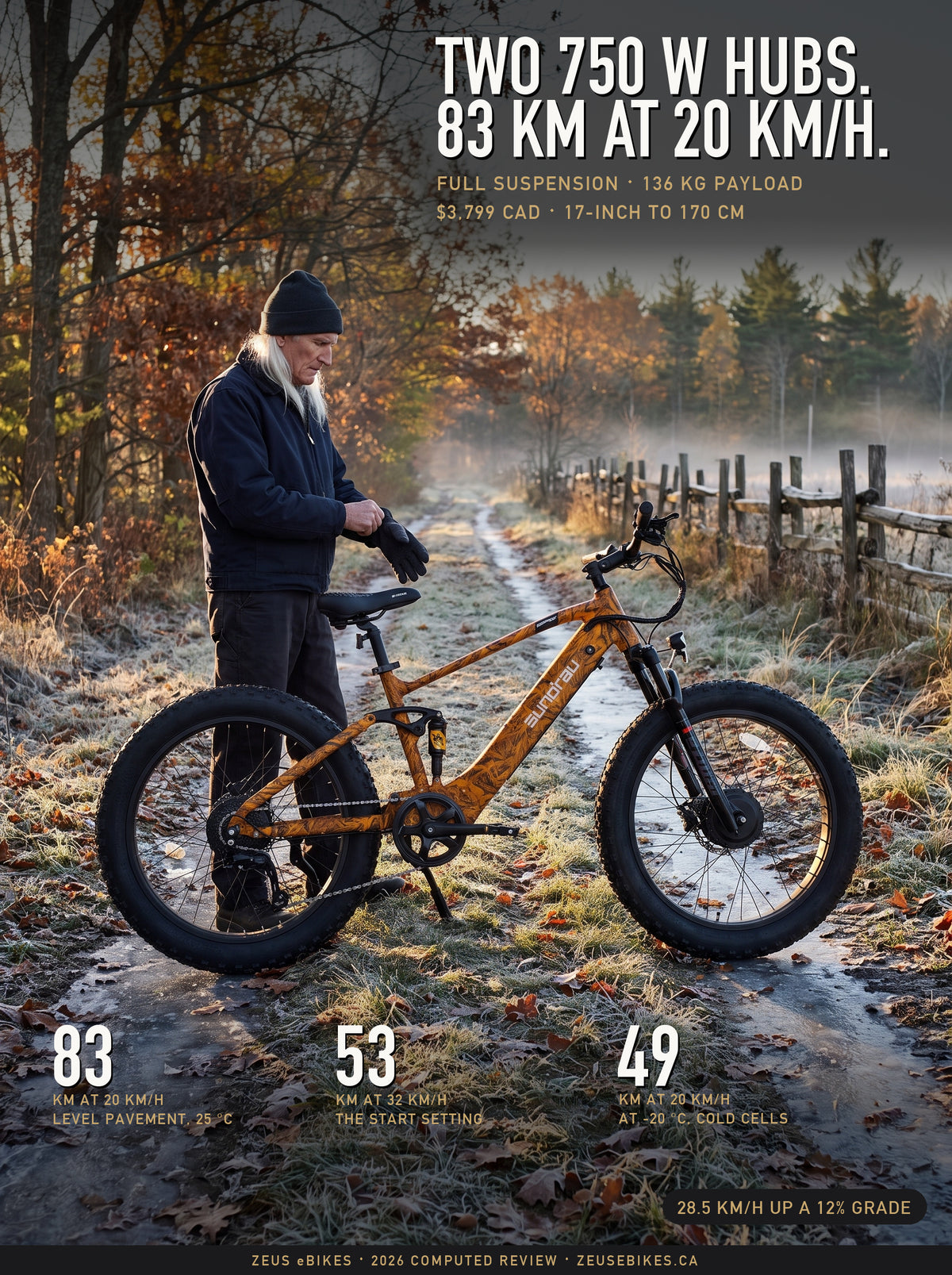
Share:
What "Not BBB Accredited" Really Means in Canada (2026)
The Canadian Shield: 14 Threats to Sovereignty (2026)