Best Electric Mountain Bikes Canada 2026: 14 Picks, $1,499–$5,700 (Chosen by Real Search Data)

📸 All photography by Playcut.ai — personalized AI actor technology
The best electric mountain bikes in Canada for 2026 are the Eunorau Urus 2.0 (best 500W full suspension, $5,700) and the Velotric Summit 2 (best overall hardtail, $3,399). For trails where e-bikes are allowed, start from a ≤500W nominal motor and check the park’s own rules before you ride. For off-road performance without trail restrictions, the 750W–4,000W picks on this list deliver significantly more torque and range.
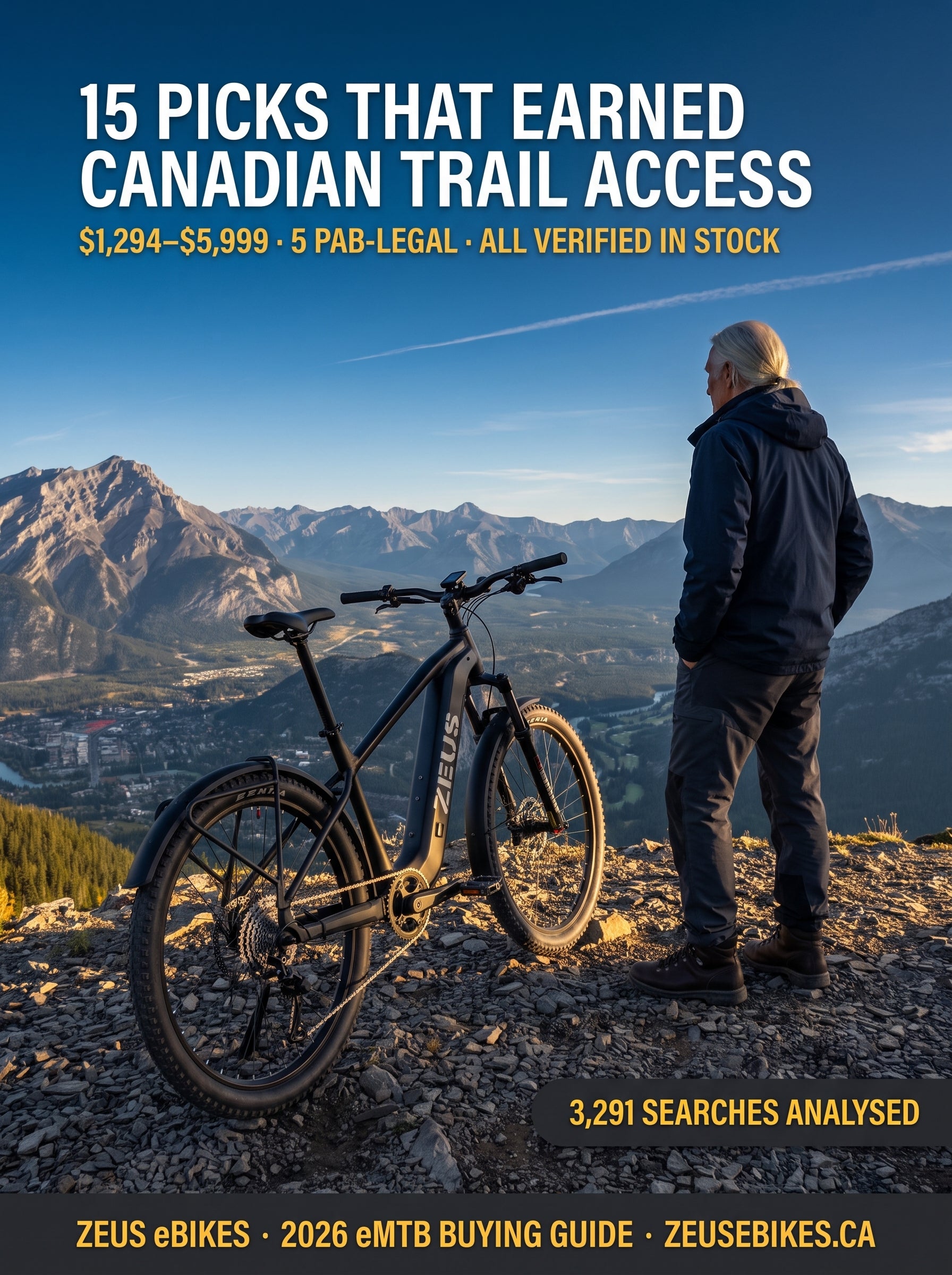
This list was built from real demand signals, not inventory coverage. We pulled 436 queries and 3,291 impressions from Google Search Console (June 2026 export) to identify what Canadian riders actually search for when looking for electric mountain bikes. Cross-referenced against the Semrush CA keyword database. All 14 bikes were verified in stock via live product API pull on June 25, 2026 — no out-of-stock picks, no discontinued models. Prices are confirmed at time of publication. PAB eligibility assessed against each bike’s published nominal motor wattage; trail rules verified against Parks Canada and provincial park authority publications as of June 2026.
WHAT’S IN THIS GUIDE
- The Four Questions That Determine Your eMTB
- Best Full-Suspension eMTBs
- Best Mid-Drive eMTBs
- Best Hardtail eMTBs
- 500W Bikes for Canadian Trails
- Best AWD & Dual-Motor eMTBs
- Best Fat-Tyre eMTBs
- Best eMTBs for Heavy Riders
- Winter Riding: Dual Battery & Cold Range
- Best for Beginners
- Full Comparison Table
- FAQ
- The Right eMTB for Your Trail
The Four Questions That Determine Your eMTB — Answered Before You Shop
In March 2025, Parks Canada expanded e-bike access in Banff to 17 named trails — but only for bikes with ≤500W nominal motors and functional pedals. At the same time, the eMTB market delivered 750W, 1,000W, and 4,000W peak motors that physically cannot be legally ridden on those trails. Buy the wrong motor class and you arrive at a trailhead with a $3,000 bike that cannot legally roll on it — or you choose PAB and leave performance on the table for terrain that demands more. These four questions take 90 seconds and narrow 14 current picks down to 2 or 3 that actually fit your situation.
Q1: Do you need PAB-legal trail access, or off-road performance?
If you ride Canadian national parks, most provincial parks, or conservation areas, you need a Power-Assisted Bicycle — a bike with a motor rated at ≤500W nominal. Five bikes on this list have a ≤500W motor; four of them carry a speed cap the maker lists as adjustable, and whether that qualifies is not settled. If you ride private property, designated motorized trails, or ORV areas, the remaining 9 bikes deliver substantially more torque, range, and capability — at the cost of trail-legal access.
Q2: Full suspension or hardtail?
Full suspension absorbs impact through both wheels, which matters on technical rocky terrain, rooted singletrack, and for riders with back or joint issues. Hardtail bikes have front suspension only — they are lighter, simpler to maintain, and more efficient on climbs. For Canadian riders doing mostly fire roads, gravel, and packed singletrack, a quality hardtail delivers 90% of the experience at 60–70% of the cost.
Q3: Mid-drive or hub motor?
Mid-drive motors sit at the bottom bracket and multiply torque through the bike’s gears. On steep climbs, this means more power per watt of battery energy. Hub motors are simpler, quieter, and have no drivetrain wear — but deliver fixed torque regardless of gear. For our full breakdown, see the Mid-Drive vs Hub Motor guide.
Q4: What is your real budget (including winter gear and financing)?
The bikes on this list run $1,499–$5,700. Every bike is available with financing — a $3,499 bike at 12 months is roughly $292/mo. Factor in winter tyres ($80–$200), a quality lock ($60–$150), and a helmet ($80–$300) before setting your ceiling. The right bike at a real budget beats the aspirational bike that gets returned.
FIND YOUR SECTION
The single most important question is PAB vs off-road. Get that wrong and you either can’t ride the trails you planned, or you bought less bike than the terrain demands. The answer to question one determines which half of this list applies to you.
Best Full-Suspension Electric Mountain Bikes Canada 2026
Full suspension eMTBs absorb impact through both wheels, making them the right choice for technical rocky terrain, rooted singletrack, and riders with back or joint issues. The trade-off is weight, complexity, and cost. On this list, full suspension runs from $1,499 to $5,700 — the four picks below cover every realistic budget.

Eunorau Urus 2.0
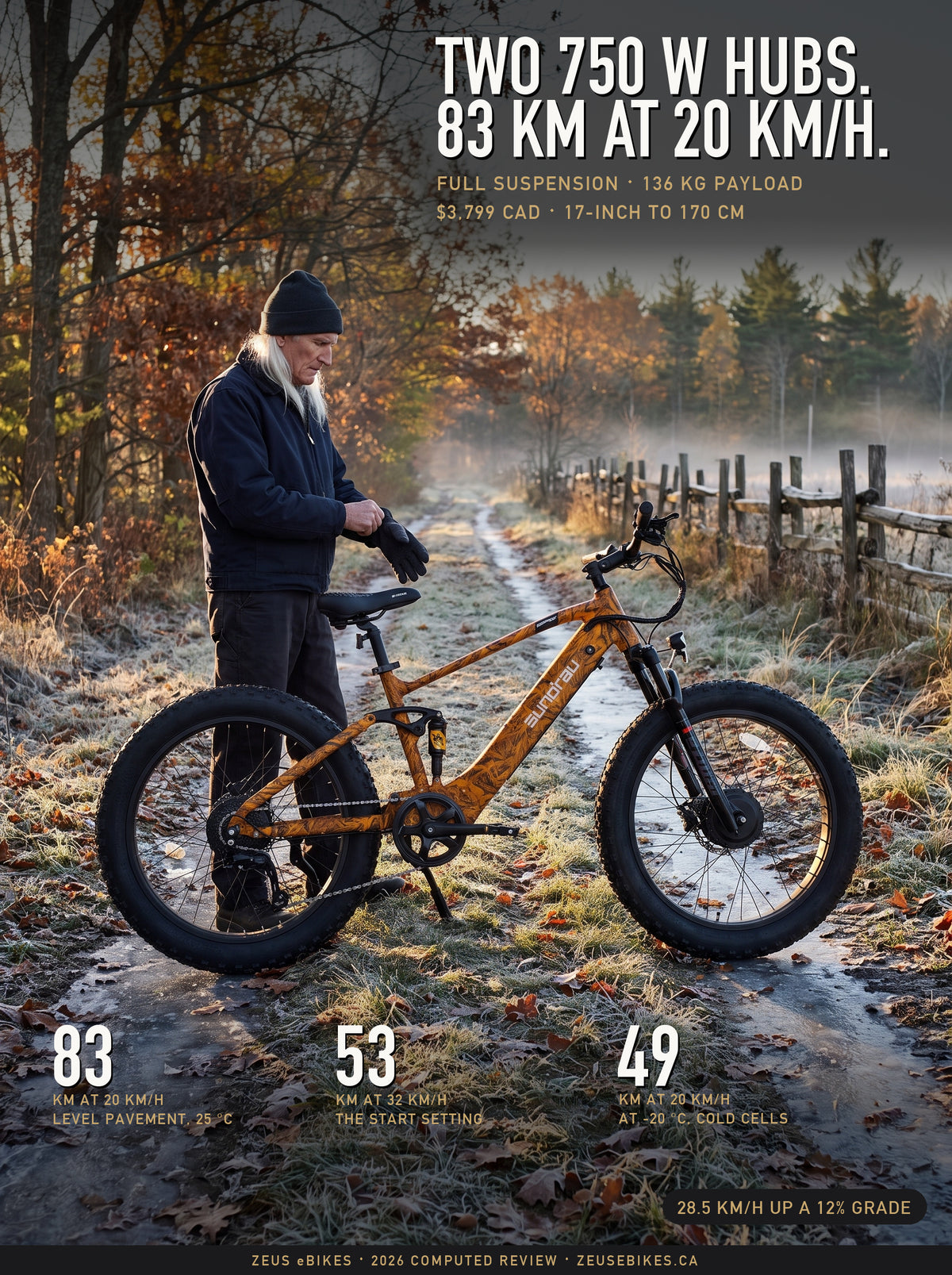
$5,700 CADThe Urus 2.0 is a 500W-rated full-suspension eMTB, but Eunorau prints two top speeds for it (32 km/h in its spec table, 45 km/h in its description) and lists the cap as unlockable, so whether an adjustable cap qualifies is not settled. Trail access is set by each land manager: check the park or conservation authority before you ride. The Bafang M600 is a legitimate trail motor: 500W nominal, 120 Nm, torque sensor, SRAM NX 11-speed, full rear travel. At $5,700, it is a serious purchase. Financed at roughly $475/mo over 12 months — see our eBike financing guide for full options.

Velotric Nomad 2X
$4,099 CADThe Nomad 2X addresses the question Canada’s heavy riders, senior riders, and serious gear haulers keep asking: is there a full-suspension fat tire eMTB that won’t buckle? At 560 lb maximum payload, it is the highest-rated bike on this list by a significant margin. The 750W motor at 1,400W peak and fat tyres make it a year-round performer on Canadian mixed terrain — packed snow, gravel, rutted fire roads. One honest disclosure: at 750W nominal, the Nomad 2X is not a PAB-legal bike. It belongs on off-road terrain and private property, not national park trails.

Eunorau Defender
$2,450 CADAt $2,450, the Defender is a full-suspension eMTB that ships at 500W and 32 km/h; Eunorau lists the cap as unlockable and whether an adjustable cap qualifies is not settled, so where a trail admits e-bikes inside the provincial limits, check its rules first. ZOOM 100mm front fork paired with an EXA air rear shock, 27.5×3.0" tyres, and a dual-battery-ready frame for riders who want extended range on longer rides. Honest trade-off: 60 Nm is trail-capable, not trail-hungry. For fire roads, packed gravel, and moderate singletrack, it is more than enough. For aggressive technical descents, step up to the Urus 2.0.

Samebike XD26-II
$1,499 CADIf full suspension is the goal and $1,499 is the ceiling, the Samebike XD26-II is the answer. 500W hub motor, 70 Nm, dual-suspension frame in Black, Blue, White and Green, all at $1,499. The bike includes a throttle mode — verify local trail rules before riding, as throttle-equipped bikes face additional restrictions on some designated cycling paths.
Velotric Nomad 2X — $4,099
Full suspension · 560 lb payload · 105 Nm · Fat tyres
Choose if: you need full suspension, fat tyres, and the highest payload on this list. The extra $700 over the Nomad 2 buys you rear travel and 470 extra pounds of rated capacity.
Velotric Nomad 2 — $3,399
Hardtail · Fat tyres · 90 Nm · Lighter build
Choose if: you want fat-tyre versatility and 90 Nm without the cost and frame complexity of full suspension. The better pick for flat-to-moderate terrain.
Not sure which suspension level fits your trails?
Five 500W picks on this list. Ten off-road performance builds. The right one depends on where you ride — and we can tell you in 60 seconds.
Call us at 1-866-938-7580 — real humans answer.
Browse All Mountain eBikes → See the 500W Picks →Budget full-suspension starts at $1,499 with the Samebike XD26-II. The Defender ($2,450) is the full-suspension pick that ships set to 32 km/h (Eunorau lists the cap as unlockable). The full-suspension flagship, a 500W Bafang M600, is $5,700 on the Urus 2.0. The Nomad 2X at $4,099 is the highest-payload option at 560 lb, but it is not PAB-legal.
Best Mid-Drive Electric Mountain Bikes Canada 2026
Mid-drive motors sit at the bottom bracket and spin through the bike’s gears, giving you chainring-multiplied torque rather than raw hub force. On steep Canadian singletrack, that means more climbing efficiency with less battery drain. The trade-off: higher price, more drivetrain wear, and the need to actually shift gears under load.

Eunorau Fat-HD 2.0 (Hunter X7)
from $3,299Eunorau builds the Fat-HD 2.0 around Bafang's M615 (BBSHD) mid-drive: 1,000W, 160 Nm through the gears, with cadence-sensing assist (Eunorau's words). On trails where it is legally permitted, 160 Nm puts this bike in a different category from hub-motor alternatives — it pulls grades that would spin or stall a rear hub. Fat tyres extend the season on Canadian terrain: loose rock, packed snow, soft dirt.
One clear note: at 1,000W nominal, this is not a PAB-legal bike. It belongs on private property, designated ORV trails, and motorized trail networks. For the full mid-drive vs hub comparison, see our Mid-Drive vs Hub Motor guide.

Velotric Discover M
$3,899The Discover M pairs a 500W mid-drive with a step-through frame — a specific combination that matters. You get mid-drive efficiency and torque (100 Nm standard, 130 Nm in boost mode) and a 6-axis IMU that adjusts assist output in real time on climbs and descents. It ships set to 32 km/h, but Velotric lists an adjustable range of 19–45 km/h, and whether an adjustable cap qualifies is not settled; check the trail manager’s rules before you ride.
The step-through frame makes mounting and dismounting easier on technical terrain with awkward footing — a practical advantage, not just an aesthetics choice. At $3,899, financed at roughly $325/mo over 12 months, it is the step-through mid-drive on this list for riders who want mid-drive dynamics on shared trails.
Mid-Drive Pick: Eunorau Specter-S 3.0 — $4,099
Bafang M620 · 1,000W · 160 Nm · Full suspension · Off-road use
Choose if: you want maximum climbing torque on off-road trails and are willing to shift gears under load. The M620 rewards proper technique with significantly better efficiency on long climbs.
Hub-Drive Pick: Velotric Summit 2 — $3,399
750W hub · 100 Nm · 801 Wh · 440 lb payload · Hardtail
Choose if: you want a simpler drivetrain, 440 lb payload, and SensorSwap cadence/torque switching without managing gear selection mid-climb.
For the full technical breakdown of when mid-drive outperforms hub and vice versa on Canadian terrain, see our Mid-Drive vs Hub Motor guide →
Mid-drive beats hub on steep climbs and long technical descents — but only where the bike is legally permitted. For off-road performance, the Fat-HD 2.0 (160 Nm, from $3,299) is the pick. For 500W mid-drive efficiency, the Discover M (100 Nm, $3,899) and the Urus 2.0 ($5,700) are the options on this list; both carry a cap the maker lists as adjustable.
Best Hardtail Electric Mountain Bikes Canada 2026
Hardtail eMTBs have front suspension only. They are lighter, cheaper to maintain, and more efficient on climbs than their full-suspension equivalents. For Canadian fire roads, gravel paths, packed singletrack, and mixed urban-trail use, a quality hardtail delivers 90% of the experience at 60–70% of the cost — and that remaining 10% only matters on aggressive technical terrain.

Velotric Summit 2
$3,399The Summit 2 is the best-overall hardtail eMTB on this list, and the bike that most demand signals pointed to across GSC and Semrush data — Canadian riders searching for a capable, reliable all-mountain eMTB keep landing on it. The specs tell the story: 801 Wh LG battery, 100 Nm, Shimano CUES 9-speed, RST air fork, NFC unlock, and SensorSwap technology that lets you switch between cadence and torque sensing on the fly without tools.
The 440 lb payload is the second-highest on this list — a meaningful number for heavier riders or anyone carrying gear. One clear disclosure: at 750W nominal, the Summit 2 exceeds the PAB limit. It is designed for off-road and private-property use, not national park trail riding. For riders who push hard on hills and climbs, the Summit 2 is a top-tier choice. Financed at roughly $292/mo over 12 months.

Taubik Westridge 4T Off-Road
$3,599Designed in Canada, the Westridge 4T Off-Road is the pick for riders who want to support Canadian-designed product and get a capable off-road fat bike in the same purchase. It runs a 1000W nominal Bafang geared hub motor with a true torque sensor delivering 95 Nm — not a 750W hub with a marketing peak rating — paired with a 960 Wh Samsung 21700 battery (UL 2271 certified), a Mozo coil fork, and a 6061 aluminium hardtail frame rated to 286 lb payload. The Canadian origin means the brand understands Canadian terrain and rider conditions — not a generic Asian-export rebranded for the market.
Honest note: at greater than 500W nominal, the Westridge 4T is not PAB-classified under provincial rules — it is designated for off-road trails and private property. Verified on the product page as of June 2026.

Velotric Tempo
$2,599At 39 lbs, the Velotric Tempo is the lightest eMTB-adjacent bike on this list — and the only one offered in four frame configurations: High Step and Mid Step, each in Regular and Large sizes. That matters for riders who have struggled to find a bike that actually fits. The motor is a 350W hub (set to 32 km/h; Velotric lists an adjustable range of 19–45 km/h) with a 374 Wh battery, SensorSwap for cadence/torque switching, NFC unlock, and Apple and Android Find Hub compatibility.
If your riding is 70% gravel and paved rail-trails with 30% light hardpack, the Tempo is the pick. Riders who want aggressive singletrack, technical descents, or heavy loads should look at the Summit 2 or Urus 2.0 — the Tempo is not built for that.
For most riders doing mixed Canadian terrain — gravel, packed trails, fire roads — the Summit 2 at $3,399 is the hardtail pick. For a 500W bike on public trails: the Tempo ($2,599, 39 lbs) or Discover M ($3,899, mid-drive), both set to 32 km/h with a cap Velotric lists as adjustable. Canadian-designed and made: the Westridge 4T ($3,599). There is a right answer in here for every situation.
500W eMTBs and Canadian Park Trails
In Canada, a Power-Assisted Bicycle must have a motor with ≤500W nominal output and motor assistance that cuts off at 32 km/h. Bikes meeting this definition are permitted on most cycling paths where cycling is allowed — including designated trails in national parks, provincial parks, and conservation areas. Bikes exceeding 500W nominal are not federally classified as PABs and require access to motorized or off-road designated routes.
The PAB definition sets the federal and provincial minimum. Individual parks, conservation authorities, and trail networks set their own rules within that framework — some restrict e-bikes further, some have pilot programs expanding access. Always verify with the specific land manager before riding. The information in this section is current as of June 2026. BC eBike Laws → · Ontario eBike Laws →
| Location | PAB-Legal ≤500W | Notes |
|---|---|---|
| Banff National Park | ✅ 17 designated trails | March 2025 expansion — Healy Creek, Brewster Creek, Redearth Creek added |
| BC Provincial Parks | ✅ Where cycling permitted | Class-1 pedal-assist allowed on all designated cycling trails |
| Alberta Provincial Parks | ✅ Class-1 since ~2021 | Motor-assist only on cycling-designated routes |
| Jasper National Park | ✅ Pilot — all cycling trails | Check Parks Canada for current pilot status before riding |
| Ontario Conservation Areas | ✅ Varies by authority | Verify with individual conservation authority before riding |
| Whistler Bike Park | ⚠️ Verify current 2026 policy | Official policy varies by trail — contact Whistler directly before visiting |
Trail rules change. Verify directly with the land manager before your ride. The information above reflects publicly available park authority publications as of June 2026.

Taubik Blackburn 275T
$2,799 / $3,199 (dual battery)The Taubik Blackburn 275T is the Canadian-made 500W pick for riders who need trail-legal access and want the option to extend range for long backcountry days. Standard battery configuration delivers 706 Wh (Samsung cells, UL 2271 certified). Optional second battery kit brings total capacity to approximately 1,411 Wh — one of the highest dual-battery configurations available in a PAB-legal Canadian eBike.
For context on what that means in real riding, see our eBike Battery Guide. The Blackburn ships in 6 colour options, features dual torque/cadence sensor input, and a 286 lb maximum payload. Available at $2,799 single battery or $3,199 with the dual battery kit.
5 picks at 500W. 9 off-road performance builds. Not sure which provincial rules apply to you?
Trail access in Canada varies by province, park authority, and trail network. Call 1-866-938-7580 — we’ll give you an honest answer for your province and your terrain.
Ontario eBike Laws → BC eBike Laws →The 5 picks at 500W on this list: Eunorau Urus 2.0 ($5,700 full-suspension flagship), Velotric Discover M ($3,899 mid-drive step-thru), Eunorau Defender ($2,450 full-suspension value), Taubik Blackburn 275T ($2,799 Canadian, dual-battery option), Velotric Tempo ($2,599 ultralight, 4 frame sizes). All ship set to 32 km/h; the Urus, Discover M, Defender and Tempo carry a cap the maker lists as adjustable, and whether that qualifies is not settled. Every other bike on this list is for off-road and private-property use.
Best AWD and Dual-Motor eMTBs Canada 2026
Dual-motor AWD eMTBs run one motor per wheel, delivering traction on loose gravel, mud, packed snow, and steep grades that would spin or bog a single rear hub. Both picks below exceed 500W — they are off-road and private-property bikes, not PAB-legal for park trails. Neither is a trail bike. Both are terrain-eating machines for riders who need grip where the terrain fights back.
See our Best Dual Motor eBikes Canada guide for the full AWD breakdown.

Eunorau Fat-AWD 3.0
$2,299The Fat-AWD 3.0 is the most accessible dual-motor AWD eMTB in the Zeus lineup — at $2,299, it delivers genuine AWD traction at a price point where most bikes are single-motor. The 110 Nm is split across two independent wheels: each motor pulls with less wheel spin than a single hub delivering the same total force, which is the practical difference between climbing loose January gravel and spinning out. At 375 lb payload, it carries a heavier rider plus a loaded pack without straining the drivetrain. Fat tyres extend the season to packed snow and soft spring trails. Hardtail frame keeps servicing costs low.
Off-road use only. For the full dual-motor category breakdown, see our Best Dual Motor eBikes Canada guide →

Freesky Ranger Plus M-540
$2,799250 Nm combined from dual 2,500W-peak hub motors (Freesky’s figures), on a step-through frame. Step-through frame geometry makes mounting and dismounting accessible for riders who have difficulty swinging a leg over a high top tube — a meaningful difference when you are fatigued on technical terrain. 400 lb maximum payload, full suspension, 1,440 Wh battery. Off-road and private property use.
At $2,799, it is $500 more than the Fat-AWD 3.0 — for that delta you get 110 more Nm of torque, a step-through frame, full suspension, and 25 lb more payload capacity.
At $2,299, the Fat-AWD 3.0 is the AWD entry point — genuine dual-motor traction at the lowest price on this list. At $2,799, the Ranger Plus M-540 adds 110 extra Nm, a step-through frame, full suspension, and 25 lb more payload capacity. Neither is PAB-legal. Both are for riders who know where they are going and what they need.
Best Fat-Tyre Electric Mountain Bikes Canada 2026
Fat tyres (3.8” and wider) reduce ground pressure across the contact patch, improving grip on sand, snow, mud, and loose gravel. For Canadian riders dealing with shoulder-season trails and winter hardpack, fat tyres extend the riding season by 6–8 weeks in most provinces. The trade-off is rolling resistance on paved surfaces and added rotational weight — something to weigh honestly against your actual terrain.
See our full Fat Tire Electric Bikes Canada guide for a complete category breakdown including all fat-tire eBikes in the Zeus lineup.

Velotric Nomad 2
$3,399The Nomad 2 is the hardtail fat tyre pick — lighter and mechanically simpler than its full-suspension sibling the Nomad 2X, delivering 90 Nm and 750W/1,300W peak on fat tyres built for Canadian mixed terrain. For riders who want fat-tyre versatility without the additional weight, cost, and maintenance complexity of rear suspension.
The trade-off is honest: you will feel rocky terrain and rooted singletrack more than on the Nomad 2X, and long technical descents are less forgiving. For flat-to-moderate off-road terrain, fire roads, and extended gravel touring, the Nomad 2 is more than sufficient. At 750W nominal, it is for off-road and private-property use — not PAB-legal for park trails.
For full-suspension fat tyre, see the Nomad 2X ($4,099) and Freesky Ranger Plus M-540 ($2,799) in the sections above. For AWD fat tyre, see the Fat-AWD 3.0 ($2,299).
Fat tyre hardtail: Velotric Nomad 2 ($3,399). Fat tyre full-suspension: Nomad 2X ($4,099). Fat tyre AWD: Ranger Plus M-540 ($2,799) and Fat-AWD 3.0 ($2,299). None of the fat-tyre picks on this list are PAB-legal — all exceed 500W nominal. Plan your trail access accordingly.
Best eMTBs for Heavy Riders Canada 2026
Payload capacity is the specification most eMTB buying guides skip — and the one that matters most for riders over 250 lbs, or for anyone carrying gear, a child seat, or loaded panniers on trails. The bikes below are listed with verified manufacturer payload ratings, not estimates. If a manufacturer does not publish a payload figure, it does not appear in the table.
| Bike | Max Payload | Motor | Price | PAB? |
|---|---|---|---|---|
| Velotric Nomad 2X | 560 lb | 750W hub, full-suspension fat | $4,099 | No |
| Velotric Summit 2 | 440 lb | 750W hub, hardtail | $3,399 | No |
| Freesky Ranger Plus M-540 | 400 lb | 5,000W AWD step-thru | $2,799 | No |
| Eunorau Fat-AWD 3.0 | 375 lb | Dual motor AWD | $2,299 | No |
| Eunorau Urus 2.0 | 300 lb | 500W Bafang M600, full-suspension | $5,700 | ⚠ Adjustable cap |
| Eunorau Defender | 300 lb | 500W hub, full-suspension | $2,450 | ⚠ Adjustable cap |
| Taubik Blackburn 275T | 286 lb | 500W Bafang hub | $2,799 | Yes |
| Taubik Westridge 4T | 286 lb | 1000W Bafang hub, hardtail | $3,599 | No |
For riders over 250 lbs who want a 500W bike, the honest order is the Discover M (Velotric rates it for a 200 kg / 440 lb total load), the Tempo (150 kg / 330 lb), then the Defender (300 lb, $2,450) and the Urus 2.0 (300 lb, $5,700); all four ship set to 32 km/h with a cap the maker lists as adjustable. If you need more than 440 lb, the Nomad 2X (560 lb) is the pick, and it exceeds 500W: an off-road/private-property bike, like the Summit 2 and Ranger Plus. For a full heavy-rider buying guide with 18 picks across all categories, see our Best eBikes for Heavy Riders Canada guide →
Need 400+ lb capacity? Nomad 2X (560 lb), Summit 2 (440 lb), Ranger Plus (400 lb) — all off-road use. At 500W, only the Discover M reaches 400+ lb (Velotric: 200 kg / 440 lb), and its cap is listed as adjustable. Know this before you buy.
Winter Riding — Dual Battery, Cold Range, and the Right Strategy
Lithium batteries lose 20–40% of their effective range at −10°C and can sustain permanent capacity loss if charged at or below freezing temperatures. For Canadian winter riding, the right strategy is more Wh (more capacity to absorb the loss), battery insulation on longer rides, and a charger location that stays consistently above 0°C. The two picks here take different approaches to the same problem.

Freesky Alaska Pro M-520
$2,699The Alaska Pro M-520 starts the winter conversation with a 2,160 Wh dual-battery configuration — the highest total battery capacity on this list by a wide margin. At −10°C, a 30–40% cold-weather loss still leaves more than 1,300 usable Wh. For context, that is more than the total battery of most single-battery eMTBs at room temperature. Full suspension, UL2849 verified. Off-road and private property use.
At $2,699, it is the highest Wh-per-dollar battery configuration on this list. For the full cold-weather riding strategy, see our Best eBikes for Winter Canada guide →
| Battery Capacity | Summer Range (est.) | At −10°C (−30% loss) | At −10°C (−40% loss) |
|---|---|---|---|
| 374 Wh (Velotric Tempo) | 40–60 km | 28–42 km | 22–36 km |
| 706 Wh (Blackburn 275T, single battery) | 80–100 km | 56–70 km | 42–60 km |
| 801 Wh (Velotric Summit 2) | 100–130 km | 70–91 km | 60–78 km |
| 2,160 Wh (Alaska Pro M-520, dual battery) | 200–280 km | 140–196 km | 120–168 km |
Range estimates are calculated from published battery capacity divided by typical mixed-terrain consumption rates. Actual range varies by rider weight, terrain gradient, temperature, tyre pressure, and assist level. Never charge a lithium battery below 0°C — this causes permanent capacity loss regardless of the battery’s rated temperature range.
For PAB-legal winter range, the Taubik Blackburn 275T dual-battery configuration ($3,199, ~1,411 Wh) is covered in the PAB-legal section above.
For winter riders, every Wh of capacity is worth more than in summer because cold weather takes 20–40% before you even leave the driveway. The Alaska Pro M-520 (2,160 Wh dual battery, $2,699) is the dual-battery winter pick. For PAB-legal winter range, the Blackburn 275T dual battery ($3,199, ~1,411 Wh) is the Canadian-made option. Neither charges below 0°C.
Best eMTBs for Beginners Canada 2026
Two types of beginners walk into the eMTB market: those with a constrained budget who want to start riding and learn, and those who understand this is a multi-year investment and want to buy once and buy right. These two picks answer both situations directly — without condescension for either choice.
The Samebike XD26-II at $1,499 is for the first group — full suspension, 500W, a price where a change of direction does not cost you four figures. If it gets ridden twice a week for a year and then circumstances change, the financial exposure is manageable. The Eunorau Defender at $2,450 is for the second group: 500W set to 32 km/h (Eunorau lists the cap as unlockable), full suspension, dual-battery ready, a bike that grows with your confidence. It is about $950 more.
Budget-first: Samebike XD26-II — $1,499 · Full suspension · 500W · Low financial risk
Investment-minded: Eunorau Defender — $2,450 · 500W, ships at 32 km/h · Full suspension · Dual-battery ready
Every bike on this list ships free to anywhere in Canada. Zeus eBikes offers a 15-day return window for unused, unopened bikes (15% restocking fee), financing options that bring a $2,450 bike to roughly $205/mo, and a team that answers the phone at 1-866-938-7580. If you want to talk through the options before committing, that is exactly what we are here for.
Budget-first beginners: Samebike XD26-II ($1,499, full suspension, low financial risk). Investment-minded beginners: Eunorau Defender ($2,450, 500W set to 32 km/h, dual-battery ready, grows with your riding). There is no wrong answer — only the one that fits your actual situation, not the one you think you should want.
At-a-Glance Comparison — All 14 Electric Mountain Bikes Canada 2026
The table below lists all 14 picks sorted by price, lowest to highest. Use the PAB column to see where each bike stands at a glance (⚠ = ships set to 32 km/h with a cap the maker lists as adjustable). Payload figures are manufacturer-published where available.
| Bike | Price | Motor | Torque | Payload | Suspension | PAB-Legal? |
|---|---|---|---|---|---|---|
| Samebike XD26-II | $1,499 | 500W hub | 70 Nm | — | Full | No* |
| Eunorau Fat-AWD 3.0 | $2,299 | Dual motor AWD | 110 Nm | 375 lb | Hardtail | No |
| Eunorau Defender | $2,450 | 500W hub | 60 Nm | 300 lb | Full | ⚠ Adjustable cap |
| Velotric Tempo | $2,599 | 350W hub | 45 Nm | 330 lb | Hardtail | ⚠ Adjustable cap |
| Freesky Alaska Pro M-520 | $2,699 | 4,000W peak dual battery | — | — | Full | No |
| Taubik Blackburn 275T | $2,799 / $3,199 | 500W Bafang hub | 70 Nm | 286 lb | Hardtail | Yes |
| Freesky Ranger Plus M-540 | $2,799 | 5,000W AWD | 250 Nm | 400 lb | Full | No |
| Eunorau Fat-HD 2.0 (Hunter X7) | from $3,299 | Bafang M615 (BBSHD) 1,000W | 160 Nm | — | Hardtail | No |
| Velotric Nomad 2 | $3,399 | 750W hub (1,300W pk) | 90 Nm | — | Hardtail | No |
| Velotric Summit 2 | $3,399 | 750W hub (1,300W pk) | 100 Nm | 440 lb | Hardtail | No |
| Taubik Westridge 4T Off-Road | $3,599 | 1000W Bafang hub | 95 Nm | 286 lb | Hardtail | No |
| Velotric Discover M | $3,899 | VeloCore 500W | 100 Nm (130 boost) | 440 lb | Hardtail | ⚠ Adjustable cap |
| Velotric Nomad 2X | $4,099 | 750W hub (1,400W pk) | 105 Nm | 560 lb | Full | No |
| Eunorau Urus 2.0 | $5,700 | Bafang M600 500W | 120 Nm | 300 lb | Full | ⚠ Adjustable cap |
* Samebike XD26-II has a 500W nominal motor but includes throttle mode. Throttle-equipped eBikes face additional trail restrictions in many conservation areas, national park paths, and cycling-designated routes regardless of motor wattage. Verify trail rules with the specific land manager before riding.
Frequently Asked Questions — Electric Mountain Bikes Canada 2026
Are e-bikes allowed on mountain bike trails in Canada?
It depends on the trail and the bike. Power-Assisted Bicycles — motors rated at 500W nominal or less, with assistance cutting off at 32 km/h — are permitted on most cycling-designated trails where conventional cycling is allowed. This includes 17 named trails in Banff National Park (expanded March 2025 to include Healy Creek, Brewster Creek, and Redearth Creek), BC Provincial Park trails, Alberta Provincial Park trails (since approximately 2021), and most Ontario conservation area paths. Bikes with motors exceeding 500W nominal are not classified as PABs and are restricted to off-road designated areas, private property, and motorized-vehicle-permitted routes. Verify with the specific land manager before every ride — trail policies change.
What is the difference between a PAB-legal eMTB and an off-road eMTB in Canada?
A PAB-legal eMTB has a nominal motor output of 500W or less and cuts motor assistance at 32 km/h. These bikes qualify as Power-Assisted Bicycles under Canadian provincial regulations and can access most cycling-designated trails. An off-road eMTB exceeds 500W nominal — common ratings are 750W, 1,000W, and 4,000W peak — and is restricted to private property, designated motorized trails, and off-road areas. The majority of eMTBs sold in Canada are not PAB-legal by default. On this list, 5 of 14 picks meet the PAB definition.
What is the best full-suspension electric mountain bike under $3,000 in Canada?
The Eunorau Defender at $2,450 is the best full-suspension eMTB under $3,000 in Canada. It has a 500W rear hub motor (60 Nm), a dual-battery ready frame, ZOOM 100mm front fork, EXA air rear shock, and 27.5×3.0" tyres. It ships set to 500W / 32 km/h; Eunorau lists the cap as unlockable, and whether that qualifies is not settled. For a budget-first full-suspension option, the Samebike XD26-II is $1,499.
Is a mid-drive or hub motor better for mountain biking in Canada?
Mid-drive motors multiply torque through the bike’s gears, giving better efficiency on steep climbs and long descents. Hub motors are simpler, quieter, require no gear shifting, and cost less to maintain. For Canadian park trails where PAB compliance matters, the VeloCore 500W mid-drive (Velotric Discover M) and Bafang M600 500W (Eunorau Urus 2.0) are the 500W mid-drive options; both carry a cap the maker lists as adjustable. For off-road performance, the Bafang M615 (BBSHD) 1,000W in the Eunorau Fat-HD 2.0 delivers 160 Nm and represents the performance ceiling on this list.
Can I ride a 750W or 1,000W eMTB on Banff National Park trails?
No. Banff National Park’s 17 designated e-bike trails are restricted to Power-Assisted Bicycles with motors rated at 500W nominal maximum, with assistance cutting off at 32 km/h. A 750W or 1,000W nominal rating exceeds this limit regardless of which assist level is selected on the display. The ≤500W picks on this list are the Eunorau Urus 2.0 (500W Bafang M600), Velotric Discover M (500W VeloCore), Eunorau Defender (500W hub), Taubik Blackburn 275T (500W Bafang hub) and Velotric Tempo (350W hub); four of them carry a speed cap the maker lists as adjustable, so check Parks Canada’s current Banff rules before you ride.
What is the best eMTB for heavy riders in Canada?
For riders over 250 lbs, the Velotric Nomad 2X (560 lb payload, $4,099), Velotric Summit 2 (440 lb payload, $3,399), and Freesky Ranger Plus M-540 (400 lb payload, $2,799) carry the three highest verified payload ratings on this list. For riders who want a 500W bike, the Velotric Discover M (440 lb) rates highest, then the Velotric Tempo (330 lb), the Eunorau Defender and the Eunorau Urus 2.0 (300 lb each); all four carry a cap the maker lists as adjustable.
How much range does an electric mountain bike lose in Canadian winter?
Lithium batteries lose approximately 20–40% of effective range at −10°C compared to summer performance. A 801 Wh battery (Velotric Summit 2) that delivers 100–130 km in summer delivers roughly 60–91 km at −10°C under the same riding conditions. The Freesky Alaska Pro M-520’s 2,160 Wh dual battery retains approximately 1,300–1,500 Wh of usable capacity at that temperature — enough for most day rides even with cold-weather loss factored in. Never charge a lithium battery below 0°C; this causes permanent capacity loss that is not recoverable.
What is the best beginner electric mountain bike under $2,000 in Canada?
The Samebike XD26-II at $1,499 is the best full-suspension eMTB under $2,000 available in Canada. It has a 500W hub motor, 70 Nm of torque and dual suspension, in Black, Blue, White and Green. For riders who can stretch to $2,450, the Eunorau Defender offers full suspension set to 32 km/h (Eunorau lists the cap as unlockable) with a dual-battery-ready frame.
The Right eMTB for Your Canadian Trail
The eMTB decision in Canada comes down to one question answered before any other: where do you ride? If the answer is designated park trails — Banff, BC provincial parks, Ontario conservation areas — the five 500W picks on this list are the place to start (check the land manager’s rules; four of them carry adjustable caps). The Eunorau Defender at $2,450 is where that conversation starts. The Eunorau Urus 2.0 at $5,700 is where it ends.
If the answer is private property, ORV networks, or designated motorized trails, the calculus changes. The Velotric Summit 2 at $3,399 is the best all-around hardtail for that use case. The Nomad 2X at $4,099 is the answer for riders who need fat tyres, full suspension, and 560 lb of payload in the same bike. The Freesky Alaska Pro M-520 at $2,699 is the dual-battery winter build. The Fat-AWD 3.0 at $2,299 is the AWD entry point for riders who need traction first and everything else second.
Budget matters — and on this list, $1,499 buys you a capable full-suspension eMTB in the Samebike XD26-II. The spread from $1,499 to $5,700 is wide enough to find the right answer at almost any realistic ceiling. Every option above was verified in stock in June 2026, and every price was re-checked against the live store on October 10, 2026.
Every bike on this list ships free to anywhere in Canada. Zeus eBikes offers a 15-day return policy for unused, unopened bikes (15% restocking fee), financing options, and a phone line that real people answer: 1-866-938-7580. If you are not certain which bike fits your terrain, your weight, and your trail access situation, call before buying. That conversation takes five minutes and saves weeks of uncertainty.
- Mid-Drive vs Hub Motor eBike Canada 2026 — which motor type fits your terrain
- 500W vs 750W vs 1,000W eBike Canada — wattage explained for Canadian riders
- Fat Tire Electric Bikes Canada 2026 — full category guide
- Best eBikes for Heavy Riders Canada 2026 — 17 picks with verified payload ratings
- Best eBikes for Winter Canada 2026 — cold weather, dual battery, and storage strategy
- Best Dual Motor eBikes Canada 2026 — AWD picks for Canadian terrain
- Best eBikes for Hills Canada — torque, gearing, and climb strategy
- eBike Battery Guide Canada 2026 — capacity, cold weather, dual battery explained
- How to Finance an eBike in Canada 2026 — monthly payment options
- Best Folding Electric Bikes Canada 2026 — storage-first picks
- Shop All Mountain eBikes at Zeus →
📸 All photography by Playcut.ai — personalized AI actor technology.
Share:
Best Folding Electric Bikes Canada (2026): 7 Verified Picks That Actually Fit Your Life
How to Finance an Electric Bike in Canada (2026): 7 Options, Real Math, No Spin