
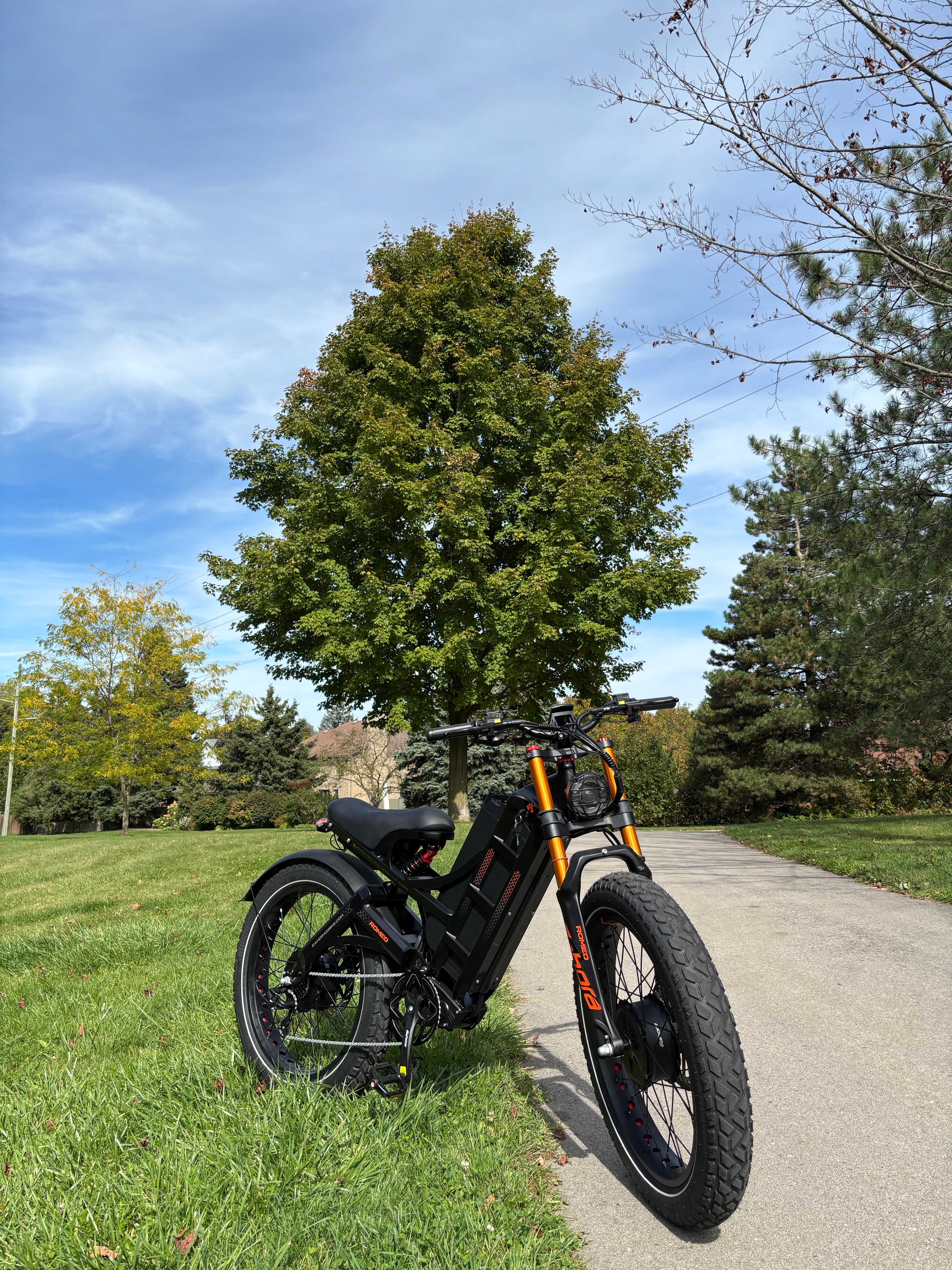

Pedal Assist vs Throttle eBikes Canada: Which Is Right for You?
Every e-bike delivers motor power one of two ways: pedal assist (the motor helps when you pedal) or throttle (the motor runs when you press a control, no pedalling required). Most modern e-bikes include both — but the way each one feels, how far it goes on a charge, how it handles a Canadian winter, and even its legal status differ more than most buyers realise.
This guide covers everything: how each system works mechanically, the two sensor types that determine your pedal assist experience, real energy consumption per kilometre, exercise data from peer-reviewed studies, winter performance at Canadian temperatures, legal rules by province, and 5 Zeus picks that span the full spectrum — from a pure mid-drive PAS machine to a moped-style throttle cruiser.
In This Guide
- How Pedal Assist Works (Including PAS Levels 1–5)
- Torque Sensor vs Cadence Sensor
- How Throttle Works
- Head-to-Head Comparison
- Range & Energy — Real Numbers
- Exercise & Fitness — What the Research Shows
- Winter Performance in Canada
- Canadian Legal Rules by Province
- Which System Fits You?
- 5 Best Zeus Picks for Every Riding Style
- Frequently Asked Questions
- The Bottom Line
How Pedal Assist (PAS) Works
Pedal assist activates the motor only when you pedal. A sensor near the crank detects your pedalling input and signals the controller to engage the motor. You select an assist level (typically 1–5) from the handlebar display, and the motor amplifies your effort accordingly. Stop pedalling, and the motor stops within a fraction of a second. It feels like cycling with a strong tailwind — you are still riding a bicycle, just with significantly less effort.
Which sensor reads your pedalling — and there are two, radically different kinds — decides whether that assist feels natural or robotic. Choose wrong and no amount of motor power fixes it: you live with surge-and-lag assist for the life of the bike. The next section breaks down both sensors so you can spot the difference on any spec sheet before you pay.
What PAS Levels 1–5 Actually Mean
Most e-bikes offer 5 pedal assist levels. Here is what each level does and how it affects your battery:
| Level | Motor Assistance | Feel | Energy Use |
|---|---|---|---|
| 1 (Eco) | 20–30% | Barely noticeable — gentle push | ~4 Wh/km |
| 2 | 40–50% | Comfortable flat-road cruising | ~6 Wh/km |
| 3 | 60–70% | Most popular everyday setting | ~8 Wh/km |
| 4 | 80–90% | Hills and headwinds | ~11 Wh/km |
| 5 (Turbo) | 100% | Maximum power, minimum range | ~15 Wh/km |
Energy consumption figures are approximate and vary by motor, rider weight, terrain, and wind. Based on aggregated data from SSRN research and real-world e-bike forum testing.
Torque Sensor vs Cadence Sensor — The Hidden Comparison
This is the comparison most PAS vs throttle guides skip — but it matters more than the PAS/throttle distinction itself. The sensor determines whether your pedal assist feels natural or robotic. Two e-bikes can both say "pedal assist" on the box and feel completely different to ride.
Cadence Sensor
How it works: A ring of 12 magnets on the crank arm passes a fixed Hall effect sensor. It detects whether you're pedalling (on/off) — not how hard.
Response time: 0.5–1.0 seconds from when you start pedalling. You feel a noticeable lag.
Feel: Motor delivers a fixed amount of power based on your selected level, regardless of your effort. Can feel like riding a moped — constant push regardless of what your legs do.
Efficiency: Uses 15–25% more battery than a torque sensor on the same route, because it delivers power even when you don't need it.
Cost: The sensor itself costs $15–30. Typically found on entry-level e-bikes under $2,000.
Best for: Riders who want consistent, predictable power. Riders with limited leg strength. Budget-conscious buyers.
Torque Sensor
How it works: A precision strain gauge integrated into the bottom bracket measures the actual force you apply to the pedals — sampling up to 1,000 times per second (Sensitivus). Proportional: press harder, get more power.
Response time: 5–10 milliseconds. Virtually instant — you cannot perceive the delay.
Feel: Seamless, intuitive response. Feels like having super-strong legs rather than a motor. The harder you pedal, the more help you get. The moment you ease off, the motor backs down.
Efficiency: 15–25% more battery-efficient than cadence sensors. Only draws power proportional to your actual effort.
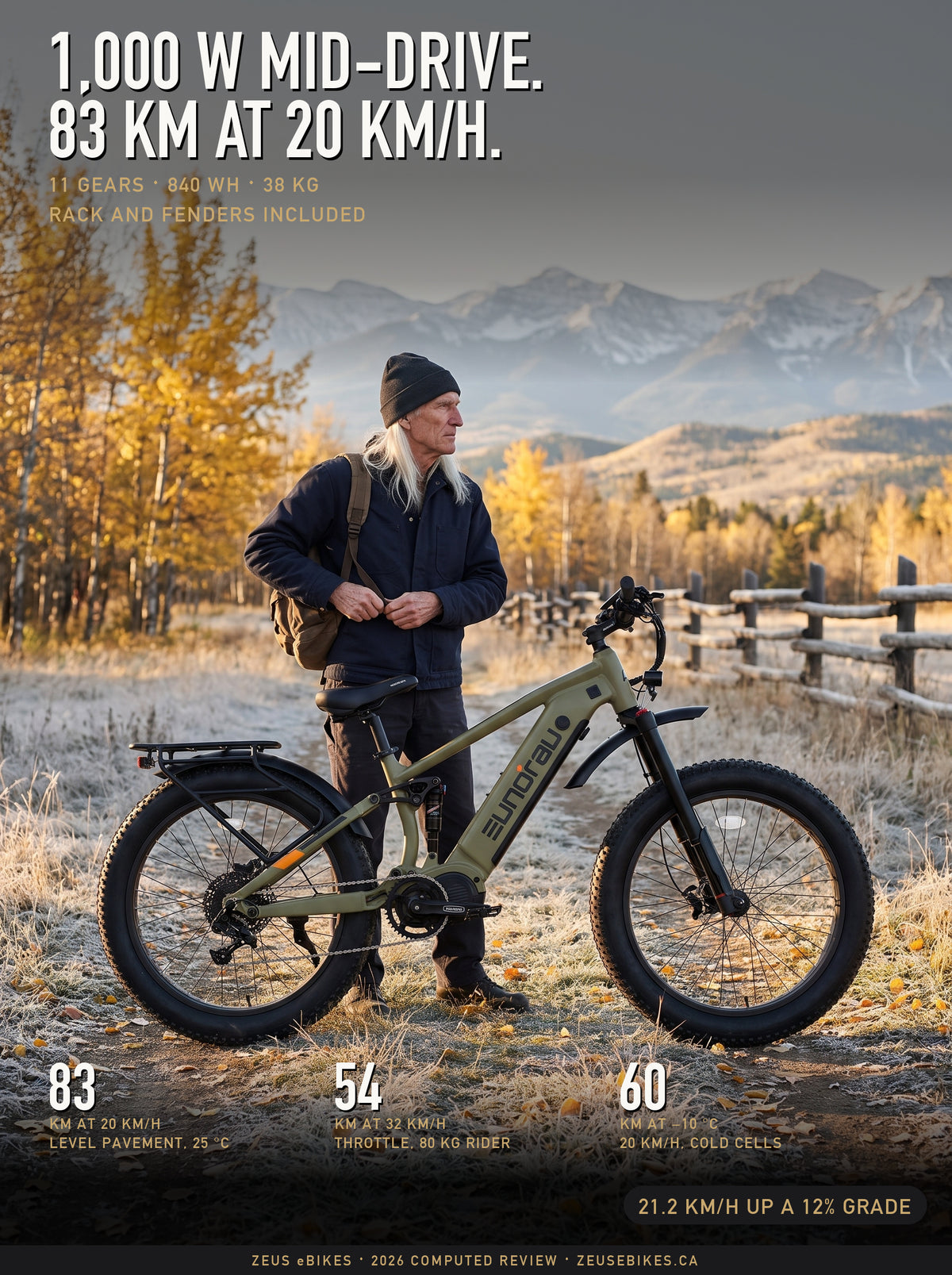
Cost: The sensor costs $100–200+. Adds $200–500 to the bike's MSRP (Electroheads). Found on mid-range to premium e-bikes: the FAT-AWD 3.0 (from $2,299), Eunorau Meta 26 ($2,295), and Eunorau Meta Foldable ($2,295) — while the Velotric Discover M ($3,899) carries both sensor types and lets you switch between them.
Best for: Riders who want a natural cycling feel. Long-distance riders. Fitness-oriented riders. Winter riders (smoother power delivery = better traction).
Can't decide? One bike lets you try both. The Velotric Discover M ($3,899) is the rare e-bike that ends the torque-vs-cadence debate empirically: its SensorSwap system toggles between a torque sensor and a cadence sensor from the display or the Velotric app — no hardware change, no shop visit. Ride your commute both ways for a week and let your legs pick the winner. Its 6-axis motion sensor also adds an Auto Mode that raises assist as a climb starts and eases off as the grade levels out, so you're not thumbing the PAS level up and down on hilly routes.
How Throttle Works
Throttle gives you motor power without pedalling. A hand control sends a variable signal (0–5V) to the controller, which delivers proportional power to the motor. Press harder, go faster — up to the assisted speed limit (32 km/h in Canada). Release, and the motor stops. Your feet can stay on the pedals or rest — the motor responds only to the hand control.
Two Common Throttle Types
- Twist throttle — rotate the handlebar grip like a motorcycle. Smooth, progressive speed modulation. Found on the Eahora FT-01 Max.
- Thumb throttle — press a lever with your thumb. Precise, less risk of accidental engagement than twist. Found on the Velotric Discover M, FAT-AWD 3.0, Eunorau Meta 26, and Eunorau Meta Foldable.
Pedal Assist vs Throttle — Head-to-Head
| Feature | Pedal Assist (PAS) | Throttle |
|---|---|---|
| Activation | Motor engages when you pedal | Motor engages when you press/twist a control |
| Effort required | You must pedal (motor amplifies your effort) | Zero pedalling needed |
| Range (same battery) | ~50% more range than throttle | Uses ~50% more battery per km |
| Energy draw | 4–10 Wh/km (levels 1–3) | 12–22 Wh/km |
| Exercise | ~300–420 cal/hr — 94% of regular cycling HR | Minimal (pedalling optional) |
| Feel | Like cycling with a strong tailwind | Like riding a scooter or moped |
| Acceleration | Progressive — builds with your pedalling | Immediate — full power on demand |
| Winter traction | Gradual power delivery — better grip on snow/ice | Sudden power surges — wheel spin risk |
| Battery dead | Ride home as a heavy bicycle | Ride home as a heavy bicycle (harder if unfit) |
| Legal in Canada | Allowed in every province within the limits | Allowed in every province within 500W / 32 km/h (BC Light class: no throttle) |
| Best for | Commuting, fitness, long rides, bike paths | Hill starts, cargo, mobility needs, short trips |
Want to feel the difference before deciding? Real humans who ride both systems answer at 1-866-938-7580 — or browse the full Zeus collection and compare sensor and throttle setups model by model.
Range & Energy — Real Numbers from Zeus Product Pages
Pedal assist extends range by approximately 50% over throttle-only riding. This isn't theory — it's directly from Zeus product specifications:
| Model | PAS Range | Throttle Range | PAS Advantage |
|---|---|---|---|
| Eahora FT-01 Max | 69 km | 45 km | +53% |
| Velotric Discover M | Up to 153 km | Up to 113 km | +35% |
Discover M figures are Velotric's manufacturer-claimed maxima under ideal conditions; the FT-01 Max figures are the manufacturer's standard range ratings. The exact size of the gap varies by bike, assist level, and terrain — but PAS comes out ahead on every model Zeus publishes both numbers for.
Why the Gap? Energy Per Kilometre
Throttle-only riding puts 100% of the propulsion load on the motor and battery. In pedal assist, your legs contribute energy, so the motor draws significantly less:
| Mode | Energy Consumption | Range on 500 Wh Battery |
|---|---|---|
| PAS Level 1–2 | 4–6 Wh/km | 80–125 km |
| PAS Level 3 (typical) | 7–10 Wh/km | 50–70 km |
| PAS Level 5 (turbo) | 10–15 Wh/km | 33–50 km |
| Throttle only | 12–22 Wh/km | 23–42 km |
Figures based on SSRN research (Jaramillo-Ramírez et al.) and eBike School real-world testing. Actual range varies by rider weight, terrain, wind, and temperature.
Exercise & Fitness — What the Research Shows
Pedal assist e-bikes deliver a real workout — and e-bike riders actually exercise more per week than conventional cyclists. That second finding surprises most people, but the data is clear.
Calories & Heart Rate
- ~300–420 calories/hour on pedal assist at moderate effort — versus ~500 cal/hr on a regular bike (New York Times / Electrek real-world testing). That's 60–84% of a conventional ride.
- E-bike riders achieve heart rates within 94% of conventional cyclists on the same route (Brigham Young University, Journal of Medical Internet Research, 33 participants).
- E-cycling provides moderate physical activity (MET 5.2–8.5) on flat terrain and vigorous activity (MET 6+) on hills — compared to conventional cycling at MET 6.3–10.9 (PMC meta-analysis, 14 studies, 239 participants).
- Throttle-only riding provides minimal exercise — balance and posture engagement only.
The Compensation Effect — E-Bikers Ride More
Here is where it gets interesting. The PASTA study (Physical Activity through Sustainable Transport Approaches) surveyed 10,000+ adults across 7 European cities and found:
- E-bike riders logged 4,463 MET minutes/week vs conventional cyclists at 4,085 — slightly more total weekly physical activity.
- E-bike trips averaged 9.4 km versus 4.8 km for conventional bike trips — nearly double the distance.
- E-bike riders rode more frequently and replaced more car trips with bike trips.
The pattern: per minute, PAS is less intense — but because e-bike riders ride longer, farther, and more often, their total weekly exercise exceeds that of people on regular bikes (PeopleForBikes).
Winter Performance — PAS vs Throttle in Canadian Cold
Pedal assist is significantly better for Canadian winter riding — for traction, range, and battery preservation. No other PAS vs throttle guide covers this, but for anyone riding in Canada from November to March, it's the most important section in this article.
Cold Weather Battery Loss
Lithium-ion batteries lose capacity in cold temperatures because the electrolyte thickens, slowing ion movement and increasing internal resistance (Battery University):
| Temperature | Battery Capacity Retained |
|---|---|
| 0°C | 70–80% |
| −10°C | ~70% |
| −20°C | 50–60% |
| −30°C | 30–46% |
Data from Battery University (BU-502) and MDPI Machines journal (2024). Exact values vary by cell chemistry.
Why PAS Wins in Winter
- Your legs offset the battery deficit. When the battery loses 30–40% capacity, your pedalling contributes energy the motor doesn't need to provide. On throttle, the motor bears 100% of the load on an already-weakened battery.
- Gradual power delivery = better traction. PAS — especially with a torque sensor — delivers power proportionally to your pedalling. On ice or packed snow, this prevents the sudden power surges that cause wheel spin. Throttle delivers instant, full power that can break traction. Multiple winter riding guides recommend starting in PAS Level 1–2 and building up gradually.
- Continuous moderate draw generates warmth. Steady PAS use produces some internal battery heat during the ride, helping maintain efficiency compared to the stop-start demand pattern of throttle use (Electric Bike Report).
Canadian Legal Rules — Throttle Is Legal (With One Nuance)
A throttle is allowed on a power-assisted bicycle in every province on bikes inside the provincial limits: 500W motor, 32 km/h maximum assisted speed (30 km/h in Nova Scotia until 19 October 2026) and operable pedals (SAAQ; provincial statutes). BC's Light class is the exception: no throttle.
In 2021, Transport Canada repealed its federal PAB definition and shifted regulatory authority to individual provinces (Canada Gazette, SOR/2020-22). Most provinces adopted similar 500W / 32 km/h rules. Key variations:
| Province | Throttle Status | Key Difference |
|---|---|---|
| Ontario | Allowed | Motor must stop when throttle released or brakes applied. Min age 16. |
| British Columbia | Legal (Standard eBike) | BC's "Light E-Bike" class (250W, 25 km/h) is PAS-only. Standard e-bikes allow throttle. |
| Québec | Legal (SAAQ) | The SAAQ confirms motors may be activated by "pedals or accelerator control." The 2024 crackdown targeted moped-style vehicles, not throttle on bicycles. |
| Alberta | Allowed | Min age 12 (under 18 needs a parent's consent form). Standard 500W / 32 km/h rules. |
| SK / MB | Legal | Manitoba requires a separate on/off mechanism apart from the throttle. |
For complete province-by-province rules, see our Canadian e-bike laws guide. For Montréal-specific rules (including the STM transit ban and park speed limits), see our Montréal e-bike rules guide.
Which System Fits You?
Most riders shouldn't choose a system at all — they should choose a usage pattern. If you'll pedal 80% of the time, prioritise sensor quality and range: pedal assist is your primary mode. If joint pain, cargo, steep starts, or fatigue mean the hand control will do most of the work, prioritise battery size and torque: you're a throttle-forward rider. The checklists below sort it out.
Choose Pedal Assist If You…
- Commute daily and want maximum range
- Want exercise — PAS burns ~300–420 cal/hr
- Prefer a natural cycling feel
- Ride long distances (40+ km per trip)
- Ride in winter — PAS gives better traction and battery conservation
- Plan to ride on Québec bike paths or BC trails (PAS has the widest legal access)
- Want the widest range of usable effort — from easy cruising to a real workout
Choose Throttle If You…
- Have knee, hip, or joint issues that make sustained pedalling painful
- Need to start from stops on steep hills
- Carry heavy cargo or passengers
- Want a moped-style riding experience
- Take short trips where range isn't a concern
- Want a rest option during long rides without stopping
- Need instant acceleration in urban traffic situations
Get a bike with both. Most Zeus e-bikes include pedal assist AND throttle. Use PAS as your primary mode for range, fitness, and winter traction. Use throttle as your backup for hill starts, tired legs, cargo days, and that one brutal headwind stretch. You don't have to choose one system — you can switch between them ride by ride, or even minute by minute. The real decision is which sensor type fits your style: torque for natural, efficient response — or cadence for consistent, predictable power.
5 Best Zeus eBikes for Every Riding Style (2026)
From pure pedal-assist performance to full throttle cruising — and everything between. Every pick below includes both PAS and throttle, so you never have to commit to one system, and prices run $2,099 to $3,899. Each bike earns its slot for a different riding style: sensor tech, throttle comfort, winter traction, folding convenience, or step-through commuting.
1. Velotric Discover M — Best Pedal Assist (Switchable Sensors)
$3,899 CAD · 500W nominal VeloCore mid-drive (960W peak) · 100Nm torque (130Nm boost) · SensorSwap: torque + cadence · Shimano CUES 9-speed · 801.6Wh battery
If this guide's core lesson is "the sensor decides how pedal assist feels," the Discover M is the one bike here that lets you test that lesson yourself. SensorSwap toggles between a torque sensor and a cadence sensor from the display or the Velotric app — commute a week on each and keep the one your legs prefer. A 6-axis motion sensor adds Auto Mode: assist rises as a climb starts and eases as the grade levels out, so hilly routes stop being a thumb workout. Because it's a mid-drive, power runs through the Shimano CUES 9-speed drivetrain (11–46T) — dropping a gear multiplies the 100Nm of torque on climbs the way no hub motor can. The 801.6Wh Samsung/LG 21700 battery backs Velotric's claim of up to 153 km on PAS and 113 km on throttle in ideal conditions.
It ships with the top speed set to 32 km/h on a 500W nominal motor — inside the power-assisted bicycle thresholds provinces use, as shipped (the app's Custom Mode can raise that to 45 km/h, which is for private property and off-road only). The low step-through frame comes ride-ready: rack with brake-light and turn-signal taillight, fenders, suspension seatpost, NFC tap-to-unlock card, and built-in Apple Find My + Android Find Hub tracking — with a removable thumb throttle for starts and rest breaks. Honest trade-offs: Velotric's published 60 lb weight excludes fenders, kickstand, and pedals — expect roughly 63–67 lbs ride-ready (Zeus estimate); the brakes are Tektro hydraulics rather than Shimano; Velotric doesn't disclose the motor's manufacturer; and 130Nm is a brief boost figure — 100Nm is what you live with on a sustained climb. Skip it if you need trail suspension or maximum torque; buy it if you want the smartest, most complete PAS commuter Zeus sells.
→ View the Velotric Discover M on Zeus eBikes
2. Eahora FT-01 Max 2025 — Best Throttle Experience
$2,099 CAD · hub motor Eahora lists at 500W, 250W and 1,500W · 70Nm · Twist throttle with cruise control · 3 PAS levels · 1,440Wh battery
This is the throttle rider's bike. The moped-style frame, twist throttle with cruise control, and the largest standard battery on this list (48V 30Ah / 1,440Wh) are purpose-built for riders who want to twist and go. You get 45 km on throttle alone — more than most daily commutes — and 69 km on PAS. That energy gap (53% more on PAS) is exactly what the range data above predicts. Dual suspension (100mm front fork + rear spring), 20"×4.0" fat tires, and 180mm hydraulic disc brakes handle any terrain. The 4" colour display (IP65 waterproof) and integrated LED lights with brake signal complete the package. At $2,099 it is the lowest-priced pick here, and no other bike on this list ships with that much battery as standard.
→ View the Eahora FT-01 Max on Zeus eBikes
3. Eunorau FAT-AWD 3.0 — Best of Both Worlds
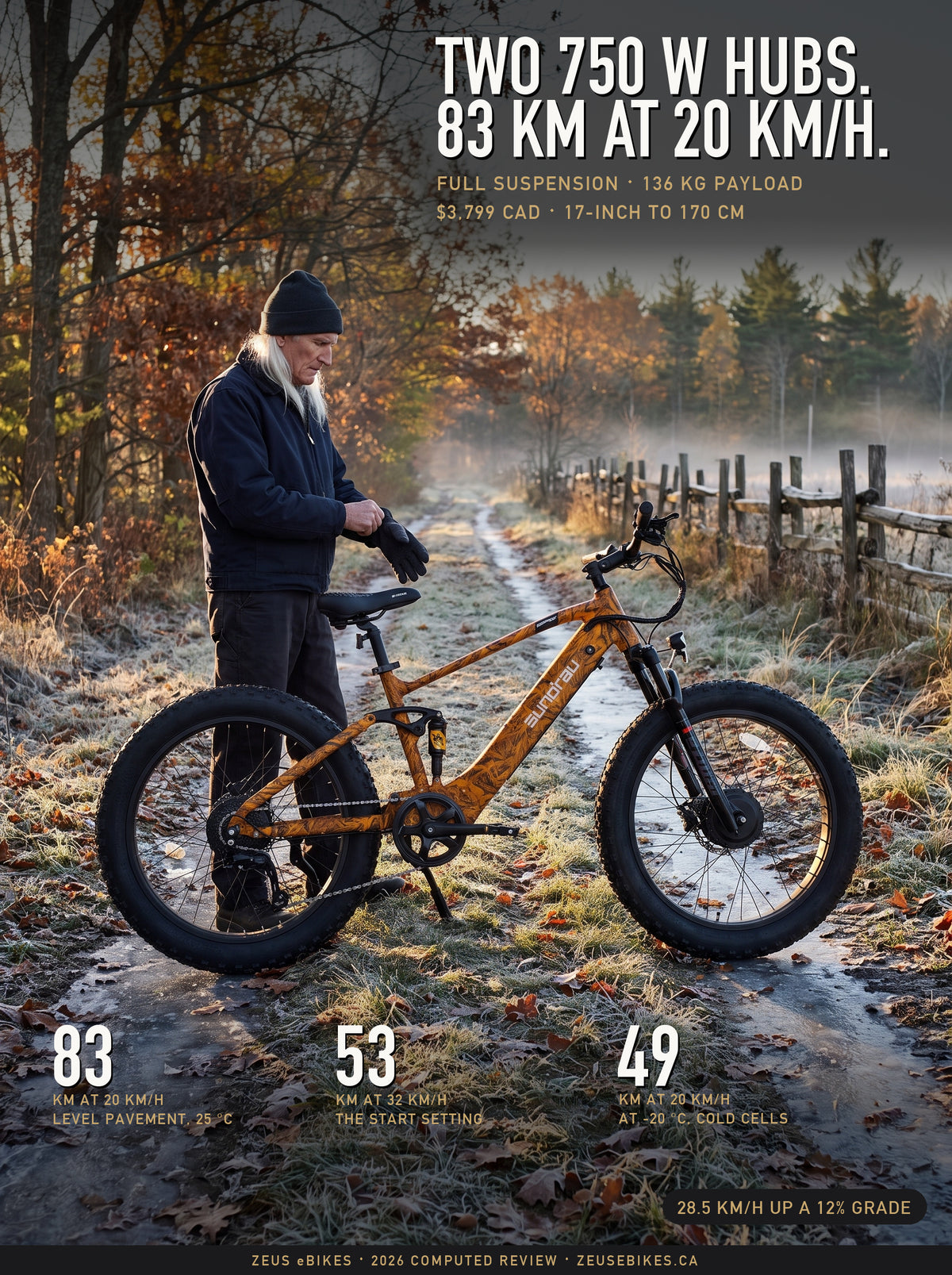
From $2,299 CAD · Dual 500W motors · 110Nm combined · Torque sensor + thumb throttle · Step-thru frame
The FAT-AWD gives you a premium torque-sensor PAS experience AND a capable thumb throttle on the same bike — plus the only all-wheel-drive system on this list. Dual 500W motors (front hub + rear hub) deliver power to both wheels — a combined 1,000W, so it is an off-road and private-property machine in any mode; engage AWD for maximum traction on snow, gravel, or mud. The torque sensor ensures smooth, proportional PAS that's ideal for Canadian winter riding (no sudden wheel spin). 26"×4.0" Kenda fat tires, expandable dual battery (up to 130 km range), and a 375 lb payload capacity. This is the bike for riders who refuse to choose between systems — and refuse to stay indoors in February.
For motor wattage details and how each tier performs, see our 500W vs 750W vs 1000W wattage guide.
Eunorau FAT-AWD 3.0 — Full Feature Overview
Dual motor AWD system, torque sensor PAS, and fat tire performance
→ View the FAT-AWD 3.0 on Zeus eBikes
4. Eunorau Meta Foldable — Best Folding Commuter with Torque Sensor
$2,295 CAD · 500W hub motor · 55Nm · Torque sensor · Thumb throttle · Folds for transit/storage
Finding a torque sensor in a folding e-bike is still rare — the Meta delivers exactly that. The torque sensor provides natural, proportional PAS that responds to your pedalling force, not just whether you're pedalling. Thumb throttle handles starts and rest breaks. The 48V 15Ah Samsung battery (720Wh) powers a 500W hub motor and ships speed-limited to 32 km/h, inside the limits the provincial rules converge on (Eunorau lists the cap as unlockable; whether an adjustable cap qualifies is not settled). Optional second battery (14Ah or 17Ah) extends range significantly. The frame folds for apartment storage or transit, and the Kenda 20"×3.0" tires provide more stability and grip than typical folding bike wheels. Shimano 7-speed, 180mm hydraulic disc brakes with motor cutoff, BC182 LCD display, and the Eunorau GO app for ride data. Payload capacity: 286 lbs. At 30 kg it's heavier than some folders, but the torque sensor PAS and Samsung battery justify the weight.
→ View the Eunorau Meta Foldable on Zeus eBikes
5. Eunorau Meta 26 — Best Full-Size Step-Through Commuter
$2,295 CAD · 500W rear hub · 55Nm peak · Torque sensor · Thumb throttle · Step-through frame
If this guide has one lesson, it's "buy the sensor, not the sticker" — and the Meta 26 is the cleanest expression of it. It runs a true torque sensor: the motor responds to how hard you press the pedals, not just whether they're turning, so the assist is proportional, natural, and efficient — no surge off the line, no on/off feel. The thumb throttle is there for starts and rest breaks and cuts at 32 km/h; Eunorau lists the cap as unlockable, and whether a bike with an adjustable cap qualifies under provincial power-assisted bicycle rules is not settled. The 48V 15Ah battery (720Wh) is removable for warm indoor charging, and an optional matched second pack roughly doubles capacity to ~1,440Wh. Zeus's real-world estimate: ~60–85 km per charge at PAS 1–2 on pavement, ~45–60 km throttle-heavy or hilly. Innova 26"×3.0" wide tires plus a front suspension fork smooth out cracked pavement and gravel shoulders, 180mm hydraulic disc brakes with motor cutoff handle the stops, and the rear LED light activates when you brake — so the cars behind you see you slowing. Shimano 7-speed, BC182 LCD with Bluetooth and the Eunorau GO app, adjustable stem, UL certified, 286 lb payload, fits riders 5'4"–6'3". The honest trade-off: at 55Nm and 68.4 lbs, it's a road commuter, not a hill-hauler — for sustained steep grades under load, look to the Discover M or FAT-AWD 3.0 above.
→ View the Eunorau Meta 26 on Zeus eBikes
Quick-Reference Comparison
| Model | System Strength | Sensor | Throttle Type | Price |
|---|---|---|---|---|
| Discover M | Pure PAS (mid-drive) | Torque + cadence (switchable) | Thumb | $3,899 |
| FT-01 Max | Throttle-forward | — | Twist + cruise | $2,099 |
| FAT-AWD 3.0 | Both (dual motor AWD) | Torque | Thumb | from $2,299 |
| Meta Foldable | Folding commuter | Torque | Thumb | $2,295 |
| Meta 26 | Step-thru commuter | Torque | Thumb | $2,295 |
Not sure which system you'll prefer? Browse Zeus's full electric bike collection — filter by motor type, price, and features. All models ship free across Canada, and warranty terms are listed on every product page.
Frequently Asked Questions
Is a throttle e-bike legal in Canada?
Yes. A throttle is allowed on a power-assisted bicycle in every province, provided the bike meets the provincial requirements — a 500W motor limit, 32 km/h maximum assisted speed (30 km/h in Nova Scotia until 19 October 2026) and operable pedals. British Columbia's Light E-Bike category (250W, 25 km/h) is the only Canadian classification that excludes throttle. For full details, see our Canadian e-bike laws guide.
Is pedal assist or throttle better for hills?
Pedal assist with a torque sensor is best for sustained hill climbing because the motor multiplies your effort proportionally — harder pedalling equals more power. A mid-drive motor (like the Discover M's VeloCore) is especially effective because it leverages the bike's gears for mechanical advantage — see our mid-drive vs hub motor comparison for the full explanation. Throttle is useful for starting from a dead stop on a steep hill, where getting initial momentum is the hardest part. Many riders use throttle to launch, then switch to PAS for the climb.
Does throttle use more battery than pedal assist?
Yes — significantly. Throttle-only riding consumes 12–22 Wh/km while pedal assist at Level 2–3 uses 4–10 Wh/km, meaning PAS gives you roughly 50% more range from the same battery. Real Zeus product data: the Eahora FT-01 Max achieves 69 km on PAS vs 45 km on throttle (+53%) from the same 1,440Wh battery. In cold Canadian winters, this gap widens further as your legs offset the battery's reduced output.
Can I have both pedal assist and throttle on one e-bike?
Yes — most modern e-bikes sold in Canada include both systems. All five Zeus picks in this guide have both PAS and throttle. You can pedal with motor assistance, use throttle alone, or combine both for maximum power. The choice is really about which mode you use most — PAS for range and exercise, throttle for convenience and rest breaks.
What is the difference between a torque sensor and a cadence sensor?
A cadence sensor detects whether you're pedalling (on/off) and delivers a fixed amount of power based on your assist level. Response time: 0.5–1.0 seconds. A torque sensor measures how hard you're pressing on the pedals — sampling up to 1,000 times per second — and delivers proportional power in 5–10 milliseconds. Torque sensors feel more natural and are 15–25% more battery-efficient, but add $200–500 to the bike's price (Electroheads). The Eunorau Meta Foldable ($2,295) is one of the relatively few folding e-bikes with a torque sensor.
Do I still get exercise with pedal assist?
Yes — substantial exercise. E-bike riders on pedal assist achieve heart rates within 94% of conventional cyclists (BYU) and burn 300–420 calories per hour. A 14-study meta-analysis (PMC) found e-cycling produces moderate-to-vigorous physical activity (MET 5.2–8.5). And the PASTA study of 10,000+ adults found e-bikers actually log more total weekly exercise than conventional cyclists — 4,463 vs 4,085 MET minutes/week — because they ride longer and more often.
Which is better for beginners — pedal assist or throttle?
Pedal assist with a torque sensor is generally better for beginners because acceleration is smooth, proportional, and predictable. Throttle can cause sudden acceleration that surprises new riders. However, having throttle available as a backup — for rest breaks, tricky intersections, or steep starts — is a significant confidence builder. Our recommendation: start with a bike that has both, use PAS as your primary mode, and throttle as needed. Our complete e-bike buying guide covers more first-time buyer tips.
What are pedal assist levels 1 to 5?
Most e-bikes offer 5 PAS levels that control how much the motor helps. Level 1 (Eco): 20–30% assistance, ~4 Wh/km — barely noticeable, maximum range. Level 2: 40–50%, ~6 Wh/km — comfortable cruising. Level 3: 60–70%, ~8 Wh/km — the most popular everyday setting. Level 4: 80–90%, ~11 Wh/km — hills and headwinds. Level 5 (Turbo): 100% motor output, ~15 Wh/km — maximum power but minimum range. Each level up roughly doubles energy consumption.
Is pedal assist or throttle better in winter and snow?
Pedal assist is significantly better for winter riding. PAS delivers gradual, proportional power that helps maintain traction on snow and ice, while throttle delivers sudden power surges that can cause wheel spin on slippery surfaces. PAS also extends range in cold weather — critical because lithium-ion batteries lose 20–40% capacity between −10°C and −20°C (Battery University). Your legs contribute energy that offsets the battery's reduced output. Start in PAS Level 1–2 on snow and build up gradually.
What happens when the battery dies — pedal assist vs throttle?
When the battery is depleted, both systems stop working. However, the experience differs significantly. With pedal assist, you've been pedalling the entire ride — so switching to unassisted pedalling is a familiar motion, just harder. With throttle, if you've been riding without pedalling, the transition to human power on a 20–35 kg bike can be difficult. This is another reason to use PAS as your primary mode: you stay in the habit of pedalling and maintain the fitness to ride home if the battery dies.
The Bottom Line
You don't have to choose between pedal assist and throttle — get a bike with both. Use pedal assist as your daily mode for range (+50%), exercise (~300–420 cal/hr), winter traction, and a natural riding feel. Use throttle for hill starts, cargo days, rest breaks, and when your legs need a reprieve. The real decision is which sensor type fits your riding style: torque for natural, efficient, winter-safe response — or cadence for consistent, predictable power at a lower price.
Every Zeus pick in this guide gives you both PAS and throttle. The difference is where each bike's strengths lie — from the Discover M's switch-it-yourself sensor tech and mid-drive PAS to the FT-01 Max's moped-style throttle cruising, from the FAT-AWD 3.0's winter-ready dual motor to the torque-sensor commuting of the Eunorau Meta 26 and the Meta Foldable — the latter in a package that folds for the subway. Browse Zeus's full collection to find the match for your ride.
Still torn between systems? Call 1-866-938-7580 — real humans who ride both answer, and they'll tell you honestly which mode suits your commute, your joints, and your winters. If spreading the cost matters, our e-bike financing guide walks through every Canadian payment option before you commit to anything.
This guide was written by the Zeus eBikes Canada editorial team. Zeus is a Canadian direct-to-consumer electric bike retailer shipping across Canada. All specifications, prices, and research citations verified August 2026.
Visuals created by Playcut.ai



Share:
Himiway C5 Review Canada (2026): The S-Class of 20-Inch Fat Tire eBikes
CitiTri E-310 Trike Review Canada: 2 Years, Zero Warranty Calls