
Québec eBike Laws (2026): The Code Read Today, the SAAQ Rule, the Moped-Style Ban, 6 Bikes Checked
 One definition, two places to find it. The Highway Safety Code calls an e-bike "a bicycle that has an electric motor" and sends you to a federal regulation for the rest; the SAAQ prints the numbers. This guide reads both.
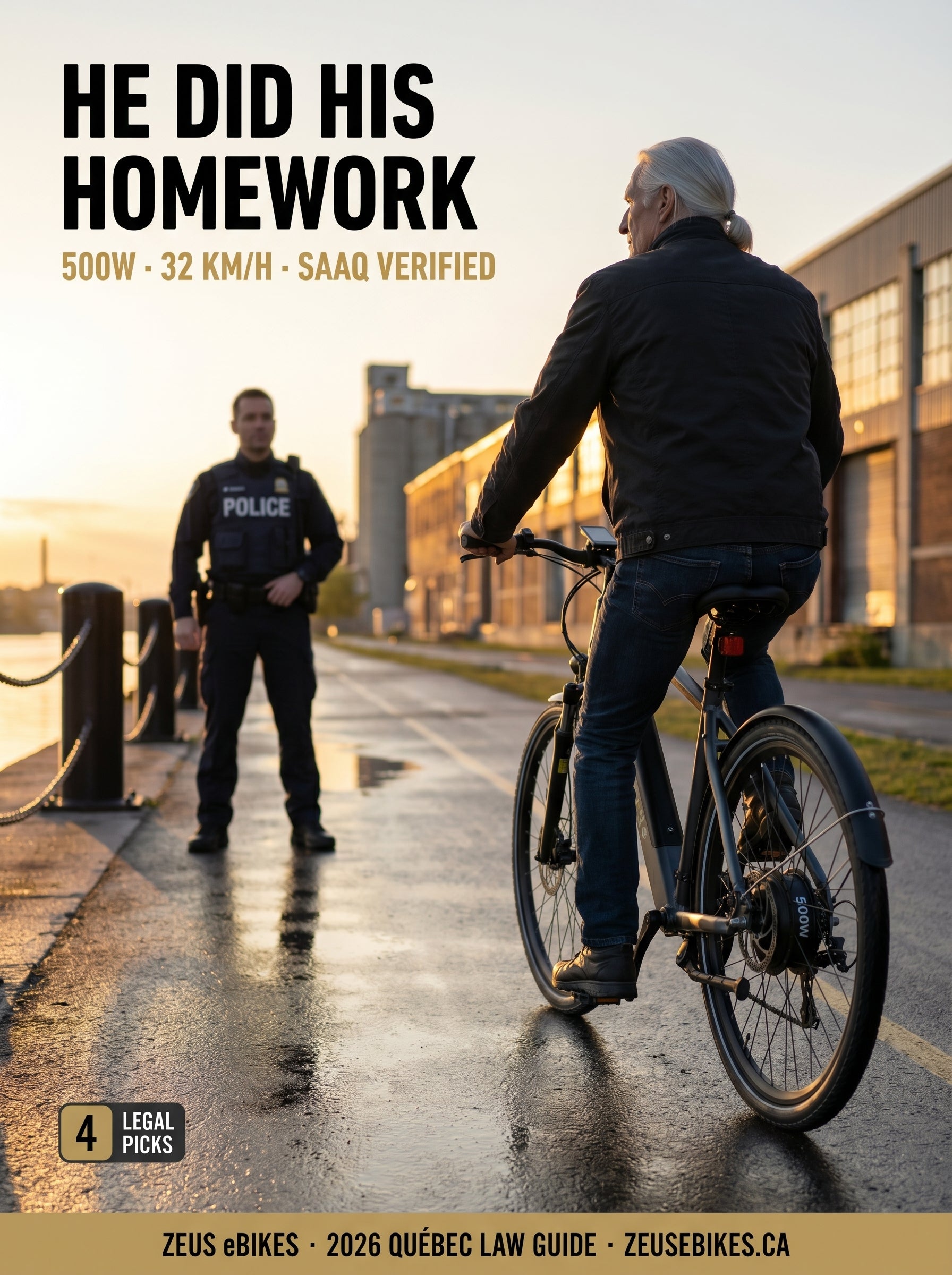
Montréal police wrote 2,411 tickets to e-bike riders in 2025, a record, for two things: no helmet, and riders under 18 without a moped licence. Québec City police wrote 663 helmet tickets to e-bike riders the same year, up 119 per cent. Since 26 January 2025 a permanent ministerial order has kept every moped-styled machine without a Transport Canada compliance label off public roads, bikeways and sidewalks, at $300 to $600 a stop.
Buy the wrong bike and none of that is theoretical: a bike that fails the definition cannot be registered, cannot be insured, and cannot be ridden home from the shop. This guide reads the Code, the regulations, the order and the SAAQ's pages as they stand on 19 September 2026 and says which side of the line your bike, and your rider, are on.
The rule itself is short. A power-assisted bicycle has an electric motor rated no more than 500 W, assistance that ceases at 32 km/h, pedals that work as on a regular bicycle at all times, handlebars, and two or three wheels (SAAQ, "On an Electric Bike", updated 25 May 2026). Assistance may be started by the pedals or by an accelerator control, so a throttle is lawful. The rider is 18, or 14 to 17 with a Class 6D moped licence, wears a helmet, and the bike carries the manufacturer's power-assisted bicycle label (Highway Safety Code s. 492.2). No licence for adults, no plate, no registration, no insurance.
Every statement below was read in the statute, regulation, order or official page on 19 September 2026, and each one links to its section. The rest covers where the 500 W figure sits in a Code that points at a repealed federal text, the 2024 and 2025 orders on moped-styled machines, e-scooters and electric dirt bikes, what a 750 W or 1,000 W bike becomes, sidewalks, bikeways and limited-access highways, Montréal's police and transit layer, the insurance gap, the Criminal Code, and six Zeus bikes checked against the rule with the maker's figures beside ours.
- Motor: a maximum power rating of no more than 500 W; a bike with a bigger motor is still a bicycle in the SAAQ's words, and not authorized on a public road or bike path
- Speed: the motor must cease to generate power at no more than 32 km/h; you may pedal faster
- Pedals and throttle: the bike must let you pedal as on a regular bike at all times; assistance "may be activated by the pedals or accelerator control"
- Age and licence: 18 and over, nothing; 14 to 17, a Class 6D moped licence (HSC s. 492.2(1)); under 14, no public road
- Helmet: every rider, every age, rigid shell with padded interior and a chin strap (Protective Helmets Regulation s. 2.1); $60 to $100 (HSC s. 507), $100 plus fees on the SPVM's sheet
- Plate, registration, insurance: none; a power-assisted bicycle is not a "road vehicle" (s. 4) and the SAAQ says it cannot be registered
- Where: every public road except limited-access highways and their ramps (s. 479); sidewalks only where a sign allows (s. 492.1); no earphones (s. 443.2)
- The ban: moped-styled two- and three-wheelers without a Transport Canada compliance label are off public roads since 30 July 2024, permanently since 26 January 2025 (Ministerial Order 2024-24), $300 to $600
- Insurance gap: an e-bike crash is outside the public automobile plan unless a covered automobile in motion is involved (Automobile Insurance Act s. 10)
The default pick is the Eunorau Meta 26 ($2,295), a 500 W torque-sensor step-through that ships at 32 km/h; the folding pick for a Plateau walk-up is the Eunorau Meta Foldable ($2,295). Or jump to the 6 bikes checked against the rule.
What's in this guide
- What makes an e-bike legal in Québec, and where the rule lives
- Québec e-bike rules at a glance, with the section for each
- Licence, registration and the insurance gap
- 18, or 14 with a Class 6D; a helmet at every age
- Where you can ride: roads, bikeways, sidewalks, highways, trails
- The moped-style ban: the 2024 order, the 2025 order, the SAAQ's three-step test
- E-scooters, pedal-less bikes, electric mopeds and electric dirt bikes
- Outside the rule: 750 W and 1,000 W bikes, unlockable caps, conversions
- What a stop costs: every fine with its section
- Montréal, Québec City and Gatineau: police, paths and transit
- Québec and Ontario, side by side
- Impaired riding: the Code and the Criminal Code
- 6 Zeus bikes checked against the rule ($1,199 to $2,899), and 2 that are not picks
- Pre-purchase checklist
- Frequently asked questions (18)
- Sources, with the date each was read
What Makes an E-Bike Legal in Québec, and Where the Rule Lives
Québec's Highway Safety Code defines a "power-assisted bicycle" in five words: "a bicycle that has an electric motor" (s. 4). The numbers everyone quotes, 500 W and 32 km/h, are not in that definition. They reach the road through s. 492.2, which requires the bike to conform to the standards for power-assisted bicycles "in this Code and in the regulations made pursuant to the Motor Vehicle Safety Act", and through the SAAQ's page, which prints them.
A bike that meets the SAAQ's figures, carries the maker's label and is ridden by an adult in a helmet is inside the rule.
Section 492.2 sets four conditions for riding a power-assisted bicycle on a public highway. The rider is 18 or older, or holds a licence to drive a moped and follows its conditions. The rider wears a protective helmet that meets the regulation. The bike bears the manufacturer's label required by the federal regulations, or, for a converted bicycle, the motor label required by s. 274.2. And the bike conforms to the other standards for power-assisted bicycles in the Code and the federal regulations. Contravening s. 492.2 carries a fine of $60 to $100 (s. 507).
The SAAQ's page, updated 25 May 2026, states the standard in plain terms. An electric bike has an electric motor and no gasoline motor, a rechargeable battery, handlebars and pedals, and two or three wheels that touch the ground. At all times it must allow the rider to pedal as on a regular bike without assistance. The assistance "may be activated by the pedals or accelerator control". To be used on public roadways the motor "must have a maximum power rating of no more than 500 watts and must cease to generate power once the bicycle reaches a speed of no more than 32 km/h".
The federal regulation the Code points at is s. 2(1) of the Motor Vehicle Safety Regulations, and its power-assisted bicycle definition (500 W, 32 km/h, operable pedals, a label) was repealed by SOR/2020-22 effective 4 February 2021. Québec's Interpretation Act has no rule, that we could find, that reads a repealed federal provision as it stood before repeal; Ontario's Legislation Act does.
So the strongest reading against a rider is that s. 492.2(4) now points at nothing, and the operative standard is the SAAQ's published one, backed by the ministerial order's own 500 W and 32 km/h thresholds. The strongest reading for a rider is the same: the province publishes 500 W and 32 km/h, its order uses them, and its police enforce them. Either way, a bike whose maker prints 500 W and 32 km/h is inside every version of the rule.
Two more sections matter at the point of sale. Section 211.1 bars anyone from selling or leasing a new power-assisted bicycle unless it bears the label prescribed by the Motor Vehicle Safety Act, and s. 210 requires every bicycle to carry a manufacturer's identification number; the SAAQ adds that an e-bike's number need not be a 17-character VIN. Section 274.2 governs conversion kits: the motor must meet the federal standard, have an on/off mechanism separate from the accelerator or a lock-out below 3 km/h, and bear a label stating its continuous power rating.
The SAAQ also draws the line between an electric bike and an electric moped. A moped is a road vehicle: two or three wheels, a maximum speed of 70 km/h, an electric motor or a motor of 50 cm³ or less with automatic transmission (s. 4).
It must carry a Transport Canada compliance label with a 17-character VIN, be built to Canada Motor Vehicle Safety Standards, be registered, and be ridden with a motorcycle helmet and a Class 6D or higher licence. An electric bike cannot be registered at all. The two categories do not overlap, and a machine that fits neither is the subject of the 2024 and 2025 orders.
Québec E-Bike Rules at a Glance, With the Section for Each
The table below carries the rule, the source and the ticket for each requirement as they read on 19 September 2026. The Code sections come from the LégisQuébec consolidation updated to 10 June 2026; the helmet standard from the Protective Helmets Regulation; the figures from the SAAQ's electric-bike page of 25 May 2026 and its FAQ on non-compliant vehicles; the ticket amounts from the Code's penal chapter, with the SPVM's own figure beside them where the two differ.
| Requirement | Québec rule | Where it is written | Ticket |
|---|---|---|---|
| Definition | "A bicycle that has an electric motor" | HSC s. 4 | |
| Motor | Maximum power rating of no more than 500 W | SAAQ electric-bike page; HSC s. 492.2(4) via the federal regulations | $60 to $100 (s. 507) |
| Speed | Motor ceases to generate power at no more than 32 km/h | SAAQ electric-bike page; SAAQ FAQ | $60 to $100 (s. 507) |
| Pedals | Rider can pedal as on a regular bike at all times; assistance may start from the pedals or an accelerator control | SAAQ electric-bike page | |
| Wheels and bars | Handlebars; two or three wheels touching the ground | SAAQ electric-bike page | |
| Label and number | Manufacturer's power-assisted bicycle label; a manufacturer's identification number | HSC ss. 492.2(3), 211.1, 210 | $60 to $100 (s. 507) |
| Age and licence | 18 and over, none; 14 to 17, a Class 6D moped licence; under 14, no public road | HSC s. 492.2(1); SAAQ Class 6D page (age 14, parental consent under 18) | $60 to $100 (s. 507); SPVM: $100 plus fees |
| Helmet | Every rider, every age; rigid shell, padded interior, chin strap, adjusted and fastened | HSC s. 492.2(2); Protective Helmets Regulation ss. 2.1, 3 | $60 to $100 (s. 507); SPVM: $100 plus fees; $121 with fees per Le Journal de Montréal |
| Plate, registration, insurance | None; a power-assisted bicycle is not a road vehicle and cannot be registered | HSC s. 4 ("road vehicle"), s. 6; SAAQ page | |
| Highways | Not on a limited-access highway or its entrance and exit ramps | HSC s. 479 | $80 to $100 (s. 504) |
| Sidewalks | Only in case of necessity or where a sign directs or allows it, at a safe speed, yielding to pedestrians | HSC s. 492.1 | $80 to $100 (s. 504) |
| Earphones | A cyclist may not wear any earphones (helmet-integrated intercoms excepted) | HSC s. 443.2 | $80 to $100 (s. 504) |
| Lights and reflectors | Front white and rear red reflectors, pedal and wheel reflectors; a white headlight and red taillight at night | HSC ss. 232, 233 | $80 to $100 (s. 504) |
| Alcohol and drugs | No drinking or cannabis while riding; the Criminal Code may reach an e-bike | HSC s. 489; Québec.ca electric-bike page | $80 to $100 (s. 504) |
| Passengers | Only on a fixed seat made for the purpose | HSC s. 485 | $80 to $100 (s. 504) |
| Moped-styled machines | Two- or three-wheeled motor vehicles that look like a motorcycle or moped, lack the compliance label, and have footrests, moped wheels, body panels, or exceed 32 km/h or 500 W: banned from public highways | Ministerial Order 2024-24, ss. 1, 2 (C-24.2, r. 0.1.3); HSC s. 633.1 | $300 to $600 (SAAQ release) |
Two notes on the table. The Code's $60 to $100 range for s. 492.2 covers the helmet, the age or licence, the label and the standards together; the SPVM's sheet gives a flat "$100, plus applicable fees", and Le Journal de Montréal reports the ticket as $121 with fees. And the cyclist offences at $80 to $100 come from s. 504, which lists sections 477 to 479 and 485 to 492.1 among others; that is the range for a sidewalk, an earphone or a red light on an e-bike, since every cyclist rule applies to a power-assisted bicycle.
Licence, Registration and the Insurance Gap
An adult needs no licence, plate, registration or insurance to ride a power-assisted bicycle in Québec, and could not register one if they tried. The Code's definition of "road vehicle" excludes "a power-assisted bicycle or an electrically propelled wheelchair" (s. 4), and registration (Title I, s. 6) and driver's licences (Title II) attach to road vehicles. The SAAQ's page says it in four words: "Electric bikes cannot be registered." The one licence in the picture is the Class 6D that lets a 14- to 17-year-old ride.
The insurance side is the part most guides leave out. Québec's public automobile plan compensates bodily injury from an "automobile", defined as any vehicle propelled by any power other than muscular force and adapted for transportation on public highways (Automobile Insurance Act s. 1). Section 10 then removes e-bike crashes: no compensation "if the injury is caused by a motor-assisted bicycle, a motorized mobility aid or a motorized personal mobility device", unless an automobile in motion other than one of those is involved in the accident (s. 10, para. 5 and the closing paragraph).
The SAAQ's electric-bike page says the same thing for riders: injuries in an accident involving an electric bike "are not covered by the public automobile insurance plan, unless the accident involves a moving vehicle that is covered by the plan". Hit by a car, you are covered as any cyclist is. Crash on your own, or into a pedestrian or another cyclist, and you rely on your health coverage, any private accident or disability policy, and, for what you do to others, your home insurance's liability section if it extends to an e-bike. Ask your insurer in writing before you assume it does.
The applicant must live in Québec, have citizenship or the right to stay more than six months, be at least 14, and, under 18, hold the written consent of a parent or guardian. The course is six hours at a driving school the SAAQ recognizes, followed by the SAAQ's knowledge and vision tests; the knowledge test is $13.50 and the licence $46.50 on the page we read.
Full motorcycle protective gear is mandatory during training. A Class 6D authorizes a moped or scooter only; a holder of any other class except Class 8 may already drive a moped, and so may ride an e-bike under 18 on that licence, since s. 492.2 asks for "a licence to drive a moped".
18, or 14 With a Class 6D; a Helmet at Every Age
The age rule is in s. 492.2(1): a person may not ride a power-assisted bicycle on a public highway unless they are 18 or older or hold a licence to drive a moped and comply with its conditions. The SAAQ restates it as 18, or 14 to 17 with a Class 6D. Under 14, there is no route onto a public road, because the Class 6D itself starts at 14.
The ticket for a minor without the licence is $60 to $100 under s. 507, and it is the second most common e-bike ticket in Montréal.
The helmet rule is in s. 492.2(2) and the Protective Helmets Regulation. Every person riding a power-assisted bicycle on a public highway wears a helmet made of a rigid shell with a padded interior and equipped with a chin strap (s. 2.1), correctly adjusted, firmly attached and free of modification (s. 3). The SAAQ names the standards it accepts: CAN/CSA-D113.2, 16 CFR Part 1203, ASTM F1447 or F1898, EN 1078, and Snell B-90 or B-95. Any certified bicycle helmet meets s. 2.1; a motorcycle helmet is not required, though the Class 6D course itself demands one during training.
This is where the tickets are. Le Journal de Montréal obtained the SPVM's figures in June 2026: 2,411 tickets to e-bike riders in 2025, up from 1,821 in 2024 and 1,922 in 2023, totalling close to $292,000, a rise of 32 per cent, for two offences, the helmet and the age. The single ticket is $121 with fees. In Québec City the SPVQ wrote 663 helmet tickets to riders of "bicyclettes assistées" in 2025, up 119 per cent on 2024, for $58,209, and 152 more by 1 June 2026 (Radio-Canada, 18 June 2026).
The regular-bicycle contrast matters for families. Québec has no helmet law for an ordinary bicycle at any age; the SAAQ's bicycle pages recommend one and require it only on an electric bike. So a teenager on a pedal bicycle rides bare-headed within the law, and the same teenager on an e-bike needs both a helmet and a Class 6D. Shared e-bikes count: the SPVM's June 2026 operations put officers beside BIXI stations so riders without a helmet could swap the electric bike for a mechanical one (TVA Nouvelles, 22 June 2026).
Every pick below ships at 32 km/h with a motor its maker rates at 500 W or less
Zeus ships across Québec with Canadian support and a 15-day return window for unused, unopened bikes (15% restocking fee). Our team reads any model's maker page against the rule before you buy: 1-866-938-7580.
Browse the 500 W collection Folding e-bikesWhere You Can Ride: Roads, Bikeways, Sidewalks, Highways, Trails
A power-assisted bicycle goes where a bicycle goes. The SAAQ's page puts it in one sentence: "You may cycle on all public roadways, except on highways and their access and exit ramps." Québec.ca's cyclist page lists the places: the roadway, a shoulder, a bikeway, a shared street, and a sidewalk only where a sign allows. Every cyclist rule in the Code applies to the e-bike rider, and the SPVM's sheet says so in the same words, with one Montréal addition for bikes with a moveable step.
On the roadway a cyclist rides as close as possible to the right edge, in the direction of traffic, allowing for the road's condition and the risk of car dooring, and may use the shoulder in the same direction (s. 487).
Riders keep to single file, never more than 15 in a group (s. 486), obey every sign and signal (s. 488), signal turns (s. 490), sit astride and hold the bars (s. 477), and carry a passenger only on a fixed seat (s. 485). A child under 12 may not ride on a road posted above 50 km/h unless a separated lane exists or an adult leads the ride (s. 491).
Sidewalks are closed by default: a cyclist may not ride on one "except in case of necessity or where directed or allowed to do so by a sign or signal", and then at a safe, reasonable speed with pedestrians given priority (s. 492.1). Limited-access highways and their ramps are closed to bicycles, mopeds and small motorcycles outright (s. 479). Both are $80 to $100 tickets under s. 504. Earphones are banned for cyclists, both ears or one; a helmet intercom that lets you hear traffic is not an earphone (s. 443.2).
Bikeways come in kinds, and the Code reaches only some of them. Québec.ca's bikeway page explains that bike paths and multi-use paths outside the public right-of-way, former rail corridors for instance, are municipal: the Highway Safety Code does not apply there, and the municipality sets who may use the path, the direction, the speed limit and the fines, and may open it to e-scooters. On a path inside the right-of-way, the Code's cyclist rules apply and the path is a bikeway a power-assisted bicycle may use. Check the municipality's page before assuming a motor is welcome on a trail.
Two other networks have their own rules. The Route verte is a provincial network of more than 5,000 km, 42 per cent of the roughly 12,000 km of trails in the province (Québec.ca); each segment belongs to a road authority or a municipality, so the segment's rule governs. On the Gatineau side of the Ottawa River, the NCC's Capital Pathway and parkways permit e-bikes with operable pedals that resemble conventional bicycles and personal cargo e-bikes, and prohibit commercial cargo e-bikes, electric kick-scooters, throttle-only devices and every other electric vehicle (NCC, "Share the Path").

A Plateau lane in the morning: the trike in the lane is inside the rule on the SAAQ's "2 or 3 wheels"; the moped-styled machine at the stand is the kind the 2024 order took off the road.
The Moped-Style Ban: the 2024 Order, the 2025 Order, and the SAAQ's Three-Step Test
Since 30 July 2024, two- or three-wheeled motor vehicles that look like a motorcycle or moped and carry no Transport Canada compliance label have been barred from Québec's public highways. The first instrument was Ministerial Order 2024-15, made 26 July 2024 under s. 633.1 of the Code, which lets the Minister of Transport prohibit a class of vehicle for up to 180 days.
Order 2024-24, made 30 December 2024 and in force on publication on 26 January 2025, made the prohibition permanent, as s. 633.1 allows at the end of the 180 days. Both orders are linked in the sources below.
The wording is the same in both. The use on public highways is prohibited for two- or three-wheeled motor vehicles, "with or without pedals", that have the appearance of a motorcycle or moped, do not bear a national safety mark or the compliance label under the Motor Vehicle Safety Act, and have at least one of four characteristics: footrests or a platform for the driver's feet; a set of tires and wheels that looks like a motorcycle's or moped's; a body that covers the frame with no height-adjustable saddle; or an engine that can exceed 32 km/h or is rated above 500 W (Order 2024-24, s. 1).
Section 2 exempts motorcycles and mopeds built before 1971, those carrying a United States or Mexican safety certification, those 15 years old or more with another country's certification, hand-built motorcycles with an SAAQ inspection certificate, off-highway vehicles under the Act respecting off-highway vehicles, and vehicles a pilot-project order allows. The Québec.ca cyclist page adds the practical reach: such vehicles "are not allowed on public roads, bikeways or sidewalks", and they were already banned from sale and new import in Québec because they lack certification. The SAAQ's release puts the fine at $300 to $600.
Step one: two or three wheels, the appearance of a motorcycle or moped, and no Transport Canada compliance label or national safety mark. Step two: any one of footrests or a platform, motorcycle-style tires and wheels, a body over the frame with no height-adjustable saddle, or a motor that reaches over 32 km/h or is rated over 500 W. Step three: none of the exemptions.
Meet all three and the vehicle is off the road. The FAQ adds that a used vehicle cannot be certified after the fact, that a CE mark is not sufficient, and that inspectors found "how easy it is to unlock the maximum speed for a large proportion of these vehicles".
Two lines in that FAQ settle the questions readers ask most. "Motorcycles or mopeds/scooters with a power rating greater than 500 watts that bear a compliance label or a national safety mark may be registered for road use", so a certified electric moped is a registered road vehicle with a plate, a Class 6D and a motorcycle helmet. And "power-assisted bikes with a power rating greater than 500 watts are not authorized for use on public roads": a 1,000 W bicycle "is still considered a bicycle, but is not authorized for use on a public road, including roadways and bike paths".
The ban had immediate effect in Montréal. The SPVM told CBC that 244 tickets had been issued between 30 July and late November 2024 for mopeds or motorcycles on public roads without a CMVSS certification mark, and cycling advocates reported bike paths noticeably clearer of the machines (CBC News, 27 November 2024). The SPVM's own sheet on the "cyclomoteur électrique" describes the pedal-less machine the order targets: a licence of Class 6D, another motorcycle class or Class 5, mandatory registration, a helmet under s. 2 of the helmet regulation, and no limited-access highways.
The strongest reading against a buyer sits in step two. The order reaches "motor vehicles", and a compliant power-assisted bicycle is not a motor vehicle under the Code's definitions; but the SAAQ's test is applied to the machine's appearance and equipment at the roadside, and a moped-styled bike with moped-style wheels and a 500 W label can be stopped and argued over. If a bike has a bench seat, footrests, motorcycle wheels or a fairing, ask the SAAQ in writing before you buy, and keep the answer with the bike. Our electric mopeds guide covers the certified category.
E-Scooters, Pedal-Less Bikes, Electric Mopeds and Electric Dirt Bikes
Québec sorts electric two-wheelers into four boxes, and the box decides the licence, the plate and the road. A power-assisted bicycle has working pedals and a motor of 500 W or less. A motorized personal mobility device, an e-scooter or unicycle, runs under a provincial pilot with its own limits. An electric moped or motorcycle carries a Transport Canada compliance label and a plate. And an electric dirt bike is an off-highway vehicle under its own Act.
Anything with moped looks and no label is in none of the boxes and is off the road.
E-scooters and other motorized personal mobility devices are lawful under an ongoing pilot project described on Québec.ca: a device with at least one wheel, powered only by electric motors, without a passenger compartment. It may be used on roads posted at 50 km/h or less and on bikeways along those roads, at no more than 25 km/h, by riders 14 and over wearing a helmet and following the cyclist rules; the device weighs no more than 36 kg. The page is explicit that "assisted bicycles" and mopeds are not motorized personal mobility devices, so the pilot's 14-and-up rule does not transfer to an e-bike.
A pedal-less electric "bike" is an electric moped in the SPVM's words: "un véhicule dépourvu de pédaliers avec une alimentation électrique". Ridden on a public road it needs a Class 6D, another motorcycle class or a Class 5 licence, registration, and a helmet under s. 2 of the Protective Helmets Regulation, and it may not use limited-access highways. That path exists only for a machine with a compliance label; without the label it cannot be registered (SAAQ FAQ), and the 2025 order keeps it off the road. The SAAQ's moped page and its certified category are the place to start.
Electric dirt bikes, the Sur-Ron and Talaria class that readers search for by name, are off-highway vehicles. The Act respecting off-highway vehicles covers "a trail bike, such as a motocross motorcycle, and any other motorized vehicle adapted or designed mainly for operation on uneven surfaces" (s. 2(7)).
Such a vehicle must be registered under the Code's rules (s. 10), ridden by a person 16 or over holding a driver's licence (s. 16), covered by civil liability insurance (s. 25), and kept off trails unsuited to it, hiking and mountain-bike trails included (s. 31). The helmet regulation's s. 2 applies. On a public road it is a motor vehicle with no compliance label, which is the machine the 2025 order names; the order's off-highway exemption covers off-highway use.
Not as an e-bike, and not on a public road, bikeway or sidewalk. As an off-highway vehicle it needs registration, a licensed rider of 16, insurance, a helmet and a trail where the Act and the landowner allow it. The Act's impaired-driving provisions apply on trails through s. 33, and the Code's fine for a prohibited vehicle on a public highway is $300 to $600. Our Sur-Ron guide covers the category by province.
Outside the Rule: 750 W and 1,000 W Bikes, Unlockable Caps, Conversions
A bicycle with a motor rated above 500 W is, in the SAAQ's own words, "still considered a bicycle, but is not authorized for use on a public road, including roadways and bike paths". It cannot be registered as a moped because it has no compliance label, and it cannot be ridden as a bicycle because it fails the standard.
A 750 W nameplate with a 32 km/h limiter is in the same place: the SAAQ reads the motor's maximum power rating, and the limiter changes the speed, not the rating. Private land is the only lawful place for such a bike.
The unlockable cap is the unsettled question, and this page gives both readings rather than one. The SAAQ's standard says the motor "must cease to generate power once the bicycle reaches a speed of no more than 32 km/h". Several makers ship a 500 W bike capped at 32 km/h with a setting that raises the cap; Eunorau labels its Meta line "Speed limited, Unlockable", Velotric offers "up to 28 MPH in Custom Mode", and Taubik's Tour page prints both "Speed 32KM/H" and "top speeds of 41km/h".
No Québec statute, regulation or SAAQ page we read decides whether a cap that can be raised satisfies "must cease". The reading for the rider is that the bike as ridden ceases at 32. The reading against is that the SAAQ's FAQ already condemns machines whose speed is "easy to unlock".
What is settled: raise the cap and ride at 40 km/h on a bike lane, and the bike as ridden no longer meets the standard, the ticket is s. 492.2 at $60 to $100 or the order at $300 to $600 depending on what the officer sees, and the insurance gap is still there. Leave the cap where the maker set it. Every card in the picks prints both figures where a maker lists both, so you know what you are buying.
Conversions have their own section. A motor sold to turn a bicycle into a power-assisted bicycle must meet the federal standard, carry an on/off mechanism separate from the accelerator or a lock-out below 3 km/h, and bear a label with its continuous power rating and maximum rpm (s. 274.2); the converted bike then rides on that motor label under s. 492.2(3). A combustion engine on a bicycle is prohibited outright: the SAAQ's page says it turns the machine into a hand-crafted moped or motorcycle, which the Code forbids.
What a Stop Costs: Every Fine With Its Section
Québec's e-bike fines come from three places: s. 507 of the Code for the four conditions in s. 492.2, s. 504 for every cyclist offence, and the ministerial order's $300 to $600 for a machine that is off the road altogether. The SPVM's sheet quotes a flat $100 plus fees for s. 492.2, and Le Journal de Montréal reports the ticket as $121 with fees.
The table gives the Code's range first and the police figure beside it, because the Code sets the range and the ticket you hold shows the total.
| Offence | Section | Fine in the Code | On the ticket |
|---|---|---|---|
| No helmet on a power-assisted bicycle | s. 492.2(2); s. 507 | $60 to $100 | $100 plus fees (SPVM); $121 (Le Journal de Montréal) |
| Under 18 without a moped licence | s. 492.2(1); s. 507 | $60 to $100 | $100 plus fees (SPVM) |
| No manufacturer's label, or a bike that fails the standard | s. 492.2(3), (4); s. 507 | $60 to $100 | $100 plus fees (SPVM) |
| Riding on a sidewalk without a sign allowing it | s. 492.1; s. 504 | $80 to $100 | |
| Earphones while riding | s. 443.2; s. 504 | $80 to $100 | |
| Red light, stop sign, wrong way, no signal, no single file | ss. 486 to 490; s. 504 | $80 to $100 | Montréal: 9,529 cyclist tickets in 2025, most for red lights (TVA Nouvelles) |
| Drinking alcohol or using cannabis while riding | s. 489; s. 504 | $80 to $100 | Criminal Code exposure on top; see the impaired section |
| Limited-access highway or ramp | s. 479; s. 504 | $80 to $100 | |
| No reflectors, or no lights at night | ss. 232, 233; s. 504 | $80 to $100 | |
| Passenger without a fixed seat | s. 485; s. 504 | $80 to $100 | |
| Hanging on to a moving power-assisted bicycle | s. 434.0.1; s. 509.3 | $300 to $500 | |
| Moped-styled machine without a compliance label on a public highway | Ministerial Order 2024-24; HSC s. 633.1 | $300 to $600 (SAAQ release and FAQ) | 244 SPVM tickets, 30 July to late November 2024 (CBC) |
| E-bike in the métro, on an STM bus or on the REM | STM By-law R-036; REM regulation s. 53.2 | REM: $75 to $500, $150 to $1,000 on a repeat (REM regulation, Annex) |
What a stop looks like. The SPVM's sheet says officers check the four things in s. 492.2: the rider's age or licence, the helmet, the removable manufacturer's label stating the bike is a power-assisted bicycle, and conformity with the federal standards. Carry the label on the bike and your licence if you are under 18. For a moped-styled machine the check is the compliance label on the frame, which the SAAQ's FAQ describes in detail: a maple-leaf national safety mark or the bilingual conformity sentence, a 17-character VIN, the date of manufacture and the vehicle type.
Seizure is not in any e-bike section of the Code we read. The order makes use on a public highway an offence and the SAAQ's release cites the fine; the Code's seizure and impoundment provisions in ss. 209.1 and following attach to road vehicles and drivers in the situations listed there. We did not find a provision that lets an officer seize a power-assisted bicycle for a s. 492.2 offence, and this page does not claim one.
Montréal, Québec City and Gatineau: Police, Paths and Transit
The Code is provincial, but the ticket, the path and the train are local. Montréal's police publish their own e-bike sheet and wrote a record 2,411 e-bike tickets in 2025; the city's 1,083 km network includes 740 km cleared in winter; and its three transit operators have three different answers to "can I bring my e-bike". Québec City's police wrote 663 helmet tickets in 2025 and its àVélo system runs only electric bikes. Gatineau riders share the NCC's pathway rules with Ottawa.
Our Montréal rules guide carries the full city layer.
Montréal
The SPVM's power-assisted bicycle sheet repeats s. 492.2 and adds one local rule: "if the power-assisted bicycle has a moveable step, the driver is not allowed on a bicycle path or lane". A moveable step, a "marche-pied", is the footboard of a scooter-styled bike; such a bike is confined to the roadway even where it is otherwise lawful.
Sidewalks follow s. 492.1. Montréal's cycling page (updated 6 August 2026) counts 1,083 km of bike lanes, of which 251 km of physically protected paths and 489 km of marked lanes are cleared of snow at the same time as the street or soon after; the Express Bike Network is a 191 km project of 17 year-round routes.
Transit is where the old advice was wrong. The STM's bicycle page carries a notice that "motorized scooters and electric personal transport devices, such as electric bikes, are no longer allowed inside métro infrastructure and buses", a change its board recommended to the agglomeration council on 5 December 2024 as an amendment to By-law R-036.
The REM's regulation, as amended in 2026, bars every "appareil de transport personnel motorisé", a class that names the "bicyclette assistée", from its trains at all times (s. 53.2), with a fine of $75 to $500. Non-motorized bicycles ride the REM under a 2026 pilot: at all times until 27 September 2026, then outside weekday peaks. Exo carries bicycles on all its trains, even at rush hour, and bars electric bikes from its bus racks.
Québec City and Gatineau
Radio-Canada reported on 18 June 2026 that the SPVQ wrote 663 tickets in 2025 to riders of assisted bicycles without a helmet, up 119 per cent on 2024, for $58,209, and 152 more by 1 June 2026; the shared àVélo fleet is entirely electric, which is where many of those riders were caught. Gatineau's pathways along the river are NCC pathways: e-bikes with operable pedals that resemble conventional bicycles are permitted, throttle-only devices and kick-scooters are not. Our shop directories for Montréal, Québec City and the province carry each city's transit and path notes.
Québec and Ontario, Side by Side
Riders who cross the Ottawa River, or who are comparing before a move, ask how the two provinces differ. They agree on the machine: 500 W, a 32 km/h cut-off, working pedals, a maker's label, and a helmet at every age. They differ on the rider and the paperwork around the rule. Québec lets a 14- to 17-year-old ride with a Class 6D licence and requires nothing from an adult; Ontario's minimum age is 16 with no licence at any age.
Ontario writes a 120 kg weight cap and a brake test; Québec's SAAQ page writes neither. Both figures below were read in the statutes on 19 September 2026.
| Rule | Québec | Ontario |
|---|---|---|
| Motor | "A maximum power rating of no more than 500 watts" (SAAQ page) | 500 W continuous (ministry requirements) |
| Cut-off | "Must cease to generate power" at no more than 32 km/h | 32 km/h |
| Throttle | Lawful; assistance "may be activated by the pedals or accelerator control" | Lawful; O. Reg. 369/09 s. 3(2) assumes an accelerator |
| Pedals | Must allow pedalling "as though on a regular bike" at all times | Operable at all times (HTA s. 1(1)) |
| Minimum age and licence | 18; or 14 with a Class 6D (HSC s. 492.2) | 16; no licence (HTA s. 38) |
| Helmet | Every age (s. 492.2(2)), $60 to $100 | Every age (HTA s. 103.1(2)), $85 |
| Weight | Not stated on the SAAQ page | 120 kg unladen (O. Reg. 369/09 s. 1) |
| Moped-styled machines | Banned from public highways by ministerial order since 30 July 2024, permanent since 26 January 2025 | Motor vehicles under the Act; a two-class regulation is proposed, not in force |
| Public insurance | Outside the public automobile plan unless a covered automobile in motion is involved (A-25 s. 10) | No provincial plan; a PAB is not a motor vehicle under the insurance Act |

The Alexandra Bridge: Québec at one end, Ontario at the other. The bike is inside both rules; the 15-year-old riding it is inside only Québec's, with a Class 6D.
A bike that is 500 W, capped at 32 km/h, pedallable and labelled is inside both provinces' rules on the pages we read. The rider rules are where a family with a 15-year-old notices the border, and the weight cap is where a heavy cargo bike does. Our Ontario e-bike laws guide carries the Ontario side, and the national hub the other eleven jurisdictions.
Impaired Riding: the Code and the Criminal Code
Québec's Code bars drinking alcohol or consuming cannabis while riding a bicycle (s. 489), an $80 to $100 ticket under s. 504, and Québec.ca's electric-bike page adds that operating an e-bike while impaired "may constitute an offence under the Criminal Code of Canada". The Criminal Code's impaired-operation offences apply to a "conveyance", which includes a motor vehicle (s. 320.11), and its "motor vehicle" is anything "drawn, propelled or driven by any means other than muscular power" (s. 2).
An e-bike under motor power fits those words; no Québec appellate decision we could find has applied them to a compliant power-assisted bicycle.
The stakes if they do apply: a first impaired-operation conviction carries a minimum $1,000 fine (s. 320.19), a driving prohibition order can follow (s. 320.24), and refusing a demand is its own offence. On an off-highway vehicle the point is settled by statute: the Act respecting off-highway vehicles applies the Code's impaired-driving provisions to trails (s. 33). Both readings sit on this page because the question is open, and because the safe answer is the same under either: ride sober.
6 Zeus Bikes Checked Against Québec's Rule, $1,199 to $2,899, and 2 That Are Not Picks
Every bike below carries a motor its maker rates at 500 W or less, pedals that work, and assistance capped at 32 km/h as shipped, each confirmed against the maker's Canadian page on 19 September 2026, product data and rendered page both. Where a maker lists a higher unlockable speed beside the shipped cap, the card says so and gives both figures, because whether an adjustable cap satisfies "must cease to generate power" is not settled in any text we read.
Two bikes readers ask about are checked at the end and are not picks: one has two motors, the other a moped-styled frame.
Prices are Zeus prices in Canadian dollars on 19 September 2026; every maker's Canadian page except Eahora's lists a lower figure today, and ours include Canadian stock, support and a 15-day return window for unused, unopened bikes (15% restocking fee). No stock claims appear here because stock moves daily. Each card carries the SPVM's moveable-step test for Montréal bike paths and the transit fit, since the STM and the REM refuse every e-bike and exo's page carries bicycles without stating a rule for electric ones.
Quick match: find your situation in thirty seconds
| # | Your situation | The pick | Price | Speed on the maker's page | Weight |
|---|---|---|---|---|---|
| 1 | Lowest price inside the rule; a walk-up or a car trunk | Samebike CY20 | $1,199 | 32 km/h: the only figure Samebike lists | Not on Samebike's page; 61 lb on the Zeus listing |
| 2 | Canadian-designed folder with a torque sensor and hydraulic brakes | Taubik Monaco S | $2,899 | 32 km/h: the only figure | 70 lb |
| 3 | The default commuter: torque sensor, big wheels, a second battery on the maker's page | Eunorau Meta 26 (Meta 24 and Meta 275 2.0 by size) | $2,295 | 32 km/h shipped; "Speed limited, unlockable" | 68.4 lb (26), 61.7 lb (24) |
| 4 | A Plateau third-floor walk-up: it folds | Eunorau Meta Foldable | $2,295 | 32 km/h shipped; "Speed limited, unlockable" | 63.4 lb |
| 5 | Hills and the Route verte: 70 Nm, dual sensor, a dual-battery option | Taubik Blackburn 275T | $2,799 | 32 km/h: the only figure | 69.5 lb |
| 6 | Three wheels, 440 lb of payload | Eunorau ONE-TRIKE 2.0 | $2,499 | 32 km/h: "under speed limited/locked" | 85.98 lb |

The lobby test: a folding bike goes up the stairs of a walk-up and into the closet, which matters in a city whose métro and REM refuse every e-bike.
Samebike CY20
$1,199
The CY20: a 350 W hub, a 468 Wh seat-post battery, mechanical discs and a fold.
The least money on this page that buys a bike inside the rule, and the one to carry up a walk-up. Samebike's Canadian page for the "CY20 350W 20" Portable Commuter" lists a 350 W brushless hub with "45+Nm", a 36V 13Ah battery of 468 Wh in the seat post, a 32 km/h speed, mechanical disc brakes, a Shimano 7-speed, a high-carbon steel frame and a 150 kg payload (Samebike Canada). No weight appears on that page; the Zeus listing states 61 lb. Samebike also sells a "CY20 Pro" with a 500 W motor and 48V 13Ah pack; this pick is the 350 W CY20.
Best for: a first e-bike, a short flat commute, a bike that lives in a hallway. Not for: Côte-des-Neiges grades or a heavier rider; 350 W and mechanical brakes are the trade-off for the price.
Taubik Monaco S
$2,899
The Monaco S: 500 W Sutto, 68 Nm, a Samsung 48V 15Ah pack certified to UL 2271, and collapsing bars.
A folding bike with a full-size drivetrain. Taubik's page lists a 500 W Sutto motor at 68 Nm, a switchable torque and cadence sensor, a 48V/15Ah Samsung pack "certified in accordance with UL 2271", a 32 km/h speed, Zoom dual-piston hydraulic brakes on 180 mm rotors, 20 x 3 in CST tires, integrated lights, a rear rack with a brake light, a 70 lb weight and a 286 lb capacity (Taubik). Our August page said 264 lb; Taubik's page says 286, and the page wins. It folds and its bars collapse, which is the storage answer in a city whose trains refuse e-bikes.
Best for: a Plateau or Rosemont commuter who wants the torque sensor and hydraulic brakes the CY20 lacks. Not for: a rider who needs to carry it up three flights daily; at 70 lb it rolls up one.
Eunorau Meta 26
$2,295
The Meta line: 500 W, 55 Nm, a torque sensor, and an optional second battery, in 24, 26 and 27.5 in wheel sizes.
The bike we point most Québec commuters at, sold by wheel size. Eunorau's Canadian pages for the Meta 26, Meta 24 and Meta 275 2.0 each list a 500 W hub with 55 Nm, a torque sensor, a 48V 15Ah pack with an optional second one, "Maximum Speed: 20MPH", and the label "Class 2, Speed limited, Unlockable".
The bike ships at 32 km/h; the label means the cap can be raised, and the section above explains why you leave it alone. Rider heights on Eunorau's pages: 5 ft 3 in to 6 ft 2 in for the 24, 5 ft 4 in to 6 ft 3 in for the 26, 5 ft 6 in to 6 ft 1 in for the 275.
Best for: a daily commute past 10 km each way, with the second pack for winter range. Not for: anyone who must fold it; the Meta Foldable below is the same drivetrain in a folding frame.
Eunorau Meta Foldable
$2,295
The Meta Foldable: 500 W, a torque sensor, hydraulic brakes and 20 x 3 in tires, folded for the closet.
Eunorau's page for the "META20 1.0" lists the same 500 W, 55 Nm torque-sensor system as the full-size Meta, a 48V 15Ah Samsung-cell pack with an optional second, "Maximum Speed: 20MPH", the "Speed limited, Unlockable" label, 20 x 3 in Kenda tires, a 63.4 lb weight and a 286 lb payload, for riders 5 ft 1 in to 6 ft 1 in (Eunorau Canada). Folded, it fits an elevator cabin or a hallway closet, which is the only way an e-bike gets into a Montréal apartment above the ground floor.
Best for: condo and walk-up riders who want the torque sensor without the full-size frame. Not for: long gravel days; the 20 in wheels are a city tool.
Taubik Blackburn 275T
$2,799
The Blackburn 275T: 500 W Sutto at 70 Nm, a Samsung pack certified to UL 2271, and a second-battery option for the Route verte.
The most torque on this page. Taubik's page lists a 500 W Sutto motor at 70 Nm, dual torque and cadence sensing, a 48V/14.7Ah Samsung pack "certified in accordance with UL 2271" with a dual-battery option for "a combined 30Ah", a 32 km/h speed, Zoom hydraulic brakes on 180 mm rotors, 27.5 in all-terrain hybrid tires, an integrated brake and running light, a rear wheel lock, 69.5 lb and a 286 lb capacity (Taubik). Mont-Royal, the Québec City climb and Gatineau Park's grades are what 70 Nm is for; the second battery is for the Route verte.
Best for: hills, heavier riders and touring days. Not for: a walk-up; it does not fold.
Eunorau ONE-TRIKE 2.0
$2,499
The ONE-TRIKE 2.0: a 500 W rear hub at 80 Nm, locked at 32 km/h, and a third wheel the SAAQ's definition allows.
The SAAQ's definition says "2 or 3 wheels that touch the ground", so a trike is inside the rule on the same terms as a bicycle. Eunorau's page lists a 48V/500W rear-drive motor with 80 Nm, a 48V/14.5Ah battery, a 440 lb payload, "Maximum Speed: 20MPH under speed limited/locked", a half-twist throttle, and 85.98 lb (Eunorau Canada). Three wheels remove the balance question for older riders and for anyone carrying a week's groceries, and hydraulic brakes need less hand force than mechanical ones.
Best for: stability, cargo and riders returning from injury. Not for: an apartment; it wants a garage or a ground-floor hallway.
Two bikes readers ask about that are not picks for Québec
Eunorau's Canadian page lists the motor as "Front 48V/500W+Rear 500W Hub motor", 110 Nm together, with "Maximum Speed: 20MPH". Two 500 W motors are 1,000 W of motor on one bicycle, and the SAAQ's FAQ says a bicycle with a motor above 500 W "is still considered a bicycle, but is not authorized for use on a public road, including roadways and bike paths".
The ministerial order lists "a power rating greater than 500 W" as a characteristic of a banned machine. A mode that runs one motor does not change what the bike carries. It is a private-land and trail bike in Québec, and this page does not recommend it for public roads.
Eahora's Canadian page lists "32km/h for PAS & throttle" as the only speed, a 48V 30Ah battery of 1,440 Wh, 90.6 lb, and, in two places, an "upgraded 500W motor"; the specification table on the same page prints "Motor 250W DC hub motor", and the page calls it a "Class 3 ebike". It has pedals and a saddle.
It also has a retro moped frame on moped-style tires and wheels, which is the second characteristic in the SAAQ's three-step test. The order reaches motor vehicles and a compliant e-bike is not one; the roadside test reads the wheels. Ask the SAAQ in writing before you buy this bike for Québec roads, and keep the answer with the bike.
Ride Québec inside the rule, $1,199 to $2,899
Every pick above shows the maker's figures beside ours. Canadian stock and support, free shipping across Québec, a 15-day return window for unused, unopened bikes (15% restocking fee), and a real human at 1-866-938-7580 who will read any model's page against the Code before you buy.
Browse the 500 W collection Step-through e-bikesPre-Purchase Checklist
Run these ten questions against the maker's page and the bike in front of you before money moves. Each one maps to a section above, and every one of them is something an officer, the SAAQ or your insurer can ask afterward. A bike that clears all ten is inside Québec's rule on the pages and sections this guide read on 19 September 2026; a bike that fails one is a conversation with the SAAQ before it is a purchase.
- The maker's page prints a motor rated 500 W or less, for every motor on the bike; two 500 W motors fail
- The maker's page prints 32 km/h as the shipped cap; if it also prints a higher unlockable figure, you will leave the cap alone
- The pedals drive the bike on their own, and the bike can be pedalled as a regular bicycle at all times
- The frame carries the manufacturer's power-assisted bicycle label and an identification number (HSC ss. 492.2(3), 210)
- No footrests or platform, no moped-style wheels, no body panels over the frame: the SAAQ's three-step test
- The rider is 18, or 14 to 17 with a Class 6D moped licence in hand
- A certified bicycle helmet, adjusted and fastened, on every ride, including a shared electric bike
- Reflectors front, rear, pedals and wheels; a white headlight and red taillight for any ride after dark (ss. 232, 233)
- The route uses roads, shoulders and bikeways, never a limited-access highway or a sidewalk without a sign, and the trail's owner allows a motor
- Your home insurer has confirmed in writing that liability cover extends to an e-bike, because the public plan will not pay for a crash that is yours alone
Frequently Asked Questions
What are the e-bike laws in Québec?
A power-assisted bicycle is "a bicycle that has an electric motor" (Highway Safety Code s. 4) with, on the SAAQ's page, a motor rated no more than 500 W, assistance that ceases at 32 km/h, pedals that work at all times, handlebars and two or three wheels. On a public highway the rider is 18 or holds a moped licence, wears a helmet that meets the regulation, and the bike bears the manufacturer's label and conforms to the standard (s. 492.2). Every cyclist rule applies. Moped-styled machines without a Transport Canada compliance label are banned by Ministerial Order 2024-24.
Are e-bikes legal in Québec?
Yes, on every public road where a bicycle may go, provided the bike meets the definition and the rider meets s. 492.2. Limited-access highways and their ramps are closed (s. 479), sidewalks are closed unless a sign opens them (s. 492.1), and municipal off-road paths follow the municipality's rule. A bike that fails the definition, with a bigger motor or no pedals, is not authorized on a public road or bike path in the SAAQ's words, and cannot be registered as anything else unless it carries a compliance label.
Do you need a licence for an electric bike in Québec?
Not at 18 or older. Between 14 and 17 the rider needs "a licence to drive a moped" (s. 492.2(1)), which the SAAQ names as the Class 6D: at least 14, parental consent under 18, a six-hour course at a recognized driving school, and the SAAQ's knowledge and vision tests. Any other licence class except Class 8 also authorizes a moped, so a 16-year-old with a probationary Class 5 qualifies. Under 14 there is no lawful route onto a public road. No plate, registration or insurance applies at any age.
Is a helmet mandatory on an e-bike in Québec?
Yes, at every age: a helmet with a rigid shell, a padded interior and a chin strap, adjusted and fastened (s. 492.2(2); Protective Helmets Regulation ss. 2.1, 3). The SAAQ accepts CAN/CSA-D113.2, 16 CFR Part 1203, ASTM F1447 or F1898, EN 1078 and Snell B-90 or B-95. The fine is $60 to $100 in the Code and $100 plus fees on the SPVM's sheet. An ordinary bicycle carries no helmet law at any age in Québec; the electric BIXI does, and Montréal wrote 2,411 e-bike tickets in 2025, most for the helmet.
Can you ride an e-bike on the sidewalk in Québec?
No, except "in case of necessity or where directed or allowed to do so by a sign or signal", and then at a safe, reasonable speed giving pedestrians priority (s. 492.1). The fine is $80 to $100 (s. 504). The Québec.ca cyclist page adds that where a sign opens a sidewalk there is no fixed speed limit; the standard is what is safe given the pedestrians, the width and the furniture. Montréal's 2026 prevention operations listed sidewalk riding among the four most frequent cyclist offences.
Are throttle e-bikes legal in Québec?
Yes. The SAAQ's page says the electric assistance "may be activated by the pedals or accelerator control", so a throttle-equipped bike is inside the rule provided the motor is 500 W or less, assistance ceases at 32 km/h, and the bike can be pedalled as a regular bicycle at all times. What Québec bans is the machine without working pedals, or with moped looks and no compliance label. Note that Gatineau's NCC pathways refuse "devices that are exclusively powered by a throttle"; a bike with pedals and a throttle is not one.
Is a 750 W or 1,000 W e-bike legal in Québec?
Not on a public road or bike path. The SAAQ's FAQ says a bicycle with a 1,000 W motor "is still considered a bicycle, but is not authorized for use on a public road, including roadways and bike paths", and that power-assisted bikes above 500 W are not authorized. A speed limiter does not change the motor's rating. Such a bike cannot be registered as a moped without a compliance label, and if it looks like a moped the 2025 order applies at $300 to $600. Private land is the only lawful place for it.
Are Sur-Ron and Talaria electric dirt bikes legal in Québec?
Not as e-bikes and not on public roads, bikeways or sidewalks. They are off-highway vehicles under the Act respecting off-highway vehicles ("a trail bike, such as a motocross motorcycle", s. 2(7)), which requires registration (s. 10), a rider of 16 with a driver's licence (s. 16), civil liability insurance (s. 25) and a helmet, and keeps them off trails made for hiking or mountain biking (s. 31). On a public highway such a machine has no compliance label and is the vehicle Ministerial Order 2024-24 names.
What did Québec ban in July 2024, and is the ban still in force?
Ministerial Order 2024-15, made 26 July 2024 and in force 30 July 2024, barred two- or three-wheeled motor vehicles that look like a motorcycle or moped, lack a national safety mark or compliance label, and have footrests, moped wheels, body panels, or a motor over 32 km/h or 500 W, from public highways. Section 633.1 limits such an order to 180 days, and Order 2024-24, in force 26 January 2025, made the prohibition permanent. Both are consolidated as C-24.2, r. 0.1.2 and r. 0.1.3. The fine is $300 to $600.
Are electric scooters legal in Québec?
Yes, under an ongoing provincial pilot project for motorized personal mobility devices described on Québec.ca: roads posted at 50 km/h or less and the bikeways along them, a maximum of 25 km/h, riders 14 and over, a helmet, and the cyclist rules. The device weighs no more than 36 kg and has no passenger compartment. The page states that assisted bicycles and mopeds are not motorized personal mobility devices, so the pilot's 14-and-up rule does not apply to an e-bike, whose rider is 18 or holds a Class 6D.
Can I register or insure my e-bike with the SAAQ?
No. A power-assisted bicycle is not a "road vehicle" under s. 4, so registration under Title I of the Code does not apply, and the SAAQ's page says "Electric bikes cannot be registered." The public automobile plan does not compensate an injury "caused by a motor-assisted bicycle" unless an automobile in motion, other than such a device, is involved (Automobile Insurance Act s. 10). Hit by a car, you are covered as a cyclist; crash alone, and you rely on your health and private coverage.
What is the speed limit for an e-bike in Québec?
The motor must cease to generate power at no more than 32 km/h; the rider may pedal faster under muscle power, and the SAAQ's page says that speed "can only be exceeded through the cyclist's muscle power on a flat surface". On the road the posted limit applies to a cyclist as to any vehicle. A bike whose cap has been raised past 32 km/h no longer meets the standard as ridden, and the SAAQ's FAQ cites the ease of unlocking these machines as a reason for the 2024 order.
Can I take my e-bike on the métro, the REM or an exo train?
Not on the métro, an STM bus or the REM. The STM's bicycle page says electric bikes "are no longer allowed inside métro infrastructure and buses", folded or not, after the December 2024 amendments to By-law R-036. The REM's regulation bars every motorized personal transport device, the "bicyclette assistée" included, from its trains at all times (s. 53.2), at $75 to $500. Exo carries bicycles on all its trains, even at rush hour, bars electric bikes from its bus racks, and states no rule for electric bikes aboard trains; ask before you board. Our Montréal guide has the hours for ordinary bikes.
How do Québec's e-bike rules differ from Ontario's?
The machine is the same: 500 W, 32 km/h, working pedals, a label, a helmet at every age. The rider differs: Québec's minimum age is 18, or 14 with a Class 6D; Ontario's is 16 with no licence. Ontario adds a 120 kg weight cap and a brake test in O. Reg. 369/09 that Québec's SAAQ page does not have. Québec's public insurance plan excludes solo e-bike crashes by statute; Ontario has no public plan. Our Ontario guide has the sections.
Do I need the manufacturer's label on my e-bike?
Yes. Section 492.2(3) requires the bike to bear "the manufacturer's label required by the regulations made pursuant to the Motor Vehicle Safety Act" if sold as a power-assisted bicycle, or the motor label under s. 274.2 if converted; s. 211.1 forbids selling a new one without it; and the SPVM's sheet lists "a removable label affixed by the manufacturer stating that it is a power-assisted bicycle" among the four things officers check. Keep it on the frame. The bike also needs a manufacturer's identification number (s. 210), which the SAAQ says need not be a 17-character VIN.
Can a 14-year-old ride an e-bike in Québec?
Only with a Class 6D moped licence, which the SAAQ issues from age 14 with a parent's written consent after a six-hour course and two tests. Without it, no public road until 18. A 14-year-old may ride an e-scooter under the pilot project without a licence, which Vélo Québec's Magali Bebronne called a double standard in La Presse in 2024; that is the current law nonetheless. Riding under age is the second most common e-bike ticket in Montréal, at $60 to $100 in the Code.
Can I convert my bicycle with an electric motor kit in Québec?
Yes, with a kit that meets s. 274.2: the motor meets the federal standard, has an on/off mechanism separate from the accelerator or a lock-out below 3 km/h, and bears a label stating its continuous power rating and maximum rpm. The converted bike then rides on that label under s. 492.2(3), within 500 W and 32 km/h. A combustion engine on a bicycle is prohibited; the SAAQ says it makes the machine a hand-crafted moped or motorcycle, which the Code forbids.
Will police seize a non-compliant e-bike in Québec?
The ticket is the consequence the texts we read provide. Section 507 gives $60 to $100 for a s. 492.2 offence, s. 504 gives $80 to $100 for the cyclist rules, and the SAAQ's release gives $300 to $600 for a prohibited machine on a public highway. The Code's seizure and impoundment provisions in ss. 209.1 and following attach to road vehicles and drivers in the situations listed there, and we found no provision that reaches a power-assisted bicycle for a s. 492.2 offence. The fines section carries every amount with its section.
The Bottom Line
Québec's e-bike rule is easy to keep and expensive to miss. A motor rated 500 W or less, assistance that ceases at 32 km/h, pedals that work, the maker's label on the frame: that is a bicycle, with no plate, registration or insurance. The rider is 18, or 14 with a Class 6D, and wears a certified helmet on every ride at any age.
The Code names the bike and points at a repealed federal text for the numbers; the SAAQ prints them, its order uses them, and its police enforce them.
Three things to remember. Montréal's 2,411 e-bike tickets in 2025 were for helmets and under-age riders and nothing else, so those two rules are the ones that cost money. The moped-styled machine without a compliance label has been off every public road, bikeway and sidewalk since 30 July 2024 and permanently since 26 January 2025, at $300 to $600. And the STM and the REM refuse every e-bike, folded or not, so a Montréal commute that needs a train is a question for exo before you board, or a bike that stays in the lane.
Buy a bike whose maker prints 500 W and 32 km/h, leave the cap where it was set, keep the label on the frame, and every version of the rule keeps you on the road. Zeus ships across Québec with a 15-day return window for unused, unopened bikes (15% restocking fee), and our team will read any model's maker page against the Code before you buy: call 1-866-938-7580. Every pick above shows the maker's figures beside ours; the 500 W collection has more, and our financing guide covers the payment options.
Published 2 February 2026. Last updated: 19 September 2026, when every statute, regulation, order, official page, transit rule and manufacturer page cited below was re-read, and the picks re-checked against each maker's Canadian page. Written by Milad Ghobadibeygvand, BScN (Western University, 2014), co-founder of Zeus eBikes Canada.
- Montréal e-bike rules (2026): the SPVM, the STM and REM bans, the REV and winter network
- Ontario e-bike laws (2026): the Act read today, Toronto and Ottawa rules
- Electric bike laws in Canada: all 13 jurisdictions in one table
- Atlantic Canada e-bike laws (2026)
- Canada vs USA e-bike laws: why a US Class 2 bike can be a Québec problem
- Electric mopeds in Canada (2026): the certified category
- Best 500 W e-bikes in Canada (2026)
- Best electric bikes for Montréal (2026)
- Electric bikes for seniors in Canada (2026)
Sources, with the date each was read
Every source below was opened on 19 September 2026 and saved. Québec statutes and regulations are linked at the LégisQuébec consolidation we read, updated to 10 June 2026 for the Code. LégisQuébec, the SAAQ and the SPVM serve their pages through a browser only, so those were read in a real browser session; the two Gazette officielle orders were downloaded as published. Where a source could not be reached, the text above says "could not look" rather than guessing at what it says.
Québec statutes, regulations and orders
- Highway Safety Code, CQLR c. C-24.2, ss. 4, 6, 60.2, 210, 211.1, 232, 233, 274.2, 434.0.1, 443.2, 477, 479, 485 to 492.2, 504, 507, 509.3, 633.1 (consolidation updated to 10 June 2026). LégisQuébec
- Protective Helmets Regulation, CQLR c. C-24.2, r. 6, ss. 2, 2.1, 3. LégisQuébec
- Ministerial Order 2024-24 concerning the use on public highways of certain 2- or 3-wheeled motor vehicles that have the appearance of a motorcycle or moped, CQLR c. C-24.2, r. 0.1.3, ss. 1, 2 (made 30 December 2024, in force 26 January 2025). LégisQuébec · as published, Gazette officielle du Québec, Part 2, 26 January 2025, p. 294A. Publications du Québec (PDF)
- Ministerial Order 2024-15, CQLR c. C-24.2, r. 0.1.2 (made 26 July 2024, in force 30 July 2024, revoked 26 January 2025). LégisQuébec · Gazette officielle du Québec, Partie 2, 30 juillet 2024, p. 5139A. Publications du Québec (PDF, French)
- Regulation respecting licences, CQLR c. C-24.2, r. 34, ss. 7.12.1, 8, 14, 15 (Class 6D). LégisQuébec
- Automobile Insurance Act, CQLR c. A-25, ss. 1, 10. LégisQuébec
- Act respecting off-highway vehicles, CQLR c. V-1.3, ss. 2, 10, 16, 25, 31, 33. LégisQuébec
- Interpretation Act, CQLR c. I-16, ss. 7 to 10, 43, 62 (read for a rule on references to repealed federal provisions; none found). LégisQuébec
SAAQ and Québec.ca
- SAAQ, On an Electric Bike (last update 25 May 2026). saaq.gouv.qc.ca
- SAAQ, Frequently asked questions regarding non-compliant motorcycles and mopeds/scooters. saaq.gouv.qc.ca
- SAAQ, Obtaining a Moped or Scooter Driver's Licence (Class 6D) (last update 23 February 2026). saaq.gouv.qc.ca
- SAAQ, On a Moped or Scooter. saaq.gouv.qc.ca · On a Bicycle: What the Law Says. saaq.gouv.qc.ca · One Head, One Helmet (last update 11 March 2026). saaq.gouv.qc.ca
- SAAQ newsroom, Non-compliant motorcycles, mopeds and scooters prohibited (30 July 2024). saaq.gouv.qc.ca · Gouvernement du Québec, Interdiction de circulation aux motocyclettes et aux cyclomoteurs non conformes (30 juillet 2024). quebec.ca
- Québec.ca, Riding an electric bike (last update 15 September 2026). quebec.ca · Traffic rules for cyclists (15 September 2026). quebec.ca · Rules for using a bikeway. quebec.ca · Rules for using electric scooters and other motorized personal mobility devices. quebec.ca
Montréal, Québec City and Gatineau
- SPVM, Power-Assisted Bicycle. spvm.qc.ca · Cyclomoteur électrique (French). spvm.qc.ca
- Ville de Montréal, Cycling and bike paths (last updated 6 August 2026). montreal.ca · The EBN: Montréal's Express Bike Network (6 August 2026). montreal.ca
- STM, Bicycles are welcome (hours 17 August 2026 to 16 May 2027; notice on electric bikes). stm.info · press release, Amendments to by-law R-036 on safety and conduct (5 December 2024). stm.info
- REM, Travel with animals, bicycles or other objects (pilot dates 18 May to 27 September 2026; Section 53.2). rem.info · Règlement concernant les normes de sécurité et de comportement des personnes... (A-33.3, R.5 (2022), as amended 2026), ss. 1, 53, 53.1, 53.2, 54 and Annex. rem.info (PDF, French)
- exo, Riding public transit with your bike. exo.quebec
- National Capital Commission, Share the Path: rules for electric power-assisted vehicles. ncc-ccn.gc.ca
Federal
- Motor Vehicle Safety Regulations, C.R.C., c. 1038, s. 2 ("power-assisted bicycle" repealed, SOR/2020-22, s. 3). Justice Laws · SOR/2020-22, Canada Gazette, Part II, 19 February 2020, s. 35(2) (definition repeal effective on the first anniversary of registration, 4 February 2021). Canada Gazette
- Criminal Code, R.S.C. 1985, c. C-46, ss. 2, 320.11, 320.14, 320.18, 320.19, 320.24. s. 2 · s. 320.11 · s. 320.14 · s. 320.19 · s. 320.24
Reporting on enforcement
- Le Journal de Montréal / TVA Nouvelles, Vélos électriques: record d'amendes imposées à des cyclistes délinquants en 2025 (16 June 2026): 2,411 tickets in 2025, 1,821 in 2024, 1,922 in 2023, about $292,000, $121 per ticket. tvanouvelles.ca
- TVA Nouvelles, Montréal: les constats d'infraction à des cyclistes en hausse de 36 % en cinq ans (22 June 2026): 9,529 cyclist tickets in 2025; 13 million passages in 2021, 19.2 million in 2025. tvanouvelles.ca · Noovo Info, Plus de 9500 contraventions ont été remises à des cyclistes de Montréal (27 June 2026). noovo.info
- Radio-Canada, Les constats remis aux cyclistes sans casque explosent (18 June 2026): SPVQ, 663 tickets in 2025, up 119 per cent, $58,209; 152 by 1 June 2026. ici.radio-canada.ca
- La Presse, Le SPVM serre la vis aux cyclistes délinquants (5 August 2024): 755 e-bike tickets in 2019, 2,000 in 2023, 1,301 by 29 July 2024. lapresse.ca
- CBC News, Ban on non-compliant mopeds makes Montreal bike paths safer, advocates say (27 November 2024): 244 SPVM tickets since 30 July. cbc.ca · Quebec bans scooters and mopeds that don't meet safety standards (30 July 2024). cbc.ca · STM expands access for dogs and bikes on the Metro, bans battery-powered transport devices (5 December 2024). cbc.ca
Manufacturer pages read for the picks (product data and rendered page, 19 September 2026)
- Samebike Canada, CY20 350W 20" Portable Commuter Electric Bike. ca.samebike.com
- Taubik, Monaco S. taubik.com · Blackburn 275T. taubik.com
- Eunorau Canada, META26 1.0. ca.eunorau-ebike.com · META24 1.0. ca.eunorau-ebike.com · META275 2.0. ca.eunorau-ebike.com · META20 1.0. ca.eunorau-ebike.com · ONE-TRIKE 2.0. ca.eunorau-ebike.com · FAT-AWD 3.0. ca.eunorau-ebike.com
- Eahora Canada, FT-01 Max. ca.eahoraebike.com

Share:
British Columbia (BC) eBike Laws 2026: Rules, Fines & Trails
Montréal E-Bike Rules (2026): The Code, the SPVM, the STM and REM Bans, Where You Can Ride, 4 Bikes Checked