
Bicycles in WW1 and WW2: Canada's Cyclists, From Ypres to Juno
Canada went to war in 1914 without a single cyclist and ended it with a battalion that rode at the front of the advance. On August 20, 2026, five of its cyclist units were awarded 18 First World War battle honours. This is how Canadians used bicycles in WW1 and WW2, read from the official histories, the archives and the war-graves register.
By Milad Ghobadibeygvand, BScN (Western University, 2014) · Civic Duty · November 2, 2026
Quick answer: Yes, in both wars. Canada formed a cyclist company in 1914 and, in May 1916, the Canadian Corps Cyclist Battalion, whose men carried messages, scouted, dug and fought; in August 1918 it sent nine Lewis-gun detachments forward with the mobile Canadian Independent Force at Amiens [3] [4]. In 1944 an estimated 1,117 bicycles landed with Canadians on Juno Beach on D-Day [16]. The cyclist units received 18 battle honours on August 20, 2026 [1]. How to remember them ↓

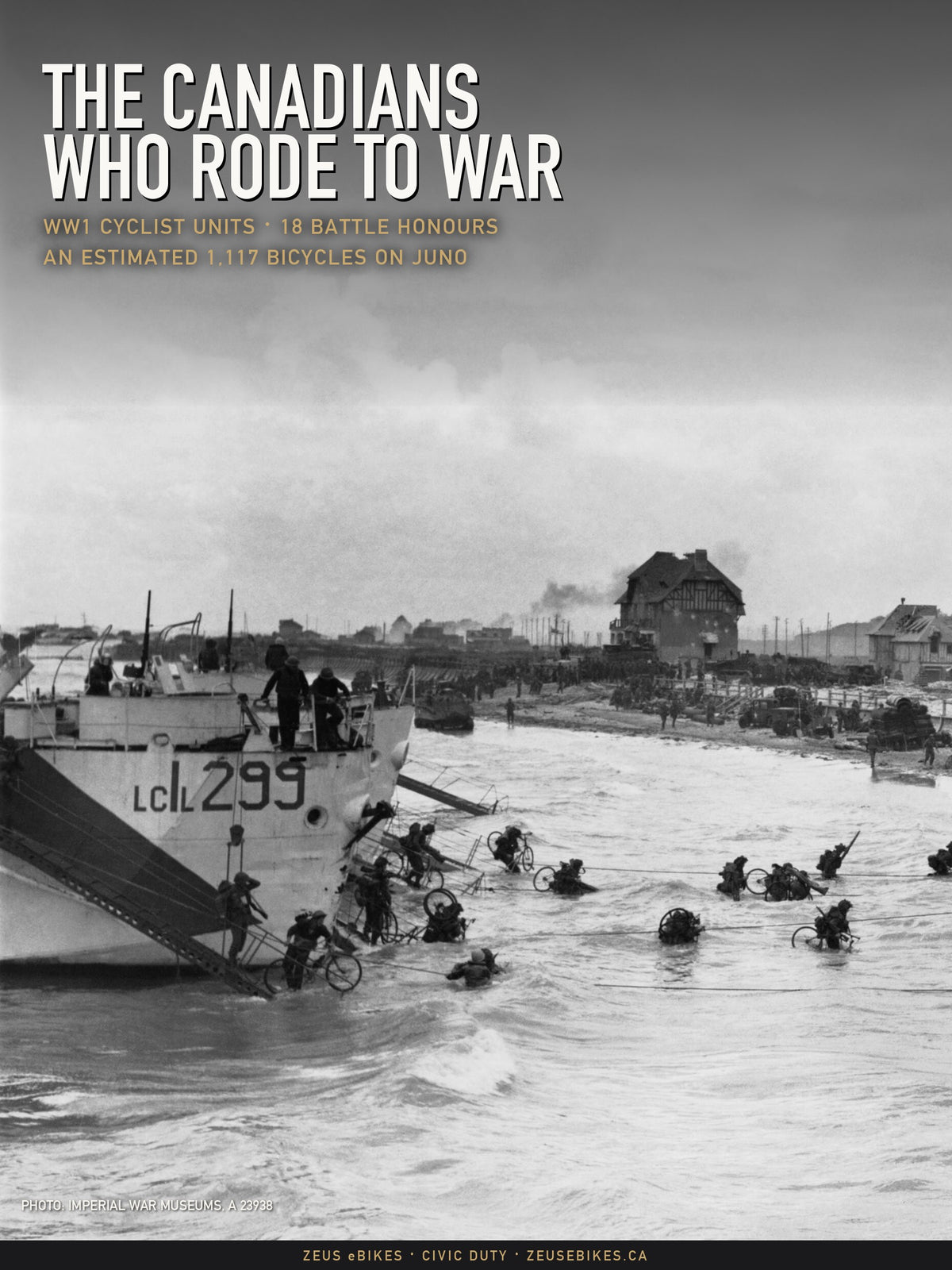
Troops of the 9th Canadian Infantry Brigade come ashore with their bicycles from landing craft at Bernières-sur-Mer, on Juno Beach, shortly before midday on June 6, 1944. Photograph: Imperial War Museums, A 23938 (UK Crown copyright expired) [19].
How this was researched: We read the Canadian Army's official histories of both wars in full text and cite them by page: G.W.L. Nicholson's Canadian Expeditionary Force, 1914-1919 and The Canadians in Italy, and C.P. Stacey's Six Years of War and The Victory Campaign [4] [12] [13] [14]. Unit dates and strengths come from Library and Archives Canada's guide to the cyclist units [3]; the battle honours from the Chief of the Defence Staff's message of August 20, 2026 [1]; the home-front rules from the wartime orders themselves [21] [22] [23].
We counted the dead ourselves. On November 2, 2026 we downloaded every record the Commonwealth War Graves Commission files under Canada's two cyclist regiments (33 and 25 records, each download matching the total the site reported), removed duplicates by the Commission's record number, and checked all 58 names against the Canadian Virtual War Memorial [9] [11].
What we could not open: the battalion's own war diary and Library and Archives Canada's photo records were unreachable from our systems that day, so where we use the war diary we say whose reading of it we rely on. Every photograph here is archival and credited; none was made with AI. This page sells nothing.
In this article
- Why Canada's First World War cyclists are in the news this November
- Were bicycles used in WW1? How Canada built its cyclist units
- What Canada's bicycle soldiers actually did
- How the cyclists came into their own in 1918
- How many Canadian cyclists died: the war-graves register
- Were bicycles used in WW2? From Dieppe to Juno Beach
- The D-Day bicycle that came home to Juno
- What bicycles Canadian soldiers rode
- Bicycles on Canada's home front
- Remembrance Day 2026: the date, the silence, holidays by province and the poppy
- How to honour Canada's cyclist soldiers this November
- Frequently asked questions
- Sources and notes
Why are Canada's First World War cyclists in the news this November?
On August 20, 2026, the Chief of the Defence Staff awarded five First World War cyclist units 18 battle honours, 11 of them to the Canadian Corps Cyclist Battalion [1] [2]. For more than a century their service carried no battle honours at all, while the war-graves register kept the names of 58 of their men [2] [9]. Here is their war from Ypres to Mons, the bicycle's second war from Dieppe to Juno Beach, and what to know for Remembrance Day 2026.
The honours came almost 108 years after the Armistice, and National Defence's account explains the gap: when Canada allocated most First World War battle honours in the late 1920s and early 1930s, the battalion had been disbanded and had no serving perpetuating unit or veterans' association [2]. Its last known surviving member, Captain Wilfred “Dick” Ellis, “died in 1996 without ever seeing his battalion receive its honours” [2].
| Unit | Battle honours awarded August 20, 2026 |
|---|---|
| Canadian Corps Cyclist Battalion | Vimy, 1917; Arras, 1917; Amiens; Scarpe, 1918; Drocourt Quéant; Canal du Nord; Cambrai, 1918; Arras, 1918; Hindenburg Line; Pursuit to Mons; France and Flanders, 1916 to 1918 (11) |
| 1st Canadian Division Cyclist Company | Gravenstafel; St. Julien; Ypres, 1915; France and Flanders, 1915 to 1916 (4) |
| 2nd Canadian Division Cyclist Company | France and Flanders, 1915 to 1916 (1) |
| 3rd Canadian Division Cyclist Company | France and Flanders, 1915 to 1916 (1) |
| 4th Canadian Division Cyclist Company | The Great War, 1916 (1) |
| Total | 18 honours, five units [1] |
The units will not be perpetuated in the formal sense, the message says [1]. Instead, the Commander of the Canadian Army has named the Canadian Intelligence Corps their historical successor under Canadian Army Order 11-27, charged with preserving the cyclists' “customs, heritage, traditions, and memory” [2]. The link is old: many cyclists came from the Corps of Guides, Canada's pre-war military intelligence organization, and in 2022 the Intelligence Corps began an Amiens Day ceremony in the cyclists' honour [2] [8].
Takeaway: This November is the first Remembrance Day on which the battalion that fought from Vimy to Mons has battle honours to its name: 11 of the 18 awarded to Canada's cyclist units.
Were bicycles used in WW1? How did Canada build its cyclist units?
Yes. Canada entered the war with no cyclists and then raised one cyclist company for each infantry division: the first at Valcartier in September 1914, the second in Toronto and Halifax that October, and the third and fourth in Toronto in 1916 [3] [5]. In May 1916 the first three were combined in Belgium into the Canadian Corps Cyclist Battalion [3].
The first company was “drawn from all arms and services in the camp” at Valcartier and, with a divisional cavalry squadron, made up the 1st Division's mounted troops [4, p. 23]. Its first bicycles were Canadian-made CCMs and Planets, later traded for the BSA, the British Army's standard machine [5]. Recruiting in Canada asked for men “possessing more than average intelligence and a high standard of education” [3].
Swipe the table to see every column
| Unit | Raised | Sailed | Strength on sailing | What became of it |
|---|---|---|---|---|
| 1st Divisional Cyclist Company | Valcartier, September 1914 (Captain R. S. Robinson) | Quebec, September 29, 1914, on the Ruthenia | 5 officers, 88 other ranks | In France from February 10, 1915; joined the battalion, May 1916 |
| 2nd Divisional Cyclist Company | Toronto and Halifax, October 1914 (Lieutenant-Colonel G. Y. Denison); platoons from Toronto, Montreal, Kingston, Vancouver, Winnipeg and Halifax | Montreal, May 16, 1915 (Corinthian); Halifax, June 15, 1915 (Caledonian) | 9 officers, 176 other ranks | In France from September 15, 1915; joined the battalion, May 1916 |
| 3rd Divisional Cyclist Company | Toronto, January 1916 (Captain G. B. Schwartz) | Halifax, January 22, 1916 (Missanabie) | 8 officers, 193 other ranks | In France from March 27, 1916; joined the battalion, May 20, 1916 |
| 4th Divisional Cyclist Company | Toronto, March 1916 (Captain G. L. Berkley) | Halifax, May 1, 1916 (Olympic) | 8 officers, 191 other ranks | Broken up at Bramshott, England, May 1916 |
| Canadian Corps Cyclist Battalion | Abeele, Belgium, May 1916 (Major A. McMillan) | Formed in the field | 1,138 served in the cyclist units over the war [2] | Demobilized at Toronto, April 1919; disbanded November 15, 1920 |
Source: Library and Archives Canada, guide to the cyclist units of the Canadian Expeditionary Force, pages 1 to 9 [3]. The archive notes that its unit guides contain some transcription errors [6].
A depot in England kept the companies supplied: the Canadian Reserve Cyclist Company, organized at Shorncliffe in April 1915 as a cyclist depot, lasted until February 1919 [3]. In Toronto, recruits trained on the Canadian National Exhibition grounds, where the 1916 film below was shot; Library and Archives Canada describes it as a short recruiting film [7], and our history of marketing traces how wartime propaganda became modern advertising after 1917.

No. 9 Platoon, Cyclist Corps, at Exhibition Camp, Toronto, 1915. Library and Archives Canada, e010931604 (Merrilees collection), shared by the archive under CC BY 2.0 [30]. Tap to enlarge.
Library and Archives Canada film, 1916
The Divisional Cyclists: A Glimpse of a Day's Training. Drill, signalling and reconnaissance at the Exhibition grounds, Toronto (6 minutes 58 seconds).
Takeaway: Canada built its cyclist arm from nothing in under two years: four companies raised at Valcartier, Toronto and Halifax, a training depot in England, and a corps battalion formed in Belgium in May 1916.
What did Canada's bicycle soldiers actually do?
Whatever the static front needed. The cyclists were trained as mounted troops for reconnaissance and light cavalry work, and on the Western Front they also carried messages, ran lines of communication, dug trenches and tunnels, carried stretchers, manned machine guns and escorted prisoners [2] [5]. The bicycle suited the work because it was cheap, quiet and needed no feed [5].
Then came Ypres. On April 22, 1915, near Elverdinghe, the 1st Divisional Cyclist Company's war diary records stragglers from the front line “complaining of a new and deadly gas” [6]. With communication down, headquarters “asked for orderlies from the cyclists to report to different BRIGADE H.Q. as despatch riders” [6]. Over the next two years they buried the dead and carried stretchers on the Somme and were largely put to tunnelling before Vimy [5].
The same battle produced one of the best-known poems of the war. During the Second Battle of Ypres, Lieutenant-Colonel John McCrae, a Canadian medical officer with the field artillery, lost a close friend on May 2, 1915, and wrote “In Flanders Fields” the next day; the poem helped make the poppy “an international symbol of remembrance” [36].

The infantry had cyclists of its own too: men of the 2nd Battalion at Scottish Lines near Poperinghe, Belgium, after the fighting at Sanctuary Wood and Maple Copse, June 1916. Photograph: H. E. Knobel, Library and Archives Canada, PA-000385 (public domain) [30].
Were they limited to roads? Mostly. In November 1918, when rain “fell constantly” on the Canadian front, the official history notes that “muddy roads slowed cyclists and mounted orderlies” [4, p. 476]. Off the road a bicycle became a load to carry: the 48th Highlanders hauled theirs across two deep ravines in Calabria in 1943 [13, p. 208].
Takeaway: For most of the war the cyclists were the army's handymen on wheels: messengers, diggers, stretcher-bearers and machine-gunners, valued for a machine that was cheap, silent and never needed feeding.
How did the cyclists come into their own in 1918?
When the front broke open. In the German spring offensive of 1918, Lieutenant-General Arthur Currie formed Lewis and Hotchkiss machine-gun detachments from the cyclists and the Canadian Light Horse [4, p. 382]. From Amiens in August to Mons in November, the battalion served with Brigadier-General Raymond Brutinel's Canadian Independent Force and “often operated at the vanguard of the advance” [2].
Getting to Amiens took a 57-kilometre ride. The Canadian Corps moved to the Amiens front in secret, and the cyclists made the move on their bicycles [8]. On August 8 the Independent Force, made up of two motor machine-gun brigades, nine Lewis-gun detachments of the cyclist battalion and two 6-inch trench mortars mounted on trucks, was to guard the cavalry's right flank, link cavalry and infantry, and secure the Amiens-Roye road [4, pp. 397-398].
At Arras three weeks later, Brutinel's Brigade pushed the line forward nearly a thousand yards on August 29, “with the Canadian Corps Cyclist Battalion establishing posts right up to the Scarpe” [4, p. 433]. In October, as the Germans fell back, the 1st and 4th Divisions each received a squadron of the Canadian Light Horse, a company of cyclists, two medium machine-gun batteries and two armoured cars to keep up the chase [4, p. 468]. In November a cyclist company rode with Major-General Burstall's 2nd Division pursuit force toward Mons [4, p. 479].

“A Canadian cyclist shouting down a dug-out in German for men to come out. Advance East of Arras. September, 1918.” (the archive's caption; Department of National Defence photograph, Library and Archives Canada, PA-003071, public domain) [30]
The advance cost them. Four cyclists who died on October 10 are buried at Ramillies British Cemetery; three who died on November 2 lie side by side at Aulnoy [9]. On November 9, two days before the Armistice, Lance Corporal Delbert Bean, MM, whose parents lived in North Hatley, Quebec, and Sergeant Patrick Quinn, DCM, died; they are buried in graves A. 4 and A. 5 of Cuesmes Communal Cemetery, 2 km west of Mons [10] [11]. National Defence names Bean as the battalion's final wartime casualty; the war-graves register records Quinn on the same date [2] [9].
November 11, 1918
The guns stopped at 11 a.m. on November 11. According to the CEF Research Group's reading of the battalion's war diary, one company came under heavy shellfire at Frameries in the last fifteen minutes and no one was hit [29].
Captain Ellis, as the same group quotes him, remembered the day this way: “On Nov. 11, there was naturally a big celebration in Mons, including a march past, but some of our men who were then over three miles past Mons did not know that the war was over actually at 11 a.m. until a German official car came through to arrange the take-over by the British.” [29]
After the Armistice the cyclists rode with the columns on the 250-mile march to the Rhine [4, p. 525], and the battalion's return to Belgium on February 6, 1919 “completed the withdrawal of the Canadians from the Army of Occupation” [4, p. 529]. It was demobilized at Toronto in April 1919 [3].
Takeaway: In the Hundred Days the cyclists did the job they were raised for: they rode ahead with machine guns, held posts and kept contact with a retreating enemy, and they were still losing men two days before the Armistice.
How many Canadian cyclists died in the First World War?
The Commonwealth War Graves Commission records 58 men under Canada's cyclist units: 33 under the Canadian Corps Cyclist Battalion and 25 under the Canadian Div. Cyclist Company [9]. National Defence puts the units' total casualties, killed and wounded together, at 261 from a wartime strength of 1,138 [2]. The register's count of the dead is ours, made on November 2, 2026.
Canada's cyclist war dead, by year of death
Source: Commonwealth War Graves Commission register, regiments "Canadian Corps Cyclist Battalion" (33) and "Canadian Div. Cyclist Company" (25), downloaded and counted by Zeus eBikes on November 2, 2026 [9]. Each year's count is in the table below.
| Year of death | Cyclist war dead (CWGC) |
|---|---|
| 1915 | 8 |
| 1916 | 7 |
| 1917 | 9 |
| 1918 | 26 (22 between 8 August and 11 November) |
| 1919 | 6 (after the Armistice) |
| 1920 | 2 (after the Armistice) |
| Total | 58 |
- The last months were the deadliest. 26 of the 58 died in 1918, and 22 of them between August 8 and November 11, almost as many as the 24 who died in all of 1915, 1916 and 1917 together [9].
- The war did not end the dying. Ten died after the Armistice, the last on November 3, 1920; three of them lie in Brussels Town Cemetery [9].
- They lie far apart. The first to die, A. Peattie, on February 24, 1915, is buried at Armentières in France; four of the men who died after the war are buried in Toronto, Vancouver and Spokane [9].
- They were young. The register records an age for 45 of the 58. Their median age was 24; the youngest was 18 and the oldest 38, and 11 were 21 or younger [9].
- Three have no known grave. Charles Cameron Flieger and Albert Metherall Brimmell are named on the Canadian National Vimy Memorial, and Harold Stone Musgrove, flying with the Royal Air Force, on the Arras Flying Services Memorial [9].
- Their decorations are in the record. Olly Walpole and Delbert Bean held the Military Medal, Patrick Quinn the Distinguished Conduct Medal, and John Romeyn Dennistoun was Mentioned in Despatches [9].
How we counted, and what the count leaves out: the Commission files these men under two regiment names, “Canadian Corps Cyclist Battalion” and “Canadian Div. Cyclist Company”. We downloaded both lists in full (33 and 25 records, matching the totals the site printed), merged them by the Commission's record number and found no duplicates.
A cyclist who died after moving to another unit is filed under that unit and is not in this count. All 58 have a page on the Canadian Virtual War Memorial; that memorial files two of them differently, Musgrove under the Royal Air Force and George Berry Bickle under the Central Ontario Regiment [9] [11].
The 58 names, in the order they died
Names, ranks and places are as the Commonwealth War Graves Commission records them; each name opens that man's page on the Canadian Virtual War Memorial [9] [11].
Swipe the table to see every column
| Date of death | Name | Rank | Buried or commemorated | Note |
|---|---|---|---|---|
| February 24, 1915 | A Peattie | Private | Cite Bonjean Military Cemetery, Armentieres (IX. C. 72.) | |
| April 14, 1915 | Henry (Harry) Wilmot Crawford | Private | Gagetown (St. John's) Church Cemetery (L. 145.) | |
| April 26, 1915 | H J Childs | Private | Bailleul Communal Cemetery, Nord (K. 4.) | |
| April 29, 1915 | Harry Good | Corporal | Wimereux Communal Cemetery (I. F. 10A.) | |
| April 29, 1915 | William Fauvel Smith | Private | Ypres Reservoir Cemetery (IV. C. 17.) | |
| May 4, 1915 | David E. Haig | Private | Agincourt (Knox United Church) Cemetery (X. 2. 8.) | |
| August 9, 1915 | Hugh Denzil Wilford | Private | Palmerston Cemetery, Ontario (Lot 32. Blk M.) | |
| December 2, 1915 | D Berard | Private | Tidworth Military Cemetery (A. 35.) | |
| May 4, 1916 | John Romeyn Dennistoun | Lieutenant | Halluin Communal Cemetery (D. 1.) | Mentioned in Despatches |
| June 16, 1916 | Walter Albert Ridout | Private | Nunhead (All Saints) Cemetery (52. 33716.) | |
| September 16, 1916 | Charles Cameron Flieger | Corporal | Vimy Memorial | |
| September 30, 1916 | Allen Neil McCullough | Private | St. Sever Cemetery, Rouen (B. 15. 18.) | |
| October 21, 1916 | John James Buchanan | Private | Boulogne Eastern Cemetery (VIII. D. 146.) | |
| November 10, 1916 | Sydney Murray Garrett | Private | Aubigny Communal Cemetery Extension (I. E. 59.) | |
| November 24, 1916 | Harold John Corbin | Corporal | Ecoivres Military Cemetery, Mont-St. Eloi (III. J. 7.) | |
| January 4, 1917 | William Maberley Fatt | Lieutenant | Croydon (Mitcham Road) Cemetery (T2. 9210.) | |
| January 19, 1917 | Arthur F. Jackson | Private | Kamloops (Pleasant Street) Cemetery (B.D. P.5. L.11. S.North.) | |
| February 4, 1917 | James William Boyd | Lieutenant | Aubigny Communal Cemetery Extension (V. A. 26.) | |
| February 22, 1917 | Robert Harcourt Switzer | Private | Ecoivres Military Cemetery, Mont-St. Eloi (IV. D. 22.) | |
| February 24, 1917 | Laurent G. Stuart | Lance Corporal | Manchester (Saint Augustin) Cemetery (Corner, near street.) | |
| May 23, 1917 | Carroll Alfred Conner | Private | Newport (East Main Street) Cemetery | |
| September 4, 1917 | Albert Metherall Brimmell | Private | Vimy Memorial | |
| November 10, 1917 | Robert Edgar Morley | Private | White House Cemetery, St. Jean-les-Ypres (I. F. 27.) | |
| November 19, 1917 | G G Webster | Private | Seaford Cemetery (A. 615.) | |
| February 2, 1918 | Allan Crawford Falkner | Private | Fosse No.10 Communal Cemetery Extension, Sains-en-Gohelle (III. D. 4.) | |
| March 6, 1918 | John Henry Rogers | Private | Seaford Cemetery (A. 577.) | |
| August 9, 1918 | Harold Stone Musgrove | Second Lieutenant | Arras Flying Services Memorial | serving with the Royal Air Force; the Canadian Virtual War Memorial files him under the RAF |
| August 10, 1918 | L J McEvay | Private | Bouchoir New British Cemetery (VI. E. 33.) | |
| August 29, 1918 | Lorenzo Charron | Private | Vis-en-Artois British Cemetery, Haucourt (V. G. 21.) | |
| September 2, 1918 | Thomas Worswick Gabbott | Corporal | Tigris Lane Cemetery, Wancourt (II. B. 6.) | |
| September 2, 1918 | G E Sellers | Lieutenant | Tigris Lane Cemetery, Wancourt (II. B. 7.) | |
| September 2, 1918 | Richard Vidal | Private | Tigris Lane Cemetery, Wancourt (II. B. 8.) | |
| September 4, 1918 | Phillip Wilcox | Private | Duisans British Cemetery, Etrun (V. H. 29.) | |
| September 18, 1918 | Albert Louden | Private | Toronto (Prospect) Cemetery (Section 7. Grave 261.) | |
| October 10, 1918 | John Campbell | Private | Ramillies British Cemetery (C. 5.) | |
| October 10, 1918 | A A Case | Private | Ramillies British Cemetery (C. 3.) | |
| October 10, 1918 | John Kirk Fergus | Private | Ramillies British Cemetery (C. 4.) | |
| October 10, 1918 | C Norris | Private | Ramillies British Cemetery (B. 5.) | |
| October 11, 1918 | Olly Walpole | Corporal | Queant Communal Cemetery British Extension (D. 30.) | Military Medal |
| October 13, 1918 | W J McDonnell | Private | Bucquoy Road Cemetery, Ficheux (III. F. 14.) | |
| November 2, 1918 | John Henry (Harry) Folliott | Private | Aulnoy Communal Cemetery (D.1. 1.) | |
| November 2, 1918 | J E Roy | Private | Aulnoy Communal Cemetery (D.1. 3.) | |
| November 2, 1918 | Herbert Wright | Private | Aulnoy Communal Cemetery (D.1. 2.) | |
| November 3, 1918 | H G Duke | Private | Valenciennes (St. Roch) Communal Cemetery (I. A. 8.) | |
| November 3, 1918 | L M Pennie | Private | Valenciennes (St. Roch) Communal Cemetery (I. A. 7.) | |
| November 7, 1918 | C E Rogers | Private | Quievrechain Communal Cemetery (In South-East part.) | |
| November 9, 1918 | Delbert Bean | Lance Corporal | Cuesmes Communal Cemetery (A. 4.) | Military Medal |
| November 9, 1918 | Patrick Quinn | Sergeant | Cuesmes Communal Cemetery (A. 5.) | Distinguished Conduct Medal |
| November 18, 1918 | J F Herod | Private | Etaples Military Cemetery (L. D. 15,.) | after the Armistice |
| November 24, 1918 | W Douglas | Private | Valenciennes (St. Roch) Communal Cemetery (I. E. 19.) | after the Armistice |
| January 24, 1919 | Robert Wilfred Prior | Private | Brussels Town Cemetery (X. 11. 8.) | after the Armistice |
| January 27, 1919 | Thomas Hughes | Private | Brussels Town Cemetery (X. 2. 4.) | after the Armistice |
| January 27, 1919 | George Jack Nisbet | Private | Brussels Town Cemetery (X. 9. 13.) | after the Armistice |
| April 7, 1919 | Nelson August Zettergreen | Private | Vancouver (Mountain View) Cemetery (Jones 2. 45. 8. 6.) | after the Armistice |
| July 9, 1919 | William Bell | Private | Toronto (Prospect) Cemetery (Sec. 17. 2792.) | after the Armistice |
| December 30, 1919 | E J H Coppin | Private | London (Mount Pleasant) Cemetery (Mil. plot. R.3. G.36.) | after the Armistice |
| May 3, 1920 | James William Yell | Private | Spokane (Fairmount) Cemetery | after the Armistice |
| November 3, 1920 | George Berry Bickle | Lieutenant | Toronto (Prospect) Cemetery (Section 12. Grave 72.) | died after the war; the Canadian Virtual War Memorial lists Canadian Infantry (Central Ontario Regiment) |
Takeaway: 58 men of Canada's cyclist units are in the war-graves register, and 22 of them died in the war's last hundred days. Each has a page you can visit on the Canadian Virtual War Memorial.
Were bicycles used in WW2? How did Canadians use them from Dieppe to Juno Beach?
Yes, at particular moments. In the Canadian Army's official histories the bicycle turns up at Dieppe in 1942, where Canadians sighted German cyclist troops; in Calabria in 1943, where Canadians rode captured Italian folding bicycles; and in Italy again in 1944 [12] [13]. On D-Day an estimated 1,117 bicycles landed with Canadians on Juno Beach [16].
Dieppe, 1942
At Pourville on August 19, 1942, Major A. T. Law, who had taken over the Cameron Highlanders of Canada when their commanding officer was killed on the beach, looked across the river and saw enemy troops, including “what appeared to be a bicycle platoon”; the official history adds that a German cyclist platoon had been sent at 5:30 that morning to reinforce the ridge near Quatre Vents Farm [12, pp. 371-372].
Italy, 1943 and 1944
A year later in Calabria, with the roads blown and the armoured cars stopped, “B” Company of the 48th Highlanders of Canada “pushed forward mounted on folding bicycles which had been found in an Italian Quartermaster Stores at Gambarie.” After hauling them across two deep ravines, the Highlanders “pedalled into Delianuova in midafternoon, to receive a rapturous welcome from the inhabitants” on September 5, 1943 [13, p. 208].
On October 20, 1944, the Governor General's Horse Guards crossed the Fiumicino and entered Cesenatico led by Lieutenant-Colonel A. K. Jordan, riding a bicycle, “the enthusiastic citizens acclaiming them as liberators” [13, p. 584].
Normandy, 1944
“Some 14,000 Canadians came ashore at Juno Beach” on June 6, 1944, according to Veterans Affairs Canada [15]. The Juno Beach Centre estimates that 1,117 bicycles landed with them, and notes that the BSA airborne folding bicycle “was not only supplied to airborne units but was also supplied to infantry or service units” [16]. Most were issued for quicker, quieter movement inland, “to be cast aside when no longer needed”, and French civilians rode many of them through the fuel shortages that followed [18].
Sea or air? The 14,000 Canadians on Juno Beach came by sea. Veterans Affairs Canada counts the paratroopers separately: “450 Canadian paratroopers also landed in Normandy before dawn to target German positions farther inland” [15]. The folding bicycle was designed for airborne troops, but at Juno it went ashore with infantry and service units [16].
In Bernières-sur-Mer, a memorial made of bicycles recalls the special units that landed there on June 6, 1944 with hundreds of bicycles, in memory of the Canadian liaison troops who came to help free France [20].
Why does the bicycle fade from the record after that? Our search of the text of Stacey's The Victory Campaign, the official history of the 1944-45 campaign in northwest Europe, found one bicycle, and it is the Dutch bicycle path on the Walcheren causeway [14]. We draw an inference from that silence, and it is ours alone: by 1944 the bicycle was a supplement to the army's trucks, carriers and jeeps, useful on a beachhead or at the head of an advance and then left behind.
Takeaway: The bicycle's Second World War comes down to a few scenes in the record: a vanguard pedalling into Delianuova, a lieutenant-colonel riding into Cesenatico, and more than a thousand bicycles coming ashore at Juno.
What happened to the D-Day bicycles? The one that came home to Juno
Most were abandoned or taken up by French civilians. One, a folding bicycle that belonged to Marius Aubé of Sherbrooke, Quebec, a Royal Canadian Army Service Corps soldier who landed at Graye-sur-Mer on D-Day, is now in the collection of the Juno Beach Centre, the Canadian museum near the landing beach [16] [18].
In the summer of 1944 Aubé befriended a 14-year-old farm boy in Banville, Christian Costil, and gave him the bicycle. The two wrote to each other for 40 years; Aubé often signed off with “friendship of someone who will never forget you” [16]. Costil kept the bicycle for 76 years. As a meter reader for France's electricity utility he folded it into his Citroën 2CV and rode it from house to house until he retired in 1985 [16].
Costil died in November 2020 and had asked his daughters to give the bicycle to the “Canadian Museum”. Marie-Claude Halot and Joëlle Letellier brought it to the Juno Beach Centre on Christmas Eve 2020, with seven of Aubé's letters [16] [17].
Aubé had died on July 28, 1988 and is buried in the veterans' section of St-Michel cemetery in Sherbrooke. His mother had promised to adopt a child if her son came home from the war, and in 1945 the family adopted his brother Gilles [16]. For the 80th anniversary of D-Day, the Legion and the Fusiliers de Sherbrooke gave the museum Aubé's medals [17].
What bicycles did Canadian soldiers ride in the two world wars?
In the First World War, Canadian-made CCMs and Planets at first, then the British Army's BSA [5]. In the Second, the BSA airborne folding bicycle, and whatever could be found: in 1943 that meant Italian folding bicycles from an enemy quartermaster's store [16] [13].
Swipe the table to see every column
| When | Bicycle | Who rode it | Source |
|---|---|---|---|
| 1914-15 | CCM and Planet, made in Canada | The first Canadian cyclist company | [5] |
| 1915-18 | BSA, the British Army's standard bicycle | Canada's cyclist units after the first machines were traded in | [5] |
| September 1943 | Italian folding bicycles from a quartermaster's store at Gambarie | “B” Company, 48th Highlanders of Canada, Calabria | [13] |
| June 1944 | BSA airborne folding bicycle | Infantry and service units at Juno Beach, including Marius Aubé of the Royal Canadian Army Service Corps | [16] |
| 1942-45, at home | Civilian bicycles built to Wartime Prices and Trade Board rules | Canadians on the home front | [21] [22] |
BSA built about 130,000 military bicycles in the Second World War, more than 60,000 of them airborne models, according to Legion Magazine [18].
How were bicycles controlled on Canada's home front?
By order. From May 1942 Canadian bicycles were built to a government specification meant to save metal; from November 1942 their retail price was capped; from April 1943 no new bicycle could be made without a permit; and from July 1943 a buyer could get a new bicycle tire only to replace one that was worn out [21] [22] [23].
Administrator's Order A-463 set the ceiling from November 9, 1942: $42.50 for a man's bicycle and $43.50 for a lady's in Ontario and Quebec, and $45.00 and $46.00 in the other provinces [21]. By our calculation from Statistics Canada's consumer price index, $42.50 in 1942 is about $790 in 2025 dollars [24].
Order A-694 followed on April 19, 1943. “No person shall, unless he has obtained the written permission of the Administrator of Fabricated Steel and Non-Ferrous Metal, manufacture or assemble a new bicycle” [22]. Every bicycle also had to meet a stripped-down schedule [22]:
- no more than 33 pounds, without tires or lights;
- “No spring type forks permitted”;
- handlebars 20 inches wide, steel rims for Canadian 28-inch tires;
- chain guards on women's bicycles only, of the half type “commonly known as the "hockey stick" type”;
- no metal at all in carriers, stands, tanks or skirt guards beyond the bolts that held them on.
Bicycles ordered by the Department of National Defence or the Department of Munitions and Supply were exempt from most of the order [22]. Tires were rationed too: under Rubber Order 4, in force from July 31, 1943, a consumer could buy a bicycle tire or tube only to replace one no longer serviceable, and could hold no more than “two tires and two tubes for such bicycle” [23].
Takeaway: At home, the war set the shape and the price of a Canadian bicycle: metal-saving frames, no spring forks, a capped price of $42.50 in Ontario and Quebec, and a new tire only when the old one was finished.
When is Remembrance Day 2026, and is it a holiday where you live?
Remembrance Day 2026 falls on Wednesday, November 11 [31]. At 11 a.m., the hour in 1918 when the First World War's fighting stopped, Canadians pause for two minutes of silence [32]. Whether you get the day off depends on where you work: it is a paid holiday for federally regulated workers, in six provinces and in all three territories [33] [42].
| Remembrance Day 2026 | What to know |
|---|---|
| Date | Wednesday, November 11, 2026 [31] |
| Two minutes of silence | At 11 a.m. [32] |
| Veterans' Week | November 5 to 11 [41], with Indigenous Veterans Day on November 8 [25] |
| National ceremony | National War Memorial, Ottawa, starting at about 10:30 a.m.; national news networks carry it live and the Legion streams it on its Facebook page [40] |
| Poppy Campaign | October 24 to November 11 [26] |
| 2026 Veterans' Week poster | “Celebrating a century of The Royal Canadian Legion” (artwork by Chaelyn Han of Vancouver) [41] |
Is Remembrance Day a statutory holiday? Province by province
Only for some workers. Federal law says November 11 “is a legal holiday and shall be kept and observed as such throughout Canada” [35], but a paid day off comes from the labour law that covers your job, and those laws differ [42]. Each row below links the government page that sets the rule.
| Where you work | Is November 11 a paid day off? |
|---|---|
| Federally regulated jobs (see the note below) | Yes, one of 10 general holidays under the Canada Labour Code Canada.ca |
| British Columbia | Yes, a statutory holiday gov.bc.ca |
| Alberta | Yes, a general holiday alberta.ca |
| Saskatchewan | Yes, a public holiday saskatchewan.ca |
| Manitoba | No pay is required if you do not work. Most industries may not operate, and retail businesses cannot open between 9 a.m. and 1 p.m. gov.mb.ca |
| Ontario | No: employers are “not required” to give it under the Employment Standards Act ontario.ca |
| Quebec | No, it is not a statutory holiday in Quebec CNESST |
| New Brunswick | Yes, a paid public holiday gnb.ca |
| Nova Scotia | Only if your employer offers pay. Most grocery stores, big-box stores and malls must close, and people who work on November 11 may get another day off with pay novascotia.ca |
| Prince Edward Island | Yes, a paid holiday Employment Standards Act (PDF) |
| Newfoundland and Labrador | Yes, a public holiday Labour Standards Act |
| Yukon | Yes, a statutory holiday yukon.ca |
| Northwest Territories | Yes, a statutory holiday ece.gov.nt.ca |
| Nunavut | Yes, a general holiday Labour Standards Act (PDF) |
Federally regulated jobs include the federal public service, Crown corporations such as Canada Post, banks, telecommunications and interprovincial transport, as listed by CNESST.
The qualifying rules, such as how long you have worked for the employer and whether you work the shifts on either side of the holiday, also differ, and each page sets them out. In Ontario, publicly funded schools are required to observe Remembrance Day, and the province's 2026 guide sets out their ceremony, from lowering flags to half-mast to the Last Post [43].
Why is Remembrance Day on November 11 at 11 a.m.?
The date and the hour belong to the Armistice. It was signed at 5 a.m. on Monday, November 11, 1918, and the ceasefire took effect at 11 a.m. [34]. Canada first marked the day as Armistice Day in 1919, and from 1921 to 1930 held it on the Monday of the week in which November 11 fell [33].
A 1931 bill passed by the House of Commons fixed it to November 11 and renamed it Remembrance Day, and the first Remembrance Day was observed on November 11, 1931 [33] [34]. It honours everyone who has served Canada “during times of war, conflict and peace”: Veterans Affairs Canada counts more than 2,300,000 Canadians who have served and more than 118,000 who died [33].
Why do Canadians wear a poppy, and on which side?
Because of McCrae's poem. Inspired by “In Flanders Fields,” Anna Guérin of France made fabric poppies to raise funds, and the Great War Veterans Association, the Legion's predecessor, adopted the idea on July 6, 1921 [38].
The Legion asks that the poppy be worn “on the left side, over the heart” from October 24 until November 11, with a pin that does not cover the flower. After the ceremony, some people lay their poppy on a cenotaph or a wreath, and in Ottawa thousands are placed on the Tomb of the Unknown Soldier; wearing one at other times to remember the Fallen is “an individual choice” [39].
The Legion gives the poppy “freely to all who wish to wear one” and takes donations to its Poppy Fund for Veterans and their families; Canadians can also receive a lapel poppy by making an online donation of $5, $10 or $20 [26].
“In Flanders Fields,” by Lieutenant-Colonel John McCrae, as printed in his 1919 collection [37]:
In Flanders fields the poppies blow
Between the crosses, row on row,
That mark our place; and in the sky
The larks, still bravely singing, fly
Scarce heard amid the guns below.
We are the Dead. Short days ago
We lived, felt dawn, saw sunset glow,
Loved and were loved, and now we lie,
In Flanders fields.
Take up our quarrel with the foe:
To you from failing hands we throw
The torch; be yours to hold it high.
If ye break faith with us who die
We shall not sleep, though poppies grow
In Flanders fields.
What does “Lest we forget” mean?
“Lest” is a formal or literary word meaning “in order to prevent something from happening”, so the words ask that we do not forget [47]. They come from Rudyard Kipling's poem “Recessional”, in which “Lest we forget” closes four of the five stanzas [49]; it was first printed in The Times on July 17, 1897, after Queen Victoria's Diamond Jubilee [48]. The Kipling Society's notes trace the line to Deuteronomy 6:12, “Then beware lest thou forget the Lord” [48].
The phrase was later “adopted to capture the significance of remembering the soldiers fallen in war”, and it became “widely known for the occasion of Remembrance Day”, as Captain Min Kim, padre of 1 Service Battalion, wrote for National Defence in 2020 [50].
What happens at the national ceremony, and where can I watch it?
The national ceremony is held at the National War Memorial in Ottawa, and the Governor General presides [33]. The Legion's 2026 program starts at about 10:30 a.m. with the Veterans' March and the arrival of dignitaries, then runs through O Canada, the Last Post, the first gun, two minutes of silence at 11:00, the second gun, the Lament, the Rouse, the Act of Remembrance, a 21-gun salute, prayers, the placing of wreaths, the benediction and God Save the King [40]. National news networks carry it live on TV, and the Legion streams it on its Facebook page [40].
The music carries the meaning. A bugler plays the Last Post, “signifying the calling home of the spirits of the Fallen to rest”; after the silence at the national ceremony, a piper plays the Lament, “symbolizing the sounds of spouses and children crying over their dead” [32] [40]. Then the bugler sounds the Rouse, which “symbolically calls the Fallen to rise above their mortal duties and rest in peace” [32]. The Act of Remembrance follows, and everyone answers its last line [32]:
They shall grow not old, as we that are left grow old;
Age shall not weary them, nor the years condemn.
At the going down of the sun and in the morning
We will remember them.
Response: “We will remember them.”
To find a ceremony near you, the Legion's ceremony locator lists those its branches hold “in communities across the country and abroad” [44].
What is the order of events for a school or community ceremony?
Veterans Affairs Canada publishes a suggested sequence for schools and community groups: vigil sentries take position, a parade or the colour party enters and special guests arrive, then come the national anthem, opening remarks, the Last Post, two minutes of silence and the Rouse, the Act of Remembrance, the Commitment to Remember, prayers or sacred traditions, poems or a special presentation, the laying of wreaths and the conclusion [45]. The Last Post, the silence and the Rouse run “one after the other, without interruption”, so the guide suggests the MC explain this before the Last Post when the audience is young [45].
The Legion's order of service opens with a land acknowledgment and places a Lament between the silence and the Rouse, the order used at the national ceremony [46] [40]. For schools, its Plan a ceremony page offers a ready-to-play slideshow with speaker notes for the MC, and it encourages schools to contact their local branch [46].
How can I explain Remembrance Day to children?
Keep it short and true: on November 11 at 11 a.m., Canadians go quiet for two minutes to remember the people who served, and the more than 118,000 who died [32] [33]. A story helps, and the cyclists make a good one: soldiers on bicycles carried messages at Ypres, rode ahead of the army in 1918 and came ashore at Juno Beach in 1944, and each of the 58 men in our honour roll has a page a class can open.
Young Canadians can also enter the Legion's National Youth Remembrance Contests in art, writing and video; this year's Veterans' Week poster features artwork by Chaelyn Han, who took part in them [41].
Takeaway: On Wednesday, November 11, 2026, the silence falls at 11 a.m. Whether the day is paid depends on where you work, and the poppy worn on the left goes back to a poem written at Ypres, in the same battle in which Canada's cyclists rode as despatch riders.
How can I honour Canada's cyclist soldiers this November?
Start with a name. Each of the 58 men in our roll has a page on the Canadian Virtual War Memorial, and the steps below go on to your own family's soldier, the Poppy Campaign and the places where the cyclists are remembered [11].
- Read one cyclist's record. Open the honour roll above, choose a name, and read his page on the Canadian Virtual War Memorial, where visitors can also leave a tribute [11].
- Find your own family's soldier. Search the First World War personnel records at Library and Archives Canada [27].
- Support the Poppy Campaign. It runs from October 24 to November 11, and “Funds donated across the country during the National Poppy Campaign support Veterans and their families” [26].
- Visit, if you travel. Bean and Quinn lie in Cuesmes Communal Cemetery, 2 km west of Mons [10]. In Normandy, the bicycle memorial stands at Bernières-sur-Mer [20], and the Juno Beach Centre welcomes cyclists with a 16-place bike rack, six charging spaces for electric bikes and a repair station; the Vélo Maritime coastal route passes through Courseulles-sur-Mer, close by [28].
- Mark August 8. The Canadian Intelligence Corps, the cyclists' successor, began holding Amiens Day ceremonies in their memory in 2022 [8] [2].
- Ride to a ceremony, and ride it safely. If you cycle to a cenotaph on November 11, our investigation into why cyclists die on Canadian roads shows how unprotected, fast road design puts riders at risk.
- Help a veteran today. If you served, or love someone who did, our help guide lists the mental-health services open to veterans and their families, including Veterans Affairs Canada's.
Find a First World War soldier by name
Library and Archives Canada holds about 622,000 service files from the Canadian Expeditionary Force.
Takeaway: The honours took almost 108 years. Remembering the men behind them can start today, with one name on the Canadian Virtual War Memorial, then another.
Frequently asked questions
Were bicycles used in WW1?
Yes. Canada entered the war with no cyclists and built its own cyclist arm: a cyclist company for each division from 1914 and, from May 1916, the Canadian Corps Cyclist Battalion. Its men carried messages, scouted, dug, carried stretchers and manned machine guns, and in the Hundred Days of 1918 they rode with the mobile Canadian Independent Force from Amiens to Mons. [3] [5] [2]
Were bicycles used in WW2?
Yes, at particular moments. Canadians sighted German cyclist troops at Dieppe in 1942, a company of the 48th Highlanders of Canada rode captured Italian folding bicycles into Delianuova, Italy, in 1943, and an estimated 1,117 bicycles landed with Canadians on Juno Beach on D-Day, June 6, 1944. [12] [13] [16]
What was the Canadian Corps Cyclist Battalion?
A First World War unit of the Canadian Expeditionary Force, formed at Abeele, Belgium, in May 1916 from the 1st, 2nd and 3rd Divisional Cyclist Companies. It was part of the Canadian Corps at Vimy Ridge and served with the Canadian Independent Force in the Hundred Days. It was demobilized at Toronto in April 1919, disbanded in November 1920, and awarded 11 battle honours in 2026. [3] [2] [1]
Did bicycle soldiers carry machine guns?
Yes. In 1918 the Canadian Corps formed Lewis and Hotchkiss machine-gun detachments from cyclists and the Canadian Light Horse, and at Amiens nine Lewis-gun detachments of the cyclist battalion went forward with the Canadian Independent Force. The Canadian Encyclopedia says the force's cyclists carried machine guns and other equipment, more than 40 kg in all, on their bicycles. [4] [5]
What bicycles were used in WW2?
Canadians landed at Juno Beach with the BSA airborne folding bicycle, which was supplied to infantry and service units as well as to airborne troops. BSA built about 130,000 military bicycles in the war, more than 60,000 of them airborne models, according to Legion Magazine. Canadians also used what they found, such as Italian folding bicycles in Calabria in 1943. [16] [18] [13]
How many bicycles landed on Juno Beach on D-Day?
The Juno Beach Centre estimates that 1,117 bicycles landed on Juno Beach on June 6, 1944, with the roughly 14,000 Canadians who came ashore that day. Many were abandoned once they became more cumbersome than useful, and after the war civilians rode the last of them during Europe's fuel shortages. [16] [15]
Were bicycle troops limited to roads?
Largely. The official history notes that in November 1918 “muddy roads slowed cyclists and mounted orderlies”, and off the road a bicycle had to be carried: in 1943 the 48th Highlanders hauled theirs across two deep ravines in Calabria before riding into Delianuova. [4] [13]
How do I find a Canadian soldier's First World War service file?
Search Library and Archives Canada's Personnel records of the First World War, which holds about 622,000 Canadian Expeditionary Force service files. For a soldier who died in service, the Canadian Virtual War Memorial and the Commonwealth War Graves Commission each keep a page with his burial or commemoration. [27] [11] [9]
When is Remembrance Day 2026?
Wednesday, November 11, 2026. Canadians pause for two minutes of silence at 11 a.m., and Veterans' Week runs from November 5 to 11. [31] [32] [41]
Is Remembrance Day a statutory holiday in Canada?
It depends on where you work. It is a paid holiday for federally regulated workers and in British Columbia, Alberta, Saskatchewan, New Brunswick, Prince Edward Island, Newfoundland and Labrador, Yukon, the Northwest Territories and Nunavut. It is not one in Ontario or Quebec. Manitoba and Nova Scotia have their own Remembrance Day rules, which close many businesses but do not require pay for people who do not work. [33] [42]
Why is Remembrance Day on November 11 at 11 a.m.?
Because the Armistice that ended the First World War's fighting took effect at 11 a.m. on November 11, 1918. Canada first marked the day as Armistice Day in 1919, and a 1931 bill fixed it to November 11 and renamed it Remembrance Day. [34] [33]
Which side do you wear a poppy on?
The Royal Canadian Legion asks that the poppy be worn on the left side, over the heart, from October 24 until November 11, with a pin that does not cover the flower. Wearing one at other times to remember the Fallen is, in the Legion's words, an individual choice. [39]
Is Remembrance Day for WW1 or WW2?
Both, and more. It began as Armistice Day, for the end of the First World War's fighting at 11 a.m. on November 11, 1918, and today it honours everyone who has served Canada during times of war, conflict and peace: Veterans Affairs Canada counts more than 2,300,000 Canadians who have served and more than 118,000 who died. [34] [33]
Who wrote “In Flanders Fields”?
Lieutenant-Colonel John McCrae, a Canadian medical officer with the field artillery, wrote it during the Second Battle of Ypres, in a part of Belgium traditionally called Flanders, in May 1915, the day after a close friend was killed. The poem helped make the poppy a symbol of remembrance. [36]
What is the order of events at a Remembrance Day ceremony?
At the national ceremony in Ottawa, the Legion's program runs through O Canada, the Last Post, the first gun, two minutes of silence at 11:00, the second gun, the Lament, the Rouse, the Act of Remembrance, a 21-gun salute, prayers, the placing of wreaths, the benediction and God Save the King. For schools and community groups, Veterans Affairs Canada suggests vigil sentries, the colour party, guests, the national anthem, opening remarks, the Last Post, the silence and the Rouse, the Act of Remembrance, the Commitment to Remember, prayers, poems, wreaths and a conclusion. [40] [45]
What does “Lest we forget” mean?
It asks that we do not forget: “lest” is a formal or literary word meaning “in order to prevent something from happening”. The words come from Rudyard Kipling's poem “Recessional”, first printed in The Times on July 17, 1897, and the phrase became widely known for Remembrance Day as a way of remembering the soldiers who fell in war. [47] [48] [50]
Sources and notes
Sources were retrieved and read on November 2, 2026, and a copy of each is held in our research file. Page numbers for the official histories are the printed pages.
- Department of National Defence, CANFORGEN 103/26, “Award of First World War battle honours to Canadian Corps Cyclist Battalion and Canadian Divisional Cyclist Companies”, August 20, 2026.
- Department of National Defence, The Maple Leaf, “Canadian Cyclists receive 18 First World War battle honours”, by Lieutenant-Colonel Casey Anderson, Canadian Intelligence Corps, September 28, 2026.
- Library and Archives Canada, Guide to Sources Relating to Units of the Canadian Expeditionary Force: Cyclists (PDF), pages 1 to 9.
- G.W.L. Nicholson, Canadian Expeditionary Force, 1914-1919: Official History of the Canadian Army in the First World War (Ottawa: Department of National Defence, 1962), pages as cited.
- Nevin McFarlane, “Canadian Corps Cyclist Battalion”, The Canadian Encyclopedia, Historica Canada, published February 22, 2025, last edited March 25, 2025.
- Dylan Roy, Library and Archives Canada, “I want to ride my bicycle!”: Cycling in the Canadian Expeditionary Force during the First World War, Discover Blog, July 31, 2025, quoting the war diary of the 1st Canadian Divisional Cyclist Company (LAC e001131804, image 53).
- Library and Archives Canada, The Divisional Cyclists: A Glimpse of a Day's Training (1916), YouTube, posted November 3, 2015.
- Steven Fouchard, Army Public Affairs, “Inaugural ceremony brings Amiens Day home”, Canadian Army, November 24, 2022.
- Commonwealth War Graves Commission, Find War Dead, regiment searches “Canadian Corps Cyclist Battalion” (33 records) and “Canadian Div. Cyclist Company” (25 records), full results downloaded and counted by Zeus eBikes on November 2, 2026.
- Commonwealth War Graves Commission, Cuesmes Communal Cemetery, location and history.
- Veterans Affairs Canada, Canadian Virtual War Memorial: Lance Corporal Delbert Bean and Sergeant Patrick Quinn; all 58 roll entries link to their memorial pages.
- C.P. Stacey, Six Years of War: The Army in Canada, Britain and the Pacific (Ottawa: Department of National Defence, 1955), pages 371-372.
- G.W.L. Nicholson, The Canadians in Italy, 1943-1945 (Ottawa: Department of National Defence, 1956), pages 208 and 584.
- C.P. Stacey, The Victory Campaign: The Operations in North-West Europe, 1944-1945 (Ottawa: Department of National Defence, 1960), page 403; searched in full text by Zeus eBikes.
- Veterans Affairs Canada, Juno Beach backgrounder (PDF).
- Juno Beach Centre, “A new iconic artefact at the museum”, Dispatches from Juno.
- Juno Beach Centre, “Marius Aubé's medals join the collections of the Juno Beach Centre!”, Dispatches from Juno.
- Sharon Adams, “Quick and quiet, this folding bike played a key Canadian role in Normandy”, Legion Magazine, June 6, 2022.
- Imperial War Museums, photograph A 23938: collection record (description read in the Internet Archive copy of May 13, 2026, because iwm.org.uk refuses automated readers); image as held on Wikimedia Commons (UK Crown copyright expired).
- Normandy War Guide, “3rd Canadian Infantry Division Bicycle Memorial”, Bernières-sur-Mer, with a transcription of the memorial's plaque.
- Wartime Prices and Trade Board, Administrator's Order No. A-463, “Respecting Retail Prices for Bicycles”, November 4, 1942, in Canadian War Orders and Regulations, October 1 to December 31, 1942, pages 362-363.
- Wartime Prices and Trade Board, Administrator's Order No. A-694, “Respecting Bicycles”, April 13, 1943, in Canadian War Orders and Regulations, 1943, Vol. II, No. 2, pages 134-137.
- Rubber Controller, Order No. Rubber 4, section 18, “Purchases of Bicycle Tires and Tubes”, in force July 31, 1943, in Canadian War Orders and Regulations, July 6 to October 4, 1943, pages 148-149.
- Statistics Canada, Table 18-10-0005-01, Consumer Price Index, annual average: Canada, all items, 8.8 in 1942 and 164.2 in 2025 (2002=100). Our calculation: $42.50 × 164.2 ÷ 8.8 = $793; given the one-decimal 1942 index, about $790.
- Department of National Defence, The Maple Leaf, “This Veterans' Week, join the conversation and show you remember”, November 4, 2025.
- The Royal Canadian Legion, The Poppy Campaign.
- Library and Archives Canada, Personnel records of the First World War.
- Juno Beach Centre, Cycle Tourism.
- CEF Research Group, “Canadian Corps Cyclist Battalion in the Great War”, posted February 11, 2026, updated March 29, 2026, drawing on the battalion's war diary and on W.D. Ellis (ed.), Saga of the Cyclists in the Great War, 1914-1918 (Toronto, 1965).
- Photographs: Library and Archives Canada e010931604 (shared by LAC on Flickr under CC BY 2.0), PA-000385 and PA-003071 (public domain in Canada), as held on Wikimedia Commons with the archive's references.
- Canada Revenue Agency, Public holidays (2026 list).
- The Royal Canadian Legion, Two Minutes of Silence.
- Veterans Affairs Canada, “10 Quick Facts on... Remembrance Day”, Internet Archive copy of December 18, 2025 (the page no longer loads on veterans.gc.ca).
- Department of National Defence, History of Remembrance Day, part 2 of its Remembrance Day ceremony guide.
- Holidays Act, R.S.C. 1985, c. H-5, s. 3, Justice Laws Website.
- Veterans Affairs Canada, “In Flanders Fields”, Canadian Military Memorials Database (memorial at Richmond Hill, Ontario).
- John McCrae, In Flanders Fields and Other Poems (1919), Project Gutenberg eBook #353.
- The Royal Canadian Legion, The Poppy.
- The Royal Canadian Legion, How to wear a Poppy.
- The Royal Canadian Legion, The National Remembrance Day Ceremony in Ottawa (2026 ceremony program).
- Veterans Affairs Canada, 2026 Veterans' Week Poster.
- Holiday rules by jurisdiction, from each government's own page (linked in the table above): Government of Canada, federal labour standards; CNESST (Quebec); British Columbia; Alberta; Saskatchewan; Manitoba; Ontario; New Brunswick; Nova Scotia; Prince Edward Island, Employment Standards Act, s. 1; Newfoundland and Labrador, Labour Standards Act, s. 14; Yukon (yukon.ca refuses automated readers, so we read the Internet Archive copy of October 3, 2026); Northwest Territories; Nunavut, Labour Standards Act, s. 1.
- Ontario Ministry of Education, Remembering Together: Observing Remembrance Day in Ontario Schools (PDF, October 2026).
- The Royal Canadian Legion, Find your local Remembrance Day Ceremony.
- Veterans Affairs Canada, A Guide to Commemorative Services (page modified April 16, 2026).
- The Royal Canadian Legion, Plan a Remembrance Day Ceremony.
- Oxford Advanced Learner's Dictionary, “lest” (conjunction).
- The Kipling Society, Readers' Guide, “Recessional” (notes by Mary Hamer): publication history and notes on the text.
- Rudyard Kipling, “Recessional” (1897), in The Five Nations, vol. II, p. 121 (Project Gutenberg eBook #60261).
- National Defence, Western Sentinel, Capt Min Kim, “Lest We Forget”: Remembering with Respect and Honour (November 24, 2020).

Share:
Velotric Fold 1 Plus Review Canada (2026): What Testers Found, Who It Fits
Velotric Summit 2 Review Canada (2026): Climbs, Range and Fit