
Ontario eBike Laws (2026): The Act Read Today, the Class Proposal, Toronto and Ottawa Rules, 12 Bikes Checked

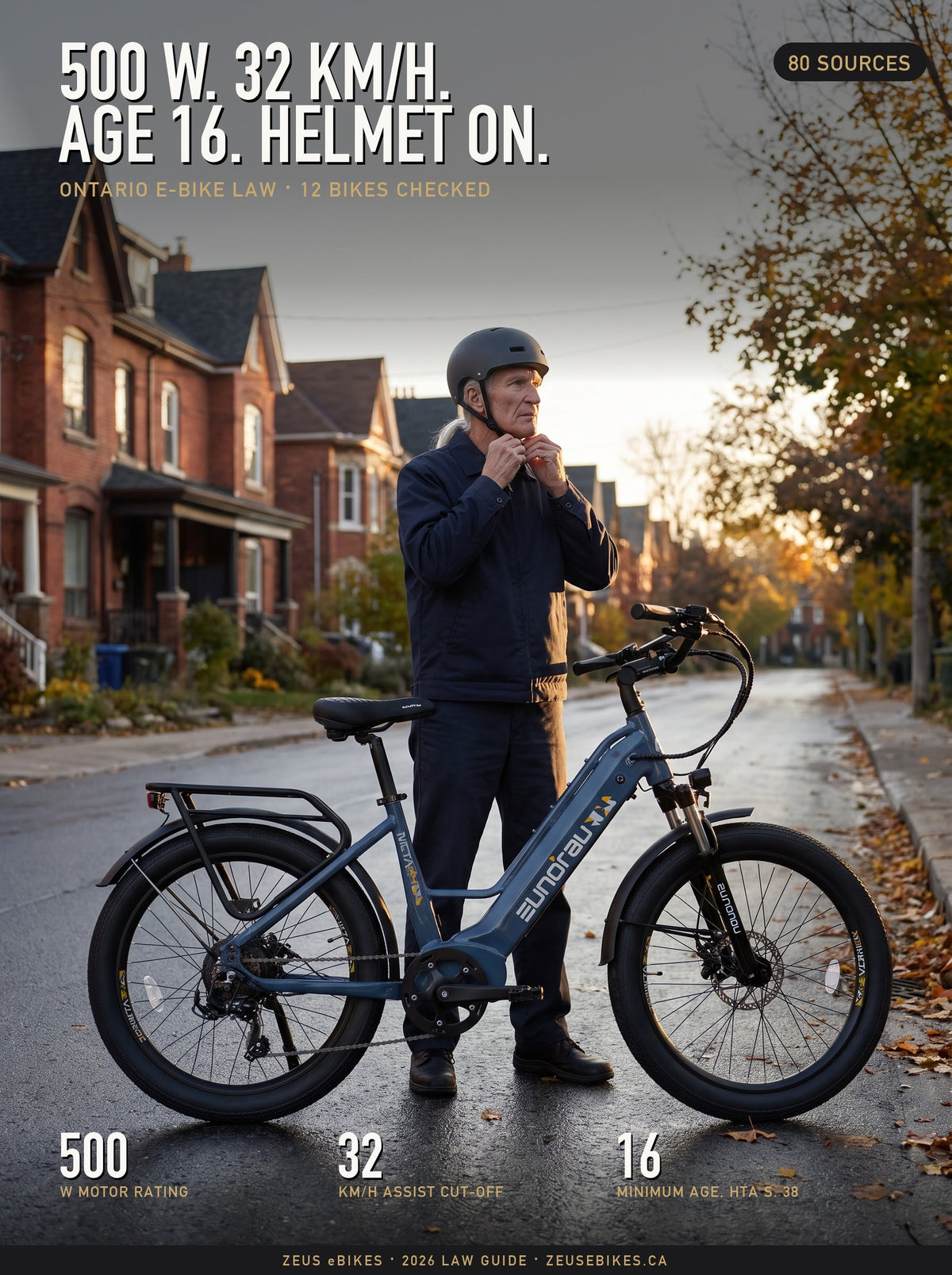
Zeus fastens his helmet beside the Eunorau Meta 275 2.0 on a Toronto street: a Playcut.ai rendering made from Eunorau's own photograph of the bike, so an illustration of it. Ontario's helmet rule covers every rider at every age; the Act, a regulation and the ministry's page each hold part of the e-bike definition, and this guide reads all three.
October tested Ontario's e-bike rule at the shop counter and at the roadside. On 2 October, CBC Marketplace reported that salespeople at six of the twelve Greater Toronto stores its journalists visited undercover explained or showed how to bypass a built-in speed limit, and that ten of the twelve sold e-bikes or e-scooters with maximum speeds beyond Ontario's limits. On 7 October, CTV News reported that Nottawasaga OPP had treated an Alliston rider's pedal-less e-bike as a motor vehicle, laid charges and impounded it for 45 days.
Both stories sit on the same line. An assist cut-off at 32 km/h and pedals that work are two of the tests that keep an e-bike a bicycle; outside the rule it is a motor vehicle: $125 for no permit, $260 for no licence, a $5,000 minimum for no insurance. The province's two-class proposal closed for comment on 7 June and still read "Proposal" on 15 October. This guide reads the Act as it stands today and says which side of the line your bike is on.
The rule itself is short. A power-assisted bicycle has pedals that work and can be pedalled without the motor (Highway Traffic Act, s. 1(1)), a motor rated 500 W or less with assistance that stops at 32 km/h (the ministry's published requirements), weighs no more than 120 kg, and carries two brakes, insulated terminals and wheels at least 35 mm wide and 350 mm across (O. Reg. 369/09). Riders are 16 or older (s. 38) and wear a helmet at every age (s. 103.1), with an $85 set fine for a bare head. No licence, plate, registration or insurance applies.
Every statement below was first read in the statute, regulation, by-law or official page on 19 September 2026; on 15 October 2026 every source was fetched again and checked, and each statement links to its section. The rest covers where the 500 W figure sits in a statute that points to a repealed federal text, what a 750 W bike or an electric dirt bike becomes, sidewalks, lanes, trails and transit in Toronto and Ottawa, the cargo and e-scooter pilots, Bill 197 and the Class 1 and Class 2 proposal, the Criminal Code, and twelve Zeus bikes checked against the rule with the maker's figures beside ours.
- Motor: 500 W or less, continuous rating; the province's proposal counts every motor together, and so did the 2021 text
- Speed: assistance stops at 32 km/h; you may pedal faster
- Pedals: must work and must be able to move the bike on their own (HTA s. 1(1)); the motor cuts when pedalling stops, the throttle is released or a brake is applied (O. Reg. 369/09 s. 3(2))
- Weight: 120 kg unladen, bike and battery together (O. Reg. 369/09 s. 1)
- Licence, plate, registration, insurance: none for a bike inside the rule; a power-assisted bicycle is not a "motor vehicle" (s. 1(1))
- Age: 16 (s. 38(1)); the owner may not let a younger rider on it (s. 38(2))
- Helmet: every rider, every age (s. 103.1(2)); $85 set fine
- Highways: none of the 400-series, the QEW or the other Schedule 1 highways (Reg. 630); sidewalks are municipal, and Toronto and Ottawa both close them to adult riders
- What is changing: the two-class regulation is still a proposal; Bill 197's e-bike sections wait for proclamation; the cargo pilot runs to 1 March 2031
The default pick is the Eunorau Meta 275 2.0 ($2,295), a 500 W torque-sensor step-through that ships at 32 km/h; the Taubik Vista 26 ($2,399) is a 500 W step-through whose maker prints 32 km/h as its only speed. Or jump to the 12 bikes checked against the rule.
What's in this guide
- What makes an e-bike legal in Ontario, and where the rule lives
- Ontario e-bike rules at a glance, with the section for each
- Licence, plates, registration and insurance
- Age 16, and a helmet at every age
- Where you can ride: roads, highways, sidewalks, lanes, trails and parks
- Toronto and Ottawa: the city layer, and the bus, train and ferry rules
- Fat tires, throttles, mopeds, trikes, e-scooters and electric dirt bikes
- What is changing: Bill 197, the two-class proposal, the pilots, Toronto's December report
- Outside the rule: modified bikes, unlockable caps, and what a stop looks like
- Ontario and Québec, side by side
- Impaired riding: the Criminal Code on a bicycle and on an e-bike
- 12 Zeus bikes checked against the rule ($1,000 to $5,700)
- Pre-purchase checklist
- Frequently asked questions (18)
- Sources, with the date each was read
What Makes an e-Bike Legal in Ontario, and Where the Rule Lives
A legal e-bike in Ontario is a "power-assisted bicycle" under s. 1(1) of the Highway Traffic Act: a bicycle with pedals that work, that can be pedalled on level ground without the motor, and whose motor and speed sit inside the limits the province publishes, 500 W and 32 km/h. The Act does not print those two numbers. It points to a federal definition repealed in 2021, and Ontario's interpretation statute says how to read a pointer to a repealed text. Both readings are below.
The statute's definition has four clauses. A power-assisted bicycle is a bicycle that (a) is a power-assisted bicycle "as defined in subsection 2 (1) of the Motor Vehicle Safety Regulations", (b) bears a manufacturer's label in compliance with that definition, (c) has pedals operable to propel it at all times, and (d) can be propelled on level ground by muscular power alone (s. 1(1)). The federal definition in clause (a) carried the 500 W and 32 km/h figures. Canada repealed it by SOR/2020-22, effective 4 February 2021, and Ontario never replaced the pointer.
The Legislation Act, 2006 answers what a pointer to a repealed federal provision means. Under s. 60(3), where the provision referred to is repealed without being replaced, "the reference is to the provision as it read immediately before the repeal or revocation". On that reading the 500 W rating, the 32 km/h cut-off and the pedal test continue to apply through the frozen federal text, which is what the ministry publishes. O. Reg. 369/09 s. 6 relies on the same text when it bars riding a bike modified "beyond the limits set out in clause (d)" of that definition.
The weaker side of the argument is the label clause. Clause (b) requires a manufacturer's label "in compliance with the definition referred to in clause (a)", a label tied to a definition that no longer exists, and the ministry's own page lists no label among its requirements. The province has twice moved to replace the definition: the Moving Ontarians More Safely Act, 2021 wrote a full one that was never proclaimed, and Bill 197 would delete it and move the rule into regulation. Until a regulation is made, the Act's hook stays a repealed text. Buy to the ministry's published figures and you are inside every reading.
Every requirement, and where it is written
| Requirement | Where it is written | Ticket |
|---|---|---|
| Pedals operable at all times; bike propellable by muscular power alone on level ground | HTA s. 1(1), clauses (c) and (d) | Outside the rule: motor-vehicle offences |
| Motor rated 500 W or less, continuous; assistance ends at 32 km/h | Repealed federal text read through the Legislation Act, 2006 s. 60(3); the ministry's published requirements | Outside the rule: motor-vehicle offences |
| Motor ceases to propel when pedalling stops, the accelerator is released or the brakes are applied | O. Reg. 369/09 s. 3(2) | s. 214(1): $60 to $1,000 |
| Unladen weight 120 kg or less, battery included | O. Reg. 369/09 s. 1 | Outside the rule: motor-vehicle offences |
| Wheels at least 35 mm wide and 350 mm in diameter | O. Reg. 369/09 s. 2 | s. 214(1) |
| Battery and motor securely fastened; terminals insulated and covered | O. Reg. 369/09 ss. 3(1), 4 | s. 214(1) |
| Two braking systems, one on the front wheel and one on the rear; stop from 30 km/h within 9 m | HTA s. 64(2); O. Reg. 369/09 s. 5 | $85 (Schedule 43, item 161.0.1) |
| No modification that raises power or speed past the limits; good working order | O. Reg. 369/09 ss. 6, 7 | s. 214(1); a modified bike is outside the rule |
| Lights and reflectors from half an hour before sunset to half an hour after sunrise | HTA s. 62(17) | $85 (item 142) |
| Bell or horn in working order | HTA s. 75(5) | $85 (item 214) |
| Rider 16 or older; owner may not permit a younger rider | HTA s. 38(1), (2) | No set fine; s. 214(1) |
| Helmet at every age, bicycle or motorcycle type | HTA s. 103.1(2), read with s. 104(1) and (2.1); Reg. 610 | $85 (item 270.1) |
Which watts count? The 2021 text speaks of "a continuous rated output power not exceeding 500 watts" for one or more motors "singly or in combination"; the ministry's 2026 proposal says "total continuous power output rating, measured at the shaft of each motor, of 500 W or less"; the ministry's current page says "an electric motor not exceeding 500 watts". Every version reads the continuous rating, and the 2021 text and the proposal both add the motors together.
A motor rated 750 W is outside on all of them, whatever the speed setting. A 500 W motor that peaks higher under load is inside on the words used. A dual-motor bike with two 500 W hubs is a 1,000 W bike.
The rule is 500 W continuous, 32 km/h, working pedals, 120 kg, two brakes. The statute reaches its two headline numbers through a repealed federal text and an interpretation rule; the province publishes them plainly; a regulation would settle it. Buy the published figures as they appear on the maker's own page.
Ontario e-Bike Rules at a Glance, With the Section for Each
Fifteen questions cover almost everything a rider asks about Ontario's rule. The table gives the answer as it stands on 15 October 2026 and the section it comes from, so you can check us against the text rather than against another guide. Fines are the set fines in the Ontario Court of Justice schedule, last updated 22 January 2026; a court can go higher, up to the $1,000 ceiling in s. 214(1) of the Act.
| Question | Ontario rule today | Where |
|---|---|---|
| Maximum motor | 500 W continuous rating; motors counted together | Ministry requirements; repealed federal text via Legislation Act, 2006 s. 60(3) |
| Assist cut-off | 32 km/h; pedalling faster is fine | Same |
| Pedals | Operable at all times; the bike must move under pedal power alone | HTA s. 1(1)(c), (d) |
| Motor behaviour | Must cease when pedalling stops, the accelerator is released or the brakes are applied | O. Reg. 369/09 s. 3(2) |
| Weight | 120 kg unladen, bike and battery | O. Reg. 369/09 s. 1 |
| Wheels | At least 35 mm wide and 350 mm across; no maximum | O. Reg. 369/09 s. 2 |
| Brakes | Two systems, one front and one rear; stop from 30 km/h within 9 m | HTA s. 64(2) ($85); O. Reg. 369/09 s. 5 |
| Lights and bell | Front white or amber lamp, rear red lamp or reflector after dusk; bell or horn always | HTA s. 62(17) ($85); s. 75(5) ($85) |
| Licence, plate, registration, insurance | None; a power-assisted bicycle is not a motor vehicle | HTA s. 1(1); ss. 7, 32; CAIA s. 2 |
| Minimum age | 16; the owner may not permit a younger rider | HTA s. 38(1), (2) |
| Helmet | Every rider, every age; bicycle or motorcycle helmet | HTA s. 103.1(2) ($85); Reg. 610 |
| Sidewalks | Municipal; Toronto bars riders 14 and over, Ottawa bars every vehicle except where signs permit bicycles | Toronto Code 950-201C(2); Ottawa By-law 2017-301 s. 67 |
| Controlled-access highways | Prohibited on the Schedule 1 highways: the 400-series, the QEW, Highway 407 and listed sections of others | Reg. 630 s. 1(1)(c.2) |
| Modification | Riding a bike modified past the power and speed limits is prohibited; the ministry calls the modification illegal | O. Reg. 369/09 s. 6 |
| A 750 W bike on a public road | A motor vehicle; which class depends on its specs; no permit $125, no licence $260, no insurance $5,000 minimum | HTA s. 1(1); s. 7; s. 32; CAIA s. 2(3) |
| The two-class proposal | A proposal; comments closed 7 June 2026; no regulation made | ERO 026-0422 |
Every bike in the picks below has a motor its maker lists at 500 W or less and ships at 32 km/h, checked on the maker's Canadian page on 17 October 2026. Want the check done for a bike you already own? Call 1-866-938-7580 with the model name and we will read its maker page against the table above with you.
Browse the 500 W collectionLicence, Plates, Registration and Insurance: None Inside the Rule, All Four Outside It
A bike inside the rule needs no driver's licence, no plate, no registration and no insurance, because the Highway Traffic Act's definition of "motor vehicle" excludes a power-assisted bicycle and its definition of "bicycle" includes one (s. 1(1)). Every paperwork rule in the Act attaches to motor vehicles. A bike outside the rule, by a 750 W motor, missing pedals or a defeated limiter, is a motor vehicle, and all four requirements arrive at once.
The paperwork that arrives: a permit and plates (s. 7(1), $125 set fine), a driver's licence for the vehicle's class (s. 32(1), $260), and automobile insurance under the Compulsory Automobile Insurance Act (s. 2(1)), where a first conviction for driving uninsured carries a fine of $5,000 to $25,000 and a later one $10,000 to $50,000, with a licence suspension of up to a year available on top (s. 2(3)). The insurance figures are minimums written into the statute, which is why that charge is the one that hurts.
Which class the bike falls into is a spec question. The Act's "motor assisted bicycle", the moped, has operable pedals, weighs no more than 55 kg, has no clutch or gearbox driven by the motor, carries an electric motor or one of 50 cc or less, and cannot exceed 50 km/h on level ground within 2 km of a standing start (s. 1(1)); the ministry's summary and its motorcycle handbook put it in the motorcycle licence classes: an M licence, or an M licence with the L condition when the road test was taken on a moped or limited-speed motorcycle.
Faster or heavier and the vehicle is a limited-speed motorcycle or a motorcycle. The ministry's summary table lists a Canadian Motor Vehicle Safety Standards compliance label as a requirement for each class; whether a bike sold as an e-bike can obtain one is a question for its maker.
Because a compliant e-bike is not a motor vehicle, no auto policy applies to it and none is required. Liability for hitting someone is a home or tenant policy question; some policies cover it under personal liability and some exclude motorized vehicles, so read the exclusions or ask your insurer in writing. Our e-bike insurance guide covers the options. An officer may stop a cyclist who is contravening the Act or a by-law and require a name and address (s. 218), and may require the driver of a power-assisted bicycle to stop and submit it to an equipment examination (s. 82(2)).
Inside the rule: no licence, plate, registration or insurance. Outside it: $125, $260 and a $5,000 floor, with the vehicle's class decided by its weight and speed and a compliance label between it and a plate. The line is the spec sheet.
Age 16, and a Helmet at Every Age
Ontario asks two things of the rider. No one under 16 may drive or operate a power-assisted bicycle on a highway (s. 38(1)), and no owner or person in possession of one may permit a rider under 16 on it (s. 38(2)). Every rider, at every age, wears a helmet (s. 103.1(2)), and the set fine for riding without one is $85. On an ordinary bicycle the helmet rule stops at 18; on an e-bike it never does.
The helmet must satisfy s. 104(1) or (2.1): a motorcycle helmet, or a bicycle helmet made to one of the standards in Regulation 610 s. 4(1), which lists CAN/CSA D113.2-M89, Snell B-95, B-90 and B-90S, ANSI Z90.4-1984, ASTM F1447-94, BS 6863:1989 and the Australian AS 2063.2-1990, with the standard's mark on the helmet (s. 4(2)). Motorcycle helmets are listed in s. 2 and include DOT FMVSS 218 and ECE 22. A parent or guardian who lets a rider under 16 onto a power-assisted bicycle without a helmet commits a separate offence (s. 104(2.3)).
The contrast with an ordinary bicycle is the point most riders get wrong. Regulation 610 s. 5 says a person 18 or older need not comply with the bicycle helmet rule in s. 104(2.1), and the bicycle no-helmet set fine is $60 (Schedule 43, item 273.1). Section 103.1(2) has no age cut-off and its item, 270.1, is $85. The 2021 rewrite that was never proclaimed would have let a 14-year-old ride a bicycle-style e-bike; the ministry's 2026 proposal keeps 16 for both proposed classes.
Sixteen to ride, and the owner answers for a younger rider. A certified bicycle or motorcycle helmet on every ride, $85 without one, at any age. The under-18 rule people remember belongs to ordinary bicycles.
Where You Can Ride: Roads, Highways, Sidewalks, Lanes, Trails and Parks
A power-assisted bicycle goes where a bicycle goes: on the roadway, in a bike lane, and on paths a municipality opens to bicycles. Four kinds of place close to it. Schedule 1 controlled-access highways are closed by regulation. Sidewalks are closed by by-law in Toronto and Ottawa. Protected lanes and park trails in Toronto are closed to bikes that do not require pedalling and to bikes over 40 kg. Provincial parks confine every vehicle to roadways and designated places.
Regulation 630 s. 1(1)(c.2) bars a power-assisted bicycle from the highways in its Schedule 1: all of Highways 400, 401, 402, 403, 404, 405, 406, 409, 410, 412, 416, 417, 418 and 427, the Queen Elizabeth Way, Highway 407 and 407 East, and listed sections of Highways 6, 7, 8, 11, 17 and others. The ministry's page names the same set as "the 400 series, the Queen Elizabeth Way, the Queensway in Ottawa or the Kitchener-Waterloo Expressway"; the regulation lists highways by number, and Highway 417 in full and sections of Highways 7 and 8 in Kitchener are in its schedule.
Sidewalks are municipal. The ministry's page bars e-bikes from municipal roads, sidewalks, paths, trails and lanes where bicycles or e-bikes are banned by by-law, and the two largest cities ban them. Toronto's Municipal Code 950-201C(2) says no person 14 or older shall ride a bicycle on a sidewalk, and for that subsection a "bicycle" includes a pedal-required e-bike under 40 kg; a heavier or throttle-only machine is a vehicle and is barred from sidewalks as one. Ottawa's Traffic and Parking By-law 2017-301 s. 67(1) bars driving any vehicle on a sidewalk except to cross it, with an exception where signs permit bicycles (s. 67(5)).
Bike lanes and trails are the layer where the type of e-bike starts to matter. Toronto's Chapter 886 defines "bicycle" for its lanes and cycle tracks to include a "pedelec", a power-assisted bicycle that requires pedalling; the city's e-bike page (30 July 2026) puts every e-bike in painted lanes and only pedal-required ones in protected lanes, and closes park trails and multi-use paths to "power-assisted e-bikes weighing more than 40kg or which do not require muscular power".
Ottawa admits e-bikes that physically resemble bicycles to its pathways and refuses scooter-type devices; the NCC's Capital Pathway admits pedal e-bikes and bars every device powered only by a throttle, at 20 km/h.
Provincial parks have one written rule: no person shall operate a vehicle in a provincial park except on a roadway or a place designated for it (O. Reg. 347/07 s. 25(1)), and "vehicle" takes its Highway Traffic Act meaning, which includes a bicycle. We could find no e-bike statement on Ontario Parks' site or on the park pages we opened, so on the words of the regulation as we read them a trail a park has designated for bicycles is open to a power-assisted bicycle, and a trail a park has signed against e-bikes is closed. Conservation authorities set their own rules; read the sign at the trailhead.
| Place | Rule for a power-assisted bicycle | Source |
|---|---|---|
| Roads and streets | Same as a bicycle; keep to the rules of the road | HTA s. 1(1); ministry page |
| 400-series, QEW, 407 and listed King's Highway sections | Prohibited | Reg. 630 s. 1(1)(c.2), Schedule 1 |
| Painted bike lanes | Open, Toronto and Ottawa | Toronto e-bike page; Ottawa cycling page |
| Toronto protected lanes and cycle tracks | Open only to bikes that require pedalling; $65 for any other vehicle in a cycle track | Code 886; fines page (886-15A) |
| Toronto park trails and multi-use paths | Closed to bikes over 40 kg or that do not require muscular power | Toronto e-bike page |
| Toronto sidewalks | Closed to riders 14 and over | Code 950-201C(2) |
| Ottawa sidewalks | Closed except where signs permit bicycles; yield and signal where they do | By-law 2017-301 s. 67(1), (5), (6) |
| Ottawa city pathways | Open to e-bikes that resemble bicycles; scooter-type devices refused | Ottawa cycling page |
| NCC Capital Pathway and parkways | Open to pedal e-bikes and personal cargo e-bikes; throttle-only devices and kick-scooters prohibited; 20 km/h | NCC Share the Path |
| Provincial parks | Roadways and designated places only; no published e-bike rule found | O. Reg. 347/07 s. 25(1) |
Roads and painted lanes are open everywhere. The 400-series and the QEW are closed by Reg. 630. Sidewalks are closed by the two big cities' by-laws. Toronto's protected lanes add a pedal test and its park trails a pedal test and a 40 kg one, and the NCC bars throttle-only devices; a pedal-assist-only bike under 40 kg passes all of them.

Alexandra Bridge, Ottawa. On the far side the NCC's pathway rules begin: pedal e-bikes yes, throttle-only devices no, 20 km/h.
Toronto and Ottawa: the City Layer, and the Bus, Train and Ferry Rules
Toronto and Ottawa add by-laws on top of the Act, and their transit agencies add carriage rules on top of that. Toronto's rules turn on two tests, whether the bike requires pedalling and whether it weighs under 40 kg. Ottawa's rules turn on appearance, whether the bike physically resembles a bicycle. The TTC bans every e-bike from its vehicles and property for five months of the year; GO Transit carries conventional-looking e-bikes and refuses moped-styled ones.
Toronto
On Toronto streets the bike is legal where a bicycle is; the city's page (updated 30 July 2026) says so and adds "never ride on the sidewalk". Painted bike lanes take bikes, e-bikes and cargo e-bikes. Protected lanes take only those that require pedalling. Park trails and multi-use paths refuse "motorized vehicles, including power-assisted e-bikes weighing more than 40kg or which do not require muscular power", and by-law officers can ticket.
The ferries and Toronto Island take e-bikes under 40 kg that require muscular power. Only a bike that can be moved by pedal power alone may park on a sidewalk or a post-and-ring stand (950-201B); scooter-styled machines park on-street.
The city's fines page lists $65 for a vehicle other than a bicycle or power-assisted bicycle in a bicycle lane (886-10A), $65 for a vehicle other than a bicycle in a cycle track (886-15A), $60 for a prohibited vehicle on a bicycle path (886-6C) and $90 for a motor vehicle on a sidewalk (950-200D(1)); it prints no dollar figure for a cyclist on a sidewalk.
Toronto Police ran a two-week enforcement campaign from 10 August 2026 aimed at sidewalk riding, wrong-way riding in cycle tracks, e-mopeds in cycle tracks and bike-lane parking, citing 514 micromobility collisions in the city this year. E-scooters are not permitted on any Toronto street, lane, trail, sidewalk or park.
City Council adopted item IE29.10 on 20 and 21 May 2026. It supports the province's two-class proposal, asks for a 55 kg limit on Class 2 and for brakes tested loaded and wet, and directs staff to report to the 9 and 10 December 2026 Council meeting on by-law changes that would bar from every bike lane, cycle track and multi-use trail any motorized vehicle other than a Class 1 or Class 2 power-assisted bicycle.
It also asks the Minister of Transportation for three things: a process to seize and impound at the curb unlicensed motorized vehicles that move under motor power at more than 32 km/h, an appearance-based exclusion modelled on Québec's code, and UL 2849 and 2271 certification for micromobility that is not an e-bike.
Each is a request or a study; none is a by-law yet. Our Toronto e-bike laws guide tracks the city layer.
Toronto's October change came from the province. O. Reg. 327/26, in force from its filing on 9 October 2026, directs the Minister to remove all bicycle lanes on Bloor Street West between Clissold Road and Royal York Road. It goes further than s. 195.6 of the Act, which directs the Minister to restore a lane for motor vehicle traffic on Bloor Street, University Avenue, Avenue Road and Yonge Street by reconfiguring their bike lanes; on this stretch the lanes come out. The construction notice set work on the 1.2 km section to start on 13 October and finish in November (CBC, 8 October).
The Court of Appeal for Ontario allowed the province's appeal in August, reversing the July 2025 ruling that had found the removal law unconstitutional (Cycle Toronto v. Ontario (Attorney General), 2026 ONCA 582), and on 13 October Cycle Toronto and its co-applicants said they will seek leave to appeal to the Supreme Court of Canada (CBC, 13 October). The rule for the bike does not move with the lanes: an e-bike inside it may ride the roadway there like any bicycle.
Ottawa and the NCC
Ottawa's Traffic and Parking By-law 2017-301 s. 67(1) bars driving a vehicle on a sidewalk except to cross it directly, allows bicycles only where official signs permit (s. 67(5)) and, where they do, makes the cyclist yield to pedestrians and signal before passing (s. 67(6)); the by-law's "bicycle" includes a power-assisted bicycle. The city's cycling page admits e-bikes that physically resemble traditional bikes to city bike paths and refuses "scooter type power assisted devices and bicycles with a non conventional appearance". Ottawa also runs an e-scooter by-law, 2020-174.
The NCC's Capital Pathway and parkways permit e-bikes with operable pedals that resemble conventional bicycles and personal cargo e-bikes with operable pedals, and prohibit commercial cargo e-bikes, kick-scooters and "all devices that are exclusively powered by a throttle", with a 20 km/h maximum for every pathway user. A bike with both pedal assist and a throttle is not exclusively throttle-powered on those words; ride it on pedal assist there and the question never arises. Our Ottawa buying guide and Ottawa shop directory cover the city.
Transit: TTC, GO and OC Transpo
The TTC does not permit e-bikes or e-scooters on its vehicles or property from 15 November to 15 April, and never on bus racks, because of their weight. Between 16 April and 14 November e-bikes ride buses, streetcars and subways at any time, including weekday peaks, if space permits; non-electric folding bikes ride all year. E-bikes can be parked at most subway station entrances year-round.
Metrolinx's bicycle policy (approved 20 March 2024) carries a "permissible e-bike", a two-wheeled, conventionally styled pedal e-bike with a CE or UL 2849 mark that weighs no more than 55 kg, on GO trains outside weekday rush hour in the peak direction; on GO buses the bike must weigh no more than 25 kg with the battery removed. A folded conventional bicycle rides as hand luggage at any time; the policy says nothing about a folded e-bike.
Anything the Act calls a power-assisted bicycle or a moped that misses that definition is a "non-permissible e-bike" and stays off, and UP Express takes no e-bikes. OC Transpo's bus racks take tires up to 2.3 in and 55 lb, no fat tires; bikes ride O-Train Lines 1, 2 and 4 all year.
Toronto: pedal-required for protected lanes, and pedal-required and under 40 kg for park trails and ferries; sidewalk riding is ticketed; December brings a staff report on barring everything else from cycling infrastructure. Ottawa: bicycle-looking e-bikes on city and NCC pathways, no throttle-only devices, 20 km/h. Transit: the TTC's five-month e-bike ban, GO's 55 kg and certification test, OC Transpo's 55 lb rack.
Fat Tires, Throttles, Mopeds, Trikes, e-Scooters and Electric Dirt Bikes
The shape of a bike decides nothing in Ontario's statute today; the specs do. A fat-tire bike, a throttle bike, a moped-styled bike and a three-wheeler are all power-assisted bicycles if they keep working pedals, a 500 W continuous rating and a 32 km/h cut-off. Two things are never e-bikes: a standing e-scooter, which has its own pilot regulation, and an electric dirt bike, which is an off-road vehicle under a separate Act with its own permit, insurance and helmet rules.
Fat tires: no maximum width exists. O. Reg. 369/09 s. 2 sets a floor of 35 mm width and 350 mm diameter, and the 2026 proposal would drop the width floor altogether. The catch is the motor on most fat-tire bikes sold online: a 750 W or 1,000 W nameplate puts the bike outside the rule before the tire is measured. The Samebike RS-A02 Pro below is a 20 x 4-inch fat-tire folder whose maker lists 500 W in its spec table, 250 W in its feature text, and 32 km/h.
Throttles are lawful under the Act. O. Reg. 369/09 s. 3(2) requires the motor to cease propelling the bike "if pedalling stops, the accelerator is released or the brakes are applied", a rule written for a bike that has an accelerator. A throttle costs access in the cities instead: Toronto's Code shuts its protected lanes and park trails to any bicycle capable of moving on power alone (s. 886-1C), whatever mode you ride in, and the NCC's pathways bar devices powered exclusively by a throttle. Our pedal assist vs throttle guide goes through the trade-offs.
A moped-styled e-bike is a power-assisted bicycle today if the pedals work and the numbers fit. The Act's own moped category, the "motor assisted bicycle", is something else: a pedal bike of no more than 55 kg with an electric motor or one of 50 cc or less that cannot exceed 50 km/h (s. 1(1)), which needs a motorcycle-class licence (M, or M with the L condition), a plate, insurance and a motorcycle helmet (s. 104(1)).
The 2026 proposal would change the first sentence: moped-, scooter- and motorcycle-styled electric vehicles would be lawful only as a moped, a limited-speed motorcycle or a motorcycle, and Toronto has asked the province for an appearance test. The changes section below has the detail, and our electric mopeds guide reads the popular models.
Three wheels are inside the rule. The ministry's page describes an e-bike with "two or three wheels", the never-proclaimed 2021 text said the same, and the proposal says "not more than three wheels". The Eunorau ONE-TRIKE 2.0 below is a 500 W trike locked at 32 km/h on its maker's page; our electric trikes guide covers the category.
A standing e-scooter is not an e-bike. O. Reg. 389/19 defines an electric kick-scooter as two wheels in line, a standing platform, a handlebar and a motor of no more than 500 W giving no more than 24 km/h, with no seat, no pedals, no basket and a weight of no more than 45 kg (ss. 1, 9).
It may be used only where a municipal by-law allows (s. 3(b)); the operator must be 16 (s. 8(1)); a helmet is required under 18 (s. 10). The pilot is revoked on 27 November 2029 (s. 14). Toronto has not opted in and bars them from every street, lane, trail, sidewalk and park; Ottawa has by-law 2020-174.
An electric dirt bike is an off-road vehicle: "a vehicle propelled or driven otherwise than by muscular power or wind and designed to travel, (a) on not more than three wheels" (Off-Road Vehicles Act, s. 1). That Act does not apply on a highway (s. 2(1)); off the road it requires a permit and plate (s. 3(1)), insurance (s. 15), a helmet (s. 19) and no child under 12 driving it except on the owner's land or under close adult supervision (s. 4), with fines to $300 where none is otherwise set (s. 21).
On a highway the vehicle is a motor vehicle, and the permit, licence and insurance offences above apply unless the vehicle and the road both fit O. Reg. 316/03.
O. Reg. 316/03 lets an "off-road motorcycle" onto some roads: two wheels, a rim of at least 250 mm, a wheelbase of at least 1,016 mm, a straddle seat, a driver only, and a design "primarily for recreational use" (s. 1).
Even then the road must be a Schedule B provincial highway or a municipal road opened by by-law (ss. 4, 4.1, with an exception in s. 4.1(2) for municipalities listed in another regulation), the vehicle needs its permit and plate (s. 16), insurance (s. 17), a driver holding a G2, M2 or higher licence (s. 18) and a helmet (s. 19), and speed is capped at 20 km/h where the limit is 50 or less (s. 22).
Whether a given model meets the off-road-motorcycle description is a question for its spec sheet, and nothing about pedals or watts rescues a machine that misses it. A Sur-Ron-style bike ridden on a Toronto street without a plate is charged as an unplated, unlicensed, uninsured motor vehicle. Our Sur-Ron guide and electric dirt bike guide read the popular models against these rules.
Fat, throttle, moped-styled and three-wheeled bikes are all inside the rule if the pedals work and the numbers fit; the cities, not the Act, are where a throttle or a moped silhouette costs access. An e-scooter lives under its own pilot to 2029. An electric dirt bike is an off-road vehicle: permit, insurance and helmet off the road, and a motor vehicle on it.
What Is Changing: Bill 197, the Two-Class Proposal, the Pilots, and Toronto's December Report
Nothing in the rule above has changed in 2026, and four things around it have moved. Bill 197 received Royal Assent on 19 November 2024; its power to create vehicle classes by regulation came into force on 19 May 2026, while its repeal of the e-bike definition waits for proclamation. The ministry posted a two-class proposal on 23 April 2026, took comments to 7 June, and has posted no decision. The cargo pilot now runs to 1 March 2031, and Toronto's staff report is due in December.
Bill 197 does three e-bike things. Section 2(1) adds to s. 1.2 of the Act a power to make regulations "establishing classes of vehicles and prescribing and governing requirements, qualifications and standards for them", and the new s. 1.2(3) makes breaking such a regulation an offence with a fine of $60 to $2,500; the e-Laws consolidation records both as in force from 19 May 2026.
Section 1(3) repeals the definition of "power-assisted bicycle", ss. 19 to 22 strip the term from the brake, inspection and helmet sections, and s. 30 repeals the never-proclaimed 2021 definition; under s. 31(2) each of those comes into force "on a day to be named by proclamation", and the consolidation still prints the old definition with the repeal as a note.
The proposal is Environmental Registry notice 026-0422, "Modernizing Ontario's Framework for Power-Assisted Bicycles (E-Bikes)", posted by the Ministry of Transportation on 23 April 2026 with a 45-day comment period to 7 June 2026. We re-read the notice on 15 October 2026: notice stage "Proposal", last updated 23 April 2026, no decision posted. The ministry's attached summary is more specific than most coverage of it, and the table below is taken from that document. A proposal on the registry is not a regulation; until one is made, the rule above governs.
The proposed Class 1 and Class 2, from the ministry's own summary
| Requirement | Proposed Class 1 | Proposed Class 2 |
|---|---|---|
| Frame | Exposed frame, not covered by body panels; no footrest or platform for the operator's feet | |
| Propulsion | Pedal-assist only; a throttle or button permitted for a walk-assist function up to 6 km/h | Throttle, button or pedal-assist |
| Pedals | Functional hand cranks or foot pedals at all times, usable in normal riding; continuous pedalling not required | |
| Wheels | Not more than three in contact with the ground; minimum 350 mm diameter including the tire; no width minimum | |
| Maximum unladen weight | 55 kg | 120 kg |
| Maximum assisted speed | 32 km/h | |
| Maximum motor power | Total continuous power output rating, measured at the shaft of each motor, of 500 W or less | |
| Seat | Operator seat height must be adjustable | |
| Brakes, terminals | Stop from 30 km/h within 9 m on a clean, paved, level surface; all electric terminals insulated and covered | |
| Lighting, bell | Bell or horn; white front light, red rear light or reflector, white front and red rear reflective tape | |
| Modifications | None permitted | |
| Licence, insurance, registration | No | |
| Minimum operator age | 16 | |
| Passengers | Any age, provided a seat is available, original or designed for the vehicle | |
| Helmet | Compliant bicycle or motorcycle helmet for all riders | |
The second half of the summary is the part a buyer of a moped-styled bike should weigh. Moped-, scooter- and motorcycle-styled electric vehicles, "generally heavier, capable of higher speeds, fully throttle-powered, and may have body panels partially or fully covering the frame", would be permitted only if they comply with an existing motor-vehicle class: a motor-assisted bicycle (55 kg, 50 km/h, pedals), a limited-speed motorcycle (70 km/h) or a motorcycle, each with a Canadian Motor Vehicle Safety Standards compliance label, an M-class licence, insurance and registration, and a helmet.
A 12-month education and awareness period is proposed before the rules would be enforced. The ministry would also explore raising the cargo pilot's minimum weight from 55 kg to 120 kg.
Toronto's Council supports the proposal and asked for more (item IE29.10, 20 and 21 May 2026): a 55 kg limit on Class 2, an appearance-based exclusion modelled on Québec's code, standardized class markers fixed to each vehicle, and a curb-side seizure process for unlicensed vehicles over 32 km/h. Its staff report on barring everything but a Class 1 or Class 2 e-bike from cycling infrastructure is due at the 9 and 10 December 2026 Council meeting. The coroner's review described in the section above asked for a 55 kg definition too; the ministry told CBC in November 2025 that it "continues to consider feedback from stakeholders".
Two more things moved in October. The province ordered the Bloor Street West bike lanes in Etobicoke removed (O. Reg. 327/26; the Toronto section above has the detail). Federally, Transport Minister Steven MacKinnon told CBC Marketplace in a late-September interview that most e-bike legislation is provincial, but that the federal government needs "to absolutely consider what we will do in terms of regulating the safety of those devices" (CBC, 2 October). CBC's report describes no federal proposal.
The cargo e-bike pilot, extended to 2031
The cargo e-bike pilot is in effect. O. Reg. 141/21 allows a "cargo power-assisted bicycle" of conventional exposed-frame design with two or three wheels, a platform or container for cargo, a weight over 55 kg, a width of no more than 1.3 m, a length of no more than 4 m, a height of no more than 2.2 m, and a motor with a continuous rated output of no more than 1,000 W that stops assisting at 32 km/h (s. 1(1)); the regulation deems it not to be a motor vehicle (s. 1(2)).
On roads, paths and parks a municipality controls, it may be used only where the municipality has passed a by-law (s. 3(b)); a provincial highway's roadway or shoulder needs no by-law, except the controlled-access highways and any road closed to bicycles or pedestrians (s. 4). The operator must be 16 (s. 8(1)) and everyone aboard wears a helmet (s. 10).
The first five-year term would have run out on 1 March 2026. The ministry posted a bulletin on 5 January 2026 (ERO 026-0006) announcing a five-year extension, and O. Reg. 31/26 amended s. 14 so that the regulation is now revoked on 1 March 2031; the ministry's page quotes fines of $250 to $2,500 under it.
Toronto joined the pilot in June 2021 and added large cargo e-bikes over 120 kg in December 2021; its Chapter 886 keeps cargo e-bikes over 500 W, or that need no muscular power, out of cycle tracks and trails. Our cargo pilot page and cargo e-bike guide follow it. The e-scooter pilot (O. Reg. 389/19) runs under the same opt-in model to 27 November 2029.
Nothing about a bike inside the rule changes under either proposed class: 500 W, 32 km/h, working pedals, 16 and a helmet are common to both. The variables are weight, throttle and appearance. A conventional-looking pedal-assist bike under 55 kg fits Class 1 as drafted; a throttle bike under 120 kg fits Class 2; a moped-styled machine sits closest to the line, and Toronto's December report may tighten the city's by-laws before the province moves.
The class-making power is law since 19 May 2026; the classes are still a proposal; the old definition stays in the Act until proclamation. The cargo pilot runs to 2031 and the e-scooter pilot to 2029. Buy a conventional pedal-assist bike inside the rule and every version of the future keeps it on the road.
Outside the Rule: Modified Bikes, Unlockable Caps, and What a Stop Looks Like
A bike leaves the rule three ways: a motor rated above 500 W, pedals that are missing or cannot move it, or a modification that lifts its power or speed past the limits; O. Reg. 369/09 s. 6 bars riding a bike modified that way, and the ministry's page calls the modification illegal. It also leaves the rule if it weighs over 120 kg or loses one of its two brakes. Outside the rule it is a motor vehicle, with the licence section's permit, licence and insurance charges.
The unsettled case is the adjustable cap. Several makers ship a bike set to 32 km/h and label it "Unlockable" or print a higher speed on the same page; Eunorau does one or both for three of the picks below. The 2021 text the province wrote and never proclaimed required a motor "incapable of providing propulsion assistance when the bicycle attains a speed of 32 kilometres per hour or more"; the 2026 proposal sets 32 km/h and bans modification; the ministry's page bans any modification "to increase the assisted speed".
Whether a cap the rider can change satisfies "incapable" has not been decided by an Ontario court we could find. Every card below follows the safe reading: leave the setting alone and treat the unlock as a private-property feature.
Sometimes the unlock is offered at the counter. CBC Marketplace's hidden-camera investigation, published 2 October 2026, found salespeople at six of the twelve Greater Toronto stores it visited who told or showed its journalists how to bypass a built-in speed limit, and ten stores selling e-bikes or e-scooters with maximum speeds beyond Ontario's limits (CBC). Stores may sell them, CBC notes. The regulation is written for the rider: a power-assisted bicycle "must not be ridden on, driven or operated if it has been modified after its manufacture" in a way that may raise its power or speed past the limits (O. Reg. 369/09 s. 6).
What a stop looks like. An officer may stop a cyclist contravening the Act or a by-law and require a name and address (s. 218(1)), and may arrest without warrant a rider who refuses (s. 218(4)). An officer may also require the driver of a power-assisted bicycle to stop and submit it to an examination (s. 82(2)). Toronto's request for a curb-side seizure process for unlicensed vehicles over 32 km/h is a request to the province; a bike outside the rule is charged today as an uninsured, unplated motor vehicle, and a bike inside it is ticketed as a bicycle, $85 for a helmet, a light or a bell.
Missing pedals are the plainest exit, and October brought a case. CTV News reported on 7 October 2026 that Nottawasaga OPP stopped a rider in Alliston, found the e-bike's pedals removed and the bike running on its motor alone, and treated it as a motor vehicle under the Act. Police say the 47-year-old could not produce a licence, permit or proof of insurance; he faces charges including five counts of operation while prohibited under the Criminal Code and operating without a licence, permit, plates or vehicle identification number, and the vehicle was impounded for 45 days (CTV News). None of it has been tested in court.
Ontario courts have read detached pedals both ways. In a ruling Canadian Lawyer reported in February 2013, Justice Donald Dudar of the Ontario Court of Justice dismissed uninsured and unplated motor-vehicle charges against a St. Catharines rider because the removed pedals were readily available and could be reattached (Canadian Lawyer). In a later case against the same rider, the trial judge held that a device whose pedals could not propel it was not a power-assisted bicycle, and the Court of Appeal dismissed his application for leave to appeal (R. v. Pizzacalla, 2014 ONCA 706). Keep the pedals on.
The coroner's e-bike death review, released the week of 27 November 2025, describes what the outside of the rule looks like in practice. It grew from five Ottawa-area deaths noted in 2021, all on e-bikes that appeared to have been modified beyond their design speed and that could not be used as pedal-assisted bicycles, and it recommends a tighter definition with a 55 kg limit, a separate class for larger motorcycle-styled machines with licensing and insurance, and better injury data. We read the report itself, dated February 2025, and CBC's account of it; the ministry told CBC it "continues to consider feedback from stakeholders".
Do not raise the power, do not defeat the cap, do not remove the pedals: each one turns the bike into a motor vehicle you cannot plate. An unlockable cap left at 32 km/h is the unsettled case; leave it alone. A stop on a compliant bike is a bicycle stop: name, address, and a look at the equipment.

6:02 a.m., a Toronto lobby. A 500 W bike set to 32 km/h needs nothing from anyone before it rolls.
Ontario and Québec, Side by Side
Riders who cross the Ottawa River, or who are comparing before a move, ask how the two provinces differ. They agree on the machine: 500 W, a 32 km/h cut-off, working pedals, and a helmet at every age. They differ on the rider. Ontario's minimum age is 16 with no licence at any age; Québec lets a 14- to 17-year-old ride with a Class 6D licence and needs nothing from an adult. Ontario writes a 120 kg weight cap; the SAAQ page does not.
| Rule | Ontario | Québec (SAAQ page, read 15 Oct 2026) |
|---|---|---|
| Motor | 500 W continuous (ministry requirements) | "a maximum power rating of no more than 500 watts" |
| Cut-off | 32 km/h | "must cease to generate power" at no more than 32 km/h |
| Throttle | Lawful; O. Reg. 369/09 s. 3(2) assumes an accelerator | Lawful; assistance "may be activated by the pedals or accelerator control" |
| Pedals | Operable at all times (HTA s. 1(1)) | Must allow pedalling "as though on a regular bike" at all times |
| Minimum age and licence | 16; no licence (s. 38) | 14 with a Class 6D licence; 18 and over, none |
| Helmet | Every age (s. 103.1(2)), $85 | Mandatory, meeting the Protective Helmets Regulation |
| Weight | 120 kg unladen (O. Reg. 369/09 s. 1) | Not stated on the SAAQ page |
A bike that is 500 W, capped at 32 km/h, pedallable and under 120 kg is inside both provinces' rules on the pages we read. The rider rules are where a family with a 15-year-old will notice the border. Our Québec e-bike laws guide and Montréal rules guide carry the Québec side, including the moped-style enforcement Montréal is known for.
Impaired Riding: the Criminal Code on a Bicycle and on an e-Bike
The Criminal Code's impaired offence attaches to a "conveyance" (s. 320.14), which s. 320.11 defines as a motor vehicle, a vessel, an aircraft or railway equipment; s. 2 defines a motor vehicle as one "drawn, propelled or driven by any means other than muscular power". A pedal bicycle is none of those, so an impaired cyclist cannot be charged with impaired driving. An e-bike under motor power is propelled by something other than muscular power, and the Code's definition, unlike the Highway Traffic Act's, does not exclude it.
The two definitions are separate, which is the whole question. Ontario's exclusion of a power-assisted bicycle from "motor vehicle" is an HTA definition for HTA purposes; the Code has its own, and on its plain words a bike moving under its motor is inside it.
The one Ontario appellate case people cite, R. v. Pizzacalla, 2014 ONCA 706, does not settle it: leave to appeal was refused on a driving-while-prohibited conviction involving a device with inoperable pedals that the trial judge found was not an HTA power-assisted bicycle at all. We could find no appellate ruling on a compliant e-bike under motor power. Ride sober; the penalties start at a $1,000 minimum fine (s. 320.19(1)) and a driving prohibition (s. 320.24).
On a pedal bicycle, impaired driving under the Code does not apply. On an e-bike under motor power, the Code's own definition of motor vehicle reaches it on its words, and no Ontario appeal court has said otherwise. Treat the e-bike like a car for this purpose.
12 Zeus Bikes Checked Against Ontario's Rule, $1,000 to $5,700
Every bike below has a motor its maker lists at 500 W or less, pedals that work, and assistance capped at 32 km/h as shipped, each checked against the maker's Canadian page on 17 October 2026, product data and rendered page both, and the four Taubiks against the manuals Taubik publishes. Where a maker prints two figures, or a higher unlockable speed beside the shipped cap, the card gives both, because whether an adjustable cap satisfies the wording has not been decided in Ontario.
Seven of the twelve joined the list on 17 October: four Taubiks, two Samebikes and the Meet One Breeze 2.0, whose makers print no speed above 32 km/h. Prices are Zeus prices in Canadian dollars on 17 October 2026, and every pick comes with Zeus support and a 15-day return window for unused, unopened bikes (15% restocking fee). No stock claims appear here because stock moves daily.
Each card carries Toronto's two tests, a bike that requires pedalling (protected lanes, park trails and the ferries) and a weight under 40 kg (park trails and the ferries). Every pick can run on its motor alone, by a throttle or a "pure electric" mode its maker lists, which keeps it off those facilities whichever mode you ride in.
The manuals Taubik publishes for the Vista 26, the Blackburn 275T, the Monaco S and the Westridge 29T each say "This equipment is not intended to be used at ambient temperatures less than 0°C or above ambient temperatures of 40°C." The sentence sits among the power-cord warnings, and the manual does not say whether "this equipment" means the charger or the bike, so ask us or Taubik before you plan a winter of riding on one.
Quick match: find your situation in thirty seconds
| Your situation | The pick | Price |
|---|---|---|
| The default: 27.5 in wheels for expansion joints, second battery for the long way home | Eunorau Meta 275 2.0 | $2,295 |
| A step-through commuter with hydraulic brakes | Taubik Vista 26 | $2,399 |
| Gravel shoulders and a long commute, with room for a second battery | Taubik Blackburn 275T | $2,799 ($3,199 with two batteries) |
| A basket, a rack and 26 in wheels on a budget | Samebike RS-A01 Pro-T | $1,199 |
| Condo, car trunk, GO under the 55 kg test: it folds | Eunorau Meta Foldable | $2,295 |
| A folding step-through with a rack and a brake light | Taubik Monaco S | $2,899 |
| The lowest price on this page | Samebike 20LVXD30-II | $1,000 |
| Fat tires and a rear shock that fold into a trunk | Samebike RS-A02 Pro | $1,399 |
| Three wheels, 440 lb of payload | Eunorau ONE-TRIKE 2.0 | $2,499 |
| A seat with a backrest, three wheels and reverse | Meet One Breeze 2.0 | $2,599 |
| A 29 in hardtail for the ride to the trailhead | Taubik Westridge 29T | $2,999 |
| A real trail bike, kept inside the rule | Eunorau Urus 2.0 | $5,700 |
The twelve at a glance: motor, speed and weight on the maker's page
| The pick | Motor on the maker's page | Speed on the maker's page | Weight, and Toronto's 40 kg test |
|---|---|---|---|
| Eunorau Meta 275 2.0 | 500 W hub | 32 km/h shipped; "Speed limited" and "Unlockable" | 68.4 lb, 31 kg: under |
| Taubik Vista 26 | 500 W (Sutto, 68 Nm) | 32 km/h, the only figure Taubik prints | 64 lb; 30.5 kg in the manual: under |
| Taubik Blackburn 275T | 500 W (Sutto, 70 Nm) | 32 km/h, the only figure Taubik prints | 69.5 lb; 34.5 kg in the manual: under |
| Samebike RS-A01 Pro-T | 350 W in the spec table, 500 W in the description | 32 km/h; "up to 20mph" in the description | 28 kg: under |
| Eunorau Meta Foldable | 500 W hub | 32 km/h shipped; "Speed limited" and "Unlockable" | 63.4 lb, 28.8 kg: under |
| Taubik Monaco S | 500 W (Sutto, 68 Nm) | 32 km/h, the only figure Taubik prints | 70 lb; 31.5 kg in the manual: under |
| Samebike 20LVXD30-II | 350 W | 32 km/h default; Samebike's blurb also says 25 | 25 kg on Samebike Canada’s spec tab (also its global, German and UK pages) |
| Samebike RS-A02 Pro | 500 W in the spec table, 250 W in the feature text | 32 km/h | 33 kg: under |
| Eunorau ONE-TRIKE 2.0 | 500 W hub | 32 km/h: "under speed limited/locked" | 85.98 lb, 39 kg: under, by a kilogram |
| Meet One Breeze 2.0 | 500 W on Meet One Canada; 750 W on its US site | 32 km/h | 57 kg net: over; roads and quiet streets |
| Taubik Westridge 29T | 500 W (Sutto on the page, Bafang in the manual) | 32 km/h, the only figure Taubik prints | 29.7 kg; 64 lb in the brochure: under |
| Eunorau Urus 2.0 | 500 W Bafang M600 | 32 km/h shipped; Eunorau also lists "28 mph / 45 km/h" | 61.7 lb, 28 kg: under |
Eunorau Meta 275 2.0
$2,295
The Meta line on the Alexandra Bridge: 500 W, a torque sensor, 27.5-inch wheels on the 275, and an optional second battery.
The commuter for Ontario's expansion joints and frost-heaved shoulders: a 27.5-inch wheel rolls over the bump instead of dropping into it. Eunorau's Canadian page lists a 500 W hub with 55 Nm, a torque sensor, a 48V 15Ah pack with an optional second one it quotes at "100 Miles" combined, and labels the bike "Class 2", "Speed limited" and "Unlockable" with "Maximum Speed: 20MPH" (Eunorau CA). It ships at 32 km/h; whether a rider-adjustable cap satisfies the wording is the unsettled question above, so leave it. At 31 kg it passes Toronto's 40 kg trail and ferry test; its throttle fails the pedalling one.
Best for: a Toronto, Mississauga or Ottawa commute past 15 km each way, with the second pack for winter. Not for: a rider under 5 ft 6 in; Eunorau lists this size from there up.
Taubik Vista 26
$2,399
Taubik's own product photo of the Vista 26: a step-through frame, a rear rack and 26-inch wheels.
A step-through commuter with hydraulic brakes and one printed speed. Taubik's spec table lists "500W Sutto (68 NM)", a "Dual Torque/Cadence Sensor", "Zoom Hydraulic Brakes" and "32KM/H" (Taubik); the manual lists a "SUTTON 48V500W HUB", a thumb throttle and a net weight of 30.5 kg, against 64 lbs on the page. Either weight passes Toronto's 40 kg trail and ferry test; the throttle fails the pedalling one. The page prints a 286 lb weight capacity and the manual "Max. load 120 kg", so plan around the lower.
Best for: a commuter who wants a step-through frame and hydraulic brakes for $2,399. Not for: riding below 0 °C before you have asked us or Taubik about its manual's temperature line.
Taubik Blackburn 275T
$2,799
Taubik's own product photo of the Blackburn 275T: 27.5-inch hybrid tires and a rear rack.
The hybrid for gravel shoulders, rail trails and a long commute: CST 27.5 x 2.35-inch tires, 70 Nm and a frame mount for a second battery. Taubik's spec table lists "500W Sutto (70 NM)", "48V/14.7Ah - Samsung (Certified in accordance with UL 2271)" and "32KM/H" (Taubik). The battery reads three ways: 14.7Ah in that table, "Samsung 15Ah (21700 cell)" in the manual, and "dual 48V 15Ah batteries, delivering a combined 30Ah capacity" in the feature text, which also calls the second "an optional second 14.7Ah battery". We sell it with one battery at $2,799 or with two at $3,199.
The manual lists a thumb throttle and 34.5 kg for the 275T: under Toronto's 40 kg test, though the throttle fails the pedalling one. Taubik's page prints a 286 lb weight capacity and the manual "Max. load 120 kg"; plan around the lower.
Best for: a long commute or weekend gravel, with the second battery for range. Not for: winter commuting until Taubik answers what its manual's 0 °C line covers.
Samebike RS-A01 Pro-T
$1,199
Samebike's own product photo of the RS-A01 Pro-T, with its front basket and rear rack.
The budget commuter with the grocery gear already on it: a front basket, a rear rack and 26-inch tires. Samebike's Canadian page gives two motor figures, 350W in its spec table and "a 500W motor" in its description, both inside the rule, and lists its speed as 32KM/H, "up to 20mph" in its own words (Samebike CA). It also quotes "55 km of pure electric range", which means the motor can move it without pedalling, so Toronto's pedal-only lanes, trails and ferries are closed to it; at 28 kg it passes the 40 kg test.
Best for: a first commuter on a budget, or a short city run with groceries. Not for: a rider who wants hydraulic brakes or an aluminium frame; Samebike lists "Mechanical Disc Brakes" and "High Carbon Steel".
Eunorau Meta Foldable
$2,295
Meta Foldable: 20-inch wheels, a torque sensor, and a fold that fits a condo hallway or a trunk.
A 500 W folder with a torque sensor for the rider whose bike has to disappear into a hallway or a trunk. Eunorau labels it "Class 2 Speed limited Unlockable" (Eunorau CA); it ships at 32 km/h. Metrolinx's policy carries a folded bicycle as hand luggage on GO trains at any time, and its "bicycle" is a conventional one with no motor; it says nothing about a folded e-bike, which rides as a permissible e-bike outside the peak-direction rush if it meets the test.
That test wants 55 kg or less, which it is at 28.8 kg, and a manufacturer's CE or UL 2849 mark; Eunorau's page answers "Yes" under "UL CERTIFIED" without naming the standard, so check the sticker. On a GO bus the limit is 25 kg with the battery out, which it does not meet. The TTC refuses every e-bike on its racks and, in winter, on its vehicles.
Best for: condo dwellers and anyone combining the bike with a car. Not for: a GO bus, or steep, sustained climbs.
Taubik Monaco S
$2,899
Taubik's own product photo of the Monaco S: 20 x 3-inch tires, a folding step-through frame and a rear rack.
The folding step-through for a condo storage room or a car trunk, with a rear rack and an integrated brake light already fitted. Taubik lists "500W SUTTO (68 NM)", "32KM/H" and a sensor you can "Switch between torque and cadence sensing to match your preferred riding style" (Taubik); the manual adds a thumb throttle and a net weight of 31.5 kg, against 70 lbs on the page.
That passes Toronto's 40 kg test, though the throttle fails the pedalling one, and it is under the GO train's 55 kg limit; GO's test also names a CE or UL 2849 mark, and Taubik's page prints UL 2271 for the battery and names neither. The page prints a 286 lb weight capacity, the manual "Max. load 120 kg"; plan around the lower.
Best for: condo dwellers and drivers who want a folder with a rack and a brake light. Not for: a January commute before you have read the cold-weather note above.
Samebike 20LVXD30-II
$1,000
20LVXD30-II: 350 W, folding, and the lowest price on this page.
The least expensive bike here, with a 350 W motor that leaves room under the 500 W line. Samebike's Canadian spec table says "Default Speed: 32KM/H" and its product blurb says 25 km/h; both are inside the rule (Samebike CA). It folds small, which suits a Toronto condo and a car trunk; for a GO train, check for the CE or UL 2849 mark that GO's test names. The 35 Nm motor is the softest here; a lakeshore headwind will ask for your legs.
Best for: a first e-bike or a second one kept at the cottage. Not for: long rural distances or a rider over the listing's capacity.
Samebike RS-A02 Pro
$1,399
Samebike's own product photo of the RS-A02 Pro: 20 x 4-inch tires, a folding frame and a rear shock.
A folding fat-tire bike for gravel, sand and rough cottage roads, with an "Adjustable Front Fork + Rear Shock Absorber" over 20 x 4.0-inch tires. Samebike's Canadian spec table lists 500W and 32KM/H, while its feature text says "a 250W motor"; either figure is inside the rule (Samebike CA). Like the RS-A01 it quotes a "55km pure electric range", so Toronto's pedal-only facilities are closed to it; at 33 kg it passes the 40 kg test.
Best for: a cottage or campground bike that rides in the trunk. Not for: a rider who wants hydraulic brakes; Samebike lists a "Mechanical Disc Brake".
Eunorau ONE-TRIKE 2.0
$2,499
ONE-TRIKE 2.0: three wheels are inside the rule, and they do not tip at a stop sign.
The ministry's page allows "two or three wheels", and a trike is the answer for a rider who will not risk a two-wheel stop on ice or after an injury. Eunorau's page lists "Maximum Speed: 20MPH under speed limited/locked", which is 32 km/h, with no unlock figure (Eunorau CA). The 440 lb payload means the rear basket does the grocery run. At 39 kg it sits under Toronto's 40 kg test by a kilogram, but its throttle keeps it off Toronto's protected lanes and park trails; its width suits a quiet street better than a narrow painted lane, and no rack takes a trike.
Best for: seniors, riders recovering from injury, and anyone whose first requirement is staying upright. Not for: transit racks or narrow lanes.
Meet One Breeze 2.0
$2,599
Meet One's own photo of the Breeze 2.0, ridden on a gravel path.
A semi-recumbent folding trike for riders whose knees, hips or back want a seat with a backrest: a forward pedal position, a speed differential, reverse, a parking brake and 180 mm discs on all three wheels. Meet One's Canadian page gives "Max Speed 32 km/h" and "Certified to UL 2849 by SGS" but names only a brushless motor (Meet One CA); the comparison table on its Breeze Pro 2.0 page lists the Breeze 2.0 with a "500W Brushless Motor".
Meet One's US site lists a "750W Brushless Motor" for the trike it sells there (Meet One US), so the rating on the motor of the bike you receive is the figure to check. Its throttle, listed beside pedal assist, cruise control and reverse, keeps it off Toronto's pedal-only facilities, and at 57 kg net it is over Toronto's 40 kg test and the GO train's 55 kg limit: a trike for roads and quiet streets.
Best for: riders who want a seat with a backrest and three wheels under them, seniors and riders with back, hip or knee trouble among them. Not for: transit, GO trains or Toronto's park trails.
Taubik Westridge 29T
$2,999
Taubik's own product photo of the Westridge 29T: a 29-inch hardtail with a suspension fork.
A 29-inch hardtail for riders whose trailhead is a road ride away: Kenda Booster Pro tires, "premium Suntour front forks", a torque sensor and an 8-speed Shimano Acera drivetrain. Taubik's page lists "500W Sutto (65 NM)" and "32KM/H" (Taubik), its manual names a "Bafang 500W/48V Hub", and its brochure gives the battery as 48V 14.7Ah against the page's 48V 15Ah.
Its weight reads 29.7 kg on the page, 64 lb in the brochure and "Weighing just 63 lbs" in the feature text; every figure passes Toronto's 40 kg test. The thumb throttle in its manual and brochure keeps it off the city's park trails at any weight, and off-road the land manager's rule applies, as the Urus card explains. Taubik's page prints a 286 lb capacity and the manual "Max Load 120 kg"; plan around the lower.
Best for: a trail rider who rides to the trailhead on a budget under $3,000. Not for: snow trails below 0 °C; see the cold-weather note above.
Eunorau Urus 2.0
$5,700
Urus 2.0: a Bafang M600 at 500 W nominal, 120 Nm, 32 km/h as shipped.
The premium pick: a full-suspension trail bike for riders who still ride to the trailhead on a public road. Eunorau's Canadian page shows "Maximum Speed 20 MPH / 32 KPH" in its spec table and "MAX SPEED: 28 mph / 45 km/h" in its description, beside "Speed limited" and "Unlockable" (Eunorau CA). It ships at 32 km/h. On the trail, the rule is the land manager's: a provincial park confines vehicles to roadways and designated places (O. Reg. 347/07 s. 25(1)), a conservation authority sets its own, and its throttle keeps it off Toronto's park trails at any weight. See our electric mountain bikes guide.
Best for: serious trail riders who need a legal ride to and from the trailhead. Not for: city commuting; the price and the suspension only pay off on trails.
Not sure which pick fits your city and your commute? Call 1-866-938-7580: we will read the maker's page with you, confirm the shipped cap, and match a model to your distance, your winter and your transit line. Every bike ships Canada-wide with a 15-day return window for unused, unopened bikes (15% restocking fee).
Browse the 500 W collectionPre-Purchase Checklist for Ontario
Ten questions settle almost every Ontario e-bike purchase before money moves. They cover the rule, the rider, the city you ride in, the train or bus you may need, and the two things that decide whether a bike stays inside the rule after the first winter. Run them against the maker's page and your own commute, and call us with whatever is left.
- Continuous motor rating 500 W or less on the maker's own page, with every motor counted together; a 750 W nameplate is outside on any speed setting
- Assistance capped at 32 km/h as shipped; if the maker lists an unlock, know you will leave it alone on public roads
- Real pedals that move the bike, and a motor that cuts when pedalling stops, the throttle is released or a brake is applied (O. Reg. 369/09 s. 3(2))
- Under 120 kg with the battery (s. 1); two brakes, one front and one rear (HTA s. 64(2)); lights for dusk (s. 62(17)); a bell (s. 75(5))
- Every rider 16 or older (s. 38); a certified bicycle or motorcycle helmet on every ride, $85 without one (s. 103.1(2))
- Your sidewalk rule: closed to riders 14 and over in Toronto, closed except where signed in Ottawa; plan a road, lane or pathway route
- Toronto: pedal-required for protected lanes, plus under 40 kg for park trails and the ferries; Ottawa and the NCC: a bike that looks like a bike, no throttle-only devices, 20 km/h on the pathways
- Transit: no e-bike on the TTC from 15 November to 15 April and never on its racks; GO wants 55 kg or less with a CE or UL 2849 mark, and a folded e-bike gets no separate rule; OC Transpo racks take 2.3 in tires and 55 lb
- If it looks like a moped or scooter, read the changes section: the proposal, Toronto's appearance ask and the pathway rules all turn on the silhouette
- Your home policy's liability section, in writing; and a place to charge indoors, since Metrolinx bars charging a non-permissible e-bike anywhere on its property
Frequently Asked Questions
What are the e-bike laws in Ontario?
A power-assisted bicycle needs working pedals and must be pedallable without the motor (Highway Traffic Act s. 1(1)), a motor rated 500 W or less with assistance that ends at 32 km/h (the ministry's published requirements, reached through the Act's pointer to the repealed federal text). It must weigh 120 kg or less and carry two brakes, insulated terminals and wheels at least 35 mm by 350 mm (O. Reg. 369/09). Riders must be 16 (s. 38) and wear a helmet at every age (s. 103.1(2), $85). No licence, plate, registration or insurance applies, because a power-assisted bicycle is not a "motor vehicle" under the Act.
Are e-bikes legal in Ontario?
Yes, on public roads, where a bicycle may go, provided the bike meets the definition: 500 W or less, a 32 km/h cut-off, working pedals, 120 kg or less and two brakes, with a rider who is 16 and wearing a helmet. A bike that misses any of those is a motor vehicle on a public road, which means a permit, plate, licence and insurance, with a compliance label standing between the bike and a plate. The 400-series highways and the QEW are closed to every e-bike (Reg. 630), and sidewalks are closed by by-law in Toronto and Ottawa.
Are 750 W e-bikes legal in Ontario?
Not on a public road. Ontario reads the motor's continuous rating, and every version of the rule stops at 500 W; a 750 W nameplate is outside on all of them, whatever the speed limiter is set to. On the road such a bike is a motor vehicle: $125 for no permit (s. 7), $260 for no licence (s. 32) and a $5,000 minimum for no insurance (CAIA s. 2(3)). It is lawful to own and to ride on private property with permission. The one 1,000 W exception is a cargo e-bike under the pilot, where a municipality has opted in.
What is the e-bike speed limit in Ontario?
The motor may assist only up to 32 km/h; the bike may be pedalled faster under your own power. Riding a bike modified to raise its power or assisted speed past the limits is prohibited (O. Reg. 369/09 s. 6), and the ministry's page calls the modification itself illegal. On the road the posted speed limit applies to an e-bike as to any vehicle, and the NCC's Ottawa pathways cap every user at 20 km/h. A bike whose maker lists a higher unlockable speed should be left at 32 km/h; whether an adjustable cap satisfies the wording has not been decided in Ontario.
Do you have to wear a helmet on an e-bike in Ontario?
Yes, at every age. Section 103.1(2) of the Highway Traffic Act requires a helmet that meets s. 104(1) or (2.1), a motorcycle helmet or a bicycle helmet certified to a standard listed in Regulation 610, and the set fine is $85 (Schedule 43, item 270.1). The under-18 rule people remember belongs to ordinary bicycles: Regulation 610 s. 5 exempts adults from the bicycle helmet rule in s. 104(2.1), and that ticket is $60. A parent who lets a rider under 16 onto an e-bike without a helmet commits a separate offence (s. 104(2.3)).
Can you ride an e-bike on the sidewalk in Ontario?
The Act leaves sidewalks to municipalities, and the ministry's page bars e-bikes from municipal sidewalks where by-laws ban bicycles or e-bikes. Toronto's Municipal Code 950-201C(2) bars anyone 14 or older from riding a bicycle, including a pedal-required e-bike under 40 kg, on a sidewalk; a heavier or throttle-only machine is barred as a vehicle. Ottawa's By-law 2017-301 s. 67(1) bars driving any vehicle on a sidewalk except to cross it, with an exception where signs permit bicycles. Treat sidewalks as closed and use the road, a lane or a pathway.
Do you need a licence, a plate or insurance for an e-bike in Ontario?
No, for a bike inside the rule. The Highway Traffic Act's definition of "motor vehicle" excludes a power-assisted bicycle (s. 1(1)), so the permit and plate rule (s. 7), the driver's licence rule (s. 32) and the Compulsory Automobile Insurance Act do not reach it. All three arrive the moment the bike leaves the rule: a 750 W motor, no working pedals or a defeated limiter. Liability for a crash on a compliant e-bike is a home or tenant policy question; our e-bike insurance guide covers it.
How old do you have to be to ride an e-bike in Ontario?
Sixteen. No person under 16 may drive or operate a power-assisted bicycle on a highway (s. 38(1)), and the owner or person in possession of the bike may not permit a younger rider on it (s. 38(2)). The 2021 rewrite that was never proclaimed would have set 14 for a bicycle-style e-bike; the ministry's 2026 proposal keeps 16 for both proposed classes. A driveway or private land that is not open to the public is outside the Act's "highway" definition, which turns on use by the general public.
Are electric dirt bikes like a Sur-Ron street legal in Ontario?
No, as e-bikes. An electric dirt bike is an off-road vehicle under the Off-Road Vehicles Act, which requires a permit and plate (s. 3), insurance (s. 15) and a helmet (s. 19) even off the road, and does not apply on a highway at all (s. 2(1)). On a road it is a motor vehicle unless it meets O. Reg. 316/03's "off-road motorcycle" description and is ridden on a Schedule B highway or a municipal road opened by by-law, with permit, insurance, a G2, M2 or higher licence and a helmet. Unplated on a city street, it is an uninsured motor vehicle.
Does Ontario use the Class 1, 2 and 3 e-bike system?
Not today. Class 1, 2 and 3 are United States labels that makers print on Canadian pages; Ontario's Act has one category, the power-assisted bicycle. The ministry has proposed its own Class 1 (pedal-assist only, 55 kg) and Class 2 (throttle allowed, 120 kg), both at 500 W and 32 km/h, and the power to make that regulation has been law since 19 May 2026, but no regulation has been made. A bike labelled "Class 3" by its maker is inside Ontario's rule only if it ships capped at 32 km/h with a 500 W or smaller continuous rating.
What are the new e-bike rules in Ontario for 2026?
There are no new rules yet. The ministry posted a two-class proposal on 23 April 2026 (ERO 026-0422), took comments to 7 June, and had posted no decision when we re-read the notice on 15 October 2026; it still reads "Proposal". Bill 197's power to create vehicle classes came into force on 19 May 2026, and its repeal of the old definition waits for proclamation. The cargo e-bike pilot was extended to 1 March 2031. Toronto Council adopted a package of requests in May and expects a staff report in December on barring non-e-bike motorized vehicles from its cycling infrastructure.
Can I ride an e-bike in bike lanes and on trails in Ontario?
Painted bike lanes, yes, everywhere we read. Protected lanes and trails depend on the city and the bike. Toronto opens protected lanes only to e-bikes that require pedalling and closes park trails and multi-use paths to any e-bike over 40 kg or that does not require muscular power, with $65 for a vehicle other than a bicycle in a cycle track. Ottawa opens its pathways to e-bikes that look like bicycles, and the NCC's Capital Pathway bars throttle-only devices at 20 km/h. Provincial parks confine vehicles to roadways and designated places (O. Reg. 347/07 s. 25(1)).
Can you ride an e-bike on the highway in Ontario?
Not on a controlled-access highway. Regulation 630 s. 1(1)(c.2) bars a power-assisted bicycle from every highway in its Schedule 1: all of the 400-series, the Queen Elizabeth Way, Highway 407 and 407 East, and listed sections of Highways 6, 7, 8, 11, 17 and others, which is the set the ministry's page describes as the 400 series, the QEW, the Queensway in Ottawa and the Kitchener-Waterloo Expressway. Every other public road is open on the same terms as a bicycle.
Are throttle e-bikes legal in Ontario?
Yes, under the Act. O. Reg. 369/09 s. 3(2) requires the motor to stop propelling the bike when pedalling stops, "the accelerator is released" or the brakes are applied, a rule written for a bike that has an accelerator, and the ministry's 2026 proposal would allow a throttle in its Class 2. The cost of a throttle is municipal: Toronto's protected lanes and park trails are open only to bikes that require pedalling, and its Code shuts out any bicycle capable of moving on power alone, so a working throttle keeps a bike off them in any riding mode; the NCC's pathways bar only devices powered exclusively by a throttle.
Are electric mopeds and e-scooters legal in Ontario?
A moped-styled e-bike is a power-assisted bicycle today if the pedals work and the numbers fit. The Act's actual moped, the "motor assisted bicycle", is a pedal bike of 55 kg or less that cannot exceed 50 km/h (s. 1(1)) and needs a motorcycle-class licence (M, or M with the L condition), a plate, insurance and a motorcycle helmet. A standing e-scooter is a separate vehicle under O. Reg. 389/19: 500 W, 24 km/h, 16 or older, lawful only where a municipal by-law allows, to 27 November 2029; Toronto has no such by-law and bars them, Ottawa has one.
What happens if you modify an e-bike past 500 W or 32 km/h?
The bike stops being a power-assisted bicycle. O. Reg. 369/09 s. 6 bars riding a bike modified to increase its power or speed beyond the limits, and s. 7 requires good working order; a bike whose motor was swapped, chipped or unlocked past 32 km/h is a motor vehicle on a public road, with the permit, licence and insurance offences that follow. The coroner's review of five Ottawa-area deaths noted that every bike involved appeared to have been modified beyond its design speed. Keep the road bike stock and buy a second bike for private land if you want more.
Can police seize or impound an e-bike in Ontario?
An officer may stop a cyclist contravening the Act or a by-law and require a name and address (s. 218), with arrest for refusing (s. 218(4)), and may require a power-assisted bicycle to stop for an equipment examination (s. 82(2)). A bike outside the rule is dealt with as a motor vehicle. Toronto Council asked the province in May 2026 for a process to seize and impound at the curb unlicensed motorized vehicles moving over 32 km/h; that is a request to the Minister, and the Council's own wording asks the province to develop a process rather than to use one.
In October 2026, OPP impounded a pedal-less e-bike in Alliston for 45 days after treating it as a motor vehicle; the rider's charges have not been tried (CTV News, 7 October).
Can you get a DUI on an e-bike in Ontario?
On a pedal bicycle, no: the Criminal Code's impaired offence needs a "conveyance", and its definition of motor vehicle excludes anything propelled by muscular power (ss. 2, 320.11, 320.14). On an e-bike under motor power the Code's own words reach the bike, because the Code does not borrow the Highway Traffic Act's exclusion, and no Ontario appeal court has ruled the other way; R. v. Pizzacalla concerned a device with inoperable pedals and a prohibited driver. Ride sober; the minimum fine is $1,000 and a driving prohibition follows.
The Bottom Line
Ontario's e-bike rule is simple to obey. A motor rated 500 W or less, assistance that stops at 32 km/h, pedals that work, 120 kg or less and two brakes make the bike a bicycle: no licence, plate, registration or insurance, a rider of 16, and a helmet at every age with an $85 ticket. The Act reaches its two headline numbers through a repealed federal text and an interpretation rule; the ministry publishes them plainly; the class regulation that would settle it is still a proposal.
Three things to watch. The province's two-class proposal, whose class-making power became law on 19 May 2026, would keep every conventional-looking pedal-assist bike where it is and move moped-styled machines to the motor-vehicle classes. Toronto's December staff report may bar everything but a Class 1 or Class 2 e-bike from the city's lanes and trails before the province moves.
And the coroner's review points at the same thing the city and the ministry do: the bikes in the fatal crashes were modified past their design speed. Buy a bike whose maker prints 500 W and 32 km/h, leave the cap alone, and every version of the rule keeps you on the road.
Zeus ships across Ontario with a 15-day return window for unused, unopened bikes (15% restocking fee), and our team will read any model's maker page against the rule before you buy: call 1-866-938-7580. Every pick above shows the maker's figures beside ours; the 500 W collection has more, and the financing guide explains the options without a monthly figure on this page.
Milad Ghobadibeygvand, BScN (Western University, 2014), is the co-founder of Zeus eBikes Canada. He verifies every Zeus law guide against the primary statute and regulation before it is published. For this guide, on 19 September 2026 and again on 15 October 2026, that meant re-reading the Highway Traffic Act and its regulations, the Compulsory Automobile Insurance Act, the Off-Road Vehicles Act, the Legislation Act, 2006, Bill 197, the set-fine schedule, the ministry's pages and its class proposal, Toronto's and Ottawa's by-laws, pages and Council decision, the TTC, Metrolinx, OC Transpo and NCC rules, the Criminal Code, and every maker's Canadian product page for the bikes named.
- eBike Laws Canada: every province, one table · Toronto eBike Laws 2026
- Québec eBike Laws 2026 · Montréal eBike Rules 2026 · Alberta · BC · Atlantic Canada · Saskatchewan and Manitoba
- Ontario cargo e-bike pilot · Canada vs USA e-bike laws · Canadian eBike Legal Access Atlas
- 500 W vs 750 W vs 1,000 W · Sur-Ron in Canada · Electric mopeds · Pedal assist vs throttle
- eBike insurance in Canada · Theft protection · e-Bike vs car
- Buying: Best 500 W e-bikes · Toronto · Ottawa · Seniors · Folding · Step-through · Fat tire
- Shops: Toronto · Ottawa · Hamilton · Mississauga · London · Kitchener
This guide summarizes Ontario e-bike rules for general information and is not legal advice. Laws change: the class proposal sits on the registry with no decision and Bill 197's e-bike sections await proclamation, so confirm the current rule with the Ministry of Transportation before you rely on this page.
Last updated: 21 October 2026, when O. Reg. 141/21 ss. 3 and 4 and Regulations 627 and 630 were read again and the cargo pilot's by-law rule was narrowed to the roads a municipality controls; before that, 17 October 2026 (picks rebuilt as twelve bikes; maker pages, manuals, statutes, regulations and notice 026-0422 read that day, the law unchanged since 15 October, when every source was fetched again and O. Reg. 327/26, CBC Marketplace's limiter investigation and the Alliston pedal case were added). Found an error? milad@zeusebikes.ca.
Sources, with the date each was read
Every law source below was read on 19 September and 15 October 2026, both copies saved; the statutes, regulations and ministry notices were checked again on 17 October, unchanged, and the manufacturer pages and manuals were read that day. Statutes and regulations link to the e-Laws consolidation current to 14 October 2026. Hosts that refuse a plain fetch were read in a real browser. The coroner's e-bike death review is not on ontario.ca that we could find; we read a trade publication's copy, which matches CBC's account.
Ontario statutes, regulations and official pages
- Highway Traffic Act, R.S.O. 1990, c. H.8, ss. 1(1), 1.2, 7, 32, 38, 62(17), 64(2), 75(5), 82(2), 103.1, 104, 214, 216, 218, and Part XII.1 (ss. 195.2, 195.6, 195.7, 195.18), with the notes on unproclaimed amendments (2021, c. 26, Sched. 1; 2024, c. 21). e-Laws
- O. Reg. 327/26, Bicycle Lanes, ss. 1, 2 (made 8 October 2026; filed, in force and published on e-Laws 9 October 2026). e-Laws
- O. Reg. 369/09, Power-Assisted Bicycles, ss. 1 to 7 (consolidated to 6 December 2018). e-Laws
- R.R.O. 1990, Reg. 610, Safety Helmets, ss. 2, 3, 4, 5. e-Laws
- R.R.O. 1990, Reg. 630, Vehicles on Controlled-Access Highways, s. 1(1)(c.2) and Schedule 1. e-Laws · Reg. 627, Use of Controlled-Access Highways by Pedestrians. e-Laws
- O. Reg. 141/21, Pilot Project: Cargo Power-Assisted Bicycles, ss. 1, 3, 8, 9, 10, 14 (as amended by O. Reg. 31/26). e-Laws
- O. Reg. 389/19, Pilot Project: Electric Kick-Scooters, ss. 1, 3, 8, 9, 10, 14 (as amended by O. Reg. 398/24). e-Laws
- O. Reg. 316/03, Operation of Off-Road Vehicles on Highways, ss. 1, 2, 4, 4.1, 6, 16 to 19, 22. e-Laws
- Off-Road Vehicles Act, R.S.O. 1990, c. O.4, ss. 1, 2, 3, 4, 15, 19, 21. e-Laws
- Compulsory Automobile Insurance Act, R.S.O. 1990, c. C.25, s. 2. e-Laws
- O. Reg. 347/07, Provincial Parks: General Provisions, ss. 1, 25(1). e-Laws
- Legislation Act, 2006, S.O. 2006, c. 21, Sched. F, ss. 59, 60. e-Laws
- Bill 197, Safer Roads and Communities Act, 2024, S.O. 2024, c. 21, ss. 1, 2, 19 to 22, 30, 31; Royal Assent 19 November 2024. Legislative Assembly of Ontario
- Ontario Court of Justice, Set Fines, Schedule 43, Highway Traffic Act (last updated 22 January 2026), items 1, 2, 84, 101.2, 142, 161.0.1, 214, 270.1, 273.1. ontariocourts.ca
- Ministry of Transportation, Riding an e-bike (updated 19 July 2024). ontario.ca · Cargo e-bike pilot program (updated 2 March 2026). ontario.ca · Electric kick-style scooters. ontario.ca · Official MTO Motorcycle Handbook, What you need to drive a motorcycle in Ontario. ontario.ca
- Environmental Registry of Ontario, notice 026-0422, Modernizing Ontario's Framework for Power-Assisted Bicycles (E-Bikes), posted 23 April 2026, comment period closed 7 June 2026, stage "Proposal" on 15 October 2026. ero.ontario.ca · the ministry's attached summary (docx). ero.ontario.ca · notice 026-0006, Cargo Power-Assisted Bicycles Pilot Extension (bulletin, 5 January 2026). ero.ontario.ca
Toronto
- Toronto Municipal Code, Chapter 950, Traffic and Parking, s. 950-201 (consolidation dated 22 July 2022). toronto.ca · Chapter 886, Footpaths, Pedestrian Ways, Bicycle Paths, Bicycle Lanes and Cycle Tracks, ss. 886-1, 886-10, 886-14, 886-15. toronto.ca
- City of Toronto, Electric Bicycles (modified 30 July 2026). toronto.ca · Rules for Rideables (modified 24 September 2026). toronto.ca · Cycling Road Fines (modified 17 July 2025). toronto.ca · Electric Scooters (modified 11 August 2026). toronto.ca · Cargo Bikes (modified 15 July 2026). toronto.ca
- Toronto City Council, item 2026.IE29.10, Supporting the Proposed Modernization of Ontario's Framework for Power-Assisted Bicycles, adopted with amendments 20 and 21 May 2026. secure.toronto.ca · Councillor Saxe's motions of 1 and 5 May 2026. 1 May · 5 May
- TTC, Bikes on TTC vehicles. ttc.ca
- Metrolinx Bicycle Policy (Conventional and Electric), approval date 20 March 2024. gotransit.com · Metrolinx revises policy for e-bikes and e-scooters (10 September 2021). metrolinx.com
- CBC News, Toronto police cracking down on e-bikes, e-scooters evading laws, regulations (10 August 2026). cbc.ca
- CBC News, Ontario will officially begin removing Toronto bike lanes on Tuesday (8 October 2026). cbc.ca · Toronto cyclists ask Canada's top court to weigh in on Ford's bike lane removal plan (13 October 2026). cbc.ca · Cycle Toronto v. Ontario (Attorney General), 2026 ONCA 582 (August 2026); the decision's text did not load through our browser route, so the citation is confirmed through a law firm's summary. mccarthy.ca
Ottawa and the National Capital Commission
- City of Ottawa, Traffic and Parking By-law No. 2017-301, s. 67 (office consolidation). documents.ottawa.ca · Part A, Rules of the road. ottawa.ca
- City of Ottawa, Cycling and the law. ottawa.ca · E-scooters (By-law No. 2020-174). ottawa.ca
- National Capital Commission, Share the Path: rules for electric power-assisted vehicles. ncc-ccn.gc.ca
- OC Transpo, Bikes on our network. octranspo.com
Federal, courts and the coroner
- Motor Vehicle Safety Regulations, C.R.C., c. 1038, s. 2, "power-assisted bicycle" [Repealed, SOR/2020-22, s. 3]. Justice Laws · SOR/2020-22. Canada Gazette, Part II
- Criminal Code, R.S.C. 1985, c. C-46: s. 2; s. 320.11; s. 320.14; s. 320.18; s. 320.19; s. 320.24
- R. v. Pizzacalla, 2014 ONCA 706. Court of Appeal for Ontario · Canadian Lawyer, Ruling confirms e-bikes are not motor vehicles (11 February 2013), on Justice Dudar's Ontario Court of Justice decision. canadianlawyermag.com
- CBC News (Marketplace), Hidden cameras show some stores unlocking speed limits on e-bikes, selling e-scooters that go up to 120 km/h (2 October 2026). cbc.ca · CTV News, How modifications to an e-bike landed a rider criminal charges (7 October 2026). ctvnews.ca
- CBC News, Coroner's office calls for clearer definition of e-bikes in Ontario (27 November 2025), on the Office of the Chief Coroner's e-bike death review. cbc.ca · E-bike Death Review, the coroner's expert-panel report (dated February 2025), in the copy hosted by eBikes International. ebikes-international.com
Québec, for the comparison
- SAAQ, Electric bikes. saaq.gouv.qc.ca · Class 6D licence. saaq.gouv.qc.ca
Manufacturer pages and manuals, read 17 October 2026 (product data and rendered page)
- Eunorau Canada: Meta 275 2.0 · Meta Foldable · ONE-TRIKE 2.0 · Urus 2.0
- Samebike Canada: 20LVXD30-II · RS-A01 Pro-T · RS-A02 Pro
- Taubik: Vista 26 (manual) · Blackburn 275T (manual) · Monaco S (manual) · Westridge 29T (manual, brochure)
- Meet One: Breeze 2.0, Canada · Breeze Pro 2.0, Canada (its comparison table lists the Breeze 2.0's motor) · Breeze 2.0, the US model
All photography by Playcut.ai.




Share:
Best Electric Bikes for Women in Canada (2026): 21 Verified Picks, Fit From 4'10", Lightest 17.7 kg
British Columbia (BC) eBike Laws 2026: Rules, Fines & Trails