
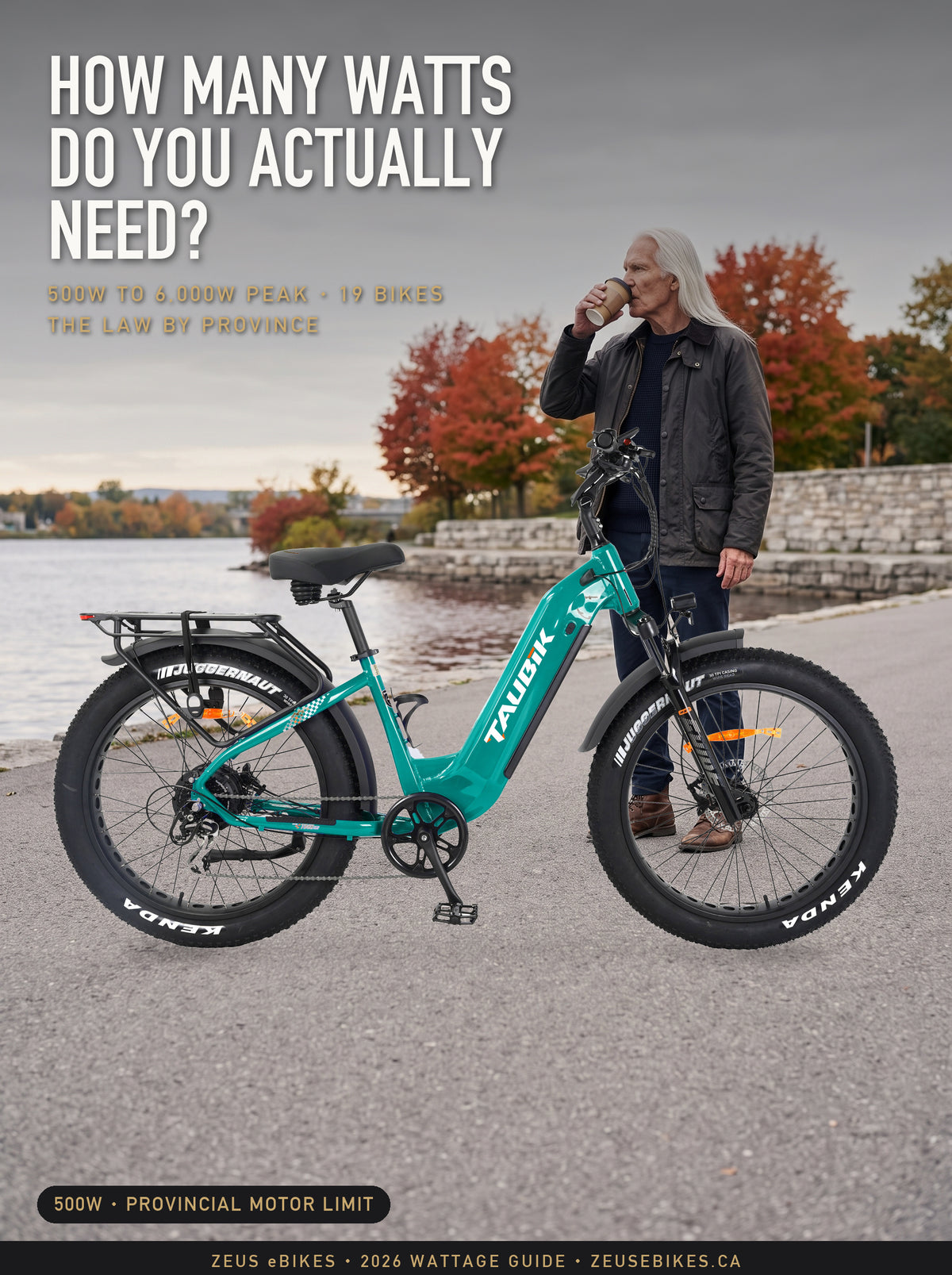
eBike Wattage in Canada (2026): How Many Watts You Actually Need — and What's Legal

How many watts does a Canadian e-bike actually need, and which wattages are legal to ride on the road? Those are two different questions. Zeus eBikes, a Canadian electric bike retailer, rebuilt this guide in October 2026 to answer both: what a watt really is, how wattage translates to real speed, watts versus the torque that actually climbs hills, and the provincial rule for every tier from 500W to 6,000W peak. Nineteen bikes from our catalogue anchor the ladder, from 500W commuters to a 6,000W-peak dual-motor machine, and every spec on them was re-read on the maker's own page.
In This Guide
- How Many Watts Do You Actually Need?
- What a Watt Really Is: Nominal vs Peak
- Do More Watts Mean More Speed?
- Is 750W or 1000W Legal? The Truth About the "Federal Law"
- The Class 1/2/3 Myth — Canada Doesn't Use It
- The Full Wattage Ladder: 500W to 6,000W Peak (19 Bikes)
- Watts vs Torque: What Actually Climbs Hills
- The Dual-Motor Trap: Why You Add the Motors Together
- Can You Make an E-Bike Faster?
- All 19 Bikes — Full Comparison Table
- Frequently Asked Questions
- The Bottom Line
How Many Watts Do You Actually Need?
For most Canadian riders, the honest answer is 500W: the ceiling of every provincial e-bike rule, so the most you can ride on the road as an e-bike, and plenty of motor for flat-to-rolling commuting, errands, and moderate hills once it has a good torque sensor or a mid-drive. You step up in wattage for exactly three reasons: sustained steep climbs under load, a heavy rider plus heavy cargo on hills, or off-road and trail riding where road-legality doesn't apply. If none of those is your daily reality, more watts mostly buys you a bike you can't legally ride to work.
Here's the mental model that cuts through the marketing. Watts is the size of the motor's total power budget. But where you ride decides your wattage before performance does — because the moment you pass 500W, you leave the street-legal category entirely, in every province. So the real first question isn't "how much power do I want," it's "where will this bike spend its life?" Answer that, and the wattage narrows itself.
Start where you'll actually ride
What a Watt Really Is: Nominal vs Peak
A watt is simply a unit of power — volts multiplied by amps — and on an e-bike it describes how hard the motor can push. But there are two watt numbers on every spec sheet, they can differ by a factor of three or more, and knowing which is which is the difference between an informed buyer and a marketed-to one. Nominal (or "rated," or "continuous") wattage is what the motor can sustain indefinitely without overheating. Peak wattage is the short burst it delivers during hard acceleration or a steep climb.
Why does the distinction matter so much? Because the law measures the continuous (nominal) number, and marketing leads with the peak number. The Eahora Juliet 2026 shows the honest version: Eahora's own page gives 1,000W rated and 1,200W peak, side by side. The Freesky Swift Horse Ultra shows the other common version: Freesky’s Canadian page prints a 4,000W peak and no rated figure at all. When a spec sheet lists a single big wattage with no qualifier, assume it's the peak, flattering number and look for the rated figure underneath. For legality you care about the continuous rating; for that punchy off-the-line feel you care about peak; and a good motor has honest headroom between the two.
See a wattage on a listing? Ask: "Is that nominal or peak?" If the answer is peak — or if the seller doesn't know — the real, law-relevant, hill-sustaining number is lower. Every wattage in this guide is labelled rated or peak, and where two sources disagree, both are printed.
Do More Watts Mean More Speed?
Not directly, and on a bike inside the rule, not at all. Top speed is set by the controller's speed limiter, not by raw wattage. On a public road the provincial rules stop assistance at 32 km/h (30 km/h in Nova Scotia's Act until 19 October 2026) whatever the motor; a bike with more watts set to that cap simply gets there faster and holds it up a hill more easily. What extra watts actually buy is acceleration and pulling power under load, not a higher number on the display. That's the single most misunderstood thing about e-bike wattage.
Off-road, where the limiter can be set higher, watts and voltage together do raise the ceiling — and this is exactly what people mean when they search "how fast does a 1500W e-bike go." The honest answer is a range, because voltage matters as much as wattage: the same 1000W motor is faster on a 52V, 60V or 72V battery than on a 48V one. Here's the realistic, off-road, unlocked picture — and to be clear, these speeds are not legal on Canadian public roads at any wattage above the 32 km/h cap:
| Nominal wattage | Typical voltage | Legal road speed (Canada) | Off-road / unlocked top speed* | Best for |
|---|---|---|---|---|
| 500W | 36–48V | 32 km/h (Nova Scotia: 30 until 19 Oct 2026) | ~32–40 km/h | Commuting, city, light hills — the legal tier |
| 750W | 48V | Not an e-bike under any provincial rule | ~40–45 km/h | Fat-tire cruising, moderate off-road |
| 1000W | 48–52V | Not an e-bike under any provincial rule | ~45–50 km/h | Steep hills, heavy loads, trail |
| 1500W | 48–52V | Not an e-bike under any provincial rule | ~50–60 km/h | Off-road performance, big riders |
| 2000W | 52–60V | Not an e-bike under any provincial rule | ~55–70 km/h | Off-road fat-tire, dune/sand |
| 3000W | 60V | Not an e-bike under any provincial rule | ~65–75 km/h | Mini-moto, dirt recreation |
| 4000–5000W | 60–72V | Not an e-bike under any provincial rule | ~70–90+ km/h | Electric dirt bikes, closed tracks |
*Off-road / unlocked figures are manufacturer-derived and vary widely with rider weight, tire size, terrain, and battery voltage. They are provided to answer the common "how fast does a __W e-bike go" question, and they are illustrative estimates — not results of controlled head-to-head testing. None of these speeds is allowed for an e-bike on a Canadian public road, where the provincial rules stop assistance at 32 km/h (30 in Nova Scotia until 19 October 2026).
Is 750W or 1000W Legal? The Truth About the "Federal Law"
Here is the most important paragraph on this page: the 500W e-bike limit is not federal any more. The federal "power-assisted bicycle" definition in the Motor Vehicle Safety Regulations was repealed by SOR/2020-22, effective 4 February 2021. Since then e-bike road rules are provincial and territorial. Every province applies the same test (Newfoundland and Labrador's Act reads two ways): a motor of 500W or less, assistance that stops at 32 km/h (30 km/h in Nova Scotia's Act until 19 October 2026) and pedals that work. Most write it into their own statute; Ontario and Alberta still point at the repealed federal text and publish 500W and 32 km/h as their guidance, and Newfoundland and Labrador's Act has no e-bike definition at all: the province points to the repealed federal standard.
Why does a repealed regulation matter to your purchase? Because the rules, minimum ages, helmet laws and throttle rules differ from province to province, and a claim that's true in Ontario can be wrong in British Columbia or Québec. When you read "federally legal" on a spec sheet, treat it as a sign that the seller hasn't checked the current law.
So, plainly: a 750W or 1000W e-bike is not an e-bike under any provincial rule, with one narrow exception. Ontario's cargo e-bike pilot (O. Reg. 141/21, running to 1 March 2031) allows cargo e-bikes heavier than 55 kg with a continuous rating of up to 1,000W, only where a municipal by-law permits them; none of the bikes in this guide is one (our cargo e-bike guide covers the pilot). Everywhere else, a bike over the limit is a motor vehicle: licence, registration and insurance apply, and because these bikes carry no Canadian motor-vehicle certification, most provinces cannot register them at all. You cannot buy a 1000W bike and "register it later."
Off public roads the provincial e-bike rule doesn't apply, but off-road is not unregulated: private land needs the owner's permission, and trails belong to land managers (provincial parks, conservation authorities, municipalities) whose rules often restrict or ban motorized e-bikes at any wattage. Check the specific trail's rules before you buy for it. Here is where each province and territory stands:
| Province / territory | Motor and speed | Minimum age · helmet | What to know |
|---|---|---|---|
| Ontario | 500 W / 32 km/h (provincial guidance) · bike ≤120 kg | 16 · helmet, all ages | The Act still points at the repealed federal definition; the province publishes 500 W and 32 km/h. Cargo e-bike pilot: cargo e-bikes over 55 kg, up to 1,000 W continuous, only where a municipal by-law allows them (to 1 March 2031). Class proposal ERO 026-0422 not in force. |
| Québec | 500 W / 32 km/h (SAAQ) | 18, or 14 to 17 with a Class 6D licence · helmet, all ages | Throttle allowed ("pedals or accelerator control"). Since 30 July 2024, machines without a CMVSS compliance mark are barred from roads, sidewalks and bike paths ($300 to $600). |
| British Columbia | Standard 500 W / 32 km/h · Light 250 W / 25 km/h | Standard 16 / Light 14 · helmet, all ages | Two classes since 5 April 2024 (B.C. Reg. 64/2024), and the 500 W is a total. A Standard throttle needs a separate on/off switch or a 3 km/h start; the Light class has no throttle. |
| Alberta | 500 W / 32 km/h (provincial guidance) | 12, written parental consent under 18 · helmet, all ages | The regulation still points at the repealed federal definition. Over the limit the bike is a moped or motorcycle by the limited-speed tests, not by wattage alone. |
| Saskatchewan | 500 W / 32 km/h (SGI) | 14 · helmet, all ages | No licence or registration inside the rule (SGI). Over 500 W or without working pedals, it is a motorcycle. |
| Manitoba | 500 W / 32 km/h | 14 · helmet, all ages, riders and passengers | The under-18 helmet rule (s. 145.0.1) is for ordinary bicycles; the e-bike helmet rule covers every age. |
| Nova Scotia | 500 W / 32 km/h from 19 Oct 2026 (30 before) | 14 from 19 Oct 2026 (none in the old Act) · helmet: not settled under the new Act, wear one | On 19 October 2026 the Traffic Safety Act replaced the Motor Vehicle Act; its regulations moved assistance from 30 to 32 km/h and set a minimum age of 14 (N.S. Reg. 221/2026, s. 3; N.S. Reg. 230/2026, s. 128). |
| New Brunswick | 500 W / 32 km/h (Service New Brunswick) | None in the Act · helmet, all ages | No e-bike definition in the Act. Over the limit with no CMVSS label, registration needs an engineer's certification. |
| Prince Edward Island | 500 W / 32 km/h · bike ≤120 kg | 16 · helmet, all ages | Power-Assisted Bicycles Regulations in force since 10 July 2021. The $500 e-bike incentive ended 30 April 2026. |
| Newfoundland and Labrador | No e-bike definition in the Act | None in the Act · helmet, all ages | The province points to the federal standard, which is the definition repealed in 2021. Consultation on new rules closed 3 September 2026; amendments are expected in the fall sitting. |
| Yukon | 500 W, motors "singly or in combination" / 32 km/h | Municipal (Whitehorse: helmet, all ages) | The Motor Vehicles Act defines an "electric power-assisted cycle"; age and helmet rules come from the municipality. |
| Northwest Territories, Nunavut | No e-bike definition | Municipal | A "pedal bicycle with motor attachment" falls under each territory's All-terrain Vehicles Act; rider rules come from community by-laws. |
From our national e-bike law guide, every row re-read in the statute on 19 September 2026. For the full province-by-province breakdown see our Canadian e-bike laws guide, plus the dedicated Ontario, BC, and Alberta guides.
No province requires insurance for a bike inside the rule (Newfoundland and Labrador's Act reads two ways on this). A bike outside the rule is a motor vehicle and needs insurance; in Ontario the first-offence fine for driving without it is $5,000 to $25,000. Home and tenant policies often exclude liability arising from self-propelled land vehicles, so ask your insurer for the answer in writing. Our deep-dive on Canada's wattage limit argues that speed, not watts, is the safety variable that should matter.
The Class 1/2/3 Myth — Canada Doesn't Use It
If you've read that your bike is "Class 2" or been asked "what class is your e-bike," here's what you need to know: Canada does not use the American Class 1/2/3 system. That three-class framework — Class 1 pedal-assist, Class 2 throttle, Class 3 speed-pedelec to 45 km/h — is a US state-law construct. It has no legal meaning in Canada, and applying it here leads people to buy bikes they can't legally ride. With no federal definition since 2021, most provinces use a single "power-assisted bicycle" category with no sub-classes at all. For the full anatomy of the system Canada does not use — state-by-state classes, speed caps and helmet rules — see the full Canada–USA comparison.
There is exactly one exception, and it's provincial: British Columbia, which since April 2024 has run its own two-tier system — a "Light" e-bike (250W, 25 km/h, no throttle, age 14+) and a "Standard" e-bike (500W, 32 km/h, throttle allowed, age 16+). Ontario has proposed a class framework, but as of 2026 nothing is in force. So when a US retailer's spec sheet or an AI assistant tells you your Canadian bike is "Class 3," treat it the same way you'd treat a US price tag: interesting context, wrong country. What governs your bike is your province's PAB rule, and — in BC only — whether it's Light or Standard.
The Full Wattage Ladder: 500W to 6,000W Peak
Here's the whole ladder, tier by tier, each with the provincial rule spelled out and the bikes that show what the tier is really for. Only the 500W tier sits inside the provincial motor limit; everything above it is an off-road and private-property machine, however it's marketed. Nineteen bikes, every spec re-read on the maker's own page on 2 and 3 October 2026, arranged from 500W all the way up to a 6,000W-peak dual-motor machine.
500W — The Provincial Ceiling
Every provincial e-bike rule caps the motor at 500W, so this is the tier for anyone riding on roads, and it's genuinely enough for most people, including for hills and heavier riders if you buy a mid-drive. Does "only 500W" mean underpowered? Not with the right motor: two of the five picks here are 500W mid-drives rated at 100 to 120 N·m. The difference between a weak 500W bike and a strong one is torque, sensor quality and motor placement, not the wattage number. One caution applies to four of the five: the maker's own page says the speed cap can be raised. They ship set to 32 km/h; whether an adjustable cap qualifies is not settled, so leave it at the factory setting on public roads, and check the rules in your province and municipality before you ride (Nova Scotia's old Act stopped assistance at 30 km/h until 19 October 2026).

The Eunorau Urus 2.0 on a mountain trail: a 500W mid-drive rated at up to 120 N·m.
Eunorau Urus 2.0
$5,700 CADProof that 500W and serious climbing are not opposites. Eunorau rates the Urus 2.0's Bafang M600 mid-drive at up to 120 N·m, and because a mid-drive works through the gears (an 11-speed SRAM NX here), it can climb grades that stall many higher-wattage hub motors. Eunorau lists 61.7 lb, a 150 mm RockShox Psylo fork, a RockShox rear shock and a 300 lb payload. It sets the maximum speed at 32 km/h and labels the bike unlockable: it ships set to 32 km/h, and whether an adjustable cap qualifies is not settled, so keep it at the factory setting on public roads.

Taubik's own photograph of the Tour S in black.
Taubik Tour
$2,899 CADThe bike we ship is Taubik's current Tour S: a 500W Bafang hub rated at 80 N·m, a 48V 15Ah Samsung battery certified to UL 2271, a dual torque and cadence sensor, Kenda Juggernaut 26 × 4.0 tires, Zoom hydraulic brakes with 180 mm rotors and a Shimano Acera 8-speed, at 77 lb. Taubik's page gives a 286 lb weight capacity and the Tour S manual a 120 kg (265 lb) maximum load: plan around the lower figure. Taubik's spec gives 32 km/h. One thing to settle before you buy it for winter: Taubik's Tour S brochure sells it for “year-round commuting in any season”, while its manual states “This equipment is not intended to be used at ambient temperatures less than 0°C”, so ask us or Taubik which governs before you plan a winter on it.

The Velotric Discover M on a neighbourhood hill: a 500W mid-drive with switchable torque and cadence sensing.
Velotric Discover M
$3,899 CADThe second 500W mid-drive here. Velotric rates the VeloCore motor at 500W, 960W peak and 100 N·m (its feature list adds "130Nm Max"), and SensorSwap switches between a torque sensor and a cadence feel with one click. The 801.6 Wh pack is certified to UL 2271 and the e-bike system to UL 2849, and the bike works with Apple Find My and Android Find Hub. It ships at 32 km/h, but Velotric's own page says the cap adjusts from 19 to 45 km/h in the app; whether an adjustable cap qualifies is not settled, so keep it at 32 km/h on public roads.

Eunorau's own photograph of the Meta Foldable, sold by Eunorau as the META20 1.0, in white.
Eunorau Meta Foldable
$2,295 CADA folding 500W with a torque sensor. Eunorau, which sells it in Canada as the META20 1.0, gives a 48V 500W rear hub at 55 N·m, a 48V 15Ah Samsung battery with an optional second 15Ah pack (rated together at up to 100 miles), Kenda 20 × 3.0 tires, a front suspension fork, 180 mm hydraulic brakes, a thumb throttle and a 7-speed Shimano drivetrain, at 63.4 lb with a 286 lb payload, in a frame that folds for a storage room, an RV bay or a car. Eunorau's page labels it speed limited and unlockable; it ships set to 32 km/h, and whether an adjustable cap qualifies is not settled.

Eunorau's own photograph of the Defender in orange.
Eunorau Defender
$2,450 CADFull suspension inside the 500W limit. Eunorau pairs a 48V 500W rear hub (60 N·m) with an air rear shock, a 48V 15Ah battery that takes an optional second pack, Chaoyang 27.5 × 3.0 tires, 180 mm hydraulic brakes and a 7-speed Shimano drivetrain, at 66 lb with a 300 lb payload. Eunorau lists the top speed as 32 km/h "under speed limited/locked" and labels the bike unlockable; whether an adjustable cap qualifies is not settled. Our price matches Eunorau's Canadian price.
Riding on public roads? Start with these five: each has a 500W motor and a factory 32 km/h setting. Not sure which? Call 1-866-938-7580 and tell us your terrain; we'll tell you honestly whether you need the mid-drive, the folder or the full-suspension pick.
Best 500W eBikes in Canada →750W — Over the Line
750W is a common motor size and a clear step up in pull over 500W, but it is above every provincial e-bike rule. On a public road a 750W bike is a motor vehicle, with the licence, registration and insurance that come with that, and most provinces cannot register one (see the law above). Buy at 750W for private land and for off-road trails whose operators allow it. Our 750W pick is a trike, which makes the point that this tier is about pulling a load, not speed.

Meigi's own photograph of the Silverado HD folding trike in green.
Meigi Silverado Folding Trike
$3,699 CADProof that a wattage tier isn't about speed. This folding fat-tire trike is limited to 32 km/h; the 750W Bafang front hub is there to move three wheels, a full basket and a rider from a standstill, and the frame folds when you're done. Our listing gives 44 kg and a 150 kg maximum load. Meigi's own catalogue also lists a 500W version of the Silverado HD; ours is the 750W. At 750W it is over the 500W provincial limit, so it is an off-road and private-property machine.
1000W — Hills, Heavy Loads, Off-Road
1000W is where you go when torque is the whole point: sustained steep climbs, a heavy rider plus cargo, or off-road trails. Double the 500W limit means firmly off-road class, but it also means a motor that doesn't bog down where a 500W hub would struggle. This is the deepest tier in the guide, with six bikes, because the key choice here is the most consequential: mid-drive versus hub. A mid-drive multiplies torque through the gears for climbing; a big hub delivers easy flat-ground pull and usually a bigger battery for the money.

The Taubik Recon on a prairie trail: a 1000W Bafang hub rated at 100 N·m.
Taubik Recon
$3,599 CADA 1000W Bafang hub motor, not a mid-drive, rated at 100 N·m, on a 48V 20Ah Samsung pack (960 Wh), with an 80 mm fork, a rear coil shock and 20 × 4.0 fat tires. Taubik lists 85 lb, a 330 lb maximum load and a top speed of "32 km/h (50 km/h off road only)". Our listing adds a torque sensor, from Canadian dealer specifications; Taubik's page doesn't name the sensor. At 1000W it is an off-road and private-property machine.

The Eunorau Fat HS on a rocky climb: a 1000W Bafang M615 mid-drive at 160 N·m.
Eunorau Fat HS / Hunter X8
$3,099 CADThe value climber. Eunorau's spec gives a 48V 1000W Bafang M615 mid-drive at 160 N·m (Eunorau also cites "over 1500 watts of peak power"), full suspension, Kenda 26 × 4.0 tires, a 48V 15Ah battery with an optional 14 or 17Ah second pack, 77.1 lb, a 300 lb payload and a 28 mph (about 45 km/h) maximum speed. Full suspension matters more on a 1000W bike than on a 500W commuter because you carry more speed over rougher ground. Eunorau's Canadian store lists it only as a two-bike pack.

The Eunorau FAT-HD 2.0: 160 N·m of mid-drive climbing on a 375 lb payload frame.
Eunorau FAT-HD 2.0 / Hunter X7
From $3,299 CADThe heavy rider's 1000W mid-drive: Eunorau describes a Bafang M615 system with the G320 motor at 160 N·m and "over 1500 watts of peak power", built around a 375 lb payload, on Kenda 26 × 4.0 tires with an RST front fork and a 48V 15Ah Samsung battery, at a listed 81.57 lb and a 28 mph (about 45 km/h) maximum speed. If you are a bigger rider who needs a bike that doesn't flinch at your weight plus a steep grade, the payload margin is the reason to choose it.

The Freesky Swift Horse Ultra: 4,000W peak on Freesky’s Canadian page, no rated figure printed.
Freesky Swift Horse Ultra X-6E
$2,699 CADThe reason to look for the rated number, not the big one. Freesky’s Canadian page for the Swift Horse Ultra prints a 4,000W-peak Bafang hub motor with 150 N·m, a 48V 35Ah LG battery (1,680 Wh by our arithmetic) and 38 mph by pedal assist and throttle, and no rated (continuous) wattage at all. With no rated figure inside the 500W line, we treat it as an off-road machine. Freesky’s Canadian store now sells the Ultra in place of the Swift Horse Pro, and our listing has followed.

Eahora's own photograph of the Juliet 2026.
Eahora Juliet 2026
$2,499 CADThe cleanest nominal-versus-peak example in this guide: Eahora's own page rates the motor at 1,000W with a 1,200W peak and 90 N·m, wrapped around a 48V 60Ah battery (2.88 kWh). At $2,499 that is about $0.87 per watt-hour, the lowest of the nineteen bikes here (our arithmetic: price ÷ Wh, prices read 3 October 2026). Eahora lists 46 to 55 km/h, front and rear suspension and 20 × 4.0 tires. If your 1000W priority is days between charges rather than climbing torque, this hub-drive is the one.

The dual-motor Eunorau FAT-AWD 3.0 on a snowy trail: two 500W motors make 1000W combined.
Eunorau FAT-AWD 3.0
From $2,299 CADThe legality lesson that catches the most buyers: a 500W motor in each wheel gives all-wheel-drive traction for snow, sand and loose trail, but 500W plus 500W is 1000W combined. B.C.'s regulation counts 500 W in total and the Yukon's Act counts motors "singly or in combination", so read the sum, not the per-motor figure (more on this trap below). Eunorau's spec: front and rear 500W hubs, 110 N·m maximum, a 48V 15Ah LG battery with an optional second 15Ah pack (1,440 Wh together), a torque sensor, a switch that runs the rear, front or both motors, an RST Guide 95 mm fork, Kenda 26 × 4.0 tires and a 375 lb payload, at 79.4 to 81.5 lb depending on the frame.
Torn between hub and mid-drive at 1000W? It's the choice that matters most at this tier. Tell us your terrain and rider weight at 1-866-938-7580 and we'll point you to the right one: the climber, the range bike, or the AWD.
Mid-Drive vs Hub, Tested →1500W — Serious Off-Road Power
Above 1000W you have left the e-bike rules far behind and entered off-road performance territory. This is where "how fast does a 1500W e-bike go" lives, where voltage starts to matter as much as watts, and where combined-motor figures appear. Four ways into the tier: two dual-motor AWD bikes rated at 1500W combined, a single hub with GPS tracking that peaks at 1,500W, and a full-suspension step-through whose two published ratings both differ from 1500W.

The Eunorau Flash AWD: two 750W motors, 184 N·m, expandable to about 2,808 Wh.
Eunorau Flash AWD
$2,700 CADTwo 750W motors make 1500W combined and 184 N·m. Its standout is battery expandability: Eunorau's spec gives a 52V 16Ah standard pack (832 Wh) with optional 21Ah and 17Ah packs, about 2,808 Wh with all three by our arithmetic. CST 20 × 4.0 tires, a 440 lb payload, and 82 to 92 lb depending on the batteries fitted. Eunorau sets 20 mph (32 km/h) and labels it unlockable; at 1500W combined it is an off-road machine either way.

Smartravel's own photograph of the Raptor ST202 on a forest trail.
Smartravel Raptor ST202 GPS
$1,999 CADThe value play of the upper ladder, and it sits on this rung by its peak figure: Smartravel's spec table gives a geared rear hub at 1,200W sustained and 1,500W peak, with 86 N·m (its feature text says "up to 95 Nm"). The same page lists a 48V 27Ah battery (1,296 Wh), 20 × 4.0 fat tires, a 350 lb payload, a 32 mph (about 51 km/h) top speed, built-in GPS tracking, and safety certification in accordance with UL 2849. If it ever moves without you, you can find it.

Eunorau's own photograph of the Defender-S 2.0 in Dry Grass Camo, drive side.
Our full computed review of the Defender-S 2.0 → range at your speed and temperature, which frame fits your height, and what every province calls a 1,500 W machine.
Eunorau Defender-S 2.0 / Hunter X6
$3,799 CADEunorau's newest Defender: two 750W hubs for all-wheel drive (1,500W combined rated), 85 N·m, a torque sensor, a 48V 17Ah battery (816 Wh), full suspension with an air rear shock, a Shimano CUES 9-speed and 203 mm rotors, at 89.3 lb with a 300 lb payload. Eunorau sets 20 mph (32 km/h) by default with a maximum setting of about 45 km/h. Each 750W motor alone is over the 500W provincial limit, so it is an off-road machine in every province.

The Freesky Wild Cat Ultra on a rocky forest trail: 2000W peak on our listing, 500W rated per Freesky's agent.
Freesky Wild Cat Ultra A-340
$2,499 CADOur listing gives a 2000W-peak motor and 130 N·m; Freesky's authorized Canadian agent lists the same 130 N·m with a 500W rating and a "custom" 2000W peak, and 32 km/h as sold; for the maximum its page gives both 55 and 60 km/h (37 mph on pedal assist). Freesky's own site no longer lists the Wild Cat Ultra. Either way it is a full-suspension step-through with a 48V 25Ah Samsung battery (1,200 Wh by our arithmetic) and 26 × 4.0 tires, and we treat it as an off-road machine: on our listing's figure it is a 2000W machine, and on the agent's the cap is adjustable, which is not settled.
2000W — The Off-Road Ceiling of the Sensible
In our view, 2000W rated is about as much as most riders can use: beyond here, the limits become traction, braking and terrain rather than motor size. This is the "most powerful e-bike" a lot of buyers are really searching for: enormous pull, a big battery, sand and loose-ground capability, and a top speed well past anything you'd want on a shared trail.

Tesway's own photograph of the X7 AWD in blue.
Tesway X7 AWD
$2,899 CADTesway rates the X7 AWD at 2000W with a 3600W peak and 200 N·m, on a 52V 60Ah battery (3,120 Wh) with an 8 A charger, a motorcycle-style dual-crown fork, Kenda 20 × 4.0 tires and a 60 km/h maximum speed. It weighs 119 lb and carries 400 lb, by Tesway's figures. Tesway states that the e-bike system is UL 2849 certified by TÜV and the battery pack UL 2271. Firmly off-road: the rated 2000W is four times the 500W provincial limit.
4000W–6000W Peak — Electric Dirt-Bike Territory
At the top of the ladder, peak ratings run from 4,000W to 6,000W, and you're no longer really talking about e-bikes; you're talking about electric mini-motos and dirt bikes with pedals. Every machine in this tier is strictly off-road, closed-track and private-land only. On a public road it is a motor vehicle, and because these machines carry no Canadian motor-vehicle certification, most provinces cannot register them at all. The honest advice at this altitude: know your local off-road access before you buy, because these bikes will outrun anywhere you're allowed to ride them.

The Freesky Ranger Plus: 5,000W peak in a step-through, off-road only.
Freesky Ranger Plus M-540
$2,799 CADDirt-bike power in a step-through you can actually get on and off. Freesky rates the Ranger Plus at 2,500W + 2,500W peak (5,000W) and, in its spec table, 125 N·m × 2 (one sentence on its page says 250 N·m per motor), on a 48V 30Ah Samsung/LG battery (1,440 Wh by our arithmetic), with 26 × 4.0 tires, 95 lb, and 40 mph (about 64 km/h) on throttle and pedal assist. Freesky publishes peak figures only. Strictly a private-land and off-road machine.

Eahora's own photograph of the Romeo Ultra II.
Eahora Romeo Ultra II
$5,599 CADThe most powerful machine in this guide by peak rating. Eahora's page gives a 60V dual-motor system at 6,000W peak and 2 × 120 N·m, a 60V 80Ah battery (4,800 Wh, the largest here), a 500 lb maximum load and 205 lb with the battery. Eahora also states "500W (Continuous)" and "compliant 500W output out of the box, peak performance unlocked for private use", and factory-sets 32 km/h. Whether a machine built to unlock to 6,000W peak qualifies as an e-bike is not settled; we treat it as an off-road and private-property machine, and where you are allowed to ride it is the real limit, not the motor.
Watts vs Torque: What Actually Climbs Hills
If you take one piece of engineering away from this guide, make it this: watts is the power budget, but torque — measured in newton-metres (N·m) — is what actually climbs the hill. Two 1000W motors can have wildly different climbing ability depending on their torque and how it's delivered. That's why the 1000W Bafang M615 mid-drive in the Fat HS, at 160 N·m through the gears, can out-climb a 1000W hub motor rated at 90 to 100 N·m: the mid-drive multiplies torque through the bike's drivetrain, while a hub motor applies it directly and flatly at the wheel.
So when you're shopping for hills, don't stop at the wattage. Look for the N·m figure and the motor type. The single most important thing this guide can tell a hill-country or heavy rider is that a 500W mid-drive can out-climb a 750W hub motor — which is why the 500W Urus 2.0 (120 N·m) and Discover M (100 N·m) belong in the same conversation as bikes with twice their wattage. Proof, again, that the wattage number alone tells you less than the industry pretends. For the deepest riding, our best e-bikes for hills guide ranks by torque and gearing, not watts, and the mid-drive vs hub comparison shows the difference on a measured climb.
The Dual-Motor Trap: Why You Add the Motors Together
Here's the legality mistake buyers make most often, and six bikes in this guide illustrate it: on a dual-motor AWD bike, you add the motors together to find its real class. B.C.'s regulation sets 500 W as a total, and the Yukon's Motor Vehicles Act counts motors "singly or in combination". A per-motor figure ("500W motors!") can make a bike sound like it fits the rule when the machine's output is double that. If a bike drives both wheels, sum the ratings. Watch how fast the combined number climbs the ladder:
| Bike | Per motor | Combined | Combined torque | Real class |
|---|---|---|---|---|
| Eunorau FAT-AWD 3.0 | 2 × 500W | 1000W | 110 N·m | ✘ Off-road (2× the limit) |
| Eunorau Flash AWD | 2 × 750W | 1500W | 184 N·m | ✘ Off-road (3× the limit) |
| Eunorau Defender-S 2.0 | 2 × 750W | 1500W | 85 N·m | ✘ Off-road (3× the limit) |
| Tesway X7 AWD | n/p | 2000W rated · 3600W peak (Tesway's spec table) | 200 N·m | ✘ Off-road (4× the limit) |
| Freesky Ranger Plus | 2 × 2500W peak | 5000W peak (no rated figure published) | 250 N·m | ✘ Off-road |
| Eahora Romeo Ultra II | n/p | 6000W peak · Eahora: 500W continuous out of the box | 2 × 120 N·m | ✘ Unlockable: off-road in our reading |
None of these is an e-bike under a provincial rule, even though the FAT-AWD's individual motors are "only" 500W each. Dual-motor bikes are outstanding for off-road traction, snow, sand and heavy loads, but the moment a bike drives two wheels, its road question is answered by the sum, not the per-motor spec. When in doubt, add them up.
Can You Make an E-Bike Faster?
Physically, often yes: many e-bikes can be "unlocked" past their speed limiter through the display, an app or a controller swap, and four bikes in our 500W tier say so on the maker's own page. Legally, on a road bike, this is where you should stop and think. The moment a bike is set past 500W or 32 km/h it is outside the provincial rule and becomes a motor vehicle, and because it carries no Canadian motor-vehicle certification, most provinces cannot register it at all. That means fines, impoundment and an insurance gap if you're in a collision, because the bike was operating outside its class.
The honest framing is the same one that runs through this whole guide: unlocking is an off-road and private-property decision, not a road one. On a trail or on private land, set your bike up however its motor allows. On the road, keep it at its factory 500W / 32 km/h settings: the small speed gain isn't worth the liability exposure. If your terrain genuinely needs more, buy the right off-road-class bike for it rather than derestricting a bike built to fit the rule. That's what the whole upper half of this ladder is for.
All 19 Bikes — Full Comparison Table
Every bike in this guide side by side, arranged up the ladder from the 500W tier to 6,000W peak, with the rated-versus-peak figures and the road status spelled out. The first five rows have a 500W motor; four ship at 32 km/h, and Eunorau prints two top speeds (32 and 45 km/h) for the Urus 2.0. Everything below them is over the provincial motor limit.
| Bike | Price | Motor (rated / peak) | Torque | Battery | On a public road |
|---|---|---|---|---|---|
| Eunorau Urus 2.0 | $5,700 | 500W mid-drive | 120 N·m | 840 Wh | 500W · Eunorau prints 32 and 45 km/h |
| Taubik Tour | $2,899 | 500W hub | 80 N·m | 720 Wh | 500W · 32 km/h |
| Velotric Discover M | $3,899 | 500W / 960W pk mid | 100 N·m | 801.6 Wh | 500W · ships at 32 km/h |
| Eunorau Meta Foldable | $2,295 | 500W hub | 55 N·m | 720 Wh | 500W · ships at 32 km/h |
| Eunorau Defender | $2,450 | 500W hub | 60 N·m | 720 Wh | 500W · ships at 32 km/h |
| Meigi Silverado Folding Trike | $3,699 | 750W hub | n/p | 672 Wh | Over 500W: off-road |
| Taubik Recon | $3,599 | 1000W hub | 100 N·m | 960 Wh | Over 500W: off-road |
| Eunorau Fat HS / Hunter X8 | $3,099 | 1000W M615 mid | 160 N·m | 720 Wh | Over 500W: off-road |
| Eunorau FAT-HD 2.0 / Hunter X7 | From $3,299 | 1000W mid / 1,500W+ pk | 160 N·m | 720 Wh | Over 500W: off-road |
| Freesky Swift Horse Ultra X-6E | $2,699 | Not printed / 4,000W pk | 150 N·m | 1,680 Wh | No rated figure: off-road |
| Eahora Juliet 2026 | $2,499 | 1000W / 1200W pk | 90 N·m | 2,880 Wh | Over 500W: off-road |
| Eunorau FAT-AWD 3.0 | From $2,299 | 2 × 500W = 1000W | 110 N·m | 720–1,440 Wh | Over 500W: off-road |
| Eunorau Flash AWD | $2,700 | 2 × 750W = 1500W | 184 N·m | 832–2,808 Wh | Over 500W: off-road |
| Smartravel Raptor ST202 GPS | $1,999 | 1200W / 1500W pk hub | 86 N·m | 1,296 Wh | Over 500W: off-road |
| Eunorau Defender-S 2.0 / Hunter X6 | $3,799 | 2 × 750W = 1500W | 85 N·m | 816 Wh | Over 500W: off-road |
| Freesky Wild Cat Ultra A-340 | $2,499 | 2000W pk (listing) · 500W / 2000W pk (agent) | 130 N·m | 1,200 Wh | Two ratings: off-road |
| Tesway X7 AWD | $2,899 | 2000W / 3600W pk | 200 N·m | 3,120 Wh | Over 500W: off-road |
| Freesky Ranger Plus M-540 | $2,799 | 2 × 2500W pk = 5000W pk | 250 N·m | 1,440 Wh | Over 500W: off-road |
| Eahora Romeo Ultra II | $5,599 | 6000W pk dual (60V) | 2 × 120 N·m | 4,800 Wh | Unlockable: off-road |
n/p = not published. Wh = the maker's figure, or volts × amp-hours where it prints only those. Specs from each maker's own page, read 2 October 2026 (from Freesky's authorized Canadian agent where Freesky no longer lists the model, and from our listing for the Meigi Silverado, whose maker pages redirect); prices from our store, 3 October 2026, in CAD and subject to change. "500W · ships at 32 km/h" = the motor rating and factory speed setting; check the rules in your province and municipality before public-road use (Nova Scotia's 30 km/h ended on 19 October 2026). "Off-road" = over the 500W provincial limit, for private property and off-road use where permitted.
Frequently Asked Questions
Who sets the 500W e-bike limit in Canada?
The provinces. The federal power-assisted bicycle definition in the Motor Vehicle Safety Regulations was repealed by SOR/2020-22, effective February 4, 2021. Since then, e-bike road rules are set by each province and territory. Every province applies the same test (a motor of 500W or less, assistance that stops at 32 km/h, or 30 km/h in Nova Scotia's Act until 19 October 2026, and working pedals), and Newfoundland and Labrador, whose Act has no e-bike definition, points to the repealed federal standard. It matters because the rules, ages and helmet laws differ province to province.
Are 750W e-bikes legal in Canada?
Not as an e-bike on public roads. Every province's e-bike rule caps the motor at 500W, so a 750W bike on a public road is a motor vehicle: licence, registration and insurance apply, and because these bikes carry no Canadian motor-vehicle certification, most provinces cannot register them at all. Off public roads the e-bike rule doesn't apply, but access is set by the landowner or trail manager, and many parks and conservation authorities restrict motorized e-bikes at any wattage.
Is a 1000W e-bike legal in Canada?
No, not on public roads, with one narrow exception. 1000W is double the 500W provincial limit, so a 1000W e-bike is an off-road and private-property machine; the same applies to 1500W, 2000W and up. The exception: Ontario's cargo e-bike pilot (O. Reg. 141/21, running to March 1, 2031) allows cargo e-bikes heavier than 55 kg with up to 1,000W continuous, only where a municipal by-law permits them, and none of the bikes in this guide is one. If your riding happens on public streets, you need a 500W bike.
How fast does a 500W, 750W, 1000W, 1500W or 2000W e-bike go?
On Canadian public roads the provincial rules stop assistance at 32 km/h (30 km/h in Nova Scotia's Act until 19 October 2026), whatever the wattage. Off-road and unlocked, top speeds rise roughly with power and voltage: a 500W bike does about 32 to 40 km/h, 750W about 40 to 45, 1000W about 45 to 50, 1500W about 50 to 60, and 2000W about 55 to 70. Voltage matters as much as watts: a 52V, 60V or 72V system reaches higher speeds than a 48V one at the same wattage. These are off-road, illustrative figures and vary with rider weight, terrain and tire size.
What is the fastest and most powerful e-bike you can buy in Canada?
In our catalogue the top of the ladder is the Eahora Romeo Ultra II, which Eahora rates at 6,000W peak and 2 × 120 N·m on a 60V, 4,800 Wh battery. The Freesky Ranger Plus (5,000W peak, 250 N·m) is close behind. All of these are off-road and private-property machines, not e-bikes under a provincial rule. Above about 2,000W the practical limits become traction, braking and terrain rather than motor size, so the fastest bike is rarely the smartest buy.
Is 500W enough for an e-bike?
For most Canadian riders, yes. A 500W motor with a torque sensor handles flat-to-rolling city commuting, carries a rider plus cargo and pulls moderate hills, and 500W is the ceiling of every provincial e-bike rule. A 500W mid-drive like the Eunorau Urus 2.0 or Velotric Discover M multiplies torque through the gears and climbs surprisingly steep terrain. Where 500W runs short is sustained steep climbs under heavy load or off-road trail riding, where more torque (measured in newton-metres, not watts) genuinely helps.
What is the difference between nominal and peak watts?
Nominal (also called rated or continuous) wattage is the power a motor can sustain without overheating, and it is the number the law measures. Peak wattage is the short burst a motor produces during hard acceleration or a steep climb, and it is always higher. The Eahora Juliet 2026 shows both honestly: 1,000W rated and 1,200W peak on Eahora's own page. Marketing loves the peak number; the law and your sustained hill-climbing care about the rated number, so always check which one a spec sheet is quoting, and watch for sources that disagree.
Do more watts mean more speed?
Not directly, and not on a bike inside the rule. Top speed is set by the controller's speed limit, not raw wattage, and the provincial rules stop assistance at 32 km/h on the road whatever the motor. What extra watts actually buy is torque: quicker acceleration, better hill-climbing and the ability to hold speed under load. Off-road, where the speed limiter can be higher, more watts and higher voltage do raise the ceiling.
What class is my e-bike in Canada — Class 1, 2, or 3?
Canada does not use the American Class 1/2/3 system. Federally there has been no e-bike definition since 2021, and most provinces use a single e-bike category (500W, assistance off at 32 km/h, working pedals) with no sub-classes. The one exception is British Columbia, which since April 2024 has two provincial classes: "Light" (250W, 25 km/h, no throttle, age 14+) and "Standard" (500W, 32 km/h, throttle allowed, age 16+). Ontario has proposed classes but none are in force. If a US site tells you your bike is "Class 2," that label has no legal meaning in Canada.
What actually climbs hills — watts or torque?
Torque, measured in newton-metres (N·m), is what climbs hills; watts is the total power budget. Two 1000W motors can have very different climbing ability depending on their torque and gearing. A mid-drive motor multiplies torque through the bike's gears, so a 1000W mid-drive with 160 N·m can out-climb a 1000W hub motor at 100 N·m. For steep Canadian hills, look at the N·m figure and whether the motor is mid-drive or hub, not just the wattage.
Can I make my e-bike faster by unlocking or modifying it?
You can physically raise the speed limit on many e-bikes through the display, an app or a controller change, but doing so takes the bike outside the provincial rule. Set past 500W or 32 km/h, it is a motor vehicle, and because it carries no Canadian motor-vehicle certification, most provinces cannot register it at all, which exposes you to fines, impoundment and an insurance gap if you are in a collision. Unlocking is a private-property and off-road decision, not a road one. Keep road bikes at their factory 500W / 32 km/h settings.
Are dual-motor e-bikes legal in Canada? Two 500W motors — is that a 500W bike?
No: combined power is what counts. B.C.'s regulation sets 500 W as a total and the Yukon's Act counts motors "singly or in combination". Two 500W hub motors make 1000W combined, double the provincial limit, so a dual-motor AWD e-bike is an off-road machine even though each motor is 500W. That is why the Eunorau FAT-AWD 3.0 (1000W combined), the Flash AWD and Defender-S 2.0 (1500W combined), the Tesway X7 AWD (2000W rated) and the Romeo Ultra II (6,000W peak) are all off-road machines.
Which e-bike wattage is best for a heavy rider or steep hills?
For steep hills and heavy riders on public roads, a 500W mid-drive with high torque (like the Urus 2.0 at 120 N·m or Discover M at 100 N·m) is the strongest option inside the 500W limit, because a mid-drive multiplies torque through the gears. Off-road, a 1000W mid-drive with 160 N·m (the Eunorau Fat HS or FAT-HD 2.0, which carries 375 lb) climbs steep ground, and dual-motor AWD bikes add traction for loose or steep surfaces. Look at the newton-metre figure and the motor type, not just the wattage.
The Bottom Line
Wattage is the most over-marketed and least-understood number in the e-bike world, so here's the whole guide in six honest lines. If you ride on Canadian public roads, you need 500W, the ceiling of every provincial rule, and a modern 500W mid-drive is genuinely enough for most people, hills included. The 500W limit is provincial: the federal definition was repealed in 2021, and the rule differs by province. More watts buy torque, not road speed. Nominal is the real number; peak is the marketing one. Two 500W motors make a 1000W off-road bike: add the motors. And the fastest, most powerful bike on the ladder is rarely the smartest buy, because above about 2,000W the limit is where you're allowed to ride, not the motor.
You don't have to get this right alone, and you don't have to decide today. Zeus ships from Canada, unused and unopened bikes can be returned within 15 days of delivery in original packaging, and a real human answers 1-866-938-7580 — tell us where you actually ride and we'll tell you honestly which wattage tier (and which of these nineteen bikes) fits, including when a 500W bike is all you need. Ready to narrow it down? Start with the tier that matches your roads.
Written by Milad Ghobadibeygvand, BScN (Western University, 2014), Co-founder of Zeus eBikes Canada. Every spec was re-read on the maker's own page on 2 and 3 October 2026 and every price on our live store; legal facts come from our national e-bike law guide, re-read in each statute on 19 September 2026.
Cover and scene visuals created with Playcut.ai; the bike on the cover and every photograph credited to a maker in its caption is that maker's own photograph, unaltered.
- Shop electric bikes in Canada — all Zeus collections and current deals
- Best 500W Electric Bikes Canada (2026): Street-Legal Picks
- Best 1000W Electric Bikes Canada (2026): Verified Picks
- Mid-Drive vs Hub Motor: Real Tests, Real Data
- Best Electric Bikes for Steep Hills in Canada (2026)
- Best Dual-Motor eBikes Canada (2026)
- eBike Laws Canada (2026): Every Province Explained


Share:
Who Is Raising Our Kids? The Measured Answer, and the Six Things That Bring a Canadian Teen Back
Can Canada Copy China? The Machine, the Cage, and the Hand We've Been Dealt