
Your First eBike in Canada (2026): 17 Mistakes We Correct on Every Call
Published: April 2026 | Last Updated: April 19, 2026 | By: Zeus eBikes Canada
The phone rings. It is always the same opening line: “I want to buy my first ebike.” What follows is the same 10-minute conversation we have had hundreds of times — because every first-timer makes the same mistakes, in the same order, for the same reasons. They think watts equal power. They buy a moped as a first bike. They pick battery size like they are buying a gas tank. They trust a brand because it had good marketing — not good bikes.
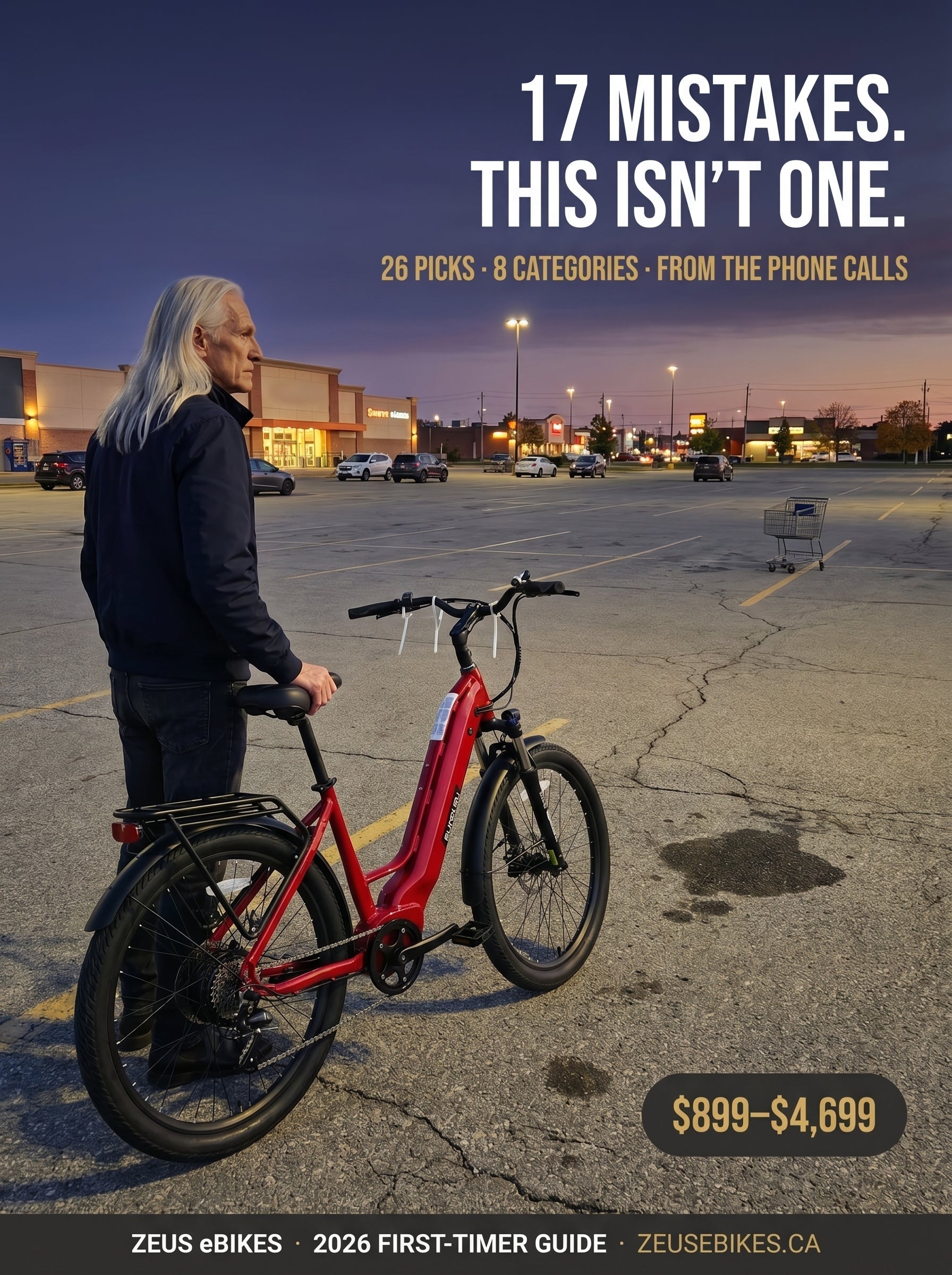
We answer 1-866-938-7580 every day. This is the checklist we wish every caller had read first. 17 mistakes. 20 picks across 8 categories. The guide nobody else wrote — because nobody else takes the calls.

In This Guide
- The First Question Nobody Asks
- Mistake #1: Trusting Marketing Over Quality
- Mistake #2: Thinking Watts = Power
- Mistake #3: Buying Battery Like a Gas Tank
- Mistake #4: Not Understanding Pedal Assist
- Mistake #5: Buying a Moped as a First Bike
- Mistake #6: Lying About Your Body
- Mistake #7: Thinking Wheel Size = Fit
- Mistake #8: Ignoring Handlebar Position
- Mistake #9: No Rack Option on Your Only Bike
- Mistake #10: Wrong Suspension for Your Back
- Mistake #11: Overconfidence at Speed
- Mistake #12: Misunderstanding Warranty
- Mistake #13: Free Lock = Good Lock
- Mistake #14: Asking “What’s the Best Bike?”
- Mistake #15: Good Launch ≠ Good Bike
- Mistake #16: Caring About Top Speed
- Mistake #17: Underestimating How It Changes Your Life
- 20 Picks Across 8 Categories
- FAQ — 10 First-Timer Questions
- What We’d Tell Our Own Family
The First Question Nobody Asks
Every first-timer calls and asks: “What is the best ebike?” That is the wrong first question. The right first question is: “Am I planning to keep this bike? If yes, for how many years?”
If the answer is “I am not sure if cycling is for me” — buy the Samebike CY20 at $1,199. Test the concept. If you love it, upgrade. If you don’t, you spent $1,199 — not $2,699.
If the answer is “I plan to keep it for years and I have decent credit” — finance something you will not outgrow. Monthly payments on a $1,994 bike are approximately $167/month. That is less than a month of downtown parking in any Canadian city. Budget should not be determined by what is in your pocket today — it should be determined by how long you plan to ride.
If you do not keep the bike — what do you do with it? You can sell it. Ebikes hold value reasonably well if maintained. But deciding up front whether this is a test or a commitment changes every decision that follows.
Samebike CY20
$1,199 CADThis is the bike for the person who is not sure yet. At $899, you test whether an ebike fits your life with minimal financial risk. Folding frame stores in a closet or car trunk. 28 kg — light enough to carry up a flight of stairs. Shimano 7-speed with 45–90 km range covers most commutes. If you love it, upgrade to something with a torque sensor and more battery. If you do not, you spent less than two months of car insurance. See it in our folding guide.
Honest limit: Mechanical disc brakes (not hydraulic). 20×2.35″ tires are not fat tires — less traction in snow and mud. Cadence sensor only. This is not a forever bike — it is a starter bike priced so you can afford to find out.
Mistake #1 — Trusting Marketing Over Quality
A brand launches. They give 10 bikes to influencers. They sell 50 at a 50% discount to seed 50 five-star reviews. A month later, the internet says they are the best brand in the category. This happens regularly. A good launch does not mean a good bike.
Consumers are easy to manipulate — and we say that as people who sell to consumers. A manufacturer can Super Launch a product line with marketing budget and review seeding. But marketing budget does not build motors, and review count does not test batteries. Ask instead: how long has the company been operating? Do they have a phone number? Do they honour warranty claims? What happens to your bike if the company disappears in 18 months? Ask the former owners of Juiced, VanMoof, Dost, or Zugo bikes.
Our guide to spotting a legitimate ebike store gives you the full checklist. But the short version: if the brand has more influencer videos than warranty claims resolved, the marketing budget is bigger than the engineering budget.
Mistake #2 — Thinking Watts = Power
This is the single most common misconception we correct on calls. Wattage is not power. Torque is power.
Wattage measures electrical input — how much energy the motor consumes. Torque (measured in Newton metres, Nm) measures mechanical output — how much force the motor puts to the wheel. A 500W motor producing 80 Nm of torque is more powerful and more efficient than a 1,500W motor producing 80 Nm, because it achieves the same force with one-third the energy draw. That means better range, less battery drain, and the same hill-climbing ability.
Nobody buys a car based on the size of the gas tank. Do not buy an ebike based on wattage.
When comparing motors: look at torque (Nm) first, wattage second. A bike with high torque and lower wattage has an efficient motor. A bike with high wattage and low torque has an inefficient motor that drains the battery faster for the same result. Our wattage guide breaks this down with specific models.
Mistake #3 — Buying Battery Like a Gas Tank
First-timers compare battery sizes the way they compare gas tanks: bigger = better. That is not how ebikes work.
The same 20Ah battery paired with three different motors — a 500W mid-drive, a 500W rear hub, and a 1,000W rear hub — will deliver three completely different ranges even with the same rider, same weather, same slope. Because range is a function of motor efficiency, not just battery capacity.
A mid-drive motor works through the gears — it multiplies your pedalling effort through the drivetrain, which makes it dramatically more efficient on hills. A hub motor pushes the wheel directly — simpler, fewer moving parts, but less efficient when climbing. And within hub motors, a motor with a high gear ratio inside the hub is more efficient than one without.
Range also depends on how lazy you are. If you stay in the same gear and let the motor do all the work, your range will suffer. If you shift gears properly (lower gears for hills, higher gears for flat) and use pedal assist instead of throttle-only, your range improves dramatically.
Expect 50–70% of the manufacturer’s claimed range in real Canadian conditions. In winter (below −10°C), subtract another 30–40%. Buy more capacity than you think you need.
Already know what you need? Skip to the picks.
20 bikes across 8 categories — or call 1-866-938-7580 and we will match you in 10 minutes.
Jump to 20 Picks → Financing Options →
He just learned that watts don’t mean what he thought. The manual is open to the wrong page. The Allen key is the wrong size. This is the part nobody photographs — because it doesn’t sell bikes. It sells honesty. · Playcut.ai
Mistake #4 — Not Understanding Pedal Assist
Almost none of the first-time buyers who call us understand this. Almost all of the bikes we sell have both throttle AND pedal assist. They are not either/or. But the type of pedal assist sensor makes a massive difference in how the bike feels.
Cadence sensor: Detects whether you are pedalling (binary on/off). Any pedal movement triggers the motor at the selected power level. Feels like an on/off switch — which can be jerky, especially from a stop.
Torque sensor: Measures how hard you are pedalling and adjusts motor power proportionally. Push harder, get more help. Ease off, the motor eases off. Feels like a bicycle with a tailwind — smooth, natural, and better for exercise because you are actually working.
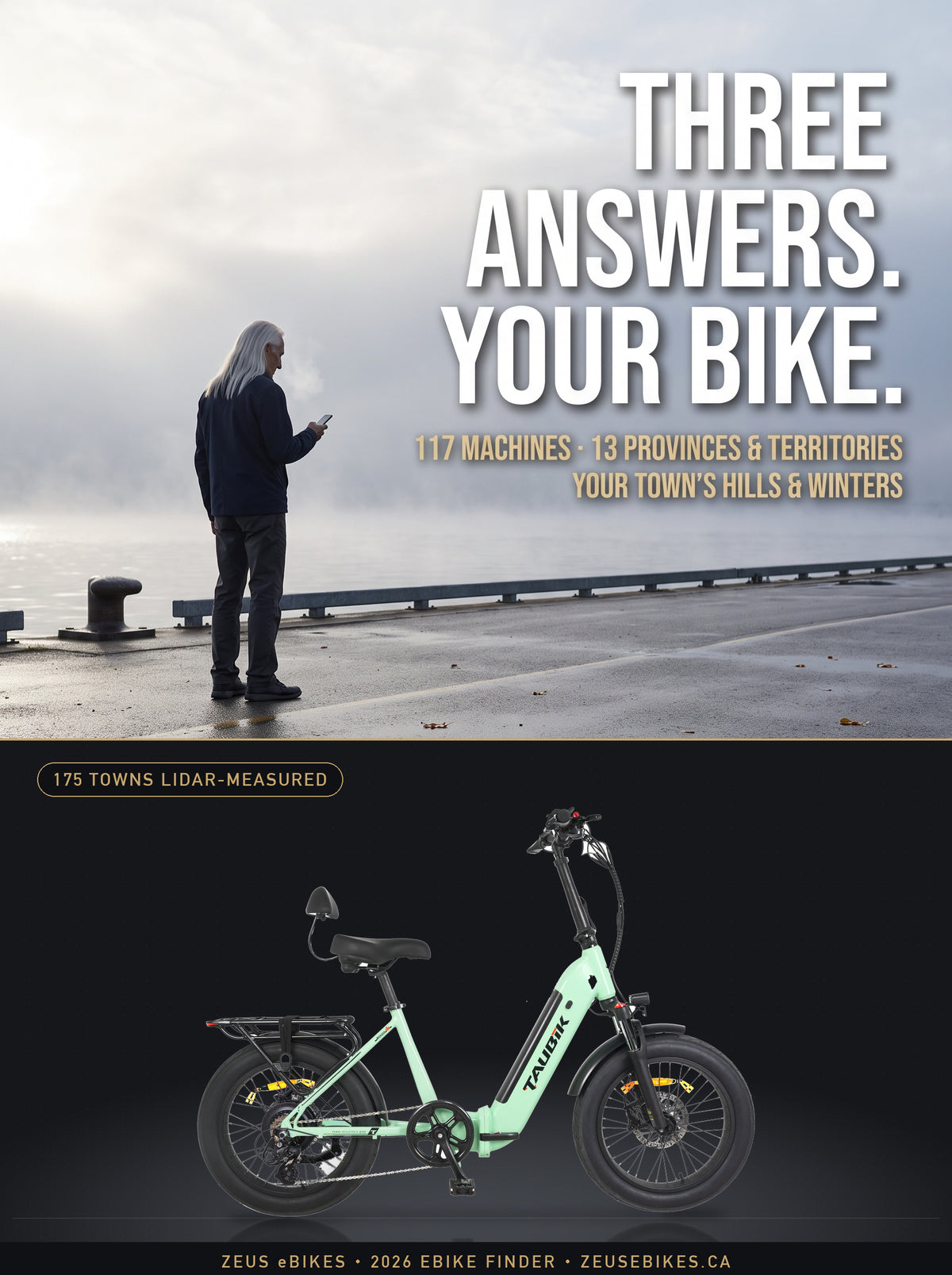
Torque sensors are also more efficient (better range per charge) because the motor is not running at full power every time you barely touch the pedals. Most bikes under $1,500 use cadence sensors. The Eunorau Meta 26 ($2,295) and Taubik Blackburn 275T ($2,799) both offer torque sensors — and the Blackburn lets you switch between torque and cadence mode. Our pedal assist vs throttle guide covers this in full.
Taubik Blackburn 275T
$2,799 CADThe only bike in our catalogue that lets you switch between torque and cadence sensor mode. Start in cadence mode to learn how pedal assist works. Switch to torque mode when you want smoother, more natural power delivery and better range. This is the bike that teaches you what kind of rider you are — without forcing you to choose before you know. Shimano Altus 7-speed. Optional second battery ($549) brings total to approximately 1,411 Wh. See it in our step-thru guide.
Honest limit: 70 Nm torque is adequate for moderate hills but not steep grades. Not a fat tire bike — the 27.5×2.35″ tires are for pavement and light gravel, not snow or sand. No full suspension.
Mistake #5 — Buying a Moped as a First Bike
We sell moped-style bikes. They are fun. They look great. But a moped is not a first bike.
Moped-style ebikes typically have bench seats with no height adjustment. That means you cannot fine-tune the fit to your body — leg extension, saddle height, riding posture. On a traditional bicycle frame with an adjustable seat post, you dial these in over the first few rides until the bike feels like an extension of your body.
You do not know how you like to ride yet. Do you prefer upright or leaning forward? City streets or trails? Exercise or pure transport? An adjustable seat lets you answer these questions. A bench seat makes the decision for you.
Buy a bike with an adjustable seat as your first ebike. Learn how you ride. Then — if you want a moped as your second bike — the Z8 starts at $1,199 and is one of the most fun machines we sell.
Eunorau Meta 26
$2,295 CADThis is the bike that solves Mistake #5. Step-through frame for easy mounting. Adjustable seat post so you can dial in the perfect riding position over your first week. Torque sensor for smooth, natural power delivery. Also sold as the smaller Meta 24, so the line fits a wider range of riders. Optional dual battery for extended range. Rack-compatible. Everything a first bike needs, nothing it does not. See it in our rider type guide.
Honest limit: 55 Nm torque is on the lower end — steep hills above 10% grade will require more pedalling effort. No full suspension. Not a fat tire bike. This is built for paved roads and light gravel, not trails or deep snow.
Mistake #6 — Lying to Yourself About Your Body
You are a big guy. Tough. Strong. You can swing your leg over a step-over frame. Except your hip says otherwise every time you mount and dismount 15 times a day — at every red light, every stop sign, every coffee shop.
If you have any hip mobility limitation, a step-through frame is not a compromise — it is the correct engineering solution. You step through the frame instead of swinging your leg over it. No hip strain. No balance wobble at stops. No ego-driven suffering.
Check the manufacturer’s rider height range on every product page. If you are on the edge of the range, call us before ordering — not after. A bike that is too large leaves you stretched out and unsafe when stopping. A bike that is too small gives you inefficient pedalling and knee pain. Inseam is the most predictive measurement — not overall height.
Mistake #7 — Thinking Wheel Size = Fit
This could not be more wrong. We have ridden 20-inch bikes that were too big at 6’1″ and 26-inch bikes that were too small. Wheel size determines ride characteristics. Frame geometry determines fit.
- 20-inch wheels: More manoeuvrable, lighter, fold into smaller packages. Common on folding and moped-style bikes.
- 26-inch wheels: Better rolling momentum, more stable at speed. Common on mountain and fat-tire bikes.
- 27.5-inch wheels: Balance of agility and stability. Common on commuters and trail bikes.
None of these numbers tell you whether the bike fits your body. The standover height, seat post range, and handlebar reach determine fit. Check the product page for the rider height range. If it is not listed, do not buy blind — call and ask.
Mistake #8 — Ignoring Handlebar Position
This only becomes obvious after hundreds of rides across different bikes. But it matters from day one.
Upright handlebars (monkey bars): You sit upright. You can see more scenery. You can chat with a friend riding beside you without cranking your neck. And if you slip on ice or hit a pothole, you do not hit the pavement face-first — because you are not leaning forward over the front wheel.
Forward-lean handlebars: Better aerodynamics. More efficient power transfer. Preferred for exercise-focused solo riding and higher speeds.
If you are riding for transport, for socialising, or in Canadian winter — upright is safer and more comfortable. If you are riding for exercise and speed on clear roads — a moderate lean is fine. Your first bike should probably be upright. You can always lean forward on a second bike once you know your preference.
Mistake #9 — No Rack Option on Your Only Bike
If this is your only ebike — and for most first-timers it will be — and you plan to use it for anything beyond pure recreation, the bike needs the option to add a rear rack. Not a rack included — at minimum, the mounting points to add one later.
All that power and range means nothing if you cannot carry groceries, a backpack, a laptop bag, or a set of tools. During three years of testing, we have loaded bikes to the point that the front wheel lifts off the ground and still made it home. The point is: how you actually use the bike matters more than the specs.
A single parent commuting to work with a grocery stop on the way home needs a different bike than a weekend trail rider. The single parent needs: rear rack, adjustable seat, good battery life, reliable warranty, and fast warranty response — because if the bike is down for four weeks waiting for a part, that costs real money in Uber rides.
Mistake #10 — Wrong Suspension for Your Back
If you have any back issues — herniated disc, chronic pain, spinal fusion, anything — you need full suspension. And not just any full suspension. You need good full suspension with adjustable damping, or be prepared to swap the rear shock for a better one.
Hardtail bikes (front suspension only) transmit every bump through the saddle directly into your spine. On smooth pavement, fine. On Canadian roads with potholes, frost heaves, and cracked asphalt? Your back will tell you within the first week.
Full suspension absorbs impacts from both wheels. The Freesky Eurostar Ultra M-410 ($2,099) has 120mm downhill full suspension with 4-piston hydraulic brakes. The Eunorau Specter-S 3.0 ($4,099) has inverted forks and a rear shock. Both are designed for rough terrain — which, in Canada, includes most city roads.
Freesky Eurostar Ultra M-410
$2,099 CADFull suspension, fat tires, 4-piston hydraulic brakes, 1,200 Wh battery, and UL2271 battery certification — all for $1,887. If your back demands full suspension and your budget demands value, this is the rational choice. 120mm downhill fork absorbs the worst of Canadian road conditions. 26×4.0″ fat tires for winter traction and pothole absorption. 400 lb payload. 6061 aluminium frame. Turn signals and 800-lumen LED headlight built in. Rider height 5’3″–6’3″. See it in our fat tire guide.
Honest limit: Speed sensor (cadence-based), not a torque sensor. No geared mid-drive — this is a hub motor. Seat height starts at 33.9″ — shorter riders should verify fit before ordering.

15 km/h. Both brakes covered. Scanning right. This is what the first Tuesday morning feels like when you stop driving and start riding. · Playcut.ai
Mistake #11 — Overconfidence at Speed
Most of the bikes we sell, unlocked, can reach 48 km/h. Should you do that on your first bike? No. You should not.
We have seen friends who ride motorcycles, friends who race cars, tough guys with years of two-wheel experience — wipe out on a new ebike. Because an ebike is not a motorcycle. They share two wheels. Everything else is different. Response time. Weight distribution. Braking distance. Suspension travel. Tyre grip. The feel of 50 km/h on ebike suspension is nothing like the feel of 50 km/h on motorcycle suspension.
Overconfidence is the most dangerous thing a first-time rider can bring. Motorcycle experience does not transfer. Car racing experience does not transfer. Athletic confidence does not transfer. If anything, it makes you more reckless because you assume competence you do not have.
Start in a quiet parking lot. Keep assist on the lowest level for your first week. Do not exceed 25 km/h until you are comfortable braking and turning at 20 km/h. Wear a helmet every single ride — it reduces head injury risk by up to 85%.
Mistake #12 — Misunderstanding How Warranty Works
Almost every first-timer assumes warranty means shipping the entire bike back to the store. It does not.
At Zeus, warranty works like this: you email support@zeusebikes.ca with your order number, photos, and a video of the issue. We contact the manufacturer on your behalf. They approve the replacement part. We ship the part to your door. You swap it yourself — with phone or video call support from us — or take it to a local bike shop ($50–$75 for most part swaps).
The bike never leaves your house. You do not box it up. You do not pay for return shipping. Typical timeline: approximately 4 weeks for common parts (battery, controller, display, throttle). Some brands are faster. Some are slower. If warranty response time matters to you — and it should if this bike is your transport — call us before you buy. We will tell you honestly which brands respond fast and which do not.
For the full process, see our How Buying Works page.
Mistake #13 — Free Lock = Good Lock
Many manufacturers include a “free lock” with the bike. We include real locks — heavy-duty ones we use ourselves. But plenty of manufacturers include $1.50 cable locks from China and call them “free.”
A free lock does not necessarily mean a good lock. Apply common sense. A $1.50 cable lock will not last as long as a $50 U-lock. A thin cable can be cut with garden shears in 3 seconds. A Kryptonite U-lock requires an angle grinder.
Budget $200–$400 for accessories on top of the bike price:
| Accessory | Budget | Priority |
|---|---|---|
| Helmet | $50–$150 | Non-negotiable |
| Lock (real U-lock or chain) | $50–$100 | Non-negotiable |
| Lights (front 300+ lumen + rear) | $30–$80 | Non-negotiable |
| Pump (with pressure gauge) | $20–$40 | Non-negotiable |
| Fenders | $30–$60 | Recommended (rain/slush) |
| Mirror | $15–$30 | Recommended (traffic) |
| Bell | $10–$20 | Required by law in most provinces |
| Phone mount | $20–$40 | Optional |
Our theft protection guide covers the full three-layer locking system. Our insurance guide covers whether you need coverage.
Need help choosing the right bike + accessories?
1-866-938-7580 — we will build you a complete setup: bike, lock, helmet, lights. One call.
Browse All Collections → Theft Protection Guide →
$1.50 vs $80. One lasted 3 seconds. One has survived Queen Street for 14 months. There is a reason it weighs more than the charger. · Playcut.ai
Mistake #14 — Asking “What’s the Best Bike?”
“What is the best bike?” is the single worst question you can ask. Best for whom? Best for what?
A single parent who commutes to work, picks up groceries, and needs the bike to survive Canadian winter needs a completely different bike than a weekend trail rider who stores it in a heated garage. The right question is: “What will I actually use this bike for, specifically?”
- How far is your commute? (determines battery needs)
- Where will you store it? (determines folding vs full-size)
- Is this your only transport or a second vehicle? (determines reliability priority)
- Will you ride in winter? (determines tire and motor needs)
- Do you need to carry cargo? (determines rack/payload needs)
- What is your weight and height? (determines frame and motor needs)
Our 8-step buying guide walks through each of these decisions. Our rider type guide matches 14 picks to specific rider profiles. Read one of those before you call us. You will get a better answer, and other customers will not have to wait.
Mistake #15 — Good Launch ≠ Good Bike
A brand you never heard of three months ago has a viral video, 50 reviews, and a clean website. That does not mean they will exist in 18 months. It does not mean they have a parts inventory. It does not mean they will answer a warranty call.
In the last three years: Juiced Bikes went bankrupt. VanMoof went bankrupt. Dost went under. Zugo disappeared. Rad Power Bikes filed Chapter 11 and sold for $13.2 million, and its new owner says it has no obligation to provide warranty or service on bikes bought before December 15, 2025. Every one of those brands had great marketing. Every one of those brands had five-star reviews.
The question is not “do they have good reviews?” The question is: “will they honour my warranty in 14 months?” Our legit store guide tells you how to check.
Mistake #16 — Caring About Top Speed
Most unlocked ebikes we sell can reach 48 km/h. For a first-time commuter, this is irrelevant. Reliability should be your focus. Because top speed on a bike you cannot service, from a brand that might not exist next year, with a warranty that takes 8 weeks to respond — that is not a feature. That is a liability.
If your bike breaks and you depend on it for transport, every day it is down costs you real money. Uber rides. Missed shifts. Late daycare pickups. A bike that does 45 km/h but has a 2-week warranty turnaround is worth more to a commuter than a bike that does 55 km/h with a 6-week turnaround.
Mistake #17 — Underestimating How It Changes Your Life
This is not a sales pitch. This is what actually happens.
Canada is not Europe. Distances are huge. You can cycle for eight hours on flat roads and see the same thing the entire time. An ebike makes those distances manageable. A 22 km commute that would take 90 minutes on a regular bike takes 40 minutes on an ebike. A grocery run that required a car becomes a 15-minute errand. A visit to a friend across the city becomes spontaneous instead of planned.
An ebike will fundamentally change your life. The first-timers who call us six months later do not talk about specs. They talk about how they sold a car. How they lost 15 pounds without trying. How they see their city differently. How their kids ask to ride with them. How they are outside every day instead of inside a car.
That is what this purchase is actually about. Not watts. Not range. Not top speed. Mobility. Freedom. Fresh air. And $6,000–$10,000 per year back in your pocket.
Not sure where to start? Call us.
1-866-938-7580 — two brothers who have ridden every bike below. We will match you in 10 minutes.
Browse All Collections → Financing Options →20 Picks Across 8 Categories
Every bike below has been personally tested. Every spec is verified against the live product page. Every price is current as of April 2026. Every one ships free across Canada with a warranty backed by a phone number: 1-866-938-7580.
Each category has a low (budget entry), mid (sweet spot), and best (top of category) pick. Start with the category that matches how you plan to use the bike — not the price column.
| Category | Low (Budget) | Mid (Sweet Spot) | Best (Top) |
|---|---|---|---|
| Folding | Samebike CY20 — $1,199 | Eunorau Meta Foldable — $2,295 | Velotric Fold 1 Plus — $2,599 |
| Step-Thru / Commuter | Eunorau Meta 26 — $2,295 | Taubik Blackburn 275T — $2,799 | — |
| Mountain / Trail | Samebike XD26-II — $1,499 | — | Eunorau Specter-S 3.0 — $4,099 |
| Fat Tire / All-Terrain | Freesky Wild Cat Pro — $2,299 | Eunorau FAT AWD 3.0 — from $2,299 | Smartravel Raptor Pro — $2,599 |
| Trike | Meigi Hera — $1,699 | CitiTri E-310 — from $2,399 | Addmotor Arisetan II — $4,199 |
| Kids | eKids 20″ 250W — $1,299 (we also carry the eKids 16 and 24) | ||
| Teens | Z8 — $1,199 | Eunorau Flash 1000W — $2,169 | — |
Featured Pick — Best Folding eBike for First-Timers
Velotric Fold 1 Plus
$2,599 CADSensorSwap — switch between torque and cadence sensor like the Blackburn 275T, but in a folding package. Apple Find My built in for anti-theft tracking. 450 lb payload — the highest of any folding ebike in our catalogue. Hydraulic 180mm brakes. Integrated front and rear lights. 20×3.0″ Arisun knobby tires for grip on wet roads. If you need a first bike that folds for apartment storage or car-trunk commuting, this is the best folding ebike we sell. See all 10 folding picks.
Honest limit: 624 Wh single battery — no dual-battery option. In Canadian winter, expect 60–75 km real-world range. 30.6 kg is manageable for carrying short distances but not truly lightweight.
Featured Pick — Best Retro / Moped Value + Teens
Z8 / Z8 Pro
$1,199–$1,699 CADTwo orderable versions on the same platform. The Z8 ($1,199) is the budget entry. The Z8 Pro ($1,699) adds a second battery for range: Riding Times’ table gives it 100–120 miles with pedal assist, and its FAQ says up to 75 miles. Both have adjustable seat posts — unlike most moped-style bikes (see Mistake #5). Fat tires and full suspension. Retro styling that makes people smile. This is the bike you buy when you already know you love riding and want something fun. See it in our moped guide. Also recommended for teens.
Honest limit: Cadence sensor on all variants. Both versions have mechanical disc brakes. 79–91 lbs is heavy for carrying up stairs. Remember Mistake #5: if this is your first ebike and you have never ridden before, start with a standard frame. If you have ridden and know how you ride, the Z8 is one of the most fun machines in our catalogue.
Featured Pick — Best Fat Tire / Winter First Bike
Eunorau FAT AWD 3.0
from $2,299 CADIf your first question is “can I ride this through a Canadian winter?” — this is the answer. All-wheel drive with a motor in each wheel prevents the rear-wheel spin that single-motor bikes suffer on ice and packed snow. And it is the only AWD eBike with a torque sensor — the sensor that prevents sudden power bursts from spinning your wheels on slippery surfaces. Step-thru frame. EUNORAU GO app for motor customisation. Optional second battery ($400+) brings total to 1,440 Wh. See it in our winter guide. Also featured in our dual motor guide.
Honest limit: 110 Nm combined torque is the lowest of any AWD bike we sell — adequate for most hills, not the pick for sustained 12%+ grades with a heavy rider. 720 Wh single battery is tight for winter — budget for the second battery to unlock 90+ km range at 0°C.
Retro / Moped — 4 Picks by Strength
Retro and moped-style bikes are the deepest category in our catalogue. Instead of low/mid/best, here are 4 picks by what each one does best. Remember Mistake #5: a moped is a great second bike. If this is your first ebike, consider a standard frame with an adjustable seat first.
| Strength | Pick | Why |
|---|---|---|
| Budget entry | Z8 — $1,199–$1,699 | 2 versions, fat tires, full suspension, adjustable seat |
| Best build quality | Vtuvia Tiger Plus — $2,599 | Full suspension fat tire, premium frame, 400 lb payload |
| Best looks | Eahora DL2000 — $3,799 | 1,560 Wh, 240mm rotors, the bike that stops traffic |
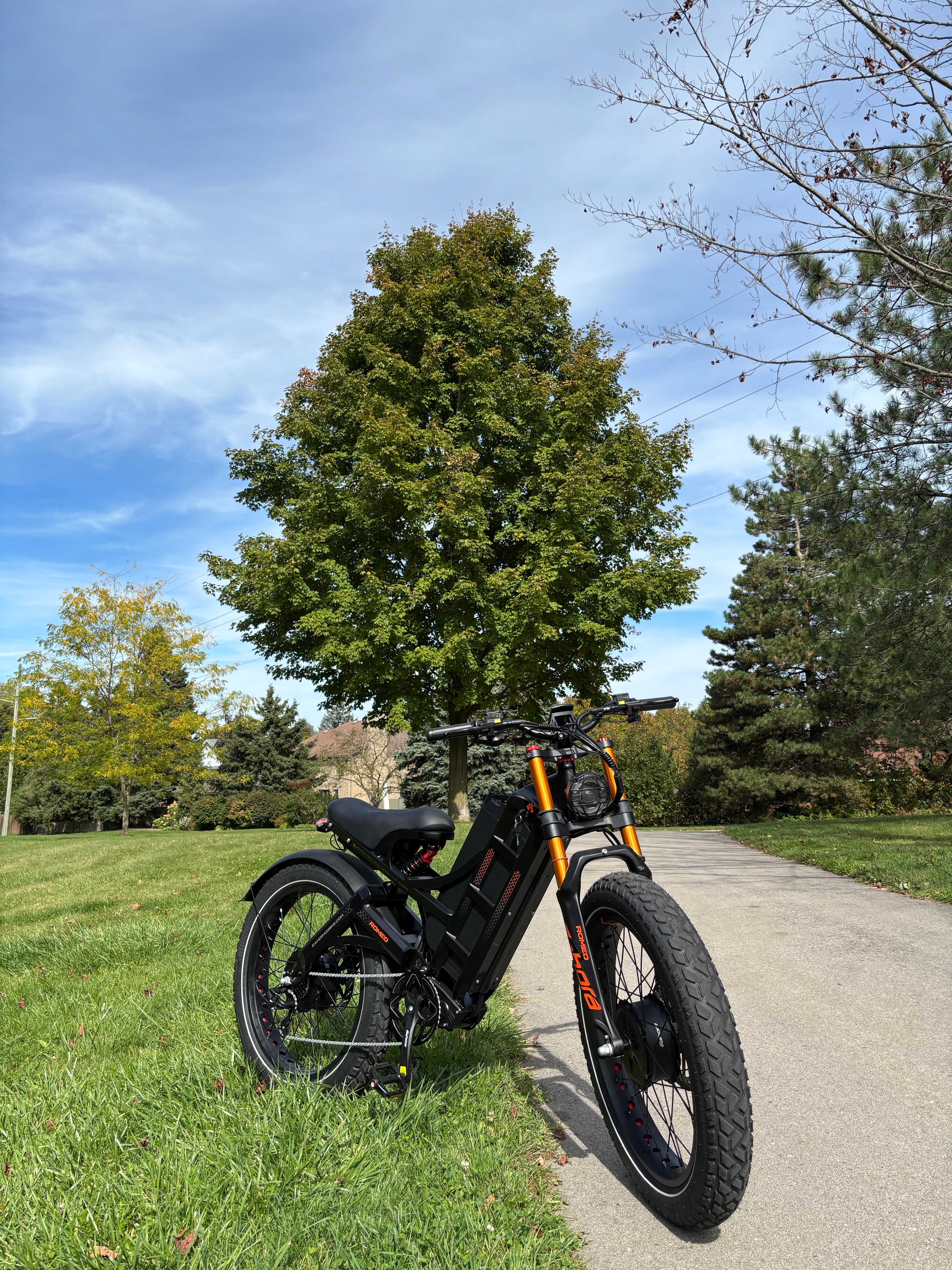
| Largest rider | Eahora Romeo Ultra II — $5,599 | Biggest frame, 500 lb payload, 4,800 Wh dual motor flagship |
For the full moped lineup, see our moped guide.
20 bikes. 8 categories. Free shipping across Canada. Canadian warranty on every one.
1-866-938-7580 — call us. We’ll match you in 10 minutes.
Browse All Collections → Financing Options →FAQ — 10 First-Timer Questions
How much should I spend on my first ebike in Canada?
It depends on whether you plan to keep it. Not sure? Start around $1,200 (CY20, $1,199). Plan to keep it? Finance a $1,500–$2,500 bike — monthly payments on a $1,994 bike are ~$167/month. Budget $200–$400 extra for accessories. The bike is about 70% of your total first-year cost.
What is the difference between a torque sensor and a cadence sensor?
Cadence = on/off. Torque = proportional to your effort. Torque feels smoother, gets better range, and gives a better workout. Most bikes under $1,500 have cadence sensors. The Meta 26 and Blackburn 275T have torque sensors. The Blackburn lets you switch between both modes.
Does higher wattage mean more power?
No. Torque (Nm) determines how powerful the bike feels. Wattage determines how much energy it consumes. A 500W motor with 80 Nm is more powerful AND more efficient than a 1,500W motor with 80 Nm. Compare torque first. Read our wattage guide.
Does wheel size determine fit?
No. Frame geometry determines fit. We have ridden 20-inch bikes too big for a 6’1″ rider and 26-inch bikes too small. Check the manufacturer’s rider height range on the product page.
What accessories do I actually need?
Four non-negotiables: helmet ($50–$150), real lock ($50–$100), lights ($30–$80), pump with gauge ($20–$40). Total: $150–$370. Budget $200–$400 on top of the bike price.
How does warranty work?
You do NOT ship the bike back. Zeus ships the replacement part to you. Email support@zeusebikes.ca with order number, photos, and video. We contact the manufacturer. Part ships to your door (~4 weeks). You swap it with phone support or take it to a local shop. See How Buying Works.
Should I buy a moped as my first bike?
No. Moped bench seats have no height adjustment. Your first bike needs an adjustable seat post so you can learn your riding position. A moped is a great second bike once you know how you ride. The Meta 26 ($2,295) is what a real first bike looks like.
How far can I actually ride on one charge?
Expect 50–70% of the claimed range in real conditions. The same battery with different motors gives different ranges — motor efficiency matters more than battery size. In Canadian winter, subtract another 30–40%. Buy more capacity than you think you need.
Is it safe for a first-time rider?
Yes — if you respect the learning curve. An ebike is NOT a motorcycle. Overconfidence is the biggest risk. Start slow, stay under 25 km/h for the first week, wear a helmet always. Helmet reduces head injury risk by up to 85%.
Can I ride in Canadian winter?
Yes. Fat tires (4.0″+) for traction. AWD for ice — the FAT AWD 3.0 (from $2,299) is the only AWD with a torque sensor. Never charge below 0°C — bring battery indoors. Wipe salt after every ride. Budget 30–40% more battery than summer needs. Read our winter guide.
What We’d Tell Our Own Family
We are two brothers who built this company. One of us spent seven years in hospitals — acute care, rehab, public health — watching what happens when people buy equipment they cannot control. That experience shapes how we recommend eBikes: honestly, with the limitations first, because a disappointed buyer is worse than a lost sale.
If someone in our family said “I want to buy my first ebike,” here is what we would do:
- Ask them why. “I want to see if ebikes fit my life” = CY20 at $1,199. “I plan to commute year-round” = Blackburn 275T at $2,799. “I need winter traction” = FAT AWD 3.0 at $2,299.
- Tell them to read this page before calling. Every minute they spend here saves us 10 minutes on the phone — and saves them from buying the wrong bike.
- Tell them the truth: the bike is 70% of the cost. Budget $200–$400 for a real lock, helmet, lights, and pump. Finance the bike if it means buying the right one instead of the cheapest one.
Read the 17 mistakes. Check the 20 picks. Match your riding to a category. Then call us at 1-866-938-7580 — we would rather lose a sale than sell you the wrong bike.
Best eBike for Every Rider Type — 14 picks matched to profiles
Best Folding eBikes Canada — 7 verified picks
Best Step-Thru eBikes Canada — 16 step-through picks
Electric Mopeds Canada — 11 moped-style picks
Fat Tire eBikes Canada — 11 verified picks
Electric Trikes Canada — 10 picks
eBikes for Teens Canada — 10 picks + safety data
eBikes for Seniors Canada — 19 picks, clinical guide
How to Finance an eBike in Canada — 7 options, real math
eBike Theft Protection Canada — the 3-layer system
eBike Insurance Canada — do you need it?
500W vs 750W vs 1000W Guide — wattage decoded
Pedal Assist vs Throttle — the full comparison
Best eBikes for Winter Canada — cold-weather picks
Dual Motor eBikes Canada — 10 AWD picks
How Buying from Zeus Works — ordering, shipping, warranty, returns
All photography by Playcut.ai — personalised AI actor technology

Share:
Best Electric Bikes Toronto 2026: 15 Picks & Where to Buy
AI Replacing Jobs in Canada? Follow the Money — Who Benefits When You're Afraid