
How to Spot a Legit eBike Store in Canada (2026 Checklist)
Published: February 2026 | By: Zeus eBikes Canada
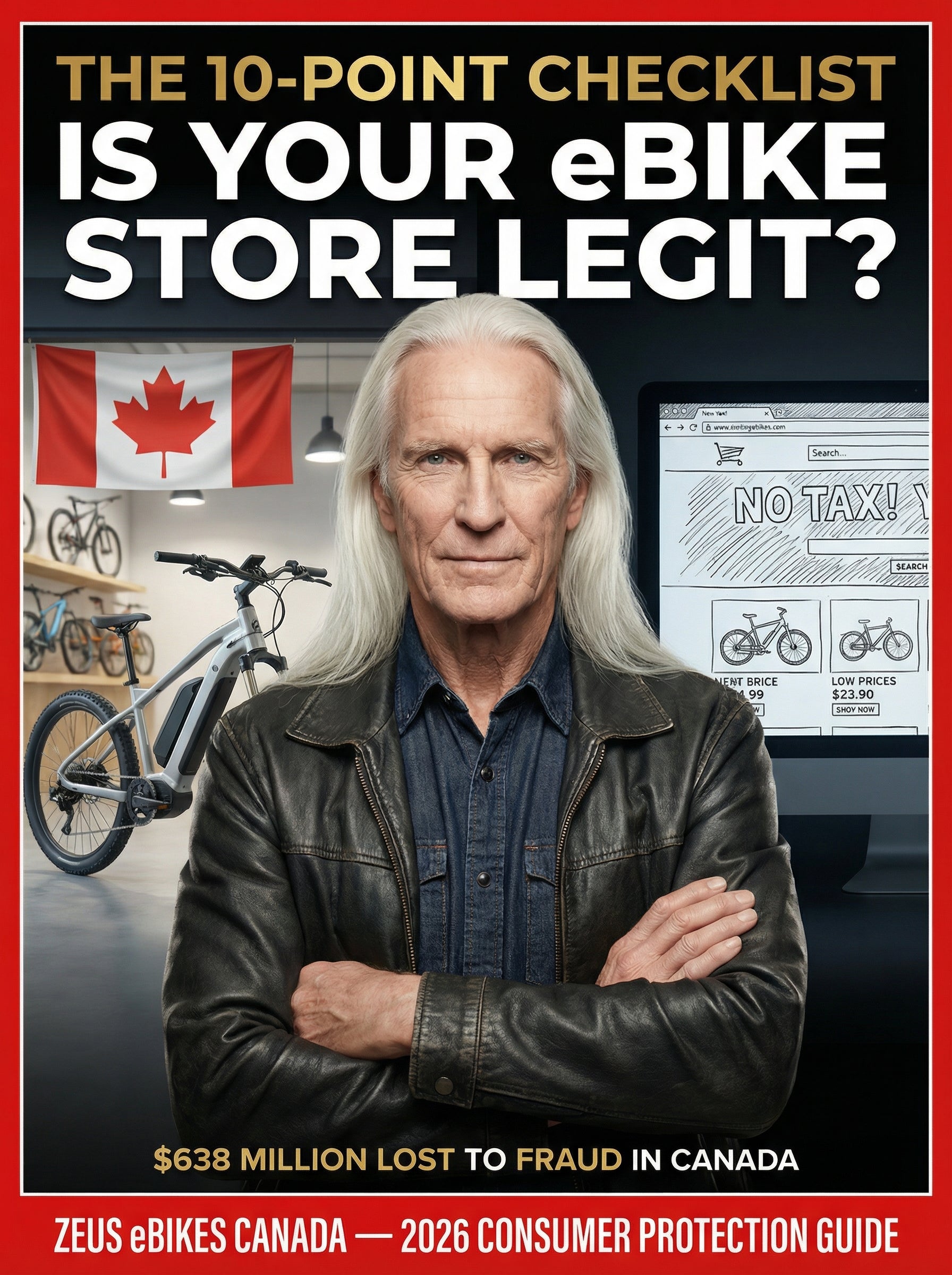
Our customer service team hears the same question multiple times a week: "I found this bike online for way cheaper — is that store legit?" Usually, the answer is no. Canadians reported $638 million in fraud losses in 2024 (Canadian Anti-Fraud Centre) — and the CAFC estimates that figure represents only 5–10% of actual losses. Online purchase scams are the fourth-riskiest fraud category in Canada, with 87.5% of targets losing money (BBB Scam Tracker, 2024).
Electric bikes cost between $1,500 and $5,000. That is too much money to hand to a store you cannot verify. This guide gives you a concrete, 10-point checklist you can run on any online ebike store in under five minutes — before you spend a dollar.
In This Guide
Why This Matters More in 2026 Than Ever
Online ebike fraud is accelerating because the market is booming. Canada's e-commerce penetration hit 11.9% of all retail sales in 2024 (Statista), and electric bike demand continues to climb. That growth has attracted a wave of illegitimate sellers — ghost storefronts, overseas dropshippers, and outright scam operations — targeting Canadian buyers who are new to the category and unfamiliar with what to look for.
The numbers are stark:
- $638 million in reported fraud losses across Canada in 2024, up from $578 million in 2023 — a 300% increase since 2020 (Canadian Anti-Fraud Centre, 2024 Annual Report)
- 87.5% of Canadians targeted by online purchase scams lost money (BBB Scam Tracker Canada, 2024)
- 39% of Canadian online shoppers have abandoned a cart specifically due to fraud concerns (TransUnion Canada, 2024)
- Online shopping fraud reports to the BBB are up 125% year over year (BBB, 2024 Study Update)
Meanwhile, 56% of Canadians said they were targeted by fraudsters in the second half of 2024 alone (TransUnion Canada, April 2025). The majority of these scams originated on social media — particularly Facebook, where impossibly cheap ebike ads have become routine.
Legit Store
- GST/HST on receipt
- Canadian business address
- Phone number answered by humans
- Published warranty with clear terms
- UL-certified, name-brand battery cells
- Reviews on Google, BBB, Trustpilot
- Ships from Canada in 3–10 days
- Domain registered 1+ years ago
Red Flag Store
- No tax charged at checkout
- No address or PO box only
- Email-only or chatbot support
- "30-day guarantee" with no details
- "Lithium battery" — no brand, no cert
- Reviews only on the store's own site
- Ships in 30–60 days from overseas
- Domain created within the last 6 months
The 10-Point eBike Store Trust Check
Run every online ebike store through these 10 checks before purchasing. Each check takes less than 30 seconds. If a store fails two or more, do not buy — regardless of how good the price looks.
| # | Check | Pass | Fail |
|---|---|---|---|
| 1 | Charges GST/HST? | Tax line visible at checkout | No tax — no CRA registration |
| 2 | Canadian business address? | Verifiable on Google Maps | PO box, blank, or residential |
| 3 | Real phone number? | Answered by a human | No number, or always voicemail |
| 4 | Published warranty? | Dedicated page with clear terms | Vague footer line or nothing |
| 5 | Certified battery? | UL 2849 + named cells (Samsung, LG) | No cert mentioned, no brand |
| 6 | Third-party reviews? | Google, BBB, Trustpilot presence | Reviews only on own site |
| 7 | Realistic specs? | Range, Wh, weight match industry norms | 200 km on 10Ah? Math does not work |
| 8 | Ships from Canada? | 3–10 day delivery with tracking | 30–60 day wait, overseas origin |
| 9 | Real social media? | Months of posts, real engagement | New account, stock photos, zero comments |
| 10 | Business > 1 year old? | WHOIS shows domain age 12+ months | Domain registered < 6 months ago |
Below, each check explained in detail with the evidence behind it.
1. Do They Charge GST/HST?
This is the single most important check. Under Canadian tax law, any business exceeding $30,000 in annual sales must register with the CRA and collect GST/HST on every transaction (Canada Revenue Agency). Since July 1, 2021, even non-resident sellers fulfilling orders in Canada must register and collect tax.
Any ebike store doing real volume will easily exceed the $30,000 threshold — that is roughly 15–20 bikes per year. If they are not charging tax, it means one of three things:
- They have no Canadian business registration — no legal obligation to honour warranty or returns under Canadian law
- They are evading tax obligations — if they cut this corner, they are cutting others
- They are shipping directly from overseas — you may owe customs duties on arrival, and you have no Canadian recourse if something goes wrong
Add the item to your cart and go to checkout. If there is zero tax line, ask yourself: why not?
2. Is There a Canadian Business Address?
A legitimate Canadian ebike retailer will publish a physical business address — not a PO box, not a residential unit, not a blank "Contact Us" page. Search the address on Google Maps. If it leads to a storage locker, a house, or a parking lot, that is a red flag.
Forum users on Electric Bike Review have documented sellers operating from "rented storage facilities with no storefront" — businesses that are impossible to visit, impossible to return a bike to, and designed to disappear when complaints pile up.
3. Can You Call a Real Person?
Before you buy, call the store's phone number. A legitimate business will answer during business hours. If the store has no phone number, only offers email support, or sends you to a chatbot that loops endlessly — walk away.
One customer on the BBB reported calling a major Canadian ebike retailer "multiple times" within three weeks of purchase with a motor defect — and never reached a human (BBB, EMMO customer review, 2024). If the store is unreachable before you buy, imagine what happens when something breaks.
4. Do They Have a Published Return and Warranty Policy?
Look for a dedicated page — not a vague sentence buried in the footer. A legitimate warranty policy will specify:
- How long the warranty lasts (frame, motor, battery — each may differ)
- What is covered and what is excluded
- Who pays for return shipping if a warranty claim is needed
- The process for filing a claim (email, phone, form)
Red flag: one retailer required an $820 shipping fee plus a 20% restocking charge to return a $3,620 defective bike (BBB customer review, 2024). Another denied a warranty claim because the customer had changed the tires (Electric Bike Review Forum). Read the policy before you buy — not after.
5. Are Their Batteries Certified?
This is a safety issue, not just a quality issue. Toronto Fire Services responded to 76 lithium-ion battery fires in 2024 — a 1,200% increase since 2020. Fire Chief Jim Jessop called ebike batteries "the largest growing fire safety risk in the city" (CBC News, 2025).
Look for:
- UL 2849 certification — the industry standard for ebike electrical systems
- Named cell brand — Samsung, LG, or Panasonic cells with verifiable part numbers
- Realistic weight — a genuine 48V 20Ah battery weighs roughly 6–7 kg. If the listing does not mention weight, or the battery arrives suspiciously light, the cells may be counterfeit
In January 2026, Amazon and UL jointly sued five Chinese companies for falsely labelling ebike products with UL safety certification trademarks (Electrek, January 2026). Fake certification marks are real, and the consequences — fire, injury, property damage — are serious.
6. Are Customer Reviews Verifiable?
On-site reviews controlled by the seller mean nothing. Check for the store on:
- Google Business Profile — does the store appear with a verified address and customer reviews?
- BBB (bbb.org/ca) — is there a business profile? What is the rating?
- Trustpilot or independent forums — do real customers discuss their experience?
Scam sites use AI-generated reviews with generic five-star praise. If the only reviews are on the store's own website, with no presence on any third-party platform, treat the store as unverified.
7. Are Their Specs Realistic?
One documented case on Endless Sphere forum: a buyer purchased a battery advertised as 48V 72Ah from AliExpress for $100 AUD. It failed after 2 km. Actual capacity was roughly 10Ah — 86% less than claimed. The battery weighed 1.8 kg instead of the 5–6 kg a genuine 72Ah pack should weigh.
If a store claims 200 km of range on a 500W hub motor with a 10Ah battery, the math does not work. If a "Samsung cell" battery costs a fraction of what Samsung cells actually cost, they are not Samsung cells. Cross-reference specs with the Zeus long-range ebike battery guide to understand what realistic capacity looks like.
8. Do They Ship from Canada with Tracking?
Check the shipping page. If the estimated delivery time is 30–60 days, the bike is almost certainly shipping from a Chinese warehouse — not from Canadian stock. That means:
- You may owe customs duties and brokerage fees on arrival
- Returns require international shipping at your expense
- Warranty service means shipping a 30+ kg bike overseas
As one forum user put it: "Who is going to ship an ebike a thousand miles away to get warranty service?" (Electric Bike Review Forum). A Canadian-based retailer ships within 3–10 business days and provides a domestic tracking number.
9. Do They Have Real Social Media Engagement?
Visit the store's Facebook, Instagram, or YouTube page. A legitimate business will have:
- Posts spanning months or years (not a burst of content created last week)
- Real customer comments and replies
- Original photos and videos of actual products
Scam operations create polished social media profiles overnight using stolen product photos and stock images. If the account has thousands of followers but zero real comments or engagement, the followers were purchased.
10. Has the Business Existed for More Than a Year?
Check the domain age using a WHOIS lookup (search "whois [website URL]"). If the domain was registered within the last 6–12 months, proceed with extreme caution.
Scam ebike stores are designed to be disposable. Forum users describe the pattern: "Part of the scam is closing up shop, leaving customers high and dry when they start to have problems, and opening a new 'brand' selling the same [product]" (Electric Bike Review Forum). A store with no history has no accountability.
Charges GST/HST? Canadian address? Real phone number? Published warranty? Certified battery? Third-party reviews? Realistic specs? Canadian shipping? Real social media? More than a year old? If a store passes all 10 — you are dealing with a legitimate operation. If it fails two or more — the savings are not worth the risk.
What Happens When You Buy from a Store That Fails the Check
These are not hypotheticals. Every case below is documented on the BBB or public forums. Initials match the original published complaints.
Attractive price → defective product → impossible return process → company disappears. Four different buyers. Four different stores. The same outcome every time. The 13% you "save" on tax becomes the most expensive discount you have ever taken.
The Hidden Cost of "No Tax"
If an ebike store is not charging GST/HST, you are not saving money — you are losing protection. The tax line at checkout is not just a government fee. It is proof that the seller is a registered Canadian business with legal obligations to you.
What the CRA Requires
Any business selling taxable goods in Canada with annual sales exceeding $30,000 must register for a GST/HST number and collect tax on every sale (Canada Revenue Agency). Since July 1, 2021, this requirement extends to non-resident vendors and marketplace operators fulfilling orders to Canadian consumers.
The penalties for non-compliance are severe: late filing penalties, daily compounding interest, frozen bank accounts, and prosecution in extreme cases (CRA Publication 16-2). A business that ignores these rules is either operating illegally or operating outside Canada entirely.
What "No Tax" Actually Means for You
| What You Think You Get | What You Actually Get |
|---|---|
| 13% savings (HST in Ontario) | No enforceable warranty under Canadian law |
| A cheaper bike | No provincial consumer protection coverage |
| Same product, less cost | No Canadian address for returns or repairs |
| Smart shopping | Potential customs duties and brokerage fees on arrival |
| A deal | A 90-day chargeback window as your only recourse |
Provincial consumer protection laws — like Ontario's Consumer Protection Act, which gives you a cooling-off period and 30-day delivery guarantee on online purchases over $50 — technically apply to all transactions with consumers in that province. But enforcement against a seller with no Canadian address, no Canadian assets, and no CRA registration is, in the words of the International Comparative Legal Guide, "extremely difficult" (ICLG, Consumer Protection Laws Canada, 2025-2026).
Battery Safety — The Risk You Cannot See
A cheap ebike battery is not just a performance problem — it is a fire hazard. Toronto Fire Services data tells the story: 76 lithium-ion battery fires in 2024, up from 29 in 2022 — a 1,200% increase since 2020. A lithium-ion battery fire can engulf a room within 90 seconds and burn at temperatures that melt firefighting equipment (CBC News, 2025).
What Goes Wrong
- Counterfeit cells: Batteries labelled as Samsung or LG that contain no-name Chinese cells with a fraction of the claimed capacity — and none of the safety engineering
- No BMS (Battery Management System): Cheap batteries may lack proper overcharge, over-discharge, and thermal protection circuits
- Fake certifications: In January 2026, Amazon and UL filed suit against five Chinese manufacturers for affixing fake UL safety marks to ebike products sold on Amazon (Electrek, Bicycle Retailer, January 2026). Only UL's for-profit certification arm can authorise the use of UL trademarks.
How to Check
| Check | What to Look For | Red Flag |
|---|---|---|
| Cell brand | Samsung, LG, Panasonic with verifiable part numbers | "Lithium battery" with no brand named |
| Certification | UL 2849 or equivalent, with certificate number | No certification mentioned, or a UL logo with no verifiable number |
| Weight | 48V 20Ah ≈ 6–7 kg; 52V 30Ah ≈ 9–10 kg | Battery weight not listed, or suspiciously light on arrival |
| Price | A genuine 48V 20Ah Samsung-cell pack costs $400–$700 CAD | A "72Ah" battery for $100 — impossible at real cell prices |
For a deeper understanding of battery capacity, voltage, and what real-world range looks like in Canadian winter, see our complete guide to long-range electric bikes in Canada.
How to Protect Yourself After Purchase
Even with due diligence, things can go wrong. Here is what to do if they do.
Pay by Credit Card — Always
Credit card purchases give you chargeback rights. Under Canadian regulations, your card issuer must reverse charges plus refund associated interest within two billing cycles or 90 days, whichever is earlier (BLG, 2024). Debit, wire transfer, e-transfer, gift cards, and cryptocurrency offer no buyer protection. Never pay for an ebike with any of these methods.
Know Your Provincial Rights
| Province | Key Online Purchase Protection |
|---|---|
| Ontario | Internet agreements over $50 must be in writing. 10-day cooling-off period. Full refund if delivery exceeds 30 days past promised date (Consumer Protection Act, 2002). |
| Alberta | Cancel internet purchases over $50 within 7 days if goods not delivered within 30 days of the delivery date (Consumer Bill of Rights). |
| British Columbia | Cancel if goods not received within 30 days of estimated delivery. If no date given, cancel within 30 days of ordering. |
| Québec | Chargeback request must be in writing. Bank has 30 days to acknowledge and must refund all connected charges. |
These protections are powerful — but only enforceable against sellers with a Canadian presence. For more on how Canadian ebike regulations work, including federal motor limits and provincial variations, see our national law guide.
Document Everything
If you need to file a complaint or chargeback, you will need:
- Order confirmation email and receipt
- Screenshots of the product listing (specs, price, warranty claims)
- All correspondence with the seller (emails, chat logs)
- Photos of the product as received, including any damage or discrepancies
File complaints with the BBB (bbb.org/ca), your provincial consumer protection office, and the Canadian Anti-Fraud Centre (antifraudcentre-centreantifraude.ca). Even if you resolve the issue through a chargeback, reporting helps protect other Canadian buyers.
Frequently Asked Questions
Why do some ebike stores not charge tax in Canada?
If an online store selling e-bikes in Canada does not charge GST/HST, it likely has no Canadian business registration. Under CRA rules, any business exceeding $30,000 in annual sales must register and collect GST/HST. A store skipping tax is either below that threshold (unlikely for any real ebike retailer), shipping directly from overseas with no Canadian presence, or evading tax obligations entirely. In all three cases, you lose access to Canadian consumer protection, enforceable warranty, and after-sales support.
How can I tell if an ebike website is a scam?
Check for these red flags: no GST/HST charged at checkout, no Canadian business address, no phone number or only email support, prices 50% or more below competitors, stock photos instead of original product images, no BBB or Google Business profile, shipping times of 30–60 days (indicating overseas fulfilment), and a domain registered less than one year ago. If a store fails two or more of these checks, look elsewhere.
Do provincial consumer protection laws apply to ebikes bought from overseas sellers?
Provincial consumer protection laws technically apply to transactions with consumers in that province, but enforcement against non-Canadian sellers is extremely difficult (ICLG, 2025-2026). If the seller has no Canadian address, assets, or business registration, provincial agencies have no practical means to compel a refund, warranty repair, or return. Your only recourse is a credit card chargeback — and even that has a limited window of roughly 90 days.
Are cheap ebike batteries from unknown brands safe?
Not necessarily. Toronto Fire Services responded to 76 lithium-ion battery fires in 2024 — up 1,200% since 2020. Documented forum cases show batteries advertised as 72Ah containing only 10Ah of actual capacity, and cells labelled "Samsung" that were manufactured by unknown Chinese factories. Look for UL 2849 certification, a named cell brand (Samsung, LG, Panasonic) with verifiable specs, and a battery weight consistent with the claimed capacity. A genuine 48V 20Ah pack weighs roughly 6–7 kg.
What should I do if an ebike store will not honour its warranty?
Document everything — save order confirmations, screenshots, and all correspondence. File a complaint with the BBB and your provincial consumer protection office. If you paid by credit card, request a chargeback through your card issuer within 90 days. In Ontario, the Consumer Protection Act gives you cancellation rights if goods are not delivered within 30 days of the promised date. If the store has no Canadian presence, a chargeback may be your only practical option.
Is it safe to buy an ebike on Amazon or Facebook Marketplace in Canada?
Amazon offers buyer protection through its A-to-Z Guarantee, but many third-party sellers on the platform ship directly from China with minimal quality control. Facebook Marketplace has no buyer protection for local pickups. On either platform, apply the same 10-point checklist: verify the seller's Canadian presence, check for real reviews, confirm battery certification, and ensure a return policy exists in writing before purchasing. Our Ridstar ebike scam warning covers one documented example of how this plays out on Amazon.
How much should an ebike cost in Canada in 2026?
Legitimate electric bikes in Canada range from about $1,200 for a basic commuter to $5,000+ for a premium mid-drive or full-suspension model. The most popular price range is $1,500–$2,500. If a store lists a fat-tire or dual-motor ebike for $500–$800, it is almost certainly a bait-and-switch, a counterfeit, or a dropshipped product with no enforceable warranty. For a detailed breakdown by category, see the Zeus eBikes price guide for Canada.
The Bottom Line
On a $2,000 ebike, the GST/HST is roughly $260. That $260 buys you: a CRA-registered seller with legal obligations to you, enforceable warranty under provincial consumer protection law, a Canadian address you can ship returns to, and a real person who answers the phone when something breaks.
Skip the tax, and you save $260. But when the battery delivers one-third of its rated range, when the return costs $1,544, when the store disappears from Amazon overnight — you lose the entire $2,000.
$260 in protection vs. $2,000 in risk. That is not a close call.
The 10-point checklist takes five minutes. Print it. Bookmark it. Send it to anyone you know who is shopping for an ebike online. It is the single fastest way to separate a legitimate Canadian retailer from a store designed to take your money and disappear. For a real-world walk through what the fine print means at a specific retailer, see our Walmart eBikes Canada audit — including the undisclosed private-label brand, the Marketplace warranty gap, and 29 Zeus alternatives. For the warehouse-club side of the same question, our Costco eBikes Canada review walks all 23 models on the floor, the 90-day return policy, and the $399 clearance claim.
Do the check. Trust the result. Buy accordingly.
Ready to shop with confidence? Browse the full Zeus eBikes Canada catalogue — every product ships from Canadian stock with GST/HST collected, a published warranty, and a real customer service team you can call.
This guide was written by the Zeus eBikes Canada editorial team. Zeus is a Canadian direct-to-consumer electric bike retailer shipping across Canada.
Visuals created by Playcut.ai

Share:
Arcads vs PlayCut AI Review: The Canadian AI That Refuses to Replace You
Himiway Cobra D7 Review Canada (2026): River-Tested, Trail-Proven