
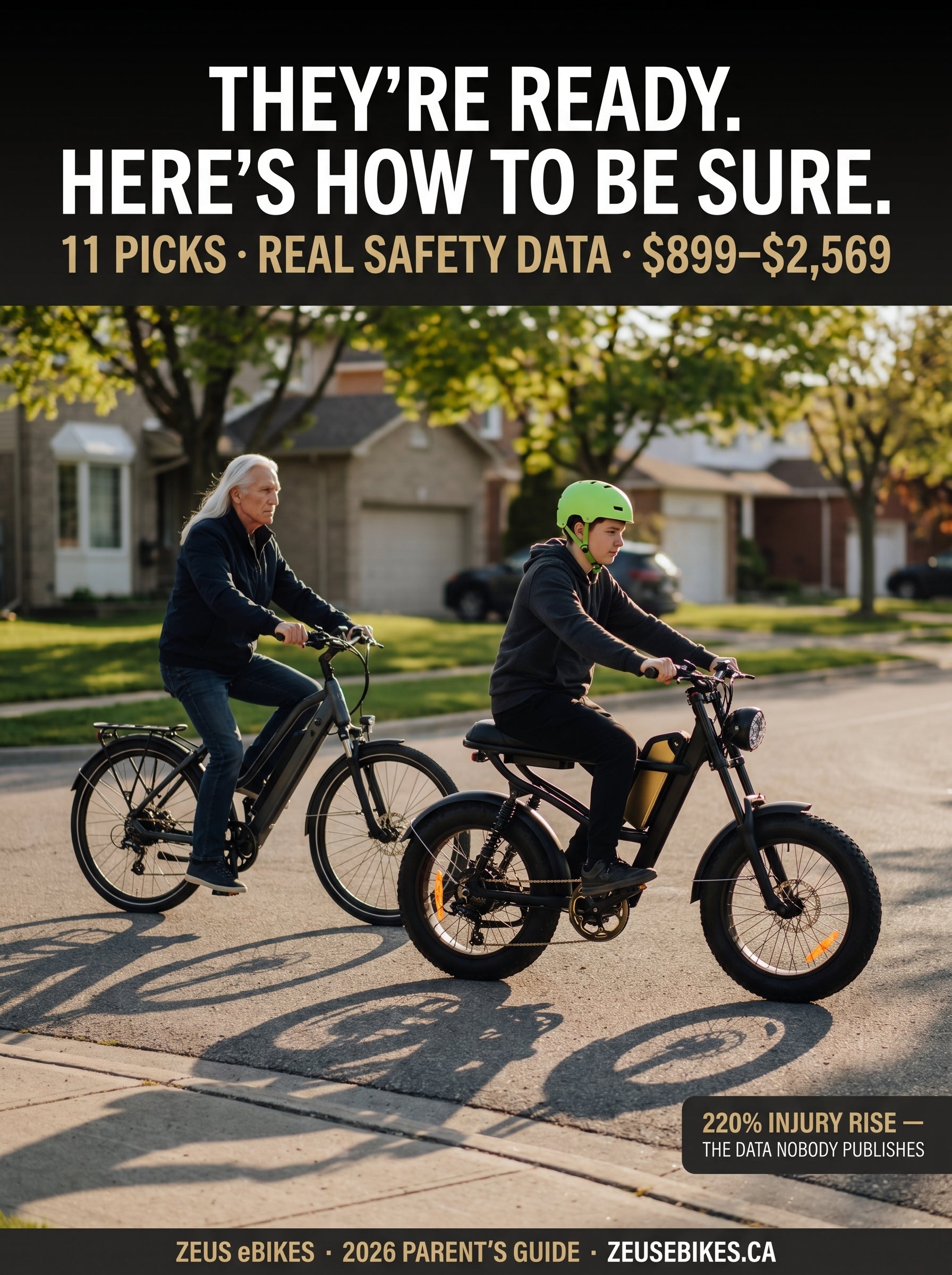
Your Teen Wants an eBike. Here’s What the Hospital Data Actually Says.
Your daughter showed you the TikTok at dinner. A kid her age — same backpack, same neighbourhood — whipping through a bike lane on a moped-style ebike with no helmet, filming one-handed. She said “I want one of those.” You said “we’ll see.” And now it is 11 PM, and you are reading this instead of sleeping, trying to figure out whether “we’ll see” should become “yes” or “absolutely not.” You found the headline about a 49-fold increase in head injuries. You saw the SickKids numbers. Your stomach dropped.
We are an ebike retailer. We sell every bike on this page. We could have skipped the injury data and gone straight to the product picks. Every competitor does. Here is why we did not: if you buy a bike based on our recommendation and your teen gets hurt because we hid what we knew, that is on us. So we are going to give you everything — the data that looks bad, the context that changes what “bad” means, a readiness checklist that actually works, and 10 bikes matched to your teen’s age, experience, and commute. Then you decide.

In This Guide
- The Fear — And What the Data Actually Shows
- Is Your Teen Ready? — 5 Questions
- All 10 Picks at a Glance
- First eBike — $1,199–$1,599
- Daily Riders — $2,099–$2,399
- Trail & All-Weather — $2,299–$2,450
- Power Machines — 17+ Only
- The Group Ride Problem
- The Speed Hack Problem
- Theft, Exercise & the Car Question
- FAQ — 10 Questions
- What We’d Tell Our Own Family
1. The Fear — And What the Data Actually Shows
The fear is not irrational. It is based on real numbers from real hospitals. Before we tell you why the numbers need context, we owe you the numbers themselves.
| Source | Finding | Year |
|---|---|---|
| SickKids Toronto | Teen ebike/e-scooter injuries: 5 → 16 cases (Jun–Jul). 220% increase. 56% not wearing helmets. | 2023–2024 |
| St. Michael’s Toronto | Ebike trauma cases: 15 → 51. 240% increase. | 2020–2024 |
| Rady Children’s (San Diego) | Ebike trauma visits: 1 → 201. Now #1 cause of ED trauma — surpassing falls and car accidents. | 2021–2025 |
| American College of Surgeons | Ebike head trauma increased 49-fold nationally. | 2017–2022 |
| CPSC (US) | 53,000+ ebike ER visits. 10–15 year olds: 44% of all injuries — the most injured age group. | 2017–2022 |
Those numbers are real. They are from published data. We are not going to downplay them.
But Here Is What Those Numbers Are Not Telling You
Read past the headlines and the same data sources reveal something the media never includes:
- Nearly 90% of electric two-wheelers surveyed at California schools exceeded legal power limits (Outside/Velo). Many “ebikes” in the injury data are actually electric motorcycles — Sur-Rons, Talarias — capable of 60–100+ km/h with no pedals. A 500W speed-limited ebike at 32 km/h is a fundamentally different machine than a 5,000W electric motorcycle at 80 km/h. The injury data conflates both.
- Helmets reduce head injury risk by up to 85% — but helmet use among injured teen ebike riders is approximately 50%. Half the head injuries in the statistics were preventable with a $40 helmet.
- Ebike injuries show “adult-like patterns” with multiple limb fractures — not because ebikes are inherently more dangerous than cars, but because teens on ebikes ride at car-adjacent speeds (25–45 km/h) without the protective shell of a vehicle.
- The comparison that matters: ebike injuries have a hospitalization rate of 11.5% vs 4.8% for regular bicycles (PubMed). But ebike fatality rates for teens remain far below car accident fatality rates for the same age group.
That last question is the only one that matters. The next section helps you answer it.

5:58 AM. The chin strap. The road ahead. He checked twice. She never looked back. · Playcut.ai
2. Is Your Teen Ready? — The 5-Question Assessment
Every other guide says “it depends on maturity.” None of them tell you how to measure it. Here are five questions. Be honest with yourself. A “no” on any single question means “not yet” — regardless of age.
- Can they ride a conventional bicycle confidently in traffic? — Not on a quiet path. In traffic. With cars. If they cannot handle a regular bike at 15–20 km/h near vehicles, adding a motor that doubles their speed is not the answer.
- Do they wear a helmet without being told? — Not “when I remind them.” Unprompted. Helmet compliance drops dramatically with teens. If the helmet is a battle, the ebike is premature.
- Can they resist peer pressure to race or show off? — Forum discussions, hospital data, and school incident reports consistently identify group riding and showing off as the single biggest predictor of teen ebike injuries. If your teen cannot say “no” to a dare, a throttle is the wrong tool.
- Do they follow household rules consistently? — An ebike comes with rules: where to ride, how fast, when to come home, where to lock it. If rules at home are negotiable, rules on the road will be too.
- Can they physically handle a 25–35 kg machine? — Most ebikes weigh 55–90 lbs. Can they lift it over a curb? Steady it at a stop? Control a slide on wet pavement? A 56 lb bike like the XD26-II is handleable for most teens. A 116 lb GT73 is not.
Scoring: 5 out of 5 — ready. 4 out of 5 — address the gap first. 3 or fewer — wait. Start with supervised rides on quiet streets. Revisit in 6 months.
The first 50 km matter most. Ride with your teen for the first 50 km. Not ahead of them — beside or behind them. Watch how they handle intersections, speed, and other riders. The habits formed in the first two weeks become permanent. Teens who ride with a parent for the first 50 km develop better habits than teens handed a bike and told to be careful (Velosurance parent research).
Not sure which bike fits your teen? Call us.
1-866-938-7580 — two brothers who will ask about your teen’s height, riding experience, and commute distance before recommending a single bike.
Browse All Collections →3. All 10 Picks at a Glance
This is the table a parent needs when they have four minutes before dinner. Every bike below ships free across Canada with a warranty and phone support. Detailed reviews follow in the sections below.
| Bike | Price | Weight | Brakes | Best For | Rider Height |
|---|---|---|---|---|---|
| Samebike CY20 | $1,199 | 61 lbs | Mechanical | Lowest-risk test | 5’1″+ |
| Z8 Moped-Style | $1,199–$1,599 | 79–91 lbs | Disc + Electronic | The bike they’ll ask for | 5’2″–6’0″ |
| Samebike XD26-II | $1,499 | 56 lbs | Hydraulic 160mm | Best first ebike | 5’4″–6’2″ |
| LOTDM200-II | $1,499 | 62 lbs | Disc | School commuter (NFC lock) | 5’1″–5’11″ |
| Vtuvia Tiger Retro | $2,099–$2,399 | ~90 lbs | Hydraulic | Shorter riders (5’1″–5’9″) | 5’1″–5’9″ |
| Eunorau Flash | $2,169+ | 82–92 lbs | Hydraulic 180mm | Grows with them (torque sensor) | 5’2″–6’4″ |
| FAT AWD 3.0 | from $2,299 | 79 lbs | Hydraulic 180mm | Winter/wet weather AWD | 5’3″–6’1″ |
| Eunorau Defender | $2,450 | 66 lbs | Hydraulic 180mm | Trail riding (lightest full-sus) | 5’3″–6’4″ |
| GT73 Motorbike | $2,099 | 116 lbs | Hydraulic | 17+ supervised off-road only | 5’6″–6’2″ |
| Raptor ST202 Pro | $2,599 | 124 lbs | Hydraulic 180mm | GPS tracking, experienced 17+ | 5’4″–6’3″ |
Sizing Quick Reference
| Teen Height | Wheel Size | Best Picks in This Guide |
|---|---|---|
| 5’1″–5’5″ (155–165 cm) | 20″ | CY20, Z8, LOTDM200-II, Tiger Retro |
| 5’4″–5’9″ (163–175 cm) | 20″ or 26″ | Tiger Retro, Flash, XD26-II |
| 5’8″–6’3″ (173–191 cm) | 26″ or 27.5″ | XD26-II, Defender, Flash, FAT AWD 3.0 |
Three Things to Check Before Buying
- Flat-foot test: The teen must be able to place both feet flat on the ground when stopped. Not tiptoes. Flat. On a 55–90 lb ebike, tiptoe contact at a red light leads to tip-overs.
- Standover clearance: 2–5 cm between the top tube and the rider when straddling. Step-through frames eliminate this issue — which is why the LOTDM200-II and CY20 are strong first-bike choices.
- Reach: The teen should grip the brake levers comfortably with a slight bend in the elbows. Fully extended arms = reduced braking control and slower reaction times.
4. First eBike — $1,199 to $1,599
This is where you start. Not at $2,500. Not with dual motors. The first ebike teaches habits — braking, speed awareness, traffic reading, locking, charging. If they crash it, scratch it, or outgrow it in a year, you spent $1,199–$1,599, not $2,500. That is the right amount of money to learn on.
Samebike CY20
$1,199 CADThe lowest-risk entry point. 350W motor is gentle — no surprises. Step-through folding frame means no standover clearance issues for any height. 61 lbs is manageable for most teens. Folds to fit in a closet, a trunk, or a GO Transit car. If your teen is not sure they will use an ebike, $1,199 answers the question without a $2,500 commitment. Trade-offs: mechanical brakes (more hand force) and smaller battery (shorter range). For a first-time teen rider, those are acceptable. See it in our folding guide.
Z8 Moped-Style eBike
$1,199–$1,599 CADLet’s be honest: this is the bike your teen is going to ask for. Moped-style ebikes are the dominant teen trend — low-slung frame, cushioned seat, fat tires, the look that owns TikTok. Two versions are orderable today: the Z8 ($1,199) and the Z8 Pro ($1,599, dual battery), both with mechanical disc plus electronic brakes on our listing. Parent note: Riding Times lists the Z8 at up to 31 mph (50 km/h), against the CY20’s listed 32 km/h, and ships it in a 25 km/h speed-limit mode you can keep. Establish speed rules before handing over the key. The moped aesthetic also draws more attention from other riders — read the group ride section before buying. See it in our moped guide.
Samebike XD26-II
$1,499 CADOur default recommendation for a teen’s first ebike. Here is why: hydraulic brakes at $1,199 — less hand force means faster stops, critical for a rider still developing traffic instincts. 56 lbs — a teen can steady it, lift it over a curb, and recover from a wobble. Full suspension absorbs the potholes and frost heaves that send rigid frames sideways. Non-fat 26″ tires mean less rolling resistance, more range, and more predictable handling than fat tires in corners. 500W motor is sufficient without being overwhelming. If you are buying one bike and you want the best balance of safety, capability, and price, this is it. See it in our mountain bike guide.
Samebike LOTDM200-II
$1,499 CADThe school commuter. NFC locking means the bike will not start without your teen’s phone or key fob. At Long Beach State, stolen ebikes made up 44% of all on-campus crime in 2024. The LOTDM200-II addresses this directly: even if someone cuts the lock, the bike does not power on without the NFC key. Fat tires handle year-round Canadian conditions. Step-through folding frame stores inside a school locker room or a closet at home. 62 lbs — manageable for a teen. The 264 lb payload limit is the one constraint — verify your teen + backpack + gear stays within it. See it in our folding guide.

7:12 AM. Three blocks to school. No car. No bus. No asking for a ride. Just his. · Playcut.ai
5. Daily Riders — $2,099 to $2,399
These are the bikes for teens who have proven they are ready — passed the checklist, ridden the first 50 km with you, demonstrated good judgement. The jump to this tier gets a torque sensor (smoother, more natural assist), better anti-theft, and longer range.
Vtuvia Tiger Retro
$2,099–$2,399 CADThe bike that fits shorter teens properly. Most ebikes start at 5’4″ or 5’6″ minimum. The Tiger Retro fits riders from 5’1″ — critical for younger teens who have passed the readiness checklist but have not hit their growth spurt yet. NFC phone/fob unlock for anti-theft. Hydraulic brakes. Two battery options: 15Ah ($2,099) or 35Ah ($2,399). The retro moped aesthetic appeals to the same teens who want the Z8 — but in a frame that fits smaller riders. Parent note: at ~90 lbs this is a heavy bike. Make sure your teen can handle the weight before buying. See it in our moped guide.
Eunorau Flash (Rear Drive)
From $2,169 CADThe platform that does not become obsolete. Start with the rear-drive at $2,169 and the standard 16Ah battery. As your teen rides more, add a second battery ($354) to double the range. Eventually, upgrade to the mid-drive ($2,899) or AWD ($3,259) configuration on the same frame. Torque sensor means the motor responds proportionally to pedal effort — no cadence-sensor jolts, smoother in traffic, better exercise. 32 km/h speed cap. Samsung cells. 440 lb payload handles the teen and whatever they are carrying. Free alarm system, U-lock, phone holder, and mirrors included. See it in our long-range guide.
Every bike above ships free across Canada with a warranty.
1-866-938-7580 — call us with your teen’s height and riding experience. We will tell you honestly which bike fits.
Browse All Collections → Financing Options →
3:47 PM. School is done. The bikes are not transportation. They are freedom. · Playcut.ai
6. Trail & All-Weather — $2,299 to $2,450
For the teen who actually rides off-road, rides year-round through Canadian weather, or both. These are not starter bikes. These are for experienced riders who have put 500+ km on a first ebike and know what they want.
Eunorau FAT AWD 3.0
from $2,299 CADBoth wheels powered simultaneously. Snow, ice, gravel, wet leaves — AWD traction handles the conditions that drop front-wheel-only bikes. Torque sensor coordinates both motors proportionally to pedal effort. LG cells. Hydraulic brakes. For the teen who rides to school in January — through slush, over ice patches, in reduced visibility — this is the bike that does not care what month it is. Optional dual battery pushes range to 128 km. See it in our winter guide.
Eunorau Defender
$2,450 CADFor the teen who actually rides trails — not the one who says they will. 165mm rear suspension travel absorbs roots, drops, and washboard gravel. 27.5×3.0″ tires split the difference between fat-tire grip and regular-tire speed. 66 lbs — the lightest full-suspension option in this guide, light enough for a teen to handle on singletrack. 500W motor keeps it manageable. Optional second battery for day-long rides. Shimano 7-speed with app connectivity for ride data. See it in our mountain bike guide.
7. Power Machines — 17+ Only, Supervised
These bikes are fast, heavy, and powerful. We include them because you asked. We include the warnings because we mean them.
GT73 Electric Motorbike
$2,099 CADThis is not a bicycle. It is an electric motorbike. 116 lbs. 57 km/h. 25″ off-road tires. Carbon steel frame. Double-wishbone suspension. Dual removable batteries with 1,747 Wh. If your 17+ teen wants the moto-style experience, this delivers it — but the weight, speed, and power demand motorcycle-level respect. Restrict to private property or supervised off-road riding until the rider demonstrates sustained, mature judgement. A certified motorcycle helmet — not a bicycle helmet — is the appropriate head protection at these speeds. See it in our dirt bike guide.
Smartravel Raptor ST202 Pro
$2,599 CAD75 km/h. Read that number again. This is the fastest machine in our entire catalogue. For an older, experienced teen who has earned trust over 1,000+ supervised kilometres, the Raptor offers GPS anti-theft tracking (monthly subscription), 2,600 Wh of range (the largest battery in this guide), and 150 Nm of torque. The GPS tracking is genuinely useful for parents — you can see where the bike is at all times. But no amount of tracking substitutes for a rider who is not ready for 75 km/h. Restrict speed modes. Ride together first. This bike is a privilege, not a right. See it in our dual motor guide.

6:34 AM. He built the checklist. She passed every question. Now he watches her ride away. That is the whole job. · Playcut.ai
8. The Group Ride Problem — What Nobody Talks About
Hospital data, school incident reports, and forum discussions all point to the same finding: the single biggest predictor of teen ebike injuries is not the bike, the speed, or the terrain. It is who they are riding with.
Teens do not crash the same way alone as they do in groups. Alone, a teen rides to get somewhere. In a group, riding becomes a performance. The dynamics shift:
- Speed escalation. One rider goes faster. Others match or exceed. Nobody wants to be the slowest. Within 10 minutes, the group is riding 15–20 km/h faster than any individual would ride alone.
- The dare economy. “Watch this.” “Bet you can’t.” “Hit that ramp.” The social reward for doing something risky is immediate (respect, laughs, TikTok content). The consequence of a crash is theoretical — until it is not.
- Distracted riding. Filming each other. Riding no-handed. Looking at their phone while moving. Group rides turn attention away from the road.
- The moped-style amplifier. Moped-style bikes like the Z8 are the dominant teen aesthetic precisely because they look impressive. That visual identity attracts group riding, which amplifies the performance dynamic. This is not a reason to avoid the Z8 — it is a reason to have a specific conversation about group riding before buying one.
What You Can Do
- Name the dynamic. “When you ride with friends, you will feel pressure to go faster and do things you would not do alone. That is normal. What I need you to do is notice it happening.”
- Set the group-ride rule early. “You can ride with friends. Maximum 3 in a group. Helmets on everyone. If someone in the group does not have a helmet, you leave.” Specific. Enforceable.
- Ride with their friends once. Not to police them. To see the dynamic. You will learn more in 30 minutes of group riding than in any conversation.
- Choose a bike with a speed ceiling you can live with. Samebike lists a 32 km/h maximum for the 350W CY20, though its manual says the speed limit can be removed; a Z8 can be set anywhere from its 25 km/h speed-limit mode to 31 mph (50 km/h) (Riding Times). The ceiling matters because group dynamics will push riders toward it.
9. The Speed Hack Problem — What No Retailer Tells You
Your teen will learn how to unlock the speed limiter. Not “might.” Will. Instructions are on YouTube, Reddit, Endless Sphere, and TikTok. Magnet tricks. Firmware flashing. Tire-size setting changes. Speed limiter disconnection.
Nearly 90% of electric two-wheelers surveyed at California schools exceeded their rated power limits (Outside/Velo, 2026). Teens are not an exception to this trend — they are the primary driver of it.
What you can do:
- Choose a bike with app-based controls that require a parent’s phone to change speed settings. The Eunorau Flash offers app-based configuration.
- Start with a lower-power bike. A 350W CY20 unlocked to maximum is still slower than a 1,200W GT73 at its lowest setting. The ceiling matters.
- Set consequences for the behaviour, not for the hack. “If I find you rode above 32 km/h, the bike stays in the garage for two weeks.” Specific. Enforceable. Not “be careful.”
- Have the honest conversation. “I know you can unlock it. I know you know how. Here is why I am asking you not to: at 50 km/h, a fall breaks bones. At 32 km/h, it bruises them. That is the difference.”
- Ride together for the first 50 km. Teens who ride with a parent during the learning phase develop better speed habits than teens handed a bike and given a lecture.
10. Theft, Exercise & the Car Question
Theft at School
At Long Beach State, stolen ebikes and e-scooters made up 44% of all on-campus reported crime in 2024. Less than 5% of stolen bikes are ever returned to their owners. Armed robberies of teens for their ebikes have been reported in Marin County and Gilbert, Arizona.
Practical steps:
- Use a hardened U-lock ($40–$80) through the frame AND the rear wheel to a fixed rack. Not a cable lock — cable locks are defeated in seconds.
- Remove the battery during class and bring it inside. It is the most expensive component and removing it disables the bike.
- Choose a bike with NFC locking (LOTDM200-II, Tiger Retro) or GPS tracking (Raptor ST202 Pro).
- Register the serial number with local police. Photograph the bike from multiple angles. Save the receipt.
- Check your home insurance — most policies cap ebike coverage at $1,000–$2,000, well below replacement cost. Dedicated ebike insurance starts at ~$14/month in Canada.
The Exercise Question — Does an eBike Make Teens Lazy?
No. But the answer is more nuanced than that.
| Scenario | Exercise Impact | Source |
|---|---|---|
| eBike replaces car rides | +550–800 MET-min/week (major gain) | European 7-city study |
| eBike replaces regular bike | −200 MET-min/week (slight loss) | Same study |
| Teen uses pedal assist | Moderate intensity — comparable to brisk walking | BYU study |
| Teen uses throttle only | Minimal exercise — essentially a moped | Common sense + research |
| eBike vs bike riders: total weekly activity | Similar (4,463 vs 4,085 MET-min/week) | ScienceDirect |
Why similar total activity? Ebike riders tend to ride more often and for longer distances, compensating for the lower per-minute intensity. A teen who would not ride a regular bike 8 km to a friend’s house will ride an ebike 8 km — and that is 8 km of moderate-intensity exercise they would not have gotten otherwise.
The honest answer for parents: If the ebike replaces being driven to school, it is a massive health win. If it replaces pedalling a regular bike, exercise drops slightly. If your teen rides throttle-only, they are riding a moped. Set the rule: pedal-assist modes for commuting, throttle for hills and intersections only.
eBike vs Car at 16 — The Canadian Math
At 16, many Canadian families face the same decision: ebike or start saving for a car?
| Cost | eBike (Year 1) | Car (Year 1) |
|---|---|---|
| Purchase | $1,199–$2,499 | $5,000–$15,000 (used) |
| Insurance | $0–$168/yr (optional) | $3,000–$6,000/yr (teen driver) |
| Fuel/charging | ~$15–$30/yr electricity | $1,500–$3,000/yr gas |
| Maintenance | $50–$150/yr | $500–$1,500/yr |
| Parking | $0 | $0–$2,400/yr (urban) |
| Year 1 Total | $1,264–$2,847 | $10,000–$27,900 |
An ebike costs 10–25% of a car in year one. It requires zero licensing, zero insurance (optionally ~$14/month), zero parking. For the teen who needs transportation to school, a job, and friends — not highway access — the math is not close. See our financing guide for monthly payment options.
FAQ — 10 Questions, Answered With Sources
Are electric bikes safe for teenagers?
It depends on the teen, the bike, and the environment. Canadian hospitals report a 220% rise in teen ebike injuries (SickKids, 2023–2024). But a significant portion of those statistics involve illegal electric motorcycles misclassified as ebikes. A responsible teen on a speed-limited bike with hydraulic brakes and a certified helmet is in a fundamentally different risk category. Use the 5-point readiness checklist in Section 2.
What is the best electric bike for a teenager in Canada?
Best first ebike: Samebike XD26-II ($1,499) — hydraulic brakes, 56 lbs, full suspension. Best school commuter: LOTDM200-II ($1,499) with NFC anti-theft lock. Best for shorter riders: Tiger Retro ($2,099) fits 5’1″–5’9″. Budget entry: CY20 at $1,199.
Do ebikes make teens lazy?
Research says no — on pedal assist. A BYU study found riders exercise at similar intensity without perceiving it as taxing. Ebike riders ride more often and farther, logging similar weekly exercise to conventional cyclists. The caveat: throttle-only mode is essentially a moped with minimal exercise. Set the rule: pedal assist for commuting, throttle for hills only.
How do I stop my teen from unlocking the speed limiter?
You probably cannot prevent it entirely — instructions are widely available. What works: choose a bike with app-based controls, start with a lower-power bike (350W–500W), set specific consequences, have the honest conversation about injury risk at different speeds, and ride together for the first 50 km.
What ebike features matter most for teen safety?
In order: (1) Hydraulic disc brakes (less hand force, faster stops). (2) Appropriate weight (under 70 lbs for younger teens). (3) Speed limiting (32 km/h cap). (4) Integrated lights. (5) Torque sensor (proportional power, no jolts). (6) Proper fit (flat-foot test at stops).
How do I prevent my teen’s ebike from being stolen at school?
Hardened U-lock through frame and rear wheel. Remove battery during class. Choose NFC locking (LOTDM200-II, Tiger Retro) or GPS tracking (Raptor ST202 Pro). Register the serial number with police. Check home insurance coverage — most cap ebike claims at $1,000–$2,000.
Is a $399 Amazon ebike safe for a teenager?
At $399: mechanical brakes (more hand force), steel frame (heavier), no torque sensor (jerky power), typically no UL battery certification, and 85% self-assembly. Three Amazon brands were recalled for battery fires in 12 months. For a vehicle a teen rides in traffic, brakes and battery are not the place to save money. A CY20 at $1,199 from a Canadian retailer includes a warranty and phone support. See our full Amazon comparison.
What is the difference between an ebike and an electric motorcycle?
A legal ebike: 500W motor, 32 km/h cap, functional pedals. An electric motorcycle (Sur-Ron, Talaria): 60–100+ km/h, no pedals, 50+ kg. Nearly 90% of electric two-wheelers at California schools exceeded legal ebike power limits. When studies report alarming injury numbers, a large portion involve electric motorcycles misclassified as ebikes.
How much exercise does a teen get on an ebike?
On pedal assist: moderate intensity, comparable to brisk walking (BYU study). Ebike riders log similar total weekly exercise to conventional cyclists because they ride more often and farther (European 7-city study, 4,463 vs 4,085 MET-min/week). On throttle only: minimal. What the ebike replaces matters most: replacing car rides adds 550–800 MET-min/week of activity.
Should I buy my 14-year-old an ebike?
This depends on the individual teen, not the age. Use the 5-point readiness checklist: confident cyclist in traffic, unprompted helmet use, resists peer pressure, follows rules, physically handles the weight. If any answer is no, wait. A responsible 14-year-old cyclist is a better candidate than an impulsive 17-year-old non-cyclist. Start with supervised rides on quiet streets.
What We’d Tell Our Own Family
We are two brothers who built this company. One of us spent seven years in hospitals — acute care, rehab, public health — watching what happens when people get hurt because someone withheld information or gave the wrong advice. That is why this article leads with the injury data. That is why we did not skip the parts that make ebikes look bad. We would rather you read the SickKids numbers here, with context, than find them alone at midnight without it.
If our own teenager asked for an ebike tomorrow, here is what we would do:
- Run the readiness checklist honestly. If they fail a single question, wait — no matter how much they beg.
- Buy the XD26-II at $1,499. Hydraulic brakes, 56 lbs, 500W. Not too much bike. Not too little.
- Ride with them for the first 50 km. Not ahead of them. Beside them. Watch how they handle a car turning in front of them. Watch what happens when a friend rides past at full throttle.
- Buy a $40 helmet and make it non-negotiable. The data says helmets reduce head injury risk by 85%. That is not a suggestion. That is a seatbelt.
- Have the speed conversation once, honestly, and then trust them. “I know you can unlock it. Here is why I am asking you not to.”
The ebike is not the risk. The teen on the ebike is not the risk. The gap between the machine’s capability and the rider’s judgement — that is the risk. Close the gap with the right bike, the right preparation, and the first 50 km together, and what you are giving them is not danger. It is independence.
The hospital data is real. The fear is rational. And the answer is not “no” — it is “not yet” or “yes, but here is how we do this safely.” Start with the readiness checklist. Start with a bike under $1,500. Start with the first 50 km together. The teen who earns an ebike through demonstrated judgement is not the teen in the injury statistics. That is the whole point of this guide.
Still not sure? Call two brothers who will be honest with you.
1-866-938-7580 — tell us your teen’s age, height, riding experience, and commute. We will tell you whether they are ready, and if so, which bike fits. If they are not ready, we will tell you that too. We would rather lose a sale than lose your trust.
Browse All Collections → Financing Options →Electric Mopeds Canada (2026) — 11 moped-style picks (the style teens want)
Best Mountain eBikes Canada (2026) — trail-ready picks
Best Dual Motor eBikes Canada (2026) — 10 AWD picks
Best Winter eBikes Canada (2026) — year-round riding
How to Finance an eBike in Canada — 7 options, real math
Amazon eBikes Canada (2026) — what $399 actually gets you
How Teens Make Money in Canada (2026) — practical guide (ebike delivery included)
All photography by Playcut.ai — personalised AI actor technology

Share:
Best Electric Bikes for Adults Canada (2026): 28 Verified Picks
How to Sell Your Electric Bike Fast in Canada (2026): Pricing, Photos, and a Simple Content System