
eBike Insurance in Canada (2026): Real Costs, All 3 Insurers Compared & the Bikes That Insure Cheapest
On 1 July 2026, Ontario quietly rewrote what happens to you if a car hits your e-bike. Under O. Reg. 383/24, most accident benefits that used to be automatic, income replacement, caregiver, housekeeping, death and funeral, became optional coverage somebody has to actively buy. If nobody in your household owns an auto policy with those options, a driver can put you in hospital and you may have no income replacement at all. That is the year e-bike insurance stopped being a theft question and became an income question.
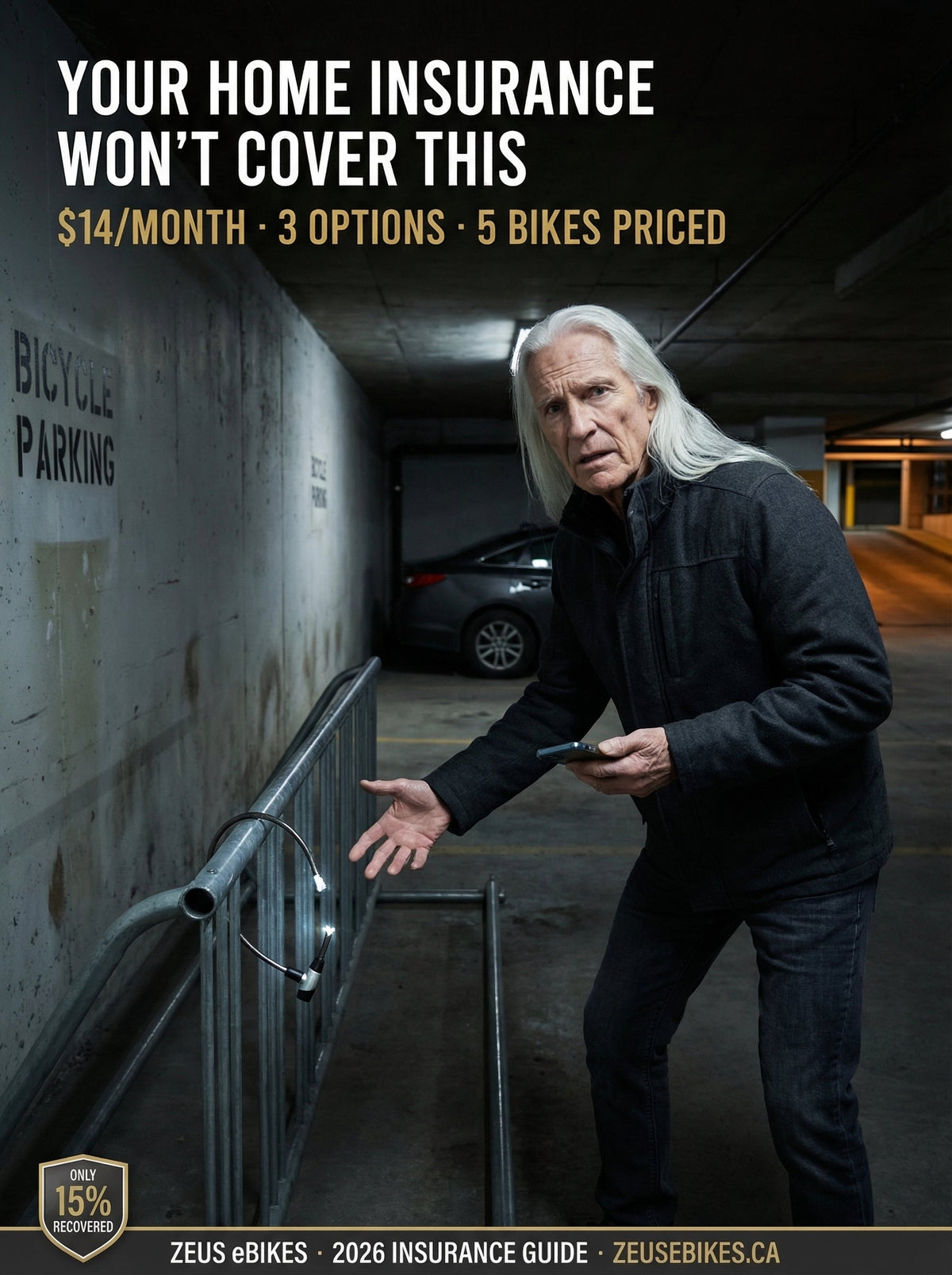
Here is what has not changed: e-bike insurance is not mandatory anywhere in Canada. No province requires it for a legal power-assisted bicycle. But “not mandatory” has never meant “not necessary.” Only about 15% of stolen bikes in Canada are ever recovered (Square One, 2025), your home policy probably contains a clause that voids the claim entirely, and the liability gap underneath all of it is the one nobody reads until they need it.
This guide gives you the real numbers, the exact phone script, the province-by-province picture, and, the part no other guide publishes: which bikes are actually cheap to insure and which ones no cycling insurer will touch.
Should you buy it? Yes if your e-bike cost more than about $1,500. Your home policy likely will not pay out in full, and may not pay at all.
Cheapest dedicated cover: Sundays Insurance: from $14/month ($168/year) on a $2,000 bike, in AB, BC, ON, MB and NS.
Broadest availability: Pedal Power Insurance: every province except Quebec, and it includes liability.
Easiest Zeus bike to insure: the Velotric Tempo ($2,599), 350W, full UL 2849 system certification and Apple Find My + Google Find Hub tracking. Runner-up: the Eunorau Meta 26 ($2,295), whose maker lists 500 W and 32 km/h as shipped (read 7 October 2026).
Free protection everyone should do today: register your serial number on 529 Garage or Bike Index: five minutes, no cost.
In This Guide
- The Honest Answer: Do You Actually Need It?
- What Changed on 1 July 2026 (Ontario Riders Read This)
- What Home Insurance Covers: and the Hidden Exclusion
- Province by Province: Where You Can Actually Buy Cover
- The $2,000 Math Problem
- The 3 Dedicated Insurers, Compared
- The Insurability Ladder: Which Bike Is Cheap to Insure
- Credit Card Protection: The 90-Day Trap
- What Happens If Your E-Bike Hurts Someone
- 7 Anti-Theft Steps That Cost Almost Nothing
- Register Your Bike Free: 529 Garage vs Bike Index
- What Insurance Costs Across the Zeus Range
- How to Actually File a Claim (Do This Before You Need It)
- Frequently Asked Questions
- The Bottom Line
The Honest Answer: Do You Actually Need E-Bike Insurance?
You need dedicated e-bike insurance if your bike cost more than roughly $1,500, if you ever park it outside, or if you ride anywhere near pedestrians. Below $1,500 the annual premium starts eating too much of the bike’s value to make sense, and a good lock plus free registration does more for you. Above $2,000 the maths stops being close. Here is the decision, in plain terms.
- Under $1,000: skip the policy. A $168 annual premium is 17%+ of the bike’s value every single year. Buy a hardened U-lock, register the serial number, and store it indoors. That is a better return on the same money.
- $1,000–$2,000: call your home or tenant insurer first, using the six-question script below. If they confirm cover in writing with a deductible you can live with, you may be done. If they hedge on any question, buy the dedicated policy.
- $2,000–$3,500: buy dedicated cover. Home-policy limits and deductibles will hand you back roughly half the bike at best, and only if the motorised-vehicle exclusion does not apply.
- Over $3,500: buy dedicated cover and schedule the bike on your home policy for liability. At this value a single theft is a serious financial event, and the bikes in this bracket are often the ones cycling insurers will not write: see the insurability ladder.
There is a second question hiding inside the first one, and it is the one that changed this year: insurance is not only about getting your bike back. It is about what happens to you. Theft cover replaces an object. Liability and accident benefits protect your income, your savings and your ability to pay rent after a collision you did not cause. Those two things are sold separately, and most riders only buy the first.
What Changed on 1 July 2026: and Why Ontario Riders Should Care Most
On 1 July 2026, Ontario Regulation 383/24 amended the Statutory Accident Benefits Schedule so that only medical, rehabilitation and attendant care benefits remain mandatory in an auto policy. Income replacement, non-earner, caregiver, housekeeping, death, funeral, visitor expenses, lost educational expenses and damage to personal items all became optional add-ons that somebody has to choose and pay for.
That sounds like a driver’s problem. It is not. In Ontario, when a car strikes a cyclist or an e-bike rider, the injured rider has historically claimed accident benefits through the auto insurance system, even though the rider owns no car and pays no auto premium. After 1 July 2026, the optional benefits are available to a narrower group of people: broadly the named insured, the drivers listed on the policy, and certain dependants in that household.
This is the single most under-reported development in Canadian cycling this year, and it reframes the whole insurance question. The rider who most needs to think about it is the one who sold the car and bought an e-bike, precisely the person with no auto policy in the household to fall back on.
What Ontario Riders Should Actually Do
- If your household has a car: phone your auto insurer and ask, in these words, “Did my policy keep the optional accident benefits after the 1 July 2026 changes, and do they extend to a household member injured while cycling?” Get the answer in writing. The optional benefits are usually cheap relative to what they replace.
- If your household has no car: you cannot buy into the auto system. Your substitute is a dedicated e-bike policy with liability plus, if you rely on your income, a personal disability or critical-illness policy. This is the honest answer, and it is not one an insurance ad will give you.
- Everyone: confirm your home or tenant policy’s personal liability section does not exclude “self-propelled land vehicles.” That is a separate exposure from the accident-benefit change and it applies in every province.
Riders outside Ontario are not directly affected by O. Reg. 383/24, but the underlying lesson travels. Accident-benefit entitlements for cyclists flow from the auto insurance regime in your province, and those regimes are being rewritten. Alberta’s care-first model under Bill 47 comes into force 1 January 2027. Assume nothing about what you are owed after a collision until you have asked.
Not sure how your bike is classified? Read the Canadian eBike Laws guide · or call 1-866-938-7580: real humans answer
What Your Home Insurance Actually Covers: and the Exclusion That Voids It
Most home and tenant policies cover bicycles as ordinary contents, with a sub-limit typically between $1,000 and $5,000. Many of those same policies also contain a motorised-vehicle exclusion that some insurers apply to e-bikes, because an e-bike has a motor. If your insurer takes that reading, the claim is not reduced. It is denied outright. Two riders on identical bikes with different insurers can get opposite answers.
Why the Exclusion Exists
A home policy is designed to cover furniture, laptops and jewellery rather than cars. Excluding motorised vehicles keeps auto risk out of a property policy, which is reasonable in principle. The problem is that the wording predates e-bikes. Whether a 350W pedal-assist commuter is a “motorised vehicle” for the purposes of a contract written years ago is a question of interpretation, and the interpretation is the insurer’s to make until you get it in writing.
Even When You Are Covered, the Numbers Are Thin
- Typical bicycle sub-limit: $1,000–$5,000 depending on insurer and policy form.
- Typical deductible: $500–$1,000, and it applies to the whole claim.
- Away-from-home theft: often covered but sometimes at a lower limit than theft from the dwelling. Ask specifically.
- Scheduling: most insurers will let you list the bike as a scheduled item for roughly $50–$200 a year, which raises the limit and often drops the deductible. This is the cheapest fix if your insurer already says yes.
- “I own an electric bicycle. Is it covered under personal property on my policy?”
- “Does the motorised-vehicle exclusion in my policy apply to e-bikes?”
- “What is my sub-limit for bicycles, and what is my deductible?”
- “Am I covered if it is stolen away from home, from a rack at work, for example?”
- “Does my personal liability coverage extend to e-bike operation if I injure someone?”
- “Can I schedule the e-bike to raise the limit, and what would that cost?”
Then ask for the answers by email. A verbal yes from a call-centre agent is not a coverage position. If questions 1 and 5 both come back as a clean yes with a limit you can live with, you may not need a dedicated policy. Anything less than that, and you do.
Velotric Tempo: $2,599 | The Easiest E-Bike in Our Catalogue to Insure
Motor: 350W nominal, comfortably under every provincial 500W ceiling · Certification: UL 2849 full-system + UL 2271 battery + UL 2580 + ISO 4210 · Tracking: Apple Find My and Google Find Hub · Weight: 39 lb
Every question an underwriter asks, this bike answers correctly. It is legally a bicycle in every province, its complete electrical system is independently certified, it reports its own location on both major phone networks, and at 39 lb one person can carry it indoors, which is the storage answer insurers actually like. If you want the cheapest possible premium and the fewest questions at claim time, this is the bike. See how it compares in our urban eBike guide.
Province by Province: Where You Can Actually Buy Cover
Dedicated e-bike insurance is not sold evenly across Canada. Sundays Insurance writes in five provinces. Pedal Power writes everywhere except Quebec. BrokerLink operates as a brokerage in seven. Quebec riders have the thinnest market of anyone, and the province’s rules around moped-style bikes make the classification question sharper there than anywhere else.
| Province | Sundays | Pedal Power | BrokerLink | What Riders There Should Note |
|---|---|---|---|---|
| Ontario | Yes | Yes | Yes | O. Reg. 383/24 cut most accident benefits to optional on 1 July 2026: see above. Best-served market overall. Ontario eBike laws |
| British Columbia | Yes | Yes | No | Two e-bike classes since April 2024. A light e-bike (250W, no throttle) is the easiest class to insure; standard class is fine too. BC eBike laws |
| Alberta | Yes | Yes | Yes | Bill 47’s care-first auto model takes effect 1 January 2027. Re-check your position then. Alberta eBike laws |
| Manitoba | Yes | Yes | Yes | Helmets are required for every power-assisted bicycle rider at every age and not only under-18s. |
| Nova Scotia | Yes | Yes | Yes | Newly served by Sundays. Compare against a scheduled item on your home policy before committing. |
| Saskatchewan | No | Yes | Yes | Pedal Power is the practical dedicated option. |
| New Brunswick | No | Yes | Yes | Pedal Power or a brokered policy. |
| Newfoundland & Labrador | No | Yes | Yes | Pedal Power or a brokered policy. |
| Prince Edward Island | No | Yes | No | Minimum riding age is 16. Pedal Power is the dedicated route. |
| Quebec | No | No | No | The thinnest market in Canada. Your realistic path is scheduling the bike on your home policy. Ask about it explicitly. Quebec eBike laws |
| Territories | No | Verify | No | The Yukon Motor Vehicles Act defines an electric power-assisted cycle; the Northwest Territories and Nunavut count a motorized pedal bicycle as an all-terrain vehicle; age and helmet rules are municipal. Confirm availability directly before assuming cover exists. |
Availability verified from each insurer’s published pages in August 2026 and again on 8 October 2026 (Sundays: Alberta, British Columbia, Ontario, Manitoba and Nova Scotia; Pedal Power: every province except Québec). Insurers expand and withdraw from provinces regularly: confirm at quote before you rely on this table.
The $2,000 Math Problem: Why Home Insurance Is Rarely Enough
Even when your home insurer says yes, the deductible does most of the damage. A home policy is built for catastrophic loss rather than for a $2,000 item, so the same $1,000 deductible that barely matters on a house fire consumes half of an e-bike claim. Run your own numbers against this table.
| E-Bike Value | Home Sub-Limit | Deductible | You Get Back | You Absorb |
|---|---|---|---|---|
| $1,199 | $2,000 | $1,000 | $199 | $1,000 |
| $2,295 | $3,000 | $1,000 | $1,399 | $1,000 |
| $2,599 | $3,000 | $1,000 | $1,599 | $1,000 |
| $2,899 | $3,000 | $1,000 | $1,899 | $1,000 |
| $3,399 | $3,000 | $1,000 | $2,000 | $1,399 |
Illustrative only, using a common $2,000–$3,000 bicycle sub-limit and a $1,000 deductible. Your policy will differ: the six-question script gets you your real numbers.
Two patterns matter here. First, the deductible is a flat cost, so it hurts cheap bikes proportionally far more: on a $1,199 bike you recover $199 and absorb $1,000. Second, once the bike’s value passes the sub-limit, the limit caps you regardless of deductible: a $3,399 bike against a $3,000 sub-limit loses money at both ends.
And all of that assumes the claim is paid. If the motorised-vehicle exclusion applies, every figure in the “You Get Back” column is $0. A dedicated policy at $168 a year removes both the sub-limit problem and the exclusion problem at once, which is the entire argument for buying one.
The 3 Dedicated Insurers, Compared
Three companies write meaningful dedicated e-bike coverage for Canadians: Sundays Insurance, Pedal Power Insurance and BrokerLink. They differ most on three things riders actually feel: whether liability is included, which provinces they serve, and whether a throttle disqualifies your bike. That last one catches more riders than any other clause.
| Feature | Sundays Insurance | Pedal Power Insurance | BrokerLink |
|---|---|---|---|
| Published price | From $14/month ($168/yr) on a $2,000 bike | Not published: quote required | States roughly $1,000/yr, varies widely |
| Provinces | AB, BC, ON, MB, NS | All except Quebec | AB, MB, NB, NL, NS, ON, SK |
| Throttle-only e-bikes | Not covered: must have functional pedals and meet provincial law | Verify at quote | Verify at quote |
| Theft (home & away) | Yes | Yes | Yes |
| Accidental damage | Yes | Yes | Yes |
| Third-party liability | No: medical only, to $1,000 | Available | Available |
| Roadside assistance | To $75 | Verify | Verify |
| Separate from home policy | Yes | Yes: explicitly | Verify |
| Underwriter | Via Bicycle Broker | Lloyd’s of London, Travelers, Great American and others | Various |
| Quote online? | Yes | Yes: or 1-866-979-2747 | Broker contact |
1. Sundays Insurance: Cheapest, If Your Bike Qualifies
The lowest published price in Canada and the simplest to buy: $168 a year on a $2,000 bike, online, in Alberta, BC, Ontario, Manitoba and Nova Scotia. It covers theft at home and away, accidental damage, malicious damage and damage during attempted theft, emergency medical to $1,000 and roadside recovery to $75. Optional add-ons cover worldwide travel, racing and accessories.
The catch, and it is a real one: Sundays does not cover throttle-only e-bikes, retrofitted conversions or home-built bikes, and the bike must comply with your province’s e-bike law. It also carries no third-party liability: only $1,000 of emergency medical. If liability is what worries you, Sundays alone is not the answer.
2. Pedal Power Insurance: Broadest Reach, Includes Liability
Available in every province except Quebec, underwritten by a panel that includes certain underwriters at Lloyd’s of London, Travelers and Great American. It covers personal, business and competition use, the only one of the three that will write a delivery rider without an argument. It keeps claims entirely separate from your home policy, which protects your claims-free discount, and liability is available.
The catch: no published pricing. You have to run a quote or call 1-866-979-2747. We removed the specific annual figure that appeared in an earlier version of this guide because we could not re-verify it on Pedal Power’s own site in August 2026, and we do not publish numbers we cannot source.
3. BrokerLink: The Bundling Route
A large Canadian brokerage rather than a specialist product. BrokerLink’s own published guidance puts e-bike insurance at roughly $1,000 a year, which is several times the specialist pricing, but that figure covers a much broader range of bikes and coverage shapes, and if your home and auto are already with them, bundling can change the total picture. Worth a call if you are already a client; otherwise start with the specialists.
Eunorau Meta 26: $2,295 | 500 W and 32 km/h on Eunorau's Page, the Figures Sundays Asks For
Motor: 500W nominal, speed-capped at 32 km/h from the factory · Sensor: true torque sensor · Battery: 48V 15Ah (720 Wh; Eunorau’s spec table lists LG cells, its product record Samsung), removable · Frame: step-through
Sundays requires that your bike meet your province’s e-bike law and have functional pedals. Eunorau's page lists the Meta 26 at 500 W and 32 km/h as shipped, with working pedals, read 7 October 2026; keep it at that setting and declare it as shipped. Eunorau badges the cap “unlockable”, and whether an adjustable cap qualifies is not settled, so get the insurer’s confirmation in writing. The removable pack comes indoors for charging, which is both a fire-safety and a theft answer.
One honest note: Eunorau states the bike is UL certified but does not publish a specific standard number, so if your building requires documented UL 2849, call us on 1-866-938-7580 before you buy. The step-through twin, the Meta 275 2.0, is the same package on 27.5″ wheels.
Buying a bike and want the cheap premium? Start with the Velotric Tempo · Browse all Zeus eBikes · Free shipping Canada-wide
The Insurability Ladder: Which Bikes Are Cheap to Insure, and Which Ones No Cycling Insurer Will Touch
Insurability comes down to two separate questions, and almost every buying guide collapses them into one. Question one is legal class: is the bike a power-assisted bicycle under your province’s law, broadly 500W or less, capped near 32 km/h, with working pedals? Question two is risk evidence: can you show independent safety certification, tracking and secure storage? A bike can ace one and fail the other, and the failure mode is different each time.
Since Canada’s federal power-assisted-bicycle definition was repealed effective 4 February 2021, the legal test is provincial. The provinces converge on the same shape (500W nominal, 32 km/h assisted cutoff, operable pedals), which is why 500W is the number that decides whether a cycling insurer will write your bike at all.
Any dedicated cycling insurer will write it, including the cheapest one. Add UL 2849 and tracking and you are the easiest customer an underwriter sees all week.
A speed mode or a removed throttle does not change the motor’s rating, so these are not power-assisted bicycles at any setting. Get the insurer’s answer in writing before you buy, declare the bike exactly as it is, and schedule it on your home policy if a cycling insurer declines.
Cycling insurers require provincial compliance, so these need a scheduled item on your home policy instead. Excellent bikes, just a different paperwork route.
Tier A: The Bikes That Get You the Cheapest Premium
These meet the 500W provincial ceiling as they ship. Every dedicated insurer in Canada will quote them, and they are the bikes to buy if a low premium and a frictionless claim matter to you.
| Bike | Price | Motor | Certification | Anti-Theft Feature | Best For |
|---|---|---|---|---|---|
| Velotric Tempo | $2,599 | 350W nominal | UL 2849 + 2271 + 2580, ISO 4210 | Apple Find My + Google Find Hub, NFC unlock | The single easiest bike here to insure |
| Eunorau Meta 26 | $2,295 | 500W nominal | UL certified (standard not published) | Removable battery | 500 W and 32 km/h on Eunorau's page as shipped (7 Oct 2026) |
| Eunorau Meta 275 2.0 | $2,295 | 500W nominal | UL certified (standard not published) | Removable battery | Same package, larger 27.5″ wheels |
| Taubik Blackburn 275T | $2,799 | 500W Sutto | UL 2271 battery | Built-in Dutch rear wheel lock | Hardware anti-theft, Canadian-owned brand |
| Samebike CY20 | $1,199 | 350W | Not published | Folds: goes indoors with you | The bike where skipping the policy is defensible |
Taubik Blackburn 275T: $2,799 | The Only Pick Here With a Lock Built Into the Frame
Motor: 500W Sutto rear hub, 70 Nm · Battery: 48V 14.7Ah Samsung (706 Wh), UL 2271 certified · Anti-theft: integrated Dutch-style rear wheel lock · Range: up to 100 km, second battery optional
A built-in wheel lock is not a substitute for a U-lock, but it changes rider behaviour in the way that actually prevents theft: it makes locking up for a two-minute errand effortless, so you do it every time instead of chancing it. Underwriters ask how you secure the bike; “it has an integrated frame lock and I use a U-lock through the frame” is a materially better answer than “I have a cable.” Honest note: the Blackburn carries UL 2271 battery certification rather than the full-system UL 2849. If full-system certification is what your building demands, the Tempo is the pick.
Samebike CY20: $1,199 | The Honest Case for Not Buying Insurance At All
Motor: 350W rear hub · Battery: removable, seat-integrated · Folds: 20″ wheels, closet and car-boot sized
At $1,199, a $168 annual premium is 14% of the bike’s value every year, and eight years of premiums would cost more than the bike did. Our honest advice on this one: buy a good U-lock, register the serial number free, and fold it into your apartment instead of locking it in a lobby. A bike that comes inside with you is a bike that does not get stolen, and that is worth more than any policy. If you commute by transit and ride the last few kilometres, this is also simply the right bike. See the folding eBike guide for the full category.
Tier B: Ask Before You Buy
These ship above 500W with a switchable speed mode or a removable throttle. Neither changes the motor’s rating, so none of them is a power-assisted bicycle at any setting, and an insurer that requires provincial compliance, as Sundays does, has grounds to decline. They are good bikes: get the insurer’s answer in writing before you buy, declare the bike exactly as it is, and schedule it on your home policy if a cycling insurer says no.
| Bike | Price | Motor | Speed Modes and Throttle | Insurance Advantage |
|---|---|---|---|---|
| Velotric Discover 3 | $3,199 | 750W | Throttle is removable; switchable to pedal-assist-only mode capped at 32 km/h | UL 2849 + 2271, Find My + Find Hub, NFC: strongest evidence package in the range |
| Velotric Summit 2 | $3,399 | 750W | Switchable speed modes; Velotric prints 750W (1,300W peak) and a 45 km/h top speed | UL 2849 + 2271 + 2580, Find My + Find Hub, NFC unlock |
| Taubik Monaco S | $2,899 | 500W Sutto | Ships within the provincial ceiling; dual torque/cadence sensor | Folds to closet size for indoor storage: no tracking built in |
Tier C: Excellent Bikes, Different Paperwork
High-power AWD and off-road machines sit outside the power-assisted-bicycle definition in most provinces, which means a dedicated cycling insurer will decline them, not because they are unsafe, but because the product is written for bicycles. Several carry stronger safety certification than bikes in Tier A. The route here is a scheduled item on your home policy, and it is worth doing, because these are the most valuable bikes on the list.
| Bike | Price | Output | Certification | Insurance Route |
|---|---|---|---|---|
| Tesway X5 AWD | $2,999 | 1,000W nominal per motor, dual | UL 2849 + TÜV system, UL 2271 battery | Schedule on home policy; NFC unlock and frame lock help the conversation |
| Freesky Alaska Pro M-520 | $2,699 | 4,000W peak | UL 2849 certified by TÜV | Schedule on home policy; independently certified full system |
| Freesky Ranger Plus M-540 | $2,799 | 5,000W peak dual-motor AWD (2 × 2,500W on Freesky's page, read 7 October 2026) | UL 2849 + UL 2271, TÜV verified | Schedule on home policy; note the 1,440 Wh replacement value |
Velotric Discover 3: $3,199 | The Best Evidence Package Money Can Buy
Certification: UL 2849 full system + UL 2271 battery, IPX6 frame / IPX7 battery · Tracking: Apple Find My + Android Find Hub · Access: NFC card unlock · Throttle: removable, for pedal-assist-only riding
If you want the strongest evidence package here on a premium commuter, this is it. Its 750W rating puts it above the 500W line at any setting, and removing the throttle does not change that, so expect the home-policy route and get any cycling insurer’s answer in writing before you buy. Tracking on both Apple and Android networks means recovery does not depend on which phone you carry. Compare it against the step-thru field in our step-thru eBike guide.
Credit Card Purchase Protection: The 90-Day Trap
Credit card purchase protection covers a new e-bike for roughly 90 days from purchase, with per-item limits commonly in the $500–$1,000 range. It is genuinely useful in the window it covers and worthless the day after. Treat it as a bridge while you arrange real cover, never as the cover itself.
Three limits do the damage. Motorised-vehicle exclusions are common across card certificates, and the same interpretation problem that affects home policies applies here. The window is short: most theft does not happen in a bike’s first three months. And the per-item cap rarely approaches the replacement cost of a $2,000+ e-bike. Purchase protection is also typically secondary, meaning you must claim on any other applicable policy first.
What Happens If Your E-Bike Hurts Someone: The Gap Nobody Reads
If you injure a pedestrian while riding, there is no mandatory insurer standing behind you the way auto insurance stands behind a driver. Your home or tenant policy’s personal liability section, usually $1,000,000 or more, may extend to e-bike operation. Or it may exclude “self-propelled land vehicles,” in which case you personally fund the defence and any damages.
This is the largest financial exposure in the whole article, and it is the one riders think about least. Unlike a stolen bike, this exposure has no ceiling set by the value of your property. Damages and legal costs are whatever a court decides they are. The good news is that it is also the cheapest gap to close: personal liability is usually already in your home policy, and the only work required is confirming it applies.
7 Anti-Theft Steps That Cost Almost Nothing
Insurance replaces a stolen bike months later, minus a deductible. These seven steps stop the theft happening, and six of them are free. Do all seven in under an hour and you will have done more for your bike than any policy does.
- Use a hardened U-lock, never a cable. Cable locks fail to bolt cutters in seconds. Lock through the frame and the rear wheel to a fixed object. If you cannot get the lock through the frame, the lock is decorative.
- Bring it indoors whenever you can. Square One’s 2025 data puts 40% of bicycle thefts at residential properties and 33% in public areas. A locked garage or shed is not the safe answer people assume. Inside the living space is.
- Take the battery with you. A bike without its battery is far less attractive to a thief and much harder to ride away. Nearly every Zeus e-bike has a key-locked removable pack, and carrying it inside is the correct charging practice anyway.
- Register the serial number free on 529 Garage or Bike Index. Five minutes. Full instructions below.
- Add tracking. The Velotric Tempo and Discover 3 report location on both Apple’s and Google’s networks with no subscription. On any other bike, hide an AirTag or equivalent inside the seat tube or under the rack. It will not stop the theft; it tells police where the bike went.
- Photograph the bike today. Both sides, the drivetrain, any scratch or marking that makes it yours, and a clear shot of the serial number. Store them in cloud or email rather than only on the phone you might lose. No insurer pays a claim quickly without them.
- Write down the serial number. It is stamped into the underside of the frame where the pedal cranks meet, or on your original invoice. Keep it with the photos. This is the single field that determines whether a recovered bike ever finds you.
Register Your Bike Free: 529 Garage vs Bike Index
Two free registries dominate in Canada, and, correcting something this guide previously got wrong: they are separate organisations rather than one platform under two names. Which one you should use depends on which your local police service partners with, because a registry only works when the people recovering bikes are searching it.
| Registry | Canadian police partnerships include | Cost | Notes |
|---|---|---|---|
| 529 Garage | Vancouver (VPD pilot from 2015), Winnipeg | Free | App-based, with a community alert network when a bike is flagged stolen |
| Bike Index | Calgary, Edmonton | Free | Registered non-profit; publishes partner recovery results openly |
If you are unsure which your city uses, register on both. It costs nothing and takes ten minutes total.
Does Registration Actually Work? The Honest Numbers
Yes, though the headline figures are messier than most articles admit, and we are not going to pick the biggest one.
- Vancouver: reported bicycle thefts fell from 3,065 in 2015 to 1,049 in 2023 following the VPD’s 529 pilot. The percentage attributed to the program varies widely by source and period. CBC reported a 30% drop in 2018, the Vancouver Police Foundation cited 40% in 2021, and later coverage has quoted 66–70%. The raw counts are the solid part; treat any single percentage with caution.
- Calgary: Bike Index reports the city’s recovery rate roughly doubled from about 12% to 21.5% within the first year of the partnership, with an estimated US$339,000 in bicycles returned. CBC reported further improvement by 2022.
- Edmonton: approximately 20,000 registrations in the first year of the Bike Index partnership, with Edmonton Police reporting more than $200,000 in returned bicycles.
Set against the roughly 15% national recovery rate for stolen bicycles, doubling your odds through a free five-minute registration is one of the highest-return actions available to any bike owner in Canada.
How to Register: Step by Step
- Go to project529.com/garage or bikeindex.org and create a free account.
- Choose “register a bike” and enter make, model, colour and, critically, the serial number. To find it, tilt the bike and look at the underside of the frame where the pedal cranks attach; it is stamped or stickered into the metal. If it is unreadable, your purchase invoice will have it.
- Upload photos, both sides at minimum.
- Save. If the bike is later stolen, mark it stolen in your account and file a police report. Keep the report number; your insurer will require it.
What Insurance Costs Across the Zeus Range
Dedicated cover runs roughly 6–14% of a bike’s value per year, and the percentage falls as the bike gets more expensive because the base premium is relatively flat. Below are estimates built from Sundays’ published $168/year figure for a $2,000 bike, applied across current Zeus pricing. They are estimates, clearly labelled as ours. Run a real quote before budgeting.
| Bike | Price | Tier | Est. annual premium | % of value/yr | Our verdict |
|---|---|---|---|---|---|
| Samebike CY20 | $1,199 | A | ~$168 | ~14% | Lock and register instead |
| Eunorau Meta 26 | $2,295 | A | ~$168–$185 | 7–8% | Insure it |
| Velotric Tempo | $2,599 | A | ~$168–$190 | 6–7% | Insure it: cheapest to place |
| Taubik Blackburn 275T | $2,799 | A | ~$180–$200 | 6–7% | Insure it |
| Taubik Monaco S | $2,899 | B | ~$180–$210 | 6–7% | Insure it; folds indoors |
| Velotric Discover 3 | $3,199 | B | Ask first | — | Get the insurer’s answer in writing; home policy if declined |
| Tesway X5 AWD | $2,999 | C | Home policy | none | Schedule it on your home policy |
Zeus editorial estimates extrapolated from Sundays Insurance’s published $168/year price for a $2,000 bicycle. Not quotes. Your actual premium depends on postal code, storage, use and claims history: and Tier C bikes are not written by cycling insurers at all.
How to Actually File a Claim: Do This Part Before You Need It
Claims fail on paperwork far more often than on coverage. The single biggest predictor of a fast payout is whether you assembled four things before the theft: the serial number, dated photographs, the original purchase invoice, and a written confirmation of what your policy covers. Ten minutes now saves weeks later.
The Four-Item File to Build Today
- Serial number, photographed and typed into a note you can find from any device.
- Photos of both sides, the drivetrain, and any identifying mark, stored in the cloud rather than only on your phone.
- The invoice showing price paid and date. Insurers settle on documented value; a screenshot of a product page is not the same thing.
- Your coverage confirmation email: the reply from the six-question script. This is what prevents an argument about what was covered.
If It Is Stolen: the First 48 Hours
- File a police report immediately and keep the report number. Most policies require prompt reporting, and credit-card protection windows can be as short as 48 hours.
- Mark the bike stolen in 529 Garage or Bike Index so the alert reaches local shops and police.
- Notify your insurer the same day, even if you do not have every document yet. Opening the claim starts the clock in your favour.
- Check second-hand marketplaces for the first two weeks and report matches to police rather than approaching a seller yourself.
- Keep every receipt for interim transport if your policy includes replacement-bike or transport benefits.
Still deciding which bike? Call 1-866-938-7580 and we will tell you honestly which tier it lands in · Browse all eBikes · Free shipping Canada-wide
Frequently Asked Questions
Is e-bike insurance mandatory in Canada?
No. No Canadian province or territory requires insurance for a legal power-assisted bicycle. Since the federal power-assisted-bicycle definition was repealed effective 4 February 2021, the rules are provincial, and they converge on the same shape: 500W nominal or less, assistance cutting out around 32 km/h, and working pedals. Meet that and you need no licence, registration or insurance to ride. What you also have, though, is no financial protection if the bike is stolen or you injure someone.
Does home insurance cover e-bike theft in Canada?
Sometimes, and you cannot assume it. Many home and tenant policies cover bicycles as contents with a sub-limit of $1,000–$5,000, but a large number also contain a motorised-vehicle exclusion that some insurers apply to e-bikes, which voids the claim entirely. Even where cover exists, a $500–$1,000 deductible consumes most of the payout on a mid-priced bike. Call your insurer, ask the six questions in the script above, and get the answers by email.
How much does e-bike insurance cost in Canada?
Dedicated cover starts at about $14 a month ($168 a year) through Sundays Insurance for a $2,000 bicycle, in Alberta, BC, Ontario, Manitoba and Nova Scotia. Pedal Power does not publish pricing and requires a quote. BrokerLink’s own guidance suggests roughly $1,000 a year. Adding the bike to your existing home policy as a scheduled item usually costs $50–$200 a year. Premiums move with bike value, postal code, storage and claims history.
What does e-bike insurance actually cover?
A typical dedicated policy covers theft at home and away, accidental and malicious damage, damage during attempted theft, accessories, and transport damage such as on a bike rack. Sundays adds emergency medical to $1,000 and roadside recovery to $75 but carries no third-party liability; Pedal Power and BrokerLink offer liability. Common exclusions across all of them: wear and tear, commercial or delivery use unless declared, throttle-only bikes, and retrofitted or home-built machines.
What changed for Ontario e-bike riders on 1 July 2026?
O. Reg. 383/24 made most statutory accident benefits optional rather than automatic. Only medical, rehabilitation and attendant care remain mandatory. Income replacement, caregiver, housekeeping, non-earner, death and funeral benefits are now optional and available to a narrower group, broadly the named insured, listed drivers and certain household dependants. A cyclist or e-bike rider struck by a car keeps the mandatory benefits but may have no income replacement unless someone in their own household bought the optional coverage.
Which e-bike is cheapest to insure in Canada?
A bike with a 500W or smaller nominal motor, functional pedals, independent safety certification and built-in tracking. In the Zeus range that is the Velotric Tempo at $2,599, 350W nominal, UL 2849 full-system certification plus UL 2271, UL 2580 and ISO 4210, and Apple Find My with Google Find Hub tracking. The Eunorau Meta 26 at $2,295 is the value alternative; Eunorau's page lists 500 W and 32 km/h as shipped (read 7 October 2026).
Can I insure a 750W or 1,000W e-bike?
Not usually through a dedicated cycling insurer. Sundays requires the bike to comply with your province’s e-bike law, and provinces converge on a 500W nominal ceiling. A speed mode or a removable throttle does not change a 750W motor’s rating, so a bike like the Velotric Discover 3 is not a power-assisted bicycle at any setting: ask the insurer in writing before you buy, and if it declines, schedule the bike as a specified item on your home policy, the same route as high-power AWD machines.
Does a throttle stop me getting insurance?
It can. Sundays does not cover throttle-only e-bikes; the bike must have functional pedals and comply with provincial law. A bike that has both pedal assist and a throttle is generally fine, but a throttle-only machine is not. Pedal Power and BrokerLink ask you to verify at quote. If your bike has a removable throttle, removing it and riding pedal-assist-only is the cleanest position.
Does my credit card cover e-bike theft?
For roughly 90 days after purchase, possibly, but check your own certificate rather than a summary. Per-item limits are commonly $500–$1,000, motorised-vehicle exclusions are widespread, and coverage is usually secondary to any other policy you hold. Terms vary by card product and issuer and not only by network. Treat it as a bridge while you arrange proper cover, and diarise the day the window closes.
What happens if my e-bike injures someone in Canada?
Because e-bike insurance is not mandatory, no insurer is automatically obliged to defend you. Your home or tenant policy’s personal liability section may extend to e-bike operation, but many policies exclude liability arising from “self-propelled land vehicles.” If that exclusion applies, you personally fund the defence and any damages, which in a serious injury claim are limited only by what a court awards. Confirm your position in writing, and if it is excluded, buy a policy that includes third-party liability.
Is 529 Garage the same as Bike Index?
No, they are separate organisations running separate registries, a point many guides get wrong. In Canada, 529 Garage partners include Vancouver and Winnipeg; Bike Index partners include Calgary and Edmonton. Both are free. If you are unsure which registry your local police service searches, register on both. It takes about ten minutes in total and costs nothing.
Does registering my bike actually help?
The published data says yes. Bike Index reports Calgary’s recovery rate roughly doubled from about 12% to 21.5% in the first year of its partnership, with an estimated US$339,000 in bicycles returned; Edmonton logged around 20,000 registrations in its first year. Vancouver’s reported thefts fell from 3,065 in 2015 to 1,049 in 2023 after the VPD’s 529 pilot, though the percentage credited to the program varies by source. Against a national recovery rate near 15%, free registration is a strong bet.
Is e-bike insurance available in Quebec?
Dedicated cover is very limited. Sundays does not write in Quebec and Pedal Power’s program is available across Canada except Quebec. The practical route for Quebec riders is to schedule the bike as a specified item on a home or tenant policy. Ask about it in those words. Quebec also permits throttle operation but bans non-compliant moped-style machines, so confirm your bike’s classification before insuring it.
Should I insure a bike that cost under $1,500?
Usually not. At $1,199, a $168 annual premium is about 14% of the bike’s value every year, and eight years of premiums would cost more than the bike did. A hardened U-lock, free registration, a removable battery brought indoors and a folding frame that comes inside with you protect a budget bike more effectively than a policy does. The Samebike CY20 is the clearest example: it folds, so it never has to be left locked outside.
The Bottom Line
E-bike insurance is not mandatory anywhere in Canada, and it is still the right purchase for most riders with a bike over $1,500. Only about 15% of stolen bicycles are recovered. Home policies either exclude e-bikes outright or hand back roughly half the value after the deductible. Credit-card protection expires in 90 days. And since 1 July 2026, an Ontario rider hit by a car may have no income replacement at all unless their own household bought the optional benefit.
The decision is genuinely simple once the numbers are in front of you. Under $1,500, buy a good lock and register the serial number. Over $2,000, buy dedicated cover at roughly $14–$19 a month and confirm your liability position separately. And whatever you ride, spend the ten minutes today building the four-item claim file, because the people who get paid quickly are the people who prepared before anything happened.
Under $1,500: U-lock, free registration on 529 Garage and Bike Index, battery indoors. Skip the premium. A folder like the Samebike CY20 comes inside with you, which beats any policy.
$1,500–$2,500: run the six-question script on your home insurer first. If any answer is soft, buy Sundays at $14/month and confirm liability separately.
$2,500–$3,500: buy dedicated cover. The Velotric Tempo is the easiest bike in our range to place, and the Eunorau Meta 26 the best value that ships compliant.
Over $3,500 or over 500W: schedule the bike on your home policy as a specified item and get the endorsement in writing. Cycling insurers will not write it; that is a paperwork route rather than a verdict on the bike.
Everyone, today: serial number written down, photos in the cloud, registry entry created. Ten minutes.
You do not have to decide today, and you should not buy a bike from anyone who tells you otherwise. If you want a straight answer about which tier a specific bike falls into, or whether your home policy is likely to cover it, call 1-866-938-7580 and a real person will talk it through, including telling you when the answer is “you do not need this.”
Zeus ships free across Canada, and our return policy and warranty terms are published in full so you can read them before you buy rather than after. If financing makes more sense than paying at once, the financing guide shows the real monthly numbers with no games.
Find the right bike for your situation. Browse all Zeus eBikes · Free Canada-wide shipping · Financing available
Published March 2026 · Fully rebuilt and re-verified 7 August 2026 · Last updated: 8 October 2026 (insurer pages, O. Reg. 383/24 and prices re-read 7 to 8 October 2026) · By Milad Ghobadibeygvand, BScN (Western University, 2014), Co-founder, Zeus eBikes Canada. Zeus is a Canadian direct-to-consumer electric bike retailer shipping across Canada. This guide is general information, not legal, financial or insurance advice: confirm your own position with your own insurer.
- Canadian eBike Laws (2026): Every Province Explained
- eBike Rebates & Incentives: Every Canadian Province (2026)
- How to Finance an Electric Bike in Canada (2026)
- How Much Does an Electric Bike Cost in Canada? (2026)
- Best Electric Bikes Under $2,000 in Canada (2026)
- Best Folding Electric Bikes Canada (2026)
- Best Step-Thru eBikes Canada (2026)
- Best Urban Electric Bikes Canada (2026)
- eBike Battery Guide Canada (2026)
- Sell Your eBike Fast Canada (2026)
Share:
Buy Ridstar in Canada: We Called the Factory. 15 Sellers Exposed
Best 500W eBikes Canada (2026): 15 Verified Picks & Hub vs Mid-Drive