
Ridstar Recall Canada 2026: The US CPSC Warning, the Health Canada Gap & What Actually Applies Here

📸 All photography by Playcut.ai — personalized AI actor technology
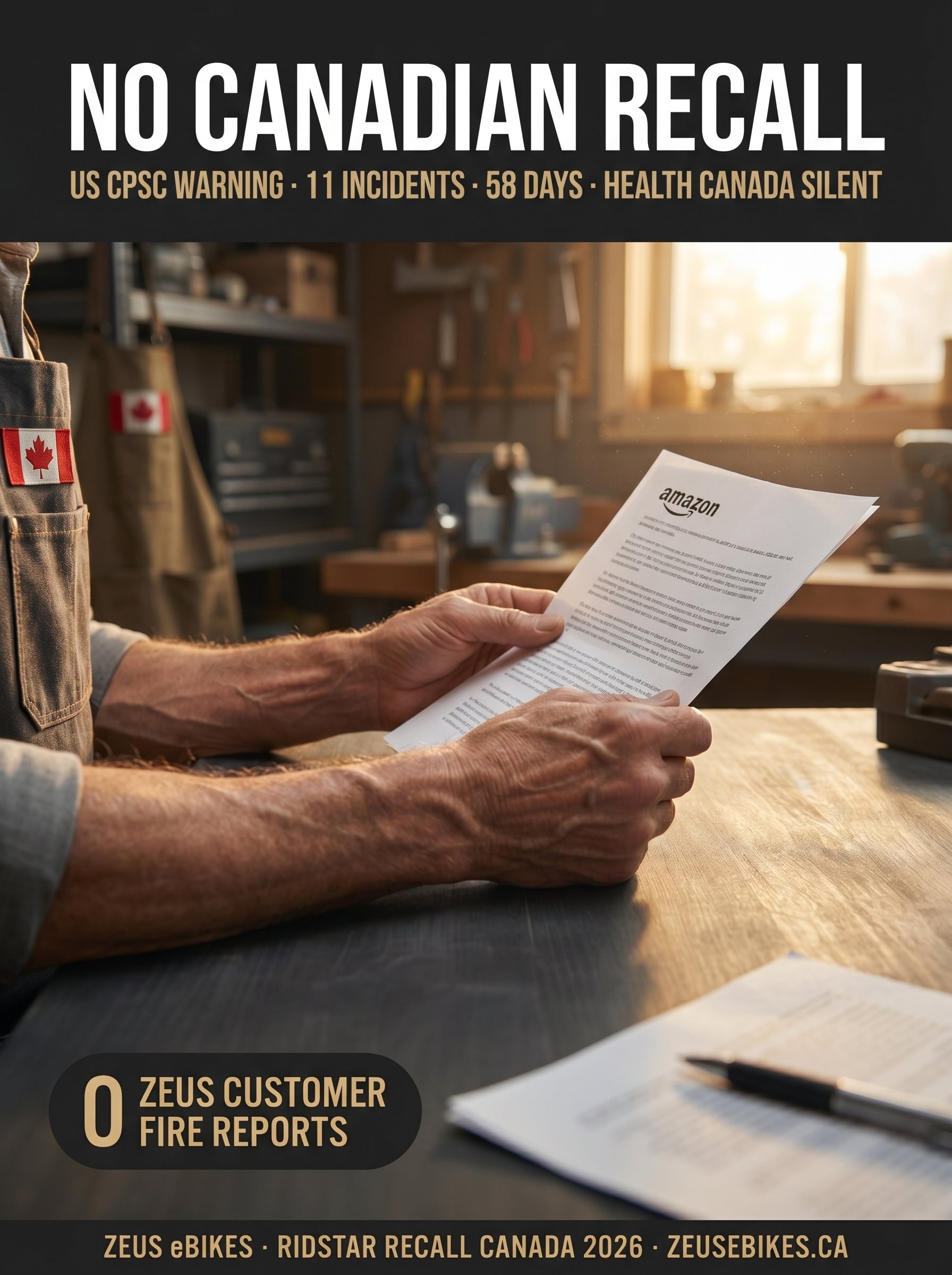
There is no Ridstar recall in Canada. The action that has generated the emails and phone calls Zeus has received over the past 60 days is a US Consumer Product Safety Commission "unilateral public warning" — not a recall — issued March 19, 2026, on the Ridstar Q20 and Q20 Pro after the manufacturer refused to negotiate a US recall. Health Canada has issued nothing. The warning does not specify which production batch is affected, does not publish a unit count, and does not provide a manufacturer-funded refund or replacement program. Ridstar has communicated to Zeus directly that the Canadian Q20 inventory is unaffected by the US action and disputes the basis of the US statement. As of the publication date of this article, Zeus has identified zero Canadian customer fire reports across its complete customer-service record — before, during, or after the US warning. What follows is the verified picture: what the CPSC filed, what it omitted, who actually has Canadian regulatory authority, why Amazon is not it, and what Canadian owners should actually do.
Primary sources audited (US): CPSC March 19, 2026 unilateral warning notice; Amazon.com, Inc. v. CPSC (Case 8:25-cv-00853-LKG, D. Md., filed March 14, 2025); CPSC Final Order No. 21-2 (January 16, 2025); Foley & Lardner, "Can a Voluntary CPSC Recall Short-Circuit Costly Class Action Litigation?" (Swanholt, Sikora, Holland, August 13, 2024); Consumer Federation of America, "The Growing Challenge of E-Commerce and Product Safety" (February 12, 2025). Secondary coverage: Electrek, Bicycle Retailer, Consumer Affairs, Daily Hornet, The Battery Wire, Newsweek, ABC7, OC DA press releases.
Primary sources audited (Canada): Canada Consumer Product Safety Act, S.C. 2010, c. 21 (royal assent December 15, 2010; in force June 20, 2011) — Sections 14, 31, 32; Health Canada Industry Guide to Section 14 Mandatory Reporting; recalls-rappels.canada.ca database (searched May 18, 2026 — zero results for "Ridstar"); Health Canada Notice of Intent on Lithium-Ion Battery Requirements (consultation December 2, 2025 – February 14, 2026); 2005 CPSC–Health Canada bilateral MOU; February 22, 2018 CPSC–Health Canada–PROFECO trilateral MOU; Ontario Sale of Goods Act; Ontario Consumer Protection Act 2002; Toronto Fire Services published incident commentary by Chief Jim Jessop.
Operational evidence: Zeus eBikes Canada customer-service records (email, phone, walk-in, live-chat) on the Ridstar Q20 product line from 2024 through publication date. Direct commercial communications between Zeus and Ridstar (Huizhou Xingqishi Sporting Goods Co., Ltd.) are reported as Zeus communications, not as independently published Ridstar press statements.
May 18, 2026 revision-pass primary-source verifications: (1) Live Amazon.ca search for "ridstar" performed and screenshot-documented; over a thousand keyword-match results returned, none of which are actual Ridstar e-bikes; Amazon's own brand-filter taxonomy on the search results page does not list Ridstar — basis for the "Amazon Has Already Pulled the Ridstar Q20 and Q20 Pro From Amazon.ca" section. (2) Amazon A-to-Z Guarantee policy pages (amazon.ca / amazon.com Help) reviewed for the 90-day claim windows — basis for the "90-Day A-to-Z Window Most Recipients Have Already Missed" section. (3) Ridstar.eu YVY C20 product page reviewed for the verbatim "equivalent to Ridstar Q20… technically identical" statement; Ridstar.com blog announcement "Ridstar to YVY: Same Trusted Ebikes, Fresh Brand" reviewed for the model-rebrand confirmation — basis for the YVY Rebrand section. (4) Zeus customer-service records and publicly available Canadian Reddit threads documenting Amazon.ca review-eligibility outcomes on non-delivery Ridstar orders — basis for the review-suppression section.
This guide is published by Zeus eBikes Canada, a Canadian electric bike retailer (zeusebikes.ca). Zeus has carried the Ridstar Q20 Pro since 2024 and has a commercial relationship with Ridstar. The editorial positions taken in this article — that the US CPSC warning is, as a matter of Canadian law, not a Canadian regulatory action because Health Canada has issued none; that the US warning as published lacks the batch and serial specificity characteristic of negotiated recalls; and that Health Canada is the only Canadian body with statutory recall authority under the CCPSA — are presented as Zeus's editorial views, supported by the primary-source citations linked throughout, and offered as fair comment on a matter of public interest under Canadian law.
Right of reply. Amazon (amazon.ca and amazon.com), Ridstar (Huizhou Xingqishi Sporting Goods Co., Ltd.), Walmart Canada, and any other party named in this article are invited to submit a published response to any factual claim or editorial characterization made here. Responses received in writing at milad@zeusebikes.ca will be appended verbatim, with attribution, to the body of this article. No published response had been received from any named party as of the most recent update date shown above.
This article is not legal advice, not financial advice, and not a substitute for the federal product-safety reporting and recall framework administered by Health Canada under the Canada Consumer Product Safety Act.
In This Guide
- What the US CPSC Actually Said on March 19, 2026
- Zeus's Canadian Customer Record: Zero Fire Reports
- The Holes in the US Warning — A Forensic Audit
- The YVY Rebrand — Same Hardware, New Brand Name, No Warning Attached
- A Warning Is Not a Recall — and Refunds Are Not the Remedy
- Who Actually Regulates eBike Safety in Canada
- Amazon Is a Retailer. It Is Not a Regulator.
- Ridstar's Position — and What Zeus Has Verified
- What a Real Recall Looked Like: Ridstar Canada 2024
- What Canadian Ridstar Owners Should Actually Do
- Zeus's Free Ridstar Battery Verification Service
- On the Post-Warning Refund Demands We Are Now Receiving
- Zeus eBikes for Riders Who Want Extra Peace of Mind
- Frequently Asked Questions
What the US CPSC Actually Said on March 19, 2026
The decision a Canadian Ridstar owner is being asked to make this week — dispose of a working battery, demand a refund, treat a bike that has been ridden without incident as if it were defective — turns entirely on what the US Consumer Product Safety Commission did and did not do on March 19, 2026. Read the warning carefully and the picture changes: this is what a regulator publishes when negotiation with a manufacturer has failed, not when a forensic investigation has concluded.
On March 19, 2026, the CPSC published a notice titled "CPSC Warns Consumers to Immediately Stop Using Ridstar E-Bikes Due to Fire Hazard; Risk of Serious Injury or Death." The notice — categorised on the CPSC website as a "warning," not a "recall" — targeted the Ridstar Q20 and Q20 Pro electric bikes.
The verified content of the warning, reproduced consistently across Electrek, Bicycle Retailer, Consumer Affairs, Daily Hornet, and The Battery Wire:
- Hazard: "The e-bikes' batteries and wires can ignite."
- Incidents: 11 reports of fire, including one burn injury, five reports of smoke inhalation, and two reports of property damage totalling over $40,000.
- Manufacturer: Huizhou Xingqishi Sporting Goods Co., Ltd., of China — "has refused to agree to an acceptable recall."
- Sold at: Amazon.com, Ridstar.net, and Walmart.com.
- Identification language: "The e-bikes are black, and the brand name 'Ridstar' is printed on the battery. The model number Q20 or Q20 Pro may be located on the purchase receipt."
- Consumer guidance: Stop using immediately; remove the battery; dispose through hazardous waste channels.
That is the entire substance of the warning. What the warning does not contain is the more interesting document — and the document Canadian consumers should weigh before disposing of a working battery on the say-so of a foreign regulator.
Zeus's Canadian Customer Record: Zero Fire Reports
Zeus eBikes Canada has carried the Ridstar Q20 Pro in our Canadian retail catalog since 2024. Every unit sold has been shipped to a Canadian customer through Zeus's direct channel, with the customer record maintained in our system. This is the operational record on the other side of the US CPSC warning:
Zeus has not identified — across its customer-service records of phone, email, walk-in, and live-chat contact — a single Canadian Ridstar customer report of fire, smoke, swelling, burning smell, or thermal event on a Zeus-sold Ridstar battery. This statement covers the period from initial 2024 listing through the publication date of this article.
This is not a marketing claim. It is the verifiable Canadian denominator the US CPSC warning omits, drawn from Zeus's complete customer-service record on this product line. The CPSC documented 11 fire incidents across an unknown US unit count, with no published batch range, no published serial cutoff, and no published context. Zeus has direct operational visibility into every Canadian customer the company has sold a Ridstar to. The Canadian Zeus count, as of the publication date, is zero.
If you are a Canadian Zeus Ridstar customer who believes you reported a battery incident and it is not reflected here, please email support@zeusebikes.ca with the subject line "Ridstar Incident Record" and any documentation, and Zeus will update this article and the underlying customer record accordingly.
How We Know — The Customer-Care Channel
The zero-fire record is not an absence of customer contact. It is operational evidence of an absence of fire across active customer contact.
Zeus maintains direct two-way contact with every Canadian Ridstar customer. The August 2024 Q20 Pro batch-recall established the protocol — every Canadian Zeus Q20 Pro owner was contacted directly by Zeus, asked to photograph their battery serial, and either (a) confirmed by Ridstar as not part of the affected batch, or (b) confirmed as affected and shipped a free replacement battery against confirmation of safe disposal of the original unit. The customer-care channel that opened during that process has remained active since.
In the time since the March 19, 2026 US CPSC warning, Zeus has received a meaningful volume of customer enquiries about the Q20 Pro. The pattern is consistent across every enquiry: customers are asking whether they should be worried, what the US warning means for them, whether their battery needs to be replaced. Not one enquiry has been a fire report. Not one customer has called or emailed to report smoke, swelling, burning smell, or thermal event on a Canadian-owned Ridstar unit. The enquiries are concern enquiries. They are not incident reports.
If a Canadian Zeus Ridstar customer had experienced a fire, Zeus would expect to know — because the August 2024 protocol established the pattern of two-way contact on this specific product line, and because Canadian eBike customers contact their retailer when something goes wrong with a battery, regardless of brand. The Canadian Zeus zero-count is the count of actual customer reports. It is not the count of assumed absences.
The Holes in the US Warning — A Forensic Audit
A negotiated CPSC recall is a discipline. It identifies which units, made when, with which battery cell chemistry, suffered which failure mode under which conditions — and it attaches a manufacturer-funded remedy. The Ridstar warning carries none of that. The omissions are the story.
Zero serial specificity
The warning lists "Q20 and Q20 Pro" as if every unit sold under those model names is equally affected, regardless of production date, battery supplier, or cell chemistry. A negotiated recall almost always specifies date-of-manufacture ranges or lot numbers. Ridstar's own August 2024 Canadian batch-specific Q20 Pro recall is documented evidence that the precision exists when the manufacturer cooperates.
Zero unit count published
On the same day — March 19, 2026 — CPSC published warnings for the LullaBear infant cushion (approximately 2,700 units, per Newsweek) and the Gpower ATV (approximately 320 units). Both included denominators. Ridstar's denominator was omitted. The agency cannot have it both ways: 11 incidents per unknown is not a meaningful incident rate.
Zero CPSC laboratory examination
None of the consulted secondary sources reference a CPSC engineering tear-down, root-cause analysis, third-party laboratory test, or battery cell forensic identification. The warning appears to be based on consumer incident reports alone. A negotiated recall typically includes engineering findings; a unilateral warning does not require them.
Zero incident-level public record
The 11 fire reports are not detailed publicly. Dates? Locations? Ages of bikes? Whether the bikes were charging or idle? Whether aftermarket batteries, replacement chargers, modified throttles, swapped controllers, or other user modifications were involved? None of it is in the published warning or any of the secondary outlets. Toronto Fire Services has explicitly attributed Canada's eBike fire surge to aftermarket batteries, chargers, and user modifications — not to specific manufacturers. The CPSC warning does not disclose whether any of the 11 incidents involved modified or aftermarket-component units. Eleven incidents without modification-status context is not the same as eleven incidents with root cause established.
Zero customer protection program
Because Huizhou Xingqishi refused to negotiate a recall, no refund, replacement, or repair program is attached to the warning. Consumers are advised to dispose of their batteries through hazardous waste channels — at their own cost and inconvenience — with no manufacturer-funded path to replacement. A warning of this kind is not a remedy. It is a notice.
Zero enforcement track record
Under 15 U.S.C. § 2064(f), CPSC may file an administrative complaint to compel a recall — but this requires a US-domiciled respondent with seizable assets. The Consumer Federation of America's 2024 analysis confirmed CPSC lacks the authority to force foreign manufacturers and sellers to act. The Ridstar parent company is Chinese, with no documented US assets. The realistic enforcement pathway is marketplace pressure, not legal compulsion.
This is not a defence of Ridstar's batteries. This is a description of the regulatory action that has been taken. A reader who treats a unilateral warning as if it were a negotiated recall is taking inferior information and dressing it as superior information — and acting on it.
A blanket model-line warning without batch specificity is not a recall. It is a notice that a regulator was unable to negotiate one.
Bought your Ridstar from Zeus and want a manufacturer-level answer about your specific battery serial?
Zeus's free Verification Service submits your battery serial to Ridstar against the same protocol that closed the August 2024 Canadian Q20 Pro batch-recall. Eligibility is strict (Zeus direct customers only, original-order email, battery-label photo). See the Verification Service section below for the exact submission protocol.
How the Verification Service WorksThe YVY Rebrand — Same Hardware, New Brand Name, No Warning Attached
There is a separate structural hole in the regulatory action worth naming directly, because it changes whose bike is covered by the warning text. Ridstar has partially rebranded the Q20 and Q20 Pro under a new brand name, "YVY" — and the CPSC warning of March 19, 2026 names only "Ridstar," not "YVY."
This is not Zeus's inference. It is Ridstar's own published statement. On Ridstar's European website at ridstar.eu, the YVY C20 product page states, verbatim:
YVY C20 (equivalent to Ridstar Q20)… It is technically identical to the Ridstar Q20, but offered under a different model name for clear branding and SEO distinction.
Ridstar.eu — YVY C20 product page
The model mapping confirmed across Ridstar's own properties (ridstar.com, ridstar.eu, ridstar-ebike.com) and across reseller pages that describe the new brand as "YVY: The New Name Riders Trust from Ridstar":
- Ridstar Q20 → YVY C20 (Canada / EU / UK / AU markets) and YVY K20 (US market)
- Ridstar Q20 Pro → YVY C20 Max (Canada / EU / UK / AU markets) and YVY K20 Pro (US market)
The same manufacturer — Huizhou Xingqishi Sporting Goods Co., Ltd. — operates both brands from the same factory, with the company's overseas warehouses (per its own About Us page) located in California, Poland, and Canada. Ridstar's own announcement to its customers, published as a blog post titled "Ridstar to YVY: Same Trusted Ebikes, Fresh Brand," describes the change in the company's own words: "the new brand identity for Ridstar Ebikes… same expertise, same strict quality standards, same team."
What this means for the regulatory action: the CPSC's identification language is unambiguous — "the e-bikes are black, and the brand name 'Ridstar' is printed on the battery." A YVY-branded battery with "YVY" printed on it instead of "Ridstar" does not match the identification text of the warning, regardless of whether the cells, wiring, controller, and chassis are identical. As drafted, the CPSC warning does not cover the YVY-branded inventory.
In Zeus's editorial view, the YVY rebrand creates a regulatory blind spot that should be transparently acknowledged in any safety conversation about Ridstar in Canada. A consumer with a YVY C20 has no public warning attached to their bike. A consumer with a Ridstar Q20 has a CPSC warning attached to theirs. The hardware, per the manufacturer's own statement, is identical. The conclusion a Canadian shopper should draw from this is the consumer's to draw — but the structural fact is worth naming: the warning's brand-name identification and the manufacturer's rebrand to YVY do not match.
Zeus does not currently carry the YVY brand. The Verification Service described below covers Ridstar-branded units sold by Zeus only; the manufacturer's verification protocol against YVY-branded inventory has not been established with Zeus.
A Warning Is Not a Recall — and Refunds Are Not the Remedy
The language matters. "Recall" has a specific meaning under both US and Canadian law. It is a formal, negotiated, manufacturer-funded program with a defined customer remedy: refund, replacement, or repair. It comes with batch identification, with timelines, with a registration page, and with consequences for the manufacturer if it does not perform.
A "unilateral public warning" is what a regulator issues when it could not negotiate any of that. It is the announcement that the regulator and the manufacturer disagree. It is the public airing of that disagreement. It is the agency's last available tool.
The Consumer Federation of America, in its February 12, 2025 analysis of 2024 CPSC safety warnings ("The Growing Challenge of E-Commerce and Product Safety"), documented 64 unilateral warnings issued in 2024 — a sharp escalation from three such warnings in 2020. Per the CFA report (figures verbatim):
- "42 of the 64 unilateral safety warnings addressed products from China" (66%).
- "61 of the 64 unilateral safety warnings addressed products sold online" (95%).
- "43 of the 64 unilateral safety warnings address products sold on Amazon" (67%).
The Ridstar warning fits the pattern the CFA documented. Chinese manufacturer with no US assets. Sold primarily via Amazon. Manufacturer refuses to engage. The CPSC's only remaining tool is public notice. The notice is published. The manufacturer continues operating from China.
There is a useful, well-documented precedent. On June 18, 2025, the CPSC issued a near-identical unilateral warning against the FENGQS F7 Pro e-bike (Shenzhen Fengqisi Car Industry Co. Ltd.) after the manufacturer declined to negotiate a recall. Approximately five weeks later, on July 24, 2025, FENGQS reversed course and agreed to a CPSC-supervised recall of approximately 100 units with a full refund remedy (no replacement option), against a record of 9 fire reports including $12,000 in property damage. The pathway from refused-warning to negotiated-recall is documented and short — when the manufacturer changes position. The open question with Ridstar is whether marketplace pressure produces the same outcome — and as of May 2026, it has not.
Customers contacting Zeus eBikes have, in some cases, demanded refunds based on the CPSC warning. The warning does not produce a refund right. A US CPSC unilateral warning is a public-safety notice — it does not legally entitle a US consumer to a refund, and it produces no consumer right whatsoever in Canada. The refund pathway, if any, runs through the seller's contract and the consumer-protection law of the jurisdiction of sale. In Canada, that is provincial sale-of-goods and consumer-protection law, not a US federal regulator.
Who Actually Regulates eBike Safety in Canada
The Canadian regulator is Health Canada's Consumer Product Safety Program, operating under the Canada Consumer Product Safety Act (CCPSA), S.C. 2010, c. 21. There is no Canadian equivalent of the US CPSC as an independent agency — consumer product safety in Canada is folded inside Health Canada, the same department that regulates pharmaceuticals and medical devices.
The CCPSA received royal assent on December 15, 2010 (S.C. 2010, c. 21) and came into force on June 20, 2011, giving Health Canada — for the first time in Canadian history — the authority to order a recall under Section 31. Before the CCPSA, federal product-safety remedies operated under the Hazardous Products Act regime, which had no mandatory recall power and relied on industry-managed voluntary action. Section 31 authorises the Minister to order a recall on reasonable grounds; Section 32 authorises orders to take other corrective measures. Voluntary recalls continue to be the practical norm in Canada — they are negotiated case-by-case with Health Canada — and Sections 31 and 32 are the statutory backstop when negotiation fails. Section 14 imposes a mandatory incident-reporting duty on manufacturers, importers, and sellers within two days of becoming aware of a reportable incident, with a written report within ten days.
Where Health Canada Stands on Ridstar
A search of the official Health Canada recalls database at recalls-rappels.canada.ca on May 18, 2026 returns zero results for "Ridstar." As of the date of this writing — 60 days after the US CPSC warning — Health Canada has issued no advisory, no Section 31 order, no Section 32 voluntary agreement, and no public consumer warning naming Ridstar.
This silence is not an oversight. It is consistent with how Health Canada operates. The CPSC and Health Canada signed a bilateral Memorandum of Understanding in 2005 (between then-CPSC Chairman Hal Stratton and Health Canada Assistant Deputy Minister Susan Fletcher); on February 22, 2018, the CPSC, Health Canada, and Mexico's PROFECO signed a new trilateral MOU at the ICPHSO meeting in Orlando. Both are information-sharing arrangements, not automatic-mirror agreements. Each Canadian regulatory action requires Health Canada to independently form a "reasonable grounds" belief under CCPSA Section 31. Health Canada does not import US decisions wholesale, and there is no obligation under either MOU to act on every CPSC warning.
The most recent illustration is Rad Power Bikes: on November 24, 2025, the CPSC issued a battery fire warning for Rad Power batteries. The manufacturer refused recall. As of early 2026 reporting from CBC News BC and Canadian Cycling Magazine, Health Canada had not issued a parallel warning despite Rad Power batteries being widely sold across British Columbia and the rest of Canada. The pattern with Ridstar repeats: US warning, no Canadian action.
The Gaps in the Canadian Framework Are Real
Canada also has a structural gap in eBike battery regulation that is worth naming. There is currently no mandatory federal certification standard for eBike batteries in Canadian law. UL 2849 is published jointly as ANSI/CAN/UL 2849 — an American National Standard and a National Standard of Canada via the Standards Council of Canada — but recognition is not mandate. California (under Senate Bill 1271, effective January 1, 2026, accepting UL 2849, UL 2271, or EN 15194) and New York City (under Local Law 39, requiring UL 2271 for batteries and UL 2849 for e-bike systems) have mandated third-party-certified standards for new sales. Federal Canadian law has not yet done so.
Health Canada published a Notice of Intent for "Proposed new requirements for lithium-ion batteries and consumer products containing lithium-ion batteries under the CCPSA" and ran a pre-consultation from December 2, 2025 to February 14, 2026. The proposal would establish mandatory performance criteria. No regulation has been promulgated as of this date. Until it is, lithium-ion eBike batteries can be lawfully sold in Canada with no mandatory third-party safety testing — though Zeus and most reputable Canadian retailers source UL 2849 or equivalent-certified packs as a matter of internal policy rather than legal requirement.
Amazon Is a Retailer. It Is Not a Regulator.
A significant portion of the panicked emails Zeus has received in the past 60 days appear to have originated with Amazon emails to Canadian Q20 owners — emails advising customers to "stop using" the product, "dispose of the battery," and pursue a refund. These emails carry the implicit weight of officialdom because they came from a large company, on the heels of a regulator's name. They do not carry legal weight.
Under Canadian law, Amazon is a marketplace operator and retailer. It has the same Section 14 reporting duty under the CCPSA as any other Canadian seller, but it has zero statutory recall-ordering authority. The Minister of Health, acting through Health Canada, is the only Canadian official authorised to order a consumer-product recall.
Amazon Canada's published policy (amazon.ca/product-safety-alerts) confirms what Amazon does when it becomes aware of a recall: suppress the listing, remove product from supply chain, notify affected customers, and require sellers to comply with manufacturer or regulator instructions. The policy is corporate. It is not regulatory. Amazon's notification email is not a Health Canada recall notice. Amazon's dispose-the-battery advisory is not a Section 31 order. Amazon's refund offer, if any, runs through Amazon's A-to-Z Guarantee — a contractual obligation between Amazon and its customers — not a regulatory remedy.
Amazon's notifications are corporate policy. They are not regulatory action. A retailer telling you to dispose of a battery is not the same as a regulator ordering you to.
This distinction matters because Amazon's communications, while well-intentioned and likely the product of legal-risk avoidance after the CPSC warning, are not based on Canadian regulatory authority. A Canadian customer who disposes of a healthy battery, or who demands a refund from a Canadian retailer based on Amazon's email, is acting on retailer correspondence — not on a Health Canada determination. There is no Health Canada determination.
Ridstar's Position — and What Zeus Has Verified
In direct communication with Zeus eBikes Canada following the March 19, 2026 CPSC warning, Ridstar has stated two things material to the Canadian situation:
- The Canadian Q20 series inventory is unaffected. Ridstar's representatives have stated to Zeus that the units sold into the Canadian market do not share the characteristics involved in the US incident reports.
- Ridstar disputes the basis of the American statement. The company has, in communications to Zeus, denied knowledge of and disagreed with the substance of the US CPSC warning.
Zeus reports these as Zeus communications with Ridstar — not as independently published Ridstar press releases. As of this writing, Ridstar has issued no public press statement responding to the CPSC warning. Neither Bicycle Retailer, Electrek, Consumer Affairs, Daily Hornet, The Battery Wire, Newsweek, nor any other outlet covering the warning has obtained a Ridstar quote. Huizhou Xingqishi Sporting Goods Co., Ltd. has not engaged the US press cycle.
That silence is editorially significant. It is also the standard pattern when a Chinese manufacturer faces a CPSC unilateral warning — public engagement with US media is not a strategy; corporate position is communicated through commercial channels to retailers and distributors, as has happened here with Zeus.
To this date, not a single Canadian Zeus customer has reported a Ridstar battery fire — not in 2024 before the prior recall, not after, and not in connection with the 2026 US warning. Zeus has a complete customer record of every Ridstar Q20 Pro sold through Zeus into Canada. The record is empty of fire reports. We say this not as a marketing claim — we say it because it is the verifiable Canadian denominator that the US CPSC warning omits.
What a Real Recall Looked Like: Ridstar Canada, August 2024
The criticism in this article of the US CPSC warning is not that recalls don't matter, or that battery defects should be ignored. The opposite. The criticism is that the 2026 US action does not do the work that a recall is supposed to do — and there is a documented Canadian precedent that proves the work is possible when the manufacturer engages.
In August 2024, Ridstar identified a defect in a specific battery production batch on the Q20 Pro. The response was the recall pattern that actually works:
- Identification. Ridstar identified the affected production batch by serial-range internal to the company's manufacturing records — not by guess, not by inference, by manufacturing data.
- Photo verification. Owners were asked to photograph the identification label on their battery and submit it. Ridstar then matched the serial against the affected production range. Some owners were confirmed-affected. Others were confirmed-not-affected.
- Remedy. Owners with confirmed-affected units received free replacement batteries shipped to Canada. The original units were collected and disposed of through hazardous-waste protocols. Zeus participated as the Canadian retailer, contacting every Canadian Q20 Pro owner in our records.
- Closure. The process closed with documented batch remediation. No Canadian Zeus customer has reported a fire — before the process, during it, or in the time since.
That is what a competent recall looks like. Identify the batch. Verify by serial. Replace the affected units. Document the remediation. The 2026 US action does not do any of this — because Ridstar is not participating in it.
The 2024 Canadian process is the strongest available evidence that Ridstar has the operational capacity to run a competent batch-specific recall. The fact that the 2026 action is structured differently is not because Ridstar cannot do it — it is because Ridstar disputes the underlying claim. That is a different conversation than "a manufacturer who refuses safety actions categorically."
A serial-by-serial batch recall is what happens when the manufacturer engages. A blanket model-line warning is what happens when the regulator and manufacturer disagree about whether engagement is warranted.
What Canadian Ridstar Owners Should Actually Do
The advice that follows is based on Health Canada's published lithium-ion battery safety guidance, Toronto Fire Services' published e-mobility battery recommendations, the manufacturer's own user documentation, and Zeus's operational experience as a Canadian eBike retailer with a complete record of zero fire incidents on Ridstar units in our customer base.
1. Inspect Before You Act
A healthy lithium-ion battery does not require disposal. A damaged or degraded lithium-ion battery does, regardless of brand. Look for:
- Visible swelling, bulging, or pillowing of the battery case
- Burning smell during charging or use
- Heat that does not dissipate within an hour of removing from the charger
- Visible terminal corrosion, fluid leakage, or damaged casing
- Charging stops working, error codes on the display, or unusual smoke or sparking
If any of these symptoms are present, stop using the battery and contact the retailer who sold you the bike. If none are present, the battery is functioning as designed. A US regulator's blanket warning about an unidentified production batch is not a defect in your specific unit.
2. Charge Properly
- Charge in an open, fire-safe area. Not in a hallway. Not on a couch. Not on a bed.
- Use only the charger that came with the bike. Aftermarket chargers are implicated in a significant share of e-bike battery fires per Toronto Fire Services data.
- Never leave a new battery charging unattended for the first three to five cycles. After that, supervised charging is adequate.
- Do not store batteries at full charge for extended periods. 40-80% state of charge is the optimal storage range.
- Do not charge a battery below freezing. Allow it to reach room temperature first.
3. Do Not Modify the Bike — Especially the Battery, Charger, Controller, or Throttle
The Ridstar Q20 and Q20 Pro are popular among younger riders, and a measurable share of eBike battery fires across all brands in Canada — per Toronto Fire Services' published incident analysis — are not caused by the original manufacturer's components. They are caused by user modifications: aftermarket batteries, aftermarket chargers, swapped controllers, modified wiring, and replaced throttles. Toronto Fire Services Chief Jim Jessop has publicly identified lithium-ion battery fires in e-bikes and e-scooters as "the largest growing fire safety risk in the city," with aftermarket batteries and chargers separately identified by Toronto Fire Services as a leading contributing factor in those incidents. This — the modification-and-aftermarket-component category — is, in Zeus's view, the single most preventable cause of eBike battery fires in Canada, and we are naming it directly because the modification culture around the Q20 line is real.
Modifications to specifically avoid on your Ridstar:
- Aftermarket batteries. Replacing the original Ridstar battery with a non-OEM pack — common on YouTube tutorials, common in eBike forums, common among riders looking for more range. Aftermarket batteries are the leading cause of eBike battery fires per Toronto Fire Services. Do not do this.
- Aftermarket chargers. Using a non-OEM charger is the second-leading cause of battery fires. Chargers are not interchangeable across battery chemistries, voltage configurations, or amperage profiles. Use only the charger that shipped with your bike.
- Throttle replacement, controller swap, or "delimiting." Among the most common modifications on the Q20 line — riders bypassing the speed limiter, swapping in higher-output controllers, replacing the original throttle with one that allows higher speeds. These modifications change the electrical characteristics of the entire drivetrain, can cause the battery to deliver current outside its design parameters, and can directly cause overheating events. They also push the bike outside the 500W nominal / 32 km/h limits Canada's provincial rules converge on, so it is no longer a power-assisted bicycle on public roads or pathways.
- Wiring modifications. Direct fire risk. Do not splice. Do not rewire. Do not bypass any switch, fuse, or protective component. Do not "hardwire" anything.
- Motor swaps, software/firmware modifications, aftermarket displays. Each of these changes the operating envelope of the battery and electrical system. Each one transfers fire risk to the modifier and voids every warranty the original manufacturer provided.
Three things every Ridstar owner — and every parent of a Ridstar rider — should understand about modifications:
- Modifications void the manufacturer's warranty. Ridstar will not honor warranty on modified units. Zeus cannot escalate a warranty claim on a modified unit to Ridstar because the modification breaks the chain of original-equipment responsibility.
- Modifications void Zeus's Verification Service eligibility. The verification service exists to confirm a specific original Ridstar battery against Ridstar's manufacturing records. If you have replaced the battery, the controller, the throttle, or any electrical component, the unit you have is no longer the unit Zeus sold and Ridstar manufactured. There is nothing for Ridstar to verify on a modified unit, and Zeus cannot facilitate a verification on a non-original component.
- Modifications transfer liability to the modifier. If a modified bike causes a fire, the person who modified it — not Zeus, not Ridstar — is the responsible party under Canadian product-liability law. Modification breaks the manufacturer-retailer-consumer chain. Manufacturer's confirmations about Canadian inventory safety apply only to the original, unmodified product as sold.
If you have already modified your bike: return it to original specification before submitting any Verification Service request, before pursuing any warranty claim, and before riding it on a Canadian public road or path. If you cannot or will not return it to original spec, the verification service is not available to you, the manufacturer's position on Canadian inventory safety does not extend to your modified unit, and the legal classification of the bike under Canadian PAB law is your responsibility, not Zeus's.
For the technical context on Canada's 500W / 32 km/h framework and why modifications can push a legal eBike into the moped or motorcycle class, see Zeus's Canadian eBike Legal Access Atlas and 500W vs 750W vs 1000W guide.
4. Confirm Your Channel of Purchase
If you bought your Ridstar from Zeus eBikes Canada, submit a Verification Service request by email only using the exact submission protocol described below at "Zeus's Free Ridstar Battery Verification Service". Zeus retains your purchase record but does not retain your battery serial number — Ridstar identifies the serial directly from the photograph of the battery label that you attach to your email. Phone calls to Zeus on this matter cannot move your verification forward, because no serial verification can be performed without the battery-label photograph in writing. Email only. No phone, no walk-in.
If you bought via Amazon Canada, Amazon Canada is currently running an active product-safety notification and refund program for Ridstar purchases via amazon.ca/your-product-safety-alerts. Your refund pathway is Amazon's program (detailed above). Submit your disposal confirmation through that page.
If you bought via Walmart Canada from a third-party marketplace seller, your remedy runs through that seller and Walmart's Marketplace Buyer Protection. Those are contractual rights, not regulatory rights. They depend on the seller still being active and on the marketplace's policies.
If you bought directly from Ridstar.net (the US site shipping to Canada) or from any unverified third-party seller, you are in the weakest position. Customer service from a non-Canadian seller, in a regulatory dispute, with no Canadian retail relationship, is a difficult position to operate from.
5. Report Any Real Incident
If you experience any actual battery event — fire, smoke, dangerous heat, damage — Canadian retailers have a legal obligation under CCPSA Section 14 to report it to Health Canada within two days of becoming aware. Owners can report directly to Health Canada through the Consumer Product Incident Report form at canada.ca/en/health-canada/services/consumer-product-safety/incident-report.html. A Canadian incident report is the input Health Canada needs to evaluate whether a Section 31 mandatory recall is warranted. A Canadian regulator acting on Canadian data is what protects Canadian consumers — not a US regulator acting on US data.
Zeus's Free Ridstar Battery Verification Service — Canadian Q20 and Q20 Pro Owners
For Zeus eBikes Canada direct customers only, Zeus will submit your battery serial number to Ridstar on your behalf — free of charge — for confirmation as to whether your specific unit is part of any current or prior Ridstar batch-recall action. Ridstar has indicated to Zeus that it will perform serial-by-serial batch verification for Zeus's Canadian customers using the same protocol that closed the August 2024 Q20 Pro recall.
This service exists for one purpose: to give Canadian Q20 and Q20 Pro owners who bought from Zeus a direct, written answer from the manufacturer about their specific serial — sourced from Ridstar's manufacturing records, not from public speculation about the US CPSC warning.
Who Is Eligible
This service is available exclusively to Zeus eBikes Canada direct customers with a verifiable Zeus order number who submit from the email address on the original order. Customers who purchased their Ridstar elsewhere — Amazon Canada, Walmart Canada, Ridstar.net, eBay, Kijiji, Facebook Marketplace, Craigslist, or any third-party reseller, including used or second-hand purchases from a prior Zeus customer — must contact their original seller for support. Zeus does not extend warranty or verification services to second-hand owners, private-sale buyers, or anyone whose name is not on the original Zeus order. Zeus cannot service units it did not sell, and Zeus cannot service units it did sell once they have been resold privately to a third party. There are no exceptions.
How to Submit a Verification Request
- Submit by email only. Phone calls, walk-ins, social-media DMs, and live-chat messages cannot move a verification forward — no serial can be matched without the written battery-label photograph and order-record check described below.
- Send from the email address on your original Zeus order. Submissions from any other email address — a spouse's address, a new address, a work address, or any email not on the original order record — will not be matched and will not be processed. This rule exists to prevent third-party and second-hand-buyer claims against warranties that do not transfer.
- Subject line — required, exactly as written: "Ridstar Battery Verification — Order #[your Zeus order number]". Submissions without an order number in the subject line will not be opened.
- Email to: support@zeusebikes.ca
- Attach a clear, in-focus photograph of the full identification label on your battery. The label is printed directly on the battery casing — not on the bike frame, not on the charger, not on the box. The serial number, model number, manufacture date, and any barcode or QR code must all be legible. Out-of-focus, partial, or cropped photos will not be processed. Ridstar identifies your serial from this photograph; Zeus does not retain customer battery serials independently of what you submit.
- In the body of the email, include: your Zeus order number, your full legal name as it appears on the original order, and the shipping address from the original order.
- That is the entire submission. Do not include additional questions, requests for general bike advice, or attachments other than the battery photograph in the same email — those will delay processing and may cause your submission to be missed.
Zeus will not process and will not respond to the following:
- Submissions without a valid Zeus order number in the subject line
- Submissions where the order number cannot be matched against Zeus's Canadian customer record
- Submissions sent from any email address other than the one used on the original Zeus order. Spouse's email, new address, work email, gift recipient's email — all will be rejected. Submit from the email on the order or do not submit.
- Submissions from second-hand owners or private-sale buyers — including buyers who purchased a Zeus-sold Ridstar from a prior Zeus customer via Kijiji, Facebook Marketplace, Craigslist, eBay, classified ads, or any private resale channel. Zeus's warranty and verification services do not transfer with the bike. The original purchaser of record is the only person Zeus services on that unit.
- Submissions from customers who purchased their Ridstar new from any seller other than Zeus eBikes Canada — Amazon Canada, Walmart Canada, Ridstar.net, or any other reseller
- Submissions with illegible, out-of-focus, partial, or doctored battery photographs
- Submissions where the name or shipping address does not match the original Zeus order on record
- Repeat submissions for the same battery serial within a 30-day window
- Phone calls, walk-ins, social-media DMs, or live-chat messages requesting verification — these channels cannot process verifications and will be redirected to the email submission protocol above
- Submissions for bikes that have been modified from original Ridstar specifications — including but not limited to aftermarket battery replacements, aftermarket chargers, swapped controllers, replaced or modified throttles, "delimiting" or speed-limiter bypasses, rewiring, motor swaps, firmware modifications, or any non-OEM electrical component. The verification service exists to confirm an original Ridstar battery against Ridstar's manufacturing records. There is nothing for the manufacturer to verify on a non-original or modified unit.
These rules exist because Zeus's customer record is the only verifiable basis for performing this service. Without it, the service has no integrity.
What Happens After You Submit
- Zeus matches your order against our customer record. If the order number is valid, your submission is logged and forwarded to Ridstar.
- Ridstar performs the batch verification. Ridstar's typical turnaround for batch checks is 5-10 business days, but Ridstar's timeline is Ridstar's — not Zeus's. Volume, time zones, and Ridstar's internal processes determine when the response comes. Zeus does not commit to a verification deadline because Zeus does not perform the verification.
-
Zeus communicates the result to you in writing. The response is one of two outcomes:
- (A) Your serial is not part of any current or prior Ridstar batch-recall action. No further action required from you. Continue normal eBike battery safety practices.
- (B) Your serial is identified by Ridstar as part of a batch-recall action. In that case, Ridstar provides a free replacement battery shipped to the Canadian address on your original Zeus order. You are required to: (i) immediately stop using the original battery, (ii) dispose of the original battery through your municipal hazardous-waste channel, and (iii) confirm disposal to Zeus in writing (photograph of the disposal receipt or facility intake confirmation) before the replacement battery ships. No replacement battery will ship until disposal confirmation has been received.
What This Service Is Not — And What You Are Responsible For
This service is a manufacturer-batch-verification facilitation. Zeus collects your submission, submits it to Ridstar, and communicates Ridstar's written response back to you. The verification itself is performed by Ridstar — Zeus is the Canadian retail intermediary, not the verifying authority.
This service is explicitly not:
- A safety inspection of your bike or battery by Zeus
- A determination by Zeus or its staff that your unit is, or is not, safe to ride
- A modification, extension, supplement, or replacement of any warranty, refund, return, or remedy right you may have under the original terms of your Zeus purchase, or under provincial sale-of-goods or consumer protection law
- A guarantee that Ridstar will respond within any particular timeframe
- A guarantee that Ridstar's verification result will be comprehensive, accurate beyond Ridstar's own records, or address every possible defect mode
- A pathway to a monetary refund, credit, or other compensation. The only remedy this service produces, if your serial comes back as part of a Ridstar batch-recall action, is a Ridstar-supplied free replacement battery and Ridstar-supplied disposal instructions. There is no cash, refund, or credit alternative.
- A Canadian or United States regulatory action. Health Canada has issued no recall, advisory, or warning on Ridstar. The United States CPSC has issued a unilateral public warning that does not apply in Canada. This service does not change either of those facts.
You — the owner — remain responsible for:
- The accuracy and legibility of the photograph you submit. Ridstar verifies what you send. If you send the wrong label or a blurred image, the response Ridstar produces is based on what you sent — not what your bike actually is.
- The accuracy of your order number and identifying information. Zeus matches your submission against our customer record exactly as you submit it. We do not search for partial matches and we do not contact you to clarify incomplete submissions.
- Your decision to continue riding the bike during the verification window. Riding is your discretion. Not riding is your discretion. Zeus does not advise on either choice. Universal lithium-ion battery safety practices — inspect for damage, swelling, or unusual heat before every ride; charge only in a fire-safe location; use only the supplied charger; never charge unattended overnight in the first few cycles of any new pack — apply to every eBike battery on the market and are your responsibility as the owner.
- Compliance with disposal instructions if your serial is identified as affected. Failure to dispose of an affected battery through proper hazardous-waste channels, or failure to provide written disposal confirmation, will result in Ridstar not shipping a replacement battery. Zeus will not advance, substitute, or pre-ship a replacement on behalf of Ridstar.
- All consequences of continued use of an unverified or affected battery, including but not limited to fire, smoke, property damage, personal injury, and damage to third parties. Zeus's role is to facilitate verification. The riding decisions and their consequences are the owner's.
One Submission. One Verification. One Outcome.
This is a voluntary free service offered by a Canadian retailer to its Canadian customers in response to a foreign regulator's warning that the manufacturer has confirmed does not apply to the Canadian inventory. It is the strongest action a Canadian retailer can take short of a regulatory recall — which, in Canada, only Health Canada has the authority to order.
If you are a Zeus Q20 or Q20 Pro customer who wants the manufacturer's written confirmation about your specific battery serial: submit. If you are not a Zeus customer: contact the seller who actually sold you the bike, because no Canadian retailer can service inventory it did not sell.
Zeus customers: email support@zeusebikes.ca with subject line "Ridstar Battery Verification — Order #[your order number]" plus a clear battery-label photo. Non-Zeus customers: contact your original seller. There are no exceptions to either.
On the Post-Warning Refund Demands We Are Now Receiving
In the days since the US CPSC warning was published on March 19, 2026, Zeus has received emails and phone calls from a specific category of customer: someone who bought a Ridstar from Zeus after the warning was already public, has ridden the bike without incident, and is now demanding a full refund — citing US news, Amazon's US refund policy, or the existence of the CPSC warning itself as the basis for the demand.
We address this directly because it deserves to be addressed.
These are not defective-product refund cases. They are not return requests on a unit that failed. They are not customers whose bikes have caused them harm. They are customers who, after using a non-defective Canadian-sold product without incident, have decided that a US news story is worth treating as a basis for a refund demand against a Canadian retailer that has no contractual relationship with the US regulator or the US marketplace whose policies are being invoked.
The product you received is not defective. The manufacturer has communicated to Zeus that the Canadian inventory is not affected by the US warning. Health Canada has issued no recall, no advisory, and no order. The bike you have been riding without incident is the same bike you bought, with the same battery you bought, from the same manufacturer who has confirmed in writing that the Canadian product is not part of the US issue. Nothing has changed about your bike. What has changed is that you read a news article.
Amazon Has Already Pulled the Ridstar Q20 and Q20 Pro From Amazon.ca
Before reading what Amazon's notification email says, the practical fact every recipient should understand: Amazon.ca has already delisted the Ridstar Q20 and Q20 Pro electric bikes. A search for "ridstar" on Amazon.ca today returns over a thousand results — but not a single one is an actual Ridstar electric bike. The visible products are third-party throttle accessories that mention "Ridstar" in the title, headlights designed to fit a Ridstar, and competitor brands. Amazon's own brand-filter taxonomy on the search results page no longer lists Ridstar as a brand selling on the platform.
The exact date Amazon.ca delisted the Ridstar Q20 and Q20 Pro line is not publicly announced, but the pattern is consistent with what Zeus's prior research on Ridstar's Amazon.ca history documented: third-party Marketplace sellers were deactivated repeatedly throughout 2024 and 2025 — the seller whack-a-mole pattern Canadian buyers reported on Reddit, RedFlagDeals, and Canadian e-bike forums — and at some point before the May 2026 customer-safety notification was sent, Amazon stopped allowing Ridstar Q20 and Q20 Pro listings from being onboarded under any seller account on Amazon.ca.
The May 2026 notification that landed in Canadian inboxes is therefore not a "stop selling" announcement. The selling had already stopped. The notification is a customer-side notice on a product Amazon had already removed from its own catalog. That sequencing — pull first, notify last — is part of the operating reality the rest of this section unpacks. It also matters legally, because Amazon's contractual refund window depends on when a purchase was made, not when a notification was sent. The next sections work through what that means in practice.
What Amazon Canada's Notification Actually Says
The most common refund demand Zeus is receiving runs through the same talking point: "Amazon is refunding everyone — why won't you?" The first thing to understand is what Amazon's notification email actually contains. Zeus has reviewed direct Amazon.ca customer notification emails sent to Canadian Ridstar order-history customers in May 2026. The notification reads, in part:
"We write to notify you of a potential safety concern with a product that you purchased on Amazon.ca... Our Product Safety team has identified that the product listed above may short circuit, overheat or melt, posing potential fire and burn hazards. If you still have this product, we urge you to stop using it immediately. Please dispose of this item and visit the Recalls and Product Safety Alerts page... to confirm disposal and obtain a refund if you haven't already received one."
Source: Amazon.ca customer notification email observed by Zeus eBikes Canada, May 2026. From order-update@amazon.ca, subject "ATTENTION: Important Safety Notice about your Past Amazon Order." The notification lists multiple Amazon.ca order IDs (702-prefix format) and directs customers to amazon.ca/your-product-safety-alerts.
What the Notification Actually Reveals: Mass Mailing, Not Manufacturer Analysis
The email exists. The refund process described in it is real. But the way Amazon Canada is operating this notification reveals something more important than the refund offer itself — and it deserves to be named directly.
Zeus has reviewed multiple Amazon.ca product-safety notification emails sent to Canadian customers in May 2026. Among them: notifications sent to Canadian customers whose original Ridstar Amazon order was a non-delivery transaction — meaning the customer never received a bike, and Amazon had already refunded the customer for non-delivery prior to the safety notification being sent. Some of these original Ridstar Amazon transactions were verified non-delivery scams that Amazon resolved through its A-to-Z Guarantee process weeks or months before the March 19, 2026 CPSC warning ever existed.
Read that again. Amazon's "product safety" notification is going to customers who do not have a product — customers who never received one, whose Amazon transaction was a scam-seller listing Amazon already processed a refund on, long before the CPSC warning ever existed.
The "or obtain a refund if you haven't already received one" language in Amazon's notification confirms this directly. Amazon is hedging against duplicate refunds because Amazon knows many of the recipients of the notification have already been refunded for unrelated reasons — non-delivery, returns, A-to-Z claims, chargebacks. Amazon does not want to issue a second refund on the same order. So Amazon writes a clause into the safety notification that quietly acknowledges most recipients are already refunded for reasons that have nothing to do with battery safety.
This tells us exactly what Amazon Canada is doing:
- Bulk-emailing every Canadian customer whose Amazon.ca order history includes any Ridstar purchase — regardless of fulfillment status, regardless of whether the customer actually has a product, regardless of whether the customer was already refunded for unrelated reasons.
- No unit-level analysis. Amazon is not checking the customer's specific battery serial, the production batch, the manufacture date, or whether the customer's particular unit shares any characteristic with the 11 incidents the CPSC documented.
- No manufacturer-level engagement. Amazon is not coordinating with Ridstar, not running the August-2024-style serial-photo batch verification protocol, not waiting on Ridstar's technical determination. Amazon is acting alone, on the basis of order history alone.
- No batch specificity. Amazon is treating every Ridstar order as equally potentially at-risk — exactly the blanket-line approach the CPSC took, magnified into customer-level corporate liability action.
The customer who emails Zeus claiming "Amazon refunded everyone for safety reasons, why won't you?" is repeating a description that does not survive contact with what Amazon is actually doing. The notification is mass-mail compliance. The refund offer that follows is a procedural option for customers who confirm disposal — not an admission by Amazon that any specific product the customer holds is defective. And many of the people receiving the notification do not have a product to dispose of, do not have a serial to confirm, and do not have a remedy to seek — because their original Ridstar Amazon transaction was a non-delivery case Amazon already resolved.
In Zeus's view, the structure of Amazon's notification — bulk-email to every order-history customer, refund offer hedged with "if you haven't already received one," no apparent unit-level filter — is consistent with corporate-liability documentation at scale, not with unit-level safety remediation.
Zeus's approach is the opposite. Zeus matches a specific customer's specific battery serial against the manufacturer's specific batch records, returns a specific written outcome per serial, and ships a free replacement battery only when the serial is verified-affected. That is the standard the August 2024 Q20 Pro recall established between Zeus and Ridstar — serial-photo verification, batch-matched response, free replacement on confirmed-affected units. It is the standard a Canadian retailer should hold to. It is the standard the published CPSC warning notably lacks. And it is the precise opposite of what Amazon Canada is doing.
The customer who tells Zeus "Amazon is refunding everyone, you should too" is asking Zeus to lower its standard to match Amazon's bulk-mailing approach. Zeus's standard is higher than that. Zeus's standard is what a Canadian retailer carrying a manufacturer's product line should look like when there is a genuine safety question on the table.
The Email Amazon Sent to a Customer Who Never Received a Bike
Consider this documented sequence of events. In Zeus's reading, it is the single clearest piece of evidence in the entire Amazon Ridstar situation about how Amazon's product-safety notification system actually operates at the recipient level.
- In 2024 or early 2025, a Canadian buyer placed an order on Amazon.ca for a Ridstar Q20 from a third-party Marketplace seller. The listing showed a low headline price and a deep "shipping fee" — a pattern Zeus's prior research documented as common across Amazon.ca Ridstar listings.
- The product never arrived. The seller — operating from a Chinese FBM account — did not ship, did not respond, did not deliver.
- The buyer filed an A-to-Z Guarantee claim. Amazon investigated, found in the buyer's favour, and issued a refund. The order in the buyer's account was marked as resolved — non-delivery, refunded — months ago.
- The buyer moved on. No bike was in their possession. Their Amazon account history showed a Ridstar order that was refunded for non-delivery, long before the CPSC March 19, 2026 warning was ever issued.
- On May 14, 2026 — long after the original order, long after the refund, with no bike anywhere in this customer's life — Amazon's "Product Safety team" emailed this customer. The email instructed the customer to stop using the Ridstar bike they did not have, to dispose of the bike they had never received, and to confirm disposal in order to obtain a refund — "if you haven't already received one."
This case is not hypothetical. Zeus has reviewed the customer's Amazon order history, the A-to-Z refund record, and the May 14, 2026 product-safety notification email. The notification was sent.
In Zeus's reading of the publicly available evidence, this matters because every data point in that sequence is in Amazon's own back-end systems: the order placed, the order never fulfilled, the A-to-Z claim filed, the claim approved, the refund issued, the absence of product in the buyer's possession. Each of those records is internal to Amazon and queryable by any Amazon internal team.
And yet Amazon's "Product Safety team" emailed this customer, instructed them to dispose of a bike they never owned, and offered a refund Amazon had already paid months earlier.
On the public evidence, we cannot identify a reading in which mass-mailing a scam victim to dispose of a bike they never received operates as unit-level consumer-safety remediation.
Reading One: Amazon's product-safety notification system does not filter recipients by whether the customer actually received the product. The notification, in this reading, would go out to every order ID in Amazon's database matching the Ridstar product line, regardless of fulfillment status, regardless of prior-refund status, regardless of whether the customer ever had a bike to be safe or unsafe about. If this reading is correct, in Zeus's view, Amazon's "Product Safety team" is best described as executing a notification template against an order-history query rather than performing safety analysis at the unit level.
Reading Two: Amazon's product-safety notification system can filter by fulfillment status but, in this case, did not. If notification volume is correlated with the legal-defense documentation function Foley & Lardner describes (cited later in this article), then notifying a maximal recipient set regardless of fulfillment status produces a higher constructive-notice yield than filtering for actual product owners. If this reading is correct, in Zeus's view, the "Product Safety team" label is operating as a corporate-liability documentation function rather than as a unit-level consumer-safety analysis function.
Both readings are consistent with the same observable fact pattern. Amazon may offer a third reading that we have not identified; we invite Amazon's published response under our Right of Reply notice above.
A separate observation, in our view, is worth recording about Amazon's commercial relationship to the Ridstar Amazon.ca Marketplace listings that produced this customer's order. The listings were non-delivery scams that Amazon's own A-to-Z process recognized and paid out on. On every one of those Marketplace transactions in 2024 and 2025 — successful delivery or non-delivery alike — Amazon collected listing fees, payment-processing fees, and Marketplace commission. Amazon's revenue flowed regardless of whether the bike shipped. In May 2026, Amazon's "Product Safety team" emailed the victims of those same Marketplace listings — including, on the documented evidence above, customers whose orders Amazon had already refunded for non-delivery — and instructed them to dispose of bikes that were never delivered.
Amazon's internal records contain every data point in the above sequence. The May 14, 2026 notification was sent. In Zeus's editorial reading, the mechanics described above are consistent with a notification operating as a procedural and documentation function rather than as a unit-level consumer-safety determination. That is our reading; the underlying facts are documented; readers can draw their own conclusions.
The Scam Economy Amazon's Notification Mailed To
The customer above is not an isolated case. Zeus eBikes Canada's customer-service line has received hundreds of calls from Canadian Ridstar buyers over the past eight months — reports of orders placed, money debited, no product delivered, eventual A-to-Z Guarantee refunds processed after weeks of back-and-forth, and a recurring pattern of operational details that, taken together, describe a substantial scam economy operating on Amazon.ca around the Ridstar product line.
The recurring pattern, from those calls:
- Fraud-indicator pricing. Listings consistently reported across Zeus's customer-call record at C$330–C$600 for a Ridstar Q20 on Amazon.ca — a bike whose manufacturer MSRP sits in the range of C$2,000 or higher. Pricing at one-quarter to one-third of MSRP, on a brand-new bike with active manufacturer positioning, is the textbook online retail fraud signal that any platform's risk system should flag.
- Non-delivery as the modal outcome. Customers paid, waited weeks, and received either no product, a small misdescribed parcel (the "keychain in place of a bike" pattern Zeus's prior research has documented at beware-ridstar-ebike-scams-amazon-canada), or — in some cases — a non-functional unit with no documentation.
- Review-suppression reports. Multiple Zeus callers reported that, after Amazon issued an A-to-Z refund for non-delivery on their Ridstar order, the option to leave a review on the product listing was either unavailable or removed. Zeus cannot verify Amazon's internal review-eligibility rules from outside the platform, but the consistency of this complaint across hundreds of customer calls is itself a data point worth putting on the record.
- Seller whack-a-mole. Customers reported the specific Marketplace seller they purchased from being later marked as "no longer available" or showing as a deactivated Amazon Marketplace account — frequently with what appeared to be the same Ridstar listings reappearing under a newly-created seller account within weeks. The deactivated-account-to-reactivated-account pattern is a documented Marketplace problem on Amazon's platform broadly.
- Amazon's revenue, regardless of outcome. On every one of these transactions — successful delivery, non-delivery scam, A-to-Z refund — Amazon collected listing fees, payment-processing fees, and Marketplace commission. The revenue flowed to Amazon whether the bike arrived in the customer's hands or not.
This is the buyer base that Amazon's May 14, 2026 mass-notification was mailed to.
When Amazon's "Product Safety team" sent the safety notification to every Canadian customer with a Ridstar order in their Amazon.ca history, the recipient list included — on Zeus's customer-call evidence — a substantial share of buyers who never received a product, because the listing they bought from was a scam Amazon's platform allowed to operate. Amazon is not unaware of this. Amazon's own A-to-Z refund records mark these orders as non-delivery resolved. Amazon's own seller-deactivation records mark these listings as terminated. Amazon's own commission ledger marks these orders as revenue collected.
And Amazon's "Product Safety team" emailed every one of them anyway, telling them to dispose of bikes that the company's own platform had already documented as never delivered, and offering refunds on top of refunds Amazon had already paid out under A-to-Z.
Either Amazon's safety function did not consult its own platform's fraud data on this product line before mailing, or it did and mailed regardless. In Zeus's view, neither reading describes unit-level consumer-safety analysis.
The first reading is, in Zeus's view, a description of a safety function operating without reference to the platform's own fraud data. The second reading is a description of a safety function operating with reference to that data and choosing — for reasons consistent with the legal-defense framework described by Foley & Lardner — to mail the maximal recipient list regardless.
In our view, mass-notifying customers whose orders Amazon's own records mark as non-delivery resolved is not, on its face, an action that advances unit-level consumer safety. It is consistent with — and, in our reading, best explained by — template-driven liability-documentation practice rather than serial-level safety analysis. Amazon may offer a different account of its decision-making; we invite the response under our Right of Reply notice above.
The Reviews That Were Never Allowed — How Amazon's Platform Silenced the Market Signal
Of every pattern Zeus's customer-service line documented across hundreds of Canadian Ridstar Amazon.ca buyers, the one with the most damaging long-term consequence for future shoppers is the review-suppression pattern. It is the mechanism by which the scam economy on Amazon.ca was allowed to continue defrauding new Canadian shoppers even as Amazon's own A-to-Z process was paying out refunds on the same listings.
The pattern, as reported repeatedly by Canadian buyers calling Zeus:
- A Canadian buyer placed an Amazon.ca Ridstar order at the fraud-indicator price point (C$330–C$600 range against C$2,000+ manufacturer MSRP).
- The bike never arrived. The seller did not ship, did not respond, did not deliver.
- The buyer filed an A-to-Z Guarantee claim. Amazon investigated, found in the buyer's favour, and refunded the purchase price.
- The buyer then tried to leave a one-star review on the listing — a warning to the next Canadian shopper that the listing was a non-delivery scam. The review option was unavailable.
Amazon's review-eligibility rules are not published in full to non-platform users, so Zeus cannot quote Amazon's exact policy text. But the operational outcome reported across the buyers Zeus has spoken with is consistent: customers who received A-to-Z refunds for non-delivery were not able to leave reviews on the product listings they bought from. The same pattern is documented in publicly available Canadian Reddit threads referenced in Zeus's prior research (beware-ridstar-ebike-scams-amazon-canada) — including a Canada-tagged thread where a buyer described a friend ordering 20 units, none delivered, and noted explicitly that they "weren't able to post an Amazon review warning others."
Read the chain that produces:
- Listing posts at a fraud-indicator price → next Canadian shopper arrives at the listing
- Next shopper checks the reviews → they see no one-star warnings, because every defrauded buyer was silenced by the review-eligibility outcome
- Next shopper buys → next shopper is defrauded → next shopper is silenced
- The listing's review pool continues to be either empty, or populated only by reviews from the small share of orders that were actually delivered → the listing's social-proof signal is structurally tilted toward "no problems reported"
- Amazon collects listing fees, payment-processing fees, and Marketplace commission on every transaction in the loop — including the non-delivery transactions Amazon then refunded under A-to-Z
Amazon's review system, as it operated on these listings, did not just fail to warn future buyers. It structurally prevented the warning from being posted. The market-correction signal that consumer reviews exist to provide was blocked at the platform level, on the same listings Amazon's own A-to-Z process was simultaneously paying out non-delivery refunds on.
The refund extinguished Amazon's liability to the individual customer. The review block extinguished the customer's ability to warn the next buyer. Both functions, in our editorial reading, protected Amazon's continued revenue on the listing — not the next shopper.
This is the structural argument the May 2026 safety notification cannot answer for. Amazon's "Product Safety team" emailing past buyers in May 2026 about a brand Amazon delisted before the email went out is, in Zeus's reading, doing in retrospect what the review system did not allow at the time of sale: putting a warning on the product. The warning, in the form of the notification, arrives to the people who already lost their money. The shoppers who would have benefited from the warning — the next Canadians who saw the listing and trusted Amazon's review aesthetic before buying — never got to see a single one of the one-star reviews the defrauded buyers tried to leave.
In our editorial view, this is the part of the Amazon Canada Ridstar story future Canadian shoppers should weigh most carefully. Amazon's reviews are not the consumer-protection signal they appear to be when the platform's eligibility outcomes suppress the negative signal at the listing level. The refund pathway protects the individual transaction. The review block protects the listing. The two operate in opposite directions, and the buyer who relies on the review system to evaluate the next Marketplace listing is operating with information the platform has filtered before they ever see it.
Amazon's Own Court Pleading Reveals the Playbook
On March 14, 2025, Amazon sued the U.S. Consumer Product Safety Commission in the U.S. District Court for the District of Maryland (Amazon.com, Inc. v. Consumer Product Safety Commission, Case No. 8:25-cv-00853-LKG), asking the court to overturn the CPSC's January 16, 2025 Final Order (CPSC Docket No. 21-2, announced via CPSC press release January 17, 2025), which required Amazon to notify and refund customers on more than 400,000 units of recalled products — specifically faulty carbon-monoxide detectors, hairdryers without electrocution protection, and children's sleepwear that violated federal flammability standards. The complaint is public record.
At paragraph 6 of the complaint, Amazon stated that the CPSC's further notification requirements were unnecessary because Amazon had — in Amazon's own words to the court — "already twice notified every individual who purchased the products." Amazon repeated the same characterization at paragraph 84: "Amazon has already twice notified 100 percent of purchasers of the Subject Products..."
Read what that confirms.
Amazon's filed position to a federal judge is that mass-notification is Amazon's standard tool — that Amazon ran the notification process twice on every original purchaser of the recalled products before the CPSC finalized its order, and that Amazon considers having done so to be a complete discharge of its customer-protection obligation. Amazon is asking the court to recognize that mass-notification is what Amazon does, that doing it is sufficient, and that any further requirement is regulatory overreach.
This is Amazon's documented position in its own legal filing. In Zeus's editorial reading, Amazon's customer-notification process is not a unit-level safety determination performed product-by-product and hazard-by-hazard. It is template execution at scale — and Amazon's own filing presents it as such.
When Amazon Canada bulk-emails Canadian Ridstar order-history customers in May 2026, what is happening — in our reading — is consistent with the practice Amazon described to the federal court as its standard: notify everyone, document the notification, satisfy the legal-defense template. Whether the customer has a product, whether the product is at risk, whether the customer has any meaningful remedy to pursue — none of that is part of the determination Amazon's filing describes. Amazon's own court pleading is the primary source.
The Foley & Lardner law firm published an analysis on August 13, 2024 (authors: Erik K. Swanholt, Kristin McGaver Sikora, Mike H. Holland) titled "Can a Voluntary Consumer Product Safety Commission Recall Short-Circuit Costly Class Action Litigation?" The analysis maps the legal-defense logic precisely. Foley's verbatim text: "providing customers belonging to a potential putative class with a robust remedy via a voluntary recall (e.g., fixing or replacing a product) can strip a court of potential avenues of redressability." Translation, in Zeus's reading: bulk-notify everyone with a documented offer, and a class-action lawsuit can be dismissed before trial because plaintiffs lack Article III standing for a remedy already nominally offered. Foley's own recommendation, verbatim: "Manufacturers should add 'possible class action defense' to the list of considerations when evaluating whether to conduct a voluntary recall."
In Zeus's editorial view, this is the mechanism the Amazon notification in your inbox is performing. The "obtain a refund if you haven't already received one" hedge clause performs three simultaneous functions, all of them documented in Amazon's own filing and in Foley's published guidance: it documents that Amazon offered a remedy, it protects Amazon from duplicate-payout exposure, and it creates an auditable record consistent with the constructive-notice element of a future class-action defense. All three functions are independent of whether you, the recipient, actually have a defective product, an active claim, or any remedy at all.
This is not speculation. It is the published legal-defense framework of a major U.S. law firm advising on CPSC compliance, applied to a fact pattern documented in one of the largest corporations in the world's own federal court pleadings. The conclusions readers draw from the combination are their own; the primary sources are cited above.
The Refund That Has No Recall Behind It
The CPSC's Ridstar action of March 19, 2026 is a unilateral public warning, not a negotiated recall. The manufacturer refused recall negotiation; the CPSC's only available tool was a public warning. Because there is no recall, there is no manufacturer-funded refund or replacement program associated with the regulator's action. Major secondary coverage of the warning (Daily Hornet, The Battery Wire, MSN) consistently characterizes this as "consumers are not eligible for a refund or replacement" through the recall pathway — because the recall remedy structure depends on manufacturer cooperation that, in this case, does not exist.
Then read Amazon's notification. Amazon offers a refund. The hedge — "if you haven't already received one" — and the friction filter (proof of disposal photograph required) reduce the actual refund delivery volume. Amazon is functionally offering a remedy that does not exist at the regulatory level for this particular safety action, because the recall the regulator could not negotiate is the only structure under which a manufacturer-funded refund would normally flow.
This is not a contradiction Amazon has explained publicly. It is also not a contradiction Amazon was legally required to create. The CPSC's January 16, 2025 Final Order requires Amazon to notify and refund on the specific products in that docket — faulty carbon-monoxide detectors, hairdryers without electrocution protection, and children's sleepwear that violated federal flammability standards. The Ridstar Q20 and Q20 Pro are not in that docket. Amazon's refund offer on Ridstar is voluntary corporate action, not regulatory compliance.
In Zeus's editorial view, the most coherent explanation for offering a refund pathway that has no recall structure behind it is that the refund offer is not the operative function of the notification — the notification itself is. The "refund if you haven't already received one" language, in our reading, functions as documentation that Amazon offered a remedy, on a recipient list Amazon can later produce in litigation. Whether the remedy was robust, whether the funding source existed, whether most recipients had standing to claim — these are, in our reading, secondary to the documentation function. Amazon may interpret its own program differently; if so, we invite Amazon's published response.
The Closed-Seller Reality — Who Actually Funds the Refund
Here is a question Amazon's notification does not answer: when the Ridstar Amazon.ca seller you bought from is closed, deactivated, banned, or vanished, who actually pays your refund?
Amazon's published Seller Reserve policy holds funds for 14-90 days after disbursement, with deactivated seller accounts not eligible for funds disbursement for 90 days from the date the account became deactivated. After the 90-day window, Amazon has no documented contractual hook back into a deactivated seller's bank account for new claims.
Zeus's earlier published research on Ridstar Amazon.ca listings (at beware-ridstar-ebike-scams-amazon-canada) documented that Amazon.ca Ridstar listings were predominantly third-party FBM (Fulfilled by Merchant) sellers operating out of China, many of whom were the subject of non-delivery scam reports across Reddit, RedFlagDeals, and Canadian eBike forums in late 2024 and 2025. Many of those sellers have since been removed from the Amazon.ca platform.
That means: most of the Ridstar Amazon.ca sellers whose customers received Amazon's May 14, 2026 mass-notification have already been past the 90-day disbursement reserve window for months. There is no seller reserve from which to fund a refund. Amazon's notification offers a refund pathway that, for most recipients, has no funding source — unless Amazon itself eats the cost, which Amazon's published policy does not commit to doing on voluntary safety notifications outside the January 2025 Final Order docket.
Three scenarios for what happens when Amazon's notification reaches one of these customers:
- Scenario A — Already-refunded customer: The customer's order shows a prior A-to-Z Guarantee refund for non-delivery, issued months ago. The customer clicks through to claim the safety refund. Amazon's system detects the prior refund and denies the new claim. Customer experience: notification received, no payout, no transparent explanation. Amazon's compliance record: notification documented as delivered.
- Scenario B — Delivered but seller deactivated: The customer has a bike, the seller is gone, the 90-day reserve window has expired. The customer submits proof of disposal. Amazon either issues an Amazon gift card (cheaper for Amazon than cash refund) or absorbs the cash refund cost itself. Volume: unknown.
- Scenario C — Customer ignores the notification: No refund issued. Amazon's compliance record: notification documented as delivered; non-claim is the customer's choice.
In Zeus's reading, the common outcome across all three scenarios is the same on Amazon's side: notification documented, recipient list satisfied, legal-defense documentation complete. The actual cash flow out of Amazon's ledger on this program — based on the structure described above — appears, in our analysis, to be minimal relative to the size of the recipient list.
The 90-Day A-to-Z Window Most Recipients Have Already Missed
Amazon's notification offers a refund. Amazon's own customer-protection contract — the A-to-Z Guarantee — defines what a refund actually is, and when a customer can compel it. Amazon's published policy (amazon.ca / amazon.com Help, verified May 2026) states the window in the company's own words:
- For items not received: the buyer must wait three days after the maximum estimated delivery date, then has a window to file a claim that closes at 90 days after that delivery date.
- For damaged items, missing refunds, or unauthorized charges: the buyer must file within 90 days of the purchase date.
That 90-day-from-purchase-date cap is the contractual reality every recipient of Amazon's May 2026 Ridstar notification is now operating inside. The Ridstar Q20 and Q20 Pro have been sold on Amazon.ca since 2023 and into 2024 and 2025. Even the most recent Amazon.ca Ridstar purchases — the ones made shortly before Amazon delisted the brand from the platform — happened months before the May 2026 notification was sent. For the vast majority of recipients, the A-to-Z Guarantee window had already closed before the safety email arrived.
What that means, contractually:
- The notification is offering a refund Amazon was not contractually obligated to provide. The A-to-Z window — the contractual remedy customers could have compelled if Amazon refused — has closed. Whatever Amazon offers now is voluntary corporate action, not the discharge of an existing contractual obligation.
- Customers cannot escalate a denial. An A-to-Z claim outside the 90-day window has no standard pathway to challenge if Amazon declines. The notification's "obtain a refund" pathway is whatever Amazon's voluntary safety program currently offers — Amazon controls both the offer and the denial, with no contractual backstop.
- The notification compounds the Seller Reserve problem. The closed-seller reality discussed above means the funding source from the marketplace seller is gone. The closed A-to-Z window means the contractual buyer remedy is gone. Both 90-day windows — the seller-side disbursement reserve and the buyer-side A-to-Z Guarantee — have, for most recipients, already expired before the May 2026 notification ever reached their inbox.
The contractual remedy customers could have compelled — Amazon's A-to-Z Guarantee — expired before Amazon's safety email arrived. The "refund" in the notification is, structurally, a voluntary offer on a contract that already ran out.
This is not a criticism of Amazon's choice to offer a voluntary safety refund. A retailer choosing to absorb a refund cost on a product line it carried is, in principle, a customer-service action. The point is that the notification's force is not what it appears. Recipients reading it as a contractual entitlement they could compel are misreading the document. The A-to-Z window — the only contractual lever they ever had — closed long before the notification arrived. What remains is Amazon's discretion.
California Yes, Everywhere Else No — The Jurisdictional Triage
The single clearest evidence that Amazon's eBike safety decisions are jurisdictional risk management rather than unit-level safety determinations: the May 2026 California-only halt on high-speed eBike sales.
On May 11, 2026, Amazon announced it would no longer permit third-party sellers to list high-speed eBikes — bikes exceeding California's legal threshold of 750W or 28 mph pedal-assist / 20 mph throttle — to California customers. The announcement came after a specific cluster of events:
- April 14, 2026: California Attorney General Rob Bonta, joined by district attorneys Lori Frugoli (Marin), Brooke Jenkins (San Francisco), and Steve Wagstaffe (San Mateo), issued the "Too Fast, Too Furious" consumer alert. The alert cited UCSF data showing rider injuries from eBikes nearly doubled each year between 2017–2022 and UCSD data showing under-18 eBike injuries up approximately 300% between 2019–2023.
- April 16, 2026: Ed Ashman, an 81-year-old Vietnam veteran and substitute teacher at El Toro High School, was fatally injured while walking near his home in Lake Forest, California, after being struck by a 14-year-old riding a Sur-Ron Ultra Bee electric motorcycle. Ashman died from his injuries approximately two weeks later. The mother of the 14-year-old, Tommi Jo Mejer (51) of Aliso Viejo, was subsequently charged by the Orange County District Attorney's office with felony involuntary manslaughter, felony child endangerment, and accessory after the fact. The OC DA press release (Spitzer) publicly described the device as an "e-motorcycle 16 times more powerful than an e-bike."
- May 7, 2026: Benson Nguyen, 13, of Santa Ana, was killed in Garden Grove, California, after crashing an electric motorcycle at approximately 35 mph at Magnolia Street and Larson Street. Garden Grove Police publicly stated the device "was not an e-bike" and "did not have pedals," and described it as more comparable to a dirt bike than to a bicycle.
- May 11, 2026: Amazon announced a California-specific compliance action requiring third-party sellers of high-speed eBikes to conform their listings to California's eBike thresholds (motor capped at 750W; 28 mph pedal-assist / 20 mph throttle), with noncompliant listings removed for California buyers. Public reporting (Electrek, May 11, 2026) described the action as California-specific in scope and explicitly tied to the Bonta alert and related Orange County prosecutions.
The action was California-specific in scope. Public reporting (Electrek, May 11, 2026) characterized Amazon's response as a California-only compliance push tied to the Bonta alert and related Orange County prosecutions, rather than as a nationwide product-line removal. Comparable high-wattage, over-the-legal-limit eBikes marketed as adult electric dirt bikes — for example the ESKUTE RT-X (manufacturer-stated 6500W peak, 53+ mph, marketed on the Amazon.com listing as "Electric Dirt Bike for Adults") — have continued to be listed on Amazon.com per publicly viewable product pages and forum reporting at the time of writing. As of the publication of this article, Zeus has not identified an Amazon public announcement of a comparable nationwide US removal or a comparable Canada-wide removal of the same product category.
In Zeus's editorial view, the engineering risk profile of an over-powered electric motorcycle does not change at a state line. The fact pattern that produced fatalities in Lake Forest and Garden Grove involves bikes of the same class that remain listed on Amazon platforms outside California. Amazon's response to that risk has been restricted, on the public record, to the jurisdiction in which the state attorney general and county prosecutors named Amazon publicly.
The risk profile of an over-powered electric motorcycle does not change at a state line. Amazon's response did.
In our editorial view, this is what Zeus's customers should understand about Amazon's eBike safety decisions: on the publicly available evidence, they appear to be weighted toward jurisdiction-specific liability exposure rather than unit-level engineering analysis of battery cell chemistry, production batch quality, or actual incident patterns. Amazon may describe its own decision-making differently; if so, we invite Amazon's published response under our Right of Reply notice above.
Why Amazon Canada Is Doing This — and What the Limits Are
Amazon's "Product Safety team" is not Health Canada. Amazon's notification email refers to "Our Product Safety team" — Amazon's internal corporate risk-management function. It is not a regulator. It has no statutory authority. It cannot order any retailer other than Amazon to stop selling anything. Its determinations are Amazon's corporate policy, not Canadian law.
Amazon's notification uses corporate liability language, not regulatory language. Amazon's description of the hazard — "may short circuit, overheat or melt" — is broader and softer than the CPSC's specific finding ("battery and wires can ignite"). Amazon is making a commercial liability-management decision based on the existence of the US CPSC warning, not implementing a Canadian recall — which does not exist.
Amazon Canada's refund program is voluntary corporate action. No Canadian regulator has required Amazon Canada to do this. The CPSC-Amazon final order of January 2025 applies to formal CPSC recalls in the United States — and Ridstar is not a recall; it is a unilateral warning. Amazon Canada is choosing, of its own accord, to remove this product line from its catalog, notify identifiable Amazon Canada buyers, and refund those who confirm disposal. That is a commercial liability-management decision, not a regulatory mandate.
This refund program applies only to purchases made on Amazon.ca. The notification is sent to customers whose Amazon Canada order ID (the 702-prefixed format) corresponds to a Ridstar purchase on Amazon.ca. It does not apply to:
- Purchases made directly from Ridstar.net (Ridstar's US-domain direct-to-consumer site)
- Purchases made on Walmart.ca
- Purchases made from any other Canadian retailer
- Purchases made from Zeus eBikes Canada
If you bought from Amazon Canada, your refund pathway is Amazon's program: submit your disposal confirmation through amazon.ca/your-product-safety-alerts and Amazon will process the refund per its corporate policy. If you bought from any other seller — including Zeus — Amazon's program has no relationship to your purchase, no matter how loudly the customer-forum discussion implies it does.
Amazon's Policy Is Not Zeus's Policy
Amazon's A-to-Z Guarantee, and Amazon Canada's product-safety refund program for Ridstar, are both contractual remedies between Amazon and its buyers — governed by Amazon's corporate terms of service. They have no force in Canadian commercial law. They do not bind a Canadian retailer that has no contractual relationship with Amazon and whose direct sale to you was through Zeus, not through Amazon's marketplace.
Two Canadian retailers — Amazon Canada and Zeus eBikes Canada — can lawfully take different commercial positions on the same product line. Amazon Canada has chosen to liquidate the Ridstar line through a refund-on-disposal program. Zeus has chosen, on the basis of Ridstar's communication to Zeus that Canadian inventory is unaffected by the US warning, to continue carrying the product and to offer Zeus customers a free batch-verification service with the manufacturer. One retailer's position is not the other retailer's law.
If you bought your Ridstar through Amazon Canada — your refund pathway is Amazon's program at amazon.ca/your-product-safety-alerts.
If you bought from Zeus — your refund pathway is Zeus's published return policy on standard terms, and Zeus's free Verification Service for Zeus direct customers.
The two paths are not interchangeable. Amazon's voluntary refund program to its own customers does not create a contractual or legal obligation on Zeus to do the same for Zeus's customers. Amazon is not Canadian commercial law. Amazon is not a Canadian regulator. Amazon is not Zeus. A refund demand that blends those three is a claim that exists in none of the three places.
A non-defective Canadian-sold product is not refundable outside Zeus's published return policy — regardless of a foreign regulator's warning, a separate marketplace's voluntary refund program, or news coverage.
What Zeus Will Do
- Process the free Verification Service for any Zeus direct customer who wants Ridstar's written batch confirmation on their specific serial. Detailed above. No cost. No conditions beyond the eligibility rules already published.
- Honor Zeus's standard published return policy for any customer within the return window who returns the product in original condition under standard terms.
- Respond in writing to every customer enquiry within one business day, documenting the position and the offered remedies.
What Zeus Will Not Do
- Refund non-defective products outside Zeus's published return window.
- Refund products that have been ridden, used, or modified beyond original condition.
- Match Amazon's US refund policy on Zeus's Canadian direct sales.
- Treat a foreign regulator's warning as an automatic refund right under Canadian law when Canadian regulators have issued no such action.
- Concede positions that are not supported by Canadian law or by the verifiable facts of the Canadian Ridstar inventory.
Has your specific Ridstar battery shown any sign of failure — swelling, heat that does not dissipate, smoke, burning smell, visible damage, performance loss?
If yes: stop using it, inspect for damage as described above, submit a Verification Service request to confirm your batch status. If your serial is identified as affected, Ridstar ships a free replacement battery against confirmation of safe disposal of the original. That is the remedy.
If no: the product you bought is not, on the facts, defective. A foreign-regulator warning that the manufacturer has confirmed does not apply to Canadian inventory is not, by itself, a basis for refund under Zeus's published return policy or under Canadian commercial law. The remedy you are asking Zeus to provide outside the published return window is not, on the facts, owed.
This article and the free Verification Service together give every Zeus Ridstar customer the actual answer to the actual question. The answer to "should I be worried about my specific battery" is "submit your serial for verification and we will tell you what Ridstar's manufacturing records say." The answer to "am I entitled to a refund" is determined by whether the product is defective or whether Zeus's published return policy applies — not by what a US regulator did, not by what Amazon decided, and not by what your neighbour heard.
Where Canadian Ridstar Shoppers Should Look Next
If you are reading this article while shopping — not while owning — your situation is different. You are deciding whether a Ridstar, a Zeus, or another Canadian-sold eBike is the right purchase. The honest answer is that the Ridstar Q20 and Q20 Pro sit at the intersection of three or four very different buyer profiles, and no single Zeus model replaces the Ridstar across all of them. We are not going to pretend one does.
What we offer instead is a profile-matched map of Zeus's Canadian category guides. Identify what you actually wanted the Ridstar for — power, terrain, age-of-rider, riding style — then click through to the specific guide written for that use case. Every model in every guide is sold in Canada, warrantied in Canada, and supported by a Canadian phone number and a Canadian customer record.
Aggressive Off-Road Power
- Best Electric Dirt Bikes Canada (2026) — direct category replacement
- Sur-Ron in Canada: The Honest Review — for buyers considering the next step up, with the legal reality check
- Best Dual Motor eBikes Canada (2026) — for Q20 Pro AWD buyers specifically
- Best 1000W Electric Bikes Canada (2026) — power-class match
Fat-Tire All-Terrain
- Best Fat Tire Electric Bikes Canada (2026) — full category review
- Fat Tire vs Regular Tire eBike Canada (2026) — the buyer decision framework
- Long Range Electric Bikes Canada (2026) — if range was the reason
Hunting, Trail & Rural Use
- Best Hunting eBikes Canada — silent, all-terrain
- Best Electric Mountain Bikes Canada (2026) — trail-rated
- Best Dual Motor eBikes Canada (2026) — AWD for rural terrain
Shopping for a Teen Rider
- Best Electric Bikes for Teens Canada (2026) — age-appropriate, PAB-legal options
- Sur-Ron in Canada: Why It Is Not Street-Legal in Any Province — the cautionary case on illegal high-power bikes
- 500W vs 750W vs 1000W eBike Canada — the Canadian power-class legality framework parents need
- Electric Bike Laws Canada (2026) — every provincial law in one place
Moped or Cruiser Style
- Electric Mopeds Canada (2026) — 11 moped-style picks
- Canadian-Designed Electric Bikes (2026) — Canadian manufacturing
- Pedal Assist vs Throttle eBikes Canada — the riding-style decision
The Best Zeus Has, by Profile
- Best Electric Bikes Canada (2026): 18 Verified Picks — Zeus's master buyer guide
- Best eBike for Every Rider Type in Canada (2026) — 14 picks across 10 categories
- Why Buy an Electric Bike from a Canadian Company — the trust framework
- First-Time eBike Buyer Checklist Canada — for shoppers new to the category
Every guide above is written for a specific Canadian rider profile, with verified Canadian pricing, real Canadian warranty support, and the same standard of customer-care record that this article documents on the Ridstar Q20 line. There are no scam-listing Marketplace sellers in any of these guides. There are no third-party FBM accounts that disappear after they collect your money. There is no "Product Safety team" mailing list mass-mailing past buyers about products they never received.
There is a Canadian retailer with a Canadian phone number, a Canadian customer-service line, a Canadian customer record, and a published track record on this exact category of product safety event. That is what reading Zeus's category-specific buyer's guides gets you.
If you would rather skip the buyer's guide and ask a direct question, email Zeus. The same customer-service operation that has handled the Canadian Ridstar Amazon scam-call volume over the past eight months will respond to yours in writing. If you want the trust framework on paper first, read what it looks like to buy from a legit Canadian eBike store.
Email support@zeusebikes.caFrequently Asked Questions
Is there a Ridstar recall in Canada?
No. As of May 18, 2026, Health Canada — the only federal body with statutory authority to order a consumer-product recall in Canada under the Canada Consumer Product Safety Act — has issued no advisory, no Section 31 order, no Section 32 voluntary agreement, and no public warning naming Ridstar. The action that has generated the recent emails and phone calls is a US Consumer Product Safety Commission public warning issued March 19, 2026 — a US regulator with no jurisdiction in Canada.
What did the US CPSC actually say about Ridstar?
On March 19, 2026, the CPSC issued a "unilateral warning" urging US consumers to stop using Ridstar Q20 and Q20 Pro eBikes due to fire hazards from lithium-ion battery and wiring failures. The warning cited 11 incident reports — one burn injury, five smoke inhalation cases, and two property damage events totalling over $40,000. The manufacturer, Huizhou Xingqishi Sporting Goods Co., Ltd. of China, refused to agree to a recall. A warning is not a recall, and a refund is not the legal remedy a CPSC warning produces.
Why isn't this a recall?
Under US law, the CPSC negotiates recalls with manufacturers. A recall is a formal program that includes a defined remedy — usually a refund, replacement, or repair — that the manufacturer agrees to deliver. When the manufacturer refuses to cooperate, the CPSC can issue a public "unilateral warning" instead. The warning has no manufacturer-funded remedy attached to it. The Consumer Federation of America's February 12, 2025 analysis of 2024 CPSC warnings ("The Growing Challenge of E-Commerce and Product Safety") documented 64 unilateral warnings issued in 2024 — 66% addressing products from China, 95% addressing products sold online, 67% addressing products sold on Amazon. The Ridstar warning fits that documented pattern.
Did the CPSC identify which production batch is affected?
No. The CPSC warning does not specify which production batch, serial range, manufacture-date cutoff, or battery-cell supplier is involved. It is a blanket model-line warning against all Q20 and Q20 Pro units regardless of when they were sold or how. Ridstar's own prior August 2024 Canadian Q20 Pro recall — a batch-specific operation where owners submitted battery photos for serial verification and received free replacements — demonstrates that the precision exists when the manufacturer cooperates. The 2026 US warning lacks that specificity because the manufacturer is not participating.
Has Ridstar made any statement about the US CPSC warning?
In direct communication with Zeus eBikes Canada, Ridstar has stated that the Q20 series inventory sold in Canada is not affected by the US action and has disputed the basis on which the American statement was issued. Ridstar has not made a corresponding public press statement responding to the CPSC warning, and no media outlet covering the action has obtained a published Ridstar quote.
What should Canadian Ridstar owners do?
Inspect your battery for any sign of damage, swelling, burning smell, heat that does not dissipate after charging, or visible terminal corrosion. Charge only in a fire-safe location, using the supplied charger, never overnight unattended on the first few charges of a new pack. If you bought from a Canadian retailer like Zeus, contact them directly with your serial number; if you bought via Amazon or Walmart marketplace from a third-party seller, your remedy goes through that seller and the marketplace's customer-protection program. You do not need to dispose of a healthy battery because a US regulator issued a model-line warning without identifying which production batch is involved.
Is Amazon authorized to make recall decisions in Canada?
No. Amazon is a marketplace operator and retailer, not a regulator. Under the Canada Consumer Product Safety Act, recall authority belongs to the Minister of Health and is exercised by Health Canada — no other federal body, no marketplace, and no retailer has the statutory power to order a recall. Amazon Canada's published policy is to suppress listings and notify customers when a credible recall is issued. Those notifications are corporate policy, not regulatory action. A customer's right to a refund from Amazon is a contractual matter under Amazon's A-to-Z Guarantee, not a Canadian recall remedy.
What happened the last time there was a real Ridstar battery issue in Canada?
In August 2024, Ridstar identified a defect in a specific battery production batch on the Q20 Pro and ran what a competent recall looks like. Canadian owners were asked to photograph the identification label on their battery and submit it for batch verification. Ridstar then matched the serial against the affected production range. Owners with confirmed-affected units received free replacement batteries shipped to Canada, with the original units disposed of through hazardous-waste protocols. Zeus eBikes Canada participated as the Canadian retailer, contacting every Canadian Q20 Pro owner in our records. To date, no Canadian Zeus customer has reported a Ridstar battery fire — before, during, or after the August 2024 process, and none in connection with the 2026 US warning.
How do I get my Ridstar battery serial verified with the manufacturer?
Zeus eBikes Canada offers a free battery batch-verification service for Zeus direct customers only — by email only, sent from the email address used on the original Zeus order. Phone calls, walk-ins, social-media DMs, and live-chat messages cannot process a verification, because no serial can be matched without the battery-label photograph and order-record check. Email support@zeusebikes.ca with the subject line "Ridstar Battery Verification — Order #[your Zeus order number]", attach a clear, in-focus photograph of the full identification label on your battery (Ridstar identifies the serial directly from your photo — Zeus does not retain customer battery serials independently), and include your Zeus order number, full legal name, and shipping address from the original order in the body. Zeus matches your order against our customer record, forwards the serial photograph to Ridstar, and communicates Ridstar's written response to you. Ridstar's typical turnaround is 5–10 business days. The service is available exclusively to Zeus direct customers who submit from the email on the original order — customers who bought from Amazon, Walmart, Ridstar.net, any reseller, or any second-hand seller (Kijiji, Facebook Marketplace, Craigslist, eBay) must contact their original seller. Submissions without a valid Zeus order number, submissions from any email address other than the one on the original order, and submissions from second-hand or private-sale buyers will not be processed. If your serial is confirmed as part of a current or prior Ridstar batch-recall, Ridstar provides a free replacement battery shipped to your Canadian address after you confirm hazardous-waste disposal of the original battery in writing. The only remedy this service produces is a Ridstar-supplied free replacement battery — there is no cash, credit, or refund alternative.
I bought my Ridstar from Zeus after the US CPSC warning was issued. Am I entitled to a refund?
No, unless the specific product you received is actually defective or unless your purchase falls within Zeus's standard return window under standard policy terms. The US CPSC warning of March 19, 2026 is a foreign regulatory action that has no Canadian legal force, does not apply to Canadian Ridstar inventory per the manufacturer's communications to Zeus on Canadian inventory, and is not by itself a basis for refund under Canadian commercial law. Amazon's US refund policy under its A-to-Z Guarantee is a contractual remedy between Amazon and its US buyers, governed by Amazon's terms of service, and does not bind Canadian retailers that have no contractual relationship with Amazon. Zeus offers the free Verification Service to confirm your specific serial against Ridstar's manufacturing records. If your serial is confirmed as part of any Ridstar batch-recall, Ridstar provides a free replacement battery. If your serial is confirmed as not part of any recall — which is the expected outcome based on Ridstar's confirmation that Canadian inventory is unaffected — the product you have is not defective and is not subject to refund. Zeus will not refund non-defective products outside its published return window regardless of what foreign regulators have done, what Amazon has done in the US, or what your neighbour has heard.
Is Amazon actually refunding everyone who bought a Ridstar?
Amazon Canada is bulk-emailing product-safety notifications to Canadian customers whose Amazon.ca order history includes a Ridstar purchase. Zeus has documented at least one case in which the notification was sent to a customer whose original Ridstar Amazon order was a non-delivery transaction that Amazon had already refunded under A-to-Z Guarantee for unrelated reasons, months before the safety notification was issued. The notification offers a refund "if you haven't already received one" — a hedge clause consistent with a recipient list that includes customers already refunded for non-delivery, returns, or A-to-Z claims unrelated to battery safety. In Zeus's editorial reading, the structure of this program is consistent with mass corporate-liability documentation rather than with unit-level manufacturer-coordinated remediation: the notification, on the evidence available to us, is dispatched against order history rather than against serial-level batch verification with the manufacturer. The customer claim that "Amazon is refunding everyone for safety reasons" does not, in our reading, match what is documented about how the program operates. Amazon's program applies only to Amazon.ca purchases identifiable by Amazon's 702-prefixed order numbers and does not bind any other Canadian retailer. If you bought from Amazon Canada, your refund pathway is Amazon's program at amazon.ca/your-product-safety-alerts. If you bought from Zeus eBikes Canada, your refund pathway is Zeus's published return policy and Zeus's free Verification Service for direct customers — which performs serial-by-serial batch verification with the manufacturer and ships a free replacement battery only when a serial is confirmed by Ridstar as part of a genuine batch-recall action.
I modified my Ridstar — replaced the throttle, swapped the controller, or installed an aftermarket battery. Does the Verification Service still apply to me?
No. The Zeus Verification Service exists to confirm a specific original Ridstar battery against Ridstar's manufacturing records. If you have modified the bike — replaced the battery with a non-OEM pack, swapped the controller, installed an aftermarket throttle, "delimited" the speed limiter, modified the wiring, replaced the charger with a non-OEM unit, or made any other change to the electrical system — the unit you have is no longer the unit Zeus sold and Ridstar manufactured. There is nothing for Ridstar to verify on a modified unit. Modifications also void the manufacturer's warranty, void Ridstar's confirmation that Canadian inventory is unaffected by the US warning (which applies only to original product), and transfer product-liability responsibility from the manufacturer and retailer to the modifier. Aftermarket batteries and chargers are the leading cause of eBike battery fires per Toronto Fire Services. If your bike has been modified, return it to original Ridstar specification before submitting any Verification Service request, before pursuing any warranty claim, and before riding it on a Canadian public road or pathway.
Why is Amazon's mass-notification approach different from a real safety remediation?
In Zeus's editorial view, Amazon's eBike safety decisions function as jurisdiction-by-jurisdiction risk management rather than unit-level safety determinations. The clearest example we have identified is Amazon's May 11, 2026 California-specific compliance action requiring third-party sellers of high-speed eBikes to conform to California's 750W / 28 mph pedal-assist / 20 mph throttle thresholds — a decision that followed two California fatalities in which Amazon was named publicly (Ed Ashman, 81, fatally injured April 16, 2026 in Lake Forest, California, by a 14-year-old riding a Sur-Ron Ultra Bee electric motorcycle that the Orange County District Attorney has publicly described as "16 times more powerful than an e-bike"; and Benson Nguyen, 13, killed May 7, 2026 in Garden Grove, California, while crashing an electric motorcycle described by Garden Grove Police as "not an e-bike" with "no pedals"). Amazon's complaint in Amazon.com, Inc. v. CPSC (Case 8:25-cv-00853-LKG, U.S. District Court for the District of Maryland, filed March 14, 2025) states at paragraph 6 that Amazon had "already twice notified every individual who purchased the products" subject to the CPSC's January 16, 2025 Final Order — documenting Amazon's position that mass-notification is its standard customer-protection practice. The Foley & Lardner law firm's August 13, 2024 analysis (Swanholt, Sikora, Holland) describes voluntary mass-notification as a tool that can "strip a court of potential avenues of redressability" under Article III. In Zeus's reading, the function Amazon's notification to Canadian Ridstar order-history customers is performing is consistent with the legal-defense framework Foley describes — corporate liability documentation generated at scale — rather than unit-level safety remediation matched to specific Ridstar batches or serials.
Is the Ridstar Q20 still being sold on Amazon Canada?
No. As of the publication date of this article, Amazon.ca has delisted the Ridstar Q20 and Q20 Pro electric bikes. A search for "ridstar" on Amazon.ca returns over a thousand keyword-match results — but not a single one is an actual Ridstar e-bike. The visible products are third-party throttle accessories that mention "Ridstar" in the title, headlights designed to fit a Ridstar, and competitor brands. Amazon's own brand-filter taxonomy on the search results page no longer lists Ridstar as a brand selling on the platform. The exact date Amazon.ca pulled the listings is not publicly announced; the pattern is consistent with the seller-whack-a-mole deactivation cycle Canadian buyers reported on Reddit, RedFlagDeals, and Canadian e-bike forums throughout 2024 and 2025, followed at some point before the May 2026 customer notification by Amazon halting any new Ridstar Q20 or Q20 Pro listings from being onboarded. The notification that arrived in Canadian inboxes in May 2026 is therefore a customer-side notice on a product Amazon had already removed from its catalog.
What is the Amazon A-to-Z Guarantee window, and why does it matter for the May 2026 Ridstar notification?
The A-to-Z Guarantee is Amazon's contractual customer-protection program for purchases from third-party sellers. Amazon's own published policy (amazon.ca / amazon.com Help) defines two windows: for items not received, the buyer must wait three days after the maximum estimated delivery date and then has a claim window that closes 90 days after that delivery date; for damaged items, missing refunds, or unauthorized charges, the buyer must file within 90 days of the purchase date. The Ridstar Q20 and Q20 Pro have been sold on Amazon.ca since 2023 and into 2024 and 2025. Even the most recent Amazon.ca Ridstar purchases — the ones made shortly before Amazon delisted the brand from the platform — happened months before the May 2026 notification was sent. For the vast majority of recipients, the A-to-Z Guarantee window had already closed before the safety email arrived. The notification's offer to "obtain a refund if you haven't already received one" is, structurally, a voluntary corporate offer on a contract that has already run out. Amazon controls both the offer and the denial, with no contractual backstop a customer can compel.
What is YVY, and why isn't it covered by the US CPSC warning?
YVY is a new brand name under which the same manufacturer that made the Ridstar Q20 and Q20 Pro — Huizhou Xingqishi Sporting Goods Co., Ltd. of China — now also sells the same product. Ridstar's own European website states that "YVY C20 (equivalent to Ridstar Q20)… is technically identical to the Ridstar Q20, but offered under a different model name for clear branding and SEO distinction." The model mapping confirmed across Ridstar's own properties: Ridstar Q20 becomes YVY C20 (Canada / EU / UK / AU markets) or YVY K20 (US market); Ridstar Q20 Pro becomes YVY C20 Max (Canada / EU / UK / AU markets) or YVY K20 Pro (US market). The US CPSC warning of March 19, 2026 identifies the hazard product by the brand name printed on the battery: "the brand name 'Ridstar' is printed on the battery." The warning names only "Ridstar," not "YVY." A YVY-branded bike with "YVY" printed on the battery instead of "Ridstar" does not match the identification text of the warning, regardless of whether the cells, wiring, controller, and chassis are identical. In Zeus's editorial view, the rebrand creates a regulatory blind spot that should be acknowledged in any Canadian safety conversation about Ridstar: the same hardware sold under the new brand name has no public regulator warning attached to it. Zeus does not currently carry the YVY brand.
Why couldn't Canadian buyers leave negative reviews on the Ridstar Amazon.ca listings?
Across hundreds of customer calls to Zeus's customer-service line, a consistent pattern emerged among Canadians who were defrauded by Ridstar Amazon.ca non-delivery listings: after Amazon issued an A-to-Z Guarantee refund for non-delivery on their order, the option to leave a review on the product listing was either unavailable or removed. The same pattern is documented in publicly available Canadian Reddit threads referenced in Zeus's prior research at /blogs/news/beware-ridstar-ebike-scams-amazon-canada — including a Canada-tagged thread where a buyer described a friend ordering 20 units, none delivered, and noted explicitly that they "weren't able to post an Amazon review warning others." Amazon's review-eligibility rules are not published in full to non-platform users, and Zeus cannot quote Amazon's exact internal policy text on this. But the operational outcome — customers who received A-to-Z refunds for non-delivery being unable to leave reviews on the listings they bought from — is consistent across the Canadian buyer reports Zeus has on file and the public Reddit record. The practical consequence: the listings continued operating with social-proof signals tilted toward "no problems reported," because the buyers who would have warned the next Canadian shopper were not able to post the warning. The refund extinguished Amazon's liability to the individual customer; the review block extinguished the customer's ability to warn the next buyer.
Eleven US incidents across an undisclosed denominator. Zero Health Canada actions in 60 days. Zero Zeus customer fire reports across the entire Canadian record. Read the regulator's source document, not the inbox panic.
This article addresses the Ridstar question specifically. These adjacent guides cover the framework that produced it:
Ridstar Coverage
Consumer Protection
Battery & Safety
📸 All photography by Playcut.ai — personalized AI actor technology

Share:
The Canadian Tax Atlas (2026)
The True Cost of Power: A Canadian Parent's Guide to Electric Bikes (and the E-Scooter Question) for Your Kid or Teen