
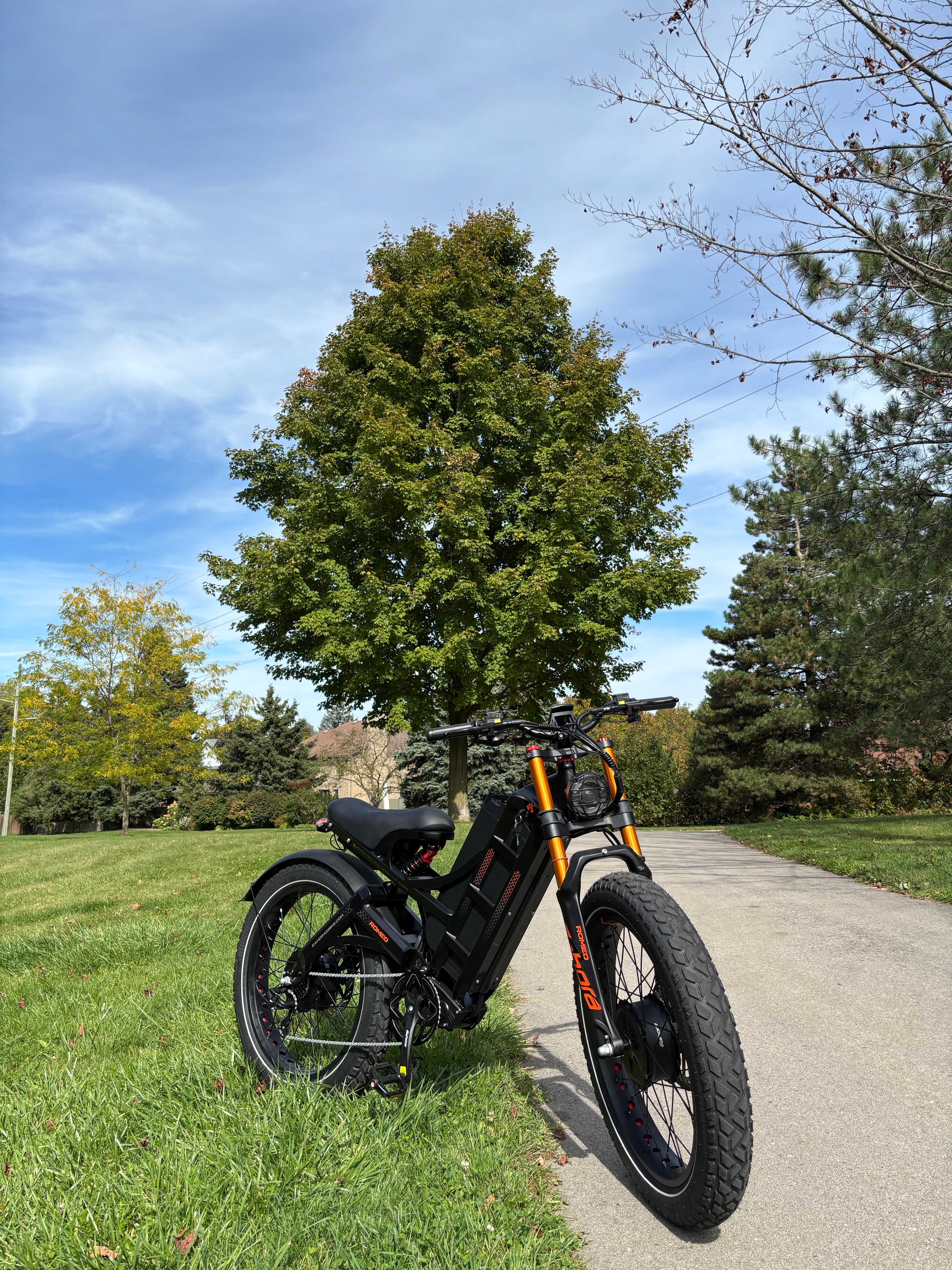
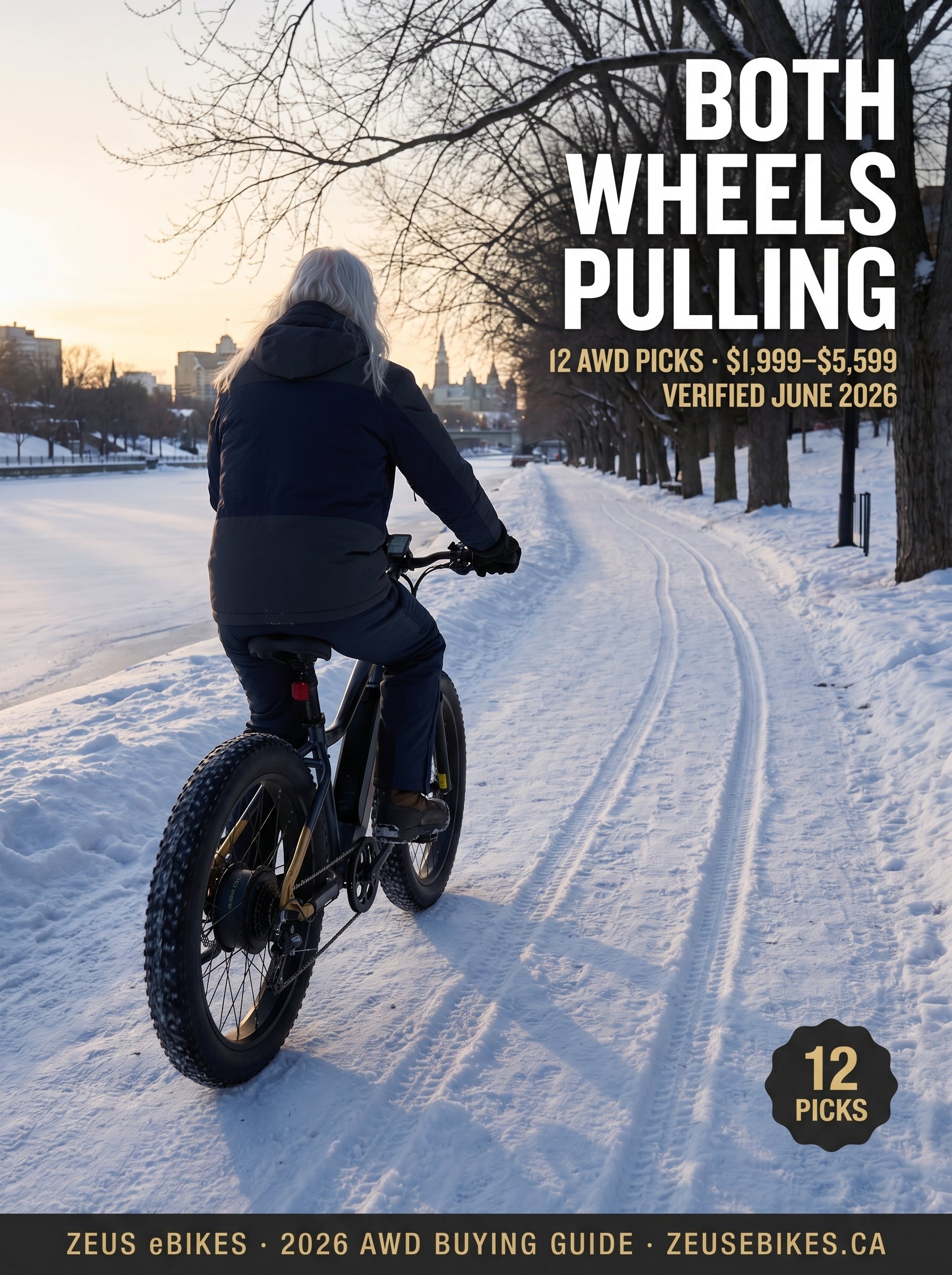
Best Dual Motor eBikes in Canada (2026): 10 AWD Picks, 36–93 kg, $1,999–$6,499
Published: March 2026 | Last Updated: June 2026 | By: Milad Ghobadibeygvand, BScN (Western University, 2014)
It is February in Ottawa. You are pedalling home from work on a single-motor ebike. The rear wheel hits a patch of black ice on the canal pathway and spins. The bike fishtails. You put your foot down, catch yourself, and walk the last 3 km in the dark.
That was the ride that made you search “dual motor ebike Canada.”
We hear the same story every winter at 1-866-938-7580. “I need something that doesn’t slip.” AWD — a dual-motor, all-wheel-drive setup with a motor in each wheel — is the only drivetrain that solves winter traction, steep hills, and heavy payloads at the same time. It also adds 10–58 kg of weight, drains your battery 30–40% faster, and costs $500–$2,000 more. Every competitor guide tells you about the traction. We are going to tell you about the trade-offs too — including the one question none of them answer: whether a two-motor bike is even road-legal where you live. Then we will show you 10 AWD picks from $1,999 to $6,499 — every price and spec re-verified live in June 2026 — ranked by what actually matters for Canadian riding.

AWD in Canadian Snow — Real Riding Footage
In This Guide
- Do You Actually Need AWD? (Honest Answer)
- 3 Trade-Offs Nobody Tells You
- Are AWD eBikes Road-Legal in Canada?
- All 10 Picks at a Glance (+ Sensor Table)
- Best-Value AWD: $1,999–$2,700 (4 Picks)
- Core Power AWD: $2,699–$2,899 (2 Picks)
- Flagship & Specialty AWD: $4,099–$6,499 (4 Picks)
- Step-Thru & Easy-Mount AWD
- Winter AWD: Real Snow Performance Data
- When Single Motor Is the Better Buy
- FAQ — 12 Questions
- What We’d Tell Our Own Family
1. Do You Actually Need Dual Motor? The Honest Answer
Rad Power’s Chapter 11 in December 2025 removed Canada’s largest AWD option from warranty coverage overnight. Choose the wrong replacement and you spend $2,000–$5,000 on a bike that still cannot hold traction on a February morning in Edmonton — because most AWD guides skip the torque sensor conversation, and most riders do not know they need one until the first slip. Here is what actually separates the AWD bikes worth buying.
You need dual motor if you ride through Canadian winter (AWD prevents rear-wheel spin on ice), face steep hills above 10% grade (110–240 Nm combined torque outpulls any single hub motor), or weigh over 100 kg with cargo (payloads reach 500 lbs across two driven wheels). If none of those describe your riding, a single motor saves $500–$2,000 and 10–25 kg of weight — and you should skip to our 500W picks instead.
Dual motor eBikes are the most overhyped and the most underappreciated category in the Canadian market — depending on who you are. Half the people buying them do not need AWD. The other half cannot believe they waited so long.
You need dual motor if any of these apply:
- You ride through Canadian winter. A rear-only hub motor on ice or packed snow loses traction and spins. AWD — a motor in each wheel — gives the front tire pulling force while the rear pushes. The difference on a February morning in Edmonton or Ottawa is the difference between riding to work and walking your bike home.
- You face steep hills daily (10%+ grade). Combined torque of 110–240 Nm across two motors pulls harder than any single hub motor. The Freesky Warrior Pro M-530 at 240 Nm combined outpulls most mid-drives on raw force.
- You weigh over 100 kg or carry heavy cargo. Two motors distribute the load. Payloads in this guide reach 500 lbs (227 kg) — more than any single-motor eBike in the Zeus catalogue. See our heavy riders guide for single-motor alternatives.
You do not need dual motor if:
- Your commute is flat and paved — a single 500W hub motor handles this at half the weight and cost
- Your hills are moderate (under 8% grade) — a mid-drive motor uses gears to climb efficiently without the weight penalty
- You need to lift the bike regularly — dual motor bikes weigh 36–93 kg, and that weight makes stairs, car racks, and transit a genuine problem

240 Nm across both hubs. The switchback he used to push. Howe Sound, 7:42 AM. · Playcut.ai
2. Three Trade-Offs Nobody Tells You Before You Buy
The three trade-offs of a dual-motor eBike are weight, range drain, and maintenance cost — real penalties that affect every rider differently, not deal-breakers. Before you buy based on torque numbers and AWD marketing, here is what every competitor guide leaves out: the actual numbers, in Canadian conditions, with honest comparisons to single-motor bikes.
1. Weight Is Real
The lightest dual motor in this guide is 36 kg (79 lbs). The heaviest is 93 kg (205 lbs). For context, a typical single-motor commuter eBike weighs 25–30 kg. That extra 10–58 kg means: harder to lift onto a car rack, impossible to carry up apartment stairs without help, and noticeably sluggish when the battery dies and you are pedalling unassisted. If you need a bike you can physically move without the motor, the weight column is the first number you check.
2. Range Drain Is Significant
Running both motors simultaneously drains the battery 30–40% faster than rear-only mode (Bosch eBike Systems). A 1,440 Wh battery delivering 120 km in single-motor mode drops to roughly 72–84 km with AWD engaged. The good news: every bike in this guide lets you switch between single-motor and AWD mode. Run rear-only on flat roads, engage AWD only when you need traction. The bad news: if you bought dual motor for winter, you are using AWD in the conditions that also reduce battery capacity by 20–30% from cold. In January at 0°C, you can lose up to 50–55% of your rated range. Dual-battery models compensate for this — single-battery models do not.
3. Maintenance Costs More
Two motors mean two controllers, additional wiring, and more connectors that can corrode or loosen — especially through salt-spray winter riding. Hub motors themselves are sealed and low-maintenance, but the electrical system connecting them is more complex. Budget $50–$100 per year for inspections and connector maintenance beyond normal brake and tire costs. The trade-off: if one motor fails, the other still works. You ride home on one motor instead of calling for a pickup.
Not sure dual motor is right for you?
Read our 500W vs 750W vs 1000W guide to find the right wattage — or call 1-866-938-7580 and we will tell you honestly.
Browse All Dual Motor eBikes →3. Are Dual-Motor / AWD eBikes Road-Legal in Canada?
At full power, no — and any honest guide has to say so. Every dual-motor bike here combines two motors for more than 500 W, and the provincial power-assisted-bicycle (PAB) rules cap a road-legal e-bike at 500 W nominal, motor cutting out at 32 km/h, with working pedals. Above that line a province treats the bike as a motor vehicle. So AWD bikes are sold for off-road and private-property use.
This is not the US Class 1/2/3 system — those are manufacturer mode labels, not Canadian law. Canada uses the PAB framework, and each province layers its own helmet, age and trail rules on top. For a two-motor bike, the 500 W line is the one that decides everything:
| Province | Road-legal e-bike limit | Over the limit | Zeus law guide |
|---|---|---|---|
| British Columbia | ≤500 W “motor-assisted cycle,” 32 km/h, pedals | Not a motor-assisted cycle — motor-vehicle rules; off-road only | BC e-bike rules & rebate |
| Ontario | ≤500 W, 32 km/h, pedals; rider 16+, helmet | Not a power-assisted bicycle — licence/insurance territory | Ontario e-bike laws |
| Quebec | ≤500 W, 32 km/h, functional pedals | Treated as a moped/motor vehicle (licence) | Quebec e-bike laws |
| Alberta | ≤500 W “power bicycle,” 32 km/h, pedals | Treated as a moped — Class 7 licence, registration, insurance | Alberta e-bike laws |
The honest workaround built into many of these bikes: several models here — including the Eahora Romeo and Juliet line — ship firmware-limited to 500 W / 32 km/h for road-legal PAB mode, and unlock to full output for off-road and private land. Run them limited on the road, full off it.
4. All 10 Picks at a Glance
Match your riding to a pick. No scrolling required. Every price re-verified live in June 2026.
🇨🇦 Ships from Canada · free Canada-wide shipping · warranty included · 1-866-938-7580 — real humans answer.
| Your Situation | Best Pick | Price | Why |
|---|---|---|---|
| Easiest to mount (lowest step) | Freesky Ranger M-540 | $1,999 | Step-thru, 18″ step, 200 Nm |
| Winter commuter (best overall) | Eunorau FAT-AWD 3.0 | from $2,299 | Only two-wheel AWD with a torque sensor; lightest at 36 kg |
| Biggest battery under $3k + anti-theft | Smartravel Raptor ST202 Pro | $2,599 | 2,600 Wh, GPS tracking app |
| Long range, expandable | Eunorau Flash AWD | $2,700 | 832 Wh → up to ~2,808 Wh, 440 lb |
| Maximum hill torque | Freesky Warrior Pro M-530 | $2,899 | 240 Nm, full suspension |
| Two-up / tandem + big battery | Freesky Cheetah MT-380 | $2,699 | 2,880 Wh, tandem seat, UL2271 cells |
| Step-thru touring flagship | Eahora Juliet Pro II | $4,099 | Step-thru, 4,200 Wh, full suspension |
| Full-suspension fat-tire flagship | Eahora Romeo Pro II | $4,299 | 3,120 Wh, 203mm 4-piston brakes |
| Most stable / heaviest loads | Meet One Tour AWD trike | from $6,499 | 3 wheels, 550 lb total, reverse + parking brake |
| Maximum range, no compromise | Eahora Romeo Ultra II | $5,599 | 4,800 Wh, 60V, 500 lb payload |
Full Spec Comparison — All 10 Side by Side
| Model | Price | Weight | Battery (Wh) | Torque (Nm) | Sensor | Payload | Frame |
|---|---|---|---|---|---|---|---|
| Ranger M-540 | $1,999 | 43 kg | 1,200* | 200 | n/p | 400 lb | Step-Thru |
| FAT-AWD 3.0 | from $2,299 | 36 kg | 720 (1,440 dual) | 110 | Torque | 375 lb | Step-Over |
| Raptor ST202 Pro | $2,599 | 56 kg | 2,600 | 150 | Speed/Brake | 400 lb | Fat Tire |
| Flash AWD | $2,700 | 37–42 kg | 832 (→2,808) | 184 | n/p | 440 lb | Step-Over |
| Warrior Pro M-530 | $2,899 | 44 kg | 1,440* | 240 | Cadence | 400 lb | Full-Susp MTB |
| Cheetah MT-380 | $2,699 | 55 kg | 2,880 | 200 | Cadence | 400 lb | Tandem Moped |
| Juliet Pro II | $4,099 | 67 kg | 4,200 | 190 (2×95) | Cadence | 400 lb | Step-Thru |
| Romeo Pro II | $4,299 | 68.5 kg | 3,120 | 240 | Cadence | 330 lb | Step-Over |
| Meet One trike | from $6,499 | 83 kg | 1,440 / 2,400 | 180 | Torque | 550 lb† | AWD Trike |
| Romeo Ultra II | $5,599 | 93 kg | 4,800 | 240 | Cadence | 500 lb | Step-Over |
Weight is with battery installed. * Wh estimated from voltage × amp-hours where the manufacturer does not publish a Wh figure — treat as an estimate, not a spec. † The Meet One figure is total load capacity (rider + cargo + bike). Two models use a torque sensor (bold): the FAT-AWD 3.0 (the only two-wheeler) and the Meet One trike. The Raptor uses speed/brake sensors; n/p means the manufacturer does not publish this figure; every other model uses cadence.
Torque sensor (the better one)
Reads how hard you push the pedals and feeds power in proportionally — smooth, natural, and roughly 10–20% more efficient. On ice it matters most: no sudden surge to break traction. Among these AWD bikes, only the FAT-AWD 3.0 (two-wheel) and the Meet One trike have one.
Cadence sensor (most of the field)
Reads only whether the pedals are turning and delivers a fixed level of assist — an on/off feel with a small lag, and a power kick that can spin a wheel on snow. Not a deal-breaker on a heavy AWD bike at low PAS, but it is why the torque-sensor FAT-AWD 3.0 is our winter pick despite its modest 110 Nm.
5. Best-Value AWD eBikes — $1,999 to $2,700
Four AWD bikes under $2,900 — and the value here is real, not a stripped spec sheet. This is where both true step-thru picks live, where the only torque-sensor two-wheeler lives, and where you will find the biggest battery under $3,000. The differences matter: 110 Nm vs 240 Nm, 720 Wh vs 2,600 Wh, torque sensor vs cadence, step-thru vs step-over. Match the spec that matters most to your riding.
Freesky Ranger M-540
$1,999 CAD
The most accessible AWD bike here — and one of the cheapest. An 18″ step-through height and a saddle that adjusts 34–39″ make it genuinely easy to get on and off, yet it still brings 200 Nm, 4-piston brakes, full suspension, turn signals and an NFC-lock colour display. The fit window is unusually wide at 5’4″–6’8″. For an easy-mount AWD that doesn’t feel like a compromise, this is the value play. See our step-thru guide.
Honest limit: Freesky does not publish the watt-hours (48V × 25Ah is roughly 1,200 Wh — our estimate) or the pedal-assist sensor type, so treat both as unconfirmed. At 95 lbs it is not light, and dual-motor range drops to 40–60 mi with both hubs engaged (60–95 mi on one).
Smartravel Raptor ST202 Pro
$2,599 CAD
2,600 Wh for $2,799 — more battery capacity than anything else under $3,000 in this guide. 52V cells (higher voltage delivers power more efficiently than 48V at the same load), a KKE adjustable coil fork with compression and rebound, and IP65 water resistance. The standout is GPS anti-theft tracking through the Smartravel app: if your bike parks outside all day, that locator is insurance, not a gimmick. 2-year warranty. See our theft-protection guide.
Honest limit: speed and brake sensors only — no torque or cadence sensor, so the assist feels less refined than torque-sensor bikes. 150 Nm is mid-pack — fine for most hills, short of the Warrior Pro’s 240 Nm. The GPS feature relies on an app subscription.
Eunorau FAT-AWD 3.0
from $2,299 CAD
This is the bike we hand to someone who says “I need to commute through a Canadian winter on two wheels.” It is the only two-wheel AWD in this guide with a torque sensor — the sensor that reads how hard you push and feeds power proportionally (the Meet One trike is the only other torque-sensor pick here). Every other AWD bike uses cadence (on/off). On ice, that proportional delivery is the difference between a smooth pull and a spun wheel. 6061 aluminium hardtail frame, 180mm hydraulic brakes, EUNORAU GO app — and at 36 kg it is the lightest dual motor in the guide. See it in our winter guide.
Honest limit: 110 Nm is the lowest torque in this guide — fine for most hills, not for sustained 12%+ grades with a heavy rider. The 720 Wh single battery is tight for winter; budget the second battery ($400+) for 1,440 Wh and an estimated 90+ km at 0°C.
Eunorau Flash AWD
$2,700 CAD
The range-anxiety answer. It starts at a modest 832 Wh, but Flash AWD accepts two extra packs for a manufacturer-rated ~2,808 Wh — the most expandable battery in the guide — with Eunorau rating that triple-battery build at up to 220 mi. 184 Nm across dual 750W hubs, the highest payload under $3,000 at 440 lb, UL-certified cells, and compact 20″ wheels that keep it nimble. Buy the range as your distance grows. See our long-range guide.
Honest limit: at 832 Wh out of the box, base range is short — the big numbers require buying extra batteries (each adds cost and weight). 80mm front fork, hardtail rear. Sensor type not published. 1,500W combined exceeds 500W — off-road or limited-mode only.
Lake Louise. February. The torque sensor reads the ice before the wheels spin. Two tracks, no slippage. · Playcut.ai
Every bike ships free across Canada with a warranty.
1-866-938-7580 — two brothers who will match your riding to the right AWD bike.
Browse Dual Motor Collection → Financing Options →6. Core Power AWD eBikes — $2,699 to $2,899
The core tier is where torque and battery scale up without crossing into flagship money. Two bikes, each built around a different idea of “more”: maximum hill torque, or maximum range with a two-up tandem deck. Both exceed 500W — off-road and private-property machines.
Freesky Warrior Pro M-530
$2,899 CAD
240 Nm — the most torque in the core tier, matched only by the flagship Eahoras above $4,000. If your reason for going dual-motor is steep hills, this is the value answer: downhill-grade full suspension tuned for long distance and rough ground, 4-piston 180mm brakes (not 2-piston), and a frame that fits a wide 5’5″–6’3″ range with a 35–40″ seat. 18-month warranty. Ride 40+ km a day across mixed surfaces and that suspension comfort compounds.
Honest limit: cadence sensor. At 44 kg it is half again heavier than the FAT-AWD 3.0. Freesky does not publish the watt-hours (48V × 30Ah is about 1,440 Wh — our estimate). 4,000W peak means it is not a road-legal PAB at full power — off-road or limited-mode only.
Freesky Cheetah MT-380
$2,699 CAD
2,880 Wh — enough to absorb winter range loss and AWD drain simultaneously. Estimated 95–160 km at 0°C with AWD engaged. But battery is not why you buy the Cheetah. You buy it because it is a factory tandem — an extended saddle rated for two riders, 400 lb combined payload. Bluetooth speakers, turn signals, brake-activated smart rear light. UL2271-certified battery — the safety standard transit authorities and insurers recognise. See it in our moped guide.
Honest limit: 55 kg — manageable on the road but a genuine obstacle if you need to lift it. Cadence sensor. 200 Nm is below the Warrior Pro’s 240 Nm despite costing more — here you are paying for the battery and the tandem deck, not torque. Moped geometry means this rides like a scooter, not a bicycle.
2,880 Wh. Two seats. One machine. Niagara Parkway, mid-afternoon — and nowhere they needed to be. · Playcut.ai
7. Flagship & Specialty AWD eBikes — $4,099 to $6,499
Four bikes for riders who have already decided AWD is non-negotiable and want the most capability money can buy: a step-thru touring flagship, a full-suspension fat-tire flagship, the most stable option on three wheels, and the biggest battery sold in Canada. This is where build quality stops being a compromise — and where you choose the body first, the battery second.
Eahora Juliet Pro II
$4,099 CADThe flagship for riders who want range and power without swinging a leg over a tall frame. The Juliet Pro II pairs a step-thru touring frame with a 4,200 Wh 60V battery (193–354 km rated PAS), full suspension (100mm front + 50mm coil rear), 4-piston brakes and a 2,000-lumen headlight. It is the most accessible way into flagship-grade AWD — easy to mount, hard to run flat. See our step-thru guide.
Honest limit: 5-level cadence sensor at a flagship price. 67 kg — you park it, you do not carry it. The 20″ wheels keep it low and stable but trade some roll-over for the easy step-through. 4,400W nominal is firmly off-road / limited-mode territory.
Eahora Romeo Pro II
$4,299 CAD
3,120 Wh, 240 Nm and true full suspension — 100mm up front, a 50mm air shock at the rear — on 26″ wheels that roll over rough ground better than the 20″ flagships. The big 203mm 4-piston brakes haul the weight down hard, and the 52V pack is rated 167–180 km PAS. This is the comfortable-distance flagship: the one you ride 60 km on mixed surfaces and step off without a sore back. Estimated winter range at 0°C: 117–126 km.
Honest limit: cadence sensor at $4,299. 68.5 kg — a park-it, don’t-lift-it machine. And mind the payload: 330 lb, lower than the 400–440 lb core-tier bikes — if you need maximum load capacity, the Ultra II (500 lb) or the Meet One trike (550 lb total) are the real haulers, not this one. See our heavy-riders guide.
Meet One Tour AWD Trike
from $6,499 CAD
The most stable AWD here — because it never asks you to balance. Two driven wheels plus a third for support on a semi-recumbent frame, all-wheel-drive traction, a torque sensor (one of only two in this guide), and trike conveniences a two-wheeler cannot offer: reverse gear, a parking brake and a differential. Total load capacity is 550 lb, the highest in the guide, and the dual battery scales from 1,440 to 2,400 Wh. For riders who want all-wheel-drive confidence without ever putting a foot down, this is the answer. See our electric trike guide.
Honest limit: a trike is wide — it will not slip through bike-lane gaps or narrow paths the way a two-wheeler does, and it corners differently (slow down before you turn). At 183 lb it is a fixed installation, not a bike you lift. The 2,400 Wh build costs more again.
Eahora Romeo Ultra II
$5,599 CAD
4,800 Wh. More battery capacity than most electric motorcycles. The 60V architecture delivers higher peak power and holds it more consistently as the pack depletes — the voltage sag that makes 48V systems feel sluggish at 30% charge is dramatically reduced. Damped air-suspension fork, INNOVA puncture-proof tires, 2,500-lumen headlight with horn, cruise control, walk mode (6 km/h), IPX6 water resistance, USB charging. Estimated winter PAS range at 0°C: approximately 265 km. Battery rated ≥1,200 cycles to 80% capacity. Read the Romeo Ultra II full review.
Honest limit: 93 kg (205 lbs). You do not lift this bike. You do not carry it up stairs. You do not put it on a standard car rack. You ride it and you park it. Cadence sensor (at $5,599, the absence of a torque sensor is the single biggest spec disappointment in this guide). 8–12 hour charge time from empty. 6,000W peak power is firmly in electric-motorcycle territory — off-road or limited-mode only.
Eahora Romeo Ultra II — Zeus eBikes Canada Review
Choose the Pro II ($4,299) if: you want a true full-suspension 26″ fat-tire flagship with 3,120 Wh — enough for any Canadian commute including deep winter — at 68.5 kg and $1,300 less than the Ultra II's everyday price. For most riders, this is the smarter buy.
Choose the Ultra II ($5,599) if: you want the highest-capacity eBike battery sold in Canada (4,800 Wh), the 60V voltage advantage, a 500 lb payload, and you never plan to lift the machine. It is for the rider who refuses to compromise on range and can live with 93 kg.
They share 240 Nm of torque and puncture-proof Innova tires. They differ on voltage (52V vs 60V), battery (3,120 vs 4,800 Wh), payload (330 vs 500 lb) and weight (68.5 vs 93 kg).
Spending flagship money? Talk to a human first.
🇨🇦 Ships from Canada · free shipping · warranty included. Call 1-866-938-7580 and we will match your weight, terrain and winter to the right machine — or split it into monthly payments.
Browse Dual Motor Collection → Financing Options →
4,800 Wh. 93 kg. The Dempster at golden hour. 500 miles of nothing and he had enough battery to do it twice. · Playcut.ai
8. Step-Thru & Easy-Mount AWD: All-Wheel Drive You Can Actually Get On
Two of these AWD bikes use a true step-thru frame, and a third removes balancing altogether. If a tall top tube — or a hip or knee that does not love swinging a leg over 80 lb of bike — is your real constraint, this is your shortlist. You do not have to give up all-wheel drive to get an easy mount.
Here is why it matters: AWD bikes are heavy (36–93 kg), and a heavy bike is hardest to manage at the exact moment you mount and dismount. A low step-through turns that moment from a small daily risk into a non-event — which is why it is the feature shorter riders, seniors and anyone with limited mobility ask for first. See our step-thru guide and seniors guide for the wider picture.
| Easy-mount AWD | Price | Step / frame | Best for |
|---|---|---|---|
| Freesky Ranger M-540 | $1,999 | 18″ step-thru, fits 5’4″–6’8″ | Cheapest true step-thru AWD |
| Eahora Juliet Pro II | $4,099 | Step-thru, 4,200 Wh | Flagship range + power without the high frame |
| Meet One Tour AWD trike | from $6,499 | Trike — no balancing at all | Stability first; reverse + parking brake |
Note: the Eunorau FAT-AWD 3.0 — our winter pick — is a step-over hardtail, not a step-thru. If the torque sensor matters most to you but the high frame does not work, the step-thru Ranger M-540 is the closest easy-mount alternative.
9. Winter AWD: Real Snow Performance Data
AWD traction is the primary reason Canadian riders buy dual motor. Here is what that actually means on snow and ice — with estimated winter range numbers based on the 20–30% capacity loss at 0°C benchmark from Bosch eBike Systems and Battery University.
| Model | Battery (Wh) | Summer Range | Winter Range (0°C est.) | Tire Size |
|---|---|---|---|---|
| FAT-AWD 3.0 (dual batt.) | 1,440 | 128 km | ~90 km | 26″×4.0″ |
| Flash AWD (base) | 832 | ~105 km | ~73 km | 20″×4.0″ |
| Ranger M-540 | 1,200* | ~110 km | ~77 km | 26″×4.0″ |
| Warrior Pro | 1,440* | ~150 km | ~105 km | 26″×4.0″ |
| Meet One trike | 1,440 / 2,400 | 88–209 km | ~62–146 km | 20″×4.0″ |
| Raptor ST202 Pro | 2,600 | 160 km | ~112 km | 20″×4.0″ |
| Cheetah MT-380 | 2,880 | 320 km | ~224 km | 20″×4.0″ |
| Romeo Pro II | 3,120 | 180 km | ~126 km | 26″×4.0″ |
| Juliet Pro II | 4,200 | 354 km | ~248 km | 20″×4.0″ |
| Romeo Ultra II | 4,800 | 378 km | ~265 km | 26″×4.0″ |
Summer figures are manufacturer PAS ranges where published; * marks a battery Wh estimated from voltage × amp-hours. Winter estimates assume a 30% capacity reduction at 0°C in PAS, single-motor (rear-only) mode — engaging AWD cuts these a further 30–40%. Store the battery indoors overnight and install it just before riding to minimise cold-start losses.
10. When Single Motor Is the Better Buy
Honesty sells more bikes than hype. Here is when you should skip dual motor entirely:
- Flat urban commutes: A single 500W hub motor at 25–30 kg handles this at half the cost. See our best 500W eBikes.
- Moderate hills (under 8% grade): A 500W mid-drive with 130 Nm torque outclimbs most dual hub motors more efficiently. See our mid-drive vs hub motor comparison.
- Apartment or transit storage: Even the lightest dual motor (36 kg) is well heavier than a quality single-motor folder. If you carry your bike daily, every kilogram counts. See our best folding eBikes.
- Budget under $1,999: No dual motor eBike in this guide costs less than $1,999. Under that price point, you get better single-motor bikes than any dual-motor option. See our best eBikes under $2,000.
FAQ — 12 Questions, Answered With Sources
Is a dual motor eBike worth it?
Dual motor is worth it for three specific use cases: winter traction on snow and ice (AWD prevents rear-wheel spin), steep hills above 10% grade (combined torque of 110–240 Nm pulls harder than any single hub motor), and heavy riders over 100 kg who need pulling force distributed across both wheels. For flat commutes and moderate hills, a single motor saves $500–$2,000 and 10–25 kg of weight.
Are dual motor / AWD eBikes legal in Canada?
At full power, no. Every dual-motor bike combines two motors for more than 500 W, and a road-legal e-bike in Canada is defined by its province, and the provincial definitions converge on a 500 W motor, 32 km/h of assisted speed (30 km/h in Nova Scotia until 19 October 2026) and working pedals. Above those limits the bike falls outside the e-bike definition: most provinces treat it as a motor vehicle (licence, insurance, registration), and Québec bars it from public roads. These bikes are sold for off-road and private-property use, and several ship firmware-limited to 500 W / 32 km/h, but their combined motor rating stays above 500 W, so treat them as off-road and private-property machines. Confirm your province first — see our Legal Access Atlas.
How much range do you lose with dual motor?
Running both motors simultaneously drains the battery 30–40% faster than rear-only mode (Bosch eBike Systems). A 1,440 Wh battery delivering 120 km in single-motor mode drops to roughly 72–84 km in AWD. Every bike in this guide lets you switch between single and dual mode — run rear-only on flat roads, engage AWD only when you need traction. This strategy recovers most of the range loss.
Dual motor vs mid-drive for hills — which is better?
A dual hub motor system (110–240 Nm combined) produces more raw torque than most mid-drives (80–160 Nm). But mid-drives use your gears to multiply force at low speeds, making them more efficient per watt on sustained steep climbs. Dual motor wins on traction (both wheels pulling) and burst power. Mid-drive wins on efficiency. For icy or loose-surface hills, dual motor AWD is superior. For long paved climbs, mid-drive is more efficient.
How heavy are dual motor eBikes?
Dual motor eBikes weigh 36–93 kg (79–205 lbs) — significantly heavier than single motor bikes (typically 25–35 kg). The lightest in this guide is the Eunorau FAT-AWD 3.0 at 36 kg; the heaviest is the Eahora Romeo Ultra II at 93 kg. Weight matters most if you need to lift the bike onto a rack, carry it up stairs, or transport it in a vehicle.
Is there a step-thru or easy-mount AWD eBike?
Yes — two picks here use a true step-thru frame: the Freesky Ranger M-540 (18″ step height, $1,999) and the flagship Eahora Juliet Pro II ($4,099). If balancing a heavy bike is the concern, the Meet One AWD trike removes it entirely with three wheels. The FAT-AWD 3.0 uses a step-over frame.
Can you use only one motor on a dual motor eBike?
Yes. Every dual motor eBike in this guide allows you to run in single-motor mode (rear only) for better range and efficiency on flat terrain, then engage AWD when you need traction on hills, snow, or loose surfaces. The FAT-AWD 3.0 manages this through the EUNORAU GO app. Most others use a handlebar switch or display setting.
Do dual motor eBikes need more maintenance?
Yes — roughly 20–30% more maintenance cost than a single motor bike. Two motors mean two controllers, additional wiring, and more connectors that can corrode or loosen. Hub motors themselves are sealed and low-maintenance, but the electrical system connecting them is more complex. Budget $50–$100 per year. The trade-off: if one motor fails, the other still works — you ride home on one motor instead of calling for a pickup.
What is AWD on an electric bike?
AWD (all-wheel drive) on an eBike means a motor in both the front and rear wheels, powering them simultaneously. Unlike a car’s AWD differential, eBike AWD runs both motors at fixed power — the front wheel claws forward while the rear pushes. This prevents the rear-wheel spin that single-motor bikes suffer on snow, ice, sand, and loose gravel.
What is the best dual motor eBike for winter in Canada?
The Eunorau FAT-AWD 3.0 (from $2,299) is our top pick for Canadian winter. It is the only two-wheel AWD eBike in this guide with a torque sensor, which delivers power proportionally to pedal effort — on icy surfaces, this prevents the sudden bursts that cause wheel spin. With the optional second battery (1,440 Wh total), estimated winter range at 0°C is approximately 90 km. For maximum winter range, the Romeo Ultra II (4,800 Wh) goes furthest between charges.
What is the lightest dual motor eBike in Canada?
Among the picks in this guide, the Eunorau FAT-AWD 3.0 at 36 kg (79 lbs) is the lightest, using dual 500W hubs and a 6061 aluminium frame. Most dual-motor AWD bikes run 40–55 kg, and the heaviest here (Romeo Ultra II) weighs 93 kg. If you need to lift your bike onto a car rack or manoeuvre in tight spaces, weight is the most important spec after brakes.
How long does a dual motor eBike battery last?
Dual motor eBike batteries typically last 500–1,200 charge cycles before degrading to 80% of original capacity — roughly 3–5 years of regular commuting. Running both motors drains faster, so you charge more frequently, which uses cycles faster. To maximise lifespan: store the battery indoors overnight, avoid draining below 20% regularly, and charge to 80% for daily use. The Romeo Ultra II specifies ≥1,200 cycles to 80% — the best longevity claim in this guide.
What We’d Tell Our Own Family
We are two brothers who built this company. One of us spent years in Canadian healthcare before this — watching what happens when people buy equipment they cannot control. That experience shapes how we recommend eBikes: honestly, with the limitations first, because a disappointed buyer is worse than a lost sale.
If someone in our family said “I need a dual motor eBike for Canadian winter,” here is what we would do:
- Ask them why. If the answer is “winter traction,” “steep hills,” or “I weigh 120 kg” — dual motor is the right answer. If the answer is “more power sounds better” — we would steer them to a single-motor bike and save them $500–$2,000.
- Start with the FAT-AWD 3.0 at $2,299 for winter commuters. The torque sensor is not a luxury — it is the difference between smooth acceleration on ice and wheel spin. It is also the lightest bike in this guide. Budget for the second battery.
- For an easy mount, start with the step-thru Ranger M-540 at $1,999 — or the Meet One trike if balancing a heavy bike is the real worry. Neither asks you to give up all-wheel drive.
- Match the flagship to the job. The Romeo Pro II at $4,299 is the full-suspension comfort flagship. For the heaviest loads, the Ultra II (500 lb, 4,800 Wh) or the Meet One trike (550 lb total) are the real haulers — the Pro II’s payload is only 330 lb. Most riders do not need any of the flagships.
Dual motor is not an upgrade. It is a tool. The right AWD bike solves problems that no single motor can — winter traction, steep hill torque, heavy-load stability. The wrong one adds 30 kg and $1,000 to a bike you did not need. Use the comparison table. Match your riding to a pick. Call us at 1-866-938-7580 if you are between two bikes — we would rather lose a sale than sell you the wrong one.
Still not sure? Call two brothers who will be honest with you.
1-866-938-7580 — tell us your weight, your commute, and your hills. We will tell you whether you need dual motor — and if so, which one.
🇨🇦 Ships from Canada · free Canada-wide shipping · warranty included · 15-day return window for unused, unopened bikes (15% restocking fee). If you are in the GTA, Hamilton or Mississauga, you can also ride before you buy — call ahead and we will set it up.
Browse Dual Motor Collection → Financing Options →Mid-Drive vs Hub Motor — the engineering comparison
Best eBikes for Winter Canada — snow-ready picks
Best eBikes for Heavy Riders Canada — payload-rated picks
Best eBikes for Hills Canada — torque-first selection
Long Range eBikes Canada — 10 best by battery size
Fat Tire eBikes Canada — 11 verified picks
Best Folding eBikes Canada — compact picks
Pedal Assist vs Throttle — which ride style fits you
E-Bike Sale Canada (2026) — current savings
All photography by Playcut.ai — personalised AI actor technology




Share:
Best Electric Dirt Bikes in Canada (2026): 6 Machines, $1,499–$6,499 — Ranked Honestly
Best Electric Bikes for Delivery in Canada (2026): 9 Picks Matched to 12 Courier Demands