
Canadian Tire eBikes in 2026: Every Model Priced & Audited — Then Pick Your Bike in 30 Seconds

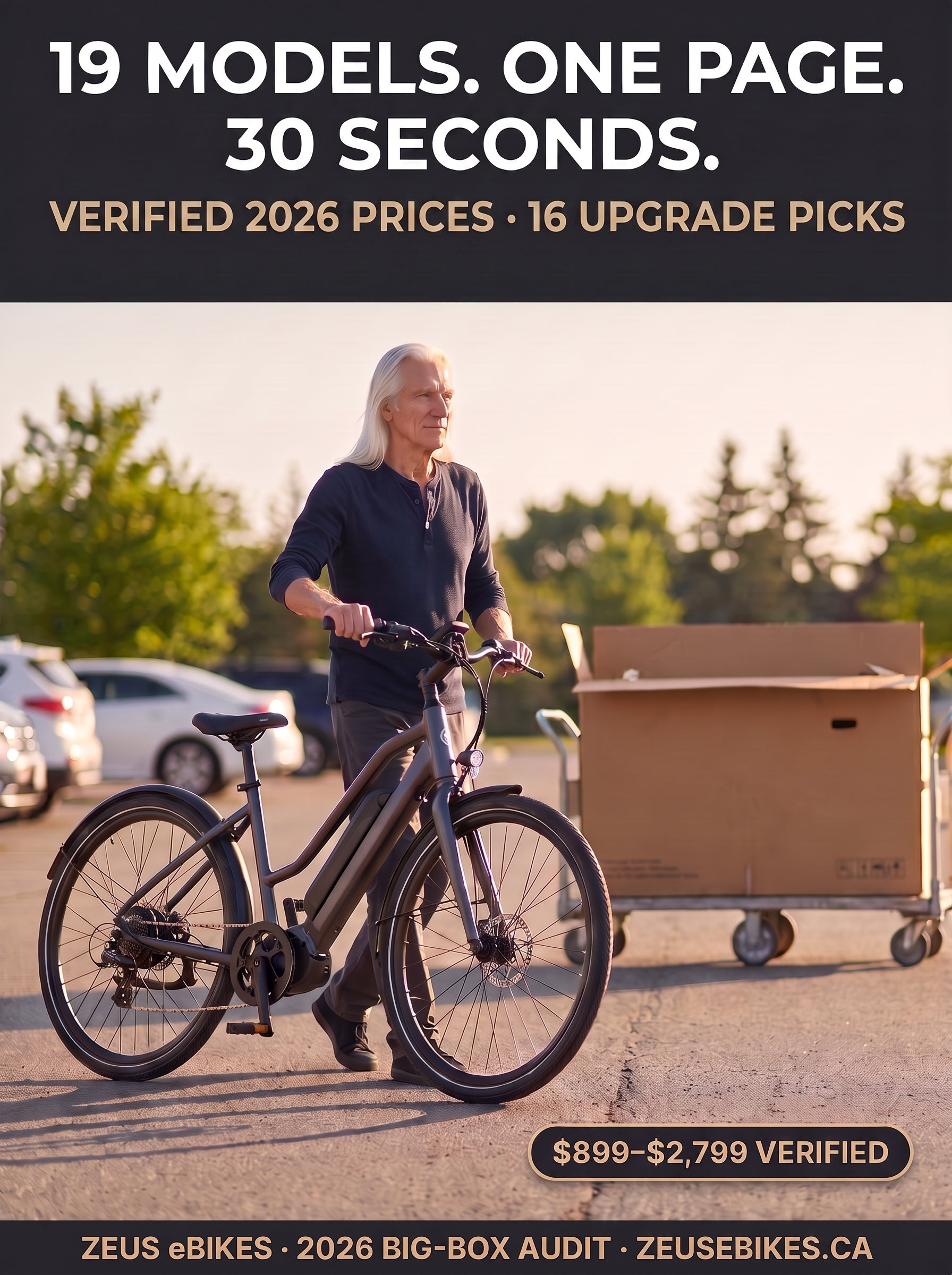
Canadian Tire sells 19 ebike model families in 2026 across four house-controlled brands — Raleigh, Junction, iZip and Stratus — from the new $899.99 Stratus Hightown to the $2,799.99 Raleigh Getaway, which is the first torque-sensor ebike we have ever verified on a Canadian Tire shelf. They are honest entry-level bikes for flat, short trips. The catch sits in the fine print: assembled-bike sales are final, batteries top out at 840 Wh, and service routes through the manufacturer, not the store. If your riding involves hills, winter, cargo or real distance, the same money goes further on a bike built for it — our current picks start at $1,099 with the Samebike 20LVXD30-II and run through the Velotric Tempo at $2,599 with a torque sensor and full-system UL 2849 certification. Every bike in this guide gets a one-line "this is your bike if" verdict — you should know your answer inside 30 seconds.
Every week, Canadians stand in front of the same Canadian Tire bike rack, phone in hand, trying to translate a spec tag into a decision. This guide does the translation once, properly, so you don't have to. We re-audited the entire shelf in August 2026 — every model, every verifiable price, both new additions — and then did the part most guides skip: we tell you exactly which bike fits which rider, in one line each, including the ones Canadian Tire sells.
In This Guide
- The 30-Second Chooser
- What Canadian Tire Actually Sells in 2026
- When a Canadian Tire eBike Is the Right Call
- The Four Specs That Decide Everything
- Returns & Service: Know the Path Before You Need It
- Folding & Small-Space Picks
- Step-Through Commuters
- Three Wheels, Zero Balancing
- Fat Tires & Four Seasons
- Power & Long Range
- Every CT Model Mapped to Its Zeus Upgrade
- Frequently Asked Questions
- The Bottom Line
Canadian Tire's website blocks automated tools, so this audit was rebuilt from primary captures: archived canadiantire.ca product pages from February–June 2026 (prices and full spec sheets pulled from the pages' own structured data), Raleigh Canada's live product listings, and flyer-tracker records current to the July 31–August 7, 2026 flyer. Motor claims were cross-checked against the component maker's published specifications — including Bafang's own spec sheet for the M200 mid-drive on the new Getaway. Every price in this article carries its verification date, because big-box prices rotate weekly. The 16 alternative picks were price-and-stock-verified against Zeus's live storefront on August 3, 2026. Where a number could not be verified from a primary source, we say so instead of guessing.
The 30-Second Chooser: Stop Comparing, Start Riding
The modern ebike shopper's problem is rarely missing information — it is seventeen open browser tabs and no permission to stop researching. This table is that permission: every rider situation we see weekly, matched to one bike. Find your row, and you're done. The rest of this article exists only to show the work behind each verdict — including three rows where the honest answer is a bike Canadian Tire sells.
| If this is you | Buy this | Price | Why it ends the search |
|---|---|---|---|
| Flat city trips under 5 km, hard $1,000 ceiling, want it today | Stratus Hightown (Canadian Tire) | $899.99 | Cheapest honest ebike on any Canadian big-box shelf |
| Want a natural-feeling ride and prefer buying in person at CT | Raleigh Getaway (Canadian Tire) | $2,200–$2,799.99 | CT's only torque-sensor bike — check raleigh-canada.ca first, it's cheaper there |
| Light trail riding, big-box budget | Raleigh Ascend (Canadian Tire) | $2,199.99 | 350W, 8 gears, disc brakes — the shelf's best trail value |
| Tightest budget, need it to fold (condo, RV, car trunk) | Samebike 20LVXD30-II | $1,099 | 330 lb payload and a 480 Wh battery for less than most CT models |
| Daily commuter that must fold at both ends | Samebike CY20 | $1,199 | Step-through folder, 7 gears, removable battery charges at your desk |
| First ebike, want the accessories problem pre-solved | Samebike RS-A01 Pro-T | $1,199 | Basket, rack and fenders included — ready for errands on day one |
| Balance concerns, or you're done with two wheels | Meigi Hera trike | $1,699 | Three wheels, 56–64 km assisted range (Meigi prints both figures), rear cargo basket included |
| Snow, sand, trails — one bike for all of it, under $2K | Eunorau E-FAT-MN | $1,699 | 80 Nm and 4-inch fat tires, and it still folds |
| Longest range for the least money | Eunorau Meta Foldable | $2,295 | 720 Wh Samsung battery, expandable with a second pack to a rated 160 km — and it folds |
| Commuter who wants the safest certified build | Taubik Vista 26 | $2,399 | UL 2849 full-system certified, torque sensor, hydraulic brakes |
| Hills on the daily route | Eunorau Meta 26 or Fat HS / Hunter X8 | $2,295 / $3,099 | Torque sensor + 55 Nm for moderate hills; 160 Nm mid-drive for serious ones (off-road power class — trails and private property) |
| Winter is not optional where you live | Smartravel Raptor ST202 Pro | $2,599 | AWD dual motor, 2,600 Wh, IP65 — built for exactly this |
| Big rider, big loads — you're tired of weight limits | Velotric Nomad 2X | $4,099 | 560 lb payload, full air suspension, 1,000 lb towing |
| You wanted a real mountain bike that happens to be electric | Eunorau Urus 2.0 | $5,700 | Bafang M600 mid-drive, 120 Nm, genuine MTB componentry |
Decision fatigue costs more than any spec mistake — it keeps you off a bike entirely. Find your row above, click through or drive over, and let the rest of this article be confirmation rather than homework. If two rows both sound like you, take the one with the bigger battery; nobody has ever regretted range.
What Canadian Tire Actually Sells in 2026: the Verified 19-Model Lineup
This spring, something new quietly appeared on the Canadian Tire shelf: a torque-sensor ebike — the first we have ever verified there. If you bought — or skipped — a CT ebike based on last year's lineup, your information is stale, and stale information on a $2,000 purchase is how buyers end up on the wrong bike for five years. Here is the full shelf as it stands in August 2026, verified model by model, so your decision runs on this month's facts rather than last spring's.
The lineup spans four brands, and all four lead back to the same company: Canadian Tire has owned Raleigh's Canadian brand rights since buying them from Accell Group for $16 million in July 2019 (Bicycle Retailer), and Junction, iZip and Stratus are house or house-controlled labels. That is not a criticism — it means consistent entry-level engineering and genuinely aggressive flyer pricing. It also means every warranty conversation eventually reaches the same head office.
| Model | Brand | Motor | Battery | Sensor | 2026 price — as verified |
|---|---|---|---|---|---|
| Getaway (M/W 700C) — new generation | Raleigh | Bafang M200 250W mid-drive, 65 Nm | 36V 14Ah Samsung (504 Wh) | Torque (Bafang spec) | $2,799.99 CT (out of stock, June capture); $2,200 in stock at raleigh-canada.ca |
| Transit Urban 27.5″ | Raleigh | 36V 250W hub | 10.5 Ah (378 Wh) | Cadence | Not re-verifiable in 2026 captures — check PDP |
| Dobson (M/W 700C) | Raleigh | 36V 250W hub | 7.0 Ah (252 Wh) | Cadence | Not re-verifiable in 2026 captures — check PDP |
| Ascend Hardtail 27.5″ | Raleigh | 36V 350W hub | Samsung 10.5 Ah (378 Wh) | Cadence | $2,199.99, in stock (April capture) |
| Delta 27.5″ | Raleigh | 36V 250W hub | External 10.5 Ah Samsung | Cadence | Not re-verifiable in 2026 captures — check PDP |
| Quanta 26″ fat-tire | Raleigh | 36V hub (wattage not disclosed) | Not disclosed | Not disclosed | $2,499.99 offer / $2,799.99 reg — current flyer (Jul 31–Aug 7) |
| Oceania 26″ cruiser | Raleigh | Integrated throttle system, lights | Not disclosed | Not disclosed | $1,699.99 offer / $1,999.99 reg (flyer, Jul 24–30) |
| Anton 26″ | Raleigh | Not disclosed on PDP | Not disclosed | Not disclosed | $1,799.99 offer / $1,999.99 reg (flyer, Jul 24–30) |
| Rapid-E Men's 700C | Junction | 36V 250W mid-drive | 10.4 Ah (~374 Wh) | Cadence | $1,799.99 (out of stock, March capture) |
| Victoria-E Women's 700C | Junction | Mid-drive (Rapid-E counterpart) | 10.4 Ah class | Cadence | Not re-verifiable in 2026 captures — check PDP |
| Powertrail 27.5″ hardtail | Junction | 36V 350W hub | Samsung 10.4 Ah (375 Wh) | Cadence | $2,199.99 (out of stock, April capture) |
| Simplify (M/W 700C) | Junction | 36V 250W hub, single-speed | Not disclosed | Cadence | Not re-verifiable in 2026 captures — check PDP |
| Tangent 48V All-Terrain 26″ | iZip | 48V hub | Not disclosed | Cadence | Not re-verifiable in 2026 captures — check PDP |
| Juice XL 48V Pro 20″ | iZip | 48V 500W hub | 17.5 Ah (840 Wh) — biggest on the shelf | Cadence | $1,999 regular (stable across our April and August checks) |
| Juice 20″ | iZip | Hub (wattage not disclosed) | Not disclosed | Not disclosed | Not re-verifiable in 2026 captures — check PDP |
| Ranger Foldable 48V 20″ | iZip | 48V hub, folding frame | Not disclosed | Cadence | Not re-verifiable in 2026 captures — check PDP |
| Polo 36V 16″ — new for 2026 | iZip | 36V hub | Frame-integrated | Not disclosed | New listing — check PDP |
| X-Trail 36V All-Terrain 27.5″ | Stratus | 36V 350W hub | 10.5 Ah (378 Wh) | Cadence | Not re-verifiable in 2026 captures — check PDP |
| Hightown 700C — new for 2026 | Stratus | 250W hub, downtube battery | Modest (capacity not disclosed) | Cadence | $899.99, in stock (May capture) — cheapest on the shelf |
What changed since our April audit — the three-line version: Canadian Tire added two models (the $899.99 Stratus Hightown city bike and the small-wheel iZip Polo), replaced the old hub-motor Getaway with a genuinely better Bafang M200 torque-sensor mid-drive, and moved the Quanta fat-tire into premium territory at $2,799.99 regular. The floor dropped, the ceiling rose, and the middle got more interesting. Anton and Oceania survive on flyer rotation at $1,699.99–$1,799.99.
Never pay a Canadian Tire regular price on an ebike. Verified flyer history shows every Raleigh model cycling onto offer within weeks — Quanta is $300 off right now, Oceania and Anton were $200–$300 off last week. And for the Getaway specifically, check both canadiantire.ca and raleigh-canada.ca: the identical bike was $599.99 cheaper on Raleigh's own site when we captured prices.
When a Canadian Tire eBike Is the Right Call
An honest audit cuts both ways, so let's say the positive part plainly: for three specific riders, Canadian Tire in 2026 is a good answer — better than it has ever been.
The under-$1,000 city rider. The new Stratus Hightown at $899.99 is the cheapest legitimate ebike on any Canadian big-box shelf. Lightweight aluminum frame, 250W hub, downtube battery, one gear, no drama. If your riding is a flat 5 km — the grocery run, the GO station, the Tuesday errand loop — this bike replaces those car trips at a price nothing in our own lineup matches. That is the honest truth, and we would rather you ride the right $900 bike than the wrong $2,000 one.
The ride-feel buyer who shops in person. The new Getaway's Bafang M200 is a real mid-drive with a real torque sensor — the motor responds to how hard you pedal, not just whether you pedal, which is the single biggest ride-quality upgrade in ebiking. Sixty-five newton-metres through the cranks, Samsung 504 Wh battery, 35–100+ km claimed range. At the $2,200 raleigh-canada.ca price it is legitimately competitive; at CT's $2,799.99 shelf price, comparison-shop first.
The same-day buyer. No dedicated retailer matches 500+ store locations. If the bike must be in your hands this afternoon and a nearby store shows stock, that convenience is worth something real.
Everyone else — the hill climber, the winter rider, the commuter doing 20 km each way, the rider over 300 lbs, the range-anxious — keeps reading, because the shelf's limits show up exactly where your riding starts.
Want the 30-second answer for your specific situation? Call 1-866-938-7580 — a real human who rides answers, and if a Canadian Tire bike genuinely fits you better, we will say so. Or browse the full Zeus lineup with verified specs on every page.
The Four Specs That Decide Whether You'll Still Love the Bike Next Year
Every ebike regret we hear about traces back to one of four specs that were invisible on the sales floor and unmissable by month six. Check these four and you can ignore ninety percent of the spec sheet — this is the entire skill of buying an ebike, compressed.
1. The sensor: cadence or torque. A cadence sensor is an on/off switch — pedal and the motor surges, stop and it cuts. Fine on flats, lurchy on starts, and frustrating on hills. A torque sensor measures how hard you press and matches the motor to you, like the bike is reading your legs. On the 2026 CT shelf, one bike has a torque sensor (the new Getaway); in the Zeus picks below, six do, starting at $2,295 with the Eunorau Meta Foldable — and four of those six (the Fold 1 Plus, Vista 26, Blackburn 275T and Velotric Tempo) let you switch between both modes. Our full mid-drive vs hub motor guide goes deeper.
2. Battery watt-hours — the number that is your actual range. Ignore range claims; multiply volts by amp-hours. Canadian Tire's shelf runs 252 Wh (Dobson) to 840 Wh (Juice XL Pro), clustering near 375 Wh — roughly 25–40 real-world kilometres with assist working, less in a Canadian February. The picks below run 468 Wh to 2,600 Wh, and four offer dual-battery expansion. If you ride more than 15 km at a stretch or through winter, 600 Wh is your floor. Our long-range guide shows the math.
3. The service path — answer it before the bike needs it. Ask one question at purchase: "A year from now, when something needs fixing on this bike, who calls whom?" Many prominent independent shops decline hub-motor ebikes — Sweet Pete's in Toronto publicly does not service hub-motor brands, Bow Cycle in Calgary lists only Bosch, Shimano, Specialized and Fazua systems, and The Bike Shop in Calgary does not service bikes with hub motors or throttles. A big-box bike's path is manufacturer warranty plus hourly specialist shops; a dedicated retailer's path is the store that sold it. Both work. One is simply shorter, and you should choose it knowingly.
4. Brakes, scaled to the bike's speed and your weight. Mechanical discs stop a 250W bike adequately. At 500W-plus, 60-plus pounds of bike, or a bigger rider, hydraulic discs are the difference between "stops" and "stops calmly in rain." Every Zeus pick below at $2,299 and up runs hydraulics; on the CT shelf, check the PDP per model — several disclose Tektro alloy discs, others don't specify.
Reading a big-box sale price (60-second version). In February 2026, Canadian Tire pleaded guilty to 74 counts under Quebec's Consumer Protection Act — a $1,287,550 penalty for inflating "regular prices" on five non-bike products in 2021. The takeaway isn't outrage; it's technique. Treat any struck-through price as a claim: check the model's flyer history on a price tracker, cross-check Raleigh models against raleigh-canada.ca, and judge the offer number on its own merits. Thirty seconds of checking beats $300 of imaginary savings.
Sensor, watt-hours, service path, brakes. Write those four on your phone before you shop anywhere — Canadian Tire, Costco, us. A bike that passes all four at your budget is a bike you will still be riding happily in year three, and any bike that fails two of them is a bike you will be replacing.
Returns and Service: Know the Path Before You Need It
Canadian Tire's published bicycle policy is repair under warranty — once a bike is assembled, there is no refund or exchange; some stores accept boxed, unassembled returns within a standard window. This is not a scandal, it is a policy — but it changes how you should buy. It means the test ride, the fit check and the spec check all happen before assembly, because the moment the store's technician builds it, the decision is final. Costco's 90-day window (see our full Costco audit) and dedicated-retailer policies each set different stakes for getting it right the first time — the smart move is knowing yours before the card comes out.
The service story is the same lesson at year two instead of day one. A Canadian Tire ebike is serviced through the manufacturer's warranty process and independent ebike specialists; the store itself repairs under warranty terms rather than operating as your bike shop. If you are handy and your bike stays healthy, you may never notice. If you commute daily on it, ask what a two-week wait for a controller would do to your month — then pick your retailer accordingly.
Here is the entire big-box-versus-dedicated question in one sentence: at a big-box store you buy a bike; at a dedicated retailer you buy a bike plus the ongoing answer to "who fixes this?" Zeus ships from Canada, warranties what it sells, stocks the parts for what it sells, and answers 1-866-938-7580 with a person. That is the product. The bikes below are what it looks like at each price.
Folding & Small-Space Picks: the Bike That Disappears When You're Done
Canadian Tire's folding options are the iZip Ranger and the new small-wheel Polo — both with undisclosed battery specs on their product pages. If your bike has to live in a condo, a car trunk or an RV bay, these four publish every number and cover every budget. One line each: the 20LVXD30-II is the price floor, the CY20 is the daily rider, the Meta Foldable is the torque-sensor upgrade, and the Fold 1 Plus is the no-compromise flagship.

The 20LVXD30-II — the most affordable way into the lineup, earning its keep on an easy evening loop. · Playcut.ai
Samebike 20LVXD30-II
$1,099 CADBest for: the budget-conscious buyer who still wants a full-size folder, not a 16-inch mini-bike, and needs a payload rating that actually covers a larger rider. 330 lb payload is unusually high for a folder at any price. 350W nominal keeps it well inside the 500W limit Canada’s provincial e-bike rules converge on. This is the lowest-priced way into the Zeus lineup.
Rider match: Small-wheel folding geometry means a low standover almost any rider can mount, and quick, nimble steering in traffic — the trade-off is a busier ride over rough pavement, so run the tires at the lower end of their rated pressure for comfort. The 330 lb payload leaves a 250 lb rider a full 80 lb of cargo headroom. With a cadence sensor, start in an easy gear so the assist comes on smoothly instead of surging.

The Samebike CY20 at the Saturday market. Charge the seat battery at your desk, fold it into the trunk, ride the errands. · Playcut.ai
Samebike CY20
$1,199 CADBest for: the first-time buyer who isn’t sure ebikes are for them yet, and doesn’t want to gamble $2,000 to find out. A step-through folding frame that folds for a condo closet or car trunk, with a removable seat-integrated battery you charge at your desk instead of hauling the whole bike to an outlet. Shimano 7-speed. This is the “test the concept” bike — with a Canadian warranty attached — and no assembled-bike-sales-are-final clause.
Rider match: The step-through fold means no leg-swing over a saddle — right for work clothes, skirts, or any hip and knee mobility limit. Use the 7 gears the way a cyclist does: shift down before you stop, so every start is easy on the knees and the motor isn't dragging you from a standstill in top gear. The removable battery also solves winter: park the bike cold, charge the battery warm indoors — lithium cells charge safely and age slower at room temperature.

63 lbs. Folds for the elevator. If it needs a warranty call in year two, the call is local. · Playcut.ai
Eunorau Meta Foldable
$2,295 CADBest for: condo and apartment dwellers, transit-and-bike commuters, RV owners — anyone whose storage space, not their budget, is the real constraint. Everything the Eunorau Meta 26 has — torque sensor, hydraulic brakes, dual battery option — in a frame that folds to apartment-closet size. 63 lbs. Fits a condo elevator, a Civic trunk, a closet. Start with 720 Wh. Add the optional 17 Ah second battery later — up to 1,536 Wh and a rated 160 km — when your riding outgrows the original. And when something goes wrong in year two, you are not shipping it to Shenzhen. You are calling us. See it in our folding guide.
Rider match: A torque sensor rewards a steady, even cadence — ride it like a regular bike with stronger legs, and you will get genuine exercise out of every commute. Respect the 63 lbs on stairs: fold it and carry frame-first, or plan for the elevator. Hydraulic brakes need only two fingers, which matters for smaller hands and long descents.

The Fold 1 Plus at camp — the folder that turns every campsite into a neighbourhood. · Playcut.ai
Velotric Fold 1 Plus
$2,599 CADBest for: the buyer who wants the folding format but refuses to compromise on tech — 109 km of independently tested range, a 450 lb payload, and the ability to toggle between torque and cadence sensing from the display. Apple Find My tracking and OTA firmware updates. No folding bike on the Canadian Tire shelf publishes even one of those four numbers. See it in our folding guide.
Rider match: This is the folder for bigger riders — a 450 lb payload means the frame, wheels and brakes are built with margin most folding bikes never have, so a 300 lb rider is nowhere near the limit. Use the sensor toggle deliberately: torque mode for the morning ride when you want the workout, cadence mode for the tired ride home. Bed the hydraulic brakes in with a dozen firm, controlled stops in the first week.
Step-Through Commuters: the Everyday Workhorses
This is the category most Canadian Tire ebikes actually compete in — and where the spec gaps show fastest, because commuting is daily and daily magnifies everything. One line each: the RS-A01 Pro-T arrives with basket, rack and fenders already fitted; the Vista 26 is the certified-safety pick; the Eunorau Meta 26 is the hills-and-range pick; the Blackburn 275T is the premium daily with a Dutch wheel lock built in. All four beat the shelf's 840 Wh battery ceiling or its cadence-sensor default — most beat both.

$1,199. Basket, rack, and fenders already on the bike. Nothing left to bolt on. · Playcut.ai
Samebike RS-A01 Pro-T
$1,199 CADBest for: the errand rider — groceries, school pickup, the daily short haul — who doesn’t want to shop for a basket and rack separately after the bike arrives. Most entry-level bikes — big-box shelves included — hand you a bare bike and a shopping list. This one ships with the front basket, rear rack, fenders, and multi-tool kit already on it. At ~57 lbs, it’s among the lightest full-size step-throughs in the catalogue — easy to lift onto a rack or into a trunk.
Rider match: At roughly 57 lbs it is among the easiest full-size electrics to walk up a porch step or lift onto a car rack — a real consideration if you are the one doing the lifting. Load it like a cyclist: heavy items in the rear rack, light ones in the front basket, because front weight changes steering feel far more than rear weight. The upright step-through posture keeps your neck and wrists neutral on everyday errands.

A lab checked this battery before we ever sold it — UL 2849, in writing, on the product page. · Playcut.ai
Taubik Vista 26
$2,399 CADBest for: the buyer who wants proof, not a logo — a year-round Canadian commuter who wants lab-verified safety on the whole electrical system, not just a battery sticker. UL 2849 is a full-system certification — not claimed by a seller, verified by an accredited third-party lab, testing the motor, controller, and battery together for thermal runaway, overcharging, and short-circuit protection. Samsung cells, UL 2271-certified separately. Switchable torque/cadence sensor. Canadian-designed. No Canadian Tire model advertises UL 2849 full-system certification — this is what the certification looks like when it is real, on the bike, in writing. See it in our step-through collection.
Rider match: Full-size 26-inch wheels give the calm, predictable handling that suits a returning rider best — the bike tracks straight and shrugs off pavement cracks that would deflect a small-wheel folder. Use the sensor switch as a training tool: torque mode on fresh days for fitness, cadence mode when you just need to get there. If your building or office asks about battery certification for indoor parking, this is the bike with the paperwork.

Month five. The controller acts up. He calls the store he bought it from. That is the entire warranty story. · Playcut.ai
Eunorau Meta 26
$2,295 CADBest for: the commuter who wants a smooth, proportional torque-sensor ride and range they can grow into — not a bike locked to whatever battery it shipped with. Torque sensor — no cadence-sensor power jolts, better for exercise, smoother in traffic. Dual-battery-ready to 1,440 Wh, so you can expand range later without buying a new bike. Hydraulic brakes. If the controller fails at month five, you call 1-866-938-7580. We diagnose it, ship the part from our manufacturer relationship with Eunorau, and walk you through the fix. That is what a warranty looks like. See it in our step-thru guide.
Rider match: The 3.0-inch-wide Innova tires are the comfort system here — wider than a standard commuter tire for cushion over potholes and gravel shoulders, without full fat-tire drag. Two listings, the Meta 24 and the Meta 26, fit riders from 5′3″ to 6′3″. With a torque sensor, shift down before every red light exactly as you would on a regular bike; the motor amplifies what your legs do, so good shifting habits translate directly into range. Plan around the 286 lb payload: rider plus loaded panniers should stay comfortably under it.

The Canadian-designed Blackburn 275T at home on a Toronto side street — the brand exists, the company answers, the specs are verified. · Playcut.ai
Taubik Blackburn 275T
$2,799 CADBest for: the buyer who wants a name they can find a head office for — a rider who wants to switch between a smooth torque feel on the commute and simple cadence assist on the way home, without buying two bikes. Canadian-designed. UL 2271-certified Samsung cells — not a logo on a listing, a lab-verified battery. Switchable torque/cadence sensor. Dutch-style integrated rear wheel lock. Available in 6 colours. The brand exists. The company is Canadian. The specs are verified. The gatekeeper is real. See it in our Canadian-designed guide.
Rider match: At 69.5 lbs this is a bike you ride everywhere and lift rarely — plan ground-floor or elevator storage rather than a walk-up. The integrated Dutch wheel lock is genuinely useful cycling practice: it secures the rear wheel for a two-minute coffee stop, but for anything longer, add a chain through the frame like any city cyclist would. The 70 Nm motor holds speed into headwinds that stall weaker commuters.
Commuting daily? Spread the cost instead of front-loading it — financing options here, or browse all step-through models. Every bike ships free from Canada with warranty included.
Three Wheels, Zero Balancing: the Category the Shelf Skips
Nothing on Canadian Tire's 19-model shelf has three wheels — yet trikes are the answer for a large group of riders the big-box aisle never serves: seniors returning to cycling, anyone with balance or inner-ear concerns, and riders who simply want to stop without unclipping a foot. One bike covers the category, and it costs the same as the shelf's cruiser.

Canadian Tire’s entire 19-model shelf includes zero trikes. This one is $1,699. · Playcut.ai
Meigi Hera Electric Trike
$1,699 CADBest for: seniors, riders with balance or mobility concerns, or anyone who wants the freedom of an ebike without the two-wheel requirement. Riders who need three wheels are simply not served by the big-box aisle — this is the bike that serves them. The Hera is the gentlest option we sell — twist throttle, rear basket for groceries, and three wheels that never fall over at a red light. See it in our trike guide.
Rider match: Trike technique is the advice that matters most here, because trikes do not handle like bicycles: slow down before corners, keep your weight centred, and never lean into a turn — the outside wheel does the work. The throttle start means pulling away needs zero balance, which is exactly the point. Measure your shed or garage door before delivery; three wheels are wider than you think.
Fat Tires & Four Seasons: Bikes That Don't Check the Forecast
The Raleigh Quanta is Canadian Tire's fat-tire entry at $2,499.99 on the current flyer — with motor wattage, battery capacity and sensor type all undisclosed on its product page. Riding through a Canadian winter on an undisclosed battery is a gamble we'd rather you skip. These three publish everything, and each answers a different budget: the E-FAT-MN at $1,699 folds, the Velotric Tempo at $2,599 weighs just 39 lb and carries full-system UL 2849 certification, and the Fat HS / Hunter X8 at $3,099 brings a genuine 1,000W mid-drive to terrain that eats hub motors.

The E-FAT-MN where fat tires belong — gravel, sand, and shoreline — in a frame that still folds into a closet. · Playcut.ai
Eunorau E-FAT-MN
$1,699 CADBest for: the apartment or condo dweller who wants genuine fat-tire snow-and-gravel traction without floor space for a full-size fat bike. 80 Nm of torque out-pulls anything on the Canadian Tire shelf — the torque-sensing Getaway peaks at 65 Nm — and the whole bike weighs just 62 lbs. 500W nominal with a printed 20 mph (32 km/h) maximum, though Eunorau also labels it “Class 3”, so its speed class is not settled. See it in our fat tire guide.
Rider match: Fat-tire riding is a pressure game, and this is the advice that transforms the bike: drop to the low end of the rated pressure for sand and snow so the tire floats, then pump it back up for pavement so it rolls instead of drags. The 80 Nm motor covers short, steep climbs, and the low folding frame gives an easy standover for nearly any rider height.
Velotric Tempo
$2,599 CADBest for: the commuter who wants every spec in writing — the exact opposite of an undisclosed shelf tag. The Tempo publishes what the Quanta hides: a 350W hub motor (650W peak, 45 Nm), a 374 Wh battery built on Samsung/LG cells and certified to UL 2271 and UL 2580, full-system UL 2849 certification, a switchable torque/cadence sensor, Shimano hydraulic brakes on 180 mm rotors, and built-in Apple Find My tracking. At 39 lbs it is the lightest eBike in the Velotric lineup — light enough to carry up apartment stairs or lift onto a transit rack without dread. The honest trade-off: 374 Wh is the smallest battery among our picks in this guide, so if maximum range matters more than low weight, the dual-battery bikes on this page are the better buy. New to reading spec sheets? Start with our Canada-wide buying guide.
Rider match: The rigid aluminium fork has no suspension, so the 700×42c puncture-resistant gravel tires are your comfort system — run them toward the lower end of their pressure range for cracked pavement and packed gravel, higher for smooth asphalt. Use torque mode for exercise and efficiency; flip to cadence mode from the display when you want a steadier push on a tired day. The trigger throttle is removable where local rules require pedal-assist-only, and the key-locked battery lifts out for warm indoor charging.

A real mid-drive with a real rear shock. Not a hub motor with a marketing name. · Playcut.ai
Eunorau Fat HS / Hunter X8
$3,099 CADBest for: the off-road rider who wants a real mid-drive, not a hub motor with a marketing name — hunters, trail riders, anyone climbing steep, loose Canadian terrain. A mid-drive works through the gears instead of fighting the wheel directly, which is why 160 Nm here climbs differently than 160 Nm from a hub motor would. Full suspension. 9-speed Shimano. The only mid-drives on the Canadian Tire shelf are 250W commuter units — this is four times that, through real trail hardware. See it in our fat tire guide.
Rider match: Mid-drive technique is non-negotiable and worth learning: shift BEFORE the hill and soften your pedal pressure for the half-second the gear changes, because 160 Nm through a derailleur punishes lazy shifts. Set the suspension sag for your weight — roughly a quarter to a third of travel under your seated weight — and the rear shock will actually work instead of just existing. At ~77 lbs, transport means a hitch rack or ramp, never a roof rack.
Winter is the great spec-revealer: small batteries lose a third of their range in the cold, cadence sensors lurch on ice, and mechanical brakes fade in slush. If you ride November through March, buy the battery and brakes for February — not for the sunny day you test-rode in. Our fat-tire guide covers the full winter playbook.
Power & Long Range: Where the Big-Box Road Ends
Above roughly $2,500, the Canadian Tire shelf simply stops — and this is the tier where ebikes become car replacements. AWD traction, motorcycle-class range, half-ton payloads, real mountain hardware: one line each — the Raptor ST202 Pro is the winter-proof AWD, the DL2000 is the range monster, the Nomad 2X is the heavy-hauler, and the Urus 2.0 is the genuine eMTB.

Both wheels driven. Snow, ice, and gravel stop being a decision. · Playcut.ai
Smartravel Raptor ST202 Pro
$2,599 CADBest for: the Canadian rider who doesn’t stop riding in November — both wheels powered means snow, ice, and loose gravel stop being a reason to leave the bike home. 150 Nm combined torque. 2,600 Wh — enough for genuine winter-range buffer when cold cuts capacity. UL 2849 system-certified. A bike this electrically complex needs a retailer who stocks its parts and answers its phone — which is exactly what it gets here. See it in our dual motor guide.
Rider match: At ~124 lbs, treat this like the small motorcycle it almost is: walk it with both hands, park it on solid ground, and forget roof racks entirely. AWD earns its keep on loose and slippery surfaces — but remember the cyclist's winter rule: traction helps you go, not stop, so brake earlier on ice than the grip tempts you to. Store and charge the battery indoors through winter; cold storage is what quietly kills range.

1,560 Wh — nearly double the biggest battery on the Canadian Tire shelf. · Playcut.ai
Eahora DL2000
$3,799 CADBest for: the rider who wants a bike that looks and rides like a small motorcycle, with the range to back it up — longer weekend rides, minimal charging anxiety. 1,560 Wh is nearly double the biggest battery on the Canadian Tire shelf. 240mm brake rotors are motorcycle-grade, not bicycle-grade. This is what $3,799 buys when all of it goes to engineering.
Rider match: The moped posture is feet-forward and relaxed — superb for throttle cruising, less efficient for pedalling, so buy it for the ride, not the workout. Bed in the 240mm rotors with ten controlled firm stops before trusting them fully; big rotors need it and reward it with fade-free stopping loaded or downhill. Its 4.5-inch tires follow the same pressure rule as any fat bike: low for loose surfaces, higher for pavement.

The Nomad 2X loaded for a self-supported day out — 560 lb of capacity means the bike carries everything and asks for nothing. · Playcut.ai
Velotric Nomad 2X
$4,099 CADBest for: heavier riders, cargo haulers, or anyone who has been told by another bike’s weight limit that they don’t fit. 560 lb payload and 1,000 lb towing capacity is the highest of anything in this article. Full air suspension with lockout and rebound adjustment. This is the highest-capacity bike Zeus sells, at a spec level Canadian Tire does not stock at any price. See it in our fat tire guide.
Rider match: Air suspension is only as good as its setup: set air pressure so the bike sits about a quarter to a third into its travel under your full riding weight — call 1-866-938-7580 and we will walk you through it in ten minutes. The 560 lb payload is the point: rider, trailer, and a week of gear with margin left. Use the lockout on smooth pavement so your pedalling drives the wheel, not the suspension.

A real mountain bike with a real mid-drive. Canadian Tire does not sell this tier at any price. · Playcut.ai
Eunorau Urus 2.0
$5,700 CADBest for: the serious trail rider who wants a genuine mountain bike with an electric assist, not an electric bike wearing knobby tires. A Bafang M600 mid-drive — considered one of the best mid-drive motors made — delivering 120 Nm through real mountain-bike gearing, paired with true full suspension and Samsung cells. This is not a category the Canadian Tire shelf stocks. If the question is “does a real Canadian-retailed eMTB exist,” this is the answer. See it in our mountain bike guide.
Rider match: Two frame sizes means fit by reach, not just height — as with any real mountain bike, the 17-inch suits shorter riders and tighter trails, the 19-inch taller riders and faster ones; if you are between sizes, call and we will size you properly. Ride the M600 like an acoustic MTB: stay in the gear that keeps your cadence lively, shift before the pitch steepens, and the 120 Nm will feel bottomless instead of abrupt.
Every Canadian Tire Model, Mapped to Its Closest Zeus Upgrade
If you walked into Canadian Tire with a specific model in mind, this is the honest cross-shop: what the bike you're considering does well, and what the nearest Zeus bike adds for the price difference. Where the CT bike wins its matchup for a given rider, the table says so.
| You're considering | CT price (verified) | Closest Zeus upgrade | What the difference buys |
|---|---|---|---|
| Stratus Hightown | $899.99 | Samebike 20LVXD30-II $1,099 | +$199: 480 Wh battery, 330 lb payload, and it folds. If your trips are 5 km and flat, the Hightown honestly suffices. |
| Raleigh Dobson / Junction Simplify | Check PDP | RS-A01 Pro-T $1,199 | 500W, 540 Wh, and the basket/rack/fenders the comfort category exists for — included, not extra |
| Raleigh Getaway (torque mid-drive) | $2,200–$2,799.99 | Eunorau Meta 26 $2,295 | Same torque-sensor ride feel, plus 720 Wh (vs 504) and dual-battery expansion to 1,440 Wh. The Getaway at $2,200 on raleigh-canada.ca is its best value — at CT's $2,799.99, the Meta wins outright. |
| Raleigh Transit / Delta | Check PDP | Vista 26 $2,399 | UL 2849 full-system certification, torque sensor, 706 Wh Samsung, hydraulic brakes |
| Raleigh Ascend / Junction Powertrail | $2,199.99 | Fat HS / Hunter X8 $3,099 | For about $900 more: 1,000W Bafang mid-drive (vs 350W hub), 160 Nm, full suspension — trail capability in a different class |
| Raleigh Quanta fat-tire | $2,499.99 offer | Eunorau E-FAT-MN $1,699 | $800 less for a published 600 Wh battery, 80 Nm of torque and true 4-inch fat tires — every spec in writing, and it folds |
| iZip Juice XL 48V Pro | $1,999 | Velotric Tempo $2,599 | +$600: switchable torque sensor, UL 2849 full-system certification, hydraulic brakes and a 39 lb frame — though the Juice XL's 840 Wh battery keeps the range advantage over the Tempo's 374 Wh |
| iZip Ranger / Polo folding | Check PDP | CY20 $1,199 | Published 468 Wh battery, 7 gears, removable-battery desk charging — every number disclosed |
| Raleigh Oceania cruiser | $1,699.99 offer | Meigi Hera trike $1,699 | Same money: three-wheel stability, 56–64 km of assisted range, cargo basket — the comfort the cruiser category is really shopping for |
| Nothing on the shelf fits — you need serious capability | — | Raptor $2,599 · DL2000 $3,799 · Nomad 2X $4,099 · Urus 2.0 $5,700 | AWD winters, 1,560 Wh range, 560 lb payloads, genuine eMTB — the tiers above the big-box ceiling |
The pattern across every row: Canadian Tire wins on price floor and same-day pickup; the upgrade buys disclosed specs, bigger batteries, better sensors and a direct service line. Neither is wrong — they're priced for different years of your riding life. Buy for year three, not day one.
Frequently Asked Questions
Are Canadian Tire ebikes any good in 2026?
Canadian Tire ebikes are honest entry-level machines, and in 2026 the lineup genuinely improved: the new Raleigh Getaway runs a Bafang M200 mid-drive with a real torque sensor — the first torque-sensor ebike we have verified on a Canadian Tire shelf. The rest of the 19-model lineup is 36V or 48V hub motors with cadence sensors and 252–840 Wh batteries. For flat, short commutes they do the job. Where they fall short is the specs that matter after year one: small batteries, no dual-battery options, and a service path that depends on the manufacturer rather than the store. If your riding is longer, hillier, or year-round, a dedicated retailer's bike with a bigger battery and direct warranty support fits better.
What ebikes does Canadian Tire sell in 2026?
As of August 2026, Canadian Tire lists 19 ebike model families across four brands, all house-controlled: Raleigh (Getaway, Transit, Dobson, Ascend, Delta, Quanta, Oceania, Anton — Canadian Tire has owned Raleigh Canada since 2019), Junction (Rapid-E, Victoria-E, Powertrail, Simplify — a Canadian Tire private label), iZip (Tangent, Juice XL 48V Pro, Juice, Ranger Foldable, and the new Polo), and Stratus (X-Trail, and the new Hightown at $899.99). Two models are new for 2026: the iZip Polo 36V with a frame-integrated battery and the Stratus Hightown lightweight city bike.
How much do Canadian Tire ebikes cost in 2026?
Verified 2026 pricing runs from $899.99 (Stratus Hightown, in stock as of our May 2026 price capture) to $2,799.99 (the new Raleigh Getaway mid-drive, and the Raleigh Quanta's regular price). Mid-lineup examples we verified: Raleigh Ascend $2,199.99, Junction Powertrail $2,199.99, Junction Rapid-E $1,799.99, iZip Juice XL 48V Pro $1,999. Flyer offers rotate weekly — in the July 31–August 7, 2026 flyer the Quanta dropped to $2,499.99, and the prior week Oceania hit $1,699.99 and Anton $1,799.99. If a model you want is not on offer this week, it usually cycles within a month.
What is Canadian Tire's return policy on ebikes?
Canadian Tire's published policy on bicycles is repair under warranty rather than refund or exchange once a bike has been assembled. Some stores apply a standard return window to boxed, unassembled bikes, but store assembly generally makes the sale final. That is not a reason to panic — it is a reason to test-ride carefully and confirm fit before the store assembles the bike. Compare policies before you buy: Costco Canada offers a 90-day return on ebikes, and dedicated retailers publish their own windows. Knowing the return path before purchase is the single cheapest insurance you can get on a $2,000 decision.
Does Canadian Tire sell a torque-sensor ebike?
Yes — one, and it is new. The 2026 Raleigh Getaway uses the Bafang M200 mid-drive, which Bafang's published specification lists as a torque-and-speed-sensor system producing 65 Nm. That makes the Getaway the first torque-sensor ebike we have verified at Canadian Tire, listed at $2,799.99 (and $2,200 on Raleigh Canada's own site). Every other model in the 19-family lineup that discloses its sensor uses a cadence sensor, which delivers power based on whether you are pedalling rather than how hard — fine on flats, less natural on hills and starts.
Which Canadian Tire ebike is the best one?
Three stand out for different buyers. Best technology: the new Raleigh Getaway — Bafang M200 torque-sensor mid-drive, 36V 14Ah Samsung cells (504 Wh), the most natural ride feel on the shelf. Best value under $1,000: the Stratus Hightown at $899.99 — 250W hub, single-speed, lightweight, ideal for flat short city trips. Best for trails on a budget: the Raleigh Ascend at $2,199.99 — 350W hub, 8-speed drivetrain, Tektro disc brakes. If you need more battery, more payload, or hills capability, that is where the lineup tops out and a dedicated retailer takes over.
Is the new Stratus Hightown any good for $899.99?
For the right rider, genuinely yes. The Stratus Hightown is Canadian Tire's lowest-priced ebike at $899.99 — a lightweight aluminum city bike with a 250W hub motor, downtube battery, cadence sensor and single-speed drivetrain. If your riding is flat, short and paved — groceries, transit connections, a 5 km commute — it does that job at an honest price. Its limits are built in: one gear means hills depend entirely on the motor, and the modest battery suits short hops, not long rides. Treat it as a car-trip replacer for city errands and it delivers; ask it to climb or tour and you will outgrow it fast.
Who services or repairs Canadian Tire ebikes?
Plan this before you buy, not after. Many major independent bike shops decline hub-motor ebike service — Sweet Pete's in Toronto publicly does not work on hub-motor brands, Bow Cycle in Calgary services only Bosch, Shimano, Specialized and Fazua systems, and The Bike Shop in Calgary does not service bikes with hub motors or throttles. A Canadian Tire ebike's service path is the manufacturer's warranty process plus independent ebike-specialist shops that charge hourly. That path works — it is just slower and more on you. The alternative model is a retailer who sells, supports and sources parts for the same bike, which is how dedicated ebike retailers including Zeus operate.
Does Canadian Tire own Raleigh?
Yes. Canadian Tire Corporation acquired the Raleigh brand rights for Canada from Accell Group in July 2019 for $16 million, as reported by Bicycle Retailer. That makes Raleigh effectively a Canadian Tire house brand in Canada, sold at Canadian Tire stores and through raleigh-canada.ca. Junction is also a Canadian Tire private label. This matters for buyers because every warranty and service question ultimately routes back to the same retailer, and because it explains why Raleigh Canada's site and Canadian Tire shelves carry the same bikes — sometimes at different prices, so check both before paying.
What was the Canadian Tire pricing conviction in Quebec?
In February 2026, a Quebec court approved a $1,287,550 penalty after Canadian Tire pleaded guilty to 74 counts under Quebec's Consumer Protection Act for artificially inflating the "regular price" on five products sold in Montreal-area stores in 2021 — kitchen knives, cookware and a drill, not ebikes. The practical lesson for any big-box shopper: treat a struck-through reference price as a claim, not a fact. Check the price history on a tracker, compare against the manufacturer's own site (for Raleigh, raleigh-canada.ca), and judge the offer price on its own merits. A $2,499.99 bike is not automatically a deal because the tag says $2,799.99.
Canadian Tire vs Costco: which is better for an ebike?
Different strengths. Costco Canada's 90-day return policy is the most forgiving in Canadian big-box retail, and its 2026 lineup includes some torque-sensor and UL 2849-certified models. Canadian Tire counters with far more store locations, weekly flyer discounts that genuinely cycle, same-day ride-home availability, and now one torque-sensor model of its own (the Raleigh Getaway). Canadian Tire's assembled-bike sales are final, which raises the stakes of choosing right the first time. If you want the lowest-risk big-box purchase, Costco's return window wins; if you want selection on a shelf this afternoon, Canadian Tire wins; if you want bigger batteries and a direct service relationship, a dedicated retailer beats both. Full comparison: our Costco eBikes audit.
Should I buy my ebike at Canadian Tire or a dedicated ebike retailer?
Use one honest test: where will your riding be in two years? If the answer is the same 5 km of flat pavement, a Canadian Tire bike — the $899.99 Hightown, the torque-sensor Getaway — will serve you well, and buying one this afternoon is a perfectly good decision. If the answer involves hills, winter, cargo, longer range or daily commuting, buy where the specs and the support scale with you: torque sensors across the range, 700–2,600 Wh batteries, dual-battery options, and a retailer who answers the phone about the exact bike they sold you. Zeus eBikes Canada ships from Canada, includes Canadian warranty support, and a real human answers at 1-866-938-7580.
The Bottom Line
Canadian Tire's 2026 ebike shelf is the best it has ever been — a real sub-$1,000 entry point, a genuine torque-sensor mid-drive, and flyer pricing that rewards patient buyers. For the flat-city, short-trip rider, it deserves an honest recommendation, and this article just gave it three. For everyone whose riding is bigger than that — hills, winters, distance, cargo, the next five years — the shelf's ceiling arrives fast: 840 Wh maximum, one torque sensor, no trikes, nothing above $2,800, and a sales-final policy the moment the bike is assembled.
You already found your row in the 30-second chooser. Here is the lowest-pressure way to act on it: call 1-866-938-7580 and talk it through with a human who rides — if a Canadian Tire bike fits you better, we will tell you so, because readers who trust us matter more than any single sale. Or start with the financing guide to see what $1,699 looks like monthly, browse the full lineup with every spec published, and know that every Zeus bike ships free from Canada with warranty included — and the person who sold it answers the phone afterward.
More verified Canadian buying guides: Costco eBikes Canada — all 23 models audited · Walmart eBikes Canada · Amazon eBikes Canada — 16 audited picks · Mid-Drive vs Hub Motor · Long-Range eBikes · The Complete Canadian eBike Buying Guide
Comparing the big-box shelves? Canadian Tire is one of five Canadian chains selling e-bikes, and the assembled-sales-final policy here is only one of five very different answers to what happens after you pay. Big-box eBikes in Canada: what all five chains sell, and who fixes yours →

Share:
Why Is Canada So Expensive? The Forensic 2026 Breakdown
Walmart eBikes Canada (2026): The Honest Audit — Movelo Is Walmart's, and 29 Zeus Alternatives