
Best Electric Dirt Bikes in Canada (2026): 6 Machines, $1,499–$6,499 — Ranked Honestly
 The honest thrill. Six machines, one rule they all share — and a country full of places you can still open them up.
Here is what happened to dirt riding in Canada: gas bikes got priced like used cars, noise bylaws closed in on every acreage within earshot of a neighbour, and a wave of imported electrics arrived with “street legal” printed on listings that were lying. The result is a buyer who wants the thrill without the carburetor, the racket, or the roadside fine — and a market that answers with more marketing than truth.
Get this purchase wrong and you own either a toy that bores a teenager in a week, or a “commuter e-bike” that is actually an unregisterable motor vehicle the first time a patrol car sees it on pavement. Get it right and you own the quietest fun in the country: instant torque, no oil changes, fuel that costs pennies, and riding hours a gas bike’s noise would never allow.
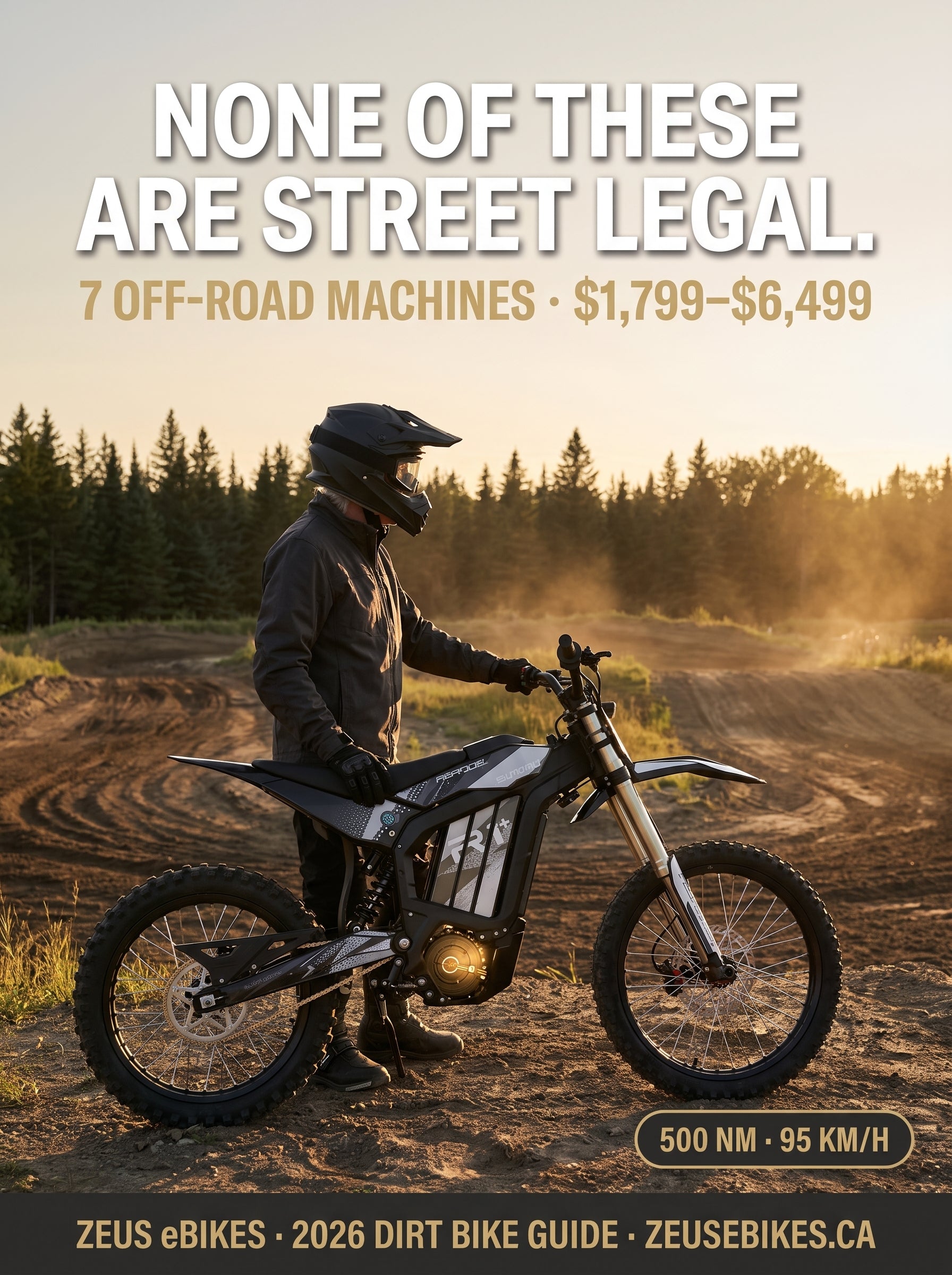
This guide ranks six electric dirt bikes Zeus sells — from the $1,499 GT54 mini to the 5,000W, 500 Nm Eunorau × Rerode R1+ — with verified specs, factory snow-track kits for Canadian winters, charge-time math, a parent’s guide for teen riders, and the sentence every other retailer buries: none of these are street legal, and we’ll show you exactly where you can ride instead.
- Street legal? No — every machine here exceeds the 500W e-bike ceiling. Off-road, private property, and permitted OHV areas only.
- Cheapest real one: GT54 mini — $1,499, 290 Nm, 65 km/h
- The adult default: GT73 — $2,199, dual batteries, 140 km throttle-only
- The flagship: Eunorau × Rerode R1+ — $6,499, 5,000W, 500 Nm, 95 km/h
- Winter: factory snow-track kits on GT54, GT54 Pro, GT73 and GT73 Pro
- Need street-legal instead? Read the Canadian eBike law guide — different machines, different rules.
What’s in This Guide
- The Legal Truth First: Where You Can Actually Ride
- Quick Match — Pick Your Machine in 30 Seconds
- 6 Machines, Ranked ($1,499–$6,499)
- Full Comparison Table
- Winter: Snow-Track Kits & Cold-Range Math
- The Parent’s Guide: Buying for a Teen
- Gas vs Electric: The Honest Trade
- Need Pedals or Street-Legal? Read This First
- Pre-Purchase Checklist
- Frequently Asked Questions (12)
The Legal Truth First: Where You Can Actually Ride
Every machine in this guide is an off-road vehicle. Each one exceeds the 500W nominal ceiling the provincial rules converge on for a power-assisted bicycle, and none carries the motor-vehicle certification that would let it register for road use instead. That is not a flaw — it is the category. A dirt bike that could pass an e-bike inspection would be too weak to jump.
Where you can ride is bigger than most buyers think: private property (yours, or land you have permission to use — the acreage, the back forty, the cottage lot, a friend’s farm), private motocross tracks, and designated off-highway-vehicle areas where your province’s OHV rules permit electric machines. What you cannot do is ride to any of those places on a public road — trailer it, truck it, or ride out your own gate.
If a seller tells you otherwise, run their claim through the 30-second model check in our Canadian eBike law guide — nominal watts, locked speed, real pedals. Every machine on this page fails it proudly, which is exactly why they’re fun. For the brands people ask about most — Sur-Ron and Talaria — the same physics and the same law apply.
Quick Match — Pick Your Machine in 30 Seconds
| Your situation | The machine | Price |
|---|---|---|
| First dirt machine, tightest budget — or a teen’s starter | GT54 Mini | $1,499 |
| Mini size, full-size speed — the pit-bike itch | GT54 Pro Mini | $1,799 |
| The adult default — dual batteries, all-afternoon riding | GT73 | $2,199 |
| More speed, more range, snow-kit winters | GT73 Pro | $2,699 |
| The full-size mid-drive flagship | Eunorau R1 | $6,299 |
| Maximum everything — 500 Nm, 95 km/h | Eunorau × Rerode R1+ | $6,499 |
6 Machines, Ranked — $1,499 to $6,499
Price order, cheapest first — because that is how real buyers shop. Every specification below comes from the machine’s own Zeus product page; every price and stock status was re-verified against the live store on July 27, 2026. All six are off-road machines: private land and permitted areas only.
GT54 Electric Mini Motorbike
$1,499
GT54 — the machine that turns a mowed field into a racetrack.
The honest answer to “cheapest electric dirt bike in Canada” that is still a dirt bike. The GT54’s 290 Nm through a geared hub (fixed 5.2:1 reduction) embarrasses machines twice its price off the line, hydraulic discs handle the braking, and front-and-rear suspension (a hydraulic double-wishbone front shock in its manual, an inverted fork in its spec table) soaks up a backyard loop’s worth of abuse. At about 106 lb with a 27.2-inch seat height, it fits older teens (its manual sets a minimum age of use of 16) and smaller adults; at 65 km/h, it demands the full-gear respect of a real machine, because it is one.

GT54 Pro — mini wheelbase, 80 km/h. The pit bike with a full-size engine note (silence).
Same compact 14/12-inch wheel format as the GT54, completely different animal: 60 volts, 338 Nm — the same torque figure as the full-size GT73 Pro — and 80 km/h in a machine you can lift into a truck bed alone. This is the pit-bike category’s whole appeal, electrified: small enough to flick, fast enough to frighten. The 330 lb payload means it genuinely carries adults, and the factory snow-track kit ($2,898 as a bundle) turns it into a winter machine. Full gear, private land, no exceptions.
Riding Times GT73
$2,199
GT73 at the back-forty gate — two batteries, evening chores done, trails open.
The machine most adult buyers on this page actually want. Two removable 48V batteries — 1,747 Wh combined — carry Riding Times’ figures of 140 km throttle-only and 270 km in pedal assist (110 km on its spec card), which in practice means an afternoon of acreage and trail riding without watching a gauge. Hydraulic suspension at both ends, hydraulic discs, a 330 lb payload on Riding Times’ page (130 kg in its manual), and a top speed of 60 km/h that is quick enough to grin at and calm enough to trust a newer rider with. Each battery charges indoors on its own included charger (9–10 hours; charge both overnight). Add the snow-track kit ($3,298 bundled) and it doesn’t hibernate in December.
Riding Times GT73 Pro
$2,699
GT73 Pro on the Canadian shield — 60 volts, 2,160 Wh, and an afternoon that refuses to end.
Everything the GT73 does, escalated: 60-volt architecture, 338 Nm, 74–80 km/h, and the biggest range claim in the lineup — 140 km throttle-only, up to 270 km with pedal assist — from 2,160 Wh of dual removable batteries that recharge in 5–6 hours each on the included 3A chargers. The rear shock, rated 1,800 lb in Riding Times’ parts list, is built for hard landings — within a load limit Riding Times gives as 330 lb on its page and 100 kg (220 lb) in its manual. This is the machine for the buyer who knows the cheaper one would leave them wanting in a month — and the $3,798 snow-track bundle makes it the most capable winter machine of the GTs.
Eunorau R1
$6,299
R1 at the track — 330 Nm of mid-drive silence where a two-stroke used to scream.
This is the real thing: full-size motocross geometry, 19-inch moto wheels front and rear, a 72V mid-drive making 330 Nm, and 85 km/h of top end — at 130 lb, roughly half the weight of the gas 250s it lines up against. The 2,520 Wh LG pack is rated to 120 km in Eco and delivers an honest 60–80 km at trail pace (35–50 km ridden flat-out in Sport — the product page prints the real numbers, including winter’s 25–40% cold reduction). A 72V 10A fast charger refills it while you eat lunch. 6061 aluminium means Canadian winter storage without rust. Three colours.
Eunorau × Rerode R1+
$6,499
R1+ on the ridge — 5,000 watts, 500 newton-metres, and not one decibel to apologize for.
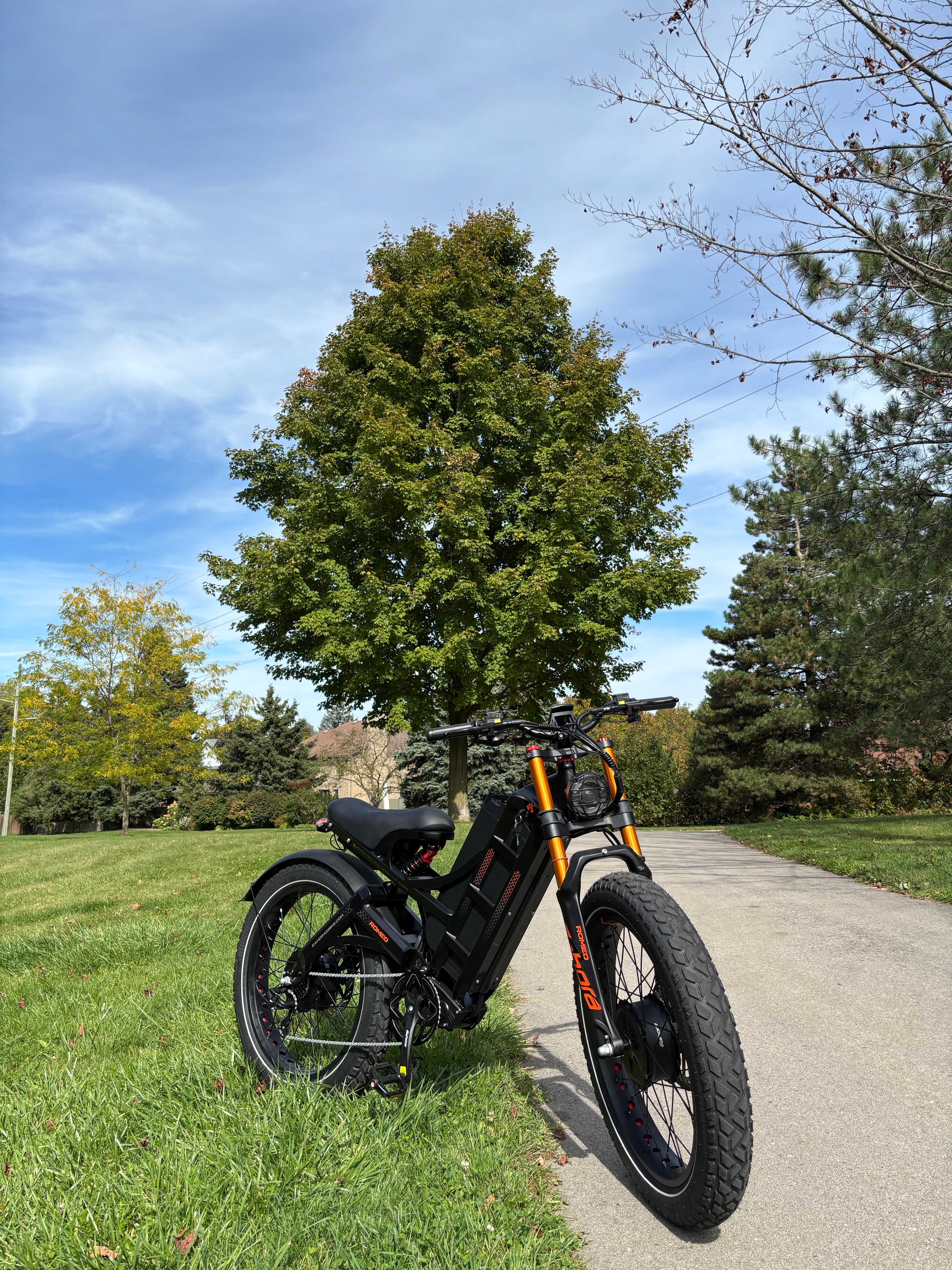
The top of the Zeus ladder, full stop. The R1+ takes the R1’s platform and turns every dial: 5,000W advanced mid-drive, 500 Nm — mid-size-motorcycle torque — 95 km/h, and a 2,880 Wh Samsung pack rated to 120 km (70–90 km at real trail pace, 40–55 ridden in Sports+ like you stole it). Flagship suspension hardware adds 20 lb over the R1; the aluminium frame still shrugs at winter storage. For $200 over the R1 you buy 170 more newton-metres and 10 more km/h — which is why most buyers who make it this far down the page buy this one. Private land has never been this loud with silence.
Want them side by side in the store?
The electric dirt bike collection holds these machines with live stock, every variant (including snow-track bundles), and financing at checkout.
Browse the Dirt Bike Collection → Financing Guide →Full Comparison Table — All 6 Machines
| Machine | Price | Motor | Torque | Top speed | Battery | Range (rated) | Weight | Snow kit |
|---|---|---|---|---|---|---|---|---|
| GT54 | $1,499 | 1,000W (2,000W pk) hub | 290 Nm | 65 km/h | 48V 27Ah (1,296 Wh) | Up to 100 km | ~106 lb | ✅ $2,598 bundle |
| GT54 Pro | $1,799 | 1,500W (3,000W pk) hub | 338 Nm | 80 km/h | 60V 25Ah (1,500 Wh) | Up to 100 km | — | ✅ $2,898 bundle |
| GT73 | $2,199 | 1,200W (2,400W pk) hub | 126 Nm | 60 km/h | 2×48V 18.2Ah (1,747 Wh) | 140 km · 270 km PAS | 116 lb | ✅ $3,298 bundle |
| GT73 Pro | $2,699 | 3,000W pk geared hub | 338 Nm | 74–80 km/h | 2×60V 18Ah (2,160 Wh) | 140 km · 270 km PAS | 123 lb | ✅ $3,798 bundle |
| R1 | $6,299 | 72V 4,000W mid-drive | 330 Nm | 85 km/h | 72V 35Ah (2,520 Wh) LG | 120 km Eco · 60–80 real | 130 lb | — |
| R1+ | $6,499 | 72V 5,000W mid-drive | 500 Nm | 95 km/h | 72V 40Ah (2,880 Wh) Samsung | 120 km Eco · 70–90 real | 150 lb | — |
All figures from the Zeus product page for each machine (manufacturer-published specs). “PAS” = pedal assist. Real-world range varies with rider weight, terrain, temperature and throttle use. None of these machines is street-legal in any province.
Winter: Snow-Track Kits & Cold-Range Math
This is the section no American guide can write. Four machines in this lineup take factory snow-track kits — a rear track and front ski conversion sold as a bundled variant on the Zeus product page: the GT54 ($2,598 bundled), the GT54 Pro ($2,898), the GT73 ($3,298) and the GT73 Pro ($3,798). A quiet electric track machine on private land is a genuinely new category of Canadian winter fun — no two-stroke smoke, no neighbour feud, no trailering to a sled zone.
Budget for the cold honestly. The R1 platform’s published figures — the only ones in this lineup with printed cold-weather numbers — show roughly 25% range loss at 0°C and 35–40% at −10°C, and lithium behaves the same in every machine here. The rules that don’t change: store and charge batteries indoors (every battery in this lineup is removable), start rides with a warm pack, and halve your summer range estimate before planning a February loop.
The Parent’s Guide: Buying for a Teen
Half the search traffic behind this page is a parent. So, plainly: the two minis — GT54 and GT54 Pro — are the machines sized for teens and smaller adults, with a 27.2-inch seat height and about 106 lb of bike to manage (the GT54, per Riding Times’ manual, which also sets a minimum age of use of 16). But “mini” describes the wheelbase, not the speed: 65 km/h and 80 km/h respectively. These are not toys, and no machine on this page belongs under a young child.
- Gear before the first metre: full-face helmet, goggles, gloves, boots that cover the ankle, long sleeves. Budget $300–$500 and treat it as part of the purchase price.
- Terrain before speed: a mowed loop or packed two-track on your own land, walked first for holes and wire. Speed settings exist — the variable-speed hubs on both minis allow restrained modes for the first month.
- Supervision as policy, not mood: a rider under 18 on a 60+ km/h machine warrants an adult present, every ride. Public OHV areas add their own provincial age rules — check before going.
- The upgrade trap, avoided: the honest reason to start at the $1,499 GT54 rather than something weaker — a teen who outgrows a toy in three weekends teaches you the expensive way that the second bike was the real purchase.
Gas vs Electric: The Honest Trade
Electric wins four ways that matter in Canada. Noise: a silent machine rides at 7 a.m. beside a neighbour’s fence line and never triggers the bylaw complaint that ends backyard tracks. Maintenance: no oil, no filters, no plugs, no carburetor to gum over winter — the R1’s aluminium frame won’t even rust in the shed. Fuel: a full charge costs pennies and happens in your basement. Torque: everything here hits peak from zero rpm — the 290 Nm GT54 launches harder than its price class has any right to.
Gas keeps two honest wins: a tank refills in three minutes while a battery wants hours (the R1 pair’s 10A fast chargers narrow this to a long lunch), and an all-day motocross session still favours the machine you can refuel between motos. If your riding is acreage loops, cottage trails, and permitted OHV country — the way most Canadians actually ride — the electric trade wins on total hours ridden per year, because the quiet machine is the one that’s allowed to run.
Need Pedals or Street-Legal? Read This First
One of these machines has pedals — the GT73 Pro (270 km rated with assist) — and it is not street-legal, because pedals don’t change wattage. If your real requirement is a machine you can ride on public roads, that is a different purchase with a hard ceiling: 500W nominal, 32 km/h, working pedals. Start with the Canadian eBike law guide and its 13 bikes checked against the rule, or the 500W vs 750W vs 1000W power-tier guide if you’re weighing how much machine the law allows. The street-legal collection holds every road-compliant model we stock.
Pre-Purchase Checklist
- Confirm where you’ll ride — before you buy. Private land you own or have permission for, a private track, or a permitted OHV area. If the honest answer is “the street,” stop and buy from the street-legal guide instead.
- Transport plan: truck bed, trailer, or hitch carrier rated for 105–150 lb. You cannot ride there on public roads.
- Charging logistics: count the chargers (the GT73s include one per battery), find the indoor outlet, plan 5–10 hours per pack — or lunch-break speed on the R1/R1+ 10A units.
- Battery certification: the GT-series packs are UL 2849 compliant per their product pages; every pack here is removable for indoor charging — non-negotiable in a Canadian garage winter.
- Gear budget: $300–$500 for full-face helmet, goggles, gloves, boots — for every rider, not just the teen.
- Tell your home insurer. A motorized off-road machine in the shed is worth a two-minute phone call — see the insurance guide.
Frequently Asked Questions
Are electric dirt bikes street legal in Canada?
No. Every bike in this guide exceeds the 500W nominal power-assisted-bicycle ceiling — and several have no operable pedals — so none qualifies as a bicycle in any province, and because they carry no motor-vehicle safety certification, they generally cannot be registered for road use either. They are off-road machines: private property, and trails or off-highway-vehicle areas that permit them. The 30-second model check in our Canadian eBike law guide applies to any model ever made.
Are electric dirt bikes legal in Ontario?
Off-road, yes — on private property with the owner’s permission, and in areas where off-road vehicles are permitted under Ontario’s off-road vehicle rules. On public roads, no: they exceed the e-bike power limit and cannot be registered as motor vehicles. See the Ontario eBike laws guide for the full road-side picture.
Are electric dirt bikes street legal in Alberta?
No — on Alberta public roads a bike over 500W nominal is a motor vehicle requiring registration and insurance it cannot obtain. Off-road is a different story: private land, and designated off-highway-vehicle areas subject to Alberta’s OHV rules. The Alberta eBike laws guide covers the road rules in detail.
Do you need a licence to ride an electric dirt bike?
Not on private property — no licence, registration, or plate applies on your own land or land you have permission to ride. On public roads these machines cannot be legally ridden at all (they exceed e-bike limits and generally cannot be registered), so a road licence never enters the picture. In designated public off-highway-vehicle areas, your province’s OHV rules apply — check them before you ride.
What is the cheapest electric dirt bike in Canada?
In our lineup, the GT54 Electric Mini Motorbike at $1,499 — a 1,000W (2,000W peak) mini with 290 Nm of torque, hydraulic disc brakes, and a 48V 27Ah battery. It is a genuine dirt machine at the price where most “dirt bikes” are toys with brushed motors and bicycle brakes.
What is the fastest electric dirt bike at Zeus?
The Eunorau × Rerode R1+ — 95 km/h off-road, from a 72V 5,000W mid-drive making 500 Nm of peak torque. The standard R1 runs 85 km/h with 330 Nm. Both are off-road and private-property machines only.
How long do electric dirt bike batteries take to charge?
It varies by pack: the GT73’s dual 48V batteries take 9–10 hours each on the included 2A chargers; the GT73 Pro’s 60V pair charge in 5–6 hours each on 3A chargers; and the R1 and R1+ use a 72V 10A fast charger. Every battery in this guide is removable, so charging happens indoors, not in the shed.
Do any electric dirt bikes have pedals?
One in this lineup: the GT73 Pro is rated 270 km with pedal assist versus 140 km throttle-only. But pedals do not change the law: it exceeds 500W nominal, so it remains an off-road machine. If you need a bike with pedals that is actually street-legal, that is a different purchase — start with our Canadian eBike law guide.
Can you ride an electric dirt bike in winter in Canada?
Yes — and four machines in this lineup have factory snow-track kits: the GT54 ($2,598 with kit), GT54 Pro ($2,898 with kit), GT73 ($3,298 with kit) and GT73 Pro ($3,798 with kit) convert to a track-and-ski setup for genuine snow riding on private land. Budget for cold-weather range loss on any electric machine: roughly 25% at 0°C and 35–40% at −10°C, per the R1 platform’s published cold-weather figures. Store batteries indoors.
Are electric dirt bikes better than gas dirt bikes?
Different, honestly. Electric wins on noise (ride at 7 a.m. without a bylaw complaint), maintenance (no oil, filters, plugs, carbs, or valve checks), indoor-charged fuel that costs pennies, and instant torque from zero. Gas still wins on refuel time (minutes versus hours) and all-day motocross sessions. For Canadian acreage owners, cottagers, and trail riders, the electric trade usually wins — which is exactly the buyer this lineup serves.
How old should a rider be for an electric dirt bike?
On private property no statutory e-bike age applies, so it is a parental judgment call. Our honest guidance: the minis (GT54, GT54 Pro — 27.2-inch seat height) fit older teens and smaller adults — Riding Times’ GT54 manual sets a minimum age of use of 16 — but a 65–80 km/h machine is not a young child’s toy in any configuration. Full protective gear — full-face helmet, gloves, boots — and supervision are non-negotiable, and public off-highway-vehicle areas have their own provincial age rules; check before riding there.
Do you need insurance for an electric dirt bike?
Not to ride on your own private property. If you ride in designated public off-highway-vehicle areas, your province’s OHV rules may require liability coverage — check before you go. Either way, tell your home insurer: coverage for theft and liability involving a motorized off-road machine varies by policy. Our eBike insurance guide covers the options.
The Bottom Line
Six machines, one honest ladder. The GT54 ($1,499) is the real-machine entry and the teen starter; the GT54 Pro ($1,799) is the pit bike with full-size speed; the GT73 ($2,199) is the adult default with dual batteries and an afternoon of range; the GT73 Pro ($2,699) escalates to 60 volts, 338 Nm and the biggest range claim in the lineup; and the R1 ($6,299) and R1+ ($6,499) are the full-size mid-drive flagships — up to 500 Nm and 95 km/h, at half the weight of the gas 250s they replace.
And the sentence that protects you: none of them is street-legal, anywhere in Canada, and none can be made street-legal. That isn’t fine print — it’s the deal. In exchange you get power no road bike is allowed to carry, silence no gas bike can offer, and a country with more private land, cottage trail and permitted OHV country than any rider will exhaust in a lifetime. Ride there, trailer between, and the only authority you’ll answer to is the weather.
Not sure which step of the ladder is yours? Call 1-866-938-7580 — a real human answers, and we’ll tell you honestly which machine fits your land, your rider, and your winter, even if the answer is the $1,499 one. Or browse the full dirt bike collection with live stock and financing at checkout.
Published: February 2026 | Last Updated: July 27, 2026 | By Milad Ghobadibeygvand, BScN (Western University, 2014), Co-founder, Zeus eBikes Canada
📸 All photography by Playcut.ai
Riding Times GT73 — Our 2-Year Review — the long-term ownership report
Sur-Ron in Canada — the brand everyone asks about, honestly covered
Talaria in Canada — the other name in high-power off-road
500W vs 750W vs 1000W — the full power-tier legal ladder
eBike Insurance Canada — what needs coverage, what doesn’t
eBike Theft Protection — the 3-layer system for machines worth stealing
Financing an Electric Bike in Canada — how the checkout options actually work


Share:
eBike Laws Canada (2026): Every Province, One Table, 13 Bikes Checked Against the Rule
How to Choose an Electric Bike in Canada (2026): 8-Step Checklist