
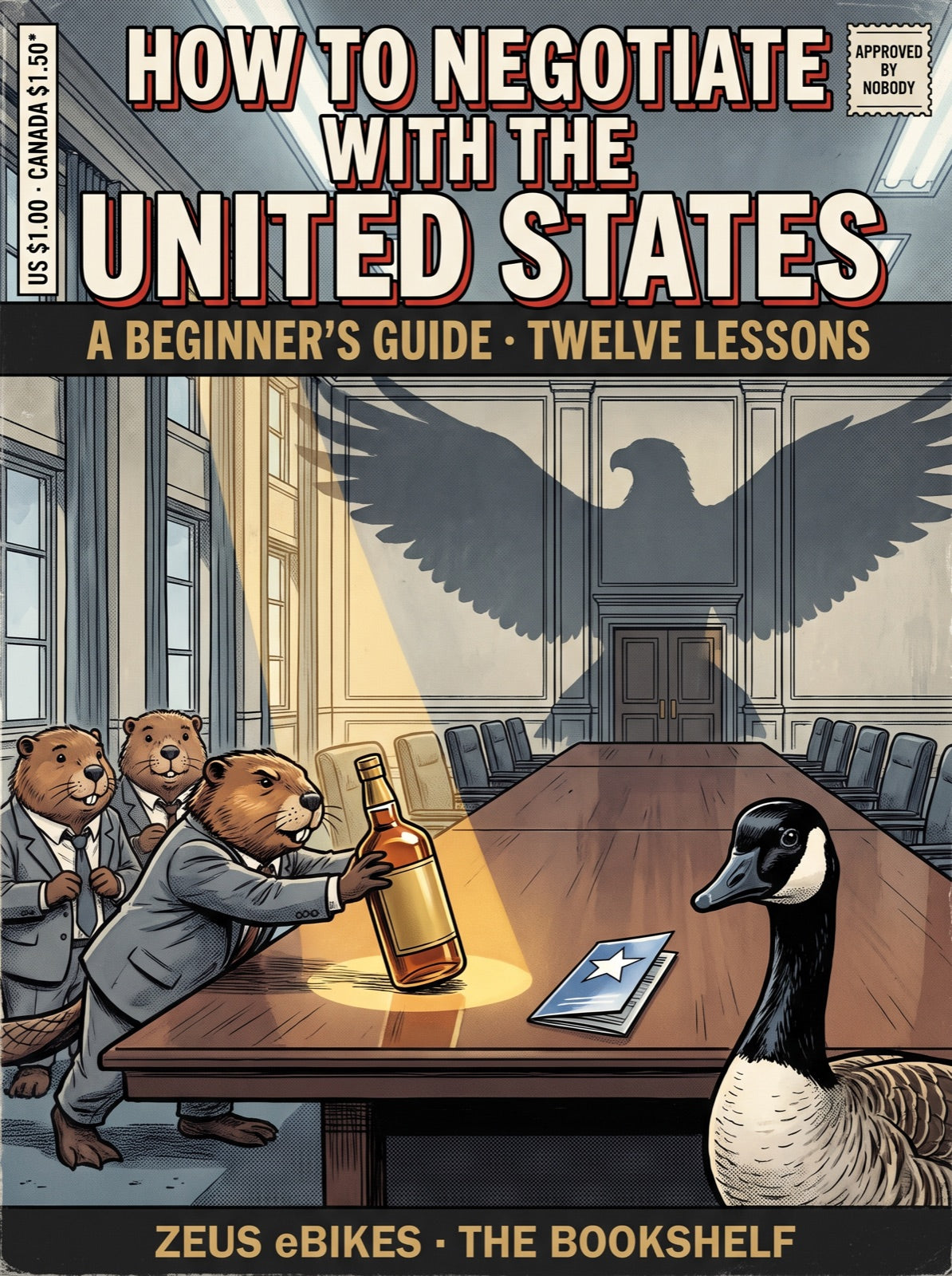

by Nobody(nobody checked) Zeus Media Comics ★ Issue #1 ★ Aug 2026

Lead NegotiatorWhere are we on the bourbon?
DeputyPrepared to un-ban it.
LeadAnd in exchange?
DeputyThey drop the new tariff.
LeadAnd the old tariffs?
DeputyThose stay.
LeadSo we give back the bourbon, and we keep paying the old tariffs.
DeputyBut not the new one.
LeadRight.
LeadIt's a good deal.
DeputyIt's a good deal.


The Prime Minister (in the dream)I'm not angry.
The Prime Minister (in the dream)I'm disappointed.
The PresidentHe was disappointed at me. In my own dream.

Aide (by phone)Sir?
The PresidentThree thousand percent.
AideOn what, sir?
The PresidentCanada.
AideWhich sector?
The PresidentAll of it. It happened on American soil.
AideThe dream, sir?
The PresidentThe disrespect.

AnchorAny indication of what caused the new tariff?
CorrespondentSources describe a dream. We have not been able to independently confirm the dream's contents.
AnchorAnd the Prime Minister?
CorrespondentHis office says he was asleep at the time, in Ottawa.
AnchorSo the question becomes—
CorrespondentThe question, as always, is what Canada is prepared to give up in exchange for relief.

A) Concede
B) Concede, but slowly (dignity)
C) Express concern
D) Express deep concern
E)
Junior StafferIs he allowed to do this?
DeputyThe last two times a court said no, it came back under a different law.
Junior StafferWhich law is this one under?
DeputyIt's from before the Depression. They found it in storage.
Junior StafferWhat's our leverage?
DeputyWe could cancel a meeting.
Lead NegotiatorGood God.
Lead NegotiatorNobody is cancelling any meetings. We're not animals.
Junior StafferWhat if we just… didn't concede anything?
Lead NegotiatorThat's the kind of thinking that gets a person posted to Oslo.
Junior StafferI hear it's nice.

American NegotiatorThe President is prepared to show mercy. Fifty percent. His final number.
American NegotiatorHe's taking a huge loss on the dream.
Lead Negotiator…We can live with fifty.
American NegotiatorYou already were.
Lead NegotiatorThen we accept.
Lead Negotiator (to press)We are pleased to report that the number is fifty again.
ReporterIsn't that exactly where you started?
Lead NegotiatorWe view it as a return to stability.

DeputyWe've drafted a statement.
Lead NegotiatorRead it.
Deputy"The goose does not speak for Canada."
Lead NegotiatorStrong. Clear. Send it.

Junior StafferWhy 1993?
DeputyHe remembers it.
Lead NegotiatorOffer to keep our cold air in a contained northern facility until they need it for summer.
DeputyThey've called the offer constructive.
Lead NegotiatorThere it is.

Lead NegotiatorDoes the Senator speak for the administration?
American NegotiatorSometimes.
Lead NegotiatorThat's clarifying.

Lead NegotiatorWe're prepared to return the bourbon.
American NegotiatorYou returned the bourbon in August.
Lead NegotiatorWe're prepared to return it again.
American NegotiatorYou can't concede the same bourbon twice.
Lead NegotiatorWe just did.

(continues on a second board)
Lead NegotiatorIf this continues, Canada will be forced to consider… rescheduling a meeting.
American NegotiatorThey're bluffing.
Second AmericanThey've never rescheduled.

Become America★
A simple solution to a complicated relationship
- We have never once tariffed Ohio.
- As a state, you would immediately enjoy our lowest domestic rate: zero.
- You would be our biggest state. We know how much you like being the biggest something.
- Includes: one (1) star.
★Terms and conditions apply. Terms may change based on dreams.
DeputyThe font is friendly.
Lead NegotiatorIt is friendly.
DeputyIs there a French version?
American NegotiatorWe've identified that as a growth area.
Lead NegotiatorWe'll take it back to Ottawa. For study.

Lead NegotiatorWhere are we on the bourbon?
DeputyPrepared to un-ban it.
LeadAnd in exchange?
DeputyThey drop the newest one.
LeadAnd the old ones?
DeputyThose stay.
LeadWhere's the junior?
DeputyOslo.
Lead…It's a good deal.
DeputyIt's a good deal.
"THE SUPPLEMENTARY MEETING!" The Delegation confronts its deadliest enemy — an agenda with no exits! Plus: the goose remains at large!
Here is the part you are not allowed to laugh at
Everything above is fiction. Almost everything below is worse, because it is real, and because every line of it carries a named source. This is not a prediction, and it is not an attack on any public servant — Canada's negotiators are career professionals playing the hand they were dealt. It is a question about the hand: if the pattern of the last eighteen months simply continues, where does it land?
The ratchet, as documented
The escalation sequence below is compiled from the tariff timeline maintained by the Canadian law firm Blakes and from U.S. trade-law analyses, each linked in the ledger.
| Date | What happened |
|---|---|
| Mar 4, 2025 | 25% U.S. tariff on Canadian goods (10% on energy) takes effect under IEEPA (International Emergency Economic Powers Act) emergency powers — ordered Feb 1, paused 30 days (Blakes) |
| Jun 4, 2025 | Steel and aluminum tariffs doubled, 25% → 50% (Blakes) |
| Aug 1, 2025 | Rate on Canadian goods raised to 35% (Blakes) |
| Feb 20, 2026 | U.S. Supreme Court rules 6–3 that the IEEPA tariffs are unlawful (WilmerHale; Miller & Chevalier) |
| Feb 20–24, 2026 | Same day as the ruling: a 10% global "temporary import surcharge" is proclaimed under a different statute — Section 122 — effective Feb 24; the next day, an increase to the statute's own 15% maximum is threatened (Davis Wright Tremaine) |
| May 2026 | The U.S. Court of International Trade strikes down the Section 122 tariffs as well (Skadden) |
| Jul 20, 2026 | 50% tariffs proclaimed on nearly $20 billion US of Canadian imports — autos, alcohol, dairy and hundreds of other lines — under Section 338 of the Tariff Act of 1930, effective Aug 19, 2026 (Holland & Knight; Honigman) |
Holland & Knight's trade group notes the remarkable part plainly: "Section 338 has never been used to impose tariffs." The statute sat dormant for 96 years. The pattern to absorb is not any single number — it is that a loss at the Supreme Court of the United States changed the legal letterhead and nothing else. The tariffs were back on the books, under new authority, within the day.
What Canada put on the table
On August 7, 2026, CBC News reported — citing industry sources with knowledge of the negotiations, speaking on condition of anonymity — that Canada was prepared to end provincial bans on U.S. alcohol, and was considering lifting retaliatory tariffs on U.S. autos and making changes on dairy. In exchange, Canada was seeking three things: that the new 50% tariffs be dropped, some relief on sectoral tariffs, and a joint announcement that trade-agreement talks would resume in the fall. One of the asks, in other words, was a scheduled announcement of future negotiations. The same report noted that American negotiators had "flatly indicated" the existing sectoral tariffs would not be removed entirely — and that Canada's strongest pressure argument was that, if the new tariffs took effect, there would be "no political appetite" among Canadians to keep the talks going. Both sides agreed to hold daily meetings. Canada's trade minister described the Washington meeting as "constructive and detailed." The comic did not invent that phrase. It quoted it.
Why the 3,000% dream tariff is a real mechanism wearing a fake number
The dream is invented. The arithmetic underneath it is not. When an extreme number enters a negotiation first, every smaller number afterwards is judged against it rather than against the world before it — the anchoring effect, documented by Amos Tversky and Daniel Kahneman in 1974 (Science, 185(4157), 1124–1131). A threatened 50% makes yesterday's 35% feel like shelter. A threatened 3,000% would make 50% feel like mercy. Accepting "only" the previous round to escape the current one is not a strategy that ends anywhere; it is the mechanism by which each round becomes the floor of the next. That is the entire comic, in one sentence, with a citation.
Can a senator really freelance a threat against Canada?
Yes — no White House sign-off is required for a senator to introduce a bill. In July 2026, Senator Bernie Moreno of Ohio introduced the CANADA FIRE Act — in full, the "Countering Atmospheric Nuisances Arising from Drifting Airborne Foreign Incendiary Residual Emissions Act" — proposing blocked assets and revoked U.S. visas for Canadian officials deemed responsible for wildfire smoke, with a sense-of-Congress provision contemplating persona-non-grata status for more than a dozen categories of Canadian diplomats, including the ambassador (bill text via the senator's office, as reported by Sabrina Eaton, cleveland.com/FireRescue1; Semafor; Washington Examiner). It has not passed as of publication (August 8, 2026). We did not invent the backronym. We could not have. As for history: Congress is a co-equal branch, any member may introduce any bill about any country, and the only statute even adjacent to freelance foreign policy — the Logan Act of 1799, aimed at private citizens conducting unauthorized diplomacy — has produced two indictments in 227 years, in 1803 and 1852, and zero convictions (Congressional Research Service). When 47 sitting senators wrote directly to Iran's leadership in 2015 to undercut a live negotiation, nothing happened to any of them (Congressional Research Service). The comic's answer — "Sometimes." — is, as far as the record shows, the accurate one.
The brochure is a punchline. The pitch is on the record.
The "51st state" framing is not a Zeus invention. By February 2025, PBS News reported that the U.S. president had "repeatedly said Canada should be the 51st U.S. state" — in his own words: "If people wanted to play the game right, it would be 100% certain that they'd become a state." In June 2026, after Canada slipped into a technical recession, he revived the theme (CTV News). And at an August 2026 Las Vegas rally, per CBC's report, he put the current mood this way: "Canada's nasty… I love the people, but they're nasty. Nasty leadership." The comic's brochure only does what satire is for — it prints the subtext in a friendly font.
For the record: Canadians are contesting the posture, in public
This piece satirizes a negotiating posture, not a country's will — and the record shows that posture is contested at every level. B.C.'s premier, on restocking American alcohol: "There is not a chance in hell that U.S. alcohol is going back on the shelf" (CBC). The Leader of the Opposition, on the reported concessions: he does not "understand the strategy" of making concessions "before even getting to the negotiating table," urging the government to "take the leverage that he has not yet squandered… and get something in return for a change" (CBC). And the Prime Minister, for his part, has insisted he wants "a more comprehensive deal, a global deal that addresses the strategic sectors," adding, of the August 19 deadline: "Will we get all of that by the 19th of August? We'll see" (CBC). The disagreement about whether concession-first works is not between Zeus and Ottawa. It is happening inside Canada, out loud, right now.
What can't be tariffed
A tariff is a tax on what crosses a border. It has no power over what a country can build, fix, move, and power for itself — which is why capacity, not concession, is the only negotiating position that compounds. That argument is the spine of our graphic novella Beaver Berry: The Ungovernable, the sober version lives in The Canadian Shield: 14 Threats to Sovereignty, and the reason your e-bike is one of the few things in this trade war that still enters Canada at a 0% duty (as of our July 2026 audit) is documented in eBike Tariffs in Canada. The wider cost-of-living ledger is in Why Is Canada So Expensive?. The beauty of e-bikes is that Canada can build them here.
Sources — the footnote ledger
- CBC News (Darren Major, Katie Simpson and Kate McKenna), "Canada prepared to halt booze bans, meet other U.S. demands in exchange for tariff relief: sources," Aug 7, 2026 — cbc.ca
- Holland & Knight, "50 Percent Opening Bid: Canadian Imports Subject to Section 338 Tariffs," Jul 2026 — hklaw.com
- Honigman LLP, "U.S. Announces New 50% Tariffs on Many Canadian Products Starting August 19, 2026" — honigman.com
- WilmerHale, "Supreme Court Strikes Down IEEPA Tariffs — What Now?", Feb 20, 2026 — wilmerhale.com
- Miller & Chevalier, "Supreme Court Finds IEEPA Tariffs Unlawful," Feb 2026 — millerchevalier.com
- Davis Wright Tremaine, "President Imposes New Temporary Global Tariff After U.S. Supreme Court Invalidates Emergency Authority," Feb 2026 — dwt.com
- Skadden, "US Trade Court Strikes Down Section 122 Tariffs," May 2026 — skadden.com
- Blakes, "U.S.–Canada Tariffs: Timeline of Key Dates and Documents" — blakes.com
- 19 U.S.C. §1338 (Section 338, Tariff Act of 1930) — 50% duty ceiling in the duty provisions at (d) and (e); exclusion-from-importation authority at (b) — law.cornell.edu
- Sabrina Eaton (cleveland.com), "Ohio senator introduces bill to sanction Canada over wildfire smoke" (carries the bill's full title and diplomatic provisions, with the bill-text PDF), FireRescue1, Jul 17, 2026 — firerescue1.com
- Semafor (Burgess Everett), "Republican senator goes after Canada for wildfire smoke," Jul 17, 2026 — semafor.com
- Washington Examiner (David Zimmermann), "Bernie Moreno calls for sanctions on Canada over wildfire smoke," Jul 2026 — washingtonexaminer.com
- Tversky, A. & Kahneman, D. (1974). "Judgment under Uncertainty: Heuristics and Biases." Science, 185(4157), 1124–1131 — psycnet.apa.org
- Congressional Research Service, "The Logan Act: An Overview" — everycrsreport.com
- CTV News, "51st state remarks revived after Canada slips into technical recession," Jun 2026 — ctvnews.ca
- Will Weissert (Associated Press, via PBS News), "Remarks on Canada becoming the 51st state raise a lot of questions," Feb 13, 2025 — pbs.org
Frequently Asked Questions
Is "How to Negotiate with the United States" a real government manual?
No. It is a work of satirical fiction published by Zeus eBikes Canada. The characters — the President, the Prime Minister, the Delegation, the Senator, the correspondent — are unnamed fictional office-holders, not depictions of any real person. No line of dialogue in the comic was said by any real person. The factual appendix (The Real Part) is separate, and every claim in it is attributed to a named source.
Did Canada really offer to end the bans on U.S. alcohol while older tariffs stay in place?
That is what CBC News reported on August 7, 2026, citing unnamed industry sources: Canada was prepared to end provincial bans on U.S. alcohol — and was considering lifting retaliatory auto tariffs and making dairy changes — in exchange for dropping the new 50% tariffs, while U.S. negotiators had "flatly indicated" that existing sectoral tariffs would not be removed entirely. The federal government declined to comment on specifics.
Is the 50% tariff on Canadian goods real?
Yes. On July 20, 2026, the White House issued proclamations imposing 50% tariffs on nearly $20 billion US of Canadian imports — including autos, alcohol, and dairy — effective August 19, 2026, under Section 338 of the Tariff Act of 1930. Trade lawyers at Holland & Knight note Section 338 had never been used to impose tariffs in its 96-year history.
Did the U.S. Supreme Court really strike down tariffs, only for new ones to appear?
Yes. On February 20, 2026, the U.S. Supreme Court ruled 6–3 that the IEEPA tariffs were unlawful. The same day, a 10% global "temporary import surcharge" was proclaimed under a different statute, with an increase to the statute's 15% maximum threatened the next day. After a U.S. trade court struck down that authority in May 2026, the 50% Canada tariffs were proclaimed in July under a third statute, Section 338 — effective August 19, 2026.
Did a U.S. senator really propose freezing Canadian officials' assets?
Yes. In July 2026, Senator Bernie Moreno of Ohio introduced the CANADA FIRE Act — the "Countering Atmospheric Nuisances Arising from Drifting Airborne Foreign Incendiary Residual Emissions Act" — proposing blocked assets and revoked U.S. visas for Canadian officials deemed responsible for wildfire smoke. It has not passed as of publication (August 8, 2026). No White House sign-off is required for a senator to introduce such a bill.
Why is an e-bike company publishing political satire?
Zeus eBikes Canada publishes a civic shelf — The Bookshelf — alongside its buying guides, because the company's stated mission is to educate and tell the truth about the market Canadians actually live in. This piece contains no product recommendations. Its companion works are the graphic novella Beaver Berry: The Ungovernable and the sovereignty explainer The Canadian Shield.
Written by Milad Ghobadibeygvand, BScN (Western University, 2014) · A work of satirical fiction; factual claims appear only in The Real Part, with sources · Cover and panel art by Playcut.ai
Share:
The Shelters Are Full: 10 Verified Ways to Help the B.C. Wildfires
How to Be a Good Chicken