
 Zeus eBikes Canada — 10 categories. 14 bikes. Prices and specs re-checked 10 October 2026.
Best eBike for Every Rider Type in Canada (2026): 14 Picks, $1,499–$6,499
Published March 2026 · By Zeus eBikes Canada · Prices and specs re-checked 10 October 2026
The wrong eBike costs you twice. Once when you buy it. Again when you sell it at a loss six months later because it does not fit your life. We see it constantly: the commuter who bought a mountain bike and hates the weight. The senior who bought a cadence-sensor bike and got thrown by the jerky power surges. The winter rider whose single 720 Wh battery dies at kilometre 25 in −15°C. Every one of those mistakes was avoidable. Every one of those riders now knows exactly what they should have bought.
This guide exists so you do not become that story. Ten categories. Fourteen hand-picked bikes. Up to two picks per category, usually a Power Pick for riders who want maximum performance regardless of motor wattage, and a 500W Pick for riders who want a bike rated at 500W nominal or under. Prices are Zeus’s on 10 October 2026; each product page shows today’s price. Every recommendation is editorial — no sponsored placements, no affiliate payouts, no manufacturer influence.
Two bikes appear in two categories each. The long-range pick is also the dual-motor Power Pick (Romeo Ultra II), and the winter pick is also the second heavy-duty pick (FAT AWD 3.0, two 500W motors, off-road). When a bike fits two categories, we say so rather than pad the list.
Pick Your Rider Type
In This Guide
Every Pick at a Glance
| Category | Pick | Model | Price | Motor | Battery | Torque | Payload |
|---|---|---|---|---|---|---|---|
| Budget | 500W | Samebike RS-A02 Pro | $1,499 | 500W / 250W (Samebike) | 720 Wh | 80 Nm | 330 lbs |
| Commuter | Power | Velotric Nomad 2X | $4,099 | 750W | — | 105 Nm | — |
| Winter | Off-road | FAT AWD 3.0 | $2,299 | 2×500W | — | 110 Nm | 375 lbs |
| Seniors | Power | Velotric Nomad 2 | $3,399 | 750W | — | 90 Nm | 505 lbs |
| Seniors | 500W | Eunorau Meta 275 2.0 | $2,295 | 500W | 720 Wh (2nd optional) | 55 Nm | 286 lbs |
| Hills | Power | Specter-S 3.0 | $4,099 | 1,000W mid | — | 160 Nm | — |
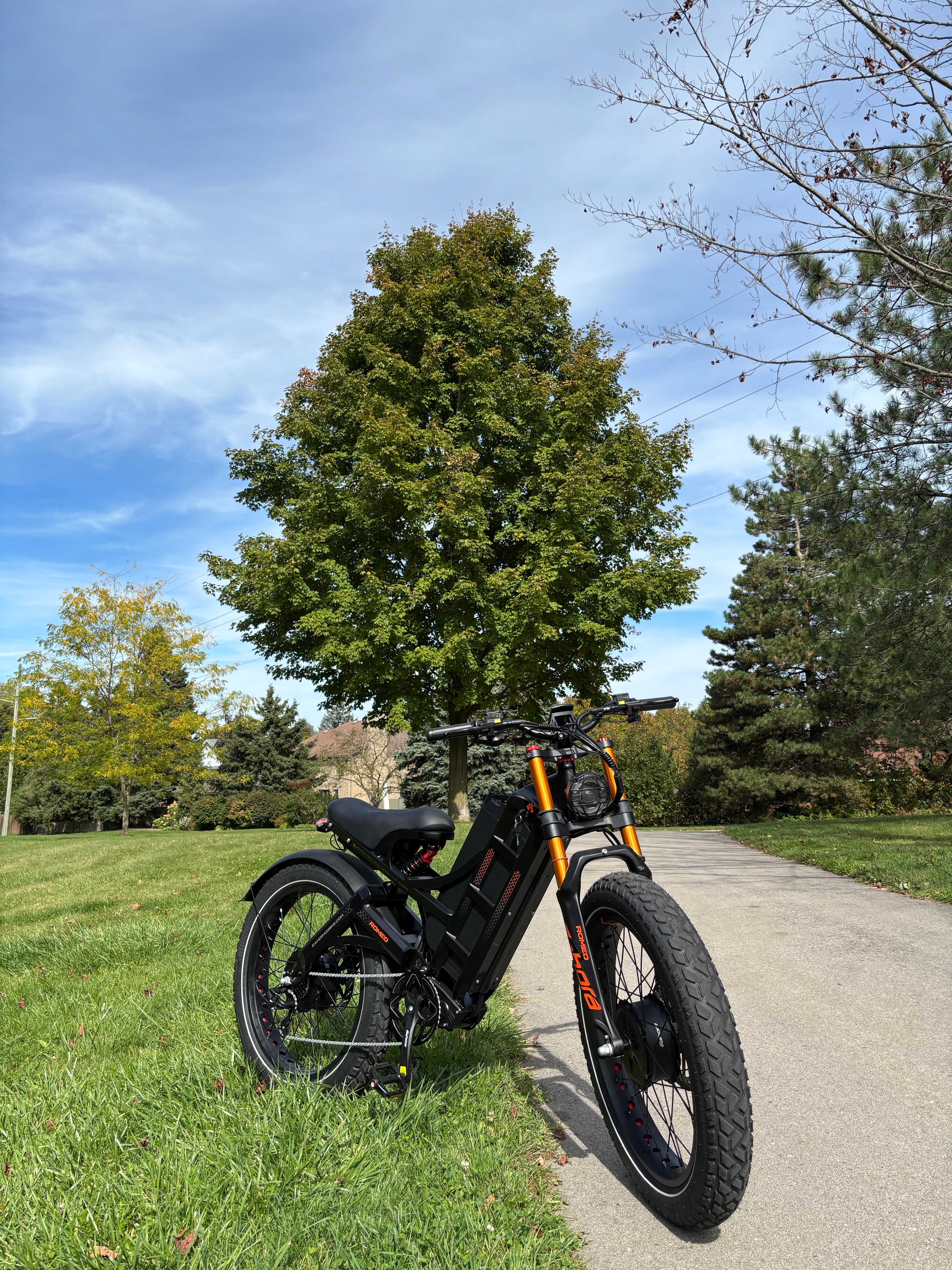
| Long Range | Power | Romeo Ultra II | $5,599 | 6,000W peak, 2 motors (Eahora) | 4,800 Wh | 2 × 120 Nm | 500 lbs |
| Long Range | No PAB claim | Eahora FT-01 Max | $2,099 | 500W / 250W / 1,500W (Eahora) | 1,440 Wh | — | — |
| Moped | Power | GT73 Pro | $2,699 | 1,500W | 60V 36Ah | 338 Nm | 330 lbs |
| Moped | Budget | Z8 Pro | $1,599 | 500W (1,500W peak) | 2 × 48V 15.6Ah | 80 Nm | 330 lbs |
| Dual Motor | Power | Romeo Ultra II | $5,599 | 6,000W peak, 2 motors (Eahora) | 4,800 Wh | 2 × 120 Nm | 500 lbs |
| Dual Motor | Light | Defender-S | $2,499 | 2×750W | 2× incl. | 2 × 80 Nm | 300 lbs |
| Trike | Power | Meet One Tour AWD | $6,499 | Dual | 2× incl. | 180 Nm | 550 lbs |
| Trike | Trike (750W) | Velotric Triker | $4,099 | 750W | — | 90 Nm | 500 lbs |
| Heavy Duty | Power | Romeo Pro II | $4,299 | 2×1,500W | 3,120 Wh | 2 × 120 Nm | 330 lbs |
| Heavy Duty | Off-road | FAT AWD 3.0 | $2,299 | 2×500W | — | 110 Nm | 375 lbs |
1. Best Budget eBike in Canada — Under $1,500
The under-$1,500 segment is where corners get cut: smaller batteries, simpler controllers, cable-actuated brakes. The pick below keeps the parts that matter most for a first eBike, full suspension, a 720 Wh battery and a folding frame, at $1,499, and we say plainly where it saves money.
Samebike RS-A02 Pro
$1,499 CADThe RS-A02 Pro puts a 720 Wh battery (48V 15Ah), a folding frame, full suspension and a 150 kg (330 lb) load rating under $1,500, all Samebike’s figures. Samebike rates the motor at 80 Nm and prints its power two ways, 500W in its spec table and 250W in its description, with a 32 km/h top speed; either power figure is within the 500W line the provincial rules converge on, and we can tell you which ships. For riders who want a 500W-or-under bike that folds and soaks up rough pavement, this is the pick at the bottom of the price range.
Honest trade-off: Cadence sensor only, so the motor comes on when you pedal rather than scaling with how hard you push. The brakes are mechanical discs, not hydraulic, and at 33 kg (Samebike) it is a heavy folder to lift. For hilly terrain or riders who want a natural cycling feel, spend more on a torque-sensor bike.
 02 · Best Commuter
2. Best Commuter eBike in Canada (2026)
A commuter eBike is not a recreational toy with a rack bolted on. It is a car replacement. It has to survive five-day-a-week abuse: potholes at 7:30 AM, rain at 5 PM, a loaded pannier on Fridays, and a Canadian winter that would kill a lesser machine. Reliability matters more than top speed. Comfort matters more than weight savings. Range matters more than peak wattage. We did not recommend mid-drive motors here even though they are technically superior for efficiency — because hub drives offer fewer drivetrain issues for daily riders who do not want to maintain a chain-and-motor interface through road salt and slush. Read our pedal assist vs throttle guide for more on motor types.
Velotric Nomad 2X
$4,099 CADPicture your Tuesday commute. The city repaved half your route but left the other half shattered. A construction plate. Two potholes deep enough to swallow a wheel. A curb cut that does not line up with the bike lane. On a rigid-frame commuter, you feel every one of those impacts through your wrists, spine, and tailbone. On the Nomad 2X, the full air suspension — not coil, air — absorbs them before they reach your body. The adjustable handlebar tilts from upright cruiser position (comfortable) to forward-leaning efficient position (fast), so you can tune the geometry to your commute. 105 Nm of torque handles loaded panniers and steep overpasses without the motor straining. Available in step-thru or step-over.
Velotric fits Kenda 26×4.0″ puncture-resistant fat tires, a 120 mm air fork with up to 80 mm of rear travel, and an 801.6 Wh battery, and rates the motor at 750W with a 1,400W peak.
Honest trade-off: $4,099 is a lot of money for a commuter. The Nomad 2X justifies its premium through air suspension, build quality, and the adjustable stem — features you feel every single ride. Whether they are worth it depends on whether your commute is 5 km of smooth bike path or 15 km of urban obstacle course. At 750W it is over the 500W line the provincial rules converge on, so it is not a power-assisted bicycle in any province: check where you can ride it before you commute on it.
3. Best eBike for Winter & Snow in Canada (2026)
Canadian winter is hard on eBikes. Cold cuts how much of a battery’s charge you can use, black ice and packed snow demand fat tires and traction, and a single rear hub motor can spin on ice. A winter eBike needs a battery buffer for cold-weather losses and, ideally, two driven wheels. Before you plan a winter on any eBike, read its maker’s operating-temperature rating: several makers’ manuals say their bikes are not intended to be used below 0°C. For the complete deep-dive, read our winter eBike guide.
FAT AWD 3.0
$2,299 CADDual 500W motors drive both wheels for traction on loose and slippery surfaces, and the torque sensor reads your pedal pressure and delivers power proportionally, so there are no sudden surges that break traction. The motor eases in when you ease in. The step-thru frame means you mount and dismount without swinging a leg over a snow-covered crossbar in winter boots. Add the optional second battery for more range when cold eats into your primary pack. Eunorau’s product page prints no operating temperature, so ask us before you plan a January on it.
This bike also appears as our second Heavy Duty pick — because the same qualities that handle winter (high payload, dual motors, torque sensor, step-thru frame) handle heavy loads.
Honest trade-off: The base battery is 720 Wh (48V 15Ah, LG cells, Eunorau), so you will need the optional second battery for long winter rides. And 110 Nm of total torque is solid but not overwhelming — do not expect this bike to charge up steep icy hills. Its two 500W motors make 1,000W combined, so it is an off-road and private-property bike, not a power-assisted bicycle.
Not sure which category fits your riding?
Browse the full Zeus eBikes collection and filter by price, motor type, frame style, or terrain. Every bike ships free across Canada with a warranty from a Canadian company.
Browse All eBikes Finance Your eBike 04 · Best for Seniors
4. Best eBike for Seniors in Canada (2026)
A senior’s eBike is not a “less powerful” bike. It is a more thoughtful bike. The features that matter most for seniors are invisible on a spec sheet: torque sensor (so the motor never jerks or surges — critical for riders with balance concerns), low step-over height (for bad hips, replaced knees, and stiff joints), wide saddle (for rides measured in hours, not minutes), and high payload (because a 200 lb rider with a 30 lb pannier of groceries needs a frame that can carry 250+ lbs without strain). These two bikes understand that assignment. Both use torque sensors — the single most important feature for senior riders.
Velotric Nomad 2
$3,399 CADHere is what a torque sensor feels like on the Nomad 2: you start pedalling gently, and the motor matches your effort gently. You push harder on an incline, and the motor pushes harder with you. You ease off on a downhill, and the motor eases off. There are no surprises. No lurches. No moments where the bike takes over and you feel out of control. That predictability is not just a comfort feature — for a senior rider, it is a safety feature. The 505 lb load rating (rider plus cargo) handles any rider weight plus cargo without the frame flexing. The 26×4.0″ fat tires provide stability on cracked pavement and packed gravel paths.
Velotric’s build quality is genuinely a cut above. You feel it in the cable routing, the brake lever pull, the way the handlebars do not creak. This is a bike that does not announce its quality with flashy features — it announces it by not breaking and not annoying you for three years.
Honest trade-off: $3,399 is premium territory. The Meta 275 2.0 below costs $1,104 less and also uses a torque sensor. The Nomad 2 justifies its premium through build quality, wider tires (26×4.0 vs 27.5×2.6), and a higher load rating (505 vs 286 lbs). If you weigh over 220 lbs or ride on loose surfaces, the Nomad 2’s advantages matter. If you ride on pavement and weigh under 200 lbs, the Meta 275 2.0 is the better value.
Eunorau Meta 275 2.0
$2,295 CADThe Meta 275 2.0 ships with one 720 Wh battery, and a matched second pack is an optional add-on: double the range, a spare for cold weather (bring one inside to stay warm while you ride on the other), or simply the confidence that you will not be stranded. The 500W motor with 55 Nm and a torque sensor gives the same smooth, predictable power delivery that makes the Nomad 2 safe for seniors — at $1,104 less. The 27.5-inch wheels roll smoother over bumps and cracks than 20-inch alternatives, which means less fatigue on longer rides. Eunorau sizes it for riders 5′6″ to 6′1″. It ships set to 500W / 32 km/h; Eunorau lists the cap as unlockable, and whether an adjustable cap qualifies is not settled.
Honest trade-off: 286 lb payload is the lowest in this section. If you weigh over 230 lbs before adding cargo, you are pushing the limit. The tires are 27.5×2.6 — not fat tires — so you lose the stability advantage of 4-inch rubber on loose surfaces. For pavement and hard-packed gravel, 2.6-inch tires are perfectly adequate. For sand, snow, or unpaved trails, spend more on the Nomad 2’s fat tires.
 05 · Best for Hills
5. Best eBike for Hills & Climbing in Canada (2026)
Hills expose every weakness in an eBike. A hub motor without enough torque overheats after two minutes of sustained climbing — you hear it whining, feel the power cutting, and eventually you are pedalling a 70 lb dead weight up a grade. A cadence sensor dumps full power the instant you pedal, which on a steep grade means a lurch forward that can break rear-wheel traction on gravel. Hill-conquering eBikes need two things: a mid-drive motor (torque multiplied through the gears, not just pushed against the wheel) and a torque sensor (power proportional to your effort, not binary on/off). The pick below delivers exactly that. For the full comparison, read our mid-drive vs hub motor guide.
Eunorau Specter-S 3.0
$4,099 CAD160 Nm from a Bafang M620 mid-drive (Eunorau’s figures). Drop to the 42T climbing gear on the SRAM NX cassette and the Specter-S 3.0 crawls up steep grades. That is the fundamental advantage of mid-drive: the motor’s torque is multiplied through the gears. In the lowest gear, the effective force at the wheel is enormous.
The 140 mm inverted fork and full suspension keep the rear wheel planted on loose surfaces during steep climbs — critical, because the mid-drive sends power through the chain, and a rear wheel that lifts or bounces loses traction instantly. Zeus currently includes a free second battery and a spare wheelset with the Specter-S 3.0 at the $4,099 price, while supplies last.
Honest trade-off: At $4,099 it is one of the dearer picks here, and at 1,000W it is an off-road and private-property bike, not a power-assisted bicycle. Mid-drive motors are more complex than hub motors — the chain and drivetrain take more abuse, and maintenance costs are higher over time. If you live on flat terrain and only encounter one hill on your commute, a mid-drive is overkill. If you live in a hilly city (Vancouver, Hamilton, Quebec City, Halifax) or ride mountain trails, the Specter-S 3.0 is worth every dollar.
 06 · Best Long Range
6. Best Long Range eBike in Canada (2026)
“What if I run out of battery?” kills more eBike sales than price objections. Range anxiety is real — and it is worse in Canada, where cold weather, headwinds, and hills conspire to drain batteries faster than the manufacturer’s rated range suggests. The solution is not a more efficient motor. It is a bigger battery. Much bigger. For the complete breakdown of every long-range model we carry, read our long-range eBike guide.
Eahora Romeo Ultra II
$5,599 CAD4,800 Wh. Read that number again: a 60V 80Ah battery (Eahora’s figures), more than six times the 720 Wh pack on the budget and seniors picks in this guide. Eahora rates it for 167–378 km in pedal-assist mode, a best case on flat ground at low assist, which puts multi-day touring between charges within reach. The 60V system (most eBikes run 48V) carries the same power at lower current, which means less heat in the wiring.
The Romeo Ultra II also appears as our Dual Motor Power Pick: with 4,800 Wh on board, running both motors takes a smaller share of the pack than it would on a small battery. Eahora Canada ships it factory-limited to 500W and 32 km/h and rates the two motors at 6,000W peak; whether a province accepts a software-limited bike as a power-assisted bicycle is not settled, so we treat it as an off-road and private-property e-bike. Full air suspension (100 mm front, 50 mm rear), a 500 lb load rating and the 60V 41A controller round it out.
Honest trade-off: 93 kg (205 lbs) with the battery, Eahora’s figure. That is the weight of the Romeo Ultra II. You are not lifting this into a truck bed alone. You are not carrying it up stairs. And $5,599 is a lot to spend on an eBike. This is a purpose-built touring and utility machine for riders who need maximum range and maximum power, and who have a ground-level storage space. If you need something you can carry, look elsewhere.
Eahora FT-01 Max
$2,099 CADThe FT-01 Max gets its range from a 1,440 Wh battery on a single hub motor that Eahora rates three ways across its own pages (500W in Eahora Canada's title, 250W in its spec table, 1,500W on Eahora's global page), so we make no power-assisted-bicycle claim for it. The moped-style comfort design — upright seating, wide saddle, forward pegs — means you can actually ride long distances without the fatigue that aggressive cycling geometry creates. Eahora rates the motor, battery, display and wiring IP65.
Honest trade-off: Eahora prints the motor three ways, so until the Canadian motor is confirmed we make no road-legal claim for it. The moped design limits pedalling efficiency compared to a traditional bicycle frame, and it is not built for steep climbs. This is a long-distance cruiser, not an all-terrain machine. Know what it is, and it will serve you well.
Found your category? Ready to ride?
Every Zeus eBike ships free across Canada, financing is available, and support comes from a Canadian company.
Shop All eBikes Pedal Assist vs Throttle Guide 07 · Best Moped-Style
7. Best Moped-Style eBike in Canada (2026)
Moped-style eBikes refuse to pretend they are bicycles. They embrace the motorcycle aesthetic — fat tires, long bench seats, aggressive stance, forward-control foot positioning — while keeping working pedals. They turn heads. They spark conversations at every traffic light. And increasingly, they deliver performance that justifies the attitude. For the full category breakdown, read our moped eBike guide.
GT73 Pro
$2,699 CAD338 Nm of torque (Riding Times’ figure), from a geared rear hub motor. This is not a moped-style eBike that looks fast and rides slow. It IS fast. Dual 60V batteries feed a Fardriver controller delivering 3,000W peak. The 25-inch off-road tires are motorcycle-grade rubber (70/100-19 spec). The 230 mm hydraulic brake rotors provide the stopping power this level of speed demands. Riding Times publishes up to 140 km of range on throttle alone and 270 km with pedal assist. For top speed it prints 37–46 mph (60–74 km/h) in its spec table and 50 mph (80 km/h) in its highlights. A snow track kit that converts the rear wheel to a track is a $1,099 option at Zeus.
This is the most aggressive eBike in the Zeus catalogue by a considerable margin. It weighs 123 lbs. It looks like something from a dystopian movie. It rides like nothing else on two wheels.
Honest trade-off: This is not a grocery-getter. At 123 lbs, you do not casually park it at a bike rack. The 25-inch tires make it physically large — store it like a motorcycle, not a bicycle. And at 1,500W, with those top speeds, it is outside every provincial e-bike category: it is an off-road and private-property machine. Know what you are buying. It is extraordinary. It is not subtle.
Z8 Pro
$1,599 CADThe Z8 Pro answers a simple question: “What if I want the moped aesthetic but not a $3,000 commitment?” At $1,599, it delivers the visual swagger of a moped eBike — the bench seat, the fat tires, the low-slung stance — with two 48V 15.6Ah batteries for range. Riding Times rates the rear hub motor at 500W (1,500W peak) and 80 Nm, which handles urban riding and light trail use. The brakes are mechanical discs front and rear with an electronic brake, so expect more adjustment than hydraulics need. Riding Times lists a speed-limit setting up to 31 mph (50 km/h); whether a bike with an adjustable cap qualifies as a power-assisted bicycle is not settled, so check your province before you ride it on public roads.
Honest trade-off: The Z8 Pro does not pretend to be the GT73 Pro. The motor is a third of the rated wattage (500W vs 1,500W). The torque is less than a quarter (80 vs 338 Nm). The tires are 20 inches, not 25. It is a moped-styled eBike for neighbourhood rides and short commutes — not a backcountry machine. What it is, at $1,599, is the moped look and dual-battery range without the GT73 Pro’s size.
 08 · Best Dual Motor
8. Best Dual Motor eBike in Canada (2026)
Two motors. Front and rear. Each finding traction independently. That is what dual-motor eBikes offer: all-wheel-drive capability that single-motor bikes cannot replicate on snow, sand, mud, or steep grades. The trade-offs are weight (more motor = more mass), battery drain (two motors draw more current), and cost. But for riders in conditions where a single rear motor spins uselessly — and in Canada, those conditions last four to six months of the year — dual-motor is not a luxury. It is the baseline.
Eahora Romeo Ultra II
$5,599 CADThe Romeo Ultra II leads this category for the same reason it leads Long Range: with 4,800 Wh on board, the main cost of two motors, higher energy use, takes a smaller share of the pack. Eahora rates the pair at 6,000W peak and 2 × 120 N·m; Eahora Canada ships it factory-limited to 500W and 32 km/h, with higher output unlocked for private use, so we treat it as an off-road and private-property e-bike.
500 lb load rating. Full air suspension. 60V controller. For riders who need this level of capability, weight and price are not the deciding factors.
Honest trade-off: Everything stated in the Long Range section applies here. 93 kg. $5,599. You need ground-level storage. You need to be comfortable with a machine this powerful. If your dual-motor needs are more modest, the Defender-S below proves you can have AWD at half the weight and less than half the price.
Defender-S
$2,499 CADHere is the number that makes the Defender-S remarkable: 77 lbs (Eunorau’s figure) for a dual-motor, dual-battery, full-suspension bike. Dual Bafang 750W hub motors (80 N·m each) provide genuine AWD traction — front and rear motors working together to pull you through conditions where a single motor slips. Both batteries are included in the $2,499 price: a 48V 15Ah main pack plus a second battery Eunorau includes. Full suspension and a 9-speed drivetrain complete a package that proves dual-motor does not have to mean double the weight.
Honest trade-off: 1,500W total (2×750W) vs the Ultra II’s 6,000W peak, and at 1,500W it is an off-road and private-property bike. Battery capacity is significantly smaller than the Ultra II’s 4,800 Wh. You will feel the dual-motor battery drain more acutely on the Defender-S. The Defender-S gives you AWD traction in a lighter package. The Ultra II gives you AWD traction with far more range and power. They serve different riders at vastly different price points.
 09 · Best Trike
9. Best Electric Trike in Canada (2026)
Electric trikes eliminate the one thing that stops millions of people from riding: balance. Three wheels means no tip-overs at stop signs. No wobbling at low speed. No fear of falling on ice. No worry about a bad hip or a knee replacement affecting your stability. For seniors, riders with balance conditions, post-surgery patients, or anyone hauling heavy cargo that would destabilise a two-wheeler, trikes are not a consolation prize — they are the superior tool. For the complete deep-dive, read our electric trikes Canada guide.
Meet One Tour AWD
$6,499 CADPicture this: you ride to the farmers’ market, load 80 lbs of produce into the rear cargo area, then realise you parked nose-first into a tight spot. On a trike without reverse, you dismount and manually wrestle 200+ lbs of bike and cargo backwards. On the Meet One Tour AWD, you press a button and the reverse mode backs you out. This is the detail that separates a trike designed by engineers who ride from a trike designed by a spec-sheet committee.
180 Nm from dual motors provides hill-climbing torque that most two-wheeled eBikes cannot match. The parking brake holds the trike stationary on any incline — critical for a 550 lb payload vehicle that could roll if left in neutral on a slope. The torque sensor delivers smooth, proportional power that does not jolt a 300 lb rider carrying 100 lbs of cargo into an uncontrolled lurch. Dual batteries provide the range for a full day of errands.
Honest trade-off: $6,499 is the highest price in this guide. And trikes are physically large — you need a garage or a wide storage area, not a hallway. The turning radius is wider than a bicycle. Narrow bike lanes are tighter. These are inherent trike trade-offs, not Meet One Tour-specific issues. If you need three-wheel stability and maximum cargo capacity, these trade-offs are irrelevant.
Velotric Triker
$4,099 CADMost trikes have a dirty secret: they are terrible in turns. A standard trike has a fixed rear axle, which means the inside wheel drags through every corner. The Velotric Triker has a rear differential — the same mechanism that lets your car turn smoothly. The inside wheel slows while the outside wheel speeds up. Turns feel natural instead of like you are fighting the bike. This single engineering detail transforms the trike riding experience from “tolerable” to “genuinely enjoyable.”
Road status: Velotric rates the Triker’s motor at 750W, above the 500W line the provincial rules converge on, so it is not a power-assisted bicycle at any setting. Trike rules also vary by province; check yours before road use.
The SensorSwap system lets you toggle between torque and cadence modes from the display. Torque mode for exercise and natural feel. Cadence mode for lazy afternoon cruising. Apple Find My integration provides built-in theft tracking without a subscription — your trike appears in the Find My app alongside your AirPods and iPhone. The folding frame addresses the biggest trike objection: storage space. Fold it and it fits in a spot that a full-size trike would not. 500 lb load rating (rider plus cargo) on a 750W motor, Velotric’s figures.
Honest trade-off: Single motor and no reverse; it does have a parking brake (Velotric). The Meet One Tour AWD’s dual motors and reverse are missing here. The Triker is a premium personal-mobility trike. The Meet One Tour is a utility-grade hauling platform. Different tools for different jobs at a $2,400 price difference.
10 · Best Heavy Duty
10. Best eBike for Heavy Riders (300+ lbs): Built to Carry, Not Creak
Here is the number to check first: the maker’s maximum load rating. It has to cover you, your clothes, your bag and anything on the rack: a 250 lb rider with a 30 lb pack is already at 280 lbs before any margin. At 300 lbs, read the rating before you read anything else on the spec sheet.
Heavy riders do not just need a higher number on a spec sheet. They need thicker gauge steel, reinforced wheel lacing, wider tyres at lower pressure for contact patch stability, hydraulic brakes with large rotors (because stopping distance scales with mass), and motors with enough torque to launch from a standstill on a hill without that sickening half-second lag where nothing happens. Eahora rates the Power Pick’s maximum load at 150 kg (330 lbs); Eunorau rates the second pick’s total payload at 375 lbs.

Eahora Romeo Pro II
$4,299 CADThe Romeo Pro II is built heavy: 151 lbs (68.5 kg with the battery, Eahora’s figure) on a high-carbon steel frame, with 26×4.0″ tyres, a 100 mm fork and an air rear shock. Eahora rates its maximum load at 150 kg (330 lbs), so a 300 lb rider has about 30 lbs left for clothing, a bag and anything on the rack. Check that figure against your own weight before you choose it.
3,120 Wh of battery capacity matters here because heavy riders drain batteries faster. By our estimate, a 300 lb rider on a 672 Wh battery gets maybe 25–30 km of real-world range; on 3,120 Wh, that same rider gets 80–120 km depending on terrain and assist level. The difference between “range anxiety on every ride” and “charge it twice a week.”
Dual motors (2 × 1,500W on Eahora’s global page, 3,000W peak on Eahora Canada’s card) with AWD provide something critical for heavy riders: traction distribution. Instead of one rear hub motor bearing the full load on a wet hill, both wheels pull. The front motor prevents that terrifying rear-wheel spin that happens when a single 750W hub motor tries to push 350 lbs up a wet grade. Full suspension absorbs the impacts that a rigid frame transmits straight to your spine — and at 300+ lbs, those impacts are significantly amplified by physics.
Honest trade-off: At 151 lbs, you are not carrying this up stairs. You are not loading it onto a car rack without a ramp or hitch carrier. And at $4,299, this is a serious investment. It uses a cadence sensor rather than a torque sensor, and Eahora’s 330 lb rating leaves little room above 300 lbs. Eahora Canada ships it limited to 500W and 32 km/h with an off-road unlock; with the motors rated 2 × 1,500W, whether a province accepts it as a power-assisted bicycle is not settled, so we treat it as an off-road and private-property e-bike.
FAT AWD 3.0
$2,299 CADThe FAT AWD 3.0 solves the heavy-rider dilemma at a price point that does not require a second mortgage: 375 lb payload, AWD traction, 110 Nm torque, and dual 500W motors. With two motors its combined rating is 1,000W, so it is not a power-assisted bicycle in any province: it is an off-road and private-property machine. At $2,299, it is $2,000 less than the Romeo Pro II, and its maker rates it to carry more: 375 lbs (Eunorau) against 330 lbs (Eahora).
Dual 500W motors with AWD provide the same traction-distribution advantage as the Romeo Pro II. On wet pavement, loose gravel, or winter slush, both wheels pull instead of one wheel spinning. For a 250–300 lb rider, this is not a luxury feature — it is a safety feature. The 110 Nm of torque ensures hill starts are smooth, not the agonising slow-roll-backward experience that hub motors under 80 Nm deliver with heavy loads.
The LG 48V 15Ah battery (720 Wh) gives a heavy rider roughly 40–65 km depending on terrain and assist level (our estimate); Eunorau’s 80-mile figure is with the optional second battery. The 26×4.0″ fat tyres run at lower pressures for a large contact patch — critical for distributing 250+ lbs of rider weight across the road surface and providing stability at speed.
Honest trade-off: Less total power than the Romeo Pro II (1,000W combined vs 2 × 1,500W). Less battery capacity (720 Wh vs 3,120 Wh). A front suspension fork only, where the Romeo Pro II has full suspension. Neither bike is rated for a 350 lb rider with cargo: Eunorau’s 375 lb rating leaves 25 lbs, and Eahora rates the Romeo Pro II lower, at 330 lbs. If you weigh 250–330 lbs and ride mostly private land and light trails, the FAT AWD 3.0 is arguably the smarter buy. Save $2,000 and still get AWD, fat tyres, and a higher load rating.
Found Your Category?
Every bike in this guide ships from Canada with Canadian support, Canadian warranty, and no cross-border surprises. Browse all 50+ models and filter by your riding style, budget, and terrain.
Shop All Zeus eBikes →Frequently Asked Questions
What does "Power Pick" vs "500W Pick" mean in this guide?
Power Pick = the best-performing bike in each category regardless of motor wattage. These may exceed the 500W the provincial rules converge on, and a bike over that line is not a power-assisted bicycle in any province. 500W Pick = the best bike rated at or below 500W nominal, the wattage line the provincial rules converge on. Wattage is one of three tests (the speed cap and pedals are the others), and some 500W picks ship set to 32 km/h with a cap their makers list as adjustable, so each card states its own road status. This matters because PAB-classified eBikes do not require registration, insurance, or a licence in most provinces. If you plan to ride on multi-use pathways, bike lanes, or trails with eBike restrictions, a 500W Pick is the closer fit (read its card’s road line). If you ride primarily on roads and private property, the Power Pick gives you more capability.
How did you select these 14 bikes out of 50+ models?
We started with the full Zeus catalogue of 50+ models and filtered through four criteria: (1) in stock and shipping from Canada when chosen, (2) specs from manufacturer data, (3) competitive pricing within the category, and (4) at least one standout feature that makes the bike the clear winner for its specific rider type. We did not include bikes that are "good enough" — every pick had to be the best option for its category. Several popular models were cut because they excelled in one area but had deal-breaking weaknesses in others. The methodology box at the top of this guide details the full verification process.
Can I use a Power Pick on bike paths and trails in Canada?
It depends on your province and municipality. Canada’s federal e-bike definition was repealed in 2021, and the rules are now provincial: they converge on a motor of 500W or less, assistance that stops at 32 km/h (Nova Scotia’s statute says 30 km/h) and working pedals. Bikes that exceed this — including most of our Power Picks — are not power-assisted bicycles, which restricts where you can ride them. Ontario, British Columbia, Alberta, and Quebec each have different rules about where higher-powered eBikes are permitted. Some municipalities add their own restrictions on top of provincial law. As a general rule: if the path says "no motorised vehicles," a Power Pick may not be welcome. Path and trail operators set their own e-bike rules, so check the path before you ride, whichever pick you choose.
Why do some bikes appear in multiple categories?
Because some bikes fit more than one need. The Eahora Romeo Ultra II appears in both Long Range and Dual Motor because its 4,800 Wh battery and two motors serve both. The FAT AWD 3.0 appears in both Winter and Heavy Duty because two driven wheels, a torque sensor and Eunorau’s 375 lb rating serve both. We could have forced unique picks into every slot, but that would mean recommending a second-best bike just to avoid repetition. We chose honesty over variety. Every appearance is earned.
What is the real-world range for a 200+ lb rider?
Manufacturer range figures are best cases. For a 200+ lb rider, expect 55–70% of the advertised range (our estimate) in real-world conditions (hills, wind, cold weather, higher assist levels). A bike claiming 100 km range will realistically deliver 55–70 km for a heavier rider. This is why we emphasise battery capacity in Wh (watt-hours) rather than range claims. More Wh = more real-world range regardless of rider weight. For reference (our estimates): 672 Wh gives a 200 lb rider roughly 35–50 km. 1,000 Wh gives 55–75 km. 2,000+ Wh gives 100+ km. Our long-range eBike guide breaks down the math in detail.
Do Zeus eBikes come assembled? What about warranty?
Every Zeus eBike ships from Canada 85–90% assembled. You will typically need to attach the handlebars, front wheel, pedals, and seat — about 20–45 minutes with the included tools and instructions. No specialised bike tools required. Warranty coverage is 1–2 years on electrical components (motor, battery, controller, display) and varies by manufacturer. Canadian-based support means you are not shipping parts across the border or dealing with overseas time zones. Our Zeus legitimacy review covers the full warranty and support experience.
The Bottom Line
There is no universal "best eBike." There is the best eBike for the way you actually ride. A $1,499 folding bike is perfect for the apartment dweller with a 5 km commute. A $5,599 dual-motor machine is perfect for the 280 lb rider hauling cargo through northern Ontario winters. Neither is wrong. Both are right — for the right person.
The 14 bikes in this guide cover ten rider types. We re-checked every card and table spec against the makers’ own figures on 10 October 2026, and every weakness we know of is on the card. Every recommendation is editorial — not sponsored, not affiliate-driven, not influenced by manufacturer margins.
If you read through your category and the right bike jumped out — trust that instinct. If you are still torn between two categories, that is normal. Read both sections, compare the trade-offs, and remember: the best eBike is the one you actually ride. Everything else is a spec sheet.
Our top picks by need: Samebike RS-A02 Pro ($1,499) if budget is the priority. Velotric Nomad 2X ($4,099) if daily commuting demands the best ride quality. Romeo Ultra II ($5,599) if range anxiety and payload capacity are deal-breakers. Every bike ships free across Canada with Canadian warranty and support.
Ready to ride? Browse the full Zeus eBikes Canada catalogue.
📸 All photography by Playcut.ai — personalized AI actor technology

Share:
eBike Canada (2026): Buyer's Guide — Commuter, Mountain, Budget, Premium, Senior, Winter & Comfort
Fat Tire vs Regular Tire eBike Canada (2026): 11 Picks, Real Data & an Honest Verdict