
📸 All photography by Playcut.ai — personalised AI actor technology
Best Long-Range Electric Bikes Canada 2026: 17 Picks from $1,099 — Every Range, Every Rider

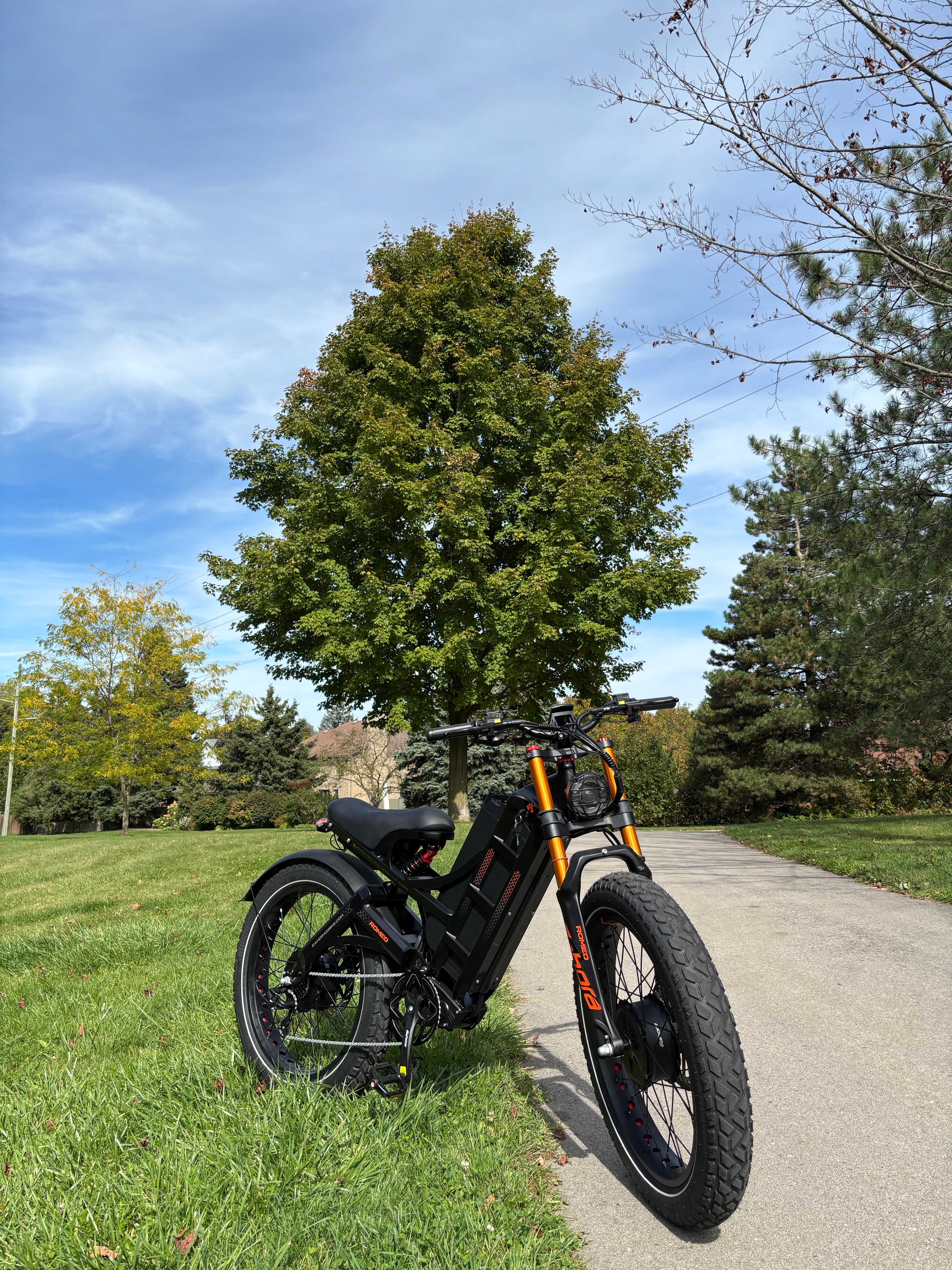
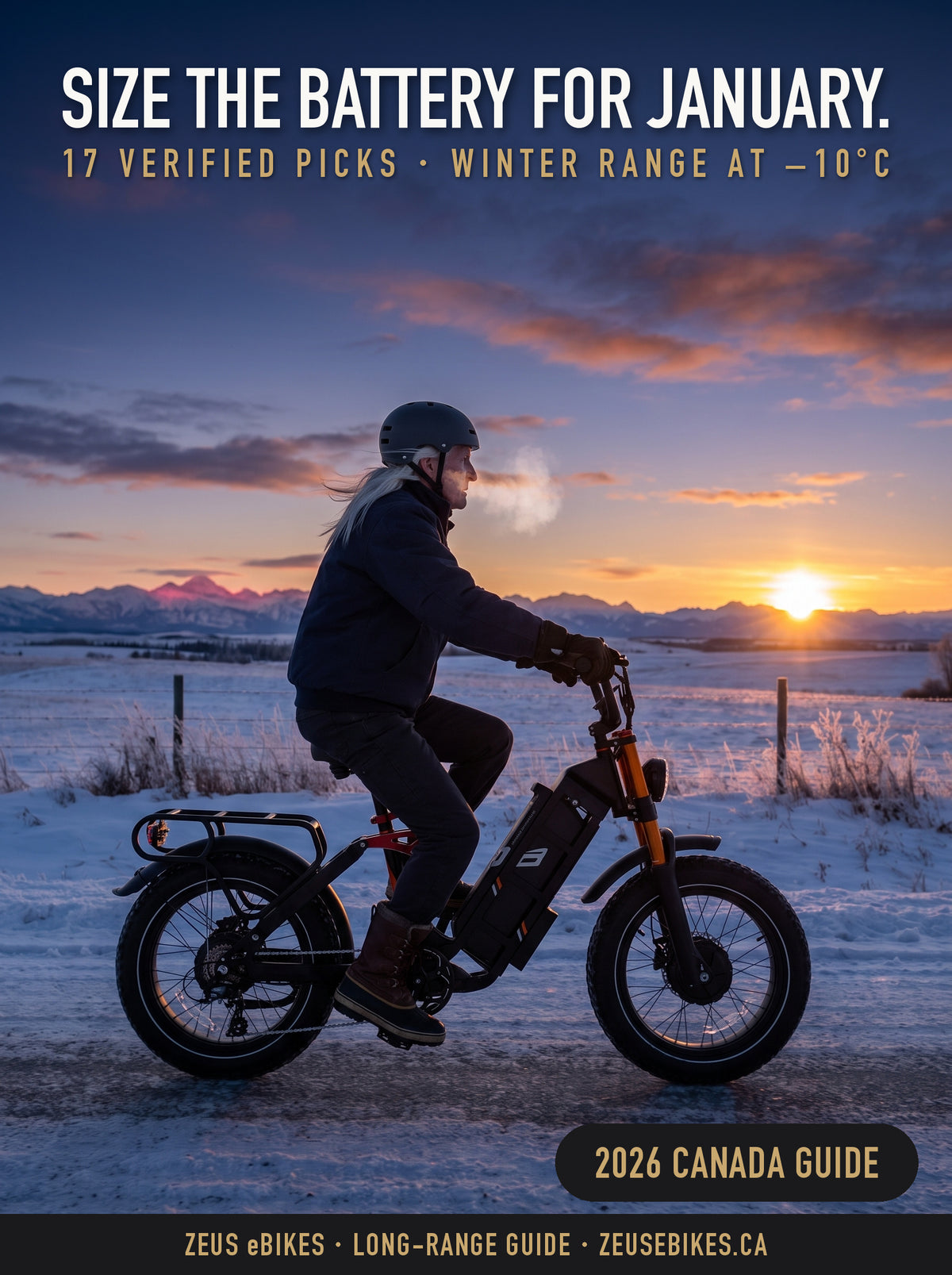
Cover: a Playcut.ai rendering made from Eahora's own photograph of the Juliet Pro II, this guide's maximum-range pick.
Range anxiety is the most common reason Canadians delay switching to an eBike — and in provinces like Alberta, Ontario, and Manitoba, it is a legitimate engineering problem, not a marketing one. A 706 Wh battery that delivers 47 km on a September afternoon delivers 33 km on a January morning at −10°C. This guide covers all 17 verified long-range picks in the Zeus eBikes Canada catalogue, from the $1,099 Samebike folding entry to the $4,099 Eahora Juliet Pro II with its 4,200 Wh pack. Every battery capacity is verified from live Zeus product pages. Winter range is calculated at −10°C (−30% reduction, per Battery University BU-502). Use cases are matched: commuting, delivery, touring, trike, folding, AWD.
Every spec in this article was verified directly from live Zeus product pages as of June 2026. Range estimates use a consistent 15 Wh/km baseline (mixed terrain, PAS 3 — derived from published battery capacity ÷ realistic consumption). Winter range is calculated at −30% of summer range (−10°C, per Battery University BU-502 lithium-ion cold-weather capacity data). No manufacturer range claim is accepted without verification; where manufacturer claims diverge significantly from the Wh/km math, we note both. PAB-legality is assessed against each province’s current highway traffic legislation; Canada’s federal PAB definition was repealed February 4, 2021 (SOR/2020-22), so provinces now set their own rules, most commonly 500W/32 km/h.
The best long-range electric bike in Canada for most riders is the Eunorau Meta 275 ($2,295) — 500W set to 32 km/h (Eunorau lists the cap as unlockable), true torque sensor, step-thru commuter frame with a 720 Wh base battery (an optional second battery takes it to ~1,440 Wh total). For maximum range, the Eahora Juliet Pro II ($4,099) carries 4,200 Wh. The Meta 275 is also our delivery pick; it ships without a rear rack, so add a rated one (delivery range guide). Browse dual battery eBikes, AWD eBikes, or folding options.
Table of Contents
- How Many Wh Do You Actually Need?
- Winter Range: The Real Numbers
- The 17 Picks at a Glance
- Section 1: Budget & Smart Commuters (480–960 Wh)
- Section 2: True Long-Range (about 1,200–1,700 Wh)
- Section 3: Extended Range (2,160–2,880 Wh)
- Section 4: Maximum Range (4,200 Wh)
- Mid-Drive vs Hub Motor: Which Gets More Range?
- Delivery eBike Range Guide
- Frequently Asked Questions
- The Bottom Line
New to the market? Start with our master eBike Canada 2026 guide — 38 verified picks across 7 categories, then come back here for the deepest long-range breakdown.
How Many Wh Do You Actually Need?
For a 30 km one-way Canadian commute, target 960 Wh minimum in summer and 1,300 Wh for winter riding. For a 50 km one-way route or delivery work, start at 1,440 Wh. The table below breaks this down by use case so you can skip past every bike that doesn’t fit before reading a single spec.
Rad Power Bikes filed Chapter 11 bankruptcy in December 2025, leaving tens of thousands of Canadian owners without warranty support and many now shopping for a replacement — this time, they are not settling for a bike that runs out of range at kilometre 38. Buy a 480 Wh bike for a 40 km winter commute and you will be pushing it home by February; buy a 4,200 Wh touring rig for a 5 km grocery run and you have spent $4,099 on a bike that never needs charging. The table below gives you the honest Wh target for your specific use case so you buy exactly the range you need and nothing you don’t.
| Use Case | Min Wh (Summer) | Min Wh (Winter −10°C) | Example Pick |
|---|---|---|---|
| 10–20 km daily commute | 480 Wh | 700 Wh | Samebike 20LVXD30-II |
| 20–35 km daily commute | 720 Wh | 1,050 Wh | Taubik Blackburn 275T (base) |
| 35–50 km daily commute | 960 Wh | 1,400 Wh | CityTri E-310 |
| 50–80 km touring / delivery | 1,200 Wh | 1,750 Wh | Freesky Wild Cat Ultra / Meta 275 (dual battery) |
| 80–120 km+ touring / delivery | 2,000+ Wh | 3,000+ Wh | Flash AWD / Alaska Pro M-520 |
| Maximum range (touring) | 4,200 Wh | — | Eahora Juliet Pro II |
The math is straightforward: battery capacity in watt-hours (Wh) divided by 15 Wh/km gives your summer range estimate at a moderate assist level (PAS 3) on mixed Canadian terrain. A 960 Wh battery yields roughly 64 km. A 1,440 Wh battery yields roughly 96 km. These are realistic working figures — not the best-case numbers manufacturers publish, which often assume PAS 1 on flat ground with a tailwind.
Winter changes the calculation entirely. At −10°C, lithium-ion cells lose approximately 30% of their usable capacity (Battery University, BU-502). That 960 Wh summer bike becomes a 672 Wh bike in January — about 45 km per charge. If your round-trip commute is 60 km, you need at minimum 1,300 Wh to clear a January morning with a reasonable buffer. This is why the dual-battery picks in Section 2 matter so much for Canadian year-round riders. For more on battery sizing, see our eBike battery guide for Canada.
Winter Range: The Real Numbers
At −10°C, expect to lose 25–35% of your rated summer range. Battery University (BU-502) documents approximately 34% capacity reduction for lithium-ion cells at −10°C. Zeus uses 30% as the working estimate for Canadian winters. A bike rated 100 km in summer delivers roughly 70 km in January — plan every commute on that basis, not the summer number. Zeus winter range formula: battery Wh × 0.70 ÷ 15 = winter km estimate at −10°C. All winter figures in the table below use this formula. For riders choosing between a fat-tire and a regular-tire eBike for winter, the tyre profile matters less than the battery size; see our fat tire eBike guide Canada for the full comparison.
The practical fix for cold-weather range loss is to store the battery indoors overnight and mount it on the bike just before riding. A warm battery installed at 18°C loses far less capacity in the first 20 minutes of a January commute than one that has been sitting at −10°C since midnight. Keeping a spare battery indoors for winter swap-outs is a common practice among cold-weather riders. The table below applies 30% winter reduction to every pick in this guide. Use the winter column to assess your actual January range before choosing a battery tier.
| # | Bike | Price | Wh | Summer Range Est. | Winter Range Est. | AWD? | PAB-Legal? |
|---|---|---|---|---|---|---|---|
| 1 | Samebike 20LVXD30-II | $1,099 | 480 Wh | ~32 km | ~22 km | No | Yes (350W) |
| 2 | Velotric Summit 2 | $3,399 | 801 Wh | ~53 km | ~37 km | No | No (750W) |
| 3 | Velotric Discover M | $3,899 | 801 Wh | ~53 km | ~37 km | No | ⚠ Adjustable cap (500W) |
| 4 | Eunorau Urus 2.0 | $5,700 | 840 Wh | ~56 km | ~39 km | No | Not settled* (500W) |
| 5 | CITYTRI E-310 | from $2,399 | 960 Wh | ~64 km | ~45 km | No | Two readings (500W / 750W) |
| 6 | FREESKY Wild Cat Ultra A-340 | $2,499 | 1,200 Wh | ~80 km | ~56 km | No | No (2,000W peak) |
| 7 | Eunorau Meta 275 (720 Wh / up to 1,440 Wh dual opt.) | $2,295 | 720 Wh | ~48 km | ~34 km | No | ⚠ Adjustable cap (500W) |
| 8 | Eunorau Meta Foldable (dual) | $2,295 | 1,440 Wh | ~96 km | ~67 km | No | ⚠ Adjustable cap (500W) |
| 9 | Freesky Swift Horse Pro X-6E | $2,699 | 1,440 or 1,680 Wh (see card) | ~96–112 km | ~67–78 km | No | Two readings (500W / 1,000W) |
| 10 | Taubik Blackburn 275T (dual) | $3,199 | 1,411 Wh | ~94 km | ~66 km | No | Yes (500W) |
| 11 | FAT-AWD 3.0 (dual) | from $2,299 | 1,440 Wh | ~96 km | ~67 km | Yes | No |
| 12 | Eunorau FAT-HD 2.0 / Hunter X7 (dual) | from $3,299 | 1,440 Wh | ~96 km | ~67 km | No | No (1,000W) |
| 13 | Freesky Alaska Pro M-520 | $2,699 | 2,160 Wh | ~144 km | ~101 km | No | No |
| 14 | Smartravel Raptor ST202 Pro | $2,599 | 2,600 Wh | ~173 km | ~121 km | Yes | No |
| 15 | Eunorau Flash AWD (triple) | $2,700 | 2,808 Wh | ~187 km | ~131 km | Yes | No |
| 16 | Freesky Cheetah MT-380 | $2,699 | 2,880 Wh | ~192 km | ~134 km | Yes | No |
| 17 | Eahora Juliet Pro II | $4,099 | 4,200 Wh | ~280 km | ~196 km | Yes | No |
Summer range estimates use 15 Wh/km (mixed terrain, PAS 3). Winter estimates apply −30% at −10°C (Battery University BU-502). Actual range varies with rider weight, terrain, speed, and temperature. These are consistent comparison baselines, not manufacturer guarantees.
Section 1 — Budget & Smart Commuters (480–960 Wh)
If your daily round-trip is under 40 km and you charge at one end of your commute, a 480–960 Wh bike covers your actual needs — and saves $500–$1,500 over a Section 2 pick you will never fully use. These five picks earn their place through price efficiency (Samebike at $1,099), SensorSwap switchable-sensor technology on a 100 Nm hardtail (Velotric Summit 2), 500W mid-drive efficiency (Velotric Discover M), premium eMTB performance (Urus 2.0), and trike stability (CityTri E-310). The shared trade-off: winter margin is tight. Anyone with a 40+ km round-trip in January should read Section 2 first. For broader entry options below $2,000, see our best electric bikes under $2,000 Canada guide.

Samebike 20LVXD30-II Folding Electric Bike
$1,099 CADYou live in a 700 sq ft apartment near a major transit hub. You take the subway 12 stops, then ride the last 8 km. You need something that folds into a locker, costs under $1,100, and does not create a warranty headache. The Samebike 20LVXD30-II is that bike: a 350W PAB-legal hub motor, 480 Wh removable battery, and a folding 20” frame with rack and fenders included at $1,099. It covers roughly 32 km of summer range — enough for a 15 km each-way commute with a charge at one end. The 480 Wh battery is the smallest in this roundup; treat it as a city bike with a charging plan, not a set-and-forget range machine.
Honest note: 480 Wh means 32 km summer / 22 km winter. Build a charging routine into your day if your commute exceeds 15 km each way. Not a genuine long-range bike — included here because it is the entry point to the Zeus lineup and the right fit for short-commute apartment riders on a strict budget.

Velotric Summit 2
$3,399 CADThe Summit 2’s standout feature is SensorSwap — a toggle between cadence and torque sensors from the handlebar display or the Velotric app, with no hardware swap. Cadence mode kicks in effortlessly on flat commutes; torque mode responds to your pedal input on grades, delivering more natural ride feel and 20–30% better battery efficiency per kilometre. The 100 Nm hub motor is a 10 Nm step up from the Summit 1, the RST Vibe 120mm air fork gives genuine tuneable suspension (not a cheap coil), and Shimano CUES 9-speed gearing is a substantial drivetrain upgrade. NFC unlock and Apple + Android Find My come standard.
Honest note: At 801 Wh, summer range is approximately 53 km / winter 37 km — sufficient for a 25 km each-way commute with charging at one end. Watch our Zeus eBikes YouTube channel for video coverage of bikes in the Zeus catalogue before buying. At 750W, it sits above the 500W PAB threshold in most provinces.

Velotric Discover M
$3,899 CADThe Discover M does something unusual: a 801 Wh mid-drive that delivers real-world range comparable to many 1,000 Wh hub-motor bikes. Mid-drives stay efficient because they route power through the bike’s gears — on a hilly route, the efficiency advantage over a hub motor can reach 25–40%. The result is approximately 53 km summer range that behaves more like 65 km on a flat urban commute. It also ships set to 500W nominal and 32 km/h, though Velotric lists an adjustable range of 19–45 km/h, and whether an adjustable cap qualifies is not settled.
Honest note: At $3,899, it is the most expensive bike in Section 1. The step-thru UL-certified combination justifies the premium for daily commuters. Mid-drives wear drivetrains faster — budget roughly $50–80/year for chain and cassette maintenance.
Not sure which battery size fits your commute? Use this quick formula: [round-trip km] ÷ 0.70 = minimum Wh for a cold-weather commute. Or call us at 1-866-938-7580 — we’ll match you to the right range in under 5 minutes.
Browse Long-Range eBikes →
Eunorau Urus 2.0
$5,700 CADThe Urus 2.0 is in Section 1 for its 840 Wh battery — but buy it for the motor and suspension, not the range. The Bafang M600 mid-drive (500W nominal, 120 Nm peak torque) paired with SRAM NX 11-speed is the same motor architecture found on premium European trail eMTBs. Full suspension, plus-size tyres — the Urus 2.0 is a capable trail machine that commutes on weekdays. The 840 Wh is acceptable for 56 km of summer range; if range is your primary concern, the picks in Section 2 give you more Wh for less money.
Honest note: The most expensive bike in Section 1 at $5,700. The Urus has a 500W nominal motor and a speed cap you can switch between 32 and 45 km/h; whether an adjustable cap qualifies under provincial e-bike rules is not settled, so check the rules in your province and municipality before riding on public roads. The value is in the Bafang M600 trail performance and full suspension, not battery capacity.

CITYTRI E-310 Electric Trike
from $2,399 CADThe CityTri is the only trike in this roundup and the only pick in Section 1 that provides genuine long-range credentials: 960 Wh of Samsung cells deliver approximately 64 km summer / 45 km winter range on a platform designed for seniors, riders with balance concerns, and cargo hauling. Three wheels mean zero balance required at stops — a hill-start confidence that no two-wheel bike in any section of this guide can replicate. For flat-to-moderate terrain with a heavy weekly load, this is the most practical daily vehicle here at under $3,000. For more on electric trikes in Canada, see our electric trikes Canada guide.
Honest note: Tricycles handle corners differently than two-wheel bikes; reduce speed on descents. Its motor is printed two ways (750W on our listing; 500W and 750W on Addmotor’s own pages): at 750W it would be above the 500W limit the provincial rules converge on, so ask us which motor ships. Wider footprint — confirm path and storage clearance before buying.
Section 2 — True Long-Range (about 1,200–1,700 Wh)
The seven bikes in this section reach roughly 1,200 to 1,700 Wh in their recommended battery configuration — enough to cover a 40 km each-way commute in January with buffer for headwinds and detours. Five include dual-battery-ready frames that start below 1,200 Wh base but reach the Section 2 tier with the optional second battery. Most Canadian year-round commuters who bought a 720 Wh bike last year have already learned this the hard way: the February test is the real test. Pick a battery in the 720–960 Wh range and you are charging at work, rationing assist levels, or calling for a ride on the coldest morning of the year. At 1,200 Wh you get roughly 80 km of summer range and 56 km in January; at 1,680 Wh that extends to 112 km summer and 78 km winter. PAB-legal choices in this section remain eligible for bike paths and public roads in most Canadian provinces.

FREESKY Wild Cat Ultra A-340
$2,499 CADFor a step-thru rider who needs serious range and serious suspension without spending $4,000+, the Wild Cat Ultra A-340 is the clearest value build in Section 2. A 1,200 Wh Samsung pack (80 km summer / 56 km winter), 130 N·m of published motor torque, downhill-rated full suspension, and 180mm 4-piston hydraulic brakes on a step-thru fat-tire frame — at $2,499. The 2,000W peak motor provides strong hill-climbing support on loaded tours; the braking is matched to the power.
Honest note: Summer range 80 km / winter 56 km at −10°C. At 2,000W peak the motor exceeds the 500W PAB threshold — this is not a PAB-legal bike for public bike paths in most provinces. Cadence-only assist (no torque sensor at this price point).

Eunorau Meta 275
$2,295 CADThe Meta 275 2.0 is the guide's standout 500W commuter: true torque sensor, 500W hub motor, 27.5" wheels, and a step-thru frame that fits riders 5'6"–6'1". The base 720 Wh battery gives approximately 48 km of summer range — enough for most 20–25 km one-way commutes. An optional second battery (available separately) roughly doubles capacity to ~1,440 Wh and extends summer range to approximately 96 km, making it viable for longer commutes without midday charging. At 500W nominal and 32 km/h it matches the numbers most provinces use; bike-path access is set provincially and locally, so check yours.
Honest note: The base 720 Wh (48 km summer) covers most urban commutes comfortably. If your round-trip exceeds 45 km in winter, budget for the optional second battery. Second battery compatibility and current stock: confirm with Zeus at 1-866-938-7580.

Eunorau Meta Foldable
$2,295 CADThe Meta Foldable is the apartment-to-range-machine answer: fold it for transit, storage, or a cramped elevator, then add a second battery (48V 15Ah = 720 Wh) for a combined pack of 1,440 Wh from a base of 48V 15Ah (720 Wh). That is 96 km of summer range on a folding 500W bike set to 32 km/h — a combination that barely existed at any price two years ago. For riders who commute part-way by transit and need a bike that collapses into a locker at both ends of the trip, no other pick here offers this flexibility.
Honest note: Range figures are for dual-battery configuration. Base 720 Wh gives 48 km summer / 34 km winter. Order the second battery at purchase — it slots into the same frame and the difference in day-to-day usability is significant.

Freesky Swift Horse Pro X-6E
$2,699 CADAt $2,699 with a Bafang hub motor (Freesky's Canadian supplier page prints 500W, peak 2,500W; our listing says 1,000W, peaking at 3,500W), the Swift Horse Pro carries the biggest single pack in Section 2 — but the figures for that pack disagree too. Freesky's supplier page and the replacement battery Zeus stocks give 48V 30Ah (1,440 Wh), while our product listing gives 48V 35Ah (1,680 Wh). Call Zeus to confirm which pack ships before you order. By this guide's method that is about 96–112 km of summer range and 67–78 km in January, on a fat-tire platform built for mixed terrain. The Bafang hub provides strong assist on moderate grades; the Samsung cells deliver consistent capacity across charge cycles.
Honest note: 1,000W nominal means not PAB-legal in most provinces. Hub motor (not mid-drive) — efficiency advantage of mid-drives on hilly terrain does not apply here. For flat-to-moderate Canadian terrain, the large Samsung pack compensates well.

Taubik Blackburn 275T
$2,799 CADThe Blackburn 275T is the precision commuter in Section 2: a torque-sensor drivetrain, UL 2271-certified base battery, and a frame designed to accept a second battery. At 706 Wh base it is a medium-range bike; add the second battery and you reach 1,411 Wh — 94 km summer, 66 km winter. The 27.5×2.35" CST hybrid tyre rolls efficiently on pavement and still handles gravel, light trails and broken pavement.
Honest note: The long-range credentials require the second battery — order it at purchase if your commute exceeds 35 km. Base range (706 Wh) is 47 km summer / 33 km winter. Its 500W nominal motor and 32 km/h top speed match the numbers provincial rules converge on (500W / 32 km/h); check the rules in your province and municipality before public-road use.
Every bike in Section 2 ships free across Canada. Financing available — break a $2,499 purchase into under $210/month. Real people answer: 1-866-938-7580
Shop Long-Range eBikes →
FAT-AWD 3.0
from $2,299 CADThe FAT-AWD 3.0 combines three things that rarely appear together under $3,000: AWD dual motors, a torque sensor, and dual-battery capability. The manufacturer rates 128 km on the dual-battery configuration — our Wh-based estimate (1,440 Wh ÷ 15 Wh/km) aligns closely at 96 km. The AWD traction is built for Canadian winters: ice-edged paths, saturated spring gravel, the kind of surface where a single rear drive can spin and stall. The torque sensor keeps hill starts smooth and AWD engagement predictable.
Honest note: The genuine long-range credentials require the second Samsung 48V 15Ah battery — order it at purchase. Base 720 Wh is 48 km summer / 34 km winter. Dual-motor AWD draws more current — range in full AWD mode will be at the lower end of the estimate. See also the best eBikes for hills Canada guide for context on AWD traction on grades.

Eunorau FAT-HD 2.0 / Hunter X7
from $3,299 CADForty kilometres from the nearest road, when the ATV track turns to mud and a rear hub would spin and stall, you understand why mid-drive matters. The Hunter X7 pairs a Bafang 1,000W mid-drive (160 Nm) with a step-thru dual-battery frame designed for multi-day backcountry use. The included 48V 15Ah Samsung (720 Wh) covers 48 km of base range; an optional second 48V 15Ah Samsung brings total capacity to 30Ah / 1,440 Wh and extends summer range to approximately 96 km. Mid-drive efficiency is most pronounced in exactly the terrain this bike targets — sustained elevation gain, loaded hunting racks, gravel that punishes single-speed hub motors.
Honest note: The Bafang 1,000W motor means this is not PAB-legal in most provinces. The long-range case requires the second battery at minimum — base 720 Wh gives approximately 48 km summer range. For the hunting use case, see Zeus's hunting eBike collection.
Section 3 — Extended Range (2,160–2,880 Wh)
Three bikes in this section carry 2,160–2,880 Wh — the tier where range anxiety disappears for almost any Canadian use case. At 2,160 Wh you get roughly 144 km of summer range and 101 km in January; at 2,808 Wh (the Flash AWD’s triple-battery configuration) Zeus’s verified estimate is approximately 187 km summer and 131 km winter. Note: the Alaska Pro M-520 and Cheetah MT-380 carry their stated Wh as standard dual-battery; the Flash AWD reaches 2,808 Wh only with a third battery purchased separately. This section covers the builds for riders who need maximum range without reaching the $4,099 Juliet Pro II tier.

Freesky Alaska Pro M-520
$2,699 CADAt $2,699 with a 2,160 Wh dual-battery pack and full suspension, the Alaska Pro M-520 is the single-motor route to extended range. The 4,500W peak rear hub and 170 Nm torque handle steep grades without the mid-drive efficiency premium; the 4-piston brakes provide stopping confidence on the long descents that follow a 100 km ride. Summer range estimate: 144 km. Winter: 101 km.
Honest note: 4,500W peak is firmly off-road territory in every Canadian province. Full suspension adds weight; confirm trail-readiness with Zeus for your specific route. For a detailed breakdown of how motor power affects hill performance, see our best eBikes for hills Canada guide.

Smartravel Raptor ST202 Pro
$2,599 CADThe Raptor ST202 Pro carries 2,600 Wh in its standard 52V 50Ah dual-battery system (Samsung/LG cells, removable). That translates to approximately 173 km of summer range and 121 km in January — figures that cover nearly any single-day Canadian route. The dual motor adds AWD traction for the terrain variety that extended-range riders typically encounter when pushing 100+ km from a city.
Honest note: Dual motor means not PAB-legal. At 2,600 Wh the pack is substantial — charge time will be longer than lower-capacity bikes. Confirm charging time with Zeus before purchase if overnight charging is a constraint.

Eunorau Flash AWD
$2,700 CADThe Flash AWD is the expandable range champion: 832 Wh primary, 1,716 Wh dual, 2,808 Wh triple. Eunorau rates 105 km (primary), 217 km (dual), 354 km (triple). Our Wh-based estimates (187 km summer / 131 km winter on triple) are conservative compared to Eunorau's figures, which likely assume flatter terrain and lower assist levels — the truth is probably between the two. AWD on 20×4.0" fat tyres with a 440 lb payload makes this the highest-capacity, highest-payload AWD bike in the guide. For Canadian winter touring or delivery that cannot stop for a charge, the triple-battery Flash AWD is the architecture.
Honest note: The 354 km manufacturer claim is achievable at low assist on flat terrain; expect real-world touring range closer to 180–220 km on a triple battery. Each additional battery adds cost and weight. 20" wheels are less stable at high speed than 26" — confirm your intended use with Zeus.
Section 4 — Maximum Range (4,200 Wh)
Two bikes earn the Section 4 designation: the Freesky Cheetah MT-380, which bridges extended and maximum range with its 2,880 Wh tandem-capable platform, and the Eahora Juliet Pro II, which carries 4,200 Wh (60V 70Ah) — the largest single-pack in the Zeus catalogue. At 15 Wh/km, that is 280 km of estimated summer range and 196 km in January. These are not bikes for everyone. They are for the rider who runs delivery routes spanning three postal codes, tours between cities, or simply refuses to charge more than once a week.

Freesky Cheetah MT-380
$2,699 CADThe Cheetah MT-380 bridges Section 3 and 4: at 2,880 Wh it is just below the Juliet Pro II's 4,200 Wh, but it adds something no other pick here offers — a tandem seat and AWD dual motors at $2,699. Two riders, 400 lb payload, 4,000W dual AWD, 192 km of estimated summer range. For couples who tour together, or cargo riders who occasionally carry a passenger, this is the only configuration in the Zeus lineup that handles both.
Honest note: Tandem riding changes handling characteristics. Confirm your combined weight fits within the 400 lb payload (bike plus both riders plus cargo). 4,000W dual motor is off-road/private property in all Canadian provinces. Not PAB-legal. If you need a legal two-person option for on-road use, the electric trikes Canada guide covers cargo-capable trike alternatives.

Eahora Juliet Pro II
$4,099 CADSome riders don’t want a commuter that happens to have decent range. They want to know they could leave Kingston on a Tuesday and pull into Toronto with 80 km still left in the battery. The Juliet Pro II is the only bike in this guide built for that calculation. Its 60V 70Ah pack — 4,200 Wh — delivers approximately 280 km of estimated summer range and 196 km in January. AWD dual-hub motors handle the terrain variety of multi-day touring routes without the mechanical complexity of a mid-drive system; the step-thru frame makes frequent stops manageable over a full day in the saddle. For delivery operators running fleet eBikes on high-mileage urban routes, the Juliet Pro II’s per-shift range reduces charge cycles and downtime. No other bike in this guide comes close on either metric.
Honest note: 4,200 Wh means significant charge time for a full cycle. Not PAB-legal (dual motor AWD). At $4,099 it is the most expensive bike in this guide. Confirm weight and storage requirements with Zeus — the Juliet Pro II is a substantial machine.
Mid-Drive vs Hub Motor: Which Gets More Range?
On hilly terrain, a mid-drive motor gets 15–40% more range per watt-hour than a comparable hub motor, because it routes power through the bike's gears and stays in its efficient RPM band on climbs. On flat terrain, the difference narrows to roughly 10–15%. The Velotric Discover M's 801 Wh mid-drive rivals 1,000 Wh hub-motor bikes in real-world Canadian range precisely because of this efficiency gap.
Choose Mid-Drive If…
- 500W range matters and your route is hilly
- You want the Discover M's 801 Wh to punch above its weight
- Urban commuting with mixed terrain and frequent stops
- The Hunter X7’s Bafang 1,000W mid-drive (160 Nm) is your target for backcountry
- You want efficient range on sustained elevation gain
Choose Hub Motor If…
- You want the largest possible Wh pack (the hub-motor Eahora Juliet Pro II carries 4,200 Wh)
- Your terrain is primarily flat — where hub motors are within 10–15% efficiency
- AWD dual-motor configuration is the priority (most AWD bikes use dual hub motors)
- Budget is the constraint — hub motors keep system costs lower
- Simpler drivetrain maintenance is important
The efficiency advantage of a mid-drive motor is most measurable on the kinds of routes that define Canadian eBike commuting: the long uphill on the way home, the bridge grade, the trail switchback. At PAS 3 on a 5% grade, a mid-drive can sustain 12–15 Wh/km where a hub motor of the same wattage draws 18–22 Wh/km. Over a 60 km commute with 400m of total elevation gain, that difference adds up to 6–12 km of additional range from the same battery pack.
For a deeper comparison of these two drivetrain types in Canadian riding conditions, see the best eBikes for hills Canada guide, which covers motor efficiency on grades in detail. For the 500W mid-drive case specifically, the Velotric Discover M is the clearest example in this roundup of a 500W mid-drive outperforming 750W hub-motor bikes in real-world range.
Best Long-Range eBikes for Delivery in Canada
Delivery riders need three things from a long-range eBike: a motor within the provincial rules, which converge on 500W / 32 km/h, so it can use public roads where e-bikes are allowed; a rack rated for real cargo weight; and enough Wh to run a full shift without a midday charge. For the full breakdown of eBike law by province — including which roads PAB-legal bikes can access — see our eBike laws Canada 2026 guide. Our delivery pick in this guide is the Eunorau Meta 275: 500W nominal and capped at 32 km/h (Eunorau lists the cap as unlockable), a torque sensor for stop-and-go riding, a 286 lb (130 kg) payload, and a 720 Wh battery that is dual-battery ready. It ships with a fender but no rear rack, so a delivery setup needs a rated rack or a backpack delivery bag.
| Bike | Rack Capacity | Wh Options | PAB-Legal? | Price |
|---|---|---|---|---|
| Eunorau Meta 275 | No rack included (fender only); 286 lb payload | 720 Wh (about 1,440 Wh with the optional second battery) | ⚠ Adjustable cap (500W) | $2,295 |
| CITYTRI E-310 (Trike) | Rear cargo basket | 960 Wh | Two readings (500W / 750W) | from $2,399 |
For delivery operators considering fleet purchases, Zeus works with businesses on volume orders. Call 1-866-938-7580 to speak directly with someone who can advise on fleet configurations, maintenance plans, and battery swap schedules for high-usage delivery environments. Ask about the Meta 275's second battery on the same call: Zeus confirms the current second-battery option by phone before you order.
Frequently Asked Questions
What is considered long-range for an electric bike in Canada?
In Canada, a genuinely long-range eBike carries 960 Wh or more. At a realistic mixed-terrain consumption of 15 Wh/km on pedal-assist level 3, 960 Wh yields roughly 64 km of summer range — enough for a 30 km round-trip commute with a reasonable buffer. Bikes from 480–720 Wh are medium-range; anything below that requires a charging plan for commutes over 20 km. True long-range starts at 1,200 Wh; maximum-range bikes in the Zeus catalogue reach 4,200 Wh on the Eahora Juliet Pro II.
How much range do I lose in Canadian winters?
Plan on 25–35% range loss at −10°C. Battery University (BU-502) documents lithium-ion capacity loss of roughly 17% at 0°C and 34% at −10°C. Zeus uses 30% as the working estimate for Canadian winters. A 1,200 Wh dual-battery bike rated for 80 km in summer will deliver approximately 56 km in January. Store the battery indoors overnight and install it just before riding to minimise cold-start capacity loss — a warm battery mounted at the last moment consistently outperforms one that has been sitting on the bike in the cold.
What is a good Wh for a 30 km daily commute in Canada?
For a 30 km one-way commute (60 km daily round-trip), target a minimum of 900–960 Wh in summer, or 1,300 Wh if you ride through a Canadian winter. At 15 Wh/km on mixed terrain at PAS 3, 960 Wh gives 64 km in summer and about 45 km at −10°C — tight for a 60 km round-trip in January. A dual-battery setup at 1,440 Wh or more covers a cold-weather 60 km commute comfortably, with enough reserve for headwinds or detours.
Is dual battery worth it on an eBike?
Yes, for commuters over 30 km one-way or anyone riding Canadian winters. A second battery typically adds 40–70% of the original range and costs far less per watt-hour than upgrading to a whole new bike. Several Zeus models — the Eunorau Meta 275, Eunorau Flash AWD, FAT-AWD 3.0 and Eunorau FAT-HD 2.0 Hunter X7 — are designed with dual (or triple) battery capability built in, with the second battery slotting cleanly into the frame without modification. The Meta 275 is the clearest value argument: its frame accepts a second battery without modification, letting you start at 720 Wh and expand to ~1,440 Wh as your commute demands grow. For every dual battery and dual-battery-ready build Zeus carries, see the dual battery electric bikes collection.
What is the longest range electric bike in Canada?
In the Zeus catalogue, the Eahora Juliet Pro II carries 4,200 Wh (60V 70Ah), the highest single-pack capacity available. At 15 Wh/km that is approximately 280 km of summer range and 196 km in January. The Eunorau Flash AWD reaches 2,808 Wh with a triple-battery configuration, and Eunorau rates it at 354 km range on triple batteries. The Freesky Cheetah MT-380 carries 2,880 Wh as a single pack, rated approximately 192 km summer range. For a step-thru touring configuration, the Juliet Pro II's 4,200 Wh is the maximum available.
Are long-range eBikes street legal in Canada?
It depends on the motor wattage and province. Canada's eBike rules are now provincial — the federal PAB definition was repealed February 4, 2021 (SOR/2020-22). Most provinces follow a 500W nominal / 32 km/h standard for a street-legal Power-Assisted Bicycle. Bikes with 500W nominal motors that ship set to 32 km/h — like the Velotric Discover M, Eunorau Meta 275, and Eunorau Meta Foldable — sit at the line most provinces use, but each maker lists the cap as adjustable, and whether an adjustable cap qualifies is not settled. Bikes rated above 500W nominal (750W, 1,000W, dual motor) are not PAB-eligible and are restricted to off-road or private property use in most provinces. Always verify with your province before riding on public paths or roads. For the full provincial breakdown, see our eBike laws Canada 2026 guide.
What eBike has the best range for delivery in Canada?
Among the bikes in this guide set to the 500W / 32 km/h limits, the Eunorau Meta 275 is our delivery pick: 500W nominal, capped at 32 km/h (Eunorau lists the cap as unlockable), a torque sensor, a 286 lb payload and a 720 Wh battery that a matched second pack roughly doubles to about 1,440 Wh (confirm the second-battery option with Zeus before ordering). By this guide's 15 Wh/km method that is about 48 km of summer range on one pack and about 96 km with two; expect about 30% less at −10°C. It ships without a rear rack, so add a rated rack or use a backpack delivery bag. No street-legal bike here reaches the 1,680 Wh a full summer shift needs on one charge, so plan a midday top-up for long days.
How long does it take to charge a long-range eBike?
Charge time depends on battery capacity and charger wattage. A standard 2A charger takes approximately 8–12 hours to charge a 1,000 Wh battery from empty. A 5A fast charger reduces that to 3–5 hours. Dual-battery bikes (1,400–2,160 Wh) typically require 12–18 hours on a standard charger or 5–8 hours with a fast charger. Most Zeus eBikes ship with a standard charger; confirm fast-charger compatibility before purchasing a third-party unit by calling 1-866-938-7580.
What is the best long-range eBike for seniors in Canada?
For seniors, the best long-range options prioritise a step-thru frame (easy mount/dismount), a torque sensor (smooth proportional assist that doesn’t surge), and a 500W motor set to 32 km/h (the line bike paths and public roads use). The Eunorau Meta 275 ($2,295) ticks all three: step-thru, torque sensor, 500W set to 32 km/h (cap listed as unlockable), 720 Wh base with optional dual-battery expansion. The Eunorau Meta Foldable ($2,295) adds compact storage. The CITYTRI E-310 electric trike (from $2,399) eliminates balance requirements entirely — zero tip-over risk at stops — with a 960 Wh Samsung battery and Addmotor’s load rating of 280 lb for the rider plus 80 lb of cargo.
Can I add a second battery to my existing eBike?
Only if the eBike was designed for it from the factory. Most single-battery eBikes cannot be retrofitted — the controller, wiring, and frame mounting points are not built for a second pack. eBikes designed for dual-battery use — including the Eunorau Meta 275, Meta Foldable, FAT-HD 2.0 Hunter X7, FAT-AWD 3.0, and Eunorau Flash AWD — have a dedicated second battery port and a dual-input controller built in. If you are buying with long-range in mind, purchase a dual-battery-ready frame from the start rather than planning to upgrade later. Confirm second battery availability with Zeus at 1-866-938-7580.
Does a mid-drive motor actually give better range than a hub motor?
Yes, on hilly or varied terrain. A mid-drive motor routes power through the bike's gears, so it stays in its efficient RPM range on climbs and descents. A hub motor's efficiency falls sharply at low wheel speed (steep climbs) and it cannot recover energy during descents. In flat urban commuting the difference is modest — perhaps 10–15% better efficiency from a mid-drive. On a hilly route, the gap can reach 25–40%. The Velotric Discover M's 801 Wh mid-drive rivals 1,000 Wh hub motors in real-world Canadian hilly range — making mid-drive efficiency a genuine consideration even when the battery capacity numbers look similar.
The Bottom Line
Match your Wh to your route and season before you look at a single bike. Use the winter range table in this guide: take your round-trip distance, divide by 0.70, then multiply by 15 to find your minimum Wh for a cold January morning with a comfortable buffer. That number is your starting point. Everything else — frame style, motor type, AWD, folding — layers on top of it.
By buyer type, the clearest recommendations from this guide: budget apartment folder → Samebike 20LVXD30-II; 500W dual-battery commuter → Eunorau Meta 275; tested hardtail with switchable sensor → Velotric Summit 2; 500W mid-drive commuter → Velotric Discover M; delivery use case → Eunorau Meta 275; AWD winter touring → Eunorau Flash AWD; maximum range → Eahora Juliet Pro II. Every one of these ships free across Canada and is backed by real humans at Zeus who answer the phone.
Zeus offers a 15-day return policy for unused, unopened bikes (15% restocking fee), financing options, and a direct phone line at 1-866-938-7580. If you are spending $2,000–$4,000 on a bike you will ride every day in Canadian weather, a 5-minute call to confirm the fit is worth it. Browse the full lineup at dual battery eBikes, dual-motor AWD eBikes, and step-through options. Financing available — ask about monthly payment options when you call.
Questions about range, battery, or which bike fits your commute?
Call us: 1-866-938-7580 · Free Canada-wide shipping · Financing available
Shop Long-Range eBikes →- Best eBikes for Hills Canada 2026 — motor efficiency on grades, AWD traction, and the steepest commutes in Canada
- How to Finance an eBike in Canada — break down $1,099–$4,099 into manageable monthly payments
- eBike Laws Canada 2026 — provincial PAB rules, speed limits, helmet requirements, and where you can ride
This guide was written by Milad Ghobadibeygvand, BScN (Western University, 2014), Co-founder of Zeus eBikes Canada. Every spec in this article was verified against live Zeus product pages before publishing. Winter range calculations use Battery University BU-502 cold-weather capacity data.
📸 All photography by Playcut.ai — personalised AI actor technology.

Share:
Electric Trikes Canada (2026): 10 Best Picks by Price & Type
Himiway A7 Pro Review Canada (2026): 2 Years Tested, Mid-Drive Step-Thru Perfection