
Best Electric Bikes for Winter in Canada: 22 Rider-Matched Picks

I'm Milad, co-founder of Zeus eBikes, and I've been riding and testing electric bikes through Canadian winters for three years — commuters, mopeds, fat bikes, trikes, all of it, through slush, hardpack and the kind of February morning that makes you question your choices. Here is the most honest thing I can tell you after all of that: the "perfect winter e-bike" doesn't exist, because you aren't a crowd — you're one rider with one set of needs. One person cares most about getting on the bike easily in snow pants. Another cares about range they can trust at −15°C. Another just wants to feel secure — a second battery, a second motor, something left if one thing fails. And the daily commuter cares about none of that as much as whether parts arrive fast when something breaks. This guide is built around those differences, not around a fake number-one.
How this guide was built (updated September 5, 2026). Three inputs, all documented. First, three years of our own winter riding and warranty-desk experience across the brands we carry — including which manufacturers actually turn parts around fast. Second, measured demand: sixteen months of our Google Search Console data plus Canadian autocomplete and AI-engine question sets, so the sections below answer what Canadian riders actually ask, in their words. Third, verification: every spec comes from the bike's Zeus listing, every price was checked against the manufacturer's own store on September 4–5, 2026 (and against our own store on September 27), and cold-weather battery guidance is sourced from Bosch eBike Systems and Battery University, linked where cited. Winter range figures are our own conservative estimates — the math is printed under the table.
Quick answer: there is no single best electric bike for winter in Canada — there are three, depending on who you are. For maximum traction, the dual-motor Eunorau FAT-AWD 3.0 ($2,299, priced identical to the maker's own store). For a working commuter, or the step-through rider who wants everything included, the 500W Taubik Tour ($2,899); Taubik's brochure calls it a year-round commuter and its manual says it is not intended to be used below 0°C, so ask us or Taubik first. For range that ends the battery conversation, the triple-battery Eunorau Flash AWD ($2,700). The rest of this guide matches the other nineteen picks to the way you actually ride — browse dual-motor eBikes and step-through eBikes to see the field.
What this guide covers
- Can you actually ride an e-bike through a Canadian winter?
- How to choose: the five questions that decide your winter bike
- Best electric bike for winter in Canada — the three winners
- Best e-bikes for winter commuting
- Best e-bikes for snow — deep snow, trails and the country
- Snow-track machines: when winter is the terrain
- The moped lane: if you know you won't pedal
- The no-fat-tire truth (and the bike I'm riding this winter)
- Winter electric bikes for adults: comfort and upright
- Long cold rides: the range fleet
- Winter-proof e-bikes: sealed for slush and salt
- Best budget winter e-bikes
- Three wheels in snow
- All 22 picks compared, with winter range estimates
- How much range do you lose in the cold?
- Battery care in a Canadian winter
- Winter tires: tread beats width
- Torque vs cadence, twist vs thumb
- The winter gear that actually matters
- Parts, salt and the spare-controller rule
- Frequently asked questions
- The bottom line
Can You Actually Ride an E-Bike Through a Canadian Winter?
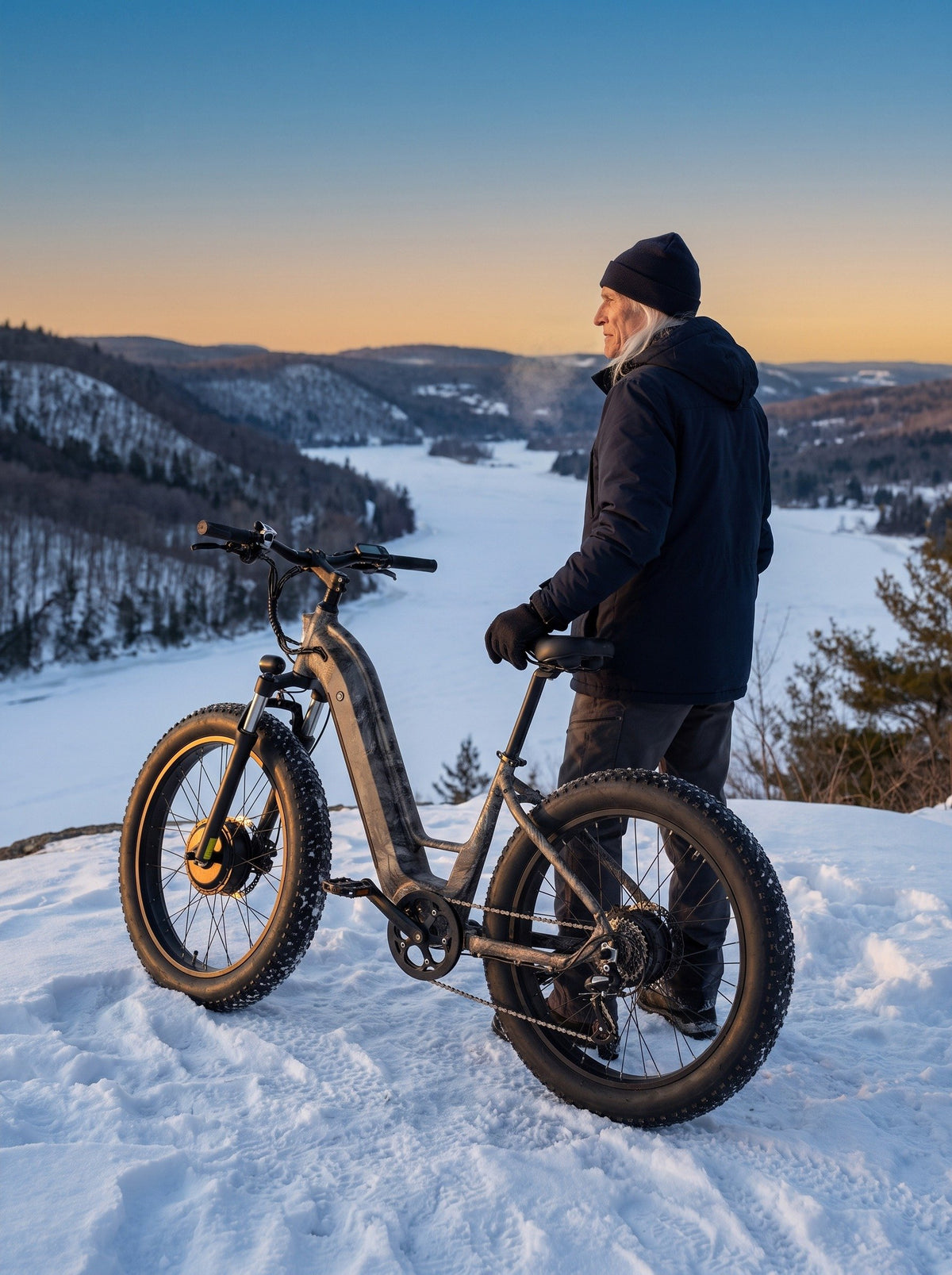
Every October, Canadians start typing "winter ebike" into Google in volume — our pull of five years of Google Trends data for Canada shows the search peaking in October and November, right as the first snow lands. Buy the wrong bike in that rush and February collects the bill: a battery that was never designed to leave a heated room, street tires skating on rutted ice, a frame you can't mount in snow pants. This guide walks you through the whole decision — who each bike is actually for, what the cold really does to a lithium battery, and which tire belongs on which surface — so the bike you buy in the fall is still the bike you love in March.
So, can you ride all winter? Yes — with three conditions. The bike needs winter traction (tread that bites, run at lower pressure — or two driven wheels), it needs brakes that work wet and cold (hydraulic discs), and its battery needs to live indoors between rides. And here's a truth from three winters of riding that no spec sheet will tell you: it always looks colder out there than it is. If you pedal, you warm up fast — which is one reason the "will I actually pedal?" question below matters more than any component choice you'll make.
Does the motor care about the cold? Far less than the battery does. Hub and mid-drive motors run happily in a Canadian winter; it's the lithium cells that lose performance as the temperature falls — Bosch eBike Systems states plainly that "cold weather reduces battery performance" and recommends keeping the pack warm until you set out (Bosch eBike Systems). I've even seen packs left out in the cold drop into protective hibernation and refuse to wake until they warmed up indoors. That's a management problem, not a disqualification — the battery section below gives you the complete routine in five rules.
How to Choose: The Five Questions That Decide Your Winter Bike
Choosing a winter e-bike comes down to five honest questions: what the bike is for, whether you'll really pedal, how much the law matters to you, how you want to sit and mount, and what battery you actually need. Answer those and the right section of this guide picks itself. Here is each one, with what three winters taught me.
1. What is the bike actually for?
Work, fun, hunting, fitness, errands — this decides everything downstream. If you're commuting daily, the bike is infrastructure: reliability and service speed outrank every spec, and you should know that in our warranty-case experience since 2023, among the brands in this guide, Eunorau and Taubik have turned parts around fastest for our customers, with Freesky close behind. If it's for fun or the trail, comfort and character win. If it's for hunting, it's cargo, torque and suspension. Different jobs, different bikes — that's why this guide is sectioned by rider, not ranked one to twenty-two.
2. Will you honestly pedal?
Be truthful with yourself here, because it changes the frame you buy. If pedalling is part of your plan — fitness, warmth, backup when the battery runs down — you want an adjustable seat at the right height, and ideally adjustable handlebars so you can dial the reach. If funds are tight and this is your only bike, pedalability is your insurance policy. But if you know, honestly, that you will ride throttle-only? Then a moped-style bike with a bench saddle is more comfortable in winter, not less — and pedalling on those frames is genuinely unpleasant anyway, so don't pretend. The trade: no pedalling means no pedal-warmth, so budget for serious cold-weather gear (see the gear section).
3. How much does the law matter to you?
The power-assisted bicycle convention most provinces use tops out at 500W nominal and 32 km/h — no dual motors, none of the big-power builds. We're not going to pretend otherwise, and we're not going to tell you what risk to take: every card below states its output class plainly, the over-500W picks carry a warning, and you do the math for your own province with our province-by-province laws guide. One more thing people miss: an over-limit e-bike can't simply be registered as a motorcycle instead — that would require the federal motor-vehicle safety certification these machines don't carry. Off-road and private property is their honest lane.
4. How do you want to sit — and fall?
Nobody likes talking about falling, but winter buyers should: an upright riding position lets you catch a slip with your feet; a forward lean sends you down face-first. That's why almost every pick in this guide is upright or step-through. Step-through frames earn their keep twice more in winter — you swing big boots through the frame instead of over a snowbank, and the bike is easier to control in a low-speed tip. It's why my own family's bikes are all step-throughs. Add an adjustable seat, adjustable handlebars where you can get them, and a genuinely comfortable saddle — cold makes a hard seat crueller — and suspension matters more in winter than summer, because half the time you won't feel confident standing off the saddle for the pothole the snow just hid.
5. What battery do you actually need?
Distance decides capacity. A 5–10 km round trip runs fine on a modest pack; a 20–40 km winter day with errands wants 20Ah (about 960 Wh) or more, because cold trims range and you'd rather have margin than anxiety. Cell quality matters more than the brochure admits: in three years of testing and warranty work, brand-name Korean cells — Samsung, LG, Panasonic — have been the most consistent performers in the cold, and the newer 21700 cell format (used by Taubik, Velotric and Himiway, among others) runs more efficiently than the older 18650s. That consistency is the honest reason those packs cost more. And remember the consumption side of the equation: a dual-motor bike on fat rubber can draw far more than a single 500W on street tires — two motors plus fat-tire rolling resistance is simple math — so a big battery on a big bike buys less distance than the same battery on a lean one.
Takeaway: job first, pedalling honesty second, law third, posture fourth, battery last — because the battery you need is a consequence of the first four. Now find your section below.
Best Electric Bike for Winter in Canada: The Three Winners
The best electric bike for winter in Canada isn't one bike — it's three, because winter riders split into four personalities: the traction rider, the working commuter, the step-through everything-included rider, and the range rider, and one bike answers two of them. These are the three we'd put under them. Each was price-checked against its maker's own store on 4–5 September 2026, and against ours on 27 September.

Eunorau FAT-AWD 3.0 — the traction winner
$2,299 CADFor the rider whose fear is the slick uphill start. Dual 500W hub motors drive both wheels through 26×4.0" fat tires, with a real torque sensor metering the power so a slippery start doesn't become a rear-wheel spin. 110 Nm combined, hydraulic discs with motor cutoff, step-through mounting, 375 lb payload, and a 48V 15Ah pack (720 Wh) with room for a second. Priced identical to Eunorau's own Canadian store (checked 12 October 2026). ⚠ Dual motors put it above the 500W street convention — check your province. Honest limit: with both motors pulling, 720 Wh goes quickly; heavy-throttle riders should budget for the second pack.

For the rider who wants the complete step-through package on day one. A 500W Bafang hub (80 Nm) inside the limit the provinces converge on, dual torque and cadence pedal assist, 26×4.0" fat tires, hydraulic 180 mm discs and a 48V 15Ah Samsung pack (720 Wh, battery certified to UL 2271), plus a true step-through for big boots, adjustable handlebars so you set the upright posture that lets you catch a slip with your feet, wired lights, and a rear rack with an integrated brake-sensor light.
It also takes our working-commuter crown: 80 Nm for loaded starts, a wired rack that keeps a bag-carrying commuter visible, and a Canadian-owned brand whose warranty turnaround our desk ranks among the fastest. Taubik's page rates the bike for 286 lb and its manual for 120 kg (264 lb), so plan around the lower; the manual rates the rear rack at 25 kg (55 lb). Speed: 32 km/h on Taubik's Tour S page and in its manual.
Read before a winter on it: Taubik's brochure calls the Tour S “the perfect go-to e-bike for year-round commuting in any season”, while its manual says the bike is “not intended to be used at ambient temperatures less than 0°C”. Ask us or Taubik before you plan a winter on it. Honest limit: at 77 lb on Taubik's page (its manual lists 35.5 kg net) it is no featherweight.

Eunorau Flash AWD — the range winner
$2,700 CADFor the rider whose real fear is the battery gauge. Dual 750W motors, 184 Nm combined, 20×4.0" fat tires, hydraulic brakes, a torque sensor, a 440 lb payload — and the only frame here that expands to three batteries: the 52V 16Ah primary (832 Wh) grows to roughly 2,808 Wh total, which converts range anxiety into a scheduling question. Also priced identical to the manufacturer's Canadian store. ⚠ Well above the 500W street convention — an off-road and private-property machine in most provinces. Honest limit: the extra packs are a real added cost; price them before committing to the three-battery plan.
Not sure which rider you are? Call 1-866-938-7580 and describe your winter — your route, your parking, whether you'll pedal. A real person (often me) will tell you honestly which one fits, and which one to skip. Every bike ships free across Canada.
Shop dual-motor eBikes →Best E-Bikes for Winter Commuting
The best e-bike for winter commuting is one that works every single morning and gets fixed fast when it doesn't. That means proven brands with quick parts turnaround, step-through mounting for winter layers, hydraulic brakes, and — if it's your only bike — honest pedalability with an adjustable seat. These four cover the commuting spectrum from $2,295 to $4,099; the crowned Taubik Tour belongs on this shortlist too.

For the daily commuter who will actually pedal. A true step-through with a 500W motor inside the street convention, a real torque sensor — the smoother power delivery you want on slick starts — hydraulic discs with motor cutoff, and a 48V 15Ah pack (720 Wh) on 26×3.0" tires: the halfway-between-fat-and-street width that suits plowed-but-messy streets, and you can re-tread it for your conditions. The line comes in three wheel sizes at the same price — Meta 24, Meta 26 and Meta 275 2.0 — so you buy by rider height, the way it should work. An optional second battery roughly doubles capacity to about 1,440 Wh. Honest limit: 55 Nm is commuter torque, not snow-plow torque.

For the commuter who wants winter comfort solved with hardware. Full suspension on a step-thru frame is rare and exactly right for frozen, rutted streets — you keep your seat when the snow hides a pothole. A 750W hub (1,400W peak, 105 Nm) on 26×4.0" fat tires, hydraulic discs with a 203 mm front rotor, a 48V 16.7Ah LG pack (801.6 Wh) with triple UL certification (UL 2849 / 2271 / 2580), and a 21700-cell format that handles cold efficiently. ⚠ 750W nominal sits above the 500W street convention in most provinces. Honest limit: cadence sensor, and it's the priciest two-wheeler in this guide.

Eunorau Meta Foldable — the condo commuter
$2,295 CADFor the commuter whose bike winters in an apartment. A folding step-through with a 500W motor inside the street convention and a 48V 15Ah Samsung-cell battery, on 20×3.0" wheels that keep it manageable in an elevator. Folding solves winter's quietest problem — where the bike (and its battery) sleep —. My honest caveat on all folders in winter: salt finds hinges, so wipe it down every couple of days and it will treat you well. Torque + hydraulic details are on the listing; at this price with this frame, it's the practical answer for storage-constrained riders.

Tesway X5 AWD — 3,120 Wh on a commuter frame
$2,999 CADFor the rider who never wants to think about charging again. A step-thru AWD with dual hub motors (200 Nm combined), 20×4.0" fat tires, hydraulic brakes with a lockout front fork, and a 52V 60Ah battery: 3,120 Wh, more capacity than anything else in the commuter lane. 400 lb payload. Tesway rates its two motors at 2,000W together, over the 500W limit the provinces converge on, so on a public road it is a motor vehicle under provincial law (moped, motorcycle or another class depending on its specs), or off-road and private property only.
Read before a winter on it: Tesway's page calls the tires “All-Season Traction”, while its X5/X7 AWD manual says the bike is “not intended to be used and stored at ambient temperatures less than 0°C (32°F)” and that the battery charges only between 0°C and 40°C. Ask us before you plan a winter on it. Honest limit: a battery this size charges in shifts; plan overnight.
Also on the 500W shortlist: the Eunorau Defender — full card in the winter-proof section, currently matching the maker's own store price and in tracked stock.
Takeaway for commuters: buy from brands that answer the phone in February — among the brands in this guide, our warranty desk's fastest are Eunorau and Taubik, with Freesky close behind — and keep a spare controller on the shelf (see the parts section for why that's the one part I tell every commuter to own).
Best E-Bikes for Snow: Deep Snow and the Country
The best e-bike for snow depends on how deep it gets before anyone plows it. City hardpack wants tread and stability; unplowed country wants flotation — real width, run soft — plus the torque to push it, and my honest advice from the deep stuff: go as wide as your bike allows, and if you can fit a 5.5" tire on a compatible frame, the difference is enormous. From the picks in this guide, deep-snow riders should start with the crowned FAT-AWD 3.0 (two driven wheels through 26×4.0" rubber), the budget-AWD Freesky Ranger Air, and the Flash AWD when the distance is long — and when winter itself is the terrain, the two machines below stop pretending to be bicycles at all.
Snow-Track Machines: When Winter Is the Terrain
Canadians search for "e-bike snow track kits" every winter, and here is the straight answer: yes, they exist, and we sell two machines factory-fitted for them. A track kit replaces the rear wheel with a snowmobile-style track and pairs the front with a ski-capable setup — turning the machine into something that treats deep snow as the point, not the obstacle. Be absolutely clear-eyed about what these are: electric mini motorbikes, not bicycles — off-road and private-property machines, full stop, and they cannot be plated for the road.

GT73 Pro — with the Snow Track Kit option
$2,699 CAD · $3,798 with trackFor private land where the snow never gets plowed at all. An electric motorbike with a 3000W-peak rear hub and dual 60V 18Ah batteries totalling 2,160 Wh — and a checkout option that adds the winter track kit ($3,798 all in). On the track it stops pretending to be a bicycle and becomes a light electric snow machine for acreage, trapline and cabin runs. ⚠ Off-road only, no exceptions: at 72 km/h capability this is nowhere near any bicycle definition, and it carries no motor-vehicle certification — it cannot be plated. Private property is its entire, honest lane.

GT54 Pro — the smaller track machine
$1,799 CAD · $2,898 with trackFor the same job at a smaller size and price. A 1500W (3000W peak) mini motorbike with a 60V 25Ah removable battery (1,500 Wh) and the same checkout track-kit option ($2,898 with the track). Between the two: the GT73 Pro carries more battery and more machine; the GT54 Pro is lighter, cheaper and easier to handle for smaller riders. ⚠ Same rule, no sugar-coating: off-road and private property only, cannot be plated, and it shares nothing with the 500W picks above except the fun.
The Moped Lane: If You Know You Won't Pedal
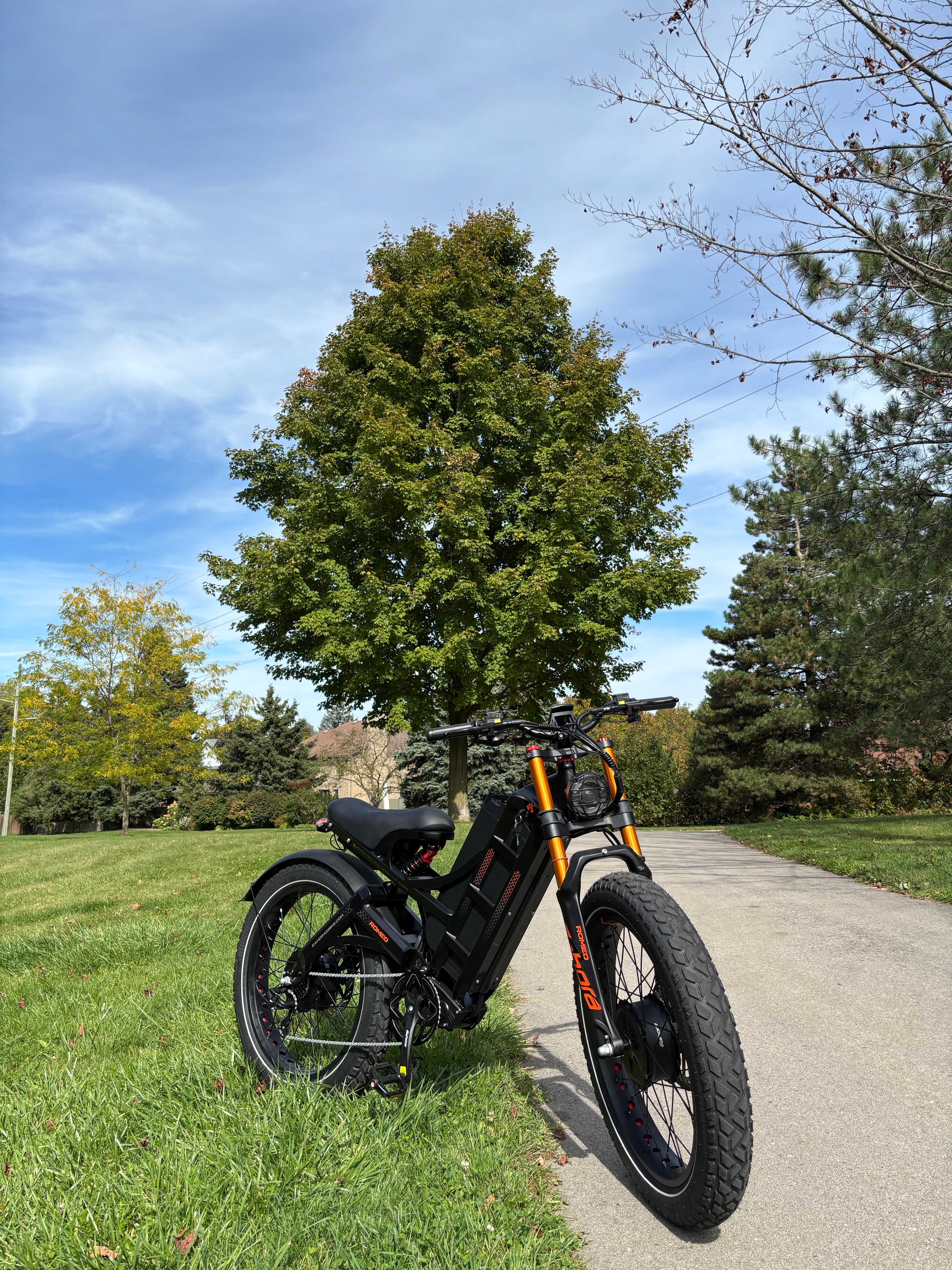
If you're honestly sure you'll never pedal, stop shopping for bicycles that pretend and buy the shape that's actually comfortable: a moped-style frame with a bench saddle, sitting low and stable. Riding one in winter feels different in ways riders love — you hold your line with confidence, closer to the ground, and a fall from a low frame is far easier on you. The trade is real: no pedalling means no pedal-warmth and no backup if the battery dies, so gear up (see gear) and buy capacity — the 4,800 Wh Romeo Ultra II in the range fleet is this lane's flagship.

For the throttle rider who wants the premium build. A moped-style machine from Canadian-owned Taubik's line: 1000W Bafang rear hub, 48V 20Ah Samsung battery (960 Wh), banana-style saddle, hydraulic 180 mm discs. Full disclosure in my own words: this year got away from me and I haven't personally tested the Recon yet — but design-wise it's phenomenal, and the customers who own one have been genuinely impressed; more than one neighbour has bought one after seeing a friend's. It shares Taubik's fast warranty turnaround, which softens the premium price. ⚠ 1000W — off-road output class in most provinces, and it can't be plated as a moped either.
The No-Fat-Tire Truth (and the Bike I'm Riding This Winter)
Here's the part of winter e-bike advice almost nobody in this industry will say out loud: if you're a reasonably confident cyclist on plowed surfaces, you don't need fat tires. Width is not what grips — tread is (more on that below). A leaner tire uses less energy, weighs less, pedals honestly if the battery runs out, and doesn't hum loudly past pedestrians. Fat rubber earns its keep in unplowed snow, full stop.
I'll put my own winter where my mouth is: the bike I'm riding and testing this winter is the Velotric Summit 2 — and it doesn't have fat tires. And when we spent three years designing our own dream hardtail, the Zeus Wolverine — built on everything Canadian riders and our Chinese manufacturing partners taught us — we didn't give it fat tires either. That should tell you something.

Velotric Summit 2 — my winter bike this year
$3,399 CADFor the rider who wants exercise, efficiency and a bike that's still a bicycle. A hybrid hardtail with a 750W inner-rotor hub (100 Nm), a 48V 16.7Ah LG 21700 pack (801.6 Wh — the efficient cell format, UL-certified), a 120 mm RST air fork, hydraulic 180 mm discs and 27.5×2.4" rubber that rolls fast and pedals honestly. This is the overweight-and-working-on-it choice, mine included: every ride is exercise with help, and pedalling keeps you warm in a way no throttle bike can. I'll be filming the winter test on this exact bike. ⚠ 750W nominal sits above the 500W convention in most provinces — run it in its pedal-assist modes and check your local rules. Honest limit: 26 kg (57 lb) before fenders, kickstand and pedals is still real weight for a hardtail.
Winter Electric Bikes for Adults: Comfort and Upright
A winter electric bike for adults means comfort engineering: upright posture (the position that lets you catch a slip with your feet), step-through mounting for winter layers, suspension that forgives what the snow hides, and honest payload numbers. These four cover it from $1,199 to $4,099 — and if balance is the real concern, the full-suspension Meet One Breeze Pro 2.0 in the trike section is the comfort answer on three wheels.

For the adult rider who wants one machine to end every winter compromise at once. A step-thru AWD with dual motors, suspension at both ends (hydraulic fork plus 50 mm rear), hydraulic discs on 180 mm rotors, a 400 lb payload, low 20×4.0" fat wheels — and a 60V 70Ah battery: 4,200 Wh, second only to its Romeo sibling below. ⚠ Well above the 500W street convention — off-road output class. Honest limits: cadence-sensor assist, and this much machine is genuinely heavy; it wants ground-floor storage.

For the adult who wants the upright step-thru experience at the entry price, fully street-side. A 500W hub inside the street convention, a hidden removable 36V 15Ah battery (540 Wh), 26×2.125" commuter tires you can re-tread for winter, and a step-thru frame with a 330 lb payload. By our winter math the 540 Wh pack is a 15–18 km machine — right for neighbourhood errands and short commutes. Honest limits: mechanical disc brakes rather than hydraulic (adjust them before the season), and cadence-sensor assist — ride it one level lower on slick starts.
Eunorau Meta 275 2.0 — the tall rider's Meta
$2,295 CADFor taller adults who want the torque-sensor commuter with more wheel under them. The 27.5" member of the Meta family: same 500W street-side motor, same real torque sensor for gradual winter power delivery, same hydraulic discs and 48V 15Ah pack (720 Wh) — on the largest wheel of the line, which rolls over frozen ruts more easily than any smaller Meta. Its tyres are 27.5 × 2.6" (Eunorau’s spec), narrower than the Meta 26’s 3.0", and you can re-tread them for your exact conditions. Honest limit: 55 Nm of commuter torque; this is a street machine, not a trail one.

Velotric GoMad — the 500 lb utility hauler
$3,399 CADFor bigger riders and bigger loads. A step-thru utility machine rated to a 500 lb payload — matched only by the Romeo Ultra II in this guide — with a 750W hub (1,300W peak, 85 Nm), a 48V 16.7Ah Samsung/LG 21700 pack (800 Wh) in the efficient cold-weather cell format, a hydraulic suspension fork, hydraulic discs, and low 20×4.0" wheels that keep heavy loads stable on slick surfaces. Winter groceries, a passenger-minded frame, real capacity. ⚠ 750W nominal — above the 500W street convention in most provinces.
Long Cold Rides: The Range Fleet
The battery-anxiety cure isn't a spec-sheet promise — it's capacity so far beyond your route that February's range tax stops mattering. These two carry the biggest packs in the guide, alongside two cross-references: the Eunorau Meta 26, whose optional second battery takes a 500W commuter to about 1,440 Wh, for the street-side version of the answer, and the 2,600 Wh Raptor ST202 Pro in the winter-proof section below.

For long distance on one motor, with a winter caveat from its maker. A dual-battery system totalling 48V 45Ah (2,160 Wh), one 4,500W peak motor with 170 N·m and a cadence sensor, 180 mm four-piston hydraulic brakes, an IPX7-rated battery, a 400 lb payload and 26×4.0" fat tires. Read Freesky’s M-520 manual before buying it for winter: it says the bike is “not intended to be used and stored at ambient temperatures less than 0°C (32°F)” and that bike and battery should be charged and stored between 10 °C and 25 °C. ⚠ Off-road output class. Honest limit: two batteries means two packs to carry indoors every night — a routine, not a burden, but know it.

For the rider who wants the battery conversation over, permanently. The biggest pack in this entire guide — 4,800 Wh — wrapped in a full-suspension, dual-motor moped-style machine with hydraulic discs and a payload rated to 500 lb. Even at our deliberately pessimistic winter consumption figure that's a 160 km ceiling; ridden as a commuter, it's a charge-once-a-week machine in January. ⚠ Emphatically off-road output class — this is the moped lane's flagship, not a bicycle-path machine. Honest limit: charging 4,800 Wh is an overnight affair, and the machine's weight matches its ambition.
Winter-Proof E-Bikes: Sealed for Slush and Salt
"Winter-ready" is a sticker; sealing is a spec. If your winter is the freeze-thaw belt — brine spray, standing meltwater, salt in everything — look for published ingress ratings, sealed wiring and hardware that shrugs off wash-downs. Two picks earn this section outright, and my personal favourite — the Velotric Summit 2 I'm riding this winter, with its triple-UL-certified LG pack — belongs in the conversation from the no-fat section above.

For the freeze-thaw belt, where winter is spray and brine as often as snow. An IP65-listed build with dual batteries totalling 2,600 Wh on 20×4.0" fat tires, hydraulic discs front and rear with brake-activated motor cutoff, dual 1200W hubs (150 Nm), and built-in GPS tracking — which matters when the bike winters in a shared garage. The sealing is the point: standing meltwater and salt spray are this bike's home conditions. ⚠ Off-road output class. The trade-off: 20" wheels give up some roll-over on frozen ruts compared to the 26" picks.

For the rider who wants one bike for all four seasons, at 500W and 32 km/h as shipped. A full-suspension frame on 27.5×3.0" tires — wide enough for plowed-street grip, tall enough to roll frozen ruts — with a 500W rear hub inside the street convention, a real torque sensor, hydraulic discs with 180 mm rotors, and a 48V 15Ah battery (720 Wh). Eunorau lists a 45 km/h unlock: keep it locked on the road, and note that whether an unlockable cap qualifies is not settled. Two frame sizes, which almost nothing at this price offers, suspension that keeps working through slush season, and a price that matches Eunorau's own Canadian store — $2,450 on both, checked 12 October 2026. Honest limit: 60 Nm is commuter torque, not snow-plow torque — deep-snow riders belong in the fat section.
Best Budget Winter E-Bikes
A budget winter e-bike has to survive winter, not just start it — so the cheap picks here still carry the non-negotiables: hydraulic brakes where possible, honest batteries, and brands whose parts our warranty desk can actually get. Two picks.

Freesky Ranger Air M-540 — AWD for $2,099
$2,099 CADFor the budget rider who still wants two driven wheels. The cheapest AWD in this guide: dual hub motors (4,000W peak combined) in a step-thru frame on 26×4.0" fat tires, hydraulic 180 mm discs, and a 48V 25Ah battery (1,200 Wh) — serious capacity at this price. If the FAT-AWD 3.0's traction argument convinced you but the budget says otherwise, this is the answer. ⚠ Far above the 500W street convention — off-road output class. Honest limits: cadence-sensor assist, and at roughly 95 lbs it's a ground-floor-storage bike.

Samebike CY20 — the $1,000 legal commuter
$1,000 CADFor the shortest commutes and the tightest budgets, fully street-side. A 350W folding commuter — comfortably inside every province's power convention — with a removable 36V 13Ah battery (468 Wh), 20×2.35" tires and a 28 kg all-in weight you can actually carry up a walk-up. By our winter math the 468 Wh pack is a 5–10 km round-tripper, which is exactly the short-haul rider this bike is for. Honest limits: mechanical disc brakes, not hydraulic — adjust them before winter and they'll do the job at these speeds — and the folding-hinge salt caveat applies: wipe it down every couple of days.
Three Wheels in Snow
Almost every trike is winter-safe — that's the honest headline for this category, and I genuinely don't understand why more people don't ride them. The one spec that matters in snow: drive the rear wheels, not just the front. A front-wheel-pull trike can spin and dig on a slick start, while rear wheels carry your body weight and simply go. I once spent an afternoon on a trike with a broken shoulder, my buddy on a two-wheeler beside me, dinner and drinks packed in the rear basket — all over town, zero worry about falling. That's the trike experience in one story, and this is the trike I'd put under a winter rider. Our full electric trikes guide covers the category.

Meet One Breeze Pro 2.0 — the comfort trike
$3,499 CADFor the rider who wants three-wheel security with genuine ride comfort. A full-suspension fat-tire trike with a real torque sensor — the gradual power delivery that matters most on three slick contact patches — hydraulic disc brakes with a parking brake, a 48V 20Ah LG-cell battery (960 Wh, dual-battery option to 1,920 Wh) and a 450 lb payload. Suspension on a trike transforms winter pavement: frozen ruts arrive at three wheels, and this frame absorbs them instead of forwarding them to your spine. ⚠ Above the strict 500W line; trike enforcement varies — check your province.
All 22 Winter Picks Compared
Every spec below comes from the bike's Zeus product listing; prices were compared with the makers' own stores on September 4–5, 2026 and re-checked against our live store on September 27, 2026. The winter-range column is our own conservative estimate, not a manufacturer claim — the method is under the table. "Street" means 500W nominal or less, inside the power-assisted bicycle convention most provinces use; verify your own province's rules either way.
| Bike | Price | Motor | Battery | Winter est.* | Class | Best for |
|---|---|---|---|---|---|---|
| FAT-AWD 3.0 | $2,299 | Dual 500W AWD | 720 Wh | ~24 km | Over 500W | Traction winner |
| Taubik Tour | $2,899 | 500W, 80 Nm | 720 Wh Samsung | ~24 km | Street | Working winner + complete step-through (manual: not below 0 °C) |
| Flash AWD | $2,700 | Dual 750W AWD | 832 Wh (to ~2,808) | ~28–94 km | Over 500W | Range winner |
| Meta 26 (also 24) | $2,295 | 500W, torque sensor | 720 Wh (to ~1,440) | ~24–48 km | Street | Commuter, sized to you |
| Meta 275 2.0 | $2,295 | 500W, torque sensor | 720 Wh | ~24 km | Street | The tall rider's Meta |
| Nomad 2X | $4,099 | 750W, 105 Nm | 801.6 Wh LG | ~27 km | Over 500W | Full-sus step-thru |
| Meta Foldable | $2,295 | 500W | 720 Wh Samsung | ~24 km | Street | Condo commuter |
| Tesway X5 AWD | $2,999 | Dual AWD, 200 Nm | 3,120 Wh | Not estimated: Tesway’s manual says not below 0°C | Over 500W | Biggest battery |
| GT73 Pro (+track) | $2,699 / $3,798 | 3000W peak | 2,160 Wh dual | ~72 km** | Off-road only | Snow-track machine |
| GT54 Pro (+track) | $1,799 / $2,898 | 1500W (3000W pk) | 1,500 Wh | ~50 km** | Off-road only | Smaller track machine |
| Taubik Recon | $3,599 | 1000W Bafang | 960 Wh Samsung | ~32 km | Over 500W | Premium moped-style |
| Summit 2 | $3,399 | 750W, 100 Nm | 801.6 Wh LG 21700 | ~27 km | Over 500W | The no-fat pick |
| Raptor ST202 Pro | $2,599 | Dual 1200W | 2,600 Wh | ~87 km | Over 500W | Slush & spray (IP65) |
| Ranger Air M-540 | $2,099 | Dual AWD (4,000W pk) | 1,200 Wh | ~40 km | Over 500W | Budget AWD |
| Samebike CY20 | $1,000 | 350W | 468 Wh | ~16 km | Street | Short-haul budget |
| Juliet Pro II | $4,099 | Dual-motor AWD | 4,200 Wh | ~140 km | Over 500W | The everything step-thru |
| Samebike RS-A01 Pro-T | $1,199 | 500W | 540 Wh | ~18 km | Street | Budget upright adult |
| Velotric GoMad | $3,399 | 750W, 85 Nm | 800 Wh 21700 | ~27 km | Over 500W | 500 lb utility hauler |
| Alaska Pro M-520 | $2,749 | Single 4,500W, cadence sensor | 2,160 Wh | ~72 km | Over 500W | Long-range + torque |
| Romeo Ultra II | $5,599 | Dual, full-sus | 4,800 Wh | ~160 km | Over 500W | The range ceiling |
| Defender | $2,450 | 500W, sensor not published | 720 Wh | ~24 km | Street | All-weather all-rounder |
| Breeze Pro 2.0 | $3,499 | Torque sensor, full-sus | 960 Wh (to 1,920) | ~32–64 km | Over 500W | Comfort trike |
*Zeus winter estimate: usable battery watt-hours ÷ 30 Wh/km — our house figure for throttle-heavy, cold-weather fat-tire riding. Deliberately pessimistic: gentle pedal assist on a mild day can double these numbers, and manufacturer best-case figures often triple them. We'd rather surprise you in the right direction in January. **The two motorbike-class machines will consume more than 30 Wh/km ridden hard — treat their rows as ceilings. All are editorial estimates, not test results or manufacturer claims.
Two bikes left on your shortlist? Call 1-866-938-7580 with your city, your route and your parking situation — we'll tell you which one survives your winter, and which we'd skip. Every bike ships free across Canada.
Shop step-through eBikes →How Much Range Do You Lose in the Cold?
Cold measurably reduces e-bike range, but there is no single honest percentage — the loss depends on temperature, wind, surface drag and how hard you lean on the motor. Bosch eBike Systems, one of the few motor makers that publishes cold-weather guidance at all, states that "cold weather reduces battery performance" and treats sub-freezing riding as a condition to manage rather than a number to quote (Bosch, 12 Questions About the eBike Battery).
Why does the loss happen? Lithium-ion chemistry slows as temperature falls: the electrolyte thickens, internal resistance rises, and the same cells deliver less usable energy before the voltage sags. Industry reference Battery University puts the safe discharge window for lithium-ion at −20°C to 60°C (BU-410) — so riding at Canadian winter temperatures is within design limits; you simply get fewer kilometres per charge while you do it. Snow adds a second tax: soft surfaces increase rolling resistance, so you spend more watt-hours per kilometre before the chemistry is even considered. And remember the third tax from the decision section: two motors on fat rubber multiply consumption again — the same reason a lean bike like the Summit 2 goes surprisingly far on 801 Wh while a dual-motor fat bike drinks its bigger pack.
That triple tax is why this guide is built around battery capacity, and why our comparison table uses a deliberately conservative 30 Wh/km winter figure instead of repeating brochure ranges. It's also the practical case for the dual-battery picks: a second pack that charges indoors and swaps mid-day sidesteps the whole cold-capacity question. Our long-range guide ranks the catalogue purely on that axis.
Takeaway: plan winter routes on our conservative estimates, not summer brochure numbers; start every cold ride at full charge with a room-temperature battery; and if your commute sits at the edge of a bike's estimate, buy the bigger battery — in February, capacity is comfort.
E-Bike Battery Care in a Canadian Winter: Five Rules
Winter battery care comes down to five rules: store it indoors, never charge it below freezing, warm it before riding, keep storage charge at 30–60%, and keep the contacts dry. Follow those and a quality lithium pack shrugs off a Canadian winter; ignore the charging rule in particular and you can damage cells permanently. Here is each rule, with the source — and for the full owner's manual on charging, safety and replacement, our complete eBike battery guide goes deeper than any winter section can.
- The battery sleeps indoors. Bosch's battery team recommends storing the pack at room temperature and, for winter riding, bringing it into a heated space and "waiting until it has warmed up to room temperature" before setting out (Dr. Vikram Godbole, Senior Product Manager for batteries, Bosch eBike Systems). The bike can live in the shed; the battery cannot. I've watched packs left in the cold drop into protective hibernation and refuse to respond until they'd warmed indoors — every pick in this guide has a removable pack for exactly this reason.
- Never charge below 0°C. This is the rule with teeth. Charging lithium-ion below freezing causes "plating of metallic lithium... on the anode," a permanent loss of capacity and safety margin; consumer packs should not be charged at freezing temperatures at all, and charge current should be reduced below 5°C (Battery University, BU-410). Practically: bring the pack in, give it two or three hours to reach room temperature, then plug in.
- Ride starts warm. A pack that starts at 20°C instead of −10°C delivers noticeably more of its capacity before the cold catches up with it. Insulated battery covers — one of the most-searched winter e-bike accessories in Canada — slow the cool-down on longer rides.
- Storing for weeks? 30–60% charge, cool and dry. If you park the bike for the season, Bosch recommends storing the battery at a 30–60% state of charge at 0–20°C in a dry environment — not full, not empty. Check it monthly and top it back into the band if it drifts low.
- Contacts dry, terminals clean. Slush finds its way everywhere. Wipe the battery contacts when you bring the pack in, and never install a pack onto wet terminals that then freeze.
The one mistake that isn't recoverable: plugging a frozen battery into its charger. Range loss from cold is temporary — capacity returns as the pack warms. Lithium plating from sub-zero charging is not. If the pack came in from the cold, it waits until it's warm. Every time.
Winter Tires: Tread Beats Width
Here is the tire truth that sells fewer fat bikes and serves more riders: width is not what grips — tread is. An aggressive tread on a 3" tire out-bites a worn-smooth 4" any day. Width buys flotation — the ability to ride on top of soft, unplowed snow instead of sinking — which is why fat rubber rules the country and barely matters on a plowed city street. And on hard glare ice, no rubber compound grips reliably at all: that's what carbide studs are for.
Does lowering tire pressure help? Yes — it's the cheapest winter upgrade there is. Dropping pressure enlarges the contact patch and lets the tread conform to the surface instead of skating over it; experiment downward a few PSI at a time and feel the grip arrive (mind your rims on frozen ruts at the very low end). Studded e-bike tires are widely available in Canada in the common sizes this guide uses — 20×4", 26×4" and the commuter widths — and "studded ebike tires" is one of the country's most-searched winter e-bike upgrades. Budget $150–$400 for a studded pair and consider it part of the bike's price if ice is on your route.
One more thing, and it matters: don't buy a bike because of its tires. You don't choose a car by the rubber it happens to wear on the lot — tires are changeable, and re-treading a Meta 26 or a Summit 2 for your exact conditions costs a fraction of buying the wrong bike. Buy the frame, motor and battery that fit your life; set the tires up for your winter. Our fat tire vs regular tire comparison runs the full physics, and the fat-tire buying guide ranks the wider catalogue.
Takeaway: plowed streets — tread, at reduced pressure, on whatever width your bike wears. Unplowed country — real fat, the wider the better, 5.5" if your bike can fit it. Glare ice — studs, no debate. And never let a tire sell you a bike.
Torque vs Cadence, Twist vs Thumb: The Winter Answers
Which sensor is better for winter — torque or cadence? Torque, and it isn't close. A torque sensor measures how hard you're pressing and feeds power in proportionally, so delivery is gradual and the wheel is far less likely to spin out on a slick start; a cadence sensor applies a fixed push whenever the cranks turn, which is exactly the surge you don't want mid-corner on ice. Torque systems also respond instantly to your pedalling, which lets you power out of a bad moment rather than waiting on the motor. Cadence bikes are still fine winter machines — several picks here use them, honestly labelled — you simply ride them one assist level lower and feed the throttle gently.
And the throttle itself? For winter, a twist throttle beats a thumb throttle — a gloved hand rotates a grip more easily and precisely than a cold thumb can feather a lever, and fine throttle control is winter traction control. Neither is a dealbreaker; both are worth knowing before you buy. The deeper mechanics live in our mid-drive vs hub motor guide.
The Winter Gear That Actually Matters
Three winters in, my gear list has boiled down to a short set of non-negotiables, in order: handlebar covers (pogies) — 100% yes, they transform cold-hand misery into a non-issue and let you wear thinner, more dexterous gloves; waterproof pants — slush spray finds everything else; a balaclava under the helmet; proper gloves inside the covers; and shoe covers for throttle riders. Remember the pedalling rule: if you're on a moped-style bike using pure throttle, you generate no heat, so gear up like a snowmobiler, not a cyclist. And a comfortable saddle is winter gear too — cold makes a hard seat crueller, and a suspension seatpost is the cheapest comfort upgrade for any hardtail pick here. Find covers, pogies and more in our accessories collection.
Parts, Salt and the Spare-Controller Rule
The most common part that fails on an e-bike — any brand, any price — is the controller. That's three years of warranty-desk experience talking. So here is the rule I give every winter commuter whose bike is their transportation: buy a spare controller when you buy the bike. Not to carry — to have on the shelf at home, so a mid-February failure is a same-day fix instead of a parts-shipment wait. And buy spares while your brand is healthy: nobody thought Rad Power could vanish either, and the pattern of a big brand leaving owners hunting parts has repeated often enough that I treat it as a rule now, not a worry.
Salt is the other winter tax. Road brine corrodes chains, rotors, spokes and connectors if it dries in place — and it finds folding hinges first. The routine is cheap: rinse or wipe down after salty rides (every other day at minimum for folders), never store the bike wet, fresh chain lube weekly, and a dab of dielectric grease on battery contacts at the start of the season. Ten minutes a week is the entire cost of a bike that still looks right in April.
Storing an E-Bike for Winter (or Between Rides)
If you ride through winter, storage is simple: bike anywhere sheltered, battery indoors, charge indoors at room temperature. If you're parking the bike until spring, do four things and spring-you will be grateful: charge the battery into the 30–60% band and store it in a dry indoor spot (Bosch's guidance); clean and lube the drivetrain so salt doesn't spend four months eating it; inflate the tires so the casings don't deform; and check the battery monthly, topping it back into the band if it has drifted. A bike put away wet and empty in December is the "battery not charging after winter" support call — one of the most common winter search queries we see — waiting to happen.
Frequently Asked Questions
What is the best electric bike for winter in Canada?
There isn't one — there are three, by rider type: the dual-motor Eunorau FAT-AWD 3.0 ($2,299) for traction, the 500W Taubik Tour ($2,899) for working commutes and the complete step-through package (Taubik's brochure calls it year-round; its manual says it is not intended to be used below 0°C, so ask us or Taubik first), and the triple-battery Eunorau Flash AWD ($2,700) for range. Match the bike to your use, your honesty about pedalling, and your province's rules — not to a stranger's ranking.
Can you ride an electric bike in winter in Canada?
Yes. With tread-appropriate tires, hydraulic disc brakes and a battery kept warm indoors between rides, e-bikes handle Canadian winters well — thousands of Canadians commute on them year-round. The motor itself is largely indifferent to cold; the battery loses some range in freezing temperatures and recovers as it warms. Equipment choice, not courage, separates comfortable winter riders from miserable ones.
Do e-bikes work in cold weather?
They do. Lithium-ion batteries are rated to discharge — that is, ride — down to about −20°C (Battery University, BU-410), which covers the large majority of Canadian riding days. Expect reduced range while the pack is cold, keep the battery indoors between rides, and never charge it until it has warmed above freezing.
How much range does an e-bike lose in winter?
There's no honest universal percentage — the loss varies with temperature, wind, surface and assist level. Bosch confirms cold reduces battery performance without quoting a single figure, and we do the same: our winter planning estimates use a conservative 30 Wh/km, roughly half to a third of fair-weather brochure range. Plan with pessimistic numbers and winter never strands you.
Do I need fat tires for winter riding?
Only if your snow goes unplowed. Width buys flotation on soft snow; tread is what actually grips, and a well-treaded 3" tire at reduced pressure handles plowed city streets excellently — it's also lighter, quieter, more efficient and far easier to pedal if the battery runs down. Deep country snow is where real fat rubber — 4" to 5.5" — earns every millimetre.
Is a torque sensor or cadence sensor better for winter?
Torque. It feeds power in proportion to your pedal pressure, so delivery is gradual and the wheel is far less likely to spin on slick starts — and it responds instantly when you need to pedal out of a bad moment. Cadence bikes remain fine winter machines ridden one assist level lower with gentle throttle; several picks in this guide use them, labelled honestly.
Can you charge an e-bike battery below freezing?
No — this is the one hard prohibition in winter e-bike ownership. Charging lithium-ion cells below 0°C causes permanent lithium plating on the anode, degrading capacity and safety (Battery University, BU-410). Bring the pack indoors, let it warm to room temperature for a couple of hours, then charge. Riding in the cold is fine; charging in it is not.
How should I store my e-bike battery in winter?
Bosch eBike Systems recommends storing packs at 30–60% charge, at 0–20°C, in a dry indoor space — never full, never empty, never in a freezing shed. Check monthly and top back into the band if the charge drifts down. For daily winter riders the rule is simpler still: the battery lives indoors, always — cold-soaked packs can even drop into protective hibernation until they warm back up.
Do I need studded tires, or are fat tires enough?
Match the tire to the surface. Treaded tires at reduced pressure handle fresh and packed snow well; on hard glare ice only carbide studs grip reliably. City riders in freeze-thaw climates often run their regular winter setup most of the season and mount a studded set for the icy stretch. Studded tires are available in the 20×4", 26×4" and commuter sizes the picks in this guide use.
Does road salt damage e-bikes?
Left in place, yes — brine corrodes chains, rotors, spokes and electrical contacts, and it finds folding hinges first. The fix is routine, not equipment: rinse or wipe the bike down after salty rides, never store it wet, re-lube the chain weekly, and keep battery contacts clean and dry. Ten minutes a week protects the bike completely.
The Bottom Line
Winter riding in Canada is a matching problem, not a ranking problem. Decide what the bike is for, be honest about whether you'll pedal, do your own law math with the warnings we've printed on every card, sit upright, and buy the battery your real distances demand — from cells with a track record in the cold. Every part of the season itself is solvable: traction comes from tread, studs or two driven wheels; stopping comes from hydraulic discs; range comes from capacity plus a battery that sleeps indoors; and the one unforgivable mistake — charging below freezing — is avoided with a two-hour warm-up. Twenty-two machines, each matched to a rider; every price checked against the maker's own store on 4–5 September and against ours on 27 September 2026.
If you're still deciding, take the low-pressure route: call 1-866-938-7580 and a real person — often me — will match your city, route and budget to a shortlist in one conversation; unused, unopened bikes can be returned within 15 days of delivery under our return policy; and every bike here can be financed by the month — the calculator and the honest math live in our financing guide. Winter is weeks from its first snow. The right bike, bought now, makes it the best riding season you didn't expect to have.
Our verdict, by rider: traction — the FAT-AWD 3.0. A bike with a job, and the complete step-through — the Taubik Tour. Range — the Flash AWD, the 3,120 Wh Tesway X5 AWD, or the 4,800 Wh Romeo Ultra II. Balance — the Breeze Pro 2.0. And if you can honestly ride a bicycle: the Summit 2, no fat tires required — same as mine.
More Zeus eBike guides
- Fat tire electric bikes in Canada (2026)
- Fat tire vs regular tire: the honest comparison
- Best long-range eBikes in Canada (2026)
- Mid-drive vs hub motor for Canadian riders
- Electric trikes in Canada (2026)
- Best electric bikes under $2,000 (2026)
- The complete eBike battery guide for Canada
- eBike laws in Canada, province by province
- The complete eBike Canada buyer's guide (2026)
Visuals created by Playcut.ai




Share:
Canada Is a Handshake: Two Albertans, $5,000, and 1,000 Miles of Proof
AI Companies Are Destroying Books. We Read the Court File.