
The Shelters Are Full: 10 Verified Ways to Help the B.C. Wildfires

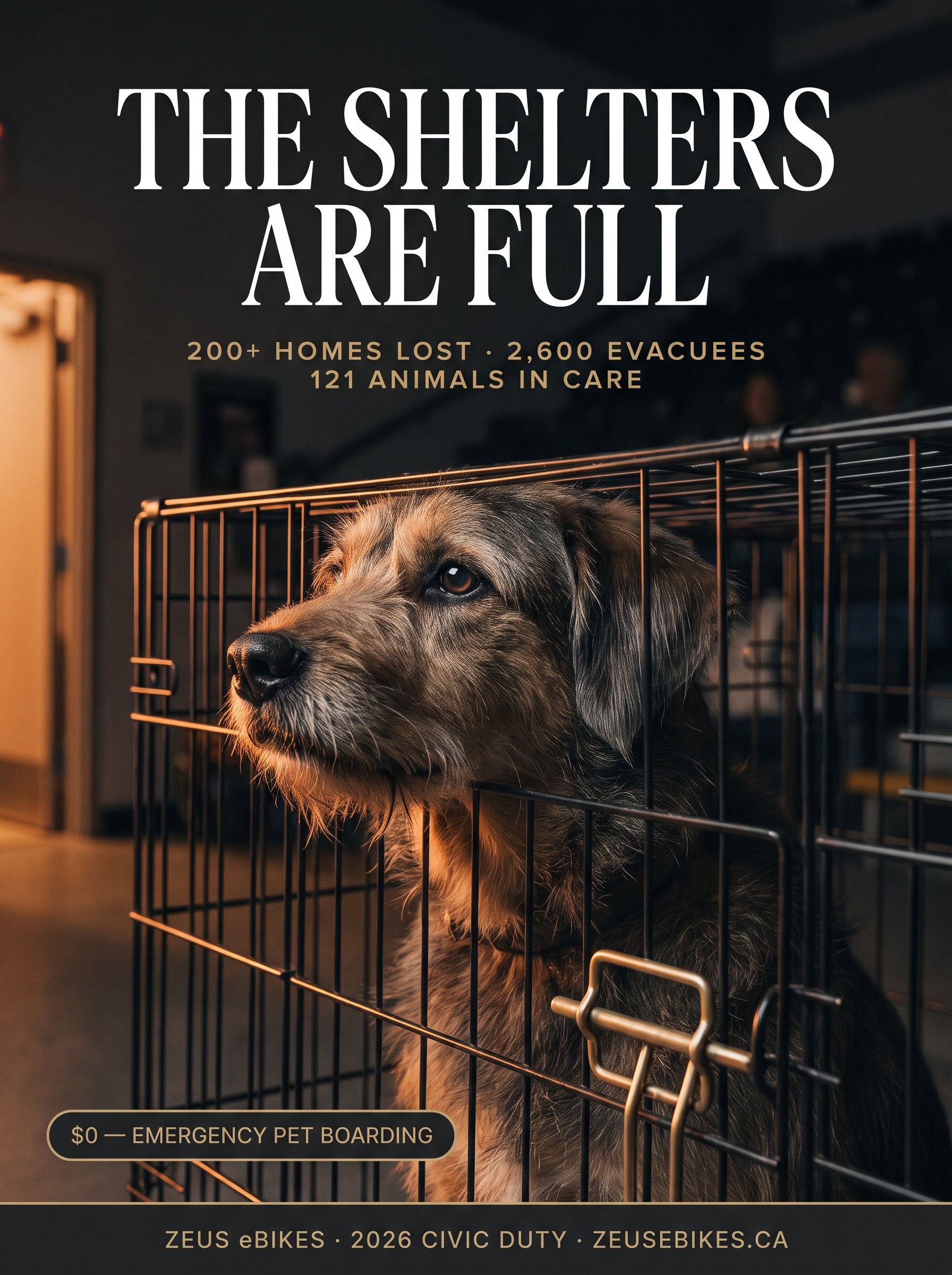
Photo illustration — created with Playcut AI; not a photograph of any named facility or animal.
By Milad Ghobadibeygvand · Published August 7, 2026 · Every organization, phone number and donation link in this article was verified live on August 7, 2026.
This article exists because of a phone call I took at 1:51 p.m. on August 7, 2026. A customer named Barb, in Vernon, was on the line about her order. Somewhere around the twenty-minute mark the conversation stopped being about a bike. She told me you can't see the mountains from her town anymore. She told me relatives had been evacuated and were waiting for the fire to be brought under control. And then she told me the thing I could not stop thinking about: the dog shelters near her are completely full, because evacuated families arrived at reception centres with animals and nowhere on earth to put them.
She told me what they needed without being asked: cages, she said — temporary cages — and food, and blankets. Old blankets people don't want anymore; those are good for dogs. I told her I'd write it up by midnight. This is that article, and it is longer than I promised her, because once I started verifying I found that most "how to help" lists circulating online are wrong, out of date, or pointing at organizations that are not the ones doing the work. So here is the checked version: what is actually burning, what the shelters and reception centres actually need, the ten organizations that are verifiably taking help right now, the four things you should not do, and — because the rumour is already moving faster than the facts — what the record actually says about whether these fires are being set deliberately. The larger questions a fire like this raises, about economics and incentives and history, deserve their own piece once the emergency tempo drops; this page is for now.
Quick answer: The fastest useful thing most Canadians can do is send money, not goods, to a registered charity working the fire line. For people: the Canadian Red Cross 2026 British Columbia Wildfires Appeal (1-800-418-1111), the Community Foundation North Okanagan Wildfire Response 2026 Fund — which also runs a dedicated OKIB Fund for the Okanagan Indian Band community that lost 200+ homes — United Way BC, and Salvation Army Emergency Disaster Services. For animals: the BC SPCA Animal Helpline at 1-855-622-7722 (free emergency boarding for evacuees), ALERT Canada, and Vernon's Animal Auxiliary. If you live in B.C. you can do more than donate: foster, or offer land for livestock through the same helpline. And do not fly a drone anywhere near a fire — that carries fines up to $100,000 under B.C.'s Wildfire Act and grounds the aircraft that are saving houses.
If you're the one who needs help right now, start here. Evacuated with animals: the BC SPCA Animal Helpline, 1-855-622-7722 (8 a.m.–6 p.m., seven days) — emergency pet boarding is free. Evacuated, full stop: the provincial ESS Call Centre, 1-800-585-9559, toll-free in B.C. For everything else — accommodation, financial supports, prescriptions, mental-health support — call or text 2-1-1 (bc.211.ca, navigators 9 a.m.–9 p.m. weekdays). We also keep a separate short page with just the evacuation numbers and addresses, built to load fast and read in one minute: where to take your animals in a B.C. wildfire evacuation. Seeing smoke or flame with no response underway? Report it: *5555 from a cell, or 1-800-663-5555 (BC Wildfire Service). And for live fire status and evacuation orders, always use EmergencyInfoBC — figures on this page are dated; official sources are live.
How this was researched. Every organization named here was verified on August 7, 2026 by loading its live donation page and confirming it returned a working page, not a dead link — plus cross-checking against the City of Vernon's own published list of reputable organizations. Fire sizes, evacuation counts and cause determinations come from the EmergencyInfoBC event postings, the BC Wildfire Service, and dated reporting from CBC News, Castanet, the Vernon Morning Star and The Canadian Press. Historical and legal claims are cited to court records, government publications and named news organizations. Where a widely repeated figure could not be traced — including a donation-matching program some sites are still advertising from 2021 — it was cut or explicitly flagged as unverified. Numbers in a live wildfire change hourly; every figure below carries its date. About the images: every image on this page is a disclosed photo illustration created with Playcut AI — not documentary photography of these fires — with one exception: a real customer photograph, marked as such in its caption. In an emergency where AI-generated fire imagery is actively misleading people (see the misinformation section below), we do not publish images that could be mistaken for the real record: no flames, no real properties, no real people, and the disclosure on every caption. Update log: Aug. 7, 2026 (evening) — fire counts refreshed against BC Wildfire Service open data (103 active, 45 out of control); Bradley Creek and Quilpituk Creek figures re-confirmed; still no 2026 donation-matching announcement. Corrections: milad@zeusebikes.ca.
In this article
- What is actually burning right now
- The part nobody counts: the animals
- Every verified way to help the animals
- Every verified way to help the people
- Four things that actively make it worse
- Are these fires being set deliberately? What the record says
- The 24-hour version: what to do today
- Frequently asked questions
- The bottom line
- Sources & notes
What Is Actually Burning Right Now
On the evening of Friday, July 31, 2026, a fire started off Westside Road at the north end of Okanagan Lake. Over the weekend, winds reported as high as 115 kilometres an hour drove it through a region already in prolonged drought; it jumped Highway 97 and forced the closure of the highway. By Thursday, August 6, the Bradley Creek wildfire covered 28.52 square kilometres, and Okanagan Indian Band Chief Dan Wilson had put a preliminary number on what it had taken: at least 200 homes on the band's reserves, destroyed (CBC News, Aug. 6). "I didn't recognize my own community," he told CBC. "It looked like a war zone." The loss falls in two parts: roughly 30 of the destroyed homes belonged to band members, and as many as 200 more were the homes of non-members living on leased certificate-of-possession band land — Chief Wilson's combined preliminary estimate reached as many as 230 (Global News, Aug. 4). By Friday, August 7, the fire had seen no significant growth — widespread smoke was limiting fire behaviour, structure-protection crews worked hot spots along Westside Road overnight, and Canada Task Force One had arrived to assist (Castanet, Aug. 7).
Further south along the same lake, the Quilpituk Creek wildfire — which started August 1 — grew from roughly 7.4 to 11.4 square kilometres in a single day. By Thursday evening the Regional District of Central Okanagan had 2,648 properties under evacuation order and 321 more on alert. Those two fires are the ones filling reception centres in Vernon and West Kelowna. They are also, and this is the part that matters, nowhere near the biggest fires in the province.
Size is not the same as damage. Five B.C. wildfires, drawn to true scale, as reported August 6–7, 2026. The fire that destroyed 200 homes is the second-smallest bar on this chart.
Sources: CBC News wildfire briefings, August 6–7, 2026; BC Wildfire Service. Chart: Zeus eBikes, drawn to true scale.
That chart is the single most useful thing I can give you before the donation list. A wildfire's danger is not its size — it is its address. Pear Lake is burning across an area forty-six times larger than Bradley Creek and it is not why Kal Tire Place in Vernon is full of families. Bradley Creek is, because Bradley Creek burned through where people live. If you are trying to decide where a hundred dollars does the most good, that distinction is the whole game.
Province-wide, BC Wildfire Service open data showed 103 active wildfires as of August 7, 45 of them out of control — and, for the first time in days, a genuinely good line in the ledger: no new fires had started in the previous 24 hours, and nine had been declared out (CBC News, Aug. 7). The smoke has not read the same memo. As of early Friday, five Interior air-quality stations — Castlegar, Cranbrook, the North Okanagan, the South Okanagan and Kamloops — sat at "very high risk" on the federal Air Quality Health Index, the top of the scale. Premier David Eby said the BC Wildfire Service has grown by almost 60 per cent since the 2021 season, and about 100 firefighters from Mexico's National Forestry Commission arrived in Abbotsford on August 6, joining a contingent that had landed the previous Monday, with roughly 100 more expected on the Sunday for a total exceeding 300 international personnel.

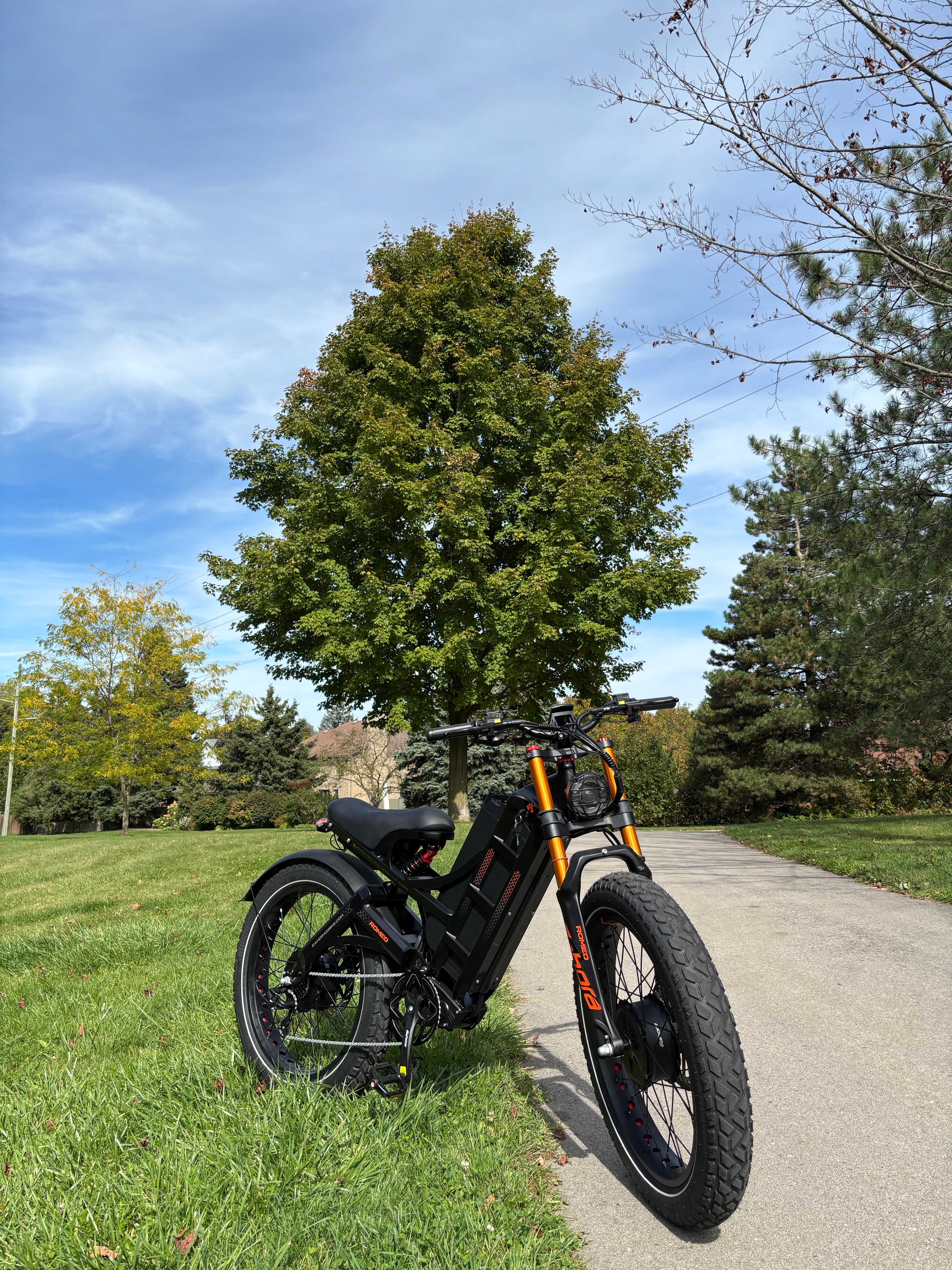
Gloria and her riding crew on a lakefront path in British Columbia — a photograph she shared with us on July 27. Ten days later her note read: “The smoke here is awful from fires and biking is not good.” Real photograph, shared by the customer — the only non-illustration image on this page.
Takeaway: Two mid-sized fires — Bradley Creek and Quilpituk Creek — are producing most of the human need in the Okanagan right now, because they burned through inhabited valley bottom rather than backcountry. Donations aimed at the North Okanagan and the Central Okanagan reach those people directly. Fire size headlines will point you somewhere else.
The Part Nobody Counts: The Animals
Every emergency has a category of loss that never makes the dashboard. In a wildfire it is the animals, and Barb was right about why: when a family gets five minutes to leave, the crate is the thing that doesn't fit.
Devyn McMillan is an Okanagan rancher who had already survived the 2021 White Rock Lake fire and had an evacuation plan ready. When Bradley Creek came over her hill on the Friday night, she was in the Yukon for work and her family had five minutes. Her six-year-old daughter left without shoes on. Friends tried to bring trailers for the horses and were turned back because of the fire risk. So her family did the thing no owner ever plans to do: they turned thirteen horses loose and hoped.
"You never want to turn your animals loose, and just pray that they make it, but they had to do that."
Devyn McMillan, Okanagan rancher, to CBC News, August 6, 2026The horses ran back into her arena and hunkered down, and survived. One was later found standing at her grandmother's house — a property it had never visited in its life, and one the fire had left untouched. The family's pig, Jellybean, was written off after her pen was found scorched to the ground; she turned up alive, burned and dehydrated, and is being cared for by friends. The house, McMillan said, "looked like it exploded."

Turned loose when trailers were blocked at the fire line, one Okanagan family's horses ran back to their riding arena, huddled together, and survived — all thirteen (CBC News, Aug. 6). Photo illustration — created with Playcut AI; not a photograph of the McMillan property.
Barb told me a version of this story on the phone before I had read a word of it — a woman with a farm full of horses who let them all go and said they'd have to fend for themselves. Barb had heard twenty horses. It was thirteen. That gap is not a criticism of Barb; it is a small, honest demonstration of how fast information deforms inside a disaster, which is exactly why every number in this article has a date and a source attached to it, and why the section on misinformation further down is not a digression.
The scale of the animal displacement is real and it is documented. By August 5, volunteers with ALERT — the Animal Lifeline Emergency Response Team, a B.C. volunteer organization founded after the 1994 Garnet Mountain wildfire — were caring for 70 dogs, 40 cats and 11 birds, plus snakes and spiders, out of the reception centre at Westbank Lions Hall. ALERT volunteers can be escorted into evacuation zones to feed or evacuate animals left behind, including livestock and even fish ponds. In Vernon, the Animal Auxiliary has been running animal support at the Emergency Operations Centre at Kal Tire Place; co-founder Gena Barzan told the Vernon Morning Star on August 6: "We've helped over 1,000 people with animals. And there's more coming."
Why the shelters fill up rather than the streets. A dog surrendered at a reception centre is not an abandoned dog — it is usually a family that could not find a hotel that takes pets, or could not get a horse trailer past a roadblock. That is why the single most effective thing the BC SPCA does in a fire is not rescue: it is handing out crates, leashes and litter boxes so evacuated families can meet hotel pet policies and keep their animals. Every crate donated is, functionally, a family kept together.
Takeaway: The animal crisis in this fire is a logistics crisis, not a cruelty crisis. Families are not dumping pets; they are running out of crates, trailers, foster space and pet-friendly rooms. Crates, foster homes and pasture are therefore worth more per dollar than almost anything else you can send.
Every Verified Way to Help the Animals
These three organizations are the ones actually working the Okanagan reception centres as of August 7, 2026. The City of Vernon names the BC SPCA and the Animal Auxiliary on its own list of reputable organizations accepting support, alongside the Salvation Army, United Way and Canadian Red Cross; the city is not accepting donations directly and directs the public to established organizations instead. If you are not here to give help but to get it — you're evacuating and there's an animal in the truck — skip this section and use the short version: where to take your animals right now.
1. BC SPCA — Animal Helpline
1-855-622-7722, 8 a.m.–6 p.m., seven days
spca.bc.ca/bc-wildfire-animal-support
The provincial backbone. Free emergency boarding for evacuees' pets, either at a community animal centre or with a volunteer foster family. Also handles pet reunification and coordinates animal rescue when it is safe to do so. Supplies are distributed through Emergency Support Services centres. Donate: spca.bc.ca/ways-to-help/donate.
2. ALERT Canada
alertcanada.org/donate
Animal Lifeline Emergency Response Team — a volunteer organization running solely on community donations, stationed at Westbank Lions Hall. As of August 5 they had 70 dogs, 40 cats, 11 birds and assorted reptiles in care. They are also the group that can be escorted into evacuation zones to feed animals that could not get out, including livestock. President Daryl Meyers: "If they know their animals are being taken care of it's just one less worry."
3. Animal Auxiliary (Vernon)
Emergency Operations Centre, Kal Tire Place · no website — current details via Vernon Morning Star coverage
The local operation Barb was describing. Per the Vernon Morning Star (Aug. 6): e-transfer donations to outbackjacks@telus.net with your full address and postal code in the memo for a charitable receipt; donation accounts also held at Rusty Spur in Vernon, Lumby and Enderby. They are asking for cat crates, gift cards, and funds for evacuee medications and animal feed — and are searching for a large empty building with a kitchen and washrooms, wheelchair accessible, for at least a month, to run an emergency pet daycare.
4. Foster a pet — the highest-leverage act
Apply through the BC SPCA volunteer/foster stream
The BC SPCA is running a fast-track onboarding process for emergency response for both foster and general volunteers. A foster home is a freed kennel; a freed kennel is a family that doesn't get told the shelter is full. If you live anywhere in B.C. and have a spare room, this is worth more than a cheque.
5. Offer land for livestock
BC SPCA Animal Helpline, 1-855-622-7722
The BC SPCA's published answer to "I have land to foster livestock" is to call the Animal Helpline, where you are added to a list of community resources shared with people who need it. Horses, cattle and goats are the hardest animals to move in a fire — trailers get turned back at roadblocks, as the McMillan family found. Pasture within trailering distance of the Okanagan is a genuinely scarce resource right now.
6. Send the right supplies — not a garage clear-out
Contact your local BC SPCA branch before dropping anything off
The BC SPCA transfers items between branches to where they are needed, so a donation in Nanaimo or Prince George can reach the Okanagan. It publishes an exact list — reproduced in full below — and asks people to contact their local branch about drop-offs first. Note that Hill's Science Diet is already supplying food for animals in BC SPCA care, so unopened food donations are used for evacuees living outside the shelter system.
The BC SPCA's actual published needs list. This is not a guess — it is the organization's own list, verified August 7, 2026: unopened bags of dry pet food (smaller bags are easier to distribute to evacuees) · canned or wet pet food that does not need a can opener · blankets and towels · cat litter boxes and scoops · cat litter · crates of all sizes · cat carriers · dog crates of all sizes · dog collars and leashes · food and water bowls, big and small · cat toys · garbage bags · paper towels · pet treats.
Barb was right on every count. Crates, blankets, food. The "old blankets people don't want anymore" instinct is exactly correct — clean used blankets and towels are on the official list.

The list, made physical. Everything in this frame is on the BC SPCA's published needs list — small bags, pull-tab cans, crates of every size, and the old blankets Barb told us about. Photo illustration — created with Playcut AI.
If you are the one evacuating. Emergency boarding for your pet is free through the BC SPCA — call 1-855-622-7722. For general evacuee support during a large emergency, the provincial ESS Call Centre is 1-800-585-9559, toll-free in B.C. Do not leave an animal behind on the assumption there is no help. Boarding is free and provided as capacity allows — and capacity is built to stretch: the network extends into volunteer foster homes precisely so a full building does not mean a full system.
Takeaway: Three organizations, one phone number. If you remember nothing else from this section, remember 1-855-622-7722 — it works for evacuees needing boarding, for people offering land for livestock, and for anyone trying to find out where supplies should actually go.
Every Verified Way to Help the People
By August 6, Emergency Support Services in Vernon alone had assisted more than 2,600 evacuees from over 1,200 households — 1,214 people from 588 households in person at Kal Tire Place, and 1,394 people from 674 households by phone or online. Ron Cartmell of the Salvation Army, which opened its Vernon site on the Friday, told The Canadian Press he had spoken with people who were on their third wildfire evacuation. That is the texture of this thing: not a single catastrophe, but a decade of them stacked on the same families.

By August 6, Emergency Support Services in Vernon alone had assisted more than 2,600 evacuees — some on their third wildfire evacuation in a decade (Vernon Morning Star; The Canadian Press). Photo illustration — created with Playcut AI.
7. Canadian Red Cross — 2026 British Columbia Wildfires Appeal
give.redcross.ca/page/26BCF · 1-800-418-1111
Launched August 5, 2026. Funds immediate and ongoing relief, recovery and resilience for people affected by the B.C. fires, plus community preparedness for future events. This is the default national channel and the one most likely to still be operating in six months, when the cameras have gone and the rebuild has not started.
8. Community Foundation North Okanagan — Wildfire Response 2026 Fund
cfno.org/wildfire-response-2026 · 250-542-8655
Launched August 5, 2026, this is the hyper-local option: every gift is tax-receipted and granted locally, for emergency food, clothing and shelter, trauma-informed counselling, rebuilding, and shoring up the small nonprofits doing the work. E-transfer to info@cfno.org noting "Wildfire Response 2026 Fund," with your mailing and email address for the receipt. Executive director Leanne Hammond handles securities transfers.
9. The OKIB Fund — for the community that lost the most
cfno.org/okib
Also run through the Community Foundation North Okanagan, this designation sends money directly to Okanagan Indian Band programs. More than 200 homes on OKIB reserve lands are gone — roughly 30 belonging to band members and as many as 200 more belonging to non-members on leased certificate-of-possession lots, per Chief Dan Wilson's preliminary count (Global News, Aug. 4). Both groups lost everything on band land, and OKIB is the government that has to manage the rebuild of all of it. If you want your donation to land where the destruction was heaviest and where rebuilding will take years rather than months, this is the address.
10. United Way BC · Salvation Army · FNESS
uwbc.ca/campaign/wildfires · salvationarmy.ca/eds · fness.bc.ca
United Way BC's United for BC Wildfire Recovery Fund publishes its split openly: 85% of every donation goes directly into communities as grants to qualified local organizations, 15% cost recovery. The Salvation Army's Emergency Disaster Services is the group feeding evacuees and firefighters on the ground. The First Nations' Emergency Services Society of B.C. works on emergency preparedness and response with First Nations across the province.
One correction worth making before you give. Several roundups circulating right now state that federal and provincial governments are matching Red Cross donations to B.C. wildfire appeals, tripling every dollar. That was true in 2021 — both governments matched donations to the British Columbia Fires Appeal, up to $20 million. We could find no such matching announcement for the 2026 appeal as of August 7, 2026. Give anyway; just don't give on the basis of a five-year-old headline, and check the appeal page itself if a match matters to your decision.
Takeaway: National reach and local knowledge are different products. The Red Cross is the right instrument for sustained, province-wide recovery. The Community Foundation North Okanagan and its OKIB Fund are the right instrument if you want your money spent within an hour's drive of the fire that caused the need. Most people should split it.
Four Things That Actively Make It Worse
Generosity has a failure mode, and in disaster response it is well documented. These are the four ways well-meaning Canadians reliably cost the response time, money or aircraft.
1. Flying a drone. This is the worst one, and it is not close. Under the Canadian Aviation Regulations every wildfire is automatically flight-restricted within five nautical miles (9.3 km) and up to 3,000 feet above ground. Transport Canada's penalties run to $25,000 and up to 18 months in prison; under section 56 of B.C.'s Wildfire Act, interfering with wildfire control carries penalties up to $100,000 and/or one year in jail. The reason for the severity is mechanical, not punitive: a drone sighting grounds airtankers and helicopters. The province's slogan is blunt — "If you're in the sky, we can't fly." The same applies on water: boats near a fire block the aircraft scooping from the lake. "Boats in sight, delay our flight."
2. Sending goods nobody asked for. Unsolicited physical donations are the classic disaster-relief own-goal: they arrive unsorted, they need volunteers to triage them, they need space that is already being used for people, and a large share ends up in landfill. The BC SPCA's list above exists precisely so you can send the right thing. The City of Vernon is not accepting goods directly at all. If an organization has not published a needs list, the correct donation is money.

What unsolicited generosity looks like when it lands: unsorted, unrequested, and consuming the volunteer hours a disaster actually runs on. Send money, or send exactly what the published list asks for. Photo illustration — created with Playcut AI.
3. Self-deploying. Driving to the fire zone to help, sightsee, or photograph the damage puts an untrained person on roads that emergency vehicles need. If you want to volunteer, go through the front door: the BC SPCA is fast-tracking emergency-response volunteer onboarding, and Vernon's Animal Auxiliary takes volunteer sign-ups at 9 a.m. daily at the southwest corner of Kal Tire Place. Both routes get you doing something useful within days.
4. Giving to something you haven't checked. Disasters attract charity fraud with total reliability; the Competition Bureau and the CRA both publish standing warnings about fake charities that appear within hours of a catastrophe, complete with realistic websites and collection boxes. The fix takes ninety seconds: search the organization in the CRA's List of charities before you send anything, or call the CRA charities line at 1-800-267-2384. Suspected fraud can be reported to the CRA Leads Program at 1-866-809-6841.
A note on the informal channels in this article. The Animal Auxiliary e-transfer address is reported here because it was published by a named local newspaper and because the City of Vernon lists Animal Auxiliary among the reputable organizations accepting support. That is a strong pairing. It is still a good habit to run any organization — including that one — through the CRA charity search before sending money, and to give through an organization's own published page rather than a link someone pasted into a comment thread.
Takeaway: The most damaging thing an ordinary person can do during a wildfire is fly a drone; the most wasteful is to ship unsorted goods. Both are done overwhelmingly by people trying to help. Check the needs list, give cash, and keep the airspace empty.
Are These Fires Being Set Deliberately? What the Record Actually Says
We found no credible public evidence, charge, court case or intelligence finding of a coordinated or state-sponsored arson campaign in British Columbia — and no one claiming otherwise has produced one. What the record does contain is a statistic that is routinely misread, a documented misinformation economy, and individual arson cases that were investigated and prosecuted. If your feed is telling you something bigger, this section is the check.
The "47 per cent human-caused" number, honestly. As of this season, the BC Wildfire Service has recorded 877 wildfires in the province, of which 411 — about 47% — are classed as human-caused. That number is real, and it is routinely misread. As Nicole Bonnett of the Kamloops Fire Centre put it: "Anything that is not suspected to be caused by lightning falls under the suspected human cause category." That bucket contains campfires, cigarettes, fireworks, vehicles, power lines and industrial activity. "Human-caused" is a residual category, not an accusation. Arson is a subset of it that BCWS does not publish separately, and cause investigations routinely take weeks or months. The Bradley Creek fire is currently suspected human-caused; that determination, on its own, tells you nothing about intent.
What the 2026 B.C. cause data actually says. 877 wildfires this season. The internet argues about the second bar as though it were a confession.
Sources: BC Wildfire Service season figures as reported by iNFOnews and Penticton Western News, July 2026; BCWS cause definitions. The lightning figure is the balance of the reported 877-fire total after the 411 classified human-caused. Chart: Zeus eBikes.
The rumour has an industry behind it. Researchers at Carleton University's Re.Climate, the Centre for Media, Technology and Democracy and the Climate Action Against Disinformation coalition mapped a disinformation network that spread across social platforms during Canada's 2023 wildfire season, pushing the claim that arsonists rather than climate change were responsible; the narratives escalated over the summer into claims about lasers, weather control, eco-terrorism and government-set fires. Former federal cabinet minister Maxime Bernier publicly suggested a "good portion" of the fires were likely started by "green terrorists." By 2026 the same ecosystem has gone synthetic: The Narwhal documented AI-generated wildfire maps circulating this season showing non-existent communities and a fabricated province called "Onjebio," and the BC Wildfire Service has issued warnings about AI-generated fire images spreading on social media. Carleton's Chris Russill dates the inflection point to 2023, when platform changes, Meta's Canadian news ban and generative AI converged to make it "faster, easier and cheaper than ever before to generate fake and misleading content."
Every one of those posts is monetized by engagement. The fire is free content. Grief is the raw material.
And then there is the fact that ends the argument. In January 2024, Brian Paré, 38, of the Chibougamau area of Quebec, pleaded guilty to 13 counts of arson and one count of arson with disregard for human life, for setting 14 wildfires between May and September 2023. On his public Facebook page were posts claiming the fires were being deliberately set by the government to trick people into believing in climate change. Two of the fires he set forced the evacuation of roughly 500 homes in Chapais. The man loudly warning that someone was lighting the forest on fire for political reasons was lighting the forest on fire.
South of the border this month, the pattern repeated in miniature and it is worth getting right, because the rumour has already outrun the record. In Spokane County, Washington, Aaron Farinacci, 37, was arrested on August 3, 2026 and charged with first-degree arson in connection with the Old Trails fire, held on a $1 million bond after a witness reported seeing him kneeling in the grass where the fire is believed to have started. Investigators have said the other two major Spokane-area fires — Autumn Lane and Fairview — were human-caused but not necessarily intentionally. Between them the three fires burned around 11,000 acres, destroyed roughly 700 buildings, and forced nearly 67,000 people from their homes. Barb told me a man had planned out the weather and lit three fires. One arson charge, one fire, and no public evidence of meteorological planning. The story grew in transit — which is how nearly all of this works.
So: are these fires being set deliberately? On the evidence available — no one has produced a case, a charge, or a finding that says so, and the one prominent Canadian wildfire arsonist of recent years turned out to be a man who believed the government-arson conspiracy himself. During an active emergency, the single most useful media-literacy habit is checking the date and the source on every number before sharing it — including ours. That is why every figure on this page carries one.
Takeaway: "Human-caused" is a residual category, not a confession — it includes power lines and campfires, and the arson share is not published. Verify before you share, report real smoke to *5555 or 1-800-663-5555, and let investigators do cause determination. The people spreading certainty about who lit the fires are not waiting for evidence; you can.
The 24-Hour Version: What to Do Today

For livestock, fenced pasture within trailering distance is among this fire’s scarcest resources. One call to 1-855-622-7722 puts your land on the list. Photo illustration — created with Playcut AI.
If you read nothing else, read this. Every item is verified and every one is doable from anywhere in Canada.
| If you are… | Do this | Where |
|---|---|---|
| Anywhere in Canada, with $20–$200 | Split it: one gift national, one gift local | Red Cross 2026 B.C. Wildfires Appeal + CFNO Wildfire Response 2026 |
| Wanting it to reach the hardest-hit community | Designate the OKIB Fund — 200+ homes lost | cfno.org/okib |
| An animal person | Donate to the animal responders actually at the reception centres | ALERT Canada · BC SPCA · Animal Auxiliary (Vernon) |
| In B.C. with a spare room | Apply to foster — emergency onboarding is fast-tracked | BC SPCA foster stream, 1-855-622-7722 |
| In B.C. with land or a barn | Offer pasture for evacuated livestock | BC SPCA Animal Helpline, 1-855-622-7722 |
| In B.C. with a truck and time | Volunteer through the front door, not the fire line | Kal Tire Place, southwest corner, 9 a.m. daily (Animal Auxiliary) |
| Cleaning out a closet | Check the published needs list first, then call your local branch | BC SPCA wildfire supply list |
| Being asked to donate by someone you don't know | Verify before you send — 90 seconds | CRA List of charities · 1-800-267-2384 |
| Evacuated yourself | Free pet boarding; ESS support | 1-855-622-7722 (pets) · 1-800-585-9559 (ESS Call Centre, B.C.) |
| Seeing smoke or flame, no response underway | Report it immediately — early reports are how small fires stay small | *5555 from a cell · 1-800-663-5555 (BC Wildfire Service) |
| Holding a drone | Leave it in the bag. Fines to $100,000 and grounded airtankers. | B.C. public interference rules |
One thing, today. Pick a single row from that table and finish it before you close this tab. A $25 gift to the OKIB Fund takes ninety seconds. A foster application takes five minutes and frees a kennel for a family who has nowhere else to put their dog. Both are worth more than reading a second article about the fire.
Frequently Asked Questions
Where should I donate for the B.C. wildfires in 2026?
For people: the Canadian Red Cross 2026 British Columbia Wildfires Appeal (1-800-418-1111) for province-wide relief, or the Community Foundation North Okanagan Wildfire Response 2026 Fund for money granted locally in the hardest-hit region. For animals: the BC SPCA, ALERT Canada, and Vernon's Animal Auxiliary. United Way BC and Salvation Army Emergency Disaster Services are also both active. The City of Vernon publicly names the Salvation Army, BC SPCA, Animal Auxiliary, United Way and Canadian Red Cross as reputable organizations accepting support.
What do wildfire animal shelters actually need?
The BC SPCA's published list: unopened dry pet food in small bags, canned food that doesn't need a can opener, blankets and towels, cat litter and litter boxes, crates of all sizes, cat carriers, collars and leashes, food and water bowls, cat toys, garbage bags, paper towels and treats. Crates are the recurring shortage, because a crate is what lets an evacuated family meet a hotel's pet policy and keep their animal. Contact your local BC SPCA branch before dropping anything off — they transfer supplies between branches to where the need is.
Can I get help for my pet if I've been evacuated?
Yes — free, provided as capacity allows, and the boarding network extends into volunteer foster homes so a full building does not mean a full system. Call the BC SPCA Animal Helpline at 1-855-622-7722, 8 a.m. to 6 p.m., seven days a week. The BC SPCA provides emergency boarding at no cost, either at a community animal centre or with a volunteer foster family, plus pet food and supplies through Emergency Support Services centres. During large emergencies the provincial ESS Call Centre can be reached toll-free in B.C. at 1-800-585-9559, and 211 British Columbia (call or text 2-1-1) connects evacuees to every other support. We keep all of it — numbers, addresses, hours — on one short page: where to take your animals in a B.C. wildfire evacuation.
I have land — can I take in evacuated horses or livestock?
Yes. The BC SPCA's published guidance is to call the Animal Helpline at 1-855-622-7722 and ask to be added to the list of community resources shared with people who need it. Large animals are the hardest problem in a fast-moving fire — the Bradley Creek fire moved so quickly that one Okanagan family had to turn thirteen horses loose because trailers were being turned back at the fire line.
How many homes were destroyed by the Bradley Creek fire?
Okanagan Indian Band Chief Dan Wilson put the preliminary figure at at least 200 homes on OKIB reserves as of August 6, 2026, describing the scene as looking like a war zone; his combined estimate reached as many as 230 — roughly 30 homes belonging to band members and up to 200 belonging to non-members on leased certificate-of-possession band land. These are preliminary counts made while the fire is still burning and should be expected to change.
Are the B.C. wildfires being set deliberately?
We found no credible public evidence, charge, court case or intelligence finding of a coordinated or state-sponsored arson campaign in British Columbia — and no one claiming otherwise has produced one. Of 877 B.C. wildfires this season, 411 are classified "human-caused" — but the BC Wildfire Service uses that label for anything not suspected to be lightning, including campfires, cigarettes, fireworks, vehicles, power lines and industrial activity. Arson is a small, unpublished subset. Individual arson does occur: a Quebec man pleaded guilty in 2024 to setting 14 wildfires in 2023, and he had been publicly posting that the government was setting the fires. In Spokane County, Washington, one man was charged with arson on August 3, 2026 over one of three major fires; the other two were assessed as human-caused but not necessarily intentional.
Is the government matching wildfire donations in 2026?
We could find no matching announcement for the 2026 British Columbia Wildfires Appeal as of August 7, 2026. Federal and provincial governments did match donations to the B.C. fires appeal in 2021, up to $20 million, and that five-year-old figure is still circulating in some "how to help" roundups. Check the appeal page directly if matching affects your decision.
Why is flying a drone near a wildfire such a big deal?
Because it grounds aircraft. Every wildfire is automatically flight-restricted within five nautical miles and up to 3,000 feet above ground under the Canadian Aviation Regulations. A single drone sighting can suspend airtanker and helicopter operations during the hours that decide whether houses survive. Penalties reach $25,000 and 18 months in prison federally, and up to $100,000 and/or a year in jail under section 56 of B.C.'s Wildfire Act.
The Bottom Line
Barb didn't call me to talk about wildfires. She called about a delivery, and somewhere in the middle of a long hold she mentioned that she can't see the mountains anymore and that the dog shelters near her have run out of room. That is how most people find out what a disaster actually needs — sideways, from someone who is in it, in the middle of a conversation about something else.
What the checking turned up is that the need is smaller and more specific than the coverage suggests. Not "help British Columbia" — crates. Pasture. A building in Vernon with a kitchen and a washroom. A foster application from someone in Kamloops with a spare room. Ninety seconds on the CRA charity list before you send money. And an empty sky over the fire so the tankers can fly.
The rest of it — who lit it, whose fault it is, what a fire like this says about how Canada manages forests, insurance and information — will be argued online for months, mostly by people who are not going to donate anything. Some of those are real questions, and they deserve a careful piece of their own once the emergency tempo drops. None of them is an emergency this week. The emergency this week is 2,600 people in Vernon who slept somewhere that isn't home, 200 families on Okanagan Indian Band land whose houses are gone, and 121 dogs, cats and birds in volunteers' care waiting for the people who are coming back for them.
Pick one line from the table above. Finish it. Then, if you want, go argue about the rest.
Zeus eBikes has no product in this article and nothing to sell you here. If you found it useful, the most valuable thing you can do is send it to one person who has been asking how to help — and give to the OKIB Fund or the BC SPCA on your way out.
Sources & Notes
All organizations, phone numbers and donation links verified live on August 7, 2026. Wildfire figures are stated with the date on which they were reported and will change. Where a claim rests on journalism, the outlet is named; where a widely repeated claim could not be verified for 2026 — notably donation matching — it is flagged in the text as unverified rather than repeated.
- Fire status and evacuations: CBC News, "What you need to know about B.C. wildfires on Aug. 6" (Aug. 6, 2026) — Bradley Creek 28.52 km², at least 200 homes on OKIB reserves per band preliminary estimates, Quilpituk Creek 11.4 km², RDCO evacuation order 2,648 properties plus 321 on alert, 110+ fires burning with ~50 out of control and ~85 lightning-caused, Pear Lake 1,325.9 km², Brunswick Creek 78 km², Ainslie Creek 406 km², air quality warnings, Mexican firefighter deployment, Premier Eby on BCWS growth. EmergencyInfoBC event postings for the Bradley Creek wildfire (K41351), Okanagan Indian Band evacuation order issued Aug. 1, 2026. CBC News, "What you need to know about B.C. wildfires on Aug. 7" (Aug. 7, 2026) — zero new fire starts in 24 hours, nine fires declared out, Quilpituk Creek evacuation order confirmed at 2,648 properties plus 321 on alert, five Interior AQHI stations at very-high risk (Castlegar, Cranbrook, North Okanagan, South Okanagan, Kamloops). BC Wildfire Service open data (queried directly Aug. 7, 2026, evening) — 103 active wildfires: 45 out of control, 21 being held, 33 under control, 4 fires of note. Castanet, "Smoke helping in control of Bradley Creek fire" (Aug. 7, 2026) — no significant growth, overnight structure protection on Westside Road, Canada Task Force One arrival. Global News, "230 homes may have been lost to Bradley Creek wildfire near Vernon: chief" (Aug. 4, 2026) — Chief Dan Wilson's breakdown of roughly 30 band-member homes and up to 200 homes of non-members on certificate-of-possession lands.
- Chief Dan Wilson and the McMillan family: CBC News, "Okanagan rancher describes Bradley Creek fire's 'path of destruction' that decimated her home" (Aug. 6, 2026) — five-minute evacuation, 13 horses turned loose, horses sheltering in the arena, the horse found at the grandmother's house, Jellybean the pig, and Chief Wilson's "war zone" quote.
- Wind and drought conditions: The Canadian Press, "Hamburgers, water and support wait for BC fire evacuees" (Aug. 4, 2026) — winds to 115 km/h, prolonged drought, Salvation Army spokesman Ron Cartmell, evacuees on their third evacuation.
- Animal response: Vernon Morning Star, "Dogs, birds and snakes, oh my! ALERT cares for Okanagan's evacuated pets" (Aug. 5, 2026) — ALERT Canada, 70 dogs / 40 cats / 11 birds, president Daryl Meyers, founding after the 1994 Garnet Mountain wildfire, escorted entry to evacuation zones including livestock. Vernon Morning Star, "Pet relief space opening for wildfire evacuated animals in Vernon" (Aug. 6, 2026) — Animal Auxiliary at Kal Tire Place, co-founder Gena Barzan, e-transfer and Rusty Spur donation accounts, cat crates and gift cards, the building request, volunteer sign-up at the southwest corner of Kal Tire Place, Centennial Outdoor Arena pet space.
- BC SPCA: "BC Wildfire Animal Evacuation Support," spca.bc.ca — Animal Helpline 1-855-622-7722 (8 a.m.–6 p.m., 7 days), free emergency boarding, the full published supplies list, Hill's Science Diet food supply, fast-track foster and volunteer onboarding for emergency response, the "land to foster livestock" instruction, and the ESS Call Centre number 1-800-585-9559.
- Human relief channels: Canadian Red Cross 2026 British Columbia Wildfires Appeal (launched Aug. 5, 2026), give.redcross.ca/page/26BCF, 1-800-418-1111. Community Foundation North Okanagan Wildfire Response 2026 Fund and OKIB Fund (launched Aug. 5, 2026) — Vernon Morning Star, "Wildfire response fund launched to coordinate relief, recovery in North Okanagan," executive director Leanne Hammond, board chair Steve Brandner, e-transfer to info@cfno.org, tax receipting, fund uses. United Way BC, "United for BC Wildfire Recovery Fund," uwbc.ca — 85% direct to communities / 15% cost recovery, 604-294-8929. Salvation Army Emergency Disaster Services, salvationarmy.ca/eds. First Nations' Emergency Services Society of B.C., fness.bc.ca. 211 British Columbia wildfire supports, bc.211.ca — call or text 2-1-1, navigators available 9 a.m.–9 p.m. weekdays, connecting evacuees to Emergency Support Services, financial supports, prescription replacement and mental-health services.
- City of Vernon: Vernon Morning Star, "Thousands receive support in Vernon as wildfire suppression efforts continue" (Aug. 6, 2026) — ESS totals of 2,600+ evacuees from 1,200+ households (1,214 from 588 households in person at Kal Tire Place; 1,394 from 674 households online or by phone), the city's list of reputable organizations, the city not accepting donations directly, Mayor Victor Cumming.
- Drones and interference: Government of British Columbia, "Public Interference," www2.gov.bc.ca — Wildfire Act s.56 penalties up to $100,000 and/or one year in jail, boating restrictions, the "If you're in the sky, we can't fly" campaign; same source family: the BC Wildfire Service public reporting line, 1-800-663-5555 / *5555 (verified on the province's how-you-can-help pages, Aug. 7, 2026). Transport Canada, "Reminder: flying a drone near wildfires is illegal and dangerous" (July 2026) — five-nautical-mile / 3,000-foot restriction under the Canadian Aviation Regulations, fines to $25,000 and up to 18 months' imprisonment.
- Charity fraud: Canada Revenue Agency, "Avoid donation-related scams" and the List of charities search (apps.cra-arc.gc.ca); CRA charities enquiries 1-800-267-2384; CRA Leads Program 1-866-809-6841. Competition Bureau Canada, "Charity scams"; Competition Bureau, "Fort McMurray fires: Beware of fake charities and donation scams" (2016) as the Canadian template for post-disaster charity fraud.
- Wildfire cause statistics: iNFOnews, "What does a 'human caused' wildfire actually mean in B.C." and Penticton Western News, "Many different causes behind 'human-caused' wildfires" (July 2026) — 877 B.C. wildfires this season, 411 human-caused (~47%), the ten-year average of 1,527 fires at roughly 40% human / 60% lightning, and Nicole Bonnett of the Kamloops Fire Centre on the definition. National context: 2026 Canadian wildfire season figures as of July 31, 2026 (4,324 fires; 3,783,685 ha nationally; 859 fires and 250,421 ha in B.C.).
- Misinformation: Media Ecosystem Observatory / Centre for Media, Technology and Democracy / Carleton University Re.Climate / Climate Action Against Disinformation, "Flame Wars: Misinformation and Wildfire in Canada's Climate Conversation" (2023 network mapping; Maxime Bernier's "green terrorists" claim). The Narwhal, "With AI slop, wildfire misinformation is mutating online" (2026) — AI-generated maps including the fabricated province "Onjebio," BC Wildfire Service warnings about AI-generated images, Carleton's Chris Russill on the 2023 inflection point, AFP's Gwen Roley on fabricated maps, and McGill's Media Ecosystem Observatory (June 2026) on coordinated international networks.
- Arson cases: CBC News, "Quebec man who blamed 2023 wildfires on government pleads guilty to setting 14 fires" (January 2024) — Brian Paré, 38, 13 counts of arson plus one count of arson with disregard for human life, 14 fires May–September 2023, the Lake Cavan fire of May 31 (~900 ha, ~400 evacuated from Chapais), and his public posts blaming the government. Spokane County, Washington, August 2026: NBC News, CNN and Al Jazeera coverage of the arrest and first-degree arson charge against Aaron Farinacci, 37, over the Old Trails fire, held on $1M bond; the Autumn Lane and Fairview fires assessed as human-caused but not necessarily intentional; approximately 11,000 acres burned, ~700 buildings destroyed and nearly 67,000 people evacuated.
- Note on the source of this article: the phone conversation that prompted it took place on August 7, 2026 with a Zeus customer in Vernon, B.C., identified here by first name only and with her knowledge that a piece would be written. No order details, contact information or personal circumstances beyond what is described are published. Where her account differed from the verified record — the number of horses, and the number of Spokane fires attributed to arson — the verified record is used and the difference is noted in the text, because that drift is part of the story. A second customer, Gloria — first name only, British Columbia — shared the photograph that appears in the fire-status section (sent July 27, 2026) and is quoted from her August 6 note to the founder; no other personal details are published.



Share:
Where to Take Your Animals in a B.C. Wildfire Evacuation — Boarding Is Free, and There Is Room
How to Negotiate with the United States: A Beginner's Guide (A Satirical Comic)