
Fat Tire vs Regular Tire eBike Canada (2026): 11 Picks, Real Data & an Honest Verdict

Fat tires win on mixed terrain and in winter snow accumulation. Regular tires win on pavement and for urban commuters who need efficiency and low weight. Plus tires (2.4"–3.0") are often the right answer for riders who want both.
One legal fact up front: most powerful fat-tire builds are off-road machines. There has been no federal e-bike definition since 2021; the provincial rules converge on a motor of 500W or less, and every dual-motor or 750W+ pick here is rated above it. The clearest road-legal picks in this guide are the Taubik Vista 26 ($2,399) — a 500W Canadian-brand step-through with a switchable torque/cadence dual sensor — and the Meigi Hera trike ($1,699) at 350W. The verdict for each rider type is in the verdict section.
The Velotric Nomad 2X was reviewed on-camera by Zeus, the Velotric Summit 2 was filmed in Waterloo, Ontario for a first-look review, and the FAT AWD 3.0 spec walkthrough is embedded below. The Taubik Vista 26, Eunorau Fat HS, Eunorau Hunter X7, Tesway X5 AWD, Taubik Westridge 4T Off-Road, and the three trikes have not been ridden by Zeus — every spec quoted for them is taken directly from the live Zeus product listing or the manufacturer’s published spec sheet, and nothing beyond that is claimed. Rolling resistance data is sourced from BicycleRollingResistance.com laboratory testing. Maintenance cost data from Canadian retailer pricing, March 2026. Every product spec and price was re-verified against the live Zeus product page on August 9, 2026; every price, the legal lines and the Eunorau, Taubik and Tesway figures were re-read against the makers' pages and manuals on October 6, 2026, and the Taubik Vista 26 figures again on October 9, 2026.
What “Fat,” “Plus,” and “Regular” Actually Mean
The wrong tire choice reveals itself in the first Canadian winter. It costs you 10–20% of your range on every paved commute, adds 15–20 lbs to carry up the stairs every day, and delivers traction in conditions you encounter once a year while failing you in conditions you ride through every week. This guide walks that decision through lab data, verified specs, and eleven picks — eight bikes and three trikes — so you choose for the terrain you actually ride.
A quick vocabulary note: regular tires are also called skinny, thin, or standard tires — if you searched “fat tire vs skinny tire eBike,” this is that comparison. Everything starts with one principle: the defining characteristic of tire type is not width alone — it is tire pressure. Lower pressure means a larger contact patch, which means more grip and more rolling resistance. Understanding this one principle explains every trade-off in this guide.
Regular (up to ~2.4"): 50–80 PSI. Optimised for paved surfaces. Maximum efficiency, minimum rolling resistance. What most commuter eBikes ship with. The Taubik Vista 26 (26" × 1.9" CST high-pressure commuter tires) is this guide’s purest example of the category.
Plus (2.4"–3.0"): 15–30 PSI. The underrated middle ground. Enough contact patch for gravel and light trail, enough efficiency for daily commuting. Barely covered by any competitor. The Velotric Summit 2’s 27.5" × 2.4" Kenda MTB rubber sits right at the band’s lower edge — wide enough to blur the categories, and proof the boundary is a spectrum, not a wall.
Fat (3.0"+, typically 4.0" on Canadian eBikes): 5–15 PSI. Maximum contact patch, maximum “float” on soft surfaces, maximum traction in snow accumulation. Also maximum rolling resistance on pavement. The Nomad 2X, FAT AWD 3.0, Fat HS, and Hunter X7 all run 26" × 4.0" Kenda tires; the Tesway X5 AWD runs 20" × 4.0".
| Tire Type | Width | Typical PSI | Best Surface | Rolling Resistance |
|---|---|---|---|---|
| Regular | Up to 2.4" | 50–80 PSI | Paved roads | Low |
| Plus | 2.4"–3.0" | 15–30 PSI | Mixed terrain | Medium |
| Fat | 3.0"+ | 5–15 PSI | Snow, gravel, trail | High |
The 5 Numbers Every Canadian Should Know Before Choosing
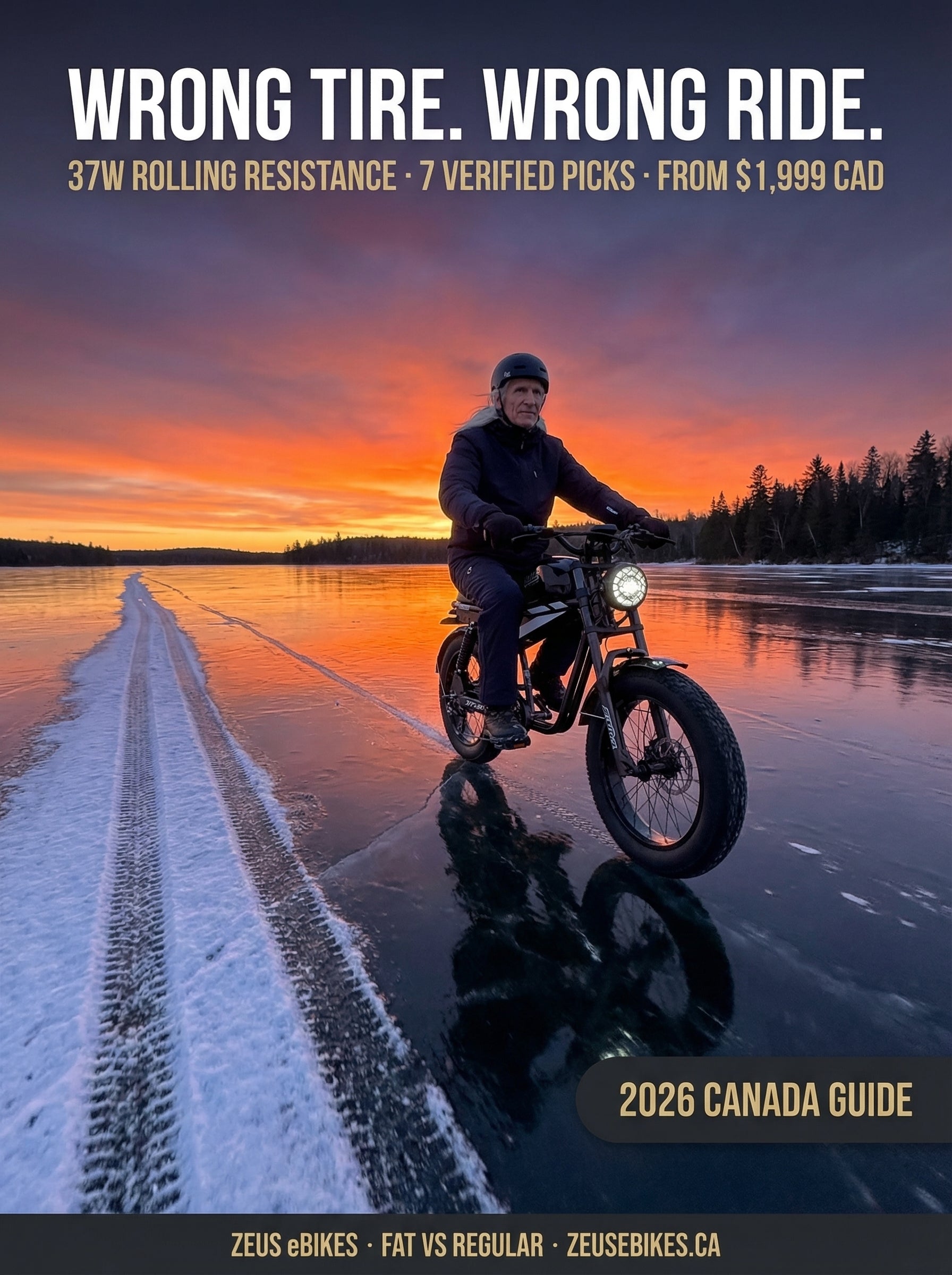
Five numbers decide this choice: rolling resistance (37W vs 7W per tire), range impact (10–20% on pavement), weight (15–20 lbs), maintenance cost (2–3× higher for fat), and the zero advantage any width gives you on ice. Together they explain why the right answer for a Waterloo commuter and a Calgary trail rider are two completely different bikes.
1. Rolling Resistance: 37W vs 7W per tire
Lab testing by BicycleRollingResistance.com measures energy lost to tire deformation. At maximum difference: a fat tire at 6 PSI loses approximately 37 watts per tire to rolling resistance. A premium road tire at 72 PSI loses approximately 7 watts. That is 60 extra watts per pair — energy your motor spends on friction instead of movement. Run your fat tires at 20 PSI instead of 6 and that number drops significantly. Tire pressure management is underrated.
2. Range Impact: 10–20% on flat pavement
On flat paved roads at identical speeds, fat tire eBikes typically deliver 10–20% less range than equivalent regular-tire models with the same battery. But battery capacity dominates the range equation: the Tesway X5 AWD (fat tires, 3,120 Wh) carries nearly four times the capacity of the Summit 2 (regular tires, 801 Wh single battery). Never let tire type distract you from battery capacity. They are separate decisions.
3. Weight Penalty: 15–20 lbs
Fat HS (fat): 79 lbs. Summit 2 (regular): 63 lbs. That is 16 lbs difference. Nomad 2X (fat): 80 lbs. Vista 26 (regular): 64 lbs. That is 16 lbs difference. At the extreme: the Tesway X5 AWD carries its 3,120 Wh battery at 119 lbs — a bike you park, not carry. If you carry your bike up stairs, onto transit, or into a condo elevator — this is the number that decides your tire type, not terrain preference.
4. Maintenance Cost: 2–3× higher for fat tires
Replacement fat tires run $40–$90 CAD per tire based on Canadian retailer pricing in 2026. Regular tires: $15–$45. Inner tubes: fat $10–$20, regular $5–$10. Fat tires also wear faster on pavement due to the larger contact area and higher friction coefficient. Over three years of daily commuting, this adds $60–$150 annually in consumables — before labour.
5. Snow vs Ice: The most important number is zero
Zero. Fat tires provide zero advantage on black ice. Ice requires studded tires regardless of width. Fat tires genuinely help on: packed snow (>5cm accumulation), slush, and loose gravel. On plowed and salted Canadian roads, regular tires are equally effective. Know your surface before choosing your tire.
Fat Tire eBike Pros and Cons — The Honest List
Fat tire eBikes trade efficiency for traction. The pros: grip on snow, sand, and gravel, stability at low speeds, and a cushioned ride at low tire pressure. The cons: 10–20% less range on pavement, 14–20 lbs more weight, heavier steering, 2–3× higher tire replacement costs — and in Canada, most high-power fat builds are not road-legal. Whether that trade is worth it depends entirely on your terrain.
| Fat Tire Pros | Fat Tire Cons |
|---|---|
| Traction on snow accumulation, sand, gravel, and loose trail — surfaces where narrow tires sink or slip | 10–20% less range on flat pavement at the same speed and battery capacity |
| Stability at low speeds — the wide contact patch resists tipping and washouts | 14–20+ lbs heavier than comparable regular-tire builds (79–119 lbs vs 63–64 lbs in this guide) |
| Comfort — 5–15 PSI acts as passive suspension, absorbing potholes and washboard | Replacement tires cost $40–$90 CAD each vs $15–$45 for regular tires; they also wear faster on pavement |
| Better support for heavier riders — the larger air volume absorbs impact under load | Heavier, slower steering feel on pavement; noticeably more effort to pedal without motor assist |
| Enables AWD and high-torque builds — nearly every dual-motor AWD eBike sold in Canada uses fat tires | Most powerful fat builds are rated over the 500W the provincial rules converge on: off-road and private-property use only |
| No advantage surrendered on plowed roads if you manage pressure (run 15–20 PSI on pavement) | No advantage on black ice — only studded tires help there, regardless of width |
One nuance the pro/con lists on other sites miss: the cons are conditional, not absolute. The range penalty applies on pavement — on snow or sand, a regular tire eBike may not move at all, which makes its efficiency irrelevant. The weight penalty only matters if you carry the bike. Judge every row of that table against your actual weekly route, not a hypothetical one.
Not sure which tier fits your riding?
Browse the full Zeus catalogue by category and find your match at every price point.
View Fat Tire eBikes View Regular & Plus eBikesFat Tire eBikes — When Fat Is Worth It
Three conditions together make fat tires worth their weight penalty: your terrain regularly includes non-paved surfaces (not occasionally), storage is not a constraint, and you want AWD traction. If all three apply — fat tire wins cleanly.
For a comprehensive list of 11 fat tire picks at every price point, our fat tire electric bikes Canada guide covers the full catalogue with specs, terrain matching, and verified pricing.
Velotric Nomad 2X
$4,099 CADThe Nomad 2X is the step-thru answer for the fat tire power case. The step-thru opening is not just about accessibility — it is about real-world agility: mid-ride dismounts at intersections, quick stops, riders with limited hip flexibility or joint concerns. The 560 lb payload rating is not a typo. It is the highest payload of any pick in this guide.
SensorSwap™ lets you toggle between torque sensing and cadence sensing — a feature no other fat pick here offers. Torque mode gives a proportional, intuitive ride that mirrors your own effort. The 120mm air fork + DNM air shock rear with 165mm travel handle technical terrain that would bottom out lesser forks. Tektro hydraulic brakes: 203mm front / 180mm rear — the large front rotor is already factory standard at this price point.
Honest trade-off: at $4,099, this is $1,000 more than the Fat HS. The premium buys: step-thru frame, SensorSwap torque sensing, 203mm front rotor standard, and 560 lb payload vs 300 lbs. Meaningful upgrades — but only if you need them specifically.
 Velotric Nomad 2X — Power Pick (Step-Thru Fat Tire)
FAT AWD 3.0 — Zeus Walkthrough
Dual 500W motors, torque sensor, adjustable handlebar, and dual-battery capability — Zeus walks through the FAT AWD 3.0 specs
FAT AWD 3.0
From $2,299 CADTwo 500W hub motors, 110 Nm combined torque, AWD traction. When the rear wheel spins on a loose or slippery surface, the front motor is still pulling — a structural advantage no single-motor bike can copy.
Legal status, stated plainly: the two motors total 1,000W combined, over the 500W the provincial rules converge on (there has been no federal e-bike definition since 2021), so on a public road it is a motor vehicle under provincial law (moped, motorcycle or another class depending on its specs), or off-road and private property only.
A torque sensor (not cadence) means the assist response is proportional to your effort. The bike responds to how hard you push, not just whether you push. Combined with the adjustable handlebar and integrated display, this is one of the most rider-tuned eBikes in this guide. Hydraulic disc brakes (180mm) included standard.
Add the second battery (48V 15Ah) to double your capacity from 720 Wh to 1,440 Wh and push range from 40 miles to 80 miles. Add the rear rack and fenders for utility. Add the front basket for grocery runs. The bike is purpose-built to be configured for exactly the riding you do.
Honest trade-off: 79.4 lbs (step-thru frame) and a 95mm front fork — enough for road and light trail, but this is comfort suspension, not technical-terrain travel. For rougher ground, the full-suspension Fat HS below is the better tool.
 FAT AWD 3.0 — AWD Pick (Dual-Motor Fat Tire)
The Fat HS runs the Bafang BBSHD 1,000W mid-drive at 160 Nm — delivered through the chain and the Shimano/Sunrace 9-speed drivetrain instead of a wheel hub. The practical difference: mid-drive torque multiplies through the gears. Downshift on a steep bush road and that 160 Nm feels significantly stronger than the same number from a hub motor.
The supporting hardware follows the off-road brief: full suspension (RST Guide 75 mm front fork + KS-388RL rear shock), hydraulic disc brakes with motor cutoff on 180 mm rotors, and 26" × 4.0" Kenda Krusade Sport fat tires. The 48V 15Ah Samsung-cell battery carries roughly 720 Wh; Eunorau offers a matched second battery that takes total capacity to roughly 1,440 Wh, rated up to 80 mi / 129 km in best-case dual-battery conditions — confirm current second-battery availability by phone (1-866-938-7580) before ordering. Eunorau backs the core system with a 2-year warranty.
Honest trade-off: the Fat HS is not road-legal in Canada. At 1,000W nominal it exceeds the 500W ceiling Canadian provinces set for power-assisted bicycles and cannot be ridden on public roads, bike lanes, or shared paths — it is a private-property, off-road, and hunting-access machine. It also uses a cadence sensor (per Eunorau’s published spec), not a torque sensor, and it offers no narrower wheel option: this is a fat-tire platform, full stop. The FAT AWD 3.0 above has AWD traction and a torque sensor, though it too is rated over 500W.
 Eunorau Fat HS — Mid-Drive Power Pick (Off-Road Only)
Eunorau FAT-HD 2.0 / Hunter X7
From $3,299 CADThe Hunter X7 runs the same Bafang BBSHD 1,000W mid-drive class as the Fat HS, 160 Nm multiplied through a Shimano 9-speed cassette, with the same cadence-sensing assist (Eunorau). Where it differs is the frame: a hardtail with an RST fork and a 375 lb payload (Eunorau).
The rest of the build is aimed at riders who go far from pavement: 26" × 4.0" Kenda Krusade Sport fat tires, an RST suspension fork, 180 mm hydraulic disc brakes with motor cutoff, a Bluetooth colour display, and a 375 lb payload. The 48V 15Ah Samsung-cell battery (roughly 720 Wh) is rated for 40–65 km on its own, and the frame ships with mounting points for an optional second 15Ah battery that lifts the rated range to 130 km (80 mi). Two frame sizes (17" and 19") fit riders from 5'3" to 6'4", Eunorau backs it with a 2-year warranty on frame, motor, battery, and components.
Honest trade-off: like the Fat HS, the Hunter X7 is not road-legal in Canada — at 1,000W it exceeds the 500W ceiling Canadian provinces set for power-assisted bicycles, so this is a private-property, off-road, and hunting-access machine. It is also a hardtail: the RST fork and fat tires absorb a lot, but there is no rear shock, and at roughly 80 lbs you will not be carrying it over deadfall. Riders who regularly exceed 40 km per outing should budget for the second battery.
 Eunorau Hunter X7 — Hardtail Mid-Drive (Off-Road Only)
Tesway X5 AWD
$2,999 CAD3,120 Wh. That is the number this bike exists for — most eBikes at this price carry 720–1,440 Wh; the X5 AWD ships with more than double that, removable, at $2,999. Tesway's X5/X7 AWD manual says the bike is “not intended to be used and stored at ambient temperatures less than 0°C (32°F)”, so ask us before you plan a winter on it.
The rest is the proven X7 AWD platform in a step-thru frame: dual 1,000W motors with 200 Nm of combined torque, 4-piston hydraulic brakes on 203 mm rotors, 20" × 4.0" Kenda puncture-resistant fat tires with 360° reflective striping, and a 400 lb total payload, the same as the step-over X7 (Tesway).
Legal status, stated plainly: Tesway rates the X5 AWD's two motors at 2,000W together, far over the 500W the provincial rules converge on, so it is a motor vehicle under provincial law (moped, motorcycle or another class depending on its specs), or off-road and private property only. And at 119 lbs, it is the heaviest bike in this guide: this is a machine you park at ground level, not carry.
 Tesway X5 AWD — 3,120 Wh Battery King (Off-Road Only)
Hub-motor fat bikes at the 1,000W tier are common. A 1,000W hub fat bike with a real torque sensor is not — the standard pattern in this category is a cadence sensor with on/off power delivery. The Westridge 4T Off-Road breaks that pattern: the motor measures your actual pedal force and matches it, which is how the 48V 20Ah Samsung 21700 battery (960 Wh, certified to UL 2271 per Taubik) stretches to a rated 100 km.
Taubik is a Canadian brand, and the build reads like it was specced by someone who rides here: Mozo coil fork, 26"×4.8" Maxxis Minion tires, and full throttle authority when the climb demands it.
Legal status, stated plainly: at 1,000W, the Westridge 4T Off-Road is rated over the 500W the provincial rules converge on at any setting, so it is a motor vehicle under provincial law (moped, motorcycle or another class depending on its specs), or off-road and private property only; it is built for logging roads, ATV trails, and Crown land. Taubik’s 500W alternative is the Westridge 29T (500W nominal). And 82 lbs is heavy — true of every 1,000W fat bike with a 20Ah battery.
 Taubik Westridge 4T Off-Road — Torque-Sensor Hub (Off-Road Only)
Regular Tire eBikes — When Narrow Wins
Regular tires are not compromises. They are optimised — for the terrain most Canadian riders actually ride: paved roads, bike lanes, and urban infrastructure. If your commute is predominantly pavement, a regular tire eBike will outperform fat tires on efficiency, weight, speed, and range per dollar. Understanding that is the beginning of making the right choice.
If you are comparing motor types alongside tire type, our mid-drive vs hub motor eBike Canada guide covers that decision in full — two picks in this guide, the Fat HS and the Hunter X7, use mid-drive motors, and the reasons matter.
Velotric Summit 2 — Zeus First Look
Filmed in Waterloo, Ontario — the 750W inner-rotor motor, tested range, and who the Summit 2 is actually for
Velotric Summit 2
$3,399 CAD63.3 lbs. For context, the Nomad 2X (fat tire, same motor class) weighs 80 lbs and the X5 AWD weighs 119. The Summit 2 is the bike you can actually live with daily — carry up a flight of stairs, hang on an apartment rack, lift onto a hitch carrier. Zeus filmed a first-look review in Waterloo (embedded above); it is one of the few bikes in this guide we have handled on camera.
The redesigned 750W inner-rotor hub delivers 100 Nm of torque — ten more than the Summit 1 it replaces — and peaks at 1,300W. The 801 Wh battery is the largest of the regular-tire picks here, and the 440 lb total payload is high for a regular-tire bike. The 27.5" × 2.4" Kenda puncture-resistant MTB tires roll fast on pavement but bite on hardpack — the exact boundary this article is about.
Legal status, stated plainly: Velotric rates the Summit 2 at 750W, over the 500W the provincial rules converge on, so on a public road it is a motor vehicle under provincial law (moped, motorcycle or another class depending on its specs), or off-road and private property only. For a 500W commuter, the Vista 26 below is the pick.
Honest trade-off: at $3,399 it is $1,000 more than the Vista 26, and it is a hardtail — no rear suspension. On loose gravel, snow, or sand, regular-tire limitations apply. This bike was built for roads and hard surfaces, and it is excellent on them.
 Velotric Summit 2 — Power Pick (Regular Tire)
Taubik Vista 26
$2,399 CADA switchable torque/cadence dual sensor — toggled from the colour display — in a $2,399, 500W commuter inside the limit the provincial rules converge on. Torque mode reads how hard you pedal and assists proportionally; cadence mode delivers steady, predictable power per assist level. No other pick in this guide’s legal-commuter tier offers both. The 500W Sutto rear hub produces 68 Nm of torque, enough for city hills at the full 32 km/h assist limit.
The Vista 26 is the purest expression of this section’s thesis. Its 26" × 1.9" CST high-pressure commuter tires are the narrowest in this guide — the configuration the rolling-resistance lab data favours most. Taubik rates the 48V 14.7Ah Samsung-cell battery (706 Wh, UL 2271 certified) at up to 100 km in ideal conditions; its manual gives 50–95 km on pedal assist and 30–35 km on pure power, and says the equipment is “not intended to be used at ambient temperatures less than 0°C”; ask us or Taubik before you plan a winter on it.
The commuter hardware is unusually complete: Zoom dual-piston hydraulic disc brakes on 180 mm rotors front and rear, a Mozo Peak 26 coil fork with 60 mm of travel, Shimano Altus 7-speed shifting, factory-mounted full fenders, integrated LED lights, and a flip-up saddle that releases the battery for indoor charging — no tools, no panels. The frame is an ultra-low step-through with an upright, swept-back riding position. Taubik is Canadian-owned and supplies an English and French owner’s manual; its warranty is 2 years on the frame and 1 year on the motor, battery, controller, display and wiring.
Honest trade-off: no rear rack is included — if you carry panniers or groceries daily, budget for one, because the fenders-only setup is a real step down from racked competitors. It comes in one frame size and Taubik publishes no rider-height range: its spec table says 15", and its dimension chart gives a 16.1" (410 mm) seat tube and a 15.9" (404 mm) reach, so call us with your height and inseam. And the 706 Wh battery is the second-smallest in this guide (only the Hera’s 468 Wh is smaller), with Taubik’s 1-year warranty on the battery and other electrical parts.
 Taubik Vista 26 — Regular Tire Legal Pick
The full Zeus catalogue spans fat tire, regular tire, and plus tier builds at every price point and power level.
Find the right bike for your rider profile in the complete Zeus collection.
View All eBikes Read Our Buyer’s GuideThe Plus Tire Middle Ground — Why 2.4"–3.0" Is Often the Right Answer
Most riders who think they need fat tires actually need plus tires. And most riders who think regular tires are sufficient are leaving traction on the table. The 2.4"–3.0" range — rarely discussed by competitors — occupies exactly the right middle: enough contact patch for gravel and light trail, enough efficiency for daily commuting, and enough clearance to run lower pressure without the full rolling resistance penalty of fat tires.
No bike in this guide wears a dedicated plus-width tire as its headline spec — and that is itself worth knowing: the plus band is underserved in the Canadian market. The closest fits are the Velotric Summit 2’s 27.5" × 2.4" Kenda MTB rubber, sitting right at the band’s lower edge, and the trikes below — the CITYTRI E-310 runs 2.4"-wide rubber on both axles. If the plus profile describes your riding — mixed surfaces, storage constraints, one bike for the commute and the weekend — the Summit 2 at $3,399 (covered above, with its lockout-equipped hardtail build) is the pick in this guide that serves it best.
If you are weighing motor type alongside tire width, our mid-drive vs hub motor comparison explains how the two mid-drives in this guide — the Fat HS and the Hunter X7 — multiply torque through their gears, and why that matters on technical terrain.
The Canadian Winter Factor — Snow, Ice, Slush and What Actually Matters
Canada does not have one kind of winter — the table below scores seven distinct conditions, and the right tire for February in Edmonton is different from the right tire for February in Vancouver. This section cuts through the generic “fat tires are better for winter” advice and gives you specific answers for specific conditions.
| Winter Condition | Fat Tire (4.0") | Plus Tire (2.4"–3.0") | Regular Tire (up to 2.4") |
|---|---|---|---|
| Glare black ice | None (studs required) | None (studs required) | None (studs required) |
| Fresh snow >5cm | Excellent | Good | Poor |
| Packed snow | Excellent | Good | Moderate |
| Slush | Very Good | Good | Poor |
| Plowed / salted road | Equal — no advantage | Equal | Equal |
| Cold dry pavement (−20°C) | Disadvantage (more drag) | Slight disadvantage | Best |
| Wet autumn leaves | Very Good | Good | Moderate |
The one rule that overrides everything: black ice requires studded tires regardless of width. No fat tire — regardless of brand or construction — provides meaningful traction on glare ice. If your primary winter concern is ice, the answer is studded tires (available in fat, plus, and regular widths), not a wider tire.
One underrated winter factor: tire pressure drops approximately 1 PSI for every 10°C temperature decrease. A fat tire inflated to 12 PSI in your heated garage will read approximately 8–9 PSI outside at −30°C. Check and adjust tire pressure seasonally — this matters more for fat tire riders than any other category.
One winter truth this guide states plainly: winter commuting happens on plowed roads and pathways, where a bike has to be inside the provincial e-bike rules, yet the best winter-traction machines in this guide are off-road only. If your winter riding is a plowed commute, the answer is a 500W bike with studded tires for ice, not a 2,000W fat build. Read the maker's temperature line before any winter plan: Taubik's Vista manual and Tesway's X5/X7 AWD manual both say those bikes are not intended to be used below 0°C.
For a complete guide to winter eBike selection in Canada — including battery performance in cold, gear recommendations, and winter maintenance — our best electric bikes for winter Canada guide covers every condition across every Canadian climate zone.
Fat vs Regular on Three Wheels — Electric Trikes
The fat-vs-regular question applies to trikes too, with one difference: a trike already has the low-speed stability a fat tire is often bought for, so tire choice becomes a pure terrain decision. Meigi builds both answers on near-identical 124-lb chassis — a regular-tire Hera and a fat-tire Meigi Zeus — which makes this the rare controlled comparison the two-wheel market never offers.
Three wheels also answer the stability question older riders ask most. If that is your starting point, our electric bikes for seniors guide and electric trikes Canada guide go deeper on frame fit and mobility needs.
Meigi Hera Electric Trike
$1,699 CADThe cheapest pick in this entire guide — and the one with the cleanest legal status. At 350W nominal, the Hera sits inside the 500W limit the provincial rules converge on. The 24" × 2.125" Kenda tires are classic regular-width rubber: efficient on pavement, predictable in traffic, cheap to replace.
Removable 36V 13Ah lithium battery (468 Wh — Meigi publishes no range figure; Zeus’s editorial estimate from capacity is roughly 30–45 km per charge), Tektro mechanical disc brakes, and a rear basket ready for groceries. Charge time is 4–5 hours.
Honest trade-off: 350W and 24 km/h means gentle hills, not steep ones — this is a flat-terrain neighbourhood and errand machine. And at 124 lbs it stores at ground level.
 Meigi Hera — Regular Tire Trike (350W PAB Legal)
Meigi Zeus Fat Tire Trike
$2,928 CADThe same 124-lb chassis weight as the Hera — with everything else turned up. The 20" × 4.0" Kenda fat tires float over gravel laneways, grass, and packed snow that would rattle the Hera’s 2.125" rubber, and the 750W Bafang front hub pulls the trike rather than pushing it — useful traction geometry on loose surfaces.
The 48V 18.2Ah battery (874 Wh) is rated by Meigi at 95 km on pedal assist and 70 km on throttle — nearly double the Hera’s capacity, with a 330 lb max load and 32 km/h top speed.
Legal status, stated plainly: at 750W, the Meigi Zeus is rated over the 500W the provincial rules converge on, so on a public road it is a motor vehicle under provincial law (moped, motorcycle or another class depending on its specs), or off-road and private property only. Honest trade-off: Tektro mechanical (not hydraulic) disc brakes, and fat rubber costs more to replace when it wears.
 Meigi Zeus — Fat Tire Trike Pick
Addmotor CITYTRI E-310
From $2,399 CADThe CITYTRI E-310 solves the trike’s biggest ownership problem: at 86 lbs with a folding frame, it is 38 lbs lighter than either Meigi and the only trike here that fits in a hatchback or condo storage room. Addmotor Canada lists 20" × 2.4" front / 18" × 2.4" rear tires: regular-width rubber, tuned for pavement.
The rear motor (90 Nm; 500W with a 1,100W peak on one Addmotor page and 750W on another, so ask us which ships) is paired with a 48V 20Ah Samsung-cell battery — 960 Wh, the second-largest of the trike picks — and a load rating of 280 lb for the rider plus 80 lb of cargo (Addmotor’s figures). Zeus has published a full CITYTRI E-310 review if you want the deep dive.
Legal status, stated plainly: our listing gives 750W, while Addmotor’s own pages print it two ways (500W with a 1,100W peak on one page, 750W on another); which motor you receive decides whether it sits inside the 500W limit the provinces converge on, so ask us before you order. Honest trade-off: from $2,399 it costs $700 or more above the Hera; you are paying for the folding frame, the Samsung battery, and the payload.
 Addmotor CITYTRI E-310 — Folding Trike Pick
All 11 Picks — Side by Side
Every pick in this guide on a single table — eight bikes, then three trikes. Each pick's motor rating is stated on its card: the Vista 26 and the Hera are rated inside the 500W the provincial rules converge on, and the CityTri depends on its motor version.
| Bike | Type | Tire | Motor | Battery | Range | Weight | Torque | Price |
|---|---|---|---|---|---|---|---|---|
| Nomad 2X | Fat Power Step-Thru | 26"×4.0" | 750W / 1,400W pk | 802 Wh | 75 mi PAS | 80 lbs | 105 Nm | $4,099 |
| FAT AWD 3.0 | Fat AWD Off-Road | 26"×4.0" | 2×500W AWD | 720–1,440 Wh | 40–80 mi | 79.4 lbs | 110 Nm | From $2,299 |
| Fat HS / Hunter X8 | Fat Power Off-Road | 26"×4.0" | 1,000W mid-drive | 720 Wh (+720 opt.) | 80 mi (dual) | 79.4 lbs | 160 Nm | $3,099 |
| FAT-HD 2.0 / Hunter X7 | Fat Power Off-Road | 26"×4.0" | 1,000W mid-drive | 720 Wh (+720 opt.) | 80 mi (dual) | 81.6 lbs | 160 Nm | From $3,299 |
| Summit 2 | Regular Power | 27.5"×2.4" | 750W / 1,300W pk | 801 Wh | — | 63.3 lbs | 100 Nm | $3,399 |
| Tesway X5 AWD | Fat AWD Off-Road | 20"×4.0" | 2×1,000W AWD | 3,120 Wh | — | 119 lbs | 200 Nm | $2,999 |
| Westridge 4T Off-Road | Fat Off-Road | Fat (Maxxis Minion) | 1,000W hub | 960 Wh | Up to 100 km | 82 lbs | 95 Nm | $3,599 |
| Vista 26 | Regular Legal | 26"×1.9" | 500W | 706 Wh | Up to 100 km | 64 lbs | 68 Nm | $2,399 |
| Meigi Hera | Trike Legal | 24"×2.125" | 350W / 540W pk | 468 Wh | ~30–45 km* | 124 lbs | — | $1,699 |
| Meigi Zeus | Trike Fat | 20"×4.0" | 750W front hub | 874 Wh | 95 km PAS | 124 lbs | — | $2,928 |
| CITYTRI E-310 | Trike Folding | 2.4" (20"F/18"R) | 500W / 750W (two readings) | 960 Wh | — | 86 lbs | 90 Nm | From $2,399 |
*Hera range is a Zeus editorial estimate from its 468 Wh capacity — Meigi does not publish a range figure. Dashes mean the manufacturer publishes no figure.
The Verdict — Which Tire Type Is Right for You?
Fat tires win on mixed terrain, snow accumulation, and AWD traction. Regular tires win on pavement, in apartments, and for pure commuting efficiency. Plus tires are the right answer when you want both — the Summit 2’s 2.4" Kenda rubber, sitting right at the plus border, is this guide’s proof that one tire can serve the commute and the trail. And on three wheels, tire choice is pure terrain: the trike already supplies the stability.
The honest answer most guides avoid: the majority of Canadian riders who buy fat tire eBikes would be better served by plus tires. Fat tires are optimised for conditions that most urban Canadians encounter occasionally, not daily. Know your actual terrain before choosing.
Choose fat tires if:
- More than 30% of your riding is on non-paved surfaces (gravel, trail, mixed terrain)
- You ride through Canadian winter with consistent snow accumulation on your regular route
- You are 250 lbs or more (fat tires at lower pressure absorb impact better under heavy loads)
- You want AWD capability — nearly every dual-motor AWD eBike uses fat tires
- Storage is ground-level — garage, secured parking, or accessible outdoor
Choose regular tires if:
- Your commute is predominantly paved roads and bike lanes
- You live in an apartment or condo (weight matters for stairs and elevators)
- You take your eBike on transit
- Speed and range efficiency are the priority
- Your city plows roads quickly and your winter roads are clear pavement
Choose plus tires if:
- You ride genuinely mixed terrain but storage is a constraint
- You want one bike that handles daily commuting AND weekend trail use
- Your route mixes pavement with gravel connector paths or crushed-stone trails
- You ride in moderately rough conditions without pushing into serious singletrack
- You want better comfort than regular tires without the full weight penalty of fat
For recommendations matched to your specific rider profile across 11 rider categories, our best eBike for every rider type Canada guide includes both fat and regular tire picks at every power level from $1,299 to $5,599.
Frequently Asked Questions
Are fat tire eBikes harder to pedal without motor assist?
Yes — significantly. Lab testing by BicycleRollingResistance.com shows approximately 37 watts of rolling resistance per fat tire at low pressure vs 7 watts for a road tire. Without motor assist, this requires meaningfully more leg effort. Running fat tires at higher pressure (15–20 PSI rather than 5–8 PSI) reduces this substantially. If you plan to ride without assist regularly, choose regular tires or maintain higher fat tire pressure.
Do fat tires actually help on black ice in Canada?
No. Black ice requires studded tires regardless of tire width. Fat tires distribute the same friction over a wider surface — they do not generate more friction on smooth ice. If black ice is your primary winter concern, invest in studded tires. They are available in fat, plus, and regular widths. Width does not solve ice; studs do.
How much range do I actually lose with fat tires?
On flat paved roads at the same speed, expect 10–20% less range compared to regular-tire builds with the same battery. But battery capacity dominates the range equation: the Tesway X5 AWD (fat tires, 3,120 Wh) carries nearly four times the capacity of the Summit 2 (regular tires, 801 Wh). Never let tire type distract you from battery capacity. Choose battery capacity first. Tire type is a secondary range factor.
Are fat tire eBikes too heavy for apartment living?
The two-wheel fat picks in this guide weigh 79–119 lbs vs 63–64 lbs for the regular tier — a difference you feel on every staircase and elevator. Fat-tier bikes are best suited to ground-level storage. If you store your bike in an apartment or carry it on transit, the Summit 2 (63.3 lbs) or Taubik Vista 26 (64 lbs) are the right choice. Weight is a daily reality, not a spec sheet footnote.
Can I swap fat tires for regular tires on an existing eBike?
Generally no — fat tire bikes are built with wider forks, frames, and wheel spacing that will not accept narrow regular tires without significant modification. None of the picks in this guide ship with a second wheel set. For every bike here, the frame geometry determines your tire width at purchase — decide your terrain honestly before you buy.
Which tire is better for year-round commuting in Canada?
It depends on your city’s plowing speed and your route. For urban riders on roads that are plowed within hours (most major Canadian cities), regular tires are equally effective on plowed roads and more efficient overall. For suburban or trail-adjacent commuters with unplowed paths and consistent snow accumulation, fat tires provide meaningful advantages. Best commuter pick: the Taubik Vista 26 — it is the guide’s clearest 500W commuter. Note that the high-traction fat picks here are off-road machines rated over 500W, so they cannot legally serve a pathway commute; for icy plowed roads, studded tires on a legal bike beat fat rubber on an illegal one.
Are fat tire eBikes worth the higher price?
The price gap is usually about the hardware that accompanies fat tire builds — dual motors, larger batteries, full suspension — not the tires themselves. The FAT AWD 3.0 from $2,299 (fat tire, AWD) costs $1,100 less than the Summit 2 at $3,399 (regular tire, single motor). Fat tires do not automatically mean higher cost. The right question: does fat tire capability match your terrain? If yes, justified. If no, you are buying capability you will not use.
Why do electric bikes have fat tires?
Fat tires run at low pressure (5–15 PSI), which creates a large contact patch that grips loose surfaces — snow, sand, gravel — where narrow tires sink or slip. Manufacturers pair them with electric motors because the motor offsets their higher rolling resistance. Fat tires exist for traction and comfort, not speed.
Are fat tire eBikes good for commuting?
For mostly-paved commutes, a regular or plus tire eBike is the better commuter — lighter, more efficient, and 10–20% more range from the same battery. In Canada there is a second reason: most high-power fat builds are rated over 500W, above the limit the provincial rules converge on, so they are not e-bikes on public roads and paths. The clearest commuter pick in this guide is the Taubik Vista 26 ($2,399); our urban electric bikes guide covers the full commuter category.
Are fat tire eBikes good for seniors?
The tires help: low pressure absorbs road vibration and the wide contact patch adds low-speed stability — two genuine benefits for older riders. But for stability specifically, three wheels beat any tire width: the trikes in this guide supply it structurally, and the 350W Meigi Hera ($1,699) is also the guide’s most clearly road-legal pick. Our electric bikes for seniors guide matches frames and tire types to mobility needs.
Are fat tires easier to ride?
At low speeds and on loose surfaces, yes — the wide contact patch adds stability, grip, and cushioning over bumps. On pavement, no — fat tires steer heavier and lose roughly five times more energy to rolling resistance than a road tire (approximately 37 watts vs 7 watts per tire in BicycleRollingResistance.com lab testing).
Do fat tire eBikes have tubes?
Typically yes — factory fat tire eBikes generally ship with inner tubes. Fat tire tubes cost $10–$20 CAD to replace vs $5–$10 for regular tubes. Tubeless conversion is possible only on tubeless-ready rims, which are uncommon on factory eBikes — check your wheel specification before attempting a conversion.
What is the difference between a fat tire eBike and an electric mountain bike?
Tire width and intent. An electric mountain bike typically runs 2.2"–2.6" knobby tires with suspension tuned for singletrack speed and cornering. A fat tire eBike runs 4.0" tires at low pressure for flotation on soft surfaces — snow, sand, loose gravel. Some models blur the line: the Velotric Nomad 2X pairs 4.0" fat tires with full air suspension.
Still torn between fat and regular?
Talk it through with a real person before you spend a dollar — call 1-866-938-7580, describe your route, and we will tell you honestly which tire type fits it, even if the honest answer is the cheaper bike. Prefer to spread the cost? Our eBike financing guide covers Klarna, Shop Pay Instalments, and PayPlan by RBC.
Browse Fat Tire eBikes Browse Commuter eBikes- Fat Tire Electric Bikes Canada (2026) — 11 Picks
- Best eBike for Every Rider Type Canada — 14 Picks
- Mid-Drive vs Hub Motor eBike Canada — Real Tests
- Best Electric Bikes for Winter Canada (2026)
- 500W vs 750W vs 1000W eBike Canada — Wattage Guide
- eBike Canada — Complete Guide 2026
- Electric Trikes Canada (2026) — Best by Price & Type
- Best Electric Bikes for Seniors Canada (2026)
📸 All photography by Playcut.ai — personalized AI actor technology

Share:
Best eBike by Rider Type Canada (2026): 14 Picks, $1,499–$6,499
eBike Theft Protection Canada (2026): The 3-Layer System That Actually Works