Best Hunting eBikes Canada (2026): 6 Silent, All-Terrain Picks for the Bush

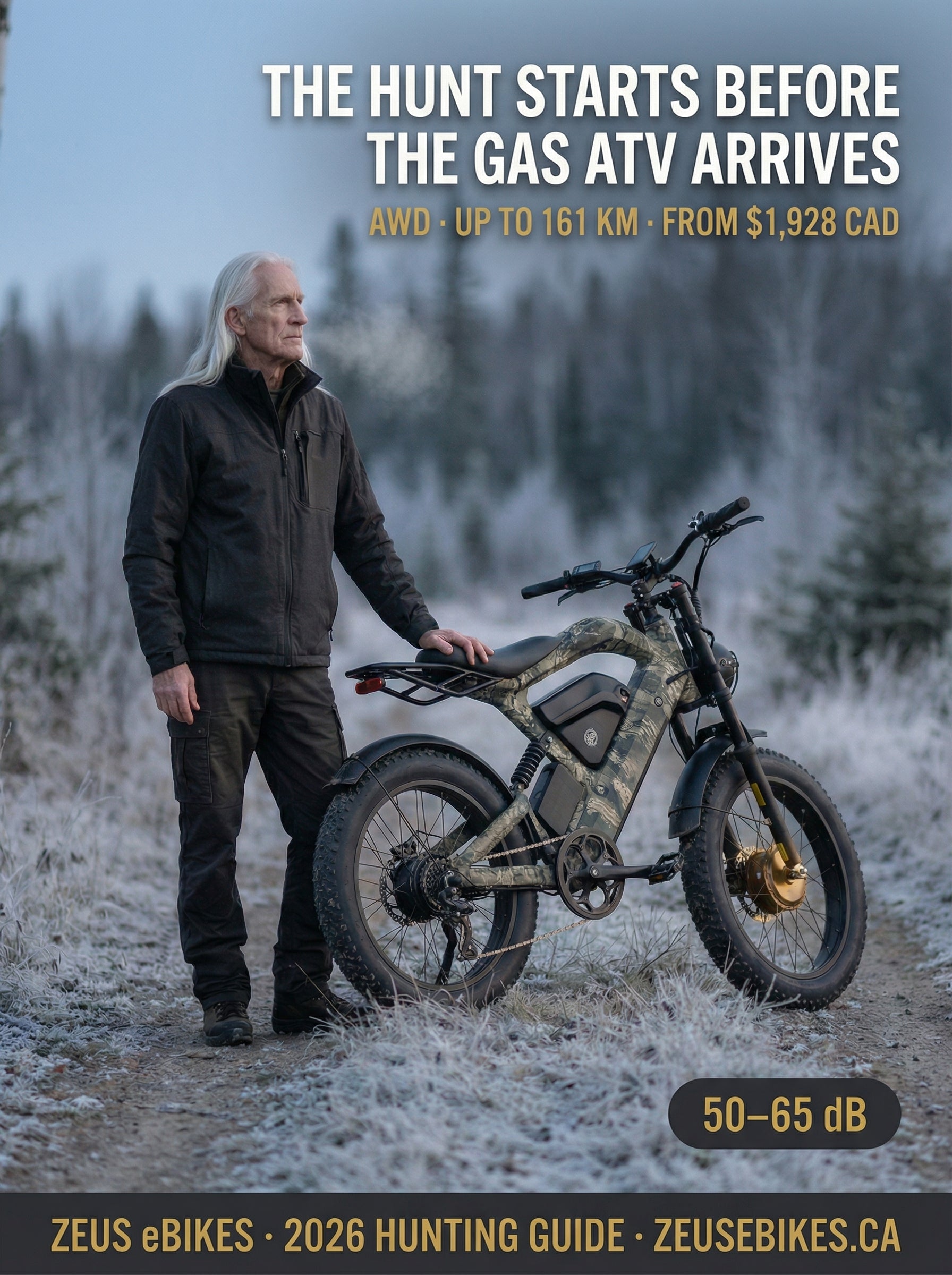
A gas ATV announces your arrival at 85–100 dB. A horse leaves scent. A hunting eBike does neither — it runs at roughly 50–65 dB at approach speeds, leaves no scent trail, and carries you and your gear 100+ km on a single charge. The problem is that most reviews are written by US-based publications for US terrain. Canadian hunters need bikes built for spring mud, dense boreal, and freezing overnight temperatures. This guide covers exactly that.
We evaluated every model currently available through the Zeus hunting eBike collection, cross-referenced against what Canadian hunters are actually searching for, and landed on six verified picks. Every price is in CAD. Every bike is currently in stock. No out-of-stock products, no discontinued models.
For most Canadian hunters, the Smartravel Raptor ST202 Pro ($2,599) is the top overall pick: AWD, 2,600 Wh battery for 161 km range, IP65 waterproofing, GPS anti-theft, and 400 lb payload. Budget-conscious hunters should look at the Freesky Ranger Air M-540 ($2,099) — also AWD, 400 lb payload, with UL safety certification and a camo colour option. For maximum raw power and deep-bush climbing, the Freesky Warrior Pro M-530 ($2,899) delivers 4,000W peak and 240 Nm. All six picks run 26×4.0" fat tires (or 20×4.0" for the Raptor) for soft-ground Canadian terrain.
In This Guide
Why a Hunting eBike Changes Everything in Canadian Bush
The average Canadian hunter covers 8–14 km per day on foot in active season, according to survey data from provincial hunting associations. That's before accounting for the pack-out — which, for a field-dressed whitetail, adds 40–70 lbs to your back over that same ground. An eBike cuts that energy expenditure dramatically. More importantly, it changes the geometry of your day: you can reach ground that a gas quad would churn up and spook game on, and you can do it without the scent and noise signature that comes with internal combustion.

The noise difference is not subtle. A gas ATV at idle sits at 85–90 dB. Under trail load, it regularly exceeds 95 dB. A hub motor eBike at the 5–10 km/h approach speeds most hunters actually use produces roughly 50–65 dB — roughly equivalent to a normal conversation at a metre's distance. Deer have a hearing range of roughly 40–60 Hz to 8 kHz, with peak sensitivity around 2–4 kHz. eBike motor frequencies fall largely below this peak sensitivity range, while the discontinuous nature of pedal-assist engagement at low speeds further reduces the auditory signature. Field reports from hunting communities across Alberta, BC, and Ontario consistently describe approaching to well within shooting range without a reaction from game that would have bolted from a gas quad.
There is also the matter of access. Many Crown land areas and designated wilderness hunting zones prohibit motorised off-road vehicles (ORVs) on sensitive terrain. An eBike, operating at low speeds with minimal ground disturbance, can access terrain that a gas quad legally or practically cannot. This is particularly relevant in the boreal zones of northern Ontario and Saskatchewan where ORV restrictions are enforced during spring melt season.
AWD vs Single Motor: Which Do You Actually Need in Canadian Bush?
Canadian hunting terrain runs a wide spectrum. A Saskatchewan prairie hunter riding packed range roads to a wheat-field blind has different traction requirements than a BC coastal hunter pushing through cedar root systems in October mud. Whether you need AWD comes down to one question: does your terrain regularly present conditions where front-wheel traction loss would leave you stuck?
AWD genuinely earns its weight and cost premium in three Canadian scenarios. The first is spring mud — the window between snowmelt and ground firming when skidder trails turn to soup. Front-drive engagement maintains forward motion when the rear wheel is spinning in ruts. The second is creek crossings, where simultaneous front and rear traction on slick rocks or submerged roots prevents washout. The third is steep, deadfall-littered side-hills where a single wheel losing grip starts a slide. Outside these scenarios — flat boreal on packed trails, September field edges, late-season hardpack — a quality single-motor bike is equally effective and noticeably lighter (AWD bikes typically run 40–48 kg versus 36–40 kg for comparable single-motor setups).
The AWD bikes in this guide run dual hub motors, which means the front and rear wheels are driven independently. This differs from a mid-drive single motor where torque is applied only through the rear wheel via the drivetrain. In deep soft ground or creek crossings, having driven traction on both ends is a material advantage that single-motor bikes, regardless of their torque rating, cannot replicate. See our dual motor eBike guide for a full breakdown of AWD system differences across all categories.
The Raptor ST202 Pro wins the overall category on the strength of one specification that no other hunting eBike in this price range can match: 2,600 Wh of battery capacity. That is not a marginal advantage. The next highest in this guide is 1,440 Wh. On a full charge, 161 km of range means a hunter can realistically ride to a remote stand, spend a full day riding game surveys, and ride home without thinking about range management. In Canadian boreal where the closest charging point might be 60 km away, that margin matters enormously.
Beyond range, the Raptor delivers exactly what a Canadian hunter wants: dual 1,500W hub motors for AWD traction through mud and creek crossings, a KKE R150S coil spring fork with 140mm travel paired with an EXA A5-RE rear shock for loaded terrain, and IP65 water resistance that handles the kind of morning rain and creek splash that kills lesser electronics. The built-in GPS anti-theft system — with phone app and remote bike-disable capability — is particularly valuable when your eBike is 4 km back at the truck while you're on stand. Note: the 20×4.0" wheel format is more manoeuvrable in tight bush than the 26" standard, though it rolls slightly less efficiently over larger obstacles.
The Ranger Air M-540 is the most affordable AWD hunting eBike in this guide, and it earns that position on genuine merit rather than by cutting corners. The 3,500W combined power output and 200 Nm torque actually exceed the Raptor's figures — the trade-off is battery capacity (1,200 Wh versus 2,600 Wh on the Raptor). For hunters whose trips are under 80 km round trip, the Ranger's battery is entirely sufficient; for multi-day backcountry access, the Raptor's larger pack provides meaningful extra margin.
Two features distinguish the Ranger Air for hunting specifically. First, the step-thru frame — rare on a full AWD fat-tire platform — makes mounting and dismounting easier in full camo gear, when carrying a bow, or in low-clearance terrain. Second, the camo colour option is the only factory camouflage available on an AWD eBike at this price point in Canada. The NFC lock/start system adds anti-theft protection without a separate subscription. Dual UL2849 and UL2271 TÜV certifications provide battery safety assurance that some competing brands in this segment lack. Published winter range data: 38–92 km at −10 to −15°C — useful for planning late-season shoulder hunts.
Browse the full collection — AWD, fat tire, camo, and full suspension options verified in stock.
Shop Hunting eBikes Canada View All AWD eBikes
Payload — Can It Actually Carry Your Gear and Game?
Payload is the hunting eBike specification that most buyers under-estimate. Manufacturers quote a maximum system load — rider plus cargo combined. The math matters: if you weigh 200 lbs and your bike is rated for 400 lbs, you have 200 lbs of remaining cargo capacity. A field-dressed whitetail deer is approximately 100–140 lbs of carcass weight. A mule deer runs 130–180 lbs. An elk, quartered, produces 250–350 lbs of boneless meat, hide, and head — more than one bike trip even at maximum payload. Moose exceed this further.
In practical terms: most Canadian deer hunters can work within a 350–400 lb rated bike. Moose and elk hunters need to plan for multiple loads or pack-out assistance regardless of bike choice. The critical factor is not just the rated maximum but how the bike handles at near-maximum load on rough ground — which is where suspension quality, tire volume, and AWD traction each contribute directly to whether a loaded bike stays upright on a creek crossing.
For hunters moving heavy loads through variable terrain, the fat-tire format's load distribution advantage is real: a 4.0-inch tire at 8–10 psi spreads the weight of a loaded rear rack across a much larger footprint than a 2.0-inch tire at 40+ psi. This is why the heavy-duty eBike category and hunting eBike category overlap almost completely — the same ground-pressure and payload engineering that serves larger riders serves hunters with loaded racks.
The Warrior Pro M-530 represents the top of the AWD power spectrum in this guide: 4,000W peak combined output and 240 Nm of torque, matched to a downhill-rated full suspension platform and 26×4.0" fat tires. This is the bike for hunters who regularly push through the worst Canadian terrain — spring breakup mud, loaded side-hill traverses, steep access trails where lower-powered AWD bikes start to struggle under load.
The downhill suspension rating matters in a specific way for loaded hunting use: the fork and shock are designed to handle both high impact and sustained compression under weight, rather than just absorbing trail chatter. On a fully loaded bike crossing deadfall and boulder fields with a quarter of elk on the rear rack, this suspension calibration keeps the bike tracking true. The 1,440 Wh battery delivers 97–193 km of range depending on assist level and load — sufficient for most single-day Canadian hunting trips with range to spare. All three colours (Black, Green, Blue) are in stock.
Velotric Nomad 2X
$4,099 CADThe Velotric Nomad 2X earns its place in this guide on a single number: 560 lb total rated payload capacity. No other bike in this guide comes close. For a 220 lb hunter in full gear, that leaves 340 lbs of cargo capacity — enough to carry a field-dressed whitetail in a single trip. The 1,000 lb tow rating extends this further: a game cart or small utility trailer attached to the rear hitches becomes a genuine option for elk pack-outs over shorter distances.
Two features are specifically valuable for hunting use. First, Stealth Mode — a built-in function that dims the display, disables all lights, and reduces speed — eliminates light and electronic signature during pre-dawn approaches to stands. Second, the SensorSwap system allows the rider to switch between torque-sensor and cadence-sensor modes: torque mode for smooth, natural-feeling pedal assist on long rides; cadence mode for maximum power engagement on loaded pulls. The DNM air rear shock (a named brand component, not an OEM unit) handles variable compression under game loads with the kind of consistency that un-branded shocks cannot guarantee. Single-motor only — for hunters who do not face the AWD scenarios described above, this is the highest-payload choice in the guide.

How Quiet Are These Bikes? The 50–65 dB Reality
The noise profile of a hunting eBike depends on three factors: the motor type, the drivetrain, and the riding speed. Hub motors — which all but one bike in this guide use — produce their noise through electromagnetic vibration in the motor housing. At hunting approach speeds of 5–10 km/h, this vibration is minimal and low-frequency. The dominant noise source at slow speeds is typically the chain and cassette: a Shimano 7-speed cassette under mild pedal load at walking pace produces approximately 40–55 dB of mechanical sound.
At 20+ km/h, tire-on-trail noise overtakes both motor and drivetrain as the primary sound source — 4.0-inch fat tires at low pressure produce a distinctive hum on hard surfaces that game at distance can detect. The practical guidance from experienced hunting eBike users is consistent: cut electric assist to PAS 1 or off within 300–500 metres of your stand area and coast or pedal quietly the final approach. At these very low assist levels, the motor is essentially silent and only drivetrain and tire contact remain.
The torque sensor versus cadence sensor distinction matters here. A cadence sensor engages and disengages motor assist in discrete steps as you pedal — which creates audible motor engagement pulses. A torque sensor provides proportional, continuous assist — the motor power rises and falls smoothly with your pedal pressure, producing a more linear and quieter engagement profile. Two bikes in this guide carry torque sensors: the Eunorau FAT-AWD 3.0 and the Velotric Nomad 2X (via SensorSwap). For the final approach to a stand, this distinction is perceptible.
Eunorau FAT-AWD 3.0
from $2,299 CADThe FAT-AWD 3.0 is the quietest AWD option in this guide by virtue of its torque sensor — the only AWD hunting eBike here with proportional assist engagement rather than stepped cadence sensing. The practical effect: zero audible motor pulse on the approach, smooth power modulation as you navigate around obstacles, and cleaner low-speed control in tight bush. At 79.4 lbs, it is also the lightest AWD option in the guide — meaningful when you're loading a heavy pack-out and need to manually lift the bike over obstacles or into a truck bed.
The dual-battery upgrade path is worth noting for hunters planning extended backcountry access: the base 720 Wh LG battery provides approximately 64 km of range, but an optional second 48V 15Ah Samsung battery (sold separately, $679) brings total capacity to 1,440 Wh and range to approximately 128 km — significantly extending wilderness viability without buying a new bike. The Kenda Krusade Sport tires are a named brand (not generic OEM rubber), and the Eunorau GO Bluetooth app enables speed adjustment for terrain matching. Camo colour is available. Note: this is a hardtail, not full suspension — the RST GUIDE fork (95mm travel) handles front hits, but no rear shock means you'll feel loaded pack-out trail more directly through the frame.

Browse the full range — from budget AWD at $1,928 to Bafang mid-drive premium at $4,019. Every bike verified in stock.
Shop All Hunting eBikesFat Tires & Canadian Terrain — What Actually Works
The hunting eBike market has largely standardised on two wheel formats: 26×4.0" and 20×4.0". The difference matters for Canadian terrain more than for most other riding contexts. A 26-inch wheel rolls over obstacles — roots, rocks, frozen ruts — with significantly less effort than a 20-inch wheel, because the larger diameter approaches the obstacle at a shallower angle. On dense boreal root systems, creek bank edges, and deadfall that you can't avoid, 26" is the better choice. The 20×4.0" format (used on the Raptor ST202 Pro) is more manoeuvrable in extremely tight bush and fits more easily on ATVs and in truck beds, but it demands more energy to maintain momentum on rough trail.
Tire pressure plays an unexpectedly large role in hunting eBike performance. Standard 4.0-inch fat tires at 10 psi provide traction and floatation that is entirely different from the same tire at 20 psi. For muskeg, soft bog, and deep snow, running at 6–8 psi turns the tire into a wide floatation platform. For packed trail, 12–15 psi reduces rolling resistance meaningfully. Most hunters run low pressure on approach and inflate before the ride out with a small hand pump.
For hunters focused on technical Canadian mountain terrain — the steep, rooted climb-and-descend that characterises BC coastal and Rocky Mountain hunting country — the combination of fat tires and a quality mid-drive motor is unmatched for sustained output efficiency. This is where our final recommendation enters. For more on fat tire eBikes for Canadian conditions broadly, see our fat tire electric bikes Canada guide.

Mid-Drive vs Hub Drive on Loaded Canadian Trails
Every AWD bike in this guide uses hub motors. Hub motors place their power directly at the wheel — the motor output is not multiplied by the bike's gear ratios. This is efficient, mechanically simple, and produces the independent front/rear traction that makes AWD meaningful. The limitation is that on a sustained 20% grade with a loaded rear rack, a hub motor delivers the same torque regardless of which gear you're in. It cannot leverage the mechanical advantage of a low gear the way a mid-drive can.
A mid-drive motor — specifically the Bafang M620 in this guide — works through the bike's drivetrain. In a low gear, the motor's output is multiplied by the gear ratio: a 160 Nm mid-drive motor in the lowest gear of an 11-speed cassette effectively delivers far more wheel torque than its rated figure suggests. This makes the Bafang M620 the most capable motor for sustained Canadian hill climbing under load. The trade-off is noise: mid-drive drivetrains under heavy load produce more chain and derailleur noise than a hub motor. At the start of an uphill technical section with a loaded rack, this is audible. For most hunting approaches — where you want quiet — the motor-off or very-low-assist final approach remains the same regardless of motor type.
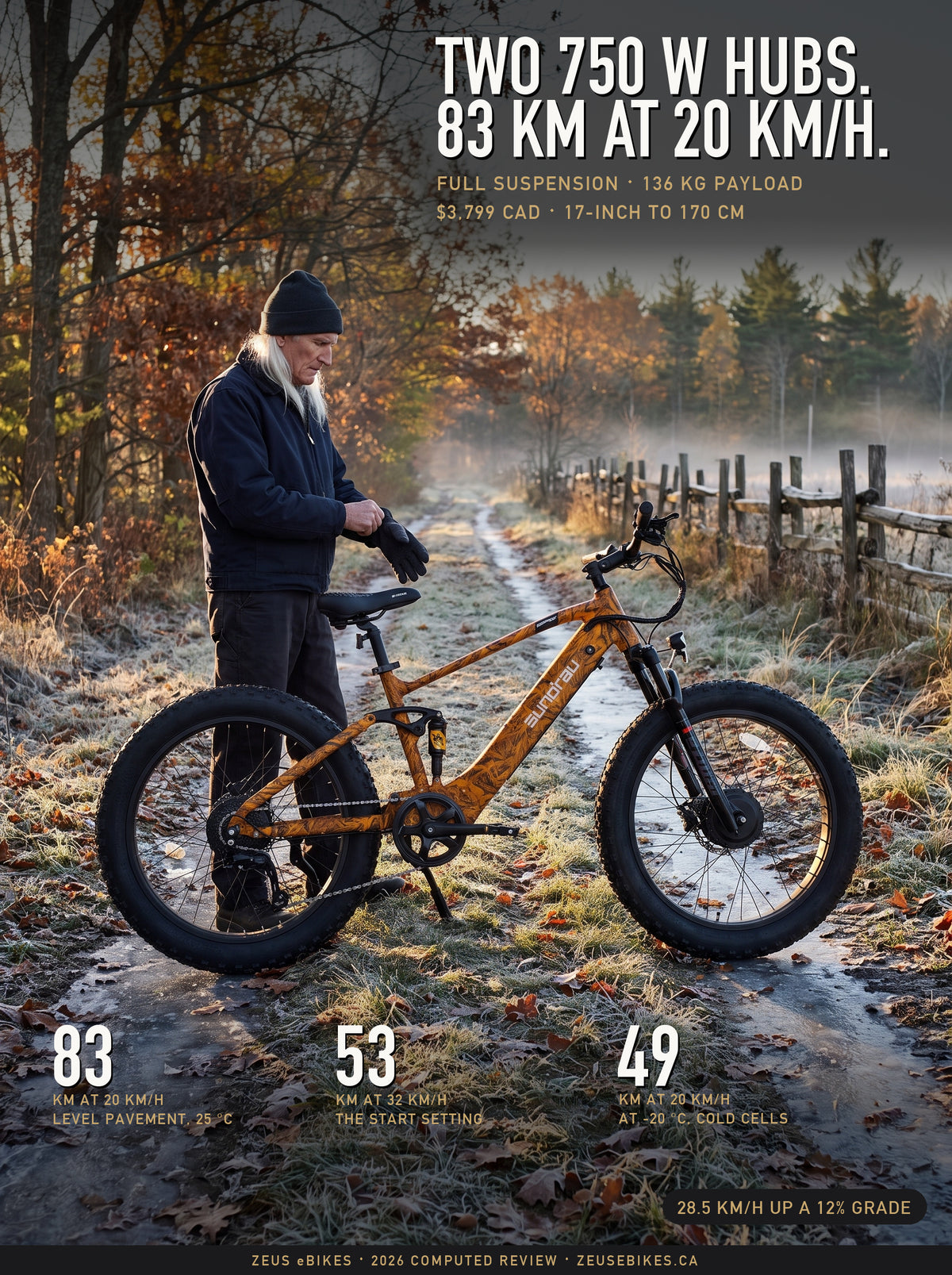
The Specter-S 3.0 is the only bike in this guide with a Bafang M620 (G510) mid-drive motor — a unit that is widely regarded as the benchmark for off-road mid-drive performance. Its 160 Nm of torque is multiplied through the SRAM NX 11-speed drivetrain, which means on the steepest Canadian mountain hunting terrain, this bike can sustain climbing output that hub motors simply cannot maintain without overheating under repeated load. For hunters targeting BC coastal zones, Rocky Mountain side-hills, and Quebec Laurentian escarpments where the terrain profile demands serious climbing efficiency, this is the correct motor choice.
The inverted fork (140mm travel) is a specific design choice for high-impact, high-load riding: the inverted tube design is stiffer under lateral load and more resistant to the flex that standard telescoping forks exhibit when heavily loaded front-to-rear. Combined with the full rear suspension and 4.0-inch fat tires, this bike handles the most demanding Canadian mountain hunting terrain. The Leaf Camo colour is purpose-built for this application. Current promo at time of writing includes a free secondary 48V 15Ah battery (+840 Wh, essentially doubling range), a 27.5×3" alternate wheel set, and a single-speed cassette conversion kit — a significant value addition for hunters who want flexibility between full-power trail use and a quieter single-speed bush configuration.


Full Comparison: 6 Hunting eBikes Side by Side
| Bike | Price CAD | Motor / Power | Torque | Battery | Range | Payload | AWD? | Suspension | Sensor |
|---|---|---|---|---|---|---|---|---|---|
| Raptor ST202 Pro | $2,599 | Dual hub / 3,000W | 150 Nm | 52V 50Ah / 2,600 Wh | 161 km | 400 lb | ✅ AWD | Full (coil) | Cadence |
| Ranger Air M-540 | $2,099 | Dual hub / 3,500W | 200 Nm | 48V 25Ah / 1,200 Wh | 64–97 km | 400 lb | ✅ AWD | Full | Cadence |
| Warrior Pro M-530 | $2,899 | Dual hub / 4,000W | 240 Nm | 48V 30Ah / 1,440 Wh | 97–193 km | 400 lb | ✅ AWD | Full (downhill) | Cadence |
| FAT-AWD 3.0 | from $2,299 | Dual hub / 1,000W | 110 Nm | 48V 15Ah / 720 Wh (+$679 upgrade) | ~64 km (128 km dual) | 375 lb | ✅ AWD | Hardtail (RST 95mm) | Torque |
| Velotric Nomad 2X | $4,099 | Hub / 750W (1,400W peak) | 105 Nm | 48V 16.7Ah / 801.6 Wh | ~120 km (PAS) | 560 lb / 1,000 lb tow | Single | Full air (DNM) | SensorSwap |
| Specter-S 3.0 | $4,099 | Bafang M620 mid-drive / 1,000W | 160 Nm | 48V 17.5Ah / 840 Wh (+free 2nd batt.) | Extended with free battery | 300 lb | Single (mid-drive) | Full (inverted 140mm) | Torque |
How to Choose Your Hunting eBike
Five questions narrow the decision to one or two bikes for most Canadian hunters:
1. How far is your round-trip access ride? Under 80 km: any bike in this guide handles it. Over 100 km: the Raptor ST202 Pro (161 km, 2,600 Wh) is the only bike with sufficient reserve margin. Over 80 km in technical terrain: the Warrior Pro M-530 (97–193 km, 1,440 Wh) or Specter-S 3.0 with free second battery are strong choices.
2. Does your territory have genuine AWD conditions? Spring mud, creek crossings, side-hills: choose an AWD model. Budget AWD: Ranger Air M-540 ($2,099). AWD with max power: Warrior Pro M-530 ($2,899). AWD with torque sensor and lightest weight: FAT-AWD 3.0 (from $2,299). Flat terrain without these conditions: Velotric Nomad 2X (highest payload) or Specter-S 3.0 (best hill climber).
3. What is your typical game load? Deer-sized: 400 lb rated bikes handle most scenarios. Elk or moose quarters: the Velotric Nomad 2X at 560 lb capacity is the strongest single-bike option, supplemented with a game cart for the heaviest loads.
4. Is Canadian mountain terrain part of your hunting? BC coastal, Rocky Mountain, or Laurentian escarpment terrain with sustained climbing: the Specter-S 3.0 (Bafang M620 mid-drive) is the correct choice. Flat-to-moderate boreal terrain: hub drive AWD bikes are equivalent or superior.
5. What is your budget ceiling? Under $2,000: Ranger Air M-540. $2,000–$2,500: Raptor ST202 Pro or FAT-AWD 3.0. $2,500–$3,000: Warrior Pro M-530. $3,000–$3,500: Velotric Nomad 2X. Premium: Specter-S 3.0. For a broader look at AWD options beyond hunting-specific use, see our best dual motor eBikes Canada 2026 guide and the long-range electric bikes Canada guide for battery and range planning.
Frequently Asked Questions — Hunting eBikes Canada
How quiet are hunting eBikes compared to a gas ATV?
Hub motor eBikes at low approach speeds (5–10 km/h) run at roughly 50–65 dB — comparable to a quiet conversation. A gas ATV idles at 85–95 dB and peaks well over 100 dB under load. That 30–40 dB difference is not marginal; it's the difference between alerting game at 500 metres and approaching without notice. Most hunters report they can ride to within 100–200 metres of where they've seen game without a reaction.
Do I need AWD for hunting in Canada?
AWD is genuinely useful in three Canadian hunting scenarios: spring mud season, creek crossings where you need traction on both wheels simultaneously, and steep deadfall-littered side-hills where front traction loss causes the bike to wash out. For flat boreal bush on packed skidder trails, single-motor is sufficient and noticeably lighter. If your hunting territory includes any of these conditions, AWD is worth the extra weight and cost.
What payload do I need for packing out game on an eBike?
A whitetail deer quartered is roughly 100–150 lbs of boneless meat plus hide and head. An elk quartered is 250–350 lbs. Add your body weight and riding gear to that. Most hunters need a 350–400 lb total capacity bike — meaning a 200 lb rider has 150–200 lbs of cargo capacity. The Velotric Nomad 2X is the strongest pick here at 560 lb total rated capacity. AWD bikes with rear racks (Freesky Ranger Air comes with one) distribute load more effectively on rough ground.
What tire size is best for Canadian hunting terrain?
4.0-inch fat tires on 26-inch wheels are the standard for serious Canadian hunting use. The wider footprint floats over soft muskeg, distributes weight on snow, and provides the volume needed to run at 6–10 psi for maximum grip on wet root systems. 20-inch wheeled bikes (like the Raptor ST202 Pro) are more manoeuvrable in tight bush but roll less efficiently over obstacles. For pure bush use, 26×4.0" is the preferred format.
Can I use a hunting eBike in winter in Canada?
Yes, with caveats. Lithium batteries lose 20–40% capacity at −10 to −15°C. The Freesky Ranger Air M-540 is the only bike in this group with published winter range data: 38–92 km at −10 to −15°C versus 64–97 km in moderate temperatures. Battery insulation (neoprene sleeve) and storing the bike warm before departure extend cold-weather performance. Early and late-season hunting (September–October, November) is generally fine; deep winter use requires planning.
Is the Bafang M620 mid-drive better than hub drive for hunting?
For sustained Canadian hill climbing with a loaded rear rack, yes. A Bafang M620 mid-drive multiplies its 160 Nm through the drivetrain gears — so on a 20% grade, you're effectively putting far more torque to the ground than a comparably rated hub motor. The trade-off is noise: mid-drive drivetrains produce more chain noise under heavy load than hub motors. On flat boreal terrain, a quality AWD hub setup is equally effective and simpler to maintain.
Do hunting eBikes work in deep snow?
Yes, with the right setup. Fat tires at 6–8 psi on packed snow perform well — the wide footprint distributes weight across the surface instead of sinking through it. The primary challenge is battery capacity: lithium batteries lose 20–40% capacity at −10 to −15°C. For packed trail conditions in early winter, most bikes in this guide handle it without issue. For deep unpacked powder, AWD traction helps significantly — the Ranger Air M-540 and FAT-AWD 3.0 are the two picks with the most relevant cold-weather data. Store the bike warm the night before and pre-warm the battery before departure.
The Bottom Line

The best hunting eBike for a Canadian hunter in 2026 is the one matched to their specific terrain and game. For most hunters, that means the Raptor ST202 Pro — the AWD, long-range, IP65-rated all-rounder that covers the widest range of Canadian conditions. Budget-focused hunters get genuine AWD at $1,928 with the Ranger Air M-540. Maximum power hunters get 4,000W AWD and downhill suspension with the Warrior Pro M-530. Hunters who want stealth torque-sensor precision get it with the FAT-AWD 3.0. Hunters who need to pack out the most weight choose the Velotric Nomad 2X. And hunters targeting serious Canadian mountain terrain get the best sustained climber with the Specter-S 3.0.
Browse the full hunting eBike collection, or explore the complete AWD range for dual-motor options across all riding styles.
Shop Hunting eBikes All AWD eBikes📸 All photography by Playcut.ai — personalized AI actor technology
Share:
SmartTravel Raptor ST201 Review
eBikes & Mental Health: 7 Research-Backed Pathways (2026)