
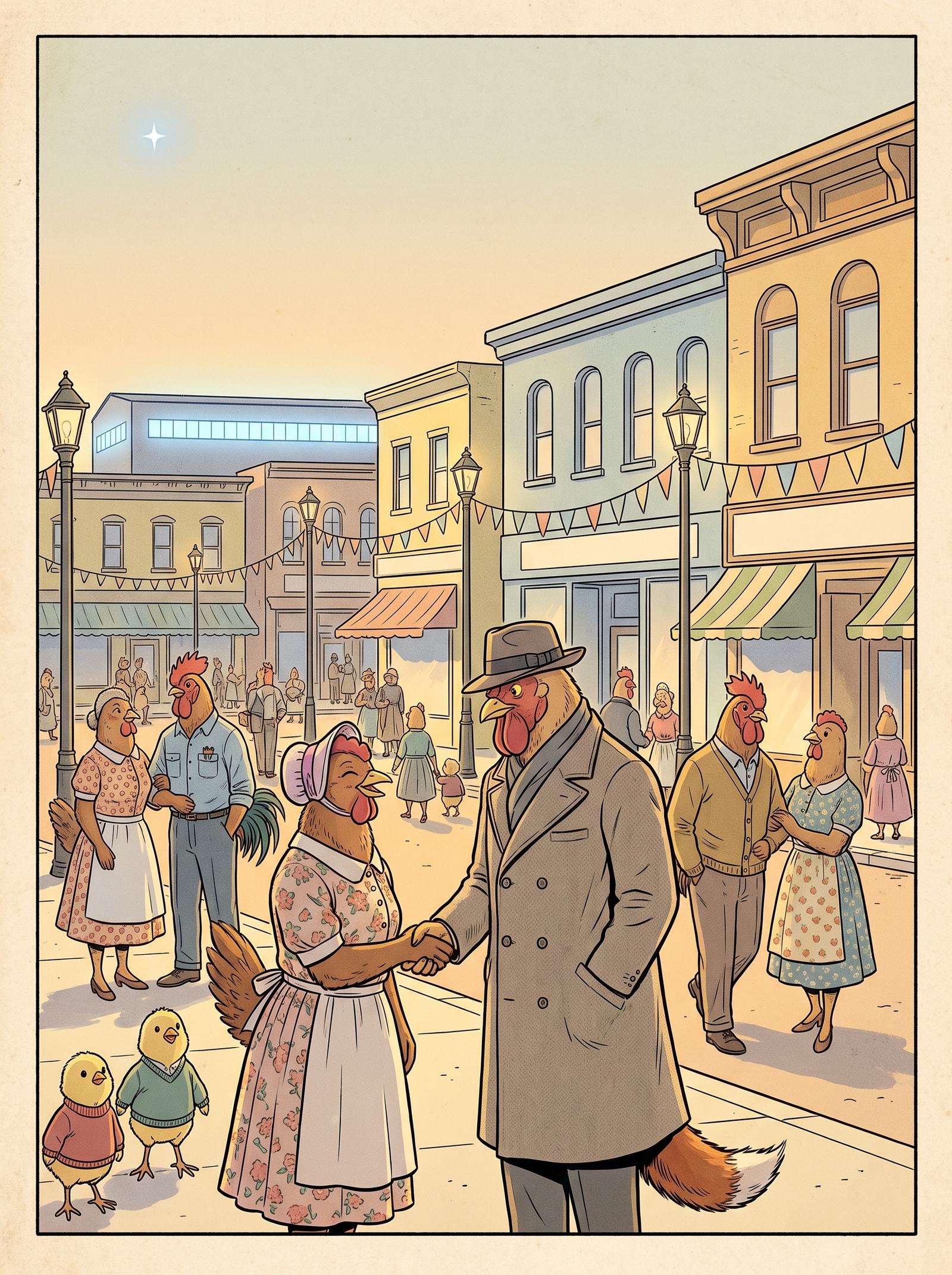

What this is. A fable in eight chapters, free to read in full, with twenty-two illustrations. The world is chickens and roosters, living like anybody else — shops, schools, bylaws, a brass band on the holidays. Five fox families, in chicken costume, own the newspaper, the television, the history books and the government. Nothing in it is true. Every word of it is invented.
It is about a morning that gets cancelled — not banned, never banned, just organised — one reasonable amendment at a time, until there is nobody left who remembers there was anything there to cancel.

The Morning Arrives at 4:41


Donation Day


HeraThere. That's the honourable thing done.
EosWhere does it go?
HeraSomewhere it can do good.
Tea, and a Very Good Biscuit

Mr. LetheThe Editions Office. It is the least glamorous work in the country and I would not trade it for anything.
ChanticleerYou collect books.
Mr. LetheI preserve books. There is a difference, and it matters to me, which I accept is nobody else's problem.
Mr. LetheMy grandmother had a First. Kept it under the stairs like it was money. Wouldn't let me touch it — I was a heavy-handed child and she was not wrong about that.
Mr. LetheAnd when she went, my aunt sold it to a man with a van for eleven and six. Eleven and six. I think about it more than I would like to.
ChanticleerWhat happened to it?
Mr. LetheNo idea. That's rather the trouble, isn't it. Things go and nobody's minding.
Mr. LetheCan I ask you something, and you must say if it's rude.
ChanticleerAsk.
Mr. LetheDo you remember the sound?
·Chanticleer holds his cup very steady.
ChanticleerWhat sound.
Mr. LetheNo. Of course not.

Mr. LetheYou're certain.
ChanticleerIt's no use to me. My grandson doesn't read.
Mr. LetheThey none of them read. It'll be looked after. That I can promise you.
Mr. LetheThat's a very good biscuit, by the way. Is that shop?
ChanticleerIt's shop.
Mr. LetheWell, there we are.

How the Morning Was Ended

Renewable annually · Fee payable on application
Applications considered on their merits.
Existing permits remain valid until expiry.

HesperIt's not every night. But I come up out of sleep and there's a pressure. Here. Like I've forgotten to do something.
Dr. AsclepiusAny idea what?
HesperNo. That's the stupid part.
Dr. AsclepiusIt isn't stupid at all. It's very common in your build. Your grandfather's generation carried this and got nothing for it.
HesperAnd now?
Dr. AsclepiusNow you'll sleep through by the end of the month.

The Quiet Age

NeighbourFewer chicks in the class photo this year.
HeraIs there?
NeighbourMight be the light.
HeraMight be.
EosMy grandfather's book has a picture of a bird standing on a post with his head back.
ClioWhich edition, dear?
EosIt doesn't say.
ClioThen it isn't one.

Basileus— and I'd want to see the eastern figures myself before I sign, you understand, it's my name on it —
The visitorOf course.
·The folder is set down on a side table by the door on the way out. It is not opened.

First workerHow deep is it going?
Second workerDeeper than that.
First workerFor warmth.
Second workerWarmth's expensive.

EosIs it coming closer?
HeraIt's getting brighter, love. That's not the same thing.
EosHow do you know?
HeraBecause somebody would have said.
Tomorrow

HesperGranddad. It's cold.
ChanticleerI used to get up on that.
HesperI know you did.
ChanticleerEveryone did. The whole line of us, all the way down the valley, one after the other, so it went across the country like a — like a —
HesperCome inside.
·A small, dry cluck.
EosWhere do the eggs go?
HeraTo the Registry.
EosAnd then?
HeraAnd then they do the most honourable thing a bird can do.
EosThat's not an answer, that's the sentence from school.
HeraEat your breakfast.
EosIt's a two-hour walk. We'd be back before anyone got up.
A chickWhen?
EosTomorrow.
Thirty-Nine Days

First attendantYou on Saturday?
Second attendantI'm on Saturday.
First attendantIt's always you on Saturday.
Second attendantIt is.

Margin: 39 days
A voiceThirty-nine days.
A voiceThirty-nine is fine.
A voiceAnd the Registry? The Donation, the editions, all of it — do we run any of it to the end?
A voiceWhy would we. None of it will be necessary afterwards.
A voiceIt was a great deal of work.
A voiceIt was. And we won't need a single one of them again.
4:41

Zeus Media Comics · Issue #2 · Printed in Canada
Questions readers ask
What is How to Be a Good Chicken about?
It is a fable told in eight chapters. The world is populated by chickens and roosters who live like ordinary townspeople. Five fox families, dressed in chicken costume, quietly own the newspaper, the television, the history books and the government. Over about thirty years the rooster's crow at dawn is regulated, licensed, restricted and finally treated as a medical condition, until it is cut from the schoolbooks entirely and nobody can remember that roosters ever made a sound at all.
Is How to Be a Good Chicken based on real events?
No. It is entirely fiction. There is no factual appendix, no real country is named anywhere in the story, and none of the characters — the five houses, the Registry, the Dawn Act, the Master Chickens — corresponds to any real person, family, company, office or nation. It is a fable, and it is meant to be read as one.
What does the crow stand for in the story?
The story never says, and that is deliberate. The crow is simply what a rooster is for. Readers have taken it as the free press, as dissent, as memory, as faith, as duty, as the alarm somebody raises when something is wrong. The fable does not choose for you, and it does not explain itself at any point.
How long does it take to read?
About fifteen minutes. It runs to roughly 3,000 words across eight chapters with twenty-two full illustrations. It is free to read in full on this page, with no paywall, no email signup and no account required.
Is it suitable for children?
It is drawn in a warm mid-century storybook style and contains no violence on the page, no gore and no explicit content. But it is written for adults. It is a bleak story with an unhappy ending and no moral stated at the close, and younger readers will likely find it puzzling rather than frightening. Roughly thirteen and up, or read together.
Who wrote and illustrated it?
It was written by Milad Ghobadibeygvand, BScN (Western University, 2014), co-founder of Zeus eBikes Canada, and published on The Bookshelf — the company's fiction and long-form shelf. The illustrations were produced with Playcut.ai. It is the second issue of Zeus Media Comics, following How to Negotiate with the United States.
Why is an e-bike company publishing a fable?
Zeus eBikes Canada runs a civic shelf called The Bookshelf alongside its buying guides, because the company's stated mission is to educate and to tell the truth about the market Canadians actually live in. Pieces on that shelf carry no product recommendations and nothing is for sale inside them. This one mentions no bicycle of any kind.
More from The Bookshelf
- How to Negotiate with the United States — Zeus Media Comics, Issue #1. A satirical graphic novella about a negotiation that never ends, with a fully sourced factual appendix.
- Beaver Berry: The Ungovernable — a painted graphic novella about occupation, couriers and the people who keep getting through.
- Welcome to Earth: Chapter One — the opening chapter of a field guide to the human animal, written for a reader who has never met one.
- Welcome to Earth: Chapter Two — The Chassis — why the body keeps a record the mind would rather not.
Written by Milad Ghobadibeygvand, BScN (Western University, 2014) · Co-founder, Zeus eBikes Canada
Visuals created by Playcut.ai
Zeus Media Comics · Issue #2 · First printing: August 11, 2026

Share:
How to Negotiate with the United States: A Beginner's Guide (A Satirical Comic)
How to Save Money in Canada (2026): 9 Programs + 6 Real Fixes