

Fat Tire Electric Bikes Canada (2026): 11 Verified Picks

Zeus eBikes Canada · Fat Tire Guide 2026 · Photo by Playcut.ai
Fat tire electric bikes are the most practical e-bike category for Canadian conditions. The wider rubber — 4.0 inches and up — delivers a larger contact patch that grips snow, sand, gravel, and potholed urban roads that would punish a standard tire. Canada's e-bike market is growing at 11.18% CAGR (Mordor Intelligence, 2025), and fat tire models are driving much of that growth as riders discover they can commute year-round instead of parking the bike from November to April.
This guide covers 11 fat tire e-bikes sold by Zeus eBikes, a Canadian direct-to-consumer electric bike retailer shipping free across all provinces. Prices range from $1,199 to $5,599 (everyday prices, re-read from the Zeus store on October 16, 2026). Specs were first verified from the product pages on March 2, 2026; on October 16, 2026, five picks were replaced, their specs read from the Zeus listing and the maker's own page, and every pick's price, battery, weight and payload re-read from its Zeus listing. Stock changes daily; each product page shows what can be ordered.
In This Guide
- Why Fat Tires Matter in Canada
- Fat Tire vs Regular: The Real Difference
- How to Choose a Fat Tire eBike
- 20-Inch vs 26-Inch Fat Tires
- Tire Pressure Guide by Terrain
- Winter Riding: Battery & Traction Reality
- 11 Best Fat Tire eBikes in Canada
- All 11 Picks Compared
- Frequently Asked Questions
- The Bottom Line
Why Fat Tires Matter in Canada
Fat tires — defined as 3.8 inches (97 mm) or wider (Wikipedia) — reduce ground pressure by distributing rider and bike weight across a larger surface area. On snow, this means floating over the surface instead of cutting through it. On gravel, it means absorbing impacts that would rattle a standard 2-inch tire. On Canada's famously rough spring roads, it means fewer flats and more comfort.
The trade-off is rolling resistance. Lab testing by BicycleRollingResistance.com shows a fat tire at 6 PSI uses roughly 37 watts of resistance per tire, compared to about 7 watts for a road tire at 72 PSI. That is an extra 60 watts across both wheels. On a pedal-only bike, you would feel that. On an e-bike with 500–1,000 watts of motor assist, you will not notice it at all.
For Canadian riders, the calculus is simple: fat tires extend your riding season by months. Riders in Montreal — where winter cycling trips on Laurier Avenue grew 540% over five years (Eco-Counter) — are proving that e-bikes are not just summer machines.
Fat Tire vs Regular Tire: The Real Difference
A fat tire is not just a wider version of a regular tire. The engineering is fundamentally different: lower pressures, different bead profiles, and wider rims change how the tire interacts with every surface. Here is how they compare on the metrics that matter to Canadian riders.
Regular Tire (1.75"–2.5")
Pressure: 40–65 PSI
Rolling resistance: Lower — faster on pavement
Weight: Lighter tire + lighter rim
Snow/ice: Poor grip, cuts through
Comfort: Moderate — depends on suspension
Best for: Dry pavement, paved bike paths, weight-sensitive builds
Fat Tire (4.0"–4.5"+)
Pressure: 5–30 PSI (adjustable by terrain)
Rolling resistance: Higher — motor compensates
Weight: Heavier tire + wider rim
Snow/ice: Strong grip, floats over surface
Comfort: High — tire acts as suspension
Best for: Snow, gravel, rough roads, year-round Canadian commuting
How to Choose a Fat Tire eBike: 4 Factors That Actually Matter
Ignore the marketing specs that do not affect your real-world riding. These four factors determine whether a fat tire e-bike works for Canadian conditions or just looks good on paper.
1. Battery Size — Cold Weather Eats Range
Lithium-ion batteries lose capacity in cold weather. Bosch eBike Systems estimates up to 30% range reduction below 0°C. Battery University data shows roughly 50% capacity at -18°C. A bike rated for 100 km in summer may deliver 50–70 km in a Canadian January. Buy more battery than you think you need. The picks in this guide range from 48V 12.5Ah (600 Wh) to 60V 80Ah (4,800 Wh).
2. Brakes — Hydraulic Disc or Nothing
Fat tire e-bikes are heavy: the picks in this guide weigh 28 to 93 kg with battery. Add a 90 kg rider and you have 118–183 kg moving at 30+ km/h. Mechanical disc brakes struggle with that load, especially in wet or icy conditions. Nine of the 11 picks have hydraulic disc brakes. The Z8 (both versions) has mechanical discs — adequate for lighter riders, but the first upgrade we would recommend — and Eunorau prints the E-FAT-MN's brakes both as hydraulic and as mechanical disc.
3. Torque & Throttle — Real-World Usability
Torque (measured in Nm) determines hill-climbing ability and acceleration from a stop. A mid-drive motor multiplies torque through the gears, so 160 Nm from a mid-drive (Eunorau's rating for the Bafang G510 that drives the Specter-S 4.0) feels more powerful on a steep hill than 200 Nm from a hub motor. A thumb or twist throttle lets you accelerate without pedalling — essential for intersection starts on icy roads.
4. Payload — The Hidden Deal-Breaker
Payload capacity determines whether you can carry groceries, a child seat, or work tools. Most fat tire e-bikes in this guide support 330–400 lbs (150–181 kg). If you weigh over 100 kg or plan to haul cargo, check the maximum payload before anything else. Three picks support 400 lbs or more: the Ranger Air M-540 and TIGER PLUS (400 lbs) and the Romeo Ultra II (500 lbs).
20-Inch vs 26-Inch Fat Tires
Wheel diameter affects handling, comfort, portability, and obstacle clearance. Neither size is universally better — it depends on how and where you ride.
| Factor | 20-Inch Fat Tire | 26-Inch Fat Tire |
|---|---|---|
| Manoeuvrability | Tighter turning radius — better for city riding | Wider turns — better stability at speed |
| Obstacle clearance | Bumps feel bigger — tire absorbs some | Rolls over roots, curbs, potholes more smoothly |
| Storage | Compact — fits in apartment hallways, car trunks | Larger footprint — needs garage or shed space |
| Folding frames | Most folding fat tire bikes use 20" wheels | Folding 26" models are rare |
| Trail comfort | Adequate for groomed paths | Superior on rough singletrack and gravel |
| Speed stability | Slight wobble above 40 km/h | More planted at higher speeds |
| Best for | Urban commuting, folding portability, storage-limited riders | Trail riding, long-distance comfort, off-road hunting |
Tire Pressure Guide by Terrain
Fat tire pressure is the single biggest performance variable you control. The right PSI for snow is completely wrong for pavement. This chart covers the most common Canadian riding surfaces — adjust based on your weight and tire width.
| Terrain | Recommended PSI | Why |
|---|---|---|
| Deep snow | 3–10 PSI | Maximum float — tire spreads across surface instead of cutting through |
| Packed snow / groomed trail | 8–12 PSI | Balance of grip and rolling efficiency on compacted surfaces |
| Sand / beach | 8–12 PSI | Similar physics to deep snow — wider contact patch prevents sinking |
| Gravel / dirt trail | 12–18 PSI | Enough give to absorb rocks, enough pressure to prevent pinch flats |
| Wet pavement | 15–22 PSI | Wider contact patch than road PSI improves wet braking |
| Dry pavement | 20–30 PSI | Minimises rolling resistance for commuting efficiency |
Sources: Rize Bikes Canada, Hycline, Leo Guar Bikes. Always check the maximum PSI printed on your tire sidewall.
Winter Riding: Battery & Traction Reality
Fat tires handle winter traction. Batteries do not. Cold is the number one range killer for any e-bike in Canada, and no amount of tire width fixes that. Here is what published data says — and what you can do about it.
Cold Weather Range Loss — Real Numbers
| Temperature | Expected Range Loss | Source |
|---|---|---|
| 0°C to -5°C | 15–25% | Shimano STEPS |
| -5°C to -10°C | 25–35% | Shimano STEPS / Bosch eBike Systems |
| -10°C to -18°C | 35–50% | Battery University (BU-502) |
| Below -18°C | 50%+ | Battery University (BU-502) |
5 Winter Battery Rules
- Store the battery indoors at 15–20°C. Install it on the bike immediately before riding.
- Never charge below 0°C. Charging a frozen lithium-ion cell damages it permanently.
- Plan for half your rated range on days below -10°C. If the bike claims 100 km, plan a 50 km route.
- Insulate the battery if riding longer than 30 minutes in extreme cold. Neoprene covers are inexpensive and effective.
- Bring the battery back inside immediately after your ride. Let it warm to room temperature before charging.
Shopping for winter capability? Browse the full Zeus eBikes mountain and off-road collection — every bike ships free across Canada.
11 Best Fat Tire eBikes in Canada (2026)
One pick per use case. Specs come from each bike's Zeus product page (first verified March 2, 2026; picks 2, 3, 4, 9 and 11 replaced and verified October 16, 2026). Every bike ships free across Canada; stock changes daily, so each product page shows what can be ordered.
1. Z8 — Best Budget Fat Tire Starter
Best for: First-time fat tire riders who want to spend under $1,400
Motor: 500W rated (1,500W peak), 80 Nm · Battery: 48V 15.6Ah (Z8) / dual 48V 15.6Ah (Z8 Pro)
Tires: 20×4.0" · Brakes: Mechanical disc + electronic brake (both versions) · Weight: 89–112 lbs
Payload: 330 lbs on Riding Times’ page, 120 kg in its manual · Price: $1,199–$1,599 CAD
The Z8 is among the lowest-priced fat tire bikes at Zeus. The moped-style frame is low-slung and stable, the 20×4.0" tires handle packed snow and gravel, and the range on the Pro model (dual battery, 120–150 km PAS) is competitive with bikes costing twice as much. Two versions are orderable: the $1,199 Z8 for basic rides and the $1,599 Z8 Pro for dual-battery all-day range.
Honest trade-off: The base Z8 has mechanical disc brakes — workable for lighter riders on flat terrain, but hydraulic is the standard for this weight class. Both orderable versions use mechanical discs.
2. Freesky Ranger Air M-540 — Best Value Full-Suspension Step-Thru
Best for: Riders who want a step-thru frame, full suspension and all-wheel drive for trails and private land
Motor: Dual 2,000W hub motors (4,000W peak, AWD), 210 N·m combined · Battery: 48V 25Ah (1,200 Wh)
Tires: 26×4.0" · Brakes: 4-piston hydraulic disc, 180mm · Weight: ~95 lbs
Payload: 400 lbs · Gears: Shimano 7-speed · Price: $2,099 CAD
Two 2,000W hub motors drive both wheels with 210 N·m between them, a front fork and a rear shock take the edge off roots and frost heaves, and the step-thru frame means you never swing a leg over a crossbar. Freesky rates it for a 400 lb payload, and the 4-piston hydraulic brakes on 180mm rotors are sized for that kind of load. The 48V 25Ah battery holds 1,200 Wh.
Honest trade-off: At 4,000W peak it sits far above the 500W line provincial e-bike rules converge on, so Zeus sells it for off-road trails, private property and routes that permit motorised vehicles, not for public roads, bike lanes or pathways. It uses a speed (cadence) sensor rather than a torque sensor, and at about 95 lbs it is not a bike you carry upstairs. Colour availability changes; the product page shows which colours can be ordered.
→ View the Ranger Air M-540 on Zeus eBikes
3. Eunorau E-FAT-MN — Best Folding Fat Tire
Best for: Apartment dwellers, car-trunk commuters and anyone who has to store a fat bike in a small space
Motor: 500W rear hub, 80 Nm · Battery: 48V 12.5Ah (600 Wh), removable
Tires: 20×4.0" Kenda · Brakes: Disc with motor cut-off (Eunorau prints both hydraulic and mechanical) · Weight: 62 lbs
Payload: 330 lbs · Gears: Shimano Altus 7-speed · Price: $1,899 CAD (from $2,299 with a second battery)
At 62 lbs (28 kg), the E-FAT-MN is the lightest bike in this guide, and its folding 6061 aluminium frame and telescoping stem collapse it for a closet, a car trunk or an RV bay. The 80 Nm hub pulls 20×4.0-inch Kenda tires that float over gravel, sand and packed snow, and the battery comes out for charging indoors. A second battery is an option on the Zeus listing for riders who want more cold-weather range, and our folding e-bike guide sets it beside the other folders.
Honest trade-off: The fork is rigid, so the 4-inch tires do all the cushioning, and the 600 Wh standard battery is the smallest in this guide. It is built to the 500W / 32 km/h lines the provincial e-bike rules converge on, but Eunorau also labels it “Class 3”, a US class that assists to 28 mph (45 km/h), so which describes it as shipped is not settled; check your province before riding it on public roads.
→ View the E-FAT-MN on Zeus eBikes
4. Taubik Tour S — Best All-Around Step-Thru
Best for: Daily riders who want an easy-mount frame, fenders and a lit rack out of the box, and a choice of torque or cadence assist
Motor: 500W Bafang rear hub, 80 Nm · Battery: 48V 15Ah Samsung (certified in accordance with UL 2271, per Taubik)
Tires: 26×4.0" Kenda Juggernaut · Brakes: Zoom hydraulic disc, dual-piston, 180mm · Weight: 77 lbs (Taubik's page; 35.5 kg in its manual)
Payload: 286 lbs (Taubik's page; 120 kg in its manual) · Gears: Shimano Acera 8-speed · Price: $2,899 CAD
The Tour S is the step-thru in this guide built for everyday riding rather than one extreme. A 500W Bafang hub with 80 Nm sits behind a step-through frame that makes getting on and off easy, and Taubik's page lists a dual torque/cadence sensor, so the assist can respond to how hard you pedal or simply to whether you are pedalling (its manual's spec table lists a torque sensor). It ships with full front and rear fenders and a rear rack that carries a brake light, and its 26×4.0-inch Kenda Juggernaut tires are the same size as the Westridge 4T's. Taubik describes itself as a proudly Canadian-owned electric bike company.
Honest trade-off: Taubik's page rates it for 286 lbs and its manual for 120 kg (265 lbs), the lowest load ratings in this guide alongside the Westridge 4T, so heavier riders should look at the 400 lb TIGER PLUS or Ranger Air M-540. A full charge takes 6–8 hours on the included 3A charger, according to the manual.
→ View the Taubik Tour S on Zeus eBikes
5. Eunorau FAT-AWD 3.0 — Best AWD for Snow & Cargo
Best for: Riders who need all-wheel drive traction for snow, hills, or heavy loads
Motor: Dual 500W AWD (front + rear), 110 Nm combined · Battery: 48V 15Ah LG (optional second 15Ah)
Tires: 26×4.0" Kenda Krusade · Brakes: Hydraulic disc, 180mm · Weight: ~79 lbs
Payload: 375 lbs · Gears: Shimano 7-speed · Price: $2,299–$2,425 CAD
The FAT-AWD 3.0 is one of the few true AWD step-thru e-bikes in Canada. Two independent 500W hub motors provide traction on both wheels — a genuine advantage in deep snow, steep wet hills, or when hauling 50+ lbs of groceries. The torque sensor delivers proportional pedal assist that feels natural, and the Eunorau GO app adds smartphone integration. With a second 15Ah battery, range extends to approximately 130 km in mild conditions.
Honest trade-off: The 15Ah single battery limits winter range to roughly 45–65 km below -5°C. Budget for the second battery if you plan to ride through Canadian winters. The 95mm front fork travel is modest for aggressive trail riding.
→ View the FAT-AWD 3.0 on Zeus eBikes
6. Smartravel Raptor ST202 Pro — Most Battery per Dollar
Best for: Riders who want the most battery their money can buy
Motor: Dual 1,500W (3,000W total), 150 Nm · Battery: 52V 50Ah Samsung/LG (2,600 Wh)
Tires: 20×4.0" · Brakes: Hydraulic disc, 180mm · Weight: 123.7 lbs (56.2 kg) with both batteries
Payload: 350 lbs · Gears: Shimano 7-speed · Price: $2,599 CAD
The Raptor ST202 Pro carries 52V 50Ah (2,600 Wh), the second-largest battery in this guide and the most watt-hours per dollar of any pick, about one for every dollar of its $2,599 price. That is 3.5 times the single-battery Z8's 749 Wh and 3.6 times the FAT-AWD 3.0's standard 720 Wh. The dual 1,500W motors provide serious acceleration. KKE R150S adjustable suspension (140mm front travel) smooths out rough roads. IP65 water resistance is confirmed on the product page. GPS tracking with a phone app adds theft recovery.
Honest trade-off: At 123.7 lbs with both batteries, this is not a nimble city bike. Colour availability changes; the product page shows which colours can be ordered. The GPS tracking requires a monthly subscription. The 52V system means standard 48V accessories and chargers are not compatible.
→ View the Raptor ST202 Pro on Zeus eBikes
Need help choosing? Compare all dual-motor e-bikes or explore the longest-range models in Zeus's lineup.
7. Taubik Westridge 4T — Best Off-Road From a Canadian-Owned Brand
Best for: Trail riders who want a bike from a Canadian-owned brand with a Bafang motor and torque sensor
Motor: 500W Bafang (1,000W peak), 80 Nm · Battery: 48V 15Ah Samsung 21700 (UL certified)
Tires: 26×4.0" Kenda Juggernaut Pro · Brakes: Zoom hydraulic disc, 180mm · Weight: 77.6 lbs
Payload: 286 lbs (Taubik's page; 120 kg in its manual) · Gears: Shimano Acera 8-speed · Price: $3,099 CAD
Taubik describes itself as a proudly Canadian-owned electric bike company. The Bafang geared hub motor is a tier above generic hub motors in build quality and efficiency. The torque sensor provides proportional assist that matches your pedalling effort. The Shimano Acera 8-speed drivetrain offers a wider gear range than the 7-speed on most picks in this guide, and Taubik's page lists the Westridge 4T as UL 2849 certified, the e-bike electrical-system standard.
Honest trade-off: Taubik's page rates it for 286 lbs and its manual for 120 kg (265 lbs), the lowest load ratings in this guide alongside the Tour S; heavier riders or cargo haulers should look at the Ranger Air M-540 (400 lbs) or the Romeo Ultra II (500 lbs). The RST air fork is front suspension only — no rear shock. The Kenda Juggernaut Pro tires are 4.0" wide, not the 4.8" listed in some sources.
→ View the Westridge 4T on Zeus eBikes
8. Vtuvia TIGER PLUS — Best Retro Comfort Cruiser
Best for: Riders who want air suspension comfort, retro style, and flexible battery options
Motor: 750W (1,100W peak), 85 Nm · Battery: 48V 35Ah (1,680 Wh)
Tires: 20×4.0" · Brakes: 4-piston hydraulic disc · Weight: ~90 lbs
Payload: 400 lbs · Gears: 7-speed · Price: $2,599 CAD
The TIGER PLUS is the most comfortable bike in this guide. Full air suspension (front and rear) absorbs everything from potholes to trail roots. The dual-seat design fits a passenger. NFC card or phone unlock adds convenience security. The 48V 35Ah battery is listed for up to 130 miles (about 210 km), enough for a full week of 30 km commutes without charging. The retro moped aesthetic is polarising, but riders who love it tend to love it intensely.
Honest trade-off: The 35Ah battery takes about 10 hours to charge, per the listing. At 90 lbs, it is not light. The 7-speed drivetrain is adequate but basic compared to the Westridge's 8-speed Shimano Acera.
→ View the TIGER PLUS on Zeus eBikes
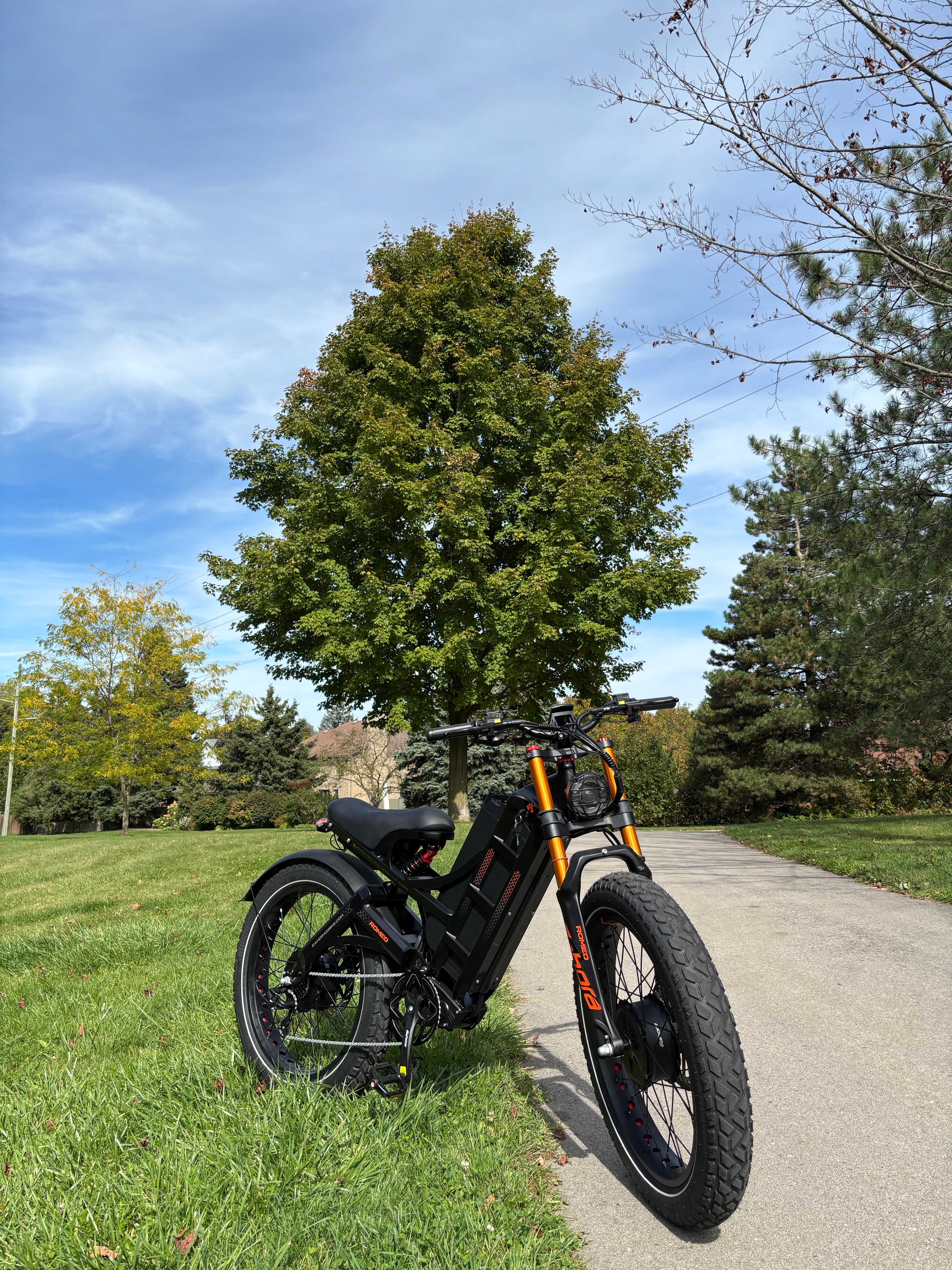
9. Eahora Romeo Ultra II — Biggest Battery in This Guide
Best for: Riders on private land and off-road trails who want the most range and payload in one machine
Motor: Dual hub motors (AWD), 6,000W combined peak, 240 N·m combined; shipped limited to 500W and 32 km/h · Battery: 60V 80Ah (4,800 Wh)
Tires: 26×4.0" · Brakes: Hydraulic disc, 240mm rotors · Weight: 205 lbs (93 kg)
Payload: 500 lbs · Gears: Shimano 7-speed · Price: $5,599 CAD
The Romeo Ultra II carries the largest battery in this guide: 60V 80Ah, or 4,800 Wh, 1.8 times the Raptor ST202 Pro's 2,600 Wh. Even at the roughly 50% capacity Battery University reports at -18°C, that leaves about 2,400 Wh, more than any other pick here except the Raptor holds at full charge in summer. It also carries the highest payload rating in the guide, 500 lbs (227 kg), and stops on 240mm rotors, the largest here alongside the DL2000's. Two hub motors drive both wheels; Eahora ships it limited to 500W and lists its higher peak output for off-road riding.
Honest trade-off: At 205 lbs (93 kg), including an 18 kg battery, it is the heaviest bike in this guide by about 40 lbs, a machine you ride rather than lift. Eahora rates the two motors at 6,000W peak, and whether a province accepts a software-limited bike as a power-assisted bicycle is not settled, so Zeus treats the Romeo Ultra II as an off-road / private-property e-bike at every setting. Pedal assist uses a cadence sensor, and at $5,599 it is the most expensive pick in this guide.
→ View the Romeo Ultra II on Zeus eBikes
10. Eahora DL2000 — Widest Tires (4.5") + Selectable Drive Modes
Best for: Riders who want maximum tire width, dual-motor versatility, and retro moped style
Motor: Dual motors, 2,000W combined peak, 2×65 Nm · Battery: 52V 30Ah (1,560 Wh)
Tires: 20×4.5" (widest in this guide) · Brakes: Hydraulic disc, 240mm rotors · Weight: ~164 lbs
Payload: 330 lbs · Gears: Single-speed · Price: $3,799 CAD
The DL2000 has the widest tires in this guide at 4.5 inches, and its 240mm brake rotors are the largest here, matched only by the Romeo Ultra II. The selectable drive mode lets you switch between dual-motor AWD, front-only, or rear-only on the fly. Front adjustable hydraulic fork (100mm) plus FASTACE rear coil shock provide full suspension. The 2,500-lumen LED headlight with integrated horn is a genuine safety feature for Canadian winter commuting in early-morning darkness.
Honest trade-off: At 164 lbs (74 kg) with battery, the DL2000 is extremely heavy, second in this guide only to the Romeo Ultra II (205 lbs). This is a sit-on-and-ride machine, not something you manoeuvre by hand. The single-speed drivetrain means no gear shifting. The 52V system requires its specific charger (58.8V 4.5A included).
→ View the Eahora DL2000 on Zeus eBikes
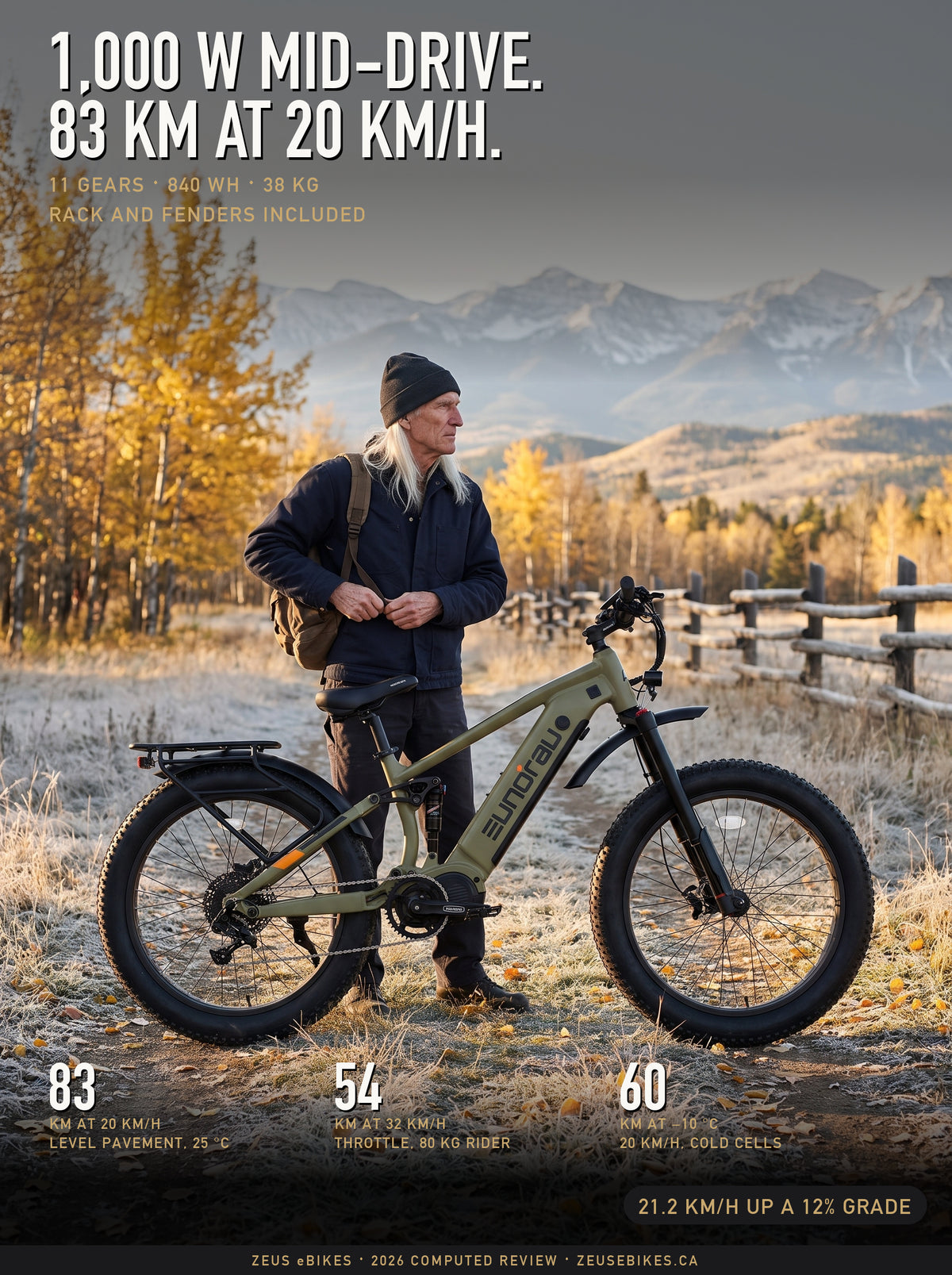
11. Eunorau Specter-S 4.0 / Hunter X9 — Best Premium Mid-Drive
Best for: Experienced trail riders who want a mid-drive motor, a premium drivetrain and full suspension
Motor: 1,000W Bafang G510 mid-drive · Battery: 48V 17.5Ah LG (840 Wh)
Tires: 26×4.0" Kenda · Brakes: 4-piston hydraulic disc, 180mm · Weight: 83.7 lbs (38 kg)
Payload: 300 lbs · Gears: SRAM NX 1×11, 11–42T · Price: $5,099 CAD
The Specter-S 4.0 is the only mid-drive fat tire e-bike in this guide, and its drivetrain shows why mid-drives cost more. The Bafang G510 drives the rear wheel through the SRAM NX 1×11 gears, so in the lowest gear its torque is multiplied before it reaches the tire, which a hub motor fixed in the wheel cannot do. Eunorau does not print a torque figure on the 4.0 listing; it rates the same G510 at 160 N·m on its Specter-ST 2.0. A 140mm fork and a rear shock give it full suspension, an aluminium rear rack and full fenders come on the bike, and the SRAM NX 1×11 is the highest-tier groupset in this entire list.
Honest trade-off: The 17.5Ah battery (840 Wh) is small for a $5,099 bike: Eunorau estimates up to 64 km per charge, and its optional 48V 5Ah second battery raises that to 83 km. At 1,000W the motor is above the 500W line provincial e-bike rules converge on, so treat it as an off-road machine for private land and permitted trails. At $5,099 it is the second most expensive pick here, after the Romeo Ultra II, and the frame is step-over only.
→ View the Specter-S 4.0 on Zeus eBikes
Our full computed review of the Specter-S 4.0 → range at your speed and temperature, which frame fits your inseam, and what each province and territory calls a 1,000 W machine.
All 11 Picks Compared
| Bike | Price | Motor | Battery | Tires | Brakes | Weight | Payload |
|---|---|---|---|---|---|---|---|
| Z8 | $1,199–$1,599 | 500W / 80 Nm | 48V 15.6Ah | 20×4.0" | Mech | 89–112 lbs | 330 lbs |
| Ranger Air M-540 | $2,099 | Dual 2,000W / 210 N·m | 48V 25Ah | 26×4.0" | 4-piston hyd | ~95 lbs | 400 lbs |
| E-FAT-MN | $1,899 | 500W / 80 Nm | 48V 12.5Ah | 20×4.0" | Disc (maker prints hyd. and mech.) | 62 lbs | 330 lbs |
| Tour S | $2,899 | 500W Bafang / 80 Nm | 48V 15Ah Samsung | 26×4.0" | Zoom hyd | 77 lbs | 286 lbs / 120 kg |
| FAT-AWD 3.0 | from $2,299 | Dual 500W / 110 Nm | 48V 15Ah LG | 26×4.0" | Hydraulic | ~79 lbs | 375 lbs |
| Raptor ST202 | $2,599 | Dual 1,500W / 150 Nm | 52V 50Ah | 20×4.0" | Hydraulic | 123.7 lbs | 350 lbs |
| Westridge 4T | $3,099 | 500W Bafang / 80 Nm | 48V 15Ah Samsung | 26×4.0" | Zoom hyd | 77.6 lbs | 286 lbs / 120 kg |
| TIGER PLUS | $2,599 | 750W / 85 Nm | 48V 35Ah | 20×4.0" | 4-piston hyd | ~90 lbs | 400 lbs |
| Romeo Ultra II | $5,599 | Dual, 6,000W pk / 240 N·m | 60V 80Ah | 26×4.0" | Hyd 240mm | 205 lbs | 500 lbs |
| DL2000 | $3,799 | Dual / 2×65 Nm | 52V 30Ah | 20×4.5" | Hyd 240mm | ~164 lbs | 330 lbs |
| Specter-S 4.0 | $5,099 | 1,000W Bafang G510 mid-drive | 48V 17.5Ah LG | 26×4.0" | 4-piston hyd | 83.7 lbs | 300 lbs |
Frequently Asked Questions
Are fat tire e-bikes good for winter riding in Canada?
Yes. Fat tires (4.0 inches or wider) provide a larger contact patch that improves traction on snow, ice, and slush. At low PSI (5–10), they float over soft snow instead of cutting through it. The main trade-off is reduced battery range — lithium-ion cells lose roughly 30% capacity below 0°C (Bosch eBike Systems) and up to 50% at -18°C (Battery University). Store your battery indoors and install it just before riding.
What PSI should I run on fat tires in snow?
For deep snow, run 3–10 PSI to maximise your contact patch and float over the surface. Packed snow and groomed trails work best at 8–12 PSI. On ploughed roads with some ice, 12–18 PSI gives a balance of grip and rolling efficiency. Never exceed the maximum pressure printed on your tire sidewall, and check pressure before every winter ride — cold air contracts and drops PSI overnight.
How much range do fat tire e-bikes lose in cold weather?
Expect 20–30% range loss around 0°C and up to 50% at -18°C. This is a lithium-ion chemistry limitation, not specific to any brand. Bosch eBike Systems estimates up to 30% reduction below freezing. Battery University data shows approximately 50% capacity at -18°C. To minimise loss, store the battery indoors at 15–20°C and install it immediately before riding.
Do fat tires make an e-bike harder to pedal?
Without motor assist, yes. Lab testing by BicycleRollingResistance.com shows a fast fat tire uses approximately 37 watts of rolling resistance per tire at 6 PSI, compared to roughly 7 watts for a premium road tire at 72 PSI. That is about 60 extra watts across both tires. On an e-bike, the motor compensates for this entirely — you will not feel the difference in pedal assist or throttle mode.
Is a 20-inch or 26-inch fat tire better?
20-inch fat tires are more compact, easier to store, and more manoeuvrable at low speed — ideal for city commuting and folding frames. 26-inch fat tires roll over obstacles more smoothly, maintain momentum better on trails, and offer more comfort on longer rides. Choose 20-inch if storage and portability matter most; choose 26-inch if trail riding or rough terrain is your priority.
Do I need AWD or dual motors on a fat tire e-bike?
AWD helps most in three scenarios: steep hills with loose or wet surfaces, deep snow or slush, and heavy cargo loads where rear-wheel spin becomes an issue. For flat urban commuting or dry trail riding, a single rear hub motor provides enough traction. AWD adds weight (typically 5–10 kg extra) and drains the battery faster, so only choose it if your conditions genuinely demand it.
How heavy are fat tire electric bikes?
The 11 bikes in this guide weigh from 28 kg (62 lbs, the folding Eunorau E-FAT-MN) to 93 kg (205 lbs, the Eahora Romeo Ultra II) with battery. Single-motor bikes with one battery sit between about 28 and 41 kg; dual-motor and dual-battery builds run from about 36 kg (the Eunorau FAT-AWD 3.0) to 93 kg. The Romeo Ultra II is the heaviest, with two motors and a 4,800 Wh battery that alone weighs 18 kg; the Eahora DL2000 comes second at about 74 kg (164 lbs). Factor weight into your decision if you need to carry the bike up stairs or load it onto a vehicle rack.
The Bottom Line
Tightest budget: Z8 ($1,199) — a real fat tire e-bike for about twelve hundred dollars.
Best all-rounder: Taubik Tour S ($2,899) — step-through frame, 80 Nm Bafang hub, fenders and a lit rack.
Best for snow: Eunorau FAT-AWD 3.0 (from $2,299) — true AWD with torque sensor.
Best for apartment living: Eunorau E-FAT-MN ($1,899) — folds, and at 62 lbs the lightest bike here.
Best for range anxiety: Eahora Romeo Ultra II ($5,599) — 4,800 Wh; the Smartravel Raptor ST202 Pro ($2,599) brings 2,600 Wh for under half the price.
Best from a Canadian-owned brand: Taubik Westridge 4T ($3,099) — Bafang motor, Samsung cells, torque sensor.
Best for serious trails: Eunorau Specter-S 4.0 ($5,099) — the only mid-drive in this guide.
Fat tire e-bikes are the most versatile category for Canadian riders. They handle winter, they handle gravel, they handle the potholed urban roads that come with spring thaw — and the motor means the extra rolling resistance costs you nothing. The 11 picks in this guide cover $1,199 to $5,599, budget starters to premium mid-drives, and every Canadian riding scenario between.
Specs were first verified on March 2, 2026; five picks were replaced and every pick's price, battery, weight and payload re-read on October 16, 2026. Stock changes daily; each product page shows what can be ordered. Every bike ships free across Canada. Financing options are available for all models.
Find your fat tire match. Browse the full mountain collection, step-thru collection, or folding collection at Zeus eBikes Canada.
Published: March 2026 | Last Updated: October 16, 2026 | By: Zeus eBikes Canada Editorial Team
Visuals created by Playcut.ai
Mid-Drive vs Hub Motor: Real Tests, Real Data
Best Folding Electric Bikes in Canada (2026)
Long Range Electric Bikes Canada (2026)
Best Dual Motor eBikes Canada (2026)
Best Electric Mountain Bikes Canada (2026)
Best Step-Thru eBikes Canada (2026)
Best eBikes for Heavy Riders Canada (2026)
Best Electric Bikes Under $2,000 Canada (2026)
How to Finance an Electric Bike in Canada (2026)


Share:
Best Electric Mopeds Canada 2026: 11 Verified Picks
Best Electric Bikes for Women in Canada (2026): 21 Verified Picks, Fit From 4'10", Lightest 17.7 kg