
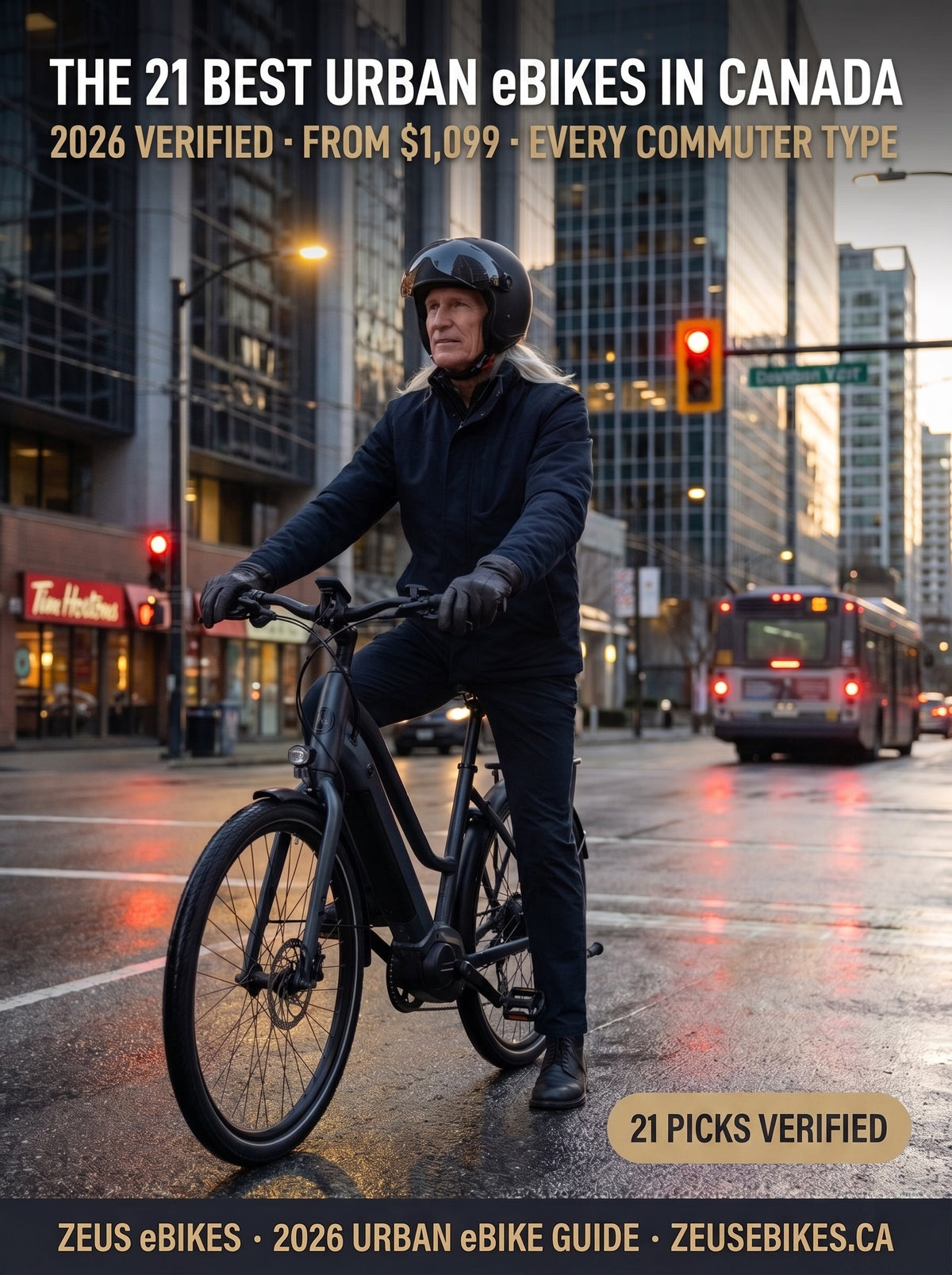
Best Urban Electric Bikes Canada (2026): 21 Verified Picks

The best urban e-bike in Canada for most commuters is the Taubik Blackburn 275T (From $2,799): torque and cadence sensing you switch between from the display, a Samsung battery, hydraulic brakes and a built-in rear wheel lock, at 500W and 32 km/h by Taubik's specification. On a budget: the Samebike RS-A01 Pro-T ($1,199). For assist that follows your pedalling: the torque-sensor Eunorau Meta 26 ($2,295). For range: the Eunorau Meta 24 ($2,295) with a second battery. For hills: the Velotric Discover M ($3,899). For condos: the folding Eunorau Meta Foldable ($2,295). Every pick carries a motor-rule mark: 6 ✔ at 500W or less on the maker's figures, 11 ⚠ with two published figures or an adjustable cap, and 4 ✘ over 500W.
This guide starts from demand: the 657 distinct searches that brought readers to this page between April 6 and October 3, 2026 (Google Search Console; 93% of the impressions with a known country came from Canada), grouped into the needs in the table below. On October 4 and 5, 2026 we read every pick against the maker's own page, and the maker's manual where we hold one, and against our listing; where they disagree, the card prints both figures and says whose each one is. Prices are our listing prices on October 4, 2026, in CAD. Stock changes, so call before you order. Each card ends with its motor rule, measured against the 500W line the provincial e-bike rules converge on.
In This Guide
- What readers search for, and the pick for each need
- The 500W line on every pick
- The urban commuter checklist
- Best overall: Taubik Blackburn 275T (From $2,799)
- Best torque sensor: Eunorau Meta 26 ($2,295)
- Best budget picks: RS-A01 Pro-T ($1,199) + XD26-II ($1,499)
- Best range: Eunorau Meta 24 ($2,295)
- Best for hills: Velotric Discover M ($3,899)
- Best low step-through: Taubik Vista 26 ($2,399)
- Best fat-tire step-through: Taubik Tour ($2,899)
- Most comfortable: Defender, Defender-S 2.0, Romeo Pro III
- Folding picks: 20LVXD30-II, Meta Foldable, Monaco S
- Urban trikes: Meigi Hera + Eunorau ONE-TRIKE 2.0
- Above 500W or two ratings: FAT-AWD 3.0, Tesway X5, Swift Horse
- Moped-style: GT33 + Eahora FT-01 Max
- The full 21-bike comparison table
- What an urban e-bike costs
- FAQ
What Readers Search For, and the Pick for Each Need
October is when the commute changes: darker mornings, wet leaves, colder air. Buy the wrong bike now and you live with it all winter: a 70 lb machine you dread carrying upstairs, a sensor that surges at every red light. This guide matches 21 bikes to the needs readers actually search for, and marks each one against the 500W line.
Each row below starts from a search that brought a reader to this guide between April 6 and October 3, 2026, quoted as typed. Find your row, then jump to your pick.
| A Search That Brought Readers Here | What It Takes | Our Pick |
|---|---|---|
| “best ebike for commuting” | One bike that handles most urban days without excuses. | Taubik Blackburn 275T (From $2,799) |
| “best affordable ebikes” | The lowest price that still brings a removable battery and a basket. | Samebike RS-A01 Pro-T ($1,199) |
| “xd26-ii urban commuting e-bike” | Hydraulic brakes and suspension at both ends under $1,500. | Samebike XD26-II ($1,499) |
| “best commuter ebike for hills” | Torque through the gears: a 500W mid-drive. | Velotric Discover M ($3,899) |
| “e bike 30 km” | A 30 km day on one charge, with margin. | Eunorau Meta 24 or Meta 26 (720 Wh; 1,440 Wh with a second pack) |
| “lightweight commuter ebike” | The fewest kilograms to carry. | Samebike 20LVXD30-II (25 kg) · XD26-II (25.5 kg) |
| “eunorau meta foldable” | A folder with a torque sensor for a condo, a trunk or a train. | Eunorau Meta Foldable ($2,295) |
| “best e bike for winter commuting” | A maker that allows the cold, and battery margin: ask us first. | Eunorau Meta 26, or the Meta 24 with a second battery |
| “full suspension commuter ebike” | Suspension at both ends, at 500W. | Eunorau Defender ($2,450) |
| “best step through ebike canada” | A low frame you can step through in work clothes. | Taubik Vista 26 ($2,399) |
| “e trikes for sale near me” | Three wheels: no balancing at a red light. | Meigi Hera ($1,699) · ONE-TRIKE 2.0 ($2,499) |
| “fastest ebikes 2026” | Speed and power past the e-bike line: off-road machines. | Eunorau FAT-AWD 3.0 · Tesway X5 AWD (✘) |
Want to browse instead of read?
Every pick ships free across Canada, and questions go to 1-866-938-7580.
Browse Urban eBikes → Financing Options →The 500W Line: What the Mark on Every Pick Means
The provincial e-bike rules converge on 500W and 32 km/h with working pedals (Nova Scotia's statute says 30 km/h); the federal definition was repealed in 2021. Over the limit, a machine on a public road is a motor vehicle: licence, registration and insurance apply, and whether it is a moped, a motorcycle or another class depends on its specifications.
Helmet rules, minimum ages and where you may ride vary by province, and Québec requires a Class 6D licence for riders aged 14 to 17. One narrow exception to the 500W line: Ontario's cargo e-bike pilot allows cargo e-bikes over 55 kg with motors up to 1,000W continuous, where a municipal by-law permits them, until 1 March 2031. None of the bikes in this guide rides that exception. The provincial detail is in our wattage and legality guide.
✔ means 500W or less at a shipped 32 km/h or lower on the maker's own figures. ⚠ means the maker, its manual or our listing prints two figures, or the bike ships with an adjustable cap (whether an adjustable cap qualifies is not settled): read the card, and keep it at the factory setting on public roads. ✘ means over 500W: private property and trails that permit motorised vehicles.
The Urban Commuter Checklist: 6 Things That Matter, 4 That Don't
Spec sheets lead with peak wattage, waterproof ratings and best-case range. The specs that decide whether a bike survives your commute (what ships in the box, the sensor, the real weight, the manual's temperature line) sit further down. Here is the filter, in order of impact.
6 Things That Actually Matter
1. What ships in the box. A rear rack means no sweaty backpack; fenders mean no stripe of road grime up your back. Each card says what the maker lists as included, and where a maker's photographs show more than its specification lists.
2. Sensor type, the spec you feel at every red light. A torque sensor reads how hard you press the pedals and assists in proportion. A cadence sensor detects that the cranks are turning and delivers a set level, which can surge on restarts. 10 of the 21 picks carry torque, dual or switchable sensing; the comparison table lists each.
3. Weight, against your actual building. Ground-floor storage? 70 lb does not matter. Stairs or a transit rack? Every pound counts. The picks run from 25 kg (the 20LVXD30-II, by Samebike's figure) to 173 lb (the Romeo Pro III with its battery); where a maker publishes no weight, the table says so.
4. The manual's temperature line, and your winter margin. Cold weather reduces battery performance (Bosch eBike Systems), and Battery University's charging table permits no charging below freezing for lithium-ion. Several makers' manuals also print a lower temperature limit for the bike itself; where we hold the manual, the card quotes it. Buy battery margin for your coldest month, and store and charge the pack indoors.
5. Payload: your body plus cargo, under the ceiling. Where a maker's page and manual print two load figures, plan around the lower; the cards print both.
6. Upright geometry. A commuter bike should put your weight on the saddle, not your wrists, and keep your head up with a clear view of traffic. Step-through frames make mounting in work clothes easy.
4 Things That Don't Matter for Urban Riding
Top speed. E-bike assistance stops at 32 km/h (30 km/h in Nova Scotia's statute), and city traffic stops you long before that matters.
Long-travel suspension. In our view, long-travel forks are trail equipment; on asphalt, a basic fork or a 2.5- to 3-inch tire at moderate pressure takes the edge off curbs and cracks. Comfort-first riders have their own section below.
Wattage as a power proxy. A 500W mid-drive with 100 Nm (the Discover M) works through the gears; compare torque and motor type, not the wattage badge. More in our wattage and legality guide.
Submersion-grade waterproofing. You commute through weather, not rivers.
Before you pick: (1) confirm what ships in the box, (2) decide whether torque-sensor feel matters on your route, (3) read the manual's temperature line and buy battery margin for your coldest month, and (4) check the lower payload figure against your weight plus cargo.
Best Overall Daily Commuter: Taubik Blackburn 275T (From $2,799) ✔
Is there one bike here that covers most Canadian commutes without an excuse? In our judgment, yes: the Blackburn 275T, with torque and cadence sensing you switch between from the display, a Samsung battery certified to UL 2271, Zoom hydraulic brakes, integrated lights and a built-in rear wheel lock, at 500W and 32 km/h by Taubik's specification.

Illustration: an AI-generated scene (Playcut.ai). The bike shown can differ from the real one; the maker's photographs are on the listing.
Taubik Blackburn 275T
From $2,799 CADThe sensor switch is the story: Taubik lets you switch between torque sensing for a natural feel and cadence sensing for steady assistance, from the handlebar display, which suits stop-and-go traffic one way and a long flat stretch the other. Add Zoom hydraulic brakes on 180 mm rotors, an RST coil fork with 80 mm of travel, 27.5 × 2.35-inch CST tires, an integrated brake and running light and a built-in rear wheel lock. Two figures for the battery: Taubik's specification gives a 48V 14.7Ah Samsung pack certified to UL 2271 (706 Wh), while its manual and its dual-battery panel give 15Ah; range is up to 100 km on the page and 50 to 95 km with pedal assist in the manual. Our dual-battery model is $3,199. Two figures for the frame too: 69.5 lb and a 286 lb capacity on the page, 34.5 kg (76 lb) and a 120 kg maximum load in the manual, so plan around the lower. The manual also states “This equipment is not intended to be used at ambient temperatures less than 0°C”, so ask us or Taubik before you plan winter riding on it.
Best Torque-Sensor Commuter: Eunorau Meta 26 ($2,295) ⚠
Does an affordable commuter with a true torque sensor exist in Canada? Yes: the Meta 26 pairs a torque sensor with a 500W hub, so assist arrives in proportion to how hard you pedal, and its 26 × 3.0-inch Innova tires take the edge off cracked pavement.

Eunorau's own photograph of the Meta 26.
Eunorau Meta 26
$2,295 CADWith a torque sensor, the 55 Nm arrives as you push, which suits a flat-to-rolling commute; this is not a hill specialist. Hydraulic brakes with motor cutoff, fenders included, a thumb throttle and a step-through frame rated to 286 lb; Eunorau lists it as UL certified without naming the standard. A second 48V 15Ah battery doubles capacity for long weeks. Eunorau's photographs show a rear rack, but its specification lists fenders, lights and a tool kit as included and no rack, so ask us before you count on one. Eunorau labels it speed limited and unlockable, and whether an adjustable cap qualifies is not settled, so keep it at the factory setting on public roads. The Meta 24 below is the same design on 24-inch wheels at 61.7 lb.
Best Budget Commuters Under $1,500: Two Honest Ways In
Under $1,500, every e-bike is a set of compromises; the question is whether the maker admits which ones. The RS-A01 Pro-T keeps the price down with mechanical brakes and a cadence sensor while bringing a front basket and a removable battery. The XD26-II spends its budget on hydraulic brakes, a 720 Wh battery and suspension at both ends.
Samebike RS-A01 Pro-T — $1,199: basket, rack and a removable battery

Illustration: an AI-generated scene (Playcut.ai). The bike shown can differ from the real one; the maker's photographs are on the listing.
Samebike RS-A01 Pro-T
$1,199 CADA front basket and a rear rack, with a hidden, removable 540 Wh battery you can charge at your desk. Samebike's specification table gives a 350W motor and our listing 500W: both are within the 500W limit, with a 32 km/h factory limit. The honest trade-offs: mechanical disc brakes need more hand force than hydraulics, and the sensor is a cadence type by our listing (Samebike's page names none), which is invisible on flat routes but less natural on hills. For a 10–20 km flat round trip it is, in our view, the most commuting per dollar on this page.
Samebike XD26-II — $1,499: the budget all-rounder people search by name

Samebike's own photograph of the XD26-II.
Samebike XD26-II
$1,499 CADOf the 21 bikes here, the XD26-II is the one readers most often search for by name before they land on this guide, and the spec-per-dollar explains it: a 720 Wh battery, 70+ Nm, hydraulic brakes and suspension at both ends for $1,499. Two speed figures: Samebike's table gives 32 km/h and its copy up to 28 mph on throttle, while our listing says 45 km/h: confirm the shipped setting before road use, and keep the motor limit at 32 km/h on public roads. The trade is the sensor: a cadence type by our listing, as Samebike's page names none.
Flat commute, basket and removable battery: RS-A01 Pro-T ($1,199). Rougher streets, bigger battery, hydraulic brakes: XD26-II ($1,499), after you confirm its shipped speed. Needs to fold: the 20LVXD30-II ($1,099) below.
Best Range: Eunorau Meta 24 With a Second Battery ($2,295) ⚠
How much battery does your commute need? At 15 to 20 Wh per kilometre of mixed city riding (our planning estimate), a 720 Wh pack covers roughly 36 to 48 km. Longer than that, buy the second battery: the Meta 24 and Meta 26 both take a second 48V 15Ah pack, and the Meta 24 is the lighter at 61.7 lb.

Eunorau's own photograph of the Meta 24.
Eunorau Meta 24
$2,295 CADRange is a battery question, and the Meta 24 answers it with a second 48V 15Ah pack: 720 Wh standard, 1,440 Wh with both, which Eunorau rates at up to 100 miles (160 km). That makes it the page's long-commute pick for riders who want a step-through frame on 24-inch Innova 3.0-inch tires, a torque sensor and hydraulic brakes with motor cutoff, at 61.7 lb. Eunorau's Meta 24 page gives Samsung cells and a 286 lb payload, with fenders included. Eunorau's photographs show a rear rack, but its specification lists fenders, lights and a tool kit as included and no rack, so ask us before you count on one. This is a range pick, not a cargo pick: for hauling, see the trikes below. Eunorau labels it speed limited and unlockable, and whether an adjustable cap qualifies is not settled, so keep it at the factory setting on public roads.
| Your Round Trip | Battery (our estimate, 20 Wh/km plus margin) | Picks |
|---|---|---|
| Under 15 km | Any pack here | Every pick (the smallest pack, the Meigi Hera's 468 Wh, covers about 23 km) |
| 15–30 km | 700 Wh+ | Blackburn 275T, Vista 26, the Eunorau Metas, Discover M |
| 30–45 km | 960 Wh+ | Meta 24 or Meta 26 with a second battery |
| 45 km+ | Two batteries | Meta 24 or Meta 26 dual (1,440 Wh), or the Blackburn 275T dual-battery model |
Best for Hills: Velotric Discover M ($3,899) ⚠
Can a 500W bike genuinely climb? Yes, if the 500W turns a mid-drive. The Discover M mounts its motor at the cranks, where it works through the gears: 100 Nm standard and 130 Nm at its maximum by Velotric's figures. On a commute with a grade that used to decide the route, this is the pick.

Illustration: an AI-generated scene (Playcut.ai). The bike shown can differ from the real one; the maker's photographs are on the listing.
Velotric Discover M
$3,899 CADSensorSwap switches between cadence and torque sensing, and the motor's 960W peak works through a Shimano CUES 9-speed. The system is certified to UL 2849, the battery to UL 2271 and its cells to UL 2580, and the 200 kg (440 lb) maximum load ties the ONE-TRIKE 2.0 for the highest any maker publishes for a bike on this page. Fenders, a rear rack rated to 30 kg, turn signals and Tektro hydraulic brakes come standard, and Velotric gives 27 kg without the fenders, kickstand and pedals. Velotric ships it at 32 km/h and its app adjusts the cap from 19 to 45 km/h: whether an adjustable cap qualifies is not settled, so keep it at the factory setting on public roads. It costs $1,100 more than the Blackburn 275T; on a hilly commute that money buys the climb.
Not sure which pick fits your commute?
Call 1-866-938-7580 and tell us how you ride: we will say which pick fits, including when the cheaper one is the right answer.
Shop Urban eBikes →Best Low Step-Through Commuter: Taubik Vista 26 ($2,399) ✔
The Vista 26 is where a low step-through frame meets good parts: dual torque and cadence sensing, Zoom hydraulic brakes and a Samsung battery certified to UL 2271. It suits riders who mount in work clothes; the card gives the trade-offs, from payload to the manual's temperature line.

Illustration: an AI-generated scene (Playcut.ai). The bike shown can differ from the real one; the maker's photographs are on the listing.
Taubik Vista 26
$2,399 CADAn ultra-low step-through on 26 × 1.9-inch commuter tires, with dual torque and cadence sensing, Zoom hydraulic brakes on 180 mm rotors, full front and rear fenders and a flip-up seat for battery access, at 64 lb on Taubik's page (30.5 kg in its manual). Taubik lists a range of up to 100 km for the 706 Wh pack. Taubik's page gives 286 lb and its manual 120 kg: plan around the lower; the manual also states “This equipment is not intended to be used at ambient temperatures less than 0°C”, so ask us or Taubik before winter riding.
Best Fat-Tire Step-Through: Taubik Tour ($2,899) ⚠
The Tour pairs a step-through frame with 26 × 4.0-inch fat tires, so you can mount it in bulky layers without swinging a leg over a high top tube. Read its cold-weather note before you plan a winter on it.

Taubik's own photograph of the Tour S in black.
Taubik Tour
$2,899 CADThe bike we ship is Taubik's current Tour S: a 500W Bafang hub rated at 80 Nm, a 48V 15Ah Samsung battery certified to UL 2271, dual torque and cadence sensing, Kenda Juggernaut 26 × 4.0 tires, Zoom hydraulic brakes on 180 mm rotors and a Shimano Acera 8-speed, at 77 lb on the page (35.5 kg in the manual; the brochure gives 14.7Ah and a Shimano Altus), with a rear rack, an integrated brake light and a thumb throttle. Taubik's page and manual give 32 km/h, and our listing, rebuilt from them, prints the same (read 8 October 2026), so keep it at 32 km/h on public roads. Load: 286 lb on the page, 120 kg in the manual. Cold weather: Taubik's brochure sells it for “year-round commuting in any season”, while its manual states “This equipment is not intended to be used at ambient temperatures less than 0°C”; ask us or Taubik which governs before you plan a winter on it.
Read the manual first: Taubik's manuals for the Tour S, Blackburn, Vista and Monaco S each state “This equipment is not intended to be used at ambient temperatures less than 0°C”. For a 500W bike in the cold season, start with the Eunorau Meta 26 or the Meta 24 with a second battery, and ask us first: Eunorau's pages for both print no operating temperature. Store and charge the battery indoors.
Most Comfortable Commutes: Suspension for Riders Who Arrive Rattled
If your streets are cracked, frost-heaved and potholed, suspension and tire volume do more for your body than any motor spec. Three picks serve three budgets and two classes: the Defender is a 500W bike with an adjustable cap; the other two are off-road machines and are labelled that way.
Eunorau Defender — $2,450: 500W full suspension ⚠

Eunorau's own photograph of the Defender in orange.
Eunorau Defender
$2,450 CADDual suspension, with a 100 mm fork and an air rear shock by Eunorau's page, on a 500W hub with a thumb throttle and brake-lever motor cutoff, on 27.5 × 3.0-inch tires that split the difference between commuter speed and fat-tire cushion, at 66 lb. An optional second battery takes capacity to about 1,440 Wh. 60 Nm is a comfort cruiser's torque, not a climber's: hilly-city riders should look at the Discover M. Eunorau's page gives 32 km/h “under speed limited/locked” and labels the bike unlockable; whether an adjustable cap qualifies is not settled, so keep it at the factory setting on public roads.
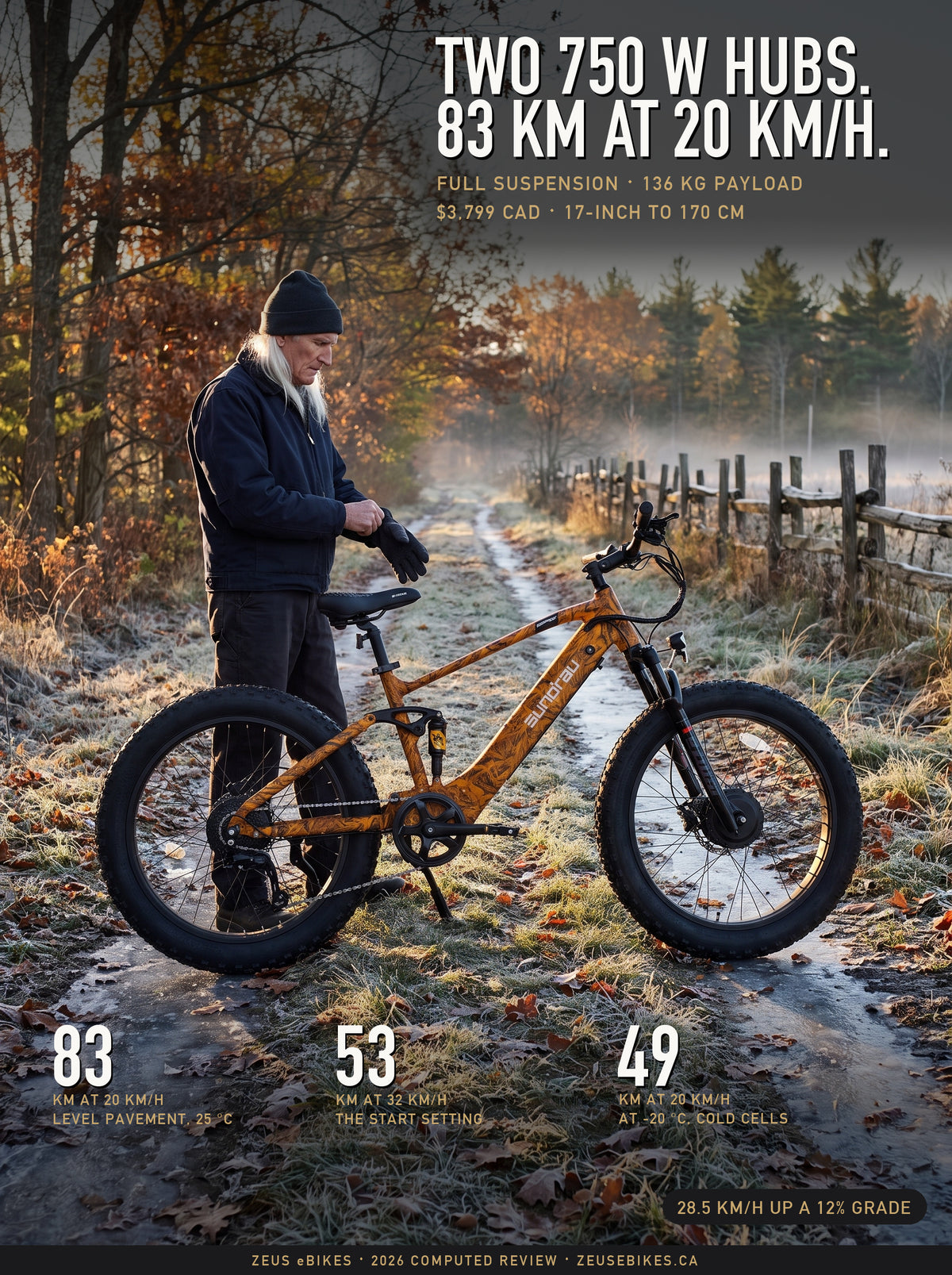
Eunorau Defender-S 2.0 — $3,799: two motors, full suspension, off-road class ✘

Eunorau's own photograph of the Defender-S 2.0 in Dry Grass Camo.
Our full computed review of the Defender-S 2.0 → range at your speed and temperature, which frame fits your height, and what every province calls a 1,500 W machine.
Eunorau Defender-S 2.0
$3,799 CADTwo 750W hubs drive both wheels (1,500W combined rated), a torque sensor reads pedal force, and both ends are suspended, with an air rear shock, a Shimano CUES 9-speed and 203 mm rotors. Eunorau sets 20 mph (32 km/h) by default with a maximum setting of about 45 km/h. Over every provincial e-bike limit: on a public road it is a motor vehicle, so it belongs on private property and trails that permit motorised vehicles. If the commute is the point, the 500W Defender above costs $1,349 less.
Eahora Romeo Pro III — $4,799: the rolling sofa, off-road class ✘

Illustration: an AI-generated scene (Playcut.ai). The bike shown can differ from the real one; the maker's photographs are on the listing.
Eahora Romeo Pro III
$4,799 CADIn our view the most comfortable machine in this guide: full suspension with an air fork and damper, 26 × 4.0-inch fat tires, Eahora's eight-second auto-cruise, and a 4,800 Wh battery, the largest here. It is not a street bike: two motors at 2,800W peak each, 48 mph on Eahora's US page, 173 lb with the battery, and a maximum load of 500 lb. Over every provincial e-bike limit: on a public road it is a motor vehicle, so it belongs on private property and trails that permit motorised vehicles. For a cottage, farm or trail life where comfort is everything and roads are optional, it is the pick.
Best Folding Commuters: For Condos, Trunks, and Mixed-Transit Rides
Do you need a folder? Ask your storage: a condo that bans full-size e-bikes in the bike room, an office with no rack, a car trunk that finishes the last leg. These three run from $1,099 to $2,899, and each card gives its motor rule. Deeper cuts live in our full folding guide.
Samebike 20LVXD30-II — $1,099: the cheapest bike in this guide ✔

Illustration: an AI-generated scene (Playcut.ai). The bike shown can differ from the real one; the maker's photographs are on the listing.
Samebike 20LVXD30-II
$1,099 CADAt 350W it is well under the 500W line, and at $1,099 it is the cheapest way into this guide. It folds to 90 × 36 × 70 cm, rolls on 20 × 1.95-inch tires, the battery removes for desk charging, and a rear rack is fitted. The honest trades: mechanical brakes, a cadence sensor by our listing and 35+ Nm that prefers flat routes, and Samebike's 120 kg payload is lower than the 150 kg on our listing: plan around the lower.
Eunorau Meta Foldable — $2,295: the torque-sensor folder ⚠

Eunorau's own photograph of the Meta Foldable, sold by Eunorau as the META20 1.0, in white.
Eunorau Meta Foldable
$2,295 CADA folder with a torque sensor, hydraulic 180 mm brakes with motor cutoff, a Samsung 720 Wh pack (with a second battery Eunorau rates it at up to 100 miles) and a thumb throttle for dead starts, with fenders included. Eunorau's photographs show a rear rack, but its specification lists fenders, lights and a tool kit as included and no rack, so ask us before you count on one. At 63.4 lb it is manageable in an elevator, though nobody calls carrying it fun. Eunorau labels it speed limited and unlockable, and whether an adjustable cap qualifies is not settled, so keep it at the factory setting on public roads.
Taubik Monaco S — $2,899: the folder that skips no spec ✔

Illustration: an AI-generated scene (Playcut.ai). The bike shown can differ from the real one; the maker's photographs are on the listing.
Taubik Monaco S
$2,899 CADTorque and cadence sensing you switch between to suit your riding, plus a thumb throttle, a rear cargo rack with an integrated brake light, an adjustable suspension fork with lockout, and 20 × 3-inch CST Big Boat tires. Taubik lists a range of up to 100 km. Trade-off: 70 lb on the page (31.5 kg in the manual) is heavy for a folder, so this is a bike that folds for storage, not one you carry up stairs daily. Load 286 lb on the page, 120 kg in the manual; the manual states “This equipment is not intended to be used at ambient temperatures less than 0°C”, so ask before winter riding.
Trunk-and-transit on a budget: 20LVXD30-II ($1,099). Daily condo commuter who cares how assist feels: Meta Foldable ($2,295). Every spec in one folding frame, stored rather than carried: Monaco S ($2,899).
Urban Electric Trikes: Stability at Every Stop
Trikes solve the two moments where two wheels fail some riders: the stop and the load. No balancing at red lights, no dismount wobble with a week's groceries aboard, and both of these carry a basket. The deeper comparison lives in the full trike guide.
Meigi Hera — $1,699: the budget urban trike ✔

Illustration: an AI-generated scene (Playcut.ai). The bike shown can differ from the real one; the maker's photographs are on the listing.
Meigi Hera
$1,699 CADThe affordable answer to “I want three wheels for errands”. A 350W motor, a throttle that moves it from a standstill, and a rear basket for groceries; Meigi gives a 15 mph (24 km/h) top speed and 25 miles on throttle or 35 with pedal assist. Mechanical brakes keep the price down, and the sensor is a cadence type by our listing (Meigi's manual refers to a crank sensor). For flat neighbourhoods, riders returning to cycling, and commutes that are really a chain of errands, it is the value pick.
Eunorau ONE-TRIKE 2.0 — $2,499: the folding cargo trike ⚠

Illustration: an AI-generated scene (Playcut.ai). The bike shown can differ from the real one; the maker's photographs are on the listing.
Eunorau ONE-TRIKE 2.0
$2,499 CAD80 Nm to move a loaded trike from a stop, brake levers with motor cutoff, front and rear baskets, a 440 lb payload, and a frame that folds so a trike can live in a garage corner or a van. At about 86 lb it is a vehicle you park, not a bike you lift. Eunorau gives a maximum of 20 mph (32 km/h) “under speed limited”, and whether an adjustable cap qualifies is not settled, so keep it at the factory setting on public roads. This is the pick when the Hera's 350W and basket are not enough for the load you carry.
Above 500W, or Two Ratings: The Power Bikes, Honest Verdicts Included
Over 500W, a machine is not an e-bike under any province's rule; on a public road it is a motor vehicle. Two of these three are over the line and the third carries two published ratings, so we treat all three as off-road machines for acreage, cottage country and trail weekends.
Eunorau FAT-AWD 3.0 — from $2,299: all-wheel drive with a torque sensor ✘

Illustration: an AI-generated scene (Playcut.ai). The bike shown can differ from the real one; the maker's photographs are on the listing.
Eunorau FAT-AWD 3.0
From $2,299 CADTwo driven wheels coordinated by one torque sensor, Kenda 4.0-inch fat tires, an RST fork, 180 mm hydraulics and a second-battery option for 1,440 Wh. Eunorau sells its rack and fender set separately. On wet gravel and loose climbs, traction is the whole story. Two 500W motors make 1,000W combined. Over every provincial e-bike limit: on a public road it is a motor vehicle, so it belongs on private property and trails that permit motorised vehicles. Black is $2,299 and Camouflage $2,425.
Tesway X5 AWD — $2,999: the 3,120 Wh step-thru ✘

Illustration: an AI-generated scene (Playcut.ai). The bike shown can differ from the real one; the maker's photographs are on the listing.
Tesway X5 AWD
$2,999 CADA 52V 60Ah (3,120 Wh) pack driving two 1,000W motors through 4-piston hydraulic brakes on 203 mm rotors, with a step-through frame, a 180 kg maximum load and a 119 lb (54 kg) bike. Tesway certifies the system to UL 2849 by TÜV and the battery to UL 2271, and gives a 60 km/h maximum speed. Over every provincial e-bike limit: on a public road it is a motor vehicle, so it belongs on private property and trails that permit motorised vehicles.
Freesky Swift Horse Pro X-6E — $2,699: 140 Nm, two published ratings ⚠

Illustration: an AI-generated scene (Playcut.ai). The bike shown can differ from the real one; the maker's photographs are on the listing.
Freesky Swift Horse Pro X-6E
$2,699 CADTwo published ratings for one bike. Our listing gives a 1,000W Bafang motor peaking at 3,500W; Freesky's authorised Canadian agent lists it at 500W with a 2,500W peak, 32 km/h as sold and 60 km/h at peak. Both agree on 140 N·m and a 48V 30Ah Samsung battery (1,440 Wh by our arithmetic); the agent adds front and rear suspension, 180 mm 4-piston hydraulic brakes, a 400 lb maximum load and an 83 lb bike. On our listing's rating it is over the 500W limit, and on the agent's the cap is adjustable and that question is not settled. We treat it as an off-road machine.
Moped-Style Urban Rides: Cafe Racer Looks, Fine Print Explained
Moped-style e-bikes bring long cushioned saddles and moto lines. The fine print matters more here than anywhere, because each of these bikes has more than one published rating, and the rules read the motor rating and the speed, not the styling. The full category lives in our electric mopeds guide.
GT33 All-Terrain Cafe Racer — from $1,599: the style pick ⚠

Illustration: an AI-generated scene (Playcut.ai). The bike shown can differ from the real one; the maker's photographs are on the listing.
GT33 All-Terrain Cafe Racer
From $1,599 CADCafe-racer styling with an elongated saddle, keyed ignition, turn signals and full dual suspension over 20 × 4.0-inch fat tires, and a 1,296 Wh battery; the dual-battery model is $1,999, and Riding Times' US page gives 102 lb net. Two published ratings: Riding Times' Canadian page sells it as 500W rated and factory-set to 25 km/h, while its US store lists 750W. Ask which version ships before road use; whether an adjustable cap qualifies is not settled, so keep it at the factory setting on public roads. Riding Times' US page prints a 330 lb maximum load and its manual 100 kg (220 lb): plan around the lower.
Eahora FT-01 Max 2025 — $2,099: moped style, three published ratings ⚠

Illustration: an AI-generated scene (Playcut.ai). The bike shown can differ from the real one; the maker's photographs are on the listing.
Eahora FT-01 Max 2025
$2,099 CADMoto bodywork over a 48V 30Ah (1,440 Wh) removable battery, 180 mm hydraulic discs front and rear, a 100 mm suspension fork, 20 × 4.0-inch tires and cruise control, at 90.6 lb with the battery, and a recommended rider weight of 330 lb or less. Three published ratings: Eahora's Canadian page sells it as a 500W geared hub at 32 km/h, the spec table on the same page says 250W, and its US page lists a 1,500W motor at 25–28 mph. Ask us which version ships before road use. At 90.6 lb, plan ground-floor storage.
The Full 21-Bike Comparison: Power, Battery, Price, and the Motor Rule
Every number below comes from the maker's page or manual, or from our listing where the card says so, read October 4 and 5, 2026; prices are our listing prices on October 4. ✔ 500W or less at a shipped 32 km/h or lower on the maker's figures; ⚠ two figures or an adjustable cap; ✘ over 500W.
| Bike | Price | Motor / Torque | Battery | Sensor | Weight | Load | Mark |
|---|---|---|---|---|---|---|---|
| Samebike 20LVXD30-II | $1,099 | 350W · 35+ Nm | 480 / 499 Wh | Cadence (listing) | 25 kg | 120 / 150 kg | ✔ |
| Samebike RS-A01 Pro-T | $1,199 | 350W / 500W · 55+ Nm | 540 Wh | Cadence (listing) | 28 kg | 150 kg | ✔ |
| Samebike XD26-II | $1,499 | 500W (750W pk) · 70+ Nm | 720 Wh | Cadence (listing) | 25.5 kg | 180 / 150 kg | ⚠ |
| GT33 Cafe Racer | From $1,599 | 500W / 750W rated · 1,350W pk | 1,296 Wh | Cadence | 102 lb (US page) | 330 lb / 100 kg | ⚠ |
| Meigi Hera (trike) | $1,699 | 350W (540W pk listing) | 468 Wh | Cadence (listing) | not published | 265 lb (listing) | ✔ |
| Eunorau Meta 26 | $2,295 | 500W · 55 Nm | 720 Wh (+2nd opt.) | Torque | 68.4 lb | 286 lb | ⚠ |
| Eunorau Meta 24 | $2,295 | 500W · 55 Nm | 720 Wh (1,440 with 2nd) | Torque | 61.7 lb | 286 lb | ⚠ |
| Eunorau Meta Foldable | $2,295 | 500W · 55 Nm | 720 Wh (+2nd opt.) | Torque | 63.4 lb | 286 lb | ⚠ |
| Eunorau FAT-AWD 3.0 | From $2,299 | 2 × 500W · 110 Nm | 720 Wh (1,440 with 2nd) | Torque | 79.4 lb | 375 lb | ✘ |
| Taubik Vista 26 | $2,399 | 500W · 68 Nm | 706 Wh | Dual | 64 lb / 30.5 kg | 286 lb / 120 kg | ✔ |
| Eunorau Defender | $2,450 | 500W · 60 Nm | 720 Wh (+2nd opt.) | Not published | 66 lb | 300 lb | ⚠ |
| Eunorau ONE-TRIKE 2.0 | $2,499 | 500W · 80 Nm | 696 Wh | Not published | 85.98 lb | 440 lb | ⚠ |
| Freesky Swift Horse Pro X-6E | $2,699 | 1,000W / 3,500W pk (listing) · 500W / 2,500W pk (agent) | 1,440 Wh | Speed sensor (agent) / cadence (listing) | 83 lb (agent) | 400 lb (agent) | ⚠ |
| Blackburn 275T | From $2,799 | 500W · 70 Nm | 706 Wh (page) / 720 (manual) | Dual, switchable | 69.5 lb / 34.5 kg | 286 lb / 120 kg | ✔ |
| Taubik Tour (Tour S) | $2,899 | 500W Bafang · 80 Nm | 720 Wh | Dual | 77 lb / 35.5 kg | 286 lb / 120 kg | ⚠ |
| Taubik Monaco S | $2,899 | 500W · 68 Nm | 720 Wh | Dual, switchable | 70 lb / 31.5 kg | 286 lb / 120 kg | ✔ |
| Tesway X5 AWD | $2,999 | 2 × 1,000W · 200 Nm | 3,120 Wh | Cadence (listing) | 119 lb (54 kg) | 180 kg | ✘ |
| Eunorau Defender-S 2.0 | $3,799 | 2 × 750W · 85 Nm | 816 Wh | Torque | 89.3 lb | 300 lb | ✘ |
| Velotric Discover M | $3,899 | 500W mid · 100–130 Nm | 801.6 Wh | Switchable | 27 kg (no fenders, stand, pedals) | 200 kg | ⚠ |
| Eahora FT-01 Max 2025 | $2,099 | 500W / 250W (CA) / 1,500W (US) | 1,440 Wh | not published | 90.6 lb | 330 lb (rider) | ⚠ |
| Eahora Romeo Pro III | $4,799 | 2 × 2,800W pk · 200 Nm | 4,800 Wh | Cadence | 173 lb | 500 lb | ✘ |
"Not published" means the maker does not print that figure on the page we read, and we will not invent it. Where a cell holds two figures, the card says whose each one is. Ask us at 1-866-938-7580 and we will confirm what we can before you order.
What an Urban eBike Costs, and What It Costs to Run
The 21 picks run from $1,099 to $4,799, and half cost $2,450 or less (the median of the 21 listing prices on October 4, 2026). No pick under $2,000 lists a torque sensor; every pick with torque, dual or switchable sensing costs $2,295 or more.
Running costs are small. A 720 Wh battery holds 0.72 kWh, so at 15 cents per kWh a full charge costs about 11 cents, and a 1,440 Wh two-battery Meta about 22 cents (our arithmetic; check the rate on your own bill, which varies by province and time of day). The full ownership comparison, including the cases where you still need the car, is in our electric bike vs car guide, and the financing options are in our financing guide.
Frequently Asked Questions
What is the best commuter electric bike in Canada?
For most commuters on this page, the Taubik Blackburn 275T (From $2,799): a 500W Sutto hub with 70 Nm, torque and cadence sensing you switch between from the display, a Samsung battery certified to UL 2271, Zoom hydraulic brakes and a built-in rear wheel lock. For hills, the Velotric Discover M ($3,899) and its 500W mid-drive; on a budget, the Samebike RS-A01 Pro-T ($1,199).
Is a 500W e-bike enough for commuting?
For city commuting, yes, and 500W is also the line the provincial rules converge on. Torque and motor type matter more than the wattage badge: the Velotric Discover M's 500W mid-drive gives 100 Nm, and 130 Nm at its maximum by Velotric's figures, through the gears, and the Taubik Tour's 500W Bafang hub is rated at 80 Nm.
Are e-bikes over 500W legal in Canada?
Not as e-bikes. Over the limit, a machine on a public road is a motor vehicle: licence, registration and insurance apply, and whether it is a moped, a motorcycle or another class depends on its specifications. Ontario's cargo e-bike pilot is a narrow exception for cargo e-bikes over 55 kg with motors up to 1,000W continuous, where a municipal by-law allows them, until 1 March 2031. The over-500W picks in this guide are marked ✘.
How far can you go on an e-bike on one charge?
Divide the battery's watt-hours by 15 to 20 Wh per kilometre of mixed city riding (our planning estimate, not a maker's figure): a 720 Wh pack covers roughly 36 to 48 km. The Eunorau Meta 24 takes a second 48V 15Ah battery for 1,440 Wh, which Eunorau rates at up to 100 miles. Cold weather reduces battery performance (Bosch eBike Systems), so plan winter days with margin.
What is the best e-bike for winter commuting?
Read the manual first. Taubik's manuals for the Tour S, Blackburn, Vista and Monaco S each state “This equipment is not intended to be used at ambient temperatures less than 0°C”, so ask us or Taubik before a winter on any of them. For a 500W bike in the cold season, start with the Eunorau Meta 26 ($2,295) or the Meta 24 with a second battery; Eunorau's pages for both print no operating temperature, so ask us first. Charge indoors: Battery University's charging table permits no charging below freezing for lithium-ion. Our winter e-bike guide has more.
How much does an urban e-bike cost in Canada?
The 21 picks here run from $1,099 (Samebike 20LVXD30-II) to $4,799 (Eahora Romeo Pro III), and half cost $2,450 or less. No pick under $2,000 lists a torque sensor; every pick with torque, dual or switchable sensing costs $2,295 or more. Our under-$2,000 guide has the full budget ladder.
What is the best e-bike for a hilly commute?
The Velotric Discover M ($3,899): its 500W mid-drive works through the gears with 100 Nm, and 130 Nm at its maximum by Velotric's figures. Among the hub-motor picks, the Taubik Tour's 500W Bafang hub is rated at 80 Nm and the Blackburn 275T's Sutto hub at 70 Nm. Our hills guide ranks more.
What is the best folding e-bike for commuting?
The Eunorau Meta Foldable ($2,295): a torque sensor, a 720 Wh Samsung battery and hydraulic brakes at 63.4 lb. The Taubik Monaco S ($2,899) adds switchable torque and cadence sensing and a lockout fork at 70 lb. On a budget, the Samebike 20LVXD30-II ($1,099) folds to 90 × 36 × 70 cm at 350W.
What is the lightest e-bike in this guide?
Among the bikes whose makers publish a weight: the Samebike 20LVXD30-II at 25 kg (our listing says 57 lb), the XD26-II at 25.5 kg, the Velotric Discover M at 27 kg without its fenders, kickstand and pedals, and the RS-A01 Pro-T at 28 kg; the Eunorau Meta 24 is 61.7 lb. Meigi prints no weight for the Hera on the pages we read, so it is not ranked.
Do you need a licence or insurance for an electric bike in Canada?
For a bike within your province's e-bike rules, adult riders need no driver's licence; Québec requires a Class 6D licence for riders aged 14 to 17, and helmet rules and minimum ages vary by province. No province requires insurance for an e-bike within its rules, though theft cover is worth pricing: see our eBike insurance guide. Over 500W, a machine on a public road is a motor vehicle, and licence, registration and insurance apply.
Do I need fat tires for commuting?
No. In our view, the 1.9- to 3-inch tires most picks here use are the better match for pavement, and 4-inch fat tires earn their place on loose surfaces and off-road: the FAT-AWD 3.0, the Tesway X5 AWD and the Taubik Tour run them.
What is the best commuter e-bike under $2,000 in Canada?
On this page: the Samebike RS-A01 Pro-T ($1,199) for a flat commute with a basket and a removable battery; the Samebike XD26-II ($1,499) for hydraulic brakes and suspension, after you confirm its shipped speed; the 20LVXD30-II ($1,099) to fold; and the Meigi Hera ($1,699) on three wheels. Our under-$2,000 guide has the full ladder.
The Bottom Line
21 bikes is a catalogue; your commute needs one. Answer three questions (where the bike sleeps, what your terrain does, how far you ride) and the guide collapses to a single row. For most people that row reads Taubik Blackburn 275T, from $2,799; for hills, the Discover M; for range, the Meta 24 with a second battery; for a condo, the Meta Foldable; on a budget, the RS-A01 Pro-T.
Questions before you order? Call 1-866-938-7580 and tell us how you ride: we will say which pick fits, including when the cheaper one is the right answer. Every bike ships free across Canada, the financing options are in our financing guide, and our return policy is published in full: an unused, unopened bike can be returned within 15 days of delivery, with a 15% restocking fee.
Ready to ride to work?
Free shipping across Canada · 1-866-938-7580 · Returns within 15 days of delivery (unused and unopened, 15% restocking fee)
Shop All Urban eBikes → See Financing Options →Keep researching: the complete eBike Canada buyer's guide · winter riding · folding eBikes · hill climbers · long-range picks · electric trikes · moped-style eBikes · wattage & legality · battery care.
Written by Milad Ghobadibeygvand, BScN (Western University, 2014), Co-founder, Zeus eBikes Canada. Prices were read from our live listings on October 4, 2026, and every pick against its maker on October 4 and 5, 2026. Prices change; the product page is always final.
Illustrations created with Playcut.ai; every photograph credited to a maker in its caption is that maker's own photograph, unaltered.

Share:
Best Step-Through eBikes & Trikes Canada (2026): 16 Picks, $1,199–$4,099
Best Electric Bikes Canada 2026: 24 Verified Picks