
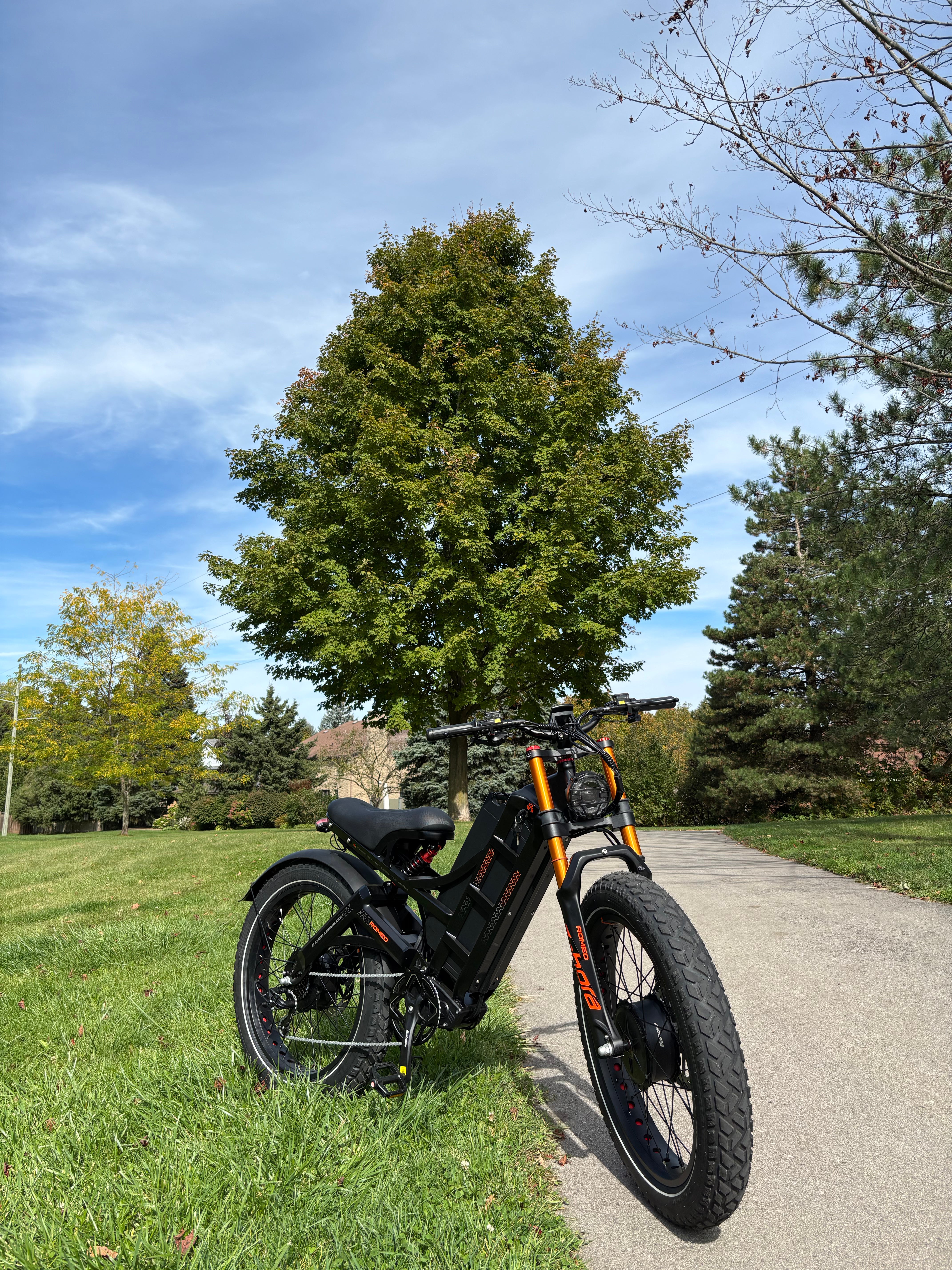
Freesky Alaska Pro M-520 Review Canada (2026): 2,160 Wh, Range Computed, Fit Measured

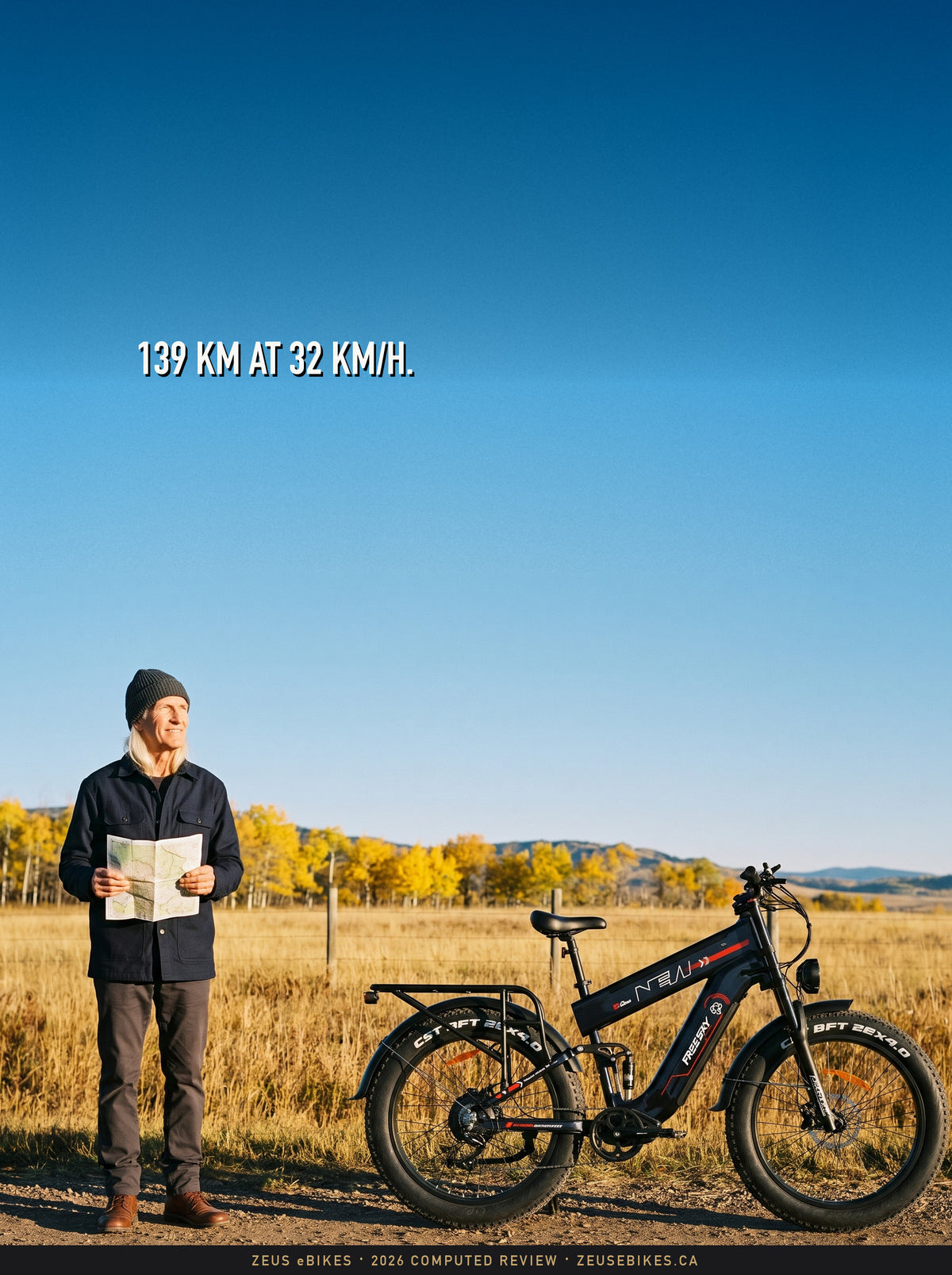
Zeus with the Freesky Alaska Pro M-520 on a ranch two-track in the Alberta foothills: a Playcut.ai rendering made from Freesky's own photograph of the Alaska Pro M-520.
By Milad Ghobadibeygvand, BScN (Western University, 2014) · Freesky's Canadian and US pages, product records, both manuals and both certificates, every provincial and territorial rule, and the Health Canada and US CPSC recall records read on 2 November 2026
We sell this bike. Zeus lists the Freesky Alaska Pro M-520 at $2,749 in Black, Green and Navy (the colour Freesky calls Blue-gray). Our US sister store, RedTail eBikes, reviewed it in September with a range model and a fit model built for this bike, and this review uses that research with a link at each point of use.
The Alaska Pro is Freesky's one-motor, two-battery M-520: a full-suspension fat-tire bike with a 4,500 W peak rear hub motor, an 18 Ah and a 27 Ah pack (2,160 Wh together) and a 400 lb load rating. Every Freesky figure below was read on 2 November 2026 from Freesky's pages, its product records, its manuals and the two certificates its page links; the range and fit figures are computed, with the method linked.
The Freesky Alaska Pro M-520 is a 48 V, full-suspension fat-tire e-bike with one 4,500 W peak rear hub motor and two removable packs, 18 Ah and 27 Ah (2,160 Wh). Freesky prints 40 MPH (64 km/h), past every provincial e-bike limit, so it belongs on private land and permitted trails.
- Range: about 139 km at 32 km/h and 185 km at 25 km/h on the throttle, 90 kg rider, flat pavement, 25 °C (modelled); about 145 km at 25 km/h at 0 °C (modelled). The manual Freesky links today allows riding down to −20 °C, and the packs charge only between 0 °C and 40 °C.
- Fit: Freesky prints 5′6″ to 6′8″. On the seat height Freesky lists, the saddle reaches the fit formula's height for at least 8 in 10 of RedTail's 6,068 measured adults from 4′11″, the shortest height with 30 or more of them, to 5′6″; then 44 in 100 at 5′8″, 10 in 100 at 5′10″ and none from 6′1″. An inseam of about 71 to 83 cm suits both of Freesky's seat figures.
- Certificates and recalls: TÜV SÜD's UL 2849 certificate names the M-520; the UL 2271 certificate Freesky shows covers the 18 Ah pack only. No recall in Health Canada's or the US CPSC's records names Freesky or the Alaska Pro.
- Verdict: in our view, a strong distance bike for private land and permitted trails and for riders up to about 5′8″; taller riders should measure first, and road riders should look elsewhere.
- At Zeus: the Alaska Pro is $2,749; the comparison sets it beside the Freesky Warrior Pro and the Tesway X7 AWD.
- Identity first: Freesky Canada lists the Alaska Pro M-520 in Black, Blue-gray, Green and Camouflage, with SKUs ending in BLACK, BLUE, GREEN and CAMOUFLAGE; our Black, Green and Navy are three of those bikes, and our Navy is the one Freesky calls Blue-gray.
- Freesky's figures: its Canadian and US pages, read on 2 November 2026 in a headless browser with every panel opened, both product records, the manual its pages link today, the earlier manual still on Freesky's file server, and the UL 2849 and UL 2271 certificates. We also read the text inside the 138 images on its pages and every page of the manual by optical character recognition, so a figure Freesky prints only in a picture still counts.
- Range: RedTail eBikes' range model for this bike, imported unchanged; before we used it, it reproduced all 21 figures RedTail publishes for its speed and pedalling grid, and we ran it in metric at Canadian temperatures.
- Fit: RedTail's run of 6,068 adults measured in the ANSUR II survey against the Alaska Pro's geometry, which Freesky's Canadian page still prints unchanged.
- Law: 44 quoted passages from the federal regulations and 13 provinces and territories, all found in copies read on 2 November 2026; three Québec pages that showed our browser a captcha were read at the Internet Archive, as were the Northwest Territories' Acts.
- Recalls: Health Canada's recall search and the US CPSC recall database, each beside a control search that had to return results.
In this review
- Who is the Alaska Pro for?
- What Freesky prints, and where its pages disagree
- How far it goes on one charge
- The two packs: charging and running on one
- Canadian cold and Freesky's two manuals
- Will it fit you?
- Is it street legal in Canada?
- Certificates and recalls
- How it compares
- What owners and testers report
- Turning it on, and the manual
- Who should buy it, and who should skip it
- Buying it from Zeus
- Questions, answered
- The bottom line
- Sources
Freesky's own assembly and instruction video for the Alaska M-520 (2025-12-28): the steps from the box to a rideable bike. We have no Alaska Pro video of our own yet.
Who is the Freesky Alaska Pro for?
The manual Freesky now links for the Alaska Pro, a file dated 19 October 2026, allows riding and storage down to −20 °C, where the one RedTail read in September stopped at 0 °C. Buy this 40.8 kg bike on Freesky's spec sheet alone and a rider over 5′8″ can end up with a saddle that will not go high enough, on a machine no province treats as an e-bike. Below we work out its range, fit and legal ground for Canada.
Its strengths are distance and carrying. Two packs hold 2,160 Wh, either one runs the bike, and Freesky rates it for 400 lb (181 kg) of rider and gear. That suits acreage, a hunting lease, a farm or a cottage road that is private.
It is the wrong bike for a commute, a bike lane or a third-floor walk-up. If your riding is on roads and paths, our guide to 500 W, 750 W and 1,000 W e-bikes shows where the provincial lines fall, and our long-range e-bike guide sets the Alaska Pro beside other long-range bikes.
Takeaway: buy the Alaska Pro for distance on private land and permitted trails, for heavy loads and for a rider up to about 5′8″; skip it if most of your riding is on public roads, paths or bike lanes.
What does Freesky print for the Alaska Pro?
Freesky's Canadian page prints one 4,500 W peak rear hub motor with 170 N·m, a 48 V 45 Ah battery in two packs (18 Ah and 27 Ah), 40 MPH, a 400 lb load and 90 lb of bike. The table quotes Freesky's wording, read on 2 November 2026, with metric conversions in the last column.
| Item | Freesky Canada prints (2 November 2026) | What that means |
|---|---|---|
| Motor | "4500W Peak Brushless Motor" | One rear hub motor; 4,500 W at peak; no rated (continuous) figure printed |
| Torque | "170N·m Torque" | 170 N·m |
| Battery | "48V 45Ah Cell Lithium Battery (18+27Ah), IPX7" | 2,160 Wh in two removable packs: 864 Wh and 1,296 Wh |
| Top speed | "TOP SPEED (PAS) 40 MPH" | 64 km/h |
| Range | "RANGE 98-175 Miles" | 158–282 km |
| Load | "LOAD CAPACITY 400 LBS" | 181 kg of rider and cargo |
| Weight | "E-BIKE WEIGHT 90 LBS" | 40.8 kg |
| Tires and wheel | 26 × 4 inch fat tires; Freesky's geometry table labels the wheel 26.7 inches, and on its own drawing RedTail measures the tires at 29.1 inches | 68 cm labelled, 74 cm drawn |
| Brakes | "180MM 4-piston Hydraulic Brakes" | 180 mm rotors |
| Suspension | "120 mm Oil-Sprung Front Fork"; "150 mm Rear Shock" | Full suspension |
| Drive and controls | "SHIMANO 7 Speed"; "Thumb Throttle"; "Cadence Sensor"; pedal assist "0~5 level" | Throttle and cadence-sensed pedal assist |
| Chargers | "US Standard 3A Smart Charger + 2A Smart Charger" | Two chargers in the box |
| Frame and seat post | "Upgraded 6061 Aluminum"; "30.9*300MM Alloy Seat Post" | Aluminum frame; a 300 mm post |
| In the box | the bike, the manual, a rear rack, front and rear mudguards | Rack and mudguards included |
Source: Freesky Canada's Alaska Pro product page, read 2 November 2026; the manuals and both certificates are linked under Sources.

The Alaska Pro in Green: Freesky's own product image. Tap or click to enlarge.
Freesky's figures have moved
Freesky's own documents print four peak figures for this bike, and they rise over time. By the dates RedTail gives them, a September 2025 post says "Official 2500W peak motor" with "a 48V 41Ah dual-battery system (1968Wh)"; a November 2025 holiday guide, "Peak 3000W brushless, 160Nm torque"; a May 2026 tire guide, "a powerful 4000W peak motor and 160Nm torque"; and the product page today, 4,500 W and 170 N·m.
Freesky's battery FAQ explains the packs: "Depending on production batch and configuration", they are 18 Ah + 23 Ah (41 Ah) or 18 Ah + 27 Ah (45 Ah). The labels on your own packs and frame settle which build you have, and older reviews, including the ride video further down, show earlier builds.
What Freesky does not print, and where its documents disagree
Freesky prints no rated (continuous) motor power for the Alaska Pro, no motor maker and no cell maker: not on its Canadian or US page, its product records, the text inside the 138 images on those pages or its manual, all read on 2 November 2026. The "4500W" is a peak. Its documents also disagree on several figures, and we print each side rather than pick one.
| Figure | Freesky's page | Freesky's other documents |
|---|---|---|
| Water rating | Battery: "IPX7" | A gallery image: "IP65 Water-Resistant"; the 18 Ah battery's UL 2271 certificate: "IP Code Rating: IP33"; the e-bike's UL 2849 certificate: "IP34 (for E-Bikes)" |
| Speed by mode | "40MPH (Throttle & PAS)" | Freesky's holiday guide: "40MPH (pedal assist) / 20MPH (throttle)" |
| Range | "RANGE 98-175 Miles" | Freesky's battery FAQ: "Dual Battery 120–200+" miles |
| Weight | "E-BIKE WEIGHT 90 LBS" | The product record's weight field: 48,988 g (108.0 lb) |
| Lowest seat | Listed: 30.7 in | Freesky's drawing, as RedTail measured it: 35.9 in (91 cm) |
| Standover | Listed: 28.7 in | The drawing: 31.5 in (80 cm), RedTail |
Read 2 November 2026. Plan on the certificates' lower water figures (keep the packs out of standing water; the manual excludes "water damage (including rust)" from the warranty), the higher weight when you lift it, and the drawing's figures when you check your inseam.
Takeaway: trust the pack, load and brake figures on Freesky's Canadian page; treat 4,500 W as a peak with no rated figure behind it, plan on the certificates' lower water ratings, and expect more than 90 lb once the rack, fenders and packs are on.
How far does the Alaska Pro go on one charge?
In our model, a 90 kg rider on the throttle gets about 139 km at 32 km/h and 185 km at 25 km/h from both packs (2,160 Wh), on flat pavement at 25 °C. Keep a fifth in reserve and plan on 111 and 148 km.
Freesky's "98-175 Miles" (158 to 282 km) asks for slow riding in the same model. The low end needs a steady 28 km/h on the throttle; the high end needs 13 km/h on the throttle, or 25 km/h with a steady 75 W from your legs.
The model is the one RedTail eBikes built for this bike, imported unchanged, and it reproduced all 21 figures RedTail publishes before we ran it in kilometres. RedTail's method section sets out the physics: Martin and colleagues' validated cycling model, fat-tire rolling resistance measured on a drum, measured rider drag, a comparable 1,000 W hub motor's published curve and LG cell energy by temperature.
| Speed | Throttle only | Throttle, 20% kept | With 75 W pedalling |
|---|---|---|---|
| 20 km/h | 227 km | 181 km | 476 km |
| 25 km/h | 185 km | 148 km | 286 km |
| 32 km/h | 139 km | 111 km | 176 km |
| 40 km/h | 100 km | 80 km | 115 km |
| 45 km/h | 83 km | 66 km | 92 km |
Modelled: steady speed on flat pavement, 90 kg rider and gear, 25 °C, no wind, both packs full (2,160 Wh). A steady 75 W is easy pedalling. In the model the comparable 1,000 W motor holds up to 47 km/h on the flat with this rider; Freesky prints 64 km/h.
One input is a figure Freesky prints two ways. Its geometry table labels the wheel 26.7 inches, and the model uses that label, as RedTail's does; scaled by the 47.4-inch wheelbase, Freesky's own drawing puts the tires at 29.1 inches (RedTail's measurement). On that wheel the model gives about 135 km at 32 km/h in place of 139, and 181 km at 25 km/h in place of 185.
The arithmetic, one ride worked through
Take 25 km/h (6.944 m/s) on the throttle with a 90 kg rider: 130.8 kg moving with the bike. Rolling resistance takes 6.944 × 130.8 × 9.81 × 0.01054 = 93.9 W (the fat-tire median rolling coefficient) and the air 0.5 × 1.184 × 0.603 × 6.944³ = 119.5 W, so the wheel needs 213.4 W.
The motor delivers 75.52% of what it draws, so the packs give 213.4 ÷ 0.7552 = 282.6 W. The packs pass on 97.03% of their cells' energy, so the cells give 291.3 W, or 11.65 Wh per kilometre. 2,160 Wh ÷ 11.65 = 185 km in our model; keep 20% back and plan on 148 km.
Rider weight, hills, ground and wind
| Rider and gear | Throttle at 25 km/h | 20% kept |
|---|---|---|
| 70 kg (154 lb) | 200 km | 160 km |
| 90 kg (198 lb) | 185 km | 148 km |
| 113 kg (250 lb) | 171 km | 137 km |
| 136 kg (300 lb) | 158 km | 127 km |
| 181 kg (400 lb) | 138 km | 110 km |
Modelled: flat pavement, 25 °C, both packs full. 181 kg is Freesky's full 400 lb load of rider and cargo.
| Grade at 20 km/h | Throttle only | With 150 W pedalling |
|---|---|---|
| 0% | 9.5 Wh/km | the rider supplies it |
| 3% | 28.6 Wh/km | 14.8 Wh/km |
| 6% | 54.6 Wh/km | 36.0 Wh/km |
| 10% | 101.5 Wh/km | 75.2 Wh/km |
| 15% | not held | not held |
Modelled: 90 kg rider, 25 °C. At 10 km/h the comparable motor holds up to a 19.8% grade on the throttle and 24.2% with 150 W of pedalling, on torque alone; tire grip, which the model leaves out, can give out first on loose ground. Our e-bikes for hills guide compares climbers.
| Condition at 25 km/h, throttle | Range |
|---|---|
| Pavement, the fat-tire median (used above) | 185 km |
| Fine gravel (1.20 × the pavement resistance) | 169 km |
| Coarse gravel (1.50 ×) | 149 km |
| A 15 km/h headwind, pavement | 90 km |
| The lowest-rolling of ten fat tires on the drum | 220 km |
| A Kenda Juggernaut Pro, the slowest-rolling | 169 km |
Modelled. Gravel ratios from Meyer, Kloss and Senner (2016), measured on one four-wheeled electric bicycle; read them as a guide to the spread.
Riders report less than Freesky's band. Ryde Kulture, a YouTube tester who weighs 220 lb, rode one on pedal assist until the packs were empty and added up his legs as "45 + 35 is 80" miles; Spokes & Scenery, after about 1,000 km on his, said "you're never going to get that kind of range" Freesky advertises, "but you're going to get something respectable".
Takeaway: in our model, plan on about 111 km at 32 km/h and 148 km at 25 km/h with a fifth kept in reserve on flat summer pavement, and far less into a headwind, on soft ground or with a heavy load.
Freesky Alaska Pro M-520
$2,749 CADOne 4,500 W peak motor and two packs (2,160 Wh, about 139 km at 32 km/h in our model), 400 lb of load, full suspension and 4-piston hydraulic brakes. For private land and permitted trails.
Questions before you order?
Call us with your height, inseam, weight and where you ride, and we will tell you straight whether the Alaska Pro suits it. Shipping is free across Canada, and financing is available.
The two packs: charging and running on one
The Alaska Pro carries two removable 48 V packs, "18Ah up top and 27Ah below", and Freesky's battery FAQ says "The bike can operate with only one working battery." In our model at 25 km/h on the throttle, the 18 Ah pack alone gives about 74 km and the 27 Ah pack about 111 km.
| Pack | Energy | 25 km/h (modelled) | 32 km/h (modelled) | Freesky's FAQ |
|---|---|---|---|---|
| 18 Ah, top | 864 Wh | 74 km | 55 km | "45–80+" miles (72–129 km) |
| 27 Ah, lower | 1,296 Wh | 111 km | 83 km | "70–120+" miles (113–193 km) |
| Both | 2,160 Wh | 185 km | 139 km | "120–200+" miles (193–322 km) |
Modelled: 90 kg rider, throttle only, flat pavement, 25 °C, both packs aboard with one empty (RedTail's basis); the watt-hours per kilometre are the whole bike's. Freesky's figures come from its dual-battery FAQ; its product page prints 98-175 miles for both packs.
Freesky supplies two chargers, "US Standard 3A Smart Charger + 2A Smart Charger", and its page says "98–175 miles on a single 8-10 hour charge". Its battery FAQ lets you "Charge both batteries at the same time", charge them one at a time or charge only one, and it recommends keeping both "at similar charge levels".
The manual Freesky links today says to charge only "between 0°C (32°F) and 40°C (104°F)" and to "Charge and store bike and battery in a dry location." It adds that a warm charger is normal: "As long as the temperature of the charger stays below 65°C (149°F), there's nothing to worry about." Our e-bike battery guide covers storage and care.
Takeaway: the system draws on both packs without switching, and either pack runs the bike alone; charge both indoors between 0 °C and 40 °C and keep them at similar levels.
What does Canadian cold do to the Alaska Pro?
Cold costs range, and Freesky's two manuals draw the cold line in different places. The manual its pages link today says the bike is "not intended to be used and stored at ambient temperatures less than -20°C"; the earlier manual, which RedTail read in September, put that line at 0 °C. Both say to charge only between 0 °C and 40 °C.
At 0 °C our model gives about 145 km at 25 km/h on the throttle, against 185 km at 25 °C. At −10 °C the cold-cell sources put the same ride between 63 and 131 km in our model, inside today's manual window and outside September's.
| Air | 25 km/h | 32 km/h | Span, 25 km/h | Manual now | Sept. manual | Charge? |
|---|---|---|---|---|---|---|
| 25 °C | 185 km | 139 km | none | inside | inside | yes |
| 10 °C | 157 km | 118 km | none | inside | inside | yes |
| 0 °C | 145 km | 109 km | 130–152 km | inside | inside | yes |
| −10 °C | 131 km | 98 km | 63–131 km | inside | outside | no: indoors |
| −20 °C | 103 km | 77 km | 51–126 km | inside | outside | no: indoors |
Modelled: 90 kg rider, throttle only, flat pavement, no wind, both packs full. The central figure uses McMaster University's LG HG2 cell measurements; the span covers the cold-cell sources RedTail read for its cold-weather range ("none" where those sources start at 0 °C). "Manual now": −20 °C to 45 °C; "Sept. manual": 0 °C to 40 °C; charging: 0 °C to 40 °C in both. Below +5 °C the model holds tire resistance at its +5 °C value, so real winter figures run lower.
So the packs come indoors to charge whenever it is below 0 °C outside, under either manual. The current manual also says "Exposure to very wet, hot, or cold conditions may void the warranty.", so cold riding inside the window still carries that line. Our winter e-bike guide compares bikes built for snow.
Takeaway: in our model, about 145 km at 25 km/h at 0 °C; at −10 °C between 63 and 131 km, inside today's manual window and outside September's. Under both manuals the packs charge only between 0 °C and 40 °C, so they come indoors.
Will the Freesky Alaska Pro fit you?
Probably, if you are under about 5′8″; measure first if you are taller. Freesky prints a 5′6″ to 6′8″ rider window, but on the seat height Freesky lists, the saddle reaches the fit formula's height for at least 8 in 10 of RedTail's 6,068 measured adults from 4′11″, the shortest height with 30 or more of them, to 5′6″; then 44 in 100 at 5′8″, 10 in 100 at 5′10″ and none from 6′1″.
The limit is the top of the seat. Freesky lists a saddle that rises to 40.7 inches (103 cm) off the ground, and the fit formula, 109% of inseam from the pedal, asks for more than that past an inseam of about 32.5 inches (83 cm), as RedTail's fit run shows. Above it you ride with the saddle at its highest and more bend in the knee.
Tall owners do ride it: RedTail quotes an owner who wrote on Freesky's page on January 15, 2025 that, at 6′2″, "it fits me perfect". Read that as one rider's comfort, with the saddle at its top.
| Height | At 109% | At 106% |
|---|---|---|
| 4′11″ (150 cm) | 100 in 100 | 100 in 100 |
| 5′0″ (152 cm) | 100 in 100 | 100 in 100 |
| 5′1″ (155 cm) | 100 in 100 | 100 in 100 |
| 5′2″ (157 cm) | 100 in 100 | 100 in 100 |
| 5′3″ (160 cm) | 99 in 100 | 100 in 100 |
| 5′4″ (163 cm) | 98 in 100 | 100 in 100 |
| 5′5″ (165 cm) | 94 in 100 | 99 in 100 |
| 5′6″ (168 cm) | 80 in 100 | 95 in 100 |
| 5′7″ (170 cm) | 64 in 100 | 89 in 100 |
| 5′8″ (173 cm) | 44 in 100 | 78 in 100 |
| 5′9″ (175 cm) | 25 in 100 | 60 in 100 |
| 5′10″ (178 cm) | 10 in 100 | 33 in 100 |
| 5′11″ (180 cm) | 1 in 100 | 14 in 100 |
| 6′0″ (183 cm) | 1 in 100 | 8 in 100 |
| 6′1″ (185 cm) | 0 in 100 | 2 in 100 |
| 6′2″ (188 cm) | 0 in 100 | 0 in 100 |
| 6′3″ (190 cm) | 0 in 100 | 0 in 100 |
| 6′4″ (193 cm) | 0 in 100 | 0 in 100 |
Each figure is the share of measured adults at that height whose saddle can be set to 109% (or 106%) of their inseam within the 30.7 to 40.7 in seat range Freesky lists. Every row rests on 30 or more adults. ANSUR II measured US Army personnel aged 17 to 58 in 2010 to 2012, a population that differs from Canada's.
Freesky's drawing disagrees with its table at the low end: RedTail measured the lowest seat at 35.9 in (91 cm), not 30.7, and the standover line at 31.5 in, not 28.7. At the drawn lowest seat, the saddle meets 109% of an inseam of 27.9 in (71 cm).
| Height | Listed | Drawn |
|---|---|---|
| 4′11″ (150 cm) | −1.9 in | −4.7 in |
| 5′0″ (152 cm) | −1.6 in | −4.4 in |
| 5′1″ (155 cm) | −1.0 in | −3.8 in |
| 5′2″ (157 cm) | −0.7 in | −3.5 in |
| 5′3″ (160 cm) | +0.0 in | −2.8 in |
| 5′4″ (163 cm) | +0.4 in | −2.4 in |
| 5′5″ (165 cm) | +1.0 in | −1.8 in |
| 5′6″ (168 cm) | +1.5 in | −1.3 in |
| 5′7″ (170 cm) | +2.0 in | −0.8 in |
| 5′8″ (173 cm) | +2.4 in | −0.4 in |
| 5′9″ (175 cm) | +3.0 in | +0.2 in |
| 5′10″ (178 cm) | +3.5 in | +0.7 in |
| 5′11″ (180 cm) | +4.2 in | +1.4 in |
| 6′0″ (183 cm) | +4.5 in | +1.7 in |
| 6′1″ (185 cm) | +5.2 in | +2.4 in |
| 6′2″ (188 cm) | +5.6 in | +2.8 in |
| 6′3″ (190 cm) | +6.6 in | +3.8 in |
| 6′4″ (193 cm) | +7.6 in | +4.8 in |
The clearance that 95 in 100 riders at each height have or exceed over the top tube: "Listed" at the 28.7 in standover Freesky prints, "Drawn" at the 31.5 in line its drawing shows (RedTail's measurement). A minus sign means the frame sits above that inseam.
So an inseam of about 71 to 83 cm (27.9 to 32.5 in) suits both of Freesky's seat figures. On the listed standover, 95 in 100 riders clear the top tube from 5′3″ up; on the drawn line, from 5′9″ up. The frame has no step-through, so you swing a leg over it. Our e-bikes for tall riders guide lists bikes measured for longer legs.
Takeaway: measure your inseam before you order: about 71 to 83 cm suits both of Freesky's seat figures, and most riders from 5′8″ up run out of seatpost; call us with your height and inseam and we will check them against the tables.
Is the Freesky Alaska Pro street legal in Canada?
No. Every province that defines an e-bike stops at 500 W and, where it sets a speed, at 32 km/h; Freesky prints a 40 MPH (64 km/h) top speed and a 4,500 W peak motor with no rated power. So no province lets it ride roads, bike lanes or paths as an e-bike.
| Jurisdiction | What the law says (read 2 November 2026) | The Alaska Pro |
|---|---|---|
| Federal | Motor Vehicle Safety Regulations, s. 2: the power-assisted bicycle definition reads "Repealed, SOR/2020-22, s. 3", repealed effective February 4, 2021. | No federal e-bike definition applies to any bike. |
| Ontario | Highway Traffic Act s. 1(1) points at the "power-assisted bicycle as defined in subsection 2 (1) of the Motor Vehicle Safety Regulations", meaning the definition repealed in 2021; ontario.ca says it is "illegal to modify your e-bike" (Riding an e-bike). | Outside the referenced definition: Freesky prints 64 km/h. |
| Québec | SAAQ: "maximum power rating of no more than 500 watts" (SAAQ); its FAQ: "A power-assisted bicycle must have a maximum power rating of no more than 500 watts and a maximum speed of 32 km/h or less to be authorized for use on a public roadway" (SAAQ FAQ, Internet Archive copy of 18 June 2026). | Outside on speed. |
| British Columbia | B.C. Reg. 64/2024 s. 3: motors with "a continuous power output rating that, in total, does not exceed 500 W"; s. 3(2)(a): "the motors must not be capable of propelling the device at a speed exceeding 32 km/h". | Outside on speed. |
| Alberta | AR 304/2002 s. 1(1)(o): a "power-assisted bicycle under the Motor Vehicle Safety Regulations (Canada)", the federal definition repealed in 2021. | Outside the referenced definition. Our Alberta e-bike law page explains the reference. |
| Saskatchewan | Registration Exemption and Reciprocity Regulations, 2014 s. 2(1)(f): "a total continuous power output rating of 500 watts or less when measured at the shaft of each motor"; s. 2(1)(f)(v)(D): "further power assistance cannot be provided when the bicycle attains a speed of 32 kilometres per hour when operated on level ground"; SGI: e-bikes "larger than 500 watts or without pedals are considered motorcycles" (SGI). | Outside on speed. |
| Manitoba | Highway Traffic Act s. 1(1): a motor with a "continuous power output rating, measured at its shaft, of 500 W or less" that "cannot provide the vehicle with motive power when it is travelling at more than 32 km/h". | Outside on speed. |
| Nova Scotia | N.S. Reg. 221/2026 s. 3: "a total continuous nominal power output rating, measured at the shaft of each motor, of 500 W or less", with no assistance once the bicycle "reaches a speed of 32 km/h on level ground". | Outside on speed. |
| New Brunswick | No e-bike definition in the Motor Vehicle Act; Service New Brunswick says a vehicle with a motor "equal to or less than 500W" that cannot assist past 32 km/h "can be considered a bicycle"; one with an electric motor "greater than 500 watts" that can power it past 32 km/h and has no CMVSS compliance label "cannot be registered" unless an engineer certifies it "mechanically fit and safe for use on New Brunswick highways" (GNB). | Not a bicycle on that guidance. |
| Prince Edward Island | Power-Assisted Bicycles Regulations: motors with "continuous power output ratings that in total do not exceed 500 watts", and none "capable of propelling the power-assisted bicycle at a speed greater than 32 kilometres per hour on level ground". | Outside on speed. |
| Newfoundland and Labrador | The Highway Traffic Act has no e-bike definition: a vehicle "propelled, driven or controlled otherwise than by muscular power" is a motor vehicle, and a moped has "a power source that produces a maximum 1.5 k.w", a speed "not exceeding 50 kilometres an hour" and "a maximum weight of 55 kilograms". | Two readings. As written, a motor vehicle: its 64 km/h and 4,500 W peak are past the moped limits. Read the other way, the province "currently follows federal standards" (CBC News), the definition repealed in 2021. |
| Yukon | Motor Vehicles Act s. 1, electric power-assisted cycle: "500 W or less in total for the motor or combination of motors", and a motor or motors "incapable of providing further assistance when the vehicle attains a speed of 32 km/h on level ground". | Outside on speed. |
| Northwest Territories | The All-terrain Vehicles Act counts a "pedal bicycle with motor attachment" among all-terrain vehicles; the Motor Vehicles Act defines a bicycle as "a cycle having any number of wheels that is propelled by human power" (both read at the Internet Archive). | An all-terrain vehicle by that Act's list. |
| Nunavut | The All-terrain Vehicles Act counts "a pedal bicycle with motor attachment" among all-terrain vehicles; the Traffic Safety Act defines a bicycle as propelled by "human muscular power" and a moped by wheels over 250 mm, a seat at least 650 mm high and a motor that cannot let it "attain a speed greater than 70 kilometres per hour". | Not a bicycle. Freesky's printed 64 km/h, 68 cm wheels and 78 cm lowest seat fit the moped wording, and the ATV list names it too. Ask the territory before riding near a road. |
Quotations are from each province's statute, regulation or regulator page, saved on the day they were read. A province's page can change; follow the link before you ride.
That leaves private land, with the owner's permission, and trails where the land manager allows motorized vehicles. Trail rules are set park by park and club by club, so ask before you ride. Our Canadian e-bike law guide links each province's full page, including Ontario, Québec and British Columbia.
Takeaway: ride the Alaska Pro where you have permission off public roads; for roads and bike lanes, choose a bike that meets your province's e-bike rule.
Is the Alaska Pro UL certified, and has it been recalled?
Partly, and no recall in Health Canada's or the US CPSC's records names Freesky or the Alaska Pro. Freesky's page shows "UL2849 Certified by TÜV" and "UL2271 Certified by TÜV (18Ah)", and the battery certificate behind the second badge covers the 18 Ah pack only.
| Document | What it covers | Dated |
|---|---|---|
| TÜV SÜD certificate U14 128702 0012 Rev. 00 | UL 2849:2020/R:2022-12 and CAN/UL 2849:2022, the e-bike's electrical system; "Model(s): M-520"; "Rated voltage: 48,1VDC"; charger output "54,6VDC, 3,0A"; "Degree of Protection: IP34 (for E-Bikes)" | 2025-11-04 |
| TÜV SÜD certificate U10 128702 0009 Rev. 00 | UL 2271:2018 and CAN/UL 2271:2018, the battery; "Model(s): FP4818R0"; "Nominal voltage: 48.1Vd.c."; "Rated capacity: 18Ah"; "The battery is used for off-road LEVs."; "IP Code Rating: IP33" | 2025-09-19 |
Both certificates name GuangZhou Yansan Science & Technology Co.,LTD as the holder. Read 2 November 2026 from the PDFs Freesky's Canadian Alaska Pro page links; RedTail read the same two on 25 September.
No certificate for the 27 Ah pack appears on Freesky's Canadian or US page, its product records, the 138 images on those pages or its manual, all read on 2 November 2026. Check the labels on both packs when your bike arrives. The battery certificate says "The battery is used for off-road LEVs.", which matches where this bike can be ridden in Canada.
| Register (read) | Searched for | Result |
|---|---|---|
| Health Canada recalls and safety alerts (2 November 2026) | "freesky", "free sky", "freeskycycle", "alaska pro", "freesky alaska", "m-520", "m520" and "yansan", archive included; control: "electric bicycle" | No recall names them; the control returned results |
| US CPSC recall database (2 November 2026) | The same terms in titles, product names and descriptions; control: a brand with a known recall | No record names them; the control returned its recall |
Each search ran beside a control that had to return results; a search that could not run is reported as not searched, never as none.
RedTail's CPSC screen on 25 September found nothing naming the Alaska Pro either. A clean recall record shows only what regulators have acted on, so the certificates and the manual's limits matter too.
Takeaway: the UL 2849 certificate names the M-520 and the UL 2271 certificate covers the 18 Ah pack; no recall at Health Canada or the US CPSC names the Alaska Pro; check both pack labels when it arrives.
How does the Alaska Pro compare with the Warrior Pro and the Tesway X7 AWD?
The Alaska Pro is the one-motor distance bike of the three, and the lightest on the makers' printed weights; the Freesky Warrior Pro adds a driven front wheel, and the Tesway X7 AWD carries a bigger pack on smaller wheels. Each maker figure below was read on 2 November 2026, and each computed figure uses one condition.
| Bike | At Zeus | Motors (peak) | Pack | Weight | Range, 82 kg, 32 km/h | Fit, 5′8″ / 5′10″ |
|---|---|---|---|---|---|---|
| Freesky Alaska Pro | $2,749 | 4,500 W × 1 | 48 V 45 Ah, 2,160 Wh | 40.8 kg (90 lb) | 140 km (87 mi) | 44 / 10 in 100 |
| Freesky Warrior Pro | $2,899 | 2,000 W × 2 | 48 V 30 Ah, 1,440 Wh | 44.0 kg (97 lb) | 93 km (58 mi) | 63 / 21 in 100 |
| Tesway X7 AWD | $2,899 | 2,000 W × 2 | 52 V 60 Ah, 3,120 Wh | 54 kg (119 lb) | 195 km (121 mi) | 78 / 35 in 100 |
Maker columns: Freesky Canada's two pages and Tesway Canada's page, read 2 November 2026; Freesky prints a 400 lb (181 kg) load for both of its bikes, Tesway "180KG Max Load" and "a combined peak power of 3600W". Range: RedTail's computed figures for an 82 kg (180 lb) rider at 32 km/h (20 mph) on the throttle, flat pavement, 25 °C, every motor driving; for the 90 kg rider used elsewhere here, this review's model gives the Alaska Pro 139 km. Fit: the share of RedTail's measured adults whose saddle reaches 109% of inseam on each maker's listed seat range.
Freesky Warrior Pro M-530
$2,899 CADTwo 2,000 W peak hub motors on a 48 V 30 Ah pack (1,440 Wh): about 93 km at 32 km/h for an 82 kg rider in RedTail's model, with a driven front wheel for loose ground. Our Warrior Pro review covers it.
Tesway X7 AWD
$2,899 CADTwo 2,000 W motors and one 52 V 60 Ah pack (3,120 Wh) on 20 × 4 inch tires: about 195 km at 32 km/h for an 82 kg rider in RedTail's model, the most distance here, and a saddle that reaches more tall riders, at 54 kg.
Our Freesky brand profile covers the whole Freesky line we sell, and our long-range e-bike guide sets these against other brands.
Takeaway: the Alaska Pro for one-motor distance at the lowest printed weight here, the Warrior Pro if you want both wheels driven, and the Tesway X7 AWD for the most range and more room for tall riders, at the most weight.
Not sure which of the three suits you?
Tell us where you ride, what you carry and how tall you are. We sell all three, so we will point you to the one that fits, even if it is not the Alaska Pro.
What do owners and testers report?
Testers like the range, the climbing and the price, and they report rough edges. Freesky's page shows 135 reviews; the riders below are independent YouTube testers, their words are theirs, and none is our measurement.
- Spokes & Scenery, after about 1,000 km: he weighed his at "87.1 lb without the fenders, the rear rack, any batteries" and over 100 lb with them; the rear shock "isn't really up to snuff", the kickstand broke and the tires were "already halfway worn"; and of Freesky's support, "the customer service wasn't really great".
- Ryde Kulture, on an earlier build with "48 volts with 41 amp hours": a pedal "just broke off" on his second day and the handlebar came loose, and he concluded "This bike just like totally failed me."
- TailHappyTV, in June 2024: in loose sand the "controller had a few minutes of cool off", the front fender rattled, and the bike climbed a 12% grade at about 21 mph.
Read each as one rider's bike, and two of the three rode earlier builds. Inspect every fitting at setup, and call us with anything loose before you ride.
An independent rider in the United States (TailHappyTV, 2024-06-12) rides an earlier build of the Alaska Pro on streets, sand and a 12% climb, reaching 37 mph on GPS: past the 32 km/h line in every provincial e-bike rule, and on public roads in his country. Not a Zeus test; Freesky's figures have changed since.
Takeaway: testers praise the range, the climbing and the price, and report a weak rear shock, a broken kickstand, a pedal that came off and a loose handlebar; check every fitting at setup and call us with anything loose.
Turning it on, and the manual
To switch it on, the display asks for an NFC card or a password. The manual Freesky links says to "use NFC to swipe the screen, or hold the power button and enter the default password: 1212 to turn on the bike."
The same manual sets the assist levels ("Level 0 indicates pedal assistance is inactive."), the braking rule ("Relying only on the rear brake will significantly increase your stopping distance."), the seatpost limit ("DO NOT raise the seat post beyond the minimum insertion marking") and the minimum age: "Riders must be at least 18 years old."
Freesky already prints 40 MPH on pedal assist, past the 32 km/h line in every provincial e-bike definition. We do not show how to change its speed, and for display settings beyond those in the manual, call us at 1-866-938-7580 before you change anything.
Who should buy the Alaska Pro, and who should skip it?
Buy it if you ride private land or permitted trails, want long range from one motor and two packs, carry real loads, and stand under about 5′8″ or have an inseam of about 71 to 83 cm. Skip it if you need roads, paths or bike lanes, are tall and want the saddle at the formula's height, or carry your bike up stairs.
The ledger sets out both sides.
| What it does well | What to plan around |
|---|---|
| Two removable packs, 2,160 Wh together, and either one runs the bike | 64 km/h printed: outside every provincial e-bike rule |
| About 139 km at 32 km/h in our model, 90 kg rider, flat pavement | Most riders from 5′8″ up run out of seatpost (RedTail measured) |
| 400 lb (181 kg) of rider and cargo on Freesky's Canadian page | No rated (continuous) motor power printed by Freesky |
| Full suspension and 4-piston hydraulic brakes on 180 mm rotors | The UL 2271 certificate covers the 18 Ah pack only |
| A UL 2849 certificate that names the M-520 | IPX7 on the page; IP33 and IP34 on the certificates |
| The manual Freesky links today allows riding and storage down to −20 °C | The packs charge only between 0 °C and 40 °C: indoors in winter |
In our view, the Alaska Pro is a strong long-range machine for private land and permitted trails: two packs with 2,160 Wh, about 139 km at 32 km/h on flat summer pavement in our model and about 145 km at 25 km/h at 0 °C, and a 400 lb load rating, for $2,749. Buy it if your inseam falls between about 71 and 83 cm.
Skip it for roads, paths and bike lanes, or if you are tall and want the saddle at the formula's height; then the Tesway X7 AWD reaches more tall riders.
That verdict is our opinion, formed from the facts above, and the facts are printed so you can reach your own.
Buying the Freesky Alaska Pro from Zeus
We list the Freesky Alaska Pro M-520 at $2,749 in Black, Green and Navy, with free shipping across Canada. Freesky's warranty is backed by Freesky in full on bikes bought from us, we handle every claim, and our 15-day return policy covers unused, unopened bikes, less a 15% restocking fee.
- Shipping: our shipping policy: "Shipping is Free Canada wide. Orders will be processed within 1-3 business days after the order has been confirmed. Shipping times will vary from 2-7 business days based on customer's location."
- Returns: our refund policy accepts "unused and unopened items within 15 days of delivery", less a "15% restocking fee and any applicable shipping charges".
- Warranty: Freesky's Canadian terms: for orders placed on or after November 13, 2025, 24 months on the motor, battery and controller and 12 months on other components, for the original purchaser, from the purchase date; labour to fit replacement parts is not included. Backed by Freesky in full; we file and follow the claim for you.
- Zeus Care: our warranty page: "Your first month of Zeus Care is included with every e-bike." Zeus Care plans run from $119 to $599, and the page says "Zeus Care is not a warranty and does not add coverage."
- Paying over time: our financing guide sets out the options.
- Questions: call 1-866-938-7580 before you order; real people answer.

The Alaska Pro in Black, side on: Freesky's own product image. Tap or click to enlarge.
Right of reply: Freesky can correct or answer anything in this review at milad@zeusebikes.ca, and we will publish the reply here.
Freesky Alaska Pro questions, answered
Is the Freesky Alaska Pro worth buying?
For distance on private ground, yes, in our view, if it fits you. It pairs one 4,500 W peak motor with two packs, 2,160 Wh together, full suspension and a 400 lb load rating for $2,749, and in our model those packs cover about 139 km at 32 km/h on flat pavement. Most riders from 5′8″ up run out of seatpost on RedTail's measurements, and no province treats it as an e-bike, so it suits private land and permitted trails.
How fast is the Freesky Alaska Pro?
Freesky's Canadian page prints "TOP SPEED (PAS) 40 MPH" (64 km/h) and "40MPH (Throttle & PAS)" in its comparison table, while its holiday guide prints "40MPH (pedal assist) / 20MPH (throttle)". Every provincial e-bike definition stops assistance at 32 km/h or less, so either way those speeds belong on private land or permitted trails. In our range model, built on a comparable 1,000 W motor, a 90 kg rider holds up to 47 km/h on the flat.
How far does the Freesky Alaska Pro go on one charge?
In our model, about 139 km at 32 km/h and 185 km at 25 km/h for a 90 kg rider on the throttle, on flat pavement at 25 °C with both packs full; keep a fifth in reserve and plan on 111 and 148 km. Freesky prints "98-175 Miles" (158 to 282 km); in our model the top end needs a steady 13 km/h on the throttle, or 25 km/h with a steady 75 W of pedalling.
Can the Alaska Pro run on one battery?
Yes. Freesky's battery FAQ says "The bike can operate with only one working battery", with "Pedal assist and throttle functions remain available". In our model at 25 km/h on the throttle, the 18 Ah pack alone gives about 74 km and the 27 Ah pack about 111 km, for a 90 kg rider on flat pavement at 25 °C.
How long does the Alaska Pro take to charge, and do both packs charge together?
Freesky supplies two chargers, "US Standard 3A Smart Charger + 2A Smart Charger", and its page says "98–175 miles on a single 8-10 hour charge". Its battery FAQ lets you "Charge both batteries at the same time", charge them one at a time or charge only one. The manual Freesky links asks you to charge only between 0 °C and 40 °C, so in winter the packs come indoors.
How much does the Freesky Alaska Pro weigh?
Freesky prints "E-BIKE WEIGHT 90 LBS" (40.8 kg), while its product record carries 108.0 lb in its weight field. One owner-tester weighed his at 87.1 lb without fenders, rack or batteries, and over 100 lb with them on. Plan on two people to lift it, and size any hitch rack for its weight.
Will the Freesky Alaska Pro fit a tall rider?
Most likely not at the full saddle height. Freesky prints a 5′6″ to 6′8″ window, but on the seat height Freesky lists, the saddle reaches the fit formula's height for at least 8 in 10 of RedTail's 6,068 measured adults from 4′11″, the shortest height with 30 or more of them, to 5′6″; then 44 in 100 at 5′8″, 10 in 100 at 5′10″ and none from 6′1″. An inseam of about 71 to 83 cm suits both of Freesky's seat figures; our e-bikes for tall riders guide lists bikes measured for longer legs.
Is the Freesky Alaska Pro street legal in Canada?
No. Every province that defines an e-bike stops at 500 W and, where it sets a speed, at 32 km/h; Freesky prints 40 MPH (64 km/h) and a 4,500 W peak motor with no rated power. So no province lets it ride roads, bike lanes or paths as an e-bike. Ride it on private land with the owner's permission, or on trails where the land manager permits motorized vehicles, and read our e-bike law guide for your province.
Can the Freesky Alaska Pro be unlocked?
To switch it on, yes: the manual Freesky links says to swipe the NFC card or enter the default password 1212. Its speed is another matter. Freesky already prints 40 MPH on pedal assist, past the 32 km/h line in every provincial e-bike definition, so whatever its setting, it is not an e-bike under any provincial rule. We do not show how to change its speed.
Does the Alaska Pro come with a rear rack and fenders?
Yes. Freesky's Canadian page lists the bike, the manual, a rear rack and front and rear mudguards under "What You'll Receive". One owner-tester weighed the bike at over 100 lb with the fenders, rack and batteries on, so check any hitch rack's rated load first.
Freesky Alaska Pro or Warrior Pro: which should I buy?
The Alaska Pro has one 4,500 W peak motor and 2,160 Wh; the Warrior Pro M-530 has two 2,000 W peak motors, 1,440 Wh and a driven front wheel for loose ground. For an 82 kg rider at 32 km/h on the throttle, RedTail's computed ranges give the Alaska Pro 140 km and the Warrior Pro 93 km. Choose the Alaska Pro ($2,749) for distance, or the Warrior Pro ($2,899) for two driven wheels; our Warrior Pro review covers it.
Is the Alaska Pro UL certified, and has it been recalled?
Its electrical system is: TÜV SÜD's UL 2849 certificate names the M-520. The UL 2271 battery certificate Freesky shows covers the 18 Ah pack only, and we found no certificate for the 27 Ah pack on Freesky's pages, records, images or manual. No recall in Health Canada's or the US CPSC's records names Freesky or the Alaska Pro.
What changed on the 2025 and 2026 Alaska Pro?
Freesky's own pages print different figures across time: 4,500 W peak and 170 N·m on its product page today, 4,000 W and 160 N·m in two of its guides, 3,000 W in its holiday guide, and 2,500 W with a 48V 41Ah (1968Wh) pair in an older post. Its battery FAQ says packs come as 18 Ah + 23 Ah or 18 Ah + 27 Ah "Depending on production batch and configuration". The labels on your own packs and frame settle which build you have.
How much power and torque does the Alaska Pro have?
Freesky's page prints "4500W Peak Brushless Motor" and "170N·m Torque", from one rear hub motor. Peak is a short burst. Freesky prints no rated (continuous) power for the Alaska Pro on its pages, its product records, the images on its page or its manual, all read on 2 November 2026, and most provincial e-bike definitions are written around continuous power.
Where can I find the Alaska Pro manual and display settings?
Freesky's Canadian and US pages link the Alaska Pro M-520 user manual (PDF), a file dated 19 October 2026. It covers turning the bike on, the assist levels, assembly, charging between 0 °C and 40 °C and Freesky's warranty conditions. For display settings beyond those, call us at 1-866-938-7580 before you change anything.
Where do I get Alaska Pro parts, such as brake pads?
Call us at 1-866-938-7580. We handle warranty claims with Freesky for bikes bought from us, and Freesky's Canadian terms cover the motor, battery and controller for 24 months and other components for 12. The brakes are "180MM 4-piston Hydraulic Brakes", so take that to a shop if you buy pads locally.
How much does the Freesky Alaska Pro cost in Canada?
$2,749 at Zeus in Black, Green and Navy, with free shipping across Canada and our 15-day return policy on unused, unopened bikes, less a 15% restocking fee. Freesky's warranty is backed by Freesky in full, we handle the claim, and financing is available.
Does cold weather affect the Alaska Pro battery?
Yes. In our model the 25 km/h throttle ride drops from 185 km at 25 °C to about 145 km at 0 °C; at −10 °C the cold-cell sources put it between 63 and 131 km, inside the −20 °C use line in the manual Freesky links today. Under that manual and the September one, the packs charge only between 0 °C and 40 °C.
Is Freesky a good brand?
Freesky sells a full line in Canada, and we sell several of its bikes. For the Alaska Pro, its UL 2849 certificate names the model, no recall at Health Canada or the US CPSC names Freesky, and its Canadian warranty covers the motor, battery and controller for 24 months. Testers report rough edges, set out in the owners section; our Freesky brand profile covers the whole line.
The bottom line
The Alaska Pro gives you two removable packs with 2,160 Wh, a 400 lb load rating and full suspension for $2,749: about 139 km at 32 km/h on flat summer pavement in our model. It belongs on private land and permitted trails, with its packs charged indoors between 0 °C and 40 °C.
If it fits your ground and your inseam, it is a capable distance machine. If you are unsure, call 1-866-938-7580 with where you ride, how tall you are and what you weigh, and we will tell you straight. You have 15 days from delivery to return it unused and unopened, less a 15% restocking fee, shipping is free across Canada, and financing is available.
Ready when you are
Free shipping across Canada, Freesky's warranty backed in full and handled by us, and a person on the phone before and after you buy.
More from Zeus: long-range e-bikes in Canada · fat-tire e-bikes · e-bikes for heavy riders · hunting e-bikes · e-bike laws by province
Sources
- Freesky (GuangZhou Yansan Science & Technology Co.,LTD): the Alaska Pro M-520 product pages and product records on Freesky's Canadian and US stores, the Warrior Pro M-530 page, its dual-battery FAQ, torque guide, tire-width guide, holiday guide and an older Alaska Pro post, and the Canadian warranty policy page. Read 2 November 2026.
- Freesky documents: Alaska Pro M-520 user manual (PDF), file dated 19 October 2026; the earlier M-520 manual (PDF), file dated 16 April 2026; TÜV SÜD America certificate U14 128702 0012 Rev. 00, UL 2849 (PDF), 2025-11-04; TÜV SÜD America certificate U10 128702 0009 Rev. 00, UL 2271 (PDF), 2025-09-19. Read 2 November 2026, with the manual and the 138 images on the pages also read by optical character recognition.
- Tesway: the X7 AWD page on Tesway's Canadian store. Read 2 November 2026.
- Our US sister store, RedTail eBikes: Freesky Alaska Pro M-520 review (range and fit models, drawing measurements, owners, certificates; verified 25 September 2026); Freesky Warrior Pro M-530 review and Tesway X7 AWD review (computed range at 20 mph and measured fit). Each read live 2 November 2026.
- Health Canada, recalls and safety alerts: searches for freesky, free sky, freeskycycle, alaska pro, freesky alaska, m-520, m520, yansan and electroy, archive included, with a control search. U.S. Consumer Product Safety Commission, recall database: the same terms on three fields, with a control brand. Read 2 November 2026.
- Range physics: Martin et al. (1998); Bafang OEM workbook (2021); Bicycle Rolling Resistance, fat-bike tests; Tengattini and Bigazzi (2018); Arango, Lopez and Ceren (2021); McMaster LG HG2 data; US Standard Atmosphere (1976); Meyer, Kloss and Senner (2016).
- Fit: ANSUR II anthropometric survey (US Army, public release), through RedTail eBikes' fit run for the Alaska Pro.
- Provincial and territorial texts: linked in the law table; the federal regulations, Ontario, Québec, British Columbia, Alberta, Saskatchewan, Manitoba, Nova Scotia, New Brunswick, Prince Edward Island, Newfoundland and Labrador, Yukon and Nunavut read 2 November 2026; the SAAQ FAQ and French pages and the Northwest Territories' Acts at the Internet Archive.
- Videos: FREESKY eBike, FREESKY eBike I 520 Alaska Assembly and Instruction (YouTube, 2025-12-28); TailHappyTV, "Cheapest" Dual Battery 37 MPH Ebike I've Tried - Freesky Alaska M-520 Pro Review (YouTube, 2024-06-12); Spokes & Scenery, FREESKY ALASKA PRO M-520 (Ride N' Review); Ryde Kulture, The Alaska Pro M-520 Review and I Rode the Alaska Pro Until It DIED!! (100 Mile Challenge). Watch pages and transcripts read 2 November 2026.
- Zeus eBikes: the Alaska Pro, Warrior Pro and Tesway X7 AWD listings, and our refund, shipping and warranty pages. Read 2 November 2026.
Share:
E-Bike Sale Canada 2026: 19 Picks From $1,000
Where Can You Ride an E-Bike in Canada? The 2026 Legal Access Atlas