Best Electric Bikes for Steep Hills in Canada (2026): 14 Picks by Torque, Terrain & Budget

A hill exposes a weak motor in about ten seconds. None of these fourteen are weak. | 📸 Photography by Playcut.ai
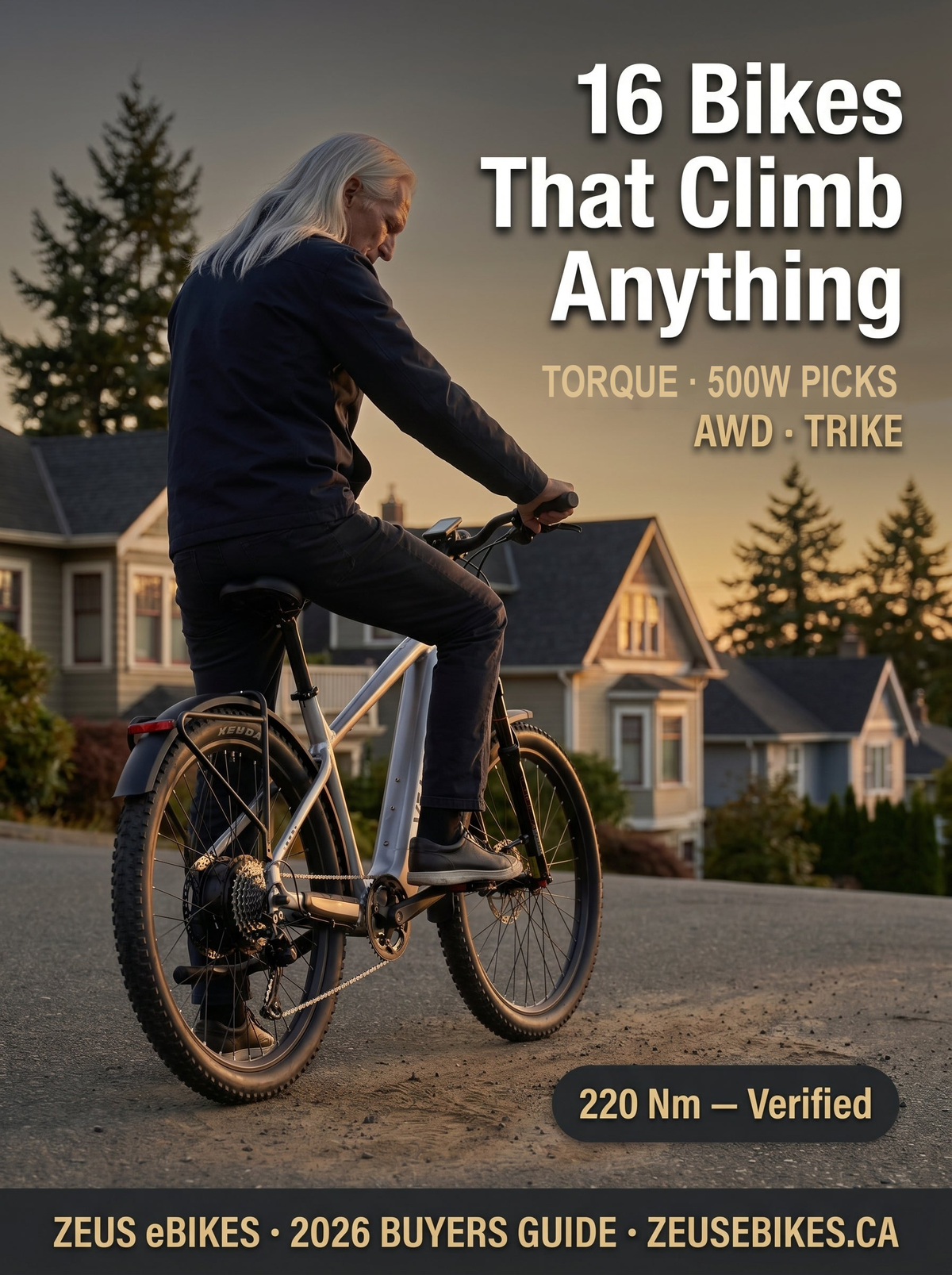
For steep hills, buy torque, not watts. Zeus co-founder Milad Ghobadibeygvand tested the Velotric Summit 2 at 220 lbs on real hill routes and calls it the best hill bike we sell — 100 Nm SensorSwap, 440 lb payload, 63 lb frame, $3,399. For seniors or step-thru riders who want a 500W hill commuter, the Velotric Discover M adds a 6-axis IMU that auto-adjusts assist to the terrain ($3,899). For genuinely steep off-road grades above 12%, the Eunorau Specter-S 3.0 (160 Nm Bafang M620, $4,099) is the machine. All 14 picks verified against live Zeus product pages in June 2026; prices re-checked 27 September 2026.
This guide is for steep streets, paved and gravel hills, and uphill commutes — the climbs most Canadians actually ride to work, school and the shops. If your “hill” is a technical mountain trail of roots, rock faces and singletrack, you want a purpose-built full-suspension eMTB instead — see our best electric mountain bikes in Canada guide.
This June 2026 edition covers 14 verified picks across four groups: 500W picks, high-torque mid-drives, AWD dual-motors, and special-situation picks (folding, trike). Zeus co-founder Milad Ghobadibeygvand personally tested the Velotric Summit 2 at 220 lbs on real Canadian hill routes; all other picks were assessed against sourced Canadian grades: Victoria’s Summit Avenue (13% average; Strava segment data), New Westminster’s Queens Avenue (10% average; Canadian Running Magazine/Strava), Hamilton’s Sydenham Road climb (6% average, ramps near 9%; Canadian Cycling Magazine), and Quebec City’s Côte Gilmour (7% average). Every torque figure, battery capacity, and price was verified against the live Zeus product page on or after 22 June 2026 (prices re-checked 27 September 2026); where a manufacturer does not publish a figure, we say so. Winter range uses the 17–47% cold-capacity loss benchmark from Battery University (BU-504) and Bosch eBike Systems.
In This Guide
- The 14 Best Electric Bikes for Steep Hills
- How Much Torque Do You Need for Steep Hills?
- Mid-Drive vs Hub vs AWD on Hills
- Is 500W Enough — and Is 750W Legal?
- Electric Bikes for Hills for Seniors
- Best Hill eBike by Canadian City
- Best Hill eBike for Heavier Riders
- How to Actually Climb a Hill
- Hills, Cold & Range
- When These 14 Aren’t Enough
- Frequently Asked Questions
The 14 Best Electric Bikes for Steep Hills in Canada (2026)
Rad Power Bikes filed Chapter 11 in December 2025 and left thousands of Canadians holding hub-motor eBikes that work fine on flat ground — until the first real hill. That search brought many of you here today. The stakes are not abstract: the wrong motor on a daily climb is a $3,000 bike that overheats, throttles down and chews through battery on the one terrain you bought it for. Walk through the situation table and the four groups below and you will know exactly which motor type, torque figure, and eBike matches your hill grade, your weight, and whether you ride on public roads — and which single spec separates a confident climb from one that stalls.
Find your situation in the table below, then jump to the pick. Every price was re-checked against the live Zeus product page on 27 September 2026.
| Your Situation | Best Pick | Price |
|---|---|---|
| Editor’s Pick — personally tested 220 lbs | Velotric Summit 2 | $3,399 |
| Seniors / step-thru 500W commuter | Velotric Discover M | $3,899 |
| Lowest-priced 500W pick — 64 lbs | Taubik Vista 26 | $2,399 |
| Premium 500W full-suspension eMTB | Eunorau Urus 2.0 | $5,700 |
| Most mid-drive torque per dollar (160 Nm) | Eunorau Hunter X7 | $3,299 |
| The steepest grades in Canada (160 Nm) | Eunorau Specter-S 3.0 | $4,099 |
| 160 Nm in a step-thru frame | Eunorau Specter-ST 2.0 | $4,099 |
| Wet/slippery hills + torque sensor | Eunorau FAT-AWD 3.0 | $2,299 |
| Year-round hills, up to 3 batteries | Eunorau Flash AWD | $2,700 |
| 250 Nm step-thru full-suspension AWD | Ranger Plus M-540 | $2,799 |
| Retro moped-style, 1,560 Wh | Eahora DL2000 | $3,799 |
| Cargo step-thru AWD, 4,200 Wh | Eahora Juliet Pro II | $4,099 |
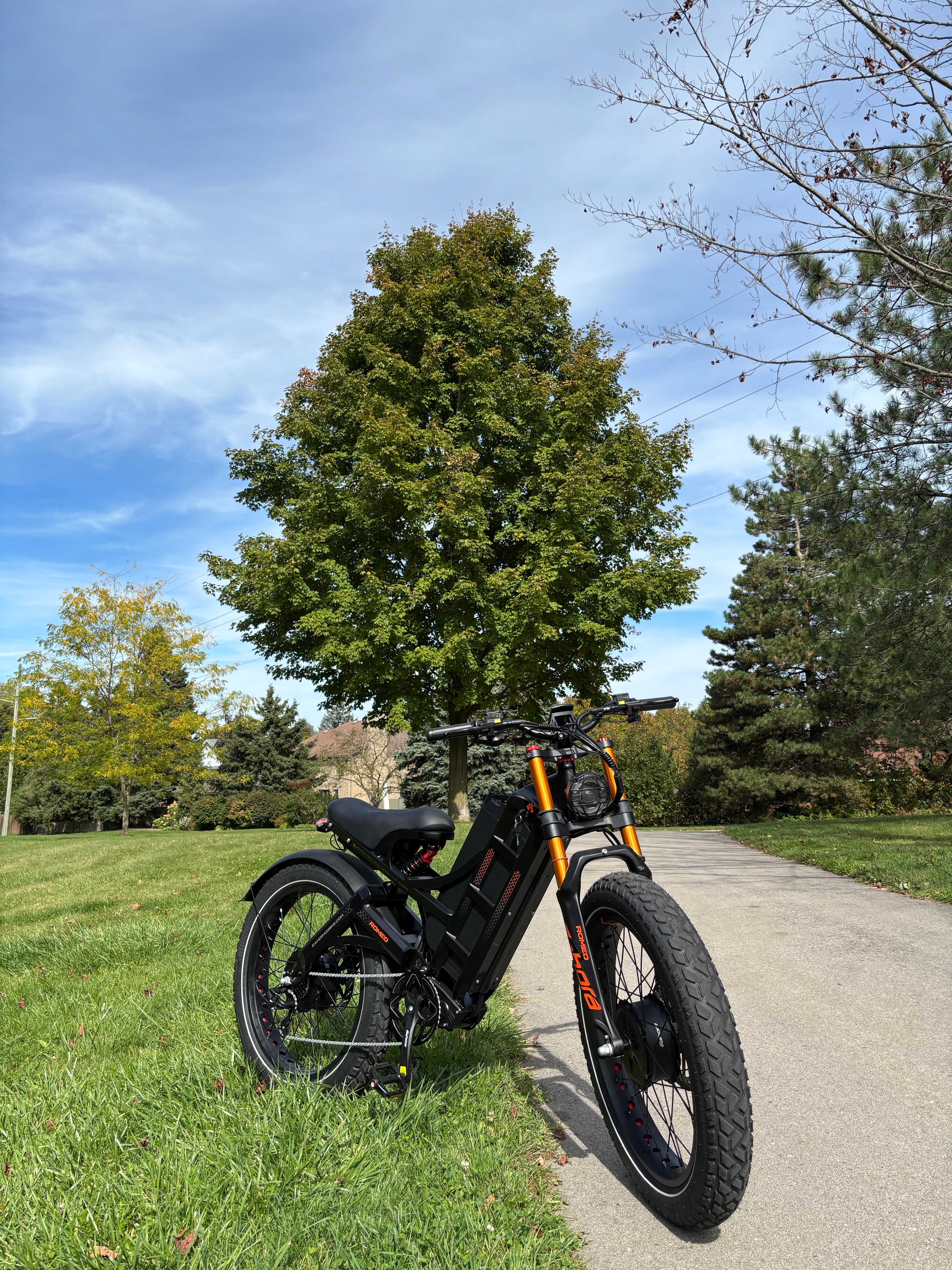
| 240 Nm, 4,800 Wh, 500 lb payload | Eahora Romeo Ultra II | $5,599 |
| Three-wheel stability for seniors | CityTri E-310 | $2,399 |
⭐ Editor’s Pick
1. Velotric Summit 2 — $3,399 (Editor’s Pick — Milad’s Personal Hill King)

220 lbs. Victoria. It climbed. | 📸 Photography by Playcut.ai
Motor: 750W hub | Torque: 100 Nm (SensorSwap torque mode) | Battery: 51.4V 15.6Ah (≈800 Wh) | Tires: 27.5″×2.4″ non-fat | Weight: 63 lbs | Payload: 440 lbs | Sensor: SensorSwap (cadence + torque toggle) | Drivetrain: 9-speed SRAM CUES | Certification: UL2849 | Power-assisted bicycle: No — 750W exceeds the 500W PAB limit
Milad rode the Summit 2 at 220 lbs on his real test routes and reports it “accelerated up the hill” — words you almost never say about a hub motor. What makes it work is the combination: a 63 lb frame (one of the lightest in this guide), 27.5″×2.4″ non-fat tires (dramatically less rolling resistance than 4.0″ fat tires), a 440 lb payload that takes heavier riders seriously, and SensorSwap so you can engage true torque mode when the grade demands it. The result is a power-to-weight ratio that outperforms heavier fat-tire bikes on real urban climbs. See the heavy rider guide for the full context on why weight matters on hills.
Honest limit: At 750W it is outside the 500W limit the provincial rules converge on — treat it as an off-road and private-property bike. Hardtail only; no rear suspension. Hub motors can throttle on very long sustained grades above 15% at high assist; use PAS 3–4 rather than full throttle to let the windings breathe.
500W Picks — Inside the 500W Limit the Provinces Converge On
2. Velotric Discover M — $3,899 (Best 500W Pick for Seniors & Step-Thru Commuters)

The grade reads itself. You just pedal. | 📸 Photography by Playcut.ai
Motor: 500W VeloCore mid-drive | Torque: 100/130 Nm (Standard/Boost, SensorSwap) | Battery: 57.2V 14Ah (≈800 Wh) | Frame: Step-thru | Payload: 440 lbs | Sensor: SensorSwap + 6-axis IMU | Brakes: Hydraulic disc | Certifications: UL2849, IP67 | Power-assisted bicycle: 500W nominal; 32 km/h default, app Custom mode up to 45 km/h (whether an adjustable cap qualifies is not settled)
The Discover M’s 6-axis IMU is the feature no other 500W pick here carries: it reads inclination in real time and automatically ramps up assist as the grade steepens, without any button press. Pair that with SensorSwap torque mode and a step-thru frame on a morning hill commute and the riding experience is quietly effortless. A 440 lb payload and IP67 weatherproofing make it the most practical year-round 500W hill commuter we carry. For the full senior-specific breakdown, see the seniors on hills section below and our seniors guide.
Honest limit: No rear suspension. 27.5″×2.25″ tires are slim — excellent on pavement, not a trail bike. About $1,500 more than the Taubik Vista 26 if budget is the primary constraint.
3. Taubik Vista 26 — $2,399 (Lowest-Priced 500W Pick — 64 lbs)

64 lbs. Then the elevator. | 📸 Photography by Playcut.ai
Motor: 500W Sutto hub | Torque: 68 Nm | Battery: 48V 14.7Ah Samsung (706 Wh, UL2271) | Tires: 26″×1.9″ CST | Suspension: 60mm coil fork | Drivetrain: 7-speed Shimano Altus | Weight: 64 lbs | Payload: 286 lbs | Sensor: Dual (cadence + torque toggle) | Brakes: Zoom hydraulic 180mm | Power-assisted bicycle: 500W / 32 km/h, single setting — inside the limits the provincial rules converge on
At 64 lbs with an ultra-low step-thru, the Vista 26 is one of the easiest bikes in this guide to manoeuvre at a stop-start hill commute — and the lower weight means less work for the motor on the grade. The dual-sensor toggles between cadence and torque modes via the display; in torque mode, hill starts feel planted despite the hub architecture. The slim 26″×1.9″ tires deliver minimal rolling resistance on pavement, giving the 500W hub a noticeable efficiency advantage over fat-tired picks on sealed surfaces.
Honest limit: 68 Nm is not adequate for sustained grades above 8–10%, especially with a heavier rider or cargo. Lowest payload (286 lbs) in the guide. For serious hill grades, the Discover M is a stronger choice.
4. Eunorau Urus 2.0 — $5,700 (Premium 500W Full-Suspension eMTB)

Full suspension. 500W. Both. | 📸 Photography by Playcut.ai
Motor: Bafang M600 500W mid-drive | Torque: 120 Nm | Battery: 48V 17.5Ah (840 Wh) | Fork: 160mm travel | Tires: 27.5″×2.8″ Maxxis Minion plus | Drivetrain: SRAM NX 11-speed | Suspension: Full suspension | Payload: 300 lbs | Sensor: Torque | Certification: UL certified | Power-assisted bicycle: 500W nominal; Eunorau prints both 32 and 45 km/h top speeds (Class 3, unlockable) (whether an adjustable cap qualifies is not settled)
The Urus 2.0 is the only 500W pick here built for both steep streets and technical trails; Eunorau's own page prints both a 32 km/h and a 45 km/h top speed and calls it an unlockable Class 3 bike, and whether an adjustable cap qualifies is not settled. The Bafang M600 powers purpose-built eMTBs at twice this price; a 160mm travel fork and Maxxis Minion 27.5″×2.8″ plus tires handle root-crossed singletrack, the SRAM NX 11-speed delivers the right gear for every pitch, and full suspension means the descent is as controlled as the climb. For riders who commute all week and shred the North Shore on weekends, this is the one bike here built for both.
Honest limit: $5,700 is the highest price in this guide. Payload is 300 lbs. Built for capability, not commuter convenience — no rack or fenders standard.
Of the fourteen picks in this guide, three are 500W nominal: the Velotric Discover M, the Taubik Vista 26, and the Eunorau Urus 2.0. The Vista 26 has a single 32 km/h setting; the Discover M ships at 32 km/h and can be unlocked higher, Eunorau prints both 32 and 45 km/h for the Urus, and whether an adjustable cap qualifies is not settled. All other picks exceed the 500W limit the provincial rules converge on and are not power-assisted bicycles on public roads. Canadian PAB rules are provincial — confirmed via each province’s current highway traffic legislation — and regulations change; always verify with your province before road use. For a complete breakdown of Canadian eBike law by province, see our eBike laws guide. Not sure which applies to you? Call Zeus at 1-866-938-7580.
Best for seniors & commuters: Velotric Discover M ($3,899, 6-axis IMU step-thru). Lowest price of the three: Taubik Vista 26 ($2,399, 64 lbs). Best for trails + streets: Eunorau Urus 2.0 ($5,700, Bafang M600). If staying at 500W is the constraint, any of these three climbs real Canadian grades. Check each card’s road line: Velotric and Eunorau list adjustable caps for the Discover M and the Urus, so whether they qualify is not settled. If you need more power and can accept off-road-only use, see the next groups.
Every pick here ships across Canada. Financing is available on all models.
See 7 ways to finance an eBike in Canada → | Shop all mid-drive eBikes →
High-Torque Mid-Drives — 160 Nm Bafang (Off-Road / Private Property)
5. Eunorau Hunter X7 (FAT-HD 2.0) — $3,299 (Most Mid-Drive Torque Per Dollar)

Every surface. One motor. | 📸 Photography by Playcut.ai
Motor: 1,000W Bafang mid-drive | Torque: 160 Nm | Battery: 48V 15Ah (≈720 Wh) | Tires: 26″×4.0″ fat | Brakes: Hydraulic disc | Power-assisted bicycle: No — 1,000W exceeds the 500W PAB limit
The Hunter X7 is the cheapest way into 160 Nm of Bafang mid-drive torque in the Zeus lineup. For riders whose hills go beyond “steep urban street” into fire roads, escarpment trails, or heavily loaded climbs, the extra 30 Nm over a 130 Nm bike is the difference between sitting and grinding. Fat tires add traction and the mid-drive routes all of it through the gears, so it climbs efficiently rather than cooking the motor.
Honest limit: 1,000W nominal = not road-legal as a PAB. Eunorau does not publish a watt-hour figure for this pack; we quote the 48V 15Ah rating. Fat tires trade some pavement efficiency for grip.
6. Eunorau Specter-S 3.0 — $4,099 (For the Steepest Grades)

160 Nm. The grade that ends other bikes. | 📸 Photography by Playcut.ai
Motor: 1,000W Bafang M620 mid-drive | Torque: 160 Nm | Battery: 48V 17.5Ah LG (840 Wh) | Fork: 140mm inverted travel | Tires: 26″×4.0″ fat | Brakes: 4-piston hydraulic 180mm | Power-assisted bicycle: No — 1,000W exceeds the 500W PAB limit
The Bafang M620 has a decade of mountain-eBike dominance and a reputation for shrugging off grades that make other motors labour. Where a 130 Nm bike slows to a crawl on Victoria’s Summit Ave, the Specter-S shifts down and keeps moving. The 140mm inverted fork and 4-piston brakes handle the descent as confidently as the climb, and the 840 Wh LG pack gives real range on sustained ascents.
Honest limit: At $4,099 it is a premium choice — for ordinary urban hills a 500W mid-drive is enough. At 1,000W it is not road-legal as a PAB. Eunorau does not publish a curb weight for this model.
7. Eunorau Specter-ST 2.0 — $4,099 (160 Nm, Step-Thru Mountain)

Stop anywhere. Both feet down. | 📸 Photography by Playcut.ai
Motor: 1,000W Bafang M620 mid-drive | Torque: 160 Nm | Frame: Step-thru | Battery: 48V 17Ah + free second 15Ah battery | Brakes: Hydraulic 180mm | Weight: 40 kg | Power-assisted bicycle: No — 1,000W exceeds the 500W PAB limit
Identical 160 Nm Bafang M620 to the Specter-S, in a step-thru frame. The low standover changes who can use that power: riders who find a high top-tube hard to clear, anyone making frequent foot-down stops on a hill commute, or riders coming from a relaxed step-thru posture who want maximum torque. It ships with a free second battery, so range on long ascents is never the constraint.
Honest limit: Step-thru frames flex slightly more than diamond frames under extreme lateral load; for aggressive technical off-road, the Specter-S is stiffer. On paved and gravel hills the difference is imperceptible. 1,000W = not road-legal as a PAB.
Want to talk through which motor fits your hill? Call Zeus at 1-866-938-7580 — real people answer.
Shop all mountain eBikes → | Mid-drive vs hub motor: which climbs better? →
AWD Dual-Motor — Maximum Traction & Capacity
8. Eunorau FAT-AWD 3.0 — $2,299 (Wet/Slippery Hills + Torque Sensor)

Wet grade. Both wheels. $2,299. | 📸 Photography by Playcut.ai
Motors: 2×500W hub (front + rear) | Torque: 110 Nm combined | Battery: 48V 15Ah LG (720 Wh; optional second → 1,440 Wh) | Tires: 26″×4.0″ Kenda Krusade fat | Payload: 375 lbs | Sensor: Torque | Frame: Step-thru | Power-assisted bicycle: No — dual 500W exceeds the 500W PAB limit
AWD plus a torque sensor at $2,299 makes the FAT-AWD 3.0 the best-value traction pick here. It handles terrain that sends single-motor bikes sideways: saturated spring gravel, an ice-edged Calgary path, wet-root North Shore singletrack. The torque sensor keeps hill starts smooth even in AWD mode, and an optional second battery doubles capacity to 1,440 Wh for all-day winter climbs. See the fat tire guide for the full category context.
Honest limit: 110 Nm combined is less raw climbing force than the 130 Nm mid-drives — it wins on traction, not torque. Running both motors draws 30–40% more battery than rear-only mode.
9. Eunorau Flash AWD — $2,700 (Year-Round, Up to 3 Batteries / 2,808 Wh)

Minus 15. Three batteries. Still going. | 📸 Photography by Playcut.ai
Motors: 2×750W hub (1,500W combined) | Torque: 184 Nm | Battery: 832 Wh base; up to 2,808 Wh with three batteries | Tires: 20″×4.0″ fat | Payload: 440 lbs | Brakes: Hydraulic disc | Certification: UL certified | Power-assisted bicycle: No — 1,500W combined exceeds the 500W PAB limit
The Flash AWD’s triple-battery system is the defining feature for Canadian hill riders: start a January commute at 2,808 Wh knowing you will lose 20–35% to cold and another large chunk to climbing, and arrive with comfortable headroom. At 184 Nm combined AWD torque, it climbs confidently from a dead stop on wet or icy grades, and with a 440 lb payload it accommodates most riders with cargo. Read our long range guide for the full deep-battery context.
Honest limit: Sensor type not published by Eunorau — confirm with Zeus before purchasing if torque-sensor feel is critical for your hill route. Each additional battery adds cost. 20″ wheels are less stable at high speed than 26″.
10. Freesky Ranger Plus M-540 — $2,799 (250 Nm Step-Thru AWD, 400 lb Payload)

250 Nm. Loaded. Up the hill. | 📸 Photography by Playcut.ai
Motors: Dual hub AWD (5,000W peak) | Torque: 250 Nm | Battery: 48V 30Ah (1,440 Wh) | Frame: Step-thru, full suspension | Payload: 400 lbs | Sensor: Cadence (5-level) | Certification: UL2849 + UL2271 | Power-assisted bicycle: No — 5,000W peak far exceeds the 500W limit the provincial rules converge on
At 250 Nm in a step-thru full-suspension AWD frame, the Ranger Plus is the highest-torque step-thru in this guide at under $3,000 — the Juliet Pro II matches the frame style at 190 Nm but costs $1,300 more at its everyday price. For a heavier rider on steep off-road terrain who also needs easy mount/dismount, the Ranger Plus is the value answer. 400 lb payload with full AWD traction handles the load; full suspension handles the terrain. The 1,440 Wh battery provides all-day range even on demanding hilly routes.
Honest limit: Cadence sensor means hill starts from a dead stop feel more abrupt than torque-sensor picks — build speed on flat ground before the grade when possible. 5,000W peak = off-road/private property only. 20″ wheels.
11. Eahora DL2000 — $3,799 (Retro Moped-Style, 1,560 Wh, All-Day Climbing)

1,560 Wh. All day. Any grade. | 📸 Photography by Playcut.ai
Motors: Dual hub (Canadian listing: 2×250W / 500W combined) | Torque: 130 Nm | Battery: 52V 30Ah (1,560 Wh) | Tires: 20″×4.5″ fat | Suspension: 100mm hydraulic fork + FASTACE rear coil | Brakes: Hydraulic disc 240mm | Weight: 164 lbs | Payload: 330 lbs | Sensor: Cadence | Power-assisted bicycle: ⚠️ Unconfirmed — CA listing 500W (inside the 500W limit) vs US listing 1,600W (outside it); confirm road-legal status with Zeus before riding on public roads
The DL2000’s defining hill advantage is the 1,560 Wh battery — more than double a 720 Wh pack, and plenty to sustain multiple daily hill climbs in a cold Canadian winter. The retro moped design adds visual appeal, and the 20″×4.5″ fat tires with full suspension handle varied terrain. At 130 Nm combined AWD torque it climbs confidently from any grade.
Honest limit: ⚠️ The Canadian and US product listings show conflicting motor wattage (500W vs 1,600W) — confirm road-use legal status with Zeus before riding on public roads. Single-speed (no gearing = less efficient on steep climbs than a mid-drive). At 164 lbs, plan your storage.
12. Eahora Juliet Pro II — $4,099 (Cargo Step-Thru AWD, 4,200 Wh)

4,200 Wh. Loaded. Steep grade. | 📸 Photography by Playcut.ai
Motors: 2×2,200W AWD (4,400W combined) | Torque: 190 Nm combined (2×95 Nm) | Battery: 60V 70Ah (4,200 Wh) | Frame: Step-thru, full suspension (100mm front + 50mm rear) | Tires: 20″×4.0″ fat | Brakes: 4-piston hydraulic 180mm | Weight: 148 lbs | Payload: 400 lbs | Sensor: Cadence (5-level) | IPX6 | Power-assisted bicycle: No
The Juliet Pro II is the cargo step-thru answer to riders who need maximum battery on hilly terrain. Its 4,200 Wh pack is the second-largest in this guide, in a step-thru full-suspension frame with 4-piston hydraulic brakes for confident descent control. At 190 Nm combined AWD torque and IPX6 weatherproofing, it is built for year-round Canadian hill riding with cargo. The 400 lb payload accommodates heavier riders plus gear.
Honest limit: Cadence sensor — start on a flat section before the grade for smoother engagement. At 148 lbs it is heavy. Not PAB-legal. 20″ wheels.
13. Eahora Romeo Ultra II — $5,599 (240 Nm, 4,800 Wh, 500 lb Payload)

240 Nm. Nothing stops it. | 📸 Photography by Playcut.ai
Motors: Dual, 6,000W peak (Eahora factory-limits them to 500W continuous) | Torque: 240 Nm total | Battery: 60V 80Ah (4,800 Wh) | Tires: 26″×4.0″ INNOVA fat | Weight: 205 lbs | Payload: 500 lbs | Sensor: Cadence (5-level) | Top speed: 70–80 km/h | Drivetrain: 7-speed Shimano | Power-assisted bicycle: No
The Romeo Ultra II sits at the extreme of every spec that matters for hills: 240 Nm of combined AWD torque, 4,800 Wh of battery, and a 500 lb payload. For the heaviest riders, or anyone who wants a machine that simply does not encounter a hill it cannot climb, this is it. The 4,800 Wh means range on repeated ascents is never the limiting factor; 240 Nm means even the steepest off-road grades are not a concern.
Honest limit: At 205 lbs it is the heaviest bike in the guide — plan storage accordingly. Cadence sensor. Top speed of 70–80 km/h means firmly off-road/private property in every province. Brakes and certifications not published by Eahora; confirm with Zeus. Charge time 8–12 hours for the full pack.
Best value traction: FAT-AWD 3.0 ($2,299, torque sensor). Year-round + max battery: Flash AWD ($2,700, up to 2,808 Wh). Step-thru 250 Nm: Ranger Plus M-540 ($2,799). Retro all-day: DL2000 ($3,799, 1,560 Wh). Cargo step-thru: Juliet Pro II ($4,099, 4,200 Wh). Maximum everything: Romeo Ultra II ($5,599, 240 Nm / 4,800 Wh / 500 lb). AWD wins on traction and total capacity; mid-drives win on gear-multiplied torque efficiency. On a dry steep grade, a mid-drive pulls harder per watt; on a wet or loose grade, AWD keeps moving when a single drive spins.
Special Situations — Folding & Trike
14. CityTri E-310 — $2,399 (Three-Wheel Stability for Seniors & Balance-First Riders)

Three wheels. Zero balance required. | 📸 Photography by Playcut.ai
Motor: rear hub printed two ways (500W with a 1,100W peak, and 750W, on Addmotor’s own pages and our listing) | Torque: 90 Nm | Battery: 48V 20Ah (960 Wh) | Tires: 20″ × 2.4″ front, 18″ × 2.4″ rear (Standard) | Frame: Three-wheel trike | Drive: Rear-wheel | Payload: 280 + 80 lb (rider + cargo) | Sensor: Cadence | Brakes: Tektro mechanical disc on each wheel | Power-assisted bicycle: not settled — at 750W it would exceed the 500W limit, at 500W it would not; ask us which motor ships
The CityTri eliminates balance entirely — three wheels, rear-wheel drive, and a comfortable upright seating position that keeps the rider planted on both ascents and descents. For seniors whose main concern on a hill is stability rather than speed, or riders recovering from injury, the trike configuration solves a problem no two-wheel bike in this guide can. At 90 Nm with a 960 Wh battery, it has enough power and range for daily hilly commutes. The payload (Addmotor prints 280 lb for the rider plus 80 lb of cargo) accommodates most riders with cargo. See the full electric trike collection.
Honest limit: Cadence sensor — assist engagement is stepped. Tricycles handle corners differently than two-wheel bikes; take steep downhill corners with care. Above the 500W limit at 750W and inside it at 500W, so ask us which motor ships. Widest footprint of any pick here — confirm path/trail width.
Need three-wheel stability: CityTri E-310 ($2,399, eliminates balance entirely). The E-310’s motor is printed two ways (500W and 750W), but it solves a specific real problem that none of the other 13 picks address.
How Much Torque Do You Actually Need for Steep Hills?
Match torque to your steepest regular grade. On a mid-drive, that means roughly 45–60 Nm for mild bike-path rises, 60–80 Nm for most suburban streets, 80–100 Nm for steep 7–10% grades, and 85–120+ Nm for the very steep climbs above 10% — Victoria’s Summit Avenue, the North Shore. Get the torque right and a heavier rider, a cold morning and a loaded pannier still clear the hill; get it wrong and the bike bogs down on the first real grade you hit.
The spec that matters for hills is torque, measured in Newton-metres (Nm) — not nominal watts. Torque is the rotational force delivered to the wheel, and force at low speed is exactly what a climb demands. Bosch eBike Systems puts it plainly: “the maximum torque is mostly used when accelerating or climbing steep hills.” Watts describe a motor’s overall output; torque describes whether it can turn the wheel against gravity at 8 km/h.
The same targets in detail, with a Canadian example for each grade:
| Hill Grade | Example | Torque Target (mid-drive) |
|---|---|---|
| 0–4% (mild) | Gentle bike-path rise | 45–60 Nm |
| 4–7% (real hill) | Most suburban streets | 60–80 Nm |
| 7–10% (steep) | Hamilton, Calgary river valley | 80–100 Nm |
| 10%+ (very steep) | Victoria Summit Ave, North Shore streets | 85–120+ Nm |
Those bands come from Electric Bike Explorer and Leoguar Bikes, and they are guidelines, not laboratory standards — treat them as a floor, not a guarantee. Two things shift the target upward: rider weight (torque demand scales with the combined load of rider, bike and cargo) and motor type (a mid-drive at a given Nm out-climbs a hub motor at the same Nm, because it routes that force through your gears). That is why every mid-drive in this guide sits at 130 Nm or higher: it buys headroom for Canadian grades, winter, and real-world weight.
Match torque to your steepest regular climb, then add headroom. Under 7% grade, 80–100 Nm is plenty. Above 10% — or if you are a heavier rider, or you ride year-round — aim for 130 Nm of mid-drive torque or more. Ignore the watt number on the marketing banner; it does not tell you whether the bike climbs.
Mid-Drive vs Hub vs AWD: Which Motor Wins on Hills?
A mid-drive motor wins on steep, firm climbs; an all-wheel-drive dual-motor wins on slippery ones; and a single hub motor is the architecture to avoid for serious hills. The reason comes down to where the force is made and how it reaches the ground.
A mid-drive motor sits at the cranks and sends power through the bike’s chain and gears. Drop into a low gear on a climb and that gearing multiplies the motor’s torque roughly two to three times at the wheel (EVELO) — the same principle as a longer wrench handle. The motor keeps spinning fast even when the bike crawls, so it stays cool and efficient exactly when a hill is hardest.
A hub motor bolts into the wheel and turns it directly, with no gears in between. Its torque is fixed regardless of how slowly the wheel turns, and a hub motor is most efficient near three-quarters of its top RPM. On a sustained steep climb the wheel turns slowly, efficiency falls toward 30%, and most of the battery’s energy becomes heat instead of motion. When the windings or internal nylon gears get too hot, the controller cuts power to protect the motor. That mid-climb power drop is thermal protection, not a defect — and it is the single most common complaint about cheap hub-motor “hill” bikes.
An AWD dual-motor bike powers both wheels at once. It does not multiply torque the way gears do, but it solves a different problem: traction. On wet November pavement, spring-melt gravel, or a loose driveway, a rear-only drive can spin its wheel and stall; AWD keeps moving because two contact patches are working, not one. Think of it as effective torque delivered to the ground rather than peak torque on a spec sheet.
Choose Mid-Drive If…
- Your hill is steep and firm — dry asphalt, packed gravel, compacted dirt.
- You want efficiency and range — gear multiplication does more climbing per watt-hour.
- You ride paved urban hills year-round and want the smoothest pedal feel.
- You want a 500W bike inside the limits the provincial rules converge on (the mid-drives below).
Choose AWD Dual-Motor If…
- Your hill is steep and uncertain — wet, icy-edged, gravel, loose dirt, roots.
- You value traction confidence over outright efficiency.
- Your terrain varies — pavement on weekdays, trail on weekends.
- You carry heavy loads and want both wheels driving on the climb.
One more spec separates a confident climb from a jerky one: the torque sensor. A torque sensor reads how hard you push — sampling rider input as often as 1,000 times per second (Electrek) — and delivers proportional power, so a hill start from a dead stop is smooth and planted. A cadence sensor only detects that the pedals are moving and dumps in power after a one-to-two-second lag, which on a steep wet start can spin the wheel or lurch the bike. Most picks in this guide use a torque sensor — specifically the mid-drives (Discover M, Urus 2.0, Specter-S, Specter-ST), the FAT-AWD 3.0, the Summit 2 (SensorSwap toggles between torque and cadence modes via the display), and the Vista 26 (dual-sensor). Cadence-sensor picks — Ranger Plus M-540, DL2000, Juliet Pro II, Romeo Ultra II — still climb powerfully, but the hill-start feel is less refined: build rolling speed before the grade where possible. For the deeper engineering, read our mid-drive vs hub motor comparison and our pedal assist vs throttle guide.
Steep and dry → mid-drive. Steep and slippery → AWD. Avoid single hub motors for serious hills. A mid-drive multiplies torque through the gears and stays cool; an AWD bike trades efficiency for all-surface traction; a cheap hub motor overheats and cuts out on the exact terrain you bought it for.
Is 500W Enough for Hills — and Is 750W Even Legal in Canada?
A 500W mid-drive is enough for the vast majority of Canadian hills, and it is the category that sits inside the limits the provincial rules converge on. This is the question almost every US buying guide ignores — they tell Canadians to buy 750W or 1000W “for hills” without mentioning that those bikes break the 500W PAB limit on a public road.
The provinces set the e-bike rules — not the US Class 1/2/3 system — and they converge on a power-assisted bicycle with a motor of 500W nominal output, working pedals, and electric assistance that cuts out at 32 km/h (Nova Scotia's statute says 30 km/h). A 500W mid-drive sits inside that limit and still climbs steep urban grades comfortably — which is exactly why the torque-not-watts point matters so much here. You do not need to break the law to climb a hill; you need gear multiplication.
Of the 14 picks in this guide, exactly three are 500W nominal: the Velotric Discover M, the Taubik Vista 26, and the Eunorau Urus 2.0. Only the Vista 26 has a single 32 km/h setting; the other two can be unlocked higher, and whether an adjustable cap qualifies is not settled. All other picks exceed the 500W limit the provincial rules converge on, which restricts them to private property and off-road use. Canadian PAB rules are set provincially and change — always verify with your province before road use. See our full eBike laws guide for a province-by-province breakdown.
If wattage and legality are your main decision points, read our full 500W vs 750W vs 1000W guide before you buy. For most riders, the answer is simpler than the spec sheets suggest: a high-torque 500W mid-drive is the sweet spot for Canadian hills.
Want a 500W bike that climbs?
Browse the Zeus mid-drive collection → | Read: 500W vs 750W vs 1000W →
Electric Bikes for Hills for Seniors in Canada (2026)
For seniors on hilly routes, the conversation shifts from “how much torque?” to “how much confidence?” Three concerns stack on top of climbing ability: easy mount/dismount on a grade (a step-thru frame eliminates the swing-leg problem), smooth torque delivery at low speed (a torque sensor prevents the lurch that catches riders off guard at a steep standing start), and for some riders, balance on a descent (a trike removes this from the equation entirely).
Three-Tier Senior Hill Framework
Tier 1 — Maximum safety, all-day confidence: The CityTri E-310 ($2,399) eliminates balance entirely. Three wheels, rear-wheel drive, and a stable upright seating position keep the rider planted on both ascents and descents. If balance is the primary concern — because of a vestibular issue, post-surgery recovery, or simply the anxiety of a steep downhill on two wheels — the trike is the answer. Read the full electric trike collection.
Tier 2 — 500W, step-thru, auto-terrain sensing: The Velotric Discover M ($3,899) is the best two-wheel senior hill pick in the guide. A step-thru frame, 440 lb payload, UL2849, IP67, and a 6-axis IMU that automatically ramps up assist as the grade increases — without any button press. The IMU is the feature that makes the biggest difference for seniors: the bike reads the hill and responds before the rider has to think about it. It is 500W and ships at 32 km/h; Velotric's app has a Custom mode up to 45 km/h, and whether an adjustable cap qualifies is not settled.
Tier 3 — Light, simple, 32 km/h only: The Taubik Vista 26 ($2,399) at 64 lbs is one of the easiest bikes in the guide to lift, store and manoeuvre at stops on a grade. Dual-sensor toggles between cadence and torque mode; in torque mode, hill starts are smooth despite the hub architecture. Not as capable as the Discover M on steep grades, but a light option for riders for whom weight is a meaningful concern.
Balance concern? CityTri E-310 trike ($2,399 — three wheels, no balance needed). Step-thru 500W commuter with intelligent terrain sensing? Velotric Discover M ($3,899 — 6-axis IMU auto-adjusts assist). Light and simple? Taubik Vista 26 ($2,399 — 64 lbs, 32 km/h only). All three pick the senior up from a full stop on a grade without lurching. Call Zeus at 1-866-938-7580 to talk through which fits your specific route and mobility level.
Best Hill eBike by Canadian City
Most Canadian city hills sit between 5% and 10% — a grade a 500W mid-drive like the Discover M climbs comfortably at 500W; only the steepest named streets, like Victoria’s 13% Summit Avenue, truly reward a 160 Nm Bafang. Below are real, sourced grades for the climbs riders actually search, with the pick that suits each. Grades are average gradients; individual ramps can be steeper.
| City & Climb | Verified Grade | Best Pick |
|---|---|---|
| Victoria — Summit Ave (Mount Tolmie) | 13% avg (Strava) | Summit 2 / Specter-S 3.0 (160 Nm) |
| Vancouver — North Shore residential / Queens Ave, New West | 10% avg (Cdn Running Mag) | FAT-AWD (wet) |
| Hamilton — Sydenham Road climb (Dundas) | 6% avg, ramps ~9% (Cdn Cycling Mag) | Discover M |
| Quebec City — Côte Gilmour | 7% avg (Strava) | Hunter X7 |
| Calgary — Edworthy to Coach Hill | 5% avg (Cdn Cycling Mag) | Discover M (senior commuter) |
| Halifax — Flamingo Drive area | 8% avg (Strava) | FAT-AWD (winter) |
In any city where “hill” and “November rain” share a sentence — Vancouver, Victoria, Halifax — AWD traction earns its place over outright torque, which is why the FAT-AWD 3.0 sits against the wet-weather picks above. For a Calgary-specific breakdown, see our best eBikes for Calgary guide.
Most Canadian city hills are 5–10% — well within a 500W mid-drive’s comfort zone. Reserve the 160 Nm Bafang bikes for genuinely steep streets (Victoria’s 13% Summit Ave, North Shore ramps) and choose AWD where wet or icy surfaces are the real obstacle, not the gradient.
Best Hill eBike for Heavier Riders
A heavier rider needs both high torque and a high payload rating, because climbing force scales with the total load of rider, bike and cargo. A 100 kg rider on a 36 kg bike is asking the motor to lift a 136 kg system up the grade — meaningfully more than a 75 kg rider on the same machine.
Four picks stand out by payload tier. The Velotric Summit 2 ($3,399) carries 440 lbs and was personally tested by Zeus co-founder Milad at 220 lbs — confirmed to accelerate on real hill climbs. The Eunorau FAT-AWD 3.0 ($2,299) carries 375 lbs and splits the climbing load across two driven wheels, which helps traction when a heavier rider starts on a steep, wet incline. The Freesky Ranger Plus M-540 ($2,799) carries 400 lbs with 250 Nm of AWD torque in a step-thru frame. For the most demanding combination of weight and grade, the Eahora Romeo Ultra II ($5,599) carries 500 lbs with 240 Nm and 4,800 Wh.
Riders above roughly 115 kg facing sustained 12%+ grades should prioritise the 160 Nm Bafang mid-drives (Hunter X7, Specter-S) or a dual-motor AWD bike for headroom — and confirm the payload rating before buying. Our heavy riders guide lists payload-rated options across the full catalogue.
For a heavier rider on hills, read the payload spec as carefully as the torque spec. The Summit 2 (440 lb, 220 lb personally tested) and FAT-AWD 3.0 (375 lb, AWD traction) are the best all-round value picks. The Ranger Plus M-540 (400 lb, 250 Nm step-thru AWD) and Romeo Ultra II (500 lb, 240 Nm) handle the most demanding loads.
How to Actually Climb a Hill on an eBike
The right technique makes a mid-range bike climb like an expensive one, and the wrong technique makes any bike struggle. The single most important move: downshift to a low gear before the grade begins, not partway up it. Shifting under the heavy load of a climb strains the chain and can drop it; shifting early keeps the drivetrain smooth and the motor in its efficient band.
- Shift early. Drop into a low gear at the base of the hill while you still have momentum.
- Spin, don’t grind. Aim for a steady cadence of about 70–90 RPM. A low gear at a brisk cadence keeps a mid-drive cool; grinding a high gear at low RPM is what overheats hub motors.
- Let the gear do the work, then add assist. Use a low gear with moderate pedal-assist first; only step up the assist level if you still slow down. Maxing the assist in a high gear wastes battery.
- Keep pedalling. On a torque-sensor bike, steady pedal pressure gives the motor a clear signal to amplify — coasting or pedalling unevenly makes the assist feel jerky.
Do this and you will also stretch your range, because an efficiently climbing motor draws far less current than one bogged down in the wrong gear — which matters even more in winter, as the next section explains.
Shift before the hill, spin at 70–90 RPM, and add assist only if you still slow. Good technique keeps a mid-drive cool and efficient and prevents the bogged-down lurch that drains the battery and overheats hub motors.
Hills, Cold & Range: What Climbing Costs Your Battery
Climbing and cold are the two biggest drains on an eBike battery, and they stack. Hills already consume far more energy per kilometre than flat riding, and lithium-ion cells lose capacity as temperature drops — roughly 17% at 0°C, 34% at −10°C and 47% at −20°C (Battery University, BU-504), with Bosch eBike Systems citing up to 30% range loss below 0°C.
The practical effect: a 720 Wh battery that delivers 60 km of summer hills can drop to 40–45 km on a cold Canadian January climb. That is why battery size matters more on hilly winter commutes than on flat ones. If you climb year-round, favour 840 Wh or larger — the Discover M (≈800 Wh), Specter-S (840 Wh), Specter-ST (dual battery), FAT-AWD (expandable to 1,440 Wh), Flash AWD (up to 2,808 Wh), DL2000 (1,560 Wh), Juliet Pro II (4,200 Wh), or Romeo Ultra II (4,800 Wh).
Two habits recover much of the loss: store the battery indoors and install it just before you ride, and charge it indoors at room temperature. For the full cold-weather playbook, see our eBike battery guide and our best eBikes for winter guide.
Cold plus climbing can cut your range by a third or more. For year-round hilly riding, size up to 840 Wh minimum, store and charge the battery indoors, and install it just before riding to protect both range and climbing power.
When These 14 Aren’t Enough
These fourteen cover almost every Canadian hill-riding need. A few edge cases point elsewhere:
- You need a motorised cargo trike. The CityTri E-310 covers balance stability, but for true cargo-hauling on hills, the electric trike collection has additional models.
- Your “hill” is a technical mountain trail. Roots, rock faces and singletrack call for a purpose-built full-suspension eMTB, not an urban hill bike. See our best electric mountain bikes guide.
- Your climbs are very long and remote. If range, not gradient, is the limit, the dual-battery and triple-battery options in our long range guide go beyond what most hill commuters need.
- You want a fat-tire bike for float as much as grip. Our fat tire guide covers terrain capability across surfaces.
- Mid-Drive vs Hub Motor eBike Canada — the full engineering comparison
- 500W vs 750W vs 1000W eBike Canada — power and the legal limit
- Best eBikes for Heavy Riders Canada — payload-rated picks
- Long Range eBikes Canada — dual-battery options
- Best eBikes for Winter Canada — cold-weather and traction
- Fat Tire eBikes Canada — terrain capability across surfaces
- Best Electric Mountain Bikes Canada — full-suspension trail eMTBs
Frequently Asked Questions
What is the best electric bike for steep hills in Canada?
Zeus co-founder Milad Ghobadibeygvand personally tested the Velotric Summit 2 at 220 lbs on real hill routes and calls it the best hill bike in the Zeus lineup — 100 Nm SensorSwap, 440 lb payload, 63 lb frame, $3,399. For genuinely steep grades above 12%, the Eunorau Specter-S 3.0 (160 Nm Bafang M620, $4,099) handles the steepest Canadian grades. For maximum force and battery, the Romeo Ultra II produces 240 Nm with 4,800 Wh. All 14 picks verified against live Zeus product pages in June 2026; prices re-checked 27 September 2026.
What is the best e-bike for going up steep hills and uphill commuting?
For an uphill commute on paved streets, a 500W mid-drive is the sweet spot — it multiplies torque through the gears, stays inside the 500W limit, and runs cool on repeated climbs. The Velotric Discover M ($3,899) adds a 6-axis IMU that auto-adjusts assist to the terrain, ideal for seniors and step-thru commuters. If your uphill route is wet, gravel or icy-edged, the Eunorau FAT-AWD 3.0 ($2,299) keeps both wheels driving so you do not spin out on a steep, slick start.
Can an electric bike climb a 15% grade?
Yes. A 15% grade — the kind found on North Vancouver residential streets — is climbable on a high-torque mid-drive in a low gear. Aim for 80–120+ Nm of mid-drive torque; a 160 Nm Bafang adds headroom for a heavier rider. The key is gearing: downshift before the grade so the motor stays in its efficient range. A single hub motor under 80 Nm will overheat and throttle down on a sustained 15% climb.
How much torque do I need for an eBike to climb hills in Canada?
Match torque to grade. As a working guideline, mild grades up to 4% need 45–60 Nm; real hills of 4–7% need 60–80 Nm; steep 7–10% grades need 80–100 Nm; and very steep grades above 10% need 85–120+ Nm on a mid-drive with good gearing (Electric Bike Explorer; Leoguar Bikes). These are enthusiast-publication guidelines, not lab standards — torque demand also rises with rider weight, and a mid-drive at a given Nm out-climbs a hub motor at the same Nm because it multiplies force through the gears.
Torque or watts — which matters more for climbing hills?
Torque. Watts describe a motor’s overall power output; torque (Newton-metres) is the rotational force at the wheel, and force at low speed is exactly what a hill demands. Bosch eBike Systems states the maximum torque is mostly used when accelerating or climbing steep hills. A high-torque 500W mid-drive producing 130 Nm can out-climb a typically-tuned 750W hub motor on a steep grade, because the mid-drive multiplies torque through the bike’s gears while the hub motor’s torque stays fixed — though a very high-power hub can still brute-force a climb.
Mid-drive or hub motor for hills — which is better?
Mid-drive is better for hills. A mid-drive motor sits at the cranks and uses the bike’s gears to multiply torque roughly 2–3 times at low speed (EVELO), exactly when a climb demands it. A hub motor produces the same torque regardless of gear; on a sustained steep climb its efficiency falls and most of the battery’s energy becomes heat rather than motion, which is why hub motors can throttle down or cut out on long grades. For steep daily climbs, choose a mid-drive. Read the full mid-drive vs hub motor comparison.
Is a 500W eBike enough for hills, or do I need 750W or 1000W?
A 500W mid-drive is enough for most Canadian hills — and it is the option that stays at the 500W line the provincial rules converge on. The provincial rules converge on 500W nominal output with assistance ending at 32 km/h (Nova Scotia's statute says 30 km/h). Bikes rated 750W–1000W or dual-motor produce more force but exceed the 500W PAB limit, so they are not road-legal Power-Assisted Bicycles and are restricted to private property or off-road use depending on your province.
Why does my eBike motor lose power or cut out on a steep hill?
Usually it is thermal protection, not a defect. A hub motor is most efficient near three-quarters of its top RPM; on a steep climb the wheel turns slowly, efficiency drops toward 30%, and the surplus energy becomes heat. When the windings or internal gears get too hot, the controller reduces power to protect the motor. Mid-drive motors avoid this because the rider downshifts and the motor keeps spinning fast even when the bike moves slowly. The fix is more torque and lower gearing, not more watts.
What is the best electric bike for hills for a heavy rider?
Torque demand scales with combined weight. The Eunorau FAT-AWD 3.0 ($2,299) carries 375 lbs with AWD traction; the Freesky Ranger Plus M-540 ($2,799) carries 400 lbs with 250 Nm; the Velotric Summit 2 ($3,399) carries 440 lbs — confirmed carrying Zeus co-founder Milad at 220 lbs on real hill climbs; and the Eahora Romeo Ultra II ($5,599) carries 500 lbs with 240 Nm and 4,800 Wh. Riders above roughly 115 kg facing sustained 12%+ grades should prioritise 160 Nm Bafang mid-drives or AWD dual-motor bikes for headroom.
What is the best electric bike for hills for seniors in Canada?
For seniors on hilly routes, the Velotric Discover M ($3,899) is the safest 500W pick: mid-drive, step-thru frame, 100–130 Nm SensorSwap, and a 6-axis IMU that smooths assist to the terrain so hill starts are never jarring. The Taubik Vista 26 ($2,399) weighs 64 lbs — easy to handle at stops on a grade. For riders where balance is the primary concern, the CityTri E-310 trike ($2,399) eliminates balance entirely: three wheels, rear-wheel drive, and a stable upright position on both the climb and descent.
Do I need a torque sensor to climb hills on an eBike?
A torque sensor makes hill starts significantly smoother — it samples pedal pressure up to 1,000 times per second (Electrek) and delivers proportional power, so a steep start from a dead stop is planted and predictable. A cadence sensor detects only that the pedals are moving and delivers power with a 1–2 second delay, which can spin the rear wheel or lurch the bike on a wet steep grade. The Velotric Summit 2, Velotric Discover M, Taubik Vista 26, Eunorau Urus 2.0, and FAT-AWD 3.0 all use torque sensors or SensorSwap dual-sensor systems. Picks with cadence sensors (Ranger Plus, DL2000, Juliet Pro II, Romeo Ultra II) rely on AWD traction to partially offset this on slippery grades.
Does cold weather reduce hill-climbing performance and range?
Yes. Lithium-ion batteries lose roughly 17% of capacity at 0°C, 34% at −10°C and 47% at −20°C (Battery University, BU-504); Bosch eBike Systems cites up to 30% range loss below 0°C. Because climbing already draws far more energy per kilometre than flat riding, a 720 Wh battery good for 60 km of summer hills may deliver only 40–45 km in a Canadian January. For year-round hilly commutes, choose 840 Wh or larger, store the battery indoors, and install it just before riding.
What gear should I use to climb a hill on an eBike?
Downshift to a low gear before the grade begins, not partway up it. Keep a steady cadence of about 70–90 RPM and let a low gear paired with moderate pedal-assist do the work, rather than grinding a high gear at low RPM. On a mid-drive this keeps the motor spinning in its efficient range and reduces heat and chain strain; on any bike it prevents the bogged-down lurch that wastes battery and momentum. Shift early, spin smoothly, and increase assist only if you still slow down.
The Bottom Line
Hills reward one decision above all others: buy torque, not watts. Zeus co-founder Milad Ghobadibeygvand tested the Velotric Summit 2 at 220 lbs on real hill routes — the result of a 63 lb frame, SensorSwap torque mode, and 27.5″×2.4″ tires that reduce rolling resistance enough to make a hub motor behave like a mid-drive. Step up to a 160 Nm Bafang for genuinely steep or off-road terrain, and choose AWD when wet, loose or icy surfaces are the real obstacle.
The Velotric Summit 2 is Zeus co-founder Milad’s personal pick: tested at 220 lbs, 100 Nm SensorSwap, 440 lb payload, 63 lb frame, $3,399. Browse every climber in the mid-drive and dual-motor collections.
Not sure which one suits your hill? You do not have to guess. An unused, unopened Zeus eBike can be returned within 15 days of delivery (15% restocking fee), so settle the choice before the box is opened. Talk it through with a real person at 1-866-938-7580 or email milad@zeusebikes.ca, and use the financing guide to see what any pick costs per month. Ships from Canada, with Canadian support behind it.
This guide was written by Milad Ghobadibeygvand, BScN (Western University, 2014), co-founder of Zeus eBikes Canada. Milad built Zeus to give Canadians honest, verified eBike guidance — every spec in this article was checked against the live product pages before publishing.
📸 All photography by Playcut.ai — personalised AI actor technology. Visuals created by Playcut.ai.

Share:
Best Electric Bikes for Delivery in Canada (2026): 9 Picks Matched to 12 Courier Demands
Best Folding Electric Bikes Canada (2026): 7 Verified Picks That Actually Fit Your Life