
Is There a Charter Right to Protected Bike Lanes? The Strongest Case, Argued Against the Court of Appeal in Cycle Toronto v. Ontario

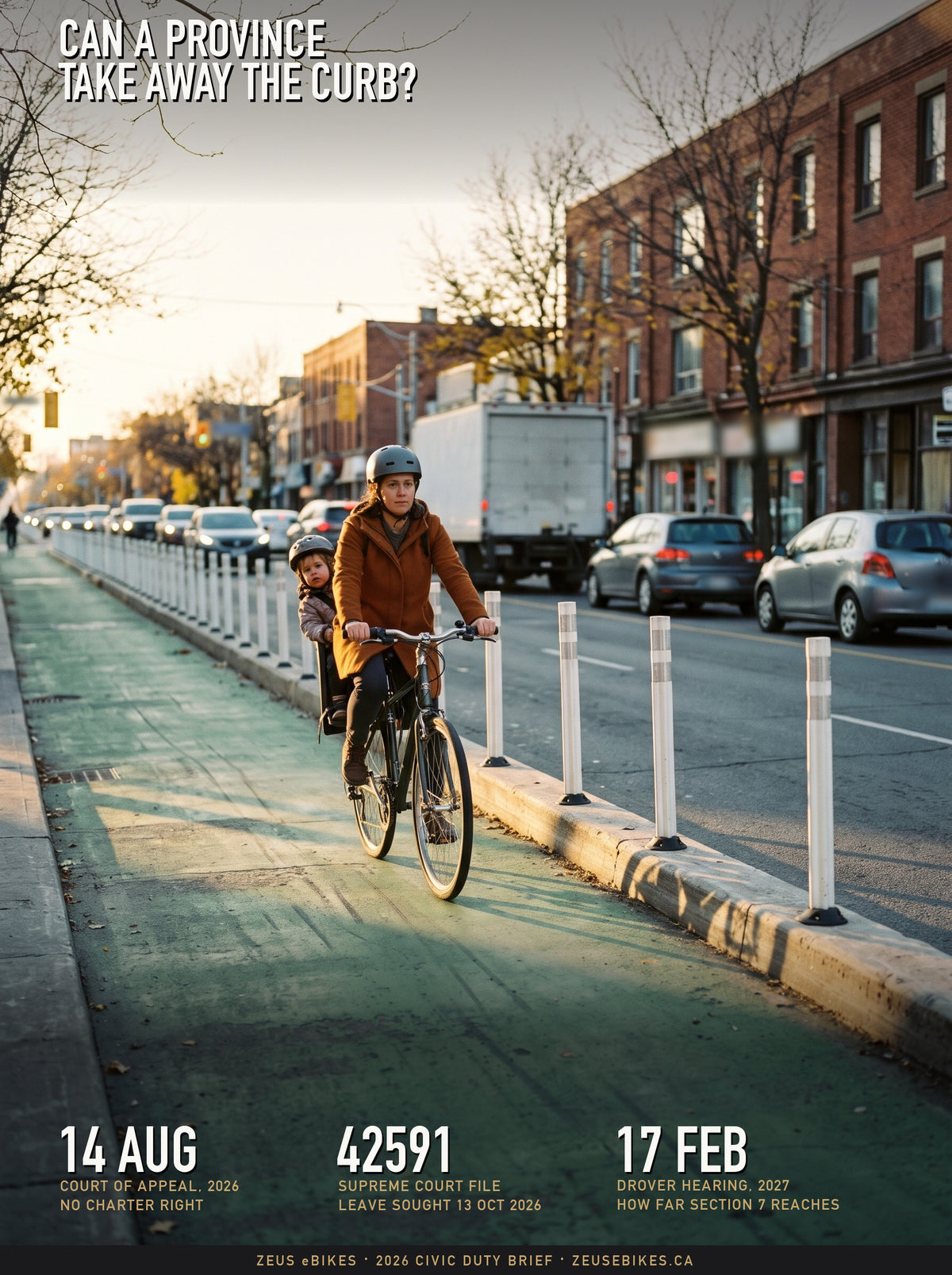
A curb, a row of posts and a green lane between a family and the traffic: the protection this brief is about. AI-generated editorial image made with Playcut.ai; it shows no real place or person.
A brief. It is not legal advice. A lawyer would put this argument in a factum: what we submit, what the other side answers, our reply. We borrowed that shape.
The author is not a lawyer and Zeus eBikes is not a law firm. We sell electric bikes, so more people riding is in our commercial interest. Zeus is not a party to, or an intervener in, the case.
Opened and read on 24 and 25 November 2026. All 80 paragraphs of the Court of Appeal's reasons, the trial reasons, the Supreme Court decisions cited here, three earlier Court of Appeal rulings that its reasons do not cite (Michaud, Flora and Tanudjaja), the Highway Traffic Act as consolidated to 20 November 2026, the Supreme Court's dockets and statistics, and Ontario's own cycling manual. A script checked each of the 164 quotations below against the saved text of its source, and the build refuses any that does not match word for word.
What we could not read. The Court of Appeal's 2024 Mathur reasons (the court's site and CanLII turn away automated readers, and we found no archived copy), so that case is quoted only as the trial judge quoted it. The memoranda on the leave application are posted on the Supreme Court's site only after leave is granted; copies can be requested from the Court, and we have not yet done so, so the applicants' grounds are given as their lawyers stated them in public. The strength ratings are our own judgment and are labelled as such.
Right of reply and corrections. This page relies on public court records and comments fairly on them. If a court, ministry, party or lawyer believes a sentence misstates the record, write to milad@zeusebikes.ca. Errors are corrected with a dated note on this page, and any reply is published in full.
As the law stands there is no Charter right to protected bike lanes: Ontario's Court of Appeal held so in Cycle Toronto v. Ontario (Attorney General), 2026 ONCA 582, on 14 August 2026.[1] The strongest argument for one is narrower than a right to be given lanes: section 7 should bar a legislature from ordering protective infrastructure removed when the evidence shows removal will make the road more dangerous, an argument built on how the Supreme Court read section 7 in Carter, Bedford and PHS.[2][3][4]
Here the trial judge found that removal would make the roads less safe, “resulting in an increased likelihood of collisions, injuries, and death”[1], and the Province's own consultant predicted more collisions.[5]
That argument is now before the Supreme Court on an application for leave (file 42591), and the Court hears Drover on 17 February 2027, on how far section 7 reaches beyond the justice system.[6][7] The data on the danger is in our investigation of how cyclists die in Canada. The Toronto story is in why Toronto's lanes are coming out.
In this brief
- Cycle Toronto v. Ontario: where the law stands on 25 November 2026
- The claim, narrowed to what a court could grant
- The facts a court would have to find
- Step one: section 7 is engaged when a law raises the risk of death or injury
- Step two: why "no baseline" does not decide a question of risk
- Step three: arbitrariness and gross disproportionality
- Step four: section 1, and what a win would look like
- The harder claim: a duty to build
- Section 15: a claim not yet argued here
- International law, and the other legal routes
- The honest ledger: where this argument loses
- What happens next: the Supreme Court leave application and Drover, with dates
- Frequently asked questions
- The bottom line
- Sources and what we could not read
Cycle Toronto v. Ontario: where the law stands on 25 November 2026
On 14 August 2026 Ontario's Court of Appeal held that there is “no Charter right to bicycle lanes”[1]; on 13 October the losing side asked the Supreme Court to hear the case.[6] If that reasoning stands, removing protective road infrastructure is no deprivation under section 7, and a court need not weigh evidence that removal raises the risk of injury or death. This brief argues that the reasoning is wrong, rates each step and sources each quotation.
(scroll horizontally on mobile to see all columns)
| Date | What happened | Source |
|---|---|---|
| 25 Nov 2024 | The Reducing Gridlock, Saving You Time Act, 2024 passes. It adds s. 195.6 to the Highway Traffic Act, requiring the Minister to remove bicycle lanes from Bloor Street, University Avenue and Yonge Street. | 2026 ONCA 582, para 9[1] |
| 14 Mar 2025 | A first request for an interlocutory injunction is dismissed by the Regional Senior Justice, who had a limited record before him. | 2025 ONSC 4397, para 7[5] |
| 22 Apr 2025 | Justice Schabas, who heard the full application, grants an injunction stopping removal until he decides. | 2025 ONSC 4397, para 8[5] |
| 5 Jun 2025 | Section 195.6 is rewritten: the Minister shall “restore a lane for motor vehicle traffic” on Bloor, University, Avenue Road and Yonge “by reconfiguring bicycle lanes”. | Highway Traffic Act, s. 195.6; ONCA para 11[8][1] |
| 30 Jul 2025 | The trial judge declares the original s. 195.6 unconstitutional and declares that reconfiguring the lanes to install a motor-vehicle lane would also violate section 7. | ONCA paras 12 to 17[1] |
| 28 Jan 2026 | The Court of Appeal hears the Province's appeal. Five interveners appear. | ONCA, cover page[1] |
| 14 Aug 2026 | The Court of Appeal allows the appeal. Justice Huscroft writes; the Associate Chief Justice and Justice Zarnett agree. | ONCA paras 79 and 80[1] |
| 9 Oct 2026 | O. Reg. 327/26 is filed: the Minister shall remove all bicycle lanes on Bloor Street West between Clissold Road and Royal York Road. | O. Reg. 327/26, s. 1[9] |
| 13 Oct 2026 | Cycle Toronto, Eva Stanger-Ross and Narada Kiondo file an application for leave to appeal to the Supreme Court (file 42591). | Supreme Court docket 42591[6] |
| 30 Oct 2026 | The Province announces that the bike lanes on Bloor Street West between Clissold Road and Royal York Road are gone and vehicle lanes restored. | CBC News, 30 October 2026[10] |
| 20 Nov 2026 | The respondents' response to the leave application is filed by the Minister of Transportation. No stay motion and no leave decision appear on the docket as read on 25 November. | Supreme Court docket 42591[6] |
| 17 Feb 2027 | The Supreme Court is scheduled to hear Drover, on whether section 7 reaches beyond the justice system. | Supreme Court docket 42005[7] |
What is decided and what is not. Decided for now: the Court of Appeal's reasons are the authority Ontario's trial courts must follow, because “a lower court is not entitled to ignore binding precedent”[3], unless “a new legal issue is raised, or if there is a significant change in the circumstances or evidence”[3].
Not decided: section 1 (the Court wrote that it was “not to be taken to be in agreement with the application judge’s s. 1 analysis”[1]), whether section 7 reaches beyond the justice system at all (the Court only assumed it did, at para 30), the Province's ground that the trial judge had reviewed “hypothetical future action taken under an unchallenged statutory provision”[1] (left open at para 19), and whether the Supreme Court will hear the case.
Takeaway: The ruling is a loss on the law in Ontario. It is not a finding that removing lanes is safe. The two things that can change it are on the Supreme Court's own calendar.
The claim, narrowed to what a court could grant
The claim is not a right to be given lanes. It is a right not to have the state make a lawful activity more dangerous arbitrarily or grossly out of proportion to a law's purpose, the reading of section 7 that struck down laws stopping sex workers protecting themselves.[3] The limit: in 2002 the Court found no case placing “a positive obligation on the state to ensure that each person enjoys life, liberty or security of the person”[12].
Three phrases do the work. “Deprived” needs state action, and a law that orders a lane removed is state action. “Life” is engaged by an increased risk of death, and “security of the person” by “any state action that causes physical or serious psychological suffering”[2], so a risk of injury counts as well as a risk of death.[2] “Principles of fundamental justice” is where a court asks whether the law is arbitrary, overbroad or grossly disproportionate.
A lawyer would not run one argument but a ladder of them, from the one with the best authority to the one with the least. The ladder below is that structure, with the Court of Appeal's answer to each and our rating. The ratings are our own judgment, and no court has made a finding on them.
(scroll horizontally on mobile to see all columns)
| Rung | What is argued | Best authority | What the Court of Appeal said | Our rating |
|---|---|---|---|---|
| 1. Removal order | Section 7 bars a law that orders existing protection removed where it will predictably raise the risk of death or injury. | Carter para 62; Bedford paras 75 to 89; PHS para 136[2][3][4] | No deprivation: repeal of what the Charter did not require cannot breach it (paras 33 to 43)[1] | Contested. Our strongest rung. |
| 2. Prohibition | Section 7 also reaches a law that stops road authorities from building protected lanes, because it deprives people of the means of protecting themselves. | Bedford para 89, which we extend from a law that stops people protecting themselves[3] | Not addressed. Section 195.3 postdates the application.[8] | Untested. |
| 3. Scheme | Where the state puts a scheme in place, the scheme must comply with the Charter. | Chaoulli para 104; Mathur as quoted at 2025 ONSC 4397, para 150[14][5] | Not engaged: the lanes depend on legislation alone (para 43)[1] | Contested. |
| 4. Equality | The absence of protection falls hardest on people with disabilities and children (section 15). | Fraser para 27[15] | Treated as a policy point (para 77), adding “There was no basis for the submission”[1] that the law put children's lives at risk; no equality analysis appears | Untried here. |
| 5. Duty to build | In special circumstances section 7 requires the state to provide protection. | Gosselin paras 82 and 83[12] | “no constitutional obligation to build bicycle lanes or to retain any that have been built”[1] (para 7) | Lost for now. |
What “protected” means here. Ontario's cycling manual draws the line between paint and barrier. Physically separated bikeways “reduce risk exposure for people riding bikes from motor vehicles by means of horizontal separation and vertical elements such as curbs, bollards or planters”[13], while a buffered lane adds paint and “No vertical elements are used”[13].
A cycle track is “a physically separated bikeway that is horizontally and vertically separated from the travelled portion of the roadway by a curb plus a horizontal buffer”[13]. This brief argues the principle of physical separation and leaves the choice of curb or bollard to engineers.
Takeaway: Rung 1 asks the courts for something they have already given to sex workers and to drug users in Bedford and PHS: scrutiny of state action that raises the risk of death. Rungs 3 to 5 ask for more, and the ledger below says how far each is from winning.
The facts a court would have to find
Four facts carry the argument, and each is in the public record. The Highway Traffic Act counts a bicycle as a vehicle on the same roads as trucks, and physical separation lowers the odds of injury. The Province's own advisers said removal would raise collisions, and the legislature barred claims against the Crown, damages included, for what follows.
The law puts bicycles among the traffic
The Highway Traffic Act says a vehicle “includes a motor vehicle, trailer, traction engine, farm tractor, road-building machine, bicycle”[8], so a cyclist on a street is a road user among road users. The trial judge found that the choice to ride is limited: “The choice to ride a bicycle is not unconstrained.”[5] The Province's own documents said it was “unable to assume that cyclists would move to secondary roads, even if encouraged”[5].
Statistics Canada's death records count 706 cyclist deaths in Canada in the ten years 2015 to 2024, 76 of them in 2024 (preliminary), including deaths where no motor vehicle was involved.[19] Who they were, and why cyclist deaths have not fallen the way other transport deaths have, is in our investigation of cyclist deaths in Canada.
Separation changes the odds
Physical separation is the route type with the lowest injury odds
690 people injured while cycling in Toronto or Vancouver; each injury site compared with a control site on the same trip. Cycle tracks carried about one ninth the odds of the reference route; bike lanes on major streets, a separate category, carried an interval that touches 1.
Source: Teschke et al., American Journal of Public Health 2012;102(12):2336-2343, adjusted odds ratios and 95% confidence intervals as printed in the paper (Table 4). The interval for cycle tracks is wide (0.02 to 0.54) because only 2 of the 690 injury sites, and 10 control sites, were on cycle tracks.
A peer-reviewed Canadian study compared the crash sites of 690 injured cyclists in Toronto and Vancouver with control sites on the same trips. Cycle tracks carried the lowest odds, “about one ninth the risk of the reference: major streets with parked cars and no bike infrastructure”[16]. Bike lanes on major streets, a separate category from cycle tracks, had an interval that touches 1, which is why this brief argues for physical separation and not for lanes alone.
Ontario's cycling manual points the same way: “Physically separated bike lanes are more effective at encouraging people to cycle than conventional, painted bike lanes”[13], and “the absolute speed of motor vehicles is directly related to the risk of serious injury or death for a person cycling”[13]. The Chief Coroner's 2012 review of 129 cycling deaths recommended “separated bike lanes”[17] among its cycling-network measures, and noted that “Studies in Denmark have shown that providing segregated bicycle tracks or lanes alongside urban roads reduced deaths among cyclists by 35%”[17].
Takeaway: The Coroner's 35% is a figure the review attributes to Danish studies; it is not the review's own Ontario finding. The Teschke interval for cycle tracks is wide because only 2 of the study's 690 injury sites were on cycle tracks.[16] The direction is the same in the study, the manual and the review.
The Province's own advisers saw it coming
The trial judge found that a Ministry of Transportation briefing dated 28 October 2024, a week after the bill was introduced, said that the ministry “does not hold any data on the performance of the identified three bike lanes to support a decision for removal, nor to assess the potential impacts of removal”[5]. The same briefing added that “bike lanes can have a positive impact on congestion and on safety of road users”[5].
That consultant, CIMA, put the collision effect at “more than 54% increase in the total number of collisions (i.e. for all road users, not just those involving cyclists)”[5], and said the congestion benefit “may be negligible or short-lived due to other confounding factors or induced demand”[5].
Collisions are not deaths, and no court has put a number on deaths from removal. The trial judge went further than the consultant: on all the evidence, including the government's own advice, he found that removal would make the roads less safe, “resulting in an increased likelihood of collisions, injuries and death”[5]. The Province's main answer on safety came from an accident-reconstruction engineer, and the trial judge found that “The government’s evidence does not contradict or credibly challenge the Applicants’ evidence”[5].
The Province's answer is a mandate, in the words of a Ministry spokesperson: “The people of Ontario gave our government a clear mandate to tackle the traffic that is costing our economy over $56 billion a year”[18]. The Court of Appeal's answer is that advice is advice: “neither the government nor the legislature is under any obligation to accept policy advice”[1]. The Supreme Court's answer to the same objection in PHS was that “when a policy is translated into law or state action, those laws and actions are subject to scrutiny under the Charter”[4].
What the Court of Appeal did with the findings. It did not set the risk findings aside as palpable and overriding error, the test for every finding of fact, “whether adjudicative, social, or legislative”[3], and neither word appears in its reasons. It held that the findings could not carry a Charter claim, and said the trial judge's proportionality reasoning “inflates the negative effects of removing the bicycle lanes”[1].[1]
The legislature barred claims against the Crown
The Act says “No cause of action arises against the Crown”[8] as a direct or indirect result of anything done under the Part, including “the removal of a bicycle lane”[8]. The bar reaches any proceeding claiming “any remedy or relief, including specific performance, injunction, declaratory relief, any form of compensation or damages”[8], but “does not apply to an application for judicial review”[8]. Further sections bar claims against the Province's contractors, including claims arising from collisions after their work (s. 195.11).[8]
The trial judge read those provisions as the Bill's own recognition that removal will cause injuries, added to “insulate it from lawsuits arising from injuries and deaths”[5]. The Court of Appeal does not mention them (our count: 0). Neither court's reasons treat the bar as stopping this case, which was brought as an application for a declaration that section 195.6 violates section 7,[1] and the Province's counsel accepted at trial that a regulation authorising removal “can be challenged by way of judicial review”[5].
Takeaway: On the Act's words, a road user hurt where a protected lane was removed has no claim against the Crown or its contractors. Judicial review remains, and a constitutional challenge to the law itself is the claim that reaches the legislature's own decision, which is why the argument matters beyond one city.
Step one: section 7 is engaged when a law raises the risk of death or injury
The Supreme Court has said that “the right to life is engaged where the law or state action imposes death or an increased risk of death on a person, either directly or indirectly”[2]. Causation needs only “a reasonable inference, drawn on a balance of probabilities”[3], and the Court's own example of a law that makes a lawful activity riskier is a cyclist.
The submission. A statute that orders protective infrastructure removed, on a road where the state decides who may travel and how, is a law that makes a lawful activity more dangerous. The Court called this threshold “the port of entry for s. 7 claims”[3], and it is deliberately not a high one: it does not require that the law be “the only or the dominant cause of the prejudice suffered by the claimant”[3]. In 2023 the Court restated, in a passage the trial judge quoted, that “A risk of such a deprivation suffices”[5].
An Ontario precedent the ruling does not cite. In Michaud the Court of Appeal applied Bedford to Ontario's rule that trucks carry speed limiters and found a breach of section 7, because “the speed limiter requirement for his truck leaves him in physical danger in some situations”[20]. The judge reached that finding “most reluctantly”[20] and questioned applying Bedford to safety rules (paras 146 to 151), and the rule was then saved under section 1, which step four takes up. The trial judge relied on Michaud; the Court of Appeal's reasons never mention it (our count: 0).[5]
The ruling. It held that removal effects no deprivation (para 43) and, in its gross-disproportionality analysis, that the trial judge was “talking of injuries and deaths that will occur only if the bicyclists choose to ride on the roads that have no bicycle lanes – a situation that obtains on roads throughout the province”[1].[1]
The reply. Bedford rejected that argument. The Attorneys General there said sex workers “can avoid both the risk inherent in prostitution and any increased risk that the laws impose simply by choosing not to engage in this activity”[3], and the Court answered that “I cannot accept the argument that it is not the law, but rather prostitutes’ choice and third parties, that cause the risks complained of in this case”[3]. The Court of Appeal cites Bedford for arbitrariness and disproportionality but never for causation or choice, and the word “helmet” appears nowhere in its reasons (our count: 0).
The Province's strongest point at this step. Section 7 may not reach this case at all. The Court of Appeal did not decide whether it applies outside the justice system; it wrote that it would “proceed on the assumption that s. 7 may be engaged beyond the administration of justice context”[1].
In Drover a majority of the Court of Appeal had held that section 7 applies beyond the justice system, “at least in the context of the liberty interest”[1], and Justice Miller dissented.[21] The Supreme Court hears the appeal on 17 February 2027, and a ruling that section 7 stops at the courthouse door ends this argument before it begins.[7]
Its second point, as we reconstruct it, is that Bedford's laws, like the helmet ban in its example, stopped people protecting themselves: they “deprive people engaged in a risky, but legal, activity of the means to protect themselves against those risks”[3]. Michaud is the same kind of case, a rule that stopped drivers accelerating out of danger. Section 195.6 stops no cyclist doing anything; it removes protection a city built.
Rating at step one (our judgment): contested. Bedford's cyclist and Michaud support engagement, and the Court of Appeal answered neither. The Province will say both concern laws that stopped people protecting themselves; our answer is that Bedford's test asks whether a law makes “this lawful activity more dangerous”[3], and removing a barrier from a road the state controls does that. The largest risk sits at the threshold in Drover.
Step two: why “no baseline” does not decide a question of risk
The Court of Appeal's central move is that “Amendment or repeal of legislation may breach the Charter only if the breach can be established independent of the prior state of the law”[1]. That rule comes from cases about statutory platforms and benefits. We submit that a claim that a removal order makes a road more dangerous does not depend on the old law: it compares the road with the order to the road without it.
The rule and its source. The Court reasoned that an order barring removal “can only be understood as establishing a Charter right to those bicycle lanes”[1], and that this would hold the legislature to a constitutional baseline. It rested on Toronto (City) v. Ontario, where the Supreme Court called a claim to restore a 47-ward council structure “a straightforward positive claim”[22] about freedom of expression, and on Sharma, a section 15 sentencing case where the Court wrote that “Parliament is not bound by its past policy choices”[23].[1]
Ontario's own line. The rule is older in Ontario than this case. In Flora the Court of Appeal rejected the claim that amending a funding regulation, whose earlier form the claimant said would have paid for his life-saving transplant abroad, was a deprivation (paras 93 and 103), quoting its earlier ruling in Lalonde that “there can be no constitutional right to the continuation of measures voluntarily taken, even where those measures accord with or enhance Charter values”[24]. The bike-lane ruling quotes the same passage of Lalonde (para 33).[1]
Takeaway: Toronto (City) and Sharma concern whether a claimant can demand a benefit or a platform the government once provided. Flora comes closest to this case: the claimant faced a risk to his life and still lost, because the regulation did “not prohibit or impede anyone from seeking medical treatment”[24]. Our distinction is that section 195.6 does not stop paying for something; it directs the state to change a shared road in a way the trial judge found makes it more dangerous.
Why it does not fit. The Supreme Court has already reviewed a decision to stop continuing a protective arrangement. In PHS the Minister declined to extend the exemption that let Insite operate, and the Court held that the decision “engages the claimants’ s. 7 interests and constitutes a limit on their s. 7 rights”[4], and was “arbitrary”[4] and grossly disproportionate because of “the correlative increase in the risk of death and disease”[4]. It added that a ministerial decision “cannot simply deny an application for a s. 56 exemption on the basis of policy simpliciter”[4].
The Court of Appeal's reasons never mention PHS or Insite (our count: 0), and Bedford answered the label of a “veiled assertion of a positive right”[3] directly: “they are asking this Court to strike down legislative provisions that aggravate the risk of disease, violence and death”[3]. The Province will point to the sentence before it: the applicants there were “not asking the government to put into place measures making prostitution safe”[3], and keeping a lane, it will say, is a measure of that kind.
Two further points. First, the lanes were not created by earlier provincial legislation. The Court itself records that “Bicycle lanes have been established by the City of Toronto on some roads pursuant to the City’s bylaw-making authority”[1], so the principle that a legislature cannot bind its successors is applied to a legislature that did not make the lanes.
Second, the claim is independent of the prior law in the sense the Court demanded. Our reading of Bedford is that it compared the world with the impugned law to the world without it, and so does this claim.[3] The Province's reply is that Bedford's world without the law was one of ordinary liberty, while the world without section 195.6 has protected lanes only because a bylaw put them there.
Where undoing a protection was struck down. Sharma records both halves: in Alliance the Supreme Court “struck down amendments to Quebec’s pay equity legislation”[23] that undermined existing protections, and it “further affirmed that s. 15(1) does not bind the legislature to its current policies”[23]. That was a section 15 case; in our reading it shows that the rule tests what the amendment itself does.
A limit case, and it is our inference. The Court of Appeal wrote that the legislature “may remove a road entirely – without implicating the Charter”[1]. Read at its widest, that sentence would also let a legislature order a guardrail removed from a mountain highway, since no provision of the Charter requires a guardrail either. The Court did not say that; its only stated limit is a breach established “independent of the prior state of the law”[1], and it did not say what such a breach would look like for a safety feature.
The Province's best answer. It is the Court of Appeal's own: if the Charter forbids removing a lane because of the protection it gives, “it can only be because there was a constitutional right to that protection”[1], and “The existence of bicycle lanes depends on legislation alone”[1], a bylaw included. Law-firm commentary reads the ruling the same way: “Prior legislative schemes are not constitutional baselines”[25], and such claims “will face a significant hurdle where the underlying benefit was not constitutionally required in the first place”[26].
On PHS, the Province would say, as we reconstruct it, that the case turned on the criminal law: without the exemption the possession offence applied to Insite's staff and clients, which is what engaged section 7 (paras 87 to 93 and 126).[4] Toronto (City), it would add, treats a claim to preserve a platform like a claim to create one (para 19).[22] The Court in PHS itself said that “If there is a Charter problem, it lies not in the statute but in the Minister’s exercise of the power the statute gives him to grant appropriate exemptions”[4].
Even the trial judge described PHS and Bedford as cases about laws that “blocked claimants from taking steps to reduce risk of harm”[5], and he had to distinguish a Superior Court ruling that repealing the long-gun registry did not infringe section 7, for want of a causal link (paras 146 to 148).[5]
Rating at step two (our judgment): contested, and the step most likely to be argued in Ottawa. In Ontario's lower courts it loses until the Supreme Court says otherwise, under Flora and now this ruling. The reply rests on PHS, which the Court of Appeal did not discuss, and on our reading of Bedford's counterfactual; the Province answers that both were criminal-law cases about people blocked from protecting themselves. Its own case rests on the “no baseline” language in Toronto (City), Sharma and Flora.
Step three: arbitrariness and gross disproportionality
Even where section 7 is engaged, the Province wins if the law is rationally connected to its purpose and not grossly disproportionate. The trial judge found that the law undermined its own purpose and endangered life. The Court of Appeal answered that inquiry with common sense and called the removal “mere traffic regulation”. This is the hardest step, because the Supreme Court has set the disproportion bar very high.
The standard. Arbitrariness “asks whether there is a direct connection between the purpose of the law and the impugned effect on the individual”[3]. The Court said the evidence “may, as in Morgentaler, show that the effect actually undermines the objective”[3], and that these principles “do not look to how well the law achieves its object”[3]. Gross disproportionality applies only “in extreme cases where the seriousness of the deprivation is totally out of sync with the objective of the measure”[3].
The ruling. The Court of Appeal framed the question as whether there is a rational connection between congestion relief and “the decision to increase the number of lanes for motor vehicles”[1]. It answered by common sense: “increasing the number of lanes available for motor vehicles must, at least to some extent, and for some period of time, be capable of contributing to reducing traffic congestion”[1]. In its words, “Law is not arbitrary simply because it is not designed to the satisfaction of expert critics”[1].
The Province's strongest point at this step. The Court rested it on Malmo-Levine, where the Supreme Court said that which measures best deter unwanted conduct is “a matter of legitimate ongoing debate”[28], and that the Charter allows “a broad, though certainly not unlimited, legislative capacity to respond”[28]. It also used the trial judge's own words: he had accepted that more car lanes “may allow more cars to travel on a road”[1] and that the applicants' expert “recognized the possibility of a short-term benefit”[1].
Takeaway: The Court of Appeal compared the law's purpose with the law's means. Bedford compares the law's purpose with its effect on the person whose life or security is at stake. On the first reading a law fails only if it contributes nothing to its purpose.[1] On the second, the question is whether the effect on cyclists bears “some relation to the law’s purpose”[3]; the Province will say it plainly does, since the lost protection is the road space the car lane takes.
What each court's reasons mention
Word-for-word counts in the complete text of the two decisions. A zero means the term appears nowhere in those reasons. The Court of Appeal named the congestion expert nine times and the injury-risk expert never.
Source: our count (script onca_audit.py, 24 November 2026) over the full text of 2026 ONCA 582 (47,351 characters) and 2025 ONSC 4397 (128,231 characters). A mention is not a holding: the chart shows what was addressed and says nothing about whether it was decided correctly.
The reply on arbitrariness. The Court of Appeal's authority that common sense need not be proved (para 60) comes from the equality analysis in Gosselin, where a legislator need not “verify all its assumptions empirically”[12]; its other authorities, Carter and Malmo-Levine, are section 7 cases (para 56).[1] Here the trial judge found, on evidence including the government's own advice, that removal would make congestion worse (para 15).[1] The applicants' lawyers put the question to the Supreme Court as whether “common sense” can prevail over uncontested engineering evidence in the Charter context[27].
The Court of Appeal also cautioned that “academic expert evidence – social science research in particular – must be approached by courts with considerable caution”[1]. That caution was aimed at the applicants' congestion expert. Some of the evidence the trial judge relied on was not academic: it came from the Ministry's own briefings and the engineering firm the Province hired. The reasons never name either, but they deal with internal advice as a category, holding that a law is not arbitrary “just because some or even many advisors, experts, and citizens predict that it will not work”[1].
The reply on gross disproportionality. This is where we expect to lose without help. The Court of Appeal wrote that “Almost nothing is like these examples”[1] and that removal “is mere traffic regulation”[1]. Our reply is Bedford's own application of the rule to a safety measure: the bawdy-house ban took away indoor premises, a “basic safety precaution”[3], and the Court said “Parliament has the power to regulate against nuisances, but not at the cost of the health, safety and lives of prostitutes”[3].
The weak point in our own reply. Bedford involved a law that exposed people to a notorious killer, and the Court of Appeal stressed that disparity, adding that the Supreme Court has since “repeatedly declined opportunities to declare deprivations of s. 7-protected rights to be grossly disproportionate”[1]. The Province's consultant predicted more collisions and gave no number of deaths; the trial judge found a greater likelihood of death without a number, and the Court of Appeal called his reasoning inflated. A death-specific estimate would make this step much stronger.
Rating at step three (our judgment): uphill. Arbitrariness is arguable, because the trial judge found the law would make congestion worse, but his acceptance of a possible short-term benefit (para 61) is the Province's best answer under a test that strikes a law only if it contributes “not even in a small way”[1]. Gross disproportionality is the step most likely to fail even in front of the Supreme Court.
Step four: section 1, and what a win would look like
Section 1 lets a government defend a law that violates a right if the limit is reasonable and demonstrably justified. The Court of Appeal did not decide it. The Supreme Court says a section 7 violation is hard to justify, but not impossible, and Ontario's Court of Appeal has saved a road-safety rule this way. A claimant who clears the first three steps would face a Province that must prove its congestion case against its own consultant's report.
The Charter guarantees its rights “subject only to such reasonable limits prescribed by law as can be demonstrably justified in a free and democratic society”[11]. The test, as Carter summarises R. v. Oakes, asks whether the means are rationally connected to the objective, minimally impairing and proportionate in their effects.[2]
The trial judge accepted that reducing congestion is a pressing objective but held that the law was not rationally connected to it, did not impair the right minimally, and that its harms outweighed its benefits.[1] The Supreme Court's own starting point is that “It is difficult to justify a s. 7 violation”[2], though “in some situations the state may be able to show that the public good”[2] justifies one. The Court of Appeal, not deciding section 1, said it was “not to be taken to be in agreement with the application judge’s s. 1 analysis”[1].
The Ontario warning. In Michaud, after finding the speed-limiter rule breached section 7, the Court of Appeal upheld it under section 1 because “the public benefits associated with improved highway safety exceed the detrimental effects on the s. 7 right of truck drivers”[20], writing that safety regulations attract “a lower level of constitutional scrutiny than criminal law”[20]. The trial judge distinguished it: there the rule “enhanced safety in the vast majority of cases”[5], while here the evidence showed removal “will substantially increase the number of collisions for all road users”[5].
Takeaway: Section 1 is where the Province must bring evidence. Its own consultant wrote that the congestion benefit “may be negligible or short-lived”[5], which is the weak point in the Province's justification.
The remedy. The Constitution makes an inconsistent law “of no force or effect”[11] to the extent of the inconsistency (s. 52(1)), and the Charter lets a court give “such remedy as the court considers appropriate and just in the circumstances”[11] (s. 24(1)). The trial judge declared the original section unconstitutional, and declared that reconfiguring the lanes would also violate section 7.[1] In PHS, which concerned a minister's decision, the Court ordered the exemption granted, because “the only constitutional response to the application for a s. 56 exemption was to grant it”[4].
(scroll horizontally on mobile to see all columns)
| A win on rung 1 would (our analysis) | A win on rung 1 would not (our analysis) |
|---|---|
| Lead to a declaration that a removal provision is of no force or effect to the extent it breaches section 7, as the trial judge declared, with section 1 decided in the same case.[1] | Oblige any city or province to build a lane anywhere. |
| Open the same challenge to other removal orders: after a review of a prescribed municipality's traffic information, Cabinet may order a lane that cost a marked motor-vehicle lane removed or reconfigured.[8] | Fix a design: curb, bollard or planter is for engineers, as the manual says.[13] |
| Give a Supreme Court answer on removal orders that every lower court in Canada would have to follow.[3] | Stop the legislature acting again on a better record, or reach section 195.3, which bars municipalities from trading a motor-vehicle lane for a bike lane.[8] |
| Let challenges to later removal orders, including judicial review of a removal regulation, rest on section 7 as well as on ordinary administrative grounds. | Prevent an override: a legislature may declare that a law shall “operate notwithstanding a provision included in section 2 or sections 7 to 15 of this Charter”[11], for up to five years at a time, and re-enact the declaration (s. 33). |
Rating at step four (our judgment): favourable if reached, not certain. Carter says a section 7 breach is hard to justify, and the trial judge found the law not even rationally connected to congestion relief. Michaud shows the Court of Appeal has justified a breach in road safety, no court above the trial judge has weighed this justification, and section 33 lets a legislature set a win aside. Reaching this step depends on winning steps one to three.
The harder claim: a duty to build
A free-standing duty to build protected lanes is the claim the Court of Appeal rejected in the plainest terms. The trial judge listed three settings where positive obligations have been imposed, and the Supreme Court has left the general question open.[5][12] The best argument is that roads are a scheme only the state controls, and it is a long shot that we rate as lost for now.
The Supreme Court's door is open but narrow. In Gosselin the Court wrote “One day s. 7 may be interpreted to include positive obligations”[12] and “I leave open the possibility that a positive obligation to sustain life, liberty, or security of the person may be made out in special circumstances”[12].
Takeaway: The door Gosselin left open is conditioned on special circumstances. The scheme principle in Chaoulli says how a scheme must behave once it exists; it does not say a scheme must be created.
In Chaoulli three judges (the Chief Justice, Justice Major and Justice Bastarache, in joint reasons on section 7) wrote that the Charter “does not confer a freestanding constitutional right to health care. However, where the government puts in place a scheme to provide health care, that scheme must comply with the Charter”[14].
The trial judge relied on the same idea through Mathur, which he quoted as saying that “where the government puts in place a scheme”[5], “that scheme must comply with the Charter”[5]. He added that the challenge was to a law “removing a safety feature on roads, something which only the government controls”[5]. The Supreme Court dismissed leave to appeal in Mathur on 1 May 2025.[32]
The Court of Appeal did not discuss Mathur at all (our count: 0). It wrote instead that there is “no constitutional obligation to regulate the use of roads in any particular manner”[1], a sentence that sits uneasily with Gosselin's “special circumstances” in our reading.
What would have to be true. The Supreme Court would have to accept in Drover that section 7 reaches beyond the justice system. A claimant would need a record of serious, foreseeable harm on identified roads, and would have to ask for protection and not for a particular design. The Court would then have to find one of the “special circumstances” Gosselin left open, and in the decisions we read none does.
A general duty would also meet the problem that ended the right-to-housing claim in Tanudjaja, which a majority of the Court of Appeal held non-justiciable because it challenged no particular law (paras 10 and 27), observing that “A challenge to a particular law or particular application of such a law is an archetypal feature of Charter challenges under s. 7 and s. 15”[29]. A challenge to section 195.6 is that kind; a demand for a network of lanes is not.
Section 15: a claim not yet argued here
An equality claim would say that missing protection falls hardest on people the Charter names, such as children and people with disabilities. The application sought a declaration that s. 195.6 “violates s. 7 of the Charter”[1], and neither court's reasons contain the words “section 15”, “s. 15” or “equality” (our count: 0 in each).
The Court of Appeal noted the interveners' points about low-income and disabled people and children, and treated them as relevant to policy, while finding no basis for the submission that the law put children's lives at risk.[1] Section 15(1) protects equality “without discrimination based on race, national or ethnic origin, colour, religion, sex, age or mental or physical disability”[11].
A claimant must show that the law “on its face or in its impact, creates a distinction based on enumerated or analogous grounds”[15] and “imposes burdens or denies a benefit in a manner that has the effect of reinforcing, perpetuating, or exacerbating disadvantage”[15]. The obstacle is the Supreme Court's caution that section 15(1) “does not impose a general, positive obligation on the state to remedy social inequalities or enact remedial legislation”[23].
The authorities on each side. For the claim, Eldridge: “once the state does provide a benefit, it is obliged to do so in a non-discriminatory manner”[30], and “In many circumstances, this will require governments to take positive action”[30]. Against it, Auton: “the legislature is under no obligation to create a particular benefit”[31]. In our reading a road network open to everyone is a service the state already provides, which makes Eldridge the better fit; what is missing is the record of who is harmed.
Rating for rungs 4 and 5 (our judgment): untried and lost for now. We found no record in this research of how many people with disabilities or children depend on a protected lane, and an equality claim without that record would fail. We are not in a position to say it cannot succeed.
International law, and the other legal routes
International law cannot create a Charter right, but it can shape how the Charter is read, and Canada has ratified the main disability-rights treaty. Ordinary law offers little for lane-building: negligence law shields core policy decisions, which in our reading a decision whether to build would be, and Ontario's statute bars claims against the Crown for removal. That leaves the Charter as the claim that reaches the legislature's decision itself.
International law. Canada ratified the Convention on the Rights of Persons with Disabilities on 11 March 2010.[37] Article 9 requires States to take “appropriate measures”[33] to ensure access “on an equal basis with others, to the physical environment, to transportation”[33]. Article 10 reaffirms the right to life and says States “shall take all necessary measures to ensure its effective enjoyment by persons with disabilities on an equal basis with others”[33]. Article 20 adds “effective measures to ensure personal mobility with the greatest possible independence for persons with disabilities”[33].
In joint reasons in 2020 the Supreme Court said that “the Charter should generally be presumed to provide protection at least as great as that afforded by similar provisions in international human rights documents which Canada has ratified”[34], while treating non-binding sources as “relevant and persuasive, but not determinative”[34]. The presumption is a tool for reading the Charter, and it “does not overthrow clear legislative intent”[34].
Takeaway: International law is a supporting argument. It explains why a court should read “security of the person” generously for people with disabilities, but it does not give anyone a lane.
In 2020 the General Assembly proclaimed a decade of road safety “with a goal of reducing road traffic deaths and injuries by at least 50 per cent from 2021 to 2030”[35], a resolution and not a treaty. The Court of Appeal's reasons do not mention international law (our count: 0).
Negligence. The Supreme Court's starting point is that public bodies make policy choices that sometimes harm people, and that “Accountability for that harm is found in the ballot box, not the courts”[36]. “Core policy” decisions are shielded from negligence liability, and “the key focus is always on the nature of the decision”[36].[36]
The Court also held that the City of Nelson's snow-clearing decision “was not a core policy decision immune from negligence liability”[36]. A decision about whether to build a protected lane looks, in our reading, like a budget and priority choice, which makes it a hard target in tort.
What Ontario's statute now says. The Highway Traffic Act now provides that, “Except as permitted by the regulations, a municipality shall not, by by-law or otherwise, reduce or permit a reduction in the number of marked lanes available for travel by motor vehicles”[8] for a bicycle lane. It lets Cabinet order a lane restored to motor vehicles “despite any Act, regulation, by-law, order, permit, approval or licence”[8], and it bars claims against the Crown for removal, damages included. We found no court challenge to the lane-reallocation ban in the sources we read.
If the courts will not find a right, a legislature can write one, and unwrite it. The Court of Appeal observed that “rights, obligations, interests, and privileges can be created by ordinary legislation and altered or removed by the same means”[1].
As a policy proposal of ours (it is not law), a provincial statute could say that a road authority rebuilding an arterial road must provide physically separated cycling infrastructure unless it first publishes a safety analysis showing why that is not feasible, and that no order may remove such infrastructure until a collision-risk analysis of the affected road has been published. On the Court of Appeal's own logic, a later legislature could repeal it.
The honest ledger: where this argument loses
The argument loses in thirteen places. Several are questions only the Supreme Court can settle; the others are limits of the record, of the remedy or of this brief. The table lists each weakness, why it bites, the source, and what would have to change. A “contested” rating means the Supreme Court has not decided the point; all ratings are our judgment.
(scroll horizontally on mobile to see all columns)
| Weakness | Why it bites | Source | What would have to change |
|---|---|---|---|
| Section 7 may not reach roads at all | The Court of Appeal only assumed it reaches beyond the justice system. | ONCA paras 27 to 30[1] | The Supreme Court says yes in Drover (hearing 17 Feb 2027).[7] |
| The “no baseline” rule | A repeal can breach the Charter only if the breach is independent of the prior law, and Ontario's Flora line applies that even where a life is at risk. | ONCA paras 33 to 43; Flora paras 101 to 104[1][24] | The Supreme Court applies PHS and Bedford to a removal order and confines Toronto (City), Sharma and Flora to benefits and platforms. |
| The leading cases were about blocked self-protection | Bedford, PHS and Michaud concerned laws that stopped people protecting themselves; section 195.6 forbids no cyclist anything. | Bedford para 89; PHS paras 87 to 93; 2025 ONSC 4397, para 144[3][4][5] | The Supreme Court asks, as Bedford did, whether the law makes “this lawful activity more dangerous”[3], whoever built the protection. |
| Gross disproportionality is an extreme standard | The Court of Appeal called removal “mere traffic regulation” and noted that the Supreme Court has declined to find gross disproportionality since Bedford. | Bedford para 120; ONCA paras 72 to 77[3][1] | Evidence of deaths rather than collisions, or a ruling that harm to some riders is enough, as Bedford says at para 123.[3] |
| A possible short-term benefit may defeat arbitrariness | The trial judge accepted a possible short-term benefit, and the Court of Appeal's test asks only whether the law can contribute at all. | ONCA paras 53 and 61[1][1] | The Supreme Court treats a law that will make congestion worse over time as one whose effect “actually undermines the objective”[3]. |
| Collisions are not deaths | The consultant estimated collisions; the trial judge found a greater likelihood of death without a number, and the Court of Appeal called that reasoning inflated. | 2025 ONSC 4397, paras 73 and 165; ONCA para 75[5][5][1] | A death-specific estimate on the record. |
| Caution about expert evidence | The Court of Appeal told courts to treat academic social-science evidence with caution. | ONCA para 61[1] | Reliance on government-commissioned and ministry evidence, which the Court of Appeal did not discuss by name. |
| Section 1 can save a road-safety law | Michaud upheld Ontario's speed-limiter rule under section 1 after finding that it breached section 7. | Michaud paras 144 and 145[20] | The Province fails to show benefits that outweigh the harm; the trial judge found they did not.[1] |
| A win can be overridden | A legislature may declare that a law operates notwithstanding section 7, for five years at a time, and renew the declaration. | Charter, s. 33[11] | Nothing a court decides; it is a political choice. |
| Mootness and an undecided ground | The Province called the case moot after the 2025 rewrite, the Court of Appeal left open its ground about hypothetical future action, and one stretch of Bloor Street West is already gone. | 2025 ONSC 4397, paras 9 to 11 and 117 to 125; ONCA paras 18 and 19; CBC[5][1][10] | The Supreme Court treats the dispute as live while, by the Minister's count, 18 kilometres of lanes remain to be removed. |
| Leave is discretionary | Leave turns on a question's “public importance”[38] or comparable significance, and the Court granted 35 of the 474 leave applications submitted to it in 2025, 7 per cent, by its own statistics. | Supreme Court Act, s. 40(1); Supreme Court statistics; docket 42591[38][39][6] | The Court grants leave, or Drover settles the point first. |
| A win would build nothing | A declaration stops a removal order; it does not oblige anyone to build, and section 195.3 limits municipal building. | HTA ss. 195.3 and 195.6[8] | A legislature chooses to build, or a later claim succeeds on rung 3 or 5. |
| Our own limits | We could not read Mathur's reasons, have not yet requested the leave memoranda, and we sell electric bikes. | Methodology above | The primary texts become available; read them yourself. |
What survives all thirteen. The Supreme Court has already held that a law making a lawful activity riskier engages section 7 and that choice does not break the chain, and in PHS it held that a minister's refusal to continue a protective exemption had to meet the principles of fundamental justice. The Court of Appeal's reasons cite Bedford for arbitrariness and gross disproportionality but never for its paragraphs on causation and choice, and never mention PHS or Michaud.
What happens next: the Supreme Court leave application and Drover, with dates
Two things can change the law, and both sit on the Supreme Court's calendar. The Court will decide whether to hear Cycle Toronto, with no date set on the docket. And it hears Drover on 17 February 2027, and its answer on how far section 7 reaches beyond the justice system will either open the door this brief walks through or close it.
(scroll horizontally on mobile to see all columns)
| Event | When | What it settles | Source |
|---|---|---|---|
| Decision on leave in Cycle Toronto (file 42591) | No date set. Response filed 20 Nov 2026. In 2025 the Court's average from filing to a leave decision was 4.4 months.[39] | Whether the Supreme Court hears the section 7 argument in this case. | Docket 42591[6] |
| Hearing in Drover (file 42005) | 17 Feb 2027 | Whether section 7 protects interests outside the administration of justice. | Docket 42005[7] |
| Removal of the remaining lanes on Yonge Street, University Avenue and Bloor Street | In “the next construction cycle”[10], in the Minister's words; bids were being taken on 30 Oct 2026 | How much of the network the case is still about: 18 kilometres, by the Minister's count. | CBC News, 30 Oct 2026[10] |
| Further orders under section 195.5 and regulations like O. Reg. 327/26 | As Cabinet makes them | Which other lanes come out while the courts decide. | HTA; O. Reg. 327/26[8][9] |
What the dockets do not show. No stay motion was on the leave docket when we read it on 25 November, and the Province announced on 30 October that the Bloor Street West removal under O. Reg. 327/26 was complete.[10] The applicants' lawyers said on 13 October that they “may seek a stay of the Ontario courts decision, pending appeal”[18].
How to follow it yourself
- Read the leave docket and the Drover docket on the Supreme Court's site; each lists every filing by date.[6][7]
- Read the Court of Appeal's 80 paragraphs. They are short enough for one sitting, and the quotations in this brief are checked against them.[1]
- Check Ontario's e-Laws consolidation of the Highway Traffic Act for Part XII.1 before relying on any summary, including this one.[8]
Takeaway: Until the Supreme Court speaks, lanes in Ontario are governed by the Highway Traffic Act and by Cabinet orders, and the Court of Appeal has held that section 7 does not stop their removal.
Frequently Asked Questions
Is there a Charter right to bike lanes?
Not as the law stands. Ontario's Court of Appeal held on 14 August 2026 that “There is no Charter right to bicycle lanes”[1]. The narrower argument, that section 7 bars removing protective lanes where removal makes the road more dangerous, was accepted by the trial judge and rejected on appeal. The Supreme Court has not ruled on it.
Is there a constitutional right to bike lanes in Canada?
In the decisions we read, no court has held that governments must build them. In 2002 the Supreme Court left open “a positive obligation to sustain life, liberty, or security of the person”[12] in special circumstances, and the Ontario Court of Appeal has since written that there is “no constitutional obligation to build bicycle lanes”[1].[1] No other province's court of appeal has ruled on the question in the sources we read.
Is removing bike lanes unconstitutional?
The trial judge said so in July 2025. The Court of Appeal reversed that in August 2026 and held that removal does not violate section 7. Cycle Toronto and its co-applicants have asked the Supreme Court to hear an appeal (file 42591), and the Court has not decided whether it will.[6]
What is Cycle Toronto v. Ontario?
It is the challenge to the Ontario law that ordered bike lanes removed from Bloor Street, University Avenue and Yonge Street.[1] Cycle Toronto and its co-applicants argued that removal breaches section 7 of the Charter. The trial judge agreed on 30 July 2025,[1] the Court of Appeal allowed the Province's appeal on 14 August 2026,[1] and on 13 October the applicants asked the Supreme Court to hear the case (file 42591). When we read the docket on 25 November, the Court had not decided whether it will.[6]
What did the Ontario Court of Appeal decide about the Toronto bike lanes?
Four things: removal is not a deprivation of life or security because the Charter does not require lanes (para 43); a repeal breaches the Charter only if the breach is independent of the prior law (para 33); the law is not arbitrary, because common sense links more car lanes to less congestion (para 60); and removal is not grossly disproportionate (paras 74 to 77). It did not decide section 1.[1][1][1][1]
Has the Supreme Court agreed to hear the Cycle Toronto bike lane case?
Not as of 25 November 2026. The application was filed on 13 October, the respondents' response on 20 November, and the docket shows no decision.[6] The Court's own statistics show 35 grants among the 474 leave applications submitted to it in 2025, 7 per cent, and an average of 4.4 months from filing to decision.[39]
Where can I read the Cycle Toronto decision?
The Court of Appeal's reasons, Cycle Toronto v. Ontario (Attorney General), 2026 ONCA 582, are on the Court of Appeal for Ontario's own decisions site,[1] and the trial reasons, 2025 ONSC 4397, are published by Ecojustice, the applicants' counsel.[5] The leave application is Supreme Court of Canada file 42591.[6] The links are in the source list at the end of this brief.
What is a protected bike lane?
In Ontario's cycling manual, a physically separated bikeway uses “horizontal separation and vertical elements such as curbs, bollards or planters”[13]. A cycle track is the version separated “by a curb plus a horizontal buffer”[13].
What is the difference between a protected, a buffered and a painted bike lane?
A buffered lane adds a painted gap and, in the manual's words, “No vertical elements are used”[13]. A protected lane has a vertical barrier. In the Toronto and Vancouver injury study, cycle tracks had adjusted odds of 0.11 against the reference, and major streets with bike lanes 0.54 with an interval (0.29 to 1.01) that touches 1.[16]
Do protected bike lanes need physical barriers?
Ontario's cycling manual describes the barrier as “vertical elements such as curbs, bollards or planters”[13]. The manual says which suits which road; this brief argues the principle and not a specific barrier.
Can the Ontario government legally remove bike lanes?
Under current Ontario law, yes. Section 195.6 directs the Minister to restore a motor-vehicle lane on four named streets, Cabinet can order other qualifying lanes removed under section 195.5, and the Court of Appeal has held that section 7 is no bar.[8][1] The Province announced on 30 October 2026 that it had finished removing one stretch of Bloor Street West.[10] Whether the law is right is the question before the Supreme Court.
What is Bill 212?
It is the common name for the Reducing Gridlock, Saving You Time Act, 2024, S.O. 2024, c. 25, passed on 25 November 2024. It added section 195.6 to the Highway Traffic Act and the provisions around it.[1][27]
Can I sue if I am hurt where a protected lane was removed?
Not the Crown under this Act. Section 195.10 says “No cause of action arises against the Crown”[8] for anything done under the Part, and bars proceedings for any remedy, damages included, but “does not apply to an application for judicial review”[8]. The Act also bars claims against the Province's contractors for collisions after their work (s. 195.11). Whether any other route exists is a question for a lawyer; this is not legal advice.
How can a bike lane removal be challenged in court?
Ontario's Act bars claims against the Crown for removal, but the bar “does not apply to an application for judicial review”[8]. The route that reaches the legislature's own decision is a constitutional challenge to the law, which is what Cycle Toronto brought: it won an injunction pausing removal until the trial judge decided,[5] then lost on appeal on 14 August 2026.[1] In Ontario that ruling now binds trial courts unless “a new legal issue is raised, or if there is a significant change in the circumstances or evidence”[3]. This is not legal advice.
Are protected bike lanes safer than painted ones?
The evidence we read points that way. Cycle tracks had the lowest injury odds of 14 route types, and Ontario's manual states that “the absolute speed of motor vehicles is directly related to the risk of serious injury or death for a person cycling”[13]. The cycle-track interval is wide because only 2 of the study's 690 injury sites were on cycle tracks.[16]
Do protected bike lanes reduce injuries?
The studies we read point that way, with limits. In the Toronto and Vancouver crash-site study, cycle tracks carried “about one ninth the risk of the reference: major streets with parked cars and no bike infrastructure”[16], from only 2 injury sites on cycle tracks.[16] The Chief Coroner's 2012 review of 129 cycling deaths noted that “Studies in Denmark have shown that providing segregated bicycle tracks or lanes alongside urban roads reduced deaths among cyclists by 35%”[17], a figure it attributes to Danish studies, not its own Ontario finding.[17]
The bottom line
Is there a Charter right to protected bike lanes? Today, no: Ontario's Court of Appeal says there is none, and the Supreme Court has not said otherwise. Is there a Charter argument that a legislature may not order protective lanes torn out when the evidence, including its own consultant's report, shows removal will make the road more dangerous? Yes, and it rests on cases the Supreme Court has already decided and on passages the Court of Appeal did not address.
The argument is strongest where it asks least. It needs no duty to build, no design standard and no ruling on congestion. It needs the Supreme Court to treat a cyclist the way it treated a sex worker in Bedford and a drug user in PHS: as someone whose life or safety the state made riskier, entitled to ask whether that was arbitrary or grossly disproportionate. In our judgment the weakest step is the third: a possible short-term benefit stands against arbitrariness, gross disproportionality is an extreme standard, and the claim must win on one of them.
Our verdict: a serious claim with a narrow path. The route runs through two Supreme Court events: whether it grants leave in file 42591, and what it decides in Drover, which it hears on 17 February 2027. Until then the Court of Appeal's reasons stand, and they do not engage with several of the cases this brief relies on.
You can check every step. Open the Court of Appeal's reasons, the Supreme Court's two dockets and Ontario's cycling manual, and compare them with the paragraphs cited here. If a sentence on this page misstates the record, tell us at milad@zeusebikes.ca and we will correct it with a dated note.
More from Zeus Media on the same story.
- How many cyclists die in Canada, and why: the data on who dies and which fixes governments refused.
- Why Toronto's bike lanes are being removed: the origin of the law, the contracts and the lanes affected.
- A Canadian Mobility Bill of Rights: a wider set of proposals on the right to get around safely.
Sources and what we could not read
What we could not read, and what each gap affects.
- The Court of Appeal's 2024 Mathur reasons: the court's site and CanLII refused automated readers, and the Internet Archive held no capture of the court's page or PDF when we tried again on 25 November. The passage in this brief is quoted only as the trial judge quoted it (2025 ONSC 4397, para 150).
- The memoranda on the leave application, including the Province's response of 20 November: the Supreme Court posts them only after leave is granted. Copies can be requested from the Court and we have not yet done so, so the applicants' grounds are given as their lawyers stated them in public and the Province's answers are our reconstruction.
- Barbra Schlifer Commemorative Clinic (2014 ONSC 5140) and Canadian Council for Refugees (2023 SCC 17) are described only as the trial judge described or quoted them (2025 ONSC 4397, paras 146 to 148 and 163).
- CanLII turns away automated readers. Nine of the eleven CanLII case pages linked here have Internet Archive captures; the other two (the trial decision and Sharma) appear in other publishers' and search-index links. Paragraph links on the Supreme Court's older decisions go to CanLII because the Court's own pages for them carry no paragraph anchors.
- The trial judge's April 2025 injunction reasons (2025 ONSC 2424) and the Court of Appeal's September 2025 case-management ruling (2025 ONCA 659): not read, and not characterised here.
- Ecojustice and CBC are cited for what the applicants' lawyers said, and the statements are theirs. The strength ratings throughout are our own judgment, and no court has made a finding on them.
Every primary source was opened and read on 24 or 25 November 2026. Each reference below gives the citation, the places we read it, and the paragraphs used.
- Cycle Toronto v. Ontario (Attorney General), 2026 ONCA 582 (14 August 2026), Court of Appeal for Ontario, COA-25-CV-1047 (Huscroft J.A.; Fairburn A.C.J.O. and Zarnett J.A. concurring). All 80 paragraphs read. Court of Appeal for Ontario · Archived copy of the court's PDF, 14 August 2026. Paragraphs used: 7, 9, 10, 11, 14, 15, 16, 17, 18-19, 18, 25, 27, 27-30, 30, 33, 33-43, 36, 38, 39, 43, 53, 56, 57, 59, 60, 61, 67, 72-77, 73, 74-77, 75, 76, 77, 78, 79 (numbered as in the court's reasons).
- Carter v. Canada (Attorney General), 2015 SCC 5, [2015] 1 S.C.R. 331 (Supreme Court of Canada) Supreme Court of Canada · CanLII. Paragraphs used: 62, 64, 94, 95 (CanLII links).
- Canada (Attorney General) v. Bedford, 2013 SCC 72, [2013] 3 S.C.R. 1101 (Supreme Court of Canada) Supreme Court of Canada · CanLII. Paragraphs used: 44, 56, 76, 78, 79, 85, 87, 88, 89, 111, 119, 120, 123, 135, 136 (CanLII links).
- Canada (Attorney General) v. PHS Community Services Society, 2011 SCC 44, [2011] 3 S.C.R. 134 (Supreme Court of Canada), the Insite case Supreme Court of Canada · CanLII. Paragraphs used: 87-93, 105, 114, 126, 128, 136, 150 (CanLII links).
- Cycle Toronto et al. v. Attorney General of Ontario et al., 2025 ONSC 4397 (30 July 2025), Ontario Superior Court of Justice, CV-24-00732896 (Schabas J.), reversed on appeal by 2026 ONCA 582. Read as published by Ecojustice (the applicants' counsel). Ecojustice PDF. Paragraphs used: 7, 8, 69, 70, 73, 78, 117-125, 120, 143, 144, 148, 150, 151, 158, 163, 165, 170, 172, 174 (numbered as in the court's reasons).
- Supreme Court of Canada, case 42591, Cycle Toronto, et al. v. Attorney General of Ontario, et al. (Ontario) (Civil) (By Leave): docket as read on 24 and 25 November 2026 Supreme Court of Canada docket.
- Supreme Court of Canada, case 42005, Attorney General of Canada v. Paul Drover (Ontario) (Civil) (By Leave): docket as read on 24 and 25 November 2026 (hearing scheduled 17 February 2027) Supreme Court of Canada docket.
- Highway Traffic Act, R.S.O. 1990, c. H.8, ss. 1(1), 195.2 to 195.13 and 195.18 (e-Laws, current consolidation from July 1, 2026, e-Laws currency date November 20, 2026, last amendment 2026, c. 7, Sched. 5; read 24 and 25 November 2026) Ontario e-Laws.
- O. Reg. 327/26, Bicycle Lanes (made 8 October 2026, filed 9 October 2026), under the Highway Traffic Act Ontario e-Laws.
- CBC News, 'Ontario government completes bike lane removal on section of Bloor Street W.' (30 October 2026) CBC News.
- Canadian Charter of Rights and Freedoms, Part I of the Constitution Act, 1982, ss. 1, 7, 15(1), 24(1) and 33; Constitution Act, 1982, s. 52(1) (Justice Laws Website) Justice Laws Website.
- Gosselin v. Québec (Attorney General), 2002 SCC 84, [2002] 4 S.C.R. 429 (Supreme Court of Canada) Supreme Court of Canada · CanLII. Paragraphs used: 56, 81, 82-83, 82, 83 (CanLII links).
- Ontario Traffic Manual Book 18: Cycling Facilities (June 2021), Ontario Traffic Council with the Ministry of Transportation; catalogue entry CL32197; quotations read in a hosted copy of the June 2021 edition Publications Ontario catalogue · Hosted copy of the June 2021 edition.
- Chaoulli v. Quebec (Attorney General), 2005 SCC 35, [2005] 1 S.C.R. 791 (Supreme Court of Canada) Supreme Court of Canada · CanLII. Paragraphs used: 104 (CanLII links).
- Fraser v. Canada (Attorney General), 2020 SCC 28 (Supreme Court of Canada) Supreme Court of Canada · CanLII. Paragraphs used: 27 (CanLII links).
- Teschke K, Harris MA, Reynolds CC, et al. Route infrastructure and the risk of injuries to bicyclists: a case-crossover study. American Journal of Public Health 2012;102(12):2336-2343 (full text read in PubMed Central, PMC3519333, 25 November 2026; Table 4 gives the injury and control sites by route type) DOI · PubMed Central full text · Europe PMC.
- Office of the Chief Coroner for Ontario, Cycling Death Review (2012), a review of 129 cycling deaths in Ontario, 2006 to 2010 (copy hosted on Ontario's Environmental Registry) Cycling Death Review (PDF).
- CBC News, 'Toronto cyclists ask Canada's top court to weigh in on Ford's bike lane removal plan' (13 October 2026, updated 14 October) CBC News.
- Statistics Canada, Table 13-10-0156-01, Deaths, by cause, Chapter XX: External causes of morbidity and mortality (V01-Y89); cause 'Pedal cyclist injured in transport accident' (V10-V19), Canada, all ages (table released 5 March 2026; 2024 preliminary; read via the CSV saved 15 November 2026) Statistics Canada table.
- R. v. Michaud, 2015 ONCA 585 (31 August 2015), Court of Appeal for Ontario, C59271 (Lauwers J.A.; Watt and Hourigan JJ.A. concurring) Archived copy of the court's page. Paragraphs used: 79, 84, 144-145, 144, 156 (numbered as in the court's reasons).
- Drover v. Canada (Attorney General), 2025 ONCA 468 (26 June 2025), Court of Appeal for Ontario (Miller J.A. dissenting); leave to appeal granted by the Supreme Court of Canada, 18 June 2026 Court of Appeal for Ontario.
- Toronto (City) v. Ontario (Attorney General), 2021 SCC 34, [2021] 2 S.C.R. 845 (Supreme Court of Canada) Supreme Court of Canada · CanLII. Paragraphs used: 19, 30 (Supreme Court of Canada links).
- R. v. Sharma, 2022 SCC 39, [2022] 3 S.C.R. 147 (Supreme Court of Canada) Supreme Court of Canada · CanLII. Paragraphs used: 61, 63 (Supreme Court of Canada links).
- Flora v. Ontario Health Insurance Plan, 2008 ONCA 538 (4 July 2008), Court of Appeal for Ontario, C47182 (Cronk J.A.; Sharpe and Gillese JJ.A. concurring) Archived copy of the court's page. Paragraphs used: 101, 101-104, 104 (numbered as in the court's reasons).
- Torys LLP, 'Pump the brakes: no constitutional guarantee for bike lanes' (August 2026), law-firm commentary Torys LLP.
- McCarthy Tétrault LLP, 'No Charter right to bicycle lanes: Court of Appeal for Ontario reins in section 7 claim' (August 2026), law-firm commentary McCarthy Tétrault.
- Ecojustice, 'Cycling advocates to seek leave to appeal bike lane ruling to Supreme Court of Canada' (13 October 2026), news release by the applicants' counsel Ecojustice.
- R. v. Malmo-Levine; R. v. Caine, 2003 SCC 74, [2003] 3 S.C.R. 571 (Supreme Court of Canada), reasons of Gonthier and Binnie JJ. for the majority Supreme Court of Canada · Archived copy of the judgment. Paragraphs used: 135, 178 (numbered as in the court's reasons).
- Tanudjaja v. Canada (Attorney General), 2014 ONCA 852 (1 December 2014), Court of Appeal for Ontario, C57714 (Pardu J.A., Strathy J.A. concurring; Feldman J.A. dissenting) Archived copy of the court's page. Paragraphs used: 22 (numbered as in the court's reasons).
- Eldridge v. British Columbia (Attorney General), [1997] 3 S.C.R. 624 (Supreme Court of Canada) Supreme Court of Canada. Paragraphs used: 73 (numbered as in the court's reasons).
- Auton (Guardian ad litem of) v. British Columbia (Attorney General), 2004 SCC 78, [2004] 3 S.C.R. 657 (Supreme Court of Canada) Supreme Court of Canada. Paragraphs used: 41 (numbered as in the court's reasons).
- Supreme Court of Canada, case 41596, His Majesty the King in Right of Ontario v. Sophia Mathur, et al.: docket as read on 24 November 2026 (leave and cross-leave to appeal from 2024 ONCA 762 dismissed 1 May 2025) Supreme Court of Canada docket.
- Convention on the Rights of Persons with Disabilities, annexed to UN General Assembly resolution A/RES/61/106 (13 December 2006), arts. 9, 10 and 20 UN General Assembly resolution (PDF).
- Quebec (Attorney General) v. 9147-0732 Québec inc., 2020 SCC 32 (Supreme Court of Canada), joint reasons on the role of international law Supreme Court of Canada · CanLII. Paragraphs used: 31, 34, 35 (CanLII links).
- UN General Assembly resolution A/RES/74/299, Improving global road safety (adopted 31 August 2020), para. 3 UN General Assembly resolution (PDF).
- Nelson (City) v. Marchi, 2021 SCC 41 (Supreme Court of Canada) Supreme Court of Canada · CanLII. Paragraphs used: 1, 2, 5 (CanLII links).
- Government of Canada news release No. 99, 'Canada Ratifies UN Convention on the Rights of Persons with Disabilities' (11 March 2010), archived Canada.ca (archived).
- Supreme Court Act, R.S.C. 1985, c. S-26, s. 40(1) (Justice Laws Website, current to 29 October 2026; read 25 November 2026) Justice Laws Website.
- Supreme Court of Canada, Statistical summary 2016 to 2025 (as of 25 September 2026; read 25 November 2026): leave applications submitted, granted and average time from filing to a leave decision Supreme Court of Canada.

Share:
Velotric Nomad 2X Review Canada (2026): Payload, Fit and Where It Rides
E-Bike News Canada, Week of Nov. 21, 2026: Alberta’s Bike-Lane and E-Scooter Bill