
eBike Battery Guide Canada (2026): The Safety Gap Explained
Published: June 2026 | Last Updated: June 2026 | By: Zeus eBikes Canada

Your eBike's battery decides how far you ride, how long the bike lasts, and — in the rare case it goes wrong — whether it's safe in your home. It's also the one part Canada has chosen not to regulate. This is the complete owner's guide: how a lithium battery actually works, how far it really goes, how to charge it without taking any risk, what a Canadian winter does to it, why it won't charge, what a replacement costs, and how to recycle it legally. It also does something no brochure will — it shows you the gap in Canadian law that lets importers cut corners, and exactly how that gap gets exploited.
We started by harvesting the real questions Canadians ask Google and AI assistants about eBike batteries, then answered each one against a primary source. We cross-checked the Canada Consumer Product Safety Act and Health Canada's advisories on Justice Laws Canada and canada.ca; pulled lithium-ion fire counts from the Toronto, Vancouver, Montreal, Ottawa, Edmonton and Calgary fire services; verified every charging, voltage, IP-rating and cold-weather figure against Battery University, CATSA and manufacturer data; and confirmed the recycling, transit and air-travel rules against Call2Recycle, the TTC, Metrolinx, TransLink, STM, Air Canada and WestJet directly. Every Zeus battery spec was checked against the live product page on June 7, 2026. Where Canadian data doesn't exist — like brand-by-brand fire causation — we say so plainly instead of guessing.
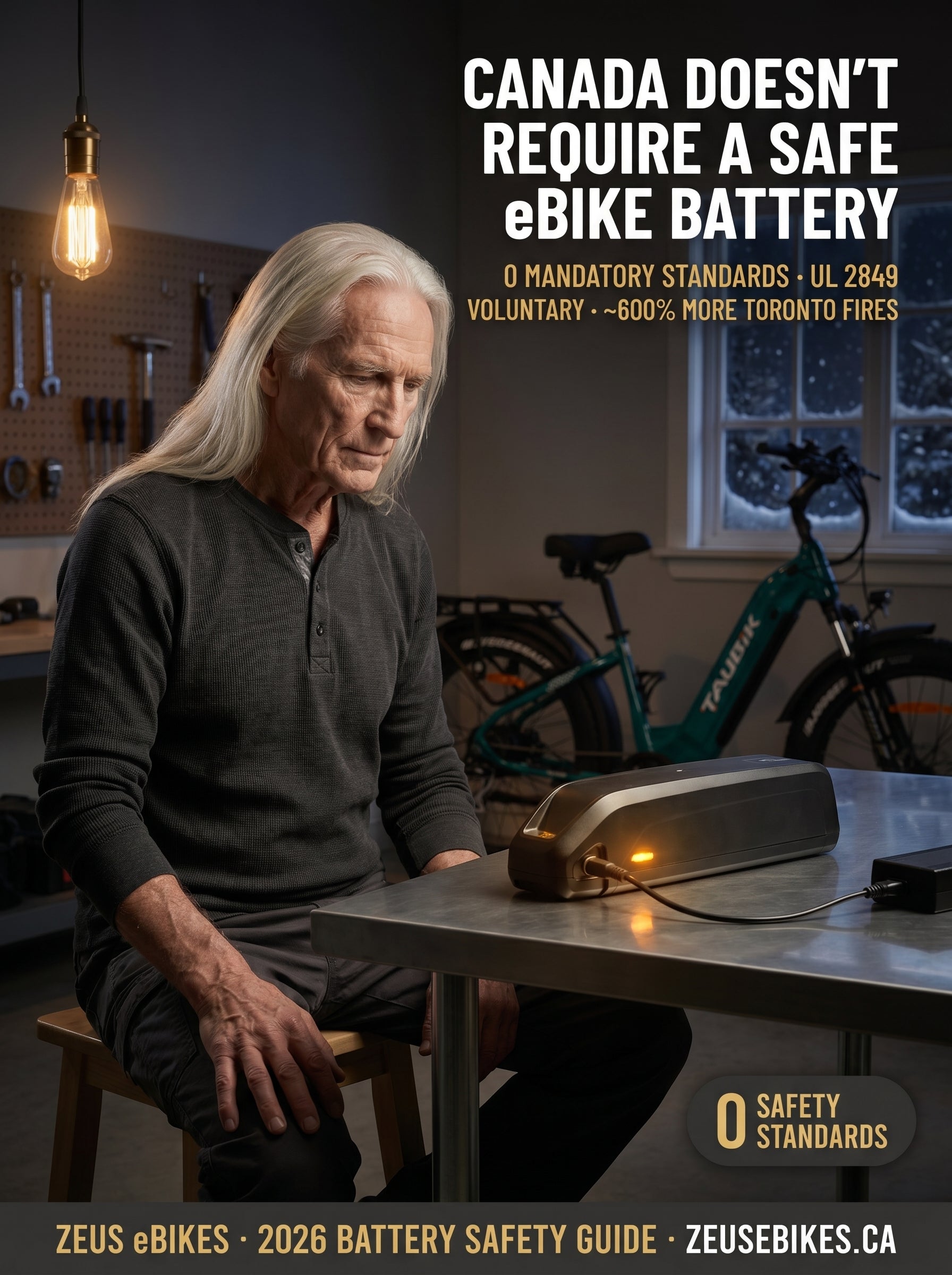
Canada has no mandatory safety standard for eBike batteries — UL 2849 certification is voluntary, and the federal lithium-battery rules now in consultation deliberately exclude eBikes. To own one safely: buy a battery with named-brand cells (Samsung, LG or Panasonic) and a real battery management system — like the Taubik Tour, which uses Samsung cells in a battery Taubik's Tour S page says is "Certified in accordance with UL 2271" — charge it only while you're awake, on a hard surface, never below 0°C; expect 20–50% less range in a Canadian winter; and when it dies, never bin it — recycle it free through Call2Recycle. For the bigger picture, see the complete Canadian eBike guide.
What This Guide Covers
- Why the battery is the part you can't get wrong
- How does an eBike battery actually work?
- How far can an eBike go on one charge?
- What battery type — and is 36V, 48V or 52V better?
- Who actually makes eBike batteries?
- Why does my battery feel warm?
- Are eBike batteries regulated in Canada?
- How do cheap eBike batteries cut corners?
- Which brands have caused fires in Canada?
- How do US and EU battery rules compare to Canada's?
- How long does it take to charge?
- How to charge without any risk
- Should I charge to 80% or 100%?
- Can I use a different charger?
- Can I ride or charge in the rain?
- What a Canadian winter does — and cold storage
- How to make your battery last longer
- How do I know if my battery is dying?
- Why won't my battery charge?
- Replacement cost — and what fits
- How to recycle a dead battery in Canada
- Can I charge in an apartment or condo?
- Transit & planes in Canada
- Will my insurance cover a battery fire?
- How to buy a safe battery
- Which eBikes have the safest batteries?
- Frequently asked questions
Why the Battery Is the One Part You Can't Afford to Get Wrong
The battery is an eBike's most expensive, most powerful and least-regulated component — a lithium-ion pack of roughly 300–960 Wh that costs from a few hundred dollars to over a thousand to replace, and the single part most capable of starting a fire if it's poorly made or mischarged.
In November 2025, the US Consumer Product Safety Commission told riders to immediately stop using certain Rad Power batteries after 31 fire reports — batteries that had also been sold in British Columbia. Health Canada issued no product-specific recall to match it. A bike that ignites in a Vancouver apartment is held to the same federal bar as one that never existed: there is no Canadian safety standard it was required to meet. This guide solves the problem that gap creates — how to understand, buy, charge, troubleshoot and eventually recycle a battery so you are never the cautionary tale.
That is not fear-mongering; it is the verified state of the rules, and we cite every source. The point of this guide is the opposite of fear. Once you understand what's inside the pack, how to read a real certification, and how a simple charging habit removes almost all of the risk, an eBike battery becomes what it should be: the quiet, reliable heart of a bike you trust. You don't need to be an engineer. You need to know what the people selling you a battery would rather you didn't ask.
Canada doesn't require your eBike battery to meet any safety standard. That means the responsibility — and the power to choose well — sits with you. The rest of this guide hands you exactly what you need to do that, from the first charge to the last.
How Does an eBike Battery Actually Work?
An eBike battery is a pack of small lithium-ion cells wired together, wrapped around a circuit board called a battery management system (BMS) that watches and protects every cell. Energy is stored chemically in each cell and released as electricity to the motor. The pack's size is measured in watt-hours — and that single number tells you how far you can ride.
Here is the chain, from smallest to largest:
- The cell — a single rechargeable lithium-ion battery, usually a metal cylinder about the size of a finger. One cell holds a little energy; an eBike needs dozens.
- The pack — many cells wired in series (to raise voltage) and in parallel (to raise capacity), sealed in a case that clicks onto your frame.
- The BMS — the brain. It balances the cells, cuts off charging when they're full, stops discharge when they're empty, and shuts the pack down on a short circuit or overheat. A pack without a real BMS is a pack with no safety net.
The maths that matters is simple: volts × amp-hours = watt-hours (Wh). A 48V battery rated at 15Ah holds 48 × 15 = 720 Wh. A 48V 20Ah pack holds 960 Wh. Watt-hours are the honest measure of energy on board — and, as the next section shows, of range.
How Far Can an eBike Go on One Charge?
Divide the battery's watt-hours by your real-world energy use. Most riders draw 10–20 Wh per kilometre, so a 720 Wh pack delivers roughly 36–72 km and a 960 Wh pack roughly 48–96 km. The wide range is real: throttle riding, hills, headwind, cold and a heavy load all push you toward the thirsty end.
The single most common buyer confusion is mixing up two different "watts." Here's the distinction that settles it:
| Spec | What it measures | What it controls |
|---|---|---|
| Motor watts (W) | Power — how hard the motor pushes | Acceleration, hill-climbing, top speed |
| Battery watt-hours (Wh) | Energy — how much fuel is stored | Range — how far you go |
A bigger motor does not give you more range — it often gives you less, because it can draw more power. A bigger battery gives you more range. When a listing shouts "1000W!" but hides the watt-hours, it's selling you power and staying quiet about distance. For the models built to go farthest on a charge, see our long-range eBike guide.
Volts = pressure. Amp-hours = the size of the tank. Watt-hours = the actual fuel on board. If you remember one battery number, remember watt-hours — then divide by roughly 15 to estimate your real Canadian-road kilometres.
What Battery Type — and Is 36V, 48V or 52V Better?
Almost every modern eBike uses lithium-ion cells, in two common cell sizes, two main chemistries, and three common voltage tiers. The differences are real, and they decide how long the pack lasts and how it behaves when it fails.
Cell sizes: 18650 vs 21700
The numbers are just dimensions in millimetres. An 18650 cell is 18mm wide and 65mm long — the long-standing eBike standard. A 21700 cell is larger, holding up to about 45% more energy, which means fewer cells, simpler wiring, and often more range in the same space (EM3ev). Neither is automatically better — a premium 18650 beats a generic 21700.
Chemistries: NMC vs LFP
| Type | Strengths | Trade-offs |
|---|---|---|
| Lithium NMC (the standard) | Energy-dense, light, long range per kilogram | Fewer cycles than LFP; more heat-sensitive |
| Lithium LFP (emerging) | Very long cycle life; more thermally stable | Heavier and bulkier for the same range |
| Lead-acid (obsolete) | Cheap | Heavy, short life, low range — avoid |
Voltage tiers: 36V vs 48V vs 52V
Nominal voltage is the pack's rated average; the full-charge voltage is higher because each lithium cell charges to 4.20V. A 36V pack (10 cells in series) reads about 42V full, a 48V pack (13S) about 54.6V, and a 52V pack (14S) about 58.8V (CYKE; Battery University). Higher voltage delivers power more efficiently — 48V is today's mainstream sweet spot, 52V squeezes out a bit more punch, 36V suits lighter city bikes. The number that matters for safety: your charger's cutoff voltage must match the pack's tier, which is exactly why chargers aren't interchangeable (more on that below).
Don't fixate on 18650 vs 21700 — that's marketing. Focus on the chemistry (NMC for most riders), the watt-hours, the voltage tier your charger is built for, and above all the cell brand. A bigger generic cell is not safer than a smaller good one.
Who Actually Makes eBike Batteries? (Cells vs Brands)
This is the question that separates a safe purchase from a gamble. The brand on your bike almost never made the cells inside the battery. A handful of global manufacturers make the actual cells; everyone else buys them, assembles them into packs, and prints their own name on the case. The cells that matter come from Samsung, LG, and Panasonic (plus Sony/Murata and a few others).
Why does the source matter so much? Because top-tier cell makers hold tighter manufacturing tolerances. A microscopic metal particle or a thin spot in a cell's internal separator is what causes an internal short — the spark that starts a battery fire. Brand-name cell lines are built to keep those defects vanishingly rare; the cheap, B-grade, and reject-bin cells that flood the bottom of the market are not (EM3ev; industry consensus). The manufacturer and grade of the cell matter more than its size.
A listing that names its cell brand — "genuine Samsung cells," "LG 21700" — is telling you something verifiable. A listing that just says "high-quality lithium battery" or "A-grade cells" with no manufacturer named is telling you something too. Generic, unnamed cells are exactly the corner that gets cut when no certification is required.
Why Does My Battery Feel Warm — and When Is It Dangerous?
A warm battery is usually normal. Every battery has internal resistance, and pushing current through it creates heat — so your pack warms up under heavy load (climbing, throttle, carrying weight) and during charging. Mild, even warmth across the pack is harmless and expected. The skill is knowing where normal ends and danger begins.
Normal warmth
Slightly warm after a long climb or fast throttle run. Warm while charging, especially in the last stage. Warmer in summer heat, cooler in winter. None of this is a problem.
Dangerous heat — stop now
Too hot to hold comfortably, or one area far hotter than the rest. Swelling or a deformed case. A chemical, sweet-solvent or burning-plastic smell. Hissing, popping, smoke or vapour.
A battery becomes dangerous the moment it's too hot to hold, swollen or deformed, hissing or smoking, or giving off a chemical, sweet-solvent or burning-plastic smell — those are the early signature of thermal runaway, a self-reinforcing heat loop where a fault inside one cell generates heat that breaks down the chemistry, releasing gas and more heat that cascades to the next cell. Health Canada's own notice describes how the "failure progression to the extreme effects of fire and explosion can happen in a matter of seconds," and that these fires are "notoriously difficult to extinguish and are prone to reigniting." If you see the signs, you don't have minutes to investigate. Stop, isolate the pack on non-combustible ground if it's safe to move, and call 911.
Toronto Fire Chief Jim Jessop has warned that once a lithium battery goes into thermal runaway, there are only about 90 seconds before a room or a subway car can be engulfed in toxic smoke (CBC). That is exactly why how you charge — covered below — matters more than any other habit you have.
Not sure your current battery is healthy?
Our team will walk you through a battery health check over the phone — no purchase required. Call 1-866-938-7580 or browse Zeus eBike accessories for chargers, storage bags and safety gear.
Are eBike Batteries Regulated in Canada? The Gap Nobody Mentions
Here is the fact the industry would rather you didn't know: no Canadian law requires your eBike battery to meet any safety standard before it's sold. Not a federal one, not a provincial one. The battery on a $5,000 bike and the battery on a $400 marketplace special are held to exactly the same legal bar — none. This isn't an opinion; it's the documented result of two federal laws each leaving eBikes to the other.
- The Motor Vehicle Safety Act (MVSA) sets safety standards for vehicles — but a power-assisted bicycle (≤500W, ≤32 km/h) is exempt from the Canadian Motor Vehicle Safety Standards. No federal vehicle standard governs an eBike battery.
- The Canada Consumer Product Safety Act (CCPSA) regulates consumer products — but it explicitly excludes "vehicles within the meaning of section 2 of the Motor Vehicle Safety Act." Legal analysis of Health Canada's own proposal confirms this exclusion "currently applies to electric micromobility devices, such as e-bikes or e-scooters" (Mondaq).
So the eBike is too much of a "vehicle" for the consumer-product law and too little of one for the vehicle law. The battery falls through the crack. And the CCPSA, as the law firm Bennett Jones notes, "does not currently specifically regulate Lithium-Ion Battery Products" for anyone yet — those rules are only at the consultation stage.
UL 2849 is real — but voluntary
UL 2849 (and its binational version, ANSI/CAN/UL 2849) is the gold-standard eBike certification: it tests the entire electrical system — battery, charger, motor, controller and wiring — against fire and shock hazards, and requires the battery pack to meet the pack-level standard UL 2271. It's recognized as a National Standard of Canada. But here's the catch SGS states plainly: "the standards themselves remain voluntary." A Canadian seller can certify to UL 2849 — many good ones do — or skip it entirely and sell anyway. The choice is theirs, not the law's.
The 2026 twist: Canada is finally regulating batteries — and leaving eBikes out
From December 2, 2025 to February 14, 2026, Health Canada ran a pre-consultation on mandatory rules for lithium-ion batteries in consumer products — vaping devices, phones, toys, tools, appliances, energy storage. It's a genuine step forward. But because eBikes are excluded from the CCPSA as "vehicles," they're left out of even this fix. Canada is moving to regulate the battery in your vape pen while leaving the far larger battery on your bike untouched. Health Canada's own data behind that consultation is sobering: 924 lithium-ion battery incident reports from 2013–2023, 266 involving injuries, and 3 fatalities — two tied to micromobility devices.
Canada's official lithium-battery fatality count over a decade is small — three deaths, two micromobility. We're not claiming the country is ablaze. The problem is the trend (steep, see below) combined with the absence of a mandatory standard. Low casualties so far is not a safe system; it's an unregulated one that hasn't been tested at scale yet.
How Do Cheap eBike Batteries Cut Corners? How Importers Exploit the Gap
An unregulated market doesn't stay honest on its own. When no one is required to certify a battery, the sellers who cut the most corners win on price — and the gap gets exploited in four documented ways.
1. The marketplace bypass
Direct-to-consumer marketplace sales skip every gatekeeper. An offshore brand can ship batteries straight to Canadian doorsteps with no pre-market safety check required. The risk only surfaces after a fire pattern emerges. Our breakdown of Amazon eBikes in Canada walks through how this plays out on the biggest marketplace of all.
2. Cutting the cells and the BMS
When certification is optional, the invisible parts are cheapened first: generic or B-grade cells instead of Samsung or LG, and a stripped-down or absent BMS instead of a genuine one. You can't see either from a product photo, and neither shows up in a spec sheet that just says "lithium battery."
3. Fake UL certification marks
Because UL 2849 is the signal smart buyers look for, the trademark itself can be counterfeited. In late January 2026, Amazon and UL Solutions jointly filed a lawsuit against a group of Chinese sellers (whose products were offered under brands including "Aipas" and "A4"), alleging they put fake UL trademarks on uncertified eBikes and batteries — the complaint alleges this "falsely implied that their batteries and electrical systems met certified safety standards" (Electrek). The allegations are unproven and have not been tested in court. The lesson for buyers holds regardless of how that case resolves: a printed logo proves nothing; a real UL mark carries a control number you can verify on UL's official database.
4. Refusing the recall
When a fire pattern emerges and the US CPSC steps in, an uncooperative offshore manufacturer can simply refuse to recall — leaving the CPSC's only tool a non-binding "warning." According to the US CPSC, Rad Power Bikes "refused to agree to an acceptable recall" during its bankruptcy; the CPSC issued a public warning instead, citing 31 fire reports and roughly $734,500 in property damage. Because the company was insolvent, many owners couldn't get a replacement or refund at all — and there's no Canadian recall backstop when that happens.
The gap isn't theoretical. It's marketplace sales with no gatekeeper, cheapened cells you can't see, counterfeit safety marks, and recalls that get refused. The defence is buying from a seller who answers the cell, BMS, and certification questions in writing — and stands behind the bike from inside Canada.
Which Battery Brands Have Caused Fires in Canada? The Honest Answer
You'd expect a clear list: this brand, this many fires, this cause. It doesn't exist — and why it doesn't is the story. No Canadian fire department or coroner publishes brand-by-brand, per-fire causation for eBike batteries. They publish aggregate counts and cause types. We checked nine fire authorities, the Health Canada recall database, and every traceable Canadian incident to confirm it.
| City / Service | Lithium-ion fire data | Brand named? |
|---|---|---|
| Toronto Fire | 29 eBike/e-scooter battery fires in 2025; ~600% rise 2020–24 | No |
| Montreal (SIM) | 71 lithium fires in 2024 (43 in 2023, 24 in 2022) — a 195% rise | No |
| Ottawa Fire | 54 lithium fires since 2024; 5 specifically eBike-related | No |
| Edmonton (EFRS) | 8 battery-related fires investigated in 2025 | No |
| Calgary Fire | 2025 losses accounted for ~88% of estimated lithium-battery fire damage over the past decade (Calgary Fire, via CTV News) | No |
| Vancouver (VFRS) | Rechargeable-battery fires nearly doubled, 29 (2021) → 53 (2024); "doesn't track e-bike fires separately" | No |
When a Canadian fire department names a cause for a single fire, it stops at the type: overcharging, modification or tampering, uncertified aftermarket batteries and chargers, damaged cells, or water and debris exposure. The building gets identified; the battery brand does not. Vancouver Fire Rescue Services put it plainly — they "don't track e-bike fires separately" (CBC).
Every clean, brand-attributed eBike fire dataset comes from the US Consumer Product Safety Commission, not a Canadian source: Rad Power (31 fires), FENGQS (9 fires, later recalled), and VIVI (recalled). Use those as warnings, not as Canadian statistics. And the one Canadian fatal fire with a brand attached (Vancouver, 2022) names several companies only in a civil lawsuit, where the allegations are unproven — not a fire-department or coroner finding.
No Canadian fire department or coroner publishes per-fire brand causation for eBike battery fires. Canada publishes aggregate counts and cause types only. The single brand-level fire dataset reaching Canadian riders comes from the US CPSC. That isn't a list of bad brands — it's the absence of a system that would tell you who they are.
How Do US and EU eBike Battery Rules Compare to Canada's? (And What Canada Actually Did)
Canada's vacuum looks worse next to its peers, because the fix is already written and working elsewhere. New York City's Local Law 39 (2023) requires eBikes to be UL 2849 certified and batteries UL 2271 to be sold; California's SB 1271 (January 2026) requires certification to UL 2849, UL 2271 or EN 15194; the EU has long mandated electrical safety under EN 15194. Each made certification mandatory. Canada has not — and after New York enforced its rule, the lethality of eBike battery fires dropped. Toronto's fire chief has formally asked Ottawa to adopt UL certification "as in the states."
It's tempting to say Health Canada has done nothing. That overstates it. Health Canada does have a standing consumer advisory on lithium-ion batteries in e-mobility devices (first issued May 2023) and a "Battery safety: Lithium-ion batteries" guidance page. Both warn the batteries can be dangerous, recommend UL-certified devices (ANSI/CAN/UL 2272 and 2849) and chargers bearing recognized Canadian marks (CSA, cUL, cETL), and tell consumers to treat spent packs as hazardous waste. What Canada lacks is a mandatory standard and any product-specific eBike recall — not federal guidance altogether. The accurate criticism is "no enforcement," not "no advice."
Until Canada makes certification mandatory, you are your own regulator — but the standard the law won't require, UL 2849, is exactly the one Health Canada already recommends and you can choose to demand. Buying a certified bike is opting into the protection the rules haven't legislated.
How Long Does It Take to Charge an eBike Battery?
Roughly the battery's amp-hours divided by the charger's amps: hours ≈ Ah ÷ A. A 14Ah pack on a 2A charger takes about 7 hours; the same pack on a 4A charger, about 3.5. Most eBikes ship with a 2A charger, while performance models use 4A or 5A fast chargers. Real-world full charges land at about 3–7 hours — a touch longer than the simple maths, because smart chargers taper the current near the top to protect the cells (Battery University; Cell Saviors). Bosch's own data shows a PowerTube 500 reaching full in about 4.5 hours on 4A versus 7.3 hours on 2A.
How to Charge Your eBike Battery Without Taking Any Risks
If you do nothing else in this guide, do this: charge only while you're awake and home, and check on it periodically. Almost every lithium fire that turns deadly happens while people are asleep or out — the warning signs come, but no one is there to act on the 90 seconds they have. A simple habit removes the overwhelming majority of the risk. Here is the full no-risk protocol.
1. Charge while you're awake and home. Never overnight, never when you leave the house. This is the single most important rule.
2. Check it periodically. Every 20–30 minutes, touch the pack and the charger. Warm is fine; too-hot-to-hold is not. Listen for hissing; look for swelling or smell.
3. Use a hard, non-combustible surface. Tile, concrete, or a metal tray — never on a bed, couch, carpet, or near curtains.
4. Keep it clear of your exit. Charge away from the door and hallway you'd use to get out.
5. Use only the charger that came with the battery. Mismatched voltage or current is a classic fire cause.
6. Unplug when full. Don't leave the pack on the charger for days.
7. Never charge below 0°C. Let a cold battery warm to room temperature first.
8. Keep a working smoke/heat alarm in the room where you charge.
9. Stop at the first warning sign. Swelling, smell, heat, hissing, smoke — unplug if safe, move the pack outside onto non-combustible ground if you can, and call 911. Water will not easily stop a lithium fire.
None of this requires special equipment. It requires a habit: plug in when you sit down to dinner or to watch something, glance at it a couple of times, and unplug before bed. A battery charged that way, in a home with a working smoke alarm, on a hard floor, removes the great majority of the avoidable risk — though no lithium battery is ever risk-free, which is exactly why the certification and cell-brand questions earlier in this guide matter regardless of what the law did or didn't require.
Should I Charge to 80% or 100% — and Can I Leave It Plugged In?
Two different questions get tangled here, so separate them. For longevity: charge to about 80–90% for daily riding and only go to 100% before a long ride. Lithium cells age fastest held at a full charge, so a lower daily ceiling can multiply the pack's lifespan. For "can I leave it plugged in": a modern BMS stops the charge at full, so you can't overcharge it — but letting it sit at 100% on the charger for days still accelerates calendar ageing, so unplug once it's full.
Keep this longevity point separate from the fire-safety rule above: "unplug when full for battery health" and "never charge unattended or overnight for fire safety" are two different reasons to do the same thing.
Can I Use a Different or Higher-Amp Charger?
Only one that matches. eBike batteries and chargers are not universal. To substitute safely, three things must line up: the charger's output voltage must match the pack's tier (a 54.6V charger for a 48V pack, 58.8V for a 52V pack), the connector must match, and the amperage must be rated for the battery. A higher-amp charger only charges faster if the pack and its BMS are rated for it — otherwise it stresses the cells.
This isn't fussiness. An undervoltage charger won't fully charge the pack; an overvoltage charger can overcharge it, overheat it, shorten its life, or start a fire — pushing a 4.20V-rated lithium cell above 4.30V plates metallic lithium and compromises safety (Battery University). The wrong charger is one of the named causes of battery fires. When in doubt, buy the manufacturer's matched replacement.
Can I Ride or Charge My eBike in the Rain? (IP Ratings, Explained)
eBike batteries are water-resistant, not waterproof. You can ride in the rain; you should not submerge the pack or charge it wet. The protection level is described by an IP rating under the international standard IEC 60529: the first digit rates dust protection, the second rates water, and an "X" means that part wasn't tested.
| IP rating | What it means | For an eBike |
|---|---|---|
| IPX4 | Splash-resistant from any direction | Handles rain; not immersion |
| IP65 | Dust-tight + low-pressure water jets | Rain and hose spray — the common eBike level |
| IP67 | Dust-tight + immersion to 1 m for 30 min | Most protected; still confirm before submerging |
Check the exact IP rating on your model's spec sheet. If a battery is ever soaked or submerged, dry it fully and have it inspected before charging — water ingress can cause a delayed internal failure days later, and Health Canada's guidance is to stop using any battery that shows water damage.
What a Canadian Winter Does to Your Battery — and Can I Store It in a Cold Garage?
Cold doesn't damage a healthy battery while you ride — it temporarily shrinks it. Lithium chemistry slows in the cold, so the same pack delivers less range below freezing, then returns to normal once it warms. The real winter risk isn't riding cold; it's charging cold and storing cold the wrong way.
| Temperature | Approx. range loss | Notes |
|---|---|---|
| ~0°C | 20–30% less | Noticeable but manageable |
| ~−7°C | 30–40% less | Plan a shorter loop or a charge buffer |
| ~−12°C | 40–50% less | The BMS may start limiting output |
| ~−18°C | ~50% (Battery University) | A pack at 100% at 27°C "typically delivers only 50%" here |
| Below ~−20°C | Riding not advised | Limited output; store and charge indoors only |
Can I leave it in a –20°C garage all winter?
Better not to. Short cold exposure won't permanently ruin a healthy pack the way charging it cold will — but a battery left at a low charge in deep cold for months can be damaged, and you must never charge it while it's below 0°C. The winter-layup routine that protects it, per Battery University: store the pack indoors at about 40% charge and a cool room temperature (around 15°C), and top it up if it drifts low over the off-season. The two habits that protect both range and lifespan: bring the battery inside to store and charge, and let a cold pack reach room temperature before you plug it in. For models built to hold range through the cold, see the best winter eBikes for Canada. And if a 30–50% winter loss breaks the maths on your commute, the engineering fix is more watt-hours on board — see the dual battery electric bikes Zeus carries (1,440–2,808 Wh combined).
How Do I Make My eBike Battery Last Longer? (The Checklist)
Most quality eBike batteries last several hundred to over 1,000 charge cycles before settling to about 80% of original capacity — years of riding. How you treat the pack changes that dramatically, and the biggest lever is how deeply you discharge it. Five habits stretch a lithium pack to its full life:
- Cap daily charging at ~80–90%. Go to 100% only before a long ride.
- Avoid draining to empty. Shallow, partial cycles last far longer than 0–100% every ride.
- Store at 40–60% when parked for weeks, in a cool, dry place — not full, not empty.
- Keep it cool. Heat above ~30°C permanently accelerates capacity loss; a hot summer trunk is one of the worst places for a battery.
- Use the matched charger and unplug when full.
How Do I Know If My eBike Battery Is Dying? (Symptom Checklist)
A failing pack announces itself. Watch for a sudden 30–40% range drop, charging that's slow or won't hold, the bike cutting out under load even on a "full" gauge, or an erratic charge readout. Those are normal end-of-life signals — most packs reach about 80% capacity after several hundred to 1,000+ cycles, and that's simply age.
One symptom is not normal wear: swelling or a bulging case is a fire risk, not ageing. If you see it, stop using the battery now, don't charge it, and recycle it. A battery that's just worn out gets you fewer kilometres; a swollen one is an emergency — and the difference matters.
Why Won't My eBike Battery Charge? (Troubleshooting Before You Replace It)
Before you assume the battery is dead and buy a new one, work the ladder — a surprising share of "dead batteries" are a dead charger or a cold pack. Here's the diagnostic order:
- Check the charger and outlet first. A dead charger mimics a dead battery exactly. Test the outlet; if the charger has a light, confirm it comes on.
- Clean the connector. A corroded or dirty port or pin can break the connection. Inspect and gently clean it.
- Rule out a temperature lockout. A pack left below 0°C will refuse to charge until it warms indoors. Bring it inside, let it reach room temperature, then try again.
- Consider BMS lockout. A deeply discharged pack — left flat for months over winter — can trip the BMS into a protection/sleep mode that disables charging, and a standard charger may not wake it (Cell Saviors).
Never force-charge or "boost" a pack that reads zero volts, or that is swollen, leaking or damaged — bypassing a tripped BMS on a deeply discharged or damaged pack can trigger thermal runaway, fire or explosion (Jauch). Recovering a deeply discharged pack means rebuilding voltage at very low current and is a job for a qualified technician, not a driveway. If the pack is swollen: stop, do not charge, isolate it outdoors on non-combustible ground, and recycle it (see below).
How Much Does It Cost to Replace an eBike Battery — and What Fits?
As a Canadian market estimate, replacement packs run from a few hundred dollars for small commuter batteries to over a thousand for long-range packs — roughly $0.50 to $1.00+ per watt-hour, higher for premium branded packs (off-brand quality-cell packs average around $0.82/Wh; Bosch packs closer to $1.72/Wh, and an 840 Wh Samsung-cell pack sells in Canada for about $1,100). Treat those as estimates, not quotes — your exact price depends on capacity, cells and brand.
To fit your bike, four things must match — and a mismatch is one of the named causes of battery fires:
| Must match | Why |
|---|---|
| Voltage tier (36V/48V/52V) | The charger and controller are built for it; wrong voltage damages or won't run |
| Watt-hours / amp-hours | Sets your range and must suit the controller's current |
| Physical mount / dock | The pack has to seat and lock on your frame |
| Connector | Plug type and polarity must match exactly |
What if my eBike brand goes out of business?
When a brand exits the market — as Rad Power did — owners can be stuck sourcing replacement packs themselves, and a discontinued mount or connector turns a simple swap into a hunt. The safe path is a reputable Canadian supplier who can match your voltage, watt-hours, mount and connector to a quality-cell pack with a real BMS — not the cheapest unbranded listing online, which is exactly where the uncertified-cell problem is worst. This is the strongest argument for buying from a company that will still answer the phone in three years.
Is a cheap, used, or third-party replacement battery safe?
Honestly, both answers are true. A reputable third-party pack with named cells, a genuine BMS and matched specs can be safe. A used or second-hand pack is genuinely risky: you can't verify cell condition, prior abuse, BMS health or swelling history, and a degraded pack is a fire hazard. If you go aftermarket, check the cells are named, the BMS is real, the voltage/connector match, the seller is reputable, and there's no swelling or damage. We won't tell you every non-OEM battery is dangerous — that's not true — but we will tell you a Marketplace mystery pack is the wrong place to save $200.
Need a replacement matched to your bike — or a safer bike than the one you're nursing?
Call 1-866-938-7580 and we'll help you match voltage, watt-hours, mount and connector — even on a bike we didn't sell. Or see the complete Canadian eBike guide to start fresh.
How Do I Recycle or Dispose of a Dead eBike Battery in Canada?
Never put a lithium eBike battery in household garbage or the blue recycling bin. Health Canada classifies it as hazardous waste, and a damaged pack in a garbage truck or sorting facility is a documented fire cause. The good news is Canada has a free, purpose-built path that most riders don't know exists.
- Call2Recycle's e-mobility program recycles eBike and e-scooter battery packs up to 5 kg (most single commuter packs — a 48V 14Ah pack is about 3.4 kg — qualify; heavy dual-battery packs may exceed it). Drop-off is free, funded by the environmental handling fee you already paid at purchase.
- One catch: eBike packs are accepted only at participating retailers that sell eBikes and e-scooters — not at every battery bin. Use the "E-Mobility Batteries" filter on the Call2Recycle drop-off locator (at recycleyourbatteries.ca) to find one near you.
- In British Columbia, the regulated E-Transport program (run by Call2Recycle) will collect a whole eBike including the battery, by residential pickup or drop-off — funded by an environmental handling fee paid at purchase.
- No participating retailer nearby? Call your municipal household hazardous-waste depot first — some accept large eBike packs, some don't. Never assume.
Before transporting any pack, tape or insulate the terminals. If the battery is swollen or damaged, isolate it outdoors and call the depot before you move it.
A dead eBike battery is hazardous waste, not garbage. Recycling it through Call2Recycle is free — the only trick is finding a participating eBike retailer via the locator's e-mobility filter. This is one thing Canada actually does well; use it.
Can I Charge My eBike Battery in an Apartment or Condo?
Sometimes the honest answer is no — and it's better to know before you buy. A condo board, strata or landlord can legally restrict or ban indoor eBike charging and storage through bylaws or lease terms, and these restrictions are rising as insurers tighten and fire services push for them. Check your specific bylaw or lease before you buy a bike, not after it arrives.
If indoor charging isn't allowed where you live, you still have safe options: a detached garage, charging outdoors when it's above 0°C, a building's dedicated charging room if it has one, or — the most flexible fix — a removable-battery model you can carry to a permitted location to charge. A removable pack also lets you bring the battery into a warm room in winter and leave the bike in the cold. (Where rules genuinely vary building to building, verify yours rather than trusting a blanket claim.)
For an apartment or condo rider, a key-removable 960 Wh pack on genuine Samsung cells is the practical answer: carry it up to charge where you're allowed, and leave the bike parked. It's backed by a 3-year, Canadian-handled warranty — the recall backstop the federal government doesn't provide. Note it's a 1000W bike, over the 500W line the provincial rules converge on, so off-road use only.
Can I Take My eBike or Battery on Transit or a Plane in Canada?
On a plane, effectively no. Canada's screening rules (CATSA, following IATA) allow lithium batteries up to 100 Wh freely, 100–160 Wh only as airline-approved carry-on spares, and nothing over 160 Wh in carry-on. A typical eBike pack is 300–700 Wh — well past the ceiling — and Air Canada and WestJet refuse eBikes outright in both cabin and checked baggage. The pack can only travel as declared dangerous-goods cargo (e.g., Air Canada Cargo), not as your luggage. The no-watt-hour-limit exception for mobility aids applies to wheelchairs, not eBikes.
On transit, the rules are agency-specific — there is no blanket Canadian ban. Of seven major agencies, only one bans eBikes outright:
| Agency | eBike rule |
|---|---|
| STM (Montreal) | Total year-round ban on electric/battery-powered bikes (by-law R-036); mobility aids exempt |
| TTC (Toronto) | Seasonal ban Nov 15–Apr 15; otherwise allowed with weekday peak-hour limits |
| Metrolinx / GO | Allowed if the battery is UL or CE certified with an undamaged seal; staff inspect and apply a tamper-proof seal |
| TransLink (Vancouver) | On bus racks if under 25 kg; rider must remove the battery and carry it onboard |
| Calgary Transit | On bus racks if under 75 lb (34 kg) and it fits the rack; no removal or certification required |
| Edmonton ETS | On the front rack within size/weight limits; battery removal requested, not required |
| VIA Rail | No published watt-hour cap, but the battery must be unplugged on entry, stored, not used or charged on board, and is subject to inspection |
Two practical reads: GO Transit is the one agency that effectively rewards a UL/CE-certified battery (it's your ticket past the seal inspection), and a removable battery is what makes the TransLink and rail rules workable. Always confirm the current rule with your agency before you rely on it — these change, and several are enforced education-first.
Will My Home Insurance Cover an eBike Battery Fire?
It depends on your insurer and your policy — and on whether your bike is a legal power-assisted bicycle (500W or less, 32 km/h or less). The honest, sourced picture: as of 2026, several major Canadian insurers — including Aviva, Wawanesa, TD and Promutuel — have publicly indicated they include legal eBikes within home, tenant or condo policies, and Promutuel states home insurance covers fire damage from a damaged lithium battery for homeowners, co-owners and tenants. These positions are insurer-specific and can change over time. TD adds an important caveat — if your eBike's motor exceeds 500W or it can go faster than 32 km/h, you should check with your insurer, because specific insurance might be required.
So this isn't a scare story about denied claims; it's a "read your policy" story. Coverage is subject to each policy's limits and conditions, and the safest position is the same one that prevents the fire in the first place: a certified battery, charged with the manufacturer's matched charger, not modified. Confirm coverage — and any eBike conditions — with your own insurer in writing before you rely on it.
How to Buy a Safe eBike Battery in Canada: The Checklist
Because the law won't vet the battery for you, vet it yourself with five questions. A seller who answers all five in writing is selling you protection the government doesn't require; a seller who dodges them is the gap in action.
- Whose cells are inside? A named maker — Samsung, LG, or Panasonic. "High-quality lithium" is not an answer.
- Is there a real BMS, and what does it protect against? Overcharge, over-discharge, short circuit, and over-temperature, at minimum.
- Is it certified — and can you verify it? UL 2849 (system) or UL 2271 (pack) is the strongest signal, and the one Health Canada recommends. Verify the mark on UL's database, since fakes exist.
- What are the watt-hours and voltage tier? Your honest range number, and what your charger must match.
- Who handles the warranty, and from where? A Canadian seller who answers the phone is your real recall backstop — because Health Canada won't be.
Which eBikes Have the Safest Batteries? The Zeus Picks We Trust
These four pass the checklist above to different degrees, and we've flagged exactly where each one's battery story is verified and where the manufacturer simply doesn't publish a detail. We won't claim a certification a maker doesn't state. Every spec was checked against the live product page on June 7, 2026.
The Tour is the answer to almost everything this guide warns about: a Canadian-designed step-thru running a 720 Wh pack on genuine Samsung cells, with a BMS Taubik states protects against overcharge and over-discharge (overcurrent and short-circuit protection are listed on the Zeus product page), and a battery Taubik's Tour S page says is "Certified in accordance with UL 2271" (read 7 October 2026); Taubik prints no system-level UL 2849 for it, the standard Canada treats as optional and Health Canada recommends. At 500W nominal and 32 km/h it sits on the line the provincial rules converge on; check your province and municipality.
Certification wording is Taubik's; confirm the scope with the seller before purchase.
A full-suspension trail bike on a proven platform with Canadian support behind it — the warranty backstop that matters when Health Canada won't be the one to recall anything. The 720 Wh battery and 500W rear hub ship set to 32 km/h; Eunorau lists a 45 km/h unlock, so whether it qualifies is not settled. Honest disclosure: Eunorau lists the Defender as UL Certified but doesn't publish which standard — worth asking about before you buy — and its product record names Samsung cells.
*Eunorau states "UL Certified" without naming the standard; its product record lists the battery type as “Lithium-Ion SAMSUNG”.
The Zeus Wolverine (1000W nominal) exceeds the 500W line the provincial e-bike rules converge on. It is over that line at any setting and is intended for off-road and private-property use. The Eahora Romeo Ultra II below (two hub motors, 6,000W peak on Eahora Canada’s card) ships set to 500W and 32 km/h; Eahora says peak output can be unlocked for private use, and whether an adjustable cap qualifies is not settled. Check your provincial rules — see our Canadian eBike laws guide — before riding a higher-power model on public roads.
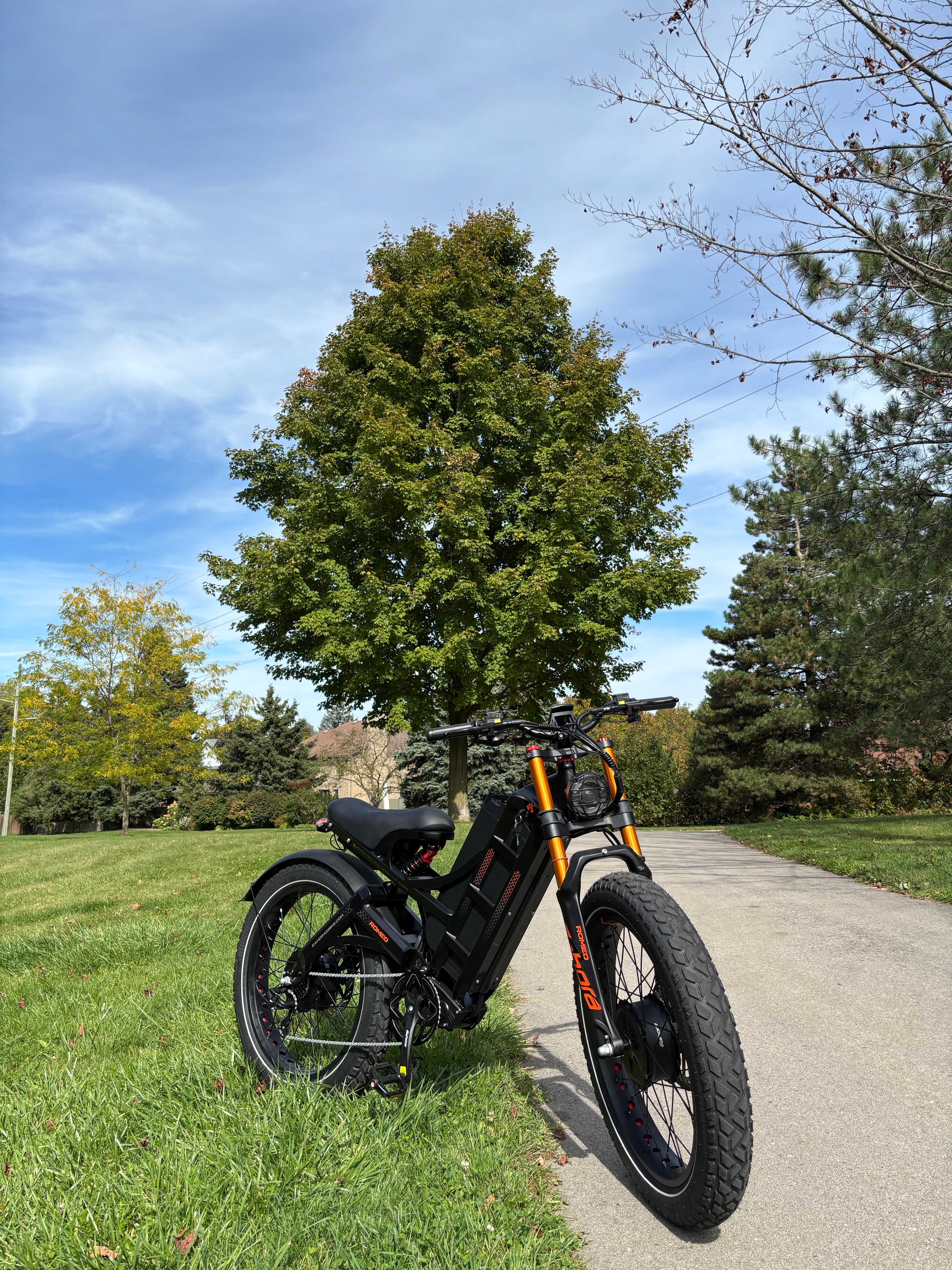
For the rider whose only battery worry is running out, the Romeo Ultra II ends the conversation: a 60V 80Ah / 4,800 Wh pack with a published PAS range of 167–378 km. It charges in 8–12 hours on its 7A quick charger, which makes the awake-and-checking protocol above non-negotiable. Honest disclosure: Eahora publishes the 4,800 Wh figure directly; the cell brand is not published (Eahora states only "Grade A lithium-ion pouch cells"). It is built for off-road power: Eahora Canada ships it set to 500W and 32 km/h, Eahora says peak output can be unlocked for private use, and whether an adjustable cap qualifies is not settled.
4,800 Wh is manufacturer-stated (60V × 80Ah). Cell brand not published by Eahora.
Frequently Asked Questions
Does Canada require eBike batteries to be safety certified?
No. Canada has no mandatory federal safety standard for eBike batteries. The Motor Vehicle Safety Act doesn't cover power-assisted bicycles, and the Canada Consumer Product Safety Act excludes them as vehicles. UL 2849, the eBike electrical-system standard, is a recognized National Standard of Canada but is voluntary. Health Canada's 2025–2026 lithium-battery consultation deliberately excludes eBikes.
Which eBike battery brands have caused fires in Canada?
There is no public Canadian list. Canadian fire departments publish aggregate lithium-ion fire counts and cause types — overcharging, modification, uncertified aftermarket batteries — but never a brand attributed to a specific fire. The only brand-named eBike fire data reaching Canada comes from the US CPSC (for example, Rad Power, with 31 fire reports). Health Canada has issued no eBike fire recall on any brand.
What does UL 2849 mean and should I look for it?
UL 2849 certifies the whole eBike electrical system — battery, charger, motor, controller and wiring — while UL 2271 covers the battery pack on its own. It's voluntary in Canada but the strongest single safety signal, and Health Canada's own advisory recommends UL-certified e-mobility devices. Verify the mark against UL's official database, because counterfeit UL labels are a documented problem.
How far can an eBike go on one charge?
Divide the battery's watt-hours by your real-world energy use. Most riders use 10–20 Wh per kilometre, so a 720 Wh pack delivers roughly 36–72 km. Watt-hours (volts × amp-hours) measure the energy that sets your range; motor watts measure power, not distance. A bigger motor doesn't mean more range — a bigger battery does.
How long does it take to charge an eBike battery?
Roughly the battery's amp-hours divided by the charger's amps — a 14Ah pack on a 2A charger takes about 7 hours. Most eBikes ship with a 2A charger; performance models use 4A or 5A fast chargers. Real-world full charges run about 3–7 hours, slightly longer than the simple estimate because smart chargers slow down near the top.
Should I charge my eBike battery to 80% or 100%?
For daily riding, charge to about 80–90% and only go to 100% before a long ride; lithium cells age fastest held at a full charge. A modern BMS stops the charge at full, so you can't overcharge it — but leaving it at 100% on the charger for days accelerates ageing, so unplug once it's full. This is separate from the fire-safety rule of never charging unattended.
Can I charge my eBike battery overnight?
Best practice is no. Charge while you're awake and home so you can react if something goes wrong, set the pack on a hard non-combustible surface away from your exit, use only the charger that came with it, check it every 20–30 minutes, and unplug it once it's full. Most lithium fires that turn deadly happen while people are asleep.
Can I use a different or higher-amp charger for my eBike battery?
Only one that matches. eBike batteries and chargers aren't universal. The charger's output voltage must match the pack, the connector must match, and the amperage must be rated for the battery (a higher-amp charger only charges faster if the pack and BMS are rated for it). A mismatched charger — wrong voltage or current — is a documented cause of battery fires, so when in doubt, use the manufacturer's matched replacement.
How cold is too cold to charge an eBike battery?
Never charge a lithium battery below 0°C. Charging a cold cell causes lithium plating, which permanently damages the battery and creates a safety hazard. If your battery has been outside in the cold, bring it indoors and let it reach room temperature before plugging it in. Riding in the cold is fine — it only reduces range temporarily.
Can I store my eBike battery in a cold garage over winter?
It's better not to. Cool storage helps, but a battery left at low charge in deep cold for months can be damaged, and you must never charge it while below 0°C. The safer winter-layup routine, per Battery University, is to store the pack indoors at about 40% charge and a cool room temperature (~15°C), and top it up if it drifts low. Bring a cold pack inside and let it warm before charging.
My eBike battery won't charge or shows no lights — is it dead?
Not necessarily. Work the ladder before replacing it: confirm the charger and outlet work (a dead charger mimics a dead battery), clean a corroded or dirty connector, and rule out a temperature lockout (a sub-0°C pack refuses to charge until warmed indoors). A deeply discharged pack can also put the BMS into lockout. Safety limit: never force-charge a pack that reads zero volts or shows swelling — that one is finished and must be recycled.
How do I know if my eBike battery is dying?
Watch for a sudden 30–40% range drop, charging that's slow or won't hold, the bike cutting out under load, or an erratic charge gauge. Most quality packs reach end of life at about 80% of original capacity after several hundred to over 1,000 charge cycles — years for most riders. One symptom isn't normal wear: swelling or a bulging case is a fire risk, not ageing. If you see it, stop using the battery and recycle it.
How much does it cost to replace an eBike battery in Canada?
As a market estimate, replacement packs run from a few hundred dollars for small commuter batteries to over a thousand for long-range packs — roughly $0.50 to $1.00+ per watt-hour, higher for premium branded packs. To fit, four things must match: voltage tier (36V/48V/52V), watt-hours or amp-hours, the physical mount or dock, and the connector. A mismatch is a named cause of battery fires, so buy from a seller who can confirm all four. (Price range is a Zeus market estimate.)
Where do I recycle a dead eBike battery in Canada, and can I throw it in the garbage?
Never put a lithium eBike battery in household garbage or the blue recycling bin — Health Canada classifies it as hazardous waste. Recycle it free through Call2Recycle's e-mobility program, which accepts eBike packs up to 5 kg but only at participating eBike-selling retailers, so use the "E-Mobility Batteries" filter on the Call2Recycle locator to find one. British Columbia's E-Transport program will also collect a whole eBike including the battery. Tape or insulate the terminals before transport.
Can I charge my eBike battery in an apartment or condo?
Sometimes the honest answer is no. A condo board, strata or landlord can restrict or ban indoor eBike charging and storage through bylaws or lease terms, and this is rising as insurers tighten. Check your specific bylaw or lease before you buy, not after. If indoor charging isn't allowed, safe alternatives include a detached garage, charging outdoors above 0°C, a building's dedicated charging room, or a removable-battery model you can carry to a permitted location.
Can I take an eBike battery on a plane or transit in Canada?
On a plane, effectively no: airlines allow lithium batteries up to about 100 Wh automatically, or 160 Wh with approval (CATSA/IATA), and a typical eBike pack of 300–700 Wh far exceeds that — Air Canada and WestJet refuse eBikes outright, so a pack must ship as declared dangerous-goods cargo, not as baggage. Transit rules vary by agency: STM Montreal bans eBikes year-round, the TTC bans them November 15–April 15, while GO, TransLink, Calgary Transit and Edmonton ETS allow them under conditions. Check your agency before you rely on it.
Will my home or tenant insurance cover an eBike battery fire?
It depends on your insurer and whether your bike is a legal power-assisted bicycle (500W or less, 32 km/h or less). Major Canadian insurers including Aviva, Wawanesa, TD and Promutuel currently fold legal eBikes into home, tenant and condo policies, but TD notes that an eBike whose motor exceeds 500W or 32 km/h may need specific insurance. Coverage is subject to your policy's limits and conditions, so confirm it with your own insurer in writing before you rely on it.
What are the warning signs of a dangerous eBike battery?
Stop using the battery immediately if you notice swelling or a deformed case, a chemical or burning-plastic smell, excessive heat, hissing or popping, smoke or vapour, case discolouration, or leakage. Don't charge it. If it's safe to do so, move it outside onto non-combustible ground away from anything that can burn, and call 911 — lithium fires spread in seconds and reignite.
The Bottom Line
Canada left a gap, and the market noticed. There's no mandatory standard for your eBike battery, the new federal rules step around eBikes entirely, and no public Canadian list will ever tell you which brands have burned. That sounds bleak — but it hands you the one thing that actually protects you: a clear set of questions and a few simple habits that don't depend on any regulator. Buy named cells, a real BMS, and verifiable certification. Charge while you're awake, on a hard floor, never below freezing. Plan for winter range, troubleshoot before you replace, and recycle the dead pack through Call2Recycle instead of the bin. Do that, and the law's silence stops being your problem.
You don't have to decide alone, and you don't have to decide today. Zeus ships from Canada with real Canadian warranty support, an unused, unopened bike can be returned within 15 days of delivery (15% restocking fee), and a real person answers 1-866-938-7580 to talk through what's inside any battery you're considering — even one we don't sell. Start with the bikes whose batteries we'd trust above, or browse the full Zeus accessories range for the charger and storage gear that make safe charging effortless.
Keep going: the complete Canadian eBike guide · best winter eBikes for Canada · long-range eBikes by battery · Canadian eBike laws, every province · how to stop eBike theft in Canada · why buy from a Canadian company.
This guide was written by the Zeus eBikes Canada editorial team. Zeus is a Canadian direct-to-consumer electric bike retailer shipping nationwide. We verify every battery specification against the live product page and cite every regulatory claim to its primary source — and where Canadian data doesn't exist, we tell you so.
Visuals created by Playcut.ai

Share:
eBike Shops in Victoria, BC (2026): Every Verified Store
Aventon eBikes Canada (2026): Verified Brand Profile