Best E-Bike for Mountain Climbing in Canada (2026): 12 Bikes on 38 Measured Climbs

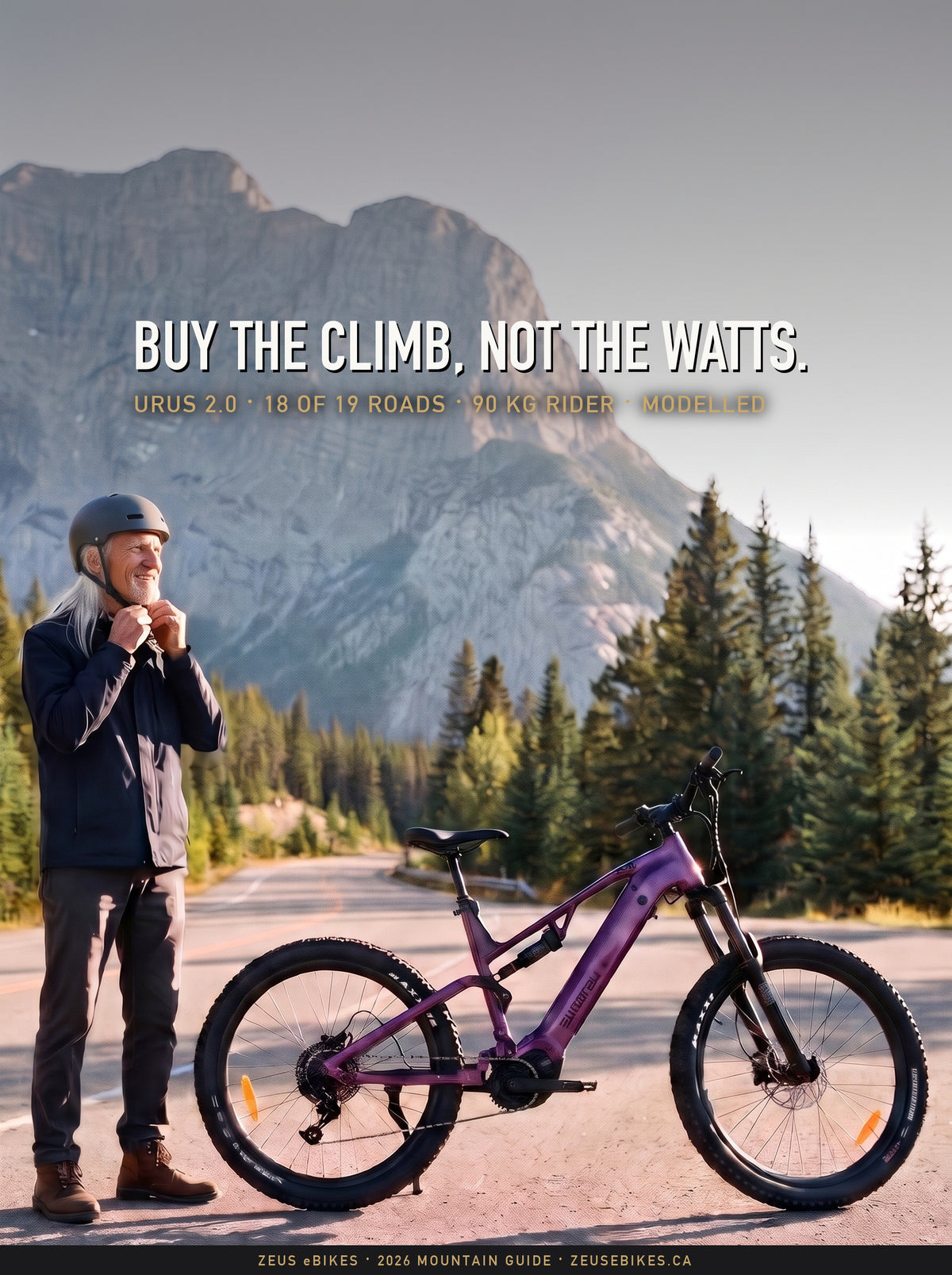
Cover: a Playcut.ai rendering made from Eunorau’s own photograph of the Urus 2.0.
Highway 40 over Highwood Pass is closed to vehicles from 1 December to 14 June [1], so the bike you buy this winter meets its first pass next summer. Buy on the box’s watts and range and it can stall on a 14% pitch or run flat 50 km from the next outlet. We measured 38 Canadian mountain destinations and ran 12 e-bikes we sell up every road, so you can buy the one that climbs yours.
Quick answer
- Best climber The Eunorau Urus 2.0 ($5,700), a 500 W Bafang mid-drive with 120 N·m and full suspension, climbs 18 of the 19 roads we measured with a 90 kg rider and has the battery for 13 at 20 km/h, the most of any two-wheeler. It ships set to 32 km/h; whether an adjustable cap qualifies is not settled.
- Runner-up The Velotric Discover M ($3,899), a 100 N·m mid-drive with 801.6 Wh, climbs 18 and finishes 11, second on two wheels, for $1,801 less.
- Lowest price The Samebike XD26-II ($1,399) climbs 18 and finishes 10, one more than the RS-A02 Pro at the same price; Samebike prints two top speeds for it.
- Three wheels The Citytri E-310 and Taubik Axis trikes finish the most roads of all, 14 of 19.
- Heavier rider With 110 kg aboard, the Urus 2.0, Discover M and XD26-II still climb 17 of 19.
- Singletrack 19 of the 32 trail destinations admit pedal-assist e-bikes only, and every bike here has a throttle. Velotric lists the Discover M’s and Tempo’s as removable; ask us before a trail day.
Browse the climbers in the mountain e-bike collection and the full-suspension collection.
Where to buy: Zeus eBikes Canada, the online store that publishes this guide, sells every bike linked here, with free shipping across Canada, phone support at 1-866-938-7580 and warranty claims filed with the maker for you (how buying from Zeus works).
Buying from Zeus: free shipping across Canada · real people at 1-866-938-7580 · every bike’s warranty backed in full by its maker, with Zeus filing the claim [2] · returns within 15 days of delivery on unused, unopened bikes (15% restocking fee, buyer pays return shipping) [3].
Pick your question and jump straight to it:
How we measured
- 38 destinations, chosen before the data: each named by at least three of five independent sources, then every road measured on Natural Resources Canada elevation data [4] and checked against PJAMM Cycling’s 17 Canadian climbs (median gain difference 2.7%) [5].
- 12 bikes run up every road with a validated cycling power model [6], measured rolling and drag figures [7], lab motor efficiency [8] and cell capacity in the cold [9], at 70, 90 and 110 kg, in July and October.
- Bike figures from each maker’s Canadian page, read 31 October and 1 November 2026, both figures where a maker prints two, and RedTail eBikes’ measured fit where our US sister store has it. Trail rules copied word for word from 68 land-manager sentences. Prices from zeusebikes.ca, 3 November 2026.
This guide covers mountain roads, passes and trail networks. For the hill on your own street, our guide to e-bikes for hills works through the torque math; for a trail bike, start with our electric mountain bike guide.
In this guide
- What makes an e-bike climb a mountain
- The 12 bikes, matched to the climb
- Where you may ride an e-bike on Canada’s mountains
- Will the battery reach the next town?
- How cold is it at the top?
- Gravel, brakes and the ride down
- Which bike fits you
- All 38 destinations, region by region
- How we measured, in full
- Questions
- The bottom line
What makes an e-bike climb a mountain
Torque gets you moving on a steep pitch, total weight sets the speed you can hold, and the battery decides whether you reach the top and the next town. Watts are not the lever: every provincial rule on these roads stops at 500 W and 32 km/h, so the climbers do the most inside that line.
The 500 W line is the law. B.C.’s standard e-bike and Nova Scotia’s power-assisted bicycle stop at 500 W and 32 km/h [10, 11]; Québec writes that a bike above 500 watts is not authorized on a public road [12]; Alberta treats one above it as a motor vehicle [13]. The trail rules that print a number print the same ceiling: Squamish’s trail society, Canmore, Golden and SilverStar. More power would take a bike off these roads, so the climbing comes down to torque, weight and battery.
Torque: can it restart you on the steepest pitch?
Stop on a steep pitch and the motor has to get you moving again. For a hub motor, what reaches the road is its torque divided by the wheel’s radius, so a bigger wheel needs more torque. These are the least torque that restarts a rider plus 10 kg of gear on a 30 kg bike at walking speed, from the same climb rule the rest of this page uses [6, 7]:
Swipe the table
| Wheel and tire | 90 kg rider, Apex 14.2% | 110 kg rider, Apex 14.2% | 90 kg rider, Mont-Mégantic 17.6% |
|---|---|---|---|
| 20 × 4.0 in fat tire | 58 N·m | 67 N·m | 71 N·m |
| 24 × 3.0 in | 63 N·m | 73 N·m | 77 N·m |
| 27.5 × 2.4 in | 67 N·m | 77 N·m | 82 N·m |
| 29 × 2.4 in | 71 N·m | 81 N·m | 86 N·m |
| 26 × 4.0 in fat tire | 73 N·m | 84 N·m | 89 N·m |
A mid-drive works through your gears instead. On the Urus 2.0’s bottom gear, a 32-tooth chainring to a 42-tooth cog, the rear wheel turns about three-quarters of a turn for each turn of the cranks, and its 120 N·m “works through that reduction rather than against it”, as RedTail’s Urus review puts it [14]. The two mid-drives here, the Urus 2.0 and the Discover M, climb 17 of 19 roads even with a 110 kg rider; so does the XD26-II, a 25.5 kg hub bike, because light weight counts as much as torque.
Weight: can it hold a speed up the climb?
At 500 W from the motor and 100 W from your legs, holding 10 km/h up a pitch depends on the total mass: rider, gear and bike. Past these totals the speed falls under 10 km/h, whatever the motor’s torque:
Swipe the table
| Pitch | Heaviest total that holds 10 km/h | Bike limit, 90 kg rider + 10 kg gear | Bike limit, 110 kg rider + 10 kg gear |
|---|---|---|---|
| SilverStar 12.3% | 167 kg | 67 kg | 47 kg |
| Apex 14.2% | 146 kg | 46 kg | 26 kg |
| Mont-Megantic 17.6% | 120 kg | 20 kg | 0 kg |
On a 14.2% pitch a 90 kg rider with gear can bring a bike of up to 46 kg and hold 10 km/h; a 110 kg rider, 26 kg. Lighter climbs better, and a heavier rider gains the most from a light bike.
Battery, brakes and gears
- Battery: about 800 Wh or more, on a bike light enough to carry it, crosses the Icefields Parkway’s 49.1 km gap at 20 km/h in October with 15% left: Urus 2.0, Discover M, Citytri E-310, Taubik Axis made it, the 720 Wh bikes and the 58 kg Breeze Pro on one battery did not. Slow to 12 km/h and pedal steadily, and every one of the twelve does. Gray Creek Pass’s 87.2 km needs two batteries.
- Brakes: hydraulic discs for the descents. Mount Revelstoke’s parkway drops 1,398 m in 25.4 km.
- Gears: enough low gears that your own 75 to 150 W keeps counting on the steep pitches. The ONE-TRIKE 2.0 has one gear, and RedTail lists the US Citytri as single-speed.
- Cold: October averages below 0 °C at the top of 6 of the 19 roads, and Taubik’s manuals carry a caution against use below 0 °C.
What to look for: 500 W or less, a mid-drive or a hub with the torque in the table for your wheel, a bike light enough for your weight, 800 Wh or more for the long passes and hydraulic brakes. Then check the trail rule: on 19 of 32 trail destinations a throttle keeps you on the road.
Riding a particular mountain? Find it among the 38 destinations, with its road numbers and its trail rule.
Find your mountain →The 12 bikes, matched to the climb
Two mid-drives lead: the Urus 2.0 and the Discover M climb 18 of the 19 roads with a 90 kg rider and finish 13 and 11 at 20 km/h with light pedalling. The Citytri and Axis trikes finish the most, 14, on 960 Wh; the Tempo, the lightest bike here, suits short climbs only.
“Climbs” counts the roads where a bike restarts a 90 kg rider on the steepest pitch and holds 10 km/h; “finishes” adds the battery test, arriving with 15% left in July and in October. Results for each road are in the destination tables.
Swipe the table
| Bike | Climbs, of 19 | Finishes, 20 km/h | Finishes, 12 km/h | Price | Motor | Battery | Weight | Top speed |
|---|---|---|---|---|---|---|---|---|
| Eunorau Urus 2.0 | 18 | 13 | 17 | $5,700 | 500 W mid, 120 N·m | 840 Wh | 28 kg | 32 km/h, can be raised |
| Velotric Discover M | 18 | 11 | 17 | $3,899 | 500 W mid, 100 N·m | 802 Wh | 27.2 kg | 32 km/h, can be raised |
| Samebike XD26-II | 18 | 10 | 16 | $1,399 | 500 W hub, 70 N·m | 720 Wh | 25.5 kg | 32 km/h or 28 mph |
| Taubik Westridge 29T | 15 | 10 | 15 | $2,999 | 500 W hub, 65 N·m | 720 Wh | 29.7 kg | 32 km/h |
| Taubik Tour S | 18 | 9 | 16 | $2,899 | 500 W hub, 80 N·m | 720 Wh | 34.9 kg | 32 km/h |
| Samebike RS-A02 Pro | 18 | 9 | 16 | $1,399 | 500 W hub, 80 N·m | 720 Wh | 33 kg | 32 km/h |
| Eunorau Defender | 12 | 8 | 12 | $2,450 | 500 W hub, 60 N·m | 720 Wh | 29.9 kg | 32 km/h, can be raised |
| Velotric Tempo | 8 | 3 | 7 | $2,599 | 350 W hub, 45 N·m | 374 Wh | 17.7 kg | 32 km/h, can be raised |
| Addmotor Citytri E-310 | 18 | 14 | 17 | From $1,899 | 500 W hub, 90 N·m | 960 Wh | 39 kg | 32 km/h |
| Taubik Axis | 18 | 14 | 17 | $4,199 | 500 W hub, 80 N·m | 960 Wh | 38 kg | 32 km/h |
| Meet One Breeze Pro 2.0 | 15 | 10 | 15 | From $3,499 | 500 W hub, 90 N·m | 960 Wh | 58 kg | 32 km/h |
| Eunorau ONE-TRIKE 2.0 | 18 | 9 | 15 | $2,429 | 500 W hub, 80 N·m | 696 Wh | 39 kg | 32 km/h, can be raised |
Every bike here is rated at or under 500 W. Five of them, the Urus 2.0, Discover M, Defender, Tempo and ONE-TRIKE 2.0, ship set to 32 km/h with a top speed their makers say can be raised; whether an adjustable cap qualifies is not settled. Samebike prints two figures for the XD26-II and names no setting, so ask us which applies to the unit we ship. Bike figures from each maker [15, 16, 17, 18, 19, 20, 21, 22, 23, 24, 25, 26].

A full-suspension electric mountain bike: a 48 V, 500 W Bafang M600 mid-drive with “MAX TORQUE: 120 N·m”, a 48 V 17.5 Ah battery (840 Wh), 150 mm RockShox suspension at both ends, an 11-speed SRAM cassette (11–42T), Maxxis Minion 27.5 × 2.8-inch tires and Tektro hydraulic brakes with a 203 mm front rotor, at 28 kg [15].
On the climbs: it passes our climb test on 18 of 19 roads with a 90 kg rider and 17 with a 110 kg rider, and the full battery test on 13, the most of any two-wheeler. Only Mont-Mégantic’s 17.6% beats it: it restarts a 90 kg rider there and holds 9.2 km/h.
Top speed, two figures: Eunorau Canada’s spec table prints “Maximum Speed 20 MPH / 32 KPH”, its description “MAX SPEED: 28 mph / 45 km/h”, and its spec grid “Class 3 Speed limited Unlockable” [15]. We ship it set to 32 km/h; whether an adjustable cap qualifies is not settled.
Fit: Eunorau prints a rider window of 5′3″–6′4″. RedTail eBikes, our US sister store, ran 6,068 bodies from the US Army’s survey on Eunorau’s photograph of the 19-inch frame: the saddle as photographed suits the median 5′7″ rider, 72 of 100 riders at 5′8″ need it higher, and 95 of 100 at 5′5″ clear the frame by 1.1 inches at a stop (RedTail’s Urus fit tables) [14]. You raise it on the dropper post; if you are 5′8″ or taller, ask us for the post’s travel before you order.
Skip it if price leads: the Discover M finishes 11 roads for $1,801 less.

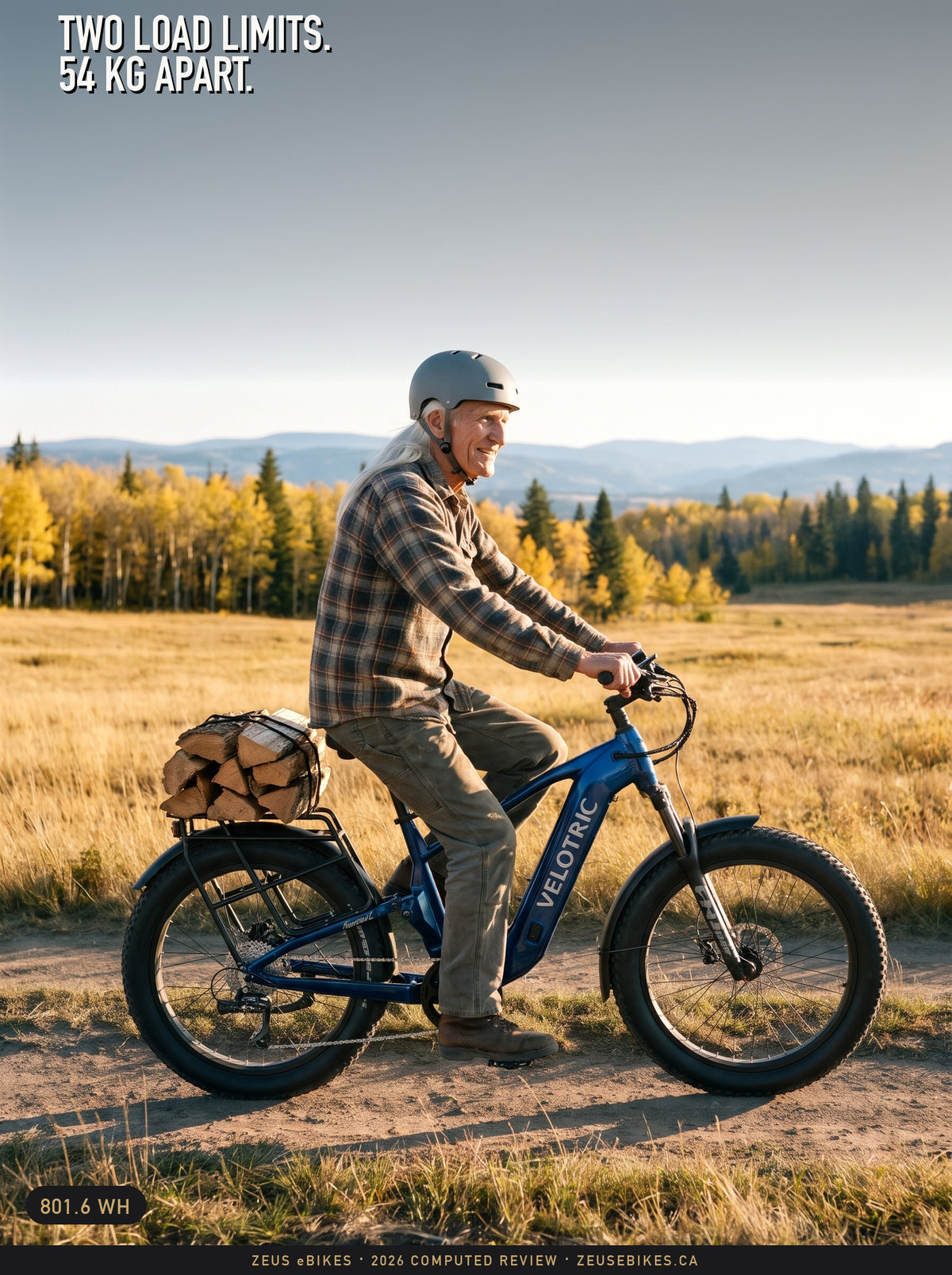
A step-through commuter built to climb: a 500 W mid-drive with “up to 960W peak power” and “100 Nm”, a 48 V 16.7 Ah battery (801.6 Wh), a Shimano CUES 9-speed, an 80 mm air fork and Tektro hydraulic brakes, at 27.2 kg [16]. RedTail found a second torque figure, “130Nm Max”, in Velotric’s US feature block (RedTail’s Discover M review) [27]; our model uses 100.
On the climbs: 18 of 19 roads with a 90 kg rider, 17 with a 110 kg rider, and the full battery test on 11, second to the Urus among two-wheelers, for $1,801 less. Slow to 12 km/h and pedal steadily and it finishes 17.
The trail question: Velotric’s spec table lists its throttle as “Trigger-control, removable”, while its feature text describes a “Native Thumb Throttle” built into the mid-drive [16]. With the throttle off it is one of two bikes here, with the Tempo, that might meet a pedal-assist-only trail rule, and the only one with the crank motor that Empire 47 and Sentiers du Moulin require; whether it qualifies is each land manager’s call. Ask us which throttle the unit we ship has.
Top speed: “Max Speed (Default) 32 km/h”, and Velotric writes that you can “Unlock Custom Mode in the app to enable both pedal assist and throttle up to 45 km/h” [16]: it ships set to 32 km/h; whether an adjustable cap qualifies is not settled.
Fit: Velotric sizes the Regular for 5′2″–5′11″ and the Large for 5′9″–6′7″, as RedTail’s review lists them [27]; RedTail has not modelled its fit.
Skip it if you ride gravel passes: only the fork and the seatpost are sprung.

The lowest-priced climber here: a full-suspension 26-inch bike with a 500 W motor, a 48 V 15 Ah battery (720 Wh), “Tire Size:26*2.1 Inch”, a Shimano 7-speed and hydraulic disc brakes, rated for 150 kg [17]. It climbs 18 of 19 roads with a 90 kg rider (17 at 110 kg) and finishes 10, level with the Westridge 29T for less than half its price.
Top speed, two figures: Samebike Canada’s page prints “32KM/H Max Speed” and “Max speed up to 28MPH with throttle” [17]. Ask us which applies to the unit we ship before you ride it on a public road.
Torque and weight: Samebike’s spec block gives “Torque:70+Nm” and “Weight :25.5KG” [17]; our model uses 70 N·m, the floor of that figure.
Skip it if you ride the long passes at 20 km/h: its 720 Wh runs short of 15% on the Icefields and Highwood gaps.

The hardtail: a 29-inch frame with a 100 mm SR Suntour fork, an 8-speed Shimano Acera and Zoom hydraulic brakes with 180 mm rotors, a 500 W hub at 65 N·m and 720 Wh [18]. It is the one here for the trail networks that admit e-bikes with no class written, SilverStar’s three Class 2 trails and Golden’s own trails.
On the climbs: 15 of 19 roads with a 90 kg rider and 10 finished. On a 29-inch wheel its 65 N·m cannot restart a 90 kg rider on pitches of 13.5% and steeper, so pedal through the restart at Apex, McBride Peak, Gray Creek and Mont-Mégantic.
Two figures from the maker: Taubik’s page gives a weight capacity of 286 lb and a weight of 29.7 kg in its spec table; its manual gives “Max Load 120 kg” and a net weight of 28.8 kg [18, 28]. Plan around 120 kg.
Cold: the manual carries the caution “not intended to be used at ambient temperatures less than 0°C” [28]; ask us or Taubik before a cold ride.
Skip it if you and your gear weigh more than 120 kg, its manual’s limit.

A step-through fat-tire bike: “500W Bafang (80 NM)”, a 48 V 15 Ah Samsung battery (720 Wh), 26 × 4-inch Kenda Juggernaut tires, a 75 mm RST fork, an 8-speed Shimano Acera and Zoom hydraulic brakes with 180 mm rotors, at 77 lb (34.9 kg) [19]. Taubik prints one top speed, “Speed 32KM/H”, with no unlock.
On the climbs: 18 of 19 roads with a 90 kg rider (15 at 110 kg) and 9 finished at 20 km/h; at 12 km/h with steady pedalling, 16.
Cold: its manual carries the same caution as Taubik’s others, “not intended to be used at ambient temperatures less than 0°C” [29], while Taubik’s brochure calls the Tour S “the perfect go-to e-bike for year-round commuting in any season” [30]. October averages below 0 °C at the top of 6 roads, so ask us or Taubik before a cold ride.
Skip it if you want rear suspension, or more than 129.7 kg (“Weight Capacity 286 lb”) of rider and gear.

A folding full-suspension fat-tire bike with 4-inch tires, mechanical disc brakes and a 720 Wh battery, 33 kg with a 150 kg payload [20].
Two motor ratings from the maker: Samebike Canada’s spec tab says 500W; its description says “The RS-A02 Pro features a 250W motor” [20]. On the 500 W reading it finishes 9 of 19 roads and climbs 18; on the 250 W reading it finishes 3 and climbs 4. Ask us which applies to the unit we ship.
Measured fit: Samebike prints a recommended height of 6′1″ to 7′9″. RedTail placed 6,068 bodies on Samebike’s drawing in RedTail’s RS-A02 Pro review: the saddle reaches the fit formula’s height for 99 of every 100 riders at 5′8″ and 5′10″, 93 at 5′6″, 85 at 6′0″ and 46 at 6′2″ [31].
Skip it if you are taller than about 6′1″, or the long passes are your plan.

A full-suspension 27.5 × 3.0-inch bike: “48V500W Rear Motor with 60N.M”, a 48 V 15 Ah Samsung battery (720 Wh), a 7-speed Shimano Altus, a KS rear shock and hydraulic brakes with 180 mm rotors, rated for 136 kg [21].
On the climbs: its 60 N·m on a big wheel is the weak point. It fails our restart with a 90 kg rider on the 7 roads steeper than 12% and finishes 8. On gentler grades it holds its own: RedTail’s Defender hills model of the US version holds 24.6 km/h up 4% and 16.7 km/h up 8% on the throttle with 180 lb (82 kg) aboard [32].
Fit: Eunorau prints 5′3″–6′4″. RedTail’s fit model puts riders below about 5′5″ on the 17-inch frame and those from about 5′5″ to 5′9″ on the 19-inch, whose saddle reaches the fit formula’s height for 99 of 100 riders at 5′5″ and 61 of 100 at 5′9″ [32].
Top speed: “Maximum Speed: 20 MPH (32 KM/H) under speed limited/locked”, and “Class 2 Speed limited Unlockable” [21]: it ships set to 32 km/h; whether an adjustable cap qualifies is not settled.
Skip it if your road has a pitch steeper than 12%, or you are taller than about 5′9″.

The lightest bike here at 17.7 kg: a hub motor Velotric lists as “36V, 350W, 650W (Peak Power), 45Nm”, a 374 Wh battery, Kenda 700 × 42c gravel tires, a rigid fork, a Shimano 8-speed (11–40T) and Shimano hydraulic brakes [22].
On the climbs: a climber for short roads. With a 90 kg rider it restarts on the roads up to 9.8% and finishes 3: Mount Royal, Mount Norquay Road above Banff and the Bow Valley Parkway.
The throttle comes off: Velotric’s spec table lists its throttle as “Trigger-control, removable” [22]. Without it the Tempo is a pedal-assist bike; whether a pedal-assist-only rule then admits it is the land manager’s call, and its rigid fork and gravel tires suit pathways more than singletrack.
Top speed: “Max Speed (Default) 32 km/h” and “Max Speed Adjustable Range 19 ~ 45 km/h” [22]: it ships set to 32 km/h; whether an adjustable cap qualifies is not settled.
Skip it if your climb has a pitch steeper than 9.8% or runs longer than a few kilometres: 45 N·m and 374 Wh.
Three wheels. The trikes finish the most roads on their bigger batteries and never need a foot down at a stop; they weigh 38 to 58 kg, and none is built for singletrack.

A folding trike with a 500 W rear motor that Addmotor Canada rates at “90Nm high torque & 1,100W peak”, a 960 Wh battery and a half-twist throttle [23]. It climbs 18 of 19 roads with a 90 kg rider and finishes 14, the most of any bike here, level with the Axis for at least $1,700 less.
Ridden off pavement: RedTail rode the US version hard off pavement with a 220 lb rider, and in RedTail’s ridden Citytri E-310 review “the folding joint produced no creak, no knock and nothing working loose” [33].
On a slope: Tektro mechanical disc brakes on all three wheels and a parking brake [23], which, as RedTail’s Citytri brakes section puts it, lets you “stop on a hill and get off” [34].
Skip it if you want hydraulic brakes or gears for the long descents: RedTail lists the US version as single-speed.

A full-suspension trike: Trama Fat 34 coil fork and rear coil, 3-inch Kenda tires, an anti-slip rear differential, Zoom hydraulic brakes with 180 mm rotors and a 7-speed Shimano Altus, with a 500 W Sutto hub and a 960 Wh Samsung battery [24]; Taubik gave us its torque by email, “Motor Torque: 80 Nm” [35].
On the climbs: it matches the Citytri, 18 climbed and 14 finished, with suspension at both ends for broken pavement and gravel shoulders.
Cold: Taubik’s manual carries the caution “not intended to be used at ambient temperatures less than 0°C” [36]; Taubik told us by email it “should have no problem being ridden in temperatures down to -20°C” with the battery kept indoors [35]. Ask us or Taubik before an October ride at altitude.
Skip it if price leads: the Citytri finishes the same 14 roads for at least $1,700 less.

A full-suspension fat-tire trike with a 500 W motor and 90 N·m on Meet One Canada’s page, a torque sensor, a differential and reverse [25]. Our listing offers it with two 960 Wh packs, 1,920 Wh in all, from $3,999: with both it finishes 13 of 19 roads instead of 10, and it is the only bike here with the energy for Gray Creek Pass, at 12 km/h with steady pedalling (65% of both packs in October).
On the climbs: at 58 kg it is the heaviest bike here, so it restarts well but slows on the steepest pitches. Load: a 204 kg maximum, the most of the twelve [25].
Cold: the manual Meet One links carries the same kind of caution at −10 °C [37], the lowest any maker here prints.
Skip it if you need to lift it into a vehicle: 58 kg net.

A folding trike: “48V/500W rear-drive motor with 80 N.m torque” through a differential, a 48 V 14.5 Ah battery (696 Wh), 20 × 2.6-inch tires, a 40 mm fork, one gear and hydraulic brakes with 180 mm rotors, at 85.98 lb (39.0 kg) with a “Total Payload Capacity: 440 lbs” [26]. It climbs 18 of 19 roads with a 90 kg rider and finishes 9; at 12 km/h with steady pedalling, 15.
Ridden by RedTail: on RedTail’s camera ride of the US version the rider says, at 1:26, “It’s proven itself that it can climb easy. I have not struggled yet for power.” RedTail’s hills model adds that up a 12% street with 440 lb aboard “the grade asks more than the model’s 80 N·m can turn, and your legs join in” (RedTail’s ONE-TRIKE review) [38]. With one gear, they join in at one ratio.
Fit: Eunorau prints 5′2″–6′1″; RedTail’s fit model lets every rider from 5′2″ to 5′4″ set the saddle where the fit formula puts it, 72 of 100 at 5′8″ and 27 of 100 at 5′10″ [38].
Top speed: “Maximum Speed: 20MPH under speed limited/locked” [26]: it ships set to 32 km/h; whether an adjustable cap qualifies is not settled.
Skip it if you are taller than about 5′9″ or want gears for steep climbs.
Two wheels, steep roads: the Urus 2.0, then the Discover M. Smallest budget: the XD26-II. Three wheels: the Citytri E-310 or the Axis finish the most roads; the Breeze Pro with two batteries goes farthest.
Weighing the price? Our financing guide shows how monthly payments work before you choose.
How financing works →Where you may ride an e-bike on Canada’s mountains
On roads, the power test is met: provincial rules converge on 500 W and assistance to 32 km/h [10, 11, 12, 13], and all twelve are rated at or under 500 W. On 19 of 32 trail destinations, only pedal-assist e-bikes may ride, and every bike here has a throttle: off the road, it needs the throttle off and the land manager’s yes.
Top speed is the other check. Six print one figure, 32 km/h; five ship set to 32 km/h with a cap their makers say can be raised, and whether an adjustable cap qualifies is not settled; Samebike prints two figures for the XD26-II, so ask us which applies to the unit we ship.
B.C. requires a separate on/off switch for a throttle or a motor that cannot engage below 3 km/h [10], and so does Nova Scotia, which also asks for at least one wheel rim of 350 mm [11]; all twelve clear the rim. Ask us which switch your bike has before you ride it in either province: the B.C. e-bike laws guide and the Atlantic Canada guide set out the rest.
Swipe the table
| What the land manager writes | Destinations | In their words | Our picks |
|---|---|---|---|
| Pedal-assist only, no throttle | 19: Whistler, Squamish, Revelstoke’s trails, Fernie, SilverStar, Golden’s Mount 7, Mount Seymour, Canmore, Moose Mountain, Highwood, Vallée Bras-du-Nord, five national-park destinations, and Bromont, Empire 47 and Sentiers du Moulin (mid-drive only) | “A bike that has an accelerator (a throttle) is not a pedal assist e-bike; it may only be ridden on roads, not on trails.” [39] | Roads; on the trails only if the throttle comes off and the land manager agrees |
| E-bikes allowed, no class written | 4: Rossland, Sun Peaks, Sutton, Gatineau Park’s pathways | “Yes, e-bikes are allowed.” [40] | Allowed; the Urus 2.0 and Westridge 29T are built for it |
| Downhill only | 1: Grouse Mountain’s bike park | “E-bikes are permitted for downhill riding only in the park; uphill travel or climbing is not allowed.” [41] | Not a bike-park pick |
| No e-bikes on trails | 1: Cypress | “Bicycles with electric assist motors (e-bikes) are not allowed on the trails in Cypress Park.” [42] | Cypress Bowl Road only |
| Pedal-assist yes, “electric” no | 3: Mont-Sainte-Anne, Mont-Mégantic (Sépaq), Mount Royal | “Mountain bike trails: electric bikes are not allowed while electric pedal-assist bikes are allowed.” [43] | Unsettled: ask |
| Rule not found | 4: Kicking Horse, Kimberley, Mount Fromme, Mont-Tremblant | The pages we read name e-bikes without a rule. | Ask the land manager |
| Road destinations only | 6: Apex, Kootenay Pass, McBride Peak, Gray Creek Pass, Crowsnest Pass, the Cabot Trail | Provincial road rules apply. | Roads |
Four exceptions open trails to a throttle bike, in the land manager’s own words:
- SilverStar: “Class 2 e-bikes are only permitted on Paradise, Cross Mountain and Knoll Loop trails The max power output on the motor permitted is 500 watts, and the bikes must be equipped with functional pedals.” [44] Whether a motor’s peak above 500 W counts is SilverStar’s call, so ask first.
- Golden: “Permitted on trails: E-bikes with a continuous maximum output of 500 watts.” [45] That notice is the Town of Golden’s, for its own trail networks; for Mount 7, ask the Golden Cycling Club.
- Whistler: the Resort Municipality writes “You can ride your standard e-bike or light e-bike on: the Valley Trail, roads, Forest Service Roads” [46], and a B.C. standard e-bike may have a throttle [10]; its recreational trails are for e-bikes without one.
- Gatineau Park: the NCC permits, “on the Capital Pathway and parkways when they are open for active use only”, “Electric power-assisted bicycles (“e-bikes”), with operable pedals, that resemble conventional bicycles” [47], and bars “All devices that are exclusively powered by a throttle” [47]. Whether a trike counts as resembling a conventional bicycle is the NCC’s call.
We checked our own shelf as well. Of the 103 e-bikes available to order from Zeus on 30 October 2026, 95 list a throttle and 5 more list one their maker calls removable, the Discover M and Tempo among them; none is sold pedal-assist-only. The Canadian e-bike legal access atlas maps the rules beyond these 38 destinations.
Before you ride: on the roads, check your bike’s top-speed status above; on 19 of 32 trail destinations a throttle keeps it on the road. Where a page is silent, ask the land manager before you unload.
Will the battery reach the next town?
Speed and your own effort move it more than battery size does. At 20 km/h with light pedalling, 4 of our 12 cross the Icefields Parkway’s 49.1 km gap with 15% left in October; at 12 km/h with steady pedalling, 12 do. Riding slower cuts air drag, and every watt from your legs is a watt the battery keeps.
The model runs each bike over the measured road in 10 m steps: the push gravity, rolling and air ask of the wheel [6, 7], met first by your legs and then by the motor, never above its rated power on a sustained climb, with motor losses from lab tests [8], cold from cell tests [9] and thinner air [48]. Your effort stands in for the assist level: 75 W is light pedalling, 150 W strong, steady pedalling. A pass means arriving with at least 15% left.
Swipe the table
| Road | Distance on one charge | Urus 2.0, 20 km/h | Discover M, 20 km/h | Citytri, 20 km/h | Urus 2.0, 12 km/h | Our 12 with 15% left, 20 km/h | At 12 km/h |
|---|---|---|---|---|---|---|---|
| Gray Creek Pass | 87.2 km gap | 180% | 188% | 166% | 103% | 0 of 12 | 0 of 12 |
| Kootenay Pass (Highway 3) | 78.5 km gap | 125% | 130% | 116% | 50% | 0 of 12 | 11 of 12 |
| Apex Mountain | 28.6 km up and back | 123% | 128% | 113% | 82% | 0 of 12 | 4 of 12 |
| Mount Revelstoke (Meadows in the Sky Parkway) | 25.4 km up and back | 117% | 122% | 107% | 61% | 0 of 12 | 11 of 12 |
| SilverStar Mountain | 17.2 km up and back | 88% | 92% | 81% | 52% | 2 of 12 | 11 of 12 |
| McBride Peak | 10.6 km up and back | 83% | 87% | 76% | 64% | 3 of 12 | 10 of 12 |
| Highwood Pass (Highway 40) | 54.6 km gap | 83% | 87% | 77% | 24% | 3 of 12 | 12 of 12 |
| Icefields Parkway (Bow Summit, Sunwapta Pass) | 49.1 km gap | 79% | 83% | 74% | 28% | 4 of 12 | 12 of 12 |
| Mount Seymour | 12.2 km up and back | 70% | 73% | 64% | 44% | 8 of 12 | 11 of 12 |
| Cabot Trail (French, MacKenzie and North Mountains) | 33.5 km gap | 62% | 65% | 57% | 30% | 11 of 12 | 12 of 12 |
Share of the battery used in October with a 90 kg rider; above 100% the bike runs out. Through-roads over their longest gap, one way, the harder direction; climbs up and back down.
The longest gaps between places to stop
The longest stretch of each through-road with no business or visitor centre within 1 km, from OpenStreetMap [49]. Treat a café or a motel as a door to knock on for an outlet.
Swipe the table
| Road | Longest gap | From → to | Bikes with 15% left at 20 km/h | At 12 km/h |
|---|---|---|---|---|
| Icefields Parkway (Bow Summit, Sunwapta Pass) | 49.1 km | The Crossing Resort → Glacier View Lodge, Columbia Icefield | Urus 2.0, Discover M, Citytri E-310, Taubik Axis | 12 of 12 |
| Highwood Pass (Highway 40) | 54.6 km | Kananaskis Lakes Trail junction → Highwood House | Urus 2.0, Citytri E-310, Taubik Axis | 12 of 12 |
| Kootenay Pass (Highway 3) | 78.5 km | Salmo → Creston | None | 11 of 12 |
| Gray Creek Pass | 87.2 km | Gray Creek, Kootenay Lake → Kimberley | None | 0 of 12 |
| Cabot Trail (French, MacKenzie and North Mountains) | 33.5 km | Cornerstone Motel → Rusty Anchor Restaurant, Pleasant Bay | Urus 2.0, Discover M, XD26-II, Westridge 29T, Tour S, RS-A02 Pro, Defender, Citytri E-310, Taubik Axis, Breeze Pro 2.0, ONE-TRIKE 2.0 | 12 of 12 |
| Crowsnest Pass | 34.0 km | Coleman → Sparwood | Urus 2.0, Discover M, XD26-II, Westridge 29T, Tour S, RS-A02 Pro, Defender, Citytri E-310, Taubik Axis, Breeze Pro 2.0, ONE-TRIKE 2.0 | 12 of 12 |
| Bow Valley Parkway | 18.2 km | Trans-Canada Highway junction → Johnston Canyon | Urus 2.0, Discover M, XD26-II, Westridge 29T, Tour S, RS-A02 Pro, Defender, Tempo, Citytri E-310, Taubik Axis, Breeze Pro 2.0, ONE-TRIKE 2.0 | 12 of 12 |
On a long pass, ride 12 km/h and pedal steadily: the Urus 2.0, Discover M and the two trikes then finish 17 of 19 roads. For Gray Creek Pass, only the Breeze Pro with its second battery has the energy.
How cold is it at the top?
In July the mean at the top of the 19 road climbs runs from 5.3 °C at Apex to 21.1 °C on Mount Royal; in October it is below 0 °C at 6 of them, and the average daily low is below 0 °C at 12.
Cold shrinks a battery. In McMaster University’s tests of LG HG2 cells, as we read them, a cell gave about 89.3% of its 25 °C energy at 0 °C and 82.5% at −10 °C [9]; the battery results above include it.
Swipe the table
| Road | Top | July mean | October mean | October daily low | Station years |
|---|---|---|---|---|---|
| Apex Mountain | 1,942 m | 5.3 °C | −3.1 °C | −8.5 °C | 1991-2020 normals |
| Gray Creek Pass | 2,066 m | 13.4 °C | −2.8 °C | −7.4 °C | 1991-2020 normals |
| Highwood Pass (Highway 40) | 2,205 m | 11.4 °C | −1.9 °C | −7.7 °C | 1963-2010 |
| McBride Peak | 1,828 m | 8.1 °C | −1.7 °C | −6.4 °C | 1973-1992 |
| Icefields Parkway (Bow Summit, Sunwapta Pass) | 2,072 m | 10.3 °C | −0.8 °C | −5.0 °C | 1996-2007 |
| Mount Revelstoke (Meadows in the Sky Parkway) | 1,917 m | 10.2 °C | −0.6 °C | −3.1 °C | 1969-1973 |
Means from Environment and Climate Change Canada stations near each top [52]. Some summit stations stopped recording decades ago; the table gives each one’s years. A cold snap on the day can be colder than any mean.
What each maker prints about cold
Swipe the table
| Bikes | Lowest temperature the maker prints | Source |
|---|---|---|
| Taubik Axis, Westridge 29T, Tour S | 0 °C caution in each manual; Taubik’s email puts the Axis at −20 °C, and its brochure calls the Tour S a year-round commuter | [36, 28, 29, 35, 30] |
| Meet One Breeze Pro 2.0 | −10 °C caution in the manual Meet One links | [37] |
| Velotric Discover M, Tempo | No riding temperature printed: charge between 10 and 30 °C, no charging below 0 °C; storage −20 to 60 °C; under troubleshooting, “Ensure ambient temp is 41°F - 104°F (5°C - 40°C)” | [50, 51] |
| Eunorau Urus 2.0, Defender, ONE-TRIKE 2.0 | None on Eunorau’s Canadian pages; RedTail quotes Eunorau’s FAQ giving the battery an optimal 10 to 55 °C | [15, 14] |
| Samebike XD26-II, RS-A02 Pro; Addmotor Citytri E-310 | None on the makers’ pages we read, nor in Samebike’s RS-A02 manual | [17, 20, 23] |
Whatever you ride, bring the battery inside at night and charge it warm. The winter e-bike guide covers riding below freezing.
October at the top averages below 0 °C at 6 of 19 road climbs. Taubik’s manuals carry a caution below 0 °C, though Taubik’s email puts the Axis at −20 °C; Meet One’s carries one at −10 °C; the others print none in what we read.
Gravel, brakes and the ride down
Most of these roads are paved. Gray Creek Pass is 60% gravel on OpenStreetMap [49], Apex’s climb from Hedley is unpaved end to end, and McBride Peak’s forest service road has no surface recorded [53]. Knobby and fat tires roll with a coefficient of 0.0092 against 0.0074 for commuter tires [7], about a quarter more effort for the grip.
The ride down matters as much. Mount Revelstoke’s parkway drops 1,398 m in 25.4 km; ten of the twelve have hydraulic disc brakes, and the Urus 2.0 adds a 203 mm front rotor. Stop at the pull-outs on a long descent, and on a trike with a parking brake, set it when you stop.
Swipe the table
| Bike | Suspension | Tires | Brakes | Gears |
|---|---|---|---|---|
| Urus 2.0 | RockShox, 150 mm front and rear | Maxxis Minion 27.5 × 2.8 in | Tektro hydraulic, 203 / 180 mm | SRAM 11-speed, 11–42T |
| Discover M | 80 mm air fork, suspension seatpost | Kenda 27.5 × 2.4 in | Tektro hydraulic | Shimano CUES 9-speed |
| XD26-II | Front and rear | 26 × 2.1 in | Hydraulic | Shimano 7-speed |
| Westridge 29T | SR Suntour XCM, 100 mm | Kenda Booster Pro 29 × 2.4 in | Zoom hydraulic, 180 mm | Shimano Acera 8-speed |
| Tour S | RST Guide, 75 mm | Kenda Juggernaut 26 × 4 in | Zoom hydraulic, 180 mm | Shimano Acera 8-speed |
| RS-A02 Pro | Adjustable fork, rear spring shock | 20 × 4.0 in | Mechanical disc | Shimano 7-speed |
| Defender | Fork and KS rear shock | Chaoyang 27.5 × 3.0 in | Hydraulic, 180 mm | Shimano Altus 7-speed |
| Tempo | Rigid fork | Kenda 700 × 42c gravel | Shimano hydraulic, 180 mm | Shimano 8-speed, 11–40T |
| Citytri E-310 | 80 mm fork | 20 × 2.4 in front, 18 × 2.4 in rear | Tektro mechanical on each wheel, parking brake | Single-speed (US version, RedTail) |
| Taubik Axis | Coil fork and rear coil | Kenda 24 × 3.0 in front, 20 × 3.0 in rear | Zoom hydraulic, 180 mm | Shimano Altus 7-speed |
| Breeze Pro 2.0 | “Triple suspension” | 18 × 4.0 in | Hydraulic, 180 mm | Shimano 7-speed |
| ONE-TRIKE 2.0 | 40 mm fork | 20 × 2.6 in | Hydraulic, 180 mm | Single speed |
From each maker’s page [15, 16, 17, 18, 19, 20, 21, 22, 23, 24, 25, 26]; the Citytri’s gearing from RedTail’s Citytri specification table.
Forest roads and loose gravel: suspension at both ends and wide tires: the Urus 2.0, Axis, Breeze Pro or XD26-II. Long paved descents: hydraulic brakes, which ten of the twelve have.
Which bike fits you
Height, weight and load narrow the choice before the climb does. Where RedTail measured a bike’s fit on the maker’s own drawing or photograph, its result sits beside the maker’s window, because they can differ by inches: Eunorau prints 5′3″–6′4″ for the Defender, and RedTail’s model fits its 19-inch frame for 61 of 100 riders at 5′9″ [32].
Weight moves the climb most. With a 110 kg rider and gear, the Urus 2.0, Discover M and XD26-II still climb 17 of 19 roads, the trikes 15, and the Westridge 29T and Defender 8.
Swipe the table
| Bike | Rider height (maker) | Fit measured by RedTail | Load (maker) | Weight (maker) |
|---|---|---|---|---|
| Urus 2.0 | 5′3″–6′4″ | Saddle as photographed suits the median 5′7″ rider; 72 of 100 at 5′8″ raise it on the dropper (RedTail) | 136 kg | 28 kg |
| Discover M | Regular 5′2″–5′11″; Large 5′9″–6′7″ (via RedTail) | Not modelled | Approx. 200 kg | 27.2 kg |
| XD26-II | Not on the page we read | No RedTail review | 150 kg | 25.5 kg |
| Westridge 29T | Not printed; one 17-inch frame | No RedTail review | 286 lb page; 120 kg manual | 29.7 kg |
| Tour S | Not printed; 17.5-inch frame | No RedTail review | 129.7 kg (286 lb) | 34.9 kg |
| RS-A02 Pro | 6′1″–7′9″ (Samebike’s chart) | 99 of 100 at 5′8″–5′10″, 85 at 6′0″, 46 at 6′2″ (RedTail) | 150 kg | 33 kg |
| Defender | 5′3″–6′4″ | 17-inch below about 5′5″; 19-inch to about 5′9″, 61 of 100 at 5′9″ (RedTail) | 136 kg | 66 lb (29.9 kg) |
| Tempo | Regular and Large frames | No RedTail review | 150 kg | 17.7 kg |
| Citytri E-310 | Standard 5′1″–5′9″; Plus 5′3″–6′1″ | No fit model; ridden by a 6′1″ rider (RedTail) | 127 kg rider + 36 kg cargo | 39 kg |
| Taubik Axis | Not printed | No RedTail review | 150 kg | 38 kg |
| Breeze Pro 2.0 | 4′7″–6′3″ (Meet One’s chart) | No RedTail review | 204 kg | 58 kg |
| ONE-TRIKE 2.0 | 5′2″–6′1″ | All at 5′2″–5′4″; 72 of 100 at 5′8″; 27 of 100 at 5′10″ (RedTail) | 440 lb | 39.0 kg |
From each maker’s Canadian page and the manuals each links [15, 16, 17, 18, 19, 20, 21, 22, 23, 24, 25, 26], and RedTail’s fit models [14, 31, 32, 38]. Call us with your inseam for any bike without a measured fit.
The law sets its own minimum age: in B.C. a standard e-bike needs a rider of 16 or older [10]; Alberta sets 12, Québec 18 (14 to 17 with a Class 6D licence) and Manitoba 14. For Nova Scotia, see the Atlantic Canada guide.
Heavier riders: the Urus 2.0, Discover M and XD26-II climb 17 of 19 roads at 110 kg. Under 5′5″ on two wheels: the Defender’s 17-inch frame or the ONE-TRIKE on three.
Between two frame sizes? Call 1-866-938-7580 with your height and inseam, and we will go through each frame with you before you order.
Call 1-866-938-7580 →All 38 destinations, region by region
Each table gives the road numbers where we measured a road, the land manager’s trail rule, and how many of our 12 finish its road with a 90 kg rider at 20 km/h with light pedalling, and at 12 km/h with steady pedalling.
A dash means the column does not apply: we have road numbers only for the roads we measured, and the trail columns do not apply to a road.
British Columbia (19)
Swipe the table
| Destination | Steepest pitch | Climb | Longest gap | October at the top | Trail rule | Our picks on its trails | Our 12 on its road, 90 kg rider |
|---|---|---|---|---|---|---|---|
| Apex Mountain · road climb | 14.2% (500 m) | 1,404 m in 28.6 km | 28.6 km | −3.1 °C | — | — | 0 of 12 at 20 km/h; 4 at 12 km/h |
| Cypress Mountain · road climb | 8.5% (500 m) | 672 m in 10.5 km | 9.6 km | 5.8 °C | No e-bikes on trails | Roads only | 11 of 12 at 20 km/h; 12 at 12 km/h |
| Fernie · bike park, trails | — | — | — | — | Class 1 only: pedal-assist, no throttle | Not as sold; ask about a removable throttle | — |
| Golden (Mount 7) · trails | — | — | — | — | Town trails: 500 W continuous; Mount 7: ask | Town trails | — |
| Gray Creek Pass · road pass | 13.7% (500 m) | 2,175 m in 90.4 km | 87.2 km | −2.8 °C | — | — | 0 of 12 at 20 km/h; 0 at 12 km/h |
| Grouse Mountain (Nancy Greene Way) · road climb | 12.8% (100 m) | 277 m in 5.7 km | 1.9 km | 9.3 °C | E-bikes downhill only in the bike park | Not a bike-park pick | 10 of 12 at 20 km/h; 10 at 12 km/h |
| Kicking Horse Mountain Resort · bike park | — | — | — | — | Rule not found | Ask the land manager | — |
| Kimberley (Kimberley Alpine Resort) · bike park, trails | — | — | — | — | Rule not found | Ask the land manager | — |
| Kootenay Pass (Highway 3) · road pass | 11.9% (500 m) | 1,268 m in 78.8 km | 78.5 km | 1.5 °C | — | — | 0 of 12 at 20 km/h; 11 at 12 km/h |
| McBride Peak · road climb | 13.5% (500 m) | 1,088 m in 10.6 km | 10.6 km | −1.7 °C | — | — | 3 of 12 at 20 km/h; 7 at 12 km/h |
| Mount Fromme · trails | — | — | — | — | Rule not found | Ask the land manager | — |
| Mount Revelstoke (Meadows in the Sky Parkway) · road climb | 9.6% (500 m) | 1,398 m in 25.4 km | 23.8 km | −0.6 °C | Parks Canada: pedal-assist only on trails | Roads only, as sold | 0 of 12 at 20 km/h; 11 at 12 km/h |
| Mount Seymour · road climb, trails | 11.3% (100 m) | 888 m in 12.2 km | 12.2 km | 4.6 °C | Class 1 only: pedal-assist, no throttle | Not as sold; ask about a removable throttle | 8 of 12 at 20 km/h; 11 at 12 km/h |
| Revelstoke trails (Mount Macpherson, Frisby Ridge) · trails | — | — | — | — | Class 1 only: pedal-assist, no throttle | Not as sold; ask about a removable throttle | — |
| Rossland (Seven Summits, Red Mountain) · trails | — | — | — | — | E-bikes allowed on most trails, no class written | Urus 2.0, Westridge 29T | — |
| SilverStar Mountain · bike park | 12.3% (100 m) | 1,096 m in 17.2 km | 17.2 km | 2.7 °C | Class 1 on singletrack; Class 2 (throttle, 500 W) on three trails | Three Class 2 trails | 2 of 12 at 20 km/h; 10 at 12 km/h |
| Squamish · trails | — | — | — | — | Class 1 only: pedal-assist, no throttle | Not as sold; ask about a removable throttle | — |
| Sun Peaks · bike park | — | — | — | — | E-bikes allowed, no class written; not recommended on downhill trails | Not a bike-park pick | — |
| Whistler · bike park, trails | — | — | — | — | Valley Trail and roads: standard e-bike; most trails: no throttle | Valley Trail and roads | No road climb measured |
Squamish: the trail society writes “Although traditional (acoustic) bikes are still the most common in our network, class 1 e-bikes are permitted on all our trails and are the bike of choice for a growing number of riders.” [54] We found no District of Squamish trail ban. Revelstoke: “Class 2 and 3 e-bikes are not permitted on any RCA trails.” [55] Mount Revelstoke National Park’s parkway is a road. The North Shore: the climbs up Cypress, Mount Seymour and Grouse are roads; at Cypress, BC Parks writes “E-bikes are restricted to park roads and areas where motor vehicles are allowed.” [42]
Alberta (7)
Swipe the table
| Destination | Steepest pitch | Climb | Longest gap | October at the top | Trail rule | Our picks on its trails | Our 12 on its road, 90 kg rider |
|---|---|---|---|---|---|---|---|
| Banff (Mount Norquay Road, Tunnel Mountain) · road climb | 8.4% (500 m) | 315 m in 5.9 km | 5.0 km | 1.4 °C | Parks Canada: pedal-assist only on trails | Roads only, as sold | 12 of 12 at 20 km/h; 12 at 12 km/h |
| Bow Valley Parkway · parkway | 6.1% (500 m) | 569 m in 51.0 km | 18.2 km | 0.9 °C | Parks Canada: pedal-assist only on trails | Roads only, as sold | 12 of 12 at 20 km/h; 12 at 12 km/h |
| Canmore (Nordic Centre, Mount Rundle) · trails | — | — | — | — | Class 1 only: pedal-assist, no throttle | Not as sold; ask about a removable throttle | No road climb measured |
| Crowsnest Pass · road pass | 9.0% (500 m) | 266 m in 35.0 km | 34.0 km | 2.6 °C | — | — | 11 of 12 at 20 km/h; 12 at 12 km/h |
| Highwood Pass (Highway 40) · road pass | 7.5% (500 m) | 735 m in 54.8 km | 54.6 km | −1.9 °C | Class 1 only: pedal-assist, no throttle | Not as sold; ask about a removable throttle | 3 of 12 at 20 km/h; 12 at 12 km/h |
| Icefields Parkway (Bow Summit, Sunwapta Pass) · parkway | 9.8% (500 m) | 2,212 m in 227.7 km | 49.1 km | −0.8 °C | Parks Canada: pedal-assist only on trails | Roads only, as sold | 4 of 12 at 20 km/h; 12 at 12 km/h |
| Moose Mountain (Bragg Creek) · trails | — | — | — | — | Class 1 only: pedal-assist, no throttle | Not as sold; ask about a removable throttle | — |
Banff and the parkways: “The use of electric bicycles (e-bikes) is prohibited in Banff National Park except on paved roads and highways.” [56] The Bow Valley Parkway, Mount Norquay Road and the Icefields Parkway are paved roads, open to e-bikes that meet the provincial road rules; the listed trails take pedal-assist e-bikes only. Canmore and Kananaskis: Alberta Parks writes “Permitted e-bikes are defined as non-throttled electric powered bicycles that provide up to 500 Watts of continuous maximum output.” [57] and the Town of Canmore “Throttle use is permitted only on roadways.” [58]
Québec (10)
Swipe the table
| Destination | Steepest pitch | Climb | Longest gap | October at the top | Trail rule | Our picks on its trails | Our 12 on its road, 90 kg rider |
|---|---|---|---|---|---|---|---|
| Bromont · bike park | — | — | — | — | Class 1 with a mid-drive motor only | Not as sold; Discover M only if its throttle comes off: ask | — |
| Empire 47 · trails | — | — | — | — | Class 1 with a mid-drive motor only | Not as sold; Discover M only if its throttle comes off: ask | — |
| Gatineau Park (Champlain Lookout) · parkway, trails | 11.5% (100 m) | 506 m in 21.4 km | 8.3 km | 8.2 °C | Pathways and open parkways: e-bikes with pedals; trails: not stated | Pathways; ask about a trike | 11 of 12 at 20 km/h; 11 at 12 km/h |
| Mont Mégantic · road climb | 17.6% (100 m) | 600 m in 9.4 km | 6.9 km | 1.5 °C | Pedal-assist yes, “electric” no | Unsettled: ask | 0 of 12 at 20 km/h; 0 at 12 km/h |
| Mont Sutton · trails | — | — | — | — | E-bikes allowed, no class written | Urus 2.0, Westridge 29T | — |
| Mont Tremblant · bike park, road climb | 11.7% (100 m) | 172 m in 14.1 km | 10.9 km | 5.4 °C | Rule not found | Ask the land manager | 11 of 12 at 20 km/h; 11 at 12 km/h |
| Mont-Sainte-Anne · bike park, trails | — | — | — | — | Pedal-assist yes, “electric” no | Unsettled: ask | — |
| Mount Royal (Montréal) · road climb | 9.4% (100 m) | 142 m in 1.9 km | 0.9 km | 8.9 °C | Pedal-assist yes, “electric” no | Unsettled: ask | 12 of 12 at 20 km/h; 12 at 12 km/h |
| Sentiers du Moulin · trails | — | — | — | — | Class 1 with a mid-drive motor only | Not as sold; Discover M only if its throttle comes off: ask | — |
| Vallée Bras-du-Nord · trails | — | — | — | — | Class 1 only: pedal-assist, no throttle | Not as sold; ask about a removable throttle | — |
The Québec mountain-bike centres: Empire 47 writes “Yes, Class 1 ebikes (without throttle and with pedal motor – wheel motor forbidden) are allowed at Empire 47, however, there is a 25% surcharge on the access fees required.” [59] Every bike here can move without pedalling as sold, which rules out class 1; the Urus 2.0 and Discover M have the crank motor those centres ask for, and only the Discover M lists a removable throttle.
Sépaq parks and Mount Royal: on Sépaq mountain-bike trails pedal-assist bikes are allowed and “electric” bikes are not, while its bike paths take both. In the park on Mount Royal a bicycle stays on public roads and chemin Olmsted, and the park by-law lists a bike that moves without pedalling as an off-road vehicle, so ask the City before you ride a throttle bike there. The Québec e-bike laws guide covers the roads.
Nova Scotia and Manitoba (2)
Swipe the table
| Destination | Steepest pitch | Climb | Longest gap | October at the top | Trail rule | Our picks on its trails | Our 12 on its road, 90 kg rider |
|---|---|---|---|---|---|---|---|
| Cabot Trail (French, MacKenzie and North Mountains) · road pass | 12.7% (500 m) | 3,812 m in 266.9 km | 33.5 km | 7.3 °C | — | — | 10 of 12 at 20 km/h; 10 at 12 km/h |
| Riding Mountain National Park · trails | — | — | — | — | Parks Canada: pedal-assist only on trails | Roads only, as sold | — |
The Cabot Trail is a highway, so Nova Scotia’s power-assisted bicycle rule applies: 500 W, assistance to 32 km/h, at least one 350 mm rim, and a separate on/off switch or no assistance below 3 km/h [11]. Its longest gap runs 33.5 km to Pleasant Bay. Riding Mountain: the park’s order defines a pedal-assist e-bike as one that “is equipped with a safety mechanism that prevents the motor from being engaged before the bicycle attains a speed of 3 km/h.” [60]
Plan the road first: all twelve are rated at or under 500 W; check each one’s top-speed status in its card, and in B.C. and Nova Scotia the throttle switch. Then check the trail rule where you park.
How we measured, in full
Every step is here, so you can check the numbers or run them for your own road: which destinations qualified and why, where elevation and grade come from, how the bike model turns each road into a climb and a battery result, and what we left out.
Which destinations
We wrote the inclusion rule on 30 October 2026, before collecting any destination data: a mountain, pass or trail network qualified if at least three of five independent sources named it, among them search-engine rankings, Trailforks region rankings, Reddit cycling communities and Semrush search volume; roads that riders pass through needed two of four. The rule picked 38: 19 in British Columbia, 10 in Québec, 7 in Alberta, one each in Nova Scotia and Manitoba.
Elevation and grade
Each road follows OpenStreetMap’s named ways [49] or PJAMM Cycling’s climb file [5], on Natural Resources Canada’s 2 m lidar where it covers at least 85% of the road, otherwise its 30 m model [4], cleaned of holes and bridge spikes and smoothed before computing grade. Against PJAMM’s 17 Canadian climbs our gain differs by a median 2.7% and our length by 0.3%; Grouse Mountain is the outlier at +28%, where PJAMM’s file starts the climb higher than the lidar reads.
The bike model and the climb test
At each 10 m step the wheel must supply speed × [mass × g × (rolling coefficient × cos θ + sin θ) + ½ × air density × drag area × speed²], the power equation Martin and colleagues validated [6]. Its inputs:
- Rolling and drag: Tengattini and Bigazzi [7].
- Motor-system efficiency: 65%, the low end of Arango and colleagues’ 65–80% [8].
- Battery energy by temperature: McMaster’s cell tests [9].
- Air density: the 1976 Standard Atmosphere [48].
The climb test asks whether the motor alone restarts the rider and 10 kg of gear at 6 km/h on the steepest pitch (the steepest 100 m on lidar climbs, 500 m elsewhere) and whether its rated power plus 100 W from the legs holds 10 km/h. A hub’s restart comes from its torque at the wheel; a mid-drive’s from its power through the gears.
What we did not model
Wind, stops and starts, traffic, tire pressure, and a battery that is not full when you set off: real rides use more. Bike figures are the makers’ own; we did not ride these bikes on these roads, and the only ride reports here are RedTail eBikes’ rides on the US Citytri and ONE-TRIKE. Trail rules change; we read every page on 30 October 2026.
Questions
What is the best e-bike for mountain climbing in Canada?
Of the 12 we ran up 38 measured Canadian climbs, the Eunorau Urus 2.0 ($5,700), a 500 W Bafang mid-drive with 120 N·m and full suspension, climbs 18 of 19 roads with a 90 kg rider and finishes 13 at 20 km/h, the most on two wheels. The Velotric Discover M ($3,899) is the value pick at 11; the Citytri E-310 and Taubik Axis trikes finish 14.
How much torque does an e-bike need to climb a mountain?
For a hub motor it depends on the wheel and your weight. To restart a 90 kg rider plus 10 kg of gear on a 30 kg bike on a 14.2% pitch, our climb rule needs 63 N·m on a 24-inch wheel, 67 on a 27.5 × 2.4-inch and 71 on a 29 × 2.4-inch; a 110 kg rider needs 73 to 84. A mid-drive multiplies its torque through the gears.
Can a 500 W e-bike climb a mountain?
Yes, on most of the roads we measured: with a 90 kg rider, eight of our twelve climb 18 of 19, the RS-A02 Pro on its 500 W reading. More power is not the answer, because every provincial e-bike rule on these roads stops at 500 W; torque, a light bike and 800 Wh or more of battery are.
Is a mid-drive or a hub motor better for climbing?
Either can climb if it has the torque and the bike is light. A mid-drive’s torque goes through your gears, so it keeps climbing as the grade rises: the Urus 2.0 and Discover M climb 17 of 19 roads with a 110 kg rider. A hub needs enough torque for its wheel: the light XD26-II hub bike also climbs 17, while the Westridge 29T, with 65 N·m on a 29-inch wheel, climbs 8.
Are e-bikes allowed on trails in Canada’s national parks?
Pedal-assist e-bikes only, on the trails each park names. Banff writes that e-bikes “with the exception of pedal assist E-bikes, are not permitted on trails”, and Jasper that a bike with a throttle “may only be ridden on roads, not on trails”. The parkways, such as the Bow Valley and Icefields, are roads, open to an e-bike with a throttle that meets the provincial road rules.
Is there an e-bike ban in Squamish?
Not on the trail society’s network. SORCA writes that “class 1 e-bikes are permitted on all our trails”, and a class 1 e-bike is pedal-assist with no throttle. We found no District of Squamish trail ban when we read its pages on 30 October 2026, so check before you ride.
Should a mountain e-bike have a throttle or pedal assist?
Pedal assist for the singletrack at Whistler, Squamish, Canmore or the national parks, where 19 of the 32 trail destinations we checked admit pedal-assist e-bikes only. A throttle helps on the road, restarting you on a steep pitch. Velotric lists the Discover M’s and Tempo’s throttles as removable; ask us before a trail day.
How far will an e-bike go on a mountain pass?
Less than the flat-road figure on the box. Over the Icefields Parkway’s 49.1 km gap in October, 4 of our 12 arrive with 15% left at 20 km/h with light pedalling, and 12 at 12 km/h with steady pedalling. Gray Creek Pass’s 87.2 km needs two batteries.
Does cold cut e-bike range in the mountains?
Yes. In McMaster University’s cell tests, as we read them, a cell gave about 89.3% of its 25 °C energy at 0 °C and 82.5% at −10 °C, and October averages below 0 °C at the top of 6 of the 19 road climbs we measured. Keep the battery indoors overnight and charge it warm.
What e-bike is best for a heavy rider on mountain climbs?
A mid-drive or the XD26-II: with a 110 kg rider and 10 kg of gear, the Urus 2.0, Discover M and XD26-II climb 17 of 19 roads, the Citytri and Axis trikes 15. Check the load rating too: 136 kg for the Urus 2.0, about 200 kg for the Discover M and 150 kg for the XD26-II.
Full suspension or hardtail for mountain riding?
For gravel and broken pavement, suspension at both ends with wide tires: the Urus 2.0, XD26-II, Taubik Axis and Breeze Pro 2.0 have it. For smooth roads and cross-country trails, the Westridge 29T hardtail has a 100 mm fork and 29-inch wheels.
Can I rent an e-bike to ride trails in Canmore or Kananaskis?
If you rent, ask for a pedal-assist bike without a throttle. Alberta Parks permits only non-throttled e-bikes of up to 500 W of continuous output on designated trails in provincial parks, and the Town of Canmore permits throttle use only on roadways.
The bottom line
Buy the climb, not the watts. On two wheels, the Urus 2.0 climbs 18 of our 19 roads and finishes 13; the Discover M comes close for $1,801 less; the XD26-II climbs the same 18 for $1,399 and finishes 10. On three wheels, the Citytri and Axis finish 14.
On the 19 trail destinations that admit pedal-assist e-bikes only, a throttle keeps you on the road.
Ways to decide without pressure
- Talk it through: 1-866-938-7580. Tell us the mountain and your weight; a real person will run the numbers with you.
- Free shipping across Canada.
- Returns: an unused, unopened bike can be returned within 15 days of delivery (15% restocking fee, buyer pays return shipping) [3].
- Warranty: the maker’s own, backed in full; Zeus files the claim [2].
- Spread the cost: the financing guide explains your options.
Ready to choose? Start with the best climber we sell.
See the Urus 2.0 →More Zeus guides: best electric mountain bikes · e-bikes for hills · legal access atlas · long-range e-bikes · battery guide · Alberta e-bike laws
References
- Alberta Parks, Kananaskis Country annual road closures (Highway 40: closed December 1 – June 14). www.albertaparks.ca/parks/kananaskis/kananaskis-country/advisories-public-safety/annual-ro. Read 30 Oct 2026.
- Zeus eBikes, Warranty (last updated 10 September 2026): “Your warranty is the manufacturer’s warranty on your e-bike.” zeusebikes.ca/pages/warranty. Read 31 Oct 2026 (store record).
- Zeus eBikes, Refund policy: returns of unused and unopened items within 15 days of delivery; a 15% restocking fee, buyer pays return shipping. zeusebikes.ca/policies/refund-policy. Retrieved 31 Oct 2026.
- Natural Resources Canada, Medium Resolution Digital Elevation Model (MRDEM-30) and the HRDEM 2 m lidar mosaic, CanElevation series. datacube.services.geo.ca/pgstac/api/collections/mrdem-30. Index re-read 30 Oct 2026.
- PJAMM Cycling, Canada climbs (each climb’s public page and its embedded GPX). pjammcycling.com/zone/140.Canada. Read 30 Oct 2026.
- Martin, Milliken, Cobb, McFadden & Coggan (1998). Validation of a mathematical model for road cycling power. Journal of Applied Biomechanics 14(3):276–291. doi.org/10.1123/jab.14.3.276. Retrieved 18 Oct 2026.
- Tengattini & Bigazzi (2018). Physical characteristics and resistance parameters of typical urban cyclists. Journal of Sports Sciences 36(20):2383–2391. doi.org/10.1080/02640414.2018.1458587. Retrieved 2 Oct 2026 (author copy at the University of British Columbia).
- Arango, Lopez & Ceren (2021). Improving the Autonomy of a Mid-Drive Motor Electric Bicycle Based on System Efficiency Maps and Its Performance. World Electric Vehicle Journal 12(2):59. mdpi-res.com/d_attachment/wevj/wevj-12-00059/article_deploy/wevj-12-00059.pdf. Retrieved 2 Oct 2026.
- Kollmeyer, McMaster University: LG 18650HG2 Li-ion battery test data, Mendeley Data, version 2. doi.org/10.17632/b5mj79w5w9.2. Retrieved 23 Sep 2026; cold factors derived 2 Oct 2026.
- B.C. Reg. 64/2024, Motor Assisted Cycle Regulation (500 W “in total”, 32 km/h). www.bclaws.gov.bc.ca/civix/document/id/complete/statreg/64_2024. Retrieved 18 Oct 2026.
- N.S. Reg. 221/2026, Traffic Safety Act Interpretation Regulations, “power-assisted bicycle” (in force 19 Oct 2026). novascotia.ca/just/regulations/regs/2026-221.pdf. Retrieved 18 Oct 2026.
- SAAQ, FAQ on non-compliant vehicles (500 watts and 32 km/h). saaq.gouv.qc.ca/en/road-safety/modes-transportation/faq-non-compliant-vehicles. Retrieved 10 Oct 2026 (saved copy re-read 18 Oct 2026).
- Alberta Transportation, mopeds and power bicycles (PDF). www.transportation.alberta.ca/content/doctype45/production/mopedpowerbikes.pdf. Read 30 Oct 2026.
- RedTail eBikes (our US sister store), Eunorau URUS 2.0 review: mid-drive gearing, fit model on Eunorau’s photograph. redtailebikes.com/blogs/journal/eunorau-urus-review. Verified 26 Sep 2026; read 2 Nov 2026.
- Eunorau Canada, URUS 2.0 product page and product record. ca.eunorau-ebike.com/products/urus. Read 1 Nov 2026.
- Velotric Canada, Discover M product page and product record. www.velotric.ca/products/velotric-discover-m-ebike. Read 1 Nov 2026.
- Samebike Canada, XD26-II product page. ca.samebike.com/products/samebike-xd26-electric-bike. Read 1 Nov 2026.
- Taubik, Westridge 29T product page. www.taubik.com/products/westridge-29t-2025. Read 31 Oct 2026.
- Taubik, Tour S product page. www.taubik.com/products/tour-s. Read 1 Nov 2026.
- Samebike Canada, RS-A02 Pro product page. ca.samebike.com/products/samebike-rsa02-folding-off-road-ebike. Read 31 Oct 2026; weight from the spec tab read 1 Oct 2026.
- Eunorau Canada, DEFENDER product page and product record. ca.eunorau-ebike.com/products/defender. Read 1 Nov 2026.
- Velotric Canada, Tempo product page and spec table. www.velotric.ca/products/velotric-tempo-ebike. Read 1 Nov 2026.
- Addmotor Canada, Citytri E-310 product page. ca.addmotor.com/products/citytri-e-310-folding-etrike-475. Read 31 Oct 2026.
- Taubik, Axis product page. www.taubik.com/products/taubik-axis-e-tricycle-trike. Read 31 Oct 2026.
- Meet One Canada, Breeze Pro 2.0 product page. ca.meetonetrike.com/collections/all/products/meet-one-breeze-pro-2-0-full-suspension-fat-t. Read 31 Oct 2026, with the size chart in its gallery; weight, brakes and tires from the page read 1 Oct 2026.
- Eunorau Canada, ONE-TRIKE 2.0 product page and product record. ca.eunorau-ebike.com/products/one-trike. Read 1 Nov 2026.
- RedTail eBikes (our US sister store), Velotric Discover M review: sizing and both torque figures. redtailebikes.com/blogs/journal/velotric-discover-m-review. Verified 16 Sep 2026; read 2 Nov 2026.
- Taubik, Westridge 29T owner’s manual (English/French). www.taubik.com/cdn/shop/files/Westridge-29T_english_french_compressed.pdf?v=18428638547140. Retrieved 2 Oct 2026 (saved copy re-read 31 Oct 2026).
- Taubik, Tour S owner’s manual (English). www.taubik.com/cdn/shop/files/TOUR_S_500W_English_version_0302_compressed.pdf. Saved 20 Oct 2026.
- Taubik, Tour S brochure (English), linked from Taubik’s Tour S page. www.taubik.com/cdn/shop/files/Taubik_Tour_S.pdf?v=9103592112869413611. Retrieved 3 Nov 2026.
- RedTail eBikes (our US sister store), Samebike RS-A02 Pro review: fit model on Samebike’s drawing. redtailebikes.com/blogs/journal/samebike-rs-a02-pro-review. Verified 26 Sep 2026; re-read 31 Oct 2026.
- RedTail eBikes (our US sister store), Eunorau DEFENDER review: hills model and frame-size fit model. redtailebikes.com/blogs/journal/eunorau-defender-review. Verified 2 Oct 2026; read 2 Nov 2026.
- RedTail eBikes (our US sister store), Addmotor Citytri E-310 review: ridden off pavement. redtailebikes.com/blogs/journal/addmotor-citytri-e-310-review#ridden. Verified 19 Sep 2026; re-read 31 Oct 2026.
- RedTail eBikes, Addmotor Citytri E-310 review: brakes and the parking brake. redtailebikes.com/blogs/journal/addmotor-citytri-e-310-review#brakes. Re-read 31 Oct 2026.
- Taubik, email to Zeus eBikes, 19 October 2026 (Axis torque, basket rating and cold-weather use). Held by Zeus eBikes.
- Taubik, Axis trike owner’s manual (English), linked from Taubik’s Axis page. www.taubik.com/cdn/shop/files/TAUBIK_AXIS_Trike_Manual_English_Web.pdf?v=61082410692188130. Retrieved 31 Oct 2026.
- Meet One, user manual (the one Meet One Canada’s manual page links). cdn.shopify.com/s/files/1/0657/9509/6628/files/1.pdf?v=1774324489. Retrieved 31 Oct 2026.
- RedTail eBikes (our US sister store), Eunorau ONE-TRIKE 2.0 review: ridden on camera; hills and fit models. redtailebikes.com/blogs/journal/eunorau-one-trike-2-review. Verified 30 Sep 2026; read 2 Nov 2026.
- “Biking - Jasper National Park”. parks.canada.ca/pn-np/ab/jasper/activ/experience/ete-summer/velo-bike. Read 30 Oct 2026.
- “RED Mountain Bike Park - Rossland, British Columbia - RED Mountain Resort”. www.redresort.com/bikepark/. Read 30 Oct 2026.
- “Grouse Bike Park - FAQS | Grouse Mountain - The Peak of Vancouver”. www.grousemountain.com/bike-park/faqs. Read 30 Oct 2026.
- “Cypress Park | BC Parks”. bcparks.ca/cypress-park/. Read 30 Oct 2026.
- “Biking Trails in Nature - Outdoor Activities in Quebec - Sepaq”. www.sepaq.com/quoi-faire/velo-sentiers.dot?language_id=1. Read 30 Oct 2026.
- “SilverStar Mountain | Mountain Safety”. www.skisilverstar.com/the-mountain/mountain-safety/. Read 30 Oct 2026.
- “Reminder: Motorized Vehicles on Trails | Town of Golden”. www.golden.ca/town-hall/news-notices/reminder-motorized-vehicles-trails. Read 30 Oct 2026.
- “E-bike Policies | Resort Municipality of Whistler”. www.whistler.ca/parks-recreation-culture/trails/e-bike-policies/. Read 30 Oct 2026.
- “Share the Path | National Capital Commission”. ncc-ccn.gc.ca/places/share-the-path. Read 30 Oct 2026.
- NOAA, NASA & USAF (1976). U.S. Standard Atmosphere, 1976 (NASA-TM-X-74335). ntrs.nasa.gov/api/citations/19770009539/downloads/19770009539.pdf. Retrieved 2 Oct 2026.
- OpenStreetMap contributors, map data © OpenStreetMap, available under the Open Database Licence. www.openstreetmap.org/copyright. Data read 30–31 Oct 2026.
- Velotric, Discover M owner’s manual (Velotric help centre attachment). velotric.zendesk.com/hc/article_attachments/45647050592411. Saved 17 Oct 2026.
- Velotric, Tempo owner’s manual (Velotric help centre attachment). velotric.zendesk.com/hc/article_attachments/46207124036123. Saved 17 Oct 2026.
- Environment and Climate Change Canada, daily climate observations (MSC GeoMet OGC API, climate-daily collection). api.weather.gc.ca/collections/climate-daily. Read 30 Oct 2026.
- Statistics Canada, National Road Network, British Columbia GeoPackage (the Alberta, Québec and Nova Scotia files follow the same address pattern). geo.statcan.gc.ca/nrn_rrn/bc/nrn_rrn_bc_GPKG.zip. Downloaded Oct 2026.
- “e-bikes now allowed at certain sorca events + e-bike etiquette info | Squamish Off-Road Cycling Association”. www.sorca.ca/news/tfva2lak6zqjpatthts8l6q8sf30ys. Read 30 Oct 2026.
- “E-biking — Revelstoke Cycling Association”. www.bikerevelstoke.org/e-biking. Read 30 Oct 2026.
- “Restricted Activity: Electric bicycles (e-bikes) - Bulletins - * - Banff National Park”. parks.canada.ca/pn-np/ab/banff/bulletins/8942f86e-3565-4b9a-a424-7c86d7c97701. Read 30 Oct 2026.
- “FAQs | Alberta Parks”. www.albertaparks.ca/albertaparks-ca/about-parks/contact-us/faqs/faqs/?name=E-Bikes/Power%2. Read 30 Oct 2026.
- “Bike and Scooter Safety: Town of Canmore”. www.canmore.ca/your-community/public-safety/bike-and-scooter-safety. Read 30 Oct 2026.
- “Description of the NPO - Empire 47”. www.empire47.com/en/about/. Read 30 Oct 2026.
- “Restricted activities - E-bike trail bicycling - Bulletins - * - Riding Mountain National Park”. parks.canada.ca/pn-np/mb/riding/securite-safety/bulletins/668ea326-a55d-4eaa-b1dd-ffe66404. Read 30 Oct 2026.
📸 Each bike image on this page is the maker’s own (the Citytri’s shows a rider); the cover is a Playcut.ai rendering.
Share:
Freesky Alaska Pro M-520 Review Canada (2026): 2,160 Wh, Range Computed, Fit Measured
Vancouver eBike Laws 2026: Where You Can Ride, Trails & 17 Bikes Checked