Best eBikes for Heavy Riders in Canada (2026): 17 Verified-Payload Picks, Rated to 500 lb

Published: February 2026 | Last Updated: June 2026 | By: Milad Ghobadibeygvand, BScN (Western University, 2014) — Co-founder, Zeus eBikes Canada
You've felt it. The half-second of hesitation before you trust a bike with your weight. The spec sheet that tops out eighty pounds below you. The "best e-bike" list clearly written for somebody else. Here is what no spec sheet ever told you: you were never the problem. The wrong bike was.
So we built the right list. We pulled the maker's own spec for the high-payload eBikes and trikes Zeus sells, checked each weight limit against the maker's page, priced them in Canadian dollars, and kept only the seventeen that genuinely carry 280 to 500 lb of rider. Twelve heavy-duty machines built to be ridden hard, two 500W mid-drives that ship at 32 km/h without losing capacity, and three trikes for taller riders and anyone who wants three-wheel stability that simply can't tip. No guessed numbers. Just the ones that take you seriously.
No spec here was taken on trust — because a heavier rider is the one person who can't afford an inflated number. Every bike cleared four checks. (1) Payload from the maker: we read each maker's own product page, most recently on 28 September 2026, and quote its weight limit in lb and kg. Where a maker splits rider and cargo we print the split, and where its pages disagree we print both figures. One maker page, Meigi's for the Blazer, states no load figure in its text, so that one comes from our listing. (2) Load-bearing build and fit: each pick has fat tires or a payload-matched wheelset, hydraulic or three-wheel braking, a frame rated for the load, and — where it matters for taller riders — a verified rider-height range. (3) Honest range: winter figures are a Zeus estimate — battery watt-hours against realistic Canadian Wh/km, then cut 25–35% for a heavier rider in −10°C to −20°C cold. (4) Certification and legality, stated not assumed: we name UL only where the manufacturer states it, and we flag which bikes are 500W and ship at 32 km/h, which of those can be set faster, and which are off-road only. Prices re-checked in CAD on 28 September 2026.
For the highest verified capacity, the Eahora Romeo Ultra II carries 500 lb on Eahora's own rating. The best value is the Freesky Ranger Air M-540 (400 lb, AWD, full suspension, UL-certified, $2,099). Need a 500W bike for the road? The Velotric Discover M pairs 440 lb with a 500W mid-drive that ships at 32 km/h and full UL certification. Tall, or want a bike that can't tip? The Addmotor Grandtan II trike carries 450 lb and fits riders to 6'4". The one rule that beats every spec: buy a payload rating at least 50 lb above your loaded weight.
Tell us who you are — we'll point you straight to it:
In This Guide
- Why most "best eBike" lists fail heavier riders
- All 17 at a glance: the comparison table
- Can a 400 lb (or heavier) rider actually ride an eBike?
- The 12 best heavy-duty eBikes for heavy riders
- 2 500W mid-drives (32 km/h as shipped)
- 3 trikes for tall riders & maximum stability
- The Heavy-Rider Fit Protocol: 6 specs that matter
- What happens if you exceed the weight limit
- Road vs off-road rules in Canada, explained
- Canadian winter range for heavier riders
- How to choose your pick
- Warranty, returns & real Canadian support
- Frequently asked questions
- The bottom line
Why Most "Best eBike" Lists Quietly Fail Heavier Riders
The bike a lot of heavier Canadians bought just vanished. Rad Power Bikes — whose fat-tire RadRover was a go-to for bigger riders — filed for Chapter 11 bankruptcy protection in December 2025, and pre-bankruptcy Canadian warranties were left unhonoured. Here's the part that stings: the RadRover was only ever rated to 275 lb. So thousands of riders were already over the line, already nursing broken spokes — and now the company that voided their warranty is gone. Ride a bike that isn't built for your weight and you don't get a refund when it fails. You get the bill. This guide is the payload-first, every-number-verified way to make sure that's never your story.
The trap is simple. Most electric bikes are engineered around a 165–220 lb rider, and the marketing rarely says so out loud. A "300 lb capacity" claim often turns out to be the rider plus everything they carry. And the lists that rank for "best eBike for heavy riders" are mostly American — they push bikes priced in U.S. dollars, never mention the 500W limit Canada's provinces converge on, and never face a Canadian winter. None of that helps you decide what to actually buy and ride here.
We did the opposite. We started from the one number that decides whether a bike is safe under you — the manufacturer's stated payload — read it on each maker's own page (re-read on 28 September 2026), and built the list around the weights, heights, terrains, budgets and laws Canadians actually live with. The result runs from a $2,099 all-wheel-drive workhorse to a 500 lb flagship to a 450 lb trike that fits a 6'4" rider, and treats a 300 lb rider with exactly the same respect — and the right specs — as a 180 lb one.
Buy a bike whose stated payload clears your fully loaded weight by at least 50 lb — you, dressed, plus pack, lock and cargo. That headroom is what protects the frame, the wheels and your warranty for years. Every pick below is built around that verified number.
All 17 Heavy-Rider eBikes & Trikes at a Glance
Grouped by type, then ranked by verified payload — the spec that matters most when you weigh more than the industry plans for. Payload is shown in lb and kg exactly as the manufacturer states it. "Legal?" shows whether the bike is 500W and ships at 32 km/h, inside the limits the provincial rules converge on ("500W", with each card noting any faster setting), or is built for private property and off-road use. All prices are CAD, re-checked 28 September 2026.
| Bike | Payload | Motor · Torque | Battery | Tires · Frame | Legal? | Price (CAD) |
|---|---|---|---|---|---|---|
| Eahora Romeo Ultra II | 500 lb / 227 kg | 6,000W peak · 2×120 Nm | 4,800 Wh | 26×4.0" · Full susp | Off-road | $5,599 |
| Eunorau Flash AWD | 440 lb / 200 kg | Dual 750W · 184 Nm | 832 Wh (exp.) | 20×4.0" · Step-thru | Off-road | $2,700 |
| Velotric Summit 2 | 440 lb / 200 kg | 750W · 100 Nm | 801 Wh | Hybrid · Hardtail | Off-road | $3,399 |
| Eahora Juliet Pro II | 400 lb (US) / 330 lb (CA) | Dual 2,200W · 190 Nm | 4,200 Wh | 20×4.0" · Step-thru | Off-road | $4,099 |
| Freesky Cheetah MT-380 | 400 lb / 181 kg | 4,000W AWD · 240 Nm | 2,880 Wh | 20×4.0" · Full susp | Off-road | $2,699 |
| Freesky Ranger Plus M-540 | 400 lb / 181 kg | 5,000W peak AWD · 250 Nm | 1,440 Wh | Fat · Step-thru | Off-road | $2,649 |
| Freesky Ranger Air M-540 | 400 lb / 181 kg | 4,000W peak AWD · 210 Nm | 1,200 Wh | Fat · Air · Step-thru | Off-road | $2,099 |
| Eunorau FAT-AWD 3.0 | 375 lb / 170 kg | Dual 500W · 110 Nm | 720 Wh (exp.) | 26×4.0" · Hardtail | Off-road | $2,299 |
| Eunorau FAT-HD / Hunter X7 | 375 lb / 170 kg | 1,000W Bafang mid · 160 Nm | 720 Wh (exp.) | 26×4.0" · Hardtail | Off-road | $3,299 |
| Eahora Romeo Pro II | 330 lb / 150 kg | 2×1,500W · 240 Nm | 3,120 Wh | 26×4.0" · Full susp | Off-road | $4,299 |
| Eahora Juliet | 330 lb / 150 kg | 1,000W · 90 Nm | 2,880 Wh | 20×4.0" · Step-thru | Off-road | $2,499 |
| Eahora Juliet Pro | 330 lb / 150 kg | 2,500W · 110 Nm | 4,200 Wh | 20×4.0" · Step-thru | Off-road | $3,599 |
| Velotric Discover M | 440 lb / 200 kg | 500W mid · 100–130 Nm | 801 Wh | Step-thru · air fork | 500W | $3,899 |
| Eunorau Urus 2.0 | 300 lb / 136 kg | 500W Bafang mid · 120 Nm | 840 Wh | Full-susp eMTB | 500W | $5,700 |
| Addmotor Grandtan II (trike) | 450 lb / 204 kg | 750W · 90 Nm | 960 Wh | 24"/20" fat · to 6'4" | Off-road | $3,399 |
| Meigi Blazer 750W (trike) | 330 lb / 150 kg | 750W · reverse gear | 768 Wh | 24×2.4" · saddle to 38" | Off-road | $3,299 |
| Addmotor Arisetan II (trike) | 280 lb rider + 100 cargo | 750W · 90 Nm | 960 Wh | 20×4" · recumbent · to 6'6" | Off-road | $4,199 |
Three groups, one job each: a wall of heavy-duty capacity from 330 to 500 lb; two 500W mid-drives, led by the 440 lb Velotric Discover M, for riding public roads; and three trikes that can't tip, for taller riders and anyone who wants the balance problem gone. Pick your group, then your weight band.
Can a 400 lb (or Heavier) Rider Actually Ride an eBike?
Yes — and not as a compromise. A heavier rider on a bike that's genuinely rated for the load gets exactly what a lighter rider gets: a machine that does what it says, holds up for years, and keeps its warranty. The catch is never you. It's a bike specced for someone half a category lighter. Match the rating to your weight with headroom and the question disappears.
Here's the ladder, and where you land on it:
- Around 250 lb — "am I too heavy?" No — you're just past the point where a standard 275 lb-rated bike runs out of margin, which is the bike's limit, not yours. Every pick in this guide is rated above 250 lb; the smallest rider share is the Arisetan II trike's, at 280 lb.
- 300 lb. You have real choice, including the best-value pick here, the Freesky Ranger Air M-540 at 400 lb for $2,099, and the 440 lb Discover M. The Urus is rated to 300 lb, so it suits riders nearer 250 lb, loaded.
- 350 lb. Look at 400 lb and up: the 400 lb Freesky picks, or the Flash AWD, Summit 2 and Discover M at 440 lb.
- 400 lb. Only the Romeo Ultra II (500 lb) leaves 50 lb of headroom here. The 440 lb bikes suit a rider up to about 390 lb, loaded, and the Grandtan II trike's 450 lb includes 100 lb of cargo, leaving 350 lb for the rider.
- 450 lb and up, or you carry cargo. The Eahora Romeo Ultra II is rated to a full 500 lb on Eahora's own page, the highest in this guide. Nothing here leaves 50 lb of headroom above a 450 lb loaded weight, so call us before you buy.
And if you're tall as well as heavy, payload isn't the whole story — fit is. The trike section below covers frames built for riders up to 6'6". One thing we'll say plainly, because the research behind this guide kept circling back to it: a heavier rider wants bike advice, not a lecture. Nothing here is about becoming smaller. It's about a spec sheet that finally has your number on it.
Not sure which band you're really in?
Weigh yourself dressed to ride, factor in your pack and lock, and call us — we'll tell you straight which of these has the headroom for you, and which don't. Browse the high-payload lineup or phone 1-866-938-7580.
The 12 Best Heavy-Duty eBikes for Heavy Riders (2026)
These twelve are the muscle of the lineup — Eahora, Eunorau, Velotric and Freesky machines built around real payload, real torque and real battery, engineered to be ridden hard on trails, gravel, sand, snow and private land. They run above the 500W limit the provincial rules converge on, so treat them as off-road and private-property bikes (see the legal section). Need a 500W bike? Jump to the mid-drives. Grouped by weight band so you can go straight to the bikes that clear your number.
Maximum capacity — 440 to 500 lb

1. Eahora Romeo Ultra II
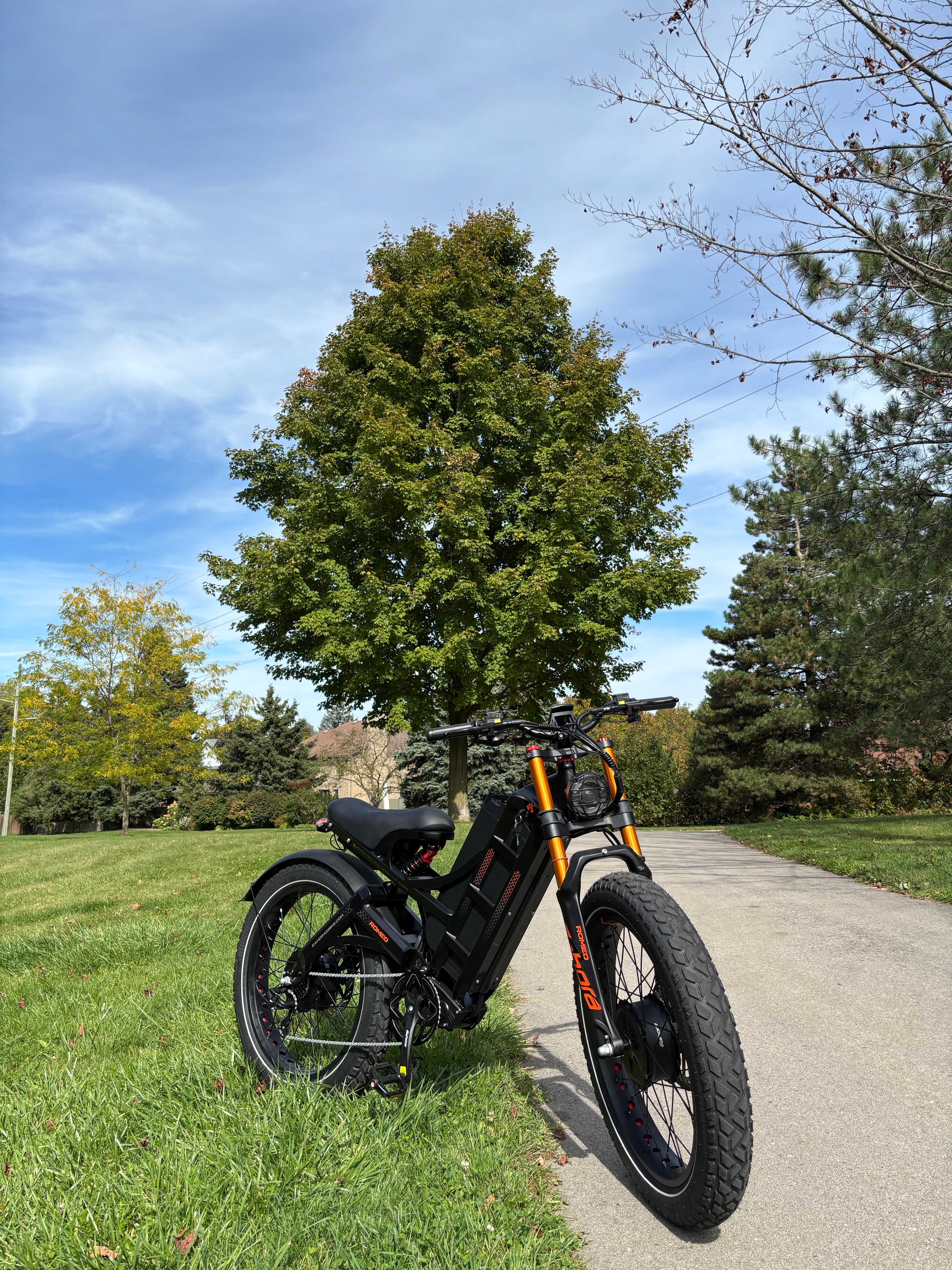
$5,599 CADThis is the one that doesn't blink when you walk up to it. Two motors with a 6,000W combined peak. 4,800 watt-hours of battery. A 500 lb payload on Eahora's own page. The Romeo Ultra II is a dual-motor flagship built to move serious weight over serious distance — full air suspension front and rear, fat 26×4.0" Innova tires, and enough reserve in the pack that range anxiety stops being part of your ride. It's unapologetically a big, powerful machine for private land and off-road riding, and at this capacity and battery size, nothing else in the guide touches its outright reach. Eahora factory-limits it to 500W continuous and 32 km/h and says the higher peak is for private use; we treat it as an off-road machine.
Buy this if
You want the most capacity and the biggest battery in this guide and you ride private land or off-road, where its dual-motor power is an asset. At 500 lb of payload you have headroom to spare even near the top of the weight range.
Skip this if
You need a 500W bike for the road, or you don't need the full 500 lb and 4,800 Wh. The Flash AWD carries 440 lb for $2,700, and the Discover M carries 440 lb on a 500W motor.

2. Eunorau Flash AWD
$2,700 CADFour hundred and forty pounds of payload, all-wheel drive, and a UL safety listing — for under $2,900. The Flash AWD splits 184 Nm of torque across two 750W motors, so both wheels drive at once: the setup that kills wheel-spin on gravel, sand and packed snow under a heavier rider. Its battery starts at 832 Wh and is expandable when you want more range. The honest trade-off is suspension — front fork only, no rear shock — so it's happiest on smoother off-road surfaces than the full-suspension picks. But for AWD traction, real capacity and a certified battery at this price, it's a lot of bike.

3. Velotric Summit 2
$3,399 CADThe lightweight all-rounder of the heavy bunch. The Summit 2 carries a 440 lb payload with the full UL 2849 / 2271 / 2580 safety stack and a SensorSwap system that toggles between torque and cadence from the display — so it reads your effort like a premium bike when you want it to. An 801 Wh LG battery and a redesigned 750W hub (1,300W peak, 100 Nm) make it nimble and efficient rather than brute-force. It's a hybrid hardtail, so it's lighter and quicker-rolling than the fat full-suspension picks — the smart choice for a heavier rider who wants a clean, certified, do-it-all bike rather than maximum power. It runs above 500W, so it's an off-road machine; for the 500W version of this idea, see the Discover M.
The Romeo Ultra II tops the table at 500 lb, with the most battery here. At 440 lb, the Flash AWD adds AWD traction and a UL listing, while the Summit 2 is the light, fully-UL-certified all-rounder. The two 440 lb bikes leave 50 lb of headroom for a rider up to about 390 lb, loaded.
The 400 lb core — fat, AWD, ready for anything

4. Eahora Juliet Pro II
$4,099 CADAll-wheel drive, full suspension, a 60V 70Ah battery and a step-through frame. The Juliet Pro II is the do-everything Eahora: dual 2,200W motors for AWD traction, 4-piston hydraulic brakes, and an easy-mount frame. Eahora's own pages disagree on two numbers: the US page rates it to 400 lb with 4,200 Wh, the Canadian page to 330 lb (150 kg) with 3,640 Wh. Plan on 330 lb until Eahora settles it. At dual 2,200W it's an off-road and private-property machine, and for a heavier rider who wants AWD, range and accessibility in one bike, it's a complete package.

5. Freesky Cheetah MT-380
$2,699 CADWant AWD power and certified safety without paying flagship money? The Cheetah MT-380 is the value answer: 400 lb payload, 4,000W of all-wheel drive, a huge 2,880 Wh battery, and both UL 2849 and UL 2271 certification — the listings that matter most when a heavier rider draws sustained current — for $2,699. Downhill-style full suspension and 4-piston brakes keep it composed, and the compact 20" fat wheels make it stable and easy to handle. Honest trade-off: no torque sensor (Freesky lists a speed sensor). If you weighed UL certification heavily (you should) but didn't want to spend $4,000, this is the bike.

6. Freesky Ranger Plus M-540
$2,649 CADA step-thru AWD fat-tire bike, and a brute in disguise: 400 lb payload, 5,000W of peak all-wheel drive, 250 Nm of torque, a 1,440 Wh UL2271 battery — and an 18" step-through opening you can actually swing into. Full suspension and 4-piston brakes back up the power, and the 1,440 Wh pack is the bigger of the two Rangers'. It's the bike for a heavier rider who wants serious AWD muscle but can't (or won't) climb over a high crossbar. Honest trade-off: cadence sensor, not torque — and it's an off-road machine that tops out at 64 km/h (40 mph). For the price, the capability is hard to match.
Down to two or three and can't split them?
That's the right instinct — for a heavier rider, the gap between the right bike and a near-miss is years of component life. Tell us your weight, height, terrain and budget and we'll narrow it to one. Call 1-866-938-7580 or explore your financing options.
The value & fat-AWD tier — 375 to 400 lb

7. Eunorau FAT-AWD 3.0
$2,299 CADThe dialled-in fat-AWD pick. A 375 lb payload, dual-motor all-wheel drive and an expandable 720 Wh battery, set apart by a torque sensor, which reads how hard you push and feeds power in proportion. For a heavier rider that means a more natural, planted feel on every pedal stroke and better battery efficiency, which matters when weight is already eating your range. When you want a fat-tire AWD bike that feels premium underfoot rather than just powerful, this is the one. Read our torque vs cadence breakdown for why the sensor earns its keep.

8. Freesky Ranger Air M-540
$2,099 CADThe best bike-for-the-money in the guide, and proof you don't have to spend big to be taken seriously. For $2,099 you get a 400 lb payload, dual-motor all-wheel drive, full suspension front and rear (a 120 mm oil-sprung fork and a 180 mm coil shock), and UL 2849 + UL 2271 safety certification — on an 18" step-through frame you swing into instead of climb over, rated to fit riders all the way to 6'8". A 1,200 Wh battery and 4-piston brakes round it out. Honest trade-off: it's a cadence sensor, not torque, and it's an off-road machine. But pound-for-dollar — capacity, AWD, air suspension, certification and a tall-friendly step-thru — nothing here matches it. It's also the natural landing spot if you're replacing a failed budget or big-box eBike, including a stranded RadRover. Financing is there if you would rather pay monthly.
Buy the Ranger Air if
You want the most capacity, traction, suspension and certification per dollar — a UL-certified, fully suspended, all-wheel-drive 400 lb step-thru for $2,099 — and a frame that fits a tall rider. It's the value benchmark every other pick gets measured against.
Spend up if
You want the bigger 1,440 Wh battery and more power of the Ranger Plus M-540, a torque sensor (go FAT-AWD 3.0), or a 500W bike (go Discover M).

9. Eunorau FAT-HD 2.0 / Hunter X7
$3,299 CADWhen the terrain points steeply up, this is the pick. The Fat-HD runs a 1,000W Bafang mid-drive with 160 Nm of torque through the bike's gears — and that gearing is exactly why a mid-drive climbs a loaded grade better than a hub motor lugging at low speed: it keeps the motor in its sweet spot and resists overheating. Pair that with fat 26×4.0" tires and a 375 lb payload, and you've got a genuine backcountry and hunting machine for a heavier rider. Our mid-drive vs hub guide explains the climbing advantage in full.
Power & easy-mount — 330 lb

10. Eahora Romeo Pro II
$4,299 CAD240 Nm of torque, a 3,120 Wh battery, full suspension and 4-piston brakes on 203 mm rotors. The Romeo Pro II is built for the rider who wants raw dual-motor punch and long legs in one premium package. Its 330 lb payload suits riders up to roughly 280 lb who'd rather have overwhelming torque than maximum capacity — choose it over the Romeo Ultra II when peak climbing grunt matters more to you than the last 170 lb of payload. It's a fast, powerful off-road machine, well beyond the road limit, and on the right terrain it earns every dollar.

11. Eahora Juliet
$2,499 CADThe easiest two-wheeler here to live with. The Juliet pairs a low step-through frame with full suspension and a big 2,880 Wh battery, so mounting is effortless and range is generous — ideal for a heavier rider who wants comfort and simplicity over outright power. At $2,499 it's one of the lower-priced picks here, and the step-thru frame makes it a standout for riders managing knee, hip or back limitations.
12. Eahora Juliet Pro
$3,599 CADA huge 4,200 Wh battery on a frame you step through instead of swinging a leg over, for $3,599. Eahora rates the Juliet Pro to 330 lb (150 kg) on both its Canadian and US pages, so it belongs with the 330 lb bikes: a rider around 280 lb, loaded, keeps the 50 lb of headroom this guide asks for. Hydraulic brakes with 4-piston calipers on a 203 mm front rotor bring it down, and the low frame suits knees, hips and backs that no longer like a high crossbar. At 2,500W it's an off-road machine, not a road commuter.
2 500W Mid-Drives for Heavy Riders (32 km/h as Shipped)
Riding public roads, bike lanes and paths? Then you want a 500W-nominal mid-drive, inside the 500W / 32 km/h limits the provincial rules converge on. The Discover M ships at 32 km/h; the Urus's maker prints both 32 and 45 km/h; each can be set faster, and whether an adjustable cap qualifies is not settled. They prove you don't have to trade away capacity: the Velotric Discover M carries a full 440 lb. Mid-drives also climb beautifully under weight, because they push through the bike's gears rather than brute-forcing the wheel.
13. Velotric Discover M
$3,899 CADThis is the bike that ends the trade-off. A 440 lb payload, the full UL 2849 / 2271 / 2580 safety stack, and a 500W VeloCore mid-drive that ships at 32 km/h. Velotric's app has a Custom Mode up to 45 km/h (28 mph), and whether an adjustable cap qualifies is not settled, so ride public roads at the default. It runs Velotric's mid-drive with 100 Nm standard and a 130 Nm boost, a SensorSwap torque/cadence system, and an 801 Wh Samsung/LG battery. For a heavier rider who needs a 500W bike and serious capacity and certified safety, nothing else in this guide does all three. It's the one we point most road-going heavier riders to first.
Buy this if
You ride public roads and paths on a 500W bike, and you refuse to give up capacity or safety certification to do it. 440 lb, full UL, 32 km/h as shipped: at $3,899 it's the most complete 500W heavy-rider bike here.
Skip this if
You only ride private land and want maximum power — the off-road Flash AWD or Romeo Ultra II give you more motor for the money once the 500W limit is off the table.
14. Eunorau Urus 2.0
$5,700 CADThe premium 500W eMTB. The Urus 2.0 runs the respected Bafang M600 mid-drive at 500W nominal with 120 Nm, an 840 Wh Samsung battery, a torque sensor with two speed sensors, full suspension and a UL safety listing. Eunorau's own page prints two top speeds for it, 32 km/h in its spec table and 45 km/h in its description, and calls it a speed-limited, unlockable Class 3 bike; whether an adjustable cap qualifies is not settled. At $5,700 it's the most refined full-suspension 500W bike here, for the rider who wants genuine trail-bike quality.
If you ride public roads on a 500W bike and need capacity, the Velotric Discover M is the one to beat: 440 lb, full UL, 32 km/h as shipped, $3,899. The Urus 2.0 is the premium full-suspension eMTB. Both can be set above 32 km/h; whether an adjustable cap qualifies is not settled, so never ride a faster setting on a public road.
3 Trikes for Tall Riders & Maximum Stability
Three wheels change everything. A trike can't tip — so the balance problem that makes a two-wheeler feel precarious under a heavier rider simply disappears. That makes trikes the standout choice for taller riders, older riders, anyone with a mobility or balance concern, and anyone who wants to plant both feet and never worry about a low-speed wobble. All three below are 750W off-road machines, and all three are built around a tall, comfortable, supported riding position.

15. Addmotor Grandtan II 750W
$3,399 CADThe highest-payload trike in this guide, and a superb fit for a tall, heavier rider. The Grandtan II carries a 450 lb payload (Addmotor splits it as 350 lb rider plus 100 lb cargo), fits riders from 5'2" to 6'4", and seats you on a well-padded saddle with a backrest — so longer rides stay comfortable and your back stays supported. A 750W rear motor with a torque sensor and a 960 Wh Samsung battery pull fat 24"/20" tires over gravel and trail, and three-wheel braking (180 mm front plus dual rear rotors) hauls the whole thing down. Honest note: it uses Tektro mechanical discs rather than hydraulic, and at 750W it's an off-road trike. For stability, comfort and a tall-friendly fit at 450 lb, it's the one.

16. Meigi Blazer 750W
$3,299 CADThe value trike — and a genuinely tall-friendly one, with a saddle that adjusts from 32" all the way to 38", so taller riders get a real leg extension instead of a cramped crouch. A 750W front-hub motor, a 768 Wh battery and 24" wheels keep it simple and stable, and two features punch above the price: a reverse gear (a genuine help when you're parking or backing a heavier trike out of a garage) and a differential axle that lets the rear wheels turn at different speeds for smoother cornering. Honest notes: front-hub motor, cadence sensor and mechanical brakes — but at $3,299 it's the lowest-priced trike in this guide.

17. Addmotor Arisetan II M-360
$4,199 CADThe most comfortable seat in the guide, and the best fit for the tallest riders. The Arisetan II is a semi-recumbent trike — you sit back into a supportive, chair-like seat with your legs out front, which takes pressure off your lower back and wrists and fits riders from 5'7" all the way to 6'6". A 750W rear-drive motor with a torque sensor and a 960 Wh Samsung battery do the work, on stable 20×4" fat tires. Addmotor rates it to 280 lb of rider plus 100 lb of cargo. It's a premium piece at $4,199, and it uses mechanical brakes, but for a tall rider — or anyone who wants to ride for hours without back strain, on a platform that can't tip — there's nothing else like it.
For the most capacity and a tall fit, the Grandtan II carries 450 lb to 6'4". For the best value on three wheels, the Meigi Blazer adjusts to a 38" saddle and adds reverse gear for $3,299. For all-day back support at the tallest fit, the semi-recumbent Arisetan II seats riders to 6'6". All three are off-road at 750W.
The Heavy-Rider Fit Protocol: 6 Specs That Actually Matter
When you weigh more than the industry plans for, the spec sheet reads differently. These are the six numbers to check before anything else — drawn from the failures heavier riders actually report, not a marketing checklist.
1. Payload capacity — the first filter
Payload is the total weight the bike is rated to carry: you, your clothing, your pack and any cargo. Check it before motor, range or price — if it doesn't clear your loaded weight with headroom, nothing else matters. The rule heavier riders pass around: buy at least 50 lb above your all-up weight. A 300 lb rider with a 15 lb pack belongs on a 365 lb-or-higher bike, not a 300.
2. Wheels and spokes — the part that fails first
The most common heavy-rider failure isn't the frame — it's the wheel. Spokes rarely snap from raw overload; they fatigue from movement in the spoke hole under repeated load cycles, and a flexy rim shortens both spoke and rim life. Motor torque only adds load the wheel was never specced for. A bike rated for your weight ships on a wheelset built to match — which is exactly what a bargain bike skips, and exactly why the RadRover earned its reputation for broken spokes.
3. Tire width and stability — 4.0", or three wheels
Fat tires (4.0" or wider) spread your weight over a larger volume of air, so you run a comfortable pressure without pinch-flatting, and gain grip and stability. For most riders over 250 lb, fat tires solve the two most common complaints — flats and comfort — at once. And if balance is a concern, a trike removes it entirely: three wheels can't tip.
4. Motor torque — Nm moves weight, not watts
Wattage gets the headlines, but torque carries a heavier rider up a hill. Target at least 90 Nm, and more if you ride hills regularly. For the steepest sustained climbs, a mid-drive — like the Fat-HD's 160 Nm Bafang — uses the bike's gears for mechanical advantage and resists overheating better than a hub motor lugging up a grade.
5. Battery capacity — size up for the weight penalty
A heavier rider draws more current, so real range runs 15–30% below the quoted figure, and Canadian cold takes another 20–40% on top. Start at 720 Wh minimum and go bigger if you ride far — the Romeo Ultra II (4,800 Wh) and Juliet Pro (4,200 Wh) carry the largest reserves here, and the Fat-AWD bikes take an optional second battery to roughly 1,440 Wh.
6. Brakes — hydraulic discs, big front rotor
More weight means more energy to shed every time you stop, and small rotors fade. Hydraulic discs are ideal; a big front rotor, like the 240 mm on the Romeo Ultra II or the 203 mm on the Juliet Pro and Romeo Pro II, gives the heat capacity a small rotor can't. The trikes use mechanical discs across three wheels, which spreads the braking load; on a two-wheeler, avoid mechanical discs or rim brakes over about 220 lb.
Payload at least 50 lb over your loaded weight → a payload-matched wheelset and fat tires (or a trike) → 90+ Nm of torque → 720 Wh+ battery → strong braking with a big front rotor → a frame or saddle that fits your height. Nail those and a bike will carry a heavier rider safely for years.
What Happens If You Exceed an eBike's Weight Limit?
Riding over the rated payload doesn't fail all at once — it fails slowly, then suddenly. The constant overload stresses the frame, wheels and brakes past their design, and the damage often builds invisibly first. In practice that means broken spokes and wheels going out of true, then accelerated brake wear, and over months, fatigue cracks at frame welds. It's a safety issue, not just a durability one.
The second cost is the warranty. Most manufacturers specifically exclude damage from exceeding the stated payload — frame cracks, wheel and spoke failures, and brake problems are the exact parts that get denied. A rider at 290 lb on a 275 lb-rated bike has quietly voided coverage on the components most likely to fail, from the first ride. That's why the "buy 50 lb of headroom" rule isn't caution for its own sake — it's what keeps both the bike and the warranty intact.
"I'm 290 lb and the bike I like is rated 275 — will it be fine?" Honestly: maybe for a while, but you're spending the wheel's fatigue life early and you've voided the warranty on it. The fix costs nothing extra here — there are bikes in this guide rated 375, 400, 440, 450 and 500 lb. Buy the headroom.
Road vs Off-Road Rules in Canada, Explained
Here's the question no U.S. "best heavy-rider eBike" list answers: most bikes that carry a heavier rider well run above the 500W limit Canada's provinces converge on. The provincial rules converge on a power-assisted bicycle with a motor of 500W nominal or less, assistance that ends at 32 km/h (Nova Scotia's 30 km/h ended on 19 October 2026), and working pedals; there is no federal e-bike definition any more (it was repealed in 2021). It's a power-and-speed standard — not the U.S. "Class 1/2/3" system, which doesn't define legality here.
That's why this guide is built in groups. The two mid-drives — Velotric Discover M and Eunorau Urus 2.0 — are 500W. The Discover M ships at 32 km/h and the Urus's maker prints both 32 and 45 km/h; each can be set faster, and whether an adjustable cap qualifies is not settled. The twelve heavy-duty picks and all three trikes exceed 500W, which makes them off-road and private-property machines — legal to own and ride on private land, not on public roads. Provincial and municipal enforcement varies, so check your own jurisdiction. Our complete Canadian eBike laws guide walks through every province.
Need to ride public roads? Choose the Discover M (440 lb) or Urus 2.0 (300 lb). Ride only private land or trails? The full heavy-duty and trike lineup opens up. Not sure which side of the line you're on? Call 1-866-938-7580 and we'll sort it with you before you buy.
Canadian Winter Range for Heavier Riders
Winter hits a heavier rider twice. You already give up 15–30% of range to your weight; then cold takes another 20–40% as the battery loses usable capacity below −10°C. The two stack, which is why a bike advertised at 120 km can realistically deliver 55–80 km for a 300 lb rider at −15°C. None of that is a reason not to ride a Canadian winter — it's a reason to plan for it:
- Store and charge the battery indoors and install it just before riding — a warm pack delivers far more of its capacity, recovering much of the cold-weather loss.
- Run lower tire pressure — drop fat tires to roughly 8–12 PSI for a bigger contact patch on snow and ice.
- Favour all-wheel drive or three wheels — the AWD picks (Flash AWD, Cheetah, Ranger Plus, Ranger Air, Fat-AWD 3.0) drive both wheels, and a trike's three wheels add winter stability on slick ground.
- Start with more battery — the biggest reserves here (Romeo Ultra II 4,800 Wh, Juliet Pro 4,200 Wh) give the most cold-weather cushion.
- Check brakes more often — salt and grit accelerate pad wear, and heavier riders already wear pads faster.
For the full cold-weather playbook, see our winter eBike guide and battery guide.
How to Choose Your Pick
The whole decision in one line: pick the bike whose verified payload clears your loaded weight by at least 50 lb, then sort by your priority. Most capacity (500 lb) is the Romeo Ultra II; best value is the $2,099 Freesky Ranger Air M-540; for the road, the 500W Velotric Discover M (440 lb); tall riders want a trike. The full shortlist:
- Most capacity (450–500 lb / cargo): Romeo Ultra II (500 lb), or the Grandtan II trike (450 lb, 350 of it rider).
- Best value: Freesky Ranger Air M-540 ($2,099, 400 lb, AWD, UL).
- 500W for the road: Velotric Discover M (440 lb, UL, 32 km/h as shipped) — or the Urus 2.0.
- Tall rider: the Arisetan II (to 6'6") or Grandtan II (to 6'4").
- Balance or mobility concern: any of the three trikes — three wheels can't tip.
- Easy mounting: Flash AWD or Discover M (440 step-thru), Ranger Plus or Ranger Air (400 step-thru), Juliet Pro or Juliet (330), or the trikes.
- Hills: Fat-HD (160 Nm mid-drive) or Romeo Pro II (240 Nm).
- Winter traction: any AWD pick or a trike.
One note specific to bigger riders: big-and-tall is not the same as heavy. Payload covers your weight; frame size, standover and saddle range cover your height. If you're both tall and heavy, favour a trike or a frame with a verified rider-height range — and tell us your height as well as your weight, and we'll factor in both.
Warranty, Returns & Real Canadian Support
For a heavier rider, who stands behind the bike matters more than for anyone — because payload-related wear is exactly where an absent or overseas warranty leaves you stranded, as the riders whose brand vanished at the end of 2025 learned. Every bike in this guide ships from Canada through Zeus with the same backing:
- Free Canada-wide shipping on every bike, with tracking once it leaves.
- A 15-day return window for unused, unopened bikes (15% restocking fee), so sort out fit and sizing with us before you open the box.
- Warranty handled in Canada — manufacturer terms on every bike, not a parts claim routed overseas.
- Real people on the phone at 1-866-938-7580 who will tell you honestly whether a bike has the headroom for your weight and the right fit for your height — or talk you out of one that doesn't.
That last point is the one we mean most. Call us, give us your numbers, and if a bike on this list isn't right for your weight, height, terrain or the law where you ride, we'll say so. Financing is available across the lineup if you'd rather spread the cost.
Frequently Asked Questions
Can a 400 lb or 500 lb person ride an electric bike in Canada?
Yes, on the right rating. The Eahora Romeo Ultra II is rated to 500 lb (227 kg) on Eahora's own page, the highest in this guide; the Addmotor Grandtan II trike to 450 lb (350 lb rider plus 100 lb cargo); the Eunorau Flash AWD, Velotric Summit 2 and Velotric Discover M to 440 lb. Choose a bike rated at least 50 lb above your fully loaded weight.
What is the highest weight capacity eBike at Zeus?
Of the bikes in this guide, the Eahora Romeo Ultra II has the highest maker rating: 500 lb (227 kg) on Eahora's own page, with a 4,800 Wh battery, for $5,599 CAD. Among trikes, the Addmotor Grandtan II is rated to 450 lb, 350 lb of it rider.
What is the best road-legal eBike for a heavy rider in Canada?
The Velotric Discover M. It pairs a 440 lb payload with a 500W-nominal mid-drive that ships at 32 km/h, plus UL 2849, UL 2271 and UL 2580 certification, for $3,899 CAD. Velotric's app can raise it to 45 km/h, and whether an adjustable cap qualifies is not settled. The Eunorau Urus 2.0 (300 lb) is the other 500W mid-drive in this guide.
What is the best eBike or trike for a tall heavy rider in Canada?
For a tall rider, fit matters as much as payload. The Addmotor Arisetan II M-360 semi-recumbent trike fits riders to 6'6" with full back support; the Addmotor Grandtan II trike fits to 6'4" at a 450 lb payload (350 lb rider plus 100 lb cargo). A trike also adds three-wheel stability that cannot tip.
Are electric trikes good for heavy riders?
Yes. Three wheels cannot tip, so a trike removes the balance problem entirely — valuable for heavier, taller, older or mobility-limited riders. The Addmotor Grandtan II is rated to 450 lb, the Meigi Blazer to 330 lb with reverse gear, and the Addmotor Arisetan II is a semi-recumbent with a back-supported seat. All three are 750W off-road machines.
What happens if you exceed an eBike's weight limit?
Exceeding the rated payload overstresses the frame, wheels and brakes. The usual results are broken spokes and wheels going out of true, pinch flats, faster brake wear, and over time fatigue cracks at frame welds. The damage often builds invisibly before anything fails, so it's a safety issue, not just a wear issue.
Does the eBike weight limit include cargo or just the rider?
It includes everything. Payload is the total combined weight the bike is rated to carry — rider plus clothing, plus pack, lock, tools and any cargo. A 400 lb payload with a 20 lb load leaves 380 lb for the rider.
Do heavier riders need fat tires?
For most riders over about 250 lb, yes. Fat tires (4.0" or wider) carry your weight on a larger volume of air at a comfortable pressure, which ends pinch flats and adds grip and stability. Most picks in this guide run 26×4.0" or 20×4.0" fat tires for exactly this reason.
Hub motor or mid-drive motor for a heavy rider?
On flat and rolling terrain a strong fat-tire hub or dual-motor setup works well and costs less. For steep, sustained climbs at higher weight, a mid-drive uses the bike's gears for mechanical advantage and resists overheating. The deciding factor is torque and gearing, not the motor type alone.
How much torque do I need to climb hills at 300 lb?
Torque (Nm), not watts, moves weight uphill. For a rider around 300 lb, target at least 90 Nm. The picks here range from 90 Nm to 250 Nm (Freesky Ranger Plus M-540, 2 × 125 Nm), with the Eunorau Fat-HD mid-drive at 160 Nm for steady climbing.
Do heavier riders get less range, and what battery size do they need?
Yes. A heavier rider draws more current, so real range typically runs 15–30% below the figure quoted for a light test rider. Size up: the Eahora Romeo Ultra II (4,800 Wh) and Juliet Pro (4,200 Wh) carry the largest reserves here, and the Eunorau Fat-AWD bikes take an optional second battery to roughly 1,440 Wh.
How does Canadian winter affect range for heavier riders?
Cold compounds the weight penalty. Lithium batteries lose roughly 20–40% of usable capacity below −10°C, on top of the 15–30% a heavier rider already gives up. Store the battery indoors and install it just before riding to recover much of that loss.
What is the best step-through eBike for heavier riders?
For capacity on a step-thru frame, the Eunorau Flash AWD (440 lb, $2,700) and the 500W Velotric Discover M (440 lb, $3,899) lead, and the Freesky Ranger Air M-540 carries 400 lb for $2,099. The Eahora Juliet Pro and Juliet (330 lb each) carry 4,200 Wh and 2,880 Wh batteries.
Are these eBikes road-legal in Canada?
Two are 500W-nominal mid-drives: the Velotric Discover M ships at 32 km/h, and Eunorau prints both 32 and 45 km/h for the Urus 2.0. The provincial rules converge on 500W, 32 km/h and working pedals; each of the two can be set faster, and whether an adjustable cap qualifies is not settled. The other picks, including all three trikes, exceed 500W, so they are for private property and off-road use.
What is the best-value heavy-rider eBike in Canada?
The Freesky Ranger Air M-540 at $2,099 CAD: a 400 lb payload, dual-motor all-wheel drive, full suspension (a 120 mm oil-sprung fork and a 180 mm coil rear shock), 26×4" fat tires, a step-through frame that fits riders to 6'8", and UL 2849 + UL 2271 certification. It's the value benchmark of this guide and a natural upgrade from a failed budget or big-box eBike.
Where can I buy a heavy-rider eBike in Canada with real warranty support?
Zeus eBikes ships every bike in this guide from Canada with free Canada-wide shipping, a 15-day return window for unused, unopened bikes (15% restocking fee), and Canadian phone support at 1-866-938-7580. That matters most for heavier riders, because payload-related wear is exactly where an absent or overseas warranty leaves you stranded.
The Bottom Line
If you weigh more than the industry plans for, stop settling for bikes rated 220–275 lb and start with the one number that matters: a verified payload with real headroom above your loaded weight. Every bike here clears that bar. For the most capacity, the Eahora Romeo Ultra II carries a full 500 lb. For the best value, the Freesky Ranger Air M-540 delivers 400 lb, AWD and full UL certification for $2,099. For a 500W bike, the Velotric Discover M gives you 440 lb, full UL and 32 km/h as shipped. And if you're tall or want a bike that can't tip, the Addmotor Grandtan II trike carries 450 lb (350 of it rider) and fits a 6'4" rider.
You don't have to decide blind. Every bike ships from Canada with free shipping, and an unused, unopened bike can be returned within 15 days of delivery (15% restocking fee) — so talk the fit through before the box is opened: a real person at 1-866-938-7580 will tell you honestly which one has the headroom for your weight, height, terrain and the law where you ride. You were never the problem. Let's get you on the bike that proves it.
Ready to ride a bike that was actually built for your weight?
Browse the full high-payload lineup, step-through collection and electric trikes — every bike ships free across Canada, backed by Canadian warranty support and a 15-day return window for unused, unopened bikes (15% restocking fee). Or call 1-866-938-7580 and we'll match your weight, height and terrain to the right one.
This guide was written by Milad Ghobadibeygvand, BScN (Western University, 2014), Co-founder of Zeus eBikes Canada — a Canadian direct-to-consumer electric bike retailer shipping across Canada since 2022. Every payload figure was re-checked against the maker's own page on 28 September 2026; Meigi's page states none for the Blazer, so that one comes from our listing.
Visuals created by Playcut.ai




Share:
Tesway X5 AWD in Canada | Complete Overview & Buyer Guide
Himiway C5 Review Canada (2026): The S-Class of 20-Inch Fat Tire eBikes