
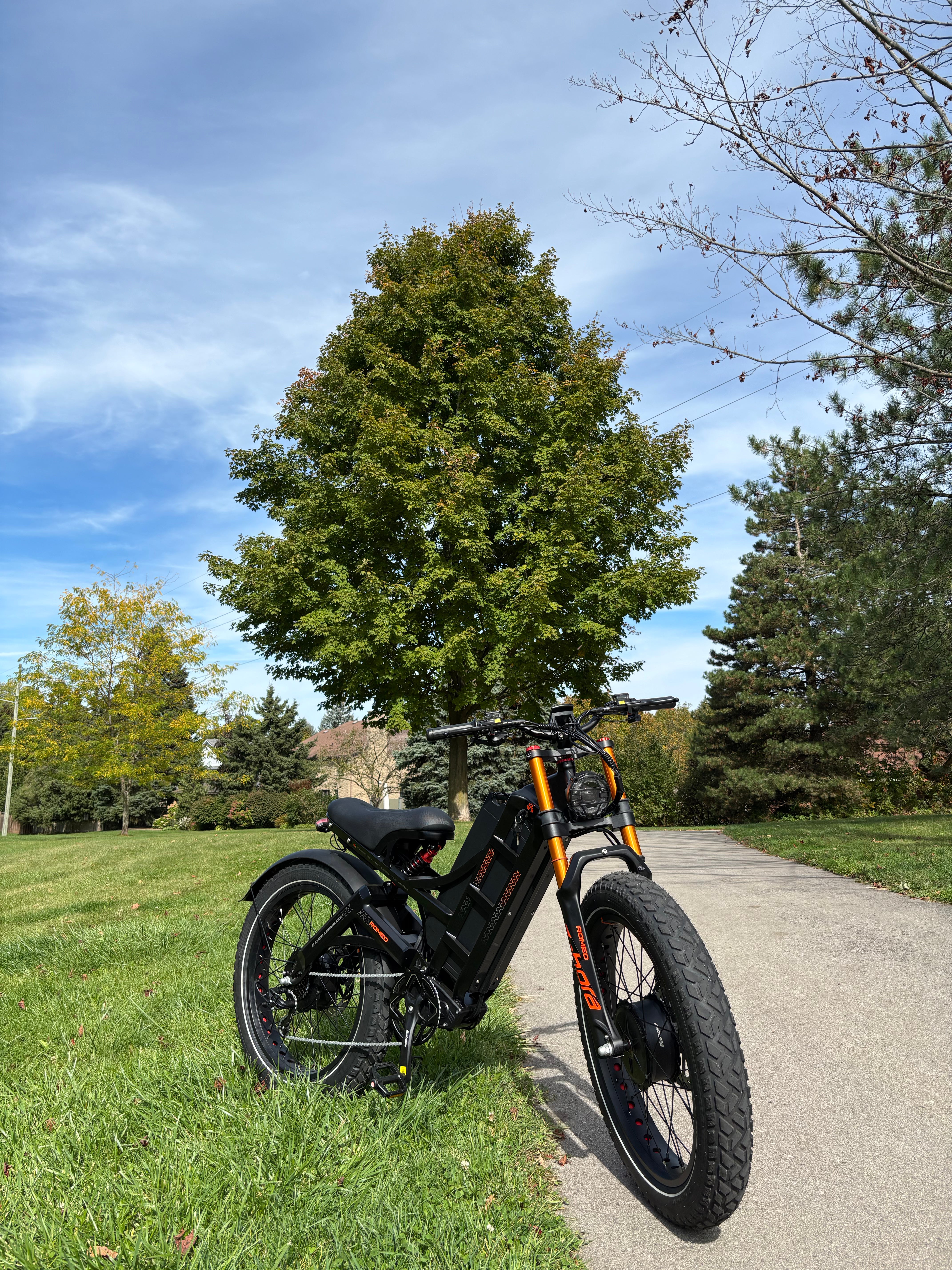
Smartravel Raptor ST202 Pro Review Canada (2026): Two Motors, 2,600 Wh, Real-World Range Computed and Tested in Snow

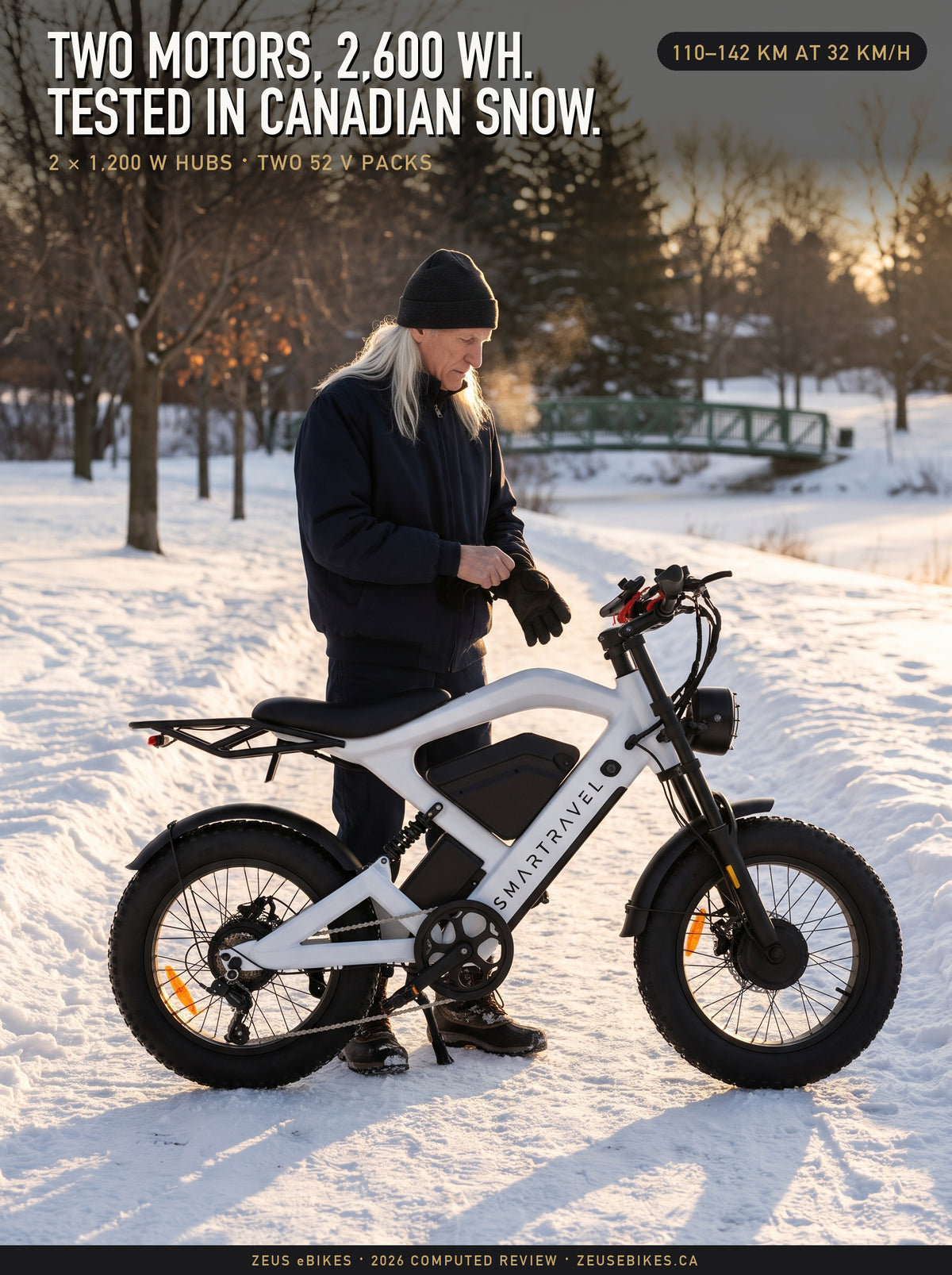
Zeus with the Raptor ST202 Pro on a snowy park path: a Playcut.ai rendering made from Smartravel's own photograph of the bike, so an illustration of it. Our real test rides are in the two videos below. The 110–142 km is the range section's real-day figure for 32 km/h with an 80 kg rider.
We rode the Raptor ST202 Pro through layered snow in a Kitchener park and up an icy hill, on camera, and then did the part most reviews skip: we computed how far it goes, at your speed, weight and temperature, and checked the model against a measured ride. Every specification here is Smartravel's, read on 25 October 2026; every store term is Zeus's, read the same day; every range and fit figure is printed with its conditions.
Every specification comes from Smartravel's Raptor ST202 Pro page, its warranty policy, its app instructions and its owner's manual, read on 25 October 2026. Our own riding is in two videos filmed in Canadian snow. The range tables come from a physics model built on Smartravel's motor, battery, weight and tire figures, imported unchanged from the Raptor ST202 Pro review by our sister store Redtail, set to Canadian speeds, loads and temperatures, and checked against a 75.6 km measured ride and a reported 22% climb.
The fit tables place Smartravel's published seat height and its own side photograph against 6,068 measured bodies; the law table quotes each province's statute or regulator page, read today. Price, payment terms and store policies come from our listing and policy pages on 25 October 2026. Zeus sells this bike; read the red flags as carefully as the green. Written by Milad Ghobadibeygvand, BScN (Western University, 2014); corrections to milad@zeusebikes.ca.
Watch: The Raptor ST202 Pro in Kitchener Snow
Our ride through layered snow in a Kitchener, Ontario park: both motors pulling, one of the two packs in use, and the one-motor switch at 8:53.
Zeus Ebikes, published 14 January 2026 (10:31). Watch on YouTube.
Watch: Two Motors on a Steep Snowy Hill
Our winter test footage, filmed in Canada for our US sister store Redtail: a steep hill, layered snow and ice underneath, on one charged pack.
Redtail Electric Bikes USA, published 2 October 2026 (3:30). Watch on YouTube.
In this review
- Who the Raptor ST202 Pro is for
- What our two winter rides showed
- Smartravel's specification
- Two 1,200 W hubs, one switch
- Two packs, 2,600 Wh, and charging
- Suspension, brakes, tires, lights and the GPS tracker
- The Pro against three bikes at Zeus
- How far it goes on one charge, computed and checked
- What the 350 lb limit covers
- Will it fit you? Computed from your height
- What the law calls it, province by province
- Where the figures disagree
- Recall record
- Is it UL certified?
- Warranty, Zeus Care and who handles a claim
- Buying it from Zeus
- The honest ledger
- Who should buy it
- Before you buy: the checklist
- Limitations of this review
- The source register
- Frequently asked questions
- The bottom line
Who the Raptor ST202 Pro is for
Snow season is starting, and a Canadian shopping for a two-motor e-bike in late October wants to know three things: how far it really goes, whether it handles snow, and where it may legally be ridden. Pick wrong and $2,599 buys a 56 kg machine that runs short of your trips or has nowhere to go.
This review answers all three with numbers and our own footage.
Smartravel builds the Pro as the upgraded Raptor: "dual batteries and dual electric drive systems", in its own words, on 20 × 4.0 fat tires with a long moped-style bench, hydraulic disc brakes, full suspension and a GPS tracker you control from your phone. Read the specification that way: a heavy, powerful machine for private land, farm and cottage tracks, winter trails and long rides where the rules allow a 2,400 W bike.

| If you want | The Raptor ST202 Pro | The number behind it |
|---|---|---|
| Range for long days | Yes, the most battery in the box among the bikes compared here | 110–142 km real-day at 32 km/h, 142–183 km at 25 km/h (range section) |
| To climb and pull through snow | Yes, with both motors | Holds 26.9 km/h on a 22% grade in our model; a reviewer reported about 26 km/h near the top |
| Theft protection built in | Yes, a GPS tracker with remote power-off | One month of GPS service free, then a paid plan (Smartravel's app guide) |
| A road commute | No: outside every provincial e-bike rule | 2 × 1,200 W and 35 mph against rules that stop at 500 W and 32 km/h (law section) |
| A light bike | No | 56.2 kg (123.7 lb) per Smartravel |
| To pedal for exercise | Poorly | The fixed 84 cm bench sits 13.8 cm below the textbook pedalling height for a 173 cm rider (fit section) |
Figures from the range, fit and law sections of this review and Smartravel's specification, read 25 October 2026.
Three colours, one price
Green, Silver Grey or Alpine White, $2,599 each (was $2,799) with free shipping across Canada. Read the fit section before you order: the bench does not adjust.
What our two winter rides showed
Our rides answer the questions a spec sheet cannot: does the second motor matter in snow, and how far does one pack go when it is cold? In Kitchener, at −2 to −3 °C, the rider covered 20 miles (32 km) on one pack, partly through layered snow, with both motors on, and the pack was still going.
On an icy slope the tires gave up before the motors did.
Here is what the footage and the narration show, with the time in our Kitchener video or the snowy-hill video so you can check each one.
| What we saw | Where it is | What it tells you |
|---|---|---|
| "we're in Kitchener" and "it's only -2 or three here today" | Kitchener video, 3:34 and 1:01 | A real Canadian winter ride, in a city park with cleared paths and deep snow |
| "we're using just one battery. We're not using both batteries yet. And I've done 20 miles in this." | Kitchener video, 0:54 | The bike runs on one pack alone; one pack carried 32 km of mixed riding |
| "I got both motors engaged" and "it's only it's only lost one bar with one battery" | Kitchener video, 2:34 to 2:42 | A floor for cold range, read from the gauge by the rider (the display is not legible in the 360° footage) |
| "They're the same capacity, 25 amps." | Kitchener video, 2:44 | Each pack is 52 V 25 Ah, 1,300 Wh, which matches the 2,600 Wh total |
| "put one motor on only. Let's try it that way." | Kitchener video, 8:53 | There is a one-motor setting, switched on the bike |
| "Top speed I got on it today was 31 mph untouched." | Snowy-hill video, 0:20 | About 50 km/h on that day, in winter conditions |
| "have no traction, guys. See, it's ice underneath." | Snowy-hill video, 1:59 to 2:01 | On ice, grip runs out before power does |
Quotations from the auto-generated captions of our two videos, saved 25 October 2026; every time stamp is the caption line's.
The cold-range floor is worth a second look. One pack is 1,300 Wh. On level pavement at −2.5 °C our model gives one pack 97 km at a steady 20 km/h and 82 km at 25 km/h. Riding deep snow costs far more energy than pavement, and the model does not price snow, so the Kitchener ride cannot be turned into a consumption figure. What it does show is that one pack, in the cold, gave 32 km of hard winter riding and kept going.
Smartravel's specification
Smartravel's Raptor ST202 Pro page prints the full specification in a Spec&Size tab, and we read it on 25 October 2026. The table copies the figures that matter to a buyer from that page. Where another document or listing prints something else, both figures are in the section on where the figures disagree, and the review follows this page.
| Specification | Smartravel prints |
|---|---|
| Motors | Hub front 1200W: 86Nm torque, 1200W (continuous), 1500W (peak); hub rear 1200W: 86Nm torque, 1200W (sustained), 1500W (peak) |
| Headline power and torque | 3000W Peak Motor; 150 N·m torque (feature copy) |
| Top speed | 35 MPH Top Speed (about 56 km/h) |
| Battery | 52V 50Ah (2600Wh); What's In The Box: 2 battery |
| Charger | Fast Charger 58.8V-3A |
| Range | 80 Miles Max Range (spec strip); 80-100 Miles (FAQ); see the range section |
| Weight | 56.2 kg / 123.7 lbs |
| Weight limit | Maximum total weight limit (combined weight of rider and cargo) of 350 pounds (158.8kg) |
| Frame | Aluminum alloy; removable lithium-ion battery; rear rack and fenders included |
| Fork | Hydraulic front suspension fork |
| Brakes | Hydraulic disc brakes, front and rear |
| Tires | Unibody, puncture protection, 20″ × 4.0″ |
| Drivetrain | Shimano 7 speed |
| Display | Smart LCD Display with USB charger |
| Lights | LED, headlight and taillight; tail light and brake light |
| Seat height | The seat height is 33 inches (84 cm), from the FAQ |
| Vehicle size | 66.93″ × 27.56″ × 43.31″ (170 × 70 × 110 cm) |
| Assembly | our ST202 pro electric bike is 90% assembled (FAQ) |
| GPS and app | real-time positioning, geo-fencing, remote motor control, overspeed and displacement alarms, 7 days of ride history |
| Safety certification | Safety Certified in Accordance with UL 2849 (see the UL section) |
Smartravel's US store page for the Raptor ST202 Pro, Spec&Size tab, spec strip, feature copy and FAQ, read 25 October 2026. Metric conversions are ours.

Two 1,200 W hubs, one switch
The Pro drives both wheels with geared hub motors, each rated by Smartravel at 1,200 W continuous and 1,500 W peak with 86 N·m, so the pair is 2,400 W continuous and the 3,000 W on the spec strip is the two peaks added. Our range model holds each motor to that continuous rating.
The 150 N·m in Smartravel's feature copy is a figure for the pair; its spec table gives 86 N·m per motor. Smartravel calls the controller FOC, field-oriented control, which "acts as the motor's brain" in its own copy.
One motor or two. Our Kitchener rider switches to one motor at 8:53, and Bike Hombre timed both settings in his review at the highest assist level.
| From a standstill to | One motor | Both motors |
|---|---|---|
| 10 mph (16 km/h) | 3.8 s | 2.8 s |
| 15 mph (24 km/h) | 4.7 s | 3.5 s |
| 20 mph (32 km/h) | 5.88 s | 4.2 s |
| 25 mph (40 km/h) | 8.1 s | 5.8 s |
| 30 mph (48 km/h) | 17.7 s | 8.3 s |
Bike Hombre's timings, from his Raptor ST202 Pro review (24 May 2025), captions read 25 October 2026; the single-motor 0–20 mph time is captioned "5.8 8 seconds", printed here as 5.88.
Top speed matches the label. RunPlayBack reported reaching "about 36 mph" in his off-road test, Bike Hombre's speedometer read 35 and then 36 with both motors on, and he checked the bike's speedometer against the app at 14, 19, 25 and 31 mph, within 1 mph each time. On one motor our model's fastest steady speed on level pavement is 48.0 km/h; on two, 51.5 km/h.
The climbing check is the one that matters for the model. On a 22% grade with both motors, Bike Hombre called out his speed from the display as it fell from 26 mph to about 16 mph (26 km/h) near the top. For a rider of his 79 kg our model gives 26.9 km/h as the fastest steady speed on 22% at the motors' continuous rating, and one motor alone cannot hold that grade at any speed. A model that lands within a few percent of the speed a rider reported on a real climb is pricing the motors' power correctly.
| Grade | Fastest steady speed, both motors | One motor |
|---|---|---|
| 0% | 51.5 km/h | 48.0 km/h |
| 4% | 49.2 km/h | 38.7 km/h |
| 8% | 46.8 km/h | 29.5 km/h |
| 12% | 39.5 km/h | 22.9 km/h |
| 16% | 33.5 km/h | 18.4 km/h |
| 20% | 28.8 km/h | 15.2 km/h |
Our model, 80 kg rider with gear, throttle only, each motor held to its 1,200 W continuous rating. Traction and the rider's balance limit steep climbs before the motors do.
Two packs, 2,600 Wh, and charging
The Pro ships with two batteries in the box, 52 V and 25 Ah each, for 2,600 Wh (52 × 50 = 2,600), double the single-motor ST202's 1,296 Wh and the largest pack in the box among the dual-motor bikes compared here. Charging is slower than Smartravel's FAQ suggests, as the arithmetic below shows.
Smartravel lists "52V 50Ah (2600Wh)" and "2 battery" on its page, and Bike Hombre gives "each battery having capacity of 52 V and 25 Ah" in his range test. Our rider confirms the 25 Ah per pack in Kitchener. Smartravel's FAQ names LG as the cell maker and its battery copy says "Even after 800 charges, the battery retains 80% of its capacity"; its warranty policy says the batteries "are engineered to maintain up to 75% of their original capacity for up to 300 charging cycles", the warranty's own measure.
How the two packs share the load. Smartravel's pages do not say. Bike Hombre rode 75.6 km with both packs fitted, and his gauge fell from five bars to one; in both of our winter rides the rider ran on one pack with the other empty or held back. So the bike runs on one pack alone, and with both fitted the full 2,600 Wh is there for a long day.
| Charging figure | Where it comes from | Hours |
|---|---|---|
| "fully charged in only 5 hours" | Smartravel FAQ | 5 |
| "only takes 5-6 hours to be fully charged" | Smartravel FAQ | 5 to 6 |
| "3A/6-7 Hours Fast Charging" | Smartravel battery graphic | 6 to 7 |
| 25 Ah ÷ 3 A | Arithmetic on the 58.8 V 3 A charger, one empty pack | about 8.3 |
| 50 Ah ÷ 3 A | The same arithmetic, both packs | about 16.7 |
Smartravel's FAQ and battery graphic on its Pro page, read 25 October 2026. A charger slows near the top of a charge, so real times run at least as long as the arithmetic.
The arithmetic is simple: a 3 A charger puts back 3 amp-hours an hour at most, so a 25 Ah pack needs at least 8.3 hours from empty. Plan on a night per empty pack, and on two nights, or two chargers, for both. For cold-weather care, our e-bike battery guide covers storage and charging temperatures.
Suspension, brakes, tires, lights and the GPS tracker
The Pro's hardware is built for weight and speed: hydraulic disc brakes with 180 mm rotors, front and rear suspension, 20 × 4.0 puncture-protected fat tires, full lights with a brake light, and a GPS tracker. Of the bikes compared here, only the two Raptors carry the tracker, and it has a running cost after the first month.
Brakes. Smartravel lists hydraulic disc brakes front and rear. Bike Hombre measured stops from 10 mph in 5 ft, from 20 mph in 13.5 ft and from about 28 mph in 27 ft in his review, and describes 180 mm rotors front and rear; his method is not stated, so treat the distances as his. Smartravel's owner's manual says its brake levers have "a built-in safety switch that automatically cuts off the motor power under normal braking conditions", and RunPlayBack shows the cut-off working on a climb in his test.
Suspension and tires. Smartravel names a "Hydraulic front suspension fork" and a "Hydraulic Shock Absorber"; Bike Hombre describes a dual crown fork and dual rear shocks, and found the rear "on the stiffer side" at his 175 lb. The tires are 20 × 4.0 with puncture protection. Bike Hombre gives the drivetrain as a seven-speed Shimano Tourney with a 46-tooth chainring.
Lights, display and horn. An LED headlight, a tail light that doubles as a brake light, and a Smart LCD display with a USB charging port, per Smartravel; Bike Hombre adds turn signals and a horn.
The GPS tracker. Smartravel's page says the app lets you "Set geo-fencing to receive alerts if the bike exceeds a preset area. Control the motor remotely, activate alarms for overspeed or displacement, and view historical ride data up to 7 days." Its app instructions add the cost: "Smartravel offers a one-month free trial of its GPS service. After the trial period, you can purchase an GPS value-added service plan on a monthly, quarterly, or annual basis". The tracker binds to a SIM phone number in the app. No plan prices are printed; ask us and we will get them from Smartravel before you order.
a tracker tells you where the bike went and can cut its power; it does not stop a thief lifting 56 kg into a van. Lock it to something solid as well.
Our e-bike theft protection guide covers the other layers of protection.
The Pro against three bikes at Zeus
Three bikes at Zeus answer the questions a Pro buyer asks: do I need the second motor (the single-motor Raptor ST202), is there a lighter dual-motor bike (the Eunorau Flash AWD), and what does a pricier moped-style twin look like (the Eahora DL2000)? Each maker's own page was read on 25 October 2026, Zeus's prices on the 26th.
| Raptor ST202 Pro | Raptor ST202 | Eunorau Flash AWD | Eahora DL2000 | |
|---|---|---|---|---|
| Zeus price (CAD) | $2,599 | $1,999 | $2,700 | $3,799 |
| Motors (maker) | 2 hubs, 1,200 W continuous each, 1,500 W peak | 1 rear hub, 1,200 W sustained, 1,500 W peak | 2 × 750 W ("52V1500W Dual 750W Motor") | Canada page: 2 × 250 W; global page: dual 800 W |
| Battery as sold | 52 V 50 Ah, 2,600 Wh (2 packs) | 48 V 27 Ah, 1,296 Wh | 52 V 16 Ah, 832 Wh; second and third packs optional | 52 V 30 Ah, 1,560 Wh |
| Weight (maker) | 56.2 kg (123.7 lb) | 51.6 kg (113.9 lb) | 82–92 lbs | 164 lb |
| Load limit (maker) | 350 lb rider and cargo | 350 lb rider and cargo | 440 lbs total payload | ≤ 330 lbs |
| Top speed (maker) | 35 mph | 32 mph | 20 MPH; Class 3, speed-limited, unlockable | Canada page: 32 km/h; global: 28 mph |
| GPS tracker | Yes, app-controlled | Yes, app-controlled | Not listed | Not listed |
| Range at 25 km/h, 80 kg (our model) | 208 km | 111 km | Not modelled | Not modelled |
Makers' pages read 25 October 2026: Smartravel Raptor ST202 Pro, Smartravel Raptor ST202, Eunorau Flash AWD (Canada), Eahora DL2000 (Canada) and (global). Prices: Zeus listings the same day. The two range figures are steady pavement, both packs where the bike has two, to empty.
Pro or ST202? For $600 more, the Pro adds a front motor, a second pack and 4.6 kg (56.2 kg against 51.6, Smartravel's figures). In our model it uses about 7% more energy per kilometre at 25 km/h (12.5 Wh against 11.7), carries twice the energy, and so goes about 208 km to the ST202's 111. On an 8% grade at 16 km/h the ST202 draws 66.1 Wh per km on its single motor; its steepest steady grade at 16 km/h is about 20%, where the Pro's two motors are limited by grip first. If you ride flat roads and short trips, the ST202 does the job; if you ride hills, snow or long days, the Pro is the one.
Two motors or one?
The Raptor ST202 Pro is $2,599; the single-motor Raptor ST202 is $1,999. Call 1-866-938-7580 and tell us your terrain and your longest ride, and we will tell you which one you need.
How far it goes on one charge, computed and checked
For an 80 kg rider on level pavement at 25 °C, both packs take the Pro about 208 km at a steady 25 km/h and 161 km at 32 km/h. Real riding, with stops, gusts and speed changes, costs more: checked against a measured ride, plan on 142–183 km at 25 km/h and 110–142 km at 32 km/h.
Smartravel prints 80 to 100 miles with no speed, load or temperature attached. This section computes the range for your conditions in four steps: the physics of a steady ride, the correction a measured ride demands, the cold, and the reserve you keep. Every step is shown, and every input has its source in the inputs table.
| Steady speed, throttle, both motors | Wh per km | Steady, both packs to empty | Real day (measured-ride correction) | Real day, keeping 25% | One pack, steady |
|---|---|---|---|---|---|
| 20 km/h | 10.5 | 248 km | 169–218 km | 127–163 km | 124 km |
| 25 km/h | 12.5 | 208 km | 142–183 km | 107–137 km | 104 km |
| 32 km/h | 16.1 | 161 km | 110–142 km | 83–106 km | 81 km |
| 40 km/h | 21.5 | 121 km | 83–106 km | 62–80 km | 61 km |
| 45 km/h | 25.5 | 102 km | 70–89 km | 52–67 km | 51 km |
| 50 km/h | 30.2 | 86 km | 59–76 km | 44–57 km | 43 km |
80 kg rider with gear, 56.1 kg bike, level pavement, 25 °C, no wind, both motors, throttle only. Steady = the physics model; real day = steady ÷ 1.465 to ÷ 1.139, the gap a measured ride showed (subsection below); 25% kept back as a planning reserve. Rounded once.
The math, worked through for 25 km/h
Here is one ride, every step shown, so you can check the arithmetic or redo it for your own numbers. The road physics is Martin and colleagues' cycling-power model, which its authors validated against measured power on an open road.
| Step | What it is | Value |
|---|---|---|
| 1 | Speed: 25 km/h ÷ 3.6 | 6.944 m/s |
| 2 | Mass moving: 80 kg rider with gear + 56.1 kg bike (Smartravel's 123.7 lb) | 136.1 kg |
| 3 | Rolling: mass × 9.81 m/s² × rolling resistance 0.01054 × speed | 97.7 W |
| 4 | Air: ½ × air density 1.184 kg/m³ × drag area 0.64 m² × speed³ | 126.9 W |
| 5 | Power the wheels need: rolling + air | 224.6 W |
| 6 | Two hubs share it: wheels at 230 rpm, each motor 4.67 N·m on 6.08 A | 302.8 W drawn (74% efficient) |
| 7 | The packs' own losses: 97.05% efficient at this current | 312.0 W from the cells |
| 8 | Per kilometre: 312.0 W ÷ 25 km/h | 12.48 Wh per km |
| 9 | Range: 2,600 Wh ÷ 12.48 Wh per km | 208.3 km, steady, to empty |
| 10 | Real day: ÷ 1.465 to ÷ 1.139 (the measured-ride gap) | 142–183 km |
| 11 | Planning: keep 25% of the pack in hand (× 0.75) | 107–137 km |
Our range model's own worked example for this ride; each line comes from the model. Rolling resistance and drag area are measured values for fat tires and upright riders (inputs table).
Two things stand out. At 25 km/h the air already takes more power than the tires (126.9 W against 97.7 W), and air drag rises with the cube of speed, which is why the range falls from 208 km at 25 km/h to 121 km at 40. And the motors work at 74% efficiency here, below their 80% rated point, because cruising at 25 km/h is a light load for 2,400 W of motor.
From steady to real: the measured ride
A steady model is a best case. To find out how much a real ride costs on top, we priced one that was measured: Bike Hombre's Raptor ST202 Pro range test, ridden on the throttle with both motors until he switched to one for the last 11 km. His own figures, from the captions: "after 2 hours and 10 minutes, 46.95 miles, and 2,766 ft of elevation gain, I finished my ride with one bar still left", "an average speed of 21.6 mph and a max speed of 40.1 mph", and "I'm 175 lb".
| Value | |
|---|---|
| Distance, average and top speed | 75.6 km at 34.8 km/h average, 64.5 km/h top |
| Rider; climbing | 79 kg; 843 m up (and 766 m down) |
| Model, steady on the flat at the average speed | 17.8 Wh per km × 75.6 km = 1,344 Wh |
| Model, the climb | 311 Wh to lift rider and bike 843 m, 431–482 Wh from the packs |
| Model total | 1,775–1,825 Wh |
| What the ride used | 2,080–2,600 Wh, from one bar of five left |
| The gap | 13.9% to 46.5% more than the model |
| That riding, full pack to the last bar | 76–94 km |
Ride figures from Bike Hombre's captions (re-read 25 October 2026), converted to metric; model figures from our range model. The used-energy bracket reads the five-bar gauge as five equal fifths of both packs together, two assumptions: a bar gauge reads pack voltage, Smartravel prints no bar thresholds, and its pages do not say how the gauge reads two packs.
That gap, 13.9% to 46.5%, is the price of real riding: stops at lights and signs, bursts to 64.5 km/h, speed held above and below the average, and wind. We divide every steady figure by 1.465 and by 1.139 to get the real-day band. The band is wide because a five-bar gauge is coarse. A calmer ride than his, with fewer stops, should land at or above the top of the band; a faster, hillier or more stop-start one, at or below the bottom. A hard day like his, 34.8 km/h average with 843 m of climbing, runs 76–94 km on both packs.
Our long-range guide plans every bike with a rule of thumb, 30 Wh per km on a hard day and 15 on a good one, which puts the Pro at 87 to 173 km. This model and the measured ride land inside that band and narrow it for this bike: 76–94 km is the hard day, measured, and 142–183 km a moderate one at 25 km/h.
Does one motor save battery?
Hardly, on the flat, and it costs more on climbs. A second motor adds its own small losses at light loads, so on level pavement one motor uses slightly less; on a hill, one motor working hard runs less efficiently than two sharing the load. Bike Hombre reasoned in his range test that "the bike only uses half the battery power if you only have the single motor mode"; the physics says otherwise, because the energy to move the bike is the same either way.
| Ride | Both motors, Wh per km | One motor, Wh per km | One motor vs both |
|---|---|---|---|
| 25 km/h, 0% grade, throttle | 12.5 | 11.9 | -4.8% |
| 32 km/h, 0% grade, throttle | 16.1 | 15.8 | -2.1% |
| 35 km/h, 0% grade, throttle | 18.0 | 17.8 | -1.1% |
| 40 km/h, 0% grade, throttle | 21.5 | 21.6 | +0.5% |
| 25 km/h, 0% grade, easy pedalling | 9.0 | 8.1 | -10.1% |
| 16 km/h, 8% grade, throttle | 55.2 | 68.4 | +24.0% |
| 16 km/h, 12% grade, throttle | 85.7 | 114.1 | +33.1% |
Our model, 80 kg rider, level pavement unless a grade is given, 25 °C. Easy pedalling = 75 W from the rider.
What do hills cost?
Every 100 m of climbing at 16 km/h on the throttle costs about 51.3 to 64.2 Wh from the packs on 4 to 12% grades, against the 37.1 Wh it takes to lift 136.1 kg of rider and bike 100 m. So a day with 1,000 m of climbing needs about a fifth to a quarter of the 2,600 Wh just for the climbing.
| Grade at 16 km/h | Both motors, throttle | Both, easy pedalling | One motor, throttle | Range if the whole ride were this grade (both, throttle) |
|---|---|---|---|---|
| 2% | 18.9 Wh/km | 12.8 Wh/km | 19.7 Wh/km | 138 km |
| 4% | 29.7 Wh/km | 22.9 Wh/km | 33.4 Wh/km | 87 km |
| 6% | 41.8 Wh/km | 34.2 Wh/km | 49.6 Wh/km | 62 km |
| 8% | 55.2 Wh/km | 46.7 Wh/km | 68.4 Wh/km | 47 km |
| 10% | 69.8 Wh/km | 60.5 Wh/km | 89.9 Wh/km | 37 km |
| 12% | 85.7 Wh/km | 75.6 Wh/km | 114.1 Wh/km | 30 km |
| 15% | 112.1 Wh/km | 100.5 Wh/km | 156.2 Wh/km | 23 km |
| 20% | 163.3 Wh/km | 149.0 Wh/km | cannot hold 16 km/h | 16 km |
Our model, 80 kg rider, 25 °C, both packs. A ride is never all climbing: price the climbs with the per-100 m cost above, on top of a flat figure.
Does rider weight change the range?
Yes, more on climbs than on the flat. At 25 km/h on level pavement the range falls from 220 km with a 60 kg rider to 171 km at the 158.8 kg limit; on an 8% grade at 16 km/h it falls from 56 km to 27 km.
| Rider and cargo | 25 km/h, flat | 32 km/h, flat | 16 km/h, 8% grade |
|---|---|---|---|
| 60 kg (132 lb) | 220 km | 169 km | 56 km |
| 80 kg (176 lb) | 208 km | 161 km | 47 km |
| 100 kg (220 lb) | 197 km | 155 km | 40 km |
| 120 kg (265 lb) | 188 km | 149 km | 35 km |
| 140 kg (309 lb) | 179 km | 143 km | 30 km |
| 158.8 kg (350 lb) | 171 km | 138 km | 27 km |
Our model, steady, both packs to empty, throttle, 25 °C. Apply the real-day correction to these as to any steady figure. 158.8 kg is Smartravel's 350 lb limit for rider and cargo together.
Does cold weather cut the range?
Yes. With the packs at air temperature, the 25 km/h ride falls from 208 km at 25 °C to 167 km at 0 °C, 152 km at −10 °C and 120 km at −20 °C, steady. Cold cells give back less of their energy, cold air is denser, and cold tires roll harder; the model counts all three. Keep the packs indoors and fit them just before you ride.
| Air temperature | Cell energy available | 25 km/h, steady | 25 km/h, real day | 32 km/h, steady | Published cell spread at 25 km/h |
|---|---|---|---|---|---|
| 25 °C | 100% | 208 km | 142–183 km | 161 km | not in the sources |
| 10 °C | 93% | 180 km | 123–158 km | 140 km | not in the sources |
| 0 °C | 89% | 167 km | 114–147 km | 130 km | 150–175 km (80–93%) |
| −5 °C | 86% | 159 km | 109–140 km | 123 km | not in the sources |
| −10 °C | 82% | 152 km | 103–133 km | 117 km | 74–152 km (40–83%) |
| −20 °C | 67% | 120 km | 82–105 km | 92 km | 60–147 km (33–82%) |
Our model, 80 kg rider, both packs, pack at air temperature. Cell energy from McMaster University's LG HG2 test data at a 0.5C discharge. The spread's low ends are cell data sheets at 1C or more (Samsung 35E, −10 °C) and NASA JPL's 35E tests (−20 °C); its high ends Casado and colleagues' 2025 low-rate measurements.
Read the spread with care. Its low end comes from a cell data sheet tested at one full charge-rate or more, a heavier draw than cruising: at 25 km/h the Pro draws about 6 A, roughly a quarter of the 1C rate from one 25 Ah pack. Riding fast or climbing in the cold moves you toward the low end. Our winter e-bike guide covers riding and storage below zero.
Tires, riding position and the motor reading
Three inputs carry the most uncertainty, so here is how far each moves the answer. Smartravel does not publish the tires' rolling resistance, so the model uses the median of ten fat tires measured on a drum by Bicycle Rolling Resistance; the lowest and highest of those ten bracket it.
| What changes | 25 km/h | 32 km/h |
|---|---|---|
| lowest-rolling measured fat tire (Schwalbe Jumbo Jim LiteSkin, 12 psi) | 238 km | 179 km |
| median of ten measured fat tires (central) | 208 km | 161 km |
| highest-rolling measured fat tire (Kenda Juggernaut Pro, 12 psi) | 194 km | 153 km |
| mountain-bike riders, leaning a little forward | 214 km | 167 km |
| 1,500 W each (Smartravel peak), 80% | 201 km | 157 km |
| 1,200 W each, 82% at rated | 237 km | 178 km |
Our model, 80 kg rider, steady, both packs, 25 °C. Central case first. The motor rows hold each hub to a different reading of Smartravel's rating or efficiency.
Smartravel's 80 to 100 miles, as rides
Each range figure Smartravel prints can be matched to the steady speed at which our 80 kg rider uses that much energy per kilometre. Its 80 miles (129 km) fits holding about 38 km/h on the throttle; its 100 miles (161 km), about 32 km/h. Both are steady-ride figures; the real-day correction applies to them too.
| Published figure | Wh per km it allows | Steady speed, throttle | Steady speed, easy pedalling |
|---|---|---|---|
| 80 miles (129 km), Smartravel spec strip | 20.2 | about 38 km/h | about 41 km/h |
| up to 100 miles (161 km), Smartravel feature copy and FAQ | 16.2 | about 32 km/h | about 36 km/h |
| up to 55 miles (89 km), Smartravel battery graphic | 29.4 | above the motors' sustained speed | not computed |
| 70–92 miles (113–148 km), Smartravel battery graphic | 17.6–23.1 | about 34–42 km/h | not computed |
| 60–100 km mixed, our product listing's estimate | 26.0–43.3 | 100 km: about 46 km/h; 60 km: harder than any steady flat ride | not computed |
Smartravel's figures from its Pro page and its graphics, read 25 October 2026; per-km energy = 2,600 Wh ÷ the figure; speeds from our model, 80 kg rider, flat, 25 °C. The 34–42 km/h is read from the speed table between 32 and 45 km/h.
Our own product listing's 60 to 100 km "mixed" estimate sits at the hard end: its 100 km matches a steady 46 km/h, and its 60 km asks more energy per kilometre than any steady flat ride the motors can hold, so it prices hills, stops and rough ground. It is a fair floor for a hard day; the table above is the fuller picture.
How every figure here is worked out
The formula is Martin and colleagues': wheel power = speed × [mass × gravity × (rolling resistance × cos θ + sin θ) + ½ × air density × drag area × speed²], with θ the slope. A geared hub turns with its wheel, so the motors supply the wheel power the rider does not; each motor follows a published curve; the packs lose a little more; and range = pack watt-hours × the share of energy the cells give at that temperature ÷ watt-hours per kilometre.
| Input | Value used | Source |
|---|---|---|
| Bike | 123.7 lb (56.1 kg) | Smartravel |
| Rider | 80 kg with gear; the weight table runs 60 to 158.8 kg | 158.8 kg is Smartravel's limit |
| Battery | 52 V × 50 Ah = 2,600 Wh; one pack 1,300 Wh | Smartravel; 25 Ah per pack from Bike Hombre and our video |
| Motors | two, each held to 1,200 W continuous and 86 N·m; Bafang RM G0H0 curve shape (≥ 80% efficient at its rated point) wound for 52 V with its no-load speed at Smartravel's 35 mph; Ke 0.96 N·m/A, R 0.297 Ω, I0 1.22 A | Smartravel ratings; shape from Bafang's 2021 OEM workbook, a comparable motor |
| Wheel | 578 mm loaded diameter, 1,815 mm around | measured on Smartravel's side photograph (Redtail's method) |
| Rolling resistance | 0.01054, median of ten 26 × 4.0 fat tires at 12 psi | Bicycle Rolling Resistance (no 20-inch fat tire is measured) |
| Drag area | 0.64 m², 37 upright cruiser riders | Tengattini and Bigazzi, 2018 |
| Chain (your pedalling only) | 97.7% | Martin et al., 1998 |
| Pack losses | 97.05% at the 25 km/h current, more at climbing currents | Arango, Lopez and Ceren, 2021 |
| Air | 25 °C at sea-level pressure, 1.184 kg/m³; denser when colder | US Standard Atmosphere, 1976 |
| Cold | share of cell energy at each temperature | McMaster LG HG2 data; spread from Samsung 35E to Casado et al. |
| Reserve | 25% kept back for planning | Schmitt, Decker and Doppelbauer, 2019 |
The model's physics, motor curve and cell data are imported unchanged from Redtail's Raptor ST202 Pro model and self-tested on every run.
| Check | Published | This model |
|---|---|---|
| Road physics: Martin et al.'s worked example | 45.7 W tires and grade; 158.8 W air | 45.7 W; 158.8 W |
| The comparable motor at its rated point | at least 80% efficient | 80% |
| A reported 22% climb, 79 kg rider, both motors | about 26 km/h near the top (Bike Hombre) | 26.9 km/h fastest steady |
| A measured 75.6 km ride | 2,080–2,600 Wh used | 1,775–1,825 Wh steady, hence the real-day correction |
The first two rows are recomputed by the model's self-test on every run; the last two are independent rides.
Price your own ride
Find your row in the range tables: your weight with gear, your usual speed, the cold and the climbs. Not sure which row is yours? Call 1-866-938-7580 and we will go through the tables with you before you buy.
What the 350 lb limit covers
Smartravel's 350 lb (158.8 kg) is the limit for rider and cargo together, not for the rider alone. Its specification lists the rear rack's "Max Load: 350 lbs", the same figure as the whole bike, while Bike Hombre gives the rack "a weight capacity of 33 lbs".
Plan loads on the lower figure until Smartravel confirms the rack's own rating in writing.
At the limit the range falls, as the weight table shows: 138 km steady at 32 km/h against 161 km at 80 kg. Our guide for heavier riders compares limits across Zeus's range.
Will it fit you? Computed from your height
The Pro's bench is fixed at 33 inches (84 cm), so fit comes down to two questions: can you put your feet down at a stop, and will you pedal with a bent knee? Seated, both feet go flat for 55 of 100 riders at 175 cm (5′9″) and 94 of 100 at 180 cm; shorter riders stop on tiptoe.
These figures come from the fit model in Redtail's Raptor ST202 Pro review, which places Smartravel's published seat height and its own side photograph against the 6,068 men and women the US Army measured for its 2012 survey; we re-checked its inputs on 25 October 2026. Bike Hombre's review recommends the Pro for riders 5′6″ to 6′3″; the rows below show what each height actually gets.
Can I put both feet down at a stop?
At a light on a moped frame you stay seated astride the bench, so its height is the reach your legs must cover. The bench's lowest point measures 82.7 cm on Smartravel's photograph; Smartravel's FAQ says 33 inches (84 cm) and Bike Hombre measured 33.4 inches (85 cm).
| Your height | Typical inseam | Both feet flat, seated, of 100 riders |
|---|---|---|
| 163 cm (5′4″) | 78 cm | 0 |
| 165 cm (5′5″) | 79 cm | 3 |
| 168 cm (5′6″) | 80 cm | 11 |
| 170 cm (5′7″) | 82 cm | 19 |
| 173 cm (5′8″) | 83 cm | 37 |
| 175 cm (5′9″) | 84 cm | 55 |
| 178 cm (5′10″) | 86 cm | 79 |
| 180 cm (5′11″) | 87 cm | 94 |
| 183 cm (6′0″) | 89 cm | 96 |
| 185 cm (6′1″) | 91 cm | 99 |
| 188 cm (6′2″) | 92 cm | 100 |
Redtail's fit model on 6,068 ANSUR II bodies (US Army personnel, men and women pooled), inputs re-checked 25 October 2026; inseams are each height's median; centimetres converted from the model's inches once.
Will I pedal with a bent knee?
Yes, at almost every adult height. The textbook pedalling height puts the saddle top at 109% of your inseam above the pedal (Peveler and colleagues, 2005), with a published range down to 106% (Ferrer-Roca and colleagues, 2012). With no seat post to raise, the bench sits below that height for the median rider at every height in the table.
| Your height | Bench below the 109% height, median rider | Riders whose own 106–110% band the bench reaches, of 100 |
|---|---|---|
| 157 cm (5′2″) | 5.6 cm | 7 |
| 160 cm (5′3″) | 7.1 cm | 1 |
| 163 cm (5′4″) | 8.2 cm | 0 |
| 168 cm (5′6″) | 11.2 cm | 0 |
| 173 cm (5′8″) | 13.8 cm | 0 |
| 178 cm (5′10″) | 16.8 cm | 0 |
| 183 cm (6′0″) | 19.9 cm | 0 |
| 188 cm (6′2″) | 22.8 cm | 0 |
Redtail's fit model, as above. The shortfall is the gap between the bench and the floor-to-saddle height the formula sets, measured from the crank axle on Smartravel's photograph.
So pedal for comfort: on the Pro two motors and a throttle carry the pace, and the effort rows of the range section show what your legs still save the pack. If you want an e-bike to pedal, look for an adjustable seat post; our dual-motor guide compares the two-motor field.
What the law calls it, province by province
The Raptor ST202 Pro is no province's e-bike. Every provincial e-bike rule stops at 500 W and at 32 km/h of assistance, and the Pro's two hubs are rated 1,200 W each with a published 35 mph, so no province lets it ride roads, bike lanes or paths as an e-bike.
Newfoundland and Labrador and the two northern territories write no e-bike definition at all.
Canada has had no federal e-bike definition since the federal power-assisted-bicycle definition in the Motor Vehicle Safety Regulations was repealed effective February 4, 2021; section 2 now reads "Repealed, SOR/2020-22, s. 3". Each row below quotes the jurisdiction's own text, read on 25 October 2026.
| Jurisdiction | What its rule says | The Raptor ST202 Pro |
|---|---|---|
| Ontario | The Highway Traffic Act defines a "power-assisted bicycle as defined in subsection 2 (1) of the Motor Vehicle Safety Regulations", the repealed federal text (500 W, 32 km/h); O. Reg. 369/09: the motor "must cease to propel the bicycle forward if pedalling stops, the accelerator is released or the brakes are applied" | Outside it |
| Quebec | SAAQ: "maximum power rating of no more than 500 watts" and 32 km/h; its FAQ: "A bicycle equipped with a 1,000-watt motor is still considered a bicycle, but is not authorized for use on a public road, including roadways and bike paths" | Not authorized on a public road |
| British Columbia | B.C. Reg. 64/2024: "one or more attached electric motors that have a continuous power output rating that, in total, does not exceed 500 W" | Outside it |
| Alberta | AR 304/2002 s. 1(1)(o) defines a power bicycle as a "power-assisted bicycle under the Motor Vehicle Safety Regulations (Canada)", the repealed federal text | Outside it |
| Saskatchewan | Registration Exemption and Reciprocity Regulations, 2014, s. 2(1)(f): "one or more electric motors that have, singly or in combination, the following characteristics: (A) a total continuous power output rating of 500 watts or less when measured at the shaft of each motor"; SGI: e-bikes "larger than 500 watts or without pedals are considered motorcycles" | Outside it; SGI calls it a motorcycle |
| Manitoba | Highway Traffic Act: "the motor has a continuous power output rating, measured at its shaft, of 500 W or less" | Outside it |
| Nova Scotia | N.S. Reg. 221/2026, in force 19 October 2026: motors with "a total continuous nominal power output rating, measured at the shaft of each motor, of 500 W or less" and "no capability of providing further assistance when the bicycle reaches a speed of 32 km/h on level ground" | Outside it |
| New Brunswick | Service New Brunswick: a motor "equal to or less than 500W" that cannot assist above 32 km/h "can be considered a bicycle" | Outside it (registration below) |
| Prince Edward Island | Power-Assisted Bicycles Regulations s. 8(2): "continuous power output ratings that in total do not exceed 500 watts" and "not be capable of propelling the power-assisted bicycle at a speed greater than 32 kilometres per hour on level ground" | Outside it |
| Newfoundland and Labrador | No e-bike definition; "bicycle" means a device "propelled by human power"; a "moped" needs a top speed "not exceeding 50 kilometres an hour" and "a maximum 1.5 k.w"; a "motor vehicle" is propelled "otherwise than by muscular power" | Read two ways (below) |
| Yukon | Motor Vehicles Act s. 1: "500 W or less in total for the motor or combination of motors" | Outside it |
| Northwest Territories | No e-bike definition; the All-terrain Vehicles Act lists "a pedal bicycle with motor attachment" as an all-terrain vehicle | An all-terrain vehicle |
| Nunavut | The All-terrain Vehicles Act lists "a pedal bicycle with motor attachment"; the Traffic Safety Act defines a moped by, among other things, "a minimum unladen height of 650 millimetres" for the seat and "an electric motor neither of which is capable of enabling the moped to attain a speed greater than 70 kilometres per hour" | Read two ways (below) |
Each statute, regulation or regulator page read on 25 October 2026 and every quoted passage found in that day's copy. The Northwest Territories' PDF now answers 404 at the territory's address, so we read and link the Internet Archive's 23 September 2025 capture. Nova Scotia's Motor Vehicle Act gave way to the Traffic Safety Act on 19 October 2026.
Newfoundland and Labrador, read two ways. As written, the Pro is a vehicle "propelled, driven or controlled otherwise than by muscular power", a motor vehicle; it is too powerful and too fast for the Act's moped definition (1.5 kW, 50 km/h). Read the other way, CBC News reported in August 2026 that the province "currently follows federal standards, alongside the HTA", meaning the definition repealed in 2021. We found no ruling either way: ask Service NL.
Nunavut, read two ways. The All-terrain Vehicles Act makes "a pedal bicycle with motor attachment" an all-terrain vehicle, while the Traffic Safety Act's moped definition (an electric motor that cannot exceed 70 km/h, a saddle at least 650 mm up) also fits the Pro. Ask the territory before you ride on a road.
Can it be plated? Service New Brunswick's registration page says that a vehicle with an electric motor over 500 W that can power it past 32 km/h and "does not have a CMVSS compliance label it cannot be registered unless the owner can prove, by having the vehicle certified by an engineer" that it is fit for the highway. We found no claim of a Canadian motor-vehicle safety (CMVSS) compliance label in any of Smartravel's pages or documents read today. So in practice: ride it off public roads, where the landowner, trail authority or track sets access, and check the off-road vehicle rules where you ride.
Our Canadian e-bike laws guide covers every province in depth, with separate pages for Ontario, Quebec, British Columbia, Alberta, Saskatchewan and Manitoba and Atlantic Canada.
farms, ranches and cottage land with the owner's permission, private tracks, and trails whose own rules admit a machine of this power. Roads, bike lanes and municipal paths are not among them: no province lets it ride there as an e-bike.
Where the figures disagree
Smartravel publishes the Pro in several places, and they do not all agree. The review follows the specification on its Pro page; the table lists every other figure we found, so you can see what we set aside and why.
| Topic | One figure | Another | What this review uses |
|---|---|---|---|
| The listing itself | Pro page: two 1,200 W hubs, 52 V 50 Ah (2,600 Wh), 56.2 kg, 350 lb | A second Smartravel storefront titles a listing "Raptor ST202 Pro" but prints the single-motor ST202's figures: one 1,500 W hub, 48V 20Ah (960Wh), 79 lb, 400 lb | The Pro page; our video shows two packs and the second motor |
| Range | 80 Miles (spec strip) | 80-100 Miles (FAQ); up to 55 miles and 70-92Miles (battery graphic); 92 miles mileage on pedal assist (riding-modes graphic) | Our model, each figure mapped to a speed |
| Charge time | 5 hours; 5-6 hours (FAQ) | 3A/6-7 Hours (graphic); 8.3 hours per pack by arithmetic | The arithmetic |
| Battery life | 800 charges to 80% (battery copy) | 75% for up to 300 charging cycles (warranty policy) | Both, as printed |
| Warranty | 12 months per part group (warranty policy); 1 Year (product page) | eighteen (18) months (owner's manual) | Both, as printed |
| Battery cover | Batteries: 12 months (warranty policy) | the warranty "does not include free accessories and batteries" (product page) | Both, as printed; ask before you order |
| Rear rack | Max Load: 350 lbs (specification) | a weight capacity of 33 lbs (Bike Hombre) | Plan on the lower figure |
| Seat height | 33 inches (FAQ) | 33.4 in (Bike Hombre); 32.6 in at the bench's dip (photograph) | All three in the fit section |
| Climbing | 35° Slope (motor graphic) | Our model at the continuous rating; Bike Hombre's reported 22% climb | The model and the reported climb |
Smartravel's Pro page, FAQ, graphics, warranty policy and owner's manual, read 25 October 2026; Bike Hombre's two videos; our measurement of Smartravel's photograph.
The first row matters if you have asked an AI engine about this bike. On 25 October 2026, one engine answered "smartravel raptor st202 pro canada" with the single-motor figures, 960 Wh and one 1,500 W motor, matching that second storefront's listing, which the engine cited. The Pro has two packs and two motors; our Kitchener footage shows both packs and the one-motor switch.
Recall record
We found no recall naming Smartravel in Health Canada's recall database or in the US Consumer Product Safety Commission's on 25 October 2026. Each search was trusted only after a control search found records known to exist; "none found" here means the searches ran and returned nothing for the brand.
| Database | Searched for | Result | Control |
|---|---|---|---|
| Health Canada recalls and safety alerts | smartravel; smart travel; st202; raptor st202 (archive included) | No results for smartravel; no recall title naming the others | "electric bicycle": 1,490 results |
| US CPSC recall database | Smartravel, Smart Travel, ST202 in the recall title, product name and description | 0 records | "Rad Power" in the title: 1 record |
Searches run 25 October 2026 and saved with their raw results. A recall can be issued after this date: check both databases before you buy.
Is it UL certified?
Smartravel says so: its Pro page's badge reads "Safety Certified in Accordance with UL 2849", its feature copy says the bike "has passed UL2849 safety certification", and its footer reads "TUV Certified" and "In accordance with UL 2849". It prints no certificate or file number, and we could not find one.
UL 2849 covers an e-bike's whole electrical system: battery, charger, motor, controller and wiring together. Certification is model by model, usually with a file number a buyer can look up. On 25 October 2026, TÜV Rheinland's public certificate database returned no result for "Smartravel" (a control search for "Bosch" returned 1,286), and a web search found no certificate. A certificate can sit under a factory's name rather than the brand's, so this is not proof of absence. If your building or insurer asks for the certificate, ask us and we will request it from Smartravel in writing.
Warranty, Zeus Care and who handles a claim
The Pro comes with Smartravel's warranty, backed by Smartravel in full as it publishes it, and Zeus handles the claim for you. Smartravel words the term three ways: its warranty policy gives 12 months for each part group, batteries included; its product page says 1 Year; its owner's manual says "eighteen (18) months".
On batteries the documents differ too. The policy says the batteries "are engineered to maintain up to 75% of their original capacity for up to 300 charging cycles, or until whichever limit is reached first", while the product page adds that the warranty "does not include free accessories and batteries". That line matters most on a bike that ships with two packs, so if battery cover decides your purchase, call us at 1-866-938-7580 before you order.
The policy also lists exclusions, among them normal wear and tear, accidents, and "Damages resulting from improper charging of the battery pack or use of any charger not supplied by Smartravel or its dealers". Read it before you modify anything: "All warranties are void if electrical parts have been repaired or modified by a person not authorized by Smartravel."
On our side, Zeus's warranty page keeps two things apart: the warranty is the manufacturer's, and Zeus Care is our service. Your first month of Zeus Care is included with every e-bike: we diagnose the problem, document it, file the claim and follow it up. Zeus Care plans continue that service for 1 to 5 years, from $119; in our page's own words, "Zeus Care is not a warranty and does not add coverage."
Buying it from Zeus
The Raptor ST202 Pro is $2,599 at Zeus (was $2,799) in Green, Silver Grey or Alpine White, with free shipping across Canada. Orders are processed in 1–3 business days and delivery takes 2–7 business days by location, per our shipping policy. Call 1-866-938-7580 before you order with any fit or range question.
| Term | What our pages say, read 25 October 2026 |
|---|---|
| Price | $2,599 CAD, all three colours (was $2,799) |
| Payment | Shop Pay sample plans on our listing: $234.58 a month for 12 months, or $888.08 a month for 3 months, at 15% APR; rates range from 0–32% APR, subject to an eligibility check and approval |
| Gift offer | Until 17 November 2026, 11:59 p.m. ET, the listing adds the free Lock-Up Box: 10 items, including a U-lock and an LED safety vest, plus 1 year of Zeus Care, shipped separately by 17 December |
| Shipping | Free across Canada; processed in 1–3 business days, delivered in 2–7 business days by location |
| Cancellation | Free within 24 hours of purchase; a 3% fee after that |
| Returns | Unused and unopened, within 15 days of delivery; a 15% restocking fee plus shipping applies |
| Defective on arrival | Refund or warranty repair within 14 days of delivery, with under 10 km of use |
| Zeus Care | First month included; plans of 1, 2, 3 or 5 years from $119 |
Our listing, shipping policy, refund policy and warranty page, read 25 October 2026.
Our e-bike financing guide compares the ways to spread the cost. If this review leaves you weighing the Pro against something lighter or road-ready, our dual-motor e-bike guide lays out the field.
Ready when you are
$2,599 with free shipping, a 15-day return window on an unused, unopened bike (a 15% restocking fee and any shipping charges apply), and a Canadian team on the phone at 1-866-938-7580.
The honest ledger
Here is everything this review found, good and bad, in one place. The green flags are about capability and value; the red flags are about weight, the law, fit and Smartravel's paperwork. Weigh them against how and where you will ride.
| Green flags | Red flags |
|---|---|
| Two packs in the box: 2,600 Wh, each pack enough for a long ride alone | At 56.2 kg it is a two-person lift, and the bench does not adjust |
| Real-day range of 110–142 km at 32 km/h for an 80 kg rider, computed and checked against a measured ride | Outside every provincial e-bike rule: private land, tracks and trails that admit it |
| Two motors pull through layered snow; our footage shows it | Ice beats the fat tires; our steep icy hill did |
| Top speed and a reported 22% climb match the label and our model | GPS service costs money after the first month, at prices Smartravel does not print |
| GPS tracker with geofence, alarms and remote power-off | Charging takes about 8.3 hours per empty pack, longer than the FAQ says |
| Hydraulic brakes with a motor cut-off in the levers | Smartravel's warranty documents differ on length and on batteries, and it prints several range figures |
| No recall found in Canada or the US; a UL 2849 claim on its page | No certificate number printed for that claim |
Every flag is sourced in the section it comes from.
Who should buy it
Buy the Raptor ST202 Pro if you ride private land, farm or cottage tracks, or winter trails, you want the most range and grip in the box for $2,599, and you are at least about 175 cm tall. Skip it if you need a road-legal commuter, a bike you can lift alone, or one you will pedal for exercise.
| Buy it if | Choose something else if |
|---|---|
| You ride long days off-road and want 2,600 Wh without buying extra packs | You need to ride roads, bike lanes or paths: look at an e-bike within the provincial 500 W limit |
| You ride snow, sand or hills where a second motor earns its keep | You must load it into a vehicle alone (56.2 kg) |
| You want a tracker that can cut the motor remotely | You are under about 170 cm and want both feet flat at a stop |
| You are tall enough to sit the bench with feet down | You want to pedal for fitness |
Built from this review's sections; the fit thresholds are the fit tables' rows at 170 and 175 cm.
Smartravel Raptor ST202 Pro
Two 1,200 W hubs, two 52 V 25 Ah packs and a GPS tracker on 20 × 4.0 fat tires: the most range and grip in the box for the money among the bikes compared here, for riders who ride where the rules allow it.
Before you buy: the checklist
Eight checks turn this review into a good purchase: measure, plan the loading, know where you will ride, and set the bike up properly on delivery day. Each takes only minutes, and each one answers a question this review raised.
- Measure your inseam and find your row in the fit tables; under about 170 cm, expect to stop on tiptoe.
- Plan the lift. 56.2 kg needs two people or a ramp; Bike Hombre suggests taking a battery out first.
- Know where you will ride and who sets access there: landowner, trail authority or track.
- Price your rides on the range tables, with the cold rows for winter and the per-100 m cost for climbs.
- Charge both packs fully before the first ride: about 8.3 hours each on the included charger.
- Tighten the handlebars firmly when you mount them ("secure the handlebars with a few screws", Smartravel's FAQ), and re-check every bolt after the first rough ride.
- Test the brake cut-off at walking pace: squeeze a lever with the throttle open and the motors should stop.
- Pair the app in the free month and try the geofence and remote power-off before you rely on them.
Limitations of this review
A review is only as good as what it could check. These are the limits of this one, stated so you can weigh every number above: what we measured ourselves, what we modelled, and what we could not find or confirm.
- Our own rides logged no energy. The Kitchener distance and battery bars come from the rider's narration; the display is not legible in the 360° footage, and snow is not in the model.
- The real-day correction comes from one measured ride, ridden hard in California, and reads a bar gauge as equal fifths. Your gap will differ with your riding.
- The motors are modelled on a comparable Bafang hub held to Smartravel's ratings; Smartravel publishes no efficiency curve. Reading the motor at 82% instead of 80% at its rated point moves the range by about 11 to 14% (tires and motor table).
- The tires are a stand-in: no 20 × 4.0 fat tire is measured on a drum, so 26 × 4.0 measurements are used.
- The fit model's bodies are US Army personnel, measured in 2010–2012, not the Canadian public, and the seat height is Smartravel's printed figure, measured again on its photograph.
- Smartravel's warranty terms, charge times and range figures disagree across its own documents; we print them all.
- The GPS plan prices and a UL certificate number are not published; we have not seen either.
The source register
Every source this review rests on, with the date we read it. Primary sources first: the maker's pages and documents, our own footage, the statutes and the safety databases; then the independent tests and the published research behind the model.
- Smartravel, Raptor ST202 Pro product page (Spec&Size, FAQ, feature copy, graphics), read 25 October 2026.
- Smartravel, Raptor ST202 product page, read 25 October 2026.
- Smartravel, Warranty & Return Policy, read 25 October 2026.
- Smartravel, ST202 app instructions (2023-12-12) and owner's manual, filed on its manuals page, read 25 October 2026.
- Zeus Ebikes, Winter E-Bikes in Canada 2026 (our Kitchener test), 14 January 2026; Redtail Electric Bikes, I Tested 2 Motors on a Steep Snowy Hill, 2 October 2026.
- Bike Hombre, Raptor ST202 Pro range test, 6 June 2025, and review, 24 May 2025; RunPlayBack, off-road test, 9 March 2026; captions read 25 October 2026.
- Redtail, Smartravel Raptor ST202 Pro review (range and fit models), inputs re-checked 25 October 2026.
- Eunorau, Flash AWD (Canada); Eahora, DL2000 (Canada) and (global), read 25 October 2026.
- Statutes and regulator pages in the law table, and the federal Motor Vehicle Safety Regulations, s. 2, read 25 October 2026; CBC News, As N.L. eyes e-bike, e-scooter regulations, 6 August 2026, read 25 October 2026.
- Health Canada recalls, US CPSC recall database and TÜV Rheinland Certipedia, searched 25 October 2026.
- Martin et al. (1998), Validation of a mathematical model for road cycling power; Bafang, OEM workbook 2021; Bicycle Rolling Resistance, fat-bike tests; Tengattini and Bigazzi (2018), resistance parameters of urban cyclists; Arango, Lopez and Ceren (2021), e-bike efficiency maps.
- McMaster University, LG 18650HG2 test data; Samsung SDI, INR18650-35E specification; Casado et al. (2025), low-temperature cell performance; Schmitt, Decker and Doppelbauer (2019), pedelec system test bench; NOAA/NASA/USAF, US Standard Atmosphere, 1976.
- US Army, ANSUR II anthropometric survey; Peveler et al. (2005), saddle height; Ferrer-Roca et al. (2012), saddle height and knee angle.
- Zeus Ebikes, product listing, warranty page, refund policy, shipping policy, read 25 October 2026.
Frequently asked questions
How far can the Smartravel Raptor ST202 Pro go on one charge?
With both 52 V 25 Ah packs full (2,600 Wh) and an 80 kg rider on level pavement at 25 °C, our model gives about 208 km at a steady 25 km/h on the throttle, 161 km at 32 km/h and 121 km at 40 km/h. Real riding costs more: a measured 75.6 km ride used 13.9 to 46.5% more energy than the model's steady figure, so plan on about 110 to 142 km at 32 km/h, and 76 to 94 km on a fast, hilly day like that one.
What is the top speed of the Raptor ST202 Pro?
Smartravel prints 35 mph, about 56 km/h. Two independent tests reached it: RunPlayBack reported about 36 mph and Bike Hombre's speedometer read 35 then 36 with both motors on. In our own snowy test the rider reached 31 mph. Our model, which holds each motor to its 1,200 W continuous rating, sustains 51.5 km/h on level pavement for an 80 kg rider; the motors' 1,500 W peak covers the rest for short bursts.
Is the Raptor ST202 Pro legal to ride on Canadian roads?
Not as an e-bike. Canada has had no federal e-bike definition since February 4, 2021, so the rules are provincial and territorial, and every provincial e-bike rule stops at 500 W and 32 km/h of assistance (Nova Scotia's too, since 19 October 2026). The Pro's two hubs are rated 1,200 W each and Smartravel publishes 35 mph, so no province lets it ride roads, bike lanes or paths as an e-bike. Newfoundland and Labrador, the Northwest Territories and Nunavut have no e-bike definition, and their Acts are read in the law section. Ride it off public roads, where the landowner, trail authority or track sets access, and check the off-road vehicle rules where you ride.
Are dual-motor e-bikes worth it?
For traction and climbing, yes; for range alone, no. On level pavement our model shows the second motor changes energy use by 4.8% or less at cruising speeds, while on an 8% grade at 16 km/h one motor alone uses 24.0% more than two sharing the load. What two motors buy is grip: the front wheel pulls when the rear slips, which our snow test shows on camera.
Is a dual-motor e-bike better than a single-motor one?
It depends on the ground. The Pro's one-motor setting costs a little less on level pavement (4.8% less at 25 km/h in our model) and a lot more on climbs. The single-motor Raptor ST202 is 4.6 kg lighter and $600 cheaper, with half the battery: 111 km at 25 km/h in the same model against the Pro's 208 km. Ride hills, sand or snow and the Pro earns its second motor.
How long does it take to charge the Raptor ST202 Pro?
Smartravel quotes 5 hours in one FAQ answer and 5 to 6 hours in another, and its battery graphic reads 3A/6-7 Hours. The included charger is rated 58.8 V and 3 A, and each pack is 25 Ah, so an empty pack needs about 8.3 hours of full charging current and both packs about 16.7. Plan on a night per empty pack.
Does the Smartravel GPS tracker need a subscription?
Yes, after the first month. Smartravel's app instructions say it offers a one-month free trial of its GPS service and that after the trial you can buy a GPS value-added service plan monthly, quarterly or annually. Smartravel's documents print no plan prices; call us and we will ask for them before you order.
How much does the Raptor ST202 Pro weigh?
Smartravel lists 56.2 kg (123.7 lb) with both batteries, and a 350 lb (158.8 kg) limit for rider and cargo together. Bike Hombre, who reviewed it, advises taking a battery out before lifting it into a car.
What is the seat height, and will the Raptor ST202 Pro fit me?
Smartravel gives the seat height as 33 inches (84 cm), and the bench does not adjust. Seated, both feet go flat for 19 of 100 riders at 170 cm, 55 at 175 cm and 94 at 180 cm in the US Army's survey of 6,068 bodies, so shorter riders stop on tiptoe. Pedalling, the bench sits below the textbook pedalling height for almost every adult.
Is the Raptor ST202 Pro good in snow and winter?
In our Kitchener ride it ploughed through layered snow with both motors pulling. Ice is the limit, as our steep-hill attempt shows. Cold also cuts range: our model's 25 km/h ride falls from 208 km at 25 °C to 152 km at −10 °C with the pack at air temperature, so store and charge the packs indoors.
Is the Raptor ST202 Pro waterproof?
Smartravel publishes no water-resistance (IP) rating for the Pro: none on its product page, in its gallery graphics, in its owner's manual or in its warranty policy, and the policy does not cover damage from water ingress. Its manual says to clean the bike with a damp cloth and to avoid spraying it with a water hose. After slush or salt, wipe it down, dry it, and store and charge the batteries indoors.
How do I calculate e-bike range?
Divide the battery's watt-hours by what your riding uses per kilometre. Watt-hours are volts times amp-hours (52 V × 50 Ah = 2,600 Wh here). Use per kilometre comes from speed, weight, tires, air and hills; our range section works one ride through step by step, then corrects the steady figure against a measured ride.
Does riding on one motor double the range?
No. On level pavement our model puts one motor's saving at 4.8% at 25 km/h and 2.1% at 32 km/h; on an 8% climb one motor uses 24.0% more. The energy to move the bike is set by speed, weight, tires and air, and both settings have to supply it.
What is the difference between the Raptor ST202 and the Raptor ST202 Pro?
The Pro adds a front hub motor and a second battery. Smartravel's pages give the ST202 one 1,200 W rear hub, a 48 V 27 Ah pack (1,296 Wh), 51.6 kg and 32 mph; the Pro two 1,200 W hubs, two packs totalling 52 V 50 Ah (2,600 Wh), 56.2 kg and 35 mph. At Zeus the ST202 is $1,999 and the Pro $2,599.
Is the Raptor ST202 Pro UL certified?
Smartravel says its page's badge reads "Safety Certified in Accordance with UL 2849", and its footer reads "TUV Certified" and "In accordance with UL 2849". It prints no certificate or file number. We found no certificate under the Smartravel name in TÜV Rheinland's public database on 25 October 2026; a certificate can sit under a factory's name, so ask us and we will request it from Smartravel in writing.
What warranty does the Raptor ST202 Pro come with in Canada?
Smartravel's warranty, backed by Smartravel in full as it publishes it, with Zeus handling the claim for you. Smartravel's documents differ: its warranty policy gives 12 months for each part group, batteries included; its product page says 1 Year and that the warranty "does not include free accessories and batteries"; its owner's manual says 18 months. If battery cover decides your purchase, call us before you order. Your first month of Zeus Care is included; Zeus Care plans are a service and add no parts coverage.
Can I ride the Raptor ST202 Pro if the battery is dead?
Smartravel's FAQ says it becomes a traditional bike, and it is a heavy one: 56.2 kg on 20 × 4.0 tires with a fixed 84 cm bench. Our fit section shows the bench sits low for pedalling, so treat pedal power as a way home.
Can I buy replacement batteries and parts for the Raptor ST202 Pro?
Smartravel lists spare parts for the ST202 family, and the Pro's packs are 52 V, where the single-motor ST202's is 48 V, so a pack must be the Pro's own. Call us at 1-866-938-7580 with your order number and we will source the right part.
Which dual-motor e-bike should I buy in Canada?
Match it to the job. The Pro carries the most battery in the box of the dual-motor bikes compared here (2,600 Wh) and a GPS tracker for $2,599; the Eunorau Flash AWD is lighter at 82–92 lb with a 440 lb payload and room for three packs; the Eahora DL2000 is the moped-styled pick at 1,560 Wh. Our dual-motor guide lays out the full field.
The bottom line
The Raptor ST202 Pro is a lot of machine for $2,599: two motors that pull through snow, 2,600 Wh that makes 110–142 km a realistic day at 32 km/h, and a GPS tracker built in. It is heavy, it is outside every provincial e-bike rule, and its bench suits riders about 175 cm and up.
If that fits how and where you ride, it is hard to beat.
No pressure to decide today. Call us at 1-866-938-7580 and we will go through the range and fit tables with you, or tell you honestly if another bike suits you better. An unused, unopened bike can come back within 15 days of delivery, less a 15% restocking fee and any shipping charges, and our financing guide lays out the ways to pay.
The Smartravel Raptor ST202 Pro at Zeus
$2,599 (was $2,799), free shipping across Canada, first month of Zeus Care included.



Share:
Zeus Future Machine: 11 Calls on Canada's Future, Every One Scored in Public
Eunorau ONE-TRIKE 2.0 Review Canada (2026): Real Range, Math Shown