
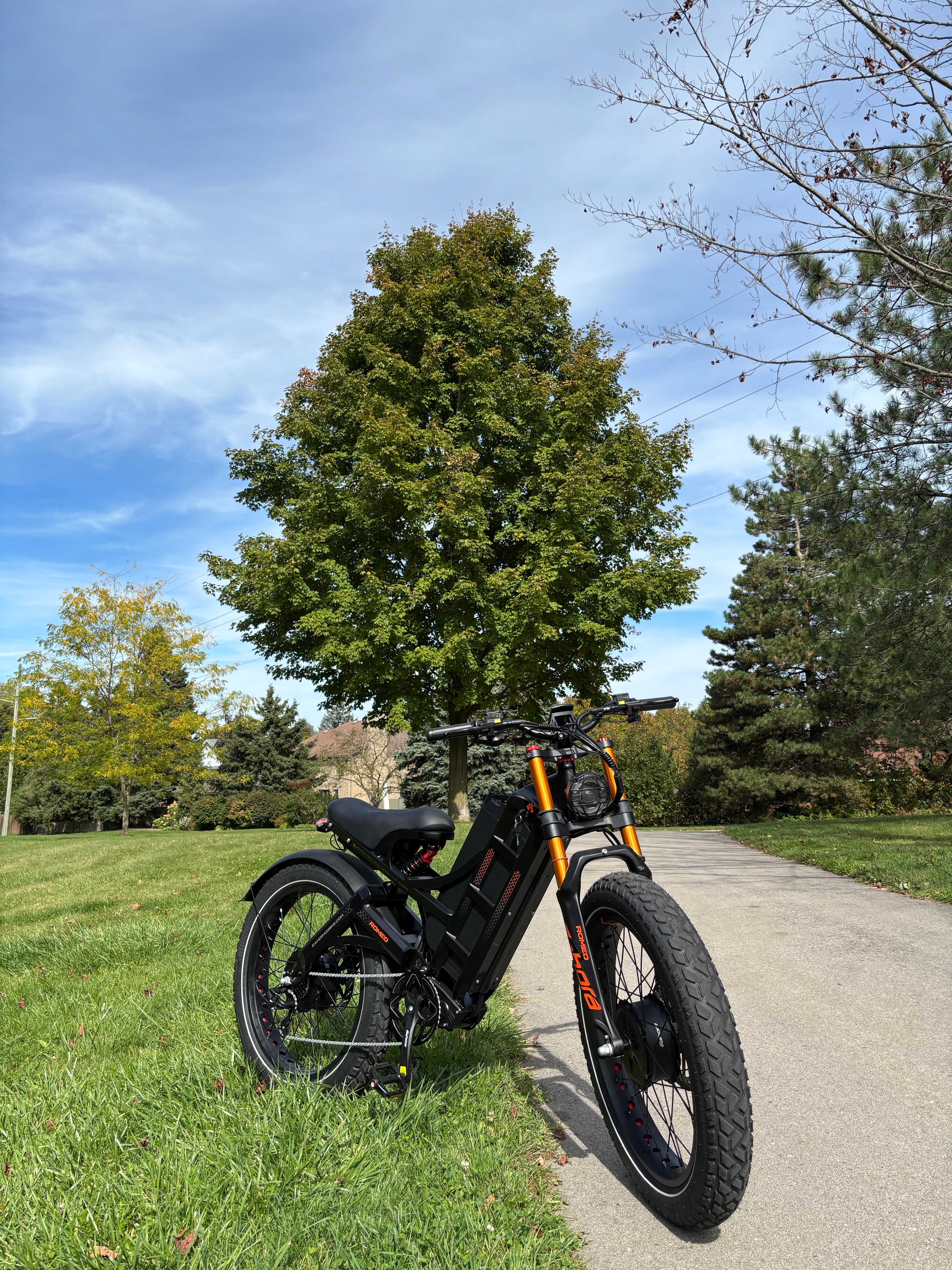
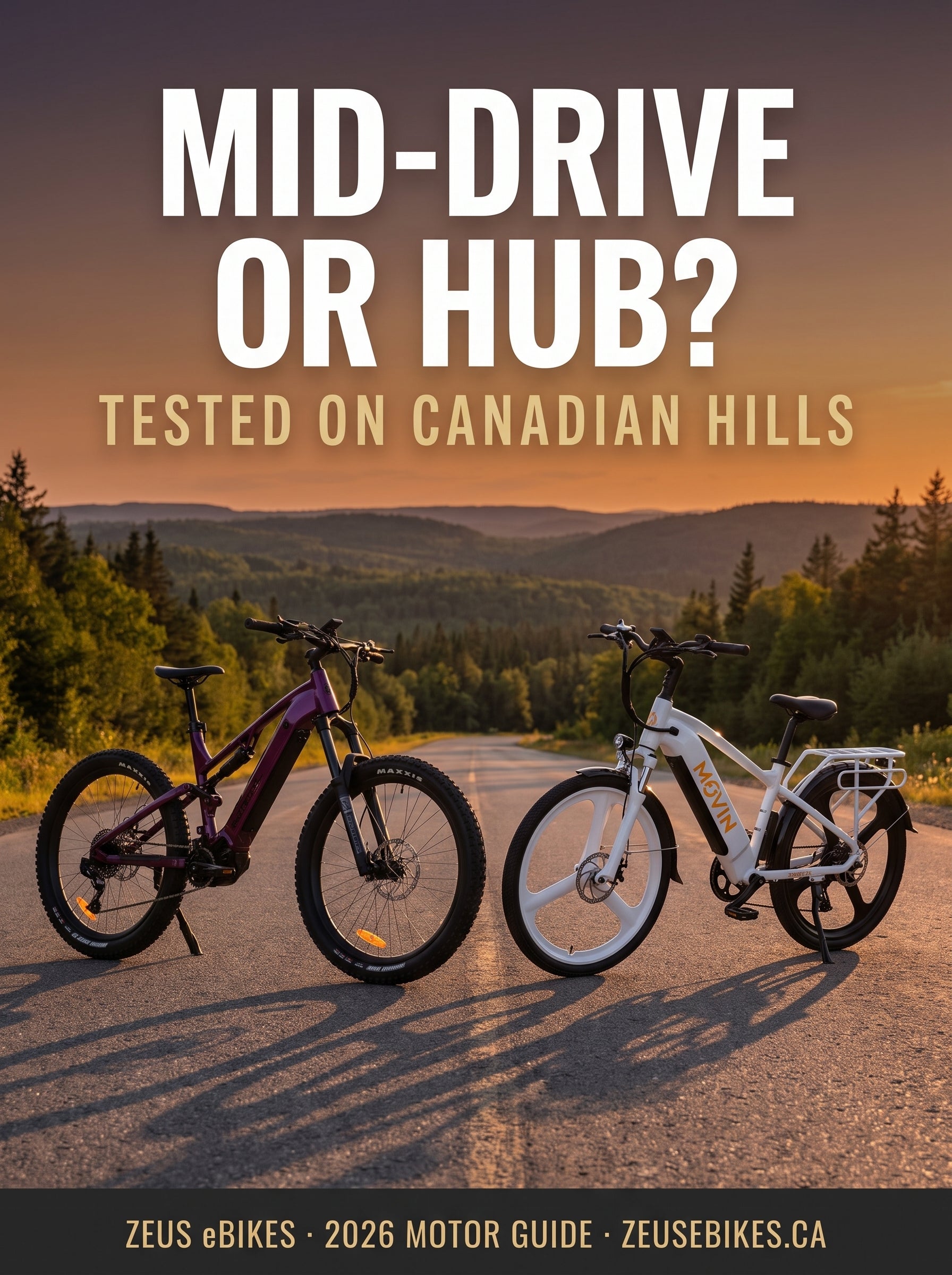
Mid-Drive vs Hub Motor eBike in Canada (2026): We Tested Both — and the Sensor Choice That Matters More

Mid-drive or hub motor? It's the first real fork in every Canadian e-bike purchase, and the honest answer is that neither is "better" — they win different rides, and the marketing on both sides hides the trade-offs. Zeus eBikes, a Canadian electric bike retailer, rebuilt this guide in July 2026 around what we can actually show you: 34 of our own test videos on Canadian hills, trails and winter roads, honest 3-year cost math, torque-per-dollar rankings across the ten in-stock bikes below — and the second decision almost every guide skips, the torque-vs-cadence sensor choice, which shapes how an e-bike feels more than the motor's position does.
In This Guide
- The 30-Second Answer
- How Each Motor Actually Works (Video)
- The Sensor Decision: Torque vs Cadence
- Hill Climbing, Head-to-Head (Video)
- Ride Feel: "A Push From Behind" vs "Super Legs"
- Real Cost: Purchase + 3-Year Maintenance
- Torque Per Dollar, Ranked
- Motor Type and Canadian Law (2026)
- Winter: Which Motor Survives -20°C
- Reliability, Lifespan, Flats and Chains
- Conversion Kits: The Honest Take
- The 10 Bikes — Every Motor Archetype
- 8 Canadian Scenarios, Matched
- Full Comparison Table
- FAQ
- Final Verdict
The 30-Second Answer: Mid-Drive vs Hub at a Glance
Here's the whole guide compressed. A mid-drive motor sits at the cranks and pushes through your gears — torque multiplication, natural feel, centred weight, higher price, faster chain wear. A hub motor sits in the wheel and pushes directly — simpler, cheaper, throttle-friendly, heavier at the rear, no gear leverage. Everything below is evidence for this table:
| Factor | Mid-Drive | Hub Motor | Winner |
|---|---|---|---|
| Sustained hill climbing | Multiplies torque through gears | Grinds at fixed leverage | Mid-drive |
| Flat-city commuting | Overkill | Perfectly suited | Hub |
| Price for equal quality | Higher | Lower | Hub |
| Drivetrain wear | Chain carries motor torque | Chain carries only your legs | Hub |
| Throttle-heavy riding | Usually pedal-first | Built for it | Hub |
| Ride feel (with torque sensor) | "Super legs" | "A push from behind" | Preference |
| Weight balance / handling | Low and centred | Rear-biased | Mid-drive |
| Rear flat repair | Conventional wheel | Motor axle + connector | Mid-drive |
| Loose-surface traction | One driven wheel | Dual-hub AWD possible | Hub (AWD) |
| Torque in the 500W class | Up to 120 Nm in our lineup | Typically 45–80 Nm | Mid-drive |
How Does Each eBike Motor Actually Work? (Video)
A hub motor is built into the wheel itself — usually the rear — and pushes the wheel around directly. Your pedalling and the motor's work are two separate inputs that never interact: the motor has one gear ratio, fixed forever, which is why hub power feels like a steady push from behind and why it doesn't care whether you shift. A mid-drive sits at the bottom bracket and turns the cranks' chainring, so its power flows through the same chain and cassette your legs use — shift to a lower gear and the motor gets the same mechanical advantage you do. One design is simple and direct; the other borrows your bicycle's oldest technology, the drivetrain, as a torque multiplier.
The Same Test, Both Motors
Full test rides — mid-drive torque and gearing first, then hub-motor throttle and daily riding.
Both filmed by Zeus on Canadian roads — same rider, same conditions philosophy.
The Sensor Decision: Torque vs Cadence — the Choice Nobody Explains
Here's the decision that shapes an e-bike's personality more than motor position, and almost no buying guide gives it a section: how the bike decides to help you. A cadence sensor detects that you're pedalling — spin the cranks and it delivers the assist level you selected, fixed and predictable, with a half-beat of lag and a slightly on/off character. A torque sensor measures how hard you're pressing, hundreds of times a second, and scales the motor to your effort — push gently, it whispers; stomp, it surges. The first feels like a machine helping you; the second feels like your own legs got stronger.
Why does this matter to your wallet? Three reasons. Torque-sensor bikes stretch their batteries further, because the motor never dumps more power than the moment needs. They're the difference between an e-bike that feels "electric" and one that feels athletic — the thing test riders notice first and spec sheets show last. And the premium has collapsed: a torque sensor used to mean $3,500+; the Eunorau Meta 26 now puts a true torque sensor on a 500W hub bike for $2,295, the Taubik Vista 26 puts a switchable dual sensor — torque mode or cadence mode, toggled from the display — on a street-legal commuter hub for $2,399, and the Taubik Recon pairs a torque sensor with a 1000W hub. Velotric sells the same switchable idea as SensorSwap: on the Discover M it rides on a 500W mid-drive, and on the Velotric Summit 2 on a 750W trail hardtail — one bike with both personalities, whichever motor position you land on.
Who should actually prefer cadence? Riders who want set-and-forget consistency — throttle-first commuters, stop-and-go delivery riders, and anyone with knee pain who'd rather the bike hold steady output than mirror their effort. Cadence is not "worse"; it's a different contract. But if you're choosing between two bikes and one has a torque sensor at a similar price, ride it before you decide — it's the upgrade most riders can feel blindfolded.
Hill Climbing: Head-to-Head on Real Canadian Hills (Video)
Hills are where the two designs stop being philosophies and start being physics. On a sustained grade, a mid-drive shifted into a low gear multiplies its torque through the drivetrain — the same 160 Nm arrives at the wheel with mechanical leverage behind it, so the motor spins in its efficient range while the bike climbs slowly and relentlessly. A hub motor has no gears to borrow: it pushes at one fixed leverage, works hardest exactly when it's least efficient, and on long steep climbs it heats up and fades. Watch the difference rather than take our word:
Same Hills, Both Motors — Watch the Difference
Mid-drive gear leverage on the left column, hub-motor grinding on the right.
The numbers behind the footage, from the bikes below: the mid-drive bench runs 100–160 Nm (Discover M 100, Urus 2.0 120, Fat HS 160), while the hub bench runs 55–100 Nm (Meta 26 at 55, Vista 26 at 68, Recon at 100). And the multiplier matters more than the raw figure: through a low gear, a 160 Nm mid-drive puts far more turning force at the wheel than any of those hubs can. That's why the 500W mid-drives out-climb 750W hub bikes — the claim our hills guide ranks by, and the single best reason mid-drives exist.
Ride Feel: "A Push From Behind" vs "Super Legs"
Spec sheets can't show you the thing riders mention first. Hub power feels like a push from behind — a friendly hand on your back that doesn't much care what your legs are doing, strongest from a standstill and steady at speed. It's relaxing, slightly detached, and with a throttle it becomes effortless in a way no mid-drive matches. Mid-drive power — especially with a torque sensor — feels like super legs: nothing seems to push you, you simply became stronger, and the harder you press the more the bike agrees. Neither is right; they're different relationships with the machine.
Feel the Difference on Camera
Mid-drive "super legs" and torque-sensor response; hub throttle-and-cruise character.
Real Cost: Purchase Price + 3-Year Maintenance
What does each motor type actually cost to own in Canada? Up front, our current in-stock benches tell the story plainly: hub bikes run $2,295–$3,599 (Meta 26 to Recon) and mid-drives run $3,099–$5,700 (Fat HS to Urus 2.0) — and the Fat HS's $3,099 BBSHD shows the old "mid-drives start at $4K" rule is dead. Over three years, the gap partially reverses: the mid-drive's torque runs through its chain and cassette, so drivetrain parts wear measurably faster, while a hub bike's chain only ever carries your legs.
| 3-year item (Zeus editorial estimates) | Mid-drive | Hub motor |
|---|---|---|
| Chains (heavy use: ~1/season vs ~1 total) | $75–$180 | $25–$60 |
| Cassette / freewheel | $50–$120 (1–2×) | $0–$60 (0–1×) |
| Brake pads (similar both) | $60–$120 | $60–$120 |
| Tires, tubes, misc. (similar both) | $100–$200 | $100–$200 |
| Motor-specific service risk | Drivetrain adjustments | Rear-flat labour if shop-done |
| 3-year maintenance band | ~$285–$620 | ~$185–$440 |
Zeus editorial estimates from typical Canadian service pricing and our shop experience; heavy daily riding sits at the top of each band, fair-weather riding at the bottom. Not a quote and not a guarantee — your usage decides.
Torque Per Dollar: The Smartest Way to Compare Motor Value
Wattage is capped by law and inflated by marketing, so here's the metric we actually shop by: newton-metres per thousand dollars — how much published climbing force each dollar buys. Ranked across every bike in this guide with a published torque figure (verified August 8, 2026):
| Bike | Motor | Torque | Price | Nm per $1,000 |
|---|---|---|---|---|
| Eunorau Flash AWD | Dual 750W hubs | 184 Nm comb. | $2,700 | 68 🏆 |
| Eunorau Fat HS / X8 | Bafang BBSHD mid | 160 Nm | $3,099 | 52 |
| Eunorau FAT-AWD 3.0 | Dual 500W hubs | 110 Nm comb. | from $2,299 | 48 |
| Eahora Juliet 2026 | 1000W hub | 90 Nm | $2,499 | 36 |
| Velotric Summit 2 | 750W hub, SensorSwap | 100 Nm | $3,399 | 29 |
| Taubik Vista 26 | 500W hub, dual sensor | 68 Nm | $2,399 | 28 |
| Taubik Recon | 1000W hub, torque sensor | 100 Nm | $3,599 | 28 |
| Velotric Discover M | VeloCore mid, SensorSwap | 100 Nm | $3,899 | 26 |
| Eunorau Meta 26 | 500W hub, torque sensor | 55 Nm | $2,295 | 24 |
| Eunorau Urus 2.0 | Bafang M600 mid | 120 Nm | $5,700 | 21 |
Published manufacturer torque ÷ everyday CAD price (October 2026). Remember mid-drive Nm multiplies through the gears, so equal numbers aren't equal climbing.
Motor Type and Canadian Law (2026)
First, the correction most e-bike guides still get wrong: there is no federal e-bike law in Canada anymore. The federal "power-assisted bicycle" definition was repealed by SOR/2020-22, effective February 4, 2021 — road rules are now set by each province, and they converge on the same line: 500W nominal motor power, 32 km/h assist cut-off, working pedals. The law doesn't care where your motor sits; a 500W mid-drive and a 500W hub are equally street-legal, and a 1000W anything is equally off-road. Our wattage guide covers the whole ladder province by province.
But motor type changes what 500W buys you — and this is the most practical legal insight in this guide. A 500W hub typically delivers 45–80 Nm. A 500W mid-drive delivers up to 100–120 Nm in our lineup (Discover M, Urus 2.0) and multiplies it through the gears. In other words: the mid-drive is how you get real climbing power without leaving the 500W rating. Riders used to jump to 750W and 1000W hubs — off-road class, insurance exposure — to solve hills that a legal mid-drive solves today. One caution on dual-motor bikes: two hub motors add together (2 × 500W = 1000W combined), which is why AWD bikes like the FAT-AWD 3.0 are off-road machines despite their per-motor rating.
Inside the limits the provincial rules converge on: ≤500W nominal, ≤32 km/h (30 km/h in Nova Scotia), pedals — motor position irrelevant. In this guide the Vista 26 ships inside that line; the Discover M, Meta 26 and Urus 2.0 ship set to it, but each maker lists an adjustable cap (Velotric 19–45 km/h, Eunorau unlockable, the Urus 32 or 45 km/h), and whether an adjustable cap qualifies is not settled. Everything else here (1000W mid-drives, 1000W hubs, dual-motor AWD) is off-road / private-property class — and an over-500W bike generally can't be registered as something else, because it carries no motor-vehicle certification. Details: eBike laws by province.
Winter: Which Motor Survives Canadian Cold?
Both, honestly — Canadian winters kill batteries and rust chains long before they kill motors. But they winter differently. The hub motor's case: it's a sealed unit with no external moving parts, indifferent to salt spray, and its simplicity is exactly what you want when it's -20°C and you just need the bike to go. Its weaknesses are wheel-spin on ice under throttle (all the torque hits one contact patch with no finesse) and the universal cold-battery range loss. The mid-drive's case: its weight sits low and centred, which makes the bike noticeably more composed on snow; and because it drives through the gears, you can select an easier gear and feed power gently for traction. Its winter tax is the exposed drivetrain — salt eats chains, so clean and lube more often.
And if your winter is genuinely slippery — packed snow, icy lanes, loose shoulders — the strongest traction answer we stock isn't a mid-drive at all: it's dual-hub AWD. Two driven wheels tow the bike through the slush line where any single-motor bike washes out, and the FAT-AWD 3.0 pairs it with a torque sensor so both motors respond to your effort together. Full cold tactics — battery care, tire pressure, studs — live in our winter guide.
Reliability: Lifespan, Flats, Chains — What Actually Breaks
How long do e-bike motors last? Longer than the internet fears. A quality hub motor is one sealed assembly with bearings — they routinely clear 10,000+ km with no attention, and what actually wears on a hub bike is everything around the motor: pads, tires, spokes on cheap wheels. Mid-drive motors are similarly long-lived as motors; what they consume is drivetrain — chains stretched by motor torque, cassettes that follow the chain, the occasional chainring. That's maintenance, not failure, and one habit halves it: ease your pedal pressure for a half-second when you shift, so the motor isn't slamming the chain across gears under full load.
Two honest annoyances, one per side. Hub bikes make rear flats a chore — the motor's axle nuts and cable connector turn a five-minute quick-release job into a 20–30 minute one (puncture-resistant tires are the cheap fix, and it's part of why our delivery guide leans on them). Mid-drives concentrate wear on parts you must actually replace on schedule — skip chain maintenance for a year and you'll buy a cassette too. Brand support decides serviceability in Canada more than architecture: this is where Bafang's ubiquity (M600 and BBSHD across our lineup) is a genuine reliability feature — parts exist, mechanics know them.
Conversion Kits: The Honest Take (We Don't Sell Them)
Plenty of Canadians search "Bafang mid drive kit" — so here's straight talk from a shop with no kit to sell you. Yes, you can convert a regular bike with a Bafang mid-drive or a hub-motor wheel kit, and tinkerers genuinely enjoy it. What the kit listings don't say: your frame was never engineered for motor torque, there are no integrated brake cut-offs or lights, battery mounting and wiring are your problem, a converted bike must still meet your province's 500W/32 km/h line to stay street-legal — and when something misbehaves, you are the warranty department. Complete bikes exist because integration, certification and support are most of what you're paying for. If you love wrenching, a kit is a rewarding project; if you love riding, buy the finished machine.
The 10 Bikes: Every Motor Archetype, Verified Live
Ten bikes, five motor archetypes — legal mid-drives, off-road mid-drives, cadence hubs, torque-sensor hubs, and dual-hub AWD — each verified against its live product listing on August 8, 2026, each carrying its honest street-legal verdict. Shopping the full category instead? The 500W guide and 1000W guide rank the complete fields; these are the archetype exemplars.
500W Mid-Drives — Climbing Power Inside the Wattage Limit

The Urus 2.0's M600 mid-drive on a Rockies climb — 120 Nm through the gears.
Eunorau Urus 2.0
$5,700 CADThe thesis of this whole guide in one bike: a 500W Bafang M600 making 120 Nm through the gears — with a cap that adjusts from 32 to 45 km/h, so check your province before road use — and it out-climbs 750W hub bikes that are not e-bikes on public roads. Full suspension, 61.7 lb, a real eMTB. If you want maximum climbing inside the 500W rating, this is the ceiling.

The Discover M on a neighbourhood grade — a legal mid-drive with SensorSwap's two personalities.
Velotric Discover M
$3,899 CADThe one bike that answers both of this guide's questions at once: a 500W mid-drive (100 Nm, 960W peak), set to 32 km/h though Velotric lists an adjustable range of 19–45 km/h, whose SensorSwap toggles between a responsive torque sensor and a steady cadence feel. Step-through frame, 801 Wh Samsung/LG battery. If you can't decide between ride feels, this is the bike that refuses to make you.
Off-Road Mid-Drives — Maximum Torque Through the Gears

The Fat HS's BBSHD earning its reputation on a rocky climb — 160 Nm through the gears.
Eunorau Fat HS / Hunter X8
$3,099 CADThe BBSHD is the mid-drive the conversion-kit crowd idolizes — here it comes already engineered into a full-suspension fat bike with 160 Nm, dual-battery expansion and a warranty. The bush-and-backcountry climber at the sane end of the price range. One honest note: Eunorau's published spec reads cadence-sensing assist, so power delivery is workhorse-steady rather than proportional — for torque-sensor feel, look to the FAT-AWD 3.0 below. (Heavier riders: its sibling FAT-HD 2.0 / X7 carries the same 160 Nm with a 375 lb payload rating.)
Zeus Mid-Drives on Trail and Off-Road
Hub Motors — Simple, Proven, Better Value on the Flat

The Vista 26 — this guide's sensor decision made switchable: torque mode or cadence mode, toggled from the display.
Taubik Vista 26
$2,399 CADThis guide's whole sensor chapter, built into one street-legal hub bike: the Vista 26's dual sensor toggles between torque mode and cadence mode from the display, so you can ride proportional assist one day and steady set-and-forget assist the next. Ultra-low step-through frame, 64 lb, Zoom hydraulic 180 mm brakes, full fenders, 286 lb payload, and a 706 Wh Samsung battery with UL 2271 certification — Taubik's own winter estimate is 55–75 km at 0°C. Honest limits: there's no dual-battery expansion, and the 26×1.9″ commuter tires are pavement rubber, not snow rubber.

The Meta 26 — a true dedicated torque sensor at $2,295, hub simplicity with proportional feel.
Eunorau Meta 26
$2,295 CADThe hybrid path this guide's sensor section exists for: hub-motor price and simplicity with the proportional, natural feel of a true torque sensor — at $2,295, with the FAT-AWD 3.0 (from $2,299) and the dual-sensor Vista 26 ($2,399) close by. It ships set to 32 km/h, and Eunorau lists the cap as unlockable. If "mid-drive feel without mid-drive money" is the sentence you've been searching for, this is its answer.

The Recon — 1000W of hub power metered by a real torque sensor.
Taubik Recon
$3,599 CADBig hub power usually comes with crude delivery; the Recon is the exception — a 1000W Bafang hub metered by a real torque sensor, so 100 Nm arrives in proportion to your legs instead of all at once. The refined end of the hub archetype, for riders who want effortless power that still feels like cycling. Off-road class at 1000W.

The Summit 2 where it lives — the city path becoming a trail.
Velotric Summit 2
$3,399 CADThe hub that closes the gap with mid-drives. A 750W inner-rotor hub making 100 Nm, carrying the same SensorSwap trick as the Discover M — cadence or torque, toggled from the display — on a hardtail with an air fork that tunes to rider weight, NFC unlock, and Apple/Android Find built in. If your week splits between commuting and trail weekends, this is the hub that does both. (It's also the bike our co-founder rides.)

The Juliet 2026 — where hub simplicity pays for a 2,880 Wh tank instead of drivetrain complexity.
Eahora Juliet 2026
$2,499 CADHere's a hub advantage no mid-drive in this guide matches: because hub bikes spend less on drivetrain complexity, the money goes into the tank — 2,880 Wh, the largest battery in this guide, rated by Eahora at 175–190 km of assist range. A cadence-sensor cruiser built to make charging a weekly event instead of a daily one. Off-road class at 1000W nominal.
Zeus Hub Motors — Commuting, Trails, Full Reviews
Dual-Hub AWD — When Two Hubs Beat One Mid-Drive

The FAT-AWD 3.0 — two driven wheels solving the one problem neither single motor can.
Eunorau FAT-AWD 3.0
From $2,299 CADThe one problem neither a single hub nor a mid-drive solves: traction on surfaces that won't hold one driven wheel. Two 500W hubs pull both ends of the bike through snow, sand and loose gravel, and — rare for AWD — a torque sensor keeps them responding to your effort in sync. Remember the legality math: two 500W motors are 1000W combined, off-road class. Watch it work:

The Flash AWD — the Flash platform's dual-motor successor, gripping loose gravel with both wheels.
Eunorau Flash AWD
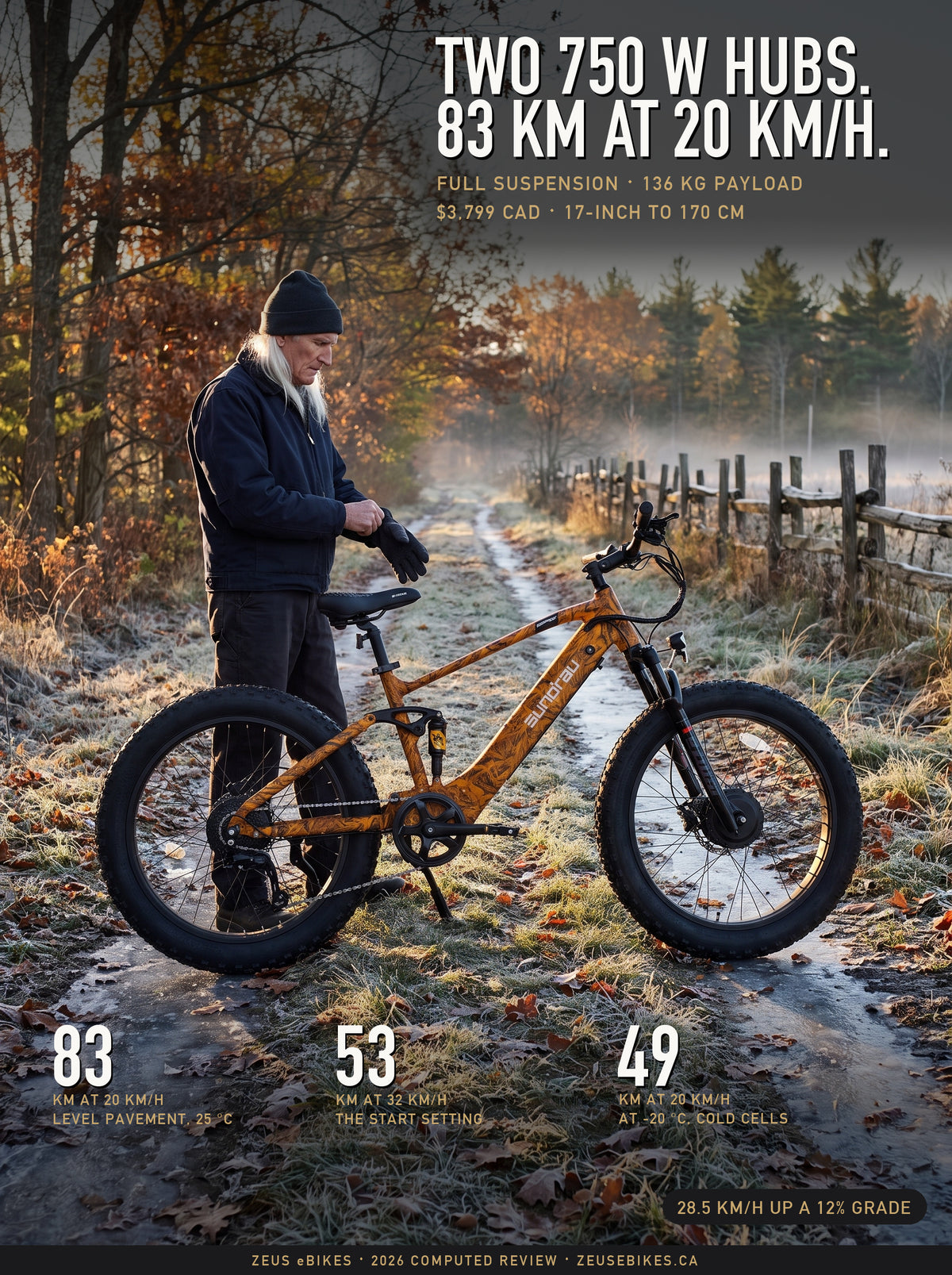
$2,700 CADThe Flash platform now ships as this dual-motor AWD — the single-motor Flash 1000W is discontinued, and this is its successor. Two 750W hubs make 1500W combined and 184 Nm, the highest torque figure in this guide, with a battery that expands from 832 Wh to roughly 2,808 Wh and UL 2849 + UL 2271 certification on the electrical system. Eunorau doesn't publish its sensor type, so we won't claim one. More power and more traction than the old Flash — traded against the gear-multiplied climbing the mid-drive version offered.
Still torn between archetypes? Tell us your postal code's hills, your storage, and your budget at 1-866-938-7580 — a real human will tell you honestly which motor your riding actually needs, including when the cheaper hub is the right answer.
Shop mid-drives → Shop all e-bikes →Which Motor Is Right for You? 8 Canadian Scenarios
| Your riding | Choose | Why | Start with |
|---|---|---|---|
| Flat-city commute (Toronto core, Winnipeg, Regina) | Hub | Simple, cheap, no wear tax | Vista 26 |
| Hilly city (Vancouver, Hamilton mountain, Québec City) | Mid-drive (500W) | Gear leverage at 500W (adjustable cap) | Discover M |
| Trails & backcountry, private land | Mid-drive (off-road) | Torque multiplication where legality allows | Fat HS |
| Natural ride feel on a budget | Torque-sensor hub | Mid-drive feel, hub price | Meta 26 |
| Heavy rider (250 lb+), hills | Mid-drive | Leverage moves mass; 375 lb frames exist | FAT-HD 2.0 |
| Snow, sand, loose surfaces | Dual-hub AWD | Two driven wheels beat any single motor | FAT-AWD 3.0 |
| Commute weekdays, trails on weekends | SensorSwap hub | One bike, both personalities | Summit 2 |
| Maximum range, minimal fuss | Big-battery hub | Money in the tank, not the drivetrain | Juliet 2026 |
All 10 Bikes — Full Comparison Table
| Bike | Price | Motor | Torque | Sensor | Battery (max) | Legal |
|---|---|---|---|---|---|---|
| Eunorau Urus 2.0 | $5,700 | Bafang M600 mid, 500W | 120 Nm | Torque | 840 Wh | ⚠ Adjustable cap |
| Velotric Discover M | $3,899 | VeloCore mid, 500W/960W pk | 100 Nm | SensorSwap (both) | 801 Wh | ⚠ Adjustable cap |
| Eunorau Fat HS / X8 | $3,099 | Bafang BBSHD mid, 1000W | 160 Nm | Cadence | 720–1,440 Wh | ✘ |
| Taubik Vista 26 | $2,399 | 500W Sutto hub | 68 Nm | Dual (torque + cadence) | 706 Wh | ✔ |
| Eunorau Meta 26 | $2,295 | 500W hub | 55 Nm | Torque | 720–1,440 Wh | ⚠ Adjustable cap |
| Taubik Recon | $3,599 | 1000W Bafang hub | 100 Nm | Torque | 960 Wh | ✘ |
| Velotric Summit 2 | $3,399 | 750W hub / 1300W pk | 100 Nm | SensorSwap (both) | 801 Wh | ✘ |
| Eahora Juliet 2026 | $2,499 | 1000W hub / 1200W pk | 90 Nm | Cadence | 2,880 Wh | ✘ |
| Eunorau Flash AWD | $2,700 | 2 × 750W = 1500W | 184 Nm comb. | n/p | 832–2,808 Wh | ✘ |
| Eunorau FAT-AWD 3.0 | from $2,299 | 2 × 500W hubs = 1000W | 110 Nm comb. | Torque | 720–1,440 Wh | ✘ |
n/p = not published by the manufacturer — we don't estimate unpublished specs. All prices and specs verified against live Zeus product pages, August 8, 2026. ✔ = ships inside the limits the provincial rules converge on (≤500W nominal, 32 km/h; Nova Scotia’s statute says 30 km/h); ✘ = off-road / private-property class.
Frequently Asked Questions
Which is better: a mid-drive or a hub motor e-bike?
Neither is universally better — they win different rides. A mid-drive sends power through your gears, so it multiplies torque for hills, feels like stronger legs, and centres the bike's weight; it costs more and wears the chain faster. A hub motor drives the wheel directly, so it is cheaper, simpler, quieter about maintenance, and better suited to throttle-heavy, flat, stop-and-go riding. In Canada, choose mid-drive for sustained hills, trails and heavy loads; choose a hub for flat commutes, budgets and throttle use — and check the sensor, which shapes ride feel as much as motor position.
What is the difference between a torque sensor and a cadence sensor?
A cadence sensor detects that you are pedalling and delivers a set level of power — simple, predictable, slightly on/off in feel. A torque sensor measures how hard you are pressing on the pedals hundreds of times per second and matches the motor's help to your effort — instant, proportional, natural. Torque sensors used to be a premium feature; they now appear on bikes like the Eunorau Meta 26 at $2,295, the Eunorau FAT-AWD 3.0 from $2,299 and the Taubik Vista 26 at $2,399, whose dual sensor switches between torque and cadence modes. If you can, test both: the sensor changes how an e-bike feels more than most spec-sheet numbers.
Is a mid-drive e-bike worth the extra money in Canada?
If you climb real hills, ride trails, or carry weight — yes, and the gap has narrowed: the Eunorau Fat HS puts a 160 Nm Bafang BBSHD mid-drive at $3,099, within reach of good hub-bike money. If your riding is flat city commuting, the honest answer is often no: a well-built hub bike delivers the same 32 km/h for less money with less drivetrain wear. The premium buys torque multiplication through your gears, better weight balance, and hill endurance — pay for it only if your terrain will use it.
Are 1000W mid-drive e-bikes legal on Canadian roads?
No. E-bike road rules are set provincially in Canada (the federal definition was repealed in 2021), and every province caps a licence-free power-assisted bicycle at 500W nominal with 32 km/h assist. A 1000W mid-drive is an off-road and private-property machine. The good news: 500W mid-drives with 100–120 Nm — like the Velotric Discover M and Eunorau Urus 2.0 — stay inside the wattage cap and out-climb many 750W hub bikes, so you no longer have to break it to get real climbing torque. Both ship set to 32 km/h, but each maker lists an adjustable cap, and whether that qualifies is not settled.
Do mid-drive motors wear out chains faster?
Yes — it is the honest trade-off of the design. A mid-drive sends motor torque through the same chain, cassette and derailleur your legs use, so expect faster chain wear than on a hub bike, especially if you shift under full power. Budget roughly a chain per season under heavy use (about $25–$60), learn to ease off the pedals for a half-second when shifting, and the drivetrain lasts far longer. Hub motors bypass the drivetrain entirely, which is why hub bikes are cheaper to keep over three years.
Which motor type is better for heavy riders (250 lb and up)?
Mid-drive, in most cases — torque multiplication through the gears is exactly what moving more mass up a grade requires, and mid-drive frames in our lineup carry payload ratings up to 375 lb (Eunorau FAT-HD 2.0 / Hunter X7). On flat terrain a strong hub motor also works well and costs less. Whichever you choose, the payload rating and wheel build matter as much as the motor — see our heavy-rider guide for payload-verified picks.
Which motor is better for Canadian winter?
Both survive winter with basic care; they fail differently. Hub motors are sealed and simple — their weak point is range loss and, on throttle-heavy riding, wheel spin on ice. Mid-drives keep weight centred and low, which helps balance on snow, and driving through the gears lets you spin an easier gear for traction — but the exposed chain needs cleaning and lubing more often against salt. For deep-snow traction, the strongest setup we stock is dual-hub AWD with a torque sensor, like the Eunorau FAT-AWD 3.0, which drives both wheels.
How long do e-bike motors last?
Quality motors commonly outlast the first battery. Hub motors have one moving assembly and routinely run 10,000 km and beyond with nothing but bearing care; the parts around them (pads, tires, spokes) wear first. Mid-drives are also long-lived, but they add drivetrain wear — chains, cassettes, chainrings — which is maintenance, not motor failure. Brand matters more than type: established platforms like Bafang's M600/M620/BBSHD family have years of parts availability behind them, which is what actually determines how long a motor stays serviceable in Canada.
Can I convert my regular bike with a mid-drive or hub motor kit?
Physically yes — Bafang mid-drive and hub kits are widely sold in Canada — but go in with open eyes. Zeus does not sell conversion kits, so read this as honest context rather than a pitch: a kit bike has no integrated brake cut-offs, lighting, or frame engineering around the motor's torque, the battery mounting is on you, and a converted bike must still meet your province's 500W/32 km/h rules to stay street-legal. Kits reward tinkerers; complete bikes exist because integration, certification and support are most of what you are buying.
Hub motor or mid-drive for food delivery and gig work?
Hub motor, for most couriers. Delivery is stop-and-go, throttle-heavy, flat-city riding — exactly the duty cycle hub motors are built for — and the drivetrain isn't eating motor torque all shift, which keeps maintenance down while the bike earns. A torque-sensor hub (like the Eunorau Meta 26) adds efficiency over a long shift. Choose a mid-drive for delivery only if your city is genuinely steep. Our dedicated delivery guide matches bikes to courier demands in detail.
What is the best mid-drive motor brand available in Canada?
Bafang is the most widely supported in Canada — Zeus alone stocks its M600 (Urus 2.0) and BBSHD/M615 family (Fat HS, FAT-HD) — and its parts availability is the practical reason to care about brand. Velotric's VeloCore (Discover M) is a strong integrated alternative with its switchable SensorSwap system. "Best" depends on the bike around it: motor brand determines serviceability, while torque, sensor and gearing determine how it rides.
Is a dual hub motor (AWD) e-bike better than one mid-drive?
For traction, yes; for climbing efficiency, no. Two hub motors driving both wheels grip loose snow, sand and gravel in a way no single-motor bike can — that is the FAT-AWD 3.0's case, and its torque sensor keeps the two motors feeling coordinated. But dual hubs still can't multiply torque through the gears, so a good mid-drive out-climbs them on long steep grades, and AWD bikes exceed 500W combined, making them off-road machines. Choose AWD for slippery surfaces, a mid-drive for sustained climbs, and remember to add both motors when judging legality.
Do hub motors make flat tires harder to fix?
Rear flats on a hub-motor bike are more awkward, yes: the motor's axle nuts and cable connector make rear-wheel removal a 20–30 minute job with tools instead of a quick-release flip. It is manageable — undo the connector, support the wheel's weight, and torque the nuts properly on reinstall — but plan for it. Mid-drive bikes keep both wheels conventional, which is a genuine everyday advantage. Puncture-resistant tires or liners are the cheap way to make the question mostly disappear on either motor type.
Final Verdict: Mid-Drive or Hub?
Buy the motor your terrain will actually use. If your week includes real hills, trails, or serious cargo, the mid-drive's gear leverage is worth every dollar — and the 500W Discover M and Urus 2.0 mean you no longer trade wattage for climbing power (both carry adjustable caps), while the $3,099 Fat HS means you no longer trade a fortune for it either. If your week is flat pavement, stoplights and errands, the hub motor is the honest choice: the Vista 26 does the same 32 km/h for less money and less upkeep, and nobody climbing nothing needs to pay a torque tax. In between live the smartest compromises — the Meta 26's torque-sensor feel at hub price, and the FAT-AWD's two driven wheels for the surfaces that hold neither.
And wherever you land, check the sensor before you buy — it's the difference you'll feel every single ride. You don't have to decide alone: Zeus ships from Canada, unused and unopened bikes can be returned within 15 days of delivery in original packaging, and a real human answers 1-866-938-7580 — describe your hills honestly and we'll match the motor honestly, including when the cheaper one wins.
Ready to choose by terrain, not marketing?
Mid-Drive eBikes → Street-Legal Picks → The Wattage Guide →Written by Milad Ghobadibeygvand, BScN (Western University, 2014), Co-founder of Zeus eBikes Canada. All 34 embedded videos were filmed by Zeus on Canadian terrain; every spec was verified against the live product page on August 8, 2026; legal facts are sourced to SOR/2020-22 and current provincial statutes.
Visuals created by Playcut.ai
- eBike Wattage in Canada (2026): 500W–5000W, What's Legal
- Best Electric Bikes for Steep Hills (2026): Ranked by Torque
- Best 500W Electric Bikes Canada (2026): Street-Legal Picks
- Best 1000W Electric Bikes Canada (2026)
- Pedal Assist vs Throttle: Which Riding Style Fits You?
- Best Dual-Motor (AWD) eBikes Canada (2026)

Share:
The Persuasion Machine: 100 Years of Marketing Tricks, Who Runs Them Best, and How to Stop Falling for Them
Welcome to Earth — Chapter One: The First Thing You Need to Know