
Eunorau Defender-S 2.0 Review Canada (2026): Two 750 W Hubs, Full Suspension, 83 km at 20 km/h, $3,799

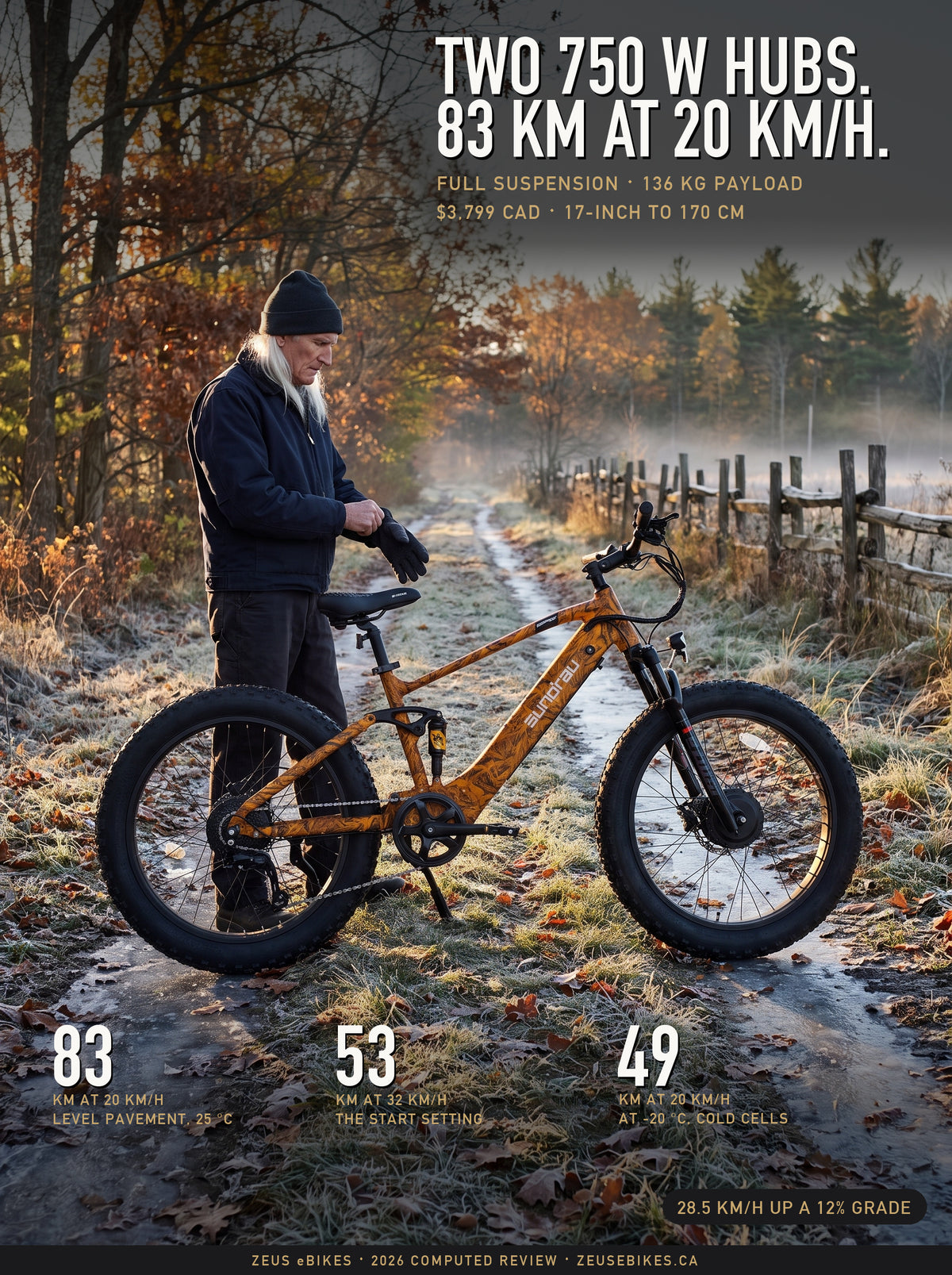
Zeus with the Defender-S 2.0 on a frosted two-track in eastern Ontario: a Playcut.ai rendering made from Eunorau's own photograph of the bike, so an illustration of it; the product photographs below are Eunorau's, unaltered. The 83 km is the range section's figure for 20 km/h on both motors with an 80 kg rider on level pavement.
Eunorau Canada published the Defender-S 2.0, also sold as the Hunter X6, on 23 September 2026 at $3,799, and it has been in stock at Zeus since 7 October at the same price. It replaces the original Defender-S in Eunorau's Canadian catalogue, and the first reviews a search returns are of that older bike. This review is of the 2.0 alone: every specification is Eunorau Canada's, read on 7 October 2026, every store term is Zeus's, read the same day, and every range and fit figure is computed from those published numbers and printed with its conditions.
Every specification comes from Eunorau Canada's Defender-S 2.0 page and its product record, both read on 7 October 2026, and every figure that takes arithmetic is recomputed here. The range tables come from a saved physics model built on Eunorau's own motor, battery, weight and tire figures; the fit tables from Eunorau's published geometry placed on its own photograph and 6,068 measured bodies; the law table from each province's statute or regulator page, quoted.
Price, stock and payment terms were read from our listing on 7 October 2026. Zeus sells this bike; read the red flags as carefully as the green. Written by Milad Ghobadibeygvand, BScN (Western University, 2014); corrections to milad@zeusebikes.ca.
In this review
- Who the Defender-S 2.0 is for
- Eunorau Canada's specification, with the geometry
- Two 750 W hubs and a torque sensor
- The four-bar suspension
- Nine gears, 203 mm brakes, the display
- Two frame sizes and the second battery
- The Defender-S 2.0 against three Eunorau siblings at Zeus
- How far it goes on one charge, computed
- What the 136 kg payload covers
- Will it fit you? Computed from your height
- Seven Canadian riders, one bike
- What the law calls it, province by province
- The 45 km/h setting
- Charging and battery care
- Where Eunorau prints a figure two ways
- Recall record
- Is it UL certified?
- Warranty, Zeus Care and who handles a claim
- Buying it from Zeus
- The honest ledger
- Who should buy it
- Before you buy: the checklist
- Limitations of this review
- The source register
- Frequently asked questions
- The bottom line
Who the Defender-S 2.0 is for
On 23 September 2026 Eunorau Canada replaced the original Defender-S with the Defender-S 2.0 at $3,799, and on 7 October it went into stock at Zeus. The decision is $3,799 for a bike with no owner reviews yet, whose two 750 W motors put it outside every provincial e-bike definition.
This review works the decision out from the published figures: how far it goes at your speed and temperature, which frame fits your inseam, and what each province calls it.
The Defender-S 2.0 is for you if your riding leaves the pavement and keeps going: two-track to a stand, a gravel concession road, sand, snow or a rutted trail. Eunorau's record opens with the words built for challenging terrain and all-season exploration, and its page's headline is Go Where One Motor Stops.

If you have read about the first Defender-S, its numbers do not carry over. For the 2.0 Eunorau prints 40.50 kg (89.3 lb), a 136 kg (300 lb) maximum payload, 203 mm rotors front and rear, a 48 V 17 Ah pack and a Class 2 start at 32 km/h. Every figure on this page is the 2.0's, read on 7 October 2026.
Riding mostly pavement and want two motors for less? The FAT-AWD 3.0 puts two 500 W hubs on a step-through from $2,299. Want full suspension with a 500 W motor you can check against your province's rule? The Eunorau Defender is that bike, and our review of it is the sibling to this one.

Eunorau Defender-S 2.0 / Hunter X6
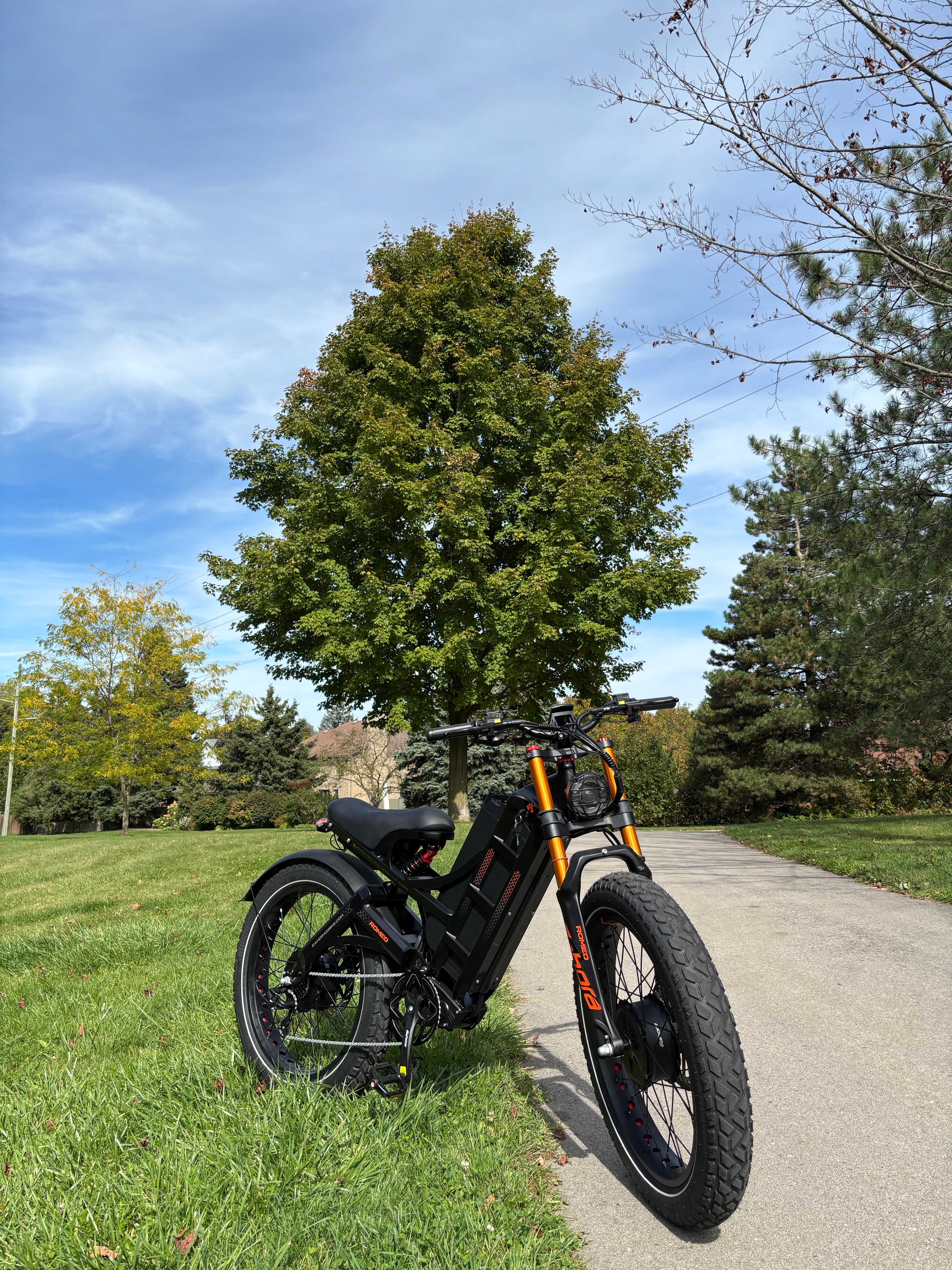
$3,799 CAD · in stockWhat it is. A four-bar full-suspension fat-tire frame with a 750 W hub in each wheel, a bottom-bracket torque sensor, an RST GUIDE 75 mm fork with lockout, an AOS01 air shock, Shimano CUES 1×9 gearing, 203 mm hydraulic rotors and a MINI TOUCH colour display with Bluetooth, in Dry Grass Camo, Moon Black or Army Green and a 17-inch or 19-inch frame.
The legal line. Each motor is 750 W. Every provincial e-bike definition stops at 500 W, four of them counting the motors together in so many words, so no province lets it ride roads, bike lanes or paths as an e-bike; the law section quotes each one.
Six choices, one price
Dry Grass Camo, Moon Black or Army Green, each in a 17-inch or 19-inch frame, all six in stock at $3,799 on 8 October 2026, with free Canada-wide shipping; our refund policy gives you 24 hours to cancel at no cost and 15 days from delivery to return it unused and unopened.
Eunorau Canada's specification, with the geometry
Eunorau Canada prints the Defender-S 2.0's specification in two places, the page's spec panel and the product record behind it, and on 7 October 2026 the two agreed on every figure below. The table is Eunorau's; the watt-hours are our arithmetic, 48 volts times 17 ampere-hours.
| Specification | Eunorau Canada publishes |
|---|---|
| Price | $3,799 CAD in all three colours and both frames, the same price Eunorau Canada printed on 7 October 2026 |
| Name | DEFENDER S 2.0/Hunter X6 |
| Motors | Dual 48V 750W hub motors, front and rear; combined rated power 1,500W; maximum torque 85 N·m |
| Controller and sensor | 48V 25A dual-motor controller; bottom-bracket torque sensor |
| Speed | Default startup mode Class 2, assisted up to 20 mph / 32 km/h; maximum setting up to 28 mph / approximately 45 km/h |
| Battery | 48V 17Ah removable lithium-ion, 21700 cells, 50A BMS (816 Wh, our arithmetic) |
| Range | Up to 40 miles / 64 km; up to 80 mi / 128 km combined with an optional second battery |
| Charger and charge time | 54.6V 2A; approximately 6–8 hours |
| Display | MINI TOUCH colour display with Bluetooth |
| Frame | 6061 aluminum, 26-inch four-bar full-suspension frame, 17-inch or 19-inch |
| Suspension | RST GUIDE fork, 75 mm travel, preload and lockout; AOS01 air shock, 165 mm eye-to-eye, adjustable |
| Drivetrain | Shimano CUES 1×9: SL-U4000-9R RAPIDFIRE PLUS shifter, RD-U3020-SGS derailleur, CS-LG300-9 11–36T cassette; 42T chainring, 170 mm cranks |
| Brakes | Hydraulic disc with motor cut-off sensors; 203 mm rotors front and rear |
| Wheels and tires | 26 × 4.0-inch fat tires; 26-inch double-wall 6061 rims; 12-gauge, 36-hole spokes |
| Cockpit | 700 mm riser bar, 25 mm rise; adjustable alloy stem (105 mm in the record); 130 mm lock-on grips; comfort saddle; 31.6 × 280 mm seat post |
| Lights and extras | LED headlight with horn; red rear reflector; adjustable aluminum kickstand; 9/16-inch folding pedals |
| Weight | 89.3 lb / 40.50 kg |
| Payload | 300 lb / 136 kg, including rider and cargo |
| UL | UL CERTIFIED: Yes (no standard named) |
Read from Eunorau Canada's Defender-S 2.0 page and product record on 7 October 2026. A throttle is not listed on either; see the conflicts table.
Eunorau's Dimensions and Rider Fit table, both frames:
| Dimension | 17-inch | 19-inch |
|---|---|---|
| A · Seat tube | 432 mm | 483 mm |
| B · Reach | 448 mm | 458 mm |
| C · Head tube | 165 mm | 165 mm |
| D · Chain stay | 495 mm | 495 mm |
| E · Bracket height | 359 mm | 359 mm |
| F · Wheelbase | 1,306 mm | 1,316 mm |
| G · Top tube | 645 mm | 655 mm |
| H · Total length | 2,042 mm | 2,052 mm |
| I · Stack | 592 mm | 595 mm |
| J · Seat height | 585–735 mm | 635–785 mm |
| Recommended height | 160–193 cm | not printed |
Eunorau's rows as printed on 7 October 2026. Row J runs from the crank axle to the saddle top (the fit section explains how it was placed).
Two 750 W hubs and a torque sensor
A 48 V 750 W hub motor turns each wheel, and one 48V 25A dual-motor controller runs the pair; Eunorau rates them at 1,500 W combined and prints one torque figure, 85 N·m maximum.
Both wheels turn at the same speed, so each motor carries half the load, and that is where a second motor earns its place: when the rear tire spins on snow, sand or wet grass, the front one is still pulling.

When you pedal, a bottom-bracket torque sensor reads your effort. Eunorau's Canadian page says the assist answers how hard you press rather than crank movement alone: lighter pressure brings gentler support, and harder pedalling more. On a slippery climb that is the difference between feeding power in and spinning a tire.
Ask Eunorau whether you can ride on one motor and its page answers that the dual-motor control system is designed to manage motor operation for different conditions, then sends you to the supplied manual for the final production control labels and operating sequence. The original Defender-S had a three-position switch; whether the 2.0 keeps one is not published, so every range figure here models both motors driving.
What the second hub buys you, in the saved model: up an 8% grade the pair holds 29.6 km/h with 80 kg aboard and 28.3 km/h with the full 136 kg, and up a 12% grade 28.5 and 22.5 km/h (the climb table). Both brake levers carry motor cut-off sensors, so either lever stops the drive.
The four-bar suspension
Both ends of the Defender-S 2.0 move: an RST GUIDE fork with 75 mm of travel, preload adjustment and a lockout up front, and an AOS01 air shock, 165 mm eye-to-eye, working a four-bar rear linkage.
Eunorau's page says the linkage, fork and shock help isolate impacts and keep the wheels tracking across broken ground, which is what two driven wheels need, since a wheel in the air drives nothing.

The fork locks out for a long climb on a graded road, and the shock is adjustable: an air shock is set by its pressure, so set it for your weight with gear before the first ride off the pavement. Seventy-five millimetres is short travel for a full-suspension bike; it takes the edge off roots, frozen ruts and washboard rather than drops. The Specter-S 4.0 carries a 140 mm fork if travel is the thing you ride for.
The fat tires do part of the same work. At low pressure a 26 × 4.0 tire flattens over roots and gravel, and Eunorau's own advice for this bike is to adjust speed and tire pressure for the conditions.
Nine gears, 203 mm brakes, the display
You shift nine speeds on Shimano's CUES group: an SL-U4000-9R RAPIDFIRE PLUS shifter, an RD-U3020-SGS rear derailleur and a CS-LG300-9 cassette, 11 to 36 teeth, driven by a 42-tooth chainring on 170 mm cranks.
On a hub-drive bike the gears set your cadence and leave the motors' load alone, and the gear section prints what your legs are worth in watt-hours.

Hydraulic discs stop both wheels on 203 mm rotors, up from 180 mm on the original Defender-S, and Eunorau's record says the integrated motor cut-off sensors immediately interrupt motor assistance when either brake lever is engaged. On a 40.5 kg bike coming down a loose grade with 136 kg aboard, rotor size is the spec to read before torque.

The rest, as Eunorau lists it: a MINI TOUCH colour display with Bluetooth for pedal-assist and speed settings; a 700 mm riser bar with 25 mm of rise on an adjustable alloy stem, with 130 mm lock-on grips; an LED headlight with an electronic horn; 26-inch double-wall rims laced with 12-gauge, 36-hole spokes; an adjustable aluminum kickstand and 9/16-inch folding pedals. At the back there is a red reflector and no light, so add a rear light before you ride the approach in the dark.

Two frame sizes and the second battery
The same bike comes in a 17-inch and a 19-inch frame at the same $3,799. Eunorau's table separates them by 51 mm of seat tube, a saddle range 50 mm higher, 10 mm of reach and 3 mm of stack, and the wheelbase grows from 1,306 to 1,316 mm.
Eunorau prints a rider window of 160 to 193 cm for the 17-inch and leaves the 19-inch blank; the fit section works out where each frame fits from the saddle figures instead.

At 40.50 kg it is a two-person lift onto a truck bed, so plan on a ramp or a hitch rack rated for the weight, and it runs 2,042 mm long on the 17-inch frame. Take the battery out before you lift: Eunorau lists the pack as removable.
A second pack nearly doubles the energy. Eunorau's page prints up to 128 km combined with an optional second battery without naming its capacity, and its Canadian battery listing for the Defender S sells a 48 V 15 Ah pack at $679 and a 17 Ah pack at $809, both on Samsung cells. Zeus sells the universal 48 V 15 Ah secondary battery at $679, and the range tables model that 15 Ah pack, 1,536 Wh in all.
The frame you pick decides how the second pack rides. The universal pack's listing names DEFENDER-S 19" plainly and DEFENDER-S 17" with the note lock out rear shock to use. Those listings print DEFENDER-S without a version number, so if you plan to carry two packs often, that line is a reason to choose the 19-inch frame, and to ask us to confirm the fit on the 2.0 before you order the pack.

The Defender-S 2.0 against three Eunorau siblings at Zeus
Three Eunorau bikes at Zeus answer the same buyer with a different trade: the FAT-AWD 3.0 keeps two motors and drops the rear shock and $1,500; the Defender keeps full suspension with one 500 W motor you can check against your province's rule; the Specter-S 4.0 trades the second motor for a mid-drive and 140 mm of fork.
Each row is the maker's own figure, read at Eunorau Canada on 7 October 2026; Zeus prices are from our listings the same day.
| Spec | Defender-S 2.0 | FAT-AWD 3.0 | Defender | Specter-S 4.0 |
|---|---|---|---|---|
| Zeus price (CAD) | $3,799 | from $2,299 | $2,450 | $5,099 |
| Motor (rated) | Two 750 W hubs, front and rear (1,500 W combined) | Two 500 W hubs, front and rear | 500 W rear hub | Bafang G510 1,000 W mid-drive |
| Torque (Eunorau figure) | 85 N·m maximum | 110 N·m maximum | 60 N·m | not printed on the 4.0 listing |
| Pedal sensor | Torque sensor | Torque sensor | not printed | not printed on the 4.0 listing |
| Main battery | 48 V 17 Ah (816 Wh) | 48 V 15 Ah (720 Wh) | 48 V 15 Ah Samsung (720 Wh) | 48 V 17.5 Ah LG (840 Wh) |
| Suspension | RST GUIDE 75 mm fork; four-bar rear, AOS01 air shock | RST front fork only | Front fork; KS A5 165 mm rear shock | 140 mm EXPLORER fork; AO-38RC rear shock |
| Tires | 26 × 4.0 fat | Kenda Krusade Sport 26 × 4.0 | Chaoyang 27.5 × 3.0 | Kenda 26 × 4.0 |
| Gears | Shimano CUES 9-speed, 11–36T | Shimano 7-speed | Shimano Altus 7-speed | SRAM NX 11-speed, 11–42T |
| Brake rotors | 203 mm hydraulic | 180 mm hydraulic | 180 mm hydraulic | 180 mm four-piston hydraulic |
| Weight (Eunorau) | 40.5 kg (89.3 lb) | 36.0 kg (79.4 lb) step-thru; 37.0 kg (81.5 lb) step-over | 29.9 kg (66 lb) | 38 kg (83.7 lb) |
| Max payload (Eunorau) | 136 kg (300 lb) | 170 kg (375 lb) | 136 kg (300 lb) | 136 kg (300 lb) |
| Assisted speed (Eunorau) | Starts at 32 km/h; maximum setting about 45 km/h | 20 mph (our 32 km/h) | 32 km/h (20 mph) in its speed-limited setting | Up to 45 km/h |
| Inside a provincial e-bike definition? | No: two 750 W motors | No: 1,000 W combined | 500 W motor, 32 km/h in Eunorau's spec; check your province and municipality | No: 1,000 W |
Maker figures from each bike's Eunorau Canada page (Defender-S 2.0, FAT-AWD 3.0, Defender, Specter-S 4.0), read 7 October 2026; Zeus prices the same day. Kilogram and km/h conversions are ours. The Specter-S 4.0's description says 330 lb where its spec table says 300 lb.
Our full computed review of the Specter-S 4.0 → range at your speed and temperature, which frame fits your inseam, and what each province and territory calls a 1,000 W machine.
Pick the Defender-S 2.0 when rough ground calls for a rear shock as well as two driven wheels. Pick the FAT-AWD 3.0 to save $1,500, carry 170 kg and step through the frame. Pick the Defender for a lighter full-suspension bike whose single 500 W motor and 32 km/h setting you can hold against your province's rule. Pick the Specter-S 4.0 when you climb more than you plough: a mid-drive through 11 gears with 140 mm of fork, and a rack and fenders in the box. Our Eunorau collection holds all four.
Two motors, or one motor and a legal row?
The Defender-S 2.0 is the bike with both motors and a rear shock. If the legal line decides it for you, the Defender's single 500 W motor and 32 km/h setting are the figures to check in our province-by-province law guide, and our dual-motor guide compares every AWD bike we sell.
How far the Defender-S 2.0 goes on one charge, computed
On the 816 Wh pack, both hubs on the throttle and an 80 kg rider aboard, the Defender-S 2.0 covers about 83 km at a steady 20 km/h over level pavement, about 69 km at 25 km/h and about 53 km at its 32 km/h start setting.
Keep the 15% Eunorau's FAQ says to leave in the pack and those plan as 71, 59 and 45 km. Add the optional 15 Ah second pack and a 20 km/h day plans at 133 km.
Behind every table in this section is one saved model of this bike, built on the figures Eunorau prints: a 48 V 750 W hub in each wheel, 85 N·m, the 48 V 17 Ah pack, 40.50 kg, 26 × 4.0 tires and the 32 km/h start. The formula lists every input and its source. Your ride, in three reads:
- Pick your pace in the speed table. 20 km/h is a relaxed trail or concession-road cruise; 32 km/h is the setting's ceiling on the flat.
- Correct it for your load and your ground with the weight rows, which run from 45 kg to the 136 kg rating, and the hill tables, which run from 2% to 15%.
- Plan from the 15%-kept column, because Eunorau's battery advice is to recharge with 10 to 15% left.
How far does it go at my speed?
Pace decides more than anything else you control: 107 km at 12 km/h shrinks to 53 km at 32 km/h on the same charge. The air's drag grows with the square of speed, so the power it takes grows with the cube (Martin et al., 1998), and riding at 32 km/h where 25 would do gives up 16 km of the 69.
| Speed, flat | Wh per km | Full charge | With 15% kept | Both packs, 15% kept |
|---|---|---|---|---|
| 12 km/h | 7.6 Wh | 107 km | 91 km | 171 km |
| 15 km/h | 8.3 Wh | 99 km | 84 km | 158 km |
| 20 km/h | 9.8 Wh | 83 km | 71 km | 133 km |
| 25 km/h | 11.8 Wh | 69 km | 59 km | 111 km |
| 28 km/h | 13.2 Wh | 62 km | 53 km | 99 km |
| 32 km/h | 15.4 Wh | 53 km | 45 km | 85 km |
Both hubs on the throttle, an 80 kg rider with gear, level pavement and still air at 25 °C. The 15%-kept column leaves the upper end of Eunorau's 10 to 15% advice in the pack; the last column adds the 15 Ah second pack for 1,536 Wh.
Pedalling stretches it furthest. The hubs drive the wheels whether you pedal or not, so every watt your legs add is a watt the pack keeps:
| Speed, flat | Throttle only | Easy pedalling (75 W) | Steady pedalling (150 W) |
|---|---|---|---|
| 15 km/h | 99 km | 282 km | legs alone |
| 20 km/h | 83 km | 143 km | legs alone |
| 25 km/h | 69 km | 96 km | 154 km |
| 32 km/h | 53 km | 64 km | 80 km |
Both hubs and the 816 Wh pack, an 80 kg rider on level ground. Easy pedalling is 75 W at the cranks, steady is 150 W; legs alone means your watts hold that pace with the motors idle.
To hold 20 km/h the wheels need 134.2 W (the road-power equation). Give 75 W of it yourself and the hubs cover the gap on 5.7 Wh a kilometre, which carries you 143 km; give 150 W and you hold the pace with the hubs idle. On legs alone the same equation moves you and the 40.5 kg bike at about 14.3 km/h on 75 W and 20.9 km/h on 150 W.
Which gear saves battery?
None of them directly: the nine gears set how fast your legs turn, and the motors sit in the wheel hubs and never see the gears. What saves the pack is the effort you put in. At 20 km/h on the flat it cuts the cost from 9.8 Wh a kilometre to 5.7, and at 20 km/h up a 4% grade from 25.8 to 21.1.
| Your ride | Throttle only | Easy pedalling (75 W) | Steady pedalling (150 W) |
|---|---|---|---|
| 20 km/h, flat | 9.8 Wh | 5.7 Wh | 0.0 Wh |
| 32 km/h, flat | 15.4 Wh | 12.8 Wh | 10.2 Wh |
| 20 km/h, 4% grade | 25.8 Wh | 21.1 Wh | 16.5 Wh |
| 20 km/h, 8% grade | 44.8 Wh | 39.1 Wh | 33.7 Wh |
Watt-hours drawn from the 816 Wh pack for each kilometre, both hubs, an 80 kg rider, still air. At 150 W you carry the flat at 20 km/h yourself and the motors draw nothing.
Drop to an easier gear before a climb so your cadence stays smooth while the bike slows. The 42-tooth chainring and Shimano's 11–36T CUES cassette give you a low gear to push in while the hubs do the heavy part.
What do hills cost, and how steep a hill can it hold?
Every 100 m you climb on the throttle at 16 km/h costs about 40 Wh on a 4% grade and about 46 Wh on a 10% grade, beyond what the same distance would cost flat. Lifting an 80 kg rider and the 40.5 kg bike through 100 m takes about 33 Wh at the wheels; the hubs and the pack lose the rest to heat.
| Grade | Wh per km, throttle | Full charge, throttle | Full charge, easy pedalling |
|---|---|---|---|
| 2% | 16 Wh | 50 km | 75 km |
| 4% | 25 Wh | 33 km | 44 km |
| 6% | 34 Wh | 24 km | 30 km |
| 8% | 44 Wh | 19 km | 22 km |
| 10% | 55 Wh | 15 km | 17 km |
| 12% | 67 Wh | 12 km | 14 km |
| 15% | 88 Wh | 9 km | 11 km |
Both hubs, the 816 Wh pack, an 80 kg rider holding 16 km/h up each grade in still air.
The fastest pace each grade allows on the throttle:
| Grade | 80 kg aboard | 120 kg aboard | 136 kg aboard |
|---|---|---|---|
| 4% | 30.9 km/h | 30.4 km/h | 30.1 km/h |
| 6% | 30.3 km/h | 29.5 km/h | 29.3 km/h |
| 8% | 29.6 km/h | 28.6 km/h | 28.3 km/h |
| 10% | 29.0 km/h | 27.5 km/h | 25.6 km/h |
| 12% | 28.5 km/h | 24.3 km/h | 22.5 km/h |
Both hubs on the throttle in still air, the 40.5 kg bike plus the load named in each column, each hub held to 85 N·m. Each cell is the top steady speed the modelled pair can hold on that grade.
This is where two driven wheels earn their place: up a 12% grade the pair holds 28.5 km/h with 80 kg aboard and 22.5 km/h with the full 136 kg. On loose ground the front hub pulls while the rear pushes, which is the traction on loose, soft, or uneven surfaces Eunorau's page describes. Read Eunorau's 85 N·m as the pair's total instead of each motor's and one cell changes: 136 kg up 12% is no longer held on the throttle alone (limitations).
Does my weight change the range?
It does, and most on climbs: at 20 km/h on the flat, 80 kg of rider and gear gets 83 km and the full 136 kg gets 70 km. Up an 8% grade at 16 km/h the gap opens wider, 26 km for a 45 kg load against 12 km for 136 kg.
| You plus your load | 20 km/h flat, throttle | 32 km/h flat, throttle | 8% climb, 16 km/h |
|---|---|---|---|
| 45 kg | 94 km | 57 km | 26 km |
| 60 kg | 89 km | 55 km | 23 km |
| 80 kg | 83 km | 53 km | 19 km |
| 100 kg | 78 km | 51 km | 16 km |
| 120 kg | 74 km | 49 km | 13 km |
| 136 kg | 70 km | 47 km | 12 km |
Rider and gear on the 40.5 kg bike, both hubs, the 816 Wh pack, still air. The 136 kg row is Eunorau's maximum payload.
Does cold weather drain the battery?
Yes: the 83 km ride at 20 km/h shrinks to about 67 km at 0 °C, 61 km at −10 °C and 49 km at −20 °C. At freezing the cells give back about 89% of their 25 °C energy, the air is denser and the tires roll harder (Rothhämel, 2023); at −20 °C the cells are down to about 67%.
| Air | Pack energy vs 25 °C | 20 km/h flat, throttle |
|---|---|---|
| 35 °C | 99% | 86 km |
| 25 °C | 100% | 83 km |
| 20 °C | 98% | 80 km |
| 10 °C | 93% | 72 km |
| 5 °C | 91% | 69 km |
| 0 °C | 89% (80–93) | 67 km (60–70) |
| -10 °C | 82% (40–83) | 61 km (30–61) |
| -20 °C | 67% (33–82) | 49 km (24–60) |
20 km/h on the throttle with both hubs, 80 kg aboard, level pavement, the 816 Wh pack. The central figures use McMaster University's measured LG HG2 cell held at the air's temperature; at 0, −10 and −20 °C the bracket spans the other published cell data (limitations).
Eunorau names snow among the Defender-S 2.0's ground, beside pavement, gravel, sand and uneven trails, so for a January ride read your kilometres from the −10 and −20 °C rows, and keep the pack indoors between rides (our winter e-bike guide).
Do the tires cut range?
Less than your speed does: across the fat tires Bicycle Rolling Resistance measured, the 20 km/h ride runs from 77 to 96 km, 83 at the median. Eunorau prints the size, 26 × 4.0-inch fat tires, and no tread or casing name, so the model takes the median of the ten 26 × 4.00 tires on the lab's drum, with the fastest and slowest as the bracket.
| Rolling resistance | 20 km/h flat, throttle | 32 km/h flat, throttle |
|---|---|---|
| 0.0070 · the lowest of ten fat tires | 96 km | 58 km |
| 0.0105 · the median of ten fat tires (used) | 83 km | 53 km |
| 0.0126 · the highest of ten fat tires | 77 km | 50 km |
Level pavement, 80 kg aboard on the throttle with both hubs, the 816 Wh pack. The lab rolled each tire at 12 psi under 42.5 kg at 29 km/h; the coefficient converts its watts.
Eunorau's 64 and 128 km, as rides
Eunorau prints up to 40 miles / 64 km on the standard pack and up to 80 mi / 128 km combined with the optional second battery. In this model an 80 kg rider on level ground in still air covers 64 km at a steady 27.2 km/h on the throttle, or 32.0 km/h pedalling easily alongside. With the 15 Ah second pack, Eunorau's 128 km comes at 25.6 km/h on the throttle or 30.9 km/h with easy pedalling. Eunorau's FAQ adds that actual range varies with rider weight, terrain, speed, assist level, temperature, tire pressure, and riding style.
Send us your ride and we will run it
One 816 Wh pack plans 71 km at 20 km/h for an 80 kg rider on the flat. Email your usual route, your weight with gear and your steepest climb to milad@zeusebikes.ca and we will run it through this model before you order, including the answer when a different bike comes out ahead.
How the range tables are computed
Each row begins with the power the wheels need at one steady speed, from the road-power equation Martin and colleagues checked against riders on real roads in 1998:
Wheel power = v × [ m × g × (Crr × cos θ + sin θ) + ½ × ρ × CdA × v² ]
In it, v is speed; m is the rider, gear and bike together; g is gravity; θ is the grade's angle; Crr is rolling resistance, where 0.0105 means a drag equal to 1.05% of the weight on the tires; ρ is the air's density; and CdA is the drag area of rider and bike. From the wheels back to the cells, four steps:
- Your pedalling reaches the rear wheel through the chain at 97.7% (Martin et al., 1998); the two hubs supply the rest.
- Each hub follows the curve of a hub motor whose figures are published, Bafang's RM G0H0: 510 rpm unloaded, 426 rpm at its rated point, at least 80% efficient, here wound for 48 V and 750 W. The two share the torque equally. Their unloaded speed is fitted at 33.6 km/h, so that the pair carries an 80 kg rider on the throttle to Eunorau's 32 km/h and no faster, and each is capped at 85 N·m.
- The pack turns some energy to heat on its own: on a 48 V pack Arango, Lopez and Ceren measured it, 3.1% at 20 km/h on the throttle here.
- Watt-hours per kilometre are the cells' watts divided by the speed, and kilometres are the 816 Wh, less any cold loss, divided by the watt-hours per kilometre.
| Input | Value used | Where it comes from |
|---|---|---|
| Bike | 40.50 kg | Eunorau Canada's Net Weight row |
| Rider and gear | 80 kg; the weight table runs 45 to 136 kg | 136 kg is Eunorau's maximum payload |
| Pack | 48 V × 17 Ah = 816 Wh; with the optional 15 Ah second pack, 1536 Wh | Eunorau's battery row and its Canadian battery listing |
| Motors | two hubs, 750 W each at 48 V, sharing the torque, each capped at 85 N·m; 33.6 km/h unloaded, 80% at the rated point | Bafang OEM workbook 2021, RM G0H0, set to Eunorau's figures |
| Wheels | 762 mm across: the 559 mm bead seat of a 26-inch tire plus twice 4.0 inches | Sheldon Brown's tire-sizing table and Eunorau's tire row |
| Rolling resistance | 0.0105, the median of ten 26 × 4.00 fat tires at 12 psi | Bicycle Rolling Resistance |
| Drag area | 0.640 m², 37 everyday riders on upright cruisers | Tengattini and Bigazzi, 2018 |
| Chain | 97.7%, your pedalling only | Martin et al., 1998 |
| Pack losses | 3.1% at 20 km/h, more on climbs | Arango, Lopez and Ceren, 2021 |
| Air | 25 °C at sea-level pressure | U.S. Standard Atmosphere, 1976 |
| Cold | the share of a cell's energy left at each temperature | McMaster University's LG HG2 cell data |
| Reserve | 15% kept in the pack, the top of the FAQ's 10 to 15% | Eunorau's FAQ |
Every input and its source. A number with no row here does not enter the model.
One ride worked through, wheel to cells: 80 kg aboard, both hubs on the throttle at 20 km/h, level pavement. Rider and bike weigh 120.5 kg. The tires take 69.2 W and the air 65.0 W, so the wheels need 134.2 W, and a 762 mm wheel turns 139.2 times a minute. Each modelled hub (1.960 N·m per amp, 0.405 Ω and 0.83 A unloaded, from Bafang's published figures wound for 48 V and 750 W) carries half the load; together they turn out 9.2 N·m on 6.3 A, 71% efficient at so light a load.
The hubs draw 189.5 W between them, and with the pack's own losses the cells give up 195.6 W, 9.78 Wh a kilometre. So 816 ÷ 9.78 comes to 83.4 km, or 70.9 km with 15% kept.
| Check | Published figure | This model |
|---|---|---|
| Road physics, Martin and colleagues' worked example | 45.7 W for the tires and the grade, 158.8 W for the air | 45.7 W and 158.8 W |
| The comparable hub at its rated point | at least 80% efficient | 80% |
| Two hubs against one | the pair at a torque draws twice what one hub draws at half of it | equal in the model's selftest |
Martin and colleagues' Appendix I (90 kg on a 0.3% grade at 8.36 m/s), the RM G0H0's rated point in Bafang's workbook, and the two-hub arithmetic in the model's own selftest, run 7 October 2026.
What the 136 kg payload covers
Eunorau rates the Defender-S 2.0 for a maximum payload of 300 lb / 136 kg, including rider and cargo. You and everything you carry on the bike count against the 136 kg; the bike's own 40.5 kg does not.
Picture a 90 kg rider with a 10 kg pack and the 4.5 kg second battery, about 105 kg, well inside the rating: at 20 km/h the weight table brackets that load between its 100 kg row, 78 km per pack, and its 120 kg row, 74 km, and the pair still climbs a 12% grade at 24.3 km/h with 120 kg aboard.

Weigh what you carry before the first trip out, and keep you, your pack, a rifle or bow case and any bolted-on gear inside 136 kg. For loads that belong behind the bike, Eunorau's Canadian listings name the Defender-S among the bikes its trailers hitch to: Zeus stocks the two-wheel hunting trailer with a Defender-S hitch option (100 kg maximum load, $530 to $600) and the cargo trailer (45 kg, $530 to $600).
The FAT-HS/Defender-S/FAT-AWD 2.0 rack and fender set is $189 at Zeus and adds a place to strap gear; each of those listings prints DEFENDER-S without a version number, so ask us to confirm the fit on the 2.0 before you order one. Hunters: our hunting e-bike guide covers the gear, and the legal-access atlas covers where a 1,500 W machine may ride on public land.
Will the Defender-S 2.0 fit you? Computed from your height
Choose the frame by your height: the 17-inch saddle range reaches the fit formula's height for most riders up to about 170 cm (73 of 100 there), and the 19-inch for most from 175 cm to 180 cm (91 and 59 of 100); at 185 cm the 19-inch reaches 16 of 100 at 109% and 47 at 106%.
Below about 165 cm, the 17-inch frame's top tube is the number to check: 48 of 100 riders at 160 cm clear it standing in bare feet.
In the rows where each frame fits, you lean about 24 to 27 degrees toward the grips, and with your back relaxed your hands carry about a fifth of your weight. Each figure comes from the 6,068 bodies in the US Army's anthropometric survey, with the saddle at 109% of inseam from the pedal axle, on the 17-inch frame as Eunorau photographed it and the 19-inch from Eunorau's printed differences. Three steps to your size:
- Measure your inseam in bare feet. Stand against a wall, draw a hardcover book up firmly between your legs where a saddle would sit, and measure from the floor to the book's top edge.
- Find your height in both saddle tables and confirm your inseam falls inside that row's range; a longer inseam behaves like the row above.
- Order the frame whose row reads higher for you, then set the saddle on arrival with the knee and heel checks at the end of this section.
Eunorau prints a window of 160 to 193 cm for the 17-inch and leaves the 19-inch blank. Its frame-size page puts a 17-inch frame where its 158–168 cm row (15"–17") meets its 168–178 cm row (17"–19"), and a 19-inch where that row meets the 178–185 cm row (19"–21"). The tables below sit closer to the size page: from about 175 cm up, most riders' saddle height runs past the 17-inch frame's top setting.
How high should the saddle go?
Set the saddle 109% of your inseam above the pedal axle; on the 17-inch frame Eunorau's seat range covers that for 100 of 100 riders at 160 cm, 73 at 170 cm and 2 at 180 cm. Published practice runs from 106% to 110.4% of inseam (Ferrer-Roca et al., 2012), and 109% is the figure Peveler and colleagues checked against knee angle in trained cyclists.
Eunorau prints the range as J: Seat height 585–735 mm on the 17-inch and 635–785 mm on the 19-inch, measured from the crank axle to the saddle top; its photograph of the 17-inch frame shows the saddle 633 mm from the crank axle, inside that range. With the saddle top taken as the point on the seat post's fitted axis, leaning back 73.1 degrees, that sits J from a crank axle 34.1 cm off the ground, the 17-inch saddle runs 91 to 105 cm off the ground and the 19-inch 96 to 110 cm.
| Your height, 17-inch | Typical inseam | Saddle, median rider | At 109% | At 106% |
|---|---|---|---|---|
| 155 cm (5'1") | 70–77 cm | 96 cm | 99 of 100 | 86 of 100 |
| 160 cm (5'3") | 73–80 cm | 98 cm | 100 of 100 | 100 of 100 |
| 165 cm (5'5") | 76–83 cm | 101 cm | 96 of 100 | 99 of 100 |
| 170 cm (5'7") | 78–86 cm | 104 cm | 73 of 100 | 92 of 100 |
| 175 cm (5'9") | 81–89 cm | 106 cm | 31 of 100 | 66 of 100 |
| 180 cm (5'11") | 84–92 cm | 109 cm | 2 of 100 | 21 of 100 |
| 185 cm (6'1") | 86–95 cm | 113 cm | 0 of 100 | 3 of 100 |
| 190 cm (6'3") | 90–97 cm | 116 cm | 0 of 100 | 0 of 100 |
Ground-to-saddle height the 109% formula gives the median rider at each height, and how many riders of 100 at that height can set it inside the 17-inch frame's 91 to 105 cm, at 109% and at 106%. Each row is the survey's one-inch band nearest that height; women and men pooled.
| Your height, 19-inch | Typical inseam | Saddle, median rider | At 109% | At 106% |
|---|---|---|---|---|
| 155 cm (5'1") | 70–77 cm | 96 cm | 53 of 100 | 19 of 100 |
| 160 cm (5'3") | 73–80 cm | 98 cm | 89 of 100 | 58 of 100 |
| 165 cm (5'5") | 76–83 cm | 101 cm | 100 of 100 | 92 of 100 |
| 170 cm (5'7") | 78–86 cm | 104 cm | 99 of 100 | 100 of 100 |
| 175 cm (5'9") | 81–89 cm | 106 cm | 91 of 100 | 98 of 100 |
| 180 cm (5'11") | 84–92 cm | 109 cm | 59 of 100 | 87 of 100 |
| 185 cm (6'1") | 86–95 cm | 113 cm | 16 of 100 | 47 of 100 |
| 190 cm (6'3") | 90–97 cm | 116 cm | 0 of 100 | 14 of 100 |
The same rows on the 19-inch frame's 96 to 110 cm: Eunorau's 635–785 mm placed along the same post as the 17-inch's.
At 180 cm the 17-inch saddle stops a median of about 4.5 cm short for the riders whose formula height it misses, and at 185 cm about 7.8 cm, which is why the 19-inch takes over there. On the 19-inch the shortfall at 190 cm is about 5.7 cm; if you are 190 cm or taller, the seat post's length is the question to settle with us before you order.
Can I put a foot down at a stop?
On the 17-inch frame, standing astride at a stop, 10 of 100 riders at 155 cm clear the top tube in bare feet, 48 at 160 cm and 85 at 165 cm. Eunorau prints no standover, so the top tube's upper edge is read on its photograph, 5 cm ahead of the saddle's nose, at 76.5 cm.
| Your height, 17-inch | Typical inseam | Clear the 17-inch top tube, of 100 |
|---|---|---|
| 155 cm (5'1") | 74 cm | 10 |
| 160 cm (5'3") | 76 cm | 48 |
| 165 cm (5'5") | 79 cm | 85 |
| 170 cm (5'7") | 82 cm | 99 |
| 175 cm (5'9") | 84 cm | 100 |
| 180 cm (5'11") | 87 cm | 100 |
| 185 cm (6'1") | 91 cm | 100 |
| 190 cm (6'3") | 93 cm | 100 |
Riders of 100 at each height whose bare-foot inseam clears the 17-inch frame's top tube at 76.5 cm. Shoes add some height; if you do not clear it, you lean the bike to one side to put a foot down.
The 19-inch frame's top tube stands higher by an amount Eunorau does not print, so read this table as the 17-inch's alone. Under about 165 cm, the 17-inch is the frame to ask us about, and the FAT-AWD 3.0 puts two hubs on a step-through you never swing a leg over.
Will I feel cramped, or stretched out?
Expect a sporty lean: on the 17-inch frame the median rider tips 24 degrees from vertical at 155 cm and 24 at 175 cm to reach the grips. On Eunorau's photograph the grips sit 52–56 cm ahead of the crank axle and 76–81 cm above it, and the 19-inch adds Eunorau's extra 10 mm of reach and 3 mm of stack.
| Your height, 17-inch | Lean from upright, median rider | Across saddle and grip positions |
|---|---|---|
| 155 cm (5'1") | 24° | 17–30° |
| 160 cm (5'3") | 24° | 18–31° |
| 165 cm (5'5") | 25° | 18–31° |
| 170 cm (5'7") | 25° | 19–31° |
| 175 cm (5'9") | 24° | 18–30° |
| 180 cm (5'11") | 23° | 17–29° |
| 185 cm (6'1") | 22° | 16–28° |
| 190 cm (6'3") | 21° | 15–27° |
Lean from vertical for the median rider on the 17-inch frame as photographed: the smallest trunk angle at which a straight arm reaches the grips from where the sit bones rest, across the saddle's sit zone and the grip's extent.
On the 19-inch frame the saddle rides higher for the same rider, so the lean grows a little: the median rider leans 27 degrees at 180 cm against 23 on the 17-inch. Eunorau lists an adjustable alloy stem, which brings the grips up toward you if you want to sit taller.
How much weight goes on my hands?
With your back relaxed, the median rider's hands carry about 18 to 19% of body weight on the 17-inch frame from 155 to 175 cm, and 19 to 21% on the 19-inch from 165 to 185 cm. For scale, ten road racers riding on the hoods put 15% of their weight on the stem (Carahalios, 2015).
| Your height, 17-inch | Share of your weight, back relaxed | Median rider's weight | On each hand |
|---|---|---|---|
| 155 cm (5'1") | 18% (17–20%) | 61 kg | about 5.5 kg |
| 160 cm (5'3") | 18% (17–20%) | 65 kg | about 6.1 kg |
| 165 cm (5'5") | 19% (17–21%) | 71 kg | about 6.7 kg |
| 170 cm (5'7") | 19% (17–21%) | 78 kg | about 7.5 kg |
| 175 cm (5'9") | 19% (17–21%) | 84 kg | about 8.1 kg |
| 180 cm (5'11") | 19% (16–21%) | 89 kg | about 8.4 kg |
| 185 cm (6'1") | 19% (15–21%) | 94 kg | about 8.7 kg |
| 190 cm (6'3") | 18% (14–21%) | 103 kg | about 9.1 kg |
The share of body weight your hands carry with a relaxed back on the 17-inch frame, from each body's segment weights (Clauser et al., 1969); the span covers the sit zone and the grip's extent, and the weight column is the survey median for that height.
A trunk you hold up yourself takes part of that load, so read each row as the ceiling. Raising the adjustable stem lowers it, and on long days padded gloves help: across 36 experienced cyclists they cut pressure over the ulnar nerve by 10 to 28% (Slane et al., 2011).
How do I set the saddle when it arrives?
Aim for your knee bent 25 to 35 degrees with the pedal at the bottom of its stroke (Peveler et al., 2007). The heel check gets you there fastest: heel on the low pedal, raise the saddle until that leg just goes straight. In 19 trained cyclists it put 70% inside the knee range, more than either inseam formula (Peveler et al., 2005). Hold the bike upright, open the post's clamp, set the height by the heel check, and close the clamp firmly before you ride.
How the fit tables are computed
Three rules make every fit row: the saddle sits 1.09 inseams above the pedal axle, the lean is the least trunk angle that lets a straight arm meet the grip, and the hand load is the share of upper-body weight that lean puts on the bars.
A worked case: you are 173 cm tall with an 82.9 cm inseam, the survey's median at that height. Your saddle goes 90.4 cm from the pedal axle, 73.4 cm from the crank axle once the 170 mm crank comes off (LeMond's 88.3% of inseam gives 73.2).
Set on the post's fitted axis 73.4 cm from a crank axle 34.1 cm off the ground, with the post leaning back 73.1 degrees, that saddle top stands 105.0 cm up, just inside the 17-inch frame's 105 cm top.
| Input | Value | Source |
|---|---|---|
| Rider bodies | 6,068 (4,082 men, 1,986 women) | US Army ANSUR II |
| Saddle formula | 109% of inseam; range 106–110.4% | Peveler et al., 2005; Ferrer-Roca et al., 2012 |
| Saddle range, 17-inch | 91–105 cm from the ground (J 585–735 mm) | Eunorau's Dimensions and Rider Fit table, placed along the measured post |
| Saddle range, 19-inch | 96–110 cm from the ground (J 635–785 mm) | the same table, placed along the same post |
| Crank length | 170 mm | Eunorau's crankset row |
| Crank axle height | 34.1 cm (34.1–35.9) | measured on the photograph; Eunorau's table lists 359 mm, the high end |
| Seat post angle | 73.1° (72.6–73.6°) | fitted along the post's edges on Eunorau's photograph |
| Grip centre | 52–56 cm ahead, 76–81 cm above the crank axle | measured on Eunorau's photograph; the 19-inch adds 10 mm and 3 mm |
| Standover, 17-inch | 76.5 cm | measured on the photograph 5 cm ahead of the saddle nose; Eunorau prints none |
| Segment weights | head and trunk 58.0%, each arm 4.9% of body weight | Clauser et al., 1969 |
Every fit input and its source.
The photograph is Eunorau's Moon Black from the drive side, the first image in its gallery, with both tires fitting circles of nearly the same size on a level line. Before a single point was read, its scale (7.96 pixels per centimetre, from the 17-inch frame's 1,306 mm wheelbase) was checked against Eunorau's table:
| Dimension | Eunorau lists | Measured on its photograph | Gap |
|---|---|---|---|
| total length (the machine's extent) | 204.2 cm | 204.4 cm | +0.1% |
| bracket height | 35.9 cm | 34.1 cm | -5.0% |
| chain stay (rear axle to bottom bracket) | 49.5 cm | 49.3 cm | -0.4% |
| seat tube (bottom bracket to the top of the seat tube) | 43.2 cm | 44.6 cm | +3.3% |
| stack (bottom bracket to the top of the head tube, vertical) | 59.2 cm | 62.4 cm | +5.4% |
| reach (bottom bracket to the top of the head tube, horizontal) | 44.8 cm | 47.8 cm | +6.8% |
| head tube | 16.5 cm | 17.3 cm | +4.8% |
| effective top tube (G: horizontal, post axis to head-tube top) | 64.5 cm | 64.1 cm | -0.6% |
The total length, chain stay, seat tube and effective top tube land within 3.5%; the bracket, stack, reach and head tube read 4.8 to 6.8% off, and Eunorau's own drawing disagrees with its table on those too. Over all 6,068 bodies, LeMond's route plus a 170 mm crank works out to 109.0% of inseam from the pedal, beside the 109.2 ± 0.9% measured in trained cyclists (Peveler et al., 2005).
175 cm or taller? Take the 19-inch
The 19-inch frame's saddle runs 96 to 110 cm from the ground. Between frames? Email your height and bare-foot inseam to milad@zeusebikes.ca and we will run both frames through this model and tell you which one, or call 1-866-938-7580.
Seven Canadian riders, one bike
The same machine read against seven rider situations we hear on the phone; each verdict is a number read from the fit model, the range model or the law table for that rider.
| Rider | Verdict | The number behind it |
|---|---|---|
| A 160 cm rider | The 17-inch frame. | At 160 cm the 17-inch saddle range covers 100 of 100 riders at 109%, and 48 of 100 clear its top tube in bare feet. |
| A 170 cm rider | The 17-inch; check the saddle at its top setting on delivery. | At 170 cm, 73 of 100 riders reach their formula height on the 17-inch and 99 of 100 clear its top tube. |
| A 180 cm rider | The 19-inch. | At 180 cm, 59 of 100 reach their formula height on the 19-inch and 2 of 100 on the 17-inch. |
| A 190 cm rider | The 19-inch with the saddle near the top; send us your inseam first. | At 190 cm the 19-inch reaches 0 of 100 riders at 109% and 14 of 100 at 106%. |
| A hunter with 20 kg of gear | Yes, inside the payload with room for a trailer. | A 90 kg rider with 20 kg of gear is 110 kg against the 136 kg rating; the weight table gives 120 kg about 74 km at 20 km/h and 13 km up an 8% grade at 16 km/h. |
| A 16-year-old | Not on a public road in any province; private land only, with the owner's permission. | Each motor is 750 W, outside every provincial e-bike definition, so the provincial e-bike age rules do not apply to it; see the law section. |
| A winter commuter | The wrong bike for a road commute; the right ground is off it. | Outside every provincial definition, and at −10 °C the 20 km/h ride is about 61 km in the model against 83 at 25 °C. |
Figures from the fit model, the range model and the law section; the 16-year-old's row comes from the law table.
What the law calls it, province by province
Canada has had no federal e-bike definition since the federal power-assisted-bicycle definition was repealed effective February 4, 2021 (SOR/2020-22), so the rules are provincial, and every provincial definition stops at 500 W (Newfoundland and Labrador's Act has no e-bike definition).
Each of the Defender-S 2.0's two hub motors is 750 W, so on 7 October 2026 it sat outside the e-bike definition of all 13 jurisdictions, whether a province counts one motor or both.
Four definitions count the motors together in so many words: British Columbia's one or more attached electric motors that have a continuous power output rating that, in total, does not exceed 500 W; Saskatchewan's singly or in combination, a total continuous power output rating of 500 watts or less; Prince Edward Island's continuous power output ratings that in total do not exceed 500 watts; and Yukon's 500 W or less in total for the motor or combination of motors.
The others write a single motor of 500 W, and a 750 W hub is not a 500 W motor. Two provinces, Ontario and Alberta, still define the e-bike by pointing at the repealed federal text, and the table says so in both rows.
| Jurisdiction | The words that decide it | The Defender-S 2.0 against them | Zeus guide |
|---|---|---|---|
| Ontario | HTA s. 1(1): a power-assisted bicycle is a bicycle that is a power-assisted bicycle as defined in subsection 2 (1) of the Motor Vehicle Safety Regulations (the Act); that federal text is repealed. O. Reg. 369/09 bars modifying a bike past the limits in that definition, and Ontario's page says removing the pedals makes the e-bike a motor vehicle, which requires a licence, insurance and registration (ontario.ca). | Outside: each motor 750 W against a 500 W definition. Ontario's page lists the requirements for road use; a bike outside them is a motor vehicle under the Act. | Ontario |
| Québec | SAAQ: the bike's electric motor must have a maximum power rating of no more than 500 watts and must cease to generate power once the bicycle reaches a speed of no more than 32 km/h (SAAQ). Its FAQ on non-compliant vehicles adds that a bicycle equipped with a 1,000-watt motor is still considered a bicycle, but is not authorized for use on a public road, including roadways and bike paths (SAAQ FAQ). | Outside: over 500 W, so in SAAQ's own words not authorized for use on a public road, including roadways and bike paths. Off-road and private land. | Québec |
| British Columbia | B.C. Reg. 64/2024, s. 3(1): the device must have one or more attached electric motors that have a continuous power output rating that, in total, does not exceed 500 W (the regulation). | Outside on either count: 750 W per motor, 1,500 W in total. | BC |
| Alberta | AR 304/2002, s. 1(1)(o): power bicycle means a vehicle that is a power-assisted bicycle under the Motor Vehicle Safety Regulations (Canada) (the regulation), the repealed federal text; Alberta's own small-vehicle fact sheet gives a power bicycle an electric motor with a maximum power of 500 watts, a top speed of 32 km/h. | Outside: above 500 W it is a motor vehicle under Alberta law; which licence class depends on the limited-speed-motorcycle specifications, not on wattage alone. | Alberta |
| Saskatchewan | The Registration Exemption and Reciprocity Regulations, 2014, s. 2(1)(f): motors that have, singly or in combination, a total continuous power output rating of 500 watts or less when measured at the shaft of each motor, and no further power assistance at 32 kilometres per hour (the regulations); SGI: electric cycles larger than 500 watts or without pedals are considered motorcycles (SGI). | Outside on either count: 750 W at each shaft, 1,500 W in total. | Saskatchewan and Manitoba |
| Manitoba | HTA s. 1(1): the motor has a continuous power output rating, measured at its shaft, of 500 W or less, and the motor cannot provide the vehicle with motive power when it is travelling at more than 32 km/h (the Act). | Outside: a 750 W motor, measured at its shaft, is not 500 W or less. | Saskatchewan and Manitoba |
| Nova Scotia | From 19 October 2026, N.S. Reg. 221/2026 s. 3: motors that have, "singly or in combination", "a total continuous nominal power output rating, measured at the shaft of each motor, of 500 W or less" and "no capability of providing further assistance when the bicycle reaches a speed of 32 km/h on level ground" (the regulation); until then the Motor Vehicle Act's "not producing more than 500 watts" and "thirty kilometres per hour" (s. 2(c)(ii)). | Outside on the motor: 750 W per motor, and the regulation counts the motors together. | Nova Scotia |
| New Brunswick | No e-bike definition in the Motor Vehicle Act; Service New Brunswick: if the vehicle can be powered by human force and has a motor equal to or less than 500W, and the motor is not capable of assisting when the vehicle is travelling at a speed greater than 32km/h then it can be considered a bicycle (GNB). | Outside: 750 W per motor is not equal to or less than 500 W. The page adds that over 500 watts and past 32 km/h, with no CMVSS label, a vehicle cannot be registered unless an engineer certifies it fit and safe for the province's highways. | New Brunswick |
| Prince Edward Island | Power-Assisted Bicycles Regulations s. 8(2)(b): the motor shall have continuous power output ratings that in total do not exceed 500 watts (the regulations). | Outside on either count: in total, 1,500 W. | PEI |
| Newfoundland and Labrador | The Highway Traffic Act has no e-bike definition: bicycle means a device propelled by human power upon which a person may ride, having 2 wheels in tandem (s. 2(e), the Act), and the Act names a power-assisted bicycle without defining one. | No definition to meet; a 1,500 W machine is not a device propelled by human power. Off-road and private land. | Newfoundland and Labrador |
| Yukon | Motor Vehicles Act s. 1, electric power-assisted cycle: a continuous power output rating, measured at the shaft of each motor, of 500 W or less in total for the motor or combination of motors (the Act). | Outside on either count: 750 W at each shaft, 1,500 W in total. | Atlas |
| Northwest Territories | No e-bike definition in the Motor Vehicles Act; the All-terrain Vehicles Act, s. 1(1), counts a pedal bicycle with motor attachment among all-terrain vehicles (the Act). | Treated as an all-terrain vehicle by the Act's own list; municipal rules apply. | Atlas |
| Nunavut | The Traffic Safety Act defines a bicycle as propelled by human muscular power; the All-terrain Vehicles Act carries the same pedal bicycle with motor attachment wording. | Treated as an all-terrain vehicle by the Act's own list; municipal rules apply. | Atlas |
Each row's operative words are quoted from the statute, regulation or regulator page linked in it, read from our saved copies on 7 October 2026 (each copy fetched between 19 September and 7 October 2026); our province guides carry the age, helmet and passenger rules the row leaves out. This table is a reading of the definitions, not legal advice.
The 45 km/h setting
Eunorau's highlights call the bike Class 2 Speed limited Unlockable, and its record lists a Power-On Setting of Manufacturer-defined Class 2 mode, up to 20 mph / 32 km/h, and a Manufacturer-Defined Class 4 Setting of up to 28 mph / approximately 45 km/h. The product FAQ closes its speed answer with follow local regulations.
Class 1, 2 and 3 are labels from US state law and Class 4 is Eunorau's own; no Canadian statute uses any of them.
The setting changes nothing in the law table, because the motors already decide it: at 32 km/h or at 45 km/h, each hub is 750 W. What the 45 km/h setting does change is your stopping distance and your range: every range figure on this page is at the 32 km/h start setting, and our wattage guide works through how many watts a rider needs and what each province allows.
Charging and battery care
Eunorau ships a 54.6 V 2 A charger and prints approximately 6–8 hours for a full charge. A typical outing asks far less: 20 km at 20 km/h on both motors draws about 196 Wh from the cells, a quarter of the pack.
Eunorau's FAQ says batteries typically last 5-6 years and will still deliver more than 80% of their original capacity after 500 charge cycles; that charging batteries when they still have 10-15% of power remaining will significantly extend their lifetime; and that a pack stored for more than 2 weeks should be kept in a cool, dry place with a 70%-80% charge remaining in it. In a Canadian winter that means the pack comes inside with you, and our battery guide covers the rest.
Where Eunorau prints a figure two ways
Eunorau describes the Defender-S 2.0 on its Canadian product page, in the product record behind it, on a lettered geometry drawing and in its accessory listings. Where two of them part ways, the right-hand column names the figure this review uses; neither version is called wrong.
| Specification | What Eunorau prints, and where | This review uses |
|---|---|---|
| Speed | Class 2 Speed limited Unlockable in the highlights; a default startup mode of Class 2, assisted up to 20 mph / 32 km/h and a maximum setting of up to 28 mph in the spec panel; Manufacturer-Defined Class 4 Setting in the record | 32 km/h for range and fit; the law section reads the motors, which both settings share |
| Throttle | Not listed on the page or in the record; Class 2 is the US label for a throttle bike, and the control sequence is left to the manual | The range tables model throttle riding because the setting is called Class 2; confirm the control with us before ordering if it decides your purchase |
| Seat height, J | 585–735 mm (17) and 635–785 mm (19) in the table, from the crank axle; the drawing's J line runs from the ground | The table's figures, from the crank axle, which the photograph matches |
| Rider height | 160–193 cm for the 17-inch and a dash for the 19-inch on the page; the frame-size page places a 17-inch at 158–178 cm and a 19-inch at 168–185 cm | Both printed, with the fit tables for your row |
| Fork adjustment | Preload and lockout on the page; Mechanical lockout in the record | The page's, which names both |
| Stem | Adjustable alloy stem on the page; 105mm aluminum stem in the record | The photographed setting in the fit model |
| Warranty | 24-MONTH+ LIMITED WARRANTY as the policy's title; 10 years on the frame and 24 months on the battery, motor and electrical components in its table | The policy's table, longer on the frame |
| Second battery | Up to 128 km combined with an optional battery on the page, with no capacity; a 15 Ah and a 17 Ah pack in the Canadian battery listing | The 15 Ah pack in the range tables, with the 17 Ah noted |
| Battery capacity | 48V 17Ah on the Canadian page, its record and the US page on 7 October 2026; a saved 20 September 2026 read of the US page printed 48V 15Ah, 13S3P | 17 Ah (816 Wh); on a 15 Ah pack every range row would shrink by 12% |
| Weight, original Defender-S | 77 lbs on Eunorau's 2025 page for the original; 89.3 lb / 40.50 kg on the 2.0 page | Each figure for its own bike |
The page and record were read 7 October 2026, the warranty, FAQ, frame-size and battery pages and the US page the same day.
Recall record
On 7 October 2026 no Health Canada recall or safety alert and no US Consumer Product Safety Commission recall named Eunorau, the Defender-S or the Hunter X6. Health Canada's recalls and safety alerts search returned no results for Eunorau and for Defender-S; its 27 results for Defender were Land Rover and Bombardier vehicle recalls, a door-knob recall and a hand sanitizer, and its 19 results for Hunter X6 were croquet sets, heaters, window sheers and hunting scents. A control search for electric bicycle returned 1,479 results the same minute, so the instrument was reading.
The CPSC's recall database returned no recall for Eunorau in its title, description and product-name fields, each proved live by a control query that returned the Rad Power Bikes RadWagon 4 recall. A model name can appear in a recall under a seller's name rather than the maker's, so both searches are a floor, re-run at every republish.
Is it UL certified?
Eunorau Canada's highlights show UL CERTIFIED: Yes, and name no standard. Two standards stand behind a mark like that: UL 2849 for an e-bike's whole electrical system and UL 2271 for the battery pack alone, and which one, or both, the Defender-S 2.0 holds is not printed.
If your landlord, building or insurer wants the certificate itself, say so with your order and we will request it from Eunorau; our battery guide explains why the certificate's number matters more than the word.
Warranty, Zeus Care and who handles a claim
Read on 7 October 2026, Eunorau's Canadian warranty policy sets a term for each part: frame 10-Year, battery 24-Month, motor 24-Month, electrical components 24-Month. The policy is offered by Eunorau Bikes, a Nevada corporation, for bikes bought in the U.S. or Canada on or after August 1st, 2023, with a Canadian address in Markham, Ontario.
It asks for product registration right after the purchase, an e-bike check-up by a Eunorau specialist or dealer after the first year of use, and that you are the original purchaser; its frame warranty excludes any suspension parts, and the 24-month warranty does not include usual wear and tear and labor cost.
Buy the Defender-S 2.0 from Zeus and your first month of Zeus Care is included: we diagnose the problem, document it, present the claim to Eunorau and follow it up until there is a decision. Zeus Care plans continue that service for 1, 2, 3 or 5 years at $119, $229, $339 and $599; they are a service, not a warranty, and they add no parts coverage. Eunorau decides each claim under its own terms. Our Eunorau brand profile sets these terms beside the brand's record.
Buying it from Zeus
| What you get from Zeus | Where it comes from |
|---|---|
| $3,799 in Dry Grass Camo, Moon Black or Army Green, 17- or 19-inch | Our listing, 7 October 2026 |
| The same $3,799 Eunorau Canada charges on its own site that day | Eunorau Canada's page, 7 October 2026 |
| All six colour-and-frame choices in stock | Our listing, re-read 8 October 2026; Eunorau Canada's own page still showed a pre-order that day |
| Cancel within 24 hours of ordering at no cost; after that a 3% transaction fee applies | Our refund policy, read 7 October 2026 |
| Shop Pay Installments: $342.89 a month over 12 months at 15% APR, or $1,298.12 over 3 | The plan table on our listing, 7 October 2026 |
| Free shipping Canada-wide, 1 to 3 business days to process and 2 to 7 in transit | Our shipping policy; no P.O. boxes, and the policy does not ship to remote communities, so call first if you live in one |
| Your warranty claim handled by Zeus, with your first month of Zeus Care included | Eunorau's warranty, with Zeus Care |
Each row read on 7 October 2026.
The value case in numbers. Our listing on 7 October 2026 split the $3,799 into 12 monthly payments of $342.89 at 15% APR, $315.68 in interest and $4,114.68 in all, or 3 payments of $1,298.12 at the same APR, $3,894.36 in all.
The listing's own note: rates range from 0-32% APR (subject to provincial regulatory limits), and payment options through Shop Pay Installments are subject to an eligibility check and approval. Our financing guide works seven financing options through with the real interest.
Change your mind after delivery and our refund policy applies: unused and unopened items within 15 days of delivery, with a 15% restocking fee and return shipping paid by you. A factory-defective bike is a different case, covered by the policy's dead-on-arrival rule: within the first two weeks of delivery and under 10 km.
Torn between the 17 and the 19, or between this and a FAT-AWD?
Call 1-866-938-7580 or email milad@zeusebikes.ca with your height, bare-foot inseam, province, what you carry and the ground you ride, and we will tell you which frame and which bike, including when the answer is not this one.
The honest ledger
Green flags
- A 750 W hub in each wheel: up a 12% grade the pair holds 28.5 km/h with 80 kg aboard and 22.5 km/h with 136 kg (the climb table).
- Full suspension: a 75 mm RST GUIDE fork with preload and lockout and a 165 mm air shock on a four-bar rear (the suspension section).
- An 816 Wh pack, with a compatible 15 Ah second pack sold: about 83 km at 20 km/h on one pack for an 80 kg rider, and 133 km planned on two (the range tables).
- Nine Shimano CUES gears, 11 to 36 teeth, so your legs have a gear on any climb (the parts section).
- 203 mm hydraulic rotors at both ends, each lever cutting the motors.
- Two frames at one price: the 17-inch for riders to about 170 cm and the 19-inch from 175 cm in the fit tables (the fit section).
- Eunorau's own $3,799 on 7 October 2026, in every colour and frame, in stock at Zeus on 8 October 2026 while Eunorau's own page still said pre-order.
Red flags: where it is the wrong bike, and what to do
- You need an e-bike for roads, bike lanes or multi-use paths: each 750 W motor is outside every provincial definition. The Eunorau Defender is full suspension with a 500 W motor and a 32 km/h setting, and our 500 W collection holds the rest; check your province's row first.
- You ride mostly pavement and want two motors for less: the FAT-AWD 3.0 puts two 500 W hubs on a step-through from $2,299, with a 170 kg payload.
- You are under about 165 cm and need a low frame to stand over: the FAT-AWD 3.0 is a step-through with two hubs, or check your row in the standover table and call us.
- You and your gear total more than 136 kg: that is Eunorau's rating, and our heavy-rider guide lists the bikes rated above it; call us before ordering this one.
- You are 190 cm or taller: the 19-inch saddle reaches 0 of 100 riders at 109%, so email us your inseam before ordering.
- You climb more than you plough: the Specter-S 4.0 is a mid-drive through 11 gears with 140 mm of fork, and our mid-drive versus hub guide explains the trade.
Who should buy it
Buy the Defender-S 2.0 if you want two driven wheels and full suspension for gravel, sand, snow, trails and climbs, nine gears, 203 mm brakes, room for 136 kg and a second pack, and you will ride it where a 1,500 W machine may go: private land and the trails that permit it.
About 83 km at 20 km/h on both motors for an 80 kg rider on the flat, 70 km with the full payload, 133 km planned on two packs, and 28.5 km/h up a 12% grade.
Choose the FAT-AWD 3.0 instead if a rigid rear is fine and $1,500 matters, or you need a step-through; the Defender if the bike has to meet your province's e-bike rule; the Specter-S 4.0 for mid-drive climbing with 140 mm of fork.
Take the 17-inch to about 170 cm and the 19-inch from 175 cm, and the low-pressure route is open: 24 hours to cancel at no cost, a real person at 1-866-938-7580, and the financing calculator before you decide.
Ready to order?
Six variants at $3,799, free shipping across Canada, Shop Pay from $342.89 a month at 15% APR, and 24 hours to cancel at no cost.
Before you buy: the checklist
Eight checks: four that settle the bike and the frame, four for the order and the first week.
- Read your province's row in the law table and decide where you will ride a 1,500 W machine; the atlas lists the trail systems and parks with a published answer.
- Measure your bare-foot inseam and find your row in both saddle tables: 17-inch to about 170 cm, 19-inch from about 175 cm.
- Total your weight, your gear and any second pack against the 136 kg; the bike's 40.5 kg is not part of it.
- Measure where you will park it for a bike of 40.5 kg and 2,042 mm, and plan a ramp for any steps.
- Work out your longest ride at 20 km/h on both motors: one pack plans 71 km for an 80 kg rider on the flat, two plan 133.
- If you will run two packs on the 17-inch frame, read the pack listing's line on locking out the rear shock first, and ask us to confirm it applies to the 2.0.
- Give the pack a full charge before the first ride: Eunorau lists 6 to 8 hours on its 54.6 V 2 A charger, and register the bike with Eunorau right after the purchase, which its warranty asks for.
- Look the box over while the carrier is still there, and send us photos within 48 hours of any damage you find.
Limitations of this review
Twenty limits on this review, numbered and tied to the section each one qualifies.
- The specifications are Eunorau Canada's, from its page, record, geometry table, battery and accessory listings, FAQ and warranty policy, recomputed wherever arithmetic enters. The range and fit models, the law table, the recall reads and our store terms are ours, each explained below.
- Zeus sells this bike. The ledger routes each rider it suits less well to another bike we sell, and the law table is each statute's own line.
- Every range row is one steady speed on one grade in still air. Stops, starts, headwinds and soft ground cost more; a tailwind costs less.
- Eunorau prints the speed, the seat-height datum, the rider height, the fork adjustment, the stem, the second battery and the warranty more than one way (the conflicts table); the review uses the figure named there.
- The law table reads the motor-power limb of each definition, with the speed limb where it decides, as our saved statute texts and regulator pages stood when read on 7 October 2026; the copies were fetched between 19 September and 7 October 2026. It leaves age, helmet and passenger rules to the province guides and is not legal advice.
- Two provinces define the e-bike by pointing at the repealed federal text (Ontario and Alberta); the table reads each at its own words and names the pointer. Saskatchewan's 2014 regulations carry their own definition, quoted in its row. New Brunswick's Act has no e-bike definition, so its registrar's page is quoted instead.
- Québec's regulator answers on two pages: its e-bike page sets the 500 W and 32 km/h rule for public roadways, and its FAQ on non-compliant vehicles calls a 1,000-watt bicycle a bicycle rather than a moped and bars it from public roads and bike paths; both are quoted, and they agree on the road.
- The recall reads ran on 7 October 2026: Health Canada's site search for four strings with a control, and the CPSC's three brand fields with a control. A name search is a floor.
- Our price, orderability and Shop Pay terms come from our own listing, read 7 October 2026; the payments are its plan table for $3,799 at 15% APR, and the plan a buyer is offered depends on the eligibility check. The listing moved from pre-order to in stock on 7 October 2026 and was re-read in stock on 8 October, when Eunorau Canada's own page still showed a pre-order.
- The motor model rests on a comparable hub's published curve, Bafang's RM G0H0, one per wheel, wound for 48 V and 750 W, with the unloaded speed fitted so two hubs carry an 80 kg rider to Eunorau's 32 km/h and no faster. Eunorau does not name the 2.0's hubs or say whether they are geared; its archived July 2025 page for the original Defender-S named Bafang 750 W hubs.
- Eunorau prints one torque figure, 85 N·m, without saying whether it is each hub's or the pair's. The model caps each hub at 85 N·m. Read as the pair's, 42.5 N·m a hub, one cell changes: 136 kg up a 12% grade is no longer held on the throttle alone, and every other range figure stays the same. Eunorau's archived 2025 page for the original printed 80 N·m for each motor, which is the reading the model keeps for the 2.0's single figure, without proof that Eunorau means it that way.
- The model splits the torque equally and does not model the 48V 25A controller's current limit; if the controller caps current below what two hubs draw on a steep climb, the climb speeds run lower.
- No drum or road figure for the Defender-S 2.0's tire was found, so the model uses the median of ten 26 × 4.00 fat tires on Bicycle Rolling Resistance's drum, bracketed by the slowest and fastest of the ten.
- The cold rows use McMaster's measured LG HG2 cell as the central line, bracketed by Samsung's 35E data sheet and Casado et al., 2025; Eunorau names 21700 cells in the record and Samsung cells in the battery listings, without a model number.
- The two-pack column uses the 15 Ah pack Eunorau's Canadian listings sell for the Defender S and leaves out the pack's 4.5 kg; Eunorau's 128 km line names no capacity, and a 17 Ah pack is also listed.
- No ride of the Defender-S 2.0 to empty, with its speed and load stated, was found in print, so the chain from wheel to pack is checked link by link against its sources, with no whole-ride figure to test it against.
- The fit tables use the bodies of US Army personnel, 6,068 soldiers aged 17 to 58 measured in 2010 to 2012, each height row being the survey's one-inch band nearest the printed centimetres; the way inseam varies at a given height should carry over to Canadian riders, while the exact spread may not.
- The 17-inch frame is Eunorau's photograph, held to its table on four dimensions; the 19-inch is that frame with Eunorau's printed differences (J 50 mm longer, reach 10 mm and stack 3 mm more), with the same post angle, cockpit and saddle. Its standover is not printed and is not given here.
- The grip is read on the photograph at the adjustable stem's photographed setting, and the sit bones are placed in the saddle's rear-middle quarter; raising or lowering the stem moves the lean and the hand load, and the hand figure is a ceiling for a relaxed back. Treat the saddle formula as a first setting: in 19 trained cyclists the inseam formulas put 55 to 65% inside the 25 to 35 degree knee range (Peveler et al., 2005).
- Expiry. Re-verify if Eunorau changes a motor, the pack, the speed settings, the payload, the rider window, the geometry or the second pack's listing, if our price or terms move, or if any province's definition changes.
The source register
The tiers behind this review, and what each was used for.
| Source | Tier | Used for |
|---|---|---|
| Eunorau Canada's Defender-S 2.0 page and product record, read 7 October 2026 | T2, manufacturer primary | Every specification, the geometry table, the feature copy, the product FAQ, the photographs |
| Eunorau Canada's Defender S battery listing, universal 48 V 15 Ah secondary battery, rack and fender set, hunting trailer, frame-size page, FAQ and warranty policy, read 7 October 2026; its FAT-AWD 3.0, Defender and Specter-S 4.0 pages and its US Defender-S 2.0 page the same day; its page for the original Defender-S as archived on 14 July 2025 | T2, manufacturer primary | The second pack and its frame note, the accessories, the size guide, battery care, the warranty, the family table, what changed from the original |
| Ontario HTA · O. Reg. 369/09 · ontario.ca · SAAQ · SAAQ FAQ · B.C. Reg. 64/2024 · AR 304/2002 · Saskatchewan Registration Exemption and Reciprocity Regulations, 2014 · SGI · Manitoba HTA · N.S. Reg. 221/2026 · Nova Scotia MVA · GNB · PEI regulations · NL HTA · Yukon MVA · NWT ATV Act · SOR/2020-22 | T1, statute and regulator | The law table, read from our saved copies on 7 October 2026; the copies were fetched between 19 September and 7 October 2026 |
| Health Canada recalls and safety alerts · CPSC recall database | T1, regulator | The recall reads of 7 October 2026 |
| Bafang OEM workbook 2021, RM G0H0 column | T2, component maker primary | The comparable hub's speeds, rating and efficiency |
| Martin et al., 1998 · Tengattini and Bigazzi, 2018 · Arango, Lopez and Ceren, 2021 · Bicycle Rolling Resistance | T1 / T2, peer-reviewed and laboratory | Road power, chain efficiency, riders' drag area, pack losses, fat-tire rolling resistance |
| McMaster HG2 data · U.S. Standard Atmosphere, 1976 · Rothhämel, 2023 · Samsung 35E data sheet · Casado et al., 2025 | T1 / T2, measured data and peer-reviewed | Cell energy by temperature and its bracket; air density; rolling resistance by temperature |
| US Army ANSUR II · Peveler et al., 2005 and 2007 · Ferrer-Roca et al., 2012 · Carahalios, 2015 · Clauser et al., 1969 · Slane et al., 2011 | T1 / T2, survey and peer-reviewed | The 6,068 bodies, the saddle formulas and knee target, the heel check, the hand-load yardstick, segment weights, glove padding |
| Sheldon Brown's tire-sizing table | T3, reference | The 559 mm bead seat of a 26-inch tire |
| Our Defender-S 2.0 listing, accessory listings, shipping policy, refund policy and warranty and Zeus Care page, read 7 October 2026; the listing re-read in stock on 8 October 2026 | First party | Price, colours, frames, orderability, Shop Pay terms, accessories, shipping, returns, Zeus Care |
| The Defender-S 2.0 range model and the two-frame fit model | First-party computation, every input and its source in the section's own table | The range and fit sections |
Retrieval dates are in the rows; the saved copies are kept with the review's research record.
Frequently asked questions
Is the Eunorau Defender-S 2.0 legal to ride on the road in Canada?
Not as an e-bike. Canada has had no federal e-bike definition since the federal power-assisted-bicycle definition was repealed effective February 4, 2021, so the rules are provincial, and every provincial definition stops at 500 W (Newfoundland and Labrador's Act has no e-bike definition). Each of the Defender-S 2.0's two hub motors is rated at 750 W, so it sits outside every provincial definition at any speed setting. Treat it as an off-road machine for private land, off-road trails that permit it and land you have permission to ride, and read your province's row in the law section before any public-road use.
How fast does the Eunorau Defender-S 2.0 go?
Eunorau Canada ships it in a mode it calls Class 2, assisted up to 20 mph (32 km/h), and lists a maximum manufacturer setting of 28 mph (about 45 km/h). On the throttle with both motors, the saved model carries an 80 kg rider to 32.2 km/h on level pavement, which is the 32 km/h start setting; Class 1, 2 and 3 are US labels, not Canadian legal categories.
How far does the Defender-S 2.0 go on one charge?
About 83 km at a steady 20 km/h on both motors for an 80 kg rider on level pavement, 69 km at 25 km/h and 53 km at 32 km/h, from the 816 Wh pack. Plan on 71 km at 20 km/h with Eunorau's 15% reserve kept, and 133 km with the optional 15 Ah second battery. Hills, cold, load and loose ground all take from those figures; the range section prints each one.
Are dual-motor e-bikes worth it?
On loose or steep ground, yes: with both 750 W hubs on the throttle the model holds 28.5 km/h up a 12% grade with 80 kg aboard and 22.5 km/h with the full 136 kg, and you still get about 83 km at 20 km/h on the flat. If your rides stay on pavement you are carrying a 40.5 kg bike and a second motor you rarely use, and the FAT-AWD 3.0 gives you two motors for less.
Are dual-motor e-bikes better than single-motor e-bikes?
For climbing and traction they are: a second driven wheel keeps pulling when the rear tire spins on snow, sand or wet grass, and the Defender-S 2.0's pair holds 22.5 km/h up a 12% grade at its full payload. For range, this review prints no single-motor figure: Eunorau does not publish a one-motor mode for the 2.0, so every range row here has both hubs driving. Match the bike to your ground.
What is a dual-motor e-bike, and how does it work?
A bike with a motor driving each wheel. On the Defender-S 2.0 a 48 V 750 W hub sits in the front wheel and another in the rear, run by one 48V 25A dual-motor controller from one 48 V 17 Ah battery; Eunorau rates the pair at 1,500 W combined and 85 N·m maximum. Both wheels turn at the same speed, so each motor carries half the load, and the front one pulls while the rear pushes.
What size Defender-S 2.0 frame do I need?
Take the 17-inch frame up to about 170 cm and the 19-inch from about 175 cm. In the fit model the 17-inch saddle range (91–105 cm from the ground) reaches the formula height for 96 of 100 riders at 165 cm and 31 at 175 cm; the 19-inch (96–110 cm) reaches 91 of 100 at 175 cm and 16 at 185 cm. Measure your inseam in bare feet and find your row in the two saddle tables.
What battery does the Defender-S 2.0 use, and can I add a second one?
A removable 48 V 17 Ah pack, 816 Wh, built on 21700 cells with a 50 A battery management system, charged in about 6 to 8 hours on the 54.6 V 2 A charger. Eunorau prints up to 128 km combined with an optional second battery without naming its capacity; its Canadian store sells a compatible 48 V 15 Ah pack ($679) and a 17 Ah pack ($809), and Zeus sells the 15 Ah universal pack at $679. Eunorau's listing for that pack says to lock out the rear shock on the 17-inch frame.
What is a torque sensor, and what does it change?
A sensor at the bottom bracket that reads how hard you press the pedals, so the motors scale their help to your effort instead of switching on when the cranks turn. Eunorau's page puts it as lighter pressure bringing gentler support and harder pedalling more. On loose ground it means power arrives smoothly rather than as a surge that spins a tire.
Is the Defender-S 2.0 a good hunting e-bike?
It carries what the job needs: two driven wheels, full suspension, 26 × 4.0 tires, a Dry Grass Camo colourway, a 136 kg payload and listed trailer and rack accessories. In the model a 100 kg rider-plus-pack load still rides 78 km at 20 km/h and climbs an 8% grade at 16 km/h for 16 km. Where you may ride a 1,500 W machine on public land is a provincial and park question; our legal-access atlas covers it.
Which accessories fit the Defender-S 2.0?
Eunorau's Canadian listings name the Defender-S on the FAT-HS/DEFENDER-S/FAT-AWD 2.0 rack and fender set ($199 at Eunorau, $189 at Zeus), the universal 48 V 15 Ah secondary battery ($679 at both), the two-wheel hunting trailer (Defender-S hitch, $530 to $600 at Zeus) and the cargo trailer. Those listings print DEFENDER-S without a version number, so ask us to confirm the fit on the 2.0 before you order one.
Can I ride the Defender-S 2.0 on one motor?
Eunorau Canada's own answer is that the dual-motor control system is designed to manage motor operation for different conditions, and it tells owners to confirm the final production control labels and operating sequence in the supplied manual. The original Defender-S had a three-position switch (front, rear or both); whether the 2.0 keeps it is not published, so every range figure here is modelled with both motors driving.
Does cold weather cut the Defender-S 2.0's range?
Yes. At 20 km/h on both motors the 83 km ride at 25 °C becomes about 67 km at 0 °C, 61 km at −10 °C and 49 km at −20 °C in the model, with the cells giving back 89%, 82% and 67% of their room-temperature energy. Charge and store the pack indoors; Eunorau's FAQ says to charge with 10 to 15% left and to store it at 70 to 80%.
What changed from the original Defender-S?
Against Eunorau's archived July 2025 page for the original, the 2.0 adds a torque sensor in place of cadence assist, an AOS01 air shock on a four-bar linkage (was an EXA KS582), Shimano CUES 9-speed with an 11–36T cassette (was Alivio, 11–34T), 203 mm rotors (was 180 mm) and a colour display with Bluetooth (was a C3 LCD). It prints one 85 N·m figure where the original printed 80 N·m per motor, weighs 40.5 kg against 35 kg (77 lb), and lists a red reflector and no motor switch where the original listed a taillight and a three-position switch. The two 750 W hubs, fork, tires and payload carry over.
Are Eunorau e-bikes good?
You can check them part by part, because Eunorau names the parts: on the Defender-S 2.0 an RST GUIDE fork, an AOS01 air shock, Shimano CUES gearing, 203 mm hydraulic rotors, a 50 A BMS, a 10-year frame warranty and a UL CERTIFIED Yes mark. On 7 October 2026 no Health Canada recall and no US CPSC recall named Eunorau, the Defender-S or the Hunter X6. Our Eunorau brand profile covers the warranty record across the range.
How much does the Defender-S 2.0 weigh, and how do I transport it?
Eunorau lists 40.50 kg (89.3 lb) without the optional second battery, and the 136 kg payload is on top of that. It is a two-person lift onto a truck bed or a hitch rack rated for the weight; it runs 2,042 mm long on the 17-inch frame and 2,052 mm on the 19-inch. Take the battery out first: Eunorau lists the pack as removable.
What warranty does the Defender-S 2.0 come with in Canada?
Eunorau's Canadian warranty covers the frame for 10 years and the battery, motor and electrical components for 24 months, for the original purchaser, and asks for product registration right after the purchase and a check-up by a Eunorau specialist or dealer after the first year; its frame warranty excludes any suspension parts. Buy it from Zeus and your first month of Zeus Care is included: we diagnose, document and file the claim with Eunorau and follow it up; Zeus Care plans run $119 to $599 and are a service that adds no parts coverage.
Is the Defender-S 2.0 in stock, and how does shipping work?
In stock at Zeus: all six colour and frame choices were orderable at $3,799 on 8 October 2026, with free Canada-wide shipping. Eunorau Canada's own page still listed the 2.0 as a pre-order that day, which is why other pages may say so. Our refund policy gives you 24 hours after ordering to cancel at no cost, and 15 days from delivery to return it unused and unopened with a 15% restocking fee; call 1-866-938-7580 before you order if you need a delivery date.
The bottom line
The Eunorau Defender-S 2.0 is a $3,799 full-suspension fat-tire bike with a 750 W hub in each wheel, a torque sensor, nine gears, 203 mm hydraulic brakes and an 816 Wh pack, rated to 136 kg, in a 17-inch or 19-inch frame, and on 7 October 2026 it sat outside every provincial and territorial e-bike definition because each motor is 750 W.
On both motors an 80 kg rider covers about 83 km at 20 km/h, 53 km at 32 km/h and 70 km at 20 km/h with the full payload, and the pair holds 28.5 km/h up a 12% grade. Buy it for loose ground, snow, trails and climbs on land where a 1,500 W machine may go; take the 17-inch to about 170 cm and the 19-inch from 175 cm.
The low-pressure route is open: call 1-866-938-7580 and a real person will confirm the frame; cancel within 24 hours at no cost; after delivery, unused and unopened bikes return within 15 days under our refund policy (15% restocking fee); and the financing guide works the monthly cost through before you decide.
Order the Defender-S 2.0
Dry Grass Camo, Moon Black or Army Green, 17- or 19-inch, $3,799 each, free shipping across Canada, in stock, and a warranty claim we carry to Eunorau for you.
- Best dual-motor eBikes in Canada (2026): every AWD bike we sell, compared
- Best hunting eBikes in Canada (2026): the gear, the ground and the law on public land
- Fat tire electric bikes in Canada (2026)
- eBike laws in Canada, province by province
- The Canadian eBike legal-access atlas: parks and trail systems with a published answer
- Eunorau Defender review: the 500 W full-suspension sibling
- Eunorau eBikes Canada: the brand profile
- Best electric bikes for winter in Canada
- eBike battery guide Canada (2026)
- How to finance an electric bike in Canada (2026)
Photographs: Eunorau's own product photography of the Defender-S 2.0, used unaltered apart from crops. The cover is a Playcut.ai rendering of Zeus with the bike, made from Eunorau's photograph as its reference: an illustration of the bike, not Eunorau's photograph. No other image on this page was generated or altered by an image model.
Share:
Zeus eBike Finder: 117 eBikes Matched to Your Body, Town and Province
The Secret Sixth Floor: 43 Years of Dogs at St. Joseph's, Every Name on the Record, and What Ontario's Ban Still Allows