

The Secret Sixth Floor: 43 Years of Dogs at St. Joseph's, Every Name on the Record, and What Ontario's Ban Still Allows

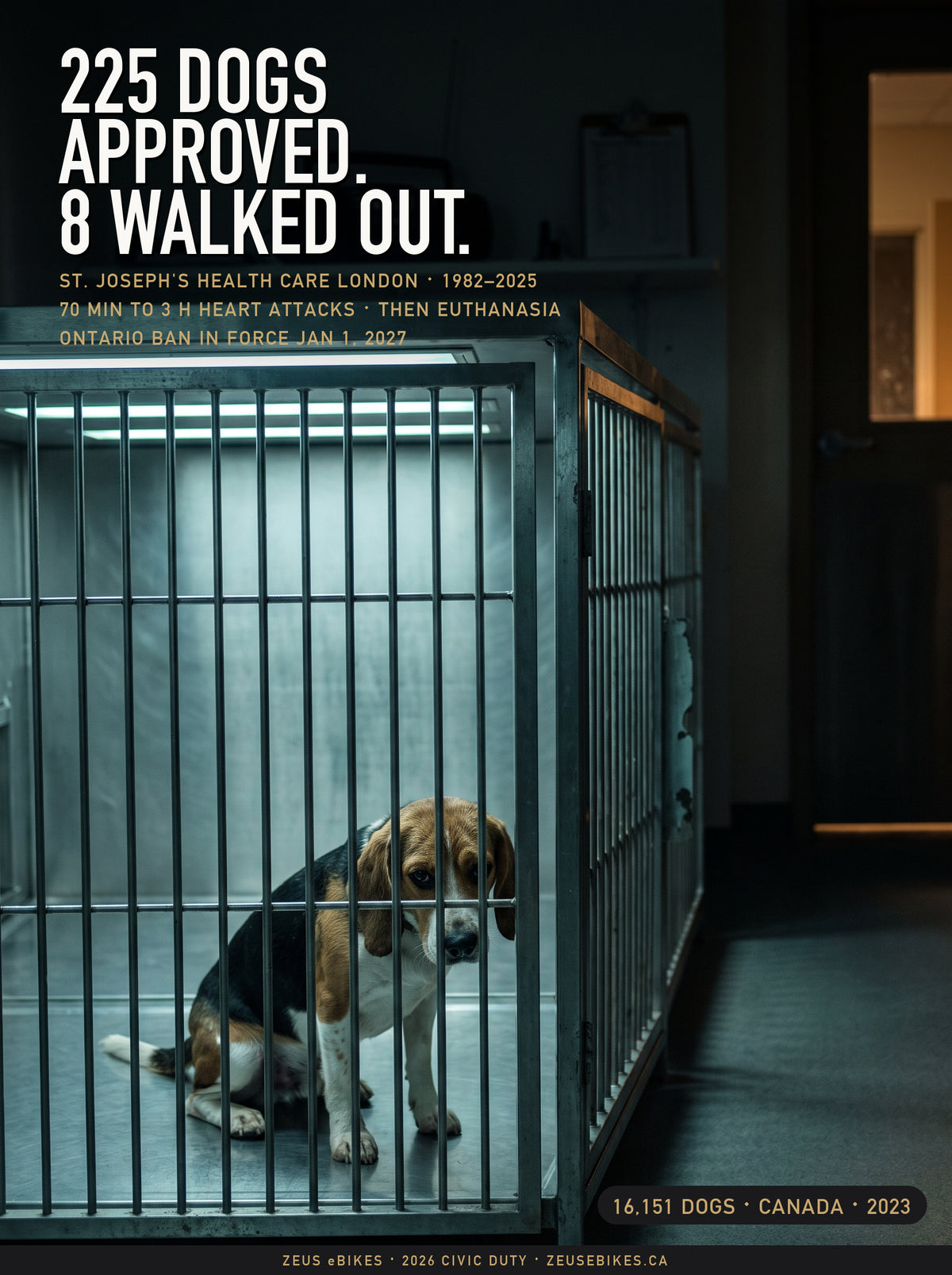
Photo illustration created with Playcut AI from the whistleblowers' published descriptions. It is not a photograph of any named facility, person or dog. The figures in the type are from this article: the protocols the IJB reviewed approved 225 dogs over four years [1], and the eight dogs alive when the program closed were released from the lab for adoption [6] [5].
A note on this article's standing. This article will not be unpublished, altered or softened in response to any legal or official pressure, from any party, public or private. Every statement of fact on this page is tied to a numbered primary source, and the research file behind it has been preserved. Errors will be corrected on the page, with the date. Every person and institution named has a right of reply, set out at the foot of the page. Any demand to remove or change this page will itself be published here, in full, with our answer. Ontario's Courts of Justice Act directs a judge to dismiss a proceeding that arises from expression on a matter of public interest unless the plaintiff meets the tests in section 137.1(4), and on dismissal entitles the defendant to full indemnity costs unless the judge decides otherwise [19]. Zeus will rely on it.
Quick answer: For decades, researchers at the Lawson Research Institute inside St. Joseph's Health Care London induced heart attacks lasting 70 minutes to three hours in young dogs, imaged their hearts, then killed them and removed the hearts. The program was publicly funded, approved by Western University's Animal Care Committee, and kept out of sight: whistleblowers described blanket-covered crates, security guards at a back door and a radio turned up to hide the barking. The Investigative Journalism Bureau published the story on August 7, 2025. The hospital stopped the dog research four days later, the head of the institute left within a week, and Premier Doug Ford promised a ban. Four reviews later said every rule had been followed. Ontario's Bill 75 passed on May 14, 2026 and takes effect on January 1, 2027. It bans invasive medical research on dogs and cats, with exceptions, and leaves imports and pound sales legal. A Scarborough lab sued to strike it down on September 25, 2026. This is the whole record, name by name, with every source linked.
How this was researched: We read the primary record rather than the coverage of it: fourteen Investigative Journalism Bureau stories from August 7, 2025 to May 15, 2026 and the National Post co-publication; Animal Justice's exposé and its committee testimony; all four reports St. Joseph's published on February 19, 2026 (the third-party panel, Western's Animal Care Committee concern report, the Canadian Council on Animal Care's special assessment and the Ontario ministry's inspection report); the hospital's own statements of August 11, September 10 and February 19; the enacted statute (S.O. 2026, c. 7, Schedule 1) and the three June 2026 regulations on e-Laws; the Hansard of November 25, December 9 and December 11, 2025, and March 24, March 25 and May 14, 2026; the Justice Policy committee transcripts of April 15 and 23, 2026, including every recorded vote on every amendment; the recorded second-reading division; the CCAC's own animal-data reports for 2020, 2023 and 2024; NSERC's open award data for fiscal years 2020 to 2024; a PubMed search of the lead researcher's canine papers; and the Nucro-Technics notice of application as filed, read in full. Every quotation below appears verbatim in a saved copy of its source, checked by script before publication. Where the record contradicts itself, both versions are printed. Where we could not find something, we say so in the limitations section. Numbered references in brackets point to the sources list at the end. Research completed October 9, 2026.
In this article
- What happened on the secret sixth floor
- The numbers the hospital gave, and the ones it declined to give
- Four reviews said the rules were followed. Read what else they said.
- Every name on the record
- Who paid
- What Ontario's law now says, section by section
- Nine loopholes, and who voted to keep them
- The ban goes to court: Nucro-Technics v. Ontario
- Where the eight dogs are, and what still happens on the sixth floor
- What a Canadian can do this week
- Frequently asked questions
- Chronology
- What this article could not verify
- Sources and notes
What happened on the secret sixth floor
On September 25, 2026, a Scarborough contract-research company asked the Ontario Superior Court to strike down the province's new ban on invasive research on dogs and cats, 98 days before it takes effect [15]. The ban exists because of what two hospital staff in London, Ontario, decided to document. If the court pauses it, the dogs lose the only statute in Canada that bans invasive research on them.
This article walks the entire record so that you can judge it yourself: the lab, the people, the reviews, the statute, the loopholes and the lawsuit.
Start where the IJB's reporters started, at a receiving door behind St. Joseph's Hospital at 268 Grosvenor Street [6]. An unmarked white van pulls up. Three security guards stand around it. People in scrubs wheel carts carrying boxes the size of dog crates, each covered with a blanket, through a side door and up an elevator to the sixth floor. The IJB obtained video of this in April 2025. "We have to call security to come and guard the entrance," one staff member told the reporters. "There'll be at least five or six of them surrounding everything, making sure no one enters the vicinity." [1]

The arrival, as the IJB's April 2025 video described it: an unmarked van, a side door, carts, blankets over the crates. Photo illustration created with Playcut AI; not a photograph of any named facility.
Under the blankets were dogs, as young as 10 months and as old as two years when they arrived from U.S. breeders, by the IJB's account; Animal Justice's exposé says some arrived at eight months [1] [5]. One of the hospital's suppliers, by its own account to the IJB, was Marshall BioResources of upstate New York; the last purchase was in 2022 [4]. Animal Justice's exposé, built on the two whistleblowers' accounts, says the dogs arrived "in unventilated vans, often covered in feces and vomit." [5] "We turn the radio on as loud as we can when we're in there," one staffer said. Inside the hospital, people called the facility the "secret sixth floor," the IJB reported [1].
"We're not even allowed to throw animal food bags into the regular garbage. We conceal them in other bags so no one knows we have animal food."
A Lawson staff member, speaking to the Investigative Journalism Bureau on condition of anonymity, August 2025
What was done to the dogs is not in dispute. It is written in the study protocols that Western University's Animal Care Committee approved and the IJB reviewed, about 100 pages of them [1]. Researchers opened the chest and blocked blood flow to part of the heart, starving the muscle of oxygen. The induced heart attacks lasted between 70 minutes and three hours. Dogs then went into the hospital's MRI and PET scanners, the same machines used on patients one floor below, and were monitored, often for weeks. Then they were euthanized and their hearts removed for study. While the dogs were meant to survive the initial heart attack, the protocol notes said up to half would not. The protocol also listed what staff should watch for afterwards: "stroke and/or respiratory distress" and a "tense body position, i.e., tucked in abdomen, not eating/drinking, depressed, limping." [1]

The procedure, as the approved protocols describe it: under anaesthesia the chest was opened and blood flow to part of the heart was blocked for between 70 minutes and three hours, and by the protocol's own estimate up to half of the dogs would not survive it [1]. Photo illustration created with Playcut AI; not a photograph of any named facility, person or dog.
The two whistleblowers, given the names Alex and Jesse by Animal Justice, described the recovery. Alex: "That is the most traumatic thing I've ever seen. It's 24-7 constant whimpering. And [her cries] would not sound like regular dog cries. They would sound like a human screaming." [5] The IJB obtained a video of a dog lying motionless after a procedure, "whimpering in high-pitched whistle tones." Photographs the staff said they took show dogs in metal-barred cages with no visible beds, in some cases with feces. "They're scared, they're alone for 23 hours every day," a staffer said [1].

Afterwards. The protocol told staff to watch for a "tense body position, i.e., tucked in abdomen, not eating/drinking, depressed, limping" [1]; the whistleblowers described a dog left alone after her surgery, whimpering and repeatedly submerging her head in her water bowl [5]. Photo illustration created with Playcut AI; not a photograph of any named facility or dog.
Animal Justice's exposé lists the behaviours the staff saw in dogs living that way: pacing, tail sucking, repeatedly dunking their faces in water. Jesse: "Some dogs just run in circles until their enclosures are painted in feces." The exposé says some dogs "suck their tails raw." [5] Western's committee would later report that the veterinary records contain no instance of a dog examined or treated for a tail injury of that kind [6]. Both statements are on the record; the reviews section prints the committee's full answer.

The room, as the staff described it: metal-barred cages with no visible beds, a radio turned up to hide the barking, and dogs that were, in one staffer's words, "scared" and "alone for 23 hours every day" [1]. Western's committee answered that all the dogs have beds and are with other dogs around the clock; both accounts are in the reviews section. Photo illustration created with Playcut AI; not a photograph of any named facility or dog.
Salt and Sugar. Two dogs were cage-mates. Sugar died during her induced heart attack. Salt, the whistleblowers told Animal Justice and later the legislature, was left alone in the cage after her own surgery, whimpering and repeatedly submerging her head in her water bowl. About two months later Salt was killed, and her body was placed in a barrel with other dogs for disposal [5]. When Animal Justice accepted a Lush Prize in the United Kingdom in May 2026, Camille Labchuk dedicated it to Salt, who "was part of the inspiration for the whistleblowers to come forward and tell their stories." [9]
The end of the process is the part the staff found hardest to carry. After death, the carcasses went into garbage bags and then into large barrels in a freezer. A photograph the IJB published shows a barrel labelled "Subject name: Croissant, Toast, Rye and Bagel." A staffer confirmed those were the names of the euthanized dogs inside. "They pile the dog bodies on top of each other, keep them there until the barrel is completely full, and then ship it off," the staffer said. "It's not just distressing, it's emotionally abusive, and it takes a toll on everyone." [1] The animal-care staff who fed the dogs and earned their trust were also the people who had to kill them. Alex, to Animal Justice: "They're having potlucks on the same day they're euthanizing these dogs […] The dogs don't get a pizza party before you kill them." [5]

After death, by the staff's account: garbage bags, then barrels in a freezer. The barrel in the photograph the IJB published was labelled "Subject name: Croissant, Toast, Rye and Bagel." [1] The tape in this illustration is blank. Photo illustration created with Playcut AI; not a photograph of any named facility.
One dog, Jesse said, was considered for adoption, and the staff let themselves hope. "Everyone got their hopes up. All the staff loved this dog so much […] Then one day they were just like, 'We're actually just going to kill her anyways." [5] St. Joseph's later told the IJB that 13 dogs had been rehomed over the life of the program and that "No dogs have been eligible for rehoming in the past 5 years." [1]
Four days after the story ran, on Monday, August 11, 2025, the hospital posted a 130-word update. "Following consultations with the province, St. Joseph's will immediately cease research studies involving dogs." It added that the research "adheres to the highest standards of, and is in compliance with, all scientific and ethics protocols." [6] Eight dogs were on the floor that day. One whistleblower told the IJB: "Some of them are completely healthy. They haven't even had their heart attack yet. But even the ones that've had heart attacks deserve a long life. One dog was supposed to be euthanized in a couple of weeks, so this came at the perfect time." [2]
What the record establishes: induced heart attacks of 70 minutes to three hours, death for up to half during the procedure by the protocol's own estimate, weeks of imaging, then euthanasia and removal of the heart. Those facts come from the approved protocols, and no review disputed them. What is contested is the dogs' housing, pain management and daily care, and the reviews section gives both sides at full strength.
The numbers the hospital gave, and the ones it declined to give
The hospital's public figures do not reconcile with its own protocols, and it declined to provide the one number that would settle it. St. Joseph's told the IJB that 15 "adult" dogs were killed annually. The protocols the IJB reviewed approved 225 dogs over four years [1].
A November 2024 document obtained by CTV requested 217 animals over four years [8]. Asked for the total killed over five years, the hospital declined to answer [1].
Asked to explain the gap between 15 a year and 225 over four, the hospital said it had improved "processes" that resulted in using fewer animals. The Canadian Council on Animal Care also declined to disclose how many dogs it had approved for St. Joseph's. "We want to bring more transparency, so we're pushing institutions to…disclose," Pierre Verreault, the council's executive director, told the IJB [1].
The hospital did offer one number of its own. Its written statement said: "It is estimated that more than 10,000 patients benefit annually for every dog included in this research." The figures, it said, are based on "our researchers' expert analysis of the prevalence of heart disease, our clinical experience and the subsequent impact of research findings to evolve diagnosis and treatment." Charu Chandrasekera, founder of the Canadian Centre for Alternatives to Animal Methods and of the Canadian Institute for Animal-Free Science, and a former cardiovascular researcher who worked with mice, told the IJB: "It's scientifically and statistically implausible to make such a claim" [1]. A research-group email quoted in Western's committee report goes further, arriving at "about one million human patients" per euthanized dog, from its own count of 35 dogs euthanized for the 1992 paper and 100 more by 2006, against "100 million cardiac patients" it says have benefited since [6].
Canada's national numbers are published by the CCAC, a non-profit that certifies institutions receiving federal research funding. Its reports give the number of dogs used in science at certified institutions [12]. They say nothing about private labs that are not certified, and nothing about which institution used which animals.
| Measure | Figure | Source |
|---|---|---|
| Dogs used in science at CCAC-certified institutions, 2020 | 8,338 | CCAC Animal Data Report 2020 [12] |
| Dogs, 2023 | 16,151 | CCAC Animal Data Report 2023 [12] |
| Dogs, 2024 | 9,252 | CCAC Animal Data Report 2024 [12] |
| All animals, 2024 | 3,706,907 | CCAC Animal Data Report 2024 [12] |
| Animals in the most invasive category (E), 2024 | 98,441 (2.6%) | CCAC Animal Data Report 2024 [12] |
| Dogs used across the European Union, 2022 | fewer than 9,000 | IJB, August 7, 2025 [1] |
| Dogs imported into Canada from the U.S. for research, 2019 to 2025 | more than 17,800 | Canada Border Services Agency data obtained by the IJB [4] |
| Dogs and cats as a share of animals in CCAC categories D and E | 0.27% | Ontario SPCA testimony citing the CCAC [10] |
Dog counts are the CCAC's own figures for certified institutions in each calendar year. The CCAC warns that year-to-year comparisons are affected by external factors, and that private laboratories without certification are not included.
Two structural facts sit under all of these numbers, and both come from the CCAC itself. First, there is no federal law regulating animal welfare in research; the CCAC sets standards but, as Verreault told the IJB, "There's nothing that stops an institution in the private sector from conducting [animal] science without being certified," and private labs can opt out. Second, the council does not review the ethics of individual studies. "There are no ethics reviews [by the CCAC]," said Andrew Fenton, co-chair of its ethics guidelines development committee. "That means that ethics is not a part of the funding decision." Verreault confirmed the CCAC did not review the ethics of St. Joseph's dog studies, and said that in his eight years it had revoked an institution's certification once [1]. The CCAC's standards for dogs, the IJB reported, were last updated in 1984 [3].
The denominator problem: every national figure above counts only certified institutions in a voluntary system. The true number of dogs used in Canadian laboratories is not knowable from public data, and the hospital at the centre of this story declined to say how many it killed.
Four reviews said the rules were followed. Read what else they said.
Every review found the research compliant with the Animals for Research Act and CCAC standards, and every review also found something the hospital's summary did not headline: a concern raised in November 2023, decisions made without the oversight committee, a 2013 agreement that had lapsed into ambiguity, and an inspector's note about the music [6].
The reviews answer whether the rules were followed. They do not answer whether the rules were enough.
| Review | Who and when | Headline finding | What else it recorded |
|---|---|---|---|
| Ontario ministry inspection | Ministry of Agriculture, Food and Agribusiness, Animal Health and Welfare Branch; inspected August 15, 2025; report sent December 31, 2025 | "in accordance with the Animals for Research Act"; purpose of inspection: complaint; species in facility: dogs, pigs and rats | Several standard operating procedures last updated in 2019 or 2020 and overdue for three-year review; "Music provided for enrichment should be on a timer so it can be shut off overnight"; a suggestion that the research team record its daily interactions with the animals |
| Western University Animal Care Committee concern report (C-119) | Three Western veterinarians, one research scientist, the committee's office manager and its chair; September 2025 | "All of the animal welfare allegations levied against the research team and facility workers were found to be unsubstantiated" | The dogs "were all sexually mature"; beds exist but were "out of view in the photos or not recognized by the public as beds"; the whimpering is "akin to post-anesthesia delirium" or opioid dysphoria; infarcts averaged about 20% of left-ventricular volume; the hospital "could have done more to communicate" |
| CCAC special assessment | CCAC Associate Director of Assessment; visit October 2025; serious recommendations due February 17, 2026 | "did not identify any issues related to animal care and use or infrastructure" | "Lawson did not comply with CCAC and institutional policies regarding the authority of the Animal Care Committee, as decisions regarding the use and fate of the dogs were made without consulting the committee"; one employee "had raised concerns regarding dog husbandry in November 2023"; anonymous reporting options were lacking |
| Third-party review panel | Commissioned and hosted by St. Joseph's and Lawson; on site December 16, 2025; report signed February 16, 2026 by Dr. Brad Wouters and Dr. Badru Moloo of UHN, Dr. Maria Terricabras Casas of Sunnybrook, and Martin Cole, a past senior inspector with the Ontario Humane Society | "no evidence of non-compliance"; "allegations of mistreatment were unfounded"; canine models "scientifically well-justified" | "deficiencies in clarity of roles, institutional approval processes, and coordinated communication"; an "outdated 2013 Memorandum of Understanding"; the hospital had "no institutional strategy for communicating" its animal research to the public; swine models "are being actively adopted" |
All four documents were published by St. Joseph's on February 19, 2026 and are linked in reference [6]. Quotations are verbatim from the documents.
The committee's answers to the whistleblowers deserve to be read in full, because they are the strongest case for the lab. On the cages: "All the dogs have beds – two types are provided," made of materials dogs cannot shred and eat, and chosen because the dogs soil their kennels and absorbent bedding would foul them. On isolation: "Dogs are not alone – they are with their conspecifics 24/7." On the vocalizing after surgery: it "is even observed in dogs that have had anesthesia with no invasive procedure." On the heart attacks: "during which dogs are fully anesthetized and free of pain, are up to three hours in length, which aligns with the approved Animal Use Protocol." On deaths during surgery: "Mortality rates disclosed within the approved AUP are aligned with reality." [6] "We found that the dogs were well cared for, there was lots of post-operative care, it was really a pristine program," the committee's chair, Arthur Brown, told CBC [7].
Read what the same documents concede. The CCAC found that Lawson's administrators did not understand the committee's role and made decisions "without consulting the committee." It found an employee had raised concerns about the dogs' husbandry in November 2023, 21 months before the exposé, was invited to file a formal report and did not. The panel found the hospital and the university had been operating under a 2013 agreement that left ambiguity over "Institutional authority and approval of animal studies at the hospital level, distinct from ACC approval." And the provincial inspector, on a complaint visit eight days after the story ran, wrote that the music should be on a timer so it could be shut off overnight [6].
Two readings of the same floor. The whistleblower Alex, to CTV on March 24, 2026: "This was never about whether the rules or the regulations were followed. The root of the issue is the outdated guidelines themselves" [8]. Eddie Clutton, chair of veterinary anaesthesiology at the University of Edinburgh and himself an animal researcher, on Western's committee reviewing its own decades of approvals: it amounts to "someone marking their own homework". A former director of Western's Department of Animal Care and Veterinary Services told the IJB that veterinary oversight every four hours "was not happening" in the years they were involved, and that "Veterinarians would say they wouldn't board their own dogs in a place like that." Western did not respond to the IJB's repeated interview requests for that story [4].
Dr. Frank Prato, who founded Lawson's imaging program and led the dog studies, gave his first interview to CBC London in February 2026 after the committee and the CCAC cleared his lab. "The dogs are fully anesthetized. Unlike a human, who will suffer great pain during a heart attack, dogs don't suffer at all." [7] On a follow-up radio interview he said of the whistleblowers: "They are not whistleblowers. We were not doing anything wrong. They were snitches." [4] He said he began using dogs to study what happens after a heart attack in 1982, that the animals' blood-vessel architecture makes the dog "the only model to properly study this technology," and that "now, we're talking about one dog life being worth more than a million patients." [7]
Clutton's reply, through the IJB: dogs do not suffer during the occlusion, but "they will as soon as they recover (from the anesthesia)." Because the chest is surgically opened, "unless managed properly and intensively, that's going to be a major cause of post-operative discomfort and suffering." And on the model itself: "The dogs we're talking about in laboratories have perfectly healthy hearts until someone blocks them off, so the idea that they make a fantastic model is immediately challengeable." [4] Andrew Fenton, the Dalhousie philosopher who sits on CCAC guideline committees, told CBC the dogs were young while most heart patients are old, and that the question "Was this necessary?" remains open [7].
"I got to know each of these dogs individually. I saw their personalities take shape. I earned their trust. And then I saw every one of them be killed," Alex said.
Alex, whistleblower, CTV News, March 24, 2026
How to hold both: the reviews establish that the lab met Canada's standards for research dogs. The whistleblowers, the inspector's music note and the CCAC's governance findings establish what those standards tolerate: a three-hour induced heart attack, a protocol that expects up to half the dogs to die, and euthanasia at the end for every survivor. Ontario's legislature read both and decided the standards were the problem.
Every name on the record
Forty-six people appear in the public record of this story in an official or professional role, 44 by name and two by pseudonym, and the first table below lists each one with what the record shows and where. A second table lists the 28 author names on the published canine studies (the indexing may list one person twice), and a third names the 16 others who spoke on the record. Nobody on this list has been found by any court, regulator or review to have broken a law or a research standard.
Private individuals are named only as the public record already names them, and the two whistleblowers are identified only by their pseudonyms.
Naming rule for this article. Institutions and officials are named for what they did in public roles. Researchers and administrators are named from their own public statements, publications and institutional pages. Legislators are named from Hansard and the committee record, which are public by law. No reader should contact any individual named here; the right of reply is at the foot of the page, and corrections will be published.
| Name | Role | What the record shows | Source |
|---|---|---|---|
| Dr. Frank S. Prato | Founder of Lawson's imaging program; lead researcher of the dog studies; professor of medical biophysics, Western | Says he began using dogs for post-heart-attack research in 1982; PubMed lists 39 papers with his name and a canine or dog model, 1985 to 2026; told CBC the dogs "don't suffer at all" and called the whistleblowers "snitches"; cleared by Western's committee and the CCAC | [7] [4] [13] |
| Dr. Gerald Wisenberg | Imaging Research Program, Lawson Health Research Institute (PubMed affiliation) | Co-author on 27 of the 39 canine papers with Prato, from 1985 (Circulation) to 2024 | [13] |
| Dr. Lisa Porter | Vice-president of research and scientific director, Lawson, until August 2025 | Told staff on August 7, 2025, per an audio recording obtained by the IJB, that the dogs "are heroes, born and bred to serve in research" and that protocols "are not meant for the public because the public doesn't understand the science," and that, if identified, the whistleblowers would be fired: "It's a complete breach of confidentiality. We've already checked with legal," she told the room. The hospital announced on August 14, 2025 that she was no longer with St. Joseph's; no reason was given | [2] [8] |
| Roy Butler, PhD | President and CEO, St. Joseph's Health Care London | Announced the third-party review and a "transition plan" for researchers on August 14, 2025; said in March 2026 that "our other animal research continues"; co-signed the February 19, 2026 release of the reviews | [2] [8] [6] |
| Jeremy Burton, PhD | Interim vice-president, research, and scientific director, Lawson | Co-signed the February 19, 2026 statement releasing the reviews | [6] |
| Steven Back | Manager of research operations, Lawson | Author of the April 12, 2025 staff email the IJB reported, which said "confidentiality is critical" and forbade "discussing your day" in the cafeteria | [1] |
| Dr. Arthur Brown | Chair, Western University Animal Care Committee | Signed the concern report finding every allegation unsubstantiated; told CBC it "was really a pristine program"; wrote to colleagues that the province's response "was issued without the benefit of expert consultation" | [6] [7] |
| Pierre Verreault | Executive director, Canadian Council on Animal Care | Confirmed the CCAC did not review the ethics of the St. Joseph's studies and has revoked certification once in his eight years; later said the CCAC "does not believe that Ridglan is a reputable supplier" | [1] [3] |
| Dr. Andrew Fenton | Dalhousie philosopher; co-chair, CCAC ethics guidelines development committee | "There are no ethics reviews [by the CCAC]"; asked whether the dog model was necessary | [1] [7] |
| Dr. Brad Wouters, Dr. Badru Moloo, Dr. Maria Terricabras Casas, Martin Cole | Third-party review panel | Signed the panel report February 16, 2026. Wouters is UHN's executive vice-president of science and research and Moloo heads UHN's Animal Resource Centre; UHN told the IJB it bought beagles from Marshall BioResources for a study conducted in 2019 and stopped all dog research in 2020 | [6] [4] |
| Hon. Doug Ford | Premier of Ontario | "Deeply disturbed" (Aug 11, 2025); "stop before I catch you" (Aug 12); "You aren't going to use pets – dogs or cats – to experiment on any longer" (Aug 25); voted Aye at second reading | [2] [7] [9] [10] |
| Hon. Michael S. Kerzner | Solicitor General; sponsor of Bill 75 | Introduced the bill November 25, 2025; told committee that the aim "is ban invasive medical research on dogs and cats and prohibit the breeding." Nucro-Technics now quotes the line in court | [10] [15] |
| Hon. Trevor Jones | Minister of Agriculture, Food and Agribusiness, whose ministry administers the Act | "This legislation is aimed at invasive procedures," and "We will not tolerate inhumane treatment of any animal." | [3] |
| Spencer Fair | Press secretary, Ministry of Agriculture, Food and Agribusiness | Said the province expected "the federal government to ensure its funding recipients operate ethically, transparently, and in accordance with Ontario law" | [8] |
| Tyler Allsopp (Bay of Quinte), Monica Ciriello (Hamilton Mountain), George Darouze (Carleton), Silvia Gualtieri (Mississauga East—Cooksville), Stéphane Sarrazin (Glengarry—Prescott—Russell), all PC | Justice Policy committee members | Voted Nay on every opposition amendment to Schedule 1 on April 23, 2026, including the amendments to end pound sales to labs and to require rehoming; Ciriello said a pound framework "can be done by regulation following further consultation" | [10] |
| Karen McCrimmon (Liberal, Kanata—Carleton; committee vice-chair), Jennie Stevens (NDP, St. Catharines) and Kristyn Wong-Tam (NDP, Toronto Centre) | Justice Policy committee members | Moved and voted Aye on the amendments to strike "medical," mandate rehoming and end pound seizure; all lost 3 to 5 | [10] |
| Lorne Coe (PC) | Chair, Standing Committee on Justice Policy | Presided over clause-by-clause; Schedule 1 reported without amendment | [10] |
| Aislinn Clancy (Green) | MPP, Kitchener Centre | The lone Nay at second reading on March 25, 2026 (105 to 1). In the Hansard we read, her objections were to the bill's bail and justice provisions; we found no statement by her against Schedule 1 | [10] |
| Alexa Gilmour (NDP), Lucille Collard (Liberal) | MPPs | Gilmour raised the import loophole in the House; Collard asked the Solicitor General about non-animal methods in committee | [10] |
| Camille Labchuk | Lawyer; executive director, Animal Justice | Received the whistleblowers in early 2025 and connected them to the IJB; testified April 15, 2026; Animal Justice intends to seek leave to intervene in the Nucro-Technics case | [9] [10] [5] |
| Dr. Charu Chandrasekera | Founder, Canadian Centre for Alternatives to Animal Methods (now the Canadian Institute for Animal-Free Science) | "Dogs share our homes — not our physiology."; called the 10,000-patients-per-dog metric "scientifically and statistically implausible" | [1] [4] |
| Dr. John Pippin; Dr. Nicholas Dodman; Dr. Eddie Clutton | Cardiovascular surgeon (Physicians Committee for Responsible Medicine); Tufts professor emeritus; Edinburgh veterinary anaesthesiologist | "Dogs are not 50-pound humans"; "totally unacceptable"; "marking their own homework" | [1] [2] [4] |
| Prof. Angela Fernandez | Director, Animal Law program, University of Toronto | Said the bill needs an import ban and that committees "can determine that the experiments are not 'invasive'" | [3] [4] |
| Lori Cohen | Founder, The Beagle Alliance | Offered foster homes in London and Toronto; "We haven't heard anything since" | [2] |
| Drew Woodley | Director of government relations, Ontario SPCA and Humane Society | Testified that pound sourcing "must be removed" and that the PAWS Act exemption for labs should end | [10] |
| Michelle Pitt | Former research assistant, London Health Sciences Centre | Says 13 dogs arrived from St. Joseph's in 2002 for heart experiments, caged without beds 23 hours a day; "It will haunt me for the rest of my life" | [2] |
| Mackenzie Kirschner, Jesse Bell | Organizers, Release the Dogs (London) | Organized the December 2025 protest asking where the dogs went; present at the March and August 2026 protests | [8] [9] |
| Jenna Olsen, Robert Cribb, Masih Khalatbari, Stacey Kuznetsova | Investigative Journalism Bureau, University of Toronto, with Postmedia | Reported the original story and its follow-ups; Olsen was a fourth-year journalism student when the story ran | [1] |
| "Alex" and "Jesse" | Whistleblowers; Lawson animal-care staff | Pseudonyms assigned by Animal Justice for their safety. One has since left the lab. Premier Ford called one of them "a champion" | [5] [4] [9] |
The scientists on the published canine studies
Authorship is public record. A PubMed search for the lead researcher's name with a canine or dog model returns 39 papers between 1985 and 2026; the 28 author names below appear on at least three of them [13]. Authorship indicates participation in the published research and nothing more; no co-author is the subject of any finding by any review or regulator.
| Co-author (as indexed by PubMed) | Canine papers with Prato, of 39 | Years |
|---|---|---|
| Wisenberg, G | 27 | 1985 to 2024 |
| Sykes, J | 26 | 1996 to 2025 |
| Butler, J | 9 | 2015 to 2024 |
| Wilk, B | 8 | 2019 to 2026 |
| Stodilka, RZ | 8 | 2005 to 2013 |
| Blackwood, KJ | 7 | 2006 to 2015 |
| Thiessen, JD | 6 | 2015 to 2025 |
| Sullivan, R | 5 | 2019 to 2025 |
| Kovacs, M | 5 | 2020 to 2025 |
| Pereira, RS | 5 | 1996 to 2001 |
| Dharmakumar, R | 4 | 2020 to 2026 |
| Biernaski, H | 4 | 2020 to 2025 |
| Thornhill, RE | 4 | 2001 to 2022 |
| Deans, L | 4 | 2010 to 2013 |
| Zabel, P | 4 | 2005 to 2010 |
| Carroll, SE | 4 | 1985 to 1992 |
| Yang, HJ | 3 | 2020 to 2026 |
| Hicks, J | 3 | 2022 to 2025 |
| Smailovic, H | 3 | 2022 to 2023 |
| Kovacs, MS | 3 | 2010 to 2022 |
| deKemp, RA | 3 | 2010 to 2019 |
| Mitchell, AJ | 3 | 2010 to 2013 |
| Sabondjian, E | 3 | 2010 to 2013 |
| Lekx, KS | 3 | 2004 to 2010 |
| Wells, RG | 3 | 2005 to 2010 |
| Kong, H | 3 | 2005 to 2009 |
| Moran, GR | 3 | 2002 to 2004 |
| Turner, KL | 3 | 1985 to 1988 |
Method: PubMed esearch, author "Prato FS" AND ("canine" OR "dog" OR "dogs" in title/abstract), run October 9, 2026; author lists from esummary; counts are of papers rather than of dogs. The indexing merges initials, so "Kovacs M" and "Kovacs MS" may be the same person.
Everyone else on the public record
| Name | Role | On the record | Source |
|---|---|---|---|
| Hon. Steve Clark (PC) | MPP, Leeds—Grenville—Thousand Islands and Rideau Lakes | Moved closure on May 14, 2026 ("I move that the question now be put."), after which third reading carried on division | [10] |
| Sana Halwani, Jonathan Chen, Evan Linn, Madison MacKinnon | Lenczner Slaght LLP, Toronto | Counsel for Nucro Technics Inc. on the notice of application. The company's website names no officers; its filing names only counsel | [15] |
| Alanna Devine | Lawyer; director of campaigns, Animal Justice | "We know there are serious questions about whether this research is needed or useful," (Aug 7, 2025) | [8] |
| Andy Adler | Canada Research Professor, Carleton University | Closed his lab, which tested stick-on monitoring electrodes on service dogs, after the Premier's "stop before I catch you": "I'm not taking any chances." | [7] |
| Brian Gover | Lawyer (Walkerton and Air India inquiries) | "I would urge the Premier to defer legislating in this area until there's been robust public debate on this issue," (March 2026) | [7] |
| Prof. Udo Schüklenk | Queen's University; Ontario Research Chair in Bioethics | "Surely what should matter, from an ethical perspective, is a particular animal's level of development, such as whether it can experience pain and suffering, not whether politicians have them as pets at home," | [3] |
| Dr. Ari Joffe | Clinical professor, pediatrics, University of Alberta | "The abuse of dogs and cats in harmful research has two problems: it is not morally permissible, and it has not and will not be predictive of human outcomes," | [3] |
| Dr. Naomi Charalambakis | Neuroscientist; Americans for Medical Progress (pro-research) | Called the St. Joseph's research "devastating, and we don't condone that." | [4] |
| Dr. Kerry Bowman | Bioethicist, University of Toronto | On importing from cited breeders: "We're colluding with a system that creates abuse and neglect, and that's very much a problem." | [4] |
| Prof. Georgia Mason | Behavioural biologist, University of Guelph | On CCAC dog standards last updated in 1984: "A 40-plus year lag is really pretty disgraceful, and reflects the tragic degree to which the CCAC is underfunded," | [3] |
| Wayne Hsiung | U.S. animal-rights activist; co-filed the 2024 Wisconsin petition against Ridglan Farms | Said that from 2018 onward there was "overwhelming evidence of abuse" at Ridglan | [3] |
| Jaasmaan Singh; Yanni Dagonas | York University student protester; York deputy spokesperson | On the macaque lab: "I look into their eyes and I feel ashamed for what we have done to these creatures," and, for York, "any suggestion that this research is unnecessary is without merit." | [4] |

After the vote. On April 23, 2026 the Justice Policy committee defeated every amendment to Schedule 1; the four recorded divisions were the same five names to three. Photo illustration created with Playcut AI; not a photograph of the committee room.
Who paid
The dog research was paid for with public money and charitable donations, and the public record lets you see part of it. NSERC's open award data lists $511,960 to Dr. Prato under two cardiac-imaging titles between fiscal 2020 and fiscal 2024, and $799,735 more under a bacteria-imaging title [13].

The research was cardiac imaging: the protocols sent the dogs into the hospital's MRI and PET scanners, the same machines used on patients one floor below, often for weeks [1]. NSERC's award records name the program and never the species [13]. Photo illustration created with Playcut AI; not a photograph of any named facility, person or dog.
The IJB identified more than $3 million in total funding to the lab's researchers from government and foundations, including the Heart and Stroke Foundation [2].
| NSERC award (recipient: Frank Prato, Western) | Program | Fiscal years | Total |
|---|---|---|---|
| Advances in Hybrid PET/MRI Cardiac Imaging (RGPIN-2020-04125) | Discovery Grant | 2020 to 2024, $34,000 a year | $170,000 |
| Motion Correction in Hybrid PET/MRI Cardiac Imaging (557043-2020) | Alliance Grant | 2020 to 2022 | $341,960 |
| Hybrid PET/MRI Biomedical Imaging of Bacteria (576699-2022) | Alliance Grant | 2022 to 2024 | $799,735 |
| All NSERC awards, FY2020 to FY2024 | $1,311,695 |
Source: NSERC Awards Data, Government of Canada open data portal, award files for fiscal years 2020 to 2024, filtered on the recipient's surname and read on October 9, 2026 [13]. The award record names the research program; it does not state which animals were used under each grant. The IJB reported that NSERC grants of nearly $500,000 since 2020 funded the dog studies [1], which matches the two cardiac titles here. Fiscal 2025 data was not yet published.
The Alliance grant's own summary explains why the imaging matters: "Some 500,000 cardiac patients per year have a cardiac imaging test to investigate the extent that blood flow has been reduced" in heart tissue [13]. Nobody in this story disputes that cardiac imaging saves lives. The committee report credits the lab's delayed-contrast MRI method with "greater than ten million scans world-wide" each year [6]. The dispute is whether, in 2025, that work still required opening the chests of healthy young dogs, and whether a public hospital may do it behind a blanket.
Follow the money yourself: NSERC's award files are public CSVs. Search any researcher's name, and the title, program and dollar amount of every award is there. What is not there is the species. Canada's funders publish the money and not the animals.
What Ontario's law now says, section by section
Ontario is the first province to prohibit invasive medical research on dogs and cats. The prohibition is section 15.1 of the Animals for Research Act, added by Schedule 1 of the Keeping Criminals Behind Bars Act, 2026, which received Royal Assent on June 2, 2026 and comes into force on January 1, 2027 [11].
It carries exceptions, a one-year transition for research already under way, and penalties of up to $1,000,000 for a corporation.
| Date | Step | Record |
|---|---|---|
| November 25, 2025 | Bill 75 introduced by Solicitor General Michael Kerzner; Schedule 1 amends the Animals for Research Act inside a justice omnibus bill | Hansard; OLA bill status [10] |
| December 9 and 11, 2025; March 24, 2026 | Second reading debate | Hansard [10] |
| March 25, 2026 | Second reading carried, 105 Ayes to 1 Nay | OLA recorded vote [10] |
| April 15, 2026 | Committee hearings: Solicitor General, Ontario SPCA, Animal Justice and others | Justice Policy committee transcript [10] |
| April 23, 2026 | Clause-by-clause; every amendment to Schedule 1 defeated; reported without amendment | Justice Policy committee transcript [10] |
| May 14, 2026 | Third reading carried on division after a closure motion by Steve Clark | Hansard [10] |
| June 2, 2026 | Royal Assent; Statutes of Ontario 2026, chapter 7 | OLA [10] |
| June 18 and 22, 2026 | O. Reg. 191/26, 192/26 and 193/26 made and filed; "invasive medical research" defined | e-Laws [11] |
| January 1, 2027 | Schedule 1 in force by order in council; the regulations come into force the same day | e-Laws consolidation notes; O. Reg. 191/26 s. 11 [11] |
The operative sentence is short. Section 15.1(1): "No person shall perform invasive medical research on cats, dogs or other prescribed animals." Section 3.1: "No operator of a supply facility shall breed cats or dogs for research purposes." [11] The regulation defines "invasive medical research" as research where any of the following "is expected or reasonably anticipated to occur": removal of organs or limbs; "Opening up the animal's thoracic cavity"; changes causing complete dysfunction of an organ or limb; methods "which cause moderate to severe distress or discomfort"; procedures "which cause severe pain near, at or above the pain tolerance threshold of unanaesthetised conscious animals"; or "The death of the animal." [11] On that definition, the St. Joseph's protocol would be caught three times over: the chest was opened, death was expected for up to half, and every survivor was killed at the end.
Then the exceptions. Section 15.1(2) permits invasive medical research at a registered facility if "the research is for a veterinary purpose set out in the regulations or is otherwise described in the regulations" and the operator submits a proposal meeting prescribed criteria, and "the animal care committee reviews the research project proposal and provides the operator of the registered research facility with its approval, in writing" under the Act's new review section. The regulation defines a veterinary purpose as research "primarily intended to further the scientific understanding of animal health or veterinary medicine", or as part of a veterinary program of study. Section 15.1(3) then requires committee approval for all other research on dogs and cats, invasive or not [11].
| Offence under section 21 | Individual, first offence | Individual, second or subsequent | Corporation, first | Corporation, second or subsequent |
|---|---|---|---|---|
| Major offence (includes s. 15.1 invasive research, s. 16 anaesthesia and analgesia, s. 20(5) and (6) pound destruction) | Up to $130,000, up to two years' imprisonment, or both | Up to $260,000, up to two years, or both | Up to $500,000 | Up to $1,000,000 |
| Minor offence (includes s. 3.1 breeding ban and any other contravention) | Up to $75,000, up to six months, or both | Up to $100,000, up to one year, or both | Up to $100,000 | Up to $250,000 |
Source: Animals for Research Act, s. 21 as substituted by S.O. 2026, c. 7, Sched. 1, s. 11 [11]. Nucro-Technics' own filing notes that before 2026 the maximum penalty under section 21 was $5,000 and six months [15].
Two dates matter more than the headline date. The regulation's transition rule says that for research a facility was already carrying out on the day of Royal Assent, the prohibitions begin to apply on the later of the in-force day and "the first anniversary of the day the Keeping Criminals Behind Bars Act, 2026 received Royal Assent." That anniversary is June 2, 2027. Research started between June 2, 2026 and January 1, 2027 is caught on January 1 [11]. And the breeding ban is a minor offence, with the lower fines.
What the law does: from January 1, 2027, an Ontario lab that opens a dog's chest, expects the dog to die, or kills it at the end commits a major offence unless the work is for animal health and an animal care committee has approved it in writing. What the law does not do is the next section.
Nine loopholes, and who voted to keep them
The legislature was told about every gap below before it voted, in writing and in testimony, and the committee defeated every amendment that was moved; each of the four recorded divisions was five votes to three [10]. The regulations made in June 2026 closed none of the gaps.
Four of the nine were the subject of recorded votes on April 23, 2026. The Ayes were Karen McCrimmon, Jennie Stevens and Kristyn Wong-Tam. The Nays were Tyler Allsopp, Monica Ciriello, George Darouze, Silvia Gualtieri and Stéphane Sarrazin. The other five gaps were raised in testimony or in the House and never reached a vote.
- Imports stay legal. Section 3.1 bans breeding dogs and cats for research in Ontario. It says nothing about buying them from Wisconsin or New York, which is where St. Joseph's and Nucro-Technics bought theirs [3] [4]. The IJB's border data counted more than 17,800 research dogs entering Canada from the United States between 2019 and 2025 [4]. Angela Fernandez: "Research facilities will continue to experiment on non-locally produced dogs and cats brought in from the U.S. and other provinces unless that loophole is closed." [3] Raised by Wong-Tam on December 11, 2025 and Gilmour on March 24, 2026; no import amendment was adopted [10].
- Pound seizure stays legal. Section 20(6)(c) of the Act still lets a pound sell an unclaimed dog or cat, after a three-day redemption period, to a registered research facility [11]. Labchuk told the committee: "We know around 12,000 lost or abandoned pet dogs and around 11,000 cats from 2012-16 alone were sold by pounds to labs for only $6 a dog and $2 for a cat." Ontario, she said, is "the only province with this mandate" in Canada. Two amendments to end it were moved on April 23. Ciriello, for the government: "Should the bill pass, a regulation could be made setting out a framework under which a pound could sell a cat or a dog to a research facility. So there is no need to support an amendment, as a desired chance can be done by regulation following further consultation." Both lost 3 to 5 [10]. The regulations made eight weeks later, O. Reg. 191/26, 192/26 and 193/26, contain no such framework; 192/26 changes the pounds regulation only to define euthanasia methods and record the method of destruction [11]. The Animal Alliance of Canada, on June 26, 2026: the regulations "do not close Ontario's long-standing pound-to-research pipeline." [14]
- The word "medical." The ban covers "invasive medical research" and nothing else. The CCAC recognizes five categories of animal use, and regulatory toxicity testing, in Labchuk's words "likely the worst category" of the five, is not medical research. McCrimmon moved to strike "medical" from sections 15.1 and 21; both motions lost on a show of hands [10].
- The committee that approved the dogs decides what is invasive. Under section 15.1(2) and the regulation, the facility's own animal care committee reviews the proposal and certifies the criteria [11]. Fernandez, in February 2026: "If the researcher denies, as Dr. Prato does here, that the experiments cause pain or claim that they cause only minimal pain, then the Animal Care Committee can determine that the experiments are not 'invasive' and they will likely be given a green," especially after decades of approving the same work [4]. Western's committee approved the St. Joseph's protocols for decades and then investigated them.
- The veterinary-purpose exception has no best-interest test. Fenton, who co-chairs the CCAC's ethics committee: "If it's going to be invasive and cause severe pain, it better be in the animals' best interests and promise them benefits. If it doesn't, they shouldn't be exposed to severe pain for veterinary medical research. That's missing from these regulations." [3]
- No duty to rehome. The regulation asks a proposal to state whether dogs or cats "could be suitable to be sold or gifted for use as pets" and to include a process "to facilitate those future uses where possible" [11]. Wong-Tam's amendment to require rehoming lost 3 to 5 [10]. The proposed regulation had included a ban on routine killing at the end of experiments with euthanasia for "humane reasons" only [5]; the final text we read on e-Laws contains no such clause [11].
- Research animals remain outside the PAWS Act. Section 1.1 of the Animals for Research Act keeps animals in registered research and supply facilities outside Ontario's general animal-welfare law, so the provincial animal welfare inspectors cannot enforce it there. Woodley asked the committee to narrow that exemption; it was not changed [10].
- A one-year grace period for research already running. The transition rule in O. Reg. 191/26 pushes the start date to June 2, 2027 for any research a facility was carrying out on June 2, 2026 [11].
- Everything that is not a dog or a cat. Pigs, rats, mice and primates are untouched unless prescribed by a future regulation. On the sixth floor the pigs and rodents remain [8]. At York University, macaques with metal head posts are the subject of a separate IJB investigation and a May 2026 protest [4].
"I would hate to think that somebody would have scooped up Creamers, brought little Creamers to the pound and then three days later, my cat would be carved up on some lab table."
MPP Kristyn Wong-Tam, moving the pound-seizure amendment, Standing Committee on Justice Policy, April 23, 2026
The honest summary: Ontario banned the specific thing that happened at St. Joseph's, when it is done for human medicine, by a facility that cannot persuade its own committee otherwise, after June 2027, to dogs that were not bought from a pound or a breeder in another jurisdiction. The qualifiers that reached a committee vote all lost; the rest were raised in testimony and left as drafted.
The ban goes to court: Nucro-Technics v. Ontario
Nucro Technics Inc., a contract research organization in Scarborough that describes itself on its website as Canada's largest privately held contract research organization [18], filed a notice of application in the Ontario Superior Court of Justice on September 25, 2026 asking the court to declare the breeding ban, the invasive-research ban, the related penalties and the regulation defining invasive research of no force or effect, and for "an interlocutory and final injunction staying the coming into force of the Ban" [15].
The hearing is to be in person at 330 University Avenue, Toronto, "on a day to be set by the Registrar." No date had been reported as of October 9, 2026.
The filing, by Lenczner Slaght LLP, makes four arguments. First, that the ban is criminal law in disguise: "The only purpose of the Ban is to enforce a moral or ethical position. There is no legitimate provincial purpose for the Ban." On that footing it is said to be ultra vires under section 91(27) of the Constitution Act, 1867. The application quotes the Premier's "Go with the mice, go with the rats, no problem" and the Solicitor General's committee testimony as proof of that purpose, and notes that Ontario "chose to seek to introduce the Ban through the Keeping Criminals Behind Bars Act, 2026." Second, that it conflicts with section 445.1 of the Criminal Code, which makes it an offence to wilfully cause "unnecessary pain, suffering or injury to an animal or a bird" [18], because Parliament "has drawn the line between lawful and unlawful treatment of animals at" unnecessary suffering, and the ban reaches suffering the company says is necessary. Third, that it creates an operational conflict with Health Canada's clinical-trial regime, under which the ICH guidelines "confirm the requirement for testing in two animal species, including a nonrodent species." It adds: "For certain drug categories, dog studies are practically required and are the most standard nonrodent species because dog physiology closely resembles that of humans." Fourth, interjurisdictional immunity. The application states that the company "supports and does not challenge the remainder of the amendments or the Act as a whole, including its requirements for animal welfare and review by animal research committees." It describes the applicant as an Ontario corporation in operation since the 1970s with "approximately 170 employees" and "approximately 500 clients, including more than forty of the fifty largest pharmaceutical companies in the world." It says "Some of its research involves testing on dogs, within the constraints of the existing Act, applicable standards, and appropriate industry practice." It also records a fact worth keeping: the Act "is unique in Canada" because "no other province has a statute that specifically regulates the use of animals for scientific research purposes." [15] Animal Justice "disagrees with the company's legal position" and intends to seek leave to intervene [5]. We did not find a public statement from Nucro-Technics, and the IJB reported the company did not respond to repeated interview requests, including a letter delivered by hand [3].
Counsel for the applicant
The notice of application is signed by Lenczner Slaght LLP of Toronto, a litigation firm, and names four lawyers for the applicant [15]. Court filings are public documents, and counsel of record are part of the public record of a case. The entries below are taken from the firm's own lawyer pages, read on October 10, 2026 [20]. Lawyers are not their clients: acting for a party in court is a professional duty rather than an endorsement of the party's conduct, and nothing here is a criticism of counsel. As with everyone on this page, no reader should contact them.
| Lawyer | Position and bar admission, per the firm | Practice, in the firm's words | Source |
|---|---|---|---|
| Sana Halwani | Partner; co-leads the firm's Intellectual Property group; Ontario bar 2005 | Practice areas listed as intellectual property, commercial litigation, public law, appeals and injunctions; patent experience "including pharmaceutical and biologics"; the page says she clerked for Justice Rosalie Abella of the Supreme Court of Canada and is a registered patent agent | [20] |
| Jonathan Chen | Partner; Ontario bar 2013, British Columbia bar 2024 | Practice described as focused on class actions, complex commercial business disputes, injunctions, product liability and professional negligence matters; clients listed include pharmaceutical manufacturers; chairs the firm's Innovation Hive | [20] |
| Evan Linn | Associate; Ontario bar 2023 | Practice areas listed as commercial litigation, construction and infrastructure, insurance, and professional liability and regulation; University of Toronto JD 2022, Yale BA 2018; listed as counsel for the defendants in a 2025 defamation claim struck as an abuse of process | [20] |
| Madison MacKinnon | Associate; Ontario bar 2025 | Practice areas listed as class actions, commercial litigation, competition and antitrust, defamation and media, employment, professional liability and regulation, and public law; Queen's University JD 2024 | [20] |
The record on Nucro-Technics itself is this. Published studies reviewed by the IJB describe beagles "humanely sacrificed" at the end of pharmaceutical studies, 30 in a 2019 prostate-cancer study and 15 in a 2020 study. Published studies place Ridglan Farms dogs in the company's studies between 2013 and 2021, the company's own 2019 purchasing procedure lists the Wisconsin breeder as a supplier, and hidden-camera footage that a whistleblower says was recorded in 2023 appears to show dogs arriving at the facility in a truck marked "Ridglan Farms". Former Ridglan employees testified in October 2024 to eye surgeries and vocal-cord cutting without anaesthesia; in January 2025 a Wisconsin judge found probable cause of multiple criminal violations and appointed a special prosecutor, and in October 2025 Ridglan agreed to surrender its breeding licence with "no admission of fault or criminal or civil liability." Ridglan has disputed the allegations, saying one former employee gave false testimony and that a January 2025 inspection by the U.S. Department of Agriculture found its operations in compliance with the federal Animal Welfare Act [3]. Last Chance for Animals released hidden-camera footage in December 2025 that it says was recorded inside Nucro-Technics in 2023 and shows dogs dosed by injection, gavage and mouth, collapsing and vomiting, and killed and necropsied at the end [14]. The CCAC opened a review of the company in late 2025; Verreault said the footage would form part of it, and that the CCAC "does not believe institutions in Canada should be procuring animals for science from this supplier." The company keeps its certificate during the review [3]. We found no published finding by any regulator against Nucro-Technics, and its filing is an application rather than a judgment.
Status, stated plainly: the law is enacted and dated. The challenge is filed and unheard. The CCAC review of Nucro-Technics is open with no published outcome. Ridglan settled without admission. None of this will be settled on January 1; the question is whether an injunction is granted before then.
Where the eight dogs are, and what still happens on the sixth floor
Eight dogs were alive on the sixth floor on August 11, 2025, six left it on September 10, 2025, and the last two were still there in March 2026. No institution has said where any of them is now, and the only report that all eight were adopted comes from the advocacy group that exposed the lab.
The six were transferred on September 10, 2025 to an organization the hospital and Western's Animal Care Committee refuse to name, describing it only as a "trusted and fully accredited organization" with "an adoption rate that is higher than 90 per cent." The name is withheld, the hospital said, "to protect the wellbeing of the dogs and to increase the willingness of people to adopt them," [6] [2]. The last two were still at the hospital on March 24, 2026; Western told CTV they "have been under the care of veterinarians and are doing well as we prepare them for adoption as well." [8] Animal Justice wrote on August 6, 2026 that the surviving dogs "have since been adopted" [5]. We found no public statement from the hospital or Western naming the organization, the adopters or the dogs' outcomes, and Animal Justice has filed a freedom-of-information request with the hospital for the transfer records [5].
The Beagle Alliance, the only Canadian rescue that specializes in dogs leaving laboratories, had foster homes ready in London and Toronto and entered discussions with Western's committee in August 2025. "We haven't heard anything since," its founder Lori Cohen said when the transfer was announced. The committee said the dogs were "best afforded this opportunity by relieving them of further public attention." [2] The protests continued, in December, in March and on the first anniversary, under one banner: release the dogs [8] [9].
The sixth floor is still a research animal facility. "Animal research will continue to be a critical part of the research we do here at Lawson. We did bring the research involving dogs to an end late last summer, but our other animal research continues," Roy Butler told CTV [8]. The provincial inspector listed the species on August 15, 2025 as dogs, pigs and rats [6]; the hospital told CBC that dogs, rodents, fruit flies and "other large mammals" were used [7]. Animal Justice says pigs in wound-healing trials are "isolated with large, open wounds down their backs," and quotes Alex: "They put more than a dozen holes on their backs… it's truly horrifying to see." [5] The IJB published a photograph taken by lab staff of pigs at the facility [1]. The hospital has said its remaining animal research meets "all ethical, legislative and regulatory standards." [8] No animal other than cats and dogs has yet been prescribed under the new section [11].
Open questions as of October 9, 2026: which organization received the dogs and whether all eight have been adopted; how many dogs the program killed in its last five years; what the hospital's "action plan" for the panel's recommendations contains; and what the CCAC's review of Nucro-Technics concluded. We will update this page when any of them is answered, and the right of reply below is open to every institution named.
What a Canadian can do this week
The ban is law, the loopholes are a matter of regulation, and regulations can be amended by cabinet without a vote in the House. That makes the next twelve weeks unusually open to ordinary pressure. Six instruments below are verified against the body that owns each decision; each one names the specific ask so a form reply cannot dodge it.
- Write to your MPP about the two regulations, by name. Section 23 of the Animals for Research Act, as amended, lets cabinet make regulations "governing standards or requirements for the carrying out of research" and conditions on pound sales under section 20(6)(c) [11]. Ask for two things: a regulation that ends the sale of pound dogs and cats to research facilities, which Monica Ciriello told the committee "can be done by regulation following further consultation" [10], and a sourcing standard that bars purchases from suppliers under criminal investigation or with repeated federal welfare citations. Address it to the Minister of Agriculture, Food and Agribusiness, who administers the Act, and copy your MPP. Find your MPP at ola.org.
- Present a petition to the Ontario Legislature. The Assembly's rules: "The petition must be written, typewritten, or printed." "All signatures must be original." Each petitioner prints a name and address; "Petitioners must be residents of Ontario"; and any MPP except a cabinet minister or the Speaker presents it. Then "The government must file a response within 24 sitting days of the presentation of the petition." [17] One ask per petition: close the pound-to-research pipeline.
- Use the access law. St. Joseph's is a public hospital and therefore an "institution" under Ontario's Freedom of Information and Protection of Privacy Act, whose definition of institution includes "a hospital" [11]. The application fee is $5 [17]. Ask for the number of dogs received and euthanized by the Lawson facility by year since 2015, the hospital's response to the ministry's inspection report, and the action plan on the panel's recommendations. Animal Justice has already filed for the transfer records; a request about the counts is a different document set.
- Comment when the ministry consults. The 2025 regulatory proposal was Proposal 52653 on the Ontario Regulatory Registry; the comment period closed January 9, 2026 [5] [14]. The ministry has said it will consult on medically unnecessary procedures and on prescribed animals [7]. Watch the Ontario Regulatory Registry for the next posting and file on each one.
- Support the intervention, or watch the case. Animal Justice has said it will seek leave to intervene in the Nucro-Technics application [5]. Court files in Ontario Superior Court are public; the application and any injunction ruling can be requested from the court office at 330 University Avenue.
- If you work inside a facility, know the three routes. Concerns can go to the facility's animal care committee, to a ministry inspector under the Animals for Research Act, or to Animal Justice's confidential tipline. The CCAC's own assessment of Lawson found that anonymous options were limited and that a November 2023 concern went nowhere [6]. Document dates, keep copies off-site, and understand that Ontario's whistleblower protections for research staff were not added by Bill 75; the Ontario SPCA asked for them and the bill passed without them [10].
What already changed because people acted. Two staff members documented what they saw. A student reporter and a veteran investigative journalist published it, with Postmedia. More than 100 people stood outside the hospital two days later. Within four days the program ended; within four months a bill was tabled; within ten months it was law. The eight dogs who were alive that Monday were released for adoption instead of being killed. The record of this story is also the record of what one province's residents can do in a year.
Frequently asked questions
What happened at St. Joseph's Hospital in London, Ontario?
Researchers at the Lawson Research Institute inside the hospital induced heart attacks lasting 70 minutes to three hours in young dogs bought from U.S. breeders, imaged their hearts, and then euthanized them and removed the hearts for study. The program ran for decades, was publicly funded and approved by Western University's Animal Care Committee, and was kept from public view. The IJB published whistleblower accounts, protocols, photographs and video on August 7, 2025, and the hospital ended the dog research on August 11, 2025.
Did the reviews find the dogs were abused?
No. Western's Animal Care Committee, the Canadian Council on Animal Care, the Ontario ministry's inspector and a third-party panel all found the research complied with the Animals for Research Act and CCAC standards, and the committee called the welfare allegations unsubstantiated. The same reviews recorded that a husbandry concern was raised in November 2023, that Lawson made decisions about the dogs without consulting the committee, and that governance and transparency were deficient. The whistleblowers dispute the reviews' description of daily care.
Is animal testing on dogs legal in Canada?
Yes. Canada has no federal law regulating animal welfare in research; the Canadian Council on Animal Care sets voluntary standards tied to federal funding, and only Ontario has a statute specific to research animals. Federal law prohibits animal testing for cosmetics (Food and Drugs Act, sections 16.1 and 16.2) and requires federal ministers to replace, reduce or refine vertebrate-animal testing of substances to the extent practicable (Canadian Environmental Protection Act, 1999, section 68.1). From January 1, 2027, Ontario prohibits invasive medical research on dogs and cats with exceptions. Elsewhere in Canada, dogs may still be used in invasive research under the CCAC's framework.
What does Ontario's Bill 75 ban, and when?
Schedule 1 of Bill 75 adds section 15.1 to the Animals for Research Act: no person shall perform invasive medical research on cats, dogs or other prescribed animals, subject to an exception for veterinary purposes approved in writing by an animal care committee. It also bans breeding dogs and cats for research in Ontario and sets fines of up to $1,000,000 for corporations. It received Royal Assent on June 2, 2026 and comes into force on January 1, 2027, with research already under way exempt until June 2, 2027.
Can Ontario labs still import dogs or buy them from pounds after the ban?
Yes to both. The law bans breeding in Ontario but not importing from other provinces or the United States, and section 20(6)(c) still permits a pound to sell an unclaimed dog or cat to a registered research facility after a three-day redemption period. Amendments to close both gaps were defeated in committee on April 23, 2026, and the June 2026 regulations did not address them.
Why are beagles used in research?
The IJB reported that the breed is frequently chosen because of its docile nature, which makes the dogs easy to handle. Purpose-bred beagles are sold by large U.S. suppliers such as Marshall BioResources and, until it surrendered its licence in 2025, Ridglan Farms. The St. Joseph's program used beagles and hounds.
How many dogs are used in research in Canada each year?
The CCAC reported 8,338 dogs at certified institutions in 2020, 16,151 in 2023 and 9,252 in 2024. Those counts exclude private laboratories that are not CCAC-certified, so the true national figure is higher and is not published anywhere. By comparison, the IJB reported fewer than 9,000 dogs used across the entire European Union in 2022.
Where are the eight St. Joseph's dogs now?
Six were transferred on September 10, 2025 to an organization the hospital and Western University will not name; the remaining two were still at the hospital in March 2026 and were described as being prepared for adoption. Animal Justice said in August 2026 that the survivors have been adopted. No institution has published the dogs' whereabouts, and Animal Justice has filed a freedom-of-information request for the transfer records.
What is Nucro-Technics, and why is it suing Ontario?
Nucro-Technics is a Scarborough contract research organization that performs drug-safety studies on dogs for pharmaceutical clients. On September 25, 2026 it applied to the Ontario Superior Court to strike down the new ban as an intrusion on federal criminal-law power and a conflict with federal drug rules, and it is seeking an injunction. Animal Justice intends to seek leave to intervene in defence of the law. No hearing date had been reported as of October 9, 2026.
The bottom line
Everything that happened on the sixth floor was approved, funded, inspected and, by the standards Canada had written, compliant. That is the finding of four reviews and it is also the indictment. A public hospital ran heart-attack experiments on healthy young dogs for 43 years; in the final protocol it opened their chests, expected up to half to die on the table, killed the survivors at the end of each study and, by the whistleblowers' account, turned up the radio. When two people on the floor could no longer carry it, the province moved in ten months to do what a federal government has never done. The law they passed is real, it is dated, and it is full of holes that were pointed out, one by one, and voted down. Whether it survives January 1 is now a question for a judge.
Salt did not make it. Croissant, Toast, Rye and Bagel did not make it. Eight dogs did, and nobody will say where they are. The least the rest of us can do is read the whole record, learn the names, and keep asking the questions that are still open.
Chronology
| Date | Event | Source |
|---|---|---|
| 1982 | Dr. Prato says he began using dogs to study what happens after a heart attack at the hospital | [7] |
| 1985 | Earliest PubMed-indexed canine heart-attack MRI paper by Prato and colleagues (Circulation) | [13] |
| 1992 to 2006 | Research-group email quoted by Western's committee: 35 dogs euthanized for the 1992 paper, 100 more by 2006 | [6] |
| 2002 | Michelle Pitt says 13 dogs from St. Joseph's were used in heart experiments at LHSC | [2] |
| 2013 | Lawson and Western sign the Memorandum of Understanding the panel later called outdated | [6] |
| 2022 | Hospital's last purchase of dogs from Marshall BioResources, with committee approval | [4] |
| November 2023 | An employee raises concerns about dog husbandry; invited to file a formal report, does not | [6] |
| November 2024 | CCAC interim assessment finds the facility compliant; a document requests 217 animals over four years | [6] [8] |
| February to March 2025 | Animal Justice writes to Lawson offering rehoming; Lisa Porter replies that Lawson rehomes "whenever possible" | [1] |
| April 12, 2025 | Staff email: "confidentiality is critical"; IJB video that month shows guards, a van and covered crates | [1] |
| August 7, 2025 | IJB and National Post publish; Animal Justice publishes its exposé; Porter holds a staff meeting | [1] [5] [2] |
| August 9, 2025 | Vigil of more than 100 people outside the hospital | [2] [8] |
| August 11, 2025 | Hospital will "immediately cease research studies involving dogs"; eight dogs on the floor; ownership passes to Western's committee | [6] |
| August 12, 2025 | Premier Ford in Windsor: "stop before I catch you" | [7] |
| August 14, 2025 | Hospital announces Porter is no longer with St. Joseph's and commissions a third-party review | [2] |
| August 15, 2025 | Provincial inspection (purpose: complaint); report sent December 31, 2025 | [6] |
| August 25, 2025 | Ford: "You aren't going to use pets – dogs or cats – to experiment on any longer" | [9] |
| September 2025 | Western committee concern report: all allegations unsubstantiated | [6] |
| September 10, 2025 | Six dogs transferred to an unnamed organization | [6] |
| October 2025 | CCAC special assessment visit | [6] |
| November 24, 2025 | IJB: Nucro-Technics bought dogs from Ridglan Farms since 2013; CCAC review opened | [3] |
| November 25, 2025 | Bill 75 introduced | [10] |
| December 12, 2025 | Release the Dogs protest, about 30 people | [8] |
| December 16, 2025 | Third-party panel's site visit | [6] |
| December 19, 2025 | Last Chance for Animals releases Nucro-Technics footage | [14] |
| January 9, 2026 | Public comment on the proposed regulations closes | [5] |
| February 4 to 6, 2026 | Prato's CBC interview; IJB publishes the whistleblower and expert replies | [7] [4] |
| February 19, 2026 | St. Joseph's publishes the four reviews | [6] |
| March 3, 2026 | Release the Dogs protest at Western and Sarnia Road, about 20 people | [9] |
| March 17, 2026 | IJB: UHN and Lawson bought dogs from Marshall BioResources; 17,800 dogs imported 2019 to 2025 | [4] |
| March 24, 2026 | Whistleblower Alex speaks to CTV; two dogs still at the hospital | [8] |
| March 25, 2026 | Second reading carried 105 to 1 | [10] |
| April 15 and 23, 2026 | Committee hearings; clause-by-clause; all Schedule 1 amendments defeated | [10] |
| May 14, 2026 | Third reading carried on division | [10] |
| June 2, 2026 | Royal Assent, S.O. 2026, c. 7 | [10] |
| June 18 and 22, 2026 | Three regulations made and filed | [11] |
| August 8, 2026 | One-year rally; hospital says pigs, rats and mice research continues | [9] [5] |
| September 25, 2026 | Nucro Technics Inc. files its application in Superior Court | [15] |
| January 1, 2027 | Schedule 1 in force; June 2, 2027 for research already under way at Royal Assent | [11] |
What this article could not verify
A record this large has holes, and a reader should know where they are. Each item below is something we looked for and could not find, or could find only in one place.
- The total number of dogs killed. The hospital declined the IJB's request for a five-year total and the CCAC declined to disclose the approved number. The figures in this article (15 a year; 225 over four years; 217 over four years; 35 for the 1992 paper and 100 more by 2006) come from four different documents and do not reconcile [1] [8] [6].
- The rehoming organization and the dogs' outcomes. No institution has named the organization or confirmed the adoptions; the statement that the survivors have been adopted rests on Animal Justice alone [5].
- The whistleblowers' identities. Not sought. Everything attributed to Alex and Jesse comes from their published interviews with Animal Justice, the IJB and CTV.
- Nucro-Technics' side. We read the company's 19-page notice of application, which is its own account of the law and of itself. We found no company statement on the Last Chance for Animals footage or the Ridglan purchases, and the IJB reported no response to its questions, including a letter delivered by hand. The published copy of the filing is a scan; pages 3 to 6 were read from the page images because the machine text of those pages was unreliable [15] [3].
- Who owns and runs Nucro-Technics. The company's website describes a firm "In business since 1970" with "more than 170 scientific support personnel" and names no officers; the court filing names only counsel. We did not search third-party directories, so no officer is named here [15].
- The Trillium's report. Animal Justice credits The Trillium with first reporting the court challenge; its article sits behind a paywall and we could not read it.
- The reviews' underlying files. Western published a five-page overview of its concern report rather than the full investigation file; the CCAC's full assessment and the panel's interview notes are not public. The IJB requested the committee and CCAC reports in February 2026 and was not given copies [4].
- The CCAC review of Nucro-Technics. Opened in late 2025; no outcome has been published as of October 9, 2026 [3].
- The final date of the ban. January 1, 2027 is the day named by order in council on the e-Laws consolidation [11]. If the court grants an injunction, that date moves; this page will be updated.
Sources and notes
All sources were retrieved and read in full between October 9 and 10, 2026, and a copy of each is held in the research file. Government documents are cited to their official publishers. Where a claim rests on journalism, the outlet and date are named. Where a figure appears in two sources at different strengths, both are given.
- Investigative Journalism Bureau (University of Toronto, with Postmedia), Jenna Olsen and Robert Cribb, "Puppies secretly tested and killed at Ontario hospital for human heart research", August 7, 2025; also published in the National Post.
- IJB, Hospital announces end to inhumane dog research after IJB investigation (Aug 11, 2025); "Head of secret research lab that used dogs in tests no longer at the Ontario hospital" (Aug 14, 2025); "Doug Ford to legislate ban on dog testing" (Aug 25, 2025); "Hospital commits to rehoming research dogs" (Sept 10, 2025).
- IJB, "Numerous dogs 'humanely sacrificed' as test subjects at private lab in Toronto area" (Sept 22, 2025); "Surgeries without anesthesia, severed vocal cords: The dog farm supplying an Ontario lab" (Nov 24, 2025); "Ontario unveils legislation to restrict invasive medical research on dogs and cats" (Nov 27, 2025).
- IJB, "Whistleblower, experts challenge researcher's claims about dog research in Ontario hospital" (Feb 6, 2026); "Two major Ontario hospital labs bought research dogs from U.S. breeder with troubled past" (Mar 17, 2026); "Ontario bans testing on dogs and cats as activists protest York University's primate research" (May 15, 2026); "At York University's primate lab, allegations of bruises, bloody wounds and escapes".
- Animal Justice, "Dogs Brutalized & Killed in Secret Lab at St. Joseph's Hospital" (Aug 7, 2025); Victory! Dogs from St. Joseph's Dog Lab RELEASED, But Secrecy Continues (Sept 11, 2025); "Ontario Seeks Public Comments on Regulations" (Jan 5, 2026); media release (May 14, 2026); "Ontario Enacts World-First Ban" (Aug 6, 2026); "Dog Lab Nucro-Technics Sues Ontario" (Oct 8, 2026).
- St. Joseph's Health Care London, "An update to the community" (Aug 11, 2025); "Message to the community September 10, 2025"; "Third-party review of animal research at Lawson Research Institute" (Feb 19, 2026) with the four reports: Third-Party Review (signed Feb 16, 2026), Western Animal Care Committee Report (C-119, Sept 2025), CCAC Special Assessment Report, and Ministry of Agriculture, Food and Agribusiness Inspection Report (facility 0197-01, inspection Aug 15, 2025, report sent Dec 31, 2025, which gives the facility's address). Researcher profile: Dr. Frank S. Prato.
- CBC News, London: "Medical professionals weigh in as Londoners react" (Aug 2025); "London hospital ending controversial research studies on dogs" (Aug 11, 2025); "'Not taking any chances': Ontario researcher closes lab" (Aug 2025, with the Windsor quotations of Aug 12); "Dogs formerly used in medical research at St. Joe's headed for adoption" (Sept 10, 2025); "New Ontario legislation doesn't define 'invasive'" (Dec 2025); "The researcher leading a controversial dog testing study defends his work" (Feb 4, 2026); "Animal welfare group overseeing medical research in London, Ont. defends dog testing" (Feb 9, 2026); Independent review says dog testing at London, Ont. hospital done ethically, but flags communication gaps (Feb 19, 2026); "Two views of Ontario's Bill 75" (Mar 2026). Radio-Canada International republication of the Prato interview: Feb 12, 2026.
- CTV News London and CP24: "London, Ont. hospital defends use of dogs in heart research amid cruelty claims" (Aug 7, 2025); "'Grief and sadness'" (Aug 9, 2025); "London, Ont. hospital announces it will cease testing on dogs" (Aug 11, 2025); "Top research official steps down at Lawson" (Aug 15, 2025); "Animal welfare advocates demand answers on whereabouts of St. Joe's research dogs" (Dec 12, 2025); "Review clears dog research at London, Ont. hospital" (Feb 19, 2026); "Whistleblower disputes review findings" (Mar 24, 2026); "Animal advocates celebrate one year since hospital canine research exposed" (Aug 10, 2026).
- The Globe and Mail / The Canadian Press, Liam Casey, "Ford promises to ban research testing on dogs and cats in Ontario" (Aug 25, 2025); André Picard, "Doug Ford is barking up the wrong tree with his ban on animal research" (opinion, Sept 2, 2025). Western Gazette, "Londoners demand St. Joseph's 'release the dogs'" (Mar 9, 2026) and editorial (Apr 1, 2026). Law Times, "Ontario halts invasive medical testing on dogs and cats" (May 25, 2026, which carries the Lush Prize dedication; note that the Law Times gives the final vote as May 21, while the Assembly's record shows third reading carried May 14, 2026, which this article follows).
- Legislative Assembly of Ontario: Bill 75, Keeping Criminals Behind Bars Act, 2026 and its status page; recorded vote on second reading (Mar 25, 2026, 105 to 1); Hansard for Nov 25, 2025, Dec 11, 2025, Mar 24, 2026, Mar 25, 2026 and May 14, 2026; Standing Committee on Justice Policy transcripts, April 15, 2026 (hearings) and April 23, 2026 (clause-by-clause, with every recorded vote quoted above).
- Ontario e-Laws: Keeping Criminals Behind Bars Act, 2026, S.O. 2026, c. 7 (Schedule 1, ss. 2, 7, 10, 11 and 12); Animals for Research Act, R.S.O. 1990, c. A.22 (consolidation with the January 1, 2027 notes; ss. 1.1, 14, 20 and 23); O. Reg. 191/26 (definition of invasive medical research, veterinary purpose, criteria, transition rule s. 16, commencement s. 11); O. Reg. 192/26 (pounds); O. Reg. 193/26 (research facilities); Freedom of Information and Protection of Privacy Act, s. 2(1), definition of "institution," clause (a.2) "a hospital."
- Canadian Council on Animal Care, Animal Data Report 2020, 2023 and 2024 (dog counts and the category of invasiveness tables).
- Natural Sciences and Engineering Research Council of Canada, NSERC's Awards Data, award files for fiscal years 2020 to 2024. PubMed search, October 9, 2026: author "Prato FS" with "canine," "dog" or "dogs" in title or abstract, 39 records, 1985 to 2026; the 1985 Circulation paper is PMID 4066229.
- Animal Alliance of Canada, "Ontario Research Facility Nucro-Technics Challenges Restrictions" (Oct 8, 2026) and "Ontario's New Animal Research Regulations: A Step Forward, But More Work Remains" (June 26, 2026). Last Chance for Animals, Nucro-Technics beagle investigation (released Dec 19, 2025). Rise for Animals, "Caution: Ontario's New Bill Is a Smokescreen" (Jan 22, 2026).
- Nucro Technics Inc. v. His Majesty the King in Right of Ontario, Notice of Application under Rule 14.05, Ontario Superior Court of Justice, Toronto, issued September 2026, counsel Lenczner Slaght LLP; 19 pages, published by the Animal Alliance of Canada and by Animal Justice. Quotations are from paragraphs 3 to 16, 21 to 27, 33 to 49 and 50 to 55 of the filed document; paragraphs 12 to 16 were read from the scanned page images.
- Federal statutes (Justice Laws Website): Criminal Code, s. 445.1 (causing unnecessary suffering); Food and Drugs Act, s. 16.1 and s. 16.2 (cosmetic animal testing, enacted 2023, c. 26, s. 505); Canadian Environmental Protection Act, 1999, s. 68.1 (replace, reduce or refine the use of vertebrate animals). Nucro-Technics company website: About Us, home page and Why Choose Nucro-Technics (company description; the site calls the company "Canada's largest privately-held CRO"), read October 10, 2026.
- Ontario e-Laws, Courts of Justice Act, R.S.O. 1990, c. C.43, s. 137.1 (dismissal of a proceeding that limits debate on matters of public interest: s. 137.1(3) order to dismiss, s. 137.1(4) exceptions, s. 137.1(7) costs on a full indemnity basis), consolidated text read October 10, 2026.
- Lenczner Slaght LLP, lawyer profiles on the firm's website: Sana Halwani, Jonathan Chen, Evan Linn, Madison MacKinnon, all read October 10, 2026; the firm's name and the four names also appear on the backsheet of the notice of application [15].
- Methodological notes. "43 years" is 1982, the year Dr. Prato told CBC he began using dogs, to 2025. Eight walked out is the hospital's own count of dogs alive on August 11, 2025, all of whom were released from the lab for adoption; it does not include dogs rehomed in earlier years. Where the hospital's 15-a-year figure and the protocols' 225-over-four-years figure conflict, both are printed and neither is treated as settled. The images on this page are AI photo illustrations created with Playcut and captioned as such; none depicts a named facility, person or animal. Legal framework relied on for fair comment and responsible communication on a matter of public interest: WIC Radio Ltd. v. Simpson, 2008 SCC 40; Grant v. Torstar Corp., 2009 SCC 61.
- Legislative Assembly of Ontario, "Petitions" (rules for preparing and presenting a petition; 24-sitting-day response). Ontario e-Laws, R.R.O. 1990, Reg. 460 (General) under the Freedom of Information and Protection of Privacy Act, s. 5.2 (the $5 request fee).
Right of reply. St. Joseph's Health Care London, the Lawson Research Institute, Western University and its Animal Care Committee, the Canadian Council on Animal Care, Nucro Technics Inc., and any individual named above may respond to or correct anything on this page by writing to milad@zeusebikes.ca. Replies will be published here in full, and corrections will be made in the text with the date of the change.


Share:
Eunorau Defender-S 2.0 Review Canada (2026): Two 750 W Hubs, Full Suspension, 83 km at 20 km/h, $3,799