
Vancouver eBike Laws 2026: The Four Rulebooks, Where You Can Actually Ride & 5 Picks That Fit the Regulation

- Motor: 500W total continuous output, maximum (B.C. Reg. 64/2024 s.3)
- Speed: motor must be incapable of assisting past 32 km/h (25 km/h for a light e-bike)
- Age: 16+ standard e-bike · 14+ light e-bike (250W, no throttle at all)
- Helmet: mandatory, every rider, every age
- Licence, insurance, plate: none required, while the bike stays inside the definition
- Sidewalks: no, unless a sign says otherwise (walk it)
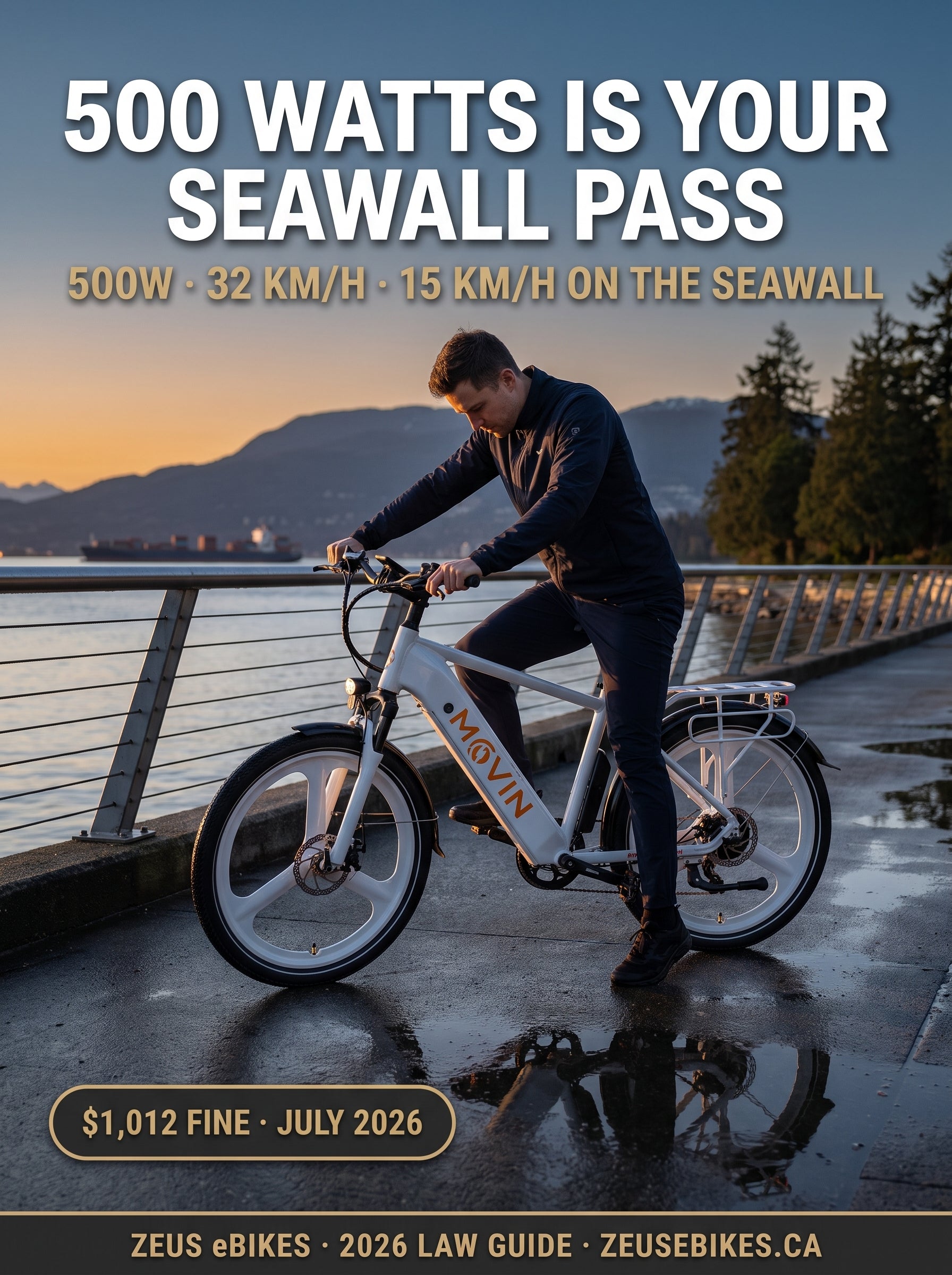
- Seawall & park paths: yes where signs or markings allow cycling; 15 km/h posted
- Regional parks (Pacific Spirit): roadways and parking lots only, unless posted
- Start here: the Samebike 20LVXD30-II at $1,099 or the whole folding e-bike range
What This Guide Covers
- Why one Vancouver ride crosses four rulebooks
- What legally counts as an e-bike here
- Where you can actually ride: surface by surface
- The seawall rule that decides whether your bike gets impounded
- City park paths vs regional park trails: the invisible border
- Where you're actually going: a place-by-place map
- Five street rules Vancouver riders break without knowing
- Age and helmet: the honest answer for parents
- Licence, insurance, and the moment that changes
- Taking your e-bike on TransLink
- And if you're asking about e-scooters instead
- What enforcement actually looked like in 2026
- Five picks that fit the regulation
- The 8-point Vancouver compliance check
- Frequently asked questions
- The bottom line
Why one Vancouver ride crosses four rulebooks
On 26 July 2026 the Vancouver Police Department fined a rider $1,012: $598 no insurance, $276 no licence, $138 speeding, after clocking them at 65 km/h (CTV News Vancouver, 27 July 2026). Nothing about the machine changed at the roadside; only its legal category did, and that same reclassification is available against any e-bike that drifts past 500W or 32 km/h. This guide maps the four separate rulebooks that govern one Vancouver ride, so you always know which one you are standing in.
A single ride from Kitsilano to Coal Harbour can pass through all four in twenty minutes. The Province decides what your bike is. The City decides what you may do with it on a street. The Park Board decides what happens once you roll onto a park path. Metro Vancouver decides something different again the moment you enter a regional park. Each has its own enforcement officers and its own penalty range, and none of them announces itself with a sign at the boundary.
One Vancouver ride · four rulebooks, top to bottom
Decides what your machine legally is: 500W, 32 km/h, age, helmet, lights, sidewalks. Enforced by the VPD. Everything below depends on passing this test.
Sidewalks, bells, headphones, crosswalks, and s.89A, the seawall carve-out that decides whether your bike is welcome or impoundable.
Designated cycle paths are open to e-bikes; footpaths and promenades are not. Enforced by Park Rangers. Fine on conviction: $50–$2,000.
The default inverts: roadways and parking lots only, unless a posted notice opens a trail. Pacific Spirit sits here. Up to $50,000 and/or 6 months on conviction.
What legally counts as an e-bike in Vancouver
In British Columbia an e-bike is a motor assisted cycle, and since 5 April 2024 it comes in two classes under the Motor Assisted Cycle (E-Bike) Regulation, B.C. Reg. 64/2024. A standard e-bike may produce up to 500W of total continuous output, may not be capable of motor-assisting past 32 km/h, and may have a throttle. A light e-bike is capped at 250W and 25 km/h and must have no throttle whatsoever. Miss any criterion and the bike is simply not a motor assisted cycle.
Most riders know the wattage number and stop there. The regulation contains five more requirements that decide legality just as firmly, and they are the ones that catch imported machines.
| Requirement | Standard e-bike | Light e-bike | Source |
|---|---|---|---|
| Total continuous power output | ≤ 500W | ≤ 250W | s.3(1) · s.6(1)(b) |
| Motor-assisted speed capability | ≤ 32 km/h | ≤ 25 km/h | s.3(2)(a) · s.6(1)(c) |
| Throttle (accelerator controller) | Permitted, with a separate on/off or 3 km/h engagement guard | Prohibited outright | s.3(2)(c) · s.6(2) |
| Motor cut-out | Must stop driving when you stop pedalling, release the throttle, or apply a brake | s.3(2)(b) | |
| Wheels | Two or three touching the ground, each at least 350 mm in diameter including the tyre | s.4(a)–(b) | |
| Brakes | Stop from 32 km/h within 9 m | Stop from 25 km/h within 7.5 m | s.12(1)–(2) |
| Minimum age | 16 | 14 | s.9 · s.8 |
| Carrying a passenger | Prohibited if the rider is under 16 | s.10 | |
Two details are worth internalising because they are where honest buyers get caught. First, the standard is continuous output rather than peak. A listing that says "500W peaking at 750W" is describing a motor whose continuous rating you still need to confirm. Second, the test is what the motor is capable of rather than what a setting currently allows: a bike advertised with a 45 km/h top speed does not become compliant because a menu option lowers it. If you want the full national picture behind these numbers, our 500W vs 750W vs 1000W guide works through what each tier can and cannot do legally in Canada.
Where you can actually ride: surface by surface
The City of Vancouver publishes a permission matrix, and for e-bikes it is refreshingly short: roads yes, protected bike lanes yes, seawall and park paths yes where signs or markings allow cycling, sidewalks no. The City's own summary is blunter still: "Walk your bike on sidewalks and through crosswalks unless otherwise posted", and it pairs that with a posted 15 km/h limit on shared pathways like the seawall.
| Device | Roads | Protected bike lanes | Seawall & park paths | Sidewalks |
|---|---|---|---|---|
| Electric-assisted bikes | Yes | Yes | Yes: where signed | No |
| Bicycles | Yes | Yes | Yes: where signed | No |
| Electric kick scooters | Yes | Yes | Yes: where signed | No |
| Electric unicycles, hoverboards, motorised skateboards | No | No | No | No |
| Motorbikes, mopeds, limited-speed motorcycles | Yes | No | No | No |
Source: City of Vancouver, Signs, signals, and regulations. The City notes that seawall and park-path access applies "on paths where signs or pavement markings allow cycling," and that the Motor Vehicle Act is what keeps unicycles, hoverboards and electric skateboards off public roads, bike lanes and sidewalks entirely.
Posted speed limits matter as much as permissions, because a Vancouver bikeway is not a road. Unless a sign says otherwise, city roads are 50 km/h, school and playground zones are 30, street bikeways are 30, lanes are 20, and the seawall and other shared pathways are posted at 15. A compliant e-bike whose motor cuts out at 32 km/h is still capable of breaking a posted 15 km/h path limit under pedal power alone.
Vancouver riders: browse the e-bikes built to the 500W / 32 km/h spec
Every bike below shows its maker's continuous rating and cut-off, read 7 October 2026, beside the limits BC enforces, so you can see for yourself whether the seawall exception stays available.
🇨🇦 Ships from Canada · Free Canada-wide shipping · 1-866-938-7580: real humans answer
Browse Urban eBikes Browse Folding eBikesThe seawall rule that decides whether your bike gets impounded
The seawall is the single most valuable piece of riding in Vancouver and the place where the legal definition stops being paperwork. Street and Traffic By-law No. 2849 s.89A(1)(b) prohibits driving, operating or propelling "any motor vehicle on any path adjacent to a seawall or on any seawall, except for a motorized wheelchair, a motor assisted cycle or an electric kick scooter." Read that exception carefully: it does not say "e-bike." It says motor assisted cycle: the exact term defined by B.C. Reg. 64/2024.
That is the whole mechanism. The by-law defines a "motor vehicle" as any vehicle which is self-propelled, which plainly includes an electric bike. Your right to be on the seawall is therefore not a general right at all; it is a carve-out that exists only while your machine satisfies the provincial definition. And s.89A(2) states the consequence in one line: "Use of any motor vehicle in contravention of section 89A(1) may result in its impoundment under the Impounding By-law."
The seawall around Stanley Park is a one-way counterclockwise loop of roughly 10 km, and the Park Board's own bike paths there were opened to e-bikes and electric kick scooters by a Parks Control By-law amendment enacted on 9 April 2024. That amendment is why you can legally ride the park sections at all, and it is recent enough that plenty of riders, and plenty of older web pages, still get it wrong in both directions.

Eunorau Meta 26
$2,295 CADEunorau's page lists this bike at 500W continuous and a 32 km/h top assist (read 7 October 2026), on full-size wheels with hydraulic 180 mm brakes. Those are the regulation's own numbers, which is what keeps the s.89A seawall exception available and the licence and insurance questions off the table.
The true torque sensor is the practical part: the motor answers how hard you pedal rather than whether the pedals are turning, so the assist feels proportional in the places Vancouver demands it: shared seawall stretches, crowded bike lanes, wet stop-and-go intersections. The removable 48V 15Ah pack carries 720 Wh, an optional second pack roughly doubles that to about 1,440 Wh, and the 26 × 3.0-inch Innova tyres plus a front suspension fork are built for the cracked, patched pavement a real commute is made of. The rear light comes on when you brake, so the cars behind you see you slowing in the rain.
Honest limit: at 68.4 lbs all-in it sits over TransLink's 25 kg bus-rack limit, and Eunorau does not publish a battery-out weight that would put it under, so treat it as not a bus-rack bike. And 55 Nm of peak torque is modest for sustained steep grades: if your daily route climbs something like the full pitch up to Queen Elizabeth Park, you will feel it. Flat-to-rolling Vancouver (the seawall, False Creek, the Adanac Bikeway) is where this bike is genuinely excellent.
City park paths vs regional park trails: the invisible border
Vancouver has two kinds of park and they run on opposite defaults. In a City park, the Parks Control By-law s.14(h) prohibits riding "any bicycle, motor assisted cycle, or electric kick scooter upon any sidewalk, footpath or promenade in any park unless such sidewalk, footpath or promenade has been so designated as a cycle path", so cycle paths are open and everything else is not. In a Metro Vancouver regional park, the rule inverts.
MVRD Regional Parks Regulation Bylaw No. 1420, 2025 s.29(f) says a person must not "use or operate an e-bike or e-scooter except on and within a roadway or parking lot or in an area designated by posted notice as allowing that activity." In a regional park your e-bike is confined to roads and parking lots unless a sign specifically opens a trail to it, even where the same trail is open to ordinary bicycles, which the bylaw treats separately under s.29(e) and defines as human-powered only.
For Vancouver riders this is not academic. Pacific Spirit Regional Park, on the city's west side next to UBC, is Metro Vancouver land rather than City of Vancouver land. Ride there on an e-bike and you are under Bylaw 1420 rather than the Parks Control By-law, and nothing in the scenery tells you that you crossed a jurisdiction.
| City park (Stanley, Queen Elizabeth, Hastings) | Regional park (Pacific Spirit) | |
|---|---|---|
| Governing rule | Parks Control By-law s.14(h) | MVRD Bylaw 1420 s.29(f) |
| Default for e-bikes | Allowed on designated cycle paths | Roadways and parking lots only |
| Trails | Open where designated and signed | Closed unless a posted notice opens them |
| Enforcement | Park Rangers | Metro Vancouver park officers |
| Penalty on conviction | $50 – $2,000 | $50 minimum, up to $50,000, and/or up to 6 months |
One honest note about penalties, because the numbers look alarming and the reality is more measured: those are the maximums available on conviction rather than tariffs handed out at the trailhead. The Park Board's Ticket Offences By-law schedule of set fines covers wildlife feeding and smoking. It does not list a set ticket amount for riding a bike or an e-bike on an undesignated park path, which falls back to the general range. Treat the ceiling as a signal of seriousness rather than an expected bill.

Eunorau Meta Foldable eBike
$2,295 CADVancouver riding is stop-and-start: a park gate, a crosswalk, a seawall crowd, a marina detour. The Meta's 180 mm hydraulic discs matter more here than a bigger motor would, and B.C. Reg. 64/2024 s.12(2) is explicit that a standard e-bike must stop from 32 km/h inside 9 m. Braking is a legal requirement rather than a nice-to-have.
It folds, which solves the two Vancouver problems that have nothing to do with riding: a condo with no bike room, and a trunk when you drive to a trailhead. The dual-battery option is the one to take if you actually use the full seawall-to-UBC-to-home loop.
Honest limit: at 63 lbs it is not a bus-rack bike. TransLink's rack limit is 25 kg. Fold it into a car rather than onto the front of a bus.
Where you're actually going: a place-by-place map
The four rulebooks are the law. This table is the ride. Vancouver's best cycling destinations sit on land owned by six different bodies, and two of them are not municipal at all. Granville Island is federal property operated by CMHC, and the UBC campus is university land with its own traffic rules. Neither is governed by a Vancouver by-law.
| Where you are | Whose rules apply | Your e-bike |
|---|---|---|
| City streets, bikeways, protected bike lanes | City of Vancouver: By-law 2849 | Allowed. Bikeways posted at 30 km/h. |
| Seawall and adjacent paths | City: By-law 2849 s.89A | Allowed only as a motor assisted cycle. 15 km/h posted. |
| Stanley Park, English Bay, Kitsilano Beach and other Park Board parks | Park Board: Parks Control By-law s.14(h) | Designated cycle paths only: not footpaths or promenades. |
| Arbutus Greenway (False Creek to the Fraser) | City of Vancouver | Allowed: a City walking and biking path. |
| Pacific Spirit Regional Park | Metro Vancouver: Bylaw 1420 s.29(f) | Roadways and parking lots only, unless a posted notice says otherwise. |
| UBC Vancouver campus | UBC: university land, its own traffic and parking rules | Not a Vancouver by-law. Follow campus rules and posted limits. |
| Granville Island | Federal: CMHC Granville Island | Reachable by the False Creek seawall; ride to posted signage on the Island. |
| On a bus rack, SkyTrain, SeaBus or West Coast Express | TransLink conditions of carriage | Under 25 kg, battery removed and carried with you. |
| Any sidewalk, anywhere | MVA s.183(2)(a) + By-law 2849 s.60 | No, unless a sign posts otherwise. Walk it. |
Two honest notes on the last of those non-municipal landlords. We could not find a published e-bike-specific rule for Granville Island or a public speed schedule on UBC's cycling pages, so we are not going to invent one. In both places, ride to the posted signage and treat them as somebody else's property, because that is what they are.
What UBC does publish is worth knowing if you work there: staff and faculty are eligible for a $400 e-bike rebate, running 1 April to 31 December 2026, applied for before purchase. UBC's own pages have carried a contradictory earlier deadline, so confirm the dates with Campus & Community Planning before you buy.
Five street rules Vancouver riders break without knowing
Beyond the big permission questions, Street and Traffic By-law No. 2849 carries a handful of small, specific obligations that apply to every bike and e-bike on a city street. None of them is intuitive, all of them are enforceable, and four of the five cost nothing to comply with.
- A bell is mandatory. s.60B: "No person shall ride a bicycle upon a street unless the bicycle is equipped with a bell capable of being used as a warning." Not a horn app, a bell.
- Headphones in both ears are prohibited. s.60A bans riding on a street while wearing headphones over or near both ears. Devices designed to improve outside hearing are exempt.
- Marked crosswalks are for walking, mostly. s.60G prohibits riding through a marked crosswalk unless it carries elephants'-feet markings or is signed to permit cycling. s.60H allows riding an unmarked crosswalk, and s.60I requires you to yield to pedestrians either way.
- Sidewalks are out unless posted. s.60 plus Motor Vehicle Act s.183(2)(a). The City's instruction is to dismount and walk.
- Lights are law, not equipment. Motor Vehicle Act s.183(6) requires, from half an hour after sunset to half an hour before sunrise, a front white lamp visible at 150 m, a red rear reflector, and a lit red rear lamp. The City goes further than the statute and tells riders to use them "after dark, when it's foggy, or when it's raining", which, in a Vancouver November, is most of your commute.
Two more worth knowing: s.59 classes bicycles as slow-moving vehicles required to keep as close as possible to the right-hand edge, and Motor Vehicle Act s.183(1) gives a cyclist "the same rights and duties as a driver of a vehicle", which is the sentence that makes red lights, stop signs and shoulder-checks legally identical to a car's. On the other side of the ledger, the City notes that provincial rules now require drivers to give at least 1 metre when passing someone on a bike.
Age and helmet: the honest answer for parents
The minimum age is 16 for a standard e-bike and 14 for a light e-bike, under sections 9 and 8 of B.C. Reg. 64/2024, and a parent or guardian who authorises or knowingly permits an underage rider commits the offence too. Helmets are mandatory for every rider and passenger of every age under Motor Vehicle Act s.184; the Province lists a $29 violation ticket, and s.184(3) caps the fine on conviction at $100.
Here is the part that catches families, and we would rather lose a sale than let you find it out from an officer. A light e-bike is not just "a smaller e-bike." Section 6(2) is absolute: to qualify as a light e-bike, the machine must not be equipped with an accelerator controller: no throttle at all, in any mode. It must also be 250W or less and capped at 25 km/h.
That does not make a 250W bike useless for a younger rider; it changes where. The age rules in ss. 8–10 govern operation "on a highway," which is the legal term covering public roads. Supervised riding on private property is a different matter, and it is how most families actually build the skills before a sixteenth birthday. Our parent's guide to e-bikes for kids and teens in Canada works through the risk data and the decision honestly, including the case for waiting.

Eunorau EKIDS-20 (2024)
$1,299 CADA properly proportioned 20-inch youth e-bike with real disc brakes and a 250W motor, light enough at 37 lbs that a young rider can pick it up, and geared to a speed a parent can jog alongside.
Read this before you buy it for a 14-year-old: the EKIDS-20 has a half-twist throttle, so under B.C. Reg. 64/2024 s.6(2) it is a standard e-bike rather than a light e-bike. On a Vancouver street or path the rider must be 16. For a younger rider it is a supervised, off-highway bike. We would rather tell you that now than have you learn it at the seawall.
Helmet on every ride regardless of age. That one is not negotiable anywhere in BC.
Licence, insurance, and the moment that changes
No licence. No insurance. No registration, no plate, no annual anything. The Province of British Columbia states it in one sentence: "You do not need a driver's license or insurance to operate an e-bike in B.C." That is the single biggest practical advantage an e-bike holds over every other motorised way of crossing this city, and it is entirely conditional on the definition.
The 26 July 2026 VPD file shows the conditional part working. The rider was not fined for owning the wrong device; they were fined $598 for no insurance and $276 for no licence because, at 65 km/h, their machine fell outside the pilot rules and was therefore classified as a motor vehicle, and motor vehicles require both. A speeding ticket of $138 came on top. The exemption did not fail. It simply never applied.
Inside the definition
≤ 500W continuous · assist cuts at ≤ 32 km/h · pedals · compliant brakes and wheels
- No driver's licence required
- No insurance required
- No registration or plate
- Seawall and park-path exception available (s.89A)
- Protected bike lanes available
Outside the definition
Over 500W continuous, or capable of assisting past 32 km/h
- Treated as a motor vehicle
- Licence and insurance requirements attach
- No seawall exception: s.89A(2) allows impoundment
- Not permitted in protected bike lanes
- Fines stack: licence + insurance + speed
Two footnotes that come up constantly. First, "no insurance required" is not the same as "no insurance available or advisable". Theft and third-party liability are worth thinking about separately, which our Canadian e-bike insurance guide covers in detail. Second, on rebates: the CleanBC e-bike rebate ended in September 2025 and BC's SCRAP-IT e-bike option has been discontinued, but the province's 7% PST exemption on e-bikes is permanent and automatic. Our BC e-bike rebate tracker keeps the live list.
Taking your e-bike on TransLink
E-bikes are permitted on bus, SkyTrain, SeaBus and West Coast Express, with conditions that quietly rule out a large share of the e-bikes on sale in Canada. On a bus rack the bike must weigh less than 25 kg (55 lbs), the wheels must fit the rack, and where there is a lithium battery TransLink requires you to remove it and carry it on board. Scooter-style e-bikes are refused outright: "They weigh too much and don't fit properly on the rack."
| Service | E-bike allowed? | The conditions that matter |
|---|---|---|
| Bus (front rack) | Yes: 2 spaces per bus | Under 25 kg (55 lbs); battery removed and carried aboard; minimum 40 cm (16") wheel |
| SkyTrain: Canada Line | Yes: 1 bike per car | No time restriction; bike under 185 cm long; no riding in stations |
| SkyTrain: Expo & Millennium | Yes: 2 bikes per car | Not westbound 7–9 a.m. or eastbound 4–6 p.m. weekdays |
| SeaBus | Yes: all times | Max 6 bikes per sailing at peak; charging e-bikes on board is not permitted |
| West Coast Express | Yes: 2 bikes per car | All times; no riding on platforms or trains |
| Seated e-mopeds & motorbike-style e-bikes | No | Not allowed on board any transit vehicle |
The 25 kg rack limit is the specification most buyers never think to check, and it is the difference between a bike that extends your commute and a bike that ends at the bus stop. Because TransLink requires the battery to come off anyway, the number to compare is the battery-out weight: and that is where a well-chosen folder wins outright.

Samebike 20LVXD30-II Folding eBike
$1,099 CADThis is the one bike in the guide whose spec sheet lines up with the transit rule. It weighs about 26 kg complete, and roughly 23 kg (51 lbs) with the battery removed: under TransLink's 25 kg rack limit, in precisely the configuration TransLink requires you to use. You take the battery off because you have to; that same act puts the bike inside the limit.
At 350W and 32 km/h it is comfortably inside the standard e-bike definition with room to spare, so nothing about it invites a conversation on the seawall. The 150 kg payload is unusually high for a folder, which matters if you commute with a pannier and a week of groceries.
Honest limit: 350W will labour on genuinely steep grades. For the flat city (downtown, False Creek, the seawall, a SkyTrain hop out to Burnaby) it is the right amount of motor and the right amount of weight.

Samebike CY20 Folding Commuter eBike
$1,199 CADSame legal maths as the bike above: 350W geared hub, assistance topping out at 32 km/h on the manufacturer's own listing, so nothing on this spec sheet needs a footnote in a legal guide either. It stays inside B.C. Reg. 64/2024, which is what keeps the seawall carve-out and the no-licence, no-insurance status available.
What the extra $100 over the 20LVXD30-II buys is comfort hardware: a suspension fork plus a suspended seat post for Vancouver's patched pavement, and a Shimano 7-speed so bridge approaches don't turn into a single-gear grind. The 468 Wh battery is built into the seat post and pulls out for condo charging, and the 150 kg payload matches the best in this table.
Honest limit: at roughly 28 kg complete it is over TransLink's 25 kg bus-rack limit, and Samebike doesn't publish a battery-out weight, so if a bus rack is part of your route, buy the 20LVXD30-II above instead. Treat it as splash-resistant rather than rain-proof: Samebike's own documents list IP64 in one place and IP54 in another.
And if you're asking about e-scooters instead
Electric kick scooters are legal in Vancouver under a provincial pilot the Province has now extended to 2028, and the city rules are tighter than the e-bike rules in three specific ways: the maximum speed is 25 km/h, the minimum age is 16, and a helmet is required. Where you may ride is otherwise identical to an e-bike: roads, bike lanes, and the seawall and park paths where cycling is allowed, never sidewalks.
Vancouver's pilot started in July 2021 and the City is explicit that "electric kick scooter by-laws are enforced by the Vancouver Police Department." That is the same VPD file that opened this guide: the 26 July rider was on a scooter rather than a bike, and the fines landed because the device exceeded the pilot's 25 km/h ceiling by 40 km/h. The seawall exception in By-law 2849 s.89A(1)(b) names electric kick scooters alongside motor assisted cycles, so scooters inherit the same conditional protection, and the same way of losing it.
What enforcement actually looked like in 2026
Two dated, on-the-record examples from this summer show what enforcement in the region is aimed at, and it is not people commuting on compliant bikes. It is machines outside the definition, and riders who are too young for what they are on.
In Vancouver, on 26 July 2026, the VPD's traffic section stopped a rider measured at 65 km/h and issued $1,012 in fines ($598 no insurance, $276 no licence, $138 speeding) because at 40 km/h over the applicable limit the device was classified as a motor vehicle. Officers also noted a disconnected brake caliper and video streaming on a handlebar-mounted phone (CTV News Vancouver, 27 July 2026).
Across the inlet, North Vancouver RCMP reported on 28 May 2026 that they had issued 15 tickets for e-mobility offences since 14 May: "no insurance, no driver's licence, no helmet, and underage riders", after months of education aimed at parents and youth. The day before, officers stopped a 15-year-old doing wheelies on an e-dirt bike, issued a $368 stunting fine, and impounded the bike for seven days.
The other risk to plan for has nothing to do with police. The VPD reports that more than 2,000 bicycles are reported stolen in Vancouver every year, and that it recovers roughly 2,000 a year, but "the majority of them will never be returned to their owners, as their serial numbers have not been reported to police, which makes them untraceable." Registering your serial with Project 529 is free, takes about two minutes, and is the single highest-return thing you can do the day your bike arrives. Our e-bike theft protection guide covers locks and storage; the registration part is free and Vancouver-specific.
Five picks that fit the regulation
Every bike below carries its maker's figures, 500W or less of continuous output and a motor that stops assisting at 32 km/h, read on 7 October 2026. Those are the two numbers B.C. Reg. 64/2024 uses, and they are what keep the s.89A seawall exception available and keep licence and insurance questions off the table. Prices were verified on the Zeus listings on 8 October 2026.
| Bike | Price | Motor | Weight | Bus rack? (25 kg limit) | Best for |
|---|---|---|---|---|---|
| Samebike 20LVXD30-II | $1,099 | 350W | ~23 kg battery out | Yes, with margin | Bus + SkyTrain commuting |
| Samebike CY20 | $1,199 | 350W | ~28 kg all-in | No | Comfort commuting (suspension + 7-speed) |
| Eunorau EKIDS-20 | $1,299 | 250W | 37 lbs all-in | n/a | Youth riding (16+ on street) |
| Eunorau Meta Foldable | $2,295 | 500W | 63 lbs all-in | No | Paths, parks, small condos |
| Eunorau Meta 26 | $2,295 | 500W | 68.4 lbs all-in | No | All-round city commuting (torque sensor) |
If your commute touches transit at any point, buy the Samebike 20LVXD30-II: it is the only bike here whose battery-out weight gives you real margin under TransLink's 25 kg rack limit, and that single number decides whether a bus is part of your route or the end of it.
If transit is not in the picture and you want one bike that handles rain, distance and rough pavement, the Eunorau Meta 26 is the better machine: a true torque sensor and a 720 Wh pack, with an optional second pack that roughly doubles it, is the right combination of feel and range for flat-to-rolling Vancouver, and the battery still pops out for condo charging even though the 68.4 lb bike itself stays in the bike room.
What we would not tell you to buy is anything advertised at 750W or with a top speed above 32 km/h, not because it is a bad bike, but because in this city it forfeits the seawall, the bike lanes, and the insurance exemption all at once.
Not sure which one fits your route?
Tell us where you ride and we will tell you honestly which of these, if any, is right. Real people, Canadian hours, no script.
Browse Folding eBikes Browse Step-Thru eBikesThe 8-point Vancouver compliance check
Run this list twice: once before you buy, and once before your first seawall ride. Eight yeses means every rulebook in this guide is satisfied: the provincial definition, the city street by-law, both sets of park rules, and TransLink's carriage conditions. It takes about five minutes and it is the whole guide compressed into a checklist.
- Continuous output 500W or less? Check the rating on the motor or the manufacturer's spec sheet rather than the peak figure in the marketing.
- Motor incapable of assisting past 32 km/h? A listing quoting 40 or 45 km/h is telling you it fails, whatever the settings menu allows.
- Working pedals, and a motor that cuts out on the brakes? Required by s.3(2)(b).
- Wheels at least 350 mm including tyres, brakes on every ground wheel? s.4.
- Rider 16 or older (14 for a genuine 250W, no-throttle light e-bike)? And no passenger if the rider is under 16.
- Helmet on, bell fitted, front white and rear red lights working? Three separate legal requirements, all cheap.
- Know which park you are entering. City park: designated cycle paths. Regional park: roadways and parking lots unless posted.
- Serial number registered free with Project 529, and photographed, before the bike leaves your hallway.
Frequently asked questions
Are e-bikes legal in Vancouver?
Yes. An e-bike that meets B.C. Reg. 64/2024 (500W or less of total continuous output, incapable of motor-assisting past 32 km/h, with working pedals and brakes) is legal on Vancouver roads, in protected bike lanes, and on the seawall and park paths where signs or markings allow cycling. It is not legal on sidewalks. A machine that exceeds those limits is not an e-bike in law; it is a motor vehicle, and different rules apply.
Can you ride an e-bike on the Vancouver seawall?
Yes, on the sections where signs or pavement markings allow cycling. Street and Traffic By-law No. 2849 s.89A(1)(b) bans motor vehicles from the seawall and adjacent paths "except for a motorized wheelchair, a motor assisted cycle or an electric kick scooter." That exception only covers you if your bike actually meets the motor assisted cycle definition. The City posts a 15 km/h limit on shared pathways like the seawall.
Do you need a licence or insurance for an e-bike in BC?
No. The Province of British Columbia states plainly: "You do not need a driver's license or insurance to operate an e-bike in B.C." There is no registration or plate either. That exemption is attached to the legal definition, not to the shape of the bike. On 26 July 2026 the VPD fined a rider $1,012 because their over-speed device was classified as a motor vehicle, which does require both.
How fast can an e-bike go in Vancouver?
The motor must be incapable of propelling the bike past 32 km/h on a clean, paved, level surface, 25 km/h for a light e-bike. On top of that, the City posts a 15 km/h limit on shared pathways such as the seawall, and Vancouver street bikeways are posted at 30 km/h. You may pedal faster than the motor cut-off under your own power, but posted path limits still apply.
What age can you ride an e-bike in Vancouver?
Sixteen for a standard e-bike and fourteen for a light e-bike, under sections 9 and 8 of B.C. Reg. 64/2024. The catch is that a light e-bike must be 250W or less, capped at 25 km/h, and, under s.6(2), must not be equipped with an accelerator controller at all. A 250W bike with a throttle is a standard e-bike, so the rider must be 16. A parent or guardian who authorises an underage rider also commits an offence.
Can you ride an e-bike on the sidewalk in Vancouver?
No, unless a sign posts otherwise. Two rules stack: Motor Vehicle Act s.183(2)(a) says a person operating a cycle must not ride on a sidewalk unless authorised by a bylaw or a sign, and Street and Traffic By-law s.60 says "No person shall ride any bicycle upon any sidewalk except where posted by signs." The City's instruction is to walk your bike on sidewalks and through crosswalks.
Can I take my e-bike on the SkyTrain or a TransLink bus?
Yes, with conditions. On a bus rack the bike must weigh less than 25 kg (55 lbs) and you must remove the lithium battery and carry it on board; scooter-style e-bikes are not accepted. On SkyTrain it is one bike per car on the Canada Line and two per car on the Expo and Millennium Lines, with bikes barred from westbound trains 7–9 a.m. and eastbound trains 4–6 p.m. on weekdays. Charging an e-bike on the SeaBus is not permitted.
Are e-bikes allowed in Pacific Spirit Regional Park?
Only on roadways and parking lots, or where a posted notice says otherwise. Pacific Spirit is a Metro Vancouver regional park rather than a City park, and MVRD Regional Parks Regulation Bylaw No. 1420, 2025 s.29(f) prohibits operating an e-bike "except on and within a roadway or parking lot or in an area designated by posted notice as allowing that activity." That is the opposite default from a City park cycle path.
Is a helmet mandatory on an e-bike in Vancouver?
Yes, for every rider and passenger of every age. Motor Vehicle Act s.184 makes it an offence to operate or ride as a passenger on a cycle on a highway without a properly worn approved helmet, and makes it a separate offence for a parent or guardian to permit an under-16 to ride without one. The Province lists a $29 violation ticket; s.184(3) sets the maximum on conviction at $100.
Are electric scooters legal in Vancouver?
Yes, under a provincial pilot the Province has extended to 2028. Vancouver joined in July 2021. The rules are tighter than the e-bike rules in three ways: maximum 25 km/h, minimum age 16, and a helmet is required. Where you may ride is otherwise the same as an e-bike: roads, bike lanes, and the seawall and park paths where cycling is allowed, never sidewalks. By-law 2849 s.89A(1)(b) names electric kick scooters alongside motor assisted cycles, so they share the same conditional seawall protection.
Is a 750W e-bike legal in Vancouver?
No. B.C. Reg. 64/2024 s.3(1) caps total continuous power output at 500W, and s.3(2)(a) requires that the motors cannot propel the device past 32 km/h. A 750W machine fails both tests, so it is not a motor assisted cycle. That matters most on the seawall, where the s.89A exception is written specifically for motor assisted cycles. Outside it, the bike is a motor vehicle and s.89A(2) allows impoundment.
The bottom line
Vancouver is one of the best cities in Canada to ride an electric bike, and the rules are not hostile. They are written in four places by four bodies that never consolidated them. Once you see the structure, it collapses into a single decision: buy a bike that genuinely meets B.C. Reg. 64/2024, and every layer above it becomes permissive. The seawall opens. The bike lanes open. The licence and insurance questions never arise. The park rules become a matter of reading a sign rather than risking a bylaw.
The riders who get caught are almost never the ones who checked. They are the ones sold a 750W machine by someone who let them believe the number did not matter in Canada. It matters here more than almost anywhere, because Vancouver's best riding, the seawall, is protected by an exception written for one specific legal category.
- Check the bike you already own. Find the continuous wattage on the motor casing or the manufacturer's spec page. If it says 500W or less and the assist stops at 32 km/h, you are compliant. Ride the seawall with confidence.
- Register the serial with Project 529. Free, about two minutes, and it is the difference between the VPD recovering your bike and auctioning it.
- Call us before you buy anything, from anyone. 1-866-938-7580: tell us your route and we will tell you honestly whether a bike's figures fit the regulation, including bikes we do not sell. Ten minutes on the phone is cheaper than a bike you cannot ride on the seawall. Zeus ships from Canada, and unused, unopened items can be returned within 15 days of delivery under our refund policy: but the better outcome is getting it right before the box is opened, which is what the call is for.
If you would rather start from the bikes than the law, our Vancouver buyer's guide ranks picks for rain, hills, condos and the seawall, and our directory of verified Vancouver e-bike shops lists where to see one in person. For the province-wide picture behind every city rule here, start with BC eBike Laws 2026.
Visuals created by Playcut.ai
- BC eBike Laws 2026: Standard vs Light, Where to Ride & 7 Legal Picks
- Best Electric Bikes for Vancouver (2026): Picks for Rain, Hills, Condos & the Seawall
- eBike Shops in Vancouver, BC: Every Verified Storefront
- Canadian eBike Legal Access Atlas: Where You Can Ride, by Bike Type and Province
- eBike Laws Canada (2026): Every Province, One Table
- Do You Need eBike Insurance in Canada?
- eBike Theft Protection Canada: Locks, Storage & Registration
- eBike Battery Guide Canada: Safety, Charging & Replacement
Share:
Why Is Car Insurance So Expensive in Canada? The 2026 Forensic Breakdown
Best Electric Bikes Montreal (2026): 8 Picks for the REV, Winter & Québec's E-Bike Rules