
BC eBike Rebate 2026: PST Exemption, Nelson $8K Loan, UBC $400, Every Active Program and Every Closed One

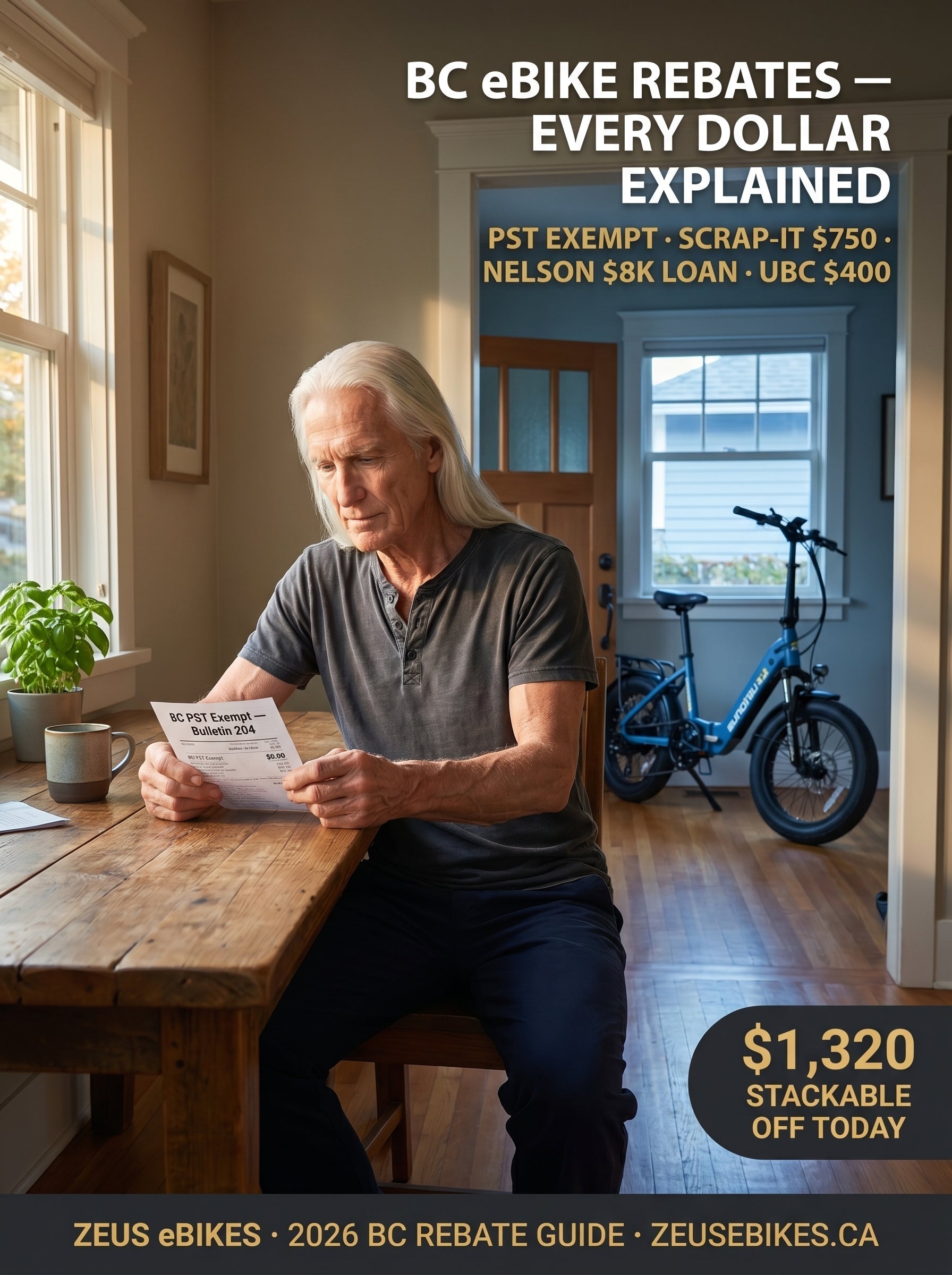
Three programs put real money in BC riders’ pockets in 2026, and one big one just shrank. SCRAP-IT’s $750 e-bike option is gone: as of August 3, 2026 (re-read 7 October 2026) the program’s own Rebate Choices page lists a single option, a $300 cash rebate for scrapping a qualifying vehicle. The 7% BC PST exemption is automatic at the till on every legal e-bike (≤500W continuous, ≤32 km/h). It saves $84 to $196 on the bikes in this guide and requires no application. BC SCRAP-IT now pays a flat $300 cash for scrapping a qualifying vehicle; the e-bike-specific $750 option was discontinued (verified August 3, 2026 and again 7 October 2026). Nelson Hydro offers up to $8,000 in low-interest on-bill financing for Nelson homeowners (rate not printed on the city's page, read 9 October 2026). UBC offers staff and faculty $400 through December 31, 2026.
What's closed: The CleanBC Go Electric e-bike rebate ($350–$1,400, income-tested) ended September 30, 2025, according to its administrator, after paying over $10.4 million in rebates (BC E-Bike Rebate Program).
What does not exist: No federal e-bike rebate: Transport Canada's Electric Vehicle Affordability Program covers new highway-capable vehicles with at least four wheels (Transport Canada). No City of Vancouver, Victoria, or Kelowna consumer rebate, and no TransLink Compass card e-bike credit, as of our May 2026 check.
The CBC investigation: In September 2024, CBC News reported that Lime, Neuron, and Bird were charging 7% PST on e-bike rentals despite the April 2021 exemption. If a retailer charges you PST on a legal e-bike, you can recover it through Form FIN 355 with the BC Ministry of Finance. You have four years from purchase. Detailed step-by-step in Section 3.
📥 The BC eBike Rebate Bookkeeper: free, printable companion. No email required.
A wallet-sized program reference card. Application checklists for every active rebate. PST refund letter template (FIN 355). Scrap-It vehicle eligibility worksheet. Stackable savings worksheet. UBC and Nelson application timelines. Built like a tax-prep workbook for your eBike purchase.
Download the Bookkeeper PDF → Or use the live calculator →In This Guide
- Why this guide exists (and what got "updated")
- The 2026 BC rebate status table
- BC PST exemption + Strata UL 2849 + used eBike rules
- BC SCRAP-IT: $300 cash now, plus the bigger ICBC insurance saving
- Nelson Hydro on-bill financing: up to $8,000
- UBC staff & faculty: $400 subsidy
- CleanBC Go Electric: the honest closed status
- The stackable savings math
- The real math: eBike vs car over 5 years
- Self-employed CRA business expense worked example
- 🧮 Interactive Stack Calculator (live in your browser)
- What does NOT exist (expectations honestly set)
- 5 picks inside the Standard category: after-PST pricing and eligibility
- BC vs Ontario vs Québec: rebate comparison
- The 5-minute "am I saving everything I can" checklist
- FAQ: 15 questions BC riders actually ask
1. Why This Guide Exists (And What Got "Updated")
You typed "bc ebike rebate 2026" into Google. You landed somewhere, maybe even on this page in its previous incarnation, and got a confused answer. There's a reason. Two of the programs that ranked for that search a year ago, CleanBC's rebate and SCRAP-IT's $750 e-bike option, have since ended, and many pages still describe them as live.
BC's e-bike rebate landscape is a graveyard of half-true retailer pages. If a page tells you the CleanBC Go Electric rebate is open, it is out of date: its administrator says it ended September 30, 2025. If it quotes a $1,050 or $750 SCRAP-IT e-bike figure, that is out of date too: SCRAP-IT's Rebate Choices page now lists a single $300 cash option (SCRAP-IT). And it pays to know what to do when a retailer charges you PST you do not owe, the issue CBC News investigated in September 2024.
This guide replaces our prior version with verified-as-of-today data on every active program, exact dollar amounts, eligibility verbatim from official sources, step-by-step applications, and the rebate stacking math that turns the remaining programs into up to $896 off a single eligible bike (plus up to $8,000 in low-interest Nelson Hydro financing if you qualify). For every active program, we list its official application URL. For every closed program, we say it is closed. For every program that does not exist (no federal e-bike rebate, no Vancouver municipal rebate, no TransLink Compass credit), we say it does not exist, so you do not waste an afternoon hunting for it.
If you are also trying to figure out which bikes are legal in BC at all (Standard vs Light, throttle rules, where you can ride), our BC eBike Laws 2026 guide is the companion to this one: the laws guide tells you what qualifies; this guide tells you how to save money on the qualifying bike. For the national rebate picture across every province and territory, see our eBike Rebates & Incentives Canada 2026 guide.
2. The 2026 BC Rebate Status Table
Bookmark this section. The program rows below were re-read against their official sources on October 9, 2026; the city and TransLink rows reflect our May 2026 check. We update this page as programs change, and each row names the date its status was last read or changed.
| Program | Status | Amount | Application |
|---|---|---|---|
| BC PST Exemption | ✓ Active: permanent | 7% off every legal e-bike | Automatic at till. No form (PST Bulletin 204). |
| BC SCRAP-IT vehicle trade-in | △ Changed: e-bike option no longer listed (re-read October 9, 2026) | $300 cash (was $750 e-bike-specific) | scrapit.ca: pre-approval required |
| Nelson Hydro On-Bill Financing | ✓ Listed: the city's page, read 9 October 2026, describes the loan and eligibility but prints no intake dates or closing date | Up to $8,000 per household (a loan rather than a rebate; rate no longer published: confirm when applying) | nelson.ca: Nelson homeowners only |
| UBC E-Bike Subsidy | ✓ Active: April 1 to December 31, 2026 | $400 (one per 5 years) | planning.ubc.ca: UBC staff/faculty |
| CleanBC Go Electric e-bike rebate | ✗ Ended September 30, 2025 (administrator) | Was $350–$1,400 income-tiered | Not accepting applications; the administrator's page announced no relaunch when we read it on October 9, 2026. |
| Federal Electric Vehicle Affordability Program | ✗ Excludes e-bikes (Transport Canada) | $2,500–$5,000 (highway-capable vehicles with at least four wheels) | Not applicable to e-bikes. |
| City of Vancouver / Victoria / Kelowna municipal | ✗ None exist | none | No consumer e-bike rebate at any major BC city as of May 2026. |
| TransLink Compass card e-bike credit | ✗ Does not exist | none | Common buyer assumption. No such program exists. |

A BC bill of sale for an Eunorau Meta Foldable showing the PST line zeroed out under PST Bulletin 204, the only universal, automatic eBike rebate in the province. Photograph by Playcut.ai (Salgado-register reference).
3. BC PST Exemption: The Only Universal, Permanent Saving
This is the program every BC buyer gets, every time, on every legal e-bike. No application. No waitlist. No income test. No form. PST Bulletin 204 (revised June 2026, read October 9, 2026) sets out the conditions, and a bike that meets them leaves the till with no 7% PST line on the receipt.
Effective April 21, 2021, BC removed the 7% Provincial Sales Tax on qualifying electric bicycles and tricycles, and PST Bulletin 204, revised June 2026, still sets out the exemption. It is permanent and it applies at the till at any BC retailer.
What it saves you depends on the bike. On a $1,199 Samebike CY20, you save $84. On a $2,450 Eunorau Defender, you save $171. On a $5,000 dual-battery touring build, you save $350. On a $200 helmet purchased separately, you pay PST. The exemption applies to the bike itself and not to accessories.
Compliance: what qualifies for the exemption
BC PST Bulletin 204 (revised June 2026, read October 9, 2026) sets out the conditions below; we list the motor's speed and power limits as two rows. Every one must be met. If any one fails, the bike is not exempt and PST applies.
| Requirement | Threshold |
|---|---|
| Has pedals or hand cranks | Functional: rider must be able to propel without motor |
| Wheel diameter | ≥ 350mm |
| Motor continuous output | ≤ 500W |
| Maximum motor-driven speed (level ground) | ≤ 32 km/h |
| Combustion engine | None |
| Frame design | Not designed or marketed to look like a motorcycle, moped, or scooter |
This is the same compliance bar as BC's Motor Assisted Cycle (E-Bike) Regulation for road-legal Standard e-bikes. If your bike is legal to ride on a BC road, it qualifies for the PST exemption. If you bought a 750W "off-road" e-bike or a moped-styled build that exceeds either threshold, it is not exempt, and you also cannot legally ride it on a BC road. For the full compliance breakdown, see our BC eBike Laws 2026 guide.
How the PST exemption works at checkout: in person vs online
The PST exemption applies the same way regardless of where you buy, but the mechanism is slightly different in person vs online, and it matters for what you should expect to see on your receipt.
| Where you buy | How the exemption is applied | What you should see at checkout |
|---|---|---|
| BC brick-and-mortar retailer | Manually applied at the till by the cashier or built into the till's product tax setup | PST line on receipt: $0.00 (or omitted entirely) |
| BC online retailer (correctly configured Shopify, WooCommerce, etc.) | Automatically applied by the tax engine based on the product's "PST exempt" tax category and your BC billing address | PST line on order summary: $0.00 (only GST 5% applies) |
| BC online retailer (misconfigured tax engine) | PST charged because the product is wrongly categorised as taxable | PST line shows 7%: request a corrected receipt before paying, or claim refund after |
| Out-of-province retailer shipping to BC (Ontario/Alberta Shopify shop) | Their tax engine may default to charging PST on every Canadian sale because they have not configured the BC e-bike exemption | PST line shows 7%: same fix: corrected receipt or FIN 355 refund |
For Zeus customers buying online at zeusebikes.ca: the PST exemption is applied automatically at checkout because our products are tagged as PST-exempt in Shopify. Your order summary shows GST 5% only, no PST line. No application needed, no form to file, no refund process. The exemption is built into the checkout the same way it would be at a BC bike shop till. Same applies to any correctly-configured BC online retailer.
How to claim a PST refund if you were wrongly charged
You have four years from the date of purchase to apply. The process:
- Confirm the bike qualifies for the exemption. Check the manufacturer spec sheet: motor continuous output 500W or less, maximum speed 32 km/h or less, wheels at least 350mm, functional pedals, no combustion, and not moped-styled.
- Request a corrected receipt from the retailer first. Email or visit them in writing. Reference BC PST Bulletin 204 (revised June 2026; the e-bike exemption dates from April 21, 2021) and request the corrected invoice and a refund of the wrongly-charged PST. Many retailers will issue the refund directly.
- If the retailer refuses, gather your documentation. Keep your original receipt, the manufacturer spec sheet showing wattage and speed, and any written communication.
- File Form FIN 355 with the BC Ministry of Finance. Download the Application for Refund – General (FIN 355) from the BC government's PST forms page, attach your documentation and submit it as the form directs; BC’s PST refund page gives you four years from the date you paid.
- Track the refund. BC Finance typically processes valid refund applications in 4–8 weeks. Refund is paid by direct deposit if you provide banking information.
The Strata UL 2849 Angle (Vancouver Condo Buyers)
If you live in a Vancouver, Burnaby, or Richmond condo, the PST exemption is not the only money your strata council cares about. Following several high-profile Lower Mainland lithium-ion battery fires linked to uncertified e-bike batteries, an increasing number of BC strata corporations now require UL 2849 certified electrical systems as a condition of indoor charging or in-suite storage. Bikes without UL 2849 face restrictions ranging from "balcony charging only" to outright in-building bans.
This is not technically a rebate, but it is real money. A bike that fails the strata test forces you into one of three positions: pay for off-site secure storage and charging ($50–$150 per month), give up the unit (nuisance lease violations stack), or replace the bike with a UL-certified one. UL 2849 certification at the time of purchase eliminates the entire scenario.
Among the e-bikes Zeus sells, the Velotric Discover M ($3,899) lists UL 2849 and UL 2271 on Velotric's page, read 7 October 2026. The Taubik Tour S ($2,899) page, read the same day, prints a battery "Certified in accordance with UL 2271" and no system certification; our earlier text called it UL 2849 certified, and that is withdrawn. For Vancouver condo buyers, a system certificate printed on the maker's page is the layer no strata bylaw change can undo. Our Canadian-designed eBikes guide and Best Electric Bikes Vancouver 2026 guide both cover the strata-compliance side of buying decisions in more depth.
The Used eBike Marketplace: PST Exemption Still Applies
If you are buying a used e-bike in BC, the PST exemption rules depend on where you buy from:
- From a registered BC dealer (most established e-bike shops, including used trade-ins they resell): the PST exemption applies if the bike meets the same Standard-compliance bar (≤500W, ≤32 km/h, pedals, etc.). Many buyers and even some dealers do not realise this and pay or charge PST anyway. If you were charged PST on a used e-bike from a registered dealer, you have the same Form FIN 355 refund right described above.
- Private sale between individuals (Pinkbike BuySell, Facebook Marketplace, Craigslist, Kijiji): private-party sales of personal-use bicycles are not subject to PST in BC at all, so the exemption is not the question. You simply pay no PST.
- Out-of-province retailer shipping to BC (Ontario or Alberta Shopify shop selling to a BC address): the seller may default to charging PST on every Canadian sale because their checkout is configured for the buyer's address. The exemption still applies if the bike is Standard-compliant. Request a corrected receipt; if refused, file FIN 355.
The trap on used: confirm the bike's actual continuous wattage and original-spec maximum speed rather than the listing's marketing copy. A 750W "off-road" e-bike sold privately is still a 750W e-bike under BC law and does not qualify for the exemption (and is not legal to ride on a road in any case). For private-sale buyers, our Sell Your eBike Fast guide covers the spec-verification process from both sides of the transaction.
Browse PST-exempt eBikes at Zeus: from $1,199
Every pick below shows its maker's continuous rating and cut-off, read 7 October 2026; a bike that meets Bulletin 204's conditions is PST-exempt at checkout. Canadian warranty. Ships across BC. Real humans answer 1-866-938-7580.
Browse Urban eBikes → Browse Folding eBikes →4. BC SCRAP-IT: The $750 eBike Rebate Is Gone ($300 Cash Remains)
This section replaces earlier advice: including our own. As of August 3, 2026, re-read 7 October 2026, the SCRAP-IT program’s Rebate Choices page at scrapit.ca lists one option: a $300 cash rebate for scrapping a qualifying vehicle. The e-bike-specific $750 rebate, and the $850 retailer-credit structure built on it, no longer appears anywhere on the program’s site. The program administrator (EcoForward Sustainable Solutions Society, formerly the SCRAP-IT Society) now files the “Enhanced SCRAP-IT Program,” the version that carried e-bike top-ups, under Past Programs on its own website.
BC retailer pages have circulated three different SCRAP-IT figures: $1,050 (a 2020–2022 CleanBC top-up era number), $750, and $850-with-store-credit. As of August 3, 2026, and again on 7 October 2026, none of these is on the program’s published rebate list. The listed amount is $300 cash. If a retailer advertises a SCRAP-IT e-bike rebate above that, confirm it in writing with SCRAP-IT directly (info@scrapit.ca · 604-868-6935) before it changes your buying decision.
What scrapping a car still gets you
- $300 cash by EFT: approval email typically within 2 business days, paid after the scrap yard confirms. Cash is cash: it can go toward an e-bike or anything else.
- Cancelled ICBC premiums: the recurring saving that dwarfs any rebate. If the vehicle you scrap carried $1,800/year in insurance, that saving repeats every year.
- Core vehicle eligibility is unchanged on the program site: registered and insured in BC, in driving condition, applicant 19 or older. Confirm current requirements in the application at scrapit.ca.

A Burnaby auto-recycler. Under today’s program, scrapping pays a flat $300 cash. The e-bike-specific $750 is no longer offered. License plates come off at the yard and not before. Photograph by Playcut.ai (Burkard documentary reference).
Don’t anchor an e-bike purchase to the former $750 SCRAP-IT e-bike option, which is no longer listed. Scrapping a qualifying vehicle still pays $300 cash plus the permanent ICBC saving, and both stack with the PST exemption you get automatically.
5. Nelson Hydro On-Bill Financing: Up to $8,000 On Your Hydro Bill
If you live in Nelson and own your home, this is the program nobody else talks about. Nelson Hydro's On-Bill Financing offers up to $8,000 in low-interest financing for an e-bike purchase, repaid through your monthly utility bill; the Loan Terms & Conditions linked from the city's page (dated July 2026) estimate payments at a 3.5% fixed rate over 2, 5 or 10 years. The page, read 8 October 2026, gives no intake dates, so confirm with Nelson Hydro before you count on it.
It is not technically a rebate: you pay the full cost back, but at a 3.5% fixed rate (Nelson Hydro’s July 2026 loan terms) against the 19.99%+ of a typical Canadian credit card, the interest savings on a $5,000 e-bike repaid over 5 years are substantial. For a Nelson homeowner trying to step into a higher-tier bike (dual battery, full suspension, premium components), the math works.
Eligibility (verbatim from nelson.ca)
- Own and occupy a residence within Nelson city limits (RDCK residents outside city do NOT qualify)
- Enrol in direct withdrawal payment for Nelson Hydro
- Maintain good standing on Nelson Hydro, property tax, utility accounts for 2 years
- 2 years of credit history with utilities
- Authorization from all persons on residential property title
- Residential (non-commercial) accounts only
What this excludes: renters, residents of the Regional District of Central Kootenay outside Nelson city limits, anyone who has been in Nelson less than 2 years, anyone with arrears on hydro or property tax, commercial accounts.

Baker Street, Nelson, BC, one of the only Canadian cities where you can finance an eBike at a low fixed rate on your hydro bill. Selkirks behind, mountains everywhere. Photograph by Playcut.ai (Burkard alpine PNW reference).
Loan terms
| Parameter | Value |
|---|---|
| Loan cap | Up to $8,000 per household |
| Interest rate | 3.5% fixed (payment estimator in the July 2026 Loan Terms & Conditions; the city's page itself prints no rate) |
| Amortization | 2, 5 or 10 years (estimator) |
| Repayment | Via monthly Nelson Hydro utility bill |
| Eligible purchase | An electric bicycle (the city’s page: “purchasing an electrical bicycle”) |
Apply at nelson.ca/825/On-Bill-Financing-Program. The city's page prints no intake dates; ask Nelson Hydro whether applications are open.
6. UBC E-Bike Subsidy: $400 for Staff & Faculty
UBC Transportation Planning\'s page, read 7 October 2026, offers staff and faculty a $400 rebate toward an e-bike for commuting to the Point Grey campus, one rebate per person every five years, with the application approved before the purchase; the pilot runs April 1 to December 31, 2026 or until the funds run out.
UBC’s program page confirms the 2026 pilot runs April 1 to December 31, 2026, first-come first-served while supplies last. Three rules from the page itself: apply and receive approval BEFORE purchasing (you then have 60 days to buy); the $400 is a taxable benefit; and the page currently also displays a “last day to submit an application is Dec 31, 2025” line that contradicts the 2026 program dates. Confirm with UBC Transportation Planning before you count on approval.
If you work at UBC's Vancouver Point Grey campus and meet the FTE threshold, the university's Campus + Community Planning office will give you $400 toward a qualifying e-bike. The pilot runs April 1 to December 31, 2026, or until supplies run out, whichever comes first. One rebate per person every 5 years.
This program is not on a single competitor's BC rebate page. UBC employs over 18,000 staff and faculty at Point Grey alone. That is a large eligible audience whose only obstacle is knowing the program exists.
Who qualifies (verbatim from UBC)
- Currently paid UBC staff or faculty at Vancouver Point Grey campus
- Minimum 12-month contract or ongoing position
- FTE ≥ 50% (some employee groups require 53.33%)
- Hourly employees: average 17.5 or 20 hours per week depending on group
- Minimum age 18
- Personal commuting use only (not for resale or business)
Bike requirements
- Minimum $1,200 before tax (excludes accessories)
- New only, no open-box, refurbished, or used
- Continuous motor output ≤ 500W
- Top speed ≤ 32 km/h
- Functional pedals, two ground-contact wheels (UBC excludes trikes)
- Maximum bike weight 120 kg
- Purchased from a Canadian vendor
Application timing: this trips people up
Apply BEFORE you purchase. Submit the UBC Qualtrics form on or after April 1, 2026. Once approved, you have 60 days to purchase the e-bike. After purchase, you have 30 days to submit the claim with your receipt. If you buy before applying, you forfeit the rebate.

UBC Point Grey, mid-morning, 18,000+ staff and faculty are eligible for $400 toward a Standard-compliant eBike. Apply before you buy. Photograph by Playcut.ai (Burkard institutional reference).
Apply at planning.ubc.ca/e-bike-subsidy. UBC says that if and when all available rebates are claimed, a waitlist will be established. Its FAQ gives the pilot as April 1 to December 31, 2026 but also prints December 31, 2025 as the last day to submit an application, so confirm the deadline with UBC.
7. CleanBC Go Electric: The Honest Closed Status
CleanBC Go Electric's e-bike rebate was income-tested, paying $350 to $1,400 per household. Its administrator says the program went live on June 1, 2023, paid over $10.4 million in rebates on more than $21 million of e-bike sales, and ended September 30, 2025 (BC E-Bike Rebate Program).
It is closed. The program portal at bcebikerebates.ca is now a status page, and the administrator lists the program among its past programs. No applications are being processed.
Will it come back?
Nothing on the administrator’s page, read October 9, 2026, announces a relaunch. UBC studied the program’s travel, environmental and equity effects in September 2025, and the administrator links that study from its page. Our view, not a prediction: if a relaunch comes, it will likely bring new terms and new applications, so waiting for one costs you the programs that are real today.
8. The Stackable Savings Math: Up to $896 Off Today
Each program above stacks with the others on the same purchase. The PST exemption is automatic, SCRAP-IT pays $300 after the scrap, UBC's $400 needs approval before you order, and Nelson's financing changes the interest cost rather than the price. Here are four real-world scenarios with verified math, all assuming today's active programs only:
| Scenario | Bike | PST Exemption | SCRAP-IT | UBC | Total Saved |
|---|---|---|---|---|---|
| A: Vancouver renter, no car to scrap | $2,295 (Meta Foldable) | $161 | none | none | $161 |
| B: BC car owner trading in for a Standard commuter | $2,799 (Blackburn 275T) | $196 | $300 | none | $496 |
| C: UBC staff scrapping a car for a higher-tier bike | $2,799 (Blackburn 275T; UBC requires two wheels, so a trike is out) | $196 | $300 | $400 | $896 |
| D: Nelson homeowner financing a $5,000 dual-battery build | $5,000 | $350 | $300 (if scrapping) | none | $650 + ~$2,100 interest savings over 5 years vs credit card |
Scenario D is the sleeper. A Nelson homeowner financing a $4,350 net-cost bike (after PST + the $300 scrap cash) over 5 years on a Nelson Hydro bill at the program’s low on-bill rate (3.5% fixed in its July 2026 Loan Terms & Conditions; confirm the current rate when applying) pays roughly $4,750 total. The same purchase on a 19.99% credit card costs approximately $6,900. The real saving is the interest delta (over $2,100) on top of the headline $650.

A Mount Pleasant cafe at 9:15 AM, the morning a Vancouver buyer realises the remaining programs stack into $896 off a single eligible bike. Photograph by Playcut.ai (Burkard documentary reference).
9. The Real Math: eBike vs Car Over 5 Years in BC
The rebate stack is the start of the saving rather than the saving itself. The actual economics of replacing a car with a Standard-compliant e-bike are dominated by what you stop paying for the car: insurance, fuel, parking, maintenance, depreciation, registration. The $896 stacked rebate is the down payment on a financial decision worth more than ten times that over five years for a typical Lower Mainland driver.
Here is the math, with assumptions cited honestly. Replace any number with your own; we have given the source for each line.
Scenario: Vancouver commuter, 12,000 km/year by car, switching to a $1,999 Standard eBike + transit for the rare car-needed trip
| Annual cost line | Car (continuing) | eBike + transit | Net annual saving |
|---|---|---|---|
| ICBC insurance (Lower Mainland avg, 2025 base) | $1,800 | $0 | $1,800 |
| Fuel (12,000 km @ 8 L/100 km @ $1.85/L Vancouver pump avg 2025) | $1,776 | $0 | $1,776 |
| Parking (downtown Vancouver pass at $250/mo, or $3,000/yr) | $3,000 | $0 | $3,000 |
| Maintenance + tires (CAA Canada estimate, mid-size sedan ~$1,200/yr) | $1,200 | $120 (eBike tune-ups) | $1,080 |
| Vehicle depreciation (mid-range used car, ~$2,500/yr first 5 yrs) | $2,500 | $170 (eBike depreciation est.) | $2,330 |
| BC vehicle registration + AirCare | $130 | $0 | $130 |
| eBike electricity (4 kWh/week @ $0.13/kWh BC Hydro residential) | $0 | $27 | −$27 |
| Occasional car (Modo / Evo) for the 4–6x/yr trips an eBike won't cover | $0 | $400 | −$400 |
| Annual total | $10,406 | $717 | $9,689 saved per year |
Across 5 years of the same commute pattern: $48,445 saved against the cost of running a car. The $1,999 eBike (or $1,559 net after PST + SCRAP-IT) pays for itself in approximately two months at the average Lower Mainland driver's car-ownership burn rate.
- You probably will not eliminate the car entirely. Many BC families need a vehicle for kid logistics, weekend trips, or weather. The math above assumes full car replacement; partial replacement (giving up one of two cars) keeps a substantial portion of the saving.
- Car-share replacement costs scale. Modo and Evo work for 4–6 trips per year cheaply. If you need a car 30+ days per year, owning is often cheaper than renting/sharing. Do your own math.
- Numbers are 2025 Lower Mainland averages. Your insurance band, your fuel consumption, your parking situation, your maintenance history will all shift these. Rebuild the table with your own numbers before deciding.
- Health benefits not quantified. Public Health Agency of Canada research links active commuting to measurable cardiovascular benefit, reduced sick days, and reduced lifetime healthcare cost. We have not put a dollar figure on this; conservative estimates start in the low thousands per year for daily riders.
10. Self-Employed BC Riders: The CRA Business Expense Worked Example
If you are self-employed in BC and use an e-bike for legitimate business purposes (food or parcel delivery, mobile services, client meetings, site visits, real estate showings), the Canada Revenue Agency's general business expense and capital cost allowance (CCA) rules apply, prorated to your business-use percentage. There is no e-bike-specific tax credit and no special CCA class for e-bikes. What you can do is treat the e-bike like any other piece of business equipment.
This section is a worked example, not tax advice. Confirm the specific treatment with a tax professional before filing.
Worked example: Vancouver food delivery rider
Assumptions:
- Self-employed, registered as a sole proprietor
- Bike: a $1,999 e-bike, BC PST exempt = $1,999 cost basis
- Business use: 80% (delivery shifts, route to client pickup zones, parcel return runs)
- Personal use: 20% (groceries, weekend rides)
- Marginal federal + BC combined tax bracket: 25.06% (BC bracket for $50,000–$57,375 net income, roughly)
Treatment 1: Capital Cost Allowance (CCA), Class 8 at 20%
Most accountants place an e-bike in CCA Class 8 (other property) at 20% declining balance. Class 8 uses the half-year rule in the year of acquisition.
| Year | Opening UCC | CCA rate | CCA claimed (80% business) | Tax saving @ 25.06% |
|---|---|---|---|---|
| Year 1 (half-year rule) | $1,999 | 10% | $160 | $40 |
| Year 2 | $1,799 | 20% | $288 | $72 |
| Year 3 | $1,439 | 20% | $230 | $58 |
| Year 4 | $1,151 | 20% | $184 | $46 |
| Year 5 | $921 | 20% | $147 | $37 |
| 5-year total | none | none | $1,010 | $253 saved |
Treatment 2: Operating expenses (every year)
Maintenance, repairs, replacement tires and parts, charging electricity, theft insurance riders, replacement batteries, all deductible at the same 80% business-use proportion as ordinary operating expenses. A delivery rider racking up 200–300 km per week will hit several hundred dollars per year in legitimate operating expenses easily.
| Annual operating cost | Total | 80% deductible | Tax saving @ 25.06% |
|---|---|---|---|
| Maintenance + tune-ups | $200 | $160 | $40 |
| Tires + parts | $150 | $120 | $30 |
| Electricity (charging) | $30 | $24 | $6 |
| Lock + theft prevention | $100 (year 1 only) | $80 | $20 |
| Replacement battery (year 4–5) | $500 (one-time) | $400 | $100 |
| 5-year operating total | $2,400 | $1,920 | $481 saved |
Combined 5-year tax savings: ~$734
For a self-employed BC rider, that is on top of the $140 PST exemption already saved at purchase. Total business-related saving on a $1,999 e-bike for a delivery rider with 80% business use, 5-year horizon: approximately $874 in tax savings stacked with the PST exemption. None of this requires a special tax credit, government rebate, or new program, just keeping receipts and filing correctly.
- Salaried employees generally cannot deduct an e-bike unless their employment contract explicitly requires them to provide their own transportation (Form T2200 + T777 process). "I commute to work on it" is not enough.
- You cannot claim 100% if you also use the bike personally. The CRA will disallow inflated business-use percentages on audit. Be honest about your split: 80% is realistic for a daily delivery rider; 100% is not.
- You cannot claim the same purchase as both CCA and operating expense. The $1,999 purchase is the capital cost (CCA); the $200/yr maintenance is operating. Different lines.
- You cannot claim the e-bike if your business is hobbyist or non-revenue-generating. CRA looks for a reasonable expectation of profit.
11. The BC eBike Rebate Stack Calculator
Three questions. See your maximum rebate stack on a Standard-compliant e-bike at the bike price you choose. No email required, nothing saved or transmitted. The math runs entirely in your browser, and it uses today's figures only: the 7% PST exemption, SCRAP-IT's $300 cash and UBC's $400 subsidy.
The calculator uses program terms re-read on 9 and 10 October 2026. PST exemption is calculated automatically at 7% of the bike price. UBC requires a $1,200+ bike price; SCRAP-IT’s $300 cash carries no bike-price condition. The calculator flags the UBC threshold at lower price points. Nelson Hydro is a financing program rather than a rebate, so it does not subtract from the headline price. The calculator notes its availability instead. ICBC premium savings are real recurring money but only materialise when you actually cancel the policy.
12. What Does NOT Exist (Setting Expectations Honestly)
Half the time spent researching e-bike rebates is spent chasing programs that do not exist. Here is the honest list of what BC riders commonly assume is available but is not. Each row names the program people ask about and what the official source actually says:
| Often-assumed program | Reality |
|---|---|
| Federal e-bike rebate | None exists. The federal Electric Vehicle Affordability Program (EVAP: transactions Feb 16, 2026; official launch Mar 31, 2026) requires four functioning wheels and explicitly excludes e-bikes. 2026 amounts step down annually starting Jan 1, 2027. The previous iZEV (paused 2025) was for cars only. |
| City of Vancouver consumer rebate | Does not exist. Vancouver supports employer transportation and bike share but has no purchase rebate. |
| City of Victoria / CRD consumer rebate | Does not exist. Saanich's 2021–2022 pilot is closed. Victoria contributes funding to provincial programs only. |
| City of Kelowna rebate | None identified. No municipal program in 2026. |
| City of Kimberley / Cumberland rebates | Past pilots ended. No verified live program in 2026. |
| District of North Vancouver rebate | Council approved a concept in April 2022 but applications were never confirmed launched. DNV operates a free cargo e-bike LENDING program with BCAA Evolve: not a purchase rebate. |
| Whistler / Squamish municipal rebate | None. Bike share programs only. |
| TransLink Compass card e-bike credit | Does not exist. TransLink offers a Commutifi platform where individual employers can fund their own programs: not a TransLink-funded rebate. |
| Insurance discount for replacing a car with an e-bike | Not formally offered by ICBC. Cancelling vehicle insurance saves what it saves; no formal e-bike incentive on top. |
| BC carbon tax rebate for e-bikes | Does not exist. The Climate Action Tax Credit is a quarterly payment based on income and family size and not tied to e-bike purchases. |
| First Nations / Indigenous community e-bike rebate | No specific consumer rebate identified at the band, tribal council, or BC Assembly of First Nations level as of May 2026. The federal Active Transportation Infrastructure Grant (Infrastructure Canada) provides infrastructure funding to Indigenous applicants but is not a consumer purchase rebate. Indigenous riders qualify for the same provincial PST exemption, SCRAP-IT, Nelson Hydro (if eligible), and UBC subsidy (if employed) as any other BC resident. |
If a retailer page tells you there is a federal $500 e-bike rebate, a Vancouver city rebate, or a TransLink credit, the page is wrong. Verify against the official source before basing a purchase decision on it.
13. 5 Picks Inside BC's Standard Category: After-PST Pricing and Eligibility Flags
Every pick below carries its maker's figures, 500 W continuous and a 32 km/h cut-off read on 7 October 2026, the two numbers Bulletin 204 and the Motor Assisted Cycle Regulation use, so it qualifies for the automatic 7% PST exemption. If none of these five fit your riding style, browse the Zeus 500 W collection. Scrap-It and UBC eligibility are flagged on each. Not every bike qualifies for every program. Honest expectations help you pick the right bike for the rebate stack you actually qualify for.
| Model | Price | After PST | Scrap-It eligible? | UBC eligible? |
|---|---|---|---|---|
| Samebike CY20 | $1,199 | $1,115 (−$84) | ✓ | ✗ $1 below $1,200 min |
| Eunorau Meta 24 | $2,295 | $2,134 (−$161) | ✓ | ✓ |
| Eunorau Meta Foldable | $2,295 | $2,134 (−$161) | ✓ | ✓ |
| Taubik Blackburn 275T | $2,799 | $2,603 (−$196) | ✓ | ✓ |
| Eunorau ONE-TRIKE 2.0 | $2,499 | $2,324 (−$175) | ✓ ($1,200 min; trikes confirmed eligible) | ✗ UBC requires 2-wheel |
Samebike CY20
$1,199 CAD · $1,115 after PSTHonest catch: and it is a strange one. SCRAP-IT’s $300 is cash for scrapping a qualifying vehicle, and its rebate list (read 10 October 2026) sets no condition on what you buy, so if you have a vehicle to scrap you can take the $300 with this bike too. But at $1,199 the CY20 lands one dollar under the UBC subsidy’s $1,200 minimum, so UBC staff and faculty get nothing on this bike.
That is not a rounding call you can argue your way out of. The programs read the invoice. If you work at UBC, the next pick up clears the threshold with room to spare and unlocks another $400. For everyone else, the CY20 remains the lowest-risk way into Vancouver e-bike commuting: PST exemption ($84) plus SCRAP-IT ($300) if you have a car to give up.
Eunorau Meta 24
$2,295 CAD · $2,134 after PSTThe mid-price commuter in this list, a full-size two-wheeler for riders who don't want a folder and don't need a trike, at $504 less than the North Shore climber below. It clears the UBC $1,200 minimum comfortably, and SCRAP-IT’s $300 cash has no bike-price condition, so the whole stack is on the table. Stack the rebates: PST exemption $161 + SCRAP-IT $300 + UBC $400 = $861, bringing the net cost to $1,434.
A true torque sensor is the reason to choose this one specifically: assist scales with how hard you actually push instead of switching on and off, which is what you want on a wet Vancouver morning pulling away from a light. Hydraulic discs on 180 mm rotors front and rear, and the 48V 15Ah Samsung pack lifts out so it charges indoors rather than in an unheated carport.
Where it is honestly weaker. At 61.7 lbs in the 24″ size and 68.4 lbs in the 26″, this is not a bike you carry up a walk-up staircase. If you live above the ground floor without an elevator, the folding pick below is the more realistic Vancouver bike. Treat the 720 Wh pack as roughly 38–56 km of real riding (a Zeus estimate from watt-hours, not a manufacturer range claim), and take 20–40% off below −10°C. If your route needs more, Eunorau sells a matched second 15Ah pack that takes it to 1,440 Wh.
Eunorau Meta Foldable
$2,295 CAD · $2,134 after PSTThe practical Vancouver pick: folds for SkyTrain when there is room, fits a Yaletown condo elevator, torque-sensor responsiveness, hydraulic brakes for wet weather. Eligible for SCRAP-IT and UBC. Stack the rebates: PST exemption $161 + SCRAP-IT $300 + UBC $400 = $861 total, net $1,434. See it in our folding eBikes guide.
Taubik Blackburn 275T
$2,799 CAD · $2,603 after PSTCanadian-designed, highest road-legal torque of the two-wheel picks here (70 Nm), hydraulic brakes, step-thru frame, switchable torque/cadence sensor. The bike that handles North Vancouver's Mountain Highway approach without straining. Eligible for SCRAP-IT and UBC. Maximum stack for a UBC staffer scrapping a car: $896 total saved, net $1,903. See our step-thru guide.
Eunorau ONE-TRIKE 2.0
$2,499 CAD · $2,324 after PSTBC PST Bulletin 204 covers tricycles equally with bicycles. The trike gets the same automatic 7% exemption. Three wheels eliminate balance demands, critical for older adults, riders recovering from injury, or anyone who carries cargo on the rear platform. SCRAP-IT: its $300 is cash for scrapping a qualifying vehicle, with no condition on what you buy, so a trike buyer can take it too. UBC subsidy not eligible: the program requires two ground-contact wheels. See our electric trikes guide.

A Sea-to-Sky granite overlook above Howe Sound at golden hour, the place a UBC staffer who scrapped a car arrives at on a bike that cost him $1,159 instead of $1,999. Photograph by Playcut.ai (Burkard "Earth's Last Light" reference).
Ride BC for less: PST exempt, SCRAP-IT eligible, Standard-compliant
Every pick above is verified BC PST exempt automatically at checkout. Scrap-It and UBC eligibility flagged on each. Canadian warranty. Ships across BC. Real humans answer 1-866-938-7580.
Browse Urban eBikes → Browse Step-Thru eBikes →14. BC vs Ontario vs Québec: Rebate Comparison
If you ride in multiple provinces, or you are weighing a move, here is the rebate landscape across the three biggest provinces. The table covers point-of-sale savings, post-purchase rebates and on-bill financing, with the status of each as read on 7 and 8 October 2026. The full national picture is in our national eBike rebate guide.
| Program | British Columbia | Ontario | Québec |
|---|---|---|---|
| Provincial sales tax on e-bikes | EXEMPT (7% saved automatically) | HST applies (13%) | QST applies (9.975%) |
| Direct provincial rebate | CleanBC closed | None | None |
| Vehicle scrap-for-bike rebate | $300 generic cash (SCRAP-IT; e-bike option discontinued) | None | None |
| Municipal rebates | None major; UBC $400 staff only | None major | None major |
| On-bill financing | Nelson Hydro up to $8,000, 3.5% fixed (July 2026 loan terms) | None | None |
| Federal rebate applicable | None (EVAP excludes e-bikes) | None | None |
BC is the most generous province in Canada for e-bike buyers in 2026, primarily because of the permanent PST exemption that nobody else offers. Ontario buyers pay 13% HST on the same Standard-compliant bike; Québec buyers pay 9.975% QST. A $2,799 Taubik Blackburn 275T costs an Ontario buyer $224 more in tax than a BC buyer for the identical bike (13% HST against the 5% GST a BC buyer still pays). Across a province with millions of car owners, that is a meaningful structural advantage that no other Canadian e-bike incentive matches.
For the full Ontario rebate breakdown, see Ontario eBike Laws 2026. For Québec, see Québec eBike Laws 2026. For Yukon, PEI, and Banff (the three direct rebate programs in Canada), see the national rebate guide.
15. The 5-Minute "Am I Saving Everything I Can" Checklist
Before you click buy or walk into a BC retailer, run this checklist. Every yes is money you have not collected yet. It takes five minutes, and it covers the PST line on your receipt, the SCRAP-IT and UBC eligibility rules, Nelson's on-bill financing, and the CRA write-off for business use.
- ✓ Am I buying a Standard-compliant bike (≤500W continuous, ≤32 km/h, has pedals, wheels ≥350mm, no combustion, and not moped-styled)? If yes, you get the 7% PST exemption automatically.
- ✓ Did the retailer charge PST on the e-bike anyway? If yes, request a corrected receipt. If they refuse, file Form FIN 355 with BC Finance within 4 years.
- ✓ Do I own a vehicle currently insured and registered in BC for 6+ months that I am willing to scrap? If yes, apply for SCRAP-IT BEFORE you scrap. The current listed rebate is $300 cash (the $750 e-bike option was discontinued).
- ✓ Am I a UBC Vancouver Point Grey staff/faculty member with FTE ≥50%? If yes, apply for the $400 subsidy BEFORE purchase via the UBC Qualtrics form. Pilot ends Dec 31, 2026.
- ✓ Do I own a home in Nelson city limits with 2+ years of good standing on Nelson Hydro? If yes, apply for the On-Bill Financing Program for up to $8,000 at a 3.5% fixed rate (its July 2026 loan terms).
- ✓ Am I self-employed and using the e-bike for business? If yes, talk to an accountant about CCA / business expense deductions.
- ✓ Am I waiting for CleanBC to reopen? Don't. The active programs are real money today. If CleanBC reopens later, you can still benefit then.
If all eligible boxes check for you, you may be looking at $1,000+ in stacked savings on a single eligible bike. Run the math for your specific situation against the bike you want before purchase. The right tier of bike depends on which programs you qualify for.
Frequently Asked Questions: 19 BC Riders Actually Asked
Is the BC e-bike rebate still available in 2026?
The CleanBC Go Electric e-bike rebate is closed. The administrator’s site states it ended September 30, 2025, after paying over $10.4 million in rebates. The 7% PST exemption on legal e-bikes remains permanently active and requires no application. That is the only rebate every BC buyer automatically gets.
How much was the BC e-bike rebate when it was active?
Income-tiered: $1,400 for households with net income under $38,950, $1,000 for households $38,951–$51,130, $350 for households over $51,131. Required e-bike priced $2,000+ before tax, new from a participating BC retailer. Income verified on line 23600 of your most recent Notice of Assessment, a common point of confusion (it is net income rather than gross). The program is currently closed.
Do I pay PST on an e-bike in BC?
No. Effective April 21, 2021, BC permanently exempted electric bicycles and tricycles from the 7% PST. The exemption is automatic at point of sale. To qualify the e-bike must have pedals, wheels ≥350mm, motor continuous output ≤500W, max motor speed ≤32 km/h, no combustion engine, and not be designed to look like a moped or scooter. PST Bulletin 204, revised June 2026, still sets out this exemption.
What if a retailer charges me PST on an e-bike: can I get a refund?
Yes. CBC News reported in September 2024 that Lime, Neuron, and Bird were charging PST on e-bike rentals despite the exemption. The BC Ministry of Finance confirmed consumers wrongly charged PST can apply for a refund. Process: request a corrected receipt from the retailer first; if they refuse, file Form FIN 355 (Application for Refund – General) with BC Finance. You have four years from purchase. Keep your original receipt.
How does the BC SCRAP-IT e-bike program work in 2026?
The e-bike-specific version is over. As of August 3, 2026, re-read 7 October 2026, SCRAP-IT’s published rebate list contains one option: a $300 cash rebate for scrapping a qualifying vehicle (registered and insured in BC, in driving condition, applicant 19+). Apply at scrapit.ca before scrapping; approval typically arrives within 2 business days and the rebate is paid by EFT after the scrap yard confirms. The cash is yours to put toward an e-bike, but it is no longer an e-bike-specific $750 program, and retailer pages still advertising $750 or $850 are out of date.
Is the $1,050 SCRAP-IT bonus still available?
No. As of August 3, 2026, re-read 7 October 2026, neither is the $750. The $1,050 figure referred to a 2020–2022 CleanBC top-up; the $750 e-bike-specific rebate that replaced it has also been discontinued. SCRAP-IT’s published rebate list now shows a single $300 cash option for scrapping a qualifying vehicle. Any retailer page quoting $1,050, $850, or $750 is out of date. Confirm with SCRAP-IT directly before relying on a figure.
Who qualifies for the Nelson Hydro e-bike financing program?
Homeowners who own and occupy a residence within Nelson city limits, are enrolled in direct withdrawal payment for Nelson Hydro, and have 2+ years of good standing on Nelson Hydro and property tax accounts. Renters and residents outside Nelson city limits do not qualify. Up to $8,000, repaid through your Nelson Hydro utility bill; the Loan Terms & Conditions linked from the city's page (dated July 2026) estimate payments at a 3.5% fixed rate over 2, 5 or 10 years. The city's page, read 8 October 2026, prints no intake dates; confirm with Nelson Hydro before you count on it.
What is the UBC e-bike subsidy and who qualifies?
UBC offers $400 to staff/faculty at the Vancouver Point Grey campus, April 1 to December 31, 2026. Eligibility: currently paid UBC staff or faculty, minimum 12-month contract or ongoing position, FTE ≥50% (some groups 53.33%). Bike must cost $1,200+ before tax, ≤500W, ≤32 km/h, ≤120 kg, two wheels, Canadian vendor. Apply via UBC Qualtrics form on or after April 1, 2026, BEFORE purchase. One rebate per person every 5 years.
Can I stack the BC PST exemption with SCRAP-IT?
Yes. PST exemption applies automatically at the till; SCRAP-IT is a separate post-purchase rebate paid after you scrap your vehicle. They stack with each other and with Nelson Hydro financing (a loan rather than a rebate, but it cuts your interest cost) and the UBC subsidy (if you qualify). Maximum stackable on a $2,799 bike for a UBC staffer scrapping a car: PST $196 + SCRAP-IT $300 + UBC $400 = $896 off, plus up to $8,000 in low-interest Nelson Hydro financing if eligible.
Does Vancouver have a city e-bike rebate?
No. The City of Vancouver does not offer a consumer e-bike rebate as of May 2026. Vancouver buyers benefit from the provincial PST exemption (automatic), SCRAP-IT (if trading in a vehicle), and UBC staff subsidy (if employed there). The City of Victoria, District of Saanich (pilot closed), and most other BC municipalities also do not currently offer consumer e-bike rebates.
Does Canada have a federal e-bike rebate?
No. The federal Electric Vehicle Affordability Program (EVAP) opened eligible transactions February 16, 2026 and officially launched March 31, 2026. It offers up to $5,000 toward BEVs and $2,500 toward PHEVs in 2026 (amounts step down to $4,000 / $2,000 on January 1, 2027 and continue declining annually). EVAP requires four functioning wheels and explicitly excludes e-bikes. The previous iZEV (paused 2025) was for cars only. The only e-bike-applicable federal benefit is CRA's general business expense rules for self-employed riders. Consult an accountant. See Section 11 below for a worked example.
Can I claim my e-bike as a business expense in BC?
If you are self-employed and use the e-bike for legitimate business purposes (delivery, client meetings, site visits), CRA's general business expense and capital cost allowance principles can apply, prorated to business-use percentage. There is no e-bike-specific CCA class. Salaried employees generally cannot deduct an e-bike unless their employment contract requires them to provide their own transportation. Confirm with a tax professional.
Do trikes qualify for the BC PST exemption?
Yes. BC PST Bulletin 204 covers both bicycles and tricycles. An electric tricycle qualifies if it has pedals, wheels ≥350mm, motor continuous output ≤500W, max speed ≤32 km/h, no combustion engine, and is not designed to look like a moped or scooter. The Eunorau ONE-TRIKE 2.0 ($2,499) saves $175 in PST automatically.
Can I get the BC e-bike rebate on a used bike or private sale?
No. CleanBC required new bikes from participating BC retailers when active. Used bikes and private sales were ineligible. SCRAP-IT and UBC subsidy also require new bikes only. The PST exemption applies to used e-bikes purchased from registered BC dealers (since exemptions follow product category), but private sales between individuals are not subject to PST anyway.
Will the BC e-bike rebate come back in 2026?
Nothing has been announced: the program's administrator lists it as ended September 30, 2025, and its page announced no relaunch when we read it on October 9, 2026. Do not put a planned purchase on hold. SCRAP-IT, the PST exemption, Nelson Hydro financing and UBC's subsidy are available now. See Section 7.
Do I save more from the SCRAP-IT rebate or from cancelling ICBC insurance?
From cancelling ICBC, by a wide margin. SCRAP-IT pays a one-time $300 cash rebate (the $750 e-bike option was discontinued). Cancelling ICBC vehicle insurance after scrapping eliminates a recurring annual premium of approximately $1,800 for an average Lower Mainland driver, $2,400+ for a typical Vancouver driver, and up to $3,000+ for under-25 or higher-risk-band drivers. Across a 5-year horizon you stop writing $9,000–$15,000 in insurance cheques. The recurring saving from cancelled insurance is bigger than the rebate itself every year. The catch: you must actually cancel the policy. ICBC refunds the unused portion of a mid-policy cancellation. See Section 4 for the full breakdown.
Can my BC strata require UL 2849 certified e-bikes for indoor charging?
Yes. Following several Lower Mainland lithium-ion battery fires linked to uncertified e-bikes, an increasing number of BC strata corporations now require UL 2849 certified electrical systems as a condition of indoor charging or in-suite storage. Strata bylaws can range from "balcony charging only" for non-certified bikes to outright in-building bans. UL 2849 certification at the time of purchase eliminates the entire risk.
Among the e-bikes Zeus sells, the Velotric Discover M ($3,899) lists UL 2849 and UL 2271 on Velotric's page; the Taubik Tour S ($2,899) page prints a battery "Certified in accordance with UL 2271" and no system certification (both read 7 October 2026). See Section 3 for the full strata-compliance discussion.
Can a self-employed delivery rider claim an e-bike on their taxes in BC?
Yes, prorated to business-use percentage. Most accountants place an e-bike in CCA Class 8 (other property) at 20% declining balance, with the half-year rule in the year of acquisition. Operating expenses (maintenance, tires, replacement parts, charging electricity, theft prevention) are deductible separately at the same business-use proportion.
A worked example: a Vancouver food delivery rider on a $1,999 e-bike at 80% business use, 25.06% combined marginal tax rate, can save approximately $253 over 5 years from CCA plus $481 from operating expenses, about $734 total tax savings on top of the $140 PST exemption. Salaried employees generally cannot deduct an e-bike unless their contract requires them to provide their own transportation. See Section 10 for the full worked example. Consult a tax professional before filing.
Can I get the BC PST exemption on a used e-bike?
Yes, depending on where you buy. From a registered BC dealer (most established e-bike shops, including used trade-ins they resell), the PST exemption applies if the bike meets the Standard-compliance bar (≤500W, ≤32 km/h, pedals, etc.). Many buyers and even some dealers do not realise this and pay or charge PST anyway. You can recover the wrongly-charged PST through Form FIN 355. Private sales between individuals (Pinkbike BuySell, Facebook Marketplace, Craigslist, Kijiji) are not subject to PST in BC at all, so the exemption is moot. Out-of-province retailers shipping to BC sometimes default to charging PST on every Canadian sale. Request a corrected receipt; if refused, file FIN 355.
Bottom Line
Four things remain for a BC buyer in October 2026: the permanent 7% PST exemption at the till, SCRAP-IT\'s $300 cash for scrapping a qualifying vehicle, UBC\'s $400 subsidy for staff and faculty with approval before the purchase, and Nelson Hydro\'s on-bill loan for Nelson homeowners. CleanBC\'s rebate ended September 30, 2025 with no successor funded. The verdict below puts the four in the order they pay.
BC has the most rider-friendly e-bike rebate landscape in Canada in 2026, not because of the headline CleanBC Go Electric program (which is closed and may not return), but because of the permanent 7% PST exemption that no other province offers. That exemption alone saves $63 to $350 on every legal e-bike at the till, automatically, with no application.
The remaining programs are real money today. The PST exemption is universal. SCRAP-IT pays $300 cash to anyone scrapping a qualifying vehicle. Nelson Hydro offers up to $8,000 in low-interest on-bill financing for Nelson homeowners (rate not printed on the city's page, read 9 October 2026). UBC pays $400 to staff and faculty at Point Grey through December 31, 2026. Stacked on the right bike for the right buyer, this is up to $896 off plus $2,000+ in interest savings over 5 years.
The traps: Retailers wrongly charging PST you do not owe (CBC investigation, file Form FIN 355). The outdated $1,050 and $750 SCRAP-IT figures (the current listed amount is $300 cash). The hypothetical CleanBC reopening (do not wait for it). The federal rebate that does not include e-bikes. The Vancouver and Victoria municipal rebates that do not exist.
Five Standard-compliant Zeus picks above, after-PST pricing transparent on each, eligibility for SCRAP-IT and UBC flagged honestly. The Samebike CY20 ($1,199) clears the SCRAP-IT minimum but sits one dollar under UBC's $1,200 floor. Going up one tier to the Eunorau Meta Foldable ($2,295), Eunorau Meta 24 ($2,295), or Taubik Blackburn 275T ($2,799) unlocks the full stack and brings the net cost lower than the headline price would suggest.
Last verified: 7 August 2026 (all prices and PST figures re-checked against live Zeus listings). Sources cited throughout. We update this page as programs change.
Published: May 2, 2026 | Last updated: 8 October 2026 (program pages and prices re-read; the Tour S certification sentence corrected) | By: Milad Ghobadibeygvand, BScN (Western University, 2014), Co-founder, Zeus eBikes Canada
📥 Take it with you. The BC eBike Rebate Bookkeeper: printable companion.
Wallet-sized program reference card. Application checklists for every active rebate. PST refund letter template (FIN 355 walkthrough). SCRAP-IT vehicle eligibility worksheet. 5-year ownership math worksheet. UBC and Nelson application timelines. Free, printable, no email required.
Download the Bookkeeper PDF → Or use the live calculator →Best Electric Bikes Vancouver 2026: 30 picks for Vancouver's terrain, transit and condo realities
eBike Rebates & Incentives Canada 2026: every province and territory
Electric Bike Laws Canada: the complete national legal guide
Ontario eBike Laws 2026: 500W rule, the moped trap, 6 legal picks
Québec eBike Laws 2026: SAAQ guide, Class 6D, 6 legal picks
Alberta eBike Laws 2026: Alberta PAB rules
Canadian eBike Legal Access Atlas: the national pillar guide
How to Finance an eBike Canada 2026: 7 financing options, real numbers
Best 500W eBikes Canada 2026: 15 street-legal picks
Best Folding eBikes Canada 2026: 7 picks for transit and condo integration
All photography by Playcut.ai: personalised AI actor technology
Share:
Montréal E-Bike Rules (2026): The Code, the SPVM, the STM and REM Bans, Where You Can Ride, 4 Bikes Checked
Ontario Cargo E-Bike Pilot (2026): The Rules to 2031, Ten Cities Checked, 9 Trikes Read Against Them