
Montréal E-Bike Rules (2026): The Code, the SPVM, the STM and REM Bans, Where You Can Ride, 5 Bikes Checked
Updated 28 October 2026 · Highway Safety Code (consolidation current to 15 October 2026), the SAAQ's English and French pages, the SPVM's sheets, the STM's bike page and By-law R-036, the REM regulation and page, exo's bike page and the city's cycling pages re-read 26 and 27 October 2026 · Maker pages, manuals and Zeus prices checked 28 October 2026

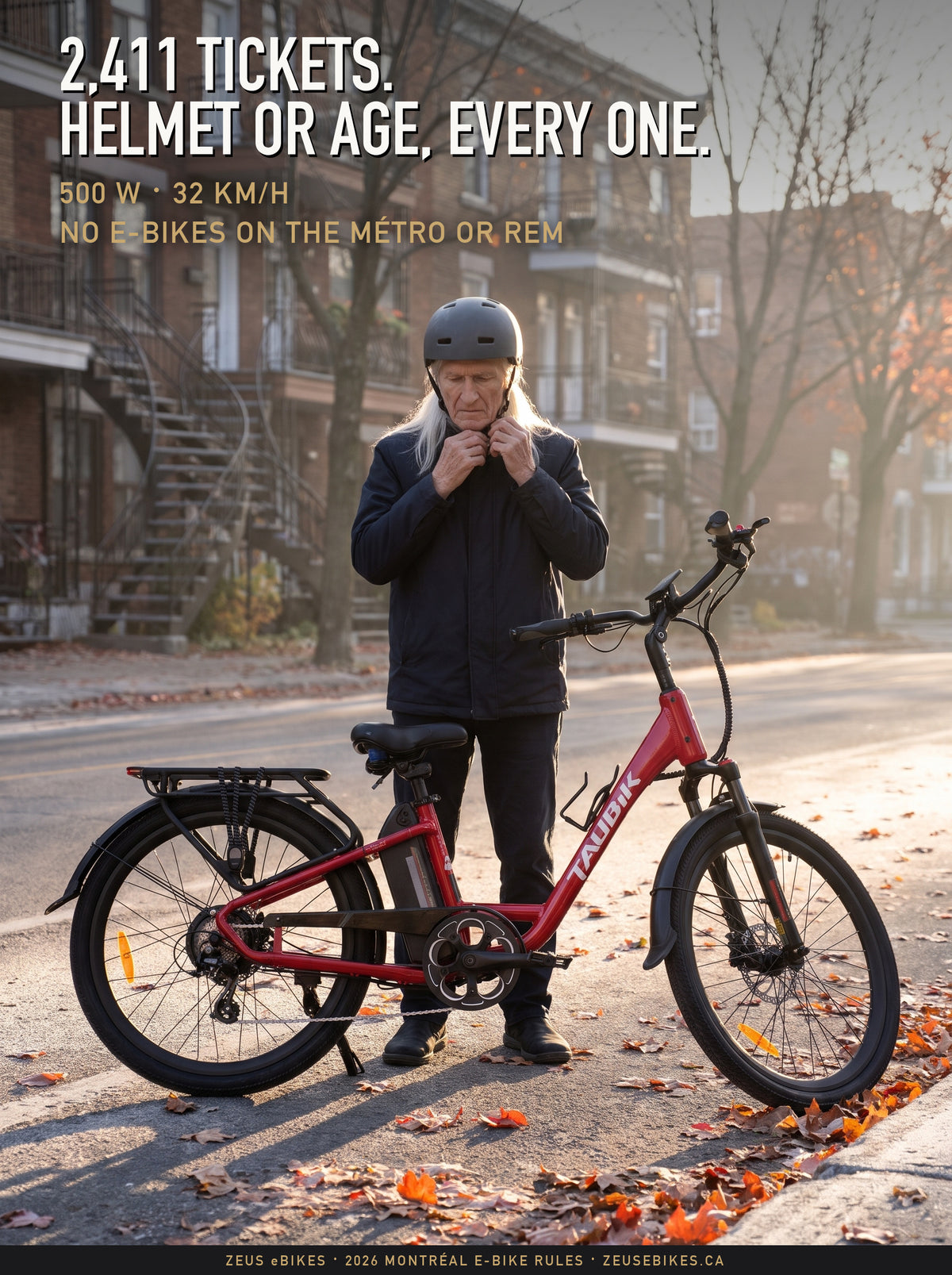
Cover: a Playcut.ai rendering of Zeus with a Taubik Vista 26, made from Taubik’s own photograph of the bike.
Montréal police wrote 2,411 tickets to e-bike riders in 2025, the most ever, at $121 each, for two offences: no helmet, and a rider under 18 without a moped licence. They wrote 9,529 tickets to cyclists of every kind the same year, up 36 per cent in five years, as the city's counters logged 19.2 million bike passages. And the métro, the STM's buses and the REM refuse every electric bike, folded or not.
Ride the wrong bike, or the right bike the wrong way, and the ticket is the smaller cost: a bike over the limit is not authorized on public roads or bike paths, and a machine without a compliance label cannot be registered to make it lawful. This guide reads the Code, the SPVM's own sheets, the transit rules and the city's pages as they stood on 27 October 2026, and says where an e-bike may go in Montréal and what it costs to get it wrong.
The rule itself is provincial and short. A power-assisted bicycle has a motor rated no more than 500 W, assistance that ceases at 32 km/h, pedals that work at all times, and two or three wheels; the rider is 18, or 14 to 17 with a Class 6D, wears a helmet, and the bike carries the maker's label (Highway Safety Code s. 492.2; SAAQ). The SPVM adds one Montréal rule: a bike with a moveable step, a footboard, stays off bicycle paths and lanes. Every cyclist rule in the Code applies. Our Québec e-bike laws guide reads the province's side section by section.
Every legal statement below was re-read in the statute, regulation, by-law or official sheet on 26 and 27 October 2026, and each links to its source, the REM regulation and the STM by-law included. The rest covers where the city's 1,083 km network lets a motor go, what the SPVM tickets and how often, the STM, REM and exo rules with their section numbers, the fines, the winter network, eight common mistakes, and five Zeus bikes checked against the rule using their makers' own figures.
- Legal bike: motor rated no more than 500 W (the SAAQ's French page says "puissance nominale", nominal power), assistance that ceases at 32 km/h, working pedals, the maker's power-assisted bicycle label (HSC s. 492.2; SAAQ)
- Rider: 18 and over, no licence; 14 to 17, a Class 6D moped licence; a helmet at every age, including on an electric BIXI; $60 to $100 in the Code, $121 on the ticket
- Paperwork: no plate or registration (SAAQ), and no insurance requirement in any text we read; the public auto plan covers an e-bike injury only when a moving automobile is involved (Automobile Insurance Act s. 10)
- Where: every street, the REV and bike lanes, at the right edge; sidewalks only where a sign allows (s. 492.1); no earphones (s. 443.2); a bike with a footboard stays off paths and lanes (SPVM)
- Métro and STM buses: no electric bikes, folded or not (STM bike page; By-law R-036, ss. 1 a.1), 20, 26), $75 to $500
- REM: no e-bike at any time (REM regulation s. 53.2), $75 to $500; ordinary bikes ride at any time under a pilot (REM page, read 27 October 2026)
- exo: bikes on all five train lines, even at peak; an e-bike boards with its battery removed if possible and folded if it folds; bus racks refuse electric and fat bikes
- Moped-styled machines without a compliance label: off public roads, bikeways and sidewalks since 30 July 2024, permanently since 26 January 2025, $300 to $600
- Winter: no rule changes; a white light in front and a red taillight at night (s. 233)
Five bikes pass the rule's power, speed, pedal and shape tests on their makers' Canadian pages: the folding Samebike 20LVXD30-II ($1,000), the three-wheel Meigi Hera ($1,799), the step-through Taubik Vista 26 ($2,399), and the Taubik Monaco S and Tour S ($2,899). Jump to the 5 bikes checked against the rule.
Jump to your situation:
What's in this guide
- What counts as a legal e-bike in Montréal, and the SPVM's footboard rule
- Where you can ride: streets, the REV, vélorues, sidewalks, parks
- What the SPVM tickets, with the 2025 numbers
- Every fine with its section
- The métro, the buses, the REM and exo: what boards and when
- Winter: the 740 km cleared network and no rule changes
- Eight things riders get wrong, checked against the text
- 5 Zeus bikes checked against the rule ($1,000 to $2,899)
- The 6-point Montréal check, and six situations to test yourself
- Montréal e-bike terms in English and French
- Frequently asked questions (17)
- Sources, with the date each was read
What Counts as a Legal E-Bike in Montréal, and the SPVM's Footboard Rule
Montréal writes no e-bike definition of its own; the Highway Safety Code and the SAAQ do. The Code calls a power-assisted bicycle "a bicycle that has an electric motor" (s. 4) and, in s. 492.2, lets it on a public highway only if the rider is 18 or holds a moped licence, wears a helmet that meets the regulation, and the bike carries the manufacturer's label and conforms to the standard.
The SAAQ's page gives the standard: a motor with "a maximum power rating of no more than 500 watts" that "must cease to generate power once the bicycle reaches a speed of no more than 32 km/h", pedals usable at all times, handlebars, and two or three wheels. Its French page, updated the same day as the English one, writes the power as "puissance nominale", nominal power. A throttle is lawful; the SAAQ says assistance "may be activated by the pedals or accelerator control".
Paragraphs (3) and (4) of s. 492.2 also point to the label and standards in the federal Motor Vehicle Safety Regulations, whose power-assisted bicycle definition was repealed effective 4 February 2021 (SOR/2020-22, s. 3(2)). The SPVM still checks the label and the SAAQ still prints the 500 W and 32 km/h figures; our Québec guide sets out how the two readings of that pointer differ.
The SPVM's power-assisted bicycle sheet restates s. 492.2 and lists what an officer checks: the rider is 18 or holds a Class 6D, the rider wears a protective helmet, the bike "must bear a removable label affixed by the manufacturer stating that it is a power-assisted bicycle", and it "must comply with the standards provided by the Motor Vehicle Safety Regulations". The fine on the sheet is "$100, plus applicable fees"; the Code's range is $60 to $100 (s. 507). Then comes the one rule that is Montréal's: "if the power-assisted bicycle has a moveable step, the driver is not allowed on a bicycle path or lane."
A moveable step, "marchepied" in the French sheet, is the flat footboard of a scooter-styled machine. A bike whose only foot placement is its pedals passes; a bike with a floorboard is confined to the roadway even where it is otherwise lawful.
The by-law behind the sheet is the agglomeration's RCG 14-043, which takes an assisted bike "équipée d'un marchepied, d'un cadre ouvert ou d'un plancher plat" out of its definition of a bicycle. It does not define "cadre ouvert". We read that as the scooter-style frame it sits beside, and the SPVM's sheet names only the step, but a strict reader could stretch it to a step-through.
A machine with a footboard can also fall under Ministerial Order 2024-24, which bars from every public highway two- or three-wheeled motor vehicles that look like a motorcycle or moped, bear no compliance label, and have at least one listed feature, such as "footrests or a platform for the driver's feet" (s. 1). The SAAQ puts the fine at $300 to $600.
Its sheet on the "cyclomoteur électrique" describes the pedal-less electric vehicle: a helmet under s. 2 of the helmet regulation, the road-vehicle traffic rules except limited-access highways, a Class 6D or another motorcycle class or a Class 5 licence, and mandatory registration. That path exists only for a machine with a Transport Canada compliance label; without it, the SAAQ says the vehicle cannot be registered, and Order 2024-24 keeps it off the road. A bike with working pedals and a 500 W motor is the other machine, and needs none of that.
One Montréal ride · four layers of rules, top to bottom
Decides what your machine is: 500 W, 32 km/h, working pedals, the maker's label, and the rider's age and helmet. Every street in Montréal starts here.
Bars moped-styled machines without a compliance label from public roads, bikeways and sidewalks. The SAAQ puts the fine at $300 to $600.
The city designates bicycle boulevards (s. 496.1) and governs paths outside the public right-of-way: its by-laws keep a bike with a footboard off paths and lanes, and a bike that moves without pedalling out of the big parks. The SPVM writes the tickets.
The métro, the STM's buses and the REM refuse e-bikes, folded or not; exo's trains take one with the battery out where possible.
Not sure a bike passes in Québec?
Call 1-866-938-7580 and a real person will read any model's maker page against the Code with you before you buy, or start with the five bikes we checked below.
See the 5 bikes checked Call 1-866-938-7580Where You Can Ride: Streets, the REV, Paths, Sidewalks, Parks
A legal e-bike goes where a bicycle goes on Montréal's street network: every street, the Express Bike Network, the painted lanes and the protected paths, at the right edge and in the direction of traffic. The city's cycling page, last updated 22 October 2026, counts 1,083 km of bike lanes across the city, through parks and along the river.
Sidewalks are closed unless a sign opens them. Inside the city's big parks a by-law applies on top: a pedal-assist bike rides at 20 km/h or less, and a bike that can move without pedalling is out, which on our reading takes in a throttle. The Lachine Canal path is Parks Canada's, with its own line on throttles.
On the street the Code's cyclist rules apply to an e-bike rider in full: ride "as close as possible to the edge or right side of the roadway" in the direction of traffic, allowing for the risk of car dooring (s. 487); single file, no more than 15 in a group (s. 486); obey every sign and signal (s. 488); signal before turning (s. 490); no earphones (s. 443.2); no passenger without a fixed seat (s. 485); reflectors, and at night a white light in front and a red taillight (ss. 232, 233).
Montréal's vélorues are what the Code calls bicycle boulevards. A city by-law designates them (s. 496.1); no road vehicle may exceed 30 km/h on one (s. 496.7); a cyclist may use the entire width of the lane in the direction of traffic (s. 496.8); and two cyclists may ride side by side unless they are riding against traffic (s. 496.10). On a shared street, a "rue partagée", vehicles are held to 20 km/h and cyclists yield to pedestrians (ss. 496.4, 496.6).
The Express Bike Network, the REV, is a 191 km project of 17 routes, protected from car traffic and "accessible all year long"; Piste Robert Silverman on Berri, Lajeunesse and Saint-Denis runs about 9 km north to south, Rue Peel crosses downtown and Avenue Souligny serves Mercier–Hochelaga-Maisonneuve, and the Viger, Saint-Antoine and Saint-Jacques route is in progress (Ville de Montréal, 6 August 2026). An e-bike inside the rule rides all of it. A bike with a footboard does not; the SPVM's sheet keeps it off every bicycle path and lane.
Sidewalks follow s. 492.1 of the Code: a cyclist may not ride on one "except in case of necessity or where directed or allowed to do so by a sign or signal", and then at a safe, reasonable speed with pedestrians given priority. The fine is $80 to $100 (s. 504), and the SPVM listed sidewalk riding among the most frequent cyclist offences in its June 2026 prevention operations, with traffic signals, earphones and bare heads on electric bikes (TVA Nouvelles, 22 June 2026).
Parks and off-road paths are a municipal matter. Québec.ca's bikeway page explains that a bike path outside the public right-of-way is the municipality's to regulate: who may use it, the direction, the speed limit, the fines.
Montréal uses that power. Three by-laws cover its big parks: By-law 10-020 for La Fontaine, Maisonneuve, Jarry, Angrignon and the other city-council parks, RCG 10-016 for Mont-Royal, Jeanne-Mance and Frédéric-Back, and RCG 09-029 for the nature parks. They read alike. A "bicyclette à assistance électrique", whose motor stops "dès que cesse l'effort", counts as a bicycle, held to 20 km/h. A "bicyclette électrique", which "permet une propulsion par le moteur sans avoir à pédaler", is listed as an off-road vehicle, and those are banned. On our reading a thumb throttle fits that second sentence.
The city says it more plainly on its park conduct page, updated 16 June 2026: a way of getting around that "ne demande aucun effort physique" is not allowed on park cycling paths, and riding above 20 km/h is forbidden. On Mont-Royal a bicycle stays on public roads and chemin Olmsted (RCG 10-016, s. 9). No text we read settles a throttle bike on a road that crosses one of these parks, or on a park path that is also on the city's cycling network, so plan on the strict reading. Borough parks have their own by-laws, and some are tighter.
The Lachine Canal path is federal. Parks Canada's visitor guidelines, modified 7 October 2026, admit pedal-assist e-bikes and say a bike with a throttle "can only be ridden on roads"; the French text says "interdits sur le sentier". Our Montréal e-bike trails guide takes each route by its owner, with a map of where a throttle can ride. Its canal uses page, modified 3 August 2026, lists "Bicycles and electric bicycles" as permitted. The two pages do not match, so plan around the later and stricter one. Each of the 5 bikes below has a throttle: ride them on the streets, the lanes and the REV.
Correction, 6 November 2026: this page used to say the city published no e-bike rule or speed cap for park paths. It does. We had read the city's cycling pages and not its park by-laws.
Zeus Ebikes Canada publishes this guide and sells its own range of e-bikes in Canada online, with free shipping.
What the SPVM Tickets, With the 2025 Numbers
The Montréal police wrote 2,411 tickets to e-bike riders in 2025, up from 1,821 in 2024 and 1,922 in 2023, for close to $292,000, a rise of 32 per cent, according to SPVM data obtained by Le Journal de Montréal in June 2026 (TVA Nouvelles, 16 June 2026). Every one was for the same two offences under s. 492.2: no helmet, and a rider under 18 without a moped licence.
The single ticket comes to $121, the SPVM pointed out to the paper; its own sheet gives the fine as $100, plus applicable fees. The SPVM's spokesperson attributed the rise to more electric bikes on the road and to riders who keep their bare-headed habits when they switch from a mechanical bike (TVA Nouvelles).
The wider picture is the same. In 2025 the SPVM wrote 9,529 tickets to cyclists of every kind, mostly for red lights, a rise of 36 per cent in five years while the city's counting sites went from 13 million passages in 2021 to 19.2 million in 2025 (TVA Nouvelles, 22 June 2026); Noovo's figure from the city's preliminary data was above 9,500, up 60 per cent on 2020, at $80 to $100 each.
In June 2026 the SPVM ran prevention operations at busy lanes: the offences officers named as the most frequent were traffic signals, sidewalks, earphones, and no helmet on an electric bike (TVA Nouvelles).
Shared bikes count. Le Journal de Montréal counted at least ten e-bike riders without a helmet in under ten minutes at Saint-Denis and Rachel, on the Plateau, on the morning of Tuesday 16 June 2026, and Québec.ca's electric-bike page says the helmet and age rules "also apply to trips made using shared e-bike services". La Presse traced the curve earlier: 755 e-bike tickets in 2019, 2,000 in 2023, 1,301 by 29 July 2024.
Moped-styled machines are the third enforcement line. Between 30 July 2024, when Ministerial Order 2024-15 took effect, and late November 2024, the SPVM issued 244 tickets for mopeds or motorcycles on public roads without a CMVSS certification mark, and cycling advocates told CBC the situation on the bike paths had improved (CBC News, 27 November 2024). The order became permanent on 26 January 2025 as Order 2024-24. The fine is $300 to $600; the machine cannot be registered afterward, because certification applies only to new vehicles (SAAQ FAQ).
The police sheets state the rules and the $100-plus-fees figure; the counts above come from the Journal de Montréal, TVA Nouvelles, Noovo, La Presse and CBC, each of which obtained them from the SPVM or the city. We found no SPVM page that publishes motor-wattage checks, label inspections or a count of speed-cap enforcement, and this page does not claim how often those happen. What it can say is that every e-bike ticket in the 2025 figures was for the helmet or the rider's age.
Every Fine With Its Section
Montréal's e-bike fines come from the Code, the ministerial order and the transit regulations, and the number on the ticket is higher than the number in the statute because fees are added. The Code sets $60 to $100 for the four conditions in s. 492.2 (s. 507) and $80 to $100 for every cyclist rule (s. 504); the SPVM's sheet gives $100 plus applicable fees, and the SPVM told Le Journal de Montréal the single ticket comes to $121.
The order's fine is $300 to $600 on the SAAQ's figures, and the REM's regulation sets its own schedule.
| Offence | Section | Fine in the text | On the ticket, and how often |
|---|---|---|---|
| No helmet on an e-bike, including an electric BIXI | HSC s. 492.2(2); s. 507 | $60 to $100 | $100 plus fees (SPVM); $121 (Le Journal); the largest share of 2,411 tickets in 2025 |
| Under 18 without a moped licence | HSC s. 492.2(1); s. 507 | $60 to $100 | $100 plus fees; the other share of the 2,411 |
| No maker's label, or a bike outside the standard | HSC s. 492.2(3), (4); s. 507 | $60 to $100 | $100 plus fees (SPVM) |
| Red light or stop sign | HSC s. 488; s. 504 | $80 to $100 | Most of the 9,529 cyclist tickets in 2025 (TVA Nouvelles) |
| Sidewalk without a sign allowing it | HSC s. 492.1; s. 504 | $80 to $100 | Among the four most frequent (SPVM, June 2026) |
| Earphones | HSC s. 443.2; s. 504 | $80 to $100 | Among the four most frequent |
| Wrong way, no signal, side by side, no lights at night | HSC ss. 486, 487, 490, 233; s. 504 | $80 to $100 | |
| Drinking or cannabis while riding | HSC s. 489; s. 504 | $80 to $100 | Criminal Code exposure on top (Québec.ca) |
| Limited-access highway or ramp | HSC s. 479; s. 504 | $80 to $100 | |
| Footboard bike on a path or lane | SPVM sheet (the sheet states no Code section for this rule) | Not stated on the sheet | The SPVM's general figure for its sheet is $100 plus fees |
| Moped-styled machine without a compliance label on a public road, bikeway or sidewalk | Ministerial Order 2024-24 s. 1; HSC s. 633.1 | $300 to $600 (SAAQ) | 244 tickets, 30 July to late November 2024 (CBC) |
| E-bike on the REM | REM regulation s. 53.2 (added by the amendment approved 18 December 2025) and Annex | $75 to $500; $150 to $1,000 on a repeat | |
| E-bike in the métro or on an STM bus | STM By-law R-036, ss. 1 a.1), 20, 20.1 and 26, as amended by R-036-5 (adopted 4 December 2024, in force 1 February 2025) | $75 to $500; doubled on a repeat within 24 months (s. 32) | The by-law counts a two- or three-wheel e-bike as a motorized personal transport device |
One thing the texts do not provide. We found no provision that lets an officer seize a power-assisted bicycle for a s. 492.2 offence; the Code's seizure provisions attach to road vehicles in the situations they list, and this page does not claim a seizure power that is not written. The STM's fine is in its by-law: R-036 sets $75 to $500 for carrying an e-bike into the métro (s. 26), doubled on a repeat within 24 months (s. 32).
The city's park by-laws set $100 for a first offence and $500 for a repeat (10-020, s. 16; RCG 10-016, s. 14; RCG 09-029, s. 73). On the cycling network, RCG 14-043 sets $30 to $50 for a first offence (s. 5).
The Métro, the Buses, the REM and exo: What Boards and When
No STM vehicle and no REM train carries an electric bike; exo's trains do, with the battery out where possible. The STM's bike page says "motorized or electric bikes, scooters and other personal transport devices are not allowed inside our facilities and vehicles", and its By-law R-036 counts any two- or three-wheel e-bike as a motorized personal transport device. The REM's regulation bars every such device from its trains at all times (s. 53.2).
Exo carries bikes on all five of its train lines, "even during peak hours", and asks e-bike riders to remove the battery before boarding where possible and to fold the bike if it folds; its bus racks take standard bicycles only. Ordinary bicycles ride all three systems, on the hours below.
| Service | An ordinary bike | An e-bike | Rule and fine |
|---|---|---|---|
| STM métro | Weekdays before 7:00, from 9:30 to 15:30 and after 18:00; weekends and holidays at any time; at any time from 17 May to 15 August 2027. Centre or rear cars, two per car, 14 or accompanied | No, folded or not | By-law R-036, ss. 1 a.1), 20, 20.1; $75 to $500 (s. 26), doubled on a repeat within 24 months (s. 32) |
| STM bus | Only a folding bike, kept folded; the page mentions a front rack only to bar bikes from it on the Pie-IX BRT lane | No, folded or not | The STM's bike page; By-law R-036 |
| REM | At any time under the REM's pilot; two per car, 14 or accompanied; may be barred during high-ridership events | No, at any time | REM regulation s. 53.2; $75 to $500, $150 to $1,000 on a repeat |
| exo train | All five lines, even at peak | Yes: battery out if possible, folded if it folds, a UL-, ETL- or CSA-certified battery, no charging aboard | exo's bike page |
| exo bus | On the free front rack, on lines that have one; two standard bikes per rack; none inside the bus | No: racks refuse electric and fat bikes | exo's bike page |
| Electric BIXI | A mechanical BIXI follows the cyclist rules | A helmet, and 18 or a Class 6D | Québec.ca; HSC s. 492.2; $121 on the ticket |
STM: métro and buses
The STM's bike page, read 28 October 2026 on the STM's new website, admits ordinary bikes to the métro from 17 August 2026 to 16 May 2027 on weekdays from opening to 7:00, from 9:30 to 15:30 and from 18:00 until closing, and at all times on weekends and holidays; from 17 May to 15 August 2027, at any time.
Riders are 14 or accompanied by an adult, board the centre or rear cars, walk beside the bike, take one bike per door and two per car. A folding bike or a scooter may travel at all times "in the métro and on buses, so long as you keep them folded during your entire trip". Then the rule that decides an e-bike: "For safety reasons, motorized or electric bikes, scooters and other personal transport devices are not allowed inside our facilities and vehicles. Exceptions apply for mobility aid devices."
The folding allowance does not rescue an e-bike. The by-law, in the STM's French consolidation read on 28 October 2026, counts a two- or three-wheel "bicyclette à assistance électrique" as a motorized personal transport device (s. 1 a.1), admits to the métro only a bicycle that is not one (ss. 20 and 20.1), and fines a breach $75 to $500 (s. 26), doubled on a repeat within 24 months (s. 32). The STM's bike page mentions a front bike rack only once, to bar bikes from it on buses using the reserved Pie-IX BRT lane.
The ban is older than the by-law's wording. The STM's press release of 5 December 2024 (archived copy) said the updated by-law bans "all electric modes of transportation (bicycles, scooters, skateboards, etc.) from the bus and métro", citing battery fires; CBC reported the same day that the STM "continues to prohibit" those devices. The amendment, R-036-5, was adopted on 4 December 2024 and took effect on 1 February 2025.
REM
The REM's regulation, made by the Autorité régionale de transport métropolitain (ARTM) and amended three times since 2022, permits a non-motorized bicycle, scooter or similar object in stations and trains on conditions: a rider under 14 accompanied by an adult, the bike under control and never leaned on the train or its equipment, two per car, and priority to other passengers (s. 53).
Section 53.1 sets the periods: weekdays from opening to 7:00, 9:30 to 15:30 and after 18:00, plus weekends and holidays, from the third Monday of August to the day before the third Monday of May; at all times in the summer weeks between; and "à toute autre période déterminée par l'opérateur du REM".
Section 53.2 then closes the door on e-bikes: "Dans le matériel roulant du REM, il est interdit à toute personne, en tout temps, de transporter un appareil de transport personnel motorisé." It came in with the amendment the ARTM's board approved on 18 December 2025. The Annex sets $75 to $500, and $150 to $1,000 on a repeat.
The REM's page, read 27 October 2026, says "At any time, bicycles are permitted on board the REM" under its pilot project, for riders 14 or accompanied, two per car, held and never leaned on the equipment, and that bikes may be barred during events that generate high ridership. We read s. 53.1's last clause, which lets the operator set other periods, as the basis for those wider hours.
A bike may be parked only "in the racks provided" and not outside the REM's operating hours. The page repeats that e-bikes "are no longer permitted within the network (Section 53.2)", folded or not. An earlier version of this page said the REM allowed e-bikes off-peak; the regulation does not.
exo
Exo's page, "Bikes and bike sharing", read 27 October 2026, says "Bikes are allowed on all five of our train lines, even during peak hours." Its electric-bike panel defines an e-bike as one with "a maximum power rating of 500 W" and no licence plate, and asks: "Before boarding, and if possible, remove the battery from the bike"; fold it if it folds; make sure the battery "is UL-, ETL- or CSA-certified and is not damaged or corroded"; and never charge it inside trains or exo buildings, though you may charge at a bikezone.
On buses, exo's front racks are free on the lines that have them and hold two standard bicycles each: "Only standard bicycles are allowed. Children's bikes, tandems, fat bikes and electric bikes are prohibited." No bicycle rides inside the bus, and "The driver may refuse a bike if safety is compromised." At the Montcalm bus terminal and the Candiac and Mont-Saint-Hilaire train stations, free bike lockers hold up to six bikes in individual compartments, each locker with a charging station for electric bikes.
Québec.ca's electric-bike page says the helmet and age rules "also apply to trips made using shared e-bike services". An electric BIXI is a power-assisted bicycle: 18 or a Class 6D, and a helmet, or a $121 ticket. In one June 2026 prevention operation, officers set up in front of a BIXI station so riders without a helmet could "échanger leur BIXI bleu pour un BIXI gris", trade a blue BIXI for a grey one, TVA Nouvelles reported.
Winter: the 740 km Cleared Network and No Rule Changes
Nothing in the Code, the SPVM's sheets or the transit rules changes in winter: the same 500 W bike, the same helmet, the same hours. What changes is the network. Under "Wintertime access", the city's cycling page says many bike lanes are cleared of snow "at the same time as the street is, or soon after", and lists among them 251 km of paths protected by concrete walls and poles and 489 km of lanes with ground markings and signage: 740 km between them.
After a storm, part of a lane may be blocked by snow piled at the roadside until snow loading is complete, and the city takes reports of uncleared paths on the same page. Its Express Bike Network is built to be "accessible all year long".
The cold changes the bike more than the rules. Our US sister store, RedTail eBikes, models a full charge at 14°F (−10 °C) on packed snow, ridden at 12 mph (about 19 km/h) on the throttle, at about 71% of what the same bike covers on a dry 77°F (25 °C) road, in a model built on measured battery-cell data from 25 °C down to −20 °C (RedTail's winter range model). What each maker allows in the cold matters too, and the five bikes checked below differ:
| Bike | What its maker prints about the cold | Where it is printed |
|---|---|---|
| Samebike 20LVXD30-II | No riding or charging temperature on Samebike Canada's page, product data and rendered page both | Samebike Canada, read 28 October 2026 |
| Meigi Hera | The only temperature range in its manual is the LCD display's, −20 °C to 60 °C; the manual asks riders to slow down on snowy or rainy days | Meigi's MG708 manual (a scanned file, read by text recognition) |
| Taubik Vista 26, Monaco S and Tour S | "This equipment is not intended to be used at ambient temperatures less than 0°C or above ambient temperatures of 40°C"; charge between 0 °C and 40 °C. The Tour S brochure calls it "the perfect go-to e-bike for year-round commuting in any season", against the manual's 0 °C | Taubik's English manuals for the Vista 26, Monaco S and Tour S and the Tour S brochure |
Taubik's own documents disagree, so we print both and ask you to check with us or Taubik before you plan a winter on one of its bikes. Whatever the bike, the one legal point for winter is lighting: a white light in front and a red taillight at night (s. 233), and in December the evening commute is a night ride. Our winter e-bike guide covers batteries and tires in detail.
Eight Things Riders Get Wrong About Montréal's E-Bike Rules, Checked Against the Text
The rules are short, and the versions repeated online and at the bike rack drift from them. Eight claims come up again and again in what riders search for and ask about Montréal; each one is set below against the sentence that decides it and the place it is written. One of them, the REM's off-peak e-bikes, appeared on an earlier version of this page.
| What gets repeated | What the text says | Where it is written |
|---|---|---|
| Québec bans throttles. | Wrong. The assistance "may be activated by the pedals or accelerator control"; what the rule demands is pedals that work at all times. | SAAQ, On an Electric Bike |
| A folded e-bike can ride the métro. | Wrong. Folding bikes ride at all times if kept folded, but "motorized or electric bikes, scooters and other personal transport devices are not allowed inside our facilities and vehicles", and the by-law counts any two- or three-wheel e-bike as such a device. | STM bike page; By-law R-036, ss. 1 a.1), 20 |
| The REM takes e-bikes outside rush hour. | Wrong. Section 53.2 bars a motorized personal transport device "en tout temps", at all times; the pilot's "at any time" covers ordinary bikes. | REM regulation s. 53.2; REM bike page |
| Every cyclist in Montréal must wear a helmet. | Only on an e-bike, a moped or a motorcycle. The Code requires a helmet on a power-assisted bicycle (s. 492.2) and on a motorcycle or moped (s. 484). None of the Code's other mentions of a helmet requires one on a pedal bicycle; the SAAQ urges one for every rider. | HSC ss. 484, 492.2; SAAQ helmet page |
| An e-bike needs a plate and insurance. | Wrong. The SAAQ: "Il ne faut pas faire immatriculer un vélo électrique." No text we read requires insurance; the public plan pays for an e-bike injury only when an automobile in motion is involved. | SAAQ (French page); Automobile Insurance Act s. 10 |
| A 750 W bike is fine in its 500 W mode. | Unsettled at best. The SAAQ sets "a maximum power rating of no more than 500 watts" and says a bicycle with a 1,000-watt motor "is not authorized for use on a public road, including roadways and bike paths". We found no text that settles whether a software limit changes a motor's rating. | SAAQ page and its FAQ on non-compliant vehicles |
| The rules change in winter. | Wrong. None of the texts we read has a winter version of the rule. The one rule winter brings closer is lighting at night: a white light in front and a red taillight. | HSC s. 233 |
| A throttle bike can ride any park path. | Wrong in the city's big parks. A bike that "permet une propulsion par le moteur sans avoir à pédaler" is listed as an off-road vehicle, and those are banned; every bicycle there is held to 20 km/h. | By-law 10-020, ss. 1, 9, 12; RCG 10-016; RCG 09-029; the city's park conduct page |
5 Zeus Bikes Checked Against the Rule, $1,000 to $2,899
Five Zeus bikes pass Québec's rule on their makers' own Canadian pages: a motor rated 500 W or less, assistance that stops at 32 km/h with no faster mode listed, pedals that work, and no footboard or moped body. They run from a $1,000 folder to two $2,899 Taubiks, with a three-wheel option between, and each card says what the bike is for in Montréal and what it is not for.
Each figure on the cards was read on the maker's Canadian page on 28 October 2026, product data and rendered page both, and in the manual the maker links. Where a maker prints two figures, the card gives both. None of the five has a footboard, so all five may use every path and lane in the city.
Prices are Zeus prices in Canadian dollars on 28 October 2026; each comes with Canadian stock, support and a 15-day return window for unused, unopened bikes (15% restocking fee, buyer pays return shipping). No stock claims appear here because stock moves daily. The transit fit is short in Montréal: no e-bike boards the métro, an STM bus or the REM; exo's trains take one with the battery removed where possible, and exo's bus racks refuse electric and fat-tire bikes.

The lobby test: in a city whose métro and REM refuse e-bikes, the bike has to get up the stairs of the walk-up, and the helmet has to go on before the lane. A Playcut.ai rendering.
Swipe the table sideways
| Bike | Zeus price | Motor, maker's rating | Assistance stops at | Torque | Weight | Folds | Maker's cold-weather line | Best Montréal fit |
|---|---|---|---|---|---|---|---|---|
| Samebike 20LVXD30-II | $1,000 | 350 W | 32 km/h | 35 Nm | 25 kg | Yes | None printed | Walk-ups and exo trains |
| Meigi Hera (trike) | $1,799 | 350 W | 15 mph (about 24 km/h) | Not printed | Not on Meigi Canada's page | No | None for riding (the manual gives the display −20 °C to 60 °C) | Balance and groceries |
| Taubik Vista 26 | $2,399 | 500 W | 32 km/h | 68 Nm | 64 lb; 30.5 kg net | No | Not below 0 °C | The daily REV commute |
| Taubik Monaco S | $2,899 | 500 W | 32 km/h | 68 Nm | 70 lb; 31.5 kg net | Yes | Not below 0 °C | A condo closet or a car trunk |
| Taubik Tour S | $2,899 | 500 W | 32 km/h | 80 Nm | 77 lb; 35.5 kg net | No | Not below 0 °C; its brochure says "any season" | Potholes and Mont-Royal climbs |
Samebike 20LVXD30-II
$1,000
The 20LVXD30-II: a 350 W folder at 25 kg, with a removable 48V 10.4Ah battery and a 32 km/h default speed on Samebike Canada's page.
Samebike Canada's page, read 28 October 2026, lists a 350 W motor at 35 Nm, a removable 48V 10.4Ah battery, a 32 km/h "Default Speed", 20 × 1.95 in tires, a Shimano 7-speed, mechanical disc brakes, a front suspension fork, 25 kg, a 120 kg payload and a folded size of 0.9 × 0.36 × 0.7 m (Samebike Canada). It rates the range at 35 to 70 km, the top figure "Tested by a 75KG rider on a flat road" in the lowest assist level.
Recall records, read 27 October 2026: Health Canada and the US CPSC list no recall of any Samebike.
At 25 kg it is the lightest bike on this list to carry up a walk-up's stairs, and it folds for the closet and for exo's trains, whose e-bike panel asks riders to fold a bike that folds. Samebike's Canadian page prints no temperature range; bring the battery indoors to charge.
Best for: a walk-up, a small apartment, and a bike-and-train commute on exo. Not for: loaded Mont-Royal climbs: 35 Nm is the lowest torque any maker prints on this list, and the brakes are mechanical.
Meigi Hera
$1,799
The Hera: a 350 W city trike with a 15 mph top speed, a removable 36V 13Ah battery and a basket at the back.
Meigi's Canadian page, read 28 October 2026, lists a 350 W front brushless hub motor, a "15MPH top speed", a removable 36V 13Ah battery, a twist throttle with three assist levels and a walking mode, Kenda 24 × 2.125 in tires, a low step-through frame with a 15 in (38 cm) down tube, and a wide rear basket (Meigi Canada). Meigi's page and our listing price it the same, $1,799.
Québec's rule covers it: the SAAQ's definition allows two or three wheels, and the Hera's top speed sits under the 32 km/h cap. Its manual sets the maximum load at 300 lb and our listing says 265 lb, so plan on the lower. The only temperature range in the manual is the display's.
Best for: a rider who wants three wheels for balance, a basket for the market, and a calm pace in the lanes. Not for: a walk-up, the métro or the REM (an electric trike boards neither), or a rider who wants 32 km/h.
Taubik Vista 26
$2,399
The Vista 26: a 500 W Sutto motor at 68 Nm, Zoom hydraulic brakes and a battery certified to UL 2271, on a low step-through frame.
Taubik's Vista 26 page, read 28 October 2026, lists a 500 W Sutto motor at 68 Nm, a 48V/14.7Ah Samsung battery "Certified In Accordance With UL 2271", 32 km/h and no other speed, a dual torque and cadence sensor, a Shimano Altus 7-speed, Zoom dual-piston hydraulic brakes on 180 mm rotors, 26 × 1.9 in CST tires, a coil front fork, lights front and rear, 64 lb and a 286 lb weight capacity (Taubik).
The manual Taubik links from the page (PDF) lists a "Torque & Cadence Sensor" (the display menu switches between them), 30.5 kg net and a 120 kg maximum load. It ships set to 32 km/h; the same manual says the maximum speed can be adjusted and asks riders to stay within the local limit, so keep it at 32 km/h, Québec's limit.
Taubik describes an ultra-low step-through frame and says the battery is interchangeable with the Escape S's. Winter is the caveat: the manual says "This equipment is not intended to be used at ambient temperatures less than 0°C". Ask us or Taubik before you plan a winter on it.
Best for: the daily REV commute, upright, with hydraulic brakes for wet lanes. Not for: a third-floor walk-up carried every day, or a winter plan that ignores the manual.
Taubik Monaco S
$2,899
The Monaco S: a 500 W Sutto motor at 68 Nm, a Samsung 48V 15Ah battery certified to UL 2271, Zoom hydraulic brakes and collapsing handlebars.
Taubik's Monaco S page, read 28 October 2026, lists a 500 W Sutto motor at 68 Nm, torque and cadence sensing you switch between, a 48V/15Ah Samsung battery "Certified In Accordance With UL 2271", 32 km/h, Zoom dual-piston hydraulic brakes on 180 mm rotors, 20 × 3 in CST Big Boat tires, a Shimano Altus 7-speed, lights, 70 lb and a 286 lb weight capacity, with "a fully foldable frame and collapsing handlebars" (Taubik). Taubik calls itself "a proudly Canadian-owned electric bike company".
The manual Taubik links from the page (PDF) gives 31.5 kg net and a 120 kg maximum load, and says the bike "is not intended to be used at ambient temperatures less than 0°C". It ships set to 32 km/h; its manual says the maximum speed can be adjusted and asks riders to stay within the local limit, so keep it at 32 km/h, Québec's limit.
At 70 lb it is a bike to roll into an elevator or up one flight, then fold for the closet or the car.
Best for: a Rosemont or Verdun commuter who wants hydraulic brakes and a torque option in a folding frame. Not for: a daily three-flight carry.
Taubik Tour S
$2,899
The Tour S: a 500 W Bafang at 80 Nm on 26 × 4 in Kenda Juggernaut tires, one speed figure on Taubik's page, and a battery certified to UL 2271.
Taubik's Tour S page, read 28 October 2026, lists a 500 W Bafang motor with 80 Nm, 32 km/h and no other speed, a 48V/15Ah Samsung battery "Certified In Accordance With UL 2271", a dual torque/cadence sensor, a Shimano Acera derailleur, Zoom hydraulic brakes on 180 mm rotors, 26 × 4 in Kenda Juggernaut tires, a rack with a brake light, 77 lb and a 286 lb weight capacity (Taubik). The page lists no throttle; the manual Taubik links from it (PDF) shows a thumb throttle, a torque sensor, 35.5 kg and a 120 kg maximum load.
Winter is where Taubik's own documents part. The brochure calls the Tour S "the perfect go-to e-bike for year-round commuting in any season"; the manual says "This equipment is not intended to be used at ambient temperatures less than 0°C or above ambient temperatures of 40°C", and sets charging at 0°C to 40°C. Both sentences are Taubik's. Ask us or Taubik before you plan a winter on it.
Best for: the REV's pothole season and the climbs up Mont-Royal, on fat tires. Not for: a walk-up, an exo bus rack (exo refuses fat and electric bikes on its racks), or a winter plan that ignores the manual.
Our test for this page is stricter than a bike's shipped setting: a maker that lists a mode above 32 km/h, or more than 500 W of motor, keeps the bike off the list, because no text we read settles whether a bike that can be set faster meets the SAAQ's "must cease to generate power". The Vista 26 and Monaco S ship set to 32 km/h with no faster mode listed; their manuals say the maximum speed can be adjusted, so keep it at 32 km/h.
Four bikes Zeus sells fail the test on their makers' own Canadian pages; the first two were picks on this page until this update.
- Eunorau Meta Foldable: "Class 2 Speed limited Unlockable" in Eunorau's specification grid, beside "Maximum Speed: 20MPH"
- Velotric Discover M: "Class 1 / 2 / 3 Speed Modes (Up to 28 MPH in Custom)" and "adjustable assisted speeds up to approximately 45 km/h (28 mph), where permitted by local regulations"; another sentence on the same page says "configurable assisted speeds up to 32 km/h (28 mph)"
- Eunorau Urus 2.0: "Class 3 Speed limited Unlockable" and "MAX SPEED: 28 mph / 45 km/h", beside "Maximum Speed 20 MPH / 32 KPH" in its table
- Eunorau FAT-AWD 3.0: "Front 48V/500W+Rear 500W", two motors and 1,000 W on one bicycle; the SAAQ says a bicycle with a 1,000-watt motor "is not authorized for use on a public road, including roadways and bike paths"
Our Real-World Test in Canadian Weather
A dual-motor e-bike, filmed and reviewed by Zeus eBikes (4:04, posted January 2026)
The bike in this video has two motors. In Québec, add a two-motor bike's ratings together before you ride it here: the SAAQ sets "a maximum power rating of no more than 500 watts", and its FAQ says a bicycle with a 1,000-watt motor "is not authorized for use on a public road, including roadways and bike paths".
Ride Montréal inside the rule, $1,000 to $2,899
Every pick above passes the rule's power, speed, pedal and shape tests on its maker's own Canadian page. Canadian stock and support, free shipping, a 15-day return window for unused, unopened bikes (15% restocking fee, buyer pays return shipping), and a real human at 1-866-938-7580 who will read any model's page against the Code before you buy.
Call 1-866-938-7580 Compare the 5 againThe 6-Point Montréal Check, and Six Situations to Test Yourself
A bike and its rider pass in Montréal when six things are true, and each one is written somewhere you can read: four about the machine, one about its label, and one about the rider. Run your own bike through the list below, then try the six situations that come up most when Montrealers ask about the rules; each answer names the section that decides it.
- The motor is rated 500 W or less, every motor on the bike counted together (SAAQ: "a maximum power rating of no more than 500 watts"; its French page says "puissance nominale").
- The assistance stops at 32 km/h, and the maker lists no faster mode (SAAQ: it "must cease to generate power once the bicycle reaches a speed of no more than 32 km/h"). If the display has a speed-limit setting, read the manual and keep it at 32 km/h or lower.
- The pedals work at all times, as on a bike without a motor (SAAQ). A throttle is allowed.
- It has two or three wheels and no moped body or footboard (SAAQ; Ministerial Order 2024-24, s. 1; the SPVM's moveable-step rule).
- It carries the maker's power-assisted bicycle label (HSC s. 492.2(3); the SPVM's sheet).
- The rider is 18, or 14 to 17 with a Class 6D, and wears a helmet with a rigid shell, a padded interior and a chin strap (HSC s. 492.2(1) and (2); Protective Helmets Regulation s. 2.1).
You are 16 and want to ride an electric BIXI to school. Can you?
Only with a Class 6D moped licence, which takes a six-hour course, the SAAQ's knowledge and vision tests, and a parent's written consent, and only in a helmet (HSC s. 492.2(1) and (2); SAAQ). Without the licence it is one of the two offences behind all 2,411 e-bike tickets of 2025: $60 to $100 in the Code (s. 507), $121 on the ticket.
Your folding e-bike fits in a bag. Can it ride the métro?
No. The STM admits folding bikes kept folded, but its by-law counts every two- or three-wheel e-bike as a motorized personal transport device (s. 1 a.1), and the bike page bars those from "our facilities and vehicles". The fine is $75 to $500 (s. 26), doubled on a repeat within 24 months (s. 32).
You commute from Brossard on the REM. Can your e-bike come aboard?
No. Section 53.2 bars a motorized personal transport device from the REM at all times, folded or not, at $75 to $500. The REM's page lets a bike be parked only in the racks provided and not outside operating hours, so a rider who brings the e-bike to the station locks it there for the train ride.
Your bike has a 750 W motor that its app limits to 500 W. Is it legal?
We cannot tell you it is. The SAAQ sets "a maximum power rating of no more than 500 watts" and says a bicycle with a 1,000-watt motor "is not authorized for use on a public road, including roadways and bike paths". We found no text that settles whether a software limit changes a motor's rating, so bikes like this stay off our Montréal list.
A scooter-styled e-bike has pedals, a floorboard and no compliance label. Can it ride the REV?
No. Ministerial Order 2024-24 bars a two- or three-wheeled motor vehicle "with or without pedals" that looks like a motorcycle or moped, bears no compliance label and has a listed feature such as footrests or a platform, from public roads, bikeways and sidewalks; the SAAQ puts the fine at $300 to $600. Even a lawful bike with a moveable step stays off paths and lanes (SPVM).
You ride the REV home after dark in January with no lights. What is the rule?
At night a bicycle must carry a white light in front and a red taillight (HSC s. 233); riding without them is $80 to $100 (s. 504). The REV stays open; the city describes its routes as "accessible all year long", and 740 km of lanes are on its winter-clearing list.
Montréal E-Bike Terms in English and French
Montréal's signs, tickets and transit rules are written in French first, and the English versions use different words for the same thing. The table pairs each term with the French the law or the operator uses, so a sign, a by-law or a ticket reads the same in either language; every pair below comes from the bilingual texts this guide cites.
| In English | En français | What it means in Montréal | Where it is written |
|---|---|---|---|
| power-assisted bicycle, e-bike | bicyclette assistée; vélo à assistance électrique (VAE) | The legal e-bike: 500 W, 32 km/h, working pedals | HSC s. 4; SAAQ |
| nominal power | puissance nominale | The SAAQ's French word for the 500 W rating; its English page says "maximum power rating" | SAAQ; Ministerial Order 2024-24, s. 1 (French) |
| moped licence, Class 6D | permis de la classe 6D (cyclomoteur) | What a rider aged 14 to 17 needs to ride an e-bike | HSC s. 492.2(1); SAAQ |
| protective helmet | casque protecteur | A rigid shell, padded inside, with a chin strap (coquille rigide, jugulaire) | Protective Helmets Regulation s. 2.1 |
| moveable step | marchepied | A footboard; it keeps a bike off bicycle paths and lanes | SPVM sheets, English and French |
| bicycle boulevard | vélorue | Cyclists may use the full lane; vehicles may not exceed 30 km/h | HSC ss. 4, 496.7, 496.8 |
| shared street | rue partagée | Pedestrians come first; vehicles may not exceed 20 km/h | HSC ss. 4, 496.4, 496.6 |
| Express Bike Network (EBN) | Réseau express vélo (REV) | A 191 km project of 17 protected routes, open all year | Ville de Montréal |
| motorized personal transport device | appareil de transport personnel motorisé | The STM's and the REM's term for the class that includes every e-bike | By-law R-036, s. 1 a.1); REM regulation s. 53.2 |
| compliance label; national safety mark | étiquette de conformité; marque nationale de sécurité | The Transport Canada certification a moped-styled machine needs to use a public road | Ministerial Order 2024-24, s. 1 |
| electric moped | cyclomoteur électrique | A machine without working pedals: registration and a licence | SPVM sheet |
| statement of offence, the ticket | constat d'infraction | What the SPVM writes: $121 for a helmet or age offence on an e-bike | TVA Nouvelles; Le Journal de Montréal |
Frequently Asked Questions
Are e-bikes legal in Montréal?
Yes, on every street, bike lane and Express Bike Network route, for a bike with a motor rated no more than 500 W, assistance that ceases at 32 km/h, working pedals and the maker's label, ridden by someone 18 or older, or 14 to 17 with a Class 6D, in a helmet (Highway Safety Code s. 492.2; SAAQ). The SPVM adds that a bike with a moveable step stays off bicycle paths and lanes. Moped-styled machines without a Transport Canada compliance label have been off public roads, bikeways and sidewalks since 30 July 2024.
Do I need a licence to ride an e-bike in Montréal?
Not at 18 or older. From 14 to 17 the rider needs a licence to drive a moped (s. 492.2(1)), the Class 6D, which takes a six-hour course, the SAAQ's knowledge and vision tests, and a parent's written consent. Riding under 18 without it is one of the two offences behind Montréal's 2,411 e-bike tickets in 2025, at $60 to $100 in the Code and $121 on the ticket.
Do I need insurance, a plate or registration for an e-bike in Montréal?
No plate and no registration: the SAAQ's French page says "Il ne faut pas faire immatriculer un vélo électrique." We found no text that requires an e-bike rider to carry insurance. The SAAQ says injuries in an e-bike accident are not covered by the public auto plan unless a moving vehicle covered by the plan is involved, the rule in s. 10 of the Automobile Insurance Act, so ask your home or tenant insurer what your policy covers for the bike and for your liability while riding.
Is a helmet mandatory on a regular bike in Montréal, or only on an e-bike?
Only on the e-bike, among bicycles. The Code requires a helmet on a power-assisted bicycle (s. 492.2(2)) and on a motorcycle or moped (s. 484); none of its other mentions of a helmet requires one on a pedal bicycle, and the SAAQ helmet page urges one for every rider without citing a rule for pedal bikes. On an e-bike the helmet needs a rigid shell, a padded interior and a chin strap (Protective Helmets Regulation s. 2.1), at every age.
Do I need a helmet on an electric BIXI?
Yes. Québec.ca's electric-bike page says the helmet and age rules "also apply to trips made using shared e-bike services". An electric BIXI is a power-assisted bicycle: 18 or a Class 6D, and a helmet with a rigid shell, a padded interior and a chin strap, or a $121 ticket. In a June 2026 prevention operation, officers set up at a BIXI station so riders without a helmet could trade a blue BIXI for a grey one (TVA Nouvelles).
Can I take my e-bike on the métro or an STM bus?
No, folded or not. The STM's bike page says "motorized or electric bikes, scooters and other personal transport devices are not allowed inside our facilities and vehicles", with exceptions for mobility aids, and By-law R-036 counts any two- or three-wheel e-bike as a motorized personal transport device (s. 1 a.1). The fine is $75 to $500 (s. 26), doubled on a repeat within 24 months (s. 32).
When can I take a regular bike on the métro?
From 17 August 2026 to 16 May 2027, on weekdays from opening to 7:00, from 9:30 to 15:30 and from 18:00 until closing, and at any time on weekends and holidays; from 17 May to 15 August 2027, at any time (STM). Board the centre or rear cars, one bike per door and two per car, at 14 or with an adult. A folding bike kept folded rides at any time, on the métro and on buses.
Can I take my bike on the REM? And my e-bike?
A bicycle, yes. The REM's page, read 27 October 2026, says "At any time, bicycles are permitted on board the REM" under its pilot, for riders 14 or accompanied, two per car, held and never leaned on the equipment, with high-ridership events excepted. An e-bike, no: s. 53.2 of the REM's regulation bars every motorized personal transport device at all times, folded or not, at $75 to $500 and $150 to $1,000 on a repeat.
Can I take my e-bike on an exo train or bus?
On the train, yes; on the bus, no. Exo's page says "Bikes are allowed on all five of our train lines, even during peak hours", and its electric-bike panel asks you to remove the battery before boarding if possible, fold the bike if it folds, carry a UL-, ETL- or CSA-certified battery, and never charge it aboard. Its bus racks take standard bicycles only: children's bikes, tandems, fat bikes and electric bikes are prohibited.
What is the speed limit for an e-bike in Montréal?
The motor must cease to generate power at no more than 32 km/h; you may go faster only under your own power on a flat surface (SAAQ). The Code's general speed limits are written for road vehicles, a class its definitions say does not include a power-assisted bicycle (ss. 4, 328), while every cyclist must comply with all traffic signs and signals (s. 488); on a vélorue, cars may not exceed 30 km/h (s. 496.7). In the city's big parks the by-laws hold every bicycle to 20 km/h, and Parc Jean-Drapeau posts 30 km/h.
Is a 750 W e-bike legal in Montréal?
Not as a power-assisted bicycle on the SAAQ's figures: it sets "a maximum power rating of no more than 500 watts" (its French page says "puissance nominale"), and says a bicycle with a 1,000-watt motor "is not authorized for use on a public road, including roadways and bike paths". We found no text that settles whether a software limit to 500 W changes a motor's rating, so 750 W bikes stay off our Montréal list. A moped-styled machine over 500 W can also fall under Order 2024-24.
Can I ride an e-bike on the sidewalk in Montréal?
No, except "in case of necessity or where directed or allowed to do so by a sign or signal", at a safe, reasonable speed with pedestrians given priority (Highway Safety Code s. 492.1). The fine is $80 to $100 (s. 504). The SPVM named sidewalk riding among the most frequent cyclist offences in its June 2026 operations.
Can I ride an e-bike on Montréal's bike paths and the REV?
Yes, if the bike is inside the rule and has no moveable step: the SPVM's sheet keeps a footboard bike off every bicycle path and lane. Paths inside the public right-of-way follow the Code's cyclist rules; paths outside it, such as former railway rights-of-way, are the municipality's to regulate: who may use them, the direction, the speed and the fines (Québec.ca bikeway page). The Express Bike Network is open all year to a legal e-bike.
Are e-bikes without pedals legal in Québec?
Not as bicycles. The SPVM calls the pedal-less electric machine an electric moped: it needs a Class 6D or another motorcycle class or a Class 5 licence, registration and a helmet, and may not use limited-access highways. That path exists only for a machine with a Transport Canada compliance label; without it, the SAAQ says the vehicle cannot be registered, and Ministerial Order 2024-24 bars it from public roads, bikeways and sidewalks at $300 to $600.
Are electric scooters legal in Montréal?
An electric kick-scooter is not an e-bike; Québec governs it under a pilot project for motorized personal mobility devices. The SAAQ's pilot page sets a 25 km/h cutoff and a 36 kg weight limit, keeps riders off roads where the limit is over 50 km/h and off sidewalks unless expressly permitted, and requires riders to be at least 14, carry proof of age and wear a helmet. The STM and the REM bar motorized scooters too.
Can I ride my e-bike in Montréal in winter?
Yes, under the same rules as in July. The city's cycling page lists 251 km of protected paths and 489 km of marked lanes among the lanes cleared of snow with the streets or soon after, and the Express Bike Network is built to be accessible all year. Run a white light in front and a red taillight at night (s. 233), charge the battery indoors, and read your maker's temperature line: Taubik's manuals say not below 0 °C.
What are the e-bike fines in Montréal?
No helmet or under-age riding: $60 to $100 in the Code (s. 507), "$100, plus applicable fees" on the SPVM's sheet, $121 on the ticket. Any cyclist rule, sidewalks and earphones and red lights included: $80 to $100 (s. 504). A moped-styled machine without a compliance label on a public road: $300 to $600 (SAAQ). An e-bike on the REM or in the métro: $75 to $500. The fines table carries every amount with its section.
The Bottom Line
Montréal is a good city for a legal e-bike and an expensive one for the two rules riders skip. A 500 W bike capped at 32 km/h with working pedals and the maker's label rides all 1,083 km of lanes, and 740 km of them are on the city's winter-clearing list; a helmet and, under 18, a Class 6D are the whole of what the police ticketed 2,411 times in 2025. Keep footboard machines off the paths, and moped-styled ones off the road entirely.
The transit answer is the one to plan around. The métro, the STM's buses and the REM refuse every electric bike, folded or not; exo's trains take one with the battery out where possible. For most riders a Montréal e-bike commute is a lane commute end to end, which the REV was built for; from the suburbs, exo's trains are the one way to bring the bike part of the way.
Every pick above passes the rule's power, speed, pedal and shape tests on its maker's own page; call 1-866-938-7580 and we will read any other model's page against the Code before you buy, and every pick comes with free shipping and a 15-day return window for unused, unopened bikes (15% restocking fee, buyer pays return shipping).
Published 2 February 2026. Last updated: 28 October 2026. Every source cited below was fetched again on 26 and 27 October 2026 and compared with the 19 October copies where one exists, the REM regulation and the STM's By-law R-036 (both PDFs) included; the statutes, regulations and orders were re-read on 27 October 2026, each maker page was read as product data and rendered page, the makers' manuals were read for their temperature and load lines, and prices were re-read on the Zeus listings on 28 October 2026. Written by Milad Ghobadibeygvand, BScN (Western University, 2014), co-founder of Zeus eBikes Canada.
- Québec e-bike laws (2026): the Code section by section, the moped-style ban, the insurance gap
- Best electric bikes for Montréal (2026)
- E-bike shops in Montréal
- Electric bike laws in Canada: all 13 jurisdictions
- Ontario e-bike laws (2026): for the Ottawa side of the river
- Best folding e-bikes in Canada (2026)
- Best e-bikes for winter in Canada (2026)
Sources, with the date each was read
Every source below was read on 26 or 27 October 2026, saved, and compared with our 19 October copy where one exists, unless its line gives a later date. Québec statutes and regulations are linked at the LégisQuébec consolidation we read, current to 15 October 2026 for the Code and the Automobile Insurance Act. Where a source could not be reached, or does not say what a claim needs, the text above says so rather than guessing at what it says.
Québec statute, regulations and orders
- Highway Safety Code, CQLR c. C-24.2, ss. 4, 232, 233, 328, 443.2, 479, 484 to 492.2, 496.1 to 496.10, 504, 507, 633.1 (consolidation current to 15 October 2026, read 27 October 2026). LégisQuébec (English) · LégisQuébec (français)
- Protective Helmets Regulation, CQLR c. C-24.2, r. 6, ss. 2, 2.1. LégisQuébec (English) · LégisQuébec (français)
- Ministerial Order 2024-24 concerning the use on public highways of certain 2- or 3-wheeled motor vehicles that have the appearance of a motorcycle or moped, CQLR c. C-24.2, r. 0.1.3, ss. 1, 2 (made 30 December 2024, in force 26 January 2025). LégisQuébec (English) · LégisQuébec (français) · Ministerial Order 2024-15, r. 0.1.2 (in force 30 July 2024, revoked 26 January 2025). LégisQuébec
- Automobile Insurance Act, CQLR c. A-25, s. 10 (consolidation current to 15 October 2026). LégisQuébec
The repealed federal definition
- Motor Vehicle Safety Regulations, C.R.C., c. 1038, s. 2: "power-assisted bicycle [Repealed, SOR/2020-22, s. 3]", in the version in force from 4 February 2021; the definition still stands in the version in force from 1 July 2020 to 3 February 2021. Justice Laws, s. 2 · point-in-time versions
- SOR/2020-22, registered 4 February 2020, s. 3(2) and its coming-into-force section (s. 3(2) in force on the first anniversary of the Regulations' commencement). Canada Gazette, Part II
SAAQ and Québec.ca
- SAAQ, On an Electric Bike (last update 25 May 2026). saaq.gouv.qc.ca (English) · Vélo électrique (dernière modification 25 mai 2026). saaq.gouv.qc.ca (français)
- SAAQ, Frequently asked questions regarding non-compliant motorcycles and mopeds/scooters (last update 16 April 2026). English · français · Newsroom, the traffic ban on non-compliant motorcycles and mopeds ($300 to $600). saaq.gouv.qc.ca
- SAAQ, Obtaining a Moped or Scooter Driver's Licence (Class 6D) (last update 23 February 2026). saaq.gouv.qc.ca · Cycling: One Head, One Helmet (last update 11 March 2026). saaq.gouv.qc.ca · Pilot project on electric scooters and motorized personal mobility devices. saaq.gouv.qc.ca
- Québec.ca, Riding an electric bike (last update 23 September 2026). quebec.ca · Traffic rules for cyclists (15 September 2026). quebec.ca · Rules for using a bikeway (13 July 2026). quebec.ca
Montréal police, city and transit
- SPVM, Power-Assisted Bicycle. spvm.qc.ca · Bicyclette assistée (French). spvm.qc.ca · Cyclomoteur électrique (French). spvm.qc.ca
- Ville de Montréal park and network by-laws, read 6 November 2026: By-law 10-020 (consolidation of 3 May 2022), RCG 10-016 (2 May 2022), RCG 09-029 (25 September 2024), RCG 14-043 (3 March 2016); Les bons comportements à adopter dans les parcs (updated 16 June 2026). montreal.ca
- Parks Canada, Lachine Canal: visitor guidelines (modified 7 October 2026) parks.canada.ca · uses of the canal (modified 3 August 2026) parks.canada.ca · Société du parc Jean-Drapeau, FAQ parcjeandrapeau.com, read 6 November 2026.
- Ville de Montréal, Cycling and bike paths (last updated 22 October 2026). montreal.ca · The EBN: Montréal's Express Bike Network (last updated 6 August 2026). montreal.ca · Map of bike paths. montreal.ca
- STM, Travelling with a bike (hours for 17 August 2026 to 16 May 2027 and the summer of 2027; the rule on electric devices), read 28 October 2026 on the STM's new website, after its move from beta.stm.info. stm.info · By-law R-036, administrative version as amended by R-036-1 to R-036-5 (French; R-036-5 adopted 4 December 2024, in force 1 February 2025), ss. 1 a.1), 20, 20.1, 26, 32. stm.info (PDF, French) · Press release, Amendments to by-law R-036 on safety and conduct (5 December 2024), archived copy. web.archive.org
- REM, Travel with animals, bicycles or other objects (pilot: bicycles at any time; Section 53.2), read 27 October 2026. rem.info · Règlement concernant les normes de sécurité et de comportement des personnes ainsi que le stationnement, la circulation, le remorquage et le remisage des véhicules applicables lors de l'utilisation des infrastructures et équipements du Réseau express métropolitain (A-33.3 – R.5 (2022), administrative version R03; amendments approved by the ARTM's board on 27 September 2024, 18 December 2025 and 18 June 2026), ss. 53, 53.1, 53.2, 54 and Annex. rem.info (PDF, French)
- exo, Bikes and bike sharing, with its electric-bike panel and its bus-rack rules, read 27 October 2026. exo.quebec
Reporting on enforcement
- Le Journal de Montréal / TVA Nouvelles, Vélos électriques: record d'amendes imposées à des cyclistes délinquants en 2025 (16 June 2026). tvanouvelles.ca
- TVA Nouvelles, Montréal: les constats d'infraction à des cyclistes en hausse de 36 % en cinq ans (22 June 2026). tvanouvelles.ca · Noovo Info, Plus de 9500 contraventions ont été remises à des cyclistes de Montréal (27 June 2026). noovo.info
- La Presse, Le SPVM serre la vis aux cyclistes délinquants (5 August 2024). lapresse.ca
- CBC News, Ban on non-compliant mopeds makes Montreal bike paths safer, advocates say (27 November 2024). cbc.ca · STM expands access for dogs and bikes on the Metro, bans battery-powered transport devices (5 December 2024). cbc.ca
Manufacturer pages and documents read for the picks (28 October 2026)
- Samebike Canada, 20LVXD30-II, product data and rendered page. ca.samebike.com
- Meigi Canada, MG708 Hera City Electric Tricycle. dwmeigi.com · User Manual for MG708 (a scanned PDF, read by text recognition). PDF
- Taubik, Vista 26 taubik.com and its English manual (file version 1216) PDF; Monaco S taubik.com and its English manual (file version 1223) PDF; Tour S taubik.com, its English manual (file version 0302) PDF and its brochure PDF
- Recall records for the three brands picked, read 27 October 2026: Health Canada recalls searches, archive included, no results: "samebike", "meigi", "taubik" · US CPSC recalls, none in title, product name or description: "samebike", "meigi", "taubik"
- Read for the four bikes that left the list: Eunorau Canada, META20 1.0 ca.eunorau-ebike.com · URUS 2.0 ca.eunorau-ebike.com · FAT-AWD 3.0 ca.eunorau-ebike.com; Velotric Canada, Discover M velotric.ca
Our US sister store's measured data
- RedTail eBikes, Best eBikes for Winter 2026: the range section, a cold-weather range model built on measured battery-cell data from 25 °C down to −20 °C (McMaster University's published test data and other cell measurements), read 27 October 2026 (US units, US prices and US rules on that page do not apply in Canada). redtailebikes.com

Share:
Samebike RS-A01 Pro-T Review Canada (2026): Real-World Range, Computed
Electric Trikes Canada (2026): 18 Matched to Your Place, Load and Size