
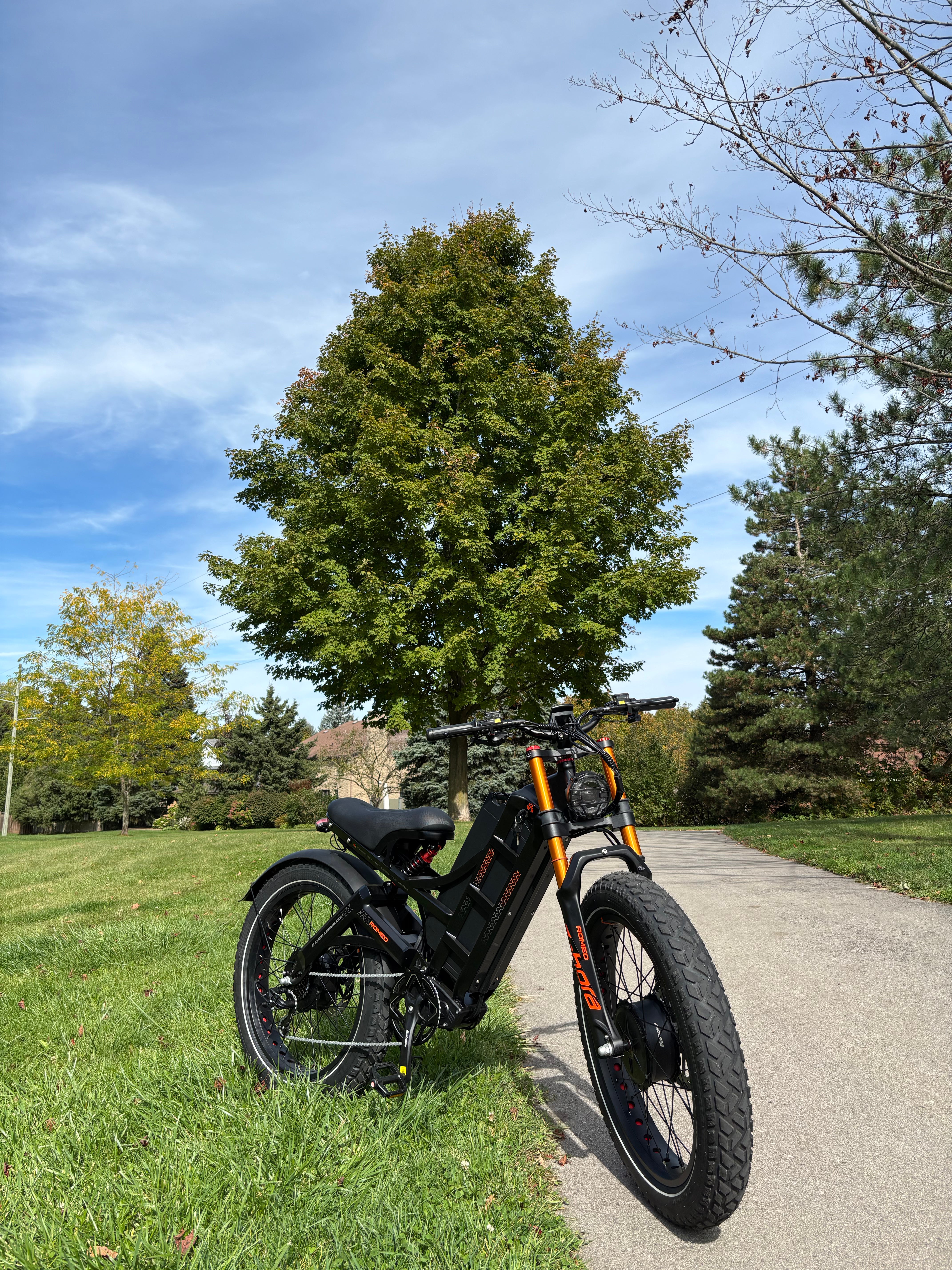
Freesky Eurostar Turbo M-410 Review Canada (2026): Real Range, Fit and Law, Computed

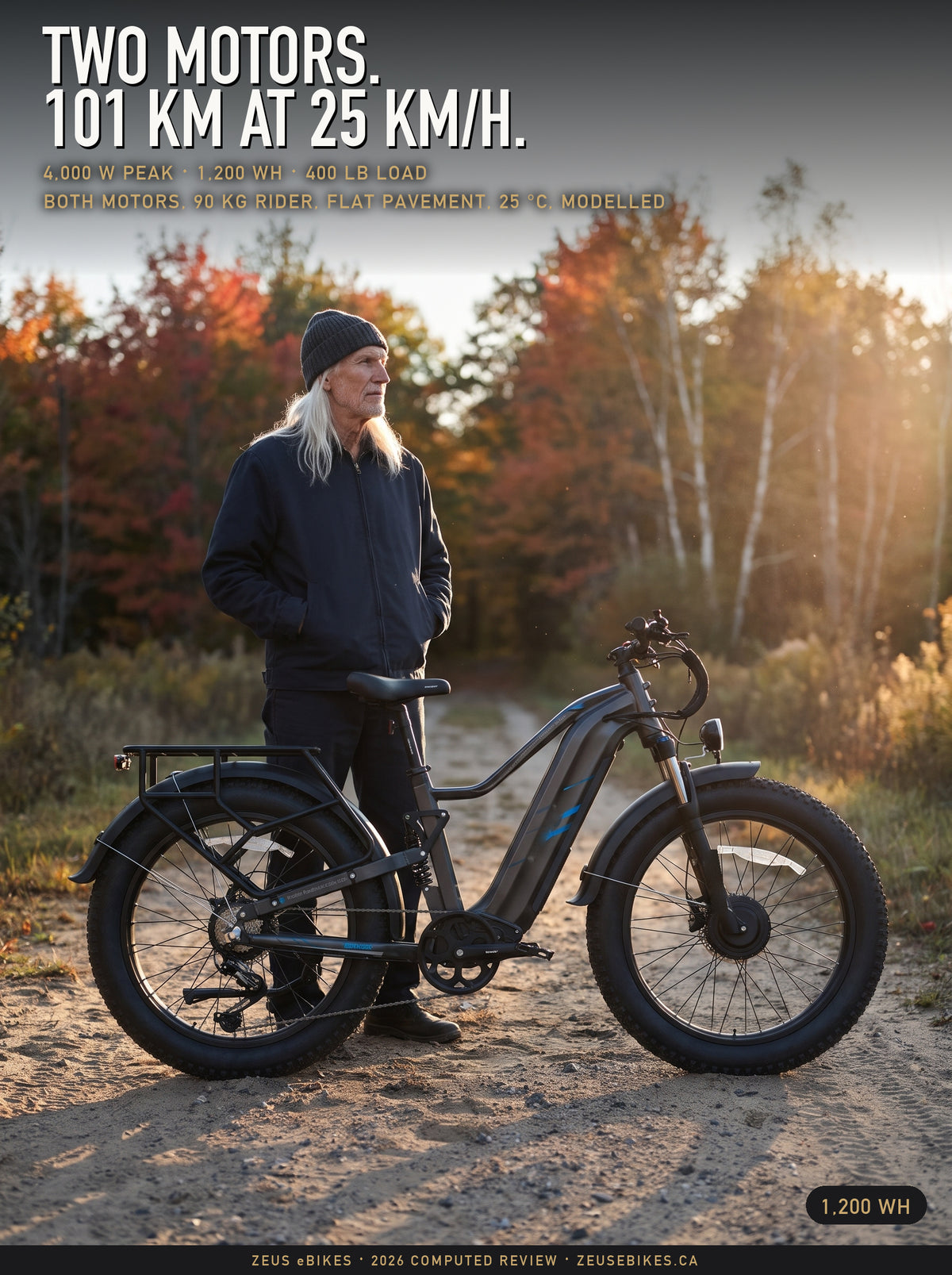
Zeus on a private two-track in the Ottawa Valley with the Freesky Eurostar Turbo M-410: a Playcut.ai rendering made from Freesky's own photograph of the bike.
By Milad Ghobadibeygvand, BScN (Western University, 2014) · Freesky's Canadian page, manual and certificates, every provincial and territorial rule, and four safety registers read on 29 October 2026
We sell this bike. Zeus lists the Freesky Eurostar Turbo M-410 at $2,099. Our US sister store, RedTail eBikes, sells it in the United States, and this review uses RedTail's published research where it computed something we did not, with a link at each point of use.
The Eurostar Turbo is Freesky's full-suspension fat-tire bike with a hub motor in each wheel: two 2,000 W peak motors, a 48 V 25 Ah pack and 26 × 4 inch tires. Every Freesky figure below was read on 29 October 2026 from Freesky's Canadian product page, its product record, the manual and the two certificates that page links, and the text in 90 of the page's images. Every range and fit figure is computed, with the method linked, and every provincial and territorial rule was re-read from its published text.
The Freesky Eurostar Turbo M-410 is a two-motor, full-suspension fat-tire e-bike that Freesky rates at 4,000 W peak and 34 MPH (55 km/h). It is built for private land and permitted trails: its printed speed is past every provincial e-bike limit, and Freesky's manual says it is not intended to be used or stored below 0 °C.
- Range: about 101 km at 25 km/h and 78 km at 32 km/h on both motors, 90 kg rider, flat, 25 °C (modelled); about 80 km at 25 km/h at 0 °C.
- One motor or two: on the throttle on the flat they land within a few per cent of each other; climbing, two motors use about 29% less energy per 100 m of height in our model.
- Fit: Freesky prints 5′3″ to 6′8″. The 28.0 in top tube clears every measured adult from 5′3″ up; seated on the lowest saddle, both feet reach the ground for 44 in 100 riders at 5′10″, and fewer below.
- Certificates and recalls: Freesky links two TÜV SÜD certificates, UL 2849 and UL 2271, naming model M-410 and a 47.19 V system; no recall at Health Canada, the US CPSC, the UK or the EU names Freesky.
- Verdict: in our view, a capable machine for loose ground on private land and permitted trails in the months above freezing, and the wrong one for roads, paths or winter riding.
- At Zeus: the Eurostar Turbo is $2,099; the comparison sets it beside the Ranger Air M-540 and the Eunorau FAT-AWD 3.0.
- Freesky's figures: Freesky's Canadian product page for the "Eurostar Turbo M-410", read on 29 October 2026 in a headless browser with every panel opened and saved, with its product record, its US page, the M-410 user manual and the UL 2849 and UL 2271 certificates it links. We read the text in 90 of the page's images, all 16 of its gallery among them. We matched the bike by colour: our four colours and Freesky's four are the same.
- Our US sister store's research: RedTail eBikes published a Eurostar Turbo review on 25 September 2026 with a range model for this bike; we used it, linked at each point of use.
- Range: RedTail's Eurostar Turbo range model, imported unchanged; it reproduced all 15 of the throttle-only figures RedTail publishes before we ran it in metric at Canadian temperatures. Freesky's Canadian page prints the same bike figures the model uses.
- Fit: RedTail has no fit model for this bike, so we ran RedTail's fit engine on Freesky's published geometry: 6,068 adults measured in the ANSUR II survey.
- Law: 44 quoted passages from the federal regulations and 13 provinces and territories, re-read on 29 October 2026; 42 were found again. Québec's two French pages and Nunavut's two acts came from archived copies and Nunavut's own PDF files when their live pages refused our browser; the Northwest Territories' acts were read at the Internet Archive.
- Safety records: Health Canada's recall search, the US CPSC recall database, the UK's product safety register and the EU's Safety Gate, on 29 October 2026, each run beside a control search that had to return results. Australia's recall site answered our research browser with HTTP 403 ("Access Denied") the same day, so it is not among them.
In this review
- Who is the Eurostar Turbo for?
- What Freesky prints for the Eurostar Turbo
- One motor or two
- How far it goes on one charge
- What Canadian cold does to it
- Will the Eurostar Turbo fit you?
- Is it legal on Canadian roads?
- Certificates and recalls
- How it compares
- Who should buy it, and who should skip it
- Buying it from Zeus
- Questions, answered
- The bottom line
- Sources
"FREESKY Ebike | Freesky Eurostar Turbo M410 Installation Video", published by Freesky's own channel on 4 August 2026 (3 min): Freesky's installation video for this bike. Watch on YouTube.
Who is the Freesky Eurostar Turbo for?
The Eurostar Turbo is new: Freesky published its installation video on 4 August 2026, and we listed the bike four days later. At 44.9 kg and a printed 55 km/h, it is easy to buy for the wrong job, because no province or territory treats it as an e-bike on its roads and its manual says it is not intended to be used below 0 °C. Below, we compute its range down to that 0 °C line, its fit by height and where it can be ridden.
It is built for private land and permitted trails: acreage, a farm, a cottage lot, a hunting lease, or a trail network that allows motorised vehicles. Two driven wheels share the push, front and rear, and Freesky rates the bike to carry 400 lb (181 kg) of rider and gear.
It is not built for a commute, a bike lane, a third-floor apartment or a January ride. If your riding is on roads and paths, our guide to 500 W, 750 W and 1,000 W e-bikes explains where the provincial lines fall.
Takeaway: buy the Eurostar Turbo for private land and permitted trails, loose ground and heavy loads in the months above freezing; skip it if most of your riding is on public roads, paths or bike lanes, or below 0 °C.
What does Freesky print for the Eurostar Turbo?
Freesky's Canadian page prints two 2,000 W peak hub motors with 210 N·m together, a 48 V 25 Ah pack (1,200 Wh), 34 MPH on pedal assist, a 400 lb load and 99 lb of bike. The table quotes Freesky's own wording where it gives one, read on 29 October 2026, with metric conversions in the last column.
| Item | Freesky Canada prints (29 October 2026) | What that means |
|---|---|---|
| Motors | "2000W + 2000W Brushless Peak Motor" | 4,000 W peak together, front and rear hub; no rated (continuous) figure printed |
| Torque | "210N·m Torque" | 105 N·m per motor |
| Battery | "48V 25Ah Lithium Battery, IPX7" | 1,200 Wh; removable |
| Top speed | "TOP SPEED (PAS) 34 MPH" | 55 km/h |
| Range | "Enjoy 60-105 miles on a single motor or 40-70 miles on dual motors per charge" | 97–169 km on one motor; 64–113 km on two |
| Load | "LOAD CAPACITY 400 LBS" | 181 kg of rider and cargo |
| Weight | "E-BIKE WEIGHT 99 LBS" | 44.9 kg |
| Tires and wheel | 26 × 4 inch fat tires; a 27.6 inch wheel diameter (geometry table) | 70.1 cm wheel; the manual recommends 16 to 20 PSI |
| Brakes | "180MM 4-piston Hydraulic Brakess" (Freesky's spelling) | 180 mm rotors, front and rear |
| Suspension | "120 mm Oil-Sprung Front Fork"; "180 mm Coil Rear Shock" | Full suspension |
| Drive and controls | "SHIMANO 7 Speed"; "Thumb Throttle"; "Cadence Sensor"; pedal assist "0~5 level" | KMC chain; colour LCD display |
| Charger | "US Standard 3A Smart Charger"; about 6 to 8 hours (Freesky's FAQ) | |
| Frame and seat post | "Upgraded 6061 Aluminum"; "30.9*300MM Alloy Seatpost" | One frame size |
| In the box | the bike, the manual, a rear rack, front and rear mudguards |
Source: Freesky Canada's Eurostar Turbo M-410 product page, read 29 October 2026; Freesky's US page prints the same rows. The manual and both certificates are linked under Sources.

The Eurostar Turbo in Black: Freesky's own product photograph of the bike, set in our studio (from our listing). Tap or click to enlarge.
Where Freesky's documents disagree
Two figures read differently in different Freesky documents, and we print both rather than pick one. The page lists a "120 mm Oil-Sprung Front Fork", while the fork section of the manual says it "can move up and down up to 80mm". The pack is "IPX7" in the page's specification table and "Waterproof Rating: IP65" on the battery image in the same page's gallery, while the battery certificate Freesky links rates it IP33 and the electrical-system certificate rates the e-bike IP34.
For riding, plan on the lowest of those figures, the certificate's IP33, and do as the manual asks: dry the bike indoors after riding in rain or snow. RedTail's review lists the motor-figure differences it found in Freesky's earlier posts in its limitations; this review uses the product page throughout.
What Freesky does not print
Three things are missing from every Freesky source we read on 29 October 2026: the Canadian and US pages with every panel open, the product record, the manual and the text in 90 of the page's images. There is no rated (continuous) motor power, only "Peak"; no maker named for the fork, the shock or the battery cells; and no default speed setting. The manual adds that "The listed range and top speed of the bike are estimates, not guarantees of performance."
On the speed setting, RedTail's review quotes a Freesky FAQ entry, read on 25 September, that set a 32 km/h default on every Freesky e-bike. That entry is not on the Eurostar Turbo's page today, so this review goes by the 34 MPH Freesky prints.
Takeaway: the motors, pack, weight, load and brakes read the same on Freesky's Canadian and US pages; 4,000 W is a peak with no rated figure behind it, and the water rating to plan on is the certificate's, the lowest of the three.
One motor or two: what does the second motor cost?
On flat pavement on the throttle, almost nothing: at 25 km/h our model gives about 100 km on the rear motor alone and 101 km on both. On climbs, two motors save energy: at 15 km/h up a 6% grade, one motor spends about 93 Wh for every 100 m of height and two spend about 66 Wh, 29% less.
The reason is in the motors' own losses. Sharing a climb's load halves the current each motor carries, and a motor's heat loss grows with the square of its current. On the flat the load is small, and in the model each running motor also has fixed losses of its own, so the second motor's fixed losses use up the saving. RedTail reached the same result in its Eurostar Turbo range model: "On the throttle from 10 to 20 mph the two modes land within 3% of each other".
RedTail's model has one exception, gentle pedalling: at 12 mph (19 km/h) on the flat with easy pedalling, two motors use 18% more than one. Its advice: "So: one motor for gentle flat miles, both motors for climbs".
| Grade at 20 km/h | Both motors | Rear motor only |
|---|---|---|
| 0% | 9.9 Wh/km | 9.8 Wh/km |
| 3% | 26.2 Wh/km | 30.4 Wh/km |
| 6% | 47.0 Wh/km | 60.3 Wh/km |
| 10% | 83.9 Wh/km | 122.9 Wh/km |
| 15% | 156.5 Wh/km | not held |
Energy per kilometre from the pack, 90 kg rider and gear, 25 °C, throttle only. "Not held" means the comparable motor cannot hold 20 km/h on that grade at its rated power; the model leaves out tire grip, which can run out first on loose ground.
Freesky makes the same point in its own words: its FAQ says the dual-motor setup "provides additional drive power for demanding terrain, while single-motor operation may help conserve battery energy in suitable riding conditions". Its manual starts a new rider "using rear-wheel drive only", in a low gear, at pedal assist level 0 or 1.
Takeaway: run both motors on climbs and loose ground, where they save energy and keep traction; on flat pavement the choice barely moves your range.
How far does the Eurostar Turbo go on one charge?
In our model, a 90 kg rider on the throttle alone gets about 101 km at 25 km/h on both motors and 78 km at 32 km/h from the full 1,200 Wh pack, on flat pavement at 25 °C. Keep a fifth in reserve and plan on 81 and 62 km. In the model, Freesky's 105 miles (169 km) is out of reach on the throttle alone at any steady speed.
Every figure here comes from the range model RedTail eBikes built for this bike. We imported it unchanged, and before we ran it in metric it reproduced all 15 of the throttle-only figures RedTail publishes. The physics is set out in RedTail's range-formula section: wheel power from Martin and colleagues' validated cycling model, fat-tire rolling resistance measured on a drum, measured rider drag, a comparable hub motor's published curve and lithium-cell energy by temperature.
| Speed | Rear motor | Both motors | Both, 20% kept |
|---|---|---|---|
| 20 km/h | 123 km | 121 km | 97 km |
| 25 km/h | 100 km | 101 km | 81 km |
| 32 km/h | 75 km | 78 km | 62 km |
| 40 km/h | 54 km | 57 km | 46 km |
| 50 km/h | not held | 39 km | 31 km |
Steady speed on flat pavement, 90 kg rider and gear, 25 °C, no wind, full 1,200 Wh pack, throttle only. "Not held" means the comparable motor cannot hold that speed on one motor at its rated power.
Pedalling stretches every figure: a steady 100 W from your legs takes the 25 km/h ride on both motors from 101 to about 171 km in the model. The throttle-only figures are the ones to plan on.
What Freesky's range claim asks of you
| Freesky prints | In kilometres | Steady speed that reaches it (our model) |
|---|---|---|
| 60 miles, one motor | 97 km | 25 km/h on the throttle |
| 105 miles, one motor | 169 km | No speed on the throttle alone; with 50 W of pedalling, 21 km/h; with 100 W, 25 km/h |
| 40 miles, both motors | 64 km | 36 km/h on the throttle |
| 70 miles, both motors | 113 km | 22 km/h on the throttle |
90 kg rider and gear, flat pavement, 25 °C, no wind, full pack. Freesky gives no speed, weight, ground or temperature for its figures.
The arithmetic, one ride worked through
Take 25 km/h (6.94 m/s) on both motors with a 90 kg rider: 134.9 kg moving with the bike. Rolling resistance costs 97 W (the fat-tire median, Crr 0.0105) and air 120 W (drag area 0.603 m², air density 1.184 kg/m³), so the wheels need 216 W. Each motor turns out 5.5 N·m at 7.2 A; the motors turn 75% of their input into wheel power, drawing 287 W from the pack, and the pack passes on 97% of the cells' energy, so the cells give up 296 W, or 11.85 Wh per kilometre. 1,200 Wh ÷ 11.85 = 101 km; keep 20% back and plan on 81 km.
Rider weight, ground and wind
| Rider and gear | Both motors at 25 km/h | Rear motor only |
|---|---|---|
| 70 kg (154 lb) | 108 km | 108 km |
| 90 kg (198 lb) | 101 km | 100 km |
| 113 kg (250 lb) | 94 km | 93 km |
| 136 kg (300 lb) | 88 km | 86 km |
| 181 kg (400 lb) | 78 km | 75 km |
Flat pavement, 25 °C, full pack. 181 kg is Freesky's full 400 lb load.
| Condition at 25 km/h, both motors | Range |
|---|---|
| Pavement, the fat-tire median (used above) | 101 km |
| Fine gravel (1.20 × the pavement resistance) | 93 km |
| Coarse gravel (1.50 ×) | 83 km |
| A 15 km/h headwind, pavement | 54 km |
| The lowest-rolling of ten fat tires on the drum | 118 km |
| The highest-rolling of the ten | 93 km |
Gravel ratios from Meyer, Kloss and Senner (2016), measured on one four-wheeled electric bicycle; no fat-tire gravel measurement was found, so read them as a guide to the spread. Tire figures from Bicycle Rolling Resistance's fat-bike drum tests, as in RedTail's model.
Takeaway: keep a fifth of the pack in reserve and plan on 81 km at 25 km/h and 62 km at 32 km/h on flat summer pavement in our model, and less into wind, on soft ground or with a heavy load.
Freesky Eurostar Turbo M-410
$2,099 CADTwo driven wheels on a 1,200 Wh pack: about 101 km at 25 km/h in our model, 400 lb of load, full suspension and four-piston hydraulic brakes. For private land and permitted trails.
Questions before you order?
Call us with your height, inseam, weight and where you plan to ride, and we will tell you straight whether the Eurostar Turbo suits it. Free shipping across Canada, and financing is available.
What does Canadian cold do to the Eurostar Turbo?
It sets a hard floor. Freesky's manual says the bike "is not intended to be used and stored at ambient temperatures less than 0°C (32°F)", and that the battery is to be charged only between 0 °C and 40 °C. Down to that line, cold cuts the pack's usable energy and thickens the air: at 25 km/h on both motors our model gives about 87 km at 10 °C and 80 km at 0 °C.
| Air temperature | Both motors, 20 km/h | Both motors, 25 km/h | Both motors, 32 km/h | Cell energy left |
|---|---|---|---|---|
| 25 °C | 121 km | 101 km | 78 km | 100% |
| 10 °C | 103 km | 87 km | 67 km | 93% |
| 0 °C | 96 km | 80 km | 62 km | 89% |
90 kg rider, flat pavement, no wind, full pack. The cell column is McMaster University's measured lithium-cell data as used in RedTail's model (its cold section sets out the sources). We print no figure below 0 °C, because Freesky's manual says the bike is not intended for it.
Snow costs more than cold. RedTail's fat-tire comparison quotes a winter-cycleway study by Fenre and Klein-Paste (2021): "Rolling resistance coefficients (Crr) higher than 0.025 noticeably reduce cycling comfort". At that resistance, 0 °C and 20 km/h, both motors give about 61 km in our model; deep or wet snow costs more.
The manual also asks you to "Charge and store bike and battery in a dry location, between 50 °F – 77 °F (10 °C – 25 °C)", to dry the bike indoors after rain or snow, and warns that "Exposure to very wet, hot, or cold conditions may void the warranty." Our battery guide covers winter storage, and our winter e-bike guide compares bikes built for colder riding.
Takeaway: ride the Eurostar Turbo above 0 °C, where our model gives about 80 km at 25 km/h at the freezing line on flat pavement before any reserve; store it and charge it indoors, and park it for the months below freezing.
Will the Freesky Eurostar Turbo fit you?
Freesky prints a 5′3″ to 6′8″ rider window and a 27 to 35 inch inseam on one frame, with a 28.0 inch standover and a saddle from 33.9 to 41.3 inches off the ground. The top tube is no barrier: it clears every measured adult from 5′3″ up. The lowest saddle height is the number to check, because it decides whether your feet reach the ground when you stop.
RedTail has no fit model for this bike, so we ran RedTail's fit engine, the one behind its fit tables, on Freesky's published geometry: 6,068 adults measured in the ANSUR II survey, each compared, barefoot, with the 28.0 inch top tube and the 33.9 inch lowest saddle. Freesky publishes no crank length or handlebar position for this bike, so the engine computes no reach or lean.
| Height | Clears the 28.0 in top tube | Both feet flat, seated at the lowest saddle (33.9 in) | The same on the Ranger Air M-540 (35 in) |
|---|---|---|---|
| 5′3″ (160 cm) 343 measured |
100 in 100 | 0 in 100 | 0 in 100 |
| 5′4″ (163 cm) 413 measured |
100 in 100 | 0 in 100 | 0 in 100 |
| 5′5″ (165 cm) 466 measured |
100 in 100 | 0 in 100 | 0 in 100 |
| 5′6″ (168 cm) 591 measured |
100 in 100 | 2 in 100 | 1 in 100 |
| 5′7″ (170 cm) 545 measured |
100 in 100 | 5 in 100 | 0 in 100 |
| 5′8″ (173 cm) 660 measured |
100 in 100 | 10 in 100 | 1 in 100 |
| 5′9″ (175 cm) 669 measured |
100 in 100 | 24 in 100 | 4 in 100 |
| 5′10″ (178 cm) 602 measured |
100 in 100 | 44 in 100 | 12 in 100 |
| 5′11″ (180 cm) 472 measured |
100 in 100 | 68 in 100 | 24 in 100 |
| 6′0″ (183 cm) 332 measured |
100 in 100 | 85 in 100 | 48 in 100 |
| 6′1″ (185 cm) 212 measured |
100 in 100 | 94 in 100 | 71 in 100 |
| 6′2″ (188 cm) 108 measured |
100 in 100 | 99 in 100 | 86 in 100 |
Each "in 100" figure is the share of measured adults at that height whose barefoot inseam reaches the figure. ANSUR II measures US Army personnel aged 17 to 58 (2010 to 2012), a population that differs from the Canadian public. Seated with both feet flat is a demanding test; a rider who cannot reach can tip the bike onto one foot or slide forward off the saddle, which a 99 lb bike makes harder.
Read it this way: from about 5′11″ up, at least half of riders can sit on the lowest saddle with both feet flat; below that, plan to slide forward off the saddle at every stop. Freesky's manual sets one more limit: "Riders must be at least 18 years old."
Takeaway: measure your inseam in socks against a wall before you order; if it is under 86 cm (33.9 in), you will not reach the ground flat-footed from the lowest saddle, so practise stops on open ground first, or call us to talk it through.
Is the Freesky Eurostar Turbo legal on Canadian roads?
No. Every province that defines an e-bike stops at 500 W and, where it sets a speed, at 32 km/h; Freesky prints a 34 MPH (55 km/h) top speed and two 2,000 W peak motors with no rated power. On roads, bike lanes and paths, it is not an e-bike anywhere in Canada.
| Jurisdiction | What the law says (read 29 October 2026) | The Eurostar Turbo |
|---|---|---|
| Federal | Motor Vehicle Safety Regulations, s. 2: the power-assisted bicycle definition reads "Repealed, SOR/2020-22, s. 3", effective February 4, 2021. | No federal e-bike definition applies to any bike. |
| Ontario | Highway Traffic Act s. 1(1) points at the "power-assisted bicycle as defined in subsection 2 (1) of the Motor Vehicle Safety Regulations", the federal text repealed in 2021; ontario.ca says it is "illegal to modify your e-bike" (Riding an e-bike). | Outside the referenced definition: Freesky prints 55 km/h. |
| Québec | SAAQ: "maximum power rating of no more than 500 watts" (SAAQ); its FAQ: "A power-assisted bicycle must have a maximum power rating of no more than 500 watts and a maximum speed of 32 km/h or less to be authorized for use on a public roadway" (SAAQ FAQ). | Outside on speed; the SAAQ says a bicycle with a 1,000-watt motor "is not authorized for use on a public road, including roadways and bike paths". |
| British Columbia | B.C. Reg. 64/2024 s. 3: motors with "a continuous power output rating that, in total, does not exceed 500 W"; s. 3(2)(a): "the motors must not be capable of propelling the device at a speed exceeding 32 km/h". | Outside on speed. |
| Alberta | AR 304/2002 s. 1(1)(o): a "power-assisted bicycle under the Motor Vehicle Safety Regulations (Canada)", the federal definition repealed in 2021. | Outside the referenced definition. Our Alberta e-bike law page explains the reference. |
| Saskatchewan | Registration Exemption and Reciprocity Regulations, 2014 s. 2(1)(f): "a total continuous power output rating of 500 watts or less when measured at the shaft of each motor"; s. 2(1)(f)(v)(D): "further power assistance cannot be provided when the bicycle attains a speed of 32 kilometres per hour when operated on level ground"; SGI: e-bikes "larger than 500 watts or without pedals are considered motorcycles" (SGI). | Outside on speed; SGI treats e-bikes over 500 watts as motorcycles. |
| Manitoba | Highway Traffic Act s. 1(1): a motor with a "continuous power output rating, measured at its shaft, of 500 W or less" that "cannot provide the vehicle with motive power when it is travelling at more than 32 km/h". | Outside on speed. |
| Nova Scotia | N.S. Reg. 221/2026 s. 3: "a total continuous nominal power output rating, measured at the shaft of each motor, of 500 W or less", with no assistance once the bicycle "reaches a speed of 32 km/h on level ground". | Outside on speed. |
| New Brunswick | No e-bike definition in the Motor Vehicle Act; Service New Brunswick says a vehicle with a motor "equal to or less than 500W" that cannot assist past 32 km/h "can be considered a bicycle", and one with a motor "greater than 500 watts" that can power past 32 km/h without a CMVSS label "cannot be registered" unless an engineer certifies it (GNB). | Not a bicycle on that guidance. |
| Prince Edward Island | Power-Assisted Bicycles Regulations: motors with "continuous power output ratings that in total do not exceed 500 watts", and none "capable of propelling the power-assisted bicycle at a speed greater than 32 kilometres per hour on level ground". | Outside on speed. |
| Newfoundland and Labrador | The Highway Traffic Act has no e-bike definition: a vehicle "propelled, driven or controlled otherwise than by muscular power" is a motor vehicle, and a moped has "a power source that produces a maximum 1.5 k.w", a speed "not exceeding 50 kilometres an hour" and "a maximum weight of 55 kilograms". | Two readings. As written, a motor vehicle: its 55 km/h and 4,000 W peak are past the moped limits. Read the other way, the province "currently follows federal standards" (CBC News), the definition repealed in 2021. |
| Yukon | Motor Vehicles Act s. 1, electric power-assisted cycle: "500 W or less in total for the motor or combination of motors", with a motor "incapable of providing further assistance when the vehicle attains a speed of 32 km/h on level ground". | Outside on speed. |
| Northwest Territories | The All-terrain Vehicles Act counts a "pedal bicycle with motor attachment" among all-terrain vehicles; the Motor Vehicles Act defines a bicycle as "a cycle having any number of wheels that is propelled by human power". | An all-terrain vehicle by that Act's list. |
| Nunavut | The All-terrain Vehicles Act counts "a pedal bicycle with motor attachment"; the Traffic Safety Act defines a bicycle as propelled by "human muscular power" and a moped as having, among other things, a seat at least 650 mm high and an electric motor not "capable of enabling the moped to attain a speed greater than 70 kilometres per hour". Both consolidations are marked "not up to date". | Two readings, ours: an all-terrain vehicle by that list, or, on Freesky's 55 km/h and 86 cm lowest saddle, a moped by the Traffic Safety Act's text. Never a bicycle. Ask the territory before riding near a road. |
Quotations are from each province's statute, regulation or regulator page, saved on the day they were read. A province's page can change; follow the link before you ride.
That leaves private land, with the owner's permission, and trails where the land manager allows motorised vehicles. Rules for those trails are set park by park and club by club, so ask before you ride. Ontario also says it is "illegal to modify your e-bike". Our Canadian e-bike law guide links each province's full page, including Ontario, Québec and British Columbia.
Takeaway: ride the Eurostar Turbo where you have permission off public roads; for roads and bike lanes, choose a bike that meets your province's e-bike rule, such as one from our 500 W collection.
Is the Eurostar Turbo UL certified, and has it been recalled?
Freesky says it is: the page shows "UL2849 Certified by TÜV" and "UL2271 Certified by TÜV", and its FAQ says "All FREESKY e-bikes are certified with both UL 2271 and UL 2849". The two TÜV SÜD certificates it links name a model number, M-410, and a 47.19 V system; neither names the Eurostar Turbo. No recall at Health Canada, the US CPSC, the UK or the EU names Freesky.
| Document | What it covers | What it says |
|---|---|---|
| TÜV SÜD certificate U14 128702 0008 Rev. 00 | UL 2849:2020/R:2022-12 and CAN/UL 2849:2022: the e-bike's whole electrical system | Models "M-530, M-540, M-410, A-340"; "Rated voltage: 47,19VDC"; charger output "54,6VDC, 3,0A"; "IP34 (for E-Bikes)"; dated 2025-07-31 |
| TÜV SÜD certificate U10 128702 0003 Rev. 00 | UL 2271:2018 and CAN/UL 2271:2018: the battery | Model FP4825R0; "Nominal voltage 47.19Vd.c."; "Rated capacity 24.5Ah"; "IP Code Rating: IP33"; "The battery is used for off-road LEVs"; dated 2025-04-03 |
Both certificates name GuangZhou Yansan Science & Technology Co., Ltd, of Guangzhou, China, as the holder, and both are linked from Freesky Canada's Eurostar Turbo page. Read 29 October 2026.
Both certificates are dated 2025 (April and July), about a year before Freesky published the bike's installation video, and list model numbers only. Neither names the Eurostar Turbo or says that a system with two motors was tested. Freesky's manual for this bike is titled "FREESKY M-410 ELECTRIC BIKE", so the model number matches; if your building, condo board or insurer needs more than that, call us and we will ask Freesky in writing which configuration was tested.
| Register (read 29 October 2026) | Searched for | Result |
|---|---|---|
| Health Canada recalls and safety alerts | "freesky", "eurostar", "m-410" and "yansan", archive included; control: "electric bicycle" | No record names them: "freesky", "m-410" and "yansan" returned no results, and "eurostar" returned two infant car seats; the control returned results |
| US CPSC recall database | Freesky, Eurostar and Yansan in titles, product names and descriptions; control: a brand with a known recall | No record names Freesky or Yansan; "Eurostar" matched one 2009 infant car seat recall; the control returned its recall |
| UK product safety alerts, reports and recalls | "freesky", "yansan" and "eurostar"; controls: "e-bike" (171 records) and a nonsense word (none) | One record: report 2609-0013, a FREESKY 540E import rejected at the border, 4 September 2026 |
| EU Safety Gate | "freesky", "yansan", "eurostar" and "electroy"; controls: "e-bike" and a nonsense word | One alert: SR/02811/26, the same 540E case, 6 October 2026 |
| Australia, productsafety.gov.au | "freesky" | Not searched: the site answered our research browser with HTTP 403, "Access Denied" |
Each search ran beside a control that had to return results; a search that could not run would be reported as not searched, never as none.
The UK's Office for Product Safety and Standards report 2609-0013 covers a "FREESKY Electric Bicycle 540E", whose identifiers include "M-540E(RANGER) - BLACK". "The import has been rejected at the border" because "the supplied Declaration of Conformity did not match the product".
The report describes the bike as "presenting a serious risk of fire" because, without that evidence, "it may be possible for it to overheat and catch fire", and names the manufacturer as Guangzhou Electroy Corporation. The EU's Safety Gate alert SR/02811/26 records the same case. Neither record is a recall, and neither names the Eurostar Turbo or the Ranger Air M-540.
Takeaway: no recall at Health Canada, the US CPSC, the UK or the EU names Freesky; the certificates Freesky links name model M-410 and a 47.19 V system, and we will ask Freesky in writing for the tested configuration if you need it before you order.
How does the Eurostar Turbo compare with the Ranger Air M-540 and the Eunorau FAT-AWD 3.0?
The Ranger Air M-540 is Freesky's step-through on the same motors and pack, at the same $2,099; the Eunorau FAT-AWD 3.0 is a lighter two-motor fat-tire step-through with a smaller pack, from $2,299. Each maker's figures below were read on 29 October 2026, Freesky's from its Canadian pages and Eunorau's from its Canadian page.
| Bike | At Zeus | Frame and suspension | Motors and top speed (maker) | Pack | Weight and rider window (maker) | Range computed, 32 km/h | Range (maker) |
|---|---|---|---|---|---|---|---|
| Freesky Eurostar Turbo | $2,099 | EMTB, 28.0 in standover; 120 mm fork, 180 mm coil shock | 2,000 + 2,000 W peak, 210 N·m; no rated power; 34 MPH (55 km/h) | 48 V 25 Ah, 1,200 Wh | 99 lb (44.9 kg); 5′3″ to 6′8″; saddle 33.9–41.3 in | 79 km, RedTail | 60–105 mi on one motor; 40–70 mi on two |
| Freesky Ranger Air M-540 | $2,099 | Step-through, 18 in step height; 120 mm fork, 180 mm coil shock | 2,000 + 2,000 W peak, 210 N·m; no rated power; 34 MPH (55 km/h) | 48 V 25 Ah, 1,200 Wh | 95 lb (43.1 kg); 5′3″ to 6′8″; saddle 35–41 in | 79 km, RedTail | 60–105 mi on one motor; 40–60 mi on two |
| Eunorau FAT-AWD 3.0 | $2,299 ($2,425 Camouflage) | Step-through; 95 mm RST fork, no rear shock | Front 500 W + rear 500 W, max 110 N·m; 20 MPH (32 km/h) | 48 V 15 Ah, 720 Wh; a second 15 Ah pack is optional | 79.4 lb (36.0 kg); 5′3″ to 6′1″; saddle 31.5–39.0 in; RedTail's FAT-AWD 3.0 fit table | 48 km, RedTail | 80 mi with the second pack |
The (maker) columns give each maker's own figures and units. Computed range, one condition: an 82 kg (180 lb) rider at 32 km/h (20 mph) on both motors, throttle only, flat pavement, 25 °C, from RedTail's published models for each bike; this review's model gives the Eurostar Turbo 78 km for the 90 kg rider used elsewhere here. Load: 400 lb (181 kg) for both Freesky bikes, 375 lb (170 kg) for the FAT-AWD 3.0, on the makers' figures. None of the three meets a provincial e-bike rule.
Freesky Ranger Air M-540
$2,099 CADThe same two 2,000 W peak motors, 1,200 Wh pack, four-piston brakes and suspension, on a step-through frame with an 18 inch step height and 4 lb less weight, for the same $2,099. Its lowest saddle sits higher (35 in), so fewer riders sit flat-footed at a stop; RedTail computes the same range for both bikes.
Eunorau FAT-AWD 3.0
from $2,299 CADTwo 500 W hub motors with a torque sensor and a switch for rear, front or both, on a 79.4 lb step-through with a 95 mm fork. Its 720 Wh pack gives about 48 km at 32 km/h in RedTail's model; Eunorau sells a second 15 Ah pack.
Our dual-motor e-bike guide sets these beside the rest of our two-motor shelf, and our Freesky brand profile covers the Freesky line.
Takeaway: choose the Eurostar Turbo for a step-over frame with a lower saddle, the Ranger Air for the same machine as a step-through, and the FAT-AWD 3.0 if a lighter bike with a torque sensor matters more than pack size and rear suspension.
Not sure which of the three suits you?
Tell us where you ride, what you carry and how tall you are. We sell all three, so we will point you to the one that fits, even if it is not the Eurostar Turbo.
Who should buy the Eurostar Turbo, and who should skip it?
Buy it if you ride private land or permitted trails above freezing, carry real loads over loose ground and want two driven wheels and full suspension at this price. Skip it if you need roads or paths, ride through the winter, store your bike up stairs, or want a certificate that names the Eurostar Turbo before you buy. The ledger below sets out both sides.
| What it does well | What to plan around |
|---|---|
| 1,200 Wh on two driven wheels: about 101 km at 25 km/h in our model | 44.9 kg (99 lb): a two-person lift |
| Two motors use about 29% less energy per 100 m of climbing than one, in our model | 34 MPH (55 km/h) printed: outside every provincial e-bike rule |
| Full suspension: a 120 mm oil-sprung fork and a 180 mm coil rear shock | Freesky's manual: not intended to be used or stored below 0 °C |
| Four-piston hydraulic brakes on 180 mm rotors | No rated (continuous) motor power printed |
| 400 lb (181 kg) of rider and cargo | Three water ratings across Freesky's documents: IPX7, IP65 and IP33 |
| Rear rack and front and rear mudguards in the box | Seated at the lowest saddle, both feet reach the ground for fewer than half of riders under 5′11″ |
Consider it if you ride off public roads with permission, between spring thaw and the first freeze, and want traction and suspension for loose ground: in our model it covers about 101 km at 25 km/h on flat summer pavement and 80 km at the 0 °C line in Freesky's manual, and two motors save energy on every climb.
Skip it if you commute on roads, paths or bike lanes, ride below freezing, need to carry the bike up stairs, or are under about 5′11″ and want both feet on the ground when you stop.
That verdict is our opinion, formed from the facts above, and the facts are printed so you can reach your own.
Buying the Freesky Eurostar Turbo from Zeus
We list the Freesky Eurostar Turbo M-410 at $2,099 in Black, Green and Gray, with free shipping across Canada. Freesky's warranty is backed by Freesky in full on bikes bought from us, we handle every claim, and our 15-day return policy covers unused, unopened bikes, less a 15% restocking fee.
- Shipping: our shipping policy: "Shipping is Free Canada wide. Orders will be processed within 1-3 business days after the order has been confirmed. Shipping times will vary from 2-7 business days based on customer's location."
- Returns: our refund policy accepts "unused and unopened items within 15 days of delivery", with "a 15% restocking fee" except where a return is our error, and the customer pays return shipping.
- Warranty: Freesky's Canadian terms: 24 months on the motor, battery and controller and 12 months on other components, for orders placed on or after November 13, 2025, for the original purchaser. Backed by Freesky in full; we file and follow the claim for you.
- Zeus Care: our warranty page: "Your first month of Zeus Care is included with every e-bike." Zeus Care plans run from $119 to $599, and the page says "Zeus Care is not a warranty and does not add coverage."
- Paying over time: our financing guide sets out the options.
- Questions: call 1-866-938-7580 before you order; real people answer.
Right of reply: Freesky can correct or answer anything in this review at milad@zeusebikes.ca, and we will publish the reply here.
Freesky Eurostar Turbo questions, answered
Is the Freesky Eurostar Turbo worth buying?
For the right rider, yes, in our view. It puts a hub motor in each wheel of a full-suspension fat-tire frame, with a 1,200 Wh pack, four-piston hydraulic brakes and a rack and mudguards in the box, for $2,099. In our model it covers about 101 km at 25 km/h on flat pavement. It suits private land and permitted trails; it does not suit roads, bike lanes, paths or riding below 0 °C, the floor Freesky's manual sets.
How far does the Eurostar Turbo go on one charge?
In our model, about 101 km at 25 km/h and 78 km at 32 km/h on both motors, for a 90 kg rider on the throttle on flat pavement at 25 °C with the full 1,200 Wh pack; keep a fifth in reserve and plan on 81 and 62 km. At 0 °C the 25 km/h ride gives about 80 km. Freesky prints 60 to 105 miles (97 to 169 km) on one motor: in our model no steady throttle speed reaches 105 miles, and steady pedalling of about 50 W does at 21 km/h.
How fast is the Freesky Eurostar Turbo?
Freesky prints a top speed of 34 MPH (55 km/h) on pedal assist or throttle. In our model, with a comparable hub motor's rated power, both motors hold up to about 54 km/h on flat pavement with a 90 kg rider and one motor up to about 47 km/h. Every provincial e-bike definition stops assistance at 32 km/h or less, so on roads, lanes and paths it is not an e-bike anywhere in Canada.
Is the Freesky Eurostar Turbo legal on Canadian roads?
No. Every province that defines an e-bike stops at 500 W and, where it sets a speed, at 32 km/h; Freesky prints 34 MPH (55 km/h) and two 2,000 W peak motors with no rated power. Ride it on private land with the owner's permission, or on trails whose manager allows motorised vehicles, and read our e-bike law guide for your province.
Does running both motors drain the battery faster than one?
Not on the flat on the throttle, in our model: at 25 km/h one motor gives about 100 km and two give 101 km. On climbs two motors save energy: at 15 km/h up a 6% grade, one motor spends about 93 Wh per 100 m of height and two about 66 Wh, 29% less. Our US sister store, RedTail eBikes, found the same pattern on the throttle in its own range model, with one exception: pedalling gently at 19 km/h (12 mph) on the flat, two motors use 18% more than one.
Can the Freesky Eurostar Turbo handle Canadian winter?
Not below freezing, by Freesky's own manual: it says the bike "is not intended to be used and stored at ambient temperatures less than 0°C (32°F)", that the battery should be charged only between 0 °C and 40 °C, and that "Exposure to very wet, hot, or cold conditions may void the warranty." Above 0 °C, its 26 × 4 inch tires and two driven wheels suit loose ground; store and charge the battery indoors.
Is the Eurostar Turbo UL certified?
Freesky says yes: its FAQ answers "Yes.All FREESKY e-bikes are certified with both UL 2271 and UL 2849", and its page links two TÜV SÜD certificates. The UL 2849 certificate (31 July 2025) lists model M-410 among four model numbers at a rated 47.19 V; the UL 2271 certificate (3 April 2025) covers battery FP4825R0 at 47.19 V and 24.5 Ah. Neither names the Eurostar Turbo or says that a two-motor system was tested.
How much does the Eurostar Turbo weigh?
Freesky prints 99 lb (44.9 kg). Plan on two people to lift it, and check a hitch rack's rated load before you buy one. The bike carries a further 400 lb (181 kg) of rider and cargo on Freesky's figure.
What size rider does the Eurostar Turbo fit?
Freesky prints 5′3″ to 6′8″ and a 27 to 35 inch inseam on one frame. We ran RedTail eBikes' fit engine on Freesky's published geometry: its 28.0 inch top tube clears every one of 6,068 measured adults from 5′3″ up, but seated on the lowest saddle (33.9 in) both feet reach the ground flat for 10 in 100 at 5′8″, 44 in 100 at 5′10″ and 85 in 100 at 6′0″. Riders 18 and over only, Freesky's manual says.
Are Freesky e-bikes reliable?
We cannot measure reliability from records, and we have no long-term failure data to report. What the records show: no recall at Health Canada, the US CPSC, the UK or the EU names Freesky; Freesky gives 24 months of warranty on the motor, battery and controller; and in 2026 the UK rejected an import of a FREESKY 540E at its border because its Declaration of Conformity did not match the bike. Neither record names the Eurostar Turbo.
What warranty does Freesky give in Canada?
Freesky's Canadian policy gives 24 months on the motor, battery and controller and 12 months on other components, for orders placed on or after November 13, 2025, for the original purchaser. Its manual excludes water damage and says that exposure to very wet, hot or cold conditions may void the warranty. Bought from us, we file and follow the claim with Freesky: call 1-866-938-7580.
How long does the Eurostar Turbo battery take to charge?
Freesky lists about 6 to 8 hours with its "US Standard 3A Smart Charger", depending on how empty the pack is. Its manual says to charge only between 0 °C and 40 °C and to store the bike and battery between 10 °C and 25 °C, so in a Canadian winter, charge it indoors.
Eurostar Turbo or Ranger Air M-540?
Freesky prints the same two 2,000 W peak motors, 48 V 25 Ah pack, brakes, suspension and 400 lb load for both, and both are $2,099 at Zeus. The Ranger Air M-540 is a step-through with an 18 inch step height and weighs 95 lb; the Eurostar Turbo has a 28.0 inch top tube and a lower lowest saddle (33.9 in against 35 in), so more riders sit with both feet flat at a stop. RedTail's models give the two bikes the same range.
Eurostar Turbo or Eunorau FAT-AWD 3.0?
The Eunorau FAT-AWD 3.0 is lighter (79.4 lb step-through on Eunorau's page), uses a torque sensor and is printed at 20 MPH, with two 500 W motors and a 48 V 15 Ah pack; the Eurostar Turbo has full suspension, a 1,200 Wh pack and 4,000 W peak. At 32 km/h with both motors, RedTail computes about 48 km for the FAT-AWD and 79 km for the Eurostar Turbo. Neither meets a provincial e-bike rule.
Can you buy the Freesky Eurostar Turbo in Canada?
Yes. We sell the Freesky Eurostar Turbo M-410 at $2,099 in Black, Green and Gray, with free shipping across Canada and our 15-day return policy on unused, unopened items, less a 15% restocking fee.
The bottom line
The Eurostar Turbo puts a hub motor in each wheel of a full-suspension fat-tire frame, with four-piston brakes and a 1,200 Wh pack, for $2,099: about 101 km at 25 km/h on flat summer pavement in our model, and less in the cold down to the 0 °C floor in Freesky's manual. It belongs on private land and permitted trails in the months above freezing.
If it fits your ground, your season and your inseam, it is a capable machine for the money. If you are unsure, call 1-866-938-7580 with where you ride and what you weigh, and we will tell you straight. You have 15 days from delivery to return it unused and unopened, less a 15% restocking fee, shipping is free across Canada, and financing is available.
Ready when you are
Free shipping across Canada, Freesky's warranty backed in full and handled by us, and a person on the phone before and after you buy.
More from Zeus: dual-motor e-bikes in Canada · fat-tire e-bikes · e-bikes for heavy riders · hunting e-bikes · e-bike laws by province
Sources
- Freesky (GuangZhou Yansan Science & Technology Co., Ltd): the Eurostar Turbo M-410 and Ranger Air M-540 product pages and product records on Freesky's Canadian store, the Eurostar Turbo page on its US store, and the Canadian warranty policy page. Read 29 October 2026.
- Freesky documents: FREESKY M-410 user manual (PDF); TÜV SÜD America certificate U14 128702 0008 Rev. 00, UL 2849 (PDF), 2025-07-31; TÜV SÜD America certificate U10 128702 0003 Rev. 00, UL 2271 (PDF), 2025-04-03. Read 29 October 2026. Freesky's installation video, published 4 August 2026.
- Eunorau: the FAT-AWD 3.0 product page on Eunorau's Canadian store. Read 29 October 2026.
- Our US sister store, RedTail eBikes: Freesky Eurostar Turbo Review (25 September 2026; range model); Freesky Ranger Air Review (computed range); Eunorau FAT-AWD 3.0 Review (computed range and fit); Fat Tire vs Regular Tire eBike. Each read live 29 October 2026.
- Health Canada, recalls and safety alerts: searches for freesky, eurostar, m-410 and yansan, archive included, with a control search. U.S. Consumer Product Safety Commission, recall database: freesky, eurostar and yansan on three fields, with a control brand. Read 29 October 2026.
- UK Office for Product Safety and Standards: Product Safety Report: FREESKY Electric Bicycle 540E (2609-0013), 4 September 2026, found by a register search for freesky (yansan and eurostar returned no record naming them; controls: e-bike, 171; a nonsense word, none). EU Safety Gate: alert SR/02811/26, 6 October 2026, found by searching freesky (yansan, eurostar and electroy returned none; controls passed). Australia's recall site answered our research browser with HTTP 403 ("Access Denied"), so it was not searched. Read 29 October 2026.
- Range physics, as used in RedTail's model: Martin et al. (1998); Bafang OEM workbook (2021); Bicycle Rolling Resistance, fat-bike tests; Tengattini and Bigazzi (2018); McMaster lithium-cell data; Meyer, Kloss and Senner (2016).
- Fit: ANSUR II anthropometric survey (US Army, public release), through RedTail eBikes' fit engine, run by Zeus on Freesky's published geometry.
- Provincial and territorial texts: linked in the law table; the federal regulations, Ontario, Québec (English and French), British Columbia, Alberta, Saskatchewan, Manitoba, Nova Scotia, New Brunswick, Prince Edward Island, Newfoundland and Labrador, Yukon, the Northwest Territories and Nunavut. Read 29 October 2026.
- Zeus eBikes: the Eurostar Turbo, Ranger Air M-540 and FAT-AWD 3.0 listings, and our refund, shipping and warranty pages. Read 29 October 2026.

Share:
Class Warfare: Who Pays for Doug Ford's OSAP Changes, and 11 Ways Students Can Push Back
Fat Tire Electric Bikes Canada (2026): 11 Picks, Matched to You