
It's Not an Accident. It's a Blueprint. — Why Cyclists and E-Bike Riders Die on Canadian Roads

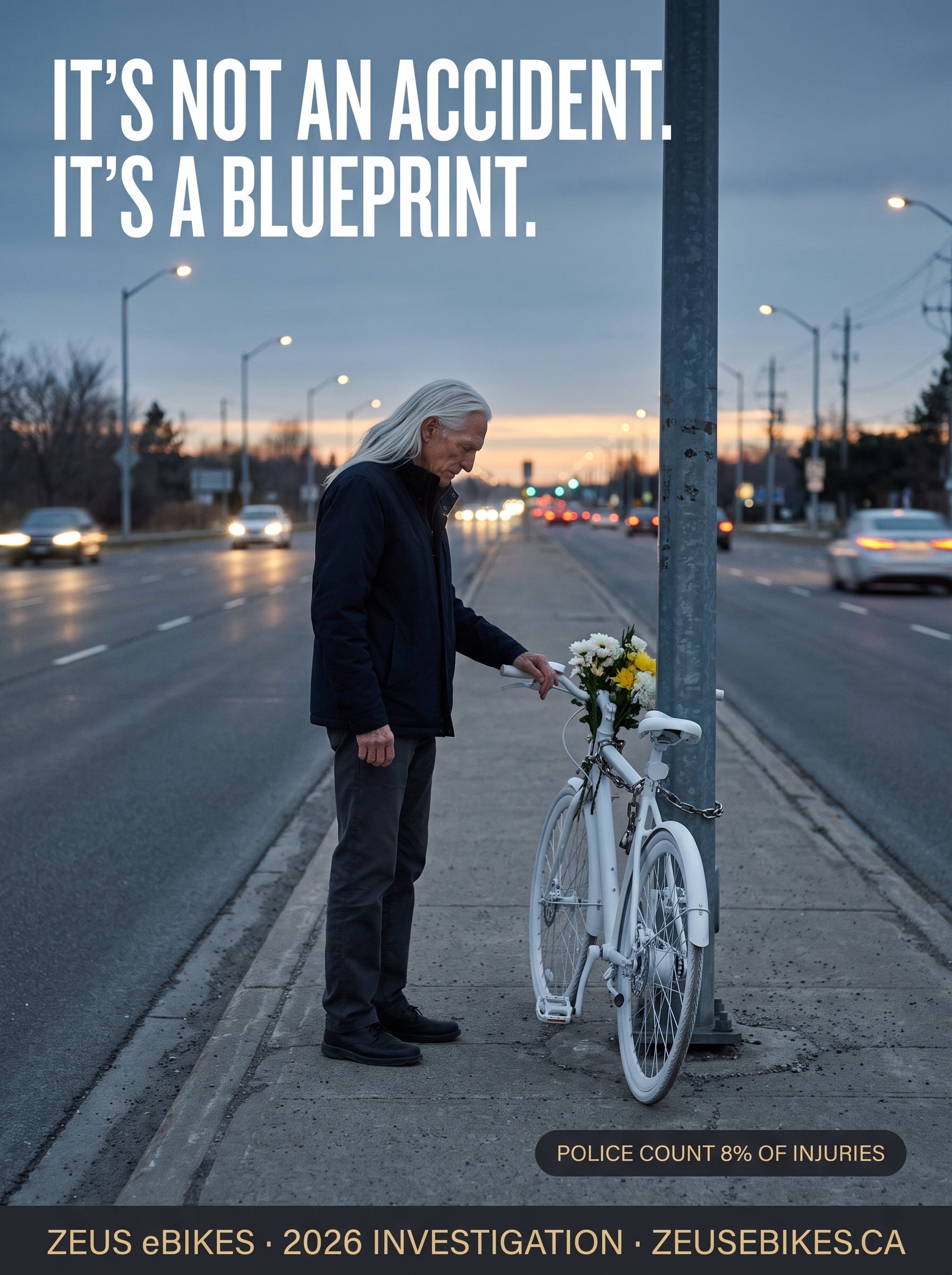
A ghost bike on a Canadian arterial. Every one marks a death the coroners keep calling "preventable." · AI-generated editorial image (Playcut.ai)
Put the same rider on the same bike in two Canadian cities and their odds of dying are not the same — and the variable is not the rider, the weather, or the driver's character. It is the blueprint: how a government chose to build the road, and how a government chose to license the person driving toward them. This is a coast-to-coast look at a body count that Canada calls "accidents," and at the paper trail — court rulings, coroners' reports, the government's own buried research — showing that almost every one of these deaths was drawn on a plan first. We are an e-bike company. We are not going to sell you anything in this article. We are going to tell you who is killing Canadian cyclists, and it is not who your feed says it is.
How this investigation was done
Government sources first; no fabrication; no blaming people the data can't name. Every figure comes from a named public source — Statistics Canada, Transport Canada, the Canadian Institute for Health Information (CIHI), Ontario's Chief Coroner, provincial road-safety agencies, peer-reviewed Canadian studies (Teschke, Redelmeier), municipal open data, the Ontario Auditor General, and court rulings — plus dated reporting from CBC, the Globe and Mail, and others for specific cases. Where the data does not exist, we say so rather than invent it: Canadian collision databases record no driver race or citizenship, so this article makes no claim about either, and treats the "immigrant driver" narrative as what the evidence shows it to be — a licensing-and-fraud story in which newcomer drivers are usually the exploited party. Criticism of governments here is fair comment grounded in their own reports and in court and coroner findings on the record. And to be precise about the charge: "by design" does not mean anyone in government wants a cyclist dead — it means these deaths are the foreseeable, repeatedly-chosen outcome of decisions that governments control and could change tomorrow. All data current to July 2026. Editorial photographs are AI-generated images created with Playcut.ai — illustrative, not documentary records of specific events or people.
Quick Answer
Cyclists and e-bike riders don't die on Canadian roads by accident — they die by design. Behind a cyclist's death sit as many as four government process-failures: the road was drawn to kill (unprotected, too fast); when the vehicle is a heavy truck, the driver was often certified through a licensing process documented as broken; the harm barely gets counted (police record under 8% of cyclist injuries); and the fixes were offered and refused (Ottawa rejected truck side guards despite its own evidence they cut deaths 61%). Any one can be fatal; in the worst cases they stack. None of this is inevitable: Montréal built the most protected cycling network in North America and Vancouver engineers out the deadly right-hook, proving the fix works on Canadian soil. The deaths that continue are the ones a different blueprint would have prevented.
In this article
- The design lottery: two Ontario cities, two sets of odds
- The blueprint thesis: roads and licences are the same machine
- Failure #1 — The road is drawn to kill
- Failure #2 — The driver is certified by a broken process
- Failure #3 — The injuries don't get counted
- Failure #4 — The fixes were offered and refused
- The e-bike question, answered honestly
- The world already ran the experiment
- The two Canadas — and the to-do list
- The backsliders: Canadians tearing out what worked
- The arsenal: how to fix your own street
- The wins: ordinary people who already did it
- Frequently asked questions
- The bottom line
The Design Lottery: Two Ontario Cities, Two Sets of Odds
In late 2024 the Ontario government passed a law to tear out protected bike lanes it had already built, and in 2025 a court struck the plan down as unconstitutional and "arbitrary." That is the trigger for this article: a government spending public money to make a road more dangerous, on the record, in a courtroom. Because if a cyclist's safety can be legislated down on purpose, then it was always a choice — which means every kilometre of Canadian road is a decision about who lives. Here is what that decision looks like when you hold everything else constant.
Take one province — Ontario — and two of its cities. In Waterloo, the city built a connected web of over 230 kilometres of trails, bike lanes and signed routes, and in 2018 Waterloo became the first mid-sized city in Ontario to earn a Gold Bicycle Friendly rating. Ninety minutes west, in London, a Western University study of local cycling collisions found something bleaker: almost every crash site had no infrastructure separating cyclists from traffic at all. London's main arteries run cyclists alongside fast cars with gaps between the few safe pockets; local riders describe commuting "very defensively," treating every trip as life or death. The bikes are identical. The riders are identical. The odds are not — and the only thing that changed is what the two city halls chose to pour.
That is the whole argument in miniature. A cyclist's risk in Canada is not mainly a story about reckless individuals. It is a story about engineering — and engineering is done by governments, on purpose, with money and votes. Once you see it that way, the word "accident" starts to look like a cover story.
Takeaway: Same bike, same rider, same province — different odds of dying, set entirely by which government built the road. If safety can be designed in (Waterloo) or legislated out (Bill 212), then a cyclist's death was never bad luck. It was a blueprint someone approved.
The Blueprint Thesis: Roads and Licences Are the Same Machine
Road death is a process-design failure, not a character failure — and the road you ride on and the licence in the other driver's wallet are outputs of the same machine: government. That is the thesis of this piece, and it is not a slogan. It is the founding principle of "Vision Zero" and the "Safe System" approach that Transport Canada, Ontario, British Columbia and a dozen Canadian cities all claim to follow: humans will always make mistakes — drivers get distracted, cyclists wobble, everyone is tired — so the system must be built so that a normal human error does not end in a corpse. When it does, that is not a moral failing of the individual. It is a design failing of the system that refused to forgive the error.
Most road-safety writing gets stuck on the individual: the reckless driver, the helmetless rider, the person who "wasn't paying attention." That framing is a trap, because it is unfixable — there will always be a reckless driver somewhere. The Safe System reframes it. You cannot screen human error out of four million drivers. You can design a road so that when a driver drifts, a concrete curb is between them and the cyclist. You can build a licensing process that actually verifies competence instead of selling certificates. Road design and licence design are the same kind of problem: both are engineered processes, both are owned by government, and both are killing cyclists in exactly the ways a competent engineer would predict.
So this article is organized as an engineer would organize a failure analysis — not "who was the bad person," but "which parts of the system failed, in what order." When a cyclist dies in Canada, the failure usually began long before the crash, in as many as four government-owned processes — any one of which can be the difference between a scare and a funeral. Here they are.
Failure #1 — The Road Is Drawn to Kill
The single biggest predictor of whether a Canadian cyclist lives or dies is not their behaviour — it is the physical design of the road under them, and above all its speed. Cyclists overwhelmingly die not on the separated paths and cycle tracks, but on the fast, unprotected arterials governments chose not to fix — and the exposure-controlled research below shows why that is no accident of chance.
Why is speed the murder weapon? Because survival is close to a physical law. A person struck by a vehicle travelling 30 km/h has roughly a 90% chance of surviving; at 50 km/h the odds fall below half; and cyclist fatality risk rises roughly sixteen-fold at 80 km/h compared with lower speeds. Studies of 30 km/h zones find they cut injuries and deaths by as much as 67%. This is why the quiet administrative act of posting an arterial at 50 or 60 km/h — beside a painted line and a row of parked cars — is not a neutral traffic decision. It is a decision about how many people the road will kill, made by someone who will never be named in the obituary.
Speed Is the Murder Weapon
A struck person's approximate chance of survival, by vehicle speed. The drop between 30 and 50 km/h is the difference between a bruise and a funeral.
Sources: peer-reviewed impact-speed survival literature; 30 km/h zone effectiveness reviews (up to 67% injury/death reduction). Curve is illustrative of the well-established relationship, not a single controlled dataset.
Speed is half the design. Separation is the other half, and here the Canadian evidence is close to settled. In a landmark case-crossover study led by UBC's Kay Teschke, protected cycle tracks had about 90% fewer injuries per kilometre than major streets with parked cars and no bike infrastructure; fully separated lanes were roughly nine times safer than those same painted, car-lined arterials; and — a detail that should end a lot of debates — painted bike lanes running next to parked cars were about seven times more dangerous than physically separated ones, because of dooring. Physical concrete between a cyclist and a car is not a nice-to-have. It is the intervention with the biggest evidence base in the entire field, and it is a pouring decision made at a council meeting.

Paint where concrete should be: a cyclist boxed between a passing truck and the door zone. About 85% of the road offers no protection at all. · AI-generated editorial image (Playcut.ai)
Two Canadian cities prove it can be done here, in our climate, at scale — which is precisely why the cities that refuse have no excuse. Montréal has the most extensive cycling network in North America: over 1,000 kilometres of paths, anchored by the Réseau Express Vélo — a 17-route, 191-kilometre network of concrete-separated lanes being rolled out across the city, lit at night, given their own traffic signals, and plowed all winter (the city clears 740 km of paths through January blizzards). Vancouver pairs downtown protected lanes with protected intersections that give cyclists their own signal phase and hold turning cars — engineering out the "right-hook," the single move that kills the most urban cyclists. The Globe and Mail ran a headline that is really the thesis of this whole section: "What the rest of Canada can learn from Vancouver's dedicated bike lanes."

The fix, in winter: a concrete-separated lane, plowed and bare, safe enough for a child. Montréal clears 740 km of these year-round. · AI-generated editorial image (Playcut.ai)
Now hold that against Ontario, which in 2024 passed Bill 212 to rip out the protected lanes on Bloor Street, Yonge Street and University Avenue in Toronto. In 2025 an Ontario Superior Court judge ruled that the removal law violates Section 7 of the Charter — the right to life and security of the person — striking it down as "arbitrary," not grounded in solid evidence, and legislated against the government's own internal safety advice. Ontario appealed; the Court of Appeal heard the case in January 2026, and as of mid-2026 its decision was pending, with the lanes still in place. Read that plainly: a Canadian government tried to spend tax money to remove the exact infrastructure that the best available evidence says keeps cyclists alive, and a court had to step in to stop it. That is not a safety failure of a distracted driver. That is a safety failure signed at the top.
Takeaway: Speed and separation decide who lives, and both are pure design choices. Montréal and Vancouver prove a Canadian city can build protected, winter-plowed networks that work. When a government instead posts 60 km/h beside a painted line — or legislates protected lanes out — it is not failing to prevent deaths. It is choosing them.
Failure #2 — The Driver Is Certified by a Broken Process
The second failure is the driver — but not in the way your social feed frames it. When the vehicle that kills a cyclist is a heavy truck — the deadliest thing they share the road with — the driver is very often the product of a commercial licensing and training process that a Canadian Auditor General, a criminal fraud investigation, and the trucking industry itself all describe as broken. Most cyclists are killed by ordinary passenger vehicles; but the truck subset is the most lethal, and it runs through the most broken process. The problem is not who the driver is. It is the machine that certified them, and it is rotten in places that are documented, named, and charged.
Start with the case that changed the law. On April 6, 2018, a semi driven by Jaskirat Singh Sidhu blew through a stop and killed 16 people on the Humboldt Broncos team bus. Sidhu, who had immigrated from India in 2013, had been newly licensed and, his victims' families alleged, inadequately trained by his employer, Adesh Deol Trucking Ltd.; inspectors later found the driver had committed 70 regulatory violations in the 11 days before the crash, and the carrier's owner faced eight counts of failing to comply with safety and log-keeping regulations. Humboldt is the reason Mandatory Entry-Level Training (MELT) exists across much of Canada today. It is the archetype of this whole section: an undertrained driver, put on the road by a negligent carrier, through a process that should have stopped both — and 16 people paid for it.
Here is the part the outrage machine gets exactly backwards. The fix that Humboldt produced — MELT — is itself being gamed, and the gaming is a system crime, not an ethnic one. In 2024–25, Ontario's Serious Fraud Office charged eight people with 24 criminal counts over bribery in commercial Class A driving exams; roughly 250 applicants had passed with the charged examiners, and about 1,200 drivers received licence-suspension letters citing "dishonesty during the Class A testing and/or training processes." One driver told a trade publication he paid $5,000 cash for training at a school that claimed it could conduct official road tests, and got no receipt. Ontario's Auditor General reported in 2026 that private colleges had falsified training records, failed to keep records that students completed MELT, skipped required components, and — in six cases — kept issuing driver-training certificates while unregistered. The trucking industry has its own name for the broader fraud economy underneath all this: "Driver Inc.," which the Canadian Trucking Alliance calls a billion-dollar scam built on misclassified drivers, fake insurance, and "fake licensing or certification schemes."
And the driver at the centre of it? Usually the victim, not the villain. In "Driver Inc." reporting, newly arrived drivers are documented being wage-stolen and exploited — one drove 16,000 km in under two weeks and was never paid. So let us be as blunt as the evidence allows. Canadian collision databases record no driver's race or citizenship, so nobody can honestly tell you that any ethnic group crashes more — and the one large study that comes close found the opposite: an Ontario analysis following 4.2 million people for eight years found recent immigrants had a crash rate 45% lower than long-term residents (158 versus 289 hospitalized-as-driver per 100,000). If you saw reckless drivers and your feed handed you an ethnicity, the feed did to you exactly what feeds do — it bound a real grievance to a false target, because "blame the newcomers" travels farther than "blame the fraud economy and the ministry that lets it run." Aim there instead, and the aim is deadly and true: bribed examiners, licence mills, "Driver Inc." carriers, and a regulator the Auditor General caught asleep.
None of this is un-fixable, either — and again a Canadian jurisdiction shows the process can be built right. British Columbia's mandatory commercial training runs 140 hours, and the province maintains carrier safety systems that actually track records. Ontario tracks carriers too, through the Commercial Vehicle Operator's Registration (CVOR), which rates every trucking company on a 0-to-100 scale for collisions and violations — the tool exists to identify the worst operators. The failure is not that Canada lacks a way to certify competence and flag bad carriers. It is that the certification process has been allowed to be bought, and the flags get ignored.

The other broken process: a truck-training yard at dusk. In Ontario, examiners were bribed and 1,200 licences were suspended. Who actually checked? · AI-generated editorial image (Playcut.ai)
The honest line on the driver: The reckless drivers people see are real, and the training/licensing rot behind them is real, documented, and criminal. But the variable that predicts danger is how the driver was trained and which carrier put them on the road — not the driver's background. Fixing it means fixing the process (real oversight, real training, real carrier accountability), not screening people by who they are. The engineer's answer and the just answer are, this time, the same answer.
Takeaway: Humboldt built MELT; fraud is hollowing it out — bribed examiners, 1,200 suspended licences, unregistered schools, a billion-dollar "Driver Inc." economy, and an Auditor General's warning. The driver in the cab is usually the exploited output of that broken process. BC's 140-hour standard proves the process can be built right. This is a system failure to fix, not a people to blame.
Failure #3 — The Injuries Don't Get Counted
The third failure is the quietest and, in some ways, the most damning: Canada does not actually count the cyclists it injures, which lets every government above claim it cannot see a problem it refuses to measure. When you read "4,742 cyclists were injured in Canada in 2023," understand that this police-reported number is a rounding error against reality.
The proof is a peer-reviewed Toronto study that linked police collision data to hospital records for 2016–2021. Police recorded 2,362 cyclist injuries. Emergency rooms treated 30,101. Police captured 7.9% of the real total — and only about 10% of the serious hospitalizations. The reason is structural: roughly 85% of cyclist injuries involve no motor vehicle at all — falls, single-bike crashes, a wheel caught in a streetcar track, a driver's door flung open — and those almost never generate a police report. Even Ontario's own 2012 coroner's review noted that while a few dozen cyclists were dying each year, about 26,000 Ontarians were visiting an emergency room annually with cycling injuries. The gap between what the state records and what the hospitals see is not a technical footnote. It is a governing convenience.
The 8% You're Allowed to See
Toronto cyclist injuries, 2016–2021: what police recorded vs. what emergency rooms actually treated. You cannot fix a problem you have decided not to measure.
Source: peer-reviewed linkage of Toronto police collision data and health-service records, 2016–2021 (PMC10958284). ~85% of cyclist injuries involve no motor vehicle and rarely reach a police report.
Dooring is the perfect emblem of the blind spot. In Ontario, opening a car door into a cyclist's path is not classified as a "collision" at all, so a category of injury and death that everyone in the cycling world knows is common simply does not appear in the standard statistics. And when Ontario's Chief Coroner reviewed 25 e-bike deaths, the panel's very first recommendation was, in effect, an admission: start collecting e-bike collision, injury and fatality data — because Canada largely does not. A government that will not measure the harm has given itself permanent deniability. "We had no evidence of a problem" is a much easier sentence to say when you designed the ledger to be blank.

A ghost bike and a rain-soaked note. The death itself gets recorded — but the injuries that come before deaths like it are counted fewer than one time in ten. · AI-generated editorial image (Playcut.ai)
Takeaway: Police record under 8% of cyclist injuries; dooring isn't even counted; e-bike data barely exists — the coroner had to recommend collecting it. You cannot fix what you refuse to see, and the blank ledger is the alibi. Underscoring the problem is itself a policy choice.
Failure #4 — The Fixes Were Offered and Refused
The fourth failure is the one that turns tragedy into something closer to negligence: for the deadliest, most preventable cyclist deaths, Canada was handed the fix — sometimes by its own researchers — and said no. The clearest case is truck side guards, and it is genuinely damning.
Heavy trucks kill cyclists out of all proportion to their numbers: in Montréal, at least one in five cycling deaths since 2005 involved a heavy truck or tractor-trailer, almost always in a turn, where the cyclist is dragged under the gap between the front and rear wheels. The fix — a metal side guard that closes that gap — is old, cheap, and proven. And here is the part that should end careers: a National Research Council report commissioned by Transport Canada noted that after the United Kingdom mandated side guards, cyclist deaths from truck-side impacts fell 61% and serious injuries fell 13% — and the NRC's own crash tests found all three guard models stopped a bike from sliding under the truck. Ontario's Chief Coroner formally recommended a national mandate after reviewing 224 cyclist and pedestrian deaths. And Transport Canada halted the NRC's promising tests and rejected the mandate, arguing there was "little verifiable evidence" the guards work. Cities filled the vacuum where they could — Vancouver's council unanimously required side guards on its own trucks after a cyclist named Agustín Beltrán was killed — but a life-saving device sits optional on the national fleet because Ottawa declined the recommendation of its own coroner and the finding of its own scientists.

The geometry Ottawa won't fix: a cyclist in the gap beside a heavy truck. A metal side guard closes it — the UK's cut these deaths 61%. · AI-generated editorial image (Playcut.ai)
Then there is the 2012 Ontario coroner's review itself, which examined 129 cyclist deaths and reached a conclusion that should hang over this entire file: every single one was "predictable and therefore preventable." Predictable means someone could have seen it coming. Preventable means someone could have stopped it and did not. The review recommended a one-metre passing law and mandatory truck side guards, among other measures. More than a decade later, cyclists are still dying in the exact ways the report predicted, on the roads it warned about, hit by the trucks it flagged. The fixes did not fail. They were declined.
The indictment, stacked: A cyclist dies on an unprotected arterial (Failure #1), struck by a driver certified through a fraud-riddled process (Failure #2), and their injury — if they had survived — would never have been counted (Failure #3), on a road where the coroner recommended the fix years ago and the government refused it (Failure #4). Four government-owned processes, all failing in a predictable order, all fixable, all fixed somewhere in Canada already. That is not an accident. That is a blueprint, followed to the letter.

Where the uncounted arrive: an ER gurney and a cracked helmet. Police will record fewer than one in ten of the injuries that end up here. · AI-generated editorial image (Playcut.ai)
The E-Bike Question, Answered Honestly
E-bikes deserve their own honest reckoning, because the panic around them is loud, the data is thin, and both the fear-mongers and the boosters are cherry-picking. Here is the whole truth, including the parts that are uncomfortable for a company that sells e-bikes.
The uncomfortable numbers first. Ontario's Chief Coroner reviewed 25 e-bike deaths (2012–2021): 96% were male, 76% were over 45, drugs were present in 69% of toxicology results, 88% died on public roads — and 60% were wearing helmets. Those last two facts detonate the easy narratives from both sides: this is not mostly reckless helmetless teenagers (they were older men, most helmeted), and it is not a problem a helmet slogan solves. At the same time, hospitals are seeing a real surge: e-bike trauma cases at Toronto's St. Michael's Hospital rose from 15 in 2020 to 51 in 2024, a 240% increase, and pediatric hospitals are reporting sharp rises in e-scooter injuries among kids aged 10–13. Something is genuinely changing, and pretending otherwise would be its own kind of lie.
But now the part the panic leaves out. In absolute terms there are still roughly ten times more conventional-bicycle injuries than e-bike injuries, and — critically — no Canadian dataset measures crashes per trip or per kilometre, so no one can honestly claim e-bikes are more dangerous per rider. International reviews find the e-bike injury pattern resembles bicycles, not motorcycles, and that riders' behaviour (signalling, stopping) is nearly identical to conventional cyclists. Where the real risk concentrates is exactly where the coroner pointed: heavier, faster machines misclassified as e-bikes — which is why the coroner's central recommendation was to split e-bikes into classes and cut the legal weight ceiling from 120 kg to 55 kg. A 25 km/h pedal-assist commuter and a 65 km/h, 120-kg electric motorcycle both get sold and ridden as "e-bikes," even though the faster machine blows past the legal pedal-assist speed limit and is not, in law, an e-bike at all — a line the government never bothered to draw cleanly, so the data, the enforcement, and the panic all blur together.
And here is where the e-bike story rejoins the main argument: the e-bike rider dies on the same unprotected roads, gets counted by the same broken system (worse — the coroner had to ask the government to start counting e-bikes at all), and is failed by the same refused fixes. The device is new. The blueprint that kills its rider is the same one that has been killing pedal cyclists for decades. If you want the deeper dive on where the wattage-and-speed lines actually sit, we've laid out the real numbers in our guide to Canada's e-bike wattage limits and why the rules that exist go largely unenforced.
Takeaway: The honest e-bike verdict: injuries are rising and older-male e-bike deaths often involve drugs and do involve helmets — but absolute numbers stay far below pedal bikes, no per-km risk data exists, and the real danger sits in fast, heavy machines the government never classified cleanly. The e-bike rider is killed by the same four failures as every other cyclist. New vehicle, same blueprint.
The World Already Ran the Experiment
Every argument against fixing Canadian roads has already been disproven by a real city, at scale, with published numbers. The world's best cycling cities are not a different species — several of them were car-choked, cyclist-killing places within living memory, and one of them is colder than almost every major city in Canada. They are what the blueprint looks like when a government actually follows it, and each one demolishes a specific Canadian excuse.
"People here just won't ride" — Copenhagen says otherwise
Copenhagen has the highest cycling share of any EU capital: roughly 49% bicycle mode share, with 45% of all commutes to work or education made by bike. That did not happen because Danes are genetically different. It happened because the city spent five decades building a complete, connected grid of curb-separated cycle tracks, prioritized bikes at signals, and made the bicycle the objectively fastest, cheapest, most convenient way to cross the city. Ridership is not a cultural trait. It is a demand curve responding to design: build the safe network and the riders appear — the same "safety in numbers" effect Canadian data shows, where hospitalization rates fell as cycling rates rose.

The destination: ordinary people of every age on a protected network with their own green light. Build it and the riders appear. · AI-generated editorial image (Playcut.ai)
"We're a car culture — always have been" — the Netherlands was too, until the children died
The most important fact about Dutch cycling paradise is that it did not exist fifty years ago. Postwar Netherlands motorized ferociously, paved over bike infrastructure, and paid the same price Canada pays now — worse: traffic deaths peaked in 1971 at about 3,300 in a single year, more than 400 of them children under fourteen. What happened next is the part every Canadian council should be forced to read. Parents rose up under a name that refused all euphemism — Stop de Kindermoord, "Stop the Child Murder" — and children themselves blockaded Amsterdam streets in protest. The government's response was not a awareness campaign. It rebuilt the country: segregated cycle lanes, sustained national funding, and street designs that assumed human error. Today 27% of all trips in the entire country — urban and rural — happen by bicycle, and Dutch children bike to school through infrastructure their grandparents marched for. The Netherlands is not proof that some countries are lucky. It is proof that a country can look at its dead, name the cause honestly, and redraw the blueprint. They called it murder, and then they stopped it.
"That takes generations" — Paris did it in one decade
Paris was, until recently, one of Europe's most hostile cities to ride in. Then it simply decided not to be: roughly 300 km of bike lanes added since 2014, arterials converted, the Seine embankment closed to cars. The result, measured by 2024: 11.2% of trips inside Paris are now made by bicycle — versus 4.3% by car. Bikes overtook cars, in Paris, in about a decade, starting from a 3% cycling share in 2010. Nobody waited for a culture change; the culture changed because the streets did. A Canadian mayor elected today could see the same curve before leaving office.
"Canada is too cold" — meet Oulu, Finland
Oulu sits near the top of the Gulf of Bothnia, 200 km from the Arctic Circle, with January temperatures averaging −7 to −15°C — a climate colder than Toronto's or Vancouver's and in the same league as Montréal's and Winnipeg's. It is also the winter cycling capital of the world: 40% of residents ride weekly, more than 40% of school trips are by bike, 22% of inner-city trips are cycled — and the share stays at 12% straight through the Finnish winter, including children riding to school in the dark at −20°C. The method is not heroism; it is maintenance policy: a connected network of separated paths that get plowed first, before the car lanes, so the bike route is always ridable. Montréal already proves the same thing at smaller scale, clearing 740 km of paths through January. The cold was never the obstacle. The plow schedule was.

A child rides to school at −15°C on a plowed, lit path. "Canada is too cold" dies here — the cold is a maintenance budget, not a fate. · AI-generated editorial image (Playcut.ai)
Takeaway: Four excuses, four cities, four disproofs — people ride when it's safe (Copenhagen), car cultures can choose to change (the Netherlands, after 400-plus children died in a single year), it takes a decade not a generation (Paris, where bikes now outnumber cars), and cold is a plowing schedule, not a fate (Oulu, 12% mode share through an Arctic-adjacent winter). The experiment has been run. Canada is not waiting for evidence. It is declining to read it.
The Two Canadas — and the To-Do List
Put the whole country on one map and you do not see a nation with a cycling-safety problem — you see two Canadas, divided by design. In one Canada, Montréal plows 740 km of concrete-protected lanes through winter, Vancouver builds intersections that hold turning trucks, British Columbia trains its truckers for 140 hours, and cities from Victoria to Toronto are lowering default speeds to 30 km/h where people and cars mix. In the other Canada, arterials run cyclists beside 60 km/h traffic with a painted line for protection, licence mills sell certificates, Ottawa refuses the truck side guards its own research found effective, and a province spends public money in court trying to tear protected lanes back out. The riders in both Canadas are the same people. The difference in their odds is a difference in blueprints.
The good news buried in that split is that every single fix is already working somewhere in this country. There is no need to invent anything, pilot anything, or wait for foreign proof. The to-do list is written, costed, and demonstrated on Canadian ground:
The fixes, all proven on Canadian soil:
• Physically separated networks that connect — concrete, not paint (Montréal REV; Vancouver; Waterloo). ~90% fewer injuries per km.
• Default 30 km/h where people and cars mix — up to 67% fewer injuries and deaths (Toronto by 2028; Vancouver; BC towns).
• Protected intersections that remove the right-hook (Vancouver).
• Mandatory truck side guards — 61% fewer cyclist truck-deaths in the UK, per Transport Canada's own report (Vancouver mandates its own; Ottawa still won't).
• A licensing process with real oversight — end the exam-bribery and licence mills; enforce carrier accountability (BC's 140-hour standard; Ontario's CVOR, used properly).
• Actually count the injured — link police and hospital data; classify dooring; collect e-bike data (the coroner's own ask).
• Stop removing what works — the lowest bar of all, and Ontario's Bill 212 couldn't clear it.
The reason to say all of this plainly is that the alternative is worse than silence. If Canadians accept that cyclist deaths are "accidents," then nothing has to change, no one has to be accountable, and the body count is just weather. But it is not weather. It is a set of decisions, made by named governments, documented in their own reports and struck down in their own courts. The 129 deaths the coroner called "predictable and preventable" were predictable because the system that produced them was designed — and preventable because we already know, and can prove, how to design it differently.
The Backsliders: Canadians Who Tore Out What Worked
For every citizen who fought to build a safe street, there is a politician who spent public money to unbuild it. Reversing cycling safety is not a hypothetical risk in Canada — it is an active political sport with a documented trail of torn-out protection, and it is spreading.
The $270,000 lesson: Toronto's Jarvis Street
Jarvis Street got bike lanes in 2010 as a street-safety measure; they cost about $86,000 to paint. In 2011, Toronto's council under Mayor Rob Ford — whose slogan was that "the war on the car is over" — voted to rip them out, and removal cost roughly $270,000, because the road had to be re-engineered to add back a reversible car lane. Read that ledger twice: the city spent more than three times the installation cost to make a street measurably more dangerous, so cars could move slightly faster. Cyclists staged a sit-in as crews scraped the lines away in 2012. It is the perfect monument to the blueprint problem — a government paying a premium to choose the deadlier design.
The apex: Ontario's Bill 212
A decade later, Doug Ford's provincial government scaled the Jarvis move up into a law. Bill 212 ordered the removal of the protected lanes on Bloor, Yonge and University — the very lanes Toronto's citizens spent twenty years winning — and an Ontario court struck the plan down as unconstitutional and "arbitrary," finding the government had legislated against its own internal safety advice. It is an exceptionally rare case of a Canadian court stopping a government from removing safety infrastructure because the evidence showed it would put lives at risk — and, as of mid-2026, the province's appeal was still pending.
A spreading contagion
This is not one rogue premier, and the contagion accelerated into 2026. In Brampton, council voted 10-1 in January 2026 to rip the concrete-separated lanes and barriers off Howden Boulevard and replace them with painted sharrows, then voted in May to restore Charolais Boulevard to four car lanes — both over its own staff's written safety warnings. Moncton pulled a St. George Boulevard bike lane added barely a year earlier because drivers complained about a lost turning lane. And in July 2026, Alberta went furthest of all: the province launched an official online “complaint portal” soliciting objections to bike lanes — with no box to voice support — while Transportation Minister Devin Dreeshen said a bill was coming in the fall to hand the province Ontario-style power to review and tear out municipal lanes. Every removal is sold as "common sense" and "reducing gridlock." Every one is a government looking at the evidence that protected lanes save lives and choosing, on purpose, to remove the protection.
The asymmetry that should scare you: Building a safe street takes citizens years of deputations, data and coalition-building. Unbuilding one takes a single council vote or a single bill — and often costs more than the lane did. Safety is hard to win and cheap to destroy, which is exactly why the people who win it can never fully stop defending it. A painted-over bike lane is not a neutral budget line. It is a decision about how much danger the next version of that road will carry — and who will bear it.
The Arsenal: How to Actually Fix the Road on Your Street
This part is not theory, and it is not despair — it is a to-do list for you, because municipal road design is one of the most responsive decisions in all of government. It happens locally, it is relatively cheap, and it turns on a councillor, a committee meeting, and a few determined neighbours. Every protected lane in this country exists because someone refused to accept the painted one. Here is exactly how they did it — and how you do it.
Your civic toolkit — the moves that actually work:
1. Call 311 and get a service-request number. Report the specific hazard and ask for a traffic-calming review of your street. That number is a paper trail the city has to track and answer.
2. Email your ward councillor — they are the lever. In most Canadian cities, traffic calming and bike lanes are initiated and prioritized by the local councillor. One email opens a staff report; a dozen from one street opens a project. Copy the mayor.
3. Depute at your council or transportation committee. You can register to speak for a few minutes at a public meeting. Bring one line: the Chief Coroner called these deaths "predictable and preventable."
4. Hand them their own evidence. Cite the Ontario Chief Coroner's cycling and e-bike death reviews, the Teschke infrastructure studies, your city's own Vision Zero plan, and the Bill 212 ruling — a court that found protected lanes engage the Charter right to life. Governments move fastest when you quote their own documents back to them.
5. Request a Community Safety Zone or a school-zone designation. These lower the speed limit and raise fines at one specific location — a concrete, winnable ask instead of an abstract one.
6. Join the group already doing this. Cycle Toronto, Vélo Québec, Bike Ottawa, the BC Cycling Coalition, Bike Calgary, Bike Winnipeg and their equivalents win these fights with organized numbers. One member is a letter; a coalition is a policy.
7. File a petition. Provincial legislatures and the federal House of Commons run official e-petitions (the federal one needs an MP to sponsor it); a neighbourhood petition to your own council is even faster.
8. Ask for the data — then vote the road. Request your street's collision history through Freedom of Information; it makes the case undeniable. Then ask every municipal candidate one question before you mark the ballot: protected lanes and default 30 km/h — yes or no?
Takeaway: The government owns the blueprint — but in a city, the blueprint is unusually easy to redraw. It answers to 311 tickets, a councillor's inbox, a deputation, and a coalition. The tools are public, free, and proven. The only missing ingredient is the decision to pick them up, and it has never once been the cyclists who lacked the evidence.
The Wins: Ordinary People Who Redrew Their Own Streets
None of this is hypothetical. Ordinary people have used exactly these tools — deputations, data, coalitions, and stubborn refusal — to force their governments to build safer streets. Three from Canada, and then the cities the whole world learns from.
Bloor Street, Toronto: a tar-paper lane that took twenty years — and won
In 2005, activists rolled a fake bike lane out of tar paper along Bloor Street in Yorkville, just to make people picture it. That stunt became a movement: "Bells on Bloor" formed in 2007 and spent a decade on bike counts, postcard campaigns, public meetings, deputations at City Hall, and one-on-one meetings with councillors — backed by a coalition that included the David Suzuki Foundation, Cycle Toronto and Doctors for Safe Cycling. Their decisive move was data: a 2009 study found only 10% of shoppers at local Bloor stores arrived by car, detonating the merchants' fear that bike lanes would kill business. A pilot went in from Shaw Street to Avenue Road in 2016; when a follow-up study showed business had actually gone up, council made it permanent in November 2017, and in June 2023 voted 21–1 to extend it. Those are the very lanes an Ontario court is now shielding from Bill 212 — a citizen-built street a government is being ordered not to tear out.
Friends and Families for Safe Streets: grief, turned into a standing force
Some of Canada's most effective road-safety advocates are the people who paid the highest price. Friends and Families for Safe Streets is led by families of the killed and survivors of road violence, working alongside Walk Toronto, Bike Law Canada and the Toronto Centre for Active Transportation. They do not just mourn — they hold governments to their own promises, launching campaigns like #BuildTheVisionTO with fifteen concrete demands to make "Vision Zero" more than a slogan. Their power is moral and specific: it is very hard for a councillor to tell a grieving parent, on the public record, that a cheaper road was worth more than their child.
Winnipeg's Wellington Crescent: when the city won't build it, neighbours will
In June 2024, 61-year-old Rob Jenner was killed on Winnipeg's Wellington Crescent by a 19-year-old driver reportedly clocked at 159 km/h in a 50 zone. On the anniversary of his death, neighbours built the safety infrastructure the city wouldn't: a roughly 400-metre pop-up protected bike lane made of cinderblocks, wooden planks and green paint — "tactical urbanism," the tool of last resort that makes a possible future physically visible. This one is still an open fight: a proposal to drop the Crescent to 30 km/h was rejected once, and the campaign continues. That is the honest shape of most of these battles — not a single triumphant vote, but a refusal that outlasts the "no."
Beyond Canada: the citizens who changed whole cities
This is not a Canadian anomaly — it is how safe streets get built everywhere, and the very templates Canadians copy were themselves built by grieving families and angry riders. In New York, Families for Safe Streets — the group Toronto's version is modelled on — was founded in 2014 by families of people killed in traffic; working with the veteran advocacy group Transportation Alternatives, it won a citywide default speed limit of 25 mph (40 km/h) that same year. In London, after six cyclists were killed in a two-week stretch in late 2013, roughly a thousand riders staged "die-in" protests outside the transport authority. The pressure produced protected cycle superhighways and, eventually, the world-first Direct Vision Standard — a rule that star-rates truck cabs by how much the driver can actually see and bars the blindest, lowest-rated designs from the city unless the operator fits extra safety equipment. That is the exact hazard Canada's own coroner flagged and Ottawa refused to touch: London's citizens forced the trucks to change; Canada's government let the trucks win.
Takeaway: The pattern repeats across the country — a death or a near-miss, then organized citizens armed with data, deputations and coalitions, then a pilot, then permanence, usually over a government's first, second and third "no." Every protected lane in Canada is a monument to people who refused the painted one. The Netherlands did it at national scale after "Stop de Kindermoord"; Canadians are doing it street by street right now. You can be the next entry on this list.
Frequently Asked Questions
How many cyclists die in Canada each year?
About 47 cyclists were killed on Canadian roads in 2023 — about 2.4% of the 1,964 people killed in traffic that year (Transport Canada). Over 2006–2017, Statistics Canada counted 890 cyclist deaths, an average of 74 per year, with the long-term rate falling. A motor vehicle was involved in 73% of fatal crashes, and cyclist deaths overwhelmingly occur on fast roads without physical separation — not on the protected paths and cycle tracks.
Are cyclist injuries in Canada undercounted?
Massively. A peer-reviewed Toronto study (2016–2021) found police recorded 2,362 cyclist injuries while emergency rooms treated 30,101 — police captured just 7.9% of the real total, and about 10% of serious hospitalizations. Around 85% of cyclist injuries involve no motor vehicle at all (falls, single-bike crashes, dooring, streetcar tracks) and rarely reach a police report. The official injury number understates reality roughly ten-fold.
Do protected bike lanes actually make cycling safer?
Yes — it is one of the best-evidenced findings in road safety. A Canadian case-crossover study (Teschke et al.) found protected cycle tracks had about 90% fewer injuries per kilometre than major streets with parked cars and no bike infrastructure, and separated lanes were roughly nine times safer than those same painted, car-lined arterials. Physical separation, not paint and not helmet laws, is the big lever.
Why does speed matter so much for cyclist survival?
It is close to a physical law. A person struck at 30 km/h has about a 90% chance of surviving; at 50 km/h the odds fall below 50%; and cyclist fatality risk rises roughly 16-fold at 80 km/h versus lower speeds. Studies show 30 km/h zones can cut injuries and deaths by up to 67%. That is why the design decision to set an arterial at 50 or 60 km/h beside unprotected cyclists is, in effect, a decision about how many will die.
Why won't Canada require side guards on trucks?
Transport Canada has repeatedly rejected a mandate, arguing there is "little verifiable evidence" of effectiveness — even though a National Research Council report it commissioned noted that side guards cut cyclist truck-deaths 61% and serious injuries 13% in the United Kingdom. Ontario's Chief Coroner recommended them after reviewing 224 cyclist and pedestrian deaths. Heavy trucks are involved in roughly one in five Montreal cycling deaths. Cities like Vancouver have mandated side guards on their own trucks while Ottawa declines to act nationally.
Is it true immigrant drivers cause more crashes in Canada?
No — the data says the opposite. An Ontario study following 4.2 million people for about eight years found recent immigrants had a crash-hospitalization rate 45% lower than long-term residents (158 vs 289 per 100,000). Canadian collision databases do not record driver race or citizenship at all, so any claim that a specific group causes more crashes is unsupported by data. The documented problem is a broken licensing process — bribed examiners, licence mills, and fraud schemes like "Driver Inc." — that puts undertrained drivers of every background on the road, with newcomer drivers most often the exploited victims of it.
What is the Ontario e-bike death review and what did it find?
Ontario's Chief Coroner reviewed 25 e-bike deaths from 2012–2021. The dead were 96% male and 76% over 45; drugs were present in 69% of toxicology results; 60% were wearing helmets; and 88% died on public roads. The panel made seven recommendations, including creating separate e-bike classes, cutting the maximum weight from 120 kg to 55 kg, considering licensing and insurance for heavier machines, enforcing speed — and, tellingly, actually collecting e-bike collision data, because Canada largely does not.
Are e-bikes more dangerous than regular bikes?
Unclear, and the honest answer matters. In absolute numbers there are roughly ten times more conventional-bicycle injuries than e-bike injuries, but no Canadian dataset measures crashes per trip or per kilometre, so no one can prove e-bikes are riskier per rider. International trauma studies find e-bike injuries can be more severe, especially in older riders, but the injury pattern resembles bicycles, not motorcycles. The real risk concentrates in fast, heavy machines misclassified as e-bikes — and in the same unprotected roads that kill pedal cyclists.
Which Canadian cities are safest for cycling?
The cities that built physically separated, connected networks. Montréal has the most extensive cycling infrastructure in North America — over 1,000 km of paths and a growing 191 km REV network of concrete-protected lanes plowed year-round. Vancouver pairs downtown protected lanes with protected intersections that engineer out the deadly right-hook. Within Ontario, Waterloo became the first mid-sized city to earn a Gold Bicycle Friendly rating. The gap between these places and car-first cities is a design choice, not a matter of luck.
What is Bill 212 in Ontario and why is it controversial?
Bill 212 is Ontario legislation that ordered the removal of protected bike lanes on Bloor Street, Yonge Street and University Avenue in Toronto. In 2025 an Ontario Superior Court judge struck the removal law down as unconstitutional under Section 7 of the Charter (life and security of the person), calling it "arbitrary" and legislated against the government's own internal safety advice; Ontario appealed, the Court of Appeal heard the case in January 2026, and as of mid-2026 the decision was pending with the lanes still in place. It is a rare, documented case of a government spending public money to make roads measurably more dangerous.
What are the best cycling cities in the world?
The cities that treated cycling as core transportation and built for it. Copenhagen has the EU's highest capital-city cycling share — about 49%, with 45% of commutes by bike. The Netherlands moves 27% of all national trips by bicycle, a system built after the 1970s "Stop de Kindermoord" protests over child traffic deaths forced a national redesign. Paris added roughly 300 km of lanes in a decade and by 2024 bikes carried 11.2% of trips versus 4.3% for cars. And Oulu, Finland — colder than most Canadian cities — keeps 12% of trips on bikes straight through winter by plowing its separated bike network first. The common thread is design, not culture or climate.
What actually prevents cyclist deaths?
The Safe System approach: build roads that forgive human error instead of punishing it with death. In practice that means physically separated bike networks that connect (not paint), default 30 km/h speeds where people and cars mix, protected intersections that remove turning conflicts, side guards on trucks, honest injury data collection, and a licensing system with real oversight. Every one of these is proven, most are already working somewhere in Canada, and the deaths that continue are the ones these fixes would have prevented.
How do I get a bike lane or traffic calming on my street in Canada?
Start with three moves: call 311 to file a tracked service request for a traffic-calming review; email your ward councillor, who in most Canadian cities is the person who initiates and prioritizes these projects; and depute (register to speak) at your council or transportation committee. Strengthen the ask by citing your city’s Vision Zero plan, the Ontario Chief Coroner’s death reviews, and the evidence that protected lanes cut injuries about 90 percent. Join your local cycling coalition — Cycle Toronto, Vélo Québec, Bike Ottawa, the BC Cycling Coalition and their equivalents — because organized numbers win these fights, and request a Community Safety Zone for a specific dangerous spot.
The Bottom Line
Stop calling them accidents. Picture the worst case this system routinely produces: a Canadian cyclist who dies on an unprotected 60 km/h arterial, struck by a driver certified through a bribed exam, whose injury the system was never going to count, on a road where the coroner recommended the fix a decade ago and the government refused it. That person was not unlucky. They were failed — foreseeably, at nearly every stage — by processes that named governments own and could change tomorrow. Montréal and Vancouver and Waterloo have already shown, in our climate, on our streets, exactly how. The only thing missing is the decision to copy the blueprint that keeps people alive instead of the one that doesn't.
If this made you angry, aim the anger where the evidence points — not at a driver's background, not at the cyclist for existing, but at the design decisions and the officials who make them. Read the Ontario Chief Coroner's cycling and e-bike death reviews; they are public. Watch whether your city is building concrete-separated lanes or repainting the same fatal lines. Ask your council for a default 30 km/h where you live. Ask your MP why Transport Canada still won't mandate the truck side guards its own research found effective. Ask your province whether it is expanding protected networks — or, like Ontario, hiring lawyers to rip them out. The body count is a policy. Policy can be changed, and it changes when enough people refuse to keep calling a blueprint an accident.
More Zeus investigations on the same system: why Canada's e-bike laws go unenforced · what the wattage limits actually are — and why speed, not watts, is the real safety variable · the honest math on replacing car trips with an e-bike · and, if you want the machine behind the "blame the newcomers" reflex, how the feed manufactures the target.
Written by Milad Ghobadibeygvand, BScN (Western University, 2014) — Co-founder, Zeus eBikes Canada. Published July 28, 2026. All data current to July 2026; every figure is sourced to a named public body, peer-reviewed study, court ruling, or dated news report. This article recommends no products. Corrections and rebuttals: milad@zeusebikes.ca.
Visuals created by Playcut.ai


Share:
Fertilizer & Food Prices Canada (2026): The War Data Nobody's Pricing In
What If Canada Owned Its Own Money? The Toll, the Chargeback Court, and the Bank We Built and Killed