
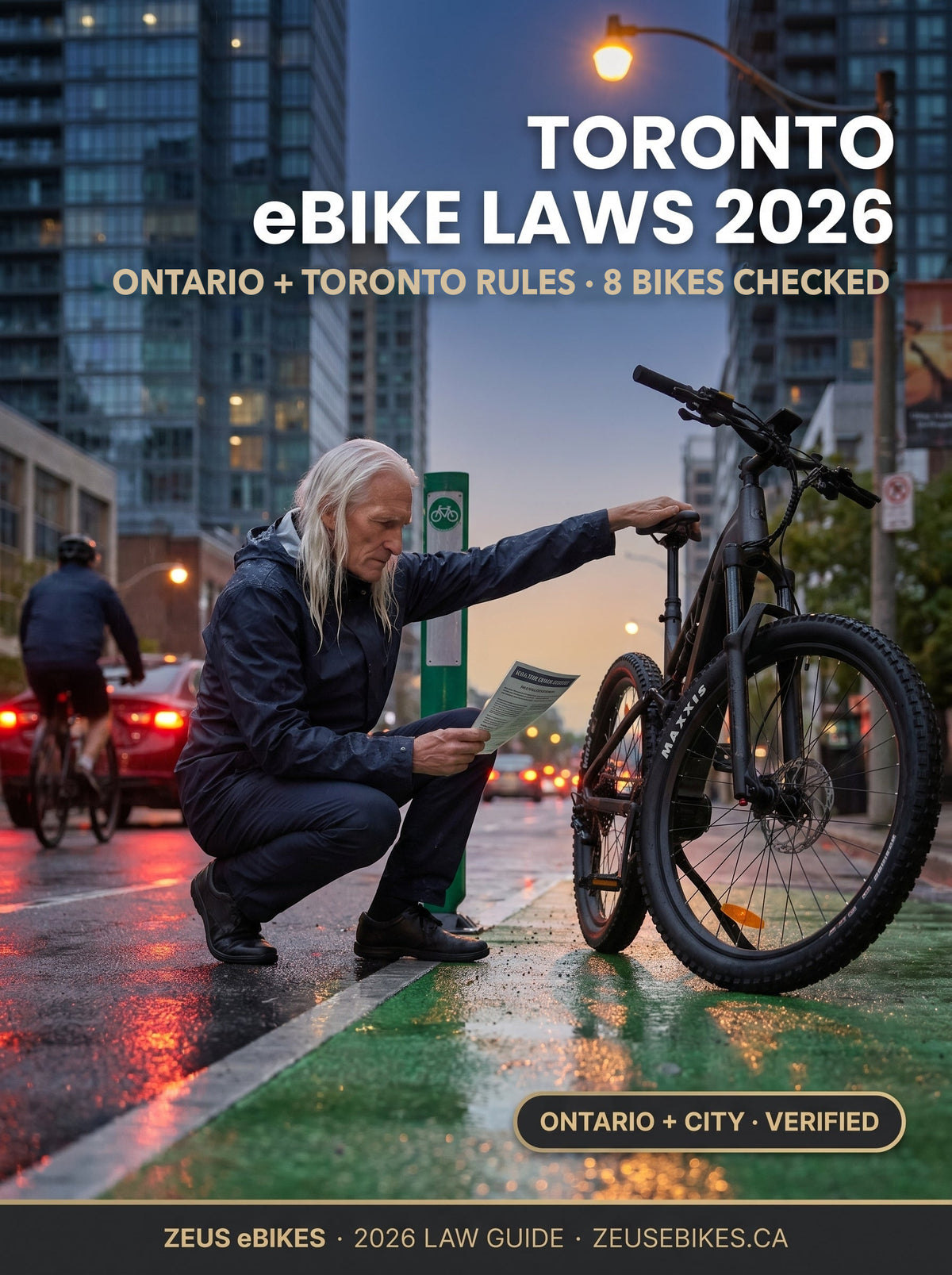
Toronto eBike Laws 2026: Ontario’s 6 Rules, Toronto’s City Rules & 7 Bikes Checked

Yes. An e-bike is legal in Toronto when it meets Ontario’s power-assisted bicycle rule (a motor rated 500W or less, assist that cuts off at 32 km/h, working pedals, 120 kg or less) and its rider is 16 or older and wears a helmet. Toronto then decides where it can go:
- Sidewalks: Never; riders 14 and older are barred (s. 950-201C(2)), and every e-bike rider must be 16
- Bike lanes: Painted lanes open to all e-bikes; protected lanes only to e-bikes that require pedalling
- Park trails & multi-use paths: Closed to e-bikes over 40 kg or that do not require muscular power
- Parking: Sidewalk stands only if it can be pedalled alone; moped- and scooter-style on-street
- Cargo e-bikes: Over 500 W or throttle-operable: no cycle tracks or trails; over 40 kg unladen: no trails
Ready to buy? Browse Toronto-ready urban eBikes or step-thru eBikes, and check each listing’s motor rating, throttle and speed setting, or visit a verified Toronto e-bike shop.
In This Guide
What counts as a legal e-bike in Ontario?
Thousands of Toronto riders are replacing their Rad Power bikes following the brand’s December 2025 Chapter 11 filing, and each of them faces the same first question: does this bike qualify as an e-bike in Ontario? Buy a motor rated above 500W nominal, a bike without working pedals, or one you plan to ride unlocked above 32 km/h, and the whole framework goes at once: no bike lanes, no post-and-ring parking, no licence exemption.
Ontario’s Ministry of Transportation defines a power-assisted bicycle (PAB) by six hard criteria, and this section shows which numbers to check on any product page before you buy.
Every condition must be met simultaneously. Passing five of six is not enough: a bike that exceeds any single threshold is classified as a motor vehicle under Ontario law.
| Requirement | Ontario Standard |
|---|---|
| Motor power | 500W maximum (nominal / rated) |
| Motor assist cut-off | Must stop at 32 km/h |
| Pedals | Must be present and fully functional |
| Maximum weight | 120 kg (bike + battery) |
| Brakes | Two independent braking systems |
| Minimum wheel specs | ≥35mm wide, ≥350mm diameter |
Sources: Highway Traffic Act s. 1(1) (the definition, operable pedals and muscular power alone); the repealed federal 500 W and 32 km/h text, read through Legislation Act, 2006 s. 60(3); O. Reg. 369/09 s. 1 (120 kg) and s. 2 (wheels); Highway Traffic Act s. 64(2) (two braking systems). Our Ontario guide sets each out in full.
No licence, registration, or insurance is required to ride a compliant Ontario e-bike. If you’re ready to buy, browse Zeus’s 500W eBikes and read each listing’s speed setting: several ship at 32 km/h with a higher unlockable speed, and whether an adjustable cap qualifies has not been decided in Ontario. Riders under 16 are not permitted to operate one on public roads. A helmet is required for every e-bike rider at every age under the Highway Traffic Act (s. 103.1(2)).
For a deeper look at how Ontario’s rules apply province-wide, see the complete Ontario eBike Laws 2026 guide. For buyers who want a motor inside the 500W threshold of every provincial rule, the best 500W eBikes Canada guide covers the options in detail.
Where you can ride in Toronto
An e-bike that meets Ontario’s rule may ride on Toronto’s public roads (not on 400-series and other controlled-access highways, which Regulation 630 s. 1(1)(c.2) closes to it) and in painted bike lanes. Toronto then adds its own layer, and it turns on two facts about your bike: does it need pedalling to move, and does it weigh more than 40 kg? The answers decide protected lanes, park trails, ferries and sidewalk parking.
✅ Public roads
Ride with traffic, obey signals and follow the rules of the road as any cyclist does. Under the Highway Traffic Act (s. 1(1)) an e-bike that meets the rule counts as a bicycle, so it needs no permit, plate, licence or insurance.
✅ Painted bike lanes
The City of Toronto says bikes, e-bikes and cargo e-bikes are allowed in painted bike lanes (Municipal Code s. 886-10A bars only vehicles other than a bicycle or power-assisted bicycle).
⚠️ Protected (physically separated) bike lanes
Only e-bikes and cargo e-bikes “that require pedalling to propel the bicycle” are allowed; e-bikes that do not require pedalling are not (City of Toronto; Municipal Code s. 886-15A). Read strictly, an e-bike with a working throttle that can move it without pedalling does not require pedalling, whichever mode you ride it in; the city publishes no exception for pedal-assist riding.
❌ Sidewalks
Municipal Code s. 950-201C(2) bars anyone 14 or older from riding a bicycle on a sidewalk, and every e-bike rider in Ontario must be 16 or older, so no e-bike rider may ride on a Toronto sidewalk. The city’s e-bike page puts it in four words: never ride on the sidewalk.
❌ Park trails, multi-use paths, ferries and Toronto Island
The City of Toronto: motorized vehicles, “including power-assisted e-bikes weighing more than 40kg or which do not require muscular power, are not permitted on park trails or multi-use paths”, and riders may be fined by by-law officers. The city names the Waterfront, Don Valley and Humber multi-use paths, the West Toronto Railpath and the hydro corridor trails. The same test applies on Toronto ferries and in Toronto Island Park: e-bikes under 40 kg that require muscular power only.
What Toronto City Council decided in May 2026, and what is due in December
On 20 and 21 May 2026 City Council adopted item IE29.10, "Supporting the Proposed Modernization of Ontario's Framework for Power-Assisted Bicycles", with amendments. Nothing in it changes a rule today. It tells you which way the city is leaning, and it sets a date: staff report back to the 9 and 10 December 2026 council meeting with by-law changes for bike lanes, cycle tracks and multi-use trails.
Council asked staff to tell Ontario's Environmental Registry that the city supports the province's proposed two-class definition (32 km/h, 500 W total continuous, working pedals, no footrests or platforms, operator age 16, helmets for all), and to ask for a 55 kg weight cap on Class 2 and a braking standard. The December report is to recommend by-laws that keep every motorized vehicle other than a Class 1 or Class 2 power-assisted bicycle out of all cycling infrastructure.
Council also asked the Minister of Transportation for a process letting Toronto Police seize unlicensed motorized micromobility vehicles at the curb, an appearance-based exclusion for moped- and motorcycle-styled machines modelled on Québec's Code, mandatory UL 2849 and UL 2271 certification for the electrical systems of micromobility vehicles other than Class 1 and Class 2 e-bikes, and standard class markers fixed by makers or retailers. Municipal Licensing and Standards is to report in 2027 on licensing rental agencies and retailers of motorized micromobility vehicles.
The province's side has not moved. Environmental Registry notice 026-0422 still reads "Proposal" on 22 October 2026; comments closed on 7 June 2026 and no decision is posted. Until a regulation is made, the rule on this page is the rule.
Toronto parking rules
In Toronto, e-bikes that pass Ontario’s test (500W rated motor, 32 km/h assist limit, working pedals, 120 kg or less) park like conventional bicycles and may lock at any of the thousands of post-and-ring stands on Toronto sidewalks or in public spaces. The rule turns on one question: can it be pedalled normally, like a regular bicycle?
If yes, your e-bike can lock up at any post-and-ring bicycle stand on Toronto sidewalks or in public spaces. This is the default for every Ontario-compliant e-bike: it has working pedals, it rides like a bike, and it parks like a bike. Downtown Toronto has thousands of post-and-ring stands, so finding a spot near most offices, shops, and transit stations is straightforward.
If no (the setup is moped-style, scooter-style, or the pedals are decorative), Toronto treats parking differently. The City of Toronto’s e-bike page says scooter-style and moped-style e-bikes must be parked on-street, similar to motorcycles; under Municipal Code s. 950-201B only bicycles and e-bikes capable of being propelled by pedal power alone may use sidewalk space and post-and-ring stands.
There is also an important interaction with indoor parking: many Toronto office buildings, condo towers, and transit stations permit bicycle parking in secure rooms or parking garages. Whether an e-bike qualifies for these spaces is building policy rather than city law, so ask the building before you buy.
Toronto riders: browse Zeus urban and step-thru eBikes
Check each listing’s motor rating, throttle and speed setting; the pages hold bikes of different ratings.
Browse Urban eBikes Browse Step-Thru eBikesCargo e-bike restrictions (cycle tracks & trails)
Toronto joined Ontario’s cargo e-bike pilot in June 2021, and the provincial pilot runs to March 1, 2031 (City of Toronto). Municipal Code 886 then sets where cargo e-bikes may go. If you’re buying an e-bike for grocery runs, family hauling, or last-mile delivery in Toronto, these restrictions are load-bearing.
| Restriction | What It Means |
|---|---|
| Not operable without pedalling | Cargo e-bikes that can be operated without muscular power (a working throttle) cannot use cycle tracks or trails |
| Maximum power output ≤500W | Cargo e-bikes over 500 W are not permitted in cycle tracks or on trails |
| Unladen weight ≤40 kg | Heavy cargo frames (loaded or not) are excluded from trails |
| Large cargo e-bike (wider than 0.9 m and over 120 kg unladen) | May not stop in a cycle track or bike lane |
The practical effect: a lightweight 500W cargo e-bike that requires pedalling to move (the type built to carry kids or groceries) can use cycle tracks, and on trails if it weighs 40 kg or less unladen. A throttle-operable or over-500 W cargo platform stays on the road and in painted lanes. If you’re buying for Toronto family riding or grocery runs and want full cycle-track access, weight and throttle behaviour are the two specs that matter most alongside the motor rating.
For more context on how Ontario’s cargo pilot rules were developed and how they interact with the PAB definition, the Ontario cargo eBike pilot 2026 update covers the programme in full.
The Toronto-ready spec checklist
Toronto is a city of stop signs every 60 metres, TTC tracks on King and Queen, potholes on Bloor, and weather that runs from February slush to August heat. Five features separate a bike that thrives in this environment from one that just survives it:
-
500W rated motor and 32 km/h assist: Ontario’s definition. Non-negotiable.
Anything above 500W nominal or unlocked above 32 km/h on a public road is a motor vehicle in Ontario. The no-licence status, bike-lane access and post-and-ring parking all depend on it; if the maker prints a higher unlockable speed, whether an adjustable cap qualifies has not been decided in Ontario. -
Hydraulic disc brakes
Toronto means traffic lights every 200 metres and unexpected pedestrians stepping off the curb. Mechanical discs work; hydraulics stop harder with less effort, require less hand strength, and maintain performance in wet conditions. For city riding, this is a safety essential. -
Integrated fenders and lights
Toronto is a 12-month riding city. Rain in April, slush in March, and dark commutes from October through February. Front and rear lights are a legal requirement in Ontario (required after dark). Fenders keep road spray off you and your clothing. Both should be integrated rather than clip-on for reliability. -
Torque sensor pedal assist
Cadence sensors work, but torque sensors give a natural, bicycle-like feel that makes bike lanes and park paths look effortless. The motor responds to how hard you push as well as to whether your feet are moving. It also makes stop-and-go city riding far less fatiguing than a cadence-only system. -
Puncture-resistant tyres
University Avenue construction debris, Bloor Street potholes, King Street TTC tracks, and gravel on every bike lane after a snowplow. Toronto eats budget tyres. A puncture-resistant casing (Schwalbe Marathon, Kenda Kwest or equivalent) is the most reliable way to avoid a repair call mid-commute.
For a broader overview of how to match an e-bike to your riding style and terrain, the best eBike for every rider type Canada guide walks through 14 picks across different use cases, with Toronto commuting as a central scenario.
7 Zeus eBikes checked against the Toronto and Ontario rules (2026)
Every pick below has a motor rated 500 W or less on its Zeus listing. Two facts matter as much in Toronto: all seven ship with a throttle, which on a strict reading keeps them out of protected lanes and off park trails and ferries (the Velotric Tempo’s throttle is removable); and several ship at 32 km/h with a higher unlockable speed, where whether an adjustable cap qualifies has not been decided in Ontario. For a broader selection, see the best electric bikes for adults Canada 2026 guide.

Eunorau Defender Full-Suspension eBike
View Current PriceToronto’s streets are not kind to bikes. Bloor Street potholes, King Street TTC tracks, University Avenue construction, and a six-month freeze-thaw cycle that splits asphalt every spring. The Defender’s full suspension (ZOOM front fork, EXA rear shock) absorbs it without transferring the hit to your wrists or lower back. The 27.5” × 3.0” tyres roll confidently over debris and salt ridges without the drag of a full fat-tyre setup. At 500W nominal and dual-battery ready, it handles a 30–40 km round-trip commute on Toronto’s roads and painted lanes.
It weighs 30 kg and has a thumb throttle; Eunorau badges it “Class 2 Speed limited Unlockable” and its Zeus listing gives a 45 km/h off-road setting, and whether an adjustable cap qualifies has not been decided in Ontario.
Add the Eunorau Defender Rack & Fender Set to turn it into a complete all-weather commuter.

Eunorau Meta 275 2.0 Step-Through eBike
View Current PriceIf you had a Rad City 5 Plus and you’re looking for what replaces it, this is it. The Meta 275 2.0 is a step-through commuter with 27.5” wheels (faster and more efficient on pavement than 20” wheels), a torque-sensor motor that feels like a bicycle, a 720 Wh battery for serious daily range, hydraulic brakes, and dual-battery capability for longer routes. It mounts and dismounts cleanly at every Toronto intersection and locks at post-and-ring stands. It has a thumb throttle, and Eunorau badges it “Class 2 Speed limited Unlockable”; whether an adjustable cap qualifies has not been decided in Ontario.

Eahora FT-01 Max 2025
View Current PriceThe FT-01 Max looks like a moped and rides like one. Its listing gives a 500W motor, a 32 km/h top speed and a pedal-assist (PAS) range; in Toronto three facts follow. The City says moped-style e-bikes must be parked on-street like motorcycles; post-and-ring stands are for bikes that can be pedalled alone. At 41 kg (90.6 lb on its listing) it is over the 40 kg line for park trails, ferries and Toronto Island. And with a twist throttle it does not require pedalling, so, read strictly, protected lanes are closed to it too.
The 70 Nm hub motor handles Toronto’s bridges and overpasses confidently. Fat 20” × 4.0” tyres absorb downtown surface damage while the front and rear suspension add a ride quality most commuters never expect. For riders who want the moped aesthetic on Toronto’s roads and painted lanes, it is the pick; for trails and protected lanes, it is not.

Taubik Monaco S Folding eBike
View Current PriceThe Monaco S is built for condo life. The folding frame collapses to a footprint that fits in elevator cabins, office corners, storage lockers, and the boot of a rideshare on the way home from the office. A 500W Sutto motor with 65 Nm of torque handles Toronto’s occasional hills and stop-and-go intersections without strain. The 48V Samsung battery gives real daily range, and the 20” × 3” tyres handle Bloor and King’s broken surfaces without drama. A rear cargo rack is included.
It weighs 31 kg and has a throttle that runs it to 32 km/h without pedalling (its listing). For anyone in King West, Liberty Village, the Financial District or Yorkville, this is the condo eBike.

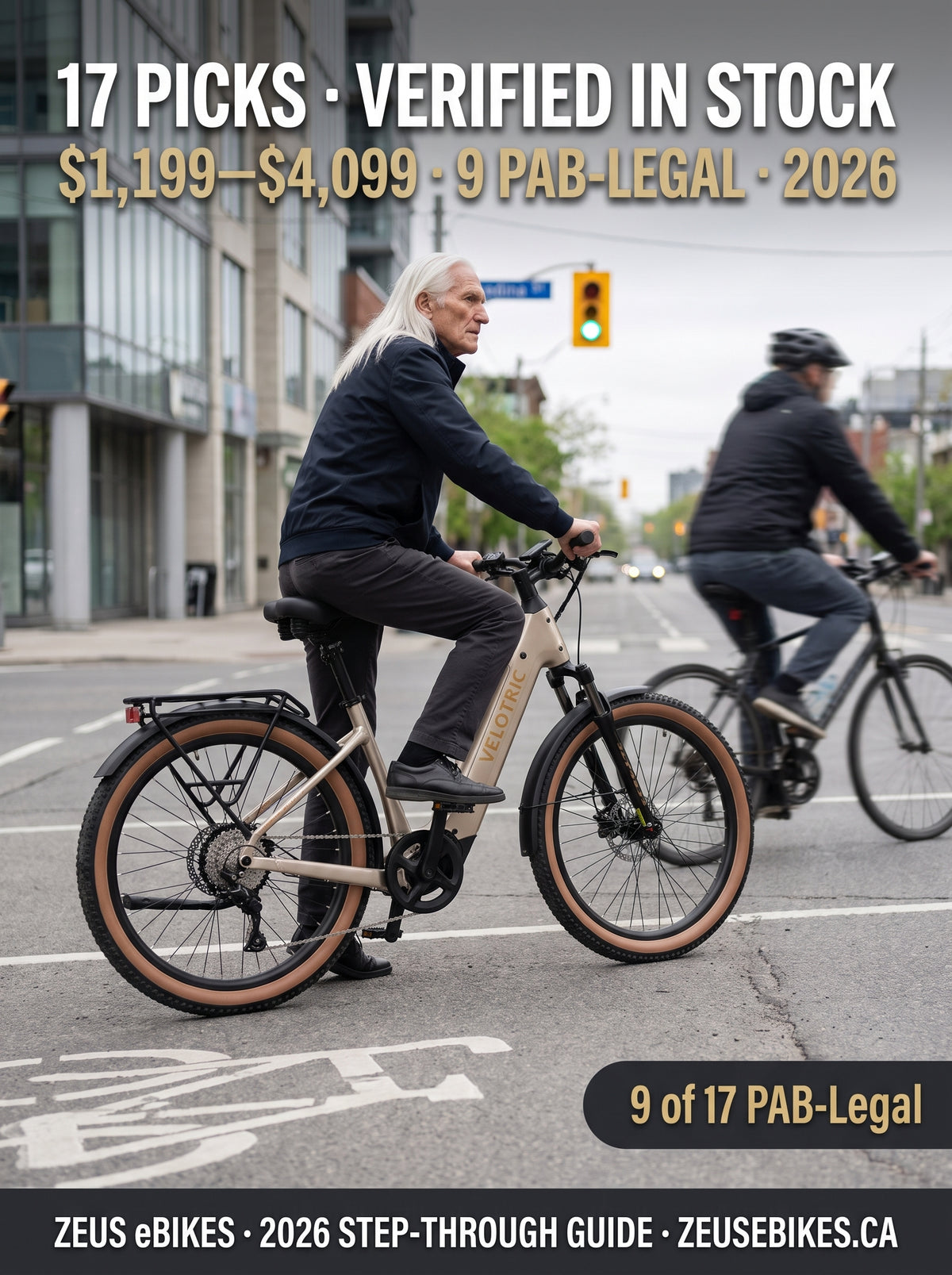
Velotric Tempo Lightweight Gravel Commuter
View Current PriceNot everyone needs to fold. If you have a house, a garage, a ground-floor apartment, or stairs you can carry a bike up, the Tempo solves a different problem: weight. At 350W it draws less than a 500W motor, which stretches range on a lighter frame. It rides like a normal bicycle, with no torque surge, no fat tyres and no moped weight, which makes it ideal for riders who want the assist on hills and headwinds but the feel of a real bike everywhere else.
At 17.7 kg it is far under the city’s 40 kg line, and its listing says the trigger throttle is removable: with it off, the bike moves only when you pedal, which is the configuration Toronto’s protected lanes and park trails ask for. Velotric ships it at 32 km/h and lists a 45 km/h off-road setting; whether an adjustable cap qualifies has not been decided in Ontario.

Eunorau ONE-TRIKE 2.0 Electric Tricycle
View Current PriceMost electric trikes on the market run 750W or 1,000W motors, which puts them above Ontario’s 500W threshold and into motor vehicle territory on public roads. The Eunorau ONE-TRIKE 2.0 is different: 500W nominal, with its listing giving 32 km/h “speed limited/locked”, and Ontario’s bicycle definition includes a tricycle. It has a half-twist throttle, so, read strictly, Toronto’s protected lanes and park trails are closed to it; roads and painted lanes are open.
For riders who need three-wheel stability (balance conditions, joint issues, age-related confidence), it is one of the few 500W trikes Zeus carries. For a broader look at legal trike options across Canada, see the electric trikes Canada 2026 guide.

Eunorau Urus 2.0 Full-Suspension eMTB
View Current PriceFor the rider who wants the most capable 500W bike here. The Bafang M600 is a 500W nominal mid-drive motor, which puts it at Ontario’s 500 W line while delivering 120 Nm of torque, full-suspension capability, a dropper post, and SRAM NX 11-speed gearing on an eMTB platform built for trails that permit it. The 48V Samsung battery delivers serious range.
It has a thumb throttle and weighs 28 kg; its listing gives a 32 km/h Limited mode and a Class 3 mode to 45 km/h, and whether an adjustable cap qualifies has not been decided in Ontario. Read strictly, Toronto’s multi-use paths and protected lanes are closed to it.
Find your Toronto commuter at Zeus eBikes
Canadian warranty. Canadian support. Ships Canada-wide.
Browse All eBikesFrequently asked questions
Are e-bikes legal in Toronto?
Yes, when the e-bike meets Ontario’s power-assisted bicycle rule (a motor rated 500W or less, assist that stops at 32 km/h, working pedals, 120 kg or less) and the rider is 16 or older and wears a helmet. No licence or registration is needed, but Toronto keeps e-bikes off sidewalks and limits protected lanes and park trails.
Can I ride an electric bike on the sidewalk in Toronto?
No. Toronto Municipal Code s. 950-201C(2) bars anyone 14 or older from riding a bicycle on a sidewalk, and every e-bike rider in Ontario must be 16 or older, so no e-bike rider may ride on a Toronto sidewalk; the City's e-bike page says it plainly: never ride on the sidewalk. Under the Highway Traffic Act (s. 1(1)) an e-bike that meets the rule counts as a bicycle, and its place is the road and the bike lane.
What is the Ontario legal definition of an e-bike?
Ontario defines a legal e-bike (power-assisted bicycle, or PAB) as having: a motor rated 500W or less (nominal or rated; peak does not count); motor assistance that cuts off at 32 km/h; functional pedals that actually propel the bike; a maximum weight of 120 kg including the battery; two braking systems, one on each wheel; and wheels at least 35mm wide and 350mm in diameter. All six conditions must be met simultaneously. A bike that meets five of six is a motor vehicle.
Can I use my e-bike on Toronto trails and park paths?
It depends on the bike. The City of Toronto says motorized vehicles, including power-assisted e-bikes weighing more than 40 kg or which do not require muscular power, are not permitted on park trails or multi-use paths, and riders can be fined by by-law officers. Read strictly, an e-bike with a throttle that can move it without pedalling does not require muscular power, whichever mode you ride it in; the city publishes no exception for pedal-assist riding. Cargo e-bikes follow Municipal Code 886: none over 500 W or operable without muscular power on trails or in cycle tracks, and none over 40 kg unladen on trails.
Do I need a licence or insurance to ride an e-bike in Toronto?
No licence, registration, or insurance is required for a compliant Ontario PAB-class e-bike (500W max, 32 km/h limit, functional pedals, under 120 kg). Riders under 16 are not permitted to operate one on Ontario public roads. A helmet is required for every rider at every age (Highway Traffic Act s. 103.1(2)). If your e-bike falls outside the definition (for example, a motor over 500W nominal, or assistance above 32 km/h), it is a motor vehicle and the permit, licence and insurance rules apply (Highway Traffic Act ss. 7(1) and 32(1); Compulsory Automobile Insurance Act s. 2(1)).
What are Toronto’s e-bike parking rules?
Under Municipal Code s. 950-201B, only bicycles and e-bikes capable of being propelled by pedal power alone may be parked on sidewalks and locked to post-and-ring stands. The City's e-bike page adds that scooter-style and moped-style e-bikes must be parked on-street, like motorcycles.
Can cargo e-bikes use Toronto’s cycle tracks and trails?
Under Municipal Code 886, cargo e-bikes that can be operated without muscular power or have a maximum power output over 500 W are not permitted in cycle tracks or on trails, and cargo e-bikes over 40 kg unladen are not permitted on trails. A large cargo e-bike (wider than 0.9 m and over 120 kg unladen) may not stop in a cycle track or bike lane. Toronto joined Ontario's cargo e-bike pilot in 2021; the pilot runs to March 1, 2031.
What happens if my e-bike has an ‘unlock’ mode above 32 km/h in Toronto?
Ridden above 32 km/h on a public road, it is outside the definition and is a motor vehicle, with the permit, licence and insurance rules that follow. Whether a bike that ships at 32 km/h but can be unlocked higher qualifies at all has not been decided in Ontario; our Ontario guide sets out both readings. Never ride an unlocked setting on a public road.
What is the minimum age to ride an e-bike in Toronto?
The minimum age to operate an e-bike on Ontario public roads, including every Toronto street, bike lane and cycle track, is 16 (Highway Traffic Act s. 38(1)). There is no upper age limit. A helmet is required for every e-bike rider at every age under the Highway Traffic Act (s. 103.1(2)).
Can I ride an e-bike on the Waterfront Trail in Toronto?
Only on the right bike. The City of Toronto lists the Waterfront multi-use path among the park paths closed to e-bikes weighing more than 40 kg or which do not require muscular power. An e-bike under 40 kg that moves only when you pedal is allowed; read strictly, one with a working throttle is not, whatever mode you ride it in.
Does Toronto have its own e-bike bylaws beyond Ontario’s provincial rules?
Yes. Toronto bars riders 14 and older from sidewalks (s. 950-201C(2)); opens protected bike lanes only to e-bikes that require pedalling; closes park trails, multi-use paths, ferries and Toronto Island Park to e-bikes over 40 kg or that do not require muscular power; limits sidewalk parking to bikes that can be pedalled alone; and sets cargo e-bike limits in Municipal Code 886. Ontario's rule decides whether the bike is an e-bike at all; Toronto's by-laws decide where it may go. Council voted on 20 and 21 May 2026 to support the province's two-class proposal and ordered a by-law report for 9 and 10 December 2026; nothing has changed yet.
- Ontario eBike Laws 2026: Province-Wide Rules, PAB Definition & Compliance Guide
- Atlantic Canada eBike Laws (2026): NS · NB · PEI · NL
- Best 500W eBikes Canada (2026): 15 Verified Picks & Hub vs Mid-Drive
- Best Electric Bikes for Adults Canada (2026)
- Best eBike by Rider Type Canada (2026): 14 Picks
- Best eBikes for Winter Canada (2026): Snow & Ice Picks
Published: January 2026 | Last updated: October 22, 2026 (Highway Traffic Act and O. Reg. 369/09 as consolidated to October 19, 2026, Toronto Municipal Code chapters 886 and 950, and the City’s e-bike and cargo pages re-read that day) | By Milad Ghobadibeygvand, BScN (Western University, 2014), Co-founder, Zeus eBikes Canada
📸 All photography by Playcut.ai, personalized AI actor technology




Share:
Why Is Toronto Removing Its Bike Lanes — and Who Benefits?
Super73 eBikes in Canada: The Verified Brand Profile (2026)