
Tesway X7 Pro Review Canada (2026): Real-World Range, Computed

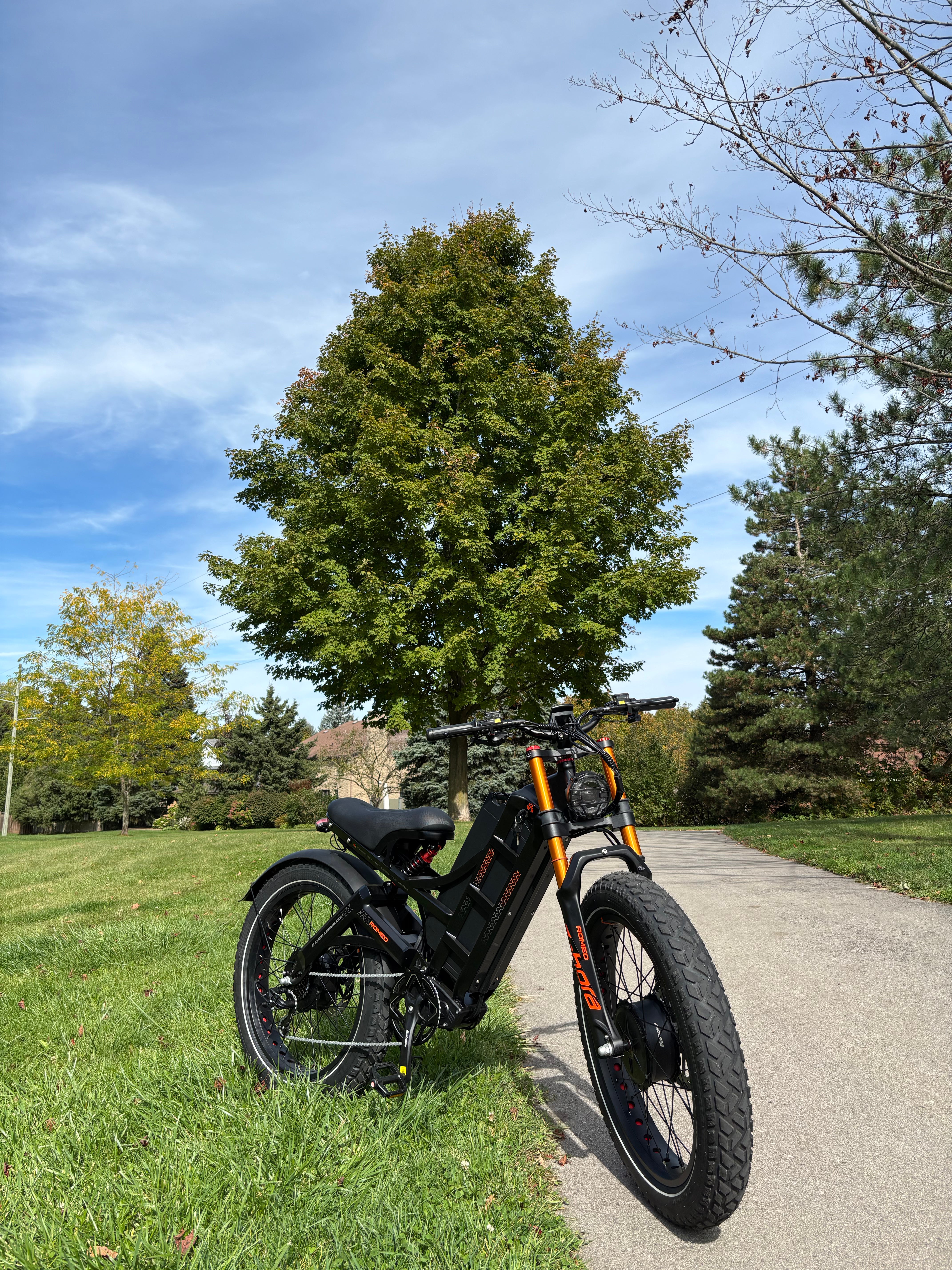
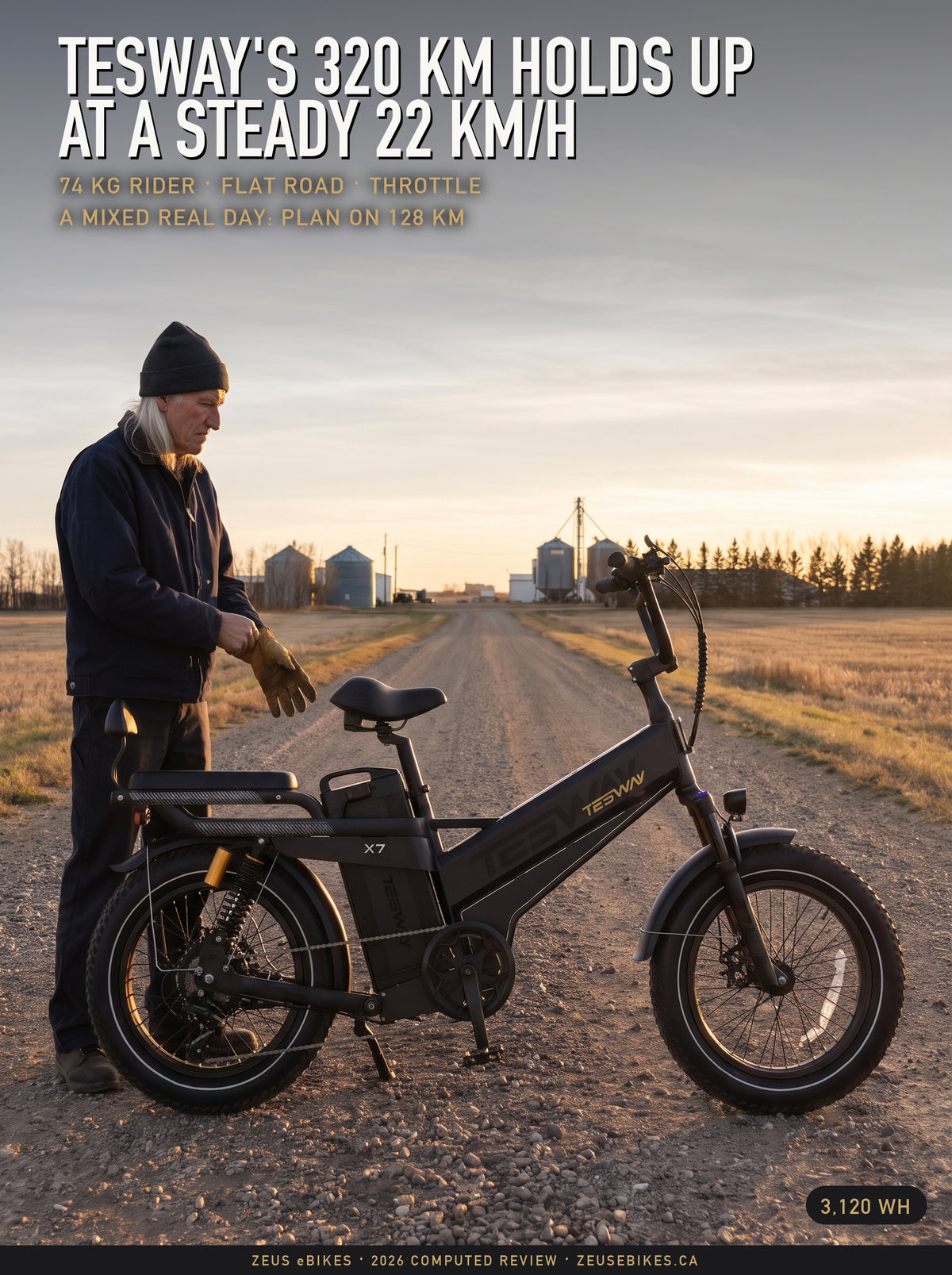
Zeus on a private farm lane in central Saskatchewan with a black Tesway X7 Pro New: a Playcut.ai rendering made from Tesway's own photograph of the bike.
By Milad Ghobadibeygvand, BScN (Western University, 2014) · Published 26 October 2026 · Every specification re-read on 26 October 2026
Tesway sells the X7 Pro New with a 60 Ah battery and a headline of 320 km, and Zeus has carried it since October 2026 at $2,099. This review is of that bike, the non-folding X7 Pro that Tesway Canada lists as the X7 PRO NEW. Every specification below is Tesway's own, read on 26 October 2026 from its Canadian and US pages and the owner's manual it links; every store term is Zeus's, read the same day; and every range figure is computed from published physics, with the arithmetic printed so you can check it.
The Tesway X7 Pro New is a $2,099 single-motor fat-tire cargo e-bike: a 1,000 W rear hub (Tesway Canada's rating), a 52 V 60 Ah pack of about 3,120 Wh, a rear seat with a backrest in the box and suspension at both ends. On level pavement an 80 kg rider covers about 272 km at a steady 25 km/h on the throttle, or 218 km keeping the 20% Tesway's manual says to leave in the pack. On a mixed real day, with stops, wind, gravel and 10 °C air, plan on about 128 km. Tesway's 320 km equals a steady 21.7 km/h on the throttle for its 74 kg test rider on a flat road. At 1,000 W it sits outside every provincial e-bike rule, so it is a bike for private land and trails whose managers allow it. See every fat-tire e-bike at Zeus.
We read Tesway Canada's X7 Pro New page, its product record, its size guide and range slide (looked at as images), Tesway's US page for the same bike, the two editions of the X5/X7 PRO owner's manual Tesway publishes (April 2026 and 2025), Tesway's FAQ, warranty and charger pages, and our own listing and policies, all on 26 October 2026. The range figures come from a saved physics model: the road-power equation of Martin and colleagues, a published hub-motor curve set to Tesway's figures, measured battery losses and measured cold-cell data, with three real-world factors added and checked against the model's own equations.
The fit figures come from 6,068 measured bodies placed on Tesway's drawing; the law table quotes each province's statute or regulator, re-read today (30 of 30 passages found); the recall check ran against Health Canada and the US CPSC with controls. We did not ride a pack flat ourselves: this is a computed review, and its limits are listed. Zeus sells this bike, so weigh the red flags as carefully as the green. Written by Milad Ghobadibeygvand, BScN (Western University, 2014); corrections to milad@zeusebikes.ca.
In this review
- What the X7 Pro New is, and who it suits
- Tesway's specification, as printed
- One rear hub: rating, peak and controls
- The battery: 52 V or 48 V, and charging
- How far it goes on one charge, computed
- The 160 kg payload and the rear seat
- Will it fit you?
- Brakes, suspension, tires, gears and lights
- The X7 Pro New against the X7 AWD
- What the law calls it, province by province
- The 25 km/h locked mode and the 52 km/h figure
- Where Tesway prints a figure two ways
- Recall record
- Is it UL certified?
- Warranty, Zeus Care and who handles a claim
- Buying it from Zeus
- The honest ledger
- Who should buy it
- Before you buy: the checklist
- Limitations of this review
- The source register
- Frequently asked questions
- The bottom line
"TESWAY X5 X7 PRO UNBOXING ASSEMBLY", published by Tesway's own channel on 17 June 2025 (4 min 19 s): the unboxing and final assembly steps. Watch on YouTube.
What the X7 Pro New is, and who it suits
Tesway put a 60 Ah battery on a single-motor fat-tire bike and printed 320 km at the top of its page. Buy on that headline and you can plan a day the pack will not finish, on a 48 kg bike that an easy 75 W of pedalling moves at about 13.9 km/h on the flat once the motor stops.
This review turns Tesway's figures into your own range at your speed, weight, ground and temperature, and shows the arithmetic at every step.
The X7 Pro New puts one rear hub motor, rated 1,000 W by Tesway Canada, under a step-over frame Tesway calls "The new non-foldable patented frame", on 20 × 4.0 Kenda tires, with a 120 mm fork, rear spring shock absorbers and four-piston hydraulic brakes. Its pack is 60 amp-hours, sold as the 52V 60AH option. A padded rear seat with a backrest comes in the box ("Backed Seat" in Tesway's box list).

It suits three riders:
- the one who wants a very long distance per charge and rides at moderate speed;
- the one who carries things, within a 160 kg payload that counts the rider;
- the one with land to cover: an acreage, a farm, a camp, or a trail network whose manager allows a 1,000 W machine.
It does not suit anyone who needs a bike for public roads, bike lanes or paths, because at 1,000 W it sits outside every provincial e-bike rule (the law section).
Tesway X7 Pro New at Zeus
$2,099 in Black (Blue is sold out at Tesway and at Zeus on 26 October 2026). Free shipping across Canada, Tesway's 2-year warranty backed by Tesway in full, and Zeus handles the claim. The listing shows today's included gifts.
Tesway's specification, as printed
Tesway Canada prints a 1,000 W rated, 2,000 W peak rear hub, 100 N·m, a 60 Ah pack it labels 52 V in the option you buy and 48 V in its spec tab, 48 kg, a 160 kg payload and 52 km/h.
Where two of its own pages disagree, the table gives both, and a later section lists every pair.
| As Tesway prints it | Where | |
|---|---|---|
| Motor | One motor, in the rear hub ("Single Motor Ebike" in Tesway's menu; the 2025 manual: "driven by a motor embedded in the hub of the rear wheel"); "Rated Power 48V 1000W | Peak Power 48V 2000W" (Canadian spec tab); Tesway US prints "Motor 52V 1500W | Peak 52V 2000W" | CA page; 2025 manual; US page |
| Torque | 100 N·m | CA spec tab |
| Battery | 60 Ah, sold as the "52V 60AH" option (about 3,120 Wh); the spec tab says "Battery-48V 60AH" and the range slide "2880WH" | CA option, tab and slide |
| Battery weight | 12.7 kg ("Battery Weight-28 LBS(12.7 kg)") | CA spec tab |
| Charger | "58.8V 5A Fast Charger"; Tesway pairs that charger with the "X7 PRO 52V" | CA page; charger listing |
| Range, Tesway | 320 km ("320 KM Max Range"; slide: 74 kg rider, flat road, "Throttle only + PAS 1"); spec tab "Range-170-200Miles" | CA highlights, slide, tab |
| Top speed, Tesway | 52 km/h (highlights); 32 mph on the US page; 31 mph in Tesway's FAQ | CA; US; FAQ |
| Pedal assist and throttle | Five assist levels plus 0, half-twist throttle, cruise control, walk assist at 6 km/h | X5/X7 PRO manual, 2026 |
| Fork and rear | "120mm Travel Fork with Hydraulic Lockout"; rear spring shock absorbers | CA page |
| Brakes | Four-piston hydraulic, front and rear; 203 mm × 2.3 mm rotors | CA spec tab |
| Tires | Kenda 20 × 4.0 fat tires with "puncture-resistant layers and 360° reflective strips" | CA page |
| Drivetrain | Shimano 7-speed; 52T chainring with a double guard | CA spec tab |
| Handlebar and display | "Non-Folding BMX Handlebar"; colour LCD with NFC card unlock and a USB charging port | CA page |
| Lights | "Integrated Headlight with Horn"; front and rear lights | CA page |
| Frame | "The new non-foldable patented frame"; the US page adds "Aluminium Alloy Non-foldable Frame" | CA; US |
| Weight | 48 kg ("EBike Weight-106 LBS(48kg)"; size guide "48KG") | CA spec tab and size guide |
| Payload | 160 kg, rider and cargo together ("Max. Payload Capacity-350 LBS(160kg)") | CA spec tab |
| Rider height, Tesway | 160–196 cm | CA size guide |
| Saddle height | 85–102 cm from the ground | CA size guide |
| Size | Length 186 cm, wheelbase 130 cm, handlebar height 125 cm, "Standing height" 62 cm, reach 46 cm, wheel diameter 59 cm | CA size guide |
| In the box | Bike, user manual, charger, 2 keys, toolkit, "Backed Seat"; the US box list adds both fenders and 2 NFC cards | CA; US |
| Colours at Zeus | Black (orderable); Blue (sold out on 26 October 2026) | Zeus listing |
Read on 26 October 2026. The 3,120 Wh is our arithmetic: 52 V × 60 Ah. Tesway prints no cell maker, water rating or motor gear type for this bike on any of the ten pages and manual sections we read; the manual's troubleshooting table names a "speed sensor" for pedal assist.

Not sure it suits your land, your load or your height?
Call 1-866-938-7580 and a person answers, or email sales@zeusebikes.ca with where you ride and your inseam. $2,099 with free shipping across Canada, Tesway's 2-year warranty backed in full, and Zeus handles the claim.
One rear hub: rating, peak and controls
The X7 Pro New has one hub motor in the rear wheel, rated 1,000 W with a 2,000 W peak by Tesway Canada, so the front wheel is pushed, never driven. The rating is the load the motor is built to carry continuously; the peak is a short burst.
On the flat our model holds 44.6 km/h at the rating with an 80 kg rider, and 47.6 km/h if the motor could hold its peak.
Tesway's 52 km/h figure is the motor's unloaded speed in our model: the most it can turn with nothing to push. Loaded, it runs out of rated power first. The 2026 manual gives the controls: "Cruise control will be triggered by long-press the minus key to activate in the pure electric mode", a half-twist throttle that needs no pedalling, five assist levels plus 0, and walk assist at "a constant speed of 6 km/h" while you push. The manual also says to "check against local laws to ensure full power mode is permitted".

Tesway does not say whether the hub is geared or direct-drive, or that it brakes regeneratively; we found neither in any of the ten pages and manual sections we read. Its US page now prints "Motor 52V 1500W", where Tesway Canada prints 1,000 W; the limitations show what 1,500 W would change (269 km instead of 272 km at 25 km/h, and 46.5 km/h flat at the rating). Our guide to hub motors against mid-drives explains why a hub never sees your gears.
The battery: 52 V or 48 V, and charging
The pack is 60 Ah and Tesway prints its voltage two ways: 52 V in the option you buy and on its US page, 48 V in its Canadian spec tab and range slide. At 52 V it holds about 3,120 Wh; at 48 V, 2,880 Wh, 7.7% less.
The charger tells you which one you have, and every range table below gives both.
Tesway's own charger listing settles which charger goes with which pack: "58.8V 5A Compatibility: X5 PRO 52V X7 PRO 52V", and "54.6V 6A Compatibility: X5 PRO 48V X7 PRO 48V". The X7 Pro New page names the "58.8V 5A Fast Charger", the 52 V one. The arithmetic agrees: a typical lithium-ion cell charges to 4.20 V (Samsung's INR18650-30Q sheet), and 58.8 V is fourteen cells in series, the "52 V" layout, where 54.6 V is thirteen, the "48 V" one. Read the label on your charger and on the pack the day it arrives, and match it before you buy a spare pack or a second charger.
| 52 V (sold option) | 48 V (spec tab, slide) | |
|---|---|---|
| Energy (V × Ah) | 3,120 Wh | 2,880 Wh |
| Charger Tesway pairs with it | 58.8 V 5 A | 54.6 V 6 A |
| 25 km/h, flat, throttle, 80 kg | 272 km (218 km with 20% kept) | 251 km (201 km) |
| A mixed day (below) | 160 km (128 km) | 147 km (118 km) |
Read on 26 October 2026 from Tesway Canada's option, spec tab, range slide and charger listing; kilometres from the range model, 25 °C unless stated.
Charging takes longer than Tesway's manual says. The manual (both editions) says "If a battery is completely discharged, it will take 6 hours to be fully recharged", and Tesway's US spec table says "Charging Time About 10 hours". A 5 A charger puts back 5 amp-hours an hour, so refilling 60 Ah from empty takes at least 12.0 hours, and the 48 Ah from the 20% Tesway says to recharge at takes 9.6 hours, before the slower constant-voltage finish of a lithium charge (the "CCCV" method on the cell sheet). Plan on an overnight charge.
Four more lines from the manual:
- Start charging "when the power is less than 20 percent".
- Under normal use the pack will see "600 charging and discharging cycles".
- The battery is "intended to be used, stored and charged" between 0 and 40 °C, a window Canadian winters leave; the cold table shows what it costs.
- The pack is "designed to be locked into a position with a key to prevent theft"; the bike ships with two keys, so keep one away from the bike.
Our battery guide covers charging an e-bike battery safely and what a Canadian winter does to a pack.
What a charge costs: a full pack is about 3.12 kWh going in, more from the wall once the charger's own losses are added. At Ontario's regulated off-peak time-of-use price of 9.8 ¢ per kWh, in effect until 31 October 2026 (Ontario Energy Board), that energy costs about 31 ¢, and 100 km at 25 km/h on the flat about 11 ¢; from 1 November 2026 the off-peak price is 9.1 ¢, so 28 ¢ and 10 ¢. Those are commodity prices only, before delivery charges, HST and rebates.
A spare pack: Tesway 48V/52V 60Ah battery
Zeus sells Tesway's 60 Ah spare in both voltages ($929 for 48 V, $959 for 52 V on 26 October 2026). Match the voltage on your bike's charger label; a second pack swapped in at the 20% mark doubles each planning figure below (for example 436 km at 25 km/h on the flat). Tesway says spares "will arrive in a separate package and do not include a charger".
How far the X7 Pro New goes on one charge, computed
On the 3,120 Wh pack, an 80 kg rider on the throttle covers about 334 km at a steady 20 km/h on level pavement, 272 km at 25 km/h and 203 km at 32 km/h. Keep the 20% Tesway's manual says to leave and plan on 267, 218 and 163 km.
A real day, with stops, wind, gravel and cool air, runs shorter: plan on about 128 km.
Every table here comes from one saved model of this bike, built on the figures Tesway Canada prints: a 1,000 W rear hub, 2,000 W peak, 100 N·m, the 60 Ah pack at 52 V and at 48 V, 48 kg, 20 × 4.0 tires on a 59 cm wheel and 52 km/h. The formula lists every input and its source. Your own range, in three reads:
- Find your pace in the speed table, and your effort in the pedalling table.
- Correct it for your load, your hills, the air temperature, and the wind, stops and ground of a real ride; or start from the three computed days.
- Plan from the 20%-kept column. Tesway's manual says to start charging "when the power is less than 20 percent".
How far does it go at my speed?
Short of pedalling, your speed is the biggest choice you make on the throttle: 403 km at 15 km/h shrinks to 203 km at 32 km/h on the same charge. The air's drag grows with the square of speed, so the power it takes grows with the cube (Martin et al., 1998): riding 32 km/h where 25 would do gives up 69 km of the 272.
| Speed, flat | Per km | 52 V pack, full | 52 V, 20% kept | 48 V pack, full | 48 V, 20% kept |
|---|---|---|---|---|---|
| 15 km/h | 7.8 Wh | 403 km | 322 km | 372 km | 297 km |
| 20 km/h | 9.3 Wh | 334 km | 267 km | 309 km | 247 km |
| 25 km/h | 11.5 Wh | 272 km | 218 km | 251 km | 201 km |
| 30 km/h | 14.1 Wh | 221 km | 177 km | 204 km | 163 km |
| 32 km/h | 15.3 Wh | 203 km | 163 km | 188 km | 150 km |
| 35 km/h | 17.3 Wh | 180 km | 144 km | 166 km | 133 km |
| 40 km/h | 21.1 Wh | 148 km | 118 km | 136 km | 109 km |
Throttle only, one rear motor, an 80 kg rider with gear on the 48 kg bike, level pavement, still air at 25 °C. The 52 V columns use 3,120 Wh, the 48 V columns 2,880 Wh (the two voltages Tesway prints). At its 1,000 W rating the motor holds about 44.6 km/h on the flat in the model, so the table stops at 40 km/h.
Tesway Canada prints no as-delivered speed setting for this bike. Its US page says the bike has a "Factory-locked mode" at 250 W and 25 km/h, and its US spec table lists a "Default Speed-16mph" (about 26 km/h), so the 25 km/h row is the one closest to the bike as Tesway describes it set at the factory. The speed-modes section covers what that mode does and does not settle.
Does pedalling stretch it?
Yes, by a lot at moderate speed. At 25 km/h, 75 W from your legs lifts the full-pack figure from 272 km to 404 km, and 150 W to 735 km. With the motor off, 75 W alone moves you and the 48 kg bike at about 13.9 km/h on level ground, and 150 W at about 20.6 km/h, so pick the column you could hold unaided.
| Speed, flat | Throttle only | Easy pedalling (75 W) | Steady pedalling (150 W) |
|---|---|---|---|
| 20 km/h | 334 km | 659 km | legs alone |
| 25 km/h | 272 km | 404 km | 735 km |
| 32 km/h | 203 km | 252 km | 329 km |
| 40 km/h | 148 km | 167 km | 192 km |
Full 3,120 Wh pack, 80 kg rider, level pavement, 25 °C. Easy pedalling is 75 W at the cranks, steady 150 W; "legs alone" means your watts hold that pace with the motor idle. At 20 km/h with 75 W your legs cover about half the road power, which is why that cell runs so long: it leans on the least-checked part of the model, its motor losses at light load (limitations).
The gears do not save battery on their own. The motor sits in the rear hub and turns at road speed whatever cog the chain is on, so a shift changes only how fast your feet turn. What saves the pack is the effort you put in:
| Your ride | Throttle only | Easy pedalling (75 W) | Steady pedalling (150 W) |
|---|---|---|---|
| 20 km/h, flat | 9.3 Wh | 4.7 Wh | 0.0 Wh |
| 25 km/h, flat | 11.5 Wh | 7.7 Wh | 4.2 Wh |
| 32 km/h, flat | 15.3 Wh | 12.4 Wh | 9.5 Wh |
| 16 km/h, 4% grade | 31.2 Wh | 22.6 Wh | 14.9 Wh |
| 16 km/h, 8% grade | 63.3 Wh | 51.7 Wh | 41.0 Wh |
Watt-hours drawn from the pack for each kilometre, 80 kg rider, still air, 25 °C. At 150 W you carry 20 km/h on the flat yourself and the motor draws nothing.
What do hills cost, and how steep a hill can it hold?
Each 100 m you climb at 16 km/h on the throttle costs the pack about 58 Wh on a 4% grade and 75 Wh on a 10% grade, beyond what the same distance would cost on the flat. Lifting an 80 kg rider and the 48 kg bike through 100 m takes 34.9 Wh at the wheel; the motor and the pack lose the rest as heat, more on steeper grades where the motor works harder.
| Grade | Per km, throttle | Full pack, throttle | Full pack, easy pedalling | Fastest it holds, throttle | Fastest, easy pedalling |
|---|---|---|---|---|---|
| 2% | 18.5 Wh | 169 km | 275 km | 41.0 km/h | 42.3 km/h |
| 4% | 31.2 Wh | 100 km | 138 km | 35.7 km/h | 37.2 km/h |
| 6% | 46.1 Wh | 68 km | 87 km | 30.9 km/h | 32.3 km/h |
| 8% | 63.3 Wh | 49 km | 60 km | 26.7 km/h | 28.2 km/h |
| 10% | 82.7 Wh | 38 km | 45 km | 23.3 km/h | 24.6 km/h |
| 12% | 104.5 Wh | 30 km | 35 km | 20.4 km/h | 21.7 km/h |
| 15% | not held | not held | 25 km | 13.8 km/h | 17.2 km/h |
16 km/h up each grade with 80 kg aboard, 3,120 Wh, still air, 25 °C. The last two columns are the fastest steady speed the motor holds on that grade within its 1,000 W rating and Tesway's 2,000 W peak. "Not held": on 15% the throttle alone cannot hold 16 km/h within that peak, so the row has no throttle range.
One motor shows its limit on steep ground with weight aboard. The table below gives the fastest steady speed the throttle alone holds with three loads. Where a cell reads "not held", the motor would need more than Tesway's 2,000 W peak from the pack to hold any steady speed on that grade: pedal hard, take a lower line or walk it with the 6 km/h walk assist.
| Grade | 80 kg aboard | 120 kg aboard | 160 kg aboard (the payload) |
|---|---|---|---|
| 4% | 35.7 km/h | 31.9 km/h | 28.3 km/h |
| 6% | 30.9 km/h | 26.4 km/h | 22.5 km/h |
| 8% | 26.7 km/h | 22.0 km/h | 17.1 km/h |
| 10% | 23.3 km/h | 17.7 km/h | 8.4 km/h |
| 12% | 20.4 km/h | 10.8 km/h | not held |
| 15% | 13.8 km/h | not held | not held |
Throttle only, one rear motor, the 48 kg bike plus the load in each column, still air, 25 °C. A load is the rider plus everything carried, up to Tesway's 160 kg payload.
Hills and flat kilometres add together. Thirty flat kilometres at 25 km/h use about 344 Wh on the throttle, and 300 m of climbing at 8% about 208 Wh more: about 552 Wh, or 18% of the pack. The model gives nothing back on the way down, which keeps a hill budget on the careful side. Our guide to 500 W, 750 W and 1,000 W e-bikes sets climbing power against the provincial limits.
Does my weight, or a passenger, change it?
Weight costs some range on the flat and much more uphill: at 25 km/h on level ground, 80 kg aboard gets 272 km and the full 160 kg gets 214 km, while up an 8% grade at 16 km/h the same loads get 49 and 25 km. Weight raises the tire drag and the work of lifting, and leaves the air drag alone.
| You plus your load | 25 km/h flat, throttle | 32 km/h flat, throttle | 8% climb at 16 km/h |
|---|---|---|---|
| 60 kg | 291 km | 214 km | 61 km |
| 80 kg | 272 km | 203 km | 49 km |
| 100 kg | 255 km | 194 km | 41 km |
| 120 kg | 240 km | 185 km | 34 km |
| 140 kg | 227 km | 176 km | 29 km |
| 160 kg | 214 km | 169 km | 25 km |
Rider and everything carried, on the 48 kg bike; throttle only, 3,120 Wh, still air, 25 °C. 160 kg is Tesway's payload, rider included.
A passenger counts in the same way. An 80 kg rider with a 60 kg passenger is the 140 kg row: 227 km at 25 km/h on the flat, 29 km up 8%. Before you carry anyone, read the payload section: Tesway's manual and its FAQ disagree about passengers, and on a public road no province treats this bike as an e-bike.
What does cold do to the range?
Cold costs range in three ways at once. At 0 °C the cells give back about 89% of their 25 °C energy, the air is denser and cold rubber rolls harder, so the 25 km/h ride falls from 272 km to about 215 km. Below 0 °C you are outside the window Tesway's 2026 manual gives the battery for use, storage and charging.
| Air | Pack energy vs 25 °C | 25 km/h flat, throttle | With 20% kept | Inside Tesway's 0–40 °C window |
|---|---|---|---|---|
| 35 °C | 99% | 285 km | 228 km | yes |
| 25 °C | 100% | 272 km | 218 km | yes |
| 20 °C | 98% | 258 km | 207 km | yes |
| 10 °C | 93% | 232 km | 186 km | yes |
| 5 °C | 91% | 221 km | 177 km | yes |
| 0 °C | 89% (80–93) | 215 km (193–225) | 172 km | yes |
| −5 °C | 86% | 204 km | 163 km | no: below it |
| −10 °C | 82% (40–83) | 194 km (94–194) | 155 km | no: below it |
| −20 °C | 67% (33–82) | 153 km (76–188) | 122 km | no: below it |
80 kg rider, 3,120 Wh, level pavement. The central figures use McMaster University’s measured LG HG2 cell held at the air's temperature; at 0, −10 and −20 °C the brackets span the published cell data, from the least capacity a Samsung data sheet lists (25R, 30Q, 35E) to the most Casado and colleagues recorded in 2025. Tesway names no cell maker for this pack.
Cold air is about 9% denser at 0 °C than at 25 °C by the gas law (U.S. Standard Atmosphere, 1976). In the model, rolling resistance changes by 0.9% for each °C away from 25, up in the cold and down in the heat: a rate between Rothhämel’s fit (5 to 25 °C) and Bicycle Rolling Resistance’s temperature test (20 to 40 °C), held at its 5 °C value in colder air because neither source measured below it.
Tesway's 2026 manual lists low temperature among the causes of short range and gives the remedy of warming the battery above 0 °C. Keep the pack indoors between winter rides, charge it indoors, and read our winter e-bike guide before you ride below freezing.
Wind, stops and gravel: what a steady-speed table leaves out
Three things shorten a real ride that a level, steady, still-air table cannot show: wind, stops and unpaved ground. We added all three to the model, each built from the model's own equations, so the same physics prices them. A 10 km/h wind out and back cuts the 25 km/h figure from 272 km to 244 km; two gentle stops a kilometre cut it to 215 km.
| 25 km/h on the flat, throttle | Per km | Full pack |
|---|---|---|
| 20 km/h tailwind | 5.4 Wh | 579 km |
| 10 km/h tailwind | 7.3 Wh | 425 km |
| Still air | 11.5 Wh | 272 km |
| 10 km/h headwind | 18.2 Wh | 171 km |
| 20 km/h headwind | 28.4 Wh | 110 km |
| 10 km/h wind, out and back | 12.8 Wh | 244 km |
| 20 km/h wind, out and back | 16.9 Wh | 185 km |
80 kg rider, 3,120 Wh, 25 °C. A headwind adds its speed to the air the bike pushes through; out and back means half the distance into the wind and half with it, and the losses into the wind outweigh the gains with it.
A stop throws away the bike's motion, and the motor must buy it back. Getting 128 kg from rest to 25 km/h stores 0.86 Wh of motion at the wheel; the model's motor spends 2.22 Wh from the pack to do it gently, over 46 m and 11.3 s, because the modelled motor wastes the most energy as heat when it turns slowly against high torque. Net of the cruising it replaces, each stop costs about 1.5 Wh started gently and 2.4 Wh started hard.
| Stops, 25 km/h between them | Gentle starts: full (20% kept) | Hard starts: full (20% kept) |
|---|---|---|
| None | 272 km (218 km) | 272 km (218 km) |
| 1 a km | 240 km (192 km) | 226 km (181 km) |
| 2 a km | 215 km (172 km) | 193 km (154 km) |
| 4 a km | 178 km (142 km) | 150 km (120 km) |
80 kg rider, 3,120 Wh, level pavement, 25 °C. A gentle start uses half the torque the motor and the pack peak allow, a hard start all of it; braking returns nothing, since Tesway publishes no regenerative braking. From 32 km/h a stop costs about 1.8 Wh gentle and 2.9 Wh hard.
Off pavement, the published data run thin. Every rolling-resistance figure in the model comes from fat tires on a smooth drum. No published test we found measures a 20 × 4.0 fat tire on gravel, so we borrowed the one clean ratio we found: Meyer, Kloss and Senner measured one bicycle's tires on asphalt, fine gravel and coarse gravel with one instrument, and the gravel figures came out 1.20 and 1.50 times the asphalt one (abstract). Applied to the X7 Pro New, the ratios give a sensitivity rather than a measurement:
| Ground | 20 km/h, full pack | 25 km/h, full (20% kept) |
|---|---|---|
| Pavement (the model) | 334 km | 272 km (218 km) |
| Fine gravel, 1.20 × | 302 km | 251 km (201 km) |
| Coarse gravel, 1.50 × | 264 km | 224 km (179 km) |
Throttle only, 80 kg, 3,120 Wh, 25 °C. Grass, sand, snow and mud are not in any table: soft ground can cost far more than gravel, and its cost depends on the surface on the day.
Three real days, computed
A real day mixes all of the above, so we computed three. Each one adds its wind, stops, ground and temperature inside a single model run, not as separate percentages multiplied together: about 215 km on an easy day, 128 km on a mixed day and 60 km on a hard one, keeping 20% in the pack. Easy pedalling lifts the mixed day to 163 km.
| Day | Conditions | Per km | 52 V pack: full (20% kept) | 48 V pack: full (20% kept) |
|---|---|---|---|---|
| An easy day | 20 km/h, 80 kg aboard, 20 °C, 1 stop a km with gentle starts, still air, 50% on fine gravel, throttle only | 11.3 Wh | 269 km (215 km) | 248 km (198 km) |
| A mixed day | 25 km/h, 90 kg aboard, 10 °C, 2 stops a km with gentle starts, 10 km/h wind out and back, 50% on fine gravel, throttle only | 18.1 Wh | 160 km (128 km) | 147 km (118 km) |
| A mixed day, pedalling easily | 25 km/h, 90 kg aboard, 10 °C, 2 stops a km with gentle starts, 10 km/h wind out and back, 50% on fine gravel, 75 W of pedalling | 14.2 Wh | 204 km (163 km) | 189 km (151 km) |
| A hard day | 30 km/h, 120 kg aboard, 0 °C, 3 stops a km with hard starts, 20 km/h wind out and back, 50% on coarse gravel, throttle only | 37.4 Wh | 74 km (60 km) | 69 km (55 km) |
Flat ground; add hills from the climbing costs above. The pack's energy is corrected for each day's temperature. These conditions are ours, chosen to span gentle and harsh riding; they are not a statistical average of Canadian days.
Read the mixed day as the honest middle: 25 km/h, 10 kg of cargo on an 80 kg rider, 10 °C air, two gentle stops a kilometre, a 10 km/h wind and half the distance on fine gravel. The hard day, at 30 km/h with 120 kg aboard at 0 °C, three hard starts a kilometre, a 20 km/h wind and coarse gravel half the way, plans on 60 km.
One charge, 128 km on a mixed day
Tell us your route, your weight with gear, your usual speed and your steepest climb, and we will run them through this model before you order, including the answer when a different bike suits your ride better. Email sales@zeusebikes.ca or call 1-866-938-7580.
Tesway's 320 km, as a ride
Tesway's 320 km holds up as a steady, slow, flat ride. Its range slide says the test used "163 lbs(74kg)" of rider on a "Flat Road" with "Throttle only + PAS 1", and labels the pack "2880WH". On those 2,880 Wh, our model covers 320 km at a steady 19.8 km/h on the throttle for a 74 kg rider; on the 3,120 Wh you buy, at 21.7 km/h.
| Tesway's figure | Needs, per km | Throttle only | Easy pedalling (75 W) | Steady pedalling (150 W) |
|---|---|---|---|---|
| 320 km, 2,880 Wh (the slide) | 9.00 Wh | 19.8 km/h | 27.4 km/h | 31.7 km/h |
| 320 km, 3,120 Wh (52 V) | 9.75 Wh | 21.7 km/h | 28.6 km/h | 32.6 km/h |
| 170 miles (274 km), 3,120 Wh | 11.40 Wh | 25.4 km/h | 31.0 km/h | 34.7 km/h |
| 200 miles (322 km), 3,120 Wh | 9.69 Wh | 21.6 km/h | 28.5 km/h | 32.6 km/h |
The level-ground steady speed that empties the whole pack over Tesway's distance, for its 74 kg test rider in still air at 25 °C. The miles are Tesway Canada's spec tab ("Range-170-200Miles").
The conditions behind it are gentle: a light rider, flat ground, a steady pace near 20 km/h, no stops, no wind and the whole pack to empty. Tesway's US page splits its figures into "Pure Electric Range-170 Miles" and "Pedal Assist Range-200 Miles"; in our model, 170 miles on the throttle alone is a steady 25.4 km/h for a 74 kg rider, close to the 25 km/h of the locked mode Tesway's US page describes.
Two riders' days against the model
We found no filmed test that ran an X7 Pro pack to empty, among the seven X7 Pro ride videos read for RedTail Ebikes' review in September 2026 and the results of three YouTube searches on 25 October 2026. Two filmed long days do bracket the model.
Both rode an X7 Pro with the same 52 V 60 Ah pack in 2024 and early 2025, before Tesway Canada published the X7 Pro New on 17 August 2026; Raspy Rides' title calls its bike foldable, and the X7 Pro New's frame does not fold. Both video descriptions carry the creators' affiliate links or discount codes, which does not change the numbers they read off.
Raspy Rides (5 October 2024) spent a day of food deliveries that "is going to be all Throttle", at about 175 lb (79 kg), "going 30 mph on the big roads" with delivery stops, and stopped after "60.2 miles" (97 km) with "three battery bars left". At a steady 40 km/h our model spends about 2,049 Wh on 97 km, 66% of the pack, before any stops. e-VRC (17 January 2025) rode 50.3 miles (81 km) "in pedal assist 5" at speeds the rider called up to 30 mph, on a cold day with a backpack, and the bike "still got two bars left".
| Rider day | Distance | How it was ridden | Left on the display | The model, same distance |
|---|---|---|---|---|
| Raspy Rides, 5 Oct 2024 | 97 km | all throttle, about 79 kg, up to 30 mph (48 km/h) with delivery stops | 3 of 5 bars | 2,049 Wh at a steady 40 km/h, 66% of the pack, before stops |
| e-VRC, 17 Jan 2025 | 81 km | pedal assist 5, up to 30 mph, cold, a heavy rider with a backpack | 2 of 5 bars | not modelled: no rider weight or temperature given |
Both on the earlier X7 Pro with the same 52 V 60 Ah pack; battery bars are not an energy gauge, so these are floors.
Neither ride ran the pack down, so neither can confirm a full-pack figure. For Raspy Rides' 97 km, the model at a steady 40 km/h, before stops, would leave about a third of the pack; the display showed three bars of five. Plan a loaded or fast day closer to those distances than to the steady table.
How the range tables are computed
Each figure begins with the power the rear wheel needs to hold one steady speed, from the road-power equation Martin and colleagues checked against riders on real roads in 1998 (Martin et al., 1998):
Wheel power = v × [ m × g × (Crr × cos θ + sin θ) + ½ × ρ × CdA × (v + headwind)² ]
In it, v is speed; m is the rider, cargo and bike together; g is gravity; θ is the grade's angle; Crr is rolling resistance, where 0.01054 means a drag equal to 1.054% of the weight on the tires; ρ is the air's density; and CdA is the drag area of rider and bike. From the wheel back to the cells, four steps:
- Your pedalling reaches the rear wheel through the chain at 97.7% (Martin et al., 1998); the motor supplies the rest.
- The one hub motor follows the curve of a hub motor whose figures are published, Bafang's RM G0H0: 510 rpm unloaded, 426 rpm at its rated point, at least 80% efficient (Bafang OEM workbook, 2021), here wound for Tesway's 52 V and 1,000 W, unloaded at Tesway's 52 km/h on the 59 cm wheel, capped at 100 N·m and at the 2,000 W peak from the pack.
- The pack loses some energy as heat inside itself, measured on a 48 V pack by Arango, Lopez and Ceren: 2.9% at 25 km/h here, more on climbs.
- Watt-hours per kilometre are the cells' watts divided by the speed; kilometres are the pack's watt-hours, corrected for temperature, divided by the watt-hours per kilometre.
| Input | Value used | Where it comes from |
|---|---|---|
| Bike | 48 kg | Tesway Canada's spec tab and size guide |
| Rider and gear | 80 kg; the load table runs 60 to 160 kg; Tesway's test rider 74 kg | 160 kg payload and the range slide, Tesway Canada |
| Pack | 52 V × 60 Ah = 3,120 Wh; 48 V × 60 Ah = 2,880 Wh | Tesway Canada's option, spec tab and slide |
| Motor | one hub, 1,000 W at 52 V, unloaded at 52.0 km/h, rated point at 43.4 km/h, 80% there, 100 N·m cap, 2,000 W pack peak | Bafang RM G0H0 set to Tesway’s figures |
| Wheel | 590 mm across | Tesway's size guide, "Wheel Diameter 59 cm" |
| Rolling resistance | 0.01054, the median of ten 26 × 4.00 fat tires at 12 psi | Bicycle Rolling Resistance |
| Drag area | 0.640 m², 37 upright cruiser riders | Tengattini and Bigazzi, 2018 |
| Chain | 97.7%, your pedalling only | Martin et al., 1998 |
| Pack losses | 2.9% at 25 km/h, more at higher currents | Arango, Lopez and Ceren, 2021 |
| Air | 25 °C at sea-level pressure | U.S. Standard Atmosphere, 1976 |
| Cold | the share of a cell's energy left at each temperature, with the published spread | McMaster University's LG HG2 data |
| Reserve | 20% kept in the pack | Tesway's manual: charge below 20 percent |
| Wind (added) | the air speed is the ground speed plus the headwind | Martin et al.'s air-speed term |
| Stops (added) | a start from rest on the model's own motor, within its torque, rating and the pack peak; no regeneration | this review's model, checked below |
| Gravel (added, sensitivity) | 1.20 × and 1.50 × the pavement figure | Meyer, Kloss and Senner, 2016 |
Every input and its source. A number with no row here does not enter the model.
One ride worked through, wheel to cells: 80 kg aboard, throttle only, 25 km/h (6.94 m/s), level pavement at 25 °C. Rider and bike weigh 128.0 kg. The tires take 91.9 W and the air 126.9 W, so the wheel needs 218.8 W; the 59 cm wheel turns 224.8 times a minute. The modelled motor (1.062 N·m per amp, 0.356 Ω and 1.02 A unloaded, from Bafang's published figures wound for Tesway's) makes 9.3 N·m on 9.8 A at 79% efficiency, so it draws 278.1 W.
With the pack's own losses the cells give up 286.5 W, which is 11.46 Wh a kilometre at 25 km/h. So 3,120 ÷ 11.46 comes to 272.2 km, or 217.8 km with 20% kept: the figures in the speed table, rounded.
| Check | Published or required | This model |
|---|---|---|
| Road physics, Martin and colleagues' worked example | 45.7 W for the tires and grade, 158.8 W for the air | 45.7 W and 158.8 W |
| The comparable hub at its rated point | at least 80% efficient | 80% |
| The wind addition at zero wind | the same answer as the model without it | identical to the last digit, 30 rides tested |
| A start from rest | never less energy than the motion it creates | held in every case |
Martin and colleagues' Appendix I (8.36 m/s, a 90 kg system, a 0.3% grade), the RM G0H0's rated point in Bafang's workbook, and the two checks on what we added, run on 25 October 2026. The physics is RedTail Ebikes' published Tesway range model, imported unchanged and self-tested before every run; its US review of the X7 Pro works the same equation in miles.
The 160 kg payload and the rear seat
Tesway rates the X7 Pro New for 160 kg, and that counts the rider, any passenger and all the cargo together. A rear seat with a backrest comes in the box, but Tesway prints passengers two ways: its FAQ says the seat "can carry an adult weighing up to 75kg", while its manual says the bike "is designed for regular country road use for a single person".
The FAQ was written for the earlier X7 Pro: its answers describe folding the bike, and the X7 Pro New's frame does not fold. The manual Tesway links today keeps the single-person line, and adds that "carrying an excessive load will damage the E-bike". Tesway's FAQ also notes that a passenger reduces range and climbing, which the model prices: with 140 kg aboard the 25 km/h ride is 227 km on the flat, and up an 8% grade the throttle holds at most 22.0 km/h with 120 kg aboard. Our guide for heavy riders compares payload ratings across the range.
If you carry a child, Tesway sells a rail surround for the rear seat that Zeus stocks: the Tesway Child Safety Handrail Fence ($169), which Tesway says "is designed to fit children from 5-10 years old" and lists for the X7 Pro. A helmet for everyone aboard is the floor. On a public road the X7 Pro New is not an e-bike in any province (the law section), so the e-bike passenger rules you may have read about do not make carrying anyone there legal; on private land the landowner sets the rules. Our cargo e-bike guide covers carrying children in more depth.
| Accessory at Zeus | Price, 26 October 2026 | What Tesway says it is | Fits (Tesway's list) |
|---|---|---|---|
| Child Safety Handrail Fence | $169 | a rail surround for the rear seat, "designed to fit children from 5-10 years old" | X5 PRO, X7 PRO, X5 AWD, X7 AWD |
| Front Basket | $79.99 | a "sturdy front basket, perfect for groceries, gear, and everyday essentials" | X5 PRO, X7 PRO, C5 AWD |
| Foldable Platform | $89.99 | a rear platform "perfect for boxes, gear, and other large loads" | X5 PRO, X7 PRO and the AWD models |
| 48V/52V 60Ah spare battery | $929 (48 V) · $959 (52 V) | Tesway's own 60 Ah pack; spares "do not include a charger" | match the voltage on your charger label |
Prices and fit lists from our listings, read on 26 October 2026; everything you carry counts toward the 160 kg.
Will the X7 Pro New fit you?
Tesway lists riders from 160 to 196 cm, but its saddle tops out at 102 cm from the ground. At the saddle height cycling research uses as the standard (109% of your inseam, measured from the pedal), that suits 100 of 100 riders at 163 cm, 80 at 173 cm, 37 at 178 cm and 8 at 183 cm.
These counts come from RedTail Ebikes' review of the same bike, which set each of the 6,068 bodies in the US Army's 2012 anthropometric survey on the X7 Pro's geometry, read from Tesway's drawing and its side photograph. Tesway Canada's size guide prints the same figures in centimetres that RedTail read in inches: an 85 to 102 cm saddle, a 130 cm wheelbase, a 62 cm "Standing height", a 125 cm handlebar and a 46 cm reach. The 109% setting is Peveler and colleagues' standard; 106% is the lower setting published work accepts (Ferrer-Roca et al., 2012).
| Your height | Typical inseam (5th–95th percentile) | Saddle height, median rider | Saddle reaches 109% | Saddle reaches 106% |
|---|---|---|---|---|
| 152 cm (5 ft 0 in) | 69–76 cm | 88 cm | 93 of 100 | 66 of 100 |
| 157 cm (5 ft 2 in) | 71–79 cm | 91 cm | 99 of 100 | 96 of 100 |
| 163 cm (5 ft 4 in) | 74–82 cm | 94 cm | 100 of 100 | 100 of 100 |
| 168 cm (5 ft 6 in) | 77–85 cm | 97 cm | 95 of 100 | 99 of 100 |
| 173 cm (5 ft 8 in) | 79–87 cm | 99 cm | 80 of 100 | 96 of 100 |
| 178 cm (5 ft 10 in) | 82–90 cm | 102 cm | 37 of 100 | 75 of 100 |
| 183 cm (6 ft 0 in) | 84–93 cm | 105 cm | 8 of 100 | 30 of 100 |
| 188 cm (6 ft 2 in) | 87–95 cm | 108 cm | 0 of 100 | 6 of 100 |
| 193 cm (6 ft 4 in) | 92–99 cm | 113 cm | 0 of 100 | 0 of 100 |
RedTail Ebikes' ANSUR II run on the X7 Pro's geometry (26 September 2026), heights converted to centimetres. A count is how many of 100 riders of that height can set the saddle at that share of their inseam inside Tesway's 85–102 cm range. At 152 cm some riders are below the lowest setting; from 173 cm up the post runs out first.
In inseam terms, the top saddle setting reaches 109% for inseams up to about 85 cm and 106% up to about 87 cm. Measure your inseam barefoot, back to a wall, with a hardback book pulled up firmly between your legs; if it is longer than 87 cm, call us before you order. Standing over the bike is easy at every height in the table: the frame's lowest top edge is 62 cm from the ground, and RedTail's run puts the median rider leaning only a few degrees forward with about 9% of body weight on the hands at 173 cm.
A viewer under one of the X7 Pro range-test videos asked this. At 178 cm (5 ft 10 in), 37 of 100 riders reach the standard 109% and 75 reach 106%; at 183 cm, 8 and 30. Most riders near 180 cm will ride with the saddle lower than the standard, which costs pedalling comfort more than motor range.
Brakes, suspension, tires, gears and lights
The parts are sized for a heavy, loaded bike: four-piston hydraulic brakes on 203 mm rotors at both wheels, a 120 mm fork with a hydraulic lockout, spring shock absorbers at the rear, Kenda 20 × 4.0 fat tires, and a Shimano 7-speed drivetrain behind a 52-tooth chainring with a double guard.
The cockpit is a one-piece BMX-style bar with a colour display.
Tesway Canada lists "Front and Rear 4-Piston Hydraulic Brakes" on 203 mm × 2.3 mm rotors at both wheels; four pistons and large rotors suit a 48 kg bike carrying 160 kg downhill. Lock the fork on smooth ground and open it on rough. The Kenda tires have "puncture-resistant layers and 360° reflective strips", and the US box list includes front and rear fenders. Tesway prints no tire pressure; its 2025 manual says to "Refer to the tire’s sidewall for the pressure range", and our fat-tire numbers come from drum tests at 12 psi (the formula).


The 52-tooth chainring sets a tall pedalling gear, so the low cogs earn their keep on starts and climbs. The headlight has a built-in horn and the display turns on with an NFC card or a passcode. Tesway publishes no water rating for the bike, though its FAQ says it "has waterproof features"; the manual asks you to "Avoid parking your E-bike outside when there is rain or snow". Our guides to fat-tire e-bikes in Canada and locking an e-bike against theft cover tires and parking.
The X7 Pro New against the X7 AWD
The X7 AWD is the same family with a hub in each wheel, for $2,899 at Zeus against the X7 Pro New's $2,099. Run through the same model with the same rider, one motor goes further on the flat (272 km against 257 km at 25 km/h), and two motors climb harder: with 160 kg aboard the AWD holds 24.3 km/h up a 12% grade where the X7 Pro New cannot hold a steady speed.
| X7 Pro New | X7 AWD | |
|---|---|---|
| Price at Zeus, 26 October 2026 | $2,099 | $2,899 |
| Motors (Tesway) | one rear hub, 1,000 W rated, 2,000 W peak | a hub in each wheel, 2,000 W rated together, 3,600 W peak |
| Torque (Tesway) | 100 N·m | 200 N·m together |
| Pack | 60 Ah, sold as 52 V (3,120 Wh) | 52 V 60 Ah (3,120 Wh) |
| Weight / payload (Tesway) | 48 kg / 160 kg | 54 kg / 181 kg |
| Charger (Tesway) | 58.8 V 5 A | 58.8 V 8 A |
| 25 km/h, flat, throttle, 80 kg | 272 km | 257 km |
| 32 km/h, flat, throttle, 80 kg | 203 km | 197 km |
| Pack per 100 m climbed at 8% | 69.3 Wh | 62.7 Wh |
| Fastest up 12% with 160 kg aboard | not held | 24.3 km/h |
| Fastest up 15% with 120 kg aboard | not held | 24.5 km/h |
Specifications from Tesway Canada's pages and our listings, read on 26 October 2026; range and climbing from the same model for both bikes (80 kg rider, still air, 25 °C; the AWD's two motors share the torque evenly, since Tesway publishes no split).
Choose the X7 AWD if you carry heavy loads up steep ground, or want the front wheel pulling on loose surfaces. Choose the X7 Pro New for the longer flat range per charge, the lighter bike and the $800 you keep. Our Tesway brand profile covers the rest of the range.
Tesway X7 AWD at Zeus
$2,899: a hub in each wheel, 2,000 W rated together and 200 N·m (Tesway's figures), the same 60 Ah pack, a 181 kg payload. The climber of the two.
What the law calls it, province by province
No province or territory lets the X7 Pro New ride public roads, bike lanes or paths as an e-bike. Nine of Canada's thirteen provinces and territories define an e-bike, and all nine stop at 500 W; New Brunswick's registry guidance uses the same 500 W; Newfoundland and Labrador, the Northwest Territories and Nunavut have no e-bike definition.
Tesway Canada rates this motor at 1,000 W.
Tesway and Zeus both list it as an e-bike, which is a shop category; where you may ride it is set by law. Canada has had no federal e-bike definition since the federal power-assisted-bicycle definition was repealed effective February 4, 2021 (SOR/2020-22; the regulation), so the rules are provincial and territorial.
| Jurisdiction | The words that decide it | The X7 Pro New against them | Zeus guide |
|---|---|---|---|
| Ontario | Highway Traffic Act s. 1(1) defines a power-assisted bicycle as a "power-assisted bicycle as defined in subsection 2 (1) of the Motor Vehicle Safety Regulations", the repealed federal text (the Act); O. Reg. 369/09 s. 3(2): the motor "must cease to propel the bicycle forward if pedalling stops, the accelerator is released or the brakes are applied" (the regulation). | Outside: 1,000 W against the 500 W of the referenced definition. Ontario adds that it is "illegal to modify your e-bike's electric motor to make it more powerful or to increase the assisted speed of the bike" (ontario.ca). | Ontario |
| Québec | SAAQ: a power-assisted bicycle must have a "maximum power rating of no more than 500 watts" (SAAQ); its FAQ: "A bicycle equipped with a 1,000-watt motor is still considered a bicycle, but is not authorized for use on a public road, including roadways and bike paths" (SAAQ FAQ). | Outside, and SAAQ names this motor size: not authorized on a public road, including roadways and bike paths. | Québec |
| British Columbia | B.C. Reg. 64/2024 s. 3(1): "one or more attached electric motors that have a continuous power output rating that, in total, does not exceed 500 W" (the regulation). | Outside: 1,000 W. | BC |
| Alberta | AR 304/2002 s. 1(1)(o): a "power bicycle" is a vehicle that is a "power-assisted bicycle under the Motor Vehicle Safety Regulations (Canada)", the repealed federal text (the regulation). | Outside: 1,000 W against the 500 W of the referenced definition. | Alberta |
| Saskatchewan | Registration Exemption and Reciprocity Regulations, 2014, s. 2(1)(f): motors that have, "singly or in combination, the following characteristics: (A) a total continuous power output rating of 500 watts or less when measured at the shaft of each motor" (the regulations); SGI: e-bikes "larger than 500 watts or without pedals are considered motorcycles" (SGI). | Outside: 1,000 W at the shaft. | Saskatchewan and Manitoba |
| Manitoba | Highway Traffic Act s. 1(1): a motor with a "continuous power output rating, measured at its shaft, of 500 W or less" (the Act). | Outside: 1,000 W. | Saskatchewan and Manitoba |
| Nova Scotia | N.S. Reg. 221/2026 s. 3 (Traffic Safety Act regulations, in force 19 October 2026): motors with "a total continuous nominal power output rating, measured at the shaft of each motor, of 500 W or less" and no assistance once the bicycle "reaches a speed of 32 km/h on level ground" (the regulation). | Outside on the motor and on the published 52 km/h. | Atlantic Canada |
| New Brunswick | No e-bike definition in the Motor Vehicle Act; Service New Brunswick treats a vehicle with a motor "equal to or less than 500W" that cannot assist past 32 km/h as a bicycle (GNB). | Outside: GNB adds that a vehicle over 500 W able to power past 32 km/h with no CMVSS compliance label cannot be registered unless an engineer certifies it fit for the province's highways. | Atlantic Canada |
| Prince Edward Island | Power-Assisted Bicycles Regulations s. 8(2): "continuous power output ratings that in total do not exceed 500 watts", and the bicycle must "not be capable of propelling the power-assisted bicycle at a speed greater than 32 kilometres per hour on level ground" (the regulations). | Outside on both counts. | Atlantic Canada |
| Newfoundland and Labrador | Highway Traffic Act s. 2(e): a bicycle "means a device propelled by human power upon which a person may ride, having 2 wheels in tandem"; s. 2(oo): a vehicle "propelled, driven or controlled otherwise than by muscular power" is a motor vehicle; s. 2(mm): a moped has "a power source that produces a maximum 1.5 k.w", a speed without pedalling "not exceeding 50 kilometres an hour" and "a maximum weight of 55 kilograms" (the Act). | Two readings. As written, a motor vehicle under s. 2(oo), and possibly a moped under s. 2(mm), whose power and weight limits it meets but whose 50 km/h is below the 52 km/h Tesway prints. Read the other way, the province "currently follows federal standards" (CBC News, 6 August 2026), meaning the definition repealed in 2021, whose 500 W it exceeds. We found no ruling either way: ask Service NL. | Atlantic Canada |
| Yukon | Motor Vehicles Act s. 1, electric power-assisted cycle: a continuous power output rating "of 500 W or less in total for the motor or combination of motors" (the Act). | Outside: 1,000 W. | Atlas |
| Northwest Territories | The Motor Vehicles Act defines a bicycle as "a cycle having any number of wheels that is propelled by human power" (the Act); the All-terrain Vehicles Act counts a "pedal bicycle with motor attachment" among all-terrain vehicles (the Act). | Treated as an all-terrain vehicle by that Act's list. | Atlas |
| Nunavut | The All-terrain Vehicles Act counts "a pedal bicycle with motor attachment" (the Act); the Traffic Safety Act defines a bicycle as propelled by "human muscular power", and a moped whose motor cannot let it "attain a speed greater than 70 kilometres per hour" (the Act). | Two readings: an all-terrain vehicle under the ATV Act, or a moped under the Traffic Safety Act's wording (a throttle bike well under 70 km/h, its saddle above 650 mm). Ask the territory before riding near a road. | Atlas |
Each row's words are quoted from the statute, regulation or regulator page linked in it, read or verified on 26 October 2026: 30 of 30 quoted passages found. The Northwest Territories' own legislation pages returned errors that day, so its two Acts are linked at the Internet Archive's captures, byte-identical to the copies we read on the territory's site on 16 October 2026. Nunavut marks both of its consolidations "not up to date": we read every amending act they list, and none changes the definitions quoted here. This table is a reading of the definitions, not legal advice.
Where no e-bike definition applies, a 1,000 W machine falls to each jurisdiction's motor-vehicle or off-road-vehicle rules. Ride it off public roads, where the landowner, trail authority or track sets access, and check the off-road vehicle rules where you ride. Our guide to e-bike laws in Canada carries the age, helmet and passenger rules the table leaves out.
At 1,000 W the X7 Pro New is outside every provincial e-bike rule. Ride it on private land with the landowner's permission, or on trails and tracks whose managers allow a machine of its power, and check your province's off-road vehicle rules first.
The 25 km/h locked mode and the 52 km/h figure
Tesway's US page says the X7 Pro has a "Factory-locked mode" that "complies with 250W and 25 km/h limits, while unlocked speeds can reach 52 km/h where legally permitted". Tesway Canada's page does not mention a locked mode at all; it prints 52 km/h as the top speed.
We do not publish settings changes, and we found no Canadian rule that a locked setting satisfies.
Read one way, the motor's rating decides: every provincial definition and guidance we read sets its limit on the motor's power rating or output, and Tesway rates this one at 1,000 W in Canada and 1,500 W in the US, so a software limit does not change what the motor is. Read the other way, a rider could argue that the locked mode's 250 W is the output that counts. We found no statute, regulator page or court decision in Canada that accepts a software limit in place of a motor's rating; until one does, plan on the rating.
Settings that raise this bike's speed or power past its factory setting. Ontario says it is illegal to modify an e-bike's motor to make it more powerful or faster, and the motor's rating already decides how every province treats this bike.
On top speed, Tesway prints three figures for the same bike: 52 km/h on its Canadian page, 32 mph (51 km/h) on its US page and "31Mph" (50 km/h) in its FAQ. In our model the motor holds about 44.6 km/h on the flat at its rating with 80 kg aboard. The 2026 manual adds that full power should be checked "against local laws".
Where Tesway prints a figure two ways
Tesway's own pages disagree with each other on 11 points about this bike, from the battery's voltage to whether it has one motor or two. We print both figures each time, and say which one this review plans on.
None of the pairs changes the review's main answers, but the voltage changes the range by 7.7%, so check your charger label.
| Point | One Tesway figure | The other | This review plans on |
|---|---|---|---|
| Battery voltage | 52 V: the option you buy, the highlights, the US page | 48 V: the Canadian spec tab and range slide | both; 52 V is the one sold |
| Battery energy | 3,120 Wh (52 V × 60 Ah) | "2880WH" on the range slide | both, in every table |
| Motor rating | 1,000 W (Canadian spec tab) | 1,500 W (US spec table); "1200W motor power" in the FAQ | 1,000 W; 1,500 W as a sensitivity |
| Number of motors | one: Tesway files it under "Single Motor Ebike", and the 2025 manual says it "is driven by a motor embedded in the hub of the rear wheel" | "equipped with dual motors at both the front and the rear" (2026 manual) | one: the bike Tesway sells and shows has one |
| Top speed | 52 km/h (Canadian page) | 32 mph (US page); "31Mph" (FAQ) | the model's own result, about 44.6 km/h loaded |
| Charge time | "About 10 hours" (US spec table) | 6 hours from empty (both manuals) | 12.0 hours from empty at 5 A, by arithmetic |
| Charger current | 5 A (text) | 6 A (the charger graphic) | 5 A, the charger Tesway pairs with the 52 V pack |
| Overnight charging | "Leaving it connected for overnight charging is OK." (manual) | "advised not to charge unattended for long periods or overnight" (FAQ) | charge where you can check on it |
| Passengers | "designed for regular country road use for a single person" (manual) | "can carry an adult weighing up to 75kg" (FAQ) | both, with the 160 kg payload |
| Warranty | "two (2) year after receipt" (policy page) | "Covers product defects or malfunctions for one year after purchase date" (a site badge) | the policy page's two years |
| Weight | 48 kg (spec tab and size guide, 26 October) | the spec tab printed 110 lb (50 kg) when Zeus added the bike on 6 October | 48 kg |
Every pair read on 26 October 2026 from Tesway Canada’s page, its US page, its FAQ, its warranty policy, its charger listing and the 2026 and 2025 manuals; the 6 October weight is our own record of adding the bike.
Recall record
We found no recall naming Tesway or the X7 Pro at Health Canada or the US Consumer Product Safety Commission on 26 October 2026. Both searches were checked against a known positive first, so the empty results describe Tesway's record rather than a failed search.
Health Canada's recalls site returned no result for "tesway" or "x7 pro" with archived records included, and its six results for "tesway x7" were Transport Canada vehicle recalls, four of them naming BMW and none naming Tesway. Its control search, "electric bicycle", returned 1,490 records. The CPSC's recall API returned nothing for "tesway" in recall titles, product names or descriptions, against a control that returned the Rad Power Bikes RadWagon 4 recall. A clean record today is not a guarantee; we re-check before every review update.
Is it UL certified?
Tesway says so on its US page and not on its Canadian one. The US page says: "The entire e-bike system is UL 2849 certified by TÜV, while the battery pack is UL 2271 certified". Tesway Canada's X7 Pro New page and both manuals do not mention UL, and we have not seen a certificate.
If your building, insurer or condo board asks for UL 2849 or another standard, ask us before you order and we will request the certificate from Tesway. Either way, our battery guide covers charging a battery in an apartment or condo.
Warranty, Zeus Care and who handles a claim
The X7 Pro New carries Tesway's 2-year limited warranty from the day you receive it, backed by Tesway in full, and Zeus handles the claim for you. Tesway's policy covers the battery, motor, frame, controller and the other listed parts against manufacturing defects, and excludes wear parts and damage from commercial use.
Tesway's Canadian warranty policy protects its e-bikes "against all manufacturing defects in material or workmanship for two (2) year after receipt of the ebike by the customer", and names the covered components, from the battery and motor to the throttle, controller and display. Its exclusions include normal wear, consumables such as tires, tubes, brake pads, cables, grips, chain and spokes, and damage from "commercial use", among others. Tesway's marketing talks about delivery work, so if that is your plan, read the commercial-use line first and ask us before you order.
The X7 Pro New's listing adds Tesway's limited-time offer: a free 2-year extended warranty on the motor, battery and frame, backed by Tesway, with no end date published. On our side, your first month of Zeus Care is included with every e-bike, and the X7 Pro New's listing includes a 2-year Zeus Care plan. Zeus Care is our service: we diagnose, document, file and follow the claim. In our warranty page's words, "Zeus Care is not a warranty and does not add coverage."
Buying it from Zeus
The X7 Pro New is $2,099 at Zeus with free shipping across Canada, the same price Tesway Canada charges for it on 26 October 2026. Black was orderable that day and Blue was sold out. An unused, unopened bike can be returned within 15 days of delivery, with a 15% restocking fee and return shipping paid by you.
Our shipping policy processes orders in 1 to 3 business days and ships in 2 to 7 business days depending on where you live; we do not ship to P.O. boxes, and ask you to call before ordering for a remote community. An order can be cancelled at no cost within 24 hours, and a 3% fee applies after that. A bike that arrives defective, used under 10 km in its first 14 days, qualifies for a refund or warranty repair (refund policy). At checkout we offer Klarna, Shop Pay Installments and PayPlan by RBC; our financing guide shows what each costs on real bikes.
What the listing included on 26 October 2026: Tesway's 6-piece accessory kit (water bottle holder, phone mount, rear bag, bike lock, brake pads and a rearview mirror), Tesway's 2-year extended warranty, a 2-year Zeus Care plan, and our free gift box, at this price the 10-item Lock-Up Box with 1 year of Zeus Care, which ends on 17 November 2026 and ships separately by 17 December 2026. Gifts combine; Zeus Care does not stack, so the 2-year plan is the one you get. Offers change, so the listing shows what an order gets on the day you buy.
Ready to order, or want a second opinion first?
Call 1-866-938-7580 and a person answers, or email sales@zeusebikes.ca with your route and your inseam. $2,099 with free shipping across Canada.
The honest ledger
The X7 Pro New's strengths are its pack and its kit for the price; its weaknesses are the law, the weight and a set of figures Tesway prints two ways. Here is each side in one list, every line traceable to a section above.
| Green flags | Red flags |
|---|---|
| A 60 Ah pack: 218 km at 25 km/h on the flat with 20% kept, 128 km on a mixed day (modelled) | At 1,000 W it is outside every provincial e-bike rule: no public roads, bike lanes or paths as an e-bike |
| Tesway's 320 km holds as physics, at a steady 20 to 22 km/h for a 74 kg rider on a flat road | 48 kg, 186 cm long: a two-person lift onto a rack or up stairs |
| A rear seat with a backrest in the box; suspension at both ends | The saddle tops out at 102 cm: 37 of 100 riders at 178 cm reach the standard height |
| Four-piston hydraulic brakes on 203 mm rotors | One motor: with 160 kg aboard it cannot hold a steady speed up 12% |
| $2,099 at Zeus, the same as Tesway Canada on 26 October 2026 | Tesway prints the voltage, rating, top speed, charge time and passenger rule two ways |
| No Health Canada or CPSC recall found, with controls | Below 0 °C is outside Tesway's battery window; no water rating published |
| Tesway's 2-year warranty backed in full; Zeus handles the claim | Commercial use is excluded from the warranty; UL claimed on the US page only |
Read on 26 October 2026; the range and fit figures are modelled.
Who should buy it
Buy the X7 Pro New if you ride private land or trails that allow a 1,000 W machine, want a very long distance per charge at moderate speed, carry loads within 160 kg, and stand up to about 173 cm, or up to about 178 cm with the saddle a little below the standard height.
Buy something else if you need a road-legal e-bike, ride steep hills with heavy loads, or need warranty cover for delivery work.
The X7 Pro New's case is its battery: 3,120 Wh for $2,099, a mixed real day that still plans on about 128 km from one charge, and a 320 km headline that is fair for its gentle conditions. Its limits are clear and fixed: the law (outside every provincial e-bike rule), the weight, a saddle that suits most riders up to about 173 cm, and one motor on steep loaded climbs, where the X7 AWD is the better pick. Check your land, your inseam and your charger label, and plan your days from the 20%-kept figures.
If you need a bike for public roads, start with our 500 W collection instead, and check the rules in your province first. If you want two driven wheels and more climbing, the X7 AWD is $2,899.
Before you buy: the checklist
Seven checks, each from a section above, before you order an X7 Pro New.
- Where will you ride? Private land with permission, or trails and tracks whose rules allow a 1,000 W machine (law).
- Your inseam. Up to about 85 cm reaches the standard saddle height and up to about 87 cm the lower one; call us if yours is longer (fit).
- Your load. You, any passenger and cargo together under 160 kg (payload).
- Your day. Plan from the 20%-kept columns and the three computed days, which are flat; hills cost more (hills).
- Your winter. Store and charge the pack indoors; below 0 °C is outside Tesway's window (cold).
- Your charger label. 58.8 V means the 52 V pack; match it before you buy a spare (battery).
- Your use. Commercial use is excluded from Tesway's warranty; ask us first if you deliver (warranty).
Limitations of this review
This is a computed review: we modelled the X7 Pro New from Tesway's figures and published physics, and did not run a pack flat ourselves. These are the places where the model, the data or our reading could be wrong, and which way each would move the numbers.
- The motor is a comparable. Tesway publishes no motor curve, so the model uses Bafang's RM G0H0, set to Tesway's voltage, rating, torque and top speed. Its losses at light load, where your legs do most of the work, are the least checked part of the model.
- Two ratings. At Tesway US's 1,500 W the model's figures barely move: 269 km instead of 272 km at 25 km/h, 204 km instead of 203 km at 32 km/h, and the motor holds 46.5 km/h flat at its rating.
- Two voltages. Every table gives the 52 V (3,120 Wh) and the 48 V (2,880 Wh) result; the pack's label decides which applies. We take Tesway's volts times amp-hours at face value and have not measured a pack.
- Tires. The rolling-resistance figures are 26 × 4.0 fat tires on a smooth drum at 12 psi; the X7 Pro New's 20-inch wheel is smaller, and on gravel, grass and sand 26-inch wheels have measured higher rolling resistance than 29-inch ones (Steyn and Warnich, 2014). The drum spread runs from 251 km (the heaviest-rolling Kenda) to 317 km (the lowest of the ten) at 25 km/h.
- Ground. The gravel rows borrow a ratio measured on another bicycle's tires; grass, sand, snow and mud are not modelled.
- Posture. A leaner, mountain-bike posture (0.603 m² of drag area, Tengattini and Bigazzi) lifts the 25 km/h ride to 282 km.
- Stops. The start model leaves out the wheels' spinning inertia, which adds a little to each start, and assumes no regenerative braking, which Tesway does not publish.
- Cold. The cells are assumed to sit at air temperature; a pack stored indoors starts warmer, so a short winter ride does better than its row.
- Fit. The bodies are US Army personnel measured in 2010 to 2012 rather than the Canadian public, and the crank and seat-post figures were read off Tesway's photograph.
- Law and offers. The law table is our reading of the definitions and is no substitute for legal advice; prices and gifts are as read on 26 October 2026 and change.
The source register
Every source this review relies on, with the date we read it. Tesway's pages and manuals, Zeus's listing and policies, the statutes and the recall databases were read on 26 October 2026; the videos and RedTail's review on 25 October 2026; the physics sources are those of the saved range model.
- Tesway Canada, X7 Pro New product page, size guide and range slide: read 26 October 2026
- Tesway US, X7 PRO product page: read 26 October 2026
- Tesway, X5-X7 PRO manual, April 2026 edition: read 26 October 2026
- Tesway, X5-X7 PRO manual, 2025 edition: read 26 October 2026
- Tesway Canada, FAQ: read 26 October 2026
- Tesway Canada, warranty policy: read 26 October 2026
- Tesway Canada, battery charger listing: read 26 October 2026
- Tesway, X5 X7 PRO unboxing and assembly video, 17 June 2025: read 25 October 2026
- Zeus, Tesway X7 Pro New listing: read 26 October 2026
- Zeus, Tesway X7 AWD listing: read 26 October 2026
- Zeus, refund policy: read 26 October 2026
- Zeus, shipping policy: read 26 October 2026
- Zeus, warranty and Zeus Care: read 26 October 2026
- Zeus, free gift box terms: read 26 October 2026
- Martin et al. (1998), validation of a mathematical model for road cycling power: used through the saved range model (deposits of 23–26 September 2026)
- Bafang, OEM workbook 2021 (RM G0H0): used through the saved range model (deposits of 23–26 September 2026)
- Bicycle Rolling Resistance, fat-bike tire tests: used through the saved range model (deposits of 23–26 September 2026)
- Bicycle Rolling Resistance, Kenda Juggernaut Pro: used through the saved range model (deposits of 23–26 September 2026)
- Bicycle Rolling Resistance, temperature test: used through the saved range model (deposits of 23–26 September 2026)
- Rothhämel (2023), rolling resistance and temperature: used through the saved range model (deposits of 23–26 September 2026)
- Tengattini and Bigazzi (2018), resistance parameters of urban cyclists: used through the saved range model (deposits of 23–26 September 2026)
- Arango, Lopez and Ceren (2021), battery efficiency: used through the saved range model (deposits of 23–26 September 2026)
- McMaster University (Kollmeyer), LG HG2 cell data: used through the saved range model (deposits of 23–26 September 2026)
- Samsung SDI, INR18650-25R data sheet: used through the saved range model (deposits of 23–26 September 2026)
- Samsung SDI, INR18650-30Q data sheet: read 25 October 2026
- Samsung SDI, INR18650-35E data sheet: used through the saved range model (deposits of 23–26 September 2026)
- Casado et al. (2025), cell energy at low temperature: used through the saved range model (deposits of 23–26 September 2026)
- U.S. Standard Atmosphere, 1976: used through the saved range model (deposits of 23–26 September 2026)
- Meyer, Kloss and Senner (2016), rolling resistance on asphalt and gravel: abstract read 25 October 2026
- Meyer et al. (2016), abstract record: read 25 October 2026
- Steyn and Warnich (2014), mountain-bike rolling resistance by surface and wheel size: read 26 October 2026
- RedTail Ebikes, Tesway X7 PRO review (fit model and US range model): read 25 October 2026
- US Army, ANSUR II raw data release: used through RedTail’s fit model
- Peveler et al. (2005), saddle height: used through RedTail’s fit model
- Ferrer-Roca et al. (2012), saddle height: used through RedTail’s fit model
- Raspy Rides, Tesway X7 Pro range test, 5 October 2024: read 25 October 2026
- e-VRC, Tesway X7 Pro range ride, 17 January 2025: read 25 October 2026
- Reddit, owner posts and threads about Tesway in r/ebikes and r/ebike (2024 to 2026): read 25 and 26 October 2026
- Ontario Energy Board, time-of-use prices: read 26 October 2026
- Health Canada, recalls and safety alerts search: read 26 October 2026
- US CPSC, recall API: read 26 October 2026
- Motor Vehicle Safety Regulations, s. 2 (repeal): read 26 October 2026
- Ontario, Highway Traffic Act: read 26 October 2026
- Ontario, O. Reg. 369/09: read 26 October 2026
- Ontario, riding an e-bike: read 26 October 2026
- SAAQ, electric bike: read 26 October 2026
- SAAQ, non-compliant vehicles FAQ: read 26 October 2026
- B.C. Reg. 64/2024: read 26 October 2026
- Alberta, AR 304/2002: read 26 October 2026
- Saskatchewan, T-18.1 Reg 13: read 26 October 2026
- SGI, power-assisted bicycles: read 26 October 2026
- Manitoba, Highway Traffic Act: read 26 October 2026
- Nova Scotia, N.S. Reg. 221/2026: read 26 October 2026
- Service New Brunswick, motor vehicle registration: read 26 October 2026
- PEI, Power-Assisted Bicycles Regulations: read 26 October 2026
- Newfoundland and Labrador, Highway Traffic Act: read 26 October 2026
- CBC News, 6 August 2026: read 26 October 2026
- Yukon, Motor Vehicles Act: read 26 October 2026
- Northwest Territories, Motor Vehicles Act (Internet Archive capture): read 26 October 2026
- Northwest Territories, All-terrain Vehicles Act (Internet Archive capture): read 26 October 2026
- Nunavut, All-terrain Vehicles Act: read 26 October 2026
- Nunavut, Traffic Safety Act: read 26 October 2026
Frequently asked questions
Is the Tesway X7 Pro legal to ride on the road in Canada?
Not as an e-bike. Canada has had no federal e-bike definition since the federal power-assisted-bicycle definition was repealed effective February 4, 2021, so the rules are provincial and territorial. Nine provinces and territories define an e-bike and all nine stop at 500 W; New Brunswick's guidance uses the same 500 W; Newfoundland and Labrador, the Northwest Territories and Nunavut have no e-bike definition. Tesway Canada rates the X7 Pro New's motor at 1,000 W, so no province or territory lets it ride public roads, bike lanes or paths as an e-bike. Ride it off public roads where the landowner or trail authority allows it.
How far does the Tesway X7 Pro go on one charge?
On the 3,120 Wh pack, about 272 km at a steady 25 km/h on the throttle for an 80 kg rider on level pavement, or 218 km keeping the 20% Tesway's manual says to leave. On a mixed real day (25 km/h, 90 kg aboard, 10 °C, two stops a kilometre, a 10 km/h wind out and back, half on fine gravel) plan on about 128 km; on a hard day, about 60 km. Tesway's 320 km is a steady 21.7 km/h on the throttle for a 74 kg rider on a flat road.
What affects the X7 Pro's range most, and how do I stretch it?
Of the things you choose, pedalling and speed: 75 W from your legs lifts the 25 km/h ride from 272 to 404 km, and 334 km at 20 km/h falls to 203 km at 32 km/h, because the power to push air grows with the cube of speed. Hills add about 58 to 75 Wh for each 100 m you climb; then cold (215 km at 0 °C), stops (two gentle stops a kilometre take it to 215 km), wind and loose ground. Ride steadily at 20 to 25 km/h, pedal, start gently, keep the pack warm and keep the tires inside the sidewall's pressure range.
How fast does the Tesway X7 Pro go?
Tesway prints 52 km/h on its Canadian page, 32 mph (51 km/h) on its US page and 31 mph in its FAQ. In our model the 1,000 W motor holds about 44.6 km/h on level pavement with an 80 kg rider, the most it sustains at its rating, and up a 10% grade it holds 23.3 km/h. Above about 25 km/h, every extra km/h costs range quickly.
Does the X7 Pro come speed-limited, and can it be unlocked?
Tesway's US page says the bike has a "Factory-locked mode" that "complies with 250W and 25 km/h limits, while unlocked speeds can reach 52 km/h where legally permitted". Tesway Canada's page does not mention a locked mode. We do not publish settings changes. The motor's 1,000 W rating already puts it outside every provincial e-bike rule, and we found no Canadian statute, regulator page or court decision that accepts a locked setting in place of the motor's rating.
Is the Tesway X7 Pro's battery 48V or 52V?
Tesway prints both. The option you buy, the highlights and the US page say 52V 60Ah, about 3,120 Wh; the Canadian spec tab and range slide say 48V 60Ah and 2,880 Wh. The charger settles it: Tesway pairs the 58.8V 5A charger, the one the X7 Pro New page names, with the "X7 PRO 52V", and a 54.6V charger with the 48V pack. Read your charger's label when the bike arrives, and match it before you buy a spare pack.
How long does the X7 Pro take to charge, and what does a charge cost?
Longer than Tesway's manual says. A 5 A charger puts back 5 amp-hours an hour, so the 60 Ah pack takes at least 12.0 hours from empty and 9.6 hours from 20%; Tesway prints "About 10 hours" on its US page and 6 hours in its manual. A full pack takes about 3.12 kWh; at Ontario's off-peak price of 9.8 ¢ per kWh, in effect until 31 October 2026, that is about 31 ¢ of electricity, and about 28 ¢ at the 9.1 ¢ that applies from 1 November, before charger losses, delivery charges and tax.
How long will the X7 Pro's 60Ah battery last?
Per charge, see the range answer above. Over its life, Tesway's manual says that under normal use the pack "will undergo 600 charging and discharging cycles", and that its charge-holding capacity falls with use. To look after it, the manual says to start charging when it drops below 20 percent, charge it fully and recharge it every month when it sits unused, and use only the supplied charger.
Is the Tesway X7 Pro a hub motor or a geared motor?
A hub motor in the rear wheel: Tesway files the bike under "Single Motor Ebike", and its 2025 manual says the bike "is driven by a motor embedded in the hub of the rear wheel". Tesway does not say whether the hub is geared or direct-drive on any of the ten pages and manual sections we read. Its 2026 manual's line about "dual motors at both the front and the rear" conflicts with the bike Tesway sells, which has one motor.
Who makes the X7 Pro's battery cells, and does it have a BMS?
Tesway does not name the cell maker for this pack on any of the ten pages and manual sections we read. It does describe protection: its FAQ says Tesway's "battery and charger have overcharge protection", the 2026 manual names a protective board in the battery, and the 2025 manual lists a "BMS Communications Error" code. Use only the supplied charger, and charge where you can check on it.
What does error code E09 mean on the Tesway X7 Pro?
Tesway's 2026 manual lists E09 as "Controller Fault". Its two steps: "Inspect and reconnect all internal wiring connectors", then "If no connection issues are found, please provide the controller serial number for a replacement." The same table covers E02 (brakes), E06 (battery under-voltage), E07 (motor), E08 (throttle) and E10 (communication). If you bought from Zeus, call us at 1-866-938-7580 before opening anything: we go through the steps with you, and if it is a warranty matter we file the claim with Tesway.
Does the Tesway X7 Pro fold?
No. Tesway calls it "The new non-foldable patented frame" and fits a one-piece "Non-Folding BMX Handlebar". The earlier X7 Pro folded, which is why older videos and Tesway's FAQ talk about folding. At 186 cm long and 48 kg, the X7 Pro New needs a large vehicle, or a rack rated above its weight.
How much does the Tesway X7 Pro weigh?
48 kg, by Tesway Canada's spec tab ("EBike Weight-106 LBS(48kg)") and its size guide; the battery alone is 12.7 kg. When Zeus added the bike on 6 October 2026, Tesway's spec tab printed 110 lb (50 kg). It is 186 cm long, so lifting it onto a rack or up stairs is a two-person job.
Can the Tesway X7 Pro carry a passenger?
Tesway prints two answers. Its FAQ says the rear seat "can carry an adult weighing up to 75kg"; its manual says the bike "is designed for regular country road use for a single person". Everything aboard shares the 160 kg payload: an 80 kg rider and a 60 kg passenger cover about 227 km at 25 km/h on the flat in our model. On a public road it is not an e-bike in any province, so e-bike passenger rules cannot make carrying anyone there legal; on private land the landowner sets the rules.
What height rider does the Tesway X7 Pro fit?
Tesway lists 160 to 196 cm, but the saddle tops out at 102 cm from the ground. At the standard saddle height (109% of inseam), it suits 100 of 100 riders at 163 cm, 80 at 173 cm, 37 at 178 cm and 8 at 183 cm, by RedTail Ebikes' run of 6,068 measured bodies; at the lower 106% setting, 75 of 100 at 178 cm and 30 at 183 cm. If your inseam is over 87 cm, call us first.
Tesway X7 Pro vs X7 AWD: which should I buy?
The X7 Pro New ($2,099) goes further on the flat, 272 km against the AWD's 257 km at 25 km/h in our model, and weighs 48 kg to the AWD's 54 kg. The X7 AWD ($2,899) has a hub in each wheel and climbs harder: with 160 kg aboard it holds 24.3 km/h up a 12% grade, where the X7 Pro New cannot hold a steady speed. Heavy loads on steep ground: the AWD. Flat range: the X7 Pro New.
Can the Tesway X7 Pro climb hills?
Yes, within limits. With 80 kg aboard on the throttle it holds 35.7 km/h up 4%, 23.3 km/h up 10% and 13.8 km/h up 15%. Each 100 m of climbing at 16 km/h costs about 58 to 75 Wh of the 3,120 Wh pack on grades of 4 to 10%. With the full 160 kg payload, the throttle alone cannot hold a steady speed up 12%, so pedal hard or walk it.
Can I ride the X7 Pro in the rain or in winter?
With care. Tesway publishes no water rating; its FAQ says the bike "has waterproof features", and its manual asks you to "Avoid parking your E-bike outside when there is rain or snow". In the cold, the 25 km/h ride falls from 272 km at 25 °C to about 215 km at 0 °C, and Tesway's 2026 manual gives the battery a 0 to 40 °C window for use, storage and charging. Keep and charge the pack indoors in winter.
Is Tesway a good brand, and what is its service like?
On the record we checked: Tesway publishes full specifications, a size guide and two manuals for this bike; we found no Health Canada or US CPSC recall naming Tesway on 26 October 2026; and its Canadian warranty runs two years from receipt. On service, the owners' public posts we read are mixed: some describe replies within a day and parts sent under warranty, others waits of weeks for parts after a fault when dealing with Tesway directly. Buy from Zeus and you call us: we file the claim and follow it. Tesway's pages also print several figures two ways, which this review lists in full.
What warranty does the Tesway X7 Pro come with in Canada?
Tesway's 2-year limited warranty from the day you receive it, backed by Tesway in full, with Zeus handling the claim. It covers manufacturing defects in the listed components, from the battery and motor to the controller and display, and excludes wear parts and damage from commercial use. The listing adds Tesway's limited-time 2-year extended warranty on the motor, battery and frame, and a 2-year Zeus Care plan, a service that adds no coverage.
How much does the Tesway X7 Pro cost in Canada, and how does ordering work?
$2,099 at Zeus with free shipping across Canada, the same as Tesway Canada's price on 26 October 2026. Orders process in 1 to 3 business days and ship in 2 to 7. Cancellation is free within 24 hours (3% after that), and an unused, unopened bike can be returned within 15 days of delivery with a 15% restocking fee. Klarna, Shop Pay Installments and PayPlan by RBC are offered at checkout.
The bottom line
The X7 Pro New earns its place on range: one 60 Ah pack plans about 218 km at a steady 25 km/h on the flat and about 128 km on a mixed real day, and Tesway's 320 km is honest physics for a light rider near 21.7 km/h on a flat road.
It asks you to accept three things: it is outside every provincial e-bike rule, it weighs 48 kg, and its saddle suits most riders up to about 173 cm.
If those fit your land, your body and your plans, order it with room to change your mind: an unused, unopened bike can be returned within 15 days of delivery (15% restocking fee), a person answers at 1-866-938-7580, and our financing guide shows what monthly plans cost. Send your route to sales@zeusebikes.ca and we will run it through this model first.
Tesway X7 Pro New, $2,099
Free shipping across Canada, Tesway's 2-year warranty backed in full, and Zeus handles the claim.
Long-range e-bikes in Canada, compared · E-bike laws in Canada · 500 W, 750 W and 1,000 W e-bikes · Winter e-bikes · E-bikes for heavy riders · Cargo e-bikes · E-bike battery guide · Tesway e-bikes in Canada · Every Tesway at Zeus
Cover: a Playcut.ai rendering made from Tesway's own photograph of the X7 Pro New. Every other image on this page is Tesway's own.
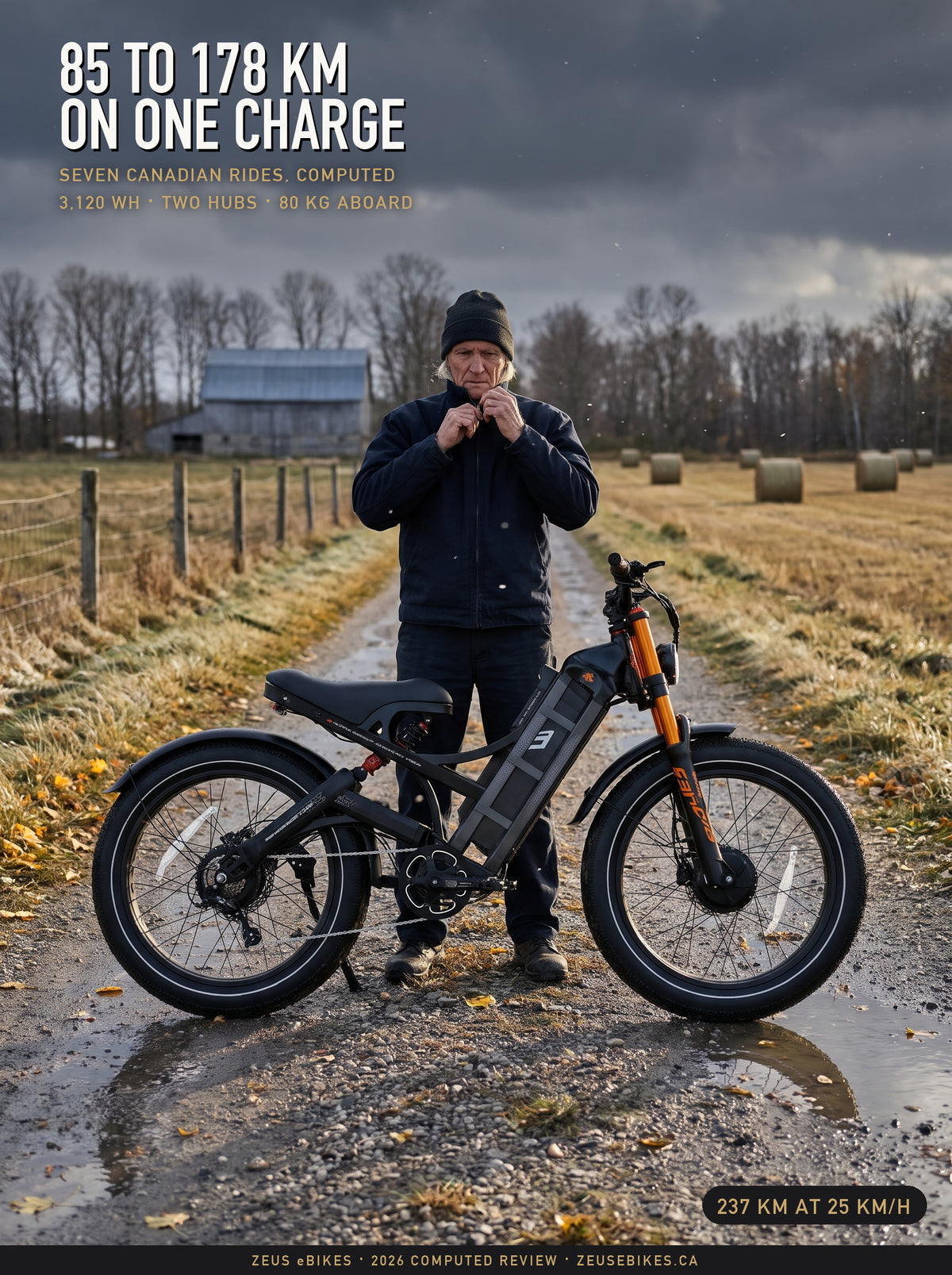



Share:
Eunorau ONE-TRIKE 2.0 Review Canada (2026): Real Range, Math Shown
Eahora Romeo Pro II Review Canada (2026): Real Range 85–178 km Computed, 3,120 Wh, $4,299