
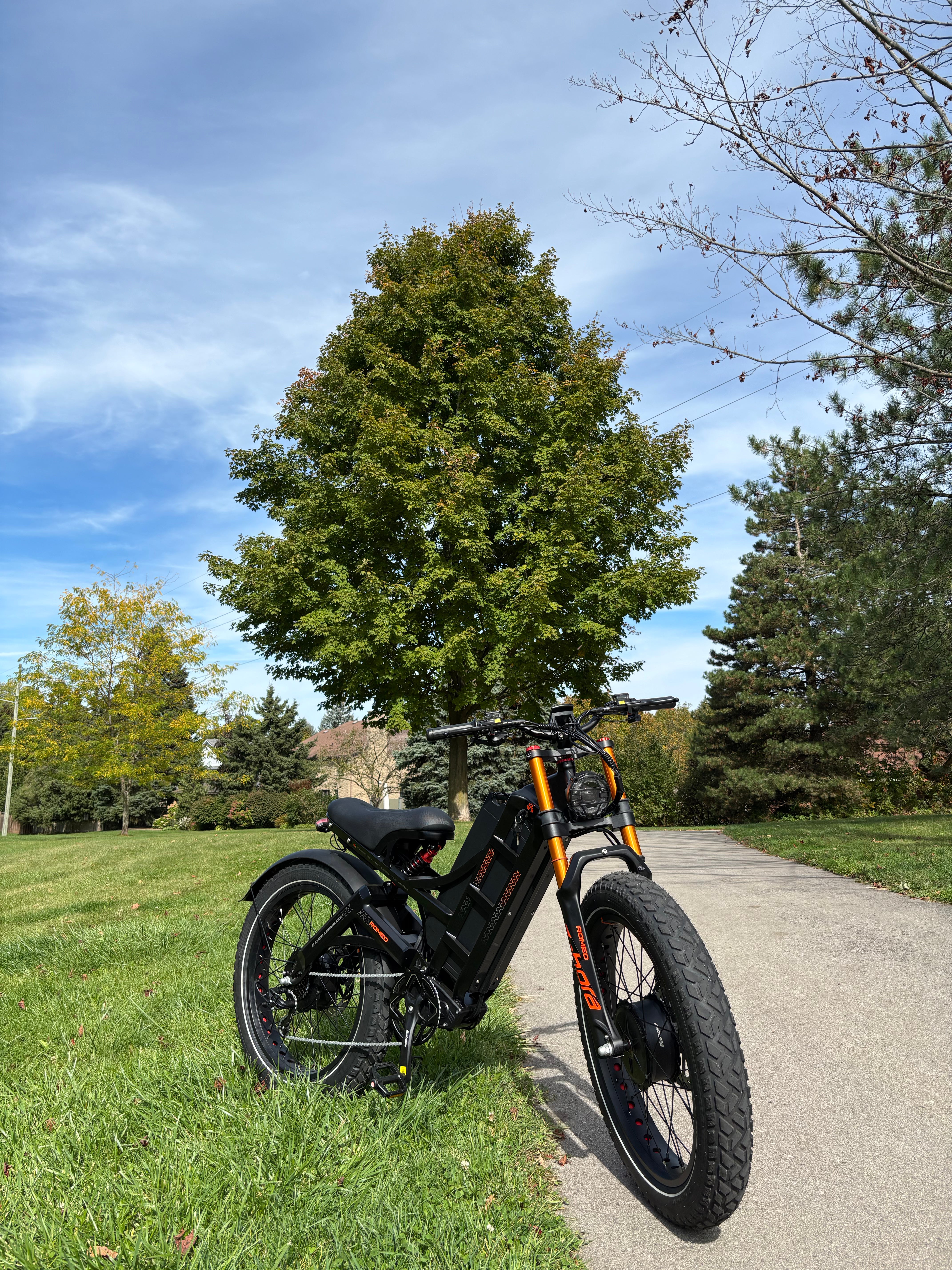
Eahora Romeo Pro II Review Canada (2026): Real Range 85–178 km Computed, 3,120 Wh, $4,299

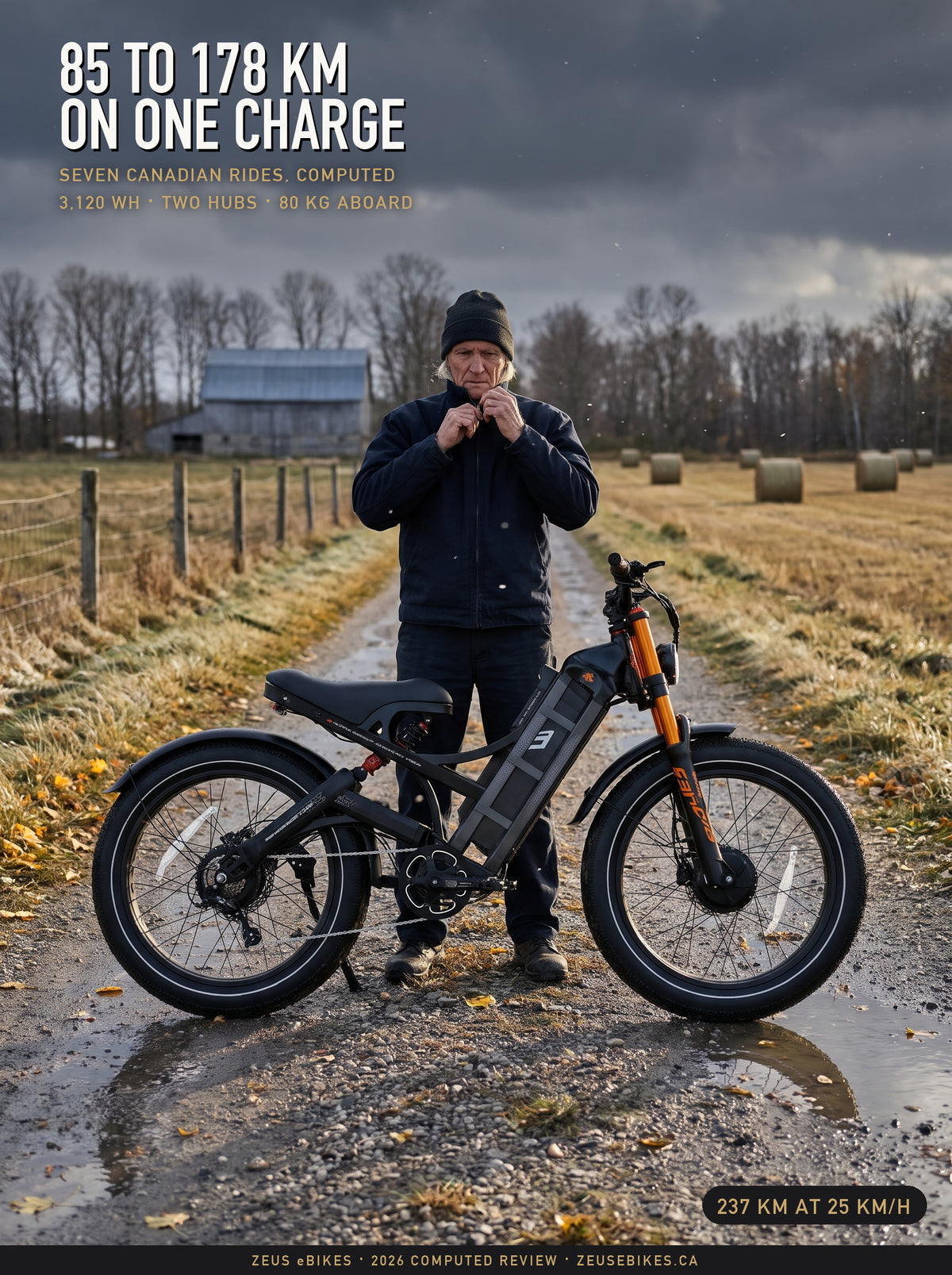
A Playcut.ai rendering made from Eahora's own photograph of the Romeo Pro II, set on a private farm lane in late October. Its seven computed rides run from 85 to 178 km on one charge.
Zeus eBikes, a Canadian e-bike retailer, sells the Eahora Romeo Pro II for $4,299, the price Eahora Canada charges for it. It is a 68.5 kg fat-tire bike with a hub motor in each wheel, a 3,120 Wh battery, 100 mm of fork travel, a 50 mm air shock and 4-piston brakes, and Eahora rates its range at 167 to 180 km with pedal assist.
This review works out how far it goes on the rides Canadians take, from the physics of each ride, and tests that arithmetic against riders who measured theirs. It also works out who fits its fixed 87 cm bench, and where the law lets a bike Eahora lists at 2 × 1,500 W ride. Every specification is Eahora's own, read on 25 October 2026.
Every specification comes from Eahora's own stores, read on 25 October 2026 (the product and policy pages again on 26 October, unchanged): the Canadian page and its product record, the global page for the same bike, and Eahora's controller, motor and battery listings. The range figures come from a saved physics model, built on the road-power equation Martin and colleagues tested on real riders, the hub-motor range model our US sister store, RedTail eBikes, publishes with its reviews, and Eahora's motor, battery, weight and tire figures.
Before any table was trusted, the model had to reproduce the unrestricted top speeds Eahora publishes for four Romeo models and a ride that one reviewer took to an empty battery; a hub rated at half Eahora's 1,500 W figure fails the top-speed test, which is why the tables use the 1,500 W.
The fit tables count 6,068 measured bodies from the US Army's ANSUR II survey; the law table quotes each province's statute or regulator page; the recall reads ran against Health Canada's and the US CPSC's registers, each with a control. Price and store terms are read from our listing and our policies the same day. Zeus sells this bike, so read the weak points as closely as the strong ones. Written by Milad Ghobadibeygvand, BScN (Western University, 2014); corrections to milad@zeusebikes.ca.
In this review
- The rider this bike is built for
- Two bikes called Romeo Pro II: which one this is
- Eahora's specification, from its Canadian and global stores
- Two 1,500 W hubs under a 500 W factory cap
- Suspension, brakes, tires and the display
- How far it really goes on one charge
- Charging it, and how long the pack lasts
- Fit: a bench fixed at 87 cm
- Where it may ride: the law in each province and territory
- The unrestricted setting
- Where Eahora's own pages disagree
- What reviewers and owners report
- Recalls and UL: what the registers show
- If something breaks: Eahora's warranty and Zeus Care
- Against three of its siblings at Zeus
- Ordering from Zeus
- What it does well, and what it costs you
- Who it suits, and who should look elsewhere
- Six checks before you order
- What this review cannot tell you
- Every source we read
- Frequently asked questions
- The verdict on the Romeo Pro II
The rider this bike is built for
Eahora now sells two bikes called the Romeo Pro II, and Zeus lists both: this 52 V 60 Ah build at $4,299 and the 70 Ah 2026 build at $4,499. Choose on the name alone and you can pay $200 more, and give up 4-piston brakes, for 520 Wh you may never use, or save the $200 and go without 520 Wh you may need. This review gives you the range, fit and legal numbers to decide.
It suits a rider who covers real distance on ground a road bike hates: farm lanes, cottage roads, gravel concessions, private acreage, and trails whose manager allows a motor this size. Two driven wheels, 2 × 120 N·m on Eahora's figure, a 3,120 Wh pack and room for 150 kg of rider and cargo make it a load-carrier that keeps going. At a steady 28 km/h with a stop every two kilometres, the model below gives 178 km on one charge.
It does not suit a commuter on bike paths. Eahora lists its motors far above the 500 W that the provincial e-bike definitions allow, so on our reading it cannot use them as an e-bike in any province (the law section has each one). It also asks a lot of anyone shorter than about 180 cm: the bench is fixed at 87 cm, and at 5′9″ only 14 of 100 men and 30 of 100 women can sit on it with both feet flat (the fit tables).

Eahora Romeo Pro II
$4,299 CAD · free Canada-wide shippingWhat it is. A high-carbon steel 26 × 18 frame on 26 × 4.0 INNOVA tires, a hub motor in each wheel with a front, rear or dual switch on the display, a 100 mm adjustable fork, a 50 mm air shock, 4-piston hydraulic brakes on 203 mm rotors, Shimano 7-speed gearing and a 2,000-lumen headlight, in Black, Grey or Green (Eahora Canada).
The legal line. Eahora's global page lists the motors at 2 × 1,500 W, and its Canadian card calls the total a 3,000 W peak. Zeus treats the bike as outside every provincial e-bike rule at every setting, including the 500 W, 32 km/h setting it ships in.
Two bikes called Romeo Pro II: which one this is
This review is of the 52 V 60 Ah Romeo Pro II, the eahora-romeo-pro-ii listing at Eahora Canada and the eahora-romeo-pro-ii listing at Zeus. The Romeo Pro II 2026 is a different bike with a 70 Ah pack, and the two are easy to mix up.
| Romeo Pro II (this review) | Romeo Pro II 2026 | |
|---|---|---|
| Zeus price, 26 Oct 2026 | $4,299 | $4,499 |
| Battery | 52 V 60 Ah, 3,120 Wh | 52 V 70 Ah, 3,640 Wh |
| Motors, Eahora's global page | 2 × 1,500 W | 2 × 2,000 W |
| Weight with battery | 68.5 kg (battery 14 kg) | 160.94 lb, 73.0 kg (battery 36.6 lb) |
| Maximum load | 150 kg | 500 lb (227 kg) |
| Brakes | 4-piston, 203 × 2.7 mm rotors | 2-piston, 240 × 3.0 mm rotors |
| Front fork | Adjustable hydraulic, 100 mm | Adjustable air, 100 mm |
| Range, Eahora Canada's row | 167–180 km with PAS, 112–122 km without | 167–180 km with PAS, 112–122 km without |
| Range at a steady 25 km/h, 80 kg (computed) | 237 km | 265 km |
| Bench height · standover | 87 cm · 67 cm | 87 cm · 67 cm |
Eahora Canada's pages and Eahora's global pages, read 25 October 2026, and our two listings the same day. The computed row comes from the range model below, on each bike's own pack and weight. Eahora prints the 2026 bike's weight in pounds only; the kilograms are our conversion.
The mix-up reaches AI chat answers too. On 25 October 2026 we put the question "How far can the Eahora Romeo Pro II go on one charge?" to four free AI tools, and three answered with the 2026 bike's 104 to 200 miles with pedal assist (the tools we asked).
Two things decide between them. The 2026 bike carries 17% more battery and a larger load rating for $200 more at Zeus and still goes further per dollar, so if range comes first, it is the better buy; RedTail eBikes' Romeo Pro II review covers that 2026 build. This one keeps 4-piston calipers and weighs 4.5 kg less, which matters every time you lift it, load it or stop it on a descent.
Two bikes called Pro II, $200 apart
This 60 Ah build at $4,299, Eahora Canada's own price, or the 2026 build at $4,499 with 520 Wh more. Both ship free across Canada, and an unused, unopened bike can be returned within 15 days of delivery (15% restocking fee).
Eahora's specification, from its Canadian and global stores
Every row below is Eahora Canada's Romeo Pro II page as it read on 25 October 2026, including its spec table, its package tab and its geometry chart. Eahora's global page for the same bike prints some of the same rows differently, and the conflicts table lists every one. The Pro II page on Eahora's European store is the 70 Ah 2026 build, so none of its figures is used here.
| Item | Eahora Canada prints |
|---|---|
| Price | $4,299 CAD at Zeus; $4,299 at Eahora Canada |
| Motors | Dual hub motors, brushless, IPX6; the Canadian page heads them "500W (Continuous)* Dual High-Torque DC Motors", footnoted "Compliant 500W output out of the box, peak performance unlocked for private use", and its card prints "52V 3,000W Peak 2-Motor"; "2 x 1,500 Watt" on the global page |
| Canadian setting | "Factory-limited to 500W output to comply with local road regulations"; "Factory-set to 32 km/h" |
| Torque | 2 × 120 N·m (max) |
| Battery | 3,120 Wh (52 V 60 Ah), lithium-ion pouch cells, Grade A, removable with 2 keys |
| Battery life | ≥ 1,200 charge cycles to 80% of capacity |
| Charger | 58.8 V 7 A, "6-7.5H charge time" |
| Eahora's range | 167–180 km with pedal assist, 112–122 km without |
| Assist and throttle | 5-level cadence-sensor pedal assist; 5-level twist throttle with a slightly delayed response; cruise control; 6 km/h walk mode |
| Display | 4-inch colour LCD with motor switch (front only, rear only, dual), Bluetooth and USB charging |
| Drivetrain | Shimano RD-TY300 7-speed, MF-TZ500-7 14–28T freewheel, 44T chainring, 170 mm aluminum cranks |
| Brakes | Hydraulic disc, 4-piston calipers, semi-metallic pads, 203 × 2.7 mm steel rotors, motor cutoff |
| Suspension | Adjustable hydraulic fork, 100 mm; air shock with damping, 50 mm |
| Wheels and tires | INNOVA 26 × 4.0 with tubes, 28–33 psi; 36-hole aluminum rims; 13-gauge black stainless spokes |
| Lights and horn | 2,000-lumen (20 W) LED headlight with built-in horn; LED taillight with brake signal; reflectors |
| Frame | High-carbon steel, 26 × 18; motorcycle-style bench with no seatpost |
| Weight and load | 68.5 kg with the 14 kg battery; maximum load ≤ 150 kg |
| Rider height | 170–195 cm (5′6″–6′4″), or inseam ≥ 73 cm |
| Geometry | Bench 87 cm, standover 67 cm, wheelbase 128 cm, length 201 cm, handlebar height 113 cm, reach 54 cm, chainstay 56 cm, width 73 cm |
| In the box | Box A: the bike 85% assembled, battery with 2 keys, charger, headlight, pedals, tools, manual; Box B: front wheel and front fender |
Eahora's wording is quoted where it is in quotation marks; the rest is its spec table, shortened. The page also warns that "some parts may differ from those listed" to keep supply moving.

Two 1,500 W hubs under a 500 W factory cap
Eahora's global page lists each hub at 1,500 W and its Canadian card prints "52V 3,000W Peak 2-Motor"; the Canadian page heads its motor section "500W (Continuous)*" and leaves the bike "limited to 500W output" and 32 km/h (Eahora Canada). The footnote to that asterisk reads "Compliant 500W output out of the box, peak performance unlocked for private use."
Eahora's May 2024 guide to the Romeo series gives the parts behind those numbers: "1500W*2" motors, a "30A*2" controller row and a top speed of 44 mph for the Pro II. In the Pro II review, TailHappyTV says the bike is "limited to 30 amps of current". Eahora does not say whether the hubs are geared; TailHappyTV calls them a "geared hub motor" (at 1:14), and Eahora's controller listing names the motor code "AKM52V26".
Rating or peak? Eahora never says which the 1,500 W is. The range model takes it as each hub's rating, and the measured top speeds back that up: a hub with the same unloaded speed but rated at half the figure, 750 W, would top out at 33.4 mph unrestricted, well short of the 42 to 47 mph four reviewers' displays showed (the checks).
What 500 W of motor output does on a hill. On the flat it is plenty: holding 32 km/h with 80 kg aboard takes about 403 W at the wheels in still air, from the road-power equation. A climb is where the cap shows. In the model, 500 W holds 20.8 km/h up a 4% grade with 80 kg aboard, 13.1 km/h up 8% and 7.7 km/h up 15%, and slower again with a heavier load (the hill tables).
Single or dual drive. The display switches between front only, rear only and both. Eahora's FAQ answers the range question both ways: dual drive "does have a slight impact on battery life compared to single-drive models", and dual motors "offer higher energy efficiency and lower energy consumption". The model shows why both can be true: one hub saves up to 4% cruising at 12 to 15 km/h and costs more on every start and climb (the one-or-two table).
Suspension, brakes, tires and the display
The Romeo Pro II stops on 4-piston hydraulic calipers over 203 mm steel rotors, with semi-metallic pads and motor cutoff, and it rides on a 100 mm adjustable fork and a 50 mm air shock (Eahora Canada). Three reviewers called the brakes good, and one reviewer's 2024 bike arrived with a coil shock where the spec names air.
On camera the brakes impressed: MrCentralDriver, braking hard at speed, "almost flew over the handlebars" and said "these brakes are good" (the review); Area 13 found that "braking is good" (at 9:20), and Electric Vehicles Space noted "good brakes" (at 2:50). TailHappyTV's 2024 bike came with a coil shock, with a rebound adjustment and a 750 lb-per-inch spring, where the spec lists an air shock (the unboxing). Eahora's spec carries the warning that parts may differ, so check what yours carries before you set the sag.
The INNOVA 26 × 4.0 tires run inner tubes at 28 to 33 psi, which makes a roadside fix a tube swap rather than a tubeless plug (Eahora Canada). The 4-inch colour display carries the motor switch, Bluetooth and a USB port, and the 20 W headlight has the horn built in. Eahora's rain answer calls the bike IPX65 while its spec table says IPX6, and the answer adds: for long parking, shelter it under a roof.

How far it really goes on one charge
With 80 kg aboard on level pavement in still air, a full charge carries the Romeo Pro II about 237 km at a steady 25 km/h and 184 km at the 32 km/h it is set to. Real riding takes more: 148 km of town errands with three stops a kilometre, and 117 km on a −10 °C January commute.
Keep the 30% that Eahora's FAQ asks you to leave in the pack ("we recommend charging the battery when it reaches around 30% capacity", Eahora Canada) and those plan as 166, 129, 104 and 82 km. Every figure comes from one saved model of this bike, built on Eahora's own numbers: two hubs at the 1,500 W Eahora lists, the 52 V 60 Ah pack, 68.5 kg, 26 × 4.0 tires, and the Canadian 500 W and 32 km/h setting. The formula shows every input and its source. Read your ride in three steps:
- Find your pace in the speed table: 20 to 25 km/h is a relaxed concession road, 32 km/h the setting's ceiling.
- Add what your ride adds: stops, wind, climbing, cold, the headlight and your load each have a table, and the seven worked rides combine them.
- Plan from the 30% column, because Eahora's battery advice is to recharge before the pack runs low.
How far does it go at my speed?
Speed decides most: 348 km at 12 km/h falls to 184 km at 32 km/h on the same charge. Air drag grows with the square of speed, so the power to push through it grows with the cube (Martin et al., 1998); riding 32 km/h where 25 would do gives up 53 km of the 237.
| Speed, level pavement | Wh per km | Full charge | With 30% kept |
|---|---|---|---|
| 12 km/h | 9.0 Wh | 348 km | 244 km |
| 15 km/h | 9.6 Wh | 326 km | 228 km |
| 20 km/h | 11.1 Wh | 282 km | 197 km |
| 25 km/h | 13.1 Wh | 237 km | 166 km |
| 28 km/h | 14.6 Wh | 213 km | 149 km |
| 32 km/h | 16.9 Wh | 184 km | 129 km |
Both hubs on the throttle, 80 kg of rider and gear, 25 °C, still air, the 3,120 Wh pack. The 30% column keeps what Eahora's FAQ asks you to leave. If your pack holds the 3,058 Wh its label shows, take 2% off every row.
Does one motor go further than two?
Barely, and only at a gentle pace: one hub covers up to 4% more at 12 to 15 km/h, the same at 25 km/h, and 2% less at 32 km/h. Every powered hub pays a no-load loss as it spins; two hubs share the current, and the copper losses grow with the square of it, so at a light load one hub wins and at a heavy one two do.
| Speed | Both hubs | One hub | One hub, range change |
|---|---|---|---|
| 12 km/h | 9.0 Wh | 8.6 Wh | +4% |
| 15 km/h | 9.6 Wh | 9.2 Wh | +4% |
| 20 km/h | 11.1 Wh | 10.8 Wh | +2% |
| 25 km/h | 13.1 Wh | 13.1 Wh | 0% |
| 28 km/h | 14.6 Wh | 14.7 Wh | -1% |
| 32 km/h | 16.9 Wh | 17.3 Wh | -2% |
Watt-hours per kilometre on level pavement with 80 kg aboard, the same model with one hub doing all the work. The unpowered hub is taken to freewheel with no drag, which flatters the one-hub column.
Starting is where two motors earn their place. Pulling away to 25 km/h at the 500 W cap costs about 2.4 Wh above cruising the same distance with both hubs, and 3.0 Wh on one (the stop table). Eahora's FAQ says dual drive has "a slight impact on battery life", and the model agrees at a cruise; leave both on for town riding, hills and loose ground.
How much does pedalling add?
A lot at 25 km/h, less at 32: easy pedalling (75 W at the cranks) stretches 237 km to 330 km at 25 km/h, and steady pedalling (150 W) to 522 km. The hubs drive the wheels whether you pedal or not, so every watt your legs give is a watt the pack keeps.
| Speed, level pavement | Throttle only | Easy pedalling, 75 W | Steady pedalling, 150 W |
|---|---|---|---|
| 25 km/h | 237 km | 330 km | 522 km |
| 32 km/h | 184 km | 223 km | 279 km |
Both hubs, 80 kg aboard, the full 3,120 Wh pack. Your pedalling reaches the wheel through the chain at 97.7% (Martin et al., 1998); the hubs supply the rest of the road load.
Two cautions. The Romeo Pro II's assist runs off a cadence sensor, which sets the motor's level by assist setting rather than by how hard you push, so these rows assume you ride the level or the throttle to hold the pace while you pedal. And on legs alone the same physics moves you and the 68.5 kg bike at about 13.0 km/h on 75 W and 19.7 km/h on 150 W, which is the honest answer to whether you can pedal it home.
Hills, and what 500 W can climb
Every 100 m you climb at 16 km/h costs about 65 Wh on a 4% grade and 84 Wh on 10%, beyond what the same distance costs on the flat. Lifting 80 kg and the 68.5 kg bike through 100 m takes 40.5 Wh at the wheels; the rest is motor and pack heat, which grows as the hubs slow down and the current climbs.
From 8% up, the factory cap sets the pace. A grade that needs more than 500 W of motor output at 16 km/h slows the bike until 500 W is enough, which is why the table's speed falls with the grade:
| Grade | Pace 500 W holds (to 16 km/h) | Wh per km | A full charge on that grade | With easy pedalling |
|---|---|---|---|---|
| 2% | 16.0 km/h | 22 Wh | 144 km | 212 km |
| 4% | 16.0 km/h | 36 Wh | 87 km | 113 km |
| 6% | 16.0 km/h | 53 Wh | 59 km | 73 km |
| 8% | 13.1 km/h | 76 Wh | 41 km | 51 km |
| 10% | 10.9 km/h | 108 Wh | 29 km | 36 km |
| 12% | 9.4 km/h | 150 Wh | 21 km | 27 km |
| 15% | 7.7 km/h | 237 Wh | 13 km | 17 km |
Both hubs on the throttle at the Canadian setting, 80 kg aboard, still air. Each row is a whole charge spent climbing that grade without stopping, a way to compare grades rather than a ride anyone takes.
The fastest steady pace each grade allows, at the 500 W setting:
| Grade | 80 kg aboard | 120 kg aboard | 150 kg aboard |
|---|---|---|---|
| 2% | 27.2 km/h | 24.3 km/h | 22.4 km/h |
| 4% | 20.8 km/h | 17.5 km/h | 15.6 km/h |
| 6% | 16.3 km/h | 13.3 km/h | 11.6 km/h |
| 8% | 13.1 km/h | 10.5 km/h | 9.1 km/h |
| 10% | 10.9 km/h | 8.7 km/h | 7.5 km/h |
| 12% | 9.4 km/h | 7.4 km/h | 6.4 km/h |
| 15% | 7.7 km/h | 6.1 km/h | 5.2 km/h |
The bike's 68.5 kg plus the load in each column, both hubs, 500 W of motor output. Eahora's 150 kg is the bike's maximum load, rider and cargo together.
TailHappyTV's climb of Eldridge Street in Los Angeles, given on camera as 33%, shows the other end: unrestricted and with dual drive, the bike slowed to a stop near the top and needed the rider's pedalling, and later, on a long climb, it shut off until it cooled, which the reviewer put down to the controllers ("it's the controllers are getting too hot", at 26:29). Expect a factory-setting climb of a steep grade to be slow, and long ones to be warm.
Does my weight change the range?
On the flat less than you would think, on a climb a great deal: at 25 km/h, 80 kg of rider and gear gets 237 km and Eahora's full 150 kg gets 198 km, but up a 6% grade at 16 km/h the same two loads get 59 km and 36 km. Rolling resistance and climbing scale with the whole mass; air drag, which dominates on the flat at speed, does not.
| Rider plus load | 25 km/h, level | 32 km/h, level | 6% grade, 16 km/h |
|---|---|---|---|
| 60 kg | 251 km | 193 km | 70 km |
| 80 kg | 237 km | 184 km | 59 km |
| 100 kg | 225 km | 177 km | 51 km |
| 120 kg | 213 km | 169 km | 44 km |
| 150 kg | 198 km | 159 km | 36 km |
The 68.5 kg bike plus the load in each row, both hubs, the full 3,120 Wh pack, still air, 25 °C. 150 kg is Eahora's maximum load.
How much does a Canadian winter take?
The 237 km at 25 km/h falls to about 189 km at 0 °C, 171 km at −10 °C and 135 km at −20 °C, and the low end of the published cell data takes −10 °C down to 83 km. Cold cells give back less of their energy, cold air is denser and cold tires roll harder (Rothhämel, 2023).
At −10 °C the measured LG HG2 cell behind the central figures is the top of the published spread; the bottom is Samsung's data sheet for its 35E cell, measured at a full 1C discharge, about 10 times the rate this bike draws from its pack at a steady 25 km/h.
| Air and pack temperature | Pack energy vs 25 °C | 25 km/h, level | 32 km/h, level |
|---|---|---|---|
| 25 °C | 100% | 237 km | 184 km |
| 20 °C | 98% | 226 km | 176 km |
| 10 °C | 93% | 204 km | 159 km |
| 5 °C | 91% | 194 km | 152 km |
| 0 °C | 89% (80–93) | 189 km (169–198) | 147 km |
| −5 °C | 86% | 180 km | 140 km |
| −10 °C | 82% (40–83) | 171 km (83–171) | 133 km |
| −20 °C | 67% (33–82) | 135 km (67–166) | 104 km |
Both hubs, 80 kg aboard, still air, the 3,120 Wh pack held at the air's temperature. The central figures use McMaster University's measured LG HG2 cell; at 0, −10 and −20 °C the brackets span the published cell data we read: Samsung's 35E data sheet, NASA JPL's tests of that cell (Bugga et al., 2019), Casado et al. (2025) and the HG2 itself. Eahora names pouch cells without a maker or model, so its own curve is unknown. The treatment is the one in RedTail eBikes' cold-weather range table.
Two of Eahora's own rules matter more than the table. Its winter maintenance article says "Riding in sub-zero weather is safe, but the colder it gets, the shorter your range", and that charging below 0 °C "can cause permanent damage": bring the pack inside and charge it at about 5 °C or warmer. A pack that starts a ride warm also gives more than one that sat outside, which is why our winter e-bike guide keeps the battery indoors between rides.
What does wind do?
A 10 km/h headwind cuts the 25 km/h figure from 237 km to 158 km, and at the 32 km/h setting even 10 km/h of headwind asks for more than the 500 W cap gives, so the bike slows. Drag depends on your speed through the air, so a headwind costs far more than a tailwind returns.
| Wind along the road | 25 km/h | 32 km/h |
|---|---|---|
| 15 km/h tailwind | 397 km | 328 km |
| 10 km/h tailwind | 344 km | 273 km |
| Still air | 237 km | 184 km |
| 10 km/h headwind | 158 km | cannot hold it |
| 15 km/h headwind | 130 km | cannot hold it |
Both hubs, 80 kg aboard, a steady wind along the road the whole way, the full pack. "Cannot hold it" means the pace needs more than 500 W of motor output, so in the Canadian setting the bike runs slower than the row's speed.
On an out-and-back ride the two halves do not cancel: with a 15 km/h wind and a 28 km/h cruise, the upwind half settles at 26.3 km/h and the round trip costs 2.3 Wh a kilometre more than still air (the windy-shoreline ride).
Does the headlight cost range?
The 20 W headlight takes 6% at 25 km/h and 13% at 15 km/h, because it burns the same 20 W however slowly you go. Eahora rates it at 2,000 lumens and 20 W (Eahora Canada); the taillight and display draw too, and Eahora prints no figure for them, so they are left out.
| Speed | Headlight off | Headlight on | Range given up |
|---|---|---|---|
| 15 km/h | 326 km | 285 km | 13% |
| 20 km/h | 282 km | 258 km | 9% |
| 25 km/h | 237 km | 223 km | 6% |
| 32 km/h | 184 km | 178 km | 4% |
Both hubs, 80 kg aboard, level pavement, the full pack; the 20 W added at the pack. December's commutes in most of Canada start and end in the dark.
What does each stop cost?
Each stop and restart to 25 km/h costs about 2.4 Wh more than riding through, so three stops a kilometre add 7.1 Wh to every kilometre: with the cooler 20 °C of a town ride, the 237 km of steady riding becomes 148 km. The brakes turn your speed into heat, and Eahora prints no regenerative braking, so the motors buy it back on every start.
| A start | Both hubs | One hub | Time and distance to speed | Energy of motion at speed |
|---|---|---|---|---|
| 0 to 20 km/h | 1.9 Wh | 2.4 Wh | 5.8 s, 21 m | 0.6 Wh |
| 0 to 25 km/h | 2.4 Wh | 3.0 Wh | 10.0 s, 48 m | 1.0 Wh |
| 0 to 32 km/h | 2.9 Wh | 3.6 Wh | 23.4 s, 157 m | 1.6 Wh |
80 kg aboard, level pavement, the 500 W cap, each hub held to the 30 A from the pack that Eahora's guide and TailHappyTV give. The first two columns are what a start costs beyond covering the same distance at a steady speed.
Getting a 148.5 kg bike and rider to 25 km/h stores only 1.0 Wh of motion; the hubs spend more than twice that, because at low speed they turn current into heat faster than into push. Gentle starts and rolling through where it is safe to do so save the most.
Do tires and riding position change it?
Yes, and they bracket every row above: across the fat tires one lab has measured, 25 km/h runs from 219 km to 276 km, and sitting tall or tucked moves it from 208 km to 275 km. We found no published rolling-resistance figure for the INNOVA tire, so the model uses the median of the ten 26 × 4.00 fat tires on Bicycle Rolling Resistance's drum, measured at 12 psi.
| Rolling resistance | 25 km/h | 32 km/h |
|---|---|---|
| 0.007 · the lowest of ten fat tires | 276 km | 207 km |
| 0.0105 · the median of ten fat tires (used) | 237 km | 184 km |
| 0.0126 · the highest of ten fat tires | 219 km | 173 km |
Level pavement, 80 kg aboard, both hubs, the full pack. Eahora's 28 to 33 psi is firmer than the lab's 12 psi; we expect that to roll easier on pavement, which would make the median row conservative (our inference: no lab has tested this tire).
| Drag area | 25 km/h | 32 km/h |
|---|---|---|
| 0.46 m² · Tengattini & Bigazzi upright cruiser mean minus one SD | 275 km | 223 km |
| 0.64 m² · upright cruiser mean (used) | 237 km | 184 km |
| 0.82 m² · mean plus one SD | 208 km | 156 km |
The drag area of rider and bike from Tengattini and Bigazzi, 2018: 37 everyday riders on upright cruisers averaged 0.640 m², with a standard deviation of 0.179. A 6-foot rider in a winter coat sits at the high end.
Seven real rides, worked line by line
Put the pieces together and seven Canadian rides run from 85 km to 178 km on a full charge, 60 to 124 km with Eahora's 30% kept. Each line below is one of the tables above; add them and divide the pack's usable energy by the total.
| Ride | Steady | Wind | Stops | Headlight | Hills | Wh per km | Usable energy | Full charge | With 30% kept |
|---|---|---|---|---|---|---|---|---|---|
|
Concession-road cruise 28 km/h, 80 kg, a stop every 2 km, still air, 15 °C |
15.4 | none | +1.3 | none | none | 16.7 | 2,972 Wh | 178 km | 124 km |
|
Town errands 25 km/h, 80 kg, three stops a kilometre, 20 °C |
13.5 | none | +7.1 | none | none | 20.6 | 3,046 Wh | 148 km | 104 km |
|
Rolling hills 25 km/h, 80 kg, 15 m of climbing every km, a stop every 2 km |
13.9 | none | +1.2 | none | +3.4 | 18.5 | 2,972 Wh | 161 km | 113 km |
|
Windy shoreline, out and back 28 km/h, 80 kg, a 15 km/h wind, head one way, tail the other; upwind, 500 W holds only 26.3 km/h |
15.4 | +2.3 | +1.3 | none | none | 19.0 | 2,972 Wh | 156 km | 109 km |
|
January commute 25 km/h, 80 kg, −10 °C, headlight on, two stops a km, a 10 km/h wind |
15.0 | +1.5 | +4.7 | +0.8 | none | 22.0 | 2,571 Wh | 117 km | 82 km |
|
Full load 25 km/h, 150 kg, Eahora's 150 kg maximum aboard, a stop every km |
16.8 | none | +3.5 | none | none | 20.3 | 2,972 Wh | 146 km | 102 km |
|
Fast and cold 32 km/h, 100 kg, −20 °C at the 32 km/h setting, 100 kg, headlight, a 15 km/h wind; upwind, 500 W holds only 24.3 km/h, which costs less a kilometre than 32 km/h in still air |
20.8 | −0.3 | +3.3 | +0.6 | none | 24.3 | 2,075 Wh | 85 km | 60 km |
Watt-hours per kilometre for each part of the ride; usable energy is the 3,120 Wh pack at that temperature (McMaster's LG HG2 central line). Wind rows are out and back; a cell reading none means the ride has none of it. Below 0 °C the published cell data spread wide: across them the January commute runs 57 to 117 km and the fast, cold ride 42 to 105 km.
The January commute, worked. At −10 °C and 25 km/h the bike needs 15.0 Wh a kilometre in still air, more than the 13.1 Wh of a summer day because the air is denser and the tires stiffer. A 10 km/h wind, head one way and tail the other, adds 1.5; two stops a kilometre at 2.4 Wh each add 4.7; the headlight adds 0.8. That is 22.0 Wh a kilometre.
The cold pack gives back 82% of its energy, 2,571 Wh, and 2,571 ÷ 22.0 = 117 km, or 82 km leaving 30%. That 82% is the measured HG2 cell, the top of the published data at −10 °C; on the bottom, Samsung's 35E sheet at 40%, the same commute is 57 km.
The hills, worked. Fifteen metres of climbing a kilometre, taken as a 4% grade, is 375 m of climbing at the 20.5 km/h the cap holds, the same distance coasting down at no motor cost, and 249 m of flat. That adds 3.4 Wh to each kilometre against a flat road, so the ride gives 161 km.

Eahora's 167 to 180 km, and 112 to 122 km, as rides
In this model an 80 kg rider matches Eahora's 167 to 180 km at a steady 32.7 to 34.8 km/h on the throttle, and its 112 to 122 km at 43.7 to 46.2 km/h: speeds the Canadian setting does not allow. At 32 km/h or slower, on level pavement in still air, the model beats both of Eahora's figures; with stops, wind and cold, real rides fall back to them.
The throttle-only figure has a second problem. Eahora prints the same one, 112 to 122 km or 70 to 76 miles, for four Romeo packs from 3,120 to 4,800 Wh, read on 25 October 2026:
| Model | Pack | Range without pedal assist, as Eahora prints it |
|---|---|---|
| Romeo Pro II | 3,120 Wh | 112–122 km |
| Romeo Pro II 2026 | 3,640 Wh | 112–122 km |
| Single-hub sibling (60 V 70 Ah) | 4,200 Wh | 70–76 miles |
| Romeo Ultra II | 4,800 Wh | 113–122 km |
Each model's own Eahora page. A 54% larger pack with the same printed range cannot describe the same test, so we read Eahora's range rows as marketing bands and computed our own.
What riders measured, and a ride to empty
Three reviewers who rode the Pro II unrestricted used 25.8 to 29.1 Wh a kilometre, the cost the model gives a steady 44 to 47 km/h; and for the one rider we found who ran a Romeo to an empty pack, the model's steady figure at that rider's cruising speed came out 31% above the distance ridden. Both point the same way: the steady tables are the ceiling, and the worked rides are where you plan.
| Reviewer | Distance | Pack used (display) | Wh per km on 3,120 Wh | Steady pace with the same cost, in the model |
|---|---|---|---|---|
| TailHappyTV | 80 km | 75% | 29.1 Wh | 47.0 km/h |
| MrCentralDriver | 24 km | 20% | 25.8 Wh | 44.0 km/h |
| Electric Vehicles Space | 56 km | 50% | 27.7 Wh | 44.6 km/h |
From the reviewers' own words on camera: TailHappyTV ("just cross over 50 Mi", 25% left, 2,165 ft of climbing, 200 lb rider), MrCentralDriver ("we're down to 80% by the way and I've almost done 15 Mi"), Electric Vehicles Space ("with 50% of the battery I managed to cover 35" miles, 250 lb rider, mostly 27 to 45 mph).
Treat the percentages with care. MrCentralDriver watched the display's percentage rise again at rest and put it down to the pack's voltage: "it does jump up a little bit it's going off a voltage sag" (the review). The figures above are each reviewer's own reading at the end of the ride.
The ride to empty. Scott Hardesty rode the Pro II's single-hub sibling, a 60 V 70 Ah bike, until "everything uh just died": "a little bit over 87 miles" on Strava, about 140 km, at 225 lb, mostly on the throttle at the "around 24 miles an hour" of its second assist level, with a sand test, a 0 to 31% hill and a brake test along the way.
The same model, run on that bike's own figures from Eahora's page, gives 183 km at a steady 24 mph and 132 km at 30 mph. Hardesty's ride used 30.0 Wh a kilometre against the model's 22.9 for that cruise, 31% more: the margin a steady-speed model leaves for the hill climb, the sand test, the brake test and gusts, none of which it prices.
The 80 km ride behind the first row
TailHappyTV's Pro II review, 8 June 2024: 50 miles through Los Angeles, unrestricted, 2,165 ft of climbing. Note how the battery reading moves during the ride.
Send us your ride and we will run it
Email your usual route, your weight with gear, your steepest climb and the coldest month you ride to milad@zeusebikes.ca. We will run it through this model before you order, including when a different bike comes out ahead.
How the numbers are computed
Each row starts with the power the wheels need at one steady speed, from the road-power equation Martin and colleagues checked against riders on real roads in 1998:
Wheel power = v × [ m × g × (Crr × cos θ + sin θ) + ½ × ρ × CdA × v² ]
Here v is speed, m the rider, gear and bike together, g gravity, θ the grade's angle, Crr the rolling resistance (0.0105 means a drag of 1.05% of the weight on the tires), ρ the air's density and CdA the drag area of rider and bike.
From the wheels back to the cells there are three steps: your pedalling, if any, comes off the top; the hubs supply the rest at the efficiency a DC motor model gives at that torque and speed; and the pack loses a little more as heat. The hub model is RedTail eBikes' published range model, imported unchanged, self-tested before every run and given this bike's figures. Watt-hours per kilometre are the cells' watts divided by the speed; kilometres are the usable watt-hours divided by that.
| Input | Value used | Where it comes from |
|---|---|---|
| Bike | 68.5 kg with the 14 kg battery | Eahora Canada's weight row |
| Rider and gear | 80 kg central; 60 to 150 kg in the weight table | 150 kg is Eahora's maximum load |
| Pack | 52 V × 60 Ah = 3,120 Wh; label 58.8 Ah, 3,058 Wh | Eahora Canada; the label as TailHappyTV and MrCentralDriver read it on camera |
| Motors | two hubs at 52 V sharing the load, each rated at the 1,500 W Eahora lists; 79.4 km/h unloaded, at least 80% efficient at the rated point | Bafang OEM workbook 2021, RM G0H0, its 510 rpm at 48 V held to 52 V; the 1,500 W from Eahora's global page, tested against the reviewers' top speeds |
| Canadian setting | 500 W of motor output, 32 km/h | Eahora Canada |
| Controller | 30 A from the pack per hub (starts only) | Eahora's 2024 Romeo guide |
| Wheels | 762 mm across: the 559 mm bead seat plus twice 4.0 in | Sheldon Brown's tire sizing |
| Rolling resistance | 0.0105, the median of ten 26 × 4.00 fat tires at 12 psi | Bicycle Rolling Resistance |
| Drag area | 0.64 m², upright cruisers | Tengattini and Bigazzi, 2018 |
| Chain | 97.7%, your pedalling only | Martin et al., 1998 |
| Pack losses | 2.9% at 25 km/h, more on climbs | Arango, López and Cerén, 2021 |
| Air | 25 °C at sea-level pressure, and its density at each temperature | U.S. Standard Atmosphere, 1976 |
| Cold | the share of a cell's energy left at each temperature | McMaster University's LG HG2 data |
| Reserve | 30% kept in the planning columns | Eahora Canada's FAQ |
| Headlight | 20 W | Eahora Canada |
Every input and its source. A number not in this table does not enter the model.
One ride worked through, wheel to cells: 80 kg aboard, both hubs on the throttle at 25 km/h (6.94 m/s) on level pavement at 25 °C. Rider and bike weigh 148.5 kg. The tires take 106.6 W and the air 126.9 W, so the wheels need 233.5 W, turning 174.0 times a minute on a 762 mm wheel. The two modelled hubs (0.899 N·m per amp, 0.238 Ω and 1.52 A unloaded each, from Bafang's published figures held at 52 V and 1,500 W) share 12.8 N·m on 17.3 A between them, 73% efficient at so light a load.
They draw 318.9 W, the pack's own losses take it to 328.6 W at the cells, and 328.6 ÷ 25 = 13.14 Wh a kilometre. So 3,120 ÷ 13.14 = 237.4 km, or 166.2 km with 30% kept.
| Check | Published or measured | This model |
|---|---|---|
| Road physics, Martin and colleagues' worked example | 45.7 W for the tires and the grade, 158.8 W for the air | 45.7 W and 158.8 W |
| The comparable hub at its rated point | at least 80% efficient | 80% |
| Romeo Pro II top speed, unrestricted | 44 mph (Eahora, May 2024); four reviewers' displays, 42 mph on the flat to 47 with a tailwind | 41.9 mph at the 52 V nominal pack, 43.3 mph tucked |
| The same hub rated at half Eahora's figure, 750 W | would have to reach the same 42 to 47 mph | 33.4 mph: ruled out |
| Romeo Pro II 2026 top speed | 45 mph (Eahora) | 43.3 mph |
| Romeo II top speed | 37 mph (Eahora, May 2024) | 37.2 mph |
| The single-hub sibling (60 V 70 Ah), top speed | 42 mph (Eahora) | 42.8 mph |
| The same sibling ridden to an empty pack | about 140 km at 225 lb | 183 km steady at 24 mph, 132 km at 30 mph |
The model's own checks, run 25 October 2026. Eahora's top speeds are its unrestricted figures; the reviewers rode near-full packs, which sit above the 52 V nominal voltage the model uses. MrCentralDriver's 45 mph came down an overpass, "but I think on flat we got like 42" (at 23:20); Electric Vehicles Space's 45 to 47 had "a little bit of wind helping" (at 15:12).
A hub rated lower than the model's would also have cost range. At 750 W, with the same unloaded speed, the seven worked rides come out 4 to 15% shorter (town errands 129 km instead of 148); at 82% efficiency instead of the comparable's 80% floor, they come out 6 to 10% longer. The top-speed check is what rules the 750 W reading out.
Charging it, and how long the pack lasts
From empty, the included 58.8 V 7 A charger needs at least 7.58 hours even if nothing were lost: 3,120 Wh ÷ 411.6 W. At 7 A into a pack that averages 52 V, it is closer to 8.57 hours before the final slow top-up. Eahora's spec table prints "6-7.5H", which is under that floor for a charge from empty, and its FAQ "6 to 8 hours" (Eahora Canada).
That timing collides with Eahora's own advice. Its battery maintenance guide says "never charge it overnight", and also "Do not run the battery completely empty", while its FAQ asks you to recharge at about 30%. A charge from 30% is roughly 70% of the time: about 6.0 hours on the same arithmetic, so start it in the morning. Charge where you can see it, indoors, off the floor of a garage that freezes, and never below 0 °C (Eahora's winter article). Our e-bike battery guide covers storage and fire safety at home.
How long the pack lasts. Eahora rates it at "≥ 1,200 charge cycles to 80% of capacity" (Eahora Canada). Price every one of those charges at 80% of today's range, the least the rating allows, and 1,200 of them still cover at least 142,000 km of town errands and 171,000 km of concession-road cruising. The rating counts charges, not years, so it says nothing about how long the pack lasts on the calendar. Eahora Canada lists the replacement 52 V 60 Ah pack for the Pro II at $1,429 (6-pin socket, read 25 October 2026); spread over the town figure, that is about 1 cent a kilometre.
Fit: a bench fixed at 87 cm
The Romeo Pro II's bench sits 87 cm off the ground and does not adjust, so your inseam decides the fit: at Eahora's 170 cm floor almost no rider can sit with both feet flat, at 5′10″ about a third can, and from 6′1″ nearly everyone can. Eahora's window is 170 to 195 cm (5′6″ to 6′4″), or an inseam of at least 73 cm, and the bench has "No Seatpost" to raise or lower (Eahora Canada's geometry).
We counted how many of 100 people of each height have a barefoot inseam of at least 87 cm, the bench's height, using the measured bodies of the US Army's ANSUR II survey: 4,082 men and 1,986 women, with RedTail eBikes' seated flat-footing method.
| Your height | Women flat-footed on the bench, of 100 | Men flat-footed on the bench, of 100 | Median inseam, women / men |
|---|---|---|---|
| 5′6″ · 168 cm | 1 | 1 | 81 / 80 cm |
| 5′7″ · 170 cm | 4 | 3 | 83 / 81 cm |
| 5′8″ · 173 cm | 9 | 6 | 84 / 83 cm |
| 5′9″ · 175 cm | 30 | 14 | 86 / 84 cm |
| 5′10″ · 178 cm | 40 | 29 | 86 / 86 cm |
| 5′11″ · 180 cm | 75* | 55 | 89 / 87 cm |
| 6′0″ · 183 cm | 90* | 77 | 90 / 89 cm |
| 6′1″ · 185 cm | 97* | 93 | 92 / 91 cm |
| 6′2″ · 188 cm | 99* | 97 | 93 / 92 cm |
| 6′3″ · 190 cm | 100* | 100 | 95 / 93 cm |
| 6′4″ · 193 cm | 100* | 100 | 96 / 96 cm |
ANSUR II crotch height (barefoot) against measured stature, one-inch height bands; * marks a band with fewer than 30 women, taken from the survey's own regression. Riding boots add their sole, so shod riders reach a little further. Every rider in Eahora's window clears its 73 cm minimum inseam: 100 of 100 from 5′5″ in this survey.
Below about 5′11″, where most riders cannot put both feet flat from the bench, the way to stop is to slide forward off it and stand over the frame, whose standover is 67 cm: every rider from 5′1″ in the survey clears that. One owner at 5′1½″, well under Eahora's 170 cm floor, described stopping that way on Eahora's review page: "I have to get off while I'm coming to a rolled stop" (Eahora Canada, reviews). If that is how you will stop, practise it in an empty lot first; 68.5 kg is a lot to catch if it leans.
The bench also fixes your leg extension, which is the tall rider's problem. At 6′5″ with a 34-inch inseam, TailHappyTV found the pedal stroke "just doesn't fit" and rode on the throttle, "a little bit scrunched" (at 18:26). The Romeo Pro II is built around its throttle and its bench more than its pedals; if long-distance pedalling matters to you, a bike with an adjustable seatpost suits you better.

Where it may ride: the law in each province and territory
On our reading, no province or territory lets the Romeo Pro II ride roads, bike lanes or paths as an e-bike: Eahora lists each hub at 1,500 W, every provincial e-bike definition stops at 500 W, and the 500 W and 32 km/h the bike ships with are settings Eahora says may be raised for private use. Canada has had no federal e-bike definition since the power-assisted-bicycle definition was repealed effective February 4, 2021 (SOR/2020-22), so the rules are provincial and territorial.
| Jurisdiction | The words that decide it | The Romeo Pro II against them, on our reading | Zeus guide |
|---|---|---|---|
| Ontario | Highway Traffic Act s. 1(1) defines a power-assisted bicycle as one that "(a) is a power-assisted bicycle as defined in subsection 2 (1) of the Motor Vehicle Safety Regulations made under the Motor Vehicle Safety Act (Canada)" (the Act), a federal text repealed in 2021; Ontario's page lists "an electric motor not exceeding 500 watts" and "a maximum assisted speed of 32 km/h" (ontario.ca). | Outside: Eahora lists 1,500 W a hub. | Ontario |
| Québec | SAAQ: the motor "must have a maximum power rating of no more than 500 watts" and "must cease to generate power once the bicycle reaches a speed of no more than 32 km/h" (SAAQ). Its FAQ: "A bicycle equipped with a 1,000-watt motor is still considered a bicycle, but is not authorized for use on a public road, including roadways and bike paths" (SAAQ FAQ). | Outside: 1,500 W a hub on Eahora's global page, so in SAAQ's words not authorized on a public road, roadways and bike paths included. | Québec |
| British Columbia | B.C. Reg. 64/2024: "one or more attached electric motors that have a continuous power output rating that, in total, does not exceed 500 W" (the regulation). | Outside: Eahora Canada calls the shipped bike "500W (Continuous)", but lists the same motors at 3,000 W peak, and they can be set past 32 km/h (below). | BC |
| Alberta | AR 304/2002: "“power bicycle” means a vehicle that is a power-assisted bicycle under the Motor Vehicle Safety Regulations (Canada) (C.R.C., c. 1038)" (the regulation), the repealed text; Alberta's booklet: a power bicycle "has an electric motor with a maximum power of 500 watts", "a top speed of 32 km/h" (Alberta). | Outside: Eahora lists 1,500 W a hub. | Alberta |
| Saskatchewan | SGI: a power-assisted bicycle "is equipped with an electric assist motor that is no larger than 500 watts" and "cannot be operated at a speed of greater than 32 km/h (20 mph)" (SGI; the regulations). | Outside: Eahora lists 1,500 W a hub. | Saskatchewan and Manitoba |
| Manitoba | Highway Traffic Act s. 1(1): "(i) the motor has a continuous power output rating, measured at its shaft, of 500 W or less" (the Act). | Outside: the 500 W "continuous" figure is the factory setting; Eahora lists 1,500 W a hub. | Saskatchewan and Manitoba |
| Nova Scotia | N.S. Reg. 221/2026 s. 3, in force since 19 October 2026: motors with "a total continuous nominal power output rating, measured at the shaft of each motor, of 500 W or less" (the regulation). | Outside on power and on speed: Eahora lists 3,000 W in total, and the motors can be set past 32 km/h (below). | Nova Scotia |
| New Brunswick | No e-bike definition in the Motor Vehicle Act; Service New Brunswick: a vehicle that "has a motor equal to or less than 500W" and stops assisting past 32 km/h can be considered a bicycle (GNB). | Outside: Eahora lists 1,500 W a hub. | New Brunswick |
| Prince Edward Island | Power-Assisted Bicycles Regulations: motors that "have continuous power output ratings that in total do not exceed 500 watts" (the regulations). | Outside: Eahora lists 3,000 W in total. | PEI |
| Newfoundland and Labrador | No e-bike definition: a bicycle "means a device propelled by human power upon which a person may ride, having 2 wheels in tandem", and the Act names a power-assisted bicycle without defining one (the Act). | Read two ways, and on neither does a bike Eahora lists at 3,000 W ride a road as an e-bike: as written, a vehicle propelled otherwise than by muscular power is a motor vehicle. Ask Service NL. | Newfoundland and Labrador |
| Yukon | Motor Vehicles Act s. 1: a motor rated "at the shaft of each motor, of 500 W or less in total for the motor or combination of motors" (the Act). | Outside: Eahora lists 3,000 W in total. | Atlas |
| Northwest Territories | No e-bike definition; the All-terrain Vehicles Act lists "(d) a pedal bicycle with motor attachment," among all-terrain vehicles (the Act, in the Internet Archive's September 2025 copy: the territory's justice site was under maintenance on 26 October 2026). | An all-terrain vehicle on that list; municipal rules apply. | Atlas |
| Nunavut | The Traffic Safety Act defines a bicycle by human power; the All-terrain Vehicles Act carries the same "(d) a pedal bicycle with motor attachment," wording. Both consolidations say they are not up to date; none of the eight amending acts they list, read 26 October 2026, changes either definition. | An all-terrain vehicle on that list; municipal rules apply. | Atlas |
Each row's operative words are quoted from the statute, regulation or regulator page linked in it, and checked on 25 October 2026 against our saved copies of those texts (each fetched between 19 September and 18 October 2026). Age, helmet and passenger rules are in our province guides. This table reads the definitions; it is not legal advice.
The 500 W setting, read two ways. Eahora Canada heads the bike's motor section "500W (Continuous)* Dual High-Torque DC Motors", footnotes it "Compliant 500W output out of the box, peak performance unlocked for private use", and says in its spec table "Factory-limited to 500W output to comply with local road regulations" (Eahora Canada); its shipping tab points to the federal power-assisted-bicycle requirements, the definition repealed in 2021. Read Eahora's way, the bike as shipped has 500 W motors.
Zeus reads it the other way. The same page's card prints "52V 3,000W Peak 2-Motor", Eahora's global page lists this bike's motors at "2 x 1,500 Watt", and the footnote ties the 500 W to an output setting that can be unlocked; on our reading that figure describes the setting, while the definitions above test the motors. The speed tests point the same way (the unrestricted setting). Until a province says that a capped bike qualifies, Zeus treats the Romeo Pro II as outside every provincial e-bike rule at every setting.
Registering it as a moped or motorcycle is a separate, provincial question. Service New Brunswick writes that "The Registrar will permit an electric motor driven cycle to be registered if it meets Canada Motor Vehicle Safety Standards (CMVSS) as a Limited Speed Motorcycle, or Scooter", and that one built after 1988 will carry a compliance label (GNB); Québec bars from public roads vehicles that look like motorcycles or mopeds and lack "the Transport Canada compliance label or a national safety mark" (SAAQ). Eahora's pages print no CMVSS compliance statement for this bike (searched 25 October 2026), so ask your registry before you buy it for the road.
Where it can go is wherever the landowner, the trail authority or the track sets access: private land, and trails or parks that allow a machine this size. Check the off-road vehicle rules where you ride; our legal-access atlas lists the parks and trail systems that have published an answer, and our e-bike law guide covers each province.
The unrestricted setting
Eahora Canada writes that "Speed limits may be adjusted for private property use where permitted by law" (Eahora Canada); unrestricted, Eahora's 2024 guide gives the Pro II a 44 mph top speed, and four reviewers' displays read 42 to 47 mph on camera (the checks). We do not publish how to change the setting, and on a public road the answer in the law table does not change with it.
The speed part of each definition reads the same way as the motor part. British Columbia's asks that "the motors must not be capable of propelling the device at a speed exceeding 32 km/h when the device is being operated on a clean, paved and level surface" (B.C. Reg. 64/2024); Nova Scotia's, "no capability of providing further assistance when the bicycle reaches a speed of 32 km/h on level ground" (N.S. Reg. 221/2026). A limit that the owner may adjust leaves the motors capable of more, so on our reading the Romeo Pro II misses the speed test too, whatever the display is set to.
On private land the unrestricted bike is a different machine to own. The three reviewers who rode it unrestricted used 25.8 to 29.1 Wh a kilometre, which on 3,120 Wh is about 107 to 121 km a charge (their rides). Above about 25 mph the pedals stop helping: MrCentralDriver found that "after 25 I'm not connected to the pedals" (the review). Eahora's warranty also excludes damage from "overloading, speeding and other human factors during riding" (Eahora's warranty terms).
Where Eahora's own pages disagree
Eahora prints eleven of the Romeo Pro II's figures two ways across its own pages, read on 25 October 2026, and one reviewer's bike arrived with a different rear shock from the one listed. The table shows both, and which one this review uses; on a figure that matters to you, ask before you order.
The Canadian page is the one Canadian buyers order from; where it disagrees with itself, both of its figures are in the row.
What reviewers and owners report
Reviewers who rode the Pro II liked its speed, brakes and cruise control and flagged its weight, its cadence-sensor pedal feel and its grips; owners' posts add a punctured tube, a front motor that stopped driving and support that did not answer. They are individual reports, and a handful of posts cannot give a failure rate; we list them so you can weigh them.
- Speed and cruise. MrCentralDriver's cruise control engaged at 40 mph "after like 7 or 8 seconds" (the review); Area 13's display read 45 mph (its review).
- The assist. "I'm pretty sure it's a 100% a Cadence Sensor", with power "kicking on and then kicking off" as the reviewer pedalled (MrCentralDriver, at 6:01), which matches Eahora's spec.
- The grips. "real cheap plastic so you're going to want gloves" (MrCentralDriver, at 3:06).
- Heat on long climbs. Unrestricted on a long steep climb, TailHappyTV's bike shut off until it cooled, which the reviewer put down to the controllers (at 26:29).
- Owner faults. Posts on Reddit's r/ebikes forum describe a front hub that "makes a kind of clicking noise but doesn't go forward" (March 2025), a throttle that "lurches a bit then stops" (June 2025), a popped front tube (September 2026) and one bike that "Won't even power on brand new out of the box", whose owner added "Company won't even respond" (January 2025). Another owner, stuck on an error code on an "eahora pro 2", called Eahora's customer service poor (February 2025), and one filmed an error code 08 on a new bike (the owner's video).
- Owners who are happy. Eahora Canada's page shows 4.86 out of 5 from 80 reviews, 69 of them five stars (Eahora Canada), and one Reddit owner titled a post "Best purchase ever" (July 2024). Owners of two other Eahora models praised its support (March 2025; November 2023).
Two practical lessons come out of the owner posts. Buy from a seller you can reach: one Reddit user asked, "Does this listing for the eahora Romeo Pro 2 at a cheap price seem fake to anyone else?" (July 2025), so before you pay, check that the seller lists an address and a phone line you can call. And keep a spare 26 × 4.0 tube and a pump on longer rides, because the tires run tubes.
Recalls and UL: what the registers show
On 26 October 2026, neither Health Canada's recall register nor the US CPSC's listed a recall for Eahora or the Romeo line, and Eahora prints no UL mark for the Romeo Pro II. Health Canada's search answered "No results found" for "eahora" (Health Canada) and for the phrases "romeo pro" and "romeo ultra"; the single word "romeo" returned 31 items, 30 vehicle recalls and one pendant light. The control phrase "electric bicycle" found Stromer's ST5 recall, so the search does reach e-bike recalls.
The CPSC's database returned no record for Eahora or "Romeo Pro" in its title, description and product-name fields; the control, Rad Power Bikes, returned its RadWagon 4 recall. A name search is a floor, because a recall can run under a seller's or importer's name, so we re-run both at every update.
On UL, Eahora's global FAQ says its batteries "are fully compliant with the rigorous UL certification standards" without naming a standard, a certificate or a model, and neither Romeo Pro II page prints a UL mark. If your building or insurer asks for UL 2849 (the e-bike's electrical system) or UL 2271 (its battery) paperwork, ask us before you order; we will not claim a certificate we cannot show you.
If something breaks: Eahora's warranty and Zeus Care
Your warranty is Eahora's, on Eahora's published terms: its Canadian warranty page offers "one year all-inclusive warranty" for the original owner and, further down, lists components at 5 months, the frame at two years and the battery at one year (Eahora's warranty terms). Both statements are on the same page, so we quote both; ask Eahora or us which applies to a part before you rely on it.
The limited terms give the forks, brakes, lights, wheel hub, throttle, controller, LCD display and other components 5 months, exclude wear parts ("tires, tubes, brake pads, cables and housing, grips, chain, spokes"), exclude second owners and damage from "collision, falling, overloading, speeding and other human factors", and ship parts within Canada.
The terms do not name the motor: on a bike whose motors sit in its wheel hubs, ask whether a motor fault falls under the 5-month "wheel hub" line or the one-year all-inclusive line before you rely on either. Eahora's returns page adds that a customer who chooses not to cooperate in the repair process pays "a 30% depreciation fee" and the round-trip freight.
Zeus handles the claim. Your first month of Zeus Care is included: we diagnose the problem, document it, file it with Eahora and follow it to the part at your door. Zeus Care plans of 1, 2, 3 or 5 years ($119 to $599) continue that service; Zeus Care is not a warranty and does not add parts coverage. A bike that arrives with a factory defect is covered by our dead-on-arrival rule: within 14 days of delivery and under 10 km, we help arrange a refund or warranty repair (our refund policy).
Against three of its siblings at Zeus
Of the four Romeos compared here, the Pro II is the lightest of the 26-inch three and the only one with 4-piston brakes on 26-inch wheels; the Pro II 2026 goes further for $200 more, the Ultra II furthest of all, and the 20-inch Romeo II is the easiest to stand over. Every figure below is from each bike's own Eahora Canada page, read 25 October 2026; the computed rows use the same model as the range section.
| Romeo Pro II | Romeo Pro II 2026 | Romeo Ultra II | Romeo II | |
|---|---|---|---|---|
| Zeus price, 26 Oct 2026 | $4,299 | $4,499 | $5,599 | $4,099 |
| Battery | 52 V 60 Ah, 3,120 Wh | 52 V 70 Ah, 3,640 Wh | 60 V 80 Ah, 4,800 Wh | 52 V 60 Ah, 3,120 Wh |
| Wheels | 26 × 4.0 | 26 × 4.0 | 26 × 4.0 | 20 × 5.0 |
| Weight with battery | 68.5 kg | 73.0 kg | 93 kg | 65 kg |
| Maximum load | 150 kg | 227 kg (500 lb) | 227 kg | 150 kg (330 lb) |
| Brakes | 4-piston, 203 mm | 2-piston, 240 mm | 2-piston, 240 mm | 4-piston, 180 mm |
| Front fork | Hydraulic, 100 mm | Air, 100 mm | Air, 100 mm | Hydraulic, 80 mm |
| Bench · standover | 87 cm · 67 cm | 87 cm · 67 cm | 88 cm · 67 cm | 86.5 cm · 62 cm |
| Eahora's rider height | 170–195 cm | 5′6″–6′4″ | 170–195 cm | 165–188 cm |
| Full charge at 25 km/h, 80 kg (computed) | 237 km | 265 km | 314 km | 244 km |
| With 30% kept | 166 km | 185 km | 220 km | 171 km |
Eahora Canada pages: Pro II, Pro II 2026, Ultra II, Romeo II (its battery row prints "500 Watt·hour (52V 60Ah)"; 52 × 60 = 3,120 Wh). Eahora prints the Pro II 2026's weight and load in pounds; the kilograms are ours. Eahora lists every one's motors at 2,500 W or more in total, and says every one's speed limit may be adjusted, so Zeus treats all four as outside every provincial e-bike rule.
- Choose the Romeo Pro II 2026 if range and load come first: 28 km more at 25 km/h in the model and a 227 kg rating, at the cost of $200, 4.5 kg and 2-piston calipers.
- Choose the Romeo Ultra II for the longest days: 314 km at 25 km/h on 4,800 Wh, with a 93 kg bike to move and an 8 to 12 hour charge on its 67.2 V charger. Our Romeo Ultra II review covers it.
- Choose the Romeo II if you are between 165 and 175 cm and will stop standing over the frame: its standover is 62 cm to the Pro II's 67, its bench 86.5 cm, Eahora's window starts at 165 cm, and it is the lightest at 65 kg.
Not sure which Romeo fits your ground?
Call 1-866-938-7580 or email sales@zeusebikes.ca with your height, your riding and where you store it. A real person will answer, and we will tell you if none of them is right.
Ordering from Zeus
The Romeo Pro II is $4,299 at Zeus, the same price as Eahora Canada, with free Canada-wide shipping; orders are processed in 1 to 3 business days and arrive in 2 to 7 more (our shipping policy). It ships 85% assembled in two boxes, with the front wheel and front fender in the second (Eahora's package list).
An unused, unopened bike can be returned within 15 days of delivery, less a 15% restocking fee and return shipping, and you can cancel within 24 hours of ordering at no cost, or later for a 3% fee (our refund policy). Financing options appear at checkout, and our financing guide explains each one. Eahora's colours are Black, Grey and Green; the product page shows which ones ship now.
Plan the first week before it arrives. At 68.5 kg it needs a ground-floor or garage home and a second person for any stairs, and the 14 kg battery comes out with its key so you can charge it indoors. Before you open the boxes, watch Eahora's installation tutorial, which its resource page links for the Romeo Pro II.

What it does well, and what it costs you
Its strengths are range, traction and stopping; its costs are weight, a fixed bench, a 500 W climb in Canada and a five-month component warranty. Both lists are drawn from the sections above.
- 148 km of town errands and 178 km of concession-road cruising on one charge, computed with 80 kg aboard.
- Two driven wheels, a motor switch for front, rear or both, and 4-piston brakes that three reviewers called good.
- Full suspension, 4-inch tires and a 150 kg load rating for gear and a rider together.
- A pack rated for 1,200 cycles to 80%: at least 142,000 km of town riding on our floor arithmetic.
- Eahora Canada's price, free shipping, and a first month of Zeus Care, in which we file any warranty claim for you.
- 68.5 kg, before you add gear, to lift, store and push.
- A bench fixed at 87 cm: at 5′9″, 14 of 100 men can sit with both feet flat.
- Outside every provincial e-bike rule: no roads, bike lanes or paths as an e-bike.
- At 500 W it holds 13.1 km/h up an 8% grade with 80 kg aboard, and a 10 km/h headwind stops it holding 32 km/h.
- Components warranted for 5 months on Eahora's limited terms, a cadence sensor, inner tubes, no UL mark printed, and a full charge of at least 7.58 hours.
Who it suits, and who should look elsewhere
Buy the Romeo Pro II if you ride private land, acreage or trails that allow it, you are about 180 cm or taller (or happy to stop standing over the frame), and you want two driven wheels, 4-piston brakes and enough battery for 178 km of concession roads on a full charge, or 124 km keeping Eahora's 30%.
Buy the Romeo Pro II 2026 instead if range matters more than brakes and weight (265 km against 237 km at 25 km/h, for $200 more), the Romeo Ultra II for the longest days, or the Romeo II, with its 62 cm standover, if you are under about 175 cm.
Look outside the Romeos if you need a bike for roads, bike lanes or paths: start from our Legal eBikes Canada collection and check each bike's own rating against your province's rule. Look elsewhere too if you must carry it upstairs or want a torque sensor's pedal feel.
Six checks before you order
Before you order, check six things: where you will ride, your inseam, your longest ride, where you will charge, how you will store and move 68.5 kg, and which of the two Pro II builds you want.
- Where you will ride it. Private land, or trails and parks that allow a machine listed at 2 × 1,500 W (the law table; the legal-access atlas).
- Your inseam. 87 cm or more to sit flat-footed, 67 cm to stand over the frame at a stop (the fit table).
- Your longest ride. Find its row in the seven worked rides, and keep 30% in the pack.
- A warm place to charge. Indoors, above 0 °C, by day, for 7.6 hours or more from empty (charging).
- Storage and transport. A ground-floor space, and a rack or trailer rated for 68.5 kg (54.5 kg with the battery out).
- The right Pro II. This 60 Ah bike for 4-piston brakes and less weight; the 2026 for 520 Wh more (which one this is).
What this review cannot tell you
Zeus sells this bike, so here is where the evidence stops. Each limit is tied to the section it qualifies.
- The specifications are Eahora's, from its Canadian and global pages for this bike, its part listings, FAQ, warranty and returns pages and articles, read on 25 October 2026. The Pro II page on its European store is the 70 Ah 2026 build, so none of its figures is used. Where Eahora's pages disagree, the conflicts table gives both figures and the one used here.
- Every steady row is one speed on one grade in still air on pavement. The worked rides add stops, a steady wind, the headlight and climbing; gusts, sand, gravel, grass, snow, traffic and a rider's bursts are not modelled and cost more.
- Eahora publishes no motor curve. The model uses a comparable hub's published figures, Bafang's RM G0H0, held at 52 V, with its rated point taken at the 1,500 W a hub that Eahora lists; Eahora does not say whether that figure is a rating or a peak, nor whether the hubs are geared (TailHappyTV says they are). The treatment reproduces Eahora's unrestricted top speeds for four Romeo models to within 2.1 mph.
- A hub rated at 750 W would top out at 33.4 mph, below every reviewer's display; if the hubs were rated that low, the worked rides would run 4 to 15% shorter, and at 82% efficiency instead of the comparable's 80% floor they would run 6 to 10% longer.
- The Canadian cap is modelled as 500 W of motor output, as Eahora words it. If the controller limits the power it draws instead, the bike climbs more slowly than the hill tables show and holds 32 km/h in fewer of the cold and windy rows.
- We found no rolling-resistance figure for the INNOVA tire; the model uses the median of ten fat tires measured at 12 psi. Eahora's 28 to 33 psi is firmer, which we expect rolls easier on pavement (an inference: no lab has tested this tire).
- The cold rows use a measured 18650 cell (LG HG2) for Eahora's unnamed pouch cells, bracketed by Samsung's 35E data sheet, NASA JPL's tests of that cell and Casado et al. (2025). At −10 °C the HG2 is the top of that spread; at its bottom the January commute is 57 km instead of 117. The true curve for this pack is unknown.
- The pack is taken at Eahora's 3,120 Wh; two reviewers read 58.8 Ah, 3,058 Wh on its label, which takes 2% off every figure.
- The reviewers' rides rely on the display's battery percentage, which one reviewer watched rise again at rest; Eahora does not say how the display computes it. Each figure is the reviewer's last reading.
- The ride to empty is a single-hub sibling with a 60 V 70 Ah pack, on mixed riding. It tests the model's direction and size, not the Pro II itself; we found no ride of a Pro II to an empty pack with its speed and load stated.
- The controllers' own losses, and the display and taillight draw, are not modelled; Eahora prints none of them.
- The fit tables use 6,068 US Army bodies measured in 2010 to 2012, barefoot. Standover is counted at contact, with no clearance. Eahora prints no bottom-bracket height, so pedal extension is not computed.
- The law table reads each definition from our saved copies, checked against those texts on 25 October 2026 (copies fetched 19 September to 18 October 2026, Nova Scotia's from 18 October, in force 19 October). It is not legal advice, and Newfoundland and Labrador's Act reads two ways.
- The recall reads are name searches with controls, which is a floor: a recall can run under a seller's or importer's name.
- The AI answers in the second section came from four free tools (iAsk, Andi, Gemini and Duck.ai) on 25 October 2026; other tools, and later answers, may differ.
- Prices are from our listings on 26 October 2026, and colours and store terms from our listing and policies on 25 October 2026; all can change. Re-verify every figure if Eahora changes the motors, pack, settings or warranty, or a province changes its definition.
Every source we read
Every source below was read on 25 October 2026 unless its entry says otherwise; the statutes were checked that day against our saved copies, fetched 19 September to 18 October 2026. The AI answers quoted in the second section came from iAsk, Andi, Gemini and Duck.ai on 25 October 2026.
- Eahora Canada, Romeo Pro II page and product record
- Eahora (global), Romeo Pro II page
- Eahora Europe, Romeo Pro II page (the 70 Ah 2026 build)
- Eahora Canada, Romeo Pro II 2026 page
- Eahora (global), Romeo Pro II 2026 page
- Eahora Canada, Romeo Ultra II page
- Eahora Canada, Romeo II page
- Eahora (global), the single-hub sibling's page
- Eahora, EAHORA ROMEO Series Comparison: The Ultimate Guide, 6 May 2024
- Eahora Canada, warranty terms
- Eahora Canada, returns and refunds
- Eahora Canada, 6 Canada Ebike Winter Maintenance Tips
- Eahora Canada, battery maintenance guide
- Eahora Canada, resource downloads (manuals and assembly videos)
- Eahora Canada, Romeo Pro II controller listing
- Eahora Canada, Romeo & Juliet battery pack listing
- Eahora (global), FAQ
- TailHappyTV, This "100 Mile" Range AWD Ebike is a THRILL! Eahora Romeo Pro II Review, 8 June 2024
- MrCentralDriver, Eahora Romeo PRO 2 - Dual Motors & Insane Range
- Electric Vehicles Space, This "100 Mile" Range AWD Ebike is a MONSTER! Eahora Romeo Pro II Review
- Area 13, This Ebike is totally ILLEGAL - But it's fun... Eahora Romeo PRO 2
- Scott Hardesty, Can this Single Battery Bike Make it to My Cabin 2 States Away? Eahora Romeo Ultra
- An owner, Error code 08 on my Eahora Romeo Pro 2.
- Electric Bike Review forum, 52 V 60 Ah battery thread (Romeo Pro II announcement, 22 April 2024)
- Electric Bike Review forum, Reviews about Romeo Pro II 3000W Dual Motor Ebike
- Reddit r/ebikes, Best purchase ever highly recommend the Eahora Romeo pro 2, July 2024
- Reddit r/ebikes, Ehora romeo pro 2 ebike, January 2025
- Reddit r/ebikes, Error code on eahora pro 2 e-bike, February 2025
- Reddit r/ebikes, Front motor of my eahora Romeo pro 2 not working, March 2025
- Reddit r/ebikes, Romeo pro 2 help, June 2025
- Reddit r/ebikes, Does this listing for the eahora Romeo Pro 2 at a cheap price seem fake to anyone else?, July 2025
- Reddit r/ebikes, Eahora Romeo pro ii 2025 edition, September 2026
- Reddit r/ebikes, eAhora brand, November 2023
- Reddit r/ebikes, an owner's review of another Eahora model, March 2025
- RedTail eBikes (our US sister store), Eahora Romeo Pro II review (the 2026 build)
- RedTail eBikes, how its range tables are computed (the hub model this review imports), read 26 October 2026
- RedTail eBikes, cold-weather range table (the cell-data treatment used here), read 26 October 2026
- RedTail eBikes, how its fit is computed (seated flat-footing on a bench, ANSUR II), read 26 October 2026
- Martin et al. (1998), validation of a mathematical model for road cycling power
- Tengattini and Bigazzi (2018), resistance parameters of urban cyclists
- Bicycle Rolling Resistance, fat bike tire tests
- Arango, López and Cerén (2021), World Electric Vehicle Journal 12:59
- McMaster University, LG HG2 cell test data (Mendeley Data)
- Samsung SDI, INR18650-35E data sheet
- NASA JPL, Bugga et al. (2019), Performance of Commercial High Energy and High Power Li-Ion Cells in Jovian Missions Encountering High Radiation Environments, NASA Battery Workshop, slide 17
- Casado et al. (2025), Journal of Power Sources
- Rothhämel (2023), rolling resistance and temperature
- U.S. Standard Atmosphere, 1976
- Bafang, OEM workbook 2021 (RM G0H0)
- Sheldon Brown, tire sizing
- US Army, ANSUR II anthropometric survey release
- Motor Vehicle Safety Regulations, s. 2 (power-assisted bicycle, repealed SOR/2020-22)
- Ontario Highway Traffic Act · O. Reg. 369/09 · ontario.ca "Riding an e-bike"
- SAAQ, electric bikes · SAAQ, FAQ on non-compliant vehicles
- B.C. Reg. 64/2024
- Alberta AR 304/2002 · Owning and Operating a Small Vehicle in Alberta
- SGI, power-assisted bicycles · Saskatchewan regulations
- Manitoba Highway Traffic Act
- N.S. Reg. 221/2026
- Service New Brunswick, motor vehicle registration
- PEI Power-Assisted Bicycles Regulations
- Newfoundland and Labrador Highway Traffic Act
- Yukon Motor Vehicles Act
- Northwest Territories All-terrain Vehicles Act
- Nunavut Traffic Safety Act · All-terrain Vehicles Act
- Health Canada, recalls and safety alerts, read 26 October 2026
- US CPSC, recall database, read 26 October 2026
- Zeus eBikes, Romeo Pro II listing, read 26 October 2026
- Zeus eBikes, refund policy
- Zeus eBikes, shipping policy
- Zeus eBikes, warranty policy and Zeus Care
Frequently asked questions
Is the Eahora Romeo Pro II street legal in Canada?
Not as an e-bike, on our reading. Eahora's global page lists its two hub motors at 1,500 W each and its Canadian card calls the total a 3,000 W peak, while every provincial e-bike definition stops at 500 W. Eahora Canada calls the bike as shipped "500W (Continuous)" and sets it to 32 km/h, but says both may be raised for private use, so Zeus treats it as outside every provincial e-bike rule at every setting. Ride it on private land and trails that allow it.
How far does the Eahora Romeo Pro II go on one charge?
With 80 kg aboard on level pavement, about 237 km at a steady 25 km/h and 184 km at 32 km/h on the 3,120 Wh pack. Real rides take more: 148 km of town errands with three stops a kilometre, 178 km cruising a concession road at 28 km/h, and 117 km on a −10 °C commute with the headlight on, or 57 km on the lowest published cold-cell figure. Keep the 30% Eahora advises and plan 104, 124 and 82 km.
What is the Romeo Pro II's top speed?
Eahora Canada sets it to 32 km/h at the factory. Eahora's global page lists 25 to 28 mph, its 2024 Romeo guide gives the Pro II 44 mph unrestricted, and four reviewers' displays read 42 to 47 mph on camera. The speed limit is a setting Eahora says may be adjusted for private property where the law permits; at any setting, Zeus treats the bike as outside every provincial e-bike rule.
Which Romeo Pro II is this, and how is the 2026 version different?
This is the 52 V 60 Ah Romeo Pro II, 3,120 Wh and 68.5 kg, with 4-piston brakes on 203 mm rotors. The Romeo Pro II 2026 has a 52 V 70 Ah pack (3,640 Wh), 2-piston brakes on 240 mm rotors, an air fork, a 500 lb load rating and 73.0 kg, and Eahora lists its motors at 2 × 2,000 W. At Zeus it costs $4,499, $200 more, and goes about 265 km at 25 km/h against 237 km.
How much does the Romeo Pro II weigh?
68.5 kg with its 14 kg battery installed, according to Eahora Canada, or about 54.5 kg with the battery out. That needs a ground-floor or garage home, two people for stairs, and a rack or trailer rated for its weight. Its maximum load, rider and cargo together, is 150 kg.
Should I buy the Romeo Pro II or the Romeo Ultra II?
The Ultra II carries 4,800 Wh to the Pro II's 3,120 and a 227 kg load to its 150 kg, and goes about 314 km at 25 km/h against 237. It weighs 93 kg, takes 8 to 12 hours to charge and costs $5,599 at Zeus. The Pro II is 24.5 kg lighter, $1,300 less and keeps 4-piston brakes. Choose the Ultra II for the longest days and heaviest loads, the Pro II if you will lift and load it often.
Is Eahora a good brand?
Eahora Canada's Romeo Pro II page shows 4.86 out of 5 from 80 reviews, and the reviewers we watched praised the speed, brakes and cruise control. Owner posts also describe a front hub that stopped driving, a faulty throttle and support that did not answer, while owners of two other Eahora models praised its support; its limited warranty gives components 5 months. Eahora Canada lists the Pro II in stock in Ontario. Buying through Zeus includes a first month of Zeus Care, in which we file any claim with Eahora for you.
Are dual-motor e-bikes worth it?
On loose ground, snow, sand and steep starts the case is strongest: two driven wheels split the push between them, and in our model sharing the current wastes less on hills and starts. On the flat at a gentle pace they cost a little range: in our model one hub goes up to 4% further at 12 to 15 km/h. They also add weight, and the Romeo Pro II, listed at 2 × 1,500 W, cannot ride Canadian roads or paths as an e-bike on our reading.
Does riding on one motor save battery?
Only at a gentle pace. In our model one hub covers up to 4% more at 12 to 15 km/h, the same at 25 km/h and 2% less at 32 km/h, and every start on one hub costs more than on two. Eahora's own FAQ says dual drive has a slight impact on battery life and also that dual motors are more efficient; our model finds each true at a different load.
How long does the Romeo Pro II take to charge?
At least 7.58 hours from empty even with no losses, because the 58.8 V 7 A charger delivers at most 411.6 W into a 3,120 Wh pack, and closer to 8.57 hours at 7 A into a pack averaging 52 V. Eahora prints 6 to 7.5 hours in its spec and 6 to 8 hours in its FAQ. Its battery guide says never to charge overnight, so charge by day, indoors and above 0 °C.
Can I ride the Romeo Pro II in the rain?
Yes. Eahora calls it IPX65 in its FAQ and IPX6 in its spec table, says riding in the rain is generally fine, and advises against submerging it and against long parking outdoors without a roof. Its battery guide adds: dry the battery contacts after rain, and keep pressurized washers off the bike.
Does cold weather cut the Romeo Pro II's range?
Yes. At a steady 25 km/h with 80 kg aboard the model gives about 189 km at 0 °C, 171 km at −10 °C and 135 km at −20 °C, and the low end of the published cell data takes −10 °C to 83 km. Eahora says riding below zero is safe with shorter range, and that charging below 0 °C can permanently damage the pack.
Will the Romeo Pro II fit me?
Eahora's window is 170 to 195 cm, or an inseam of at least 73 cm, but the bench is fixed at 87 cm. In the US Army's ANSUR II survey, at 5′9″ only 14 of 100 men and 30 of 100 women can sit with both feet flat; at 6′1″, 93 of 100 men. Shorter riders stop by standing over the 67 cm frame, and a 6′5″ reviewer found the pedalling cramped.
What battery does the Romeo Pro II use, and what does a new one cost?
A removable 52 V 60 Ah lithium-ion pack of Grade A pouch cells, 3,120 Wh, rated for at least 1,200 charge cycles to 80% of its capacity; two reviewers read 58.8 Ah on its label. Eahora Canada lists the replacement Romeo Pro II pack at $1,429 with the 6-pin socket. Match the socket and voltage to your bike before ordering.
Can I register the Romeo Pro II as a moped?
That is a provincial question with its own tests. New Brunswick registers a vehicle as a limited-speed motorcycle or scooter if it meets the Canada Motor Vehicle Safety Standards, shown by a compliance label, and Québec bars from public roads motorcycle- or moped-like vehicles without one. Eahora's pages print no CMVSS compliance statement for this bike, so ask your registry before you buy it for road use.
Can I unlock the Romeo Pro II's speed limit?
We do not publish how. Eahora Canada says the speed limit may be adjusted for private property use where the law permits, and unrestricted, four reviewers' displays read 42 to 47 mph. On a public road it stays outside every provincial e-bike rule at any setting, and Eahora's warranty excludes damage from speeding and overloading.
What warranty does the Romeo Pro II have in Canada?
Eahora's, on its published terms: its Canadian page opens with a one-year all-inclusive warranty for the original owner, and its limited terms give components 5 months, the frame 2 years and the battery 1 year, with wear parts excluded. Your first month of Zeus Care is included, and in that month Zeus files any claim with Eahora for you; Zeus Care plans continue that service and do not add parts coverage.
Does the Romeo Pro II have known problems?
On 26 October 2026, neither Health Canada nor the US CPSC listed a recall under Eahora's name. Owners have posted about a front hub that clicked but would not drive, a throttle that cut out, an error code 08, a popped tube and support that did not answer, and one reviewer's bike shut off on a long steep climb until it cooled, which the reviewer put down to the controllers. These are individual reports, and they cannot give a failure rate.
The verdict on the Romeo Pro II
The Romeo Pro II is a strong machine for the right ground: two driven wheels, 4-piston brakes and a 3,120 Wh pack that carries an 80 kg rider 148 km on town errands and 178 km down concession roads. On our reading it is not an e-bike under any provincial rule, its bench decides who fits, and its 2026 sibling goes further for $200 more. If those trade-offs fit your riding, it is a great deal of capability for $4,299.
The low-pressure route is open. Call 1-866-938-7580 or write to sales@zeusebikes.ca and a real person will answer; send your route to milad@zeusebikes.ca and we will run it through the model. Shipping is free across Canada, an unused, unopened bike can be returned within 15 days of delivery (15% restocking fee), and your first month of Zeus Care is included.
Ready when you are
Eahora Canada's price, free shipping, and a first month of Zeus Care.
- Eahora Romeo Ultra II review: the 4,800 Wh flagship
- Eahora eBikes Canada: the brand profile
- Best dual-motor eBikes in Canada (2026)
- Best long-range electric bikes in Canada (2026), with the range math shown
- Best electric bikes for winter in Canada
- eBike laws in Canada, province by province
- The Canadian eBike legal-access atlas
- eBike battery guide Canada (2026)
- How to finance an electric bike in Canada (2026)
- Best hunting eBikes in Canada
Photographs: the Romeo Pro II in our product page's studio images, and Eahora's own photograph of a rider on a park path. Cover: a Playcut.ai rendering made from Eahora's own photograph of the Romeo Pro II.



Share:
Tesway X7 Pro Review Canada (2026): Real-World Range, Computed