
eBike Laws Canada (2026): Every Province, 16 Legal Picks — No Licence Needed
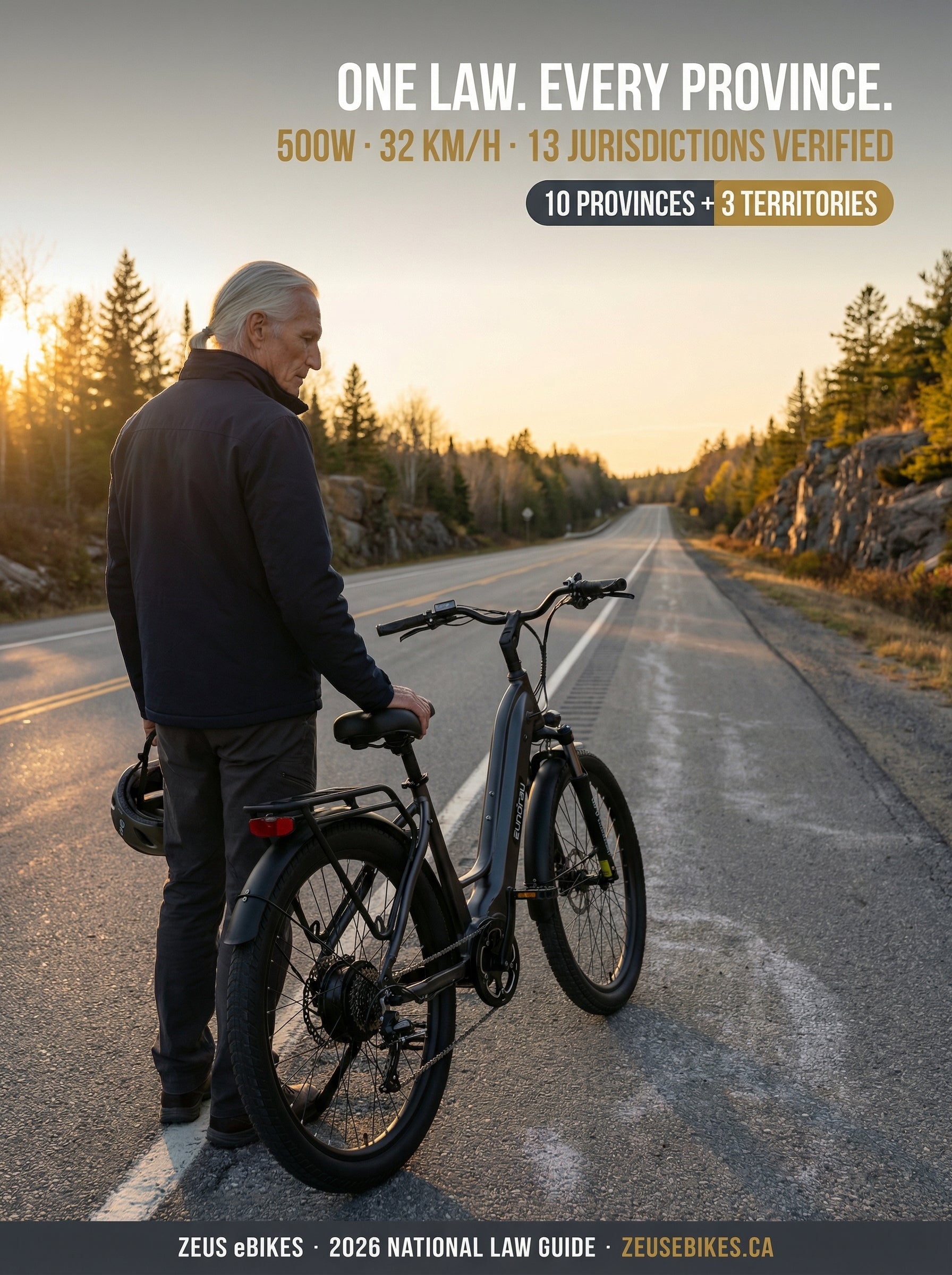
 One law. Every province. Zeus with the Meta275 500W on Highway 17 — the road that connects Ontario to Québec without changing the rules.
Get the rules wrong and a 30-second police stop ends with a fine, your bike on a tow truck, and your home insurance refusing to cover any crash that happened on the way. Get them right and you ride a 500W eBike anywhere in Canada with no driver’s licence, no vehicle registration, no plates, and no insurance — in any province, any city, any path that allows bicycles. Over five years, that is roughly $7,500–$12,500 saved versus a moped or scooter.
Three rules cover 90% of it: 500W nominal motor or less, motor cuts at 32 km/h, working pedals. Meet all three and you are a power-assisted bicycle (PAB) under federal law, and every province treats you like a regular cyclist. Miss any one and your bike is reclassified as a motor vehicle — registration, insurance, and a driver’s licence apply.
This guide settles the remaining 10%: where the provinces diverge on age, helmets, and throttles; what changed in 2024–2026; what fines look like in real Canadian cities right now; how to verify a listing is actually 500W nominal (not 750W relabeled); a 30-second playbook for a police stop; and 16 Zeus eBikes that ship PAB-compliant out of the box.
- Motor: 500W maximum nominal (continuous) output — all provinces
- Speed: Motor must stop assisting at 32 km/h (BC Light class: 25 km/h)
- Pedals: Operable pedals required — a bike that cannot be pedalled is not a PAB
- Licence / Registration / Plates / Insurance: Not required for a compliant PAB in any province
- Helmet: Required in every jurisdiction except Manitoba (under 18 only)
- Min age: 12 (AB) · 14 (SK, MB, QC w/ 6D) · 16 (ON, BC) · varies elsewhere
- Throttle: Legal in most provinces — restricted in QC, AB, NL and BC’s Light class
- Get it wrong: Bike is reclassified as a motor vehicle — fines, impoundment, insurance void
Start with our 15 best 500W street-legal eBikes or the general eBike Canada pillar — every pick meets the national PAB standard. Or jump to the 16 legal picks in this guide.
This guide settles the federal rules and provincial differences. For trail-by-trail and terrain-by-terrain access — Parks Canada (the 37-park patchwork), the Trans Canada Trail’s 28,000 km / 500-operator system, named provincial parks, the 90-cell legality matrix (9 bike types × 10 terrains), and the 15 most common compliance traps — see the Canadian eBike Legal Access Atlas 2026. The Atlas includes a free printable pocket guide that fits in a pannier — eight pages, government-publication design, no email, no signup.
What’s in This Guide
- What Makes an eBike Legal in Canada
- No Licence, No Registration, No Insurance
- Province-by-Province Comparison Table
- Fines, Impoundment & What Enforcement Looks Like in 2026
- What Changed in 2024–2026
- Throttle Rules: The Province That Restricts Them
- Where You Can and Cannot Ride
- What Invalidates Your Legal Status
- The Import Trap: Amazon, Walmart & the Nominal-vs-Peak Scam
- 16 PAB-Compliant Zeus Picks ($1,000–$4,999) — with a Quick Match by rider type
- Pre-Purchase Compliance Checklist
- If Police Stop You: A 30-Second Playbook
- Frequently Asked Questions (10)
What Makes an eBike Legal in Canada?
The line between “legal cyclist” and “unlicensed motor vehicle operator” is six numbers on a spec sheet. Cross any one of them and your bike loses its bicycle classification at the federal level — and every province treats the reclassified vehicle as a moped or motor vehicle, with the licensing, registration, and insurance obligations that follow. The good news: those six numbers are public, fixed, and written into the federal Motor Vehicle Safety Regulations (C.R.C., c. 1038, §2). Every province adopts them without modification as the baseline.
A bike that meets all six is a power-assisted bicycle (PAB). A PAB is treated like a conventional bicycle — same road access, same rules, no motor vehicle requirements. A bike that fails any one is not a PAB, and never will be on a public road, regardless of how the listing is marketed.
The PAB standard has six technical requirements. A bike must meet all six:
| Requirement | Specification | What It Means in Practice |
|---|---|---|
| Motor output | Max 500W nominal (continuous) | The sustained power rating, not peak burst. A 500W motor peaking at 900W during hard starts is compliant. A motor rated at 750W nominal is not. |
| Assisted speed | Max 32 km/h | Motor must stop helping at or before 32 km/h. You can pedal faster — the limit is on the motor, not the rider. |
| Pedals | Operable at all times | The bike must be rideable under human power alone. Remove the pedals and it is no longer a PAB. |
| Total weight | Max 120 kg (bike + battery) | Rider weight is not counted. Most e-bikes weigh 25–50 kg — well within the limit. |
| Brakes | Two independent systems | Front and rear brakes, each functional independently. Hydraulic discs exceed this standard easily. |
| Electrical safety | Insulated terminals | No exposed wiring on the motor or battery. All reputable manufacturers build to this standard. |
Do You Need a Licence for an Electric Bike in Canada?
No. A compliant power-assisted bicycle requires no driver’s licence, no vehicle registration, no licence plate, and no insurance in any Canadian province or territory. This is not a loophole — it is by design. The PAB definition exists specifically to separate electric bicycles from motor vehicles so they can be treated like conventional bikes.
The only province-level exception: Québec requires riders aged 14–17 to hold a Class 6D moped licence. Riders 18 and older need nothing. Every other province has zero licensing requirements for PAB riders of any age above the minimum.
What You Do Not Need (Anywhere in Canada)
- Driver’s licence — not required for a compliant PAB at any age above the provincial minimum
- Vehicle registration — not required and not available in most provinces (a PAB cannot be registered)
- Licence plate — not required
- Insurance — not required (though optional coverage is available — see our eBike Insurance Canada guide)
When You DO Need a Licence
If your bike exceeds the PAB definition — motor above 500W nominal, assisted speed above 32 km/h, or no operable pedals — it becomes a motor vehicle. Motor vehicles require registration, insurance, and a valid driver’s licence in every province. There is no middle ground: a bike either meets the PAB definition or it does not.
Eunorau Meta275 500W
$1,979No licence required. No registration. No insurance. The Meta275 is the default recommendation for riders who want a PAB-compliant commuter with no paperwork. 65 Nm torque sensor delivers proportional, natural pedal feel. Ships with a free second battery for dual-battery range up to 105 km. 500W nominal, 32 km/h — legal on public roads in every Canadian province.
 Taubik Westridge 29T — No Licence. No Registration. Just Ride.
Province-by-Province Comparison: One Table
Every province adopted the federal 500W / 32 km/h baseline. The differences are in rider requirements: minimum age, helmet rules, and throttle policy. This table covers all 10 provinces and 3 territories.
| Province | Min Age | Helmet | Throttle | Key Gotcha | Guide |
|---|---|---|---|---|---|
| Ontario | 16 | All ages | ✅ Allowed | No passengers under 16. Bill 197 (2024) will create new e-bike classes — regs pending. | ON |
| Québec | 14 (6D) / 18 | All ages | ⚠️ Restricted | Throttle-only riding non-compliant. 14–17 need Class 6D licence. Moped-style banned July 2024. | QC |
| British Columbia | 16 / 14 | All ages | Standard ✅ / Light ❌ | Two classes since April 2024. Light: 250W, 25 km/h, no throttle. Standard: 500W, 32 km/h. | BC |
| Alberta | 12 | All ages | ⚠️ Pedal-engage | Lowest age in Canada (12). Motor must disengage when pedalling stops. Over 500W = moped (Class 7 licence). | AB |
| Saskatchewan | 14 | All ages | ✅ Allowed | Has two categories (power-assisted vs power cycles) — power cycles need registration. | SK/MB |
| Manitoba | 14 | Under 18 only | ✅ Allowed | Only province where adults can legally ride without a helmet (though not recommended). | SK/MB |
| Nova Scotia | No specific min | All ages | ✅ Allowed | Wheel diameter minimum 350 mm. PAB treated identically to standard pedal bicycles. | — |
| New Brunswick | No specific min | All ages | ✅ Allowed | Over 500W without CMVSS label requires engineer certification to register. | — |
| PEI | No specific min | All ages | ✅ Allowed | PAB rules came into effect July 2021. E-bike rebate programme available. | — |
| Newfoundland | 14 (permit 14–17) | All ages | Pedal-engage | Riders 14–17 need a permit. Motor must disengage when pedalling stops. Fine up to $180 for no helmet. | — |
| Yukon | Follows federal | All ages | ✅ Allowed | Limited dedicated legislation. Follows federal baseline. | — |
| NWT | Follows federal | All ages | ✅ Allowed | Limited dedicated legislation. Follows federal baseline. | — |
| Nunavut | Follows federal | All ages | ✅ Allowed | Limited dedicated legislation. Follows federal baseline. | — |
Motor limit: 500W nominal in all jurisdictions. Speed limit: 32 km/h in all jurisdictions (BC Light class: 25 km/h). No licence, registration, or insurance required for compliant PABs in any jurisdiction.
Riding across multiple provinces this season?
The Canadian eBike Legal Access Atlas goes one layer deeper: which terrains accept which bike types, the 13 jurisdictions side-by-side, the 15 hidden traps, the 5-Step Decision Tree. It includes a free 8-page printable pocket guide that fits in a pannier — no email, no signup.
↓ Download the Atlas Pocket Guide (PDF) Open the Full Atlas → Freesky Nova B-360 — One Law. Coast to Coast.
Fines, Impoundment & What Enforcement Looks Like in 2026
A bike that fails the PAB definition is a motor vehicle on a public road. That single reclassification triggers four enforcement consequences — and the fine is usually the smallest of them. Enforcement intensity varies wildly by province; the legal exposure does not.
| Violation | What it looks like | Typical penalty range |
|---|---|---|
| Operating an unregistered motor vehicle | Police verify motor specs against PAB definition; non-PAB on a road = unregistered MV | $250–$2,000 set fine (varies by provincial schedule) |
| Operating without insurance | Same stop, separate offence under provincial compulsory-insurance acts | Significant. Ontario’s Compulsory Automobile Insurance Act sets fines starting at $5,000 for a first offence; BC, AB, and other provinces have similar floors. |
| Operating without a driver’s licence | If the bike is reclassified, the rider needs the appropriate class licence | Several hundred dollars per offence; potential demerit consequences for current licence holders |
| No helmet | Enforced separately from PAB compliance in every province except Manitoba (under 18 only) | $30–$160 set fine (Ontario commonly $60; BC $29; AB municipalities vary) |
| Riding on a sidewalk | Banned for PABs in most provinces; municipal bylaws may add restrictions | $50–$120 set fine (commonly $90 in Ontario) |
| Québec moped-style frame on public roads | SAAQ + SPVM crackdown active since July 2024 on bikes that look like mopeds | $300–$600 documented across Montreal and Quebec City |
- Insurance void in a crash. If your bike is reclassified as a motor vehicle, your home or tenant insurance personal liability rider excludes it. A serious injury claim against you is uninsured — potentially six figures in damages.
- Bike impounded on the spot. Provinces with vehicle seizure powers (BC, AB, MB) can tow your bike at the rider’s expense. Storage fees accrue daily until you pay to release it.
- Civil liability you absorb personally. Without auto insurance, you owe the other party’s medical and property costs out of pocket. This is the line between a $400 ticket and bankruptcy.
- The stop record. Motor vehicle violations attach to your provincial driving record — even if you don’t hold a driver’s licence today — affecting future licensing applications.
What Enforcement Actually Looks Like, Province by Province (April 2026)
Compiled from provincial transport ministry communications and police press releases through April 2026. Enforcement intensity changes; legal exposure does not.
- Ontario: Light enforcement on standard 500W bikes. Heavier focus on cargo bikes outside the cargo pilot scope (see our Ontario Cargo eBike Pilot guide) and on moped-style frames in Toronto’s downtown core. See the Toronto eBike Laws 2026 guide for city-level specifics.
- Québec: Active SAAQ + SPVM enforcement of moped-style frames since July 2024 — $300–$600 fines documented across Montreal and Quebec City. See our Québec eBike Laws guide.
- British Columbia: Soft enforcement of the new two-class system. Vancouver targets non-PAB bikes on the seawall, Stanley Park paths, and Lions Gate connector. See BC eBike Laws.
- Alberta: Light roadside enforcement except for clearly modified bikes (visible motor swaps, missing pedals). See Alberta eBike Laws.
- Saskatchewan & Manitoba: Largely complaint-driven. SK distinguishes power-assisted vs power cycles; check the category before riding. See SK/MB eBike Laws.
- Maritime provinces + territories: Active enforcement is rare. Most cases are crash-related or sidewalk-riding complaints. Legal exposure remains identical to elsewhere.
What Changed in 2024–2026
Three provinces updated their e-bike regulations in the past two years. If you bought your bike before April 2024, the rules may have changed under you.
| Province | Change | Date | What It Means for Riders |
|---|---|---|---|
| British Columbia | Two-class e-bike system created (B.C. Reg. 64/2024) | April 5, 2024 | BC now has Light E-Bikes (250W, 25 km/h, no throttle, age 14+) and Standard E-Bikes (500W, 32 km/h, throttle OK, age 16+). Most Zeus 500W bikes fall into the Standard class. The Light class opens trail access in some parks that restrict Standard e-bikes. |
| Ontario | Bill 197 repealed “power-assisted bicycle” from the HTA | Royal Assent Nov 19, 2024 | The term “PAB” is being replaced with regulation-making authority for new e-bike classes. No new regulations have been enacted yet — the existing 500W / 32 km/h rules remain in effect until new regulations are proclaimed. The Ontario cargo e-bike pilot expires March 1, 2026, with a proposed extension to 2031. |
| Québec | SAAQ banned non-compliant moped-style e-bikes from public roads | July 2024 | Vehicles with footrests, motorcycle-style wheels, or motors exceeding 500W face $300–$600 fines. SPVM enforcement targeting moped-style frames that are sold as “e-bikes” but do not meet the PAB definition. Standard 500W bikes with pedals are unaffected. |
 Taubik Monaco — Designed in Canada. Built for Canadian Rules.
Throttle Rules: The Province That Restricts Them
In most provinces, throttles are legal on a PAB. The bike must still have operable pedals, but a throttle that propels the bike without pedalling is permitted — provided the motor stays under 500W and cuts at 32 km/h. The exception is Québec.
The SAAQ requires that a power-assisted bicycle’s motor be activated by pedalling. This means throttle-only operation on public roads does not meet Québec’s interpretation of the PAB definition. A bike with a throttle is not automatically illegal — but using it without pedalling is. For Québec-specific details, see our Québec eBike Laws guide.
Alberta and Newfoundland also require the motor to disengage when the rider stops pedalling — a functional restriction on throttle-only riding, though the wording differs from Québec’s approach.
BC’s Light E-Bike class (250W, 25 km/h) prohibits throttles entirely. The Standard class (500W, 32 km/h) allows them, with the requirement that the throttle has an on/off switch or a 3 km/h engagement delay.
If you plan to ride across provinces — or are unsure which province you will be in — the safest legal position is a pedal-assist eBike with a torque sensor. It is legal everywhere, without exception.
An Ontario rider with a fully legal 500W throttle eBike crosses the bridge into Gatineau (Québec) for lunch. The bike is identical. The rider is identical. The throttle is identical. The instant they cross the river, throttle-only operation is non-compliant under Québec’s SAAQ interpretation. Same situation crossing into Alberta from Saskatchewan, or onto a Trans Canada Trail segment with stricter operator rules.
Practical defence: if your cross-provincial route includes Québec, Alberta, Newfoundland, or BC’s Light-class trail networks, ride in pedal-assist mode the entire route. The motor still helps. The throttle simply isn’t used. For the full terrain-by-terrain breakdown, see the Canadian eBike Legal Access Atlas — it lists which trail systems prohibit throttles even where the province permits them. The Trans-Canada eBike Atlas covers the 28 named long-distance routes specifically.
Taubik Westridge 29T
$2,89990 Nm is the highest torque of any 500W PAB-compliant eBike at Zeus — and it is activated by a torque sensor, not a cadence switch. That combination means the motor responds proportionally to pedal pressure, which is exactly the behaviour that Québec, Alberta, and every other province considers compliant. The 29″ wheels roll over roots and broken pavement better than smaller diameters, and the Kenda Booster Pro tyres grip in wet conditions. Designed in Canada. UL-certified Samsung 21700 cells. Mozo coil suspension fork. 500W nominal, 32 km/h — legal on every Canadian road.
 Eunorau Meta Foldable — Pedal Assist. Legal Everywhere.
Where You Can and Cannot Ride
A compliant PAB has the same road access as a conventional bicycle in every Canadian province. That means most public roads and bike lanes are open. The restrictions are consistent nationwide:
| Location | Status | Notes |
|---|---|---|
| Public roads and streets | ✅ Permitted | Same rules as conventional bicycles. Obey all traffic signals and signs. |
| Bike lanes and cycle tracks | ✅ Permitted | Compliant PABs are permitted in cycling infrastructure in all provinces. |
| Multi-use trails and pathways | ⚠️ Varies | Check with the specific trail authority. Provincial parks, conservation areas, and municipal trails set their own rules. Many permit Class 1 pedal-assist but restrict throttle bikes. |
| Sidewalks | ❌ Prohibited | Nearly all provinces ban PABs from sidewalks, following standard bicycle rules. Enforcement varies by city. |
| Highways and expressways | ❌ Prohibited | Controlled-access highways are closed to bicycles and PABs in all provinces. |
Looking for a city-specific breakdown?
Zeus publishes law guides for Calgary, Edmonton, Ottawa, and Vancouver — each with local rules + top picks for that city.
Browse All 500W Legal Picks →What Invalidates Your Legal Status
A bike that qualified as a PAB when you bought it can lose that status if modified. The consequences of riding a reclassified vehicle without registration, insurance, and a licence are a provincial offence in every jurisdiction.
- Increasing motor output above 500W nominal — controller chips, winding mods, or motor swaps that raise sustained output
- Removing or disabling the pedals — no operable pedals = not a PAB
- Modifying the speed limiter — allowing motor assist above 32 km/h on public roads
- Adding a combustion engine — the PAB definition requires an electric-only motor
If a modified bike is reclassified as a motor vehicle and operated on public roads without registration and insurance, the rider faces fines and potential licence consequences — even if they do not hold a licence, because operating a motor vehicle without one is a separate offence.
Taubik Monaco
$2,099Designed in Canada. UL-certified Samsung 21700 cells. Compact 20″×3.0″ Kenda Street tyres fit tight hallways, elevator corners, and condo bike rooms without folding. Zoom hydraulic dual-piston brakes, Shimano 8-speed, colour LCD. Four colour options including Robin’s Egg. 500W nominal, 32 km/h — PAB-compliant nationally. For riders who want a Canadian-designed eBike that needs no modification to be legal anywhere in the country.
 Eunorau Defender — 500W. Full Suspension. Trail-Tested.
The Import Trap: Why Most “Canada-Legal” Listings Aren’t
The single fastest way Canadians end up illegal: they buy from Amazon, Walmart, eBay, Canadian Tire, Costco, or AliExpress, the listing says “500W” or “Canadian compliant,” and the bike that arrives draws 800–1,200W under load. The product page wasn’t lying outright — it was using one of three engineered loopholes. None of them survive a roadside inspection.
Three Tricks Listings Use
- Peak watts labelled as nominal. “500W (1000W peak)” is fine — that is a true 500W nominal motor with normal headroom. “1000W peak” with no nominal stated, or “750W rated” with a controller that pushes 1500W continuous, is not. The motor sticker, the controller amp rating, and the spec sheet should all agree. When they don’t, the bike is not what the listing claims.
- Software speed limits that unlock with a hidden menu. Many imported bikes ship at 32 km/h “Canada mode,” but a hidden display sequence (often P-code menus or held button combinations) flips the cap to 45, 55, or 70 km/h. The instant you change it — or the dealer changes it before delivery — the bike stops being a PAB. Police don’t need to clock you above 32; they need only confirm the firmware allows it.
- Pedals that look operable but aren’t. Some imported moped-style bikes have decorative pedals that don’t actually drive a chain, that fold flat against the frame for show, or that are cosmetically attached to a fixed crank. If you cannot ride the bike under human power alone with the motor off, it is not a PAB regardless of motor wattage.
How to Verify Before You Buy — The 3 Tests
| Test | What to ask / look for | What pass looks like |
|---|---|---|
| Nominal rating in writing | Email the seller and ask: “Confirm the nominal (continuous) motor rating in watts, not peak, not max output, not rated power.” | A written reply naming “500W nominal” or “500W continuous.” Vague answers, deflections, or only peak figures = fail. |
| Controller current math | Look at the controller spec: amps × battery voltage = sustained power capability. | A 22A controller × 48V = 1,056W. That bike cannot be a 500W PAB regardless of what the listing says. Look for ~10–15A controllers on 48V systems. |
| CMVSS / Transport Canada label | Bikes imported as PABs carry a manufacturer’s certification that the model meets the C.R.C. c. 1038 §2 definition. | A printed label on the frame or a certificate in the documentation. No label on a bike you cannot return = walk away. |
Read the Marketplace Audit Before You Click Buy
Zeus has published honest, unsponsored audits of every major Canadian eBike marketplace — not because we want the sale, but because the same buyers who get burned on Amazon end up calling us six months later asking how to make a non-PAB bike legal. (You can’t. The answer is always to sell it on Kijiji at a loss and start over.) Each audit names the specific models, calls out which are PAB-compliant in writing, which sit in grey zones, and which fail the spec test on day one.
- Amazon eBikes Canada — what $399 to $1,200 actually gets you, model by model
- Walmart eBikes Canada — including the Movelo line (Walmart’s house brand) and 18 Zeus alternatives
- Canadian Tire eBikes — every model audited, with five Zeus alternatives under 500W
- Costco eBikes Canada — all 16 models reviewed
- Buy Ridstar in Canada — 15 sellers investigated, the verified pattern of compliance issues
- Ridstar Amazon Canada warning — what buyers are reporting and how to protect yourself
- How to Spot a Legit eBike Store in Canada — the trust signals that separate retailers from drop-shippers
16 PAB-Compliant Zeus Picks — $1,000 to $4,999
Every pick below has a 500W nominal motor (or less) and is speed-limited to 32 km/h — meeting the federal PAB standard adopted by all Canadian provinces. Verify current specs on the product page before purchasing; specs can change between production runs. For the broader Zeus catalogue across rider profiles, see our Best eBike for Every Rider Type in Canada guide and the general Electric Bikes Canada 2026 pillar.
Quick Match — Pick by Profile in 30 Seconds
If you don’t have time to read every product card, this table tells you which pick fits which rider. All bikes are PAB-compliant nationally. Click through to the product card below for the full reasoning.
| You ride mostly… | The pick | Price |
|---|---|---|
| City + paved paths + mixed pavement | Eunorau Meta275 500W | $1,979 |
| To a folding storage situation (condo, RV, transit) | Eunorau Meta Foldable | $1,994 |
| Errands, family loops, want a step-thru | Eunorau Meta Step-Thru | $1,994 |
| Long days, no charging stops | Freesky Nova B-360 (dual battery) | $2,373 |
| In Québec, AB, NL, or BC Light class (throttle restricted) | Taubik Westridge 29T (90 Nm torque sensor) | $2,899 |
| Canadian-designed compact for tight storage | Taubik Monaco | $2,099 |
| Mid-drive step-thru with full suspension | Himiway A7 Pro Mid-Drive | $2,999 |
| Real trails with real elevation | Eunorau Urus (BAFANG M600) | $4,999 |
| Mountain on a budget (cheapest full-suspension) | Samebike XD26-II | $1,199 |
| Trail-capable but want hardtail comfort + bigger tyres | Eunorau Defender (full suspension) | $2,569 |
| Step-thru hybrid + integrated ring lock | Taubik Blackburn 275T (Canadian-designed) | $2,399 |
| Stable three-wheel platform for neighbourhood errands | Meigi Hera (350W trike) | $1,699 |
| Heavy payload + foldable trike (440 lb capacity) | Eunorau ONE-TRIKE 2.0 | $2,429 |
| Moped-style cruiser with the largest single battery | Eahora FT-01 Max (2025) — verify QC before riding | $4,300 |
| Absolute lowest legal price entry | Samebike LOTDM200-II | $1,299 |
| First eBike, want it to fold, travel, and survive years | Samebike 20LVXD30-II (350W) | $1,000 |
Now, the full reasoning for each pick — what to know before you commit, what each one does well, and where the honest trade-offs sit.
Samebike LOTDM200-II
$1,299At $1,299, the LOTDM200-II is the lowest-cost PAB-compliant eBike in the Zeus catalogue. Fat tyres handle winter slush and gravel paths. Folding frame stores in a closet or car boot. 70 Nm is strong for this price tier. Not the lightest or the most refined — but it is legal on every Canadian road and it gets you riding for under $1,300.
Honest limit: Cadence sensor, not torque. The pedal feel is less natural than the Meta275 above. Weight is on the heavier side for a folder. But at this price, those are expected trade-offs.
Eunorau Meta Foldable
$1,994The folding Meta is the practical choice for condo riders and anyone whose bike needs to live indoors. Folds to fit an elevator cabin, rides with the same torque sensor and hydraulic brake package as the full-size version. 20″×3.0″ Kenda tyres absorb uneven pavement without the rolling resistance of a full fat tyre. Optional second battery extends range to 160 km. PAB-compliant nationally. For the full folding category, see our Best Folding eBikes Canada guide.
 Taubik Blackburn 275T — Canadian Step-Thru. Ring Lock Built In.
Taubik Blackburn 275T
$2,399Designed in Canada. The Blackburn 275T is the step-thru with the most thoughtful spec sheet in this list: a switchable dual torque/cadence sensor lets you toggle between natural pedal feel and steady cruise from the display — a feature that costs $3,000+ on most brands. Integrated Dutch-style ring lock (hardened steel through the rear spokes), UL-certified Samsung 21700 cells, Shimano Altus 7-speed, Zoom hydraulic dual-piston brakes. Optional dual battery brings total capacity to 1,411 Wh and range to ~160 km. Six colour options. 500W nominal, 32 km/h — PAB-compliant nationally. For the full step-thru category, see our Step-Thru eBikes Canada guide.
Honest limit: At 69.5 lbs (31.5 kg), it is heavier than the Meta Foldable. No rear suspension — hardtail only. The coil fork is 60–80 mm travel, not air-adjustable. But the dual sensor, ring lock, and Canadian design make it the most complete step-thru in the PAB-compliant tier.
Eunorau Defender
$2,569The only full-suspension 500W eBike in the Zeus catalogue. Front and rear suspension absorb roots, potholes, and broken pavement that would punish a hardtail. 27.5″×3.0″ tyres sit between trail and all-road — enough volume for gravel without the rolling resistance of a 4″ fat tyre. Optional dual battery extends range to 177 km. 500W nominal, 32 km/h — legal on every Canadian road and any trail that permits e-bikes. For the full mountain category, see our Mountain eBikes Canada guide.
Freesky Nova B-360
$2,373Dual 15Ah Samsung batteries (30Ah total) deliver 120–193 km of range — the longest of any 500W PAB-compliant bike at Zeus. Torque sensor, step-thru frame, 27.5″×2.2″ tyres. For riders whose commute demands range certainty or who ride long recreational routes without charging infrastructure. PAB-compliant nationally. For a full range comparison, see our Long Range eBikes Canada guide.
 Eahora FT-01 Max — Moped Style. 1,440 Wh. PAB-Compliant.
Eahora FT-01 Max (2025)
$4,300The FT-01 Max is the moped-style option in the PAB-compliant tier. 500W nominal motor, 32 km/h speed limit, operable pedals — it meets the federal definition. The 1,440 Wh battery (48V 30Ah) is the largest single battery of any 500W eBike at Zeus. Full suspension front and rear, 20″×4.0″ fat tyres, hydraulic disc brakes, twist throttle, IP65 waterproofing across motor, battery, display, and wiring. The moped-inspired cruiser frame is built for comfortable upright city riding. For the full moped-style category, see our Electric Mopeds Canada guide.
Honest limit: At 90.6 lbs (41 kg), this is the heaviest 500W eBike on this list. Not practical for stairs or tight storage. Cadence sensor, not torque. And the moped aesthetic is worth understanding: Québec’s SAAQ cracked down on moped-style frames in July 2024 — while the FT-01 Max meets the 500W/32 km/h definition and has operable pedals, its moped silhouette may attract enforcement attention in Québec specifically. In every other province, the specs define compliance, not the frame style. If you ride in Québec, verify with a product specialist before purchasing.
Every pick above is PAB-compliant and ships across Canada.
Not sure which one fits your riding style? Our How to Choose an eBike guide walks through the decision in 8 steps.
See All 500W Legal Picks → Current Deals → Himiway A7 Pro — 130 Nm Mid-Drive. Parliament Hill.
Himiway A7 Pro Mid-Drive
$2,999This is the bike for the buyer who chooses a Range Rover over a Honda. The A7 Pro is a 500W mid-drive — the motor sits at the cranks, not the hub, which means it uses the Shimano 9-speed drivetrain to multiply torque through the gears. 130 Nm is the highest torque of any step-thru on this page. German-engineered Schwalbe Super Moto-X tyres with puncture-resistant belts. SR-Suntour X1-BOOST fork with 120 mm travel. DNM rear shock. A dropper seat post with 100 mm of travel, adjustable without dismounting. Built-in electronic rear wheel lock. Integrated cargo rack with bungee cords. Front and rear fenders. 48V LED headlight and brake-actuated tail light. The free security kit includes an anti-theft alarm, U-lock, phone holder, and mirrors.
Every sensor: torque, shifting, speed, and brake — four independent inputs feeding the motor controller. This is the kind of sensor integration found on European mid-drives costing $5,000+. The step-thru frame fits riders from 5’3″ to 6’5″. The finish is what our review called AAAA-grade — two years in, the paint still looks showroom. One warranty call in 24 months across all units sold. 500W nominal, 32 km/h — PAB-compliant nationally. For the full review, see our Himiway A7 Pro 2-Year Review. For the mid-drive vs hub motor breakdown, see why mid-drive matters for hills and range.
Honest limit: At 77 lbs (34.9 kg), this is not light. The 720 Wh single battery delivers 55–78 km real-world range — less than the dual-battery picks above. No dual-battery option. And at $2,999 (sale), it is the second-most expensive pick on this page. The premium is in the mid-drive engineering, the component quality, and the build finish — not in battery capacity.
 Samebike XD26-II — $1,199. Full Suspension. Cascade Mountain.
Samebike XD26-II
$1,199Full suspension, 500W motor, 720 Wh battery, hydraulic disc brakes, Shimano 7-speed — at $1,199, the XD26-II is the cheapest mountain eBike at Zeus by a wide margin. At 25.5 kg it is also one of the lightest. Four colour options. 180 kg payload. 55–110 km range. For riders entering the eMTB category who want full suspension without a $2,500+ commitment.
Honest limit: Cadence sensor, not torque — the pedal feel is less refined than torque-sensor picks. Mechanical disc brakes, not hydraulic. But at $1,199 for full suspension, 720 Wh, and hydraulic-level stopping power, those are expected trade-offs at this price point. Ships speed-limited to 32 km/h out of the box — PAB-compliant on arrival. For the full mountain category, see our Mountain eBikes Canada guide.
 Eunorau Urus — 120 Nm. BAFANG M600. The Stawamus Chief.
Eunorau Urus
$4,999The Urus is not for casual riders. BAFANG M600 mid-drive producing 120 Nm through an SRAM NX 11-speed drivetrain. X-Fusion TRACE fork with 160 mm travel. X-Fusion DLX rear shock. Tektro HD-E725 hydraulic brakes with 203 mm front rotor. Maxxis Minion 27.5″×2.8″ tyres — the same rubber used on competitive downhill bikes. Remote dropper seat post. Two frame sizes (17″ and 19″). Samsung 840 Wh battery. This is a serious trail machine built from components that trail riders will recognise and respect.
Honest limit: At $4,999 (sale), this is the most expensive pick on this page. No rack, no fenders, no lights — it is a trail machine, not a commuter. 61.7 lbs is heavy for a 27.5″ bike. But if you ride real trails with real elevation, this is the bike that belongs there. Ships speed-limited to 32 km/h out of the box — PAB-compliant on arrival. For the mid-drive advantage on steep terrain, see our mid-drive vs hub motor guide.
 Meigi Hera — Three Wheels. Peggy’s Cove.
Meigi Hera Electric Trike
$1,699The Hera is the trike that does not try to be anything it is not. 350W motor, 24 km/h top speed, three wheels, a rear basket, and a retro silhouette that looks like it belongs on a European seaside promenade. At 350W and 24 km/h, it sits comfortably under the PAB limit in every Canadian province — including BC’s Light E-Bike class. Tektro mechanical disc brakes. Shimano 7-speed. Removable battery. Twist throttle. LED lights front and rear. The 24″ Kenda tyres ride smooth on pavement and packed gravel.
The rear basket is 19″×15″×10″ with a 50 lb capacity — groceries, a bag of dog food, a case of beer. That is the use case: neighbourhood errands, farmers’ market runs, cottage laps. No complexity. No learning curve. Three wheels that do not fall over. For riders who want stability over speed and charm over specs, this is the pick. For the full trike category, see our Electric Trikes Canada guide.
 ONE-TRIKE 2.0 — 440 lbs Payload. Foldable.
Eunorau ONE-TRIKE 2.0
$2,429The ONE-TRIKE 2.0 is built for payload. 440 lbs (200 kg) capacity — the highest of any trike at Zeus. The folding stem makes it storable in a garage or car trunk despite being a three-wheeler. 500W motor, 80 Nm torque, hydraulic disc brakes with motor cutoff, 48V/14.5Ah battery with up to 80 km range. The comfort saddle includes a backrest. Suspension fork with 40 mm travel. For heavier riders, cargo haulers, or anyone who needs three-wheel stability with serious carrying capacity, this is the pick. PAB-compliant nationally. For the full trike comparison, see our Electric Trikes Canada guide.
 Eunorau Meta Step-Thru — The Gift. Niagara Falls.
Eunorau Meta Step-Thru
$1,994If you are buying an eBike for your girlfriend, wife, or mother — and you want to get it right the first time — this is the one. The Meta Step-Thru comes in two frame sizes, which means you can match the bike to her height instead of hoping one size fits. The step-thru frame makes mounting and dismounting effortless. The torque sensor delivers natural, proportional pedal assist — the kind that feels like riding a regular bike with a tailwind, not a throttle-controlled machine. Hydraulic brakes. Front suspension. Optional second battery extends range to 160 km for day rides.
At $1,994, it is the most thoughtful gift in the 500W PAB-compliant tier: a bike she will actually ride, not one that collects dust because the frame is wrong or the motor feel is harsh. Every Zeus eBike ships with free Canada-wide delivery. For more options, see our Best eBikes for Women Canada guide.
Editor’s Note: The One Bike Every Canadian Family Should Own
Samebike 20LVXD30-II
$1,000This is not a 500W pick. It is a 350W folder at $1,000 — and it is the bike our own family keeps at home. The reason it is on this page: at 350W, it sits under the PAB motor limit in every province, making it legal anywhere in Canada without question. No grey areas. No enforcement risk. No debate.
The real value is what it replaces. This bike has saved thousands in ride-share costs because it travels: fold it, load it in a car trunk, take it to another city, unfold it, ride. It goes to campsites. It handles cottage country. It works for riders up to 6’4″ (the suspension seat post and adjustable handlebar stem accommodate tall frames). It ships with rear rack, fenders, front and rear lights, twist throttle, 5-level pedal assist, Shimano 7-speed, and a lockable removable battery — everything you need, nothing you do not. The 20″×1.95″ tyres are standard-width — lighter and faster-rolling than fat tyres, with enough grip for pavement, packed gravel, and dry trails. 150 kg (330 lb) payload capacity.
Why we trust it: Zero warranty calls. Not one. Across every unit sold. That is the single most meaningful spec a retailer can report. For a complete breakdown of the folding eBike category, see our Best Folding eBikes Canada guide.
 Samebike LOTDM200-II — $1,299. Handles Winnipeg in March.
Pre-Purchase Compliance Checklist
Before buying any eBike you plan to ride on Canadian public roads, verify these five items against the spec sheet — not the marketing copy:
- Nominal motor rating is 500W or less. Look for “500W rated,” “500W nominal,” or “500W continuous.” If the listing only shows peak wattage, ask the retailer to confirm the nominal rating in writing.
- Assisted speed is limited to 32 km/h. Some bikes ship with a configurable speed limit. Confirm the bike is set to 32 km/h and the setting cannot be overridden without tools.
- Pedals are operable. The bike must be rideable under human power alone. Test this before purchase if possible.
- Total weight is under 120 kg. Most eBikes weigh 25–50 kg. Dual-battery builds can approach 55 kg. All well within the limit.
- Two independent brakes are present. Hydraulic disc brakes (standard on most Zeus picks) exceed this requirement. Verify both levers actuate independently.
If Police Stop You: A 30-Second Playbook
A police stop on a PAB-compliant 500W eBike is brief and uneventful — if you know what an officer is checking. They verify three things: the motor wattage, the speed limit setting, and (in helmet provinces) the helmet. That’s it. The stop should end in under five minutes.
The 30-Second Response
- Stay calm. Dismount. Roll the bike to the side. Don’t argue. Don’t volunteer information. The officer is probably checking a routine compliance question, not building a case.
- Point to the motor. Most Zeus eBikes have the wattage stamped or stickered on the motor housing — usually the rear hub or near the crank for mid-drives. Say: “It’s a 500W nominal motor — meets the federal PAB definition.” Confident, factual, brief.
- Mention the speed limiter. “It’s set to 32 km/h. The display shows the cap.” If your display can show the speed-limiter setting, switch to that screen and hand the bike forward.
- Have one document ready: the spec sheet. Save the Zeus product page (or the manufacturer’s spec PDF) on your phone. Either page shows nominal motor rating in writing. That’s enough — you don’t need a lawyer’s opinion, you need the spec.
- Helmet on. In every province except Manitoba (under 18 only), no helmet is a separate offence regardless of the bike’s compliance. Wearing one removes a free reason for the officer to write a ticket.
What Officers Don’t Check Roadside (And What They Do)
| Roadside (fast) | Garage / inspection-level (slow) |
|---|---|
| Motor sticker / stamp | Controller current rating |
| Speed limiter setting on display | Firmware menus |
| Pedals present and operable | Battery voltage / Wh capacity |
| Helmet (in helmet provinces) | Tear-down for unauthorised modifications |
Roadside stops almost never escalate to inspection-level scrutiny unless the bike is visibly modified (drilled motor vents, exposed aftermarket controllers), missing pedals, or the rider admits to changing the firmware. Do not say anything that admits to a modification. If you’ve made one, the bike isn’t a PAB and this guide doesn’t protect you.
- Visibly modified motor (drilled vents, painted-over labels, aftermarket housing)
- Missing or non-functional pedals
- Throttle being used in Québec without the rider pedalling
- Moped-style frame in Québec without obvious operable pedals (active SAAQ enforcement)
- The rider admitting they changed the speed limit setting
- Speed observed above 32 km/h on motor power alone
Avoid all six and the stop ends in under five minutes. Any one and the conversation gets longer, and the bike may be detained for inspection.
Frequently Asked Questions
Do you need a licence for an electric bike in Canada?
No — as long as the bike meets the PAB definition: 500W maximum nominal motor, motor stops assisting at 32 km/h, operable pedals. A compliant PAB requires no driver’s licence, no vehicle registration, and no licence plate in any Canadian province or territory. Québec’s only exception: riders aged 14–17 need a Class 6D moped licence.
What is the speed limit for e-bikes in Canada?
32 km/h is the motor-assisted speed limit across all provinces and territories. The motor must stop helping at or before 32 km/h. You can pedal faster under your own power — the limit applies to the motor only. BC’s Light E-Bike class has a lower motor cutoff of 25 km/h.
Are 750W e-bikes legal in Canada?
Not on public roads. A 750W nominal motor exceeds the 500W PAB limit. A bike with a 750W continuous-rated motor does not qualify as a power-assisted bicycle in any province. It may be classified as a moped or motor vehicle, requiring registration, insurance, and a licence. It is legal on private property and trails that permit it. See the 500W vs 750W vs 1000W guide for a full breakdown.
Are 1000W e-bikes legal in Canada?
Not on public roads. 1000W nominal is double the 500W PAB limit. On public roads, a 1000W bike is classified as a motor vehicle. It is legal on private property and off-road trails where permitted. See the 1000W eBikes Canada guide for off-road options and the legal framework.
Do you need a helmet for an electric bike in Canada?
In every province except Manitoba, yes — helmets are mandatory for all e-bike riders regardless of age. Manitoba requires helmets only for riders under 18 (recommended for all). An approved bicycle helmet meeting CSA, CPSC, ASTM, or EN 1078 certification qualifies in all provinces.
Are throttle e-bikes legal in Canada?
In most provinces, yes — throttles are legal if the bike meets the PAB definition (500W, 32 km/h, operable pedals). Québec restricts throttle-only operation on public roads. Alberta and Newfoundland require the motor to disengage when the rider stops pedalling. BC’s Light E-Bike class prohibits throttles; the Standard class allows them. For a full comparison, see our Pedal Assist vs Throttle guide.
Can you get a DUI on an e-bike in Canada?
The Criminal Code’s impaired driving provisions apply to “motor vehicles.” A compliant PAB is excluded from the motor vehicle definition in most provincial highway traffic acts — but provinces may have separate provisions, and case law has produced mixed outcomes. Regardless of classification, riding impaired is dangerous and may result in charges under other statutes. This is not legal advice — consult a lawyer for your specific situation.
Do you need insurance for an electric bike in Canada?
No province requires insurance for a compliant PAB. If your bike exceeds the PAB definition, it may be classified as a motor vehicle requiring insurance. Optional e-bike coverage is available through dedicated providers and some home insurance riders. For a full breakdown, see our eBike Insurance Canada guide.
What is the minimum age to ride an e-bike in Canada?
Alberta: 12. Manitoba and Saskatchewan: 14. Québec: 14 with a Class 6D licence, 18 without. Ontario and BC: 16. Nova Scotia, New Brunswick, PEI: no specific minimum age in PAB legislation. Newfoundland: no general minimum, but riders 14–17 need a permit.
Can you ride an e-bike on sidewalks in Canada?
Generally no. Most provinces prohibit e-bikes on sidewalks, following the same rules as conventional bicycles. Ontario’s Highway Traffic Act explicitly bans PABs from sidewalks province-wide. Bike lanes and cycle tracks are permitted in all provinces for compliant PABs.
The Bottom Line
Canadian eBike law is simpler than 90% of riders think. One national standard — 500W nominal motor, 32 km/h motor cutoff, operable pedals — makes your bike legal on public roads in every province and territory. No driver’s licence. No vehicle registration. No insurance. No plates. No road tax. The only meaningful variations are minimum age (12 in Alberta, 16 in Ontario and BC, varies elsewhere), helmet rules (Manitoba is the only adults-exempt province), and throttle policy (Québec restricts, Alberta and Newfoundland require pedal engagement, BC splits into two classes).
What that’s worth, in dollars. A driver’s licence costs roughly $80–$160 to issue and $80+/year in renewal fees across most provinces. Vehicle registration runs $80–$120/year. Vehicle insurance averages $1,500–$2,500/year for a Canadian driver, and a moped or scooter typically carries $400–$1,000/year minimum. A compliant 500W eBike costs zero of all of these. Over five years, the licence-and-insurance savings alone exceed the full purchase price of every bike on this page — including the $4,999 Eunorau Urus. That’s before you count the gasoline you don’t buy. (For the wider picture on Canadian costs — auto, housing, food — see Why Is Canada So Expensive? and Canada’s $300B/yr car dependency.)
The catch is binary. You are either a PAB or you are not. There is no middle ground. Bikes labelled “500W” that aren’t actually 500W nominal — and bikes whose firmware unlocks past 32 km/h — fail the test the second the controller draws more current than the rating allows. Buy from a retailer that audits its inventory against the actual federal definition. For Canadian road use, the answer is a 500W nominal eBike with a 32 km/h speed limiter and operable pedals — the exact specification every Zeus eBike on this page ships with, no modifications, no grey areas.
For trail-by-trail and terrain-by-terrain access — Parks Canada, Trans Canada Trail, named provincial parks — see the Canadian eBike Legal Access Atlas with its free printable pocket guide. For off-road, private property, and trails where the PAB definition does not apply, see our 500W vs 750W vs 1000W guide for the full legal breakdown by power tier.
Published: June 2025 | Last Updated: April 30, 2026 | By: Zeus eBikes Canada Editorial Team
📸 All photography by Playcut.ai — personalised AI actor technology
Ontario eBike Laws (2026) — 500W limit, age 16+, helmet all ages, Toronto-specific rules
Québec eBike Laws (2026) — SAAQ rules, age 14+ with Class 6D, throttle restriction
BC eBike Laws (2026) — two-class system, Light vs Standard, trail access
Alberta eBike Laws (2026) — age 12+, motor must disengage when pedalling stops
Saskatchewan & Manitoba eBike Laws (2026) — age 14+, Manitoba helmet under 18 only
Toronto eBike Laws (2026) — bike lanes, trails, parking, cargo restrictions
Best Electric Bikes Toronto (2026) — 16 picks for condos, commutes, winter
Montréal eBike Rules (2026) — SPVM enforcement, STM transit ban, path access
Ontario Cargo eBike Pilot Update — expiration timeline, proposed extension to 2031
Trans-Canada eBike Atlas (2026) — 28 named long-distance routes, every province
Best 500W eBikes Canada (2026) — every street-legal pick, every riding style
Electric Bikes Canada (2026) — the general pillar, 16 picks across 6 rider types
Best eBike for Every Rider Type — 21 picks, $1,299–$5,599
Why Buy Canadian eBike (2026) — trust, support, warranty, 29 picks
First-Time eBike Buyer Checklist — 17 mistakes, 26 picks
eBike Theft Protection Canada — the 3-layer system that actually works
eBike Insurance Canada — do you need it, real costs, 3 options
Share:
Toronto Electric Bike Laws (2026): Where You Can Ride (Bike Lanes, Trails, Sidewalks), Parking Rules, and 5 Toronto-Friendly Picks
Best Electric Dirt Bikes in Canada (2026): Riding Times GT73 vs GT54 vs Z8 + The “Full-On” R1 (Which One’s Right for You?)