
How to Choose an Electric Bike in Canada (2026): The 8-Step Buyer's Checklist

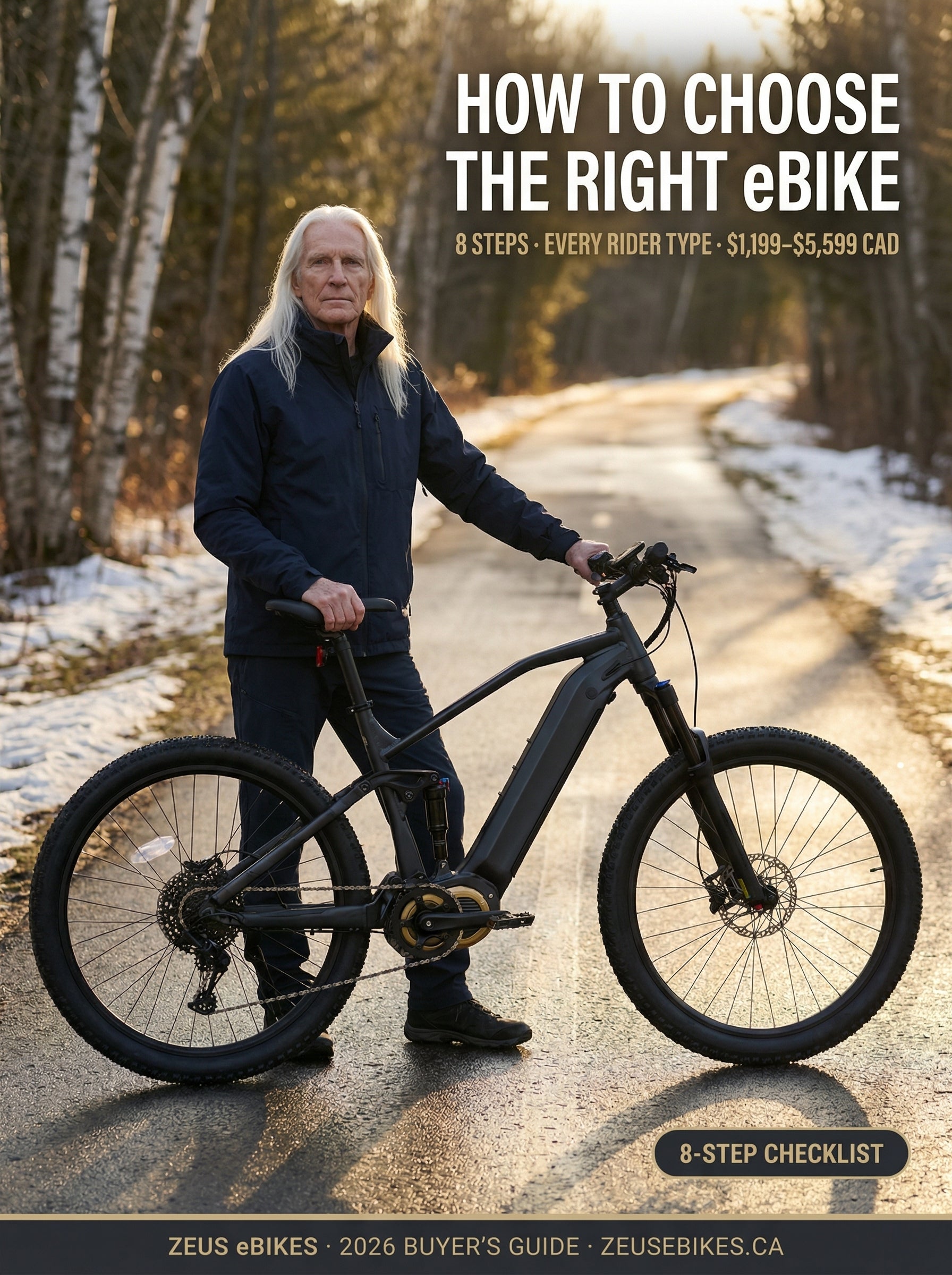
8 steps: (1) Identify your terrain — urban pavement, mixed gravel, trail, or year-round winter. (2) Set a real budget including lock, helmet, lights, and maintenance. (3) Choose hub motor for city and mixed terrain, mid-drive for sustained hills and trails. (4) Calculate range as your longest trip × 1.5, then add 20% for Canadian winter. (5) Decide between pedal assist (exercise and range), throttle (commuting ease), or both. (6) Match frame style — step-thru for easy mounting, folding for apartments — and verify weight capacity. (7) Confirm Canadian warranty coverage and local service. (8) Match your rider type to the right verified guide.
Ready to pick now? The best electric bikes in Canada guide lists 18 verified picks from $1,199 to $4,019 organized by price. The eBike Canada buying guide matches 16 picks to 6 specific rider profiles.
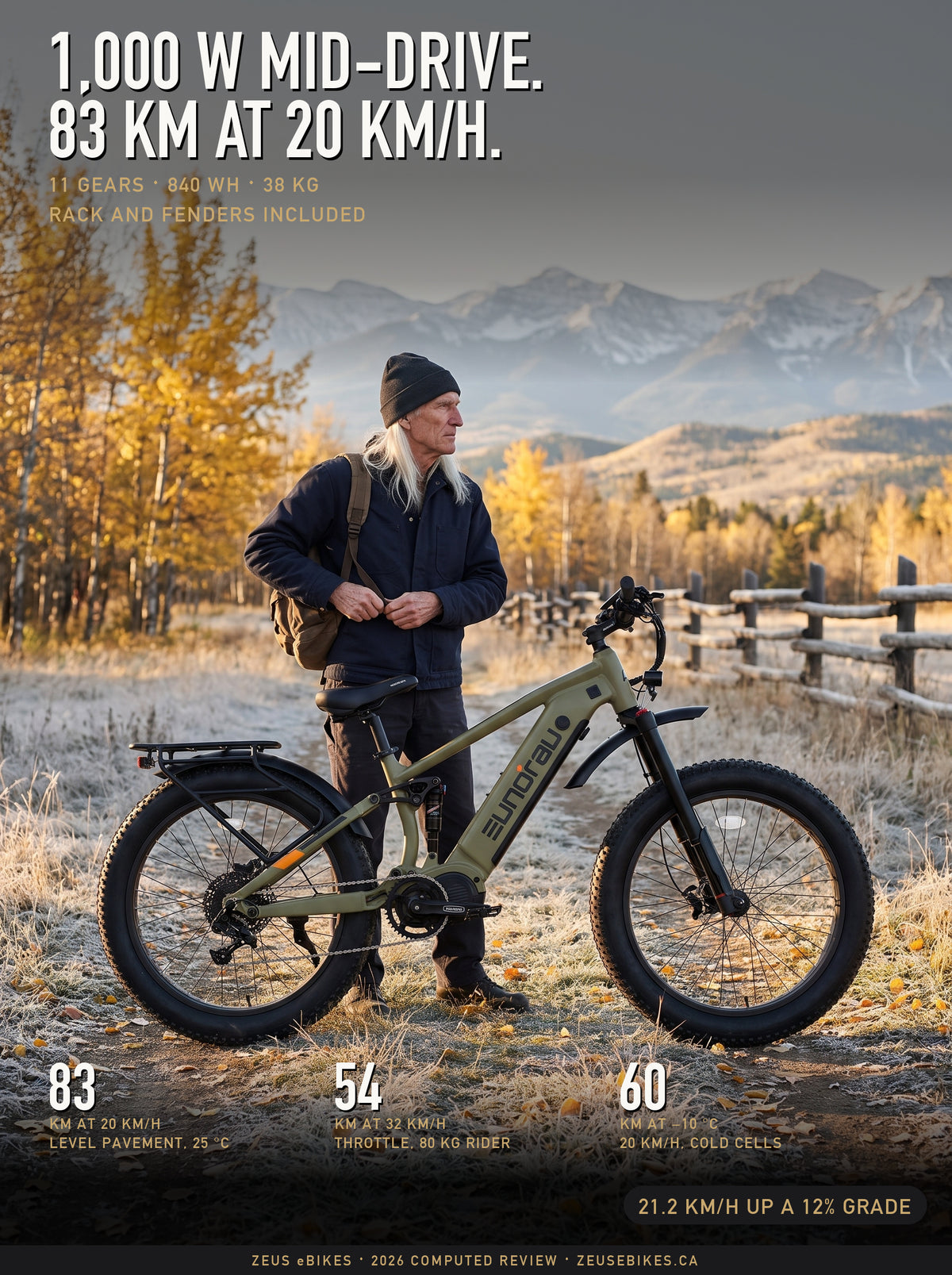
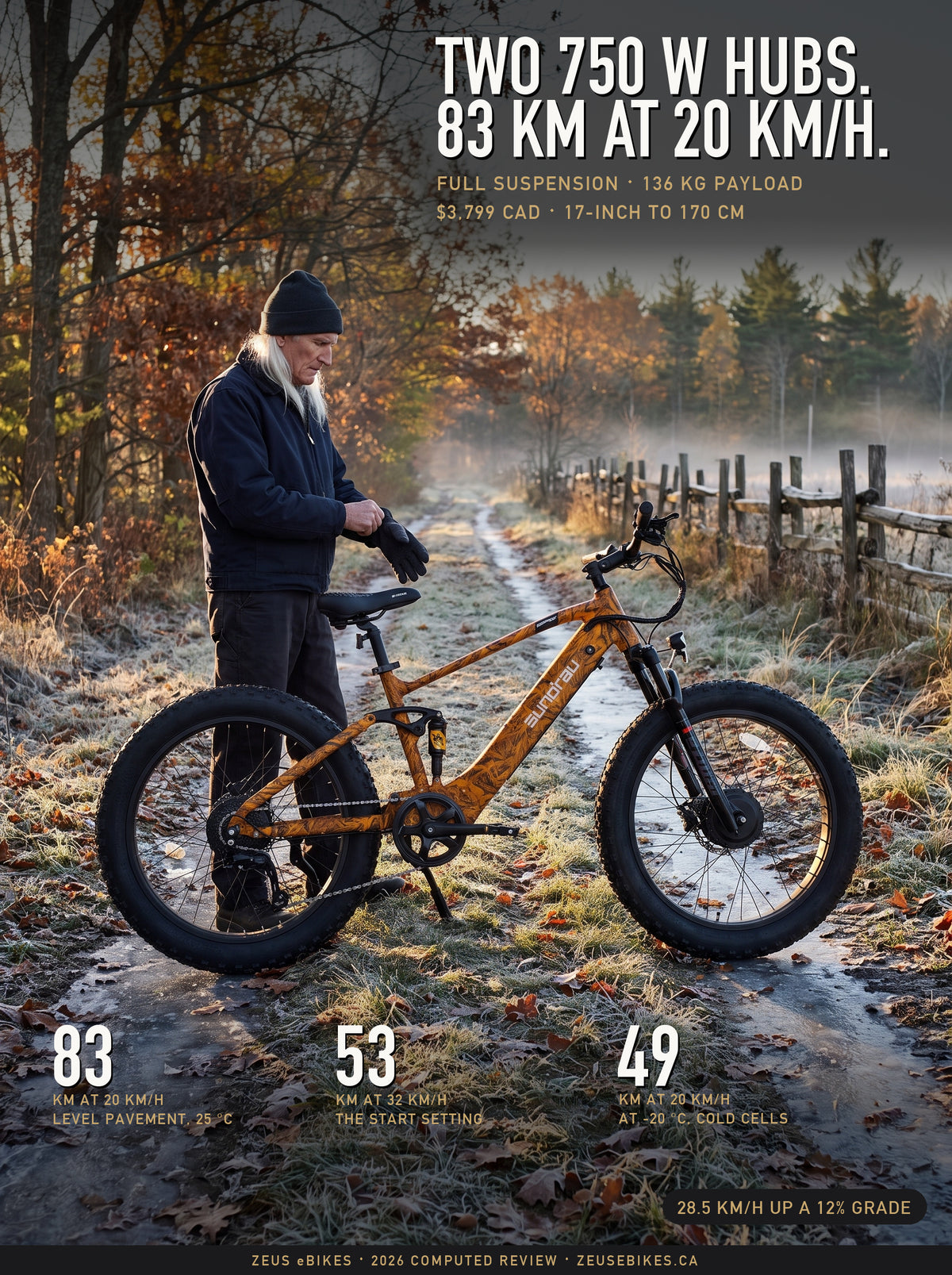
📸 All photography by Playcut.ai — personalized AI actor technology
Zeus eBikes Canada has been testing electric bikes in Waterloo, Ontario since 2021 — hands on every model sold, in every Canadian season. This checklist was built from 50+ hands-on tests cross-referenced with 70+ published guides, real customer support data on what buyers regret after purchase, and quarterly review of Canadian eBike market conditions including pricing, availability, and warranty service records. Every recommendation links to verified picks, not hypotheticals.
What This Guide Covers
- Step 1: Define Your Riding Terrain
- Step 2: Set Your Real Budget
- Step 3: Hub Motor or Mid-Drive?
- Step 4: Calculate Your Real Range Needs
- Step 5: Pedal Assist, Throttle, or Both?
- Step 6: Frame, Fit, and Weight Capacity
- Step 7: Canadian Warranty and Support
- Step 8: Find the Right Guide for Your Rider Type
- Frequently Asked Questions
Step 1: Define Your Riding Terrain — This Choice Eliminates Half the Market
Canadian terrain is not one thing. The rider commuting downtown Vancouver needs a fundamentally different bike than the one tackling Gatineau Park trails or hauling through a February Winnipeg morning at -20°C. Every electric bike is a series of engineering compromises — it optimizes for something specific. Getting terrain wrong before you buy is the most expensive mistake a Canadian e-bike buyer makes, because you can't fix it by adding accessories.
There are four terrain categories that matter in Canada:
- Urban paved — city streets, protected bike lanes, gravel path edges. Any bike works here. Narrower tires (1.9–2.4 inches) roll faster and use less battery. Weight matters less because you're rarely lifting the bike.
- Mixed terrain — paved streets alternating with light gravel, rail trails, park paths, and the occasional poorly maintained road. Semi-fat tires (2.4–3.0 inches) give you traction flexibility without the weight and rolling resistance of full fat.
- Off-road and trail — packed dirt, roots, rocks, loose gravel, technical descents. You need front suspension at minimum, 2.6–4.0 inch tires, and enough torque to pull out of a rut. Mid-drive motors earn their premium here.
- Winter and year-round Canadian — snow, ice, slush, road salt, freeze-thaw cycles, and temperatures that cut battery range by 20–40% overnight. Fat tires (4.0 inches minimum) and either rear-wheel drive or full AWD. This is the most demanding Canadian category, and underestimating it costs money every single winter.
Still unsure? For mixed terrain and winter riding, see our fat tire electric bikes Canada guide. For technical trails, see our mountain electric bikes Canada guide. For dedicated year-round riders, our best electric bikes for winter Canada guide covers the top verified picks.
If you ride year-round in Canada, a fat-tire bike eliminates 90% of terrain conflicts. If you ride pavement only May through October, a narrower-tire urban bike is faster, lighter, and more efficient — and you shouldn't pay the fat-tire weight penalty for summer-only conditions.
Step 2: Set Your Real Budget — The Bike Is 70% of the Total Cost
The number on the product page isn't your actual cost. Most first-time Canadian e-bike buyers arrive at a budget with one number in mind and discover two additional line items within the first week of ownership. Planning for the full system upfront prevents the post-purchase frustration of a great bike paired with a $20 lock, no lights, and nowhere to put a bag.
What to budget beyond the bike
- Lock — $60–$120. Non-negotiable in any Canadian city. A U-lock plus a secondary cable is the standard setup.
- Helmet — $50–$200. Strongly recommended for all Canadian riders.
- Lights — $30–$80 if not already integrated. Many e-bikes in the under-$1,500 tier omit front or rear lights.
- Rack and bags — $80–$200 if you're commuting with gear. Not all bikes include a rear rack.
- First-year maintenance — $100–$200. Brake pad replacement, chain lube, cable adjustment after break-in.
Canadian eBike budget tiers
- Under $1,500 CAD — entry-level commuters and folding bikes. Good for 15–25 km daily commutes on pavement. Limited cold-weather battery performance and typically shorter warranty terms.
- $1,500–$2,500 — the Canadian sweet spot. Better batteries (500+ Wh), hydraulic disc brakes, integrated lights, and often a torque sensor. Handles mixed terrain and moderate winter riding. Where most Canadian buyers end up after trying a cheaper option.
- $2,500–$5,599 — flagship performance. Dual-battery capacity, full suspension, AWD options, carry capacities over 150 kg. Built for riders who use the bike as a car replacement, not a supplement.
Before you finalize any number, check whether your province has an active rebate. Most provincial e-bike rebates have ended: Prince Edward Island's $500 incentive on April 30, 2026 and Yukon's rebate on March 31, 2026. British Columbia still exempts e-bikes from its 7% PST. See the complete breakdown in our eBike rebates and incentives Canada guide.
Financing is widely available. Most Canadian buyers can access an eBike for under $60/month on a 36-month plan with no interest during promotional periods. Read the full breakdown of options in our electric bike financing guide Canada.
If you're shopping price-first, our best electric bikes Canada guide organizes 18 verified picks from $1,199 to $4,019 — including the strongest options at every budget tier.
See 18 verified picks organized by price — $1,199 to $4,019 CAD
Every model hand-tested by Zeus eBikes Canada. Every spec verified. Every price current.
Browse Picks by Price See Current DealsAdd $300–$600 to whatever you plan to spend on the bike. Budget for the full system — lock, helmet, lights, rack, and first-year service — not just the purchase price. Most buyers who think they need a $1,200 bike actually belong in the $1,500–$1,800 tier once they account for what's missing from budget models.
Step 3: Hub Motor or Mid-Drive? The Decision Most Buyers Skip
This is the spec that separates an e-bike that works for your terrain from one that fights you on it. Most Canadian buyers skip it entirely, assume it doesn't matter, and then find out it does — usually on a steep driveway or a wet trail where the physics become very clear.
Hub motors sit inside the wheel hub (usually the rear wheel) and drive the wheel directly, bypassing the bike's gears entirely. They are mechanically simpler, quieter in Canadian road-salt conditions, and significantly cheaper to service when something eventually needs attention. In a country where salt, slush, and debris enter drivetrain components every winter, this matters. Approximately 73% of electric bikes sold in Canada use hub motors (Mordor Intelligence, 2025).
Mid-drive motors sit at the cranks — the central bottom bracket. They drive the drivetrain through the bike's existing gears, which gives them mechanical advantage on steep climbs and makes them more power-efficient on long rides with varied elevation. The trade-off: they stress the chain and cassette harder, require more frequent drivetrain maintenance, and cost significantly more to service when components wear out.
Hub Motor
Best for: Urban commuting, mixed terrain, flat to moderate hills, riders who prioritize low maintenance over five years of Canadian riding.
- Simpler mechanical design — fewer moving parts
- More salt and weather resistant
- Lower service costs
- 73% of Canadian eBike market
- Works well for 90% of Canadian rider use cases
Mid-Drive Motor
Best for: Sustained climbs over 10% grade, serious trail and off-road use, riders prioritizing range efficiency on long rides with significant elevation.
- Mechanical gear advantage on steep hills
- More efficient over long distances with elevation
- More natural ride feel on technical terrain
- Higher service cost — chain, cassette wear faster
- Earns its premium only in specific use cases
For the complete technical breakdown with Canadian test data across multiple terrain types and conditions, read our mid-drive vs hub motor eBike guide. It covers wattage, torque, and real-world climbing results tested in Ontario conditions.
For flat Canadian cities and mixed terrain, hub motor wins on reliability, salt resistance, and long-term value. Mid-drive earns its $300–$500 premium only for serious hill climbers and trail riders who will use that advantage regularly. Don't pay for capability you'll encounter twice a year.
Step 4: How Far Do You Actually Need to Go? Battery Math, Canadian Edition
Every battery range number on every product page is measured under conditions that don't exist in Canada. Manufacturers test at 20°C, flat terrain, a 68 kg rider on mid-assist, zero headwind, and a battery that hasn't degraded. Every one of those assumptions works against you in actual Canadian riding.
What to expect by season:
- Spring and summer (above 10°C): 60–80% of rated range
- Fall (0–10°C): 50–65% of rated range
- Winter (below -10°C): 40–55% of rated range. Store the battery indoors overnight. Install it immediately before riding — a warm battery loses significantly less capacity than a cold one.
The range formula that works in Canada
(Your longest daily trip) × 1.5 × 1.2 for winter buffer = minimum effective range you need
Example: 20 km daily commute → 30 km safety margin → ×1.2 for winter = 36 km minimum effective range needed. A bike with a 80 km rated range delivers approximately 48–64 km in summer and 32–44 km in a January commute — enough to cover a 20 km round trip with meaningful margin.
Battery capacity guide for Canadian buyers
| Battery Size | Rated Range | Real-World (Spring/Summer) | Real-World (Canadian Winter) | Best For |
|---|---|---|---|---|
| Under 400 Wh | 35–60 km | 22–45 km | 14–30 km | Short urban commutes (under 15 km) |
| 400–600 Wh | 60–90 km | 40–65 km | 25–45 km | Most Canadian daily commutes year-round |
| 600–1,000 Wh | 80–130 km | 55–95 km | 35–65 km | Long commutes, touring, winter range security |
| 1,000+ Wh (dual battery) | 120–200+ km | 85–150 km | 55–100 km | Car replacement, delivery, zero range anxiety |
If range is your primary decision criterion, see our long-range electric bikes Canada guide — it ranks the top picks by verified real-world range in Canadian testing, not manufacturer spec sheets.
Never buy a bike where your daily round-trip is more than 50% of its rated range. You need the remaining capacity as margin for cold weather, headwind, hills, and the battery degradation that accumulates over two to three years of Canadian riding. The range anxiety is not worth the upfront saving.
Step 5: Pedal Assist, Throttle, or Both?
Pedal assist means the motor amplifies your pedalling effort — you pedal, the motor helps proportionally. It feels natural, gives you real exercise benefit, and extends range because the system is more efficient when you're contributing. Most eBikes offer 3–5 assist levels so you control exactly how much effort goes into each ride.
Throttle means the motor runs on demand — twist or press to go, no pedalling required. It feels closer to a scooter. It's better for heavy loads, steep approaches, commuting in work clothes, long trips where fatigue sets in, and riders with physical limitations who can't sustain consistent pedalling.
Most Canadian electric bikes include both. The right answer for most riders is: buy a bike with both, use pedal assist for exercise days, throttle for commute days. The two systems serve different riding moments and don't conflict.
The sensor underneath the pedal assist matters
- Cadence sensor — detects wheel rotation speed and applies a fixed power boost. Simple, common in budget models, slightly jerky at low speeds. The motor applies the same power regardless of how hard you're actually pedalling.
- Torque sensor — measures actual force you apply to the pedals and scales the motor assist proportionally. Smoother, more natural, significantly better for exercise benefit (the harder you push, the more assist you get), and more expensive. Standard on mid-range and premium Canadian bikes.
If you're buying an eBike partly for fitness and rehabilitation, prioritize a torque sensor — the exercise research supports it. For purely commuting utility or physical mobility support, a cadence sensor with good throttle covers everything you actually need. For the full breakdown with Canadian real-world test data, read our pedal assist vs throttle eBike Canada guide.
Throttle is not cheating. Pedal assist is not a substitute for a real workout unless the bike has a torque sensor. Know which matters most to your actual riding before you read a single spec sheet — then confirm the bike has the sensor type that fits your goal.
Step 6: Does the Bike Fit Your Body and Your Life?
Electric bikes weigh 22–38 kg — significantly more than a conventional bicycle. That weight changes how you mount and dismount, how you handle the bike stopped in traffic, and whether you can physically get it up an apartment building stairwell. Getting frame style wrong is the second most common Canadian eBike return reason, after buying the wrong category entirely.
Frame styles in Canada
- Diamond frame (high step-over): Traditional geometry with a horizontal top tube. Better for sustained speed and aggressive positioning. Requires swinging a leg over a high tube — not ideal for stiff joints, shorter inseam, or frequent stopping in city traffic.
- Step-thru (low or no top tube): Easy mount and dismount from either side. Ideal for seniors, shorter riders, riders with hip or knee mobility limitations, and anyone commuting in work clothes. The performance tradeoff is negligible for Canadian street riding — this is a practical choice, not a compromise.
- Folding: Small footprint when folded, compact for apartments without bike storage, transit-friendly, and RV-compatible. The tradeoffs: heavier to carry folded, smaller 20-inch wheels reduce stability at speed, and folding mechanisms add mechanical complexity.
Weight capacity — don't assume
Most electric bikes sold in Canada are rated for 120–136 kg (265–300 lbs). If you're at or near that limit, you need to verify explicitly — not assume. Exceeding a weight rating means accelerated motor wear, reduced battery range per charge, brake system stress, and frame fatigue that voids manufacturer warranty. For riders over 100 kg, see our dedicated best eBikes for heavy riders Canada guide — it covers models rated to 150–180 kg with verified carry capacity data.
Browse by frame style on Zeus eBikes Canada:
- Step-through electric bikes — low step-over, easy mounting for every rider
- Folding electric bikes — compact storage, transit-friendly
Additional guides by body and lifestyle fit: best eBikes for seniors Canada · best step-thru eBikes Canada · best folding electric bikes Canada.
If you're over 100 kg, check the weight capacity number explicitly — never assume. If you have any mobility limitation — hip, knee, balance — step-thru is not a style preference, it's a safety decision. The performance difference between step-thru and diamond frame is irrelevant for Canadian street riding.
Step 7: Canadian Warranty and Where You're Actually Buying From
This section gets ignored until something breaks. Then it becomes the only thing that matters.
A significant portion of electric bikes sold to Canadian addresses ship from US warehouses with US warranty terms. When a warranty claim requires cross-border shipping — at the buyer's cost — a 30 kg e-bike becomes an extremely expensive problem to resolve. Some brands explicitly exclude Canadian buyers from warranty service after tariff changes in 2025.
The Rad Power Bikes situation illustrates exactly what happens when Canadian eBike buyers don't verify this: when Rad filed Chapter 11 in December 2025, Canadian customers who had bought from the Vancouver store found that the brand's new owner has no obligation to provide warranty or service on bikes bought before December 15, 2025; those claims go to the US bankruptcy case. Pre-bankruptcy purchases had no enforceable Canadian warranty claim path. See our Rad Power alternatives guide for Canadian buyers navigating that situation.
What legitimate Canadian warranty coverage looks like
- Frame: 2 years minimum (lifetime on premium models)
- Battery: 1–2 years or 500–1,000 charge cycles, whichever comes first
- Motor: 1–2 years
- Electronics and controller: 1 year minimum
- Service path: A specific named process — not just "contact us." Either a local repair network, a ship-to-us policy with prepaid shipping, or on-site technician options.
Zeus eBikes ships from Canada, provides Canadian-applicable warranty coverage on every model, and backs every sale with a service process that doesn't require cross-border logistics. For a full 9-point verification checklist to apply to any Canadian eBike seller before you buy, see our guide on how to spot a legitimate eBike store in Canada.
Browse every Zeus eBike — Canadian pricing, Canadian warranty, ships from Canada
Every model currently in stock. Every price in CAD. Every warranty applicable in Canada.
Browse the Full Catalog 9-Point Seller VerificationA bike that is $200 cheaper from a US-warehouse-only seller is not actually $200 cheaper. Factor in the real cost of a warranty claim that requires you to ship a 30 kg bike across the border at your expense. The savings disappear the first time something needs service.
Step 8: Match Your Rider Type to the Right Verified Guide
You've answered the 7 questions. You know your terrain, your budget, your motor preference, your range needs, your assist style, your frame requirements, and your warranty minimum. Now find the list built for exactly your profile.
Zeus maintains two primary guides for Canadian eBike buyers. They serve different decisions — use one or both depending on how you think about the purchase:
If you know your budget and want picks organized by price:
→ Best Electric Bikes Canada (2026): 18 Verified Picks, $1,199–$4,019
Organized from most affordable to most capable. The fastest way to see exactly what your money buys at every tier from $1,199 entry-level commuters to $4,019 flagship dual-motor machines. Every spec verified, every price current, every model tested by Zeus Canada.
If you know your rider type and want picks matched to your use case:
→ eBike Canada (2026): The Complete Buying Guide — 16 Picks for Every Rider Type
Six Canadian rider profiles — budget, commuter, mountain, senior, winter, and premium — each with 2–3 verified picks matched to that exact use case. Find your profile and go straight to the options that were built for riders like you.
Find your category guide directly
| Your Situation | Guide to Read |
|---|---|
| Daily city commuter | Best Urban Electric Bikes Canada |
| Trail and mountain riding | Best Electric Mountain Bikes Canada |
| Year-round / winter riding | Best Electric Bikes for Winter Canada |
| Fat tire curiosity | Fat Tire Electric Bikes Canada |
| Senior or mobility considerations | Electric Bikes for Seniors Canada |
| Rider over 100 kg | Best eBikes for Heavy Riders Canada |
| Steep hills and climbs | Best Electric Bikes for Hills Canada |
| Long distance touring | Long Range Electric Bikes Canada |
| Step-thru frame needed | Best Step-Thru eBikes Canada |
| Apartment, folding, transit use | Best Folding Electric Bikes Canada |
| Strict $2,000 budget | Best Electric Bikes Under $2,000 Canada |
| Dual motor / AWD | Best Dual Motor eBikes Canada |
The 8 steps are not a formula — they're a filter. Each step eliminates bikes that can't work for your situation. By step 7, you should have a clear category in mind. Step 8 takes you to the verified list built for that exact category. If you're still between two categories, read both guides — the picks in each are different and designed for different riders.
Frequently Asked Questions
How much should I budget for an electric bike in Canada?
For a reliable mid-range electric bike with a Canadian warranty, hydraulic disc brakes, and a 500+ Wh battery, budget $1,500–$2,200 for the bike itself. Add $300–$500 for a quality lock, helmet, lights, and first-year accessories. Budget-tier bikes start at $1,199 (see the best electric bikes Canada guide) but typically have shorter warranties, smaller batteries, and cadence-only sensors. Most provincial e-bike rebates have ended (Prince Edward Island's on April 30, 2026 and Yukon's on March 31, 2026), and British Columbia still exempts e-bikes from its 7% PST. Financing options start under $60/month on a 36-month plan — read the full breakdown in our electric bike financing Canada guide.
What is the difference between a hub motor and a mid-drive motor?
Hub motors sit in the wheel hub and drive the wheel directly. They're simpler, quieter, more resistant to road salt, and better suited to flat and mixed terrain — which describes most Canadian city riding. Mid-drive motors sit at the cranks and use the bike's gears, giving them mechanical advantage on sustained steep climbs and technical trails. About 73% of Canadian eBikes use hub motors (Mordor Intelligence, 2025). For a full technical comparison with real-world Canadian test results, see our mid-drive vs hub motor guide.
How far can an electric bike realistically go in Canadian winter?
Expect 40–55% of the manufacturer's rated range at temperatures below -10°C. A bike rated at 100 km will deliver approximately 40–55 km in January conditions. Two critical habits to maximize winter range: store the battery indoors overnight (cold batteries lose capacity until warmed up), and ride at a lower assist level to conserve output on cold mornings. For the top picks with verified Canadian winter range estimates, see our best electric bikes for winter Canada guide.
Should I get pedal assist or throttle on my eBike?
Most Canadian electric bikes offer both pedal assist and throttle — and that combination is the right answer for most riders. Pedal assist gives you exercise benefit and extends your range. Throttle provides instant power for heavy loads, headwinds, and fatigue on longer trips. If fitness is your primary goal, prioritize a torque-sensor pedal assist system — it scales with your actual effort and provides real aerobic benefit. If you're replacing car trips, strong throttle responsiveness matters more. See our pedal assist vs throttle eBike guide for full Canadian test data comparing both systems.
What accessories do I need when I buy an electric bike in Canada?
Non-negotiables: a quality U-lock or heavy chain ($60–$120), a helmet ($50–$200), and front/rear lights ($30–$80 if not already integrated). For commuters: a rear rack ($50–$120) and panniers or handlebar bag ($40–$100). For winter riders: bar mitts ($40–$80) and fender extensions if not already included. Total accessories budget: $300–$500 on top of the bike purchase. This is the line item most first-time buyers forget until the second week of ownership.
How do I know if an eBike seller in Canada is legitimate?
Verify: a Canadian business registration number, a physical Canadian address (not just a warehouse), a warranty policy that names a specific service process applicable in Canada, and reviews from verified Canadian buyers — not Amazon-style star aggregations. Avoid sellers whose only return address is a US location. Cross-border warranty service for a 30 kg e-bike is not a workable warranty. For a full 9-point verification checklist you can apply to any Canadian seller before purchasing, see our guide on how to spot a legitimate eBike store in Canada.
Which eBike guide should I read for my rider type in Canada?
Zeus maintains two primary guides. For picks organized by price ($1,199–$4,019), see the best electric bikes Canada guide — 18 verified picks from entry-level to flagship. For picks matched to your specific rider profile, see the eBike Canada buying guide — 16 picks across 6 Canadian rider types including commuter, mountain, budget, senior, winter, and premium. Use the first if you know your budget. Use the second if you know your use case. Use both if you're deciding between two categories.
The 8 Steps, Compressed
If you're reading this as a final check before purchasing: terrain first, budget second, hub vs mid-drive third, range fourth, assist type fifth, frame fit sixth, warranty seventh, right guide eighth. Each step eliminates bikes that can't work for you. By step seven, the right category is clear. By step eight, you're reading the list built for exactly that category.
The two guides that route every Canadian buyer to the right bike:
- Best Electric Bikes Canada (2026) — 18 verified picks organized by price, $1,199–$4,019
- eBike Canada (2026): Buying Guide — 16 picks matched to 6 rider types

Share:
Best Electric Dirt Bikes in Canada (2026): 6 Machines, $1,499–$6,499 — Ranked Honestly
Best Dual Motor eBikes in Canada (2026): 10 AWD Picks, 36–93 kg, $1,999–$6,499