
Ontario Cargo E-Bike Pilot (2026): The Rules to 2031, Ten Cities Checked, 9 Trikes Read Against Them
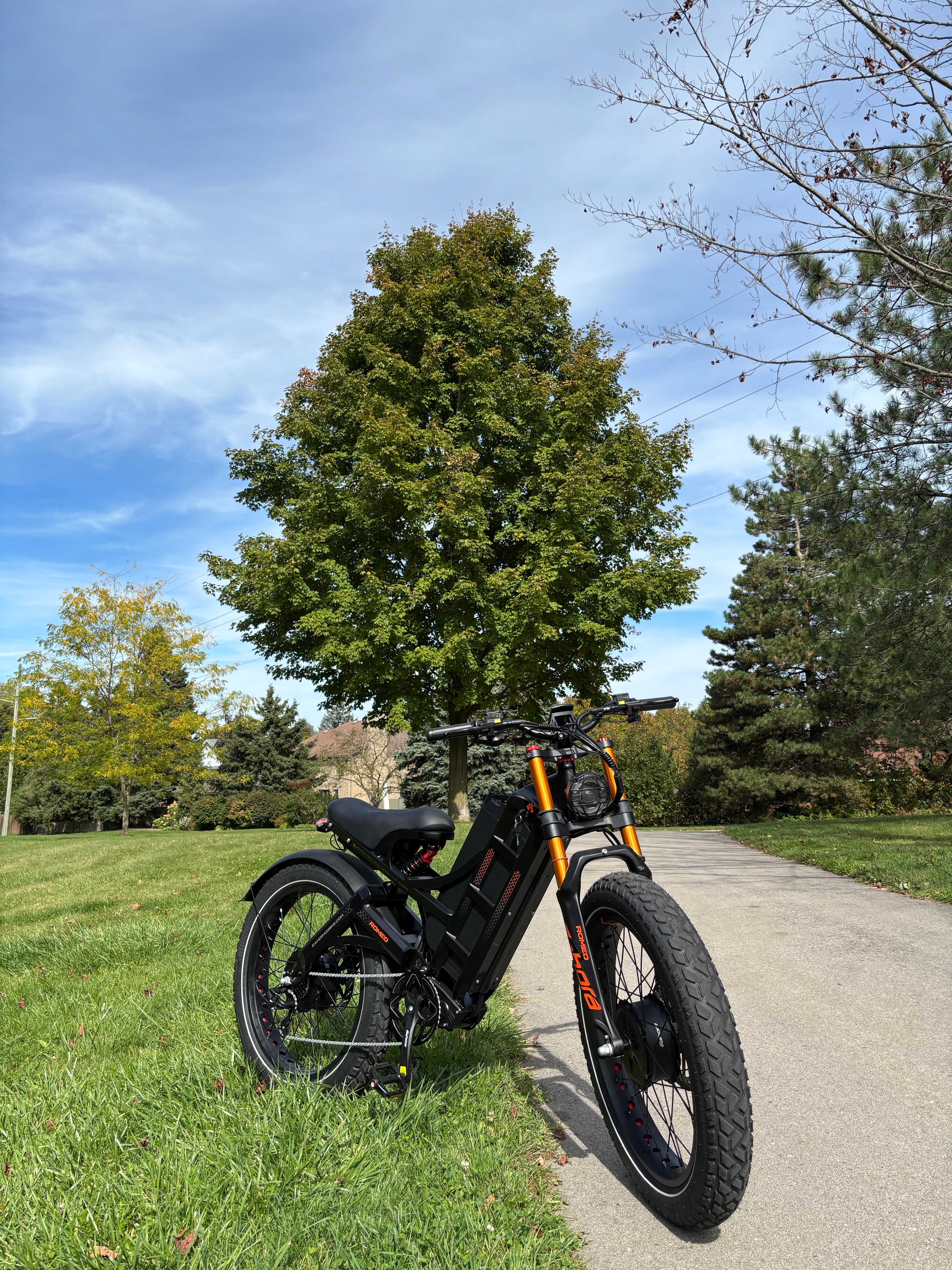
 Two rules, one trike. A 350 W trike such as this Meigi Hera is an ordinary e-bike under Ontario's rule; the pilot adds a second category for machines over 55 kg with motors up to 1,000 W.
Ontario lets a heavier, more powerful class of e-bike onto city streets, but only in cities that ask for it. The cargo e-bike pilot regulation, O. Reg. 141/21, now runs to 1 March 2031, and three of the province's ten largest cities have a by-law letting these machines onto their roads. Ottawa had one; its own text set its repeal for 1 March 2026, and we found no replacement.
This guide reads the regulation, the ministry's pages, the 2026 e-bike proposal and ten city by-laws as they stood on 28 September 2026. It then checks the nine trikes Zeus sells against both of Ontario's rules, the ordinary e-bike rule and the pilot, using each maker's own figures. Several fit the ordinary rule. Two Addmotor trikes, listed at 49 kg with 750 W motors on the maker's US pages, fit neither.
- Status: in force until 1 March 2031 (O. Reg. 31/26, filed 12 February 2026). An April 2026 proposal would raise the 55 kg minimum to 120 kg; it was still a proposal on 28 September.
- What qualifies: two or three wheels, working pedals, a platform, basket or container, over 55 kg, no wider than 1.3 m, no longer than 4 m, no taller than 2.2 m, and a motor rated 1,000 W or less whose assistance stops at 32 km/h (s. 1(1)).
- Where: only on roads whose municipality has a by-law allowing it (s. 3). Toronto, Hamilton and London have one; Mississauga and Vaughan say cargo e-bikes are not allowed; Ottawa's reached its own repeal date on 1 March 2026. Never the 400-series or the QEW (s. 4(2)).
- Rider: 16 or older, a helmet for every rider and passenger, no towing, fines of $250 to $2,500 (s. 8, s. 10; HTA s. 228(8)).
- Your trike: 500 W or less, a 32 km/h cap, working pedals and 120 kg or less make it an ordinary e-bike (O. Reg. 369/09); over 500 W at 55 kg or less fits neither rule on a public road.
The ordinary-rule trikes checked here include the Meigi Hera ($1,699, 350 W) and the Eunorau ONE-TRIKE 2.0 ($2,499, 500 W, 39 kg). Or jump to the 9 trikes checked against both rules.
What's in this guide
- The pilot runs to 1 March 2031: what changed in 2026
- What counts as a cargo e-bike, clause by clause
- Which rule covers your trike: e-bike, cargo e-bike, or neither
- Where a cargo e-bike may ride in Ontario
- Ontario's ten largest cities, checked
- Toronto: lanes, cycle tracks, trails, sidewalks and parking
- Rider rules: age, helmets, passengers, towing, loads, fines
- 9 Zeus trikes checked against both rules ($1,699 to $4,199)
- What the 2026 e-bike proposal would change
- Before you buy: an eight-point check
- Frequently asked questions (11)
- Sources, with the date each was read
The Pilot Runs to 1 March 2031: What Changed in 2026
On 12 February 2026 Ontario filed O. Reg. 31/26, which rewrote s. 15(2) of the cargo regulation so that its revoking section, s. 14, comes into force on 1 March 2031 (O. Reg. 31/26, s. 1). Pages and by-laws written against the old date, Ottawa's among them, planned for a pilot that was about to stop. This section sets out what the regulation says now and where each 2026 change leaves a buyer.
The consolidated regulation carries the note "This Regulation is revoked on March 1, 2031" (O. Reg. 141/21, e-Laws, current to 23 September 2026), and the ministry's pilot page, updated 2 March 2026, gives the same end date (MTO, cargo e-bike pilot program). The Highway Traffic Act caps any pilot regulation at twelve years from filing (Highway Traffic Act, s. 228(6)), so 2031 sits inside that limit.
| Date | What happened | Source |
|---|---|---|
| 1 March 2021 | The pilot begins | MTO pilot page |
| 29 April 2021 | O. Reg. 321/21 adds clause (d.1): "has a weight of more than 55 kilograms" | O. Reg. 321/21, s. 1 |
| June 2021 | Toronto opts in for personal and business use | City of Toronto cargo page |
| 8 September 2021 | Ottawa staff report to Council recommends an e-cargo bike by-law, enacted as By-law 2021-290 | Ottawa report ACS2021-TSD-TRF-0003 |
| December 2021 | Toronto adds large cargo e-bikes over 120 kg unladen | City of Toronto cargo page |
| 10 May 2023 | Hamilton passes By-laws 23-074 and 23-075 | Hamilton by-laws |
| 5 January 2026 | Ministry bulletin proposes five more years, "No additional changes" | ERO 026-0006 |
| 12 February 2026 | O. Reg. 31/26 filed: s. 14 comes into force on 1 March 2031 | O. Reg. 31/26 |
| 1 March 2026 | Ottawa By-law 2021-290 reaches the repeal date in its own s. 38 | Ottawa by-law page |
| 23 April 2026 | E-bike redefinition proposal posted; it would explore raising the cargo minimum to 120 kg | ERO 026-0422 |
| 12 May 2026 | London passes a new cargo by-law, S.-6452-147 | London by-law page |
| 7 June 2026 | Comments on 026-0422 close; still marked "Proposal" on 28 September | ERO 026-0422 |
| 1 March 2031 | The pilot regulation is revoked | O. Reg. 141/21, s. 14; O. Reg. 31/26 |
The pilot is law until 1 March 2031. What could move sooner is the 55 kg line: the April proposal would raise it to 120 kg, which would put every trike on this page below the new minimum. Plan a purchase around the rules in force, and watch the registry.
What Counts as a Cargo E-Bike: the Definition, Clause by Clause
Under O. Reg. 141/21 s. 1(1), a cargo power-assisted bicycle is a pedal-driven bicycle of conventional exposed fork-and-frame design that meets eleven conditions at once. Miss one and the vehicle is not a cargo e-bike under the pilot, whatever its seller calls it. The clause buyers miss most is the weight: the vehicle must weigh more than 55 kilograms, and no upper limit applies.
| Clause | The regulation requires | What it means for a trike |
|---|---|---|
| (a) | Two or three wheels | Every trike on this page passes |
| (b) | Pedals fitted at all times that are always operable to propel the bicycle | Throttles are not banned; working pedals are required |
| (c) | A platform, basket or container for carrying cargo, parcels or goods | A factory basket or box counts; whether a bare rack is a "platform" the regulation does not say |
| (d) | Steering handlebars | All pass |
| (d.1) | A weight of more than 55 kilograms, added by O. Reg. 321/21 on 29 April 2021 | No maker publishes a weight above 55 kg for any of the nine trikes checked below |
| (e) to (g) | Width up to 1.3 m, length up to 4 m, height up to 2.2 m | Trikes on this page are 0.72 m to 0.82 m wide where the maker lists it |
| (h) | Wheels at least 35 mm wide and 350 mm in diameter | The smallest wheel on these nine is the Citytri Standard's 18 in rear, per Addmotor |
| (i) | No structure that fully encloses the occupant area | The ministry's page adds that partial enclosures are permitted |
| (j) | An electric motor with a continuous rated output of 1,000 W or less that gives no assistance at 32 km/h or more | The continuous rating counts, never the peak |
The ministry's page states the other side plainly: "There is no maximum weight limit" (MTO, requirements). A cargo e-bike "is deemed not to be a motor vehicle under the Act" (s. 1(2)), yet any municipal by-law that governs or prohibits motorized vehicles still applies to it unless the by-law says otherwise (s. 1(3)). The equipment list adds a bell or horn, lamps, reflective material, and brakes that stop the bike within nine metres from 30 km/h (s. 9).
Two gaps matter when you compare a spec sheet with clause (d.1) and clause (j). The regulation does not say whether the 55 kg includes the battery, and makers print weight both ways; if a figure sits within a few kilograms of the line, ask the seller for it in writing. And a cap sold as 20 mph is 32.2 km/h, while clause (j) wants no assistance at 32 km/h or more: set the display to 32 km/h.
The continuous rating is the number both of Ontario's rules read. Taubik, for one, lists the Pivot trike's motor as "500W SUTTO" with "a peak power of 1000W" (Taubik, Pivot); the 500 W figure is the one that decides its class. A spec sheet that prints only a peak figure has not answered the question.
A pilot cargo e-bike is heavy (over 55 kg), carries a basket, platform or box, fits inside 1.3 m by 4 m by 2.2 m, and has a motor rated 1,000 W or less that quits at 32 km/h. Read the maker's continuous rating and weight before you read anything else.
Which Ontario Rule Covers Your Trike: E-Bike, Cargo E-Bike, or Neither
A three-wheeler with a motor can fall under one of two Ontario rules, and a trike that fits neither is a motor vehicle on a public road. The ordinary e-bike rule covers motors of 500 W or less on machines of 120 kg or less. The pilot covers machines over 55 kg with motors up to 1,000 W. Anything else needs a permit, plates, a driver's licence and insurance to use a road.
| Your trike | The rule it falls under | Where it can ride | Licence, plates, insurance |
|---|---|---|---|
| Motor 500 W or less, 120 kg or less, assistance stops at 32 km/h, working pedals | Ordinary e-bike: HTA s. 1(1), whose definition of a bicycle includes a tricycle, and O. Reg. 369/09 s. 1 | Where e-bikes may ride; cities decide sidewalks, lanes and trails | None |
| Motor rated over 500 W up to 1,000 W, over 55 kg, basket or platform, inside the size limits | Cargo e-bike under the pilot (O. Reg. 141/21 s. 1(1)) | Only where a municipal by-law allows it, plus provincial roads outside the controlled-access highways in Regulations 627 and 630 | None under the regulation; a city may attach conditions |
| Motor over 500 W at 55 kg or less, or over 1,000 W at any weight | Neither: a "motor vehicle" (HTA s. 1(1)) | No public road as an e-bike | Permit and plates (HTA s. 7(1)), licence (s. 32(1)), insurance (Compulsory Automobile Insurance Act, s. 2(1)) |
| Motor 500 W or less, over 55 kg, with a basket or platform | Both definitions describe it | See the two readings below | None |
The last row is the one the ministry's own pages do not address. The ordinary rule's weight ceiling is 120 kg unladen (O. Reg. 369/09 s. 1), and the pilot's floor is 55 kg, so a 60 kg basket trike or box bike with a 500 W motor, on two wheels or three, matches both descriptions. Section 3 of the pilot regulation then bars any cargo e-bike from municipal roads unless a by-law permits it, and the Act says a pilot regulation prevails over the Act where the two conflict (HTA s. 228(7)).
Reading one: it is a cargo e-bike, and without a municipal by-law s. 3 keeps it off city roads. Ottawa's 2021 staff report took this line, saying the province's changes "re-classify some existing e-bikes over 55 kilograms as e-cargo bikes" and leave their owners "in violation" (Ottawa report ACS2021-TSD-TRF-0003). That report leaned on a 55 kg e-bike ceiling in Bill 282, a definition the Act still shows as awaiting proclamation.
Reading two: it stays a power-assisted bicycle under the definition in force, with O. Reg. 369/09's 120 kg ceiling, and the pilot adds a category without taking one away. The ministry's guidance describes the pilot as covering "larger cargo power-assisted bicycles" (MTO guidelines for municipalities). Neither the regulation nor the ministry says which label wins. In a city with a cargo by-law, both readings let you ride; elsewhere, only the second does.
Not sure which row your trike sits in? Call 1-866-938-7580 with the model and your city, and we will read the maker's page against both rules with you before you buy. The ordinary-rule trikes are grouped in our trike collection.
Browse electric trikesWhere a Cargo E-Bike May Ride in Ontario
The pilot starts from a prohibition. Section 3 bars a cargo e-bike from every highway, sidewalk, trail, path, walkway, public park and exhibition ground unless the regulation permits it and, on anything a municipality controls, a municipal by-law permits it too. A city that has passed no by-law has, for its own streets, left the answer at no. The regulation then says where a permitted bike rides.
| Place | What O. Reg. 141/21 says | Section |
|---|---|---|
| Roadway or shoulder | Permitted, subject to s. 3 on municipal roads | s. 4(1) |
| Bike lane, where one exists | Must be used, unless a municipal by-law bars cargo e-bikes from it | s. 5(1), 5(3) |
| No bike lane, or the lane is barred | On the shoulder as close to its right edge as possible, or at the right edge of the roadway | s. 5(3) |
| Sidewalk in a tunnel or underpass | Permitted instead of the bike lane unless a municipal by-law says no | s. 5(2) |
| Sidewalks, trails, paths, parks elsewhere | Only where a by-law allows it, at a speed not "markedly greater" than nearby pedestrians' | s. 3, s. 7(2) |
| 400-series highways, the QEW and the other scheduled controlled-access highways | Never | s. 4(2) |
| Any road where bicycles or pedestrians are barred | Never | s. 4(2)(c) |
| Leaving it parked | Not in a place meant for the passage of vehicles or pedestrians, such as a bike lane or sidewalk | s. 8(5) |
The ministry's guidelines for municipalities read the parking rule as sending cargo e-bikes to "spots for motor vehicles", since they may not stop in places of passage (MTO guidelines). Cities have written their own versions: Toronto lets cargo bikes use on-street parking where parking is allowed, and Hamilton lets them use conventional bike parking and public loading zones. The city sections below give each.
Provincial highways that no municipality controls are the one case where the regulation alone decides: s. 4(1) permits the roadway and shoulder, less the scheduled controlled-access highways. The Act's rules of the road apply to every cargo e-bike trip, by-law or not (s. 6), and a rider must keep a safe distance from pedestrians and other users and give way where space runs short (s. 7(1)).
No by-law, no city streets. Where a by-law exists, a cargo e-bike uses the bike lane if there is one, the right edge of the road if there is not, and never a 400-series highway or the QEW.
Ontario's Ten Largest Cities, Checked: Who Allows Cargo E-Bikes
Of Ontario's ten largest municipalities, three had a cargo e-bike by-law in force on 28 September 2026: Toronto, Hamilton and London. Mississauga and Vaughan say plainly that cargo e-bikes are not allowed. Ottawa's by-law repealed itself on 1 March 2026 under its own s. 38. For Brampton, Markham, Kitchener and Windsor we found no by-law on the city's pages or in its council records.
| City (2021 population) | Status on 28 Sept 2026 | Local rules that matter | Primary source |
|---|---|---|---|
| Toronto (2,794,356) | Allowed since June 2021; large cargo e-bikes since December 2021 | Roads; lanes and cycle tracks depend on motor and weight; no park trails; no sidewalks (next section) | City cargo page, Code ch. 886, 950, 608 |
| Ottawa (1,017,449) | By-law 2021-290 "shall be repealed on March 1, 2026" (s. 38); no replacement found | While in force: roads, bike lanes and cycle tracks; personal cargo e-bikes on multi-use pathways; never sidewalks | E-Cargo Bike By-law 2021-290 |
| Mississauga (717,961) | Not allowed: cargo e-bikes "are not allowed on city roads" | None: the city lists them among vehicles it does not allow | City micro-mobility page |
| Brampton (656,480) | No by-law found | Ask the city before riding | City cycling page and council records searched |
| Hamilton (569,353) | Allowed: By-laws 23-074 and 23-075, passed 10 May 2023 | Roads, bike lanes and boulevard multi-use paths; not sidewalks, unpaved or park trails, or the QEW, 403, Linc or Red Hill | City cargo page and both by-laws |
| London (422,324) | Allowed: By-law S.-6452-147, passed 12 May 2026 | Roads posted 50 km/h or less (bike lane required where one exists); paths and parks except hiking trails, environmentally significant areas and natural park areas; no sidewalks; over 119 kg off multi-use pathways | Cargo By-law S.-6452-147, city page |
| Markham (338,503) | No by-law found | Ask the city before riding | City site and council records searched |
| Vaughan (323,103) | "Currently, cargo e-bikes are not permitted in Vaughan" | The city says it is "not participating in the cargo e-bike pilot" | City micromobility rules page |
| Kitchener (256,885) | No by-law found | A 2022 Region of Waterloo report said adding cargo e-bikes to its shared micromobility system would need a separate consultation | Region of Waterloo report TES-TRS-22-06 |
| Windsor (229,660) | No by-law found | Ask the city before riding | City site searched |
Population figures are the 2021 Census counts (Statistics Canada, table 98-10-0002-01). A finding of no by-law is not proof that none exists: it means the city's own pages and a search of its site and council records turned none up on 28 September. The ministry holds the list, since a participating city must send it a copy of its by-law; we found no published copy of that list on the ministry's pages (MTO).
Two city pages trail their own law. Hamilton's page dates the by-laws to "April 26, 2022", while the by-laws record a Council date of 26 April 2023 and passage on 10 May 2023. London's page still gives the pilot's original 2026 end date; its new by-law runs until the provincial regulation is revoked. In Ottawa, the E-Cargo Bike By-law page still prints the repeal date, and the City's by-law list names no successor: until Ottawa says otherwise, call 3-1-1 before you ride a pilot-class cargo e-bike on city streets.
If your city sits inside a region such as Peel, York, Durham, Halton, Niagara or Waterloo, ask whether its by-law also covers the regional roads you plan to use. For shops near you, see our guides to e-bike shops in Hamilton and London.
In Toronto, Hamilton and London a pilot cargo e-bike has a by-law behind it. In Mississauga and Vaughan it does not. In Ottawa the by-law's own clock ran out on 1 March 2026. Everywhere else, get the answer from the city in writing before a 750 W trike leaves the driveway.
Toronto: Where a Cargo E-Bike May and May Not Go
Toronto opted into the pilot in June 2021 and added large cargo e-bikes, those over 120 kg unladen, that December (City of Toronto, Cargo Bikes). Its Municipal Code then sorts cargo e-bikes by motor, weight and pedals. A pedal-driven cargo e-bike of 500 W or less and 120 kg or less counts as a bicycle in bike lanes and cycle tracks (s. 886-1C). Above 500 W, the Code's lists leave it out.
| Where | Cargo e-bike, 500 W or less, 120 kg or less, pedalling required | Large cargo e-bike: 500 W or less, wider than 0.9 m, over 120 kg | Cargo e-bike over 500 W | Source |
|---|---|---|---|---|
| Roadway | Yes | Yes | Yes | O. Reg. 141/21 s. 4(1); City cargo page |
| Painted bike lane | Yes | Yes, but may not stop in it | The Code's list omits it; the City's e-bike page says cargo e-bikes may use painted lanes | Code s. 886-10A, 886-10C; City e-bike page |
| Protected lane or cycle track | Yes | Yes, but may not stop in it | No | Code s. 886-15A, 886-15B; City cargo page |
| Park trails and multi-use paths | No | No | No | Code s. 608-1, 608-26B, 886-1B; City e-bike page |
| Sidewalks | No | No | No | Code s. 950-201C; O. Reg. 141/21 s. 3 |
| Expressways in Schedule I | No | No | No | Code s. 950-201E; O. Reg. 141/21 s. 4(2) |
The trail row follows from arithmetic. Toronto's bicycle definition for parks and park paths covers a power-assisted bicycle "which weighs less than 40 kilograms and requires pedalling" (Code ch. 608, s. 608-1), and vehicles other than bicycles are confined to park roadways and parking areas (s. 608-26B). Every pilot cargo e-bike weighs over 55 kg, so none can use a park trail. The City's e-bike page, modified 30 July 2026, says the same of e-bikes over 40 kg or "which do not require muscular power" (City of Toronto, Electric Bicycles).
Throttles matter as much as watts. The Code's bicycle definition for lanes and cycle tracks excludes any bicycle "capable of being propelled or driven solely by any power other than muscular power" (Code ch. 886, s. 886-1C), and the City's page bars e-bikes and cargo e-bikes "that do not require pedalling" from protected lanes. The test is what the bike can do, not the mode you ride in. Eight of the nine trikes below list a throttle; Taubik's page lists none for the Pivot.
The painted-lane cell is the one to watch. Section 886-10A lets a bicycle, a large cargo e-bike or a power-assisted bicycle use a bike lane, and a cargo e-bike over 500 W is none of those. The City's e-bike page, published by the same government, says "Bikes, e-bikes and cargo e-bikes are allowed in painted bike lanes." Until the two agree, the Code is the text a ticket would cite. If lanes are closed to you, O. Reg. 141/21 s. 5(3) puts you at the right edge of the roadway.
Parking has its own pair of sources. The City's cargo page says cargo bikes "can currently be parked on sidewalks" that stay passable, and may use on-street parking but not overnight in permit-parking areas. For a pilot cargo e-bike, s. 8(5) of the regulation forbids leaving it where pedestrians pass, and the ministry names the sidewalk as its example. Park on the street. For ordinary e-bike rules in the city, see our Toronto e-bike laws guide.
In Toronto a pedal-driven cargo e-bike of 500 W or less gets roads, lanes and cycle tracks. One over 500 W gets the roadway, and a painted lane only on the City page's word. Nothing over 40 kg, and nothing that runs on its throttle alone, goes on a park trail.
Rider Rules Under the Pilot: Age, Helmets, Passengers, Towing, Loads
The pilot's operator rules sit in sections 7 to 12 of O. Reg. 141/21, and the Highway Traffic Act's rules of the road apply on top of them (s. 6). A contravention of the pilot regulation carries a fine of $250 to $2,500 (HTA s. 228(8)), the range the ministry's own page repeats. The table gives each rule with its section.
| Rule | What the regulation says | Section |
|---|---|---|
| Age | No one under 16 operates a cargo e-bike | s. 8(1) |
| Helmet | Every person operating or riding on one wears a bicycle or motorcycle helmet that meets the Act | s. 10; HTA s. 104(1), (2.1) |
| Passengers | None, unless the bike was manufactured to carry passengers; the ministry adds that the seat must be built as part of the vehicle | s. 8(2) |
| Towing | No towing another person, vehicle or device, and no hitching the bike to anything to be towed | s. 8(3), 8(4) |
| Leaving it | Never where vehicles or pedestrians pass | s. 8(5) |
| Goods | No dangerous or hazardous goods; every load bound, secured, contained or covered so nothing falls, leaks, spills or blows off | s. 8(6), 8(7) |
| Pedestrians | Safe distance, give way where space is short, bell or horn when needed | s. 7(1), 7(3) |
| Lights | White or amber lamp in front and a red lamp or reflector behind, from half an hour before sunset to half an hour after sunrise and in poor visibility; reflective material front and rear | s. 7(4), 9(4), 9(5) |
| Brakes | A full stop within 9 m from 30 km/h on clean, level pavement | s. 9(9) |
| Modifications | Nothing that lifts the continuous rating past 1,000 W or the assisted speed past 32 km/h, and no second power source | s. 9(6), 9(7) |
| Police stop | Stop when required; show a driver's licence if you carry one, or give your name, address and date of birth | s. 11 |
| Collisions | Report any collision with a pedestrian, animal or vehicle that injures someone or damages property to a police officer | s. 12(1) |
Two of these rows answer questions callers have put to us. A basket is not a seat: under s. 8(2) a grandchild may ride only on a passenger seat the maker built into the bike. A dog cart or a trailer counts as a device or vehicle under s. 8(3), so a pilot cargo e-bike may not pull one. On modifications, the ministry's summary goes further than the regulation, telling riders simply not to "modify the vehicle" (MTO).
An ordinary e-bike trike has a passenger rule of its own. The Act says "No person riding or operating a bicycle designed for carrying one person only shall carry any other person thereon" (HTA s. 178(2)), and the Act's definition of a bicycle includes both a tricycle and a power-assisted bicycle (s. 1(1)). A one-seat trike carries one person, whichever rule it falls under.
An ordinary e-bike carries a second limit: its owner may not let anyone under 16 ride on it (HTA s. 38(2)), and read plainly that includes a child passenger.
Whether that bar also reaches a pilot cargo e-bike is unsettled. The pilot's s. 8(2) allows a passenger on a seat the maker built and sets no age, and a pilot regulation prevails over the Act where the two conflict (s. 228(7)). The Biking Lawyer, a Toronto cycling-injury firm, reads s. 38 as applying anyway and concludes that passengers under 16 "may not be permitted" (The Biking Lawyer, 29 October 2025). Until the province settles it, treat a child passenger as the risky case.
Impaired riding may bring Criminal Code consequences, the ministry's page adds.
The regulation asks for no driver's licence, permit or insurance from a cargo e-bike rider; s. 11 mentions a licence only if you carry one. The ministry lists insurance among the matters a participating city decides, including its type and coverage. Our e-bike insurance guide covers the insurance side.
9 Zeus Trikes Checked Against Both Rules, $1,699 to $4,199
We read each trike's maker page on 28 September 2026, product data and rendered page both, and set the maker's figures against the two rules above. Three sit under the ordinary e-bike rule on the maker's figures, the Pivot once its assistance stops at 32 km/h. Three depend on which motor version you buy. One, the Blazer, turns on a weight no maker publishes, and two fit neither rule on a public road. None can be confirmed as a pilot cargo e-bike.
The February version of this guide put six trikes inside the pilot, five of them on a "published weight" of 124 lb. No maker prints it: Taubik's weight line for the Pivot reads N/A, Meigi prints no weight for any trike, and Addmotor gives the Arisetan II as 108 lb (49 kg). Three of our own listings still print 124 lb. Where our listings and the maker disagree below, the maker's figure decides the verdict and the table names both.
| Trike | Zeus price | Motor (maker) | Weight (maker) | Assist cap (maker) | Ontario rule |
|---|---|---|---|---|---|
| Meigi Hera | $1,699 | 350 W | Not published (our listing: 124 lb) | 15 mph (24 km/h) | Ordinary e-bike |
| Eunorau ONE-TRIKE 2.0 | $2,499 | 500 W | 85.98 lb (39 kg) | 20 mph, "under speed limited/locked" | Ordinary e-bike |
| Addmotor Citytri E-310 | $2,399 | 500 W on Addmotor Canada; 750 W on its US page and our listing | 86 lb (39 kg) with battery | 20 mph (32 km/h) | Ordinary e-bike at 500 W; neither at 750 W |
| Taubik Pivot | $4,199 | 500 W, 1,000 W peak | N/A on Taubik's page | 32 km/h in the spec table; 41 km/h in the motor text | Ordinary e-bike once assistance stops at 32 km/h |
| Meigi Zeus fat tire | $2,928 | 500 W on Meigi Canada; 750 W on its US page and our listing | Not published (our listing: 124 lb) | 20 mph | Ordinary e-bike at 500 W; at 750 W, a cargo e-bike only if over 55 kg |
| Meigi Silverado | $3,699 | 750 W or 500 W (two Meigi Canada listings); our listing: 750 W | Not published (our listing: 44 kg) | 20 mph | Ordinary e-bike at 500 W; neither at 750 W and 44 kg |
| Meigi Blazer 750W | $3,299 | 750 W | Not published (our listing: 124 lb) | Not published (our listing: 32 km/h) | A cargo e-bike only if over 55 kg; unconfirmed |
| Addmotor Arisetan II M-360 | $4,199 | 750 W on Addmotor's US page; Canadian page gives no wattage | 108 lb (49 kg) | 20 mph (32 km/h) | Neither, at 750 W |
| Addmotor Grandtan II | $3,399 | 750 W on Addmotor's US page; Canadian page gives no wattage | 108 lb (49 kg); our listing: 118 lb | 20 mph (32 km/h) | Neither, at 750 W |
Prices are Zeus prices in Canadian dollars on 28 September 2026. For six of the eight trikes whose makers sell them in Canada, the maker's Canadian price is lower than ours today; Meigi's Canadian prices for the Hera and the 750 W Silverado are higher, and Meigi does not offer the Blazer on its Canadian store. A Zeus order adds our phone line and the 15-day return window for unused, unopened items. Every trike here except the Pivot lists a throttle, which keeps it off Toronto's protected lanes and park trails.
Several makers print a cap of 20 mph, which is 32.2 km/h. Set any of these displays to 32 km/h, the figure both of Ontario's rules name.
Meigi Hera
$1,699
The Hera sits well inside the ordinary rule: Meigi lists a "350W Front Brushless Hub" and a "15MPH top speed", with a twist throttle and a rear basket (Meigi Canada). As an ordinary e-bike it needs no by-law. Meigi publishes no weight; our listing says 124 lb, and if that holds, its basket also puts it inside the pilot's description, the two-readings case in the section on which rule applies.
Best for: groceries and errands at an unhurried pace. Not for: a rider who wants 32 km/h, or Toronto's protected lanes, since it has a throttle.
Eunorau ONE-TRIKE 2.0
$2,499
Eunorau's Canadian page lists "48V/500W rear-drive motor with 80 N.m torque", "Weight: 85.98 lbs", a half-twist throttle, front and rear baskets and "20MPH under speed limited/locked" (Eunorau Canada). That is an ordinary Ontario e-bike with nothing left to guess, once the display is set to 32 km/h, since 20 mph is 32.2 km/h. At 39 kg it is far under the pilot's 55 kg line, so no by-law question arises.
Best for: a rider who wants the rules settled on the maker's own page, and a trike that folds for the car. Not for: Toronto's park trails or protected lanes, which close to throttle bikes.
Addmotor Citytri E-310
$2,399
Addmotor's Canadian page lists a "500W Rear-Drive Motor" with a 1,100 W peak and "86 LBS / 39KG (Include Battery)" (Addmotor Canada); its US page lists 750 W, and so does our listing. A 500 W unit is an ordinary Ontario e-bike. A 750 W unit at 39 kg fits neither rule on a public road. Call us before you buy for Ontario roads and we will tell you which motor the unit carries.
Best for: a folding trike for a condo storage room or a car trunk. Not for: a buyer who cannot confirm the 500 W version.
Taubik Pivot
$4,199
Taubik's page gives two speeds for the same trike: "Speed 32KM/H" in its specification table and "top speeds of 41km/h" in its motor description, beside a "500W SUTTO" motor and "Weight: N/A" (Taubik, Pivot). At 500 W it belongs under the ordinary rule once assistance stops at 32 km/h; confirm that setting before you ride a road. Taubik lists no throttle, the one trike here for which that is true.
Best for: a rider who wants a torque sensor and suspension, and no throttle on the maker's list. Not for: a buyer who needs the weight in writing, since Taubik does not publish it.
The Meigi Zeus fat tire ($2,928) and the Meigi Silverado ($3,699) each come in two motors: Meigi Canada sells the Zeus only as a 500 W model and the Silverado as both. A 500 W unit is an ordinary e-bike. A 750 W Silverado at the 44 kg on our listing fits neither rule; a 750 W Zeus becomes a pilot cargo e-bike only above 55 kg, and Meigi publishes no weight.
The Meigi Blazer 750W ($3,299) has a 750 W front hub and a thumb throttle; Meigi publishes no weight and does not offer it on its Canadian store. Our listing's 124 lb, about 56 kg, would clear the 55 kg line by about a kilogram. If that figure holds and its assistance stops at 32 km/h, the Blazer meets the pilot's description and is legal only where a by-law allows it; if not, it fits neither rule.
The Addmotor Arisetan II ($4,199) and the Grandtan II ($3,399) weigh 49 kg on Addmotor's Canadian pages, and Addmotor's US pages list 750 W motors. At 750 W and 49 kg, both fall outside both rules on a public road. Our Ontario e-bike laws guide sets out what a bike outside the rule becomes.
Buying a trike for Ontario roads? Call 1-866-938-7580 with the model and your city. We will tell you which motor the unit carries and read it against both rules before you pay.
See all electric trikesWhat the 2026 E-Bike Proposal Would Change for Trikes
On 23 April 2026 the ministry posted a proposal to replace Ontario's e-bike definition with two classes, and its summary adds one line about this pilot: if the classes pass, the ministry "would explore amending" O. Reg. 141/21 "to update the minimum weight requirement for cargo e-bikes from 55kg to 120kg" (ERO 026-0422 and its attached summary). Comments closed on 7 June. The registry still showed it as a proposal on 28 September.
| Proposed | Class 1 | Class 2 |
|---|---|---|
| Propulsion | Pedal assist only, with a walk-assist throttle or button up to 6 km/h | Throttle, button or pedal assist |
| Maximum unladen weight | 55 kg | 120 kg |
| Maximum assisted speed | 32 km/h | 32 km/h |
| Motor | 500 W or less in total continuous rating, measured at the shaft of each motor | |
| Wheels | No more than three on the ground; at least 350 mm in diameter including the tire | |
| Operator | Age 16; a helmet for every rider; passengers allowed on a seat built or designed for the vehicle | |
| Licence, insurance, registration | None | |
Read together, the two changes would move trikes between categories; what follows is our reading of the proposal as written, not a statement the ministry has made. A throttle trike of 500 W or less and up to 120 kg would be a Class 2 e-bike, so the heavy 500 W trikes in the two-readings box would get a clear home. A 750 W trike under 120 kg would fit neither class, and with the cargo minimum at 120 kg it would fit the pilot only if it weighed more than that.
The proposal also pairs the classes with a line for everything else: moped and motorcycle-styled electric vehicles "would only be permitted on roads if they meet the requirements of an existing motor vehicle class", with a 12-month education period proposed. Our Ontario e-bike laws guide tracks the proposal alongside Bill 197, whose class-making power in HTA s. 1.2(1)(g) has been in force since 19 May 2026.
If both parts of the proposal pass as written, a 500 W trike keeps a clear place on the road and a 750 W trike under 120 kg loses its route through the pilot. Nothing has passed yet; buy for the rules in force, and prefer a motor that fits both the rules of today and the proposal.
Before You Buy a Trike for Ontario Roads: an Eight-Point Check
Buying online is fine: the rules turn on the vehicle's specifications and where you ride it, not on where it was sold. What matters is getting the maker's own figures before you pay, because a listing's numbers can differ from the maker's, as the table above shows for several of ours. Work through these eight points with the maker's page open beside the listing.
- Motor rating. Find the continuous rating, not the peak. 500 W or less is an ordinary e-bike; above 500 W up to 1,000 W needs the pilot (O. Reg. 141/21 s. 1(1)(j)).
- Weight. Get the maker's figure and whether it includes the battery. Over 55 kg puts a basket trike inside the pilot's description (s. 1(1)(d.1)); over 120 kg takes it out of the ordinary rule (O. Reg. 369/09 s. 1).
- Speed cap. Set the display to 32 km/h; 20 mph is 32.2 km/h.
- Your city. Above 500 W, confirm your municipality has a cargo by-law in force, in writing if you can (s. 3).
- Throttle. In Toronto a throttle keeps any e-bike off protected lanes and park trails, whatever mode you ride in (Code s. 886-1C, s. 608-1).
- Passengers. Only on a passenger seat the maker built for the bike (s. 8(2); HTA s. 178(2)).
- Towing. None behind a pilot cargo e-bike (s. 8(3)).
- Width. Up to 1.3 m under the pilot (s. 1(1)(e)); in Toronto, a cargo e-bike counts as a large cargo e-bike only when it is wider than 0.9 m and heavier than 120 kg (Code s. 886-1).
A 500 W trike under 55 kg answers every question on this list with the maker's page alone. Anything heavier or stronger needs two more answers, the maker's weight and your city's by-law, before it is worth buying for the road.
Frequently Asked Questions
Is Ontario's cargo e-bike pilot still running in 2026?
Yes. O. Reg. 31/26, filed 12 February 2026, moved the pilot regulation's revocation to 1 March 2031, and the ministry's page gives the same date. A separate April 2026 proposal would raise the pilot's 55 kg minimum to 120 kg; it was still a proposal on 28 September 2026.
What is the minimum weight for a cargo e-bike in Ontario?
More than 55 kilograms (O. Reg. 141/21 s. 1(1)(d.1), added by O. Reg. 321/21 in April 2021). There is no maximum. The regulation does not say whether the battery counts, so get the maker's figure and ask how it was measured if it sits near the line.
Can I ride a cargo e-bike in Toronto bike lanes?
A pedal-driven cargo e-bike of 500 W or less and 120 kg or less may use painted lanes and cycle tracks (Code s. 886-1C). Over 500 W, Code s. 886-10A leaves it off the bike-lane list while the City's e-bike page says cargo e-bikes may use painted lanes; cycle tracks stay closed. Large cargo e-bikes may use both but not stop in them.
Are electric trikes street legal in Ontario?
Yes, as ordinary e-bikes, when they meet the rule: a trike with working pedals, a motor of 500 W or less, assistance that stops at 32 km/h and a weight of 120 kg or less is a bicycle under the Act (HTA s. 1(1); O. Reg. 369/09). Above 500 W it needs the cargo pilot, which means over 55 kg and a city by-law. Over 500 W at 55 kg or less, it fits neither.
Do I need a licence or insurance for an electric trike in Ontario?
Not for an ordinary e-bike trike, and not under the cargo pilot regulation, which asks for no licence, permit or insurance. A city that allows cargo e-bikes may set insurance terms of its own, the ministry says. A trike outside both rules is a motor vehicle and needs a permit, a licence and insurance (HTA s. 7(1), s. 32(1); Compulsory Automobile Insurance Act, s. 2(1)).
Can I carry a passenger or a child on an electric trike?
Only on a seat built for a passenger. Under the pilot, a passenger may ride only if the bike was manufactured to carry one (s. 8(2)). For an ordinary trike, the Act bars carrying anyone on a bicycle designed for one person (HTA s. 178(2)), and an owner may not let anyone under 16 ride on an ordinary e-bike (s. 38(2)); whether that bar also covers a pilot cargo e-bike is unsettled, and one Toronto cycling lawyer reads it as covering it. A basket is not a seat, and everyone aboard a cargo e-bike wears a helmet (s. 10).
Can I tow a trailer or a dog cart behind a cargo e-bike?
No. The pilot bars towing "another person, vehicle or device" and hitching the bike to anything to be towed (O. Reg. 141/21 s. 8(3), 8(4)). Carry the load in the bike's own basket, platform or box, bound or covered so nothing can fall or spill (s. 8(7)).
Is a cargo e-bike a motor vehicle in Ontario?
No. A cargo e-bike that meets the definition "is deemed not to be a motor vehicle under the Act" (s. 1(2)). But municipal by-laws that govern or prohibit motorized vehicles still apply to it unless the by-law says otherwise (s. 1(3)), and a trike that misses the definition, for instance at 750 W and 49 kg, is a motor vehicle on a road.
Can I ride a cargo e-bike in Ottawa?
Not on the by-law Ottawa passed in 2021. Its E-Cargo Bike By-law 2021-290 says it "shall be repealed on March 1, 2026" (s. 38), the City's page still shows that date, and we found no replacement on 28 September 2026. Call 3-1-1 before riding a pilot-class cargo e-bike on city streets. The lapse does not touch an ordinary e-bike trike of 500 W or less.
Can I ride an electric trike on the sidewalk in Ontario?
Sidewalks belong to the municipality. A pilot cargo e-bike may use one only where a by-law allows it (s. 3), and Toronto, Hamilton and London all bar cargo e-bikes from sidewalks. Toronto also bars anyone 14 or older from riding a bicycle on a sidewalk (Code s. 950-201C). The pilot's one sidewalk exception is a tunnel or underpass (s. 5(2)).
Are 750 W electric trikes legal in Ontario?
Only as a pilot cargo e-bike: over 55 kg, a basket, platform or container, inside the size limits, assistance stopping at 32 km/h, and ridden only where a municipal by-law allows it. A 750 W trike under 55 kg fits neither Ontario rule on a public road, and none of the 750 W trikes checked above has a maker-published weight over 55 kg.
The Bottom Line
Ontario's cargo pilot is a second door onto the road for heavy, more powerful e-bikes, and it opens only where a city has passed a by-law. It runs to 1 March 2031. A cargo e-bike under it weighs over 55 kg, carries a basket, platform or container, and has a motor rated 1,000 W or less that stops assisting at 32 km/h. Toronto, Hamilton and London have opened the door; Ottawa's by-law reached its own end date, and we found no replacement.
For a trike buyer the simpler door is the ordinary rule. A trike of 500 W or less, 120 kg or less, with working pedals and a 32 km/h cap, needs no by-law and no licence, and it keeps a clear place under the 2026 proposal. Three of the nine trikes above meet that rule on the maker's own figures today, and three more do in their 500 W versions.
The risk sits with 750 W trikes that weigh under 55 kg, which fit neither rule on a public road, and with any spec sheet that prints a peak rating or no weight at all. Ask for the maker's continuous rating and weight before you buy, and check your city's by-law if the motor is over 500 W.
Zeus ships across Ontario, and unused, unopened orders can be returned within 15 days of delivery under our refund policy. Call 1-866-938-7580 with a model and your city, and we will read the maker's page against both rules with you before you order. The electric trike collection lists every trike we carry, and the financing guide explains the options.
Milad Ghobadibeygvand, BScN (Western University, 2014), is the co-founder of Zeus eBikes Canada. He verifies every Zeus law guide against the primary regulation and by-laws before it is published. For this guide, on 28 September 2026, that meant re-reading O. Reg. 141/21 and its amendments, O. Reg. 369/09, the Highway Traffic Act, the ministry's pilot pages and its 2026 proposal, the by-laws and pages of Ontario's ten largest cities, and each trike maker's product page.
- Ontario eBike Laws 2026 · Toronto eBike Laws 2026 · eBike Laws Canada: every province
- Electric trikes in Canada · Best cargo e-bikes in Canada · E-bikes for seniors
- 500 W vs 750 W vs 1,000 W · Pedal assist vs throttle · eBike insurance in Canada
- Canadian eBike Legal Access Atlas · Best e-bikes for Toronto · Best e-bikes for Ottawa
- Shops: Toronto · Ottawa · Hamilton · London · Mississauga
This guide summarizes Ontario's cargo e-bike rules for general information and is not legal advice. The pilot runs to 1 March 2031 and the 2026 e-bike proposal may change it sooner, so confirm the current rule with the Ministry of Transportation and your municipality before you rely on this page. Last updated: 8 October 2026 (every linked source was fetched again on 7 October 2026 and compared with the September copy; nine trike prices re-read on the Zeus listings; notice 026-0422 still "Proposal"). Sources read 28 September 2026. Found an error? milad@zeusebikes.ca.
Sources, with the Date Each Was Read
Every source below was opened on 28 September 2026 unless the entry says otherwise. Statutes and regulations were read on e-Laws; municipal pages, by-laws and council reports on each city's own site; product figures on each maker's own page, with the product data and the rendered page read together. Where a city page and its by-law disagree, the text above gives both.
- O. Reg. 141/21, Pilot Project: Cargo Power-Assisted Bicycles, consolidation current to 23 September 2026: ss. 1 to 14.
- O. Reg. 321/21, filed 29 April 2021: adds s. 1(1)(d.1), the 55 kg clause.
- O. Reg. 31/26, filed 12 February 2026: s. 14 comes into force on 1 March 2031.
- O. Reg. 369/09, Power-Assisted Bicycles: ss. 1 to 7.
- Highway Traffic Act, R.S.O. 1990, c. H.8: ss. 1(1), 1.2(1)(g), 7(1), 32(1), 38(1), 103.1(2), 104, 178(2), 228(6) to (8).
- Compulsory Automobile Insurance Act, R.S.O. 1990, c. C.25: s. 2 (saved copy current to 16 September 2026, re-read 28 September).
- Ministry of Transportation, Cargo e-bike pilot program, updated 2 March 2026.
- Ministry of Transportation, guidelines for municipalities, updated 18 June 2021.
- Environmental Registry 019-2745, decision posted 13 May 2021.
- Environmental Registry 026-0006, bulletin posted 5 January 2026.
- Environmental Registry 026-0422, proposal posted 23 April 2026, with the attached summary of the proposed classes.
- City of Toronto, Cargo Bikes, modified 15 July 2026.
- City of Toronto, Electric Bicycles, modified 30 July 2026.
- Toronto Municipal Code ch. 886, current to 30 July 2026: ss. 886-1, 886-6, 886-10, 886-15.
- Toronto Municipal Code ch. 950: s. 950-201.
- Toronto Municipal Code ch. 608: ss. 608-1, 608-26, 608-32.
- City of Ottawa, E-Cargo Bike By-law 2021-290: ss. 18, 38; and the City's By-law A-Z list.
- City of Ottawa, report ACS2021-TSD-TRF-0003, to Council 8 September 2021.
- City of Mississauga, Micro-mobility.
- City of Hamilton, Cargo E-Bike Pilot Program, modified 13 June 2023; By-law 23-074 and By-law 23-075, passed 10 May 2023.
- City of London, Cargo Power-assisted Bicycle By-law S.-6452-147, passed 12 May 2026; City of London, Cargo power-assisted bicycles, modified 4 June 2026.
- City of Vaughan, Types of Micromobility, Rules and Regulations.
- Region of Waterloo, report TES-TRS-22-06, 12 April 2022.
- Statistics Canada, table 98-10-0002-01, 2021 Census population counts.
- Maker pages: Meigi Hera, Meigi Zeus 500W, Meigi Silverado HD and its 500W version, Meigi Blazer, Eunorau ONE-TRIKE 2.0, Addmotor Citytri E-310, Addmotor Arisetan II, Addmotor Grandtan, Addmotor's US pages for the Arisetan II, Grandtan and Citytri, and Taubik Pivot.
- The Biking Lawyer, "E-Cargo Bikes, E-Bikes & the Law: Passengers on Electric Bikes", 29 October 2025, read 28 September 2026: a practitioner's reading of HTA s. 38.
- Zeus eBikes refund policy.
The February version gave the regulation's original revocation date and called the five-year extension a proposal; O. Reg. 31/26 made it law on 12 February 2026. It put six trikes inside the pilot, five of them on a "published weight" of 124 lb that no maker prints; on the makers' figures none can be confirmed, and two sit outside both rules. The Meet One Breeze it listed is not in this version.
It also said the pilot bars modifying the vehicle; the regulation bars changes that raise power or speed or add another power source, and the ministry's summary is the broader statement. It did not name the cities that allow cargo e-bikes, or the Toronto bike-lane conflict between the Code and the City's page. This version adds both, with their sources.

Share:
BC eBike Rebate 2026: PST Exemption, Nelson $8K Loan, UBC $400, Every Active Program and Every Closed One
eBike Laws Canada (2026): Every Province, One Table, 13 Bikes Checked Against the Rule